Cost of living in Canada can vary depending on the city or region. Major cities like Toronto and Vancouver tend to have higher living costs compared to smaller cities or rural areas, but the cities offer chances of high paying jobs in Canada . Depending on one's lifestyle and tastes, cost of living for a student in Canada might range from 15,000 CAD (INR 917,164.50) to 20,000 CAD (INR 1,222,886) yearly. Average expenses in Canada varies across Canada's various provinces. In terms of tuition costs, the majority of Canadian academic institutions provide courses with tuition costs that fall between the range of 15,000 CAD (INR 917,164.50). In addition, a single student's monthly cost of living in Canada is 880 CAD (INR 53,034) without housing.
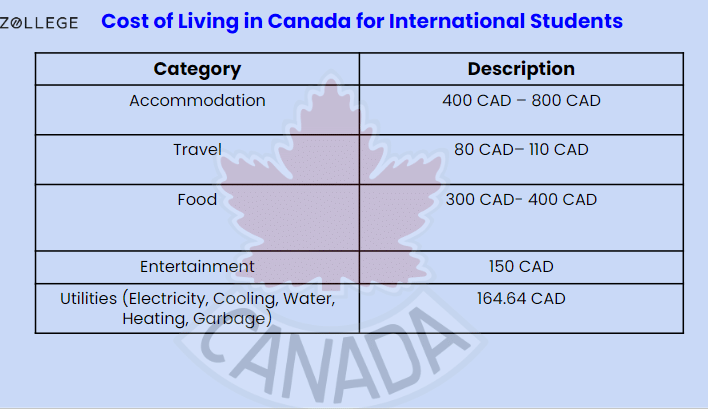
It's crucial to remember that travel habits, individual preferences, and geographic variables can all have a big impact on transportation expenses. Canadian citizens and tourists frequently combine different modes of transportation to find the one that best fits their needs and budget, and it is subsidized for students and working professionals. Additionally, you can reduce your transportation costs by looking into sales, discounts, and buying tickets in bulk, if your average salary in Canada is not sufficient. The cost per month would be around 100 CAD - 150 CAD (INR 6,114.43- 9,171.65).
In order to effectively manage meal expenses, people should think about meal planning, budgeting, cooking at home, looking into inexpensive dining options, taking advantage of sales or discounts, and making well-informed decisions based on their financial objectives and dietary preferences. So, a budgeting is necesssary for students before students immigrate to Canada to study in Canada. It's crucial to remember that these are only estimates, and that actual expenses may differ depending on a number of variables including the particular restaurant or grocery store, the city or area, and the state of the market. In addition, there may be other costs associated with eating out or ordering takeout or delivery, including taxes, gratuities, service fees, and delivery costs. The per month cost would be around CAD 200 and CAD 300 (INR 12,053 to 18,079) for food and groceries. Students can spend upto 150 CAD (INR 9,171.65) for entertainment. Utilities (Electricity, cooling, water, heating, garbage) would roughly amount to 164.64 CAD (INR 10,027.67) for students per month.
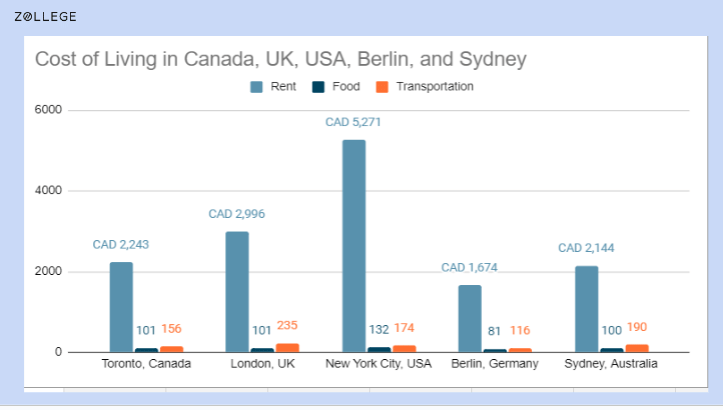
Cost of Living in Canada vs UK vs USA vs Germany vs Australia
Candidates can opt for program that has high ROI. It is crucial to remember that these are estimates, and that actual costs may differ depending on your unique situation, your lifestyle, and the city or province in which you reside. International students and newcomers should also plan for one-time costs like health insurance, visa application fees, initial setup costs, and emergency funds once they arrive in Canada. To properly manage your finances when living in Canada, it's a good idea to do thorough research on the costs of living in the city or area of your choice and to develop a comprehensive budget. Like The average MBA salary in Canada is CAD 81,208(INR5061935.27) per year, or CAD 41.65(INR 2596.17) per hour. Here is a brief comparison for living expenses in Canada between different cities:
Note: 1 CAD= INR 61.14 as on 20th March 2024
Average Living Expenses for International Students in Canada
Students should prepare for recurring expenses such as accommodation, food and groceries, travel health insurance, transportation, clothing, and entertainment and should set aside money for these daily and inevitable costs. Applicants are required to have enough proof of funds, having no criminal records, medical test for Canada student visa. Additionally, applying for an International Student Identification Card after arriving in Canada is the ideal way for international students to handle their living expenditures and other cost of living in Canada per month.
|
Expenses |
Cost (monthly) |
|
Accommodation (shared apartments) |
400 CAD – 800 CAD |
|
Travel |
80 CAD– 110 CAD |
|
Food |
300 CAD- 400 CAD |
|
Entertainment |
150 CAD |
|
Health Insurance (BC MSP Program) |
74 CAD |
|
Utilities (Electricity, cooling, water, heating, garbage) |
164.64 CAD |
|
Utilities (Internet – 60 Mbps or more) |
78.82 CAD |
Note: 1 CAD= INR 61.14 as on 20th March 2024
Cost of Accommodation in Canada
The cost of living for students depends on their lifestyle. Furthermore, the monthly expenses in Canada with rent would differ depending on whether they choose to live on or off campus. Depending on the university they choose to apply to, students may be given access to the on-campus facility. It is preferable to submit a separate application for on-campus housing. The average salary in Canada helps in comfortable living and manage other expenses. Canada PR requirements include several criteria like age, education level, experience and skills of English. Additionally, the cost of on-campus housing could be somewhere from CAD 8,000 and CAD 10,000 (per year). However, the student would have to pay between CAD 400 (INR 24796.47) and CAD 700 (INR 43393.82) every month for a shared condo. Their location and the season they are renting it at will determine this.
|
Type of Accommodation |
Average Cost |
|
On-campus |
8,000 - 10,000 CAD (annually) |
|
Shared accommodation Off-campus |
400 to 700 CAD (monthly) |
|
1 BHK in City Center |
1,332 CAD (monthly) |
|
1 BHK Outside of City Center |
1,123 CAD (monthly) |
Note: 1 CAD= INR 61.14 as on 20th March 2024
Travel Expenses
Candidates can look for the best cities in Canda while applying for the program. The average monthly expenses in Canada of the commute will vary depending on where the student chooses to live in Canada—on or off campus. Public transport one-way fares can run a few dollars, while monthly passes can run between CAD 80 and CAD 150.
|
Factors |
Average Cost Per Month |
|
Buses |
100 CAD - 150 CAD |
|
Subway |
65 CAD - 99 CAD (Monthly Pass) |
|
Taxis (1 km) |
40 CAD - 50 CAD |
Note: 1 CAD= INR 61.14 as on 20th March 2024
Food in Canada
All top Universities in Canada can be categorized global top-ranking universities, employment opportunities and relatively lower cost of living. For international students living in Canada, food is an essential part of living costs. For overseas students, the monthly average cost of living in Canada ranges between CAD 200 and CAD 300 (INR 12,053 to 18,079) for food and other daily expenses, excluding housing. Refer to the following table for more information regarding Canadian food costs:
|
Milk (1 litre) |
2.46 CAD |
|
Rice (1kg) |
3.74 CAD |
|
Water (1.5 liter) |
1.84 CAD |
|
Apple (1 kg) |
4.24 CAD |
|
Eggs (12 Nos) |
3.63 CAD |
|
Cheese (1 kg) |
12.99 CAD |
|
Chicken (1 kg) |
13.44 CAD |
Note: 1 CAD= INR 61.14 as on 20th March 2024
Health Insurance in Canada
There is a significant rise in job vacancies in Canada in the accommodation and food services sector. It rose 12.7% to 149,600 vacant jobs in the second quarter and an overall job vacancy rate of 10.9%. For international students studying in Canada, health insurance is a significant component of living expenses. The average yearly premium for health insurance, according to the Canada Insurance Plan, is between 500 and 700 Canadian dollars (approximately INR 30,133 to 42,186). The most common insurance companies chosen by international students include Manulife Financial, Alliance Global, Sun Life, Green Shield, etc.
|
Name of the Plan |
Approximate Costs |
|
iMED |
225 CAD for 3 months |
|
BC MSP Program |
74 CAD for 1 month |
|
AMS/GSS Health and Dental Plan |
176.42 CAD for 8 months |
Note: 1 CAD= INR 61.14 as on 20th March 2024
Studying in Canada is considered a rewarding investment for the future of the students as they will get access to premier education in tandem with a globally recognized degree. It would be a prudent choice to plan and reckon with their expenses before going to Canada. depends on the individual skill and work experience, so candidates must choose the university accordingly. Citizenship and Immigration Canada (CIC) needs evidence that candidates have sufficient funds to study and live in the country. Canadian universities provide a cost of living estimate to the incoming students. Moreover, to live a comfortable life in Canada, students should have CAD 12,000/per annum.
FAQs
Ques. What is the average cost of rent in Canada?
Answer: The average cost of rent in Canada varies depending on the location. In major cities, a one-bedroom apartment in the city center can range from CAD 1,500 to CAD 3,000 per month, while outside the city center, it can range from CAD 1,200 to CAD 2,000.
Ques. How much does it cost to buy a house in Canada?
Answer: The cost of buying a house in Canada varies widely depending on the city and neighborhood. In major cities, the average price of a detached home can range from CAD 800,000 to over CAD 1 million, but prices can be lower in smaller towns or rural areas.
Ques. What are the average grocery costs in Canada?
Answer: On average, a person can spend between CAD 200 to CAD 400 per month on groceries in Canada. However, individual spending may vary depending on dietary preferences, shopping habits, and location.
Ques. How much does public transportation cost in Canada?
Answer: The cost of public transportation in Canada varies depending on the city and transportation system. A monthly public transportation pass can range from CAD 100 to CAD 150, but individual tickets and fares are also available.
Ques. Are healthcare expenses covered in Canada?
Answer: Canada has a publicly funded healthcare system called Medicare, which covers basic healthcare services for Canadian citizens and permanent residents. However, there may be additional costs for prescription medications, dental care, and vision care that may not be covered by the government.
Ques. What are the average utility costs in Canada?
Answer: Utility costs, including electricity, heating, water, and internet, vary depending on the location and size of the residence. On average, monthly utility bills can range from CAD 100 to CAD 200, but this can vary significantly.
Ques. How much does it cost to attend a university or college in Canada?
Answer: Tuition fees for post-secondary education in Canada vary depending on the institution and program of study. On average, undergraduate tuition fees for Canadian students can range from CAD 6,000 to CAD 20,000 per year, while international students may have higher fees.
Ques. What are the average healthcare insurance costs in Canada?
Answer: Basic healthcare services in Canada are covered by the government. However, additional healthcare insurance, such as private health insurance or employee benefit plans, can be purchased to cover expenses like prescription medications, dental care, and vision care. The cost of private health insurance varies based on coverage and individual circumstances.
Ques. How much does it cost to dine out in Canada?
Answer: The cost of dining out in Canada varies depending on the type of restaurant and location. On average, a meal at an inexpensive restaurant can range from CAD 10 to CAD 20 per person, while a three-course meal for two at a mid-range restaurant can range from CAD 50 to CAD 100.
Ques. What are the average costs of childcare in Canada?
Answer: Childcare costs in Canada can vary depending on the type of care (e.g., daycare, nanny), location, and age of the child. On average, monthly childcare expenses can range from CAD 800 to CAD 1,500, but it's important to research specific childcare options in your area for accurate pricing.
Ques: Can international students work on campus in Canada?
Ans: Yes, foreign students are able to work on campus without a separate work permit as long as they have a valid study permit. Nonetheless, there might be limitations on how many hours students can work in a week during the school year.
Ques: What are the costs of healthcare for international students in Canada?
Ans: The cost of healthcare for foreign students in Canada varies by province or territory. Some students may need to purchase private health insurance, but many universities offer health insurance plans for students.
Ques: Are there additional costs for international students, such as visa fees and travel expenses?
Ans: Absolutely, foreign students must set aside money for one-time costs like visa application fees, airfare, travel, settlement (first-time setup in Canada), and emergency funds.
Ques: Do international students need to pay for utilities (electricity, heating, water) in Canada?
Ans: Yes, even though some rental agreements may include utilities in the rent, international students living off-campus may need to pay for them. Utility costs may be covered by housing costs for on-campus students.
Ques: How can international students manage their finances and budget effectively in Canada?
Ans: In order to effectively manage their finances, international students should make a monthly budget, keep track of their spending, establish financial objectives, look into ways to cut costs, take advantage of student discounts, and consult their university or college for financial guidance or resources.
Ques: What are the options for international students to find part-time jobs in Canada?
Ans: Part-time jobs for international students can be found through local businesses, student organizations, networking events, job boards, online job portals, and university career services. Before applying for jobs, it's crucial to review employer requirements and work permit laws.
![University of Toronto [U of T]](https://static.zollege.in/public/college_data/images/studyabroad/logos/college_104_25-12:44_University_of_Toronto-logo-2417C8AF32-seeklogo.jpeg?tr=w-50,h-50,c-force?tr=h-40,w-35,c-force)
![The University of British Columbia [UBC]](https://static.zollege.in/public/college_data/images/studyabroad/logos/college_64_25-11:13_Capture.jpeg?tr=w-50,h-50,c-force?tr=h-40,w-35,c-force)

![University of Montreal [U de M]](https://static.zollege.in/public/college_data/images/studyabroad/logos/college_71_24-17:54_udem.jpeg?tr=w-50,h-50,c-force?tr=h-40,w-35,c-force)
![University of Alberta [UAlberta]](https://static.zollege.in/public/college_data/images/studyabroad/logos/college_9_24-17:46_alberta-.jpeg?tr=w-50,h-50,c-force?tr=h-40,w-35,c-force)