
Maharashtra Board 2025 Class 10 Science and Technology I Question Paper PDF with Solutions


| Updated On - Sep 15, 2025
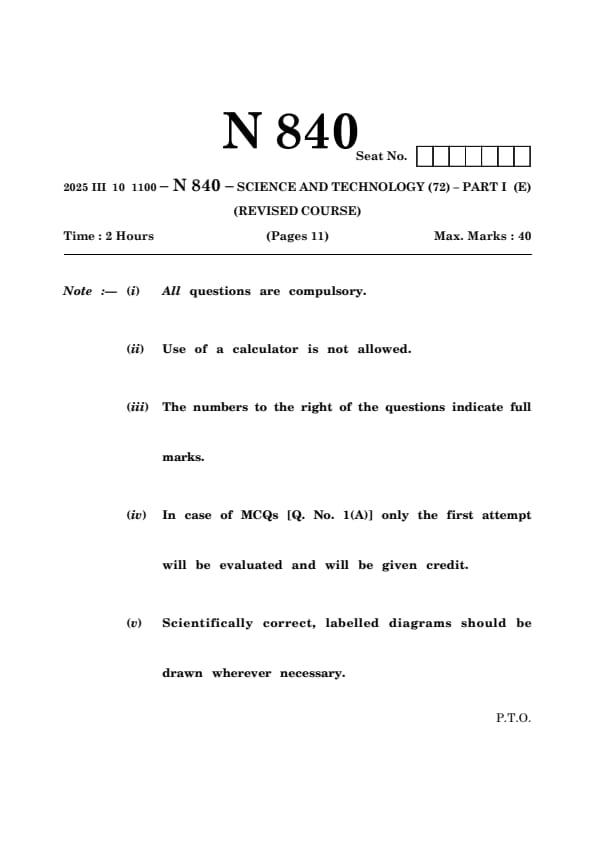
The Maharashtra Board Class 10th English Question Paper PDF with Solutions is available for download. Class 10 exams were conducted from February 21 to March 17, 2025. The practical exams were held earlier, from February 3 to February 20, 2025. The Maharashtra State Board of Secondary and Higher Secondary Education (MSBSHSE) conducted the Class 10 Science and Technology I examination for a total duration of 2 hours, and the question paper had a total of 40 marks.
Maharastra Board Class 10 Science and Technology I Question Paper with Solutions
| Maharastra Board Class 10 Science and Technology I Question Paper with Solutions | Download PDF | Check Solutions |
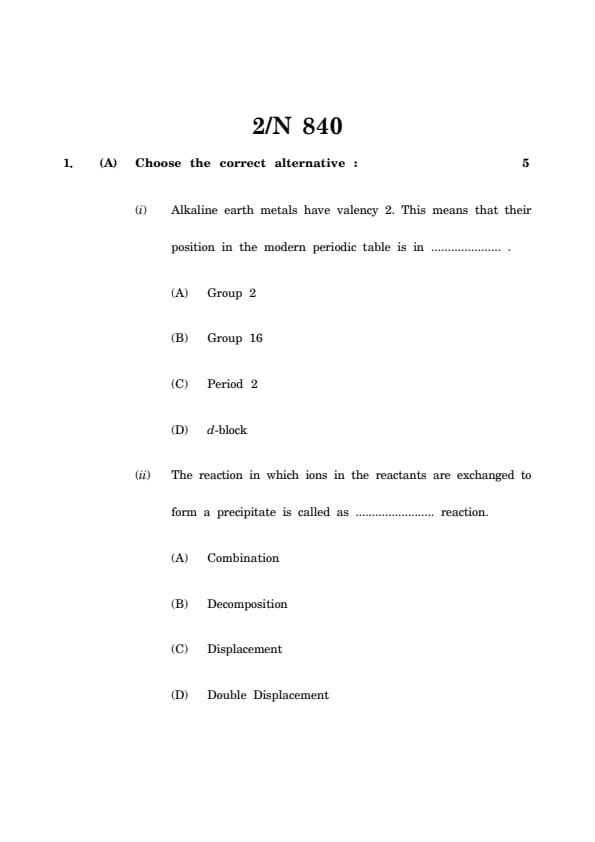
(A) Choose the correct alternative:
(i) Alkaline earth metals have valency 2. This means that their position in the modern periodic table is in .................... .
View Solution
Alkaline Earth Metals have valency 2 → They belong to Group 2.
Alkaline earth metals are a group of elements located in Group 2 of the periodic table. The elements in this group include beryllium (Be), magnesium (Mg), calcium (Ca), strontium (Sr), barium (Ba), and radium (Ra). These metals share several key characteristics:
- They have two electrons in their outermost electron shell, which gives them a valency of 2.
- These elements tend to lose their two valence electrons to form cations with a +2 charge when they react, which is a characteristic feature of metals.
- Their reactivity increases as you move down the group, with radium being the most reactive, and beryllium being the least reactive.
- They form ionic compounds, where they combine with nonmetals to form salts, like calcium chloride (CaCl₂) or magnesium oxide (MgO).
Since they all have two valence electrons, they are classified as Group 2 elements in the periodic table. These metals are important in various chemical reactions, especially in the formation of basic oxides and hydroxides, and they play crucial roles in biology and industry.
Solution: (A) Group 2. Quick Tip: Quick Tip:} The alkaline earth metals are important in the production of materials like cement, glass, and in the development of alloys. Their ionic nature makes them effective in forming a variety of salts and compounds.
(ii) The reaction in which ions in the reactants are exchanged to form a precipitate is called as ...................... reaction.
View Solution
The reaction in which ions are exchanged to form a precipitate → Double Displacement reaction.
A double displacement reaction, also called a double replacement reaction, occurs when two ionic compounds in aqueous solution exchange ions to form new compounds. This type of reaction involves the replacement of one element in each compound by another. If one of the products is insoluble in water, it will form a precipitate.
- In a double displacement reaction, the positive and negative ions of two ionic compounds swap places, resulting in the formation of two new compounds.
- One of these new compounds, typically a salt, may not dissolve in water, thus forming a solid precipitate.
- A classic example is when solutions of silver nitrate (AgNO₃) and sodium chloride (NaCl) are mixed. Silver chloride (AgCl), a white precipitate, forms because it is insoluble in water.
This reaction can be summarized as follows: \[ AB(aq) + CD(aq) \rightarrow AD(s) + CB(aq) \]
Where "s" denotes the solid precipitate, and "aq" denotes an aqueous solution.
Solution: (D) Double Displacement. Quick Tip: Quick Tip:} Double displacement reactions are important in analytical chemistry for identifying unknown compounds through precipitate formation. These reactions are also essential in water treatment processes, where unwanted ions are removed.
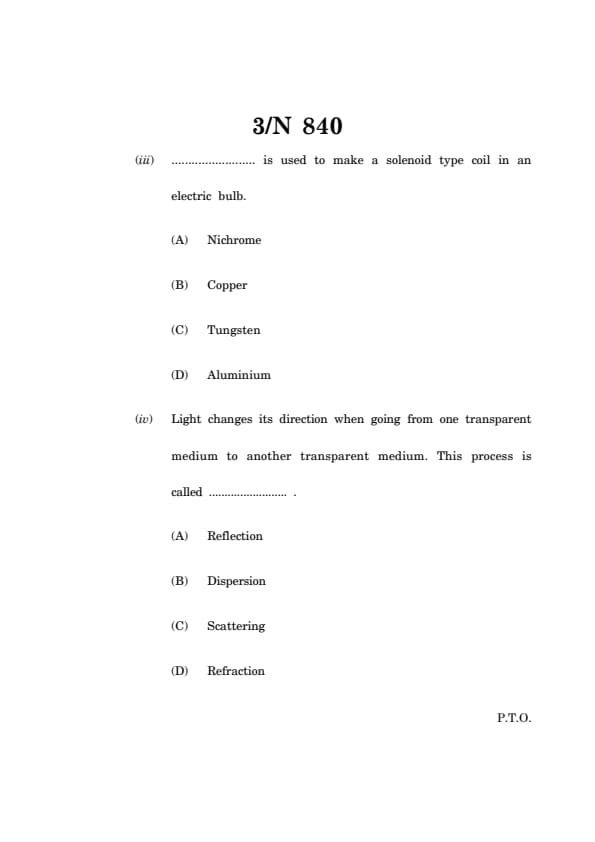
(iii) .................... is used to make a solenoid type coil in an electric bulb.
View Solution
A solenoid-type filament in an electric bulb is made of Tungsten (because of its high melting point).
The filament in electric bulbs is typically made of tungsten due to its remarkable properties. Tungsten has the highest melting point of all metals, approximately 3422°C (6192°F), which is essential for its use in light bulbs. When current flows through the filament, it heats up due to the resistance it offers to the electric current, and it begins to glow, producing light.
- The high melting point of tungsten allows the filament to reach high temperatures without melting. This is crucial because light bulbs need to operate at high temperatures to produce visible light.
- Tungsten also has excellent durability and resistance to thermal shock, meaning it can withstand rapid temperature changes, which is common when light bulbs are turned on and off.
- Additionally, tungsten has a low vapor pressure at high temperatures, which ensures that the filament does not evaporate easily, allowing it to last longer.
For these reasons, tungsten is the material of choice for electric bulb filaments.
Solution: (C) Tungsten. Quick Tip: Quick Tip:} Tungsten’s high melting point and resilience make it ideal not only for light bulbs but also for other high-temperature applications, such as in electrical contacts, heating elements, and aerospace technologies.
(iv) Light changes its direction when going from one transparent medium to another transparent medium. This process is called ...................... .
View Solution
Light changes direction when going from one medium to another → Refraction.
Refraction is the bending of light when it passes from one medium into another. This occurs because light travels at different speeds in different media. The change in speed causes the light ray to change direction.
- The amount of bending depends on the angle at which the light enters the new medium and the refractive index of the two media involved. The refractive index is a measure of how much the speed of light is reduced inside the medium.
- For example, when light passes from air (a less dense medium) into water (a denser medium), the light slows down and bends towards the normal (the perpendicular line to the surface). Conversely, when light moves from water to air, it speeds up and bends away from the normal.
- This phenomenon is described by Snell's Law, which mathematically relates the angles of incidence and refraction to the refractive indices of the two media.
Refraction is responsible for many optical phenomena, such as the formation of rainbows, the apparent bending of objects underwater, and the focusing of light in lenses.
Solution: (D) Refraction. Quick Tip: Quick Tip:} Refraction is crucial in the design of optical instruments like glasses, microscopes, and cameras, where precise control of light’s path is required for proper functionality.
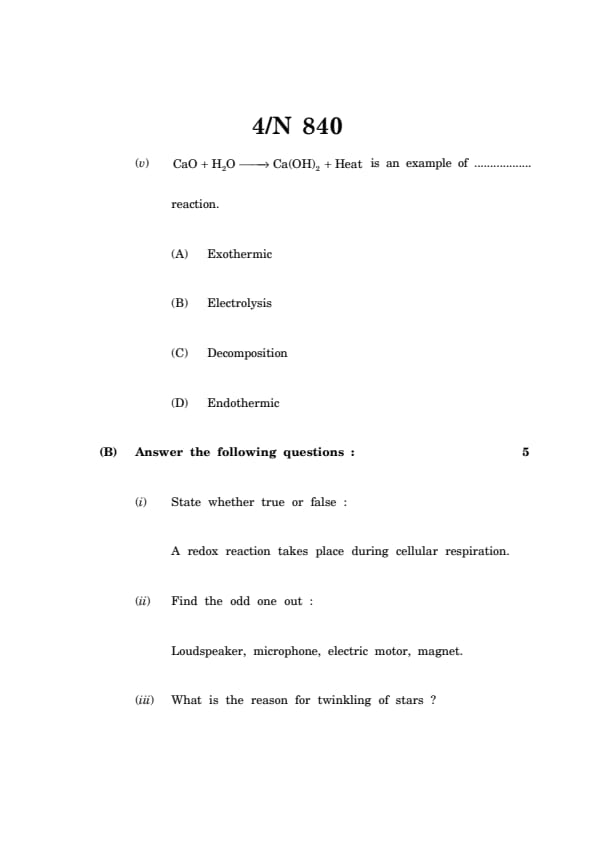
(v) CaO + H\(_2\)O \(\rightarrow\) Ca(OH)\(_2\) + Heat is an example of ................. reaction.
View Solution
CaO + H₂O → Ca(OH)₂ + Heat (heat is evolved) → Exothermic reaction.
The reaction between calcium oxide (CaO) and water (H₂O) is an exothermic reaction, meaning that it releases energy in the form of heat. When calcium oxide (commonly known as quicklime) reacts with water, calcium hydroxide (Ca(OH)₂) is formed, and a significant amount of heat is released during the process.
- Exothermic reactions are characterized by the release of energy, typically in the form of heat, light, or both. The heat released in this reaction is so significant that it is used in industrial processes such as the production of cement.
- In this specific reaction, the calcium oxide undergoes a chemical transformation with water, releasing energy as the new bonds are formed in the calcium hydroxide product. This is a typical feature of many metal oxide reactions with water.
This reaction is also an example of a hydration reaction, where water is added to a substance to form a new product.
Solution: (A) Exothermic. Quick Tip: Quick Tip:} Exothermic reactions are essential in many chemical processes, including combustion, neutralization, and in the industrial production of chemicals like cement and soap.
(i) State whether true or false:
A redox reaction takes place during cellular respiration.
View Solution
N/A Quick Tip: Quick Tip:} Redox reactions are essential in both biological processes, like cellular respiration, and industrial processes, such as combustion and corrosion.
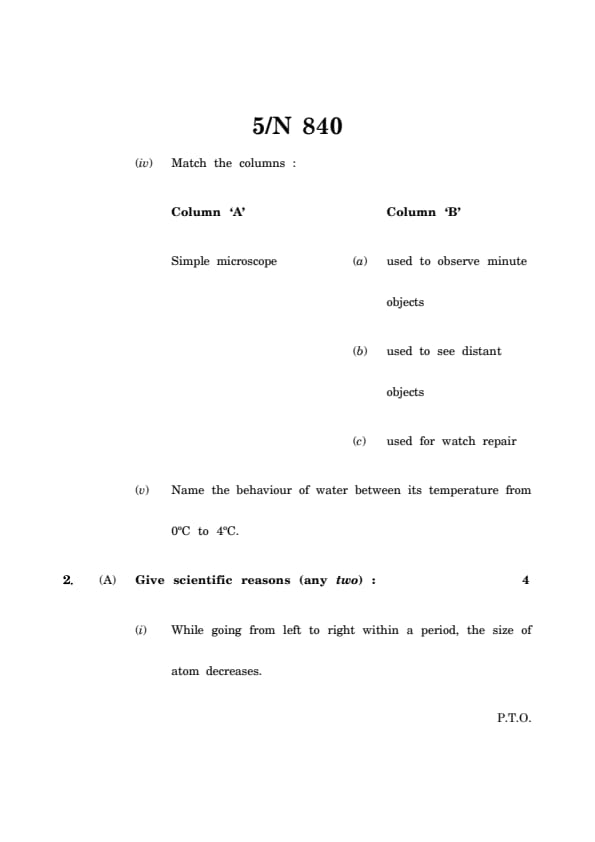
(v) Name the behaviour of water between its temperature from 0°C to 4°C.
View Solution
The behaviour of water between 0°C to 4°C is called anomalous expansion of water.
Water exhibits an anomalous expansion between 0°C and 4°C. Normally, most substances expand when heated, but water behaves differently in this temperature range. When water is cooled from 4°C to 0°C, it contracts like most substances. However, as it continues to cool below 4°C, it starts expanding again until it reaches 0°C.
The reasons for this anomaly are due to the unique hydrogen bonds in water. At temperatures below 4°C, the water molecules arrange themselves in a more open hexagonal structure due to hydrogen bonding, which increases the volume and decreases the density of the water. At 4°C, water reaches its maximum density because the molecules are packed most efficiently.
Water contracts instead of expanding when heated from 0°C to 4°C, reaching maximum density at 4°C. Quick Tip: Quick Tip:} The anomalous expansion of water is crucial for life on Earth because it allows ice to float on water, insulating aquatic life during freezing temperatures.
(i) While going from left to right within a period, the size of the atom decreases.
View Solution
As we move across a period in the periodic table from left to right, the number of protons in the nucleus increases, leading to an increase in the nuclear charge. This stronger nuclear charge exerts a greater attractive force on the electrons in the outer shell, pulling them closer to the nucleus.
However, the number of electron shells remains the same across a period. As a result, the electrons are drawn closer to the nucleus, causing the atomic size to decrease. This is a general trend that can be observed in all elements across a period.
Nuclear charge increases, pulling electrons closer to the nucleus, hence atomic size decreases. Quick Tip: Quick Tip:} The decrease in atomic size across a period is one of the key trends in the periodic table and plays a major role in determining the chemical properties of elements.
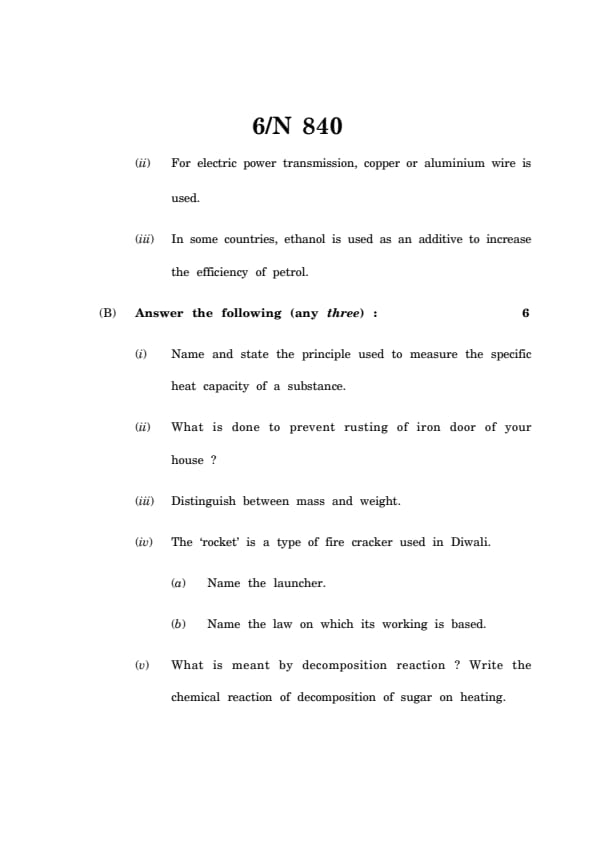
(ii) For electric power transmission, copper or aluminium wire is used.
View Solution
Copper and aluminium are commonly used materials for electric power transmission due to their excellent electrical properties. They both have low resistivity, meaning they offer minimal resistance to the flow of electricity, allowing for efficient transmission of electrical power.
- Copper has better conductivity than aluminium, making it ideal for high-efficiency transmission in smaller cross-sections. However, copper is heavier and more expensive.
- Aluminium, on the other hand, is lighter and more cost-effective than copper. It is often used in high-voltage power transmission lines, where its lower cost and lighter weight make it advantageous.
Both metals also have good mechanical properties, such as flexibility and durability, which are essential for maintaining and repairing power transmission lines.
Both have low resistivity and high conductivity, so they allow electricity to pass with minimum energy loss. Quick Tip: Quick Tip:} While copper has better conductivity, aluminium’s lower cost and lighter weight make it a preferred choice for long-distance power transmission.
(i) Name and state the principle used to measure the specific heat capacity of a substance.
View Solution
N/A Quick Tip: Quick Tip:} The method of mixtures is a practical application of the conservation of energy, where energy lost equals energy gained. It is often used in calorimetry to determine specific heat capacities.
(ii) What is done to prevent rusting of iron door of your house?
View Solution
N/A Quick Tip: Quick Tip:} Galvanization is particularly effective for outdoor objects like gates and fences, while oiling and painting work well for indoor objects where exposure to moisture is minimal.
(iv) The ‘rocket’ is a type of fire cracker used in Diwali.
View Solution
N/A Quick Tip: Quick Tip:} Newton’s Third Law is not only essential in rocketry but also explains many everyday phenomena, such as the recoil of a gun or the pushback when you jump off a boat.
(v) What is meant by decomposition reaction? Write the chemical reaction of decomposition of sugar on heating.
View Solution
A decomposition reaction is a type of chemical reaction in which a single compound breaks down into two or more simpler substances when heated or by other means such as electrolysis. In a decomposition reaction, one reactant is broken down into multiple products.
Example: Decomposition of Sugar on Heating:
When sugar (sucrose, \(C_{12}H_{22}O_{11}\)) is heated, it decomposes into carbon (C) and water vapor (\(H_2O\)). This is a classic example of a thermal decomposition reaction, where heat is required to break down the sugar.
The reaction can be written as: \[ C_{12}H_{22}O_{11} \xrightarrow{\Delta} 12C + 11H_2O \]
Here:
- \(C_{12}H_{22}O_{11}\) is sucrose (sugar),
- \(\Delta\) represents heat,
- \(12C\) is carbon, and
- \(11H_2O\) is water vapor.
A decomposition reaction is a type of chemical reaction in which a single compound breaks down into two or more simpler substances when heated or by other means. Quick Tip: Quick Tip:} Decomposition reactions are used in many industrial processes, such as the production of oxygen from potassium chlorate (\(KClO_3\)) and the breakdown of organic matter in composting.
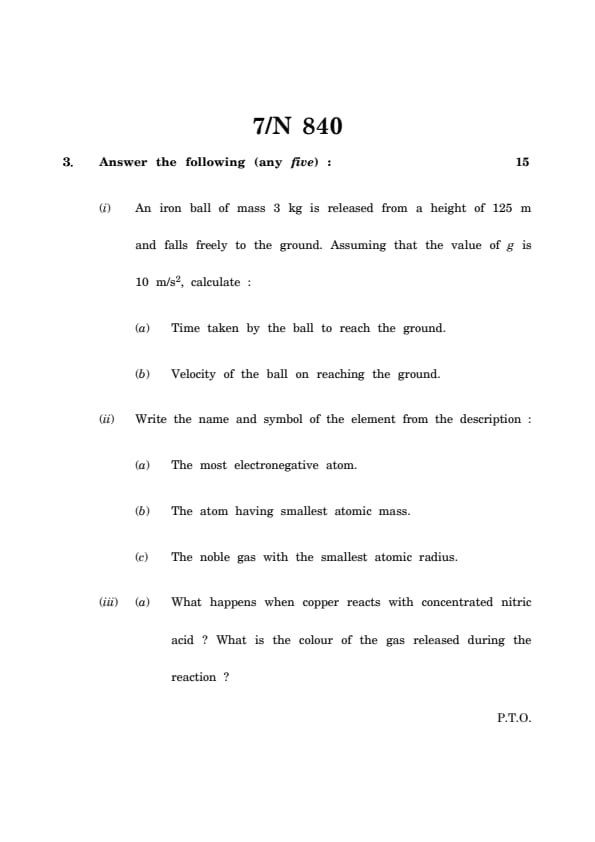
(i) An iron ball of mass 3 kg is released from a height of 125 m and falls freely to the ground. Assuming that the value of \(g\) is 10 m/s\(^2\), calculate:
View Solution
N/A
(ii) Write the name and symbol of the element from the description:
View Solution
N/A Quick Tip: Quick Tip:} Nitrogen dioxide (\(NO_2\)) is a toxic gas, so reactions involving concentrated nitric acid should be performed in a well-ventilated area or under a fume hood.
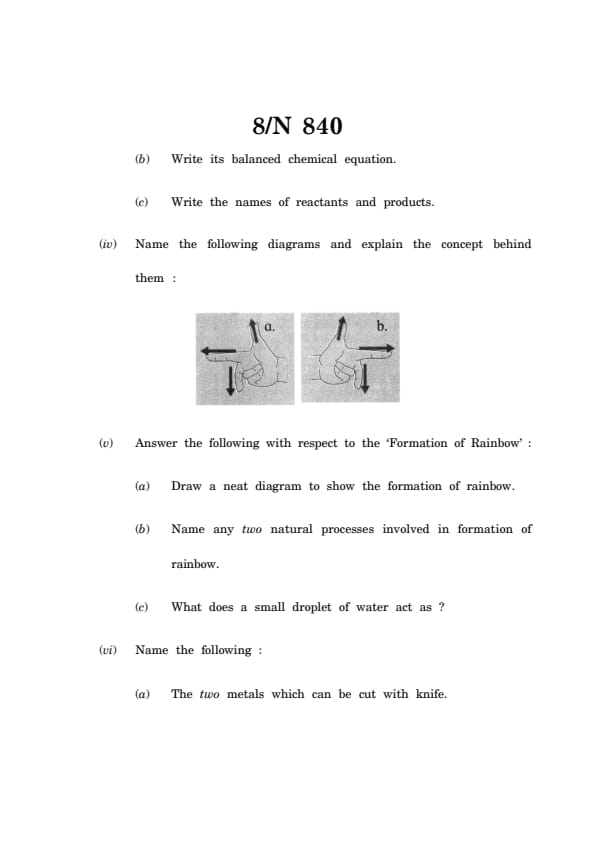
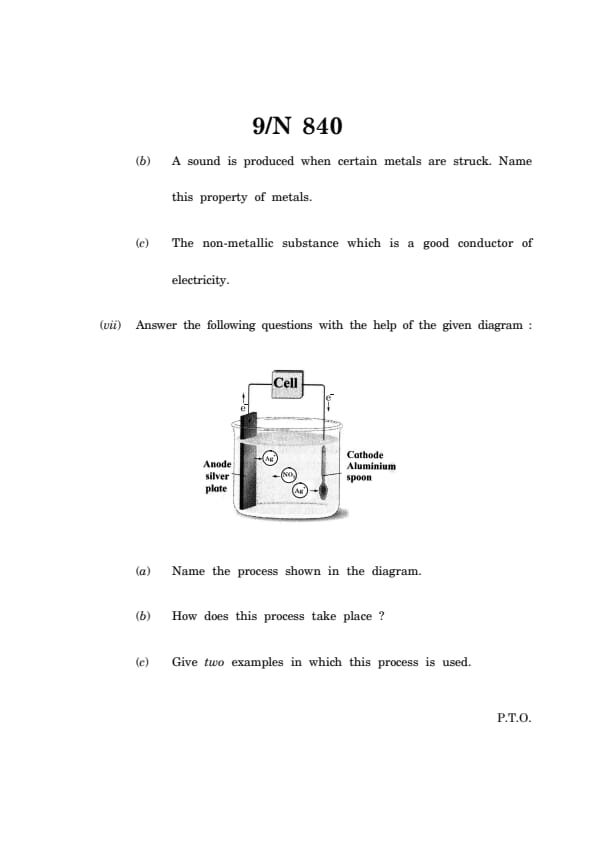
(vi) Name the following:
View Solution
N/A Quick Tip: Quick Tip:} Graphite’s electrical conductivity is why it is used in electrical applications like batteries, electrodes, and as a lubricant in mechanical systems.
*The article might have information for the previous academic years, please refer the official website of the exam.