
ATMA 2026 Question Paper with Solution PDF


Content Curator | Updated On - Jul 10, 2026
Download the ATMA 2026 question paper with solutions for free below. ATMA 2026 was conducted by the Association of Indian Management Schools (AIMS) on February 22, 2026 as a 180-mark computer-based test, with three skill areas - Analytical Reasoning, Verbal Skills, and Quantitative Skills - to be cleared in 3 hours.
| ATMA 2026 Question Paper with Solutions | Download PDF | Check Solutions |
ATMA 2026 WITH SOLUTIONS PDF Questions with Solutions
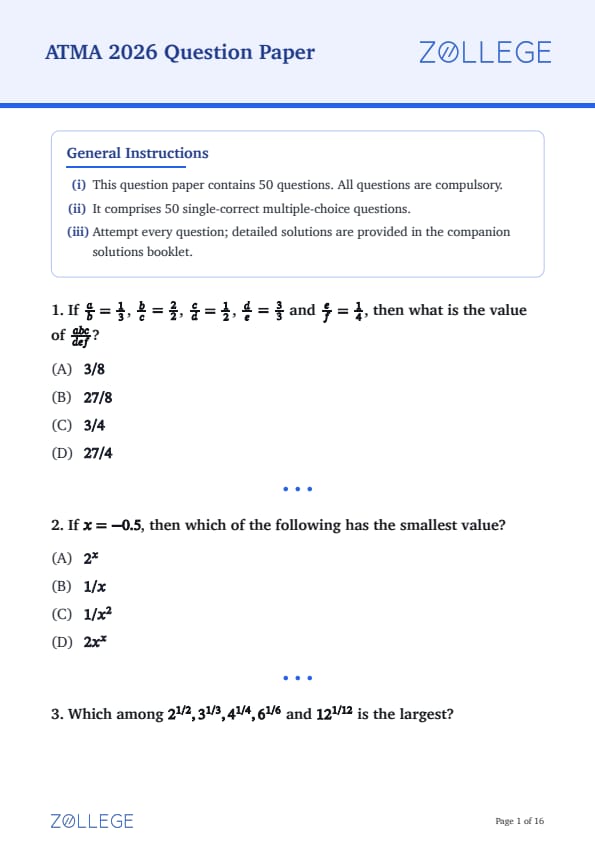
If \( \frac{a}{b} = \frac{1}{3} \), \( \frac{b}{c} = \frac{2}{2} \), \( \frac{c}{d} = \frac{1}{2} \), \( \frac{d}{e} = \frac{3}{3} \) and \( \frac{e}{f} = \frac{1}{4} \), then what is the value of \( \frac{abc}{def} \)?
If \( x = -0.5 \), then which of the following has the smallest value?
Which among \( 2^{1/2}, 3^{1/3}, 4^{1/4}, 6^{1/6} \) and \( 12^{1/12} \) is the largest?
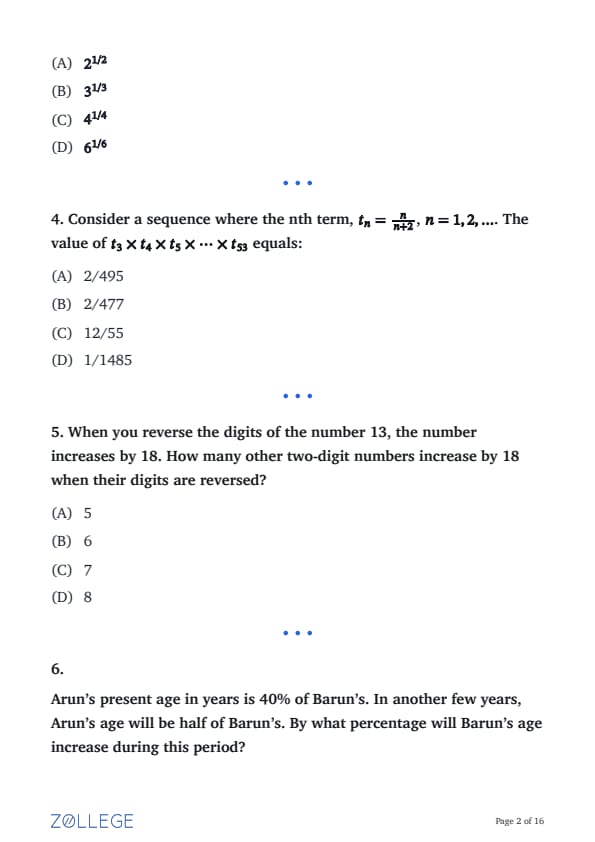
Consider a sequence where the nth term, \( t_n = \frac{n}{n+2} \), \( n = 1, 2, \dots \). The value of \( t_3 \times t_4 \times t_5 \times \dots \times t_{53} \) equals:
When you reverse the digits of the number 13, the number increases by 18. How many other two-digit numbers increase by 18 when their digits are reversed?
Arun’s present age in years is 40% of Barun’s. In another few years, Arun’s age will be half of Barun’s. By what percentage will Barun’s age increase during this period?
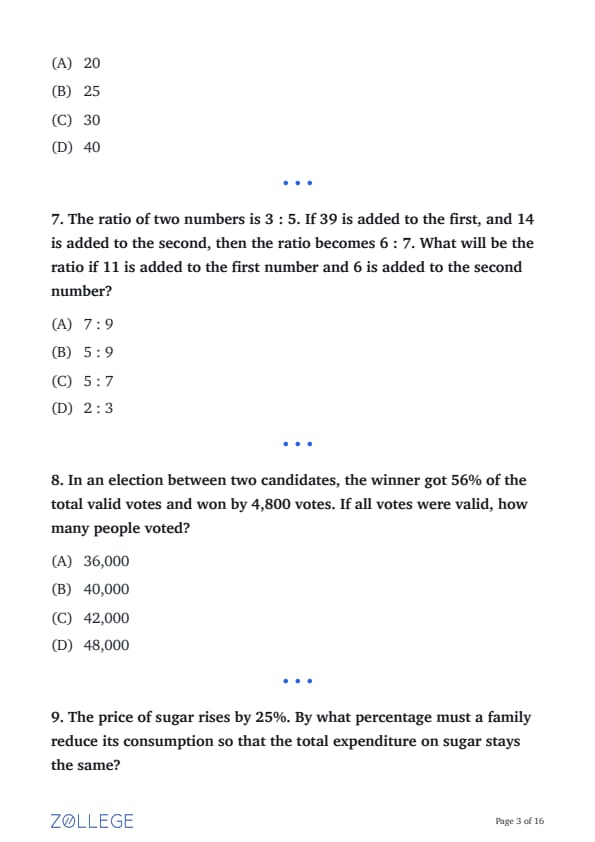
The ratio of two numbers is 3 : 5. If 39 is added to the first, and 14 is added to the second, then the ratio becomes 6 : 7. What will be the ratio if 11 is added to the first number and 6 is added to the second number?
In an election between two candidates, the winner got 56% of the total valid votes and won by 4,800 votes. If all votes were valid, how many people voted?
The price of sugar rises by 25%. By what percentage must a family reduce its consumption so that the total expenditure on sugar stays the same?
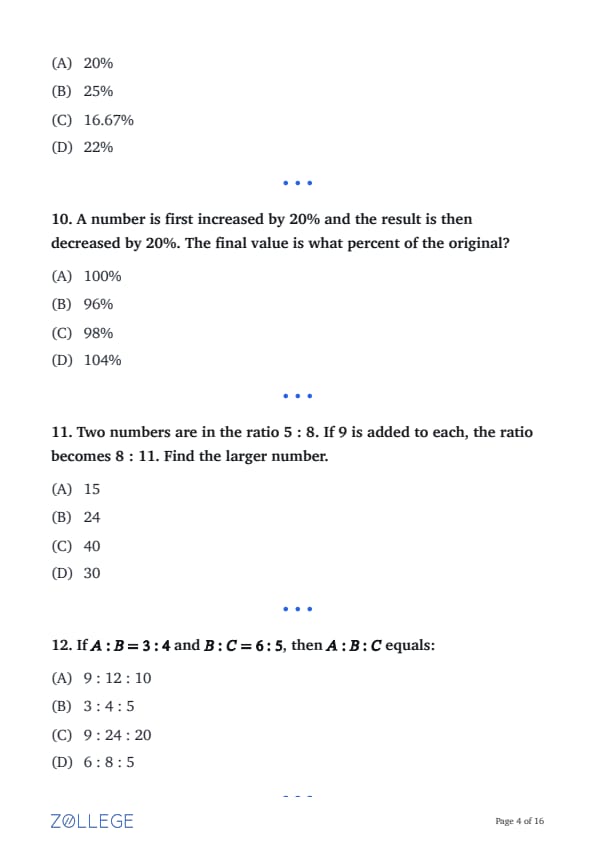
A number is first increased by 20% and the result is then decreased by 20%. The final value is what percent of the original?
Two numbers are in the ratio 5 : 8. If 9 is added to each, the ratio becomes 8 : 11. Find the larger number.
If \(A:B = 3:4\) and \(B:C = 6:5\), then \(A:B:C\) equals:
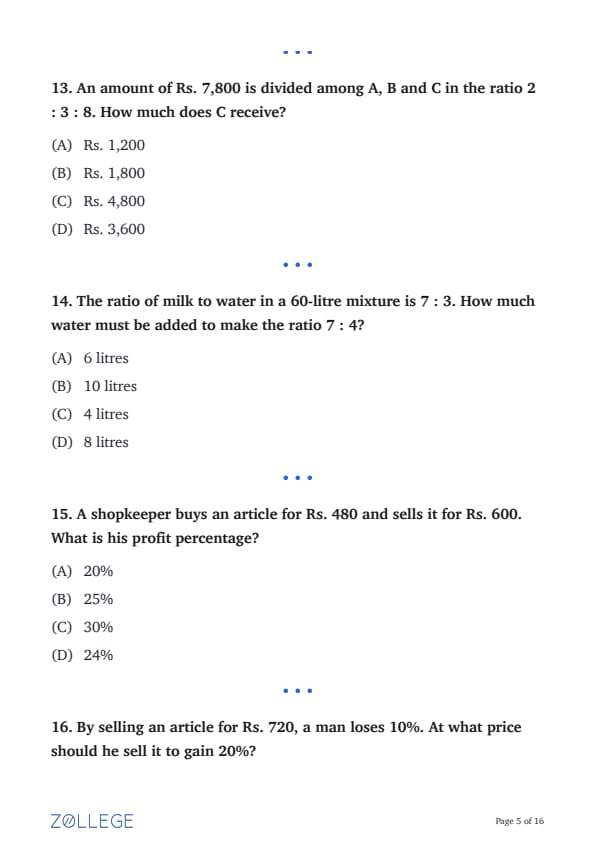
An amount of Rs. 7,800 is divided among A, B and C in the ratio 2 : 3 : 8. How much does C receive?
The ratio of milk to water in a 60-litre mixture is 7 : 3. How much water must be added to make the ratio 7 : 4?
A shopkeeper buys an article for Rs. 480 and sells it for Rs. 600. What is his profit percentage?
By selling an article for Rs. 720, a man loses 10%. At what price should he sell it to gain 20%?
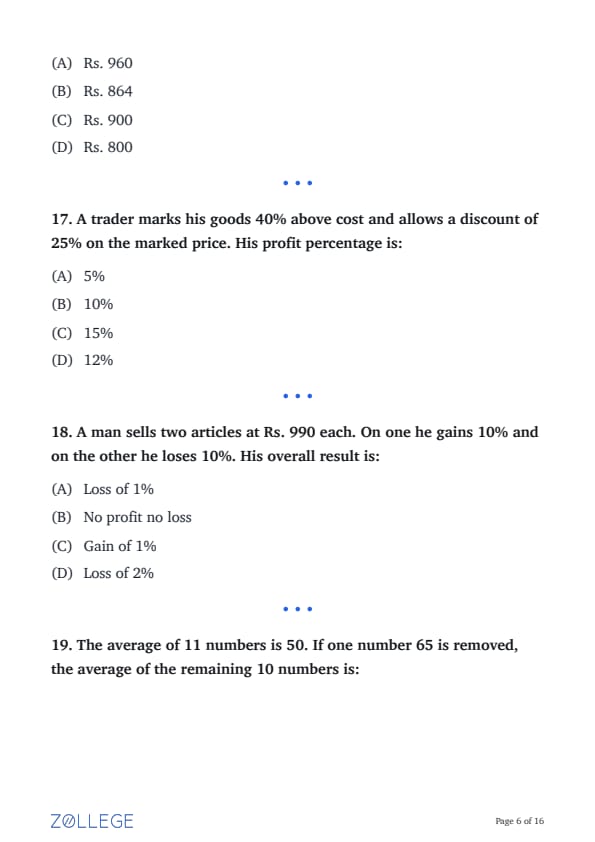
A trader marks his goods 40% above cost and allows a discount of 25% on the marked price. His profit percentage is:
A man sells two articles at Rs. 990 each. On one he gains 10% and on the other he loses 10%. His overall result is:
The average of 11 numbers is 50. If one number 65 is removed, the average of the remaining 10 numbers is:
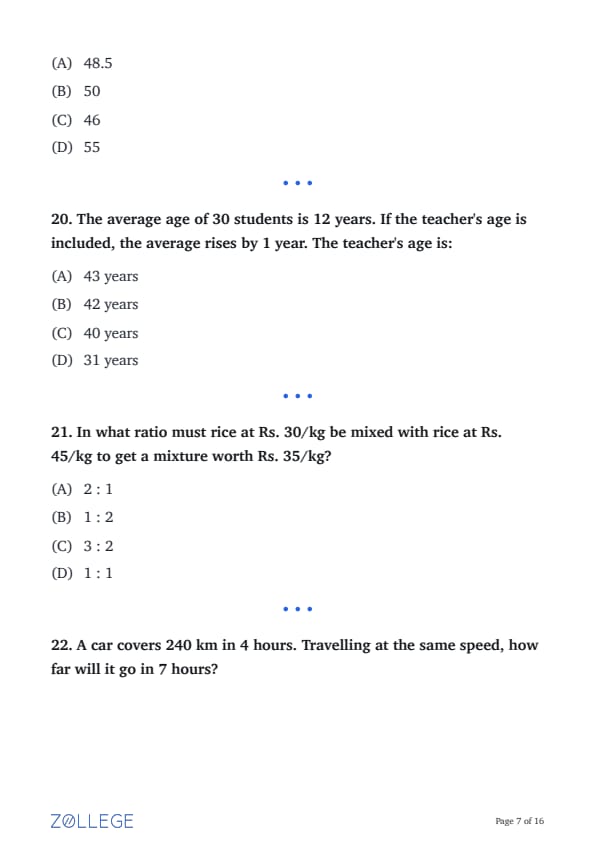
The average age of 30 students is 12 years. If the teacher's age is included, the average rises by 1 year. The teacher's age is:
In what ratio must rice at Rs. 30/kg be mixed with rice at Rs. 45/kg to get a mixture worth Rs. 35/kg?
A car covers 240 km in 4 hours. Travelling at the same speed, how far will it go in 7 hours?
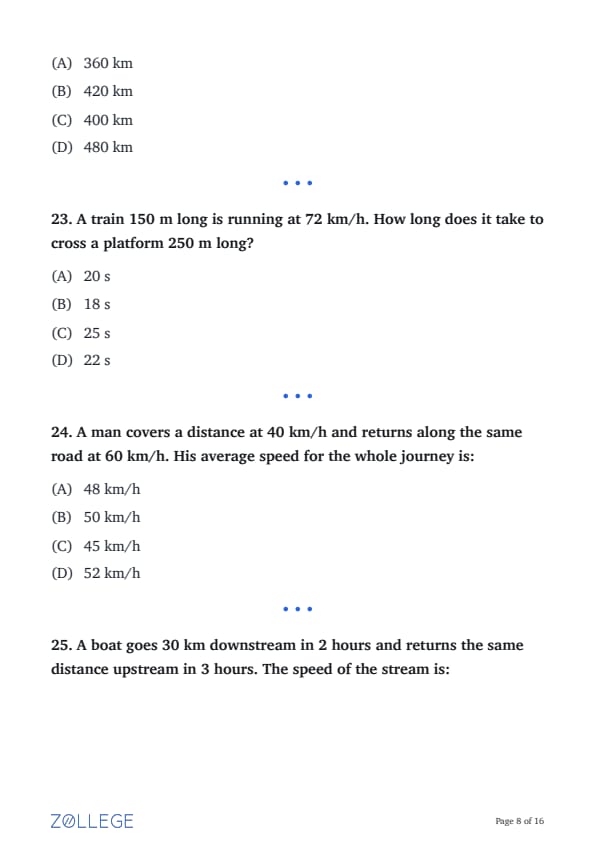
A train 150 m long is running at 72 km/h. How long does it take to cross a platform 250 m long?
A man covers a distance at 40 km/h and returns along the same road at 60 km/h. His average speed for the whole journey is:
A boat goes 30 km downstream in 2 hours and returns the same distance upstream in 3 hours. The speed of the stream is:
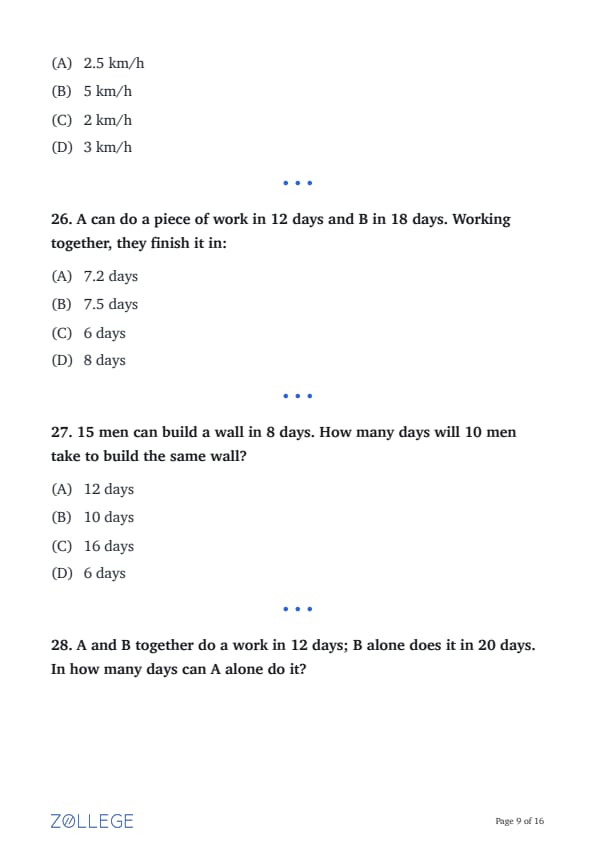
A can do a piece of work in 12 days and B in 18 days. Working together, they finish it in:
15 men can build a wall in 8 days. How many days will 10 men take to build the same wall?
A and B together do a work in 12 days; B alone does it in 20 days. In how many days can A alone do it?
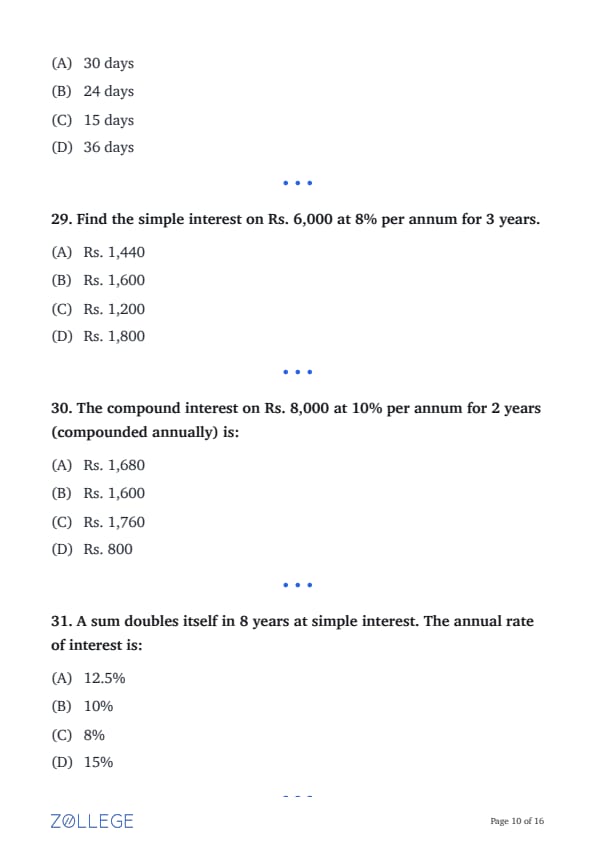
Find the simple interest on Rs. 6,000 at 8% per annum for 3 years.
The compound interest on Rs. 8,000 at 10% per annum for 2 years (compounded annually) is:
A sum doubles itself in 8 years at simple interest. The annual rate of interest is:
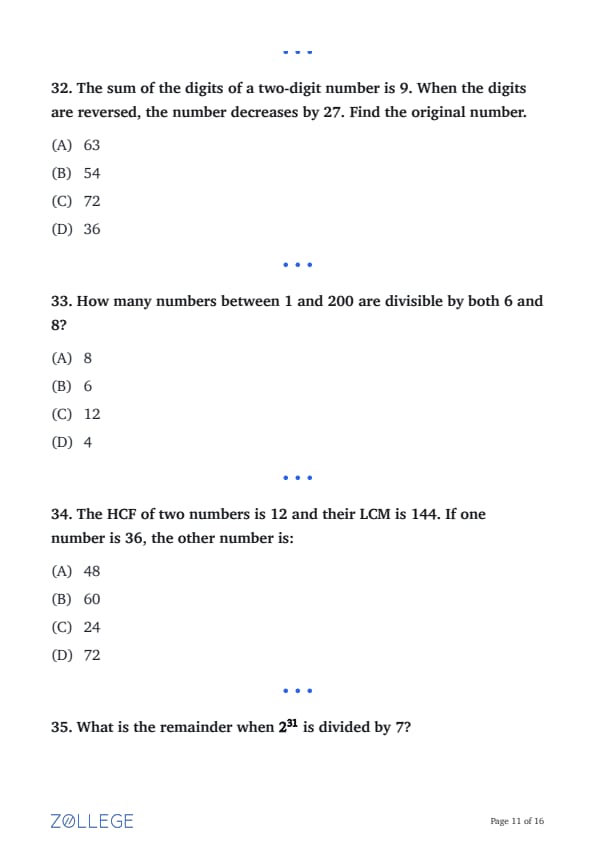
The sum of the digits of a two-digit number is 9. When the digits are reversed, the number decreases by 27. Find the original number.
How many numbers between 1 and 200 are divisible by both 6 and 8?
The HCF of two numbers is 12 and their LCM is 144. If one number is 36, the other number is:
What is the remainder when \(2^{31}\) is divided by 7?
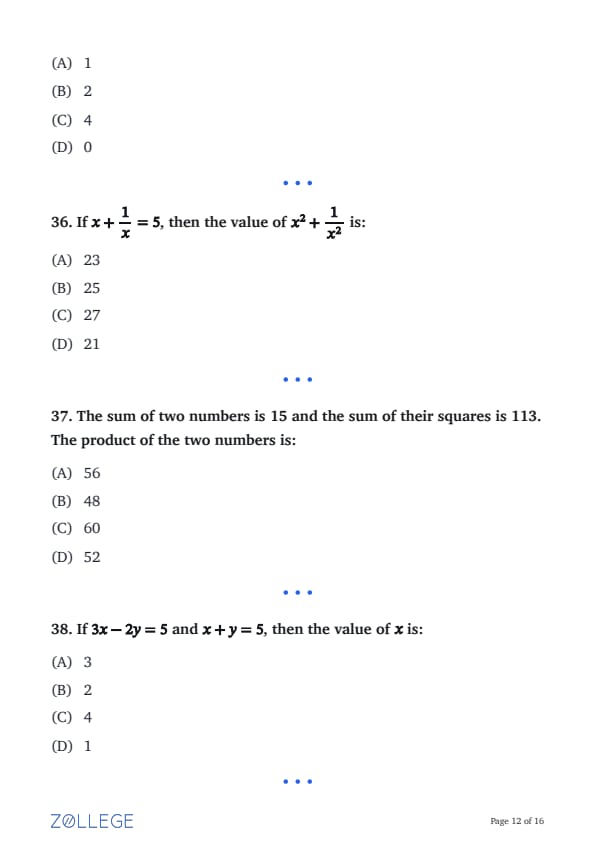
If \(x + \dfrac{1}{x} = 5\), then the value of \(x^2 + \dfrac{1}{x^2}\) is:
The sum of two numbers is 15 and the sum of their squares is 113. The product of the two numbers is:
If \(3x - 2y = 5\) and \(x + y = 5\), then the value of \(x\) is:
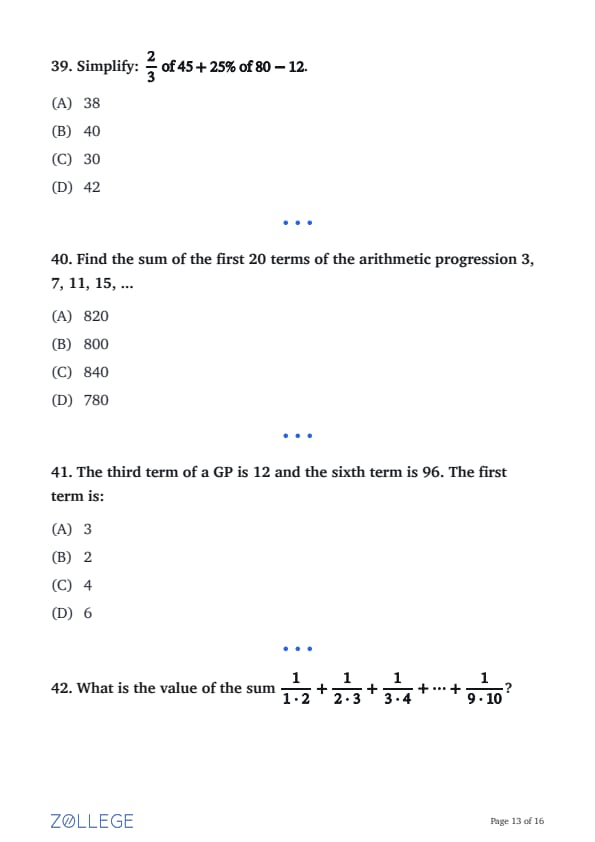
Simplify: \(\dfrac{2}{3} \text{ of } 45 + 25\% \text{ of } 80 - 12\).
Find the sum of the first 20 terms of the arithmetic progression 3, 7, 11, 15, ...
The third term of a GP is 12 and the sixth term is 96. The first term is:
What is the value of the sum \(\dfrac{1}{1\cdot2} + \dfrac{1}{2\cdot3} + \dfrac{1}{3\cdot4} + \cdots + \dfrac{1}{9\cdot10}\)?
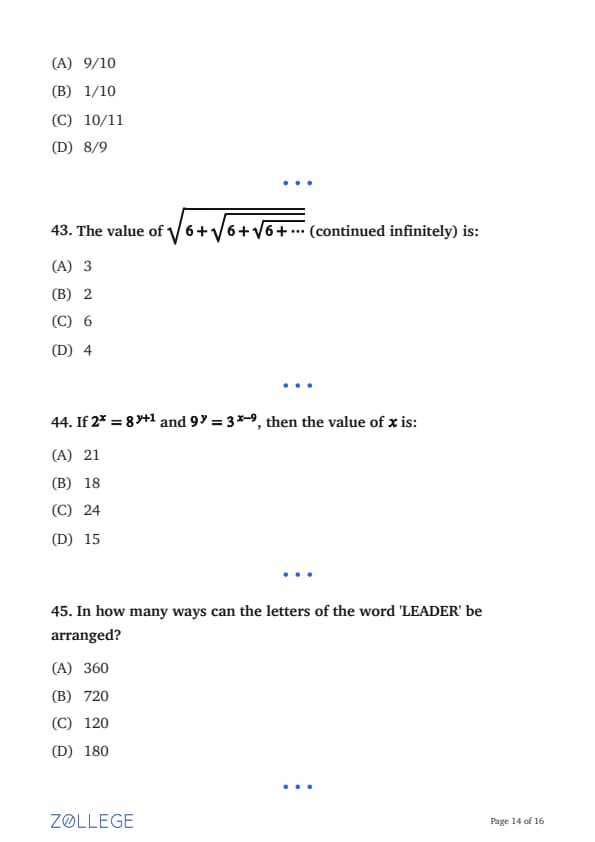
The value of \(\sqrt{6+\sqrt{6+\sqrt{6+\cdots}}}\) (continued infinitely) is:
If \(2^{x} = 8^{\,y+1}\) and \(9^{\,y} = 3^{\,x-9}\), then the value of \(x\) is:
In how many ways can the letters of the word 'LEADER' be arranged?
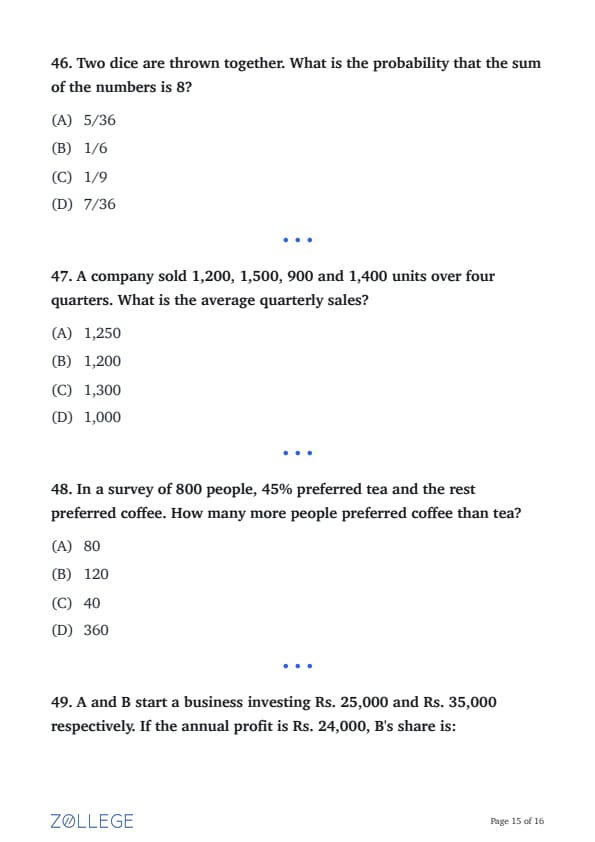
Two dice are thrown together. What is the probability that the sum of the numbers is 8?
A company sold 1,200, 1,500, 900 and 1,400 units over four quarters. What is the average quarterly sales?
In a survey of 800 people, 45% preferred tea and the rest preferred coffee. How many more people preferred coffee than tea?
A and B start a business investing Rs. 25,000 and Rs. 35,000 respectively. If the annual profit is Rs. 24,000, B's share is:
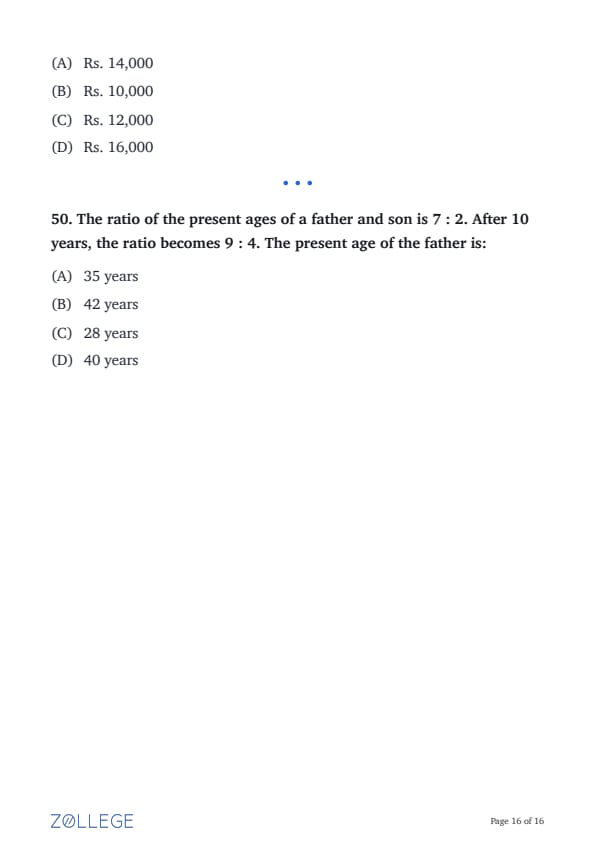
The ratio of the present ages of a father and son is 7 : 2. After 10 years, the ratio becomes 9 : 4. The present age of the father is:
ATMA 2026 Exam Pattern and Marking Scheme Explained
ATMA runs the same blueprint at every sitting, so the February 22 paper followed the pattern AIMS lists on its official website (atmaaims.com). Read it before you start the paper.
- Total questions: 180 MCQs, three sections, each with two parts of 30 questions
- Duration: 3 hours for the whole test
- Total marks: 180, with one mark for every question
- Marking scheme: +1 for a correct answer and -0.25 for a wrong one
- Sections: Analytical Reasoning Skills, Verbal Skills, and Quantitative Skills
- Question type: single-correct MCQs only, no numerical-entry questions
High-Weightage Topics in ATMA 2026 Quantitative Skills to Focus On First
Quantitative Skills was the toughest section in ATMA 2026. Here are the arithmetic and algebra areas that carried the most questions, so begin your practice with these.
- Ratio, proportion and percentages: layered ratio problems, mixtures, and percentage word problems
- Profit, loss and interest: markup-and-discount chains plus simple and compound interest
- Arithmetic: time-speed-distance, time and work, averages, and boats and streams
- Number system: digit-reversal, HCF and LCM, and remainder problems
- Algebra and sequences: algebraic identities, equations, and AP and GP series
- Surds, exponents and modern maths: power comparisons, permutations, and probability
ATMA 2026 Question Paper Preparation Video
Source: MBA with Arshi Khan
How to Use the ATMA 2026 Question Paper for Practice
Use this paper as a full timed mock first. The solutions show each step, so you can spot exactly where your method slowed down.
- Attempt the Quantitative set against a strict clock before checking any answer
- Go through every question with the solution PDF, then redo the ones you missed
- Note the topic that cost the most time - usually ratios or the exponent-comparison question
- Redo the set after a couple of days so the approach sticks, not just the answer
ATMA Good Attempts and Score Benchmark
- Target 135-145 correct out of 180 - the safe band for a moderate ATMA paper
- ATMA 2026 was moderate overall, and Quantitative Skills was the hardest of the three sections
- With a -0.25 penalty, leave a question blank instead of guessing when you cannot cut the options down
ATMA 2026 Question Paper with Solutions FAQs
Ques. Was the Quantitative Skills section the hardest part of ATMA 2026?
Ans. Yes. Students found Quantitative Skills the toughest of the three sections in ATMA 2026 because the questions were long and calculation-heavy - ratios, exponent comparisons, and sequence products. Verbal and Analytical Reasoning felt closer to moderate.
Ques. How many attempts make a good ATMA 2026 score?
Ans. About 135 to 145 correct out of 180 is a solid score in a moderate ATMA paper. Because of the -0.25 negative marking, accuracy beats volume, so skip a question when you cannot rule out at least two options.
Ques. Which Quantitative topics carried the most weight in ATMA 2026?
Ans. Ratio and proportion, percentages, profit and loss, arithmetic (time-speed-distance and work), number systems, and algebra led the Quant questions. Arithmetic-based problems clearly outnumbered pure algebra.
Ques. Did AIMS officially release the ATMA 2026 question paper?
Ans. No. ATMA is a computer-based test, so AIMS does not publish an official paper for each sitting. This ATMA 2026 set is built in the exact ATMA pattern and difficulty for practice. The most recent official sets on atmaaims.com date to 2021.
Ques. Are calculators allowed in the ATMA exam?
Ans. No. ATMA allows neither physical nor on-screen calculators, so Quantitative Skills questions are designed to be solved by hand in the sectional time. Practising mental math on ratios and powers directly protects your marks.
Ques. Where can I download the ATMA 2026 question paper with solutions PDF for free?
Ans. Use the table above to download the question paper and step-by-step solutions free of cost. For official sample papers and the exam bulletin, visit the AIMS website at atmaaims.com.
*The article might have information for the previous academic years, please refer the official website of the exam.