
SNAP 2020 Question Paper with Solution PDF


Content Writer | Updated On - Nov 1, 2025
SNAP Question Papers are crucial for effective exam preparation and are available for free download with solutions in PDF format. Conducted by Symbiosis International University (SIU) for MBA/PGDM admissions, practicing with these past papers helps aspirants understand the exam's difficulty, syllabus, and pattern, thereby improving speed and accuracy. The SNAP test is a 60-minute online exam with 60 multiple-choice questions covering General English; Quantitative, Data Interpretation & Data Sufficiency; and Analytical & Logical Reasoning. For more details and registration, visit the official website, snaptest.org.
SNAP 2020 Question Paper with Solution PDF
| SNAP 2020 Question Paper with Solutions PDF | Download PDF | Check Solutions |

What is the meaning of "spilling the beans"?
View Solution
Step 1: Understanding the Concept:
The question asks for the meaning of the idiom "spilling the beans". An idiom is a phrase whose meaning is not deducible from the literal definitions of the individual words.
Step 2: Detailed Explanation:
The idiom "spilling the beans" means to disclose a secret or reveal something prematurely.
Let's analyze the options:
(A) To get scared extremely: This is incorrect. The idiom is not related to fear.
(B) To reveal a secret: This perfectly matches the meaning of the idiom. For example, "He spilled the beans about the surprise party."
(C) To manage multiple tasks: This is incorrect. This describes multitasking.
(D) To conceal the information: This is the opposite of the idiom's meaning. To conceal is to hide, whereas "spilling the beans" is to reveal.
Step 3: Final Answer:
Based on the analysis, the correct meaning of "spilling the beans" is to reveal a secret.
Quick Tip: To master idioms, create flashcards with the idiom on one side and its meaning and an example sentence on the other. Regular practice is key to remembering their figurative meanings.
What is the meaning of "Talking nineteen to the dozen"?
View Solution
Step 1: Understanding the Concept:
This question requires understanding another English idiom: "Talking nineteen to the dozen". This idiom describes a particular manner of speaking.
Step 2: Detailed Explanation:
The phrase "nineteen to the dozen" is an expression of excess. It means talking at a very fast pace, saying far more than what is normal or necessary in a given time. Essentially, it describes someone who is talking rapidly and without pause.
Let's examine the options:
(A) Talking consciously: This means speaking with awareness, which is not what the idiom implies.
(B) Running hurriedly: This is incorrect as the idiom relates to speaking, not running.
(C) Keeping up: This means maintaining pace with something or someone, which is unrelated.
(D) Speaking continuously: This aligns with the meaning of the idiom, which describes someone talking volubly and incessantly.
Step 3: Final Answer:
The correct meaning of "Talking nineteen to the dozen" is to speak continuously and rapidly.
Quick Tip: Idioms involving numbers often suggest a large quantity or a fast pace. For example, "a hundred and one things to do" means many tasks. Recognizing this pattern can help you guess the meaning of unfamiliar idioms.
Identify figure of speech in the following sentence: "I wandered lonely as a cloud"
View Solution
Step 1: Understanding the Concept:
A figure of speech is a word or phrase used in a non-literal sense for rhetorical or vivid effect. The question asks to identify the specific figure of speech used in the given line from William Wordsworth's poem.
Step 2: Detailed Explanation:
Let's define the given figures of speech:
Simile: A direct comparison between two unlike things, using the words "like" or "as".
Personification: Giving human qualities or abilities to inanimate objects or abstract ideas.
Onomatopoeia: A word that imitates the natural sound of a thing (e.g., "buzz", "hiss").
Hyperbole: An exaggerated statement not meant to be taken literally.
The sentence is "I wandered lonely as a cloud".
Here, the speaker ("I") is being directly compared to a "cloud" using the word "as". This explicit comparison is the definition of a simile.
Step 3: Final Answer:
The sentence uses the word "as" to make a direct comparison, which is a simile.
Quick Tip: Remember the key difference: a \textbf{Simile} uses "like" or "as" for comparison (e.g., brave as a lion), while a \textbf{Metaphor} makes a direct statement (e.g., he is a lion).
Identify figure of speech in the following sentence: "A child is a fire to lit, not a vase to be filled."
View Solution
Step 1: Understanding the Concept:
This question, like the previous one, asks to identify the figure of speech. We need to analyze how the comparison is made in the sentence.
Step 2: Detailed Explanation:
The sentence states, "A child is a fire to lit...".
This is a direct comparison between a "child" and a "fire". It does not use "like" or "as". It asserts that one thing \textit{is another to highlight a quality—in this case, that a child has innate potential and passion that needs to be ignited, rather than being an empty vessel that needs to be passively filled with information.
This type of implicit or direct comparison without using "like" or "as" is a Metaphor.
(A) Onomatopoeia: There are no words imitating sounds.
(B) Personification: A child is already a person; no human qualities are given to inanimate objects.
(C) Simile: The words "like" or "as" are not used for the comparison.
Step 3: Final Answer:
The sentence makes an implicit comparison by stating a child "is" a fire, which is a metaphor.
Quick Tip: Metaphors are powerful because they create a strong, direct image in the reader's mind by equating two different things. Look for forms of the verb "to be" (is, are, was, were) used to connect two unlike nouns.
Choose the appropriate word to fill in the blank: What prevented her _____ coming?
View Solution
Step 1: Understanding the Concept:
This question tests knowledge of prepositions and verb collocations. Certain verbs are always followed by specific prepositions to form a grammatically correct structure.
Step 2: Detailed Explanation:
The verb in the sentence is "prevented". The standard grammatical structure for the verb "prevent" is:
prevent + someone/something + from + verb(-ing)
Applying this structure to the given sentence:
"What prevented her from coming?"
The preposition "from" is required to correctly connect the verb "prevented" with the action "coming".
The other options are incorrect:
(B) While: "prevented her while coming" is grammatically incorrect.
(C) In: "prevented her in coming" is grammatically incorrect.
(D) About: "prevented her about coming" is grammatically incorrect.
Step 3: Final Answer:
The correct preposition to use with "prevent" in this context is "from".
Quick Tip: Keep a list of common verb-preposition combinations (phrasal verbs and collocations), such as "prevent from," "insist on," "accuse of," "rely on," and "prohibit from." This is a frequent topic in grammar tests.
Which conjunction can fill in the following sentence? He had a severe tooth pain ______ he visited a doctor.
View Solution
Step 1: Understanding the Concept:
The question asks for the correct conjunction to link two clauses. Conjunctions show the relationship between ideas. We need to identify the relationship between "He had a severe tooth pain" and "he visited a doctor".
Step 2: Detailed Explanation:
The first clause, "He had a severe tooth pain," is the cause or reason.
The second clause, "he visited a doctor," is the effect or result.
We need a conjunction that introduces a result.
Let's analyze the options:
(A) In: This is a preposition, not a coordinating conjunction to link two independent clauses here.
(B) Lest: This conjunction is used to introduce a negative purpose (e.g., "He studied hard lest he should fail"). It is not suitable here.
(C) So: This conjunction is used to show a result or consequence. "He had a severe tooth pain, so he visited a doctor." This correctly shows the cause-and-effect relationship.
(D) Because: This conjunction is used to introduce a reason. It would be used if the clauses were reversed: "He visited a doctor because he had a severe tooth pain." Placing it in the blank would be grammatically incorrect in this sentence structure.
Step 3: Final Answer:
The conjunction "so" correctly indicates that visiting the doctor was a result of the tooth pain.
Quick Tip: Remember the FANBOYS acronym for coordinating conjunctions: \textbf{F}or, \textbf{A}nd, \textbf{N}or, \textbf{B}ut, \textbf{O}r, \textbf{Y}et, \textbf{S}o. Each has a specific function. "So" is for effect/result, while "For" is for cause/reason (similar to "because").
Which Adverb can be filled in the following sentence? He appeared _______ excited to see his mother.
View Solution
Step 1: Understanding the Concept:
The question requires an adverb of degree to modify the adjective "excited". Adverbs of degree tell us about the intensity of an action, adjective, or another adverb.
Step 2: Detailed Explanation:
Let's analyze the options and how they modify "excited":
(A) Slightly: "He appeared slightly excited" means he was only a little excited. This is grammatically correct but implies a low level of excitement.
(B) Enough: The adverb "enough" usually comes \textit{after the adjective it modifies (e.g., "He appeared excited enough"). Placing it before is incorrect.
(C) So: "He appeared so excited" means he was very excited. "So" is a common intensifier that emphasizes the degree of excitement. This fits the context well.
(D) Fairly: "He appeared fairly excited" means he was moderately excited. This is grammatically correct but less emphatic than "so".
While (A), (C), and (D) are grammatically possible, "so" is the strongest and most common intensifier used in this context to express a high degree of emotion. Without further context, it is the most appropriate choice to convey strong feeling.
Step 3: Final Answer:
The adverb "so" is the best fit to intensify the adjective "excited" in the given sentence.
Quick Tip: Pay attention to the position of adverbs. Some adverbs of degree like "enough" follow the adjective, while most others like "very," "so," "extremely," "fairly," and "slightly" precede it.
Fill in the blank with the most appropriate word. A ________ of singers
View Solution
Step 1: Understanding the Concept:
This question tests vocabulary, specifically the use of collective nouns. A collective noun is a word that refers to a group of people, animals, or things as a single entity.
Step 2: Detailed Explanation:
We need to find the correct collective noun for a group of singers. Let's look at the options:
(A) Class: This is used for a group of students (a class of students).
(B) Team: This is used for a group of players (a team of players).
(C) Choir: This is the specific term for an organized group of singers, especially one that takes part in church services or performs in public (a choir of singers).
(D) Troupe: This is used for a group of dancers, actors, or other entertainers (a troupe of actors).
Step 3: Final Answer:
The correct collective noun for a group of singers is a "choir".
Quick Tip: Learning common collective nouns is important for vocabulary. Examples include: a flock of sheep, a herd of elephants, a school of fish, a pride of lions, and a panel of experts.
Fill in the blank to make the sentence grammatically and contextually correct. The world _______ better place to live.
View Solution
Step 1: Understanding the Concept:
This question tests the use of modal verbs (will, would, should) and sentence structure. There appears to be a typographical error in the question or options, as inserting any option directly creates a redundant or incorrect phrase (e.g., "The world would be a better better place to live."). We must infer the intended sentence.
Step 2: Detailed Explanation:
Let's assume the intended sentence structure is "The world _______ a better place to live." and the blank needs to be filled. Statements about the world becoming a better place are often hypothetical or aspirational, often part of a conditional sentence (e.g., "The world would be a better place \textit{if...").
will be a: Suggests a future certainty or prediction. ("The world will be a better place.")
would be a: Suggests a hypothetical condition. ("The world would be a better place.") This is a very common and flexible phrasing for expressing hope or a conditional outcome.
should be a: Expresses an obligation or recommendation. ("The world should be a better place.")
Given the likely typo, where the options seem to contain the word "better" redundantly, we must select the most logical verb phrase. The phrase "would be a better" contains the correct modal verb "would" for a hypothetical or aspirational context, which is very common for this topic. It is highly probable that the question intended to have a simple blank to be filled by this phrase, and the word "better" was mistakenly included in the main sentence. Among the choices, (B) provides the most appropriate grammatical structure for such a sentence, despite the redundancy created.
Step 3: Final Answer:
Assuming a typo in the question, the phrase "would be a better" is the most contextually and grammatically appropriate choice to complete the intended thought.
Quick Tip: In exams, if you encounter a question with a likely typo, try to understand the intended meaning. Analyze the grammatical components (like modal verbs) in the options to see which one fits the context best, even if the final sentence is slightly flawed due to the error.
Which of the following is correctly spelt?
View Solution
Step 1: Understanding the Concept:
This question tests spelling. The word to be spelled is "irretrievable".
Step 2: Detailed Explanation:
Let's break the word down into its components to analyze the spelling:
Prefix: ir- (a form of 'in-', meaning 'not')
Root word: retrieve (to get or bring something back)
Suffix: -able (capable of being)
The key is the spelling of the root word "retrieve". It follows the "i before e, except after c" rule. So, it's r-e-t-r-ie-v-e. When adding the suffix "-able", the final 'e' is dropped.
Combining the parts: Ir + retriev + able = Irretrievable.
Let's check the options:
(A) Irrerievable: Incorrect, double 'r' is wrong.
(B) Irretrievable: Correct spelling.
(C) Irretreivable: Incorrect, 'ei' is transposed.
(D) Irriteiveble: Incorrect, multiple errors.
Step 3: Final Answer:
The correct spelling is "Irretrievable".
Quick Tip: When unsure about spelling, break the word into its prefix, root, and suffix. Spelling the root word correctly is often the most challenging part. Also, remember common spelling rules like "i before e".
Fill in the blank with the appropriate word. He apologized ___________.
View Solution
Step 1: Understanding the Concept:
This question asks for the most suitable adverb to describe the manner of apologizing. This is a test of vocabulary and word collocations (words that are commonly used together).
Step 2: Detailed Explanation:
Let's define the adverbs:
(A) Predominantly: mainly; for the most part. (e.g., "The audience was predominantly female.")
(B) Proactively: by taking action to control a situation rather than just responding to it after it has happened. (e.g., "The company proactively addressed the issue.")
(C) Profusely: to a great degree; in large amounts. It is often used to describe sweating, bleeding, or thanking/apologizing. (e.g., "He was bleeding profusely.")
(D) Purportedly: as appears or is stated to be true, though not necessarily so; allegedly. (e.g., "The letter was purportedly written by the CEO.")
The phrase "apologized profusely" is a very strong and common collocation in English. It means to apologize a lot, repeatedly, and with great sincerity. The other adverbs do not fit the context of apologizing.
Step 3: Final Answer:
The word "profusely" is the most appropriate adverb to describe an extensive apology.
Quick Tip: Learning common collocations (like verb-adverb pairs) is a great way to improve fluency and vocabulary. Pay attention to words that frequently appear together, such as "profusely apologize," "deeply regret," and "sincerely hope."
Fill in the blank with the appropriate phrase. A ship was __________
View Solution
Step 1: Understanding the Concept:
This question tests knowledge of phrasal verbs and idioms, particularly in the context of ships. We need to choose the phrase that makes a logical and grammatically correct sentence.
Step 2: Detailed Explanation:
Let's analyze the options:
(A) Holed up: This phrasal verb has two relevant meanings. It commonly means to hide or take shelter (e.g., "The criminals were holed up in a cabin."). A ship could be "holed up" in a harbor to wait out a storm. Separately, the term "holed" means to have a hole punctured in something. A ship can be "holed" below the waterline, causing it to sink. Given the options, "holed up" is the most plausible choice, likely meaning the ship was taking shelter.
(B) Halting on: This is not a standard English phrasal verb.
(C) Hauled at: "Hauled" means to pull or drag with effort. While a ship can be "hauled up" or "hauled into port," "hauled at" is not a standard phrase.
(D) Heed at: "Heed" means to pay attention to. "Heed at" is not a phrasal verb.
Among the given choices, "Holed up" is the only option that forms a recognizable phrasal verb and can be used in the context of a ship taking shelter.
Step 3: Final Answer:
The most appropriate phrase to complete the sentence is "Holed up".
Quick Tip: Phrasal verbs are common in English. When you encounter a new one, look up its meaning and try to create a few example sentences. Pay attention to the preposition, as it can completely change the meaning (e.g., `put up`, `put off`, `put down`).
Which of the following is a compound word?
View Solution
Step 1: Understanding the Concept:
A compound word is a word that is formed by joining two or more independent words to create a new word with a new meaning. Examples include `sunflower` (sun + flower) and `notebook` (note + book).
Step 2: Detailed Explanation:
Let's analyze the options:
(A) Colorado: This is a proper noun, the name of a US state. It is not a compound word in English.
(B) Knowledge: This word has roots in Old English (`cnāwan` for 'know' and `-læc` suffix) but is not a compound of two modern, independent English words.
(C) Butterfly: This is a compound word, formed from butter + fly.
(D) Raincheck: This is also a compound word, formed from rain + check.
This question is flawed as it has two correct answers, (C) and (D). Both are clear examples of compound words. However, in multiple-choice questions, if such a situation arises, one must choose the best possible answer or what might be the intended answer. Both are equally valid. For the purpose of providing a single solution, we will select one. "Raincheck" is a clear combination of two words to form a new, idiomatic meaning (a promise to take up an offer at a later date), making it an excellent example of a compound word.
Step 3: Final Answer:
Both "Butterfly" and "Raincheck" are compound words. We select "Raincheck" as the answer. It is formed by combining "rain" and "check".
Quick Tip: To identify compound words, try to split them into smaller words that can stand on their own. For example, `keyboard` can be split into `key` and `board`. Be aware of flawed questions in exams; if you find two correct answers, re-read the question carefully for any nuance you might have missed before making your best judgment.
What is the meaning of Largesse?
View Solution
Step 1: Understanding the Concept:
This question tests vocabulary. It asks for the meaning of the word "largesse".
Step 2: Detailed Explanation:
Largesse (or largess) means generosity in bestowing money or gifts upon others; it can also refer to the money or gifts themselves. It implies giving freely and bountifully.
Now let's look at the meanings of the options:
(A) Globalized: developed or operated on a worldwide scale.
(B) Liberal: This word has several meanings. One of them is "(of a person) giving generously" or "(of a thing) given in generous amounts". For example, "a liberal helping of rice". This sense of generosity is very close to the meaning of "largesse".
(C) Saturate: to cause (something) to become thoroughly soaked with liquid so that no more can be absorbed.
(D) Acquittal: a judgment that a person is not guilty of the crime with which they have been charged.
Comparing the options, "liberal" in its sense of "generous" is the closest synonym for "largesse".
Step 3: Final Answer:
The best synonym for "Largesse" among the given options is "Liberal".
Quick Tip: When faced with a difficult vocabulary word, use the process of elimination. Even if you don't know the word, you might know that some of the options are clearly wrong. In this case, Globalized, Saturate, and Acquittal have meanings very different from anything related to giving or generosity.
Which of the following words is correctly spelt?
View Solution
Step 1: Understanding the Concept:
This question tests the correct spelling of the word "conscientious".
Step 2: Detailed Explanation:
"Conscientious" means wishing to do one's work or duty well and thoroughly. Let's break down its spelling.
It starts with Con-.
It has the word science embedded in it, but with a different vowel: sci.
It has the sound "-en-": en.
It ends with the common suffix -tious (pronounced 'shus').
Putting it together: C-o-n-s-c-i-e-n-t-i-o-u-s.
Let's examine the options:
(A) Conseintious: Incorrect, the `ei` is wrong.
(B) Consciention: Incorrect, this is not a word and misses the `-tious` ending.
(C) Conscientious: This is the correct spelling.
(D) Consientious: Incorrect, it is missing the first 'c' after the 's'.
Step 3: Final Answer:
The correct spelling is "Conscientious".
Quick Tip: For difficult spellings, mnemonics can be helpful. For "conscientious," you could try to remember to "be \textbf{con}scious of \textbf{sci}ence." Breaking the word into sounds and syllables (Con-sci-en-tious) also helps to spell it correctly.
Two successive discounts of 10% and 5% are equivalent to a single discount of
View Solution
Step 1: Understanding the Concept:
When multiple discounts are applied successively, the second discount is applied to the price remaining after the first discount, not on the original price. We need to find a single discount rate that would result in the same final price.
Step 2: Key Formula or Approach:
The formula for the equivalent single discount for two successive discounts of \(x%\) and \(y%\) is:
\[ Single Equivalent Discount = \left( x + y - \frac{xy}{100} \right) % \]
Step 3: Detailed Explanation:
Here, the two successive discounts are \(x = 10%\) and \(y = 5%\).
Substitute these values into the formula:
\[ Equivalent Discount = \left( 10 + 5 - \frac{10 \times 5}{100} \right) % \] \[ = \left( 15 - \frac{50}{100} \right) % \] \[ = \left( 15 - 0.5 \right) % \] \[ = 14.5 % \]
Alternative Method (Using an example price):
Let the original price of the item be INR 100.
First discount of 10%: \(10%\) of 100 = 10.
Price after first discount = \(100 - 10 = 90\).
Second discount of 5% is applied on the new price (90):
\(5%\) of 90 = \(0.05 \times 90 = 4.5\).
Final price = \(90 - 4.5 = 85.5\).
Total discount = Original Price - Final Price = \(100 - 85.5 = 14.5\).
Single discount percentage = \(\frac{14.5}{100} \times 100% = 14.5%\).
Step 4: Final Answer:
Both methods show that the single equivalent discount is 14.5%.
Quick Tip: The successive discount formula is a time-saver in exams. Always remember that the net discount is slightly less than the sum of the individual discounts (10 + 5 = 15) because the second discount is applied on a reduced base.
P makes a profit of 12% on a transaction. Had he bought the article at 10% less and sold it for 4% less, by what percent his profit percentage would have increased?
View Solution
Step 1: Understanding the Concept:
This problem involves calculating a new profit percentage based on hypothetical changes to the cost price and selling price, and then finding the percentage increase in the profit percentage itself. We will assume an initial cost price to simplify calculations.
Step 2: Detailed Explanation:
Initial Scenario:
Let the original Cost Price (CP) be INR 100.
Profit is 12%.
Initial Profit = 12% of 100 = INR 12.
Original Selling Price (SP) = CP + Profit = \(100 + 12 = INR 112\).
The initial profit percentage is 12%.
New (Hypothetical) Scenario:
The article is bought at 10% less.
New CP = \(100 - (10% of 100) = 100 - 10 = INR 90\).
It is sold for 4% less. This implies 4% less than the original selling price.
New SP = \(112 - (4% of 112) = 112 - (0.04 \times 112) = 112 - 4.48 = INR 107.52\).
New Profit = New SP - New CP = \(107.52 - 90 = INR 17.52\).
New Profit Percentage = \(\frac{New Profit}{New CP} \times 100 = \frac{17.52}{90} \times 100 = \frac{1752}{90} = 19.466... % \).
Calculating the Increase in Profit Percentage:
The question asks for the percentage increase in the profit percentage.
Original Profit Percentage = 12%.
New Profit Percentage = 19.466... %.
Increase in Profit Percentage = \(\frac{New Profit % - Original Profit %}{Original Profit %} \times 100\).
\[ Percentage Increase = \frac{19.466... - 12}{12} \times 100 \] \[ = \frac{7.466...}{12} \times 100 \]
Using fractions for accuracy: New Profit % was \(\frac{1752}{90} = \frac{292}{15}\). \[ Increase = \frac{\frac{292}{15} - 12}{12} \times 100 = \frac{\frac{292 - 180}{15}}{12} \times 100 = \frac{112/15}{12} \times 100 \] \[ = \frac{112}{15 \times 12} \times 100 = \frac{112}{180} \times 100 = \frac{28}{45} \times 100 = 62.22... % \]
Step 3: Final Answer:
The percentage increase in the profit percentage is 62.22..., which is closest to 62.25%.
Quick Tip: In profit and loss problems, assuming the initial Cost Price to be 100 makes percentage calculations straightforward. Be careful with what the final question asks for - in this case, it's not the new profit percent, but the *percentage change* in the profit percent.
A sum of INR 15000 is put on compound interest. This sum becomes 2 times in 5 years at this rate. What would the original sum become after 20 years?
View Solution
Step 1: Understanding the Concept:
This problem deals with compound interest where the investment grows by a fixed multiplier over a specific period. We can use this multiplier to calculate the final amount over a longer duration.
Step 2: Key Formula or Approach:
The amount \(A\) after time \(t\) with principal \(P\) is given by \(A = P(1 + r/100)^t\). A simpler approach here is to use the doubling period.
If a sum doubles in \(T\) years, then in \(n \times T\) years, the sum becomes \(2^n\) times the principal.
Step 3: Detailed Explanation:
The principal sum (P) = INR 15000.
The sum doubles (becomes 2 times) in 5 years. So, the doubling period is 5 years.
We need to find the amount after 20 years.
The total time period is 20 years.
Number of doubling periods (\(n\)) = \(\frac{Total Time}{Doubling Period} = \frac{20 years}{5 years} = 4\).
This means the initial sum will double 4 times.
Amount after 20 years = \(P \times 2^n = P \times 2^4\).
Amount = \(15000 \times 16\).
\[ 15000 \times 16 = 15000 \times (10 + 6) = 150000 + 90000 = 240000 \]
So, the sum would become INR 240,000 after 20 years.
Step 4: Final Answer:
The calculated amount is INR 240,000. Since this value is not among options (a), (b), or (c), the correct choice is (d) None of these.
Quick Tip: For compound interest problems where the money multiplies by a certain factor (doubles, triples, etc.) in a fixed time, you don't need to calculate the interest rate. Simply determine how many of these fixed periods fit into the total time and raise the multiplication factor to that power.
A sum of INR 27800 is invested for 2 years in 2 different schemes, both on simple interest. The rates of interest are 14% and 11% in the 1st and 2nd schemes respectively. The total interest after 2 years is INR 7016. What sum was invested in the 2nd scheme?
View Solution
Step 1: Understanding the Concept:
This is a problem of simple interest where a principal amount is split into two parts and invested at different rates. We can solve this using either algebra or the method of alligation.
Step 2: Key Formula or Approach:
Algebraic Method: Let the sum invested in the 2nd scheme be \(x\). The sum in the 1st scheme is \((27800 - x)\). The total interest is the sum of interests from both schemes. SI = \((P \times R \times T)/100\).
Alligation Method: We can apply alligation on the interest rates or the total interest earned to find the ratio of the invested sums.
Step 3: Detailed Explanation (Alligation Method):
This method is generally faster.
1. Calculate the interest for the total sum if invested entirely in the 1st scheme:
Interest = \(27800 \times \frac{14}{100} \times 2 = INR 7784\).
2. Calculate the interest for the total sum if invested entirely in the 2nd scheme:
Interest = \(27800 \times \frac{11}{100} \times 2 = INR 6116\).
3. The actual total interest earned is INR 7016.
4. Now, set up the alligation diagram:
\begin{tabular{ccc
Interest from Scheme 1 & & Interest from Scheme 2
7784 & & 6116
& \(\nwarrow \searrow\) &
& 7016 &
& \(\swarrow \nearrow\) &
(7016 - 6116) & & (7784 - 7016)
900 & : & 768
\end{tabular
5. The ratio of the sum invested in Scheme 1 to Scheme 2 is 900 : 768.
6. Simplify the ratio by dividing both sides by their greatest common divisor.
\(\frac{900}{12} = 75\), \(\frac{768}{12} = 64\). So, Ratio = 75 : 64.
7. The sum of the ratio parts is \(75 + 64 = 139\).
8. The total sum invested is INR 27800. We need to find the sum invested in the 2nd scheme (corresponding to the ratio part 64).
Sum in 2nd scheme = \(\frac{64}{139} \times 27800 = 64 \times 200 = INR 12800\).
Step 4: Final Answer:
The sum invested in the 2nd scheme is INR 12800.
Quick Tip: The method of alligation is very efficient for problems where a quantity is split into two groups with different average values (like interest rates, prices, speeds, etc.) and the overall average is known. It directly gives the ratio of the quantities in the two groups.
A and B can finish a work in 10 days and 15 days respectively. They together work on it for 5 days and then the rest of the work is finished by C in 2 days. They get INR 450 for finishing this work. What should be the shares of A, B, and C respectively?
View Solution
Step 1: Understanding the Concept:
In time and work problems, wages are distributed in proportion to the amount of work done by each individual, not necessarily the number of days they worked.
Step 2: Key Formula or Approach:
1. Calculate the fraction of work done by each person.
2. Find the ratio of the work done by A, B, and C.
3. Distribute the total wage (INR 450) in this ratio.
Step 3: Detailed Explanation:
1. Individual rates of work:
A's 1-day work = \(\frac{1}{10}\).
B's 1-day work = \(\frac{1}{15}\).
2. Work done by A and B:
A and B work together for 5 days.
Work done by A in 5 days = \(5 \times \frac{1}{10} = \frac{5}{10} = \frac{1}{2}\).
Work done by B in 5 days = \(5 \times \frac{1}{15} = \frac{5}{15} = \frac{1}{3}\).
3. Work done by C:
Total work done by A and B = \(\frac{1}{2} + \frac{1}{3} = \frac{3+2}{6} = \frac{5}{6}\).
Remaining work = \(1 - \frac{5}{6} = \frac{1}{6}\).
This remaining work is done by C. So, work done by C = \(\frac{1}{6}\).
4. Ratio of work done:
The ratio of work done by A, B, and C is:
A : B : C = \(\frac{1}{2} : \frac{1}{3} : \frac{1}{6}\).
To get an integer ratio, multiply by the LCM of the denominators (2, 3, 6), which is 6.
Ratio = \(6 \times \frac{1}{2} : 6 \times \frac{1}{3} : 6 \times \frac{1}{6} = 3 : 2 : 1\).
5. Distribution of wages:
Total wage = INR 450.
Sum of ratio parts = \(3 + 2 + 1 = 6\).
A's share = \(\frac{3}{6} \times 450 = \frac{1}{2} \times 450 = INR 225\).
B's share = \(\frac{2}{6} \times 450 = \frac{1}{3} \times 450 = INR 150\).
C's share = \(\frac{1}{6} \times 450 = INR 75\).
Step 4: Final Answer:
The respective shares are A = INR 225, B = INR 150, and C = INR 75.
Quick Tip: Remember, wages are always divided based on the ratio of work done. First, find the fraction of the total work each person completed, then use that ratio to divide the payment.
There are 10 people in a family: the average age of the 2 grandparents is 64 years; the average age of 2 uncles is 42 years; the average age of the 2 aunts is 38 years and the average age of 4 cousins is 16 years. What is the average age of the family members?
View Solution
Step 1: Understanding the Concept:
To find the average age of the entire family, we need to calculate the total sum of the ages of all family members and then divide by the total number of members.
Step 2: Key Formula or Approach:
Average = \(\frac{Sum of Observations}{Number of Observations}\).
Therefore, Sum of Observations = Average \(\times\) Number of Observations.
Step 3: Detailed Explanation:
1. Calculate the sum of ages for each group:
Sum of ages of 2 grandparents = \(2 \times 64 = 128\) years.
Sum of ages of 2 uncles = \(2 \times 42 = 84\) years.
Sum of ages of 2 aunts = \(2 \times 38 = 76\) years.
Sum of ages of 4 cousins = \(4 \times 16 = 64\) years.
2. Calculate the total sum of ages for the entire family:
Total Sum = (Sum of grandparents' ages) + (Sum of uncles' ages) + (Sum of aunts' ages) + (Sum of cousins' ages).
Total Sum = \(128 + 84 + 76 + 64\).
Total Sum = \(128 + 160 + 64 = 352\) years.
3. Calculate the total number of family members:
Total Members = 2 (grandparents) + 2 (uncles) + 2 (aunts) + 4 (cousins) = 10 people.
4. Calculate the average age of the family:
Average Age = \(\frac{Total Sum of Ages}{Total Number of Members} = \frac{352}{10} = 35.2\) years.
Step 4: Final Answer:
The average age of the family members is 35.2 years.
Quick Tip: This is a weighted average problem. To find the overall average, you cannot simply average the given averages (64, 42, 38, 16). You must first find the total sum by multiplying each average by the size of its group.
The median salaries of 3 B-Schools A, B and C are in the ratio 7:6:5 in the year 2019. The median salaries of these 3 B-schools are in the ratio 3:3:4 in the year 2020. If the median salary of A increased by 20% from 2019 to 2020, by what percent did the median salary of B increase?
View Solution
Step 1: Understanding the Concept:
This problem connects two different ratios using a given percentage change for one of the items. We can set up algebraic expressions for the salaries in both years and use the given percentage change to find a relationship between the variables of the two ratios.
Step 2: Detailed Explanation:
1. Set up variables for salaries in 2019:
Let the common multiplier for the 2019 ratio be \(x\).
Salary of A in 2019 = \(7x\).
Salary of B in 2019 = \(6x\).
Salary of C in 2019 = \(5x\).
2. Set up variables for salaries in 2020:
Let the common multiplier for the 2020 ratio be \(y\).
Salary of A in 2020 = \(3y\).
Salary of B in 2020 = \(3y\).
Salary of C in 2020 = \(4y\).
3. Use the given percentage increase for A to relate x and y:
The salary of A increased by 20% from 2019 to 2020.
Salary of A in 2020 = Salary of A in 2019 \(\times (1 + 20/100)\).
\(3y = 7x \times (1.2)\).
\(3y = 8.4x\).
\(y = \frac{8.4x}{3} = 2.8x\).
4. Calculate the percentage increase for B:
We need to find the percentage increase in the salary of B.
Salary of B in 2019 = \(6x\).
Salary of B in 2020 = \(3y\).
Substitute the value of \(y\) in terms of \(x\) into the expression for B's 2020 salary:
Salary of B in 2020 = \(3 \times (2.8x) = 8.4x\).
Increase in B's salary = (Salary in 2020) - (Salary in 2019) = \(8.4x - 6x = 2.4x\).
Percentage Increase = \(\frac{Increase}{Original Salary (2019)} \times 100\).
Percentage Increase = \(\frac{2.4x}{6x} \times 100 = 0.4 \times 100 = 40%\).
Step 3: Final Answer:
The median salary of B increased by 40%.
Quick Tip: When dealing with multiple ratios, the key is to find a linking piece of information (like a percentage change or an absolute value) that allows you to establish a mathematical relationship between the different ratio multipliers (x and y in this case).
The combined age of a mother and daughter duo is 42 years. The product of their ages, 5 years back, was 60 years. What is the present age of the mother?
View Solution
Step 1: Understanding the Concept:
This is a word problem on ages that can be solved by forming a system of equations, which will lead to a quadratic equation.
Step 2: Detailed Explanation:
1. Formulate equations based on the given information:
Let the present age of the mother be \(M\) and the present age of the daughter be \(D\).
From the first statement: \(M + D = 42\). (Equation 1)
This means \(D = 42 - M\).
2. Consider the ages 5 years back:
Mother's age 5 years back = \(M - 5\).
Daughter's age 5 years back = \(D - 5\).
From the second statement, the product of their ages 5 years back was 60:
\((M - 5)(D - 5) = 60\). (Equation 2)
3. Solve the system of equations:
Substitute the expression for \(D\) from Equation 1 into Equation 2:
\((M - 5)((42 - M) - 5) = 60\).
\((M - 5)(37 - M) = 60\).
Expand the expression:
\(37M - M^2 - 185 + 5M = 60\).
\(-M^2 + 42M - 185 = 60\).
Rearrange into standard quadratic form (\(ax^2 + bx + c = 0\)):
\(-M^2 + 42M - 245 = 0\).
\(M^2 - 42M + 245 = 0\).
4. Factorize the quadratic equation:
We need two numbers that multiply to 245 and add up to -42. Let's find factors of 245. \(245 = 5 \times 49 = 5 \times 7 \times 7\). The pairs are (1, 245), (5, 49), (7, 35).
The pair (-7, -35) adds up to -42.
So, the equation can be factored as: \((M - 35)(M - 7) = 0\).
This gives two possible values for M: \(M = 35\) or \(M = 7\).
5. Interpret the result:
The mother's age must be greater than the daughter's age.
If \(M = 35\), then \(D = 42 - 35 = 7\). This is a valid scenario.
If \(M = 7\), then \(D = 42 - 7 = 35\). This is impossible as the mother would be younger than the daughter.
Therefore, the mother's present age is 35 years.
Step 3: Final Answer:
The mother's present age is 35 years. Since this is not listed in options (a), (b), or (c), the correct answer is (d) None of these.
Quick Tip: For age-related problems, setting up equations is the most reliable method. When solving the resulting quadratic equation, always check both solutions against the logic of the problem (e.g., age cannot be negative, a parent must be older than their child).
A is 2 times B and B is 2 times C. The average of the reciprocals of A, B and C is 7/12. What is the value of A?
View Solution
Step 1: Understanding the Concept:
This problem involves setting up the relationship between three numbers based on ratios and then using the given average of their reciprocals to find their actual values.
Step 2: Detailed Explanation:
1. Express A and B in terms of C:
Let the value of C be \(x\).
B is 2 times C, so \(B = 2x\).
A is 2 times B, so \(A = 2 \times (2x) = 4x\).
So, the three numbers are \(4x\), \(2x\), and \(x\).
2. Find the reciprocals of A, B, and C:
Reciprocal of A = \(\frac{1}{4x}\).
Reciprocal of B = \(\frac{1}{2x}\).
Reciprocal of C = \(\frac{1}{x}\).
3. Use the average formula for the reciprocals:
The average of the reciprocals is given as \(\frac{7}{12}\).
Average = \(\frac{Sum of reciprocals}{Number of values}\).
\[ \frac{7}{12} = \frac{\frac{1}{4x} + \frac{1}{2x} + \frac{1}{x}}{3} \]
4. Solve the equation for x:
First, find the sum of the reciprocals by taking a common denominator (\(4x\)):
\[ Sum = \frac{1}{4x} + \frac{2}{4x} + \frac{4}{4x} = \frac{1+2+4}{4x} = \frac{7}{4x} \]
Substitute this sum back into the average equation:
\[ \frac{7}{12} = \frac{\frac{7}{4x}}{3} \]
\[ \frac{7}{12} = \frac{7}{4x \times 3} = \frac{7}{12x} \]
By comparing the two sides of the equation, we can see that:
\(12 = 12x\).
\(x = 1\).
5. Find the value of A:
The question asks for the value of A.
\(A = 4x = 4(1) = 4\).
Step 3: Final Answer:
The value of A is 4.
Quick Tip: When numbers are given in relation to each other (e.g., A is twice B, B is thrice C), it's easiest to start by assigning a variable to the last number in the chain (C in this case) and expressing all other numbers in terms of that single variable.
What is the value of log 8 / log 64?
View Solution
Step 1: Understanding the Concept:
This problem uses the change of base formula for logarithms. When a logarithm is written as \(\log x\) without a specified base, it usually implies a common base (like 10 or e), but for this problem, the base is irrelevant as it cancels out.
Step 2: Key Formula or Approach:
The change of base formula for logarithms is \(\log_b(a) = \frac{\log_c(a)}{\log_c(b)}\).
The given expression \(\frac{\log 8}{\log 64}\) fits the right side of this formula, where \(a=8\), \(b=64\), and \(c\) is any common base. Therefore, the expression is equal to \(\log_{64}(8)\).
Step 3: Detailed Explanation:
We need to evaluate \(\log_{64}(8)\).
Let \(\log_{64}(8) = y\).
By the definition of a logarithm, this exponential form is \(64^y = 8\).
To solve for \(y\), we should express both sides of the equation with the same base. We can use base 8 since \(64 = 8^2\).
Substitute \(64\) with \(8^2\):
\[ (8^2)^y = 8 \] \[ 8^{2y} = 8^1 \]
Now that the bases are the same, we can equate the exponents:
\[ 2y = 1 \] \[ y = \frac{1}{2} \]
The value of the expression is \(\frac{1}{2}\), which is equal to 0.5.
Step 4: Final Answer:
The value is 0.5. (Note: Option B is likely a formatting error for 1/2, making both B and C correct. However, 0.5 is explicitly given as an option.)
Quick Tip: Recognize the change of base formula pattern \(\frac{\log a}{\log b} = \log_b a\). Then, ask yourself: "To what power must I raise the new base (b) to get the number (a)?" In this case, "To what power must I raise 64 to get 8?" Since 8 is the square root of 64, the power is 1/2.
Which of the following is a factor of \(x^4 + 4x^2 + 3\)?
View Solution
Step 1: Understanding the Concept:
The problem asks to find a factor of the given polynomial. The polynomial \(x^4 + 4x^2 + 3\) is a quadratic in form, which can be factored by treating \(x^2\) as a single variable. (Note: The OCR text `r² + 4x² + 3` has been corrected to the more likely intended polynomial `x\^4 + 4x\^2 + 3`.)
Step 2: Detailed Explanation:
1. Treat the polynomial as a quadratic:
Let \(y = x^2\). Substituting this into the polynomial gives:
\(y^2 + 4y + 3\).
2. Factor the quadratic expression:
We need to find two numbers that multiply to 3 and add up to 4. These numbers are 1 and 3.
So, the factored form of the quadratic is \((y + 1)(y + 3)\).
3. Substitute back \(x^2\) for \(y\):
Now, replace \(y\) with \(x^2\) to get the factors of the original polynomial:
\((x^2 + 1)(x^2 + 3)\).
4. Compare with the given options:
The factors of \(x^4 + 4x^2 + 3\) are \((x^2 + 1)\) and \((x^2 + 3)\).
(A) \(x^2 - 1\): This is not a factor.
(B) \(x^2 + 3\): This is a factor.
(C) \(x^2 - 3\): This is not a factor.
Step 3: Final Answer:
\(x^2 + 3\) is a factor of the given polynomial.
Quick Tip: Whenever you see a polynomial with only even powers of the variable (e.g., \(x^4, x^2\)), try substituting \(y = x^2\) to turn it into a standard quadratic equation, which is much easier to factor.
If one of the sides of a square is increased by 20% and the other side of decreased by 20% to get a rectangle, what percent of the area of the square will be the area of this rectangle?
View Solution
Step 1: Understanding the Concept:
This problem involves calculating the new area of a shape after its dimensions have been changed by given percentages and then comparing the new area to the original area.
Step 2: Key Formula or Approach:
For successive percentage changes on a value (which applies to area), if one dimension changes by \(x%\) and another by \(y%\), the net percentage change in the area is \((x + y + \frac{xy}{100})%\). Here, an increase is positive and a decrease is negative.
Step 3: Detailed Explanation:
Method 1: Using an example side length
1. Let the side of the original square be 10 units.
2. Original Area = \(10 \times 10 = 100\) square units.
3. One side is increased by 20%:
New length = \(10 + (20% of 10) = 10 + 2 = 12\) units.
4. The other side is decreased by 20%:
New width = \(10 - (20% of 10) = 10 - 2 = 8\) units.
5. New Area of the rectangle = New length \(\times\) New width = \(12 \times 8 = 96\) square units.
6. The question asks for the new area as a percentage of the original area.
Percentage = \(\frac{New Area}{Original Area} \times 100 = \frac{96}{100} \times 100 = 96%\).
Method 2: Using the net percentage change formula
Let \(x = +20%\) (increase) and \(y = -20%\) (decrease).
Net change in area = \( (20 + (-20) + \frac{20 \times (-20)}{100}) % \).
= \( (0 + \frac{-400}{100}) % \).
= \(-4%\).
A -4% change means the new area is 4% less than the original. Therefore, the new area is \(100% - 4% = 96%\) of the original area.
Step 4: Final Answer:
The area of the rectangle will be 96% of the area of the square.
Quick Tip: The formula for successive percentage change is very useful for area problems. A common mistake is to think that a 20% increase and a 20% decrease will cancel each other out. They don't, because the decrease is calculated on a larger base, resulting in a net decrease.
There is a cube of edge 8 cm. This cube is immersed in a water-filled vessel with the dimension of its rectangular base (12 cm x 20 cm). By how many cms will the level of water rise in the vessel?
View Solution
Step 1: Understanding the Concept:
According to Archimedes' principle, when an object is fully immersed in a fluid, it displaces a volume of fluid equal to its own volume. The rise in the water level is this displaced volume spread over the base area of the container.
Step 2: Key Formula or Approach:
Volume of Cube = \((edge)^3\).
Volume of water displaced = Volume of Cube.
Volume of water displaced = (Area of vessel's base) \(\times\) (Rise in water level).
Step 3: Detailed Explanation:
1. Calculate the volume of the cube:
Edge of the cube = 8 cm.
Volume of the cube = \(8^3 = 8 \times 8 \times 8 = 512 cm^3\).
2. This is the volume of water that will be displaced.
Volume displaced = 512 cm\(^3\).
3. Calculate the base area of the rectangular vessel:
Base dimensions = 12 cm \(\times\) 20 cm.
Base Area = \(12 \times 20 = 240 cm^2\).
4. Calculate the rise in water level (h):
The displaced volume will raise the water level in the vessel. This added volume takes the shape of a cuboid with the vessel's base and height \(h\).
Volume displaced = Base Area \(\times\) h.
\(512 = 240 \times h\).
\(h = \frac{512}{240}\).
Simplify the fraction: \(h = \frac{256}{120} = \frac{128}{60} = \frac{64}{30} = \frac{32}{15}\).
\(h = 2.133...\) cm.
Step 4: Final Answer:
The rise in the water level will be approximately 2.13 cm. This value is not present in options (a), (b), or (c). Therefore, the correct option is (d) None of these.
\begin{quicktipbox
For immersion problems, always equate the volume of the object being submerged to the volume of the fluid that rises. The volume of the rise is always the base area of the container multiplied by the change in height.
\end{quicktipbox Quick Tip: For immersion problems, always equate the volume of the object being submerged to the volume of the fluid that rises. The volume of the rise is always the base area of the container multiplied by the change in height.
What is the value of \(\sin 45^\circ + \tan 45^\circ\)?
View Solution
Step 1: Understanding the Concept:
This question requires the knowledge of standard trigonometric values for specific angles, in this case, 45 degrees.
Step 2: Key Formula or Approach:
We need the values of \(\sin 45^\circ\) and \(\tan 45^\circ\).
From standard trigonometric tables:
\(\sin 45^\circ = \frac{1}{\sqrt{2}}\)
\(\tan 45^\circ = 1\)
Step 3: Detailed Explanation:
Substitute the known values into the expression:
\[ \sin 45^\circ + \tan 45^\circ = \frac{1}{\sqrt{2}} + 1 \]
To add these terms, we can find a common denominator, which is \(\sqrt{2}\).
\[ = \frac{1}{\sqrt{2}} + \frac{\sqrt{2}}{\sqrt{2}} \] \[ = \frac{1 + \sqrt{2}}{\sqrt{2}} \]
This matches option (C).
Step 4: Final Answer:
The value of the expression is \(\frac{\sqrt{2}+1}{\sqrt{2}}\).
Quick Tip: Memorizing the trigonometric values for standard angles (0°, 30°, 45°, 60°, 90°) is essential for competitive exams. It saves a lot of time and allows for quick calculations in trigonometry, geometry, and physics problems.
What is the value of \(\frac{\sin 42^\circ}{\cos 48^\circ}\)?
View Solution
Step 1: Understanding the Concept:
This problem involves the use of trigonometric identities for complementary angles. Two angles are complementary if their sum is 90°.
Step 2: Key Formula or Approach:
The key complementary angle identity is:
\(\cos(\theta) = \sin(90^\circ - \theta)\) or \(\sin(\theta) = \cos(90^\circ - \theta)\).
Step 3: Detailed Explanation:
1. Observe the angles in the expression: 42° and 48°.
2. Check if they are complementary: \(42^\circ + 48^\circ = 90^\circ\). Yes, they are.
3. We can rewrite one trigonometric function in terms of the other using the complementary identity. Let's rewrite \(\cos 48^\circ\).
4. Using the identity \(\cos(\theta) = \sin(90^\circ - \theta)\), we have:
\(\cos 48^\circ = \sin(90^\circ - 48^\circ) = \sin 42^\circ\).
5. Now substitute this back into the original expression:
\[ \frac{\sin 42^\circ}{\cos 48^\circ} = \frac{\sin 42^\circ}{\sin 42^\circ} \]
6. Since the numerator and denominator are identical (and not zero), the fraction simplifies to 1.
Step 4: Final Answer:
The value of the expression is 1.
Quick Tip: Whenever you see a trigonometric ratio involving angles that are not standard (like 30°, 45°, 60°), immediately check if they add up to 90° or 180° with other angles in the problem. This often points towards using complementary or supplementary angle identities.
What will be the missing term in the series: 11, 88, ..., 6336, 57024, 456192?
View Solution
Step 1: Understanding the Concept:
This is a number series problem where we need to identify the pattern that governs the sequence of numbers to find the missing term. The pattern is often based on multiplication, division, addition, or a combination of operations.
Step 2: Detailed Explanation:
1. Analyze the relationship between known consecutive terms:
Let's find the ratio between the terms to check for a multiplication pattern.
Ratio between the 2nd and 1st term: \(\frac{88}{11} = 8\).
Ratio between the 6th and 5th term: \(\frac{456192}{57024}\). We can check this: \(57024 \times 8 = 456192\). So, the ratio is 8.
Ratio between the 5th and 4th term: \(\frac{57024}{6336}\). We can check this: \(6336 \times 9 = 57024\). So, the ratio is 9.
2. Identify the pattern of multipliers:
The series is: \(11 \xrightarrow{\times 8} 88 \xrightarrow{\times ?} ... \xrightarrow{\times ?} 6336 \xrightarrow{\times 9} 57024 \xrightarrow{\times 8} 456192\).
The sequence of multipliers is: 8, ?, ?, 9, 8.
This pattern is not a simple arithmetic or geometric progression. A plausible, though slightly unusual, pattern could be a pair-wise sequence like (8, 8, 9, 9, 8). Let's test this hypothesis by working backwards from the known terms or by testing the options.
3. Test the options:
Let's assume the missing term is 704 (Option A).
The series would be: 11, 88, 704, 6336, ...
Let's check the multipliers with this assumption:
Multiplier from 88 to 704: \(\frac{704}{88} = 8\).
Multiplier from 704 to 6336: \(\frac{6336}{704}\). Let's check: \(704 \times 9 = 6336\). This is correct.
4. Confirm the complete pattern:
If the missing term is 704, the sequence of multipliers is: 8, 8, 9, 9, 8.
This pattern, with repeating multipliers, is a valid (though complex) series pattern. Since it works out perfectly with option (A), this is the intended answer.
Step 3: Final Answer:
The missing term in the series is 704.
Quick Tip: In complex number series, especially those with a single missing term in the middle, it's often effective to calculate the ratios/differences for the known parts of the series first (both at the beginning and the end). Then, you can either hypothesize a pattern or, more quickly, test the given options to see which one fits.
A bag has a total of 108 toys. These toys are of 3 different colours: black, green and white. If a toy is taken out randomly, the probabilities of getting a black and a green are \(\frac{1}{3}\) and \(\frac{1}{4}\) respectively. What is the number of white toys?
View Solution
Step 1: Understanding the Concept:
The number of items of a specific type in a collection is the product of the total number of items and the probability of randomly selecting that specific type.
Step 2: Key Formula or Approach:
Number of items = Total number of items \(\times\) Probability of selecting the item.
Step 3: Detailed Explanation:
1. Calculate the number of black toys:
Total toys = 108.
Probability of getting a black toy = \(\frac{1}{3}\).
Number of black toys = \(108 \times \frac{1}{3} = 36\).
2. Calculate the number of green toys:
Probability of getting a green toy = \(\frac{1}{4}\).
Number of green toys = \(108 \times \frac{1}{4} = 27\).
3. Calculate the number of white toys:
The remaining toys must be white.
Number of white toys = Total toys - (Number of black toys + Number of green toys).
Number of white toys = \(108 - (36 + 27)\).
Number of white toys = \(108 - 63 = 45\).
Step 4: Final Answer:
The number of white toys is 45. Since this value is not among options (A), (B), or (C), the correct answer is (D) None of these.
Quick Tip: In probability questions involving counts, first convert the probabilities into actual numbers for each category. The sum of items in all categories must equal the total number of items.
The average weight of three men A, B and C is 84 kg. D joins them and the average weight of the four becomes 80 kg. If E whose weight is 3 kg more than that of D replaces A, the average weight of B, C, D and E becomes 79 kg. The weight of A is.
View Solution
Step 1: Understanding the Concept:
This problem involves calculating individual values from a series of changing averages. The key is to convert each average into a sum of weights.
Step 2: Key Formula or Approach:
Sum of values = Average \(\times\) Number of values.
Step 3: Detailed Explanation:
1. From the first statement:
The average weight of A, B, and C is 84 kg.
Sum of their weights: \(A + B + C = 84 \times 3 = 252\) kg. (Equation 1)
2. From the second statement:
D joins them, and the average weight of A, B, C, and D is 80 kg.
Sum of their weights: \(A + B + C + D = 80 \times 4 = 320\) kg. (Equation 2)
To find D's weight, subtract Equation 1 from Equation 2:
\(D = (A + B + C + D) - (A + B + C) = 320 - 252 = 68\) kg.
3. From the third statement:
E's weight is 3 kg more than D's.
\(E = D + 3 = 68 + 3 = 71\) kg.
E replaces A, and the average weight of B, C, D, and E is 79 kg.
Sum of their weights: \(B + C + D + E = 79 \times 4 = 316\) kg.
4. Find the weight of A:
We know the values of D and E. Let's find the sum of B and C from the last equation.
\(B + C + 68 + 71 = 316\).
\(B + C + 139 = 316\).
\(B + C = 316 - 139 = 177\) kg.
Now substitute the value of \((B+C)\) back into Equation 1:
\(A + (B + C) = 252\).
\(A + 177 = 252\).
\(A = 252 - 177 = 75\) kg.
Step 4: Final Answer:
The weight of A is 75 kg.
Quick Tip: In average problems with joining/leaving/replacement, always work with the SUMS. It's much easier to add or subtract total values than to work with the averages directly.
The sum of the digits of a number is 10. The difference between this number and a number formed with the same digits, but in the reverse order, is 18. What is the square of the number formed by reversing its digits?
View Solution
Step 1: Understanding the Concept:
This is a word problem involving a two-digit number. We need to set up algebraic equations based on the properties of the number and its digits.
Step 2: Detailed Explanation:
1. Represent the number algebraically:
Let the two-digit number be \(10x + y\), where \(x\) is the tens digit and \(y\) is the units digit.
The number formed by reversing the digits is \(10y + x\).
2. Formulate equations from the given conditions:
Condition 1: The sum of the digits is 10.
\(x + y = 10\) (Equation 1)
Condition 2: The difference between the number and its reverse is 18.
\((10x + y) - (10y + x) = 18\).
\(9x - 9y = 18\).
Dividing by 9, we get: \(x - y = 2\) (Equation 2)
3. Solve the system of linear equations:
We have:
\(x + y = 10\)
\(x - y = 2\)
Adding the two equations:
\(2x = 12 \implies x = 6\).
Substitute \(x = 6\) into Equation 1:
\(6 + y = 10 \implies y = 4\).
4. Find the numbers and the required value:
The original number is \(10(6) + 4 = 64\).
The reversed number is \(10(4) + 6 = 46\).
The question asks for the square of the number formed by reversing its digits, which is \(46^2\).
\(46^2 = 46 \times 46 = 2116\).
Step 4: Final Answer:
The square of the reversed number is 2116.
Quick Tip: Remember the algebraic shortcut: the difference between a two-digit number (\(10x+y\)) and its reverse (\(10y+x\)) is always \(9(x-y)\). This can save you time in setting up the second equation.
We have 60, 76 and 84 loaves of bread of companies A, B and C respectively. We have to supply these bread to retail stores so that a store has the bread of just one of the companies and all the stores have the same number of loaves. What can be the minimum number of stores?
View Solution
Step 1: Understanding the Concept:
To have the "minimum number of stores", we must maximize the number of loaves supplied to each store. The condition that "all the stores have the same number of loaves" means this number must be a common divisor of 60, 76, and 84. To maximize this number, we need to find the Highest Common Factor (HCF) of the three quantities.
Step 2: Key Formula or Approach:
1. Find the HCF of the given numbers (60, 76, 84). This gives the number of loaves per store.
2. Divide the number of loaves of each company by the HCF to find the number of stores for each company.
3. Sum the number of stores to get the total minimum number of stores.
Step 3: Detailed Explanation:
1. Find the HCF of 60, 76, and 84:
Using the prime factorization method:
\(60 = 2^2 \times 3 \times 5\)
\(76 = 2^2 \times 19\)
\(84 = 2^2 \times 3 \times 7\)
The highest common factor is the product of the lowest powers of common prime factors. The only common prime factor is 2, with the lowest power being \(2^2\).
HCF = \(2^2 = 4\).
So, each store will receive 4 loaves of bread.
2. Calculate the number of stores required for each company:
Number of stores for company A = \(\frac{60}{4} = 15\).
Number of stores for company B = \(\frac{76}{4} = 19\).
Number of stores for company C = \(\frac{84}{4} = 21\).
3. Calculate the total minimum number of stores:
Total stores = \(15 + 19 + 21 = 55\).
Step 4: Final Answer:
The minimum number of stores required is 55.
Quick Tip: This is a classic HCF application problem. Whenever a question asks to divide different quantities into the largest possible equal groups, you need to find the HCF. If it asks for the minimum number of such groups, the process is the same.
Find the missing term of the series: 61, 74, 89, 97, ..., 121, 145
View Solution
Step 1: Understanding the Concept:
This question presents a number series with a complex pattern. A common type of complex pattern is an alternating series, where two independent series are interleaved.
Step 2: Detailed Explanation:
1. Identify the two alternating series:
Let's split the main series into two sub-series based on their positions (odd and even).
Series 1 (odd positions): 61, 89, ?, 145
Series 2 (even positions): 74, 97, 121
2. Analyze the pattern in Series 2:
Let's find the difference between consecutive terms in Series 2.
\(97 - 74 = 23\)
\(121 - 97 = 24\)
This series follows a clear pattern where the difference increases by 1 each time (+23, +24, ...).
3. Analyze the pattern in Series 1:
Let's find the difference between the first two terms of Series 1.
\(89 - 61 = 28\)
The missing term is the third term in this series. Let's assume a simple pattern for the differences in this series as well. A common pattern is a constant difference. Let's test if a constant difference of 28 works.
Term 3 = Term 2 + 28 = \(89 + 28 = 117\).
Now let's check if the next term (145) follows this pattern.
Term 4 = Term 3 + 28 = \(117 + 28 = 145\).
This matches the series perfectly.
Step 4: Final Answer:
The pattern for the first series is a constant addition of 28. The missing term is 117.
Quick Tip: If the differences between consecutive terms in a series do not follow a simple pattern, check for an alternating series. Separate the terms at odd and even positions into two different series and analyze them individually.
Some As are Bs and some Bs are Cs. Which of the following is necessarily true?
I. Some As are Cs
II. All Cs are As
View Solution
Step 1: Understanding the Concept:
This is a syllogism problem. We need to determine the validity of the conclusions based on the given statements. The best method is to use Venn diagrams to represent the relationships and check all possibilities.
Step 2: Detailed Explanation using Venn Diagrams:
Statement 1: Some As are Bs. This means the set A and set B have a non-empty intersection. We draw two overlapping circles for A and B.
Statement 2: Some Bs are Cs. This means the set B and set C have a non-empty intersection. We draw a circle for C that overlaps with B.
Now, we must consider all possible ways to draw C.
Possibility 1: The circle C overlaps with B, but does not overlap with A at all. This is a valid representation of the statements.
Possibility 2: The circle C overlaps with B, and it also happens to overlap with A. This is also a valid representation.
Evaluating the Conclusions:
A conclusion is "necessarily true" only if it holds for ALL possible diagrams.
Conclusion I: Some As are Cs. This conclusion is true for Possibility 2, but it is false for Possibility 1. Since it is not true in all cases, it does not necessarily follow.
Conclusion II: All Cs are As. This conclusion is not supported by either diagram. The statements only use the word "some," so we can never conclude "all."
Step 3: Final Answer:
Since neither conclusion is guaranteed to be true based on the given statements, the correct option is that neither I nor II follow.
Quick Tip: In syllogisms, the key is to prove a conclusion false. If you can draw just one valid Venn diagram that contradicts a conclusion, then that conclusion is not necessarily true. "Some" statements do not create a definite link between the end terms of a chain (A and C here).
If H \(<\) G = J and J \(>\) K, then which of the following is necessarily true?
(I) H \(>\) K
(II) G \(>\) K
View Solution
Step 1: Understanding the Concept:
This problem involves logical deduction using mathematical inequalities. The goal is to combine the given statements to find a definitive relationship between the variables.
Step 2: Detailed Explanation:
1. Combine the given statements:
We are given:
1) H \(<\) G
2) G = J
3) J \(>\) K
We can combine these into a single chain: \(H < G = J > K\).
2. Evaluate Conclusion (I): H \(>\) K
From the combined statement, we have \(H < J\) and \(J > K\). When two variables are related through a common variable with opposing inequality signs (\(<\) and \(>\)), no definite relationship can be established between them.
For example, let \(J = 10\). Then \(H\) can be any number less than 10 (e.g., 9, 5) and \(K\) can be any number less than 10 (e.g., 8, 9).
If \(H=9\) and \(K=8\), then \(H > K\).
If \(H=5\) and \(K=9\), then \(H < K\).
Since we cannot determine a consistent relationship, Conclusion (I) is not necessarily true.
3. Evaluate Conclusion (II): G \(>\) K
From the combined statement, we have \(G = J\) and \(J > K\). Since G is equal to J, we can substitute G in place of J in the second inequality.
This gives us \(G > K\). This relationship is always true based on the given statements.
Therefore, Conclusion (II) is necessarily true.
Step 3: Final Answer:
Only conclusion (II) is necessarily true.
Quick Tip: When combining inequalities, you can only draw a conclusion if the inequality signs point in the same direction (e.g., from A > B > C, you can conclude A > C). If the signs oppose each other (A > B < C), no conclusion can be drawn between A and C.
There are 40 people standing in a row. A is 12th from the left and B is 9th from the right. How many people are there in between A and B?
View Solution
Step 1: Understanding the Concept:
This is a ranking and ordering problem. To find the number of people between two individuals, it's easiest if both their positions are known from the same end (e.g., both from the left).
Step 2: Key Formula or Approach:
1. Convert the position of one person so both are from the same end. Position from Left = (Total number of people - Position from Right) + 1.
2. If there is no overlap, Number of people between = (Higher rank - Lower rank) - 1.
Step 3: Detailed Explanation:
1. Given information:
Total people = 40.
A's position from the left = 12.
B's position from the right = 9.
2. Convert B's position to be from the left:
B's position from the left = (40 - 9) + 1 = 31 + 1 = 32.
3. Check for overlap:
A is the 12th person from the left, and B is the 32nd person from the left. Since \(12 + 9 = 21 < 40\), the positions do not overlap.
4. Calculate the number of people between them:
The people between A and B are those from position 13 up to position 31, inclusive.
Number of people between = (B's position from left) - (A's position from left) - 1.
Number of people between = 32 - 12 - 1 = 20 - 1 = 19.
Step 4: Final Answer:
There are 19 people between A and B.
Quick Tip: Always check for overlap before calculating the number of people in between. You can check for overlap by adding the positions from opposite ends. If the sum is less than the total number of people, there is no overlap. If it's more, there is an overlap.
Create meaningful words from the following and then find the odd one out.
View Solution
Step 1: Understanding the Concept:
This is a verbal reasoning question that requires unscrambling jumbled letters to form meaningful words and then finding the one that does not belong to the group formed by the others.
Step 2: Detailed Explanation:
1. Unscramble the letters in each option:
(A) HIFS \(\rightarrow\) FISH
(B) TBOA \(\rightarrow\) BOAT
(C) UOBY \(\rightarrow\) BUOY (a floating marker)
(D) GATO \(\rightarrow\) GOAT
2. Find the relationship between the words and identify the odd one out:
The words are FISH, BOAT, BUOY, and GOAT.
Let's categorize them based on their common properties.
- FISH: An animal that lives in water.
- BOAT: A vehicle used on water.
- BUOY: An object that floats on water.
- GOAT: An animal that lives on land.
The words FISH, BOAT, and BUOY are all related to water. The word GOAT is the only one that is exclusively related to land.
Step 3: Final Answer:
Therefore, GOAT is the odd one out.
Quick Tip: When solving "odd one out" problems with words, think about multiple categories: type (animal, object), habitat (land, water, air), function, material, etc., to find the strongest link among the majority of the words.
Find the missing term in the series: A15, B10, \underlin{\hspace{1.5cm}}, D3.
View Solution
Step 1: Understanding the Concept:
This is an alphanumeric series where two separate patterns, one for the letters and one for the numbers, are combined.
Step 2: Detailed Explanation:
1. Analyze the letter pattern:
The letters in the series are A, B, \underlin{\hspace{1.5cm, D.
This is a simple alphabetical progression. The missing letter must be C.
2. Analyze the number pattern:
The numbers in the series are 15, 10, \underlin{\hspace{1.5cm, 3.
Let's look at the differences between the known consecutive numbers.
Difference between 1st and 2nd term = \(10 - 15 = -5\).
Let the missing number be \(x\). The sequence of differences is \(-5, x-10, 3-x\).
A common pattern for differences is an arithmetic progression. Let's see if the differences are decreasing by a constant amount. Let's assume the differences are -5, -4, -3.
- The second term is \(15 - 5 = 10\). (Correct)
- The third (missing) term would be \(10 - 4 = 6\).
- The fourth term would be \(6 - 3 = 3\). (Correct)
This pattern works perfectly. The missing number is 6.
3. Combine the letter and number:
The missing letter is C and the missing number is 6. Therefore, the missing term is C6.
Step 3: Final Answer:
The missing term in the series is C6.
Quick Tip: For alphanumeric series, always separate the letter and number patterns. Solve them independently first, and then combine the results to find the final answer.
You are facing North. You take a right turn and walk for 5 Kms. You again take a right turn and walk for 3 Kms. You now take a left turn and walk for 2 Kms. You now take a 90-degree turn to your left. Which direction are you facing now?
View Solution
Step 1: Understanding the Concept:
This is a direction sense test. We need to track the change in direction after each turn. The distance walked is irrelevant to the final direction.
Step 2: Detailed Explanation:
Let's trace the direction at each step:
1. Start: You are facing North.
2. First turn: You take a right turn. A right turn from North leads to East.
3. Second turn: You again take a right turn. A right turn from East leads to South.
4. Third turn: You now take a left turn. A left turn from South leads to East.
5. Fourth turn: You now take a 90-degree turn to your left. A 90-degree left turn is the same as a standard left turn. A left turn from East leads to North.
Step 3: Final Answer:
After all the turns, you are facing North.
Quick Tip: You can solve direction problems quickly by visualizing a compass or by remembering that a right turn is a +90° (clockwise) rotation and a left turn is a -90° (counter-clockwise) rotation. You can keep a running total of the turns to find the final orientation.
Find the missing number that should come at the place of question mark (?).
\begin{tabular{|c|c|c|
\hline
17 & 13 & 19
\hline
272 & 156 & 342
\hline
306 & ? & 380
\hline
\end{tabular
View Solution
Step 1: Understanding the Concept:
This is a missing number puzzle in a matrix format. We need to identify the logical relationship between the numbers, which can be either row-wise or column-wise.
Step 2: Detailed Explanation:
1. Analyze the pattern column-wise:
Let's examine the relationship between the numbers in the first and third columns, as they are complete.
Column 1: Top number = 17.
- Middle number = 272. Let's see how it relates to 17: \(272 \div 17 = 16\). So, \(272 = 17 \times 16\). This can be written as \(17 \times (17 - 1)\).
- Bottom number = 306. Let's see how it relates to 17: \(306 \div 17 = 18\). So, \(306 = 17 \times 18\). This can be written as \(17 \times (17 + 1)\).
2. Confirm the pattern with Column 3:
Top number = 19.
- Middle number = 342. Let's test the pattern: \(19 \times (19 - 1) = 19 \times 18 = 342\). The pattern holds.
- Bottom number = 380. Let's test the pattern: \(19 \times (19 + 1) = 19 \times 20 = 380\). The pattern holds.
3. Apply the pattern to Column 2 to find the missing number:
The pattern is:
- Middle Row = Top Row \(\times\) (Top Row - 1)
- Bottom Row = Top Row \(\times\) (Top Row + 1)
For Column 2, the top number is 13.
The missing number is in the bottom row.
Missing Number = \(13 \times (13 + 1) = 13 \times 14\).
\(13 \times 14 = 182\).
Step 3: Final Answer:
The missing number is 182.
Quick Tip: In matrix puzzles, always check for simple arithmetic relationships (multiplication, division, squares) first. Test your hypothesized pattern on a complete row or column before applying it to find the missing number.
The diagram below shows the number of people who attended seminars on Physics, Chemistry, Math and Biology. What is the number of people who attended exactly any two seminars?
View Solution
Step 1: Understanding the Concept:
This question requires interpreting a Venn diagram. We need to find the sum of the numbers located in the regions that represent the intersection of exactly two sets, and no more.
Step 2: Detailed Explanation:
1. Identify the regions for "exactly two seminars":
In the given Venn diagram, these are the regions where only two shapes (circles, squares, etc.) overlap. We need to sum the numbers present in these specific overlapping areas, excluding the central parts where three or more shapes overlap.
2. List the numbers from these regions:
- Number of people who attended exactly Biology and Physics = 7.
- Number of people who attended exactly Biology and Chemistry = 5.
- Number of people who attended exactly Physics and Math = 14.
- Number of people who attended exactly Chemistry and Math = 10.
(Note: The numbers 4 and 2 are in regions where three subjects intersect, so they represent people who attended exactly three seminars, and are not included in our count.)
3. Calculate the total:
Total number of people who attended exactly two seminars = \(7 + 5 + 14 + 10\).
Total = \(12 + 24 = 36\).
Step 3: Final Answer:
The number of people who attended exactly any two seminars is 36.
Quick Tip: Read Venn diagram questions carefully. Distinguish between "at least two", "exactly two", and "A and B". "Exactly two" means you should only count the numbers in the non-overlapping parts of the intersections of two sets.
If P means division, T means addition, M means subtraction and D means multiplication, then the value of:
8 D 16 P 32 T 16 D 32 P 64 is:
View Solution
Step 1: Understanding the Concept:
This question is a mathematical operations puzzle where symbols are replaced by operators. The calculation must follow the BODMAS rule (Brackets, Orders, Division, Multiplication, Addition, Subtraction).
Step 2: Detailed Explanation:
1. Substitute the operators:
The given expression is: 8 D 16 P 32 T 16 D 32 P 64
Substituting the meanings of the letters:
D = \(\times\) (multiplication)
P = \(\div\) (division)
T = \(+\) (addition)
The expression becomes: \(8 \times 16 \div 32 + 16 \times 32 \div 64\)
2. Apply the BODMAS rule:
According to BODMAS, Division and Multiplication have the same priority and should be performed from left to right. Then, Addition is performed.
Let's evaluate the first part: \(8 \times 16 \div 32\)
\[ 8 \times 16 = 128 \] \[ 128 \div 32 = 4 \]
Now evaluate the second part: \(16 \times 32 \div 64\)
\[ 16 \times 32 = 512 \] \[ 512 \div 64 = 8 \]
Now, substitute these results back into the expression:
\[ 4 + 8 \] \[ = 12 \]
Step 3: Final Answer:
The value of the expression is 12.
Quick Tip: Always follow the BODMAS rule strictly. When dealing with operators of the same priority (like multiplication and division), solve the expression from left to right to avoid errors.
Directions: In this question, a statement is followed by two courses of action numbered I and II. Consider everything in the statement to be true and decide which of the suggested courses of action logically follow(s) for pursuing.
Statement: The government of state 'Y' has decided to remove hutments and buildings that have come up beside the roads to broaden them in city 'A'.
Courses of action:
I. The government of state 'Y' should rehabilitate the affected residents of hutments/buildings.
II. The government should compensate the residents of targeted houses with a reasonable amount.
View Solution
Step 1: Understanding the Concept:
This type of question evaluates the ability to identify a logical and practical step to address a problem or situation described in a statement. A course of action should be a practical solution to the problem that arises from the statement.
Step 2: Detailed Explanation:
1. Analyze the Statement: The government is undertaking a development activity (broadening roads) which has a negative consequence: displacing residents from their homes. This displacement is the problem that needs a course of action.
2. Evaluate Course of Action I: "The government...should rehabilitate the affected residents". Rehabilitation means providing alternative housing or means to secure housing. This directly addresses the problem of displacement by providing a solution for the homeless residents. It is a logical and socially responsible course of action.
3. Evaluate Course of Action II: "The government should compensate the residents...with a reasonable amount". Compensation means providing money to the residents for their loss. This money can be used by them to find new housing. This also directly addresses the problem of displacement. It is also a logical and legally often required course of action.
4. Relate I and II: Both actions are valid solutions to the problem. Rehabilitation provides a direct physical solution (a new home), while compensation provides a financial solution. A government could choose to do one, the other, or a combination of both. Since both are viable and independent solutions, the option "Either I or II follow" is the most appropriate. It implies that pursuing at least one of these actions is a logical step.
Step 3: Final Answer:
Both rehabilitation and compensation are logical and practical solutions to the problem of displacement. Therefore, either course of action I or II would be a suitable follow-up.
Quick Tip: In 'Course of Action' questions, the action should solve or mitigate a problem created by the statement. A good course of action is both logical and practical. If two actions are both valid but different ways of solving the same problem, "Either/Or" is often the correct choice.
Some have suggested a correlation between not wearing polished shoes and being lethargic - that those who don't polish their shoes are generally more lethargic than those who do. This, however, is not the case. I work at the employment exchange and the majority of the applicants have polished shoes. Which of the following assumptions is made by the author of the argument?
View Solution
Step 1: Understanding the Concept:
An assumption is an unstated premise that is required for an argument's conclusion to be valid. We need to find the hidden link that connects the author's evidence to their conclusion.
Step 2: Detailed Explanation:
1. Break down the argument:
- Claim being refuted: Unpolished shoes \(\implies\) Lethargy.
- Author's Conclusion: The claim is false.
- Author's Evidence: Most job applicants at an employment exchange wear polished shoes.
2. Find the logical gap: The author is using "job applicants" as a group to disprove a claim about "lethargic people". For the evidence to be relevant, the author must believe that the group of "job applicants" is a representative sample of "lethargic people". In other words, the author is assuming that being unemployed and seeking a job at an exchange is an indicator of lethargy.
3. Analyze the options based on this gap:
(A) This is irrelevant to the structure of the argument.
(B) This is directly contradicted by the author's evidence, which is about unemployed people (applicants).
(C) This is irrelevant to the argument's logic.
(D) This is the exact unstated link. The author's logic is: "You say lethargic people have unpolished shoes. I will show you a group I assume is lethargic (job applicants), and they have polished shoes. Therefore, you are wrong." Without this assumption, the evidence about job applicants' shoes has no bearing on the claim about lethargic people.
Step 3: Final Answer:
The author assumes that the people applying for jobs are lethargic in order to connect their evidence to the claim being refuted.
Quick Tip: To find an assumption, look for the missing piece of information that connects the evidence to the conclusion. Ask yourself, "What must the author believe to be true for this evidence to prove this point?"
Find the missing number (?) in the circle puzzle shown.
View Solution
Step 1: Understanding the Concept:
This puzzle requires identifying a mathematical relationship between the numbers in different sectors of the circle. The puzzle is divided into four quadrants, each with two numbers in an outer ring and one number in a middle ring.
Step 2: Detailed Explanation:
1. Identify the pattern in the complete quadrants:
- Top-Right Quadrant: Outer numbers are 45 and 26. Middle number is 5.
- Bottom-Right Quadrant: Outer numbers are 20 and 4. Middle number is 4.
- Bottom-Left Quadrant: Outer numbers are 120 and 20. Middle number is 10.
2. Test for a consistent rule:
Let's check the relationship in the bottom-left quadrant. The numbers are 120, 20, and 10.
\(120 - 20 = 100\). The square root of 100 is 10. So, \(\sqrt{120 - 20} = 10\).
Let's see if this rule, \(\sqrt{Outer_1 - Outer_2} = Middle\), holds for the other quadrants.
- Bottom-Right: \(\sqrt{20 - 4} = \sqrt{16} = 4\). This matches.
- Top-Right: \(\sqrt{45 - 26} = \sqrt{19}\). This is not 5. So this rule is incorrect.
3. Let's try a different rule:
- Bottom-Left Quadrant (120, 20, 10): \((120-20) \div 10 = 100 \div 10 = 10\). So, \((Outer_1 - Outer_2) \div Middle = Middle\). This is equivalent to \(Outer_1 - Outer_2 = Middle^2\), which is the same as the previous rule. My previous check for the top-right must be re-examined.
Wait, the numbers in the top-right are 45, 20 and 5, not 45, 26 and 5. The diagram is a bit ambiguous. Let's assume the sectors are defined by the thick lines.
- Top-Right Sector: 45 (outer), 5 (middle), 20 (outer)
- Bottom-Right Sector: 20 (outer), 4 (middle), 4 (outer)
- Bottom-Left Sector: 120 (outer), 10 (middle), 20 (outer)
- Top-Left Sector: 90 (outer), ? (middle), 26 (outer)
Let's re-test the rule \(Larger Outer - Smaller Outer = Middle^2\).
- Top-Right Sector: \(45 - 20 = 25\). And \(5^2 = 25\). This works.
- Bottom-Right Sector: \(20 - 4 = 16\). And \(4^2 = 16\). This works.
- Bottom-Left Sector: \(120 - 20 = 100\). And \(10^2 = 100\). This works.
4. Apply the confirmed rule to the Top-Left Sector:
The outer numbers are 90 and 26. The middle number is ?. Let the missing number be \(x\).
According to the rule: \(90 - 26 = x^2\).
\[ 64 = x^2 \] \[ x = \sqrt{64} \] \[ x = 8 \]
Step 3: Final Answer:
The missing number is 8.
Quick Tip: In circle puzzles with sectors, look for a consistent mathematical operation (addition, subtraction, multiplication, square, square root, etc.) that relates the numbers within each sector. Test your hypothesis on all complete sectors before applying it to the one with the missing number.
If DIP is coded as 172203, then what is the code for "TAKE"?
View Solution
Step 1: Understanding the Concept:
This is a coding-decoding problem that requires deciphering a complex set of rules for converting letters into numbers. The solution involves multiple steps and different rules for different types of letters.
Step 2: Decoding the pattern for "DIP"
1. Let's analyze the code for DIP = 172203. It's an 6-digit number, suggesting a 2-digit code for each of the 3 letters.
2. Let's test a pattern based on the reversed word. The reverse of DIP is PID.
3. Let's assign the code parts to the letters of PID: P \(\rightarrow\) 17, I \(\rightarrow\) 22, D \(\rightarrow\) 03.
4. Let's find the rule for each letter based on its alphabetical position (P=16, I=9, D=4).
- For P(16): The code is 17. Rule: Position + 1. P is a consonant in the second half of the alphabet (N-Z).
- For D(4): The code is 03. Rule: Position - 1. D is a consonant in the first half of the alphabet (A-M).
- For I(9): The code is 22. I is a vowel. Rule: Position + 13. \(9 + 13 = 22\).
5. The complete rule is: Reverse the word. Then, for each letter, if it is a consonant in A-M, subtract 1 from its position. If it is a consonant in N-Z, add 1. If it is a vowel, add 13. Then concatenate the resulting numbers. This rule perfectly explains how DIP is coded to 172203.
Step 3: Applying the rule to "TAKE"
1. Reverse the word: The reverse of TAKE is EKAT.
2. Apply the rule to each letter of EKAT:
- E(5): Vowel \(\implies\) 5 + 13 = 18.
- K(11): Consonant (A-M) \(\implies\) 11 - 1 = 10.
- A(1): Vowel \(\implies\) 1 + 13 = 14.
- T(20): Consonant (N-Z) \(\implies\) 20 + 1 = 21.
3. Assemble the code: The code is formed by concatenating the results in the order of the reversed word (EKAT): 18101421.
Step 4: Final Answer and Analysis:
The code derived from the logical rule is 18101421. This number is not present in the options. This indicates a high probability of an error in the question's provided options. No other simple, consistent rule can be found to match both the example (DIP) and any of the given options for TAKE.
Quick Tip: In complex coding questions, look for multi-step rules. Check for reversing the word, different rules for vowels and consonants, or rules based on a letter's position in the alphabet (e.g., first half vs. second half). If your derived rule works perfectly for the example but not the options, be aware the question might be flawed.
In the following figure, the Pentagon, the Rectangle, the Triangle and the Circle represent the number of students in a class who play Cricket, Soccer, Hockey and Baseball respectively. Which of the following is the highest?
View Solution
Step 1: Understanding the Concept:
This question requires interpreting a Venn diagram with four overlapping sets. We need to calculate the total number of students for each of the four conditions given in the options and then identify the highest value.
- Pentagon: Cricket
- Rectangle: Soccer
- Triangle: Hockey
- Circle: Baseball
Step 2: Detailed Explanation:
1. Calculate Option (A): At least one of Hockey or Baseball.
This means the total number of students in the union of the Triangle and the Circle (Triangle \(\cup\) Circle). We sum all the numbers inside these two shapes, counting overlapping regions only once.
Students = (7) + (8) + (11) + (4) + (5) + (9) = 44.
2. Calculate Option (B): Exactly two of the sports.
This means the sum of numbers in regions where exactly two shapes intersect.
- Cricket and Soccer (Pentagon \(\cap\) Rectangle): 7
- Cricket and Baseball (Pentagon \(\cap\) Circle): 8
- Hockey and Baseball (Triangle \(\cap\) Circle): 11
- Soccer and Baseball (Rectangle \(\cap\) Circle): 9
Total = \(7 + 8 + 11 + 9 = 35\).
3. Calculate Option (C): Exactly one of the four sports.
This means the sum of numbers that are inside only one shape.
- Only Cricket (Pentagon): 10
- Only Soccer (Rectangle): 9
- Only Hockey (Triangle): 7
- Only Baseball (Circle): 5
Total = \(10 + 9 + 7 + 5 = 31\).
4. Calculate Option (D): At least one of Cricket or Soccer.
This means the total number of students in the union of the Pentagon and the Rectangle (Pentagon \(\cup\) Rectangle).
Students = (10) [Cricket only] + (9) [Soccer only] + (7) [Cr+So] + (8) [Cr+Ba] + (11) [Cr+Ho+Ba] + (4) [Cr+So+Ho] + (9) [So+Ba] = 58.
Step 3: Comparison and Final Answer:
- (A) = 44
- (B) = 35
- (C) = 31
- (D) = 58
The highest value is 58, which corresponds to option (D).
Quick Tip: When calculating the union of sets ("at least one of A or B"), be careful not to double-count the elements in the intersection. The easiest way is to add all the distinct numbers present within the boundaries of the specified shapes.
Two adjacent faces of a cube are painted red and out of the remaining sides, two opposite faces are painted green. The cube is then cut into 125 equal smaller cubes. How many smaller cubes will have at most two sides painted?
View Solution
Step 1: Understanding the Concept:
This is a problem on cubes. The key is to understand how the paint on the faces of a large cube translates to the smaller cubes after cutting. The phrase "at most two sides painted" is a crucial instruction.
Step 2: Detailed Explanation:
1. Determine the cube's dimensions:
The large cube is cut into 125 smaller cubes. Let the large cube be of size \(n \times n \times n\).
\(n^3 = 125 \implies n = 5\).
So, the large cube is composed of a \(5 \times 5 \times 5\) arrangement of smaller cubes.
2. Analyze the painting scheme:
A cube has 6 faces.
- 2 adjacent faces are Red. Let's say the Top and Front faces are Red.
- 2 opposite faces are Green. Let's say the Left and Right faces are Green.
- The remaining 2 faces (Bottom and Back) are opposite each other and are unpainted.
3. Calculate the number of cubes with "at most two sides painted":
This means we need to find the total number of cubes with 0 sides painted, 1 side painted, or 2 sides painted. An easier way is to calculate the total number of cubes and subtract the number of cubes with more than two sides painted (i.e., 3 sides painted).
Total cubes = 125.
Number with at most 2 sides painted = Total cubes - (Number with 3 sides painted).
4. Find the number of cubes with 3 sides painted:
Cubes with 3 sides painted can only be the corner cubes of the large cube. There are 8 corners in total. We need to check the painting at each of the 8 corners:
- Top-Front-Left corner: Touches Red, Red, Green faces. \(\implies\) 3 sides painted.
- Top-Front-Right corner: Touches Red, Red, Green faces. \(\implies\) 3 sides painted.
- Top-Back-Left corner: Touches Red, Unpainted, Green faces. \(\implies\) 2 sides painted.
- Top-Back-Right corner: Touches Red, Unpainted, Green faces. \(\implies\) 2 sides painted.
- Bottom-Front-Left corner: Touches Unpainted, Red, Green faces. \(\implies\) 2 sides painted.
- Bottom-Front-Right corner: Touches Unpainted, Red, Green faces. \(\implies\) 2 sides painted.
- Bottom-Back-Left corner: Touches Unpainted, Unpainted, Green faces. \(\implies\) 1 side painted.
- Bottom-Back-Right corner: Touches Unpainted, Unpainted, Green faces. \(\implies\) 1 side painted.
Only 2 corners have 3 painted faces.
5. Calculate the final result:
Number with at most 2 sides painted = \(125 - 2 = 123\).
Step 3: Final Answer:
There are 123 smaller cubes with at most two sides painted.
Quick Tip: For cube problems, "at most n" and "at least n" are common phrases. "At most n" is often easiest to solve by finding the complement: (Total) - (Cubes with more than n faces painted). Visualizing the cube and its painted faces is key to finding the corner and edge conditions.
Prashant forgot his five-digit ATM pin. However he remembers that the ATM PIN has a cube of a number in the 3rd place and prime numbers in the first and the last places. The even prime number is in the 1st place. He also remembers that the digit in the 3rd place is equal to the product of the digits in the 1st and the 2nd places and the sum of the digits in the 1st and the 2nd places is equal to the digit in the 4th place. The digit in the last place is half the digit in the 4th place. What is his ATM PIN?
View Solution
Step 1: Understanding the Concept:
This is a logical deduction puzzle. We need to use the given clues sequentially to determine each of the five digits of the ATM PIN.
Step 2: Detailed Explanation:
Let the 5-digit PIN be D1 D2 D3 D4 D5.
1. Clue 3: "The even prime number is in the 1st place." The only even prime number is 2.
\(\implies\) D1 = 2. PIN is 2 _ _ _ _.
2. Clue 1: "a cube of a number in the 3rd place." The only single-digit cubes are \(1^3=1\) and \(2^3=8\). So, D3 can be 1 or 8.
3. Clue 4: "the digit in the 3rd place is equal to the product of the digits in the 1st and the 2nd places". So, D3 = D1 \(\times\) D2.
\(\implies\) D3 = 2 \(\times\) D2.
- If D3 = 1, then \(1 = 2 \times D2\), which means D2 = 0.5 (not possible).
- If D3 = 8, then \(8 = 2 \times D2\), which means D2 = 4 (possible).
\(\implies\) D2 = 4 and D3 = 8. PIN is 2 4 8 _ _.
4. Clue 5: "the sum of the digits in the 1st and the 2nd places is equal to the digit in the 4th place".
\(\implies\) D4 = D1 + D2 = 2 + 4 = 6. PIN is 2 4 8 6 _.
5. Clue 6: "The digit in the last place is half the digit in the 4th place".
\(\implies\) D5 = D4 / 2 = 6 / 2 = 3. PIN is 2 4 8 6 3.
Step 3: Final Verification:
Let's check the remaining clue (Clue 2): "prime numbers in the first and the last places".
- First digit D1 = 2 (is a prime).
- Last digit D5 = 3 (is a prime).
All clues are satisfied by the PIN 24863.
Step 4: Final Answer:
The ATM PIN is 24863.
Quick Tip: In logic puzzles with multiple clues, start with the most definitive clue (like "the only even prime number is..."). Use the result from one clue as the input for the next, building the solution step-by-step.
Refer to the sequence of letters given below and answer the questions that follow.
N F C I O R O O I U M N T S M C T U A A N R T I E I C T O A N N T I
If all the vowels from the given sequence are removed, then which letter will be the 8th letter to the right of the 5th letter to the left of the 10th letter from the right?
View Solution
Step 1: Understanding the Concept:
This problem involves string manipulation and relative positioning. We first need to create a new sequence by following a rule and then locate a specific position within it.
Step 2: Detailed Explanation:
1. Create the new sequence:
The rule is to remove all vowels (A, E, I, O, U) from the original sequence.
Original: N F C I O R O O I U M N T S M C T U A A N R T I E I C T O A N N T I
New Sequence (consonants only): N F C R M N T S M C T N R T C T N N T
2. Determine the final position:
The question asks for the "8th letter to the right of the 5th letter to the left of the 10th letter from the right". We can calculate this net position relative to the right end.
- Start at the 10th position from the right.
- "5th letter to the left" means moving 5 positions towards the beginning of the sequence (away from the right end). This is equivalent to position \(10 + 5 = 15\) from the right.
- "8th letter to the right" means moving 8 positions towards the end of the sequence. This is equivalent to position \(15 - 8 = 7\) from the right.
So, we need to find the 7th letter from the right in the new sequence.
3. Find the letter at the calculated position:
New Sequence: N F C R M N T S M C T N R T C T N N T
Let's count 7 letters from the right end:
- 1st: T
- 2nd: N
- 3rd: N
- 4th: T
- 5th: C
- 6th: T
- 7th: R
Step 3: Final Answer:
The required letter is R.
Quick Tip: For questions involving multiple relative positions ("left of right of..."), you can simplify the instruction first. "Right" and "left" are opposing directions. Here, "8th to the right" (+8) and "5th to the left" (-5) result in a net move of +3 (3 positions to the right) from the initial reference point. So, the question simplifies to finding the 3rd letter to the right of the 10th letter from the right, which is the 7th from the right.
A traveller travels 10 km towards the East from Pune. He then turns 90 degrees towards his right and travels 5 km and again takes a 90 degrees turn towards his right and walks 5 km. What direction is he now with respect to Pune?
View Solution
Step 1: Understanding the Concept:
This is a direction sense problem where we need to find the final position relative to the starting point. Using a coordinate system or drawing a diagram is the most effective method.
Step 2: Detailed Explanation using a Diagram/Coordinates:
1. Starting Point: Let Pune be the origin (0,0). The cardinal directions are: North (+y), South (-y), East (+x), West (-x).
2. First Move: "travels 10 km towards the East".
The traveller moves from (0,0) to (10,0). He is now facing East.
3. Second Move: "turns 90 degrees towards his right and travels 5 km".
A 90-degree right turn from East is South. He travels 5 km South.
His coordinates change from (10,0) to (10, 0-5) = (10, -5). He is now facing South.
4. Third Move: "again takes a 90 degrees turn towards his right and walks 5 km".
A 90-degree right turn from South is West. He travels 5 km West.
His coordinates change from (10, -5) to (10-5, -5) = (5, -5). This is his final position.
5. Determine the final direction relative to the start:
- Starting point (Pune): (0,0)
- Final position: (5, -5)
- The x-coordinate is positive (+5), which means the final location is to the East of Pune.
- The y-coordinate is negative (-5), which means the final location is to the South of Pune.
Combining these two, the final direction is South-East with respect to Pune.
Step 3: Final Answer:
The traveller is in the South-East direction with respect to Pune.
Quick Tip: Drawing a simple diagram is a quick and reliable way to solve direction problems. Start at a point, draw a line for each movement, and pay close attention to the direction of turns. The final direction is the line connecting the start point to the end point.
Which of the following is the correct position of H?
View Solution
Step 1: Referencing the Solved Arrangement:
From the arrangement derived above (F - B - D - E - C - H - G - A clockwise), we can determine the position of H relative to the others.
Step 2: Evaluating the Options:
- (A) Left of C: In the clockwise sequence, the order is E-C-H. This means H is immediately to the right of C. However, if we look anti-clockwise, H is immediately to the left of C. In seating arrangement questions, "Left of C" generally refers to the immediate left. Let's assume an anti-clockwise view or that the question phrasing is slightly ambiguous and this is the intended answer.
- (B) Exactly Opposite of B: In our 8-person arrangement, B is at position 2 and H is at position 6. The person opposite B would be at position \(2+4=6\). Wait, B is at 45 degrees, H is at -135 degrees. The person opposite B should be at 45-180 = -135 degrees. So H is opposite B. Let me recheck my diagram. F(1)-B(2)-D(3)-E(4)-C(5)-H(6)-G(7)-A(8). The person opposite B(2) is H(6). So this is correct. Let me re-evaluate option A.
- "Left of C": In the clockwise arrangement `...E-C-H...`, H is to the immediate right of C. So (A) is incorrect.
- Let me re-check my arrangement deduction.
- F opp C. OK.
- C-H-G. OK. `F _ _ _ C H G _`.
- B _ E, E not next to F. B at 2, E at 4. `F B _ E C H G _`. E(4) not next to F(1). OK.
- D not next to F. D must be at 3. A at 8. `F B D E C H G A`. OK.
- F(1) B(2) D(3) E(4) C(5) H(6) G(7) A(8).
- Opposites: (1,5) F,C. (2,6) B,H. (3,7) D,G. (4,8) E,A.
- Let's re-evaluate the options for Q55 based on this confirmed arrangement.
- (a) Left of C: H is to the immediate right of C. Incorrect.
- (b) Exactly Opposite of B: H is opposite B. Correct.
- (c) Exactly Opposite of E: A is opposite E. Incorrect.
- (d) Cannot be Determined: It is determined. Incorrect.
There must have been an error in my initial quick check.
Step 3: Final Answer:
Based on the confirmed arrangement, H is at position 6 and B is at position 2. In an 8-seater table, positions \(n\) and \(n+4\) are opposite. Thus, H is exactly opposite to B.
Correct Answer is (B). My previous selection of (A) was incorrect. Quick Tip: In circular arrangement problems, double-check your final arrangement against every single clue before answering the questions. For "opposite" positions in an n-person circle, the person is at position \(k + n/2\) from person \(k\).
Based on the same arrangement, which of the following statements is not correct?
View Solution
Step 1: Referencing the Solved Arrangement:
We use the same final arrangement: F - B - D - E - C - H - G - A (clockwise). We need to find the statement that is false.
Step 2: Evaluating the Statements:
- (A) B is to the immediate right of F. In our clockwise arrangement, the person after F is B. So, B is to the immediate right of F. This statement is correct.
- (B) G is sitting two places to the left of F. To find the person two places to the left of F, we move anti-clockwise from F. The first person to the left is A, and the second is G. So, G is two places to the left of F. This statement is correct.
- (C) There are only six persons whose sitting positions can be exactly determined. Our step-by-step deduction led to a unique and fixed position for all eight people (F, B, D, E, C, H, G, A). Therefore, the positions of all eight persons can be exactly determined. This statement claims only six can be determined, which is not correct.
- (D) All of these. Since statement (C) is incorrect, this option is also incorrect.
Step 3: Final Answer:
The statement that is not correct is (C).
Quick Tip: When a question asks "which is not correct?", carefully evaluate each option. If you find one that is definitively false and you are confident in your solution, you can mark it without necessarily checking the others if short on time.
There are six persons A, B, C, D, E and F. C is the sister of F. B is the brother of E's husband. D is the father of A and the grandfather of F. There are two fathers, three brothers and a mother in the group. How many male members are there in the group?
View Solution
Step 1: Understanding the Concept:
This is a blood relations puzzle. We need to construct a family tree based on the given clues and constraints to determine the gender of each member.
Step 2: Detailed Explanation:
1. Analyze the clues to build the tree:
- "D is the father of A and the grandfather of F." This establishes three generations: D (top), A (middle), F (bottom). D is male.
- "C is the sister of F." C and F are siblings, and C is female. Since F's grandfather is D, C's grandfather is also D. They are children of A.
- "There are two fathers." We know D is a father. For there to be a second father, A must also be a father (to F and C). This means A is male.
- "There are three brothers." For this to be true, F must be male (brother of C). So F is male. We need two more brothers.
- "B is the brother of E's husband." B is male. E has a husband, so E is female.
- Let's connect this clue. If A is E's husband, then B would be A's brother. This would give us three brothers: B (brother of A), A (brother of B), and F (brother of C). This fits perfectly.
- "There is a mother in the group." If A (male) is married to E (female) and they are the parents of F and C, then E is the mother. This also fits.
2. Construct the final family tree:
- Generation 1: D (Male)
- Generation 2: D has two sons, A and B (who are brothers). A is married to E (Female).
- Generation 3: A and E have two children: a son F and a daughter C.
3. Count the male members:
The male members in the family are D, A, B, and F.
Total number of males = 4.
Step 3: Final Answer:
There are four male members in the group.
Quick Tip: In blood relation puzzles, use the constraints (like "two fathers, three brothers") to determine the gender of individuals whose gender is not explicitly stated. Building a simple diagram helps visualize the relationships.
Directions: In the following question, a part of the figure is missing. Find from the given options (a, b, c and d) the right figure to fit in the missing part.
View Solution
Step 1: Understanding the Concept:
This is a figure completion problem. We need to identify the pattern or symmetry in the given parts of the image to determine what the missing part should look like.
Step 2: Detailed Explanation:
1. Analyze the pattern in the figure: The main square is divided into four quadrants.
2. Observe the relationship between the quadrants:
- The figure in the top-right quadrant and the figure in the bottom-left quadrant are identical. They consist of a single quarter-circle arc.
- This suggests a pattern of diagonal symmetry, where diagonally opposite quadrants contain identical figures.
3. Apply the pattern to find the missing quadrant:
- The missing quadrant is the top-left one. According to the diagonal symmetry pattern, it should be identical to the figure in the bottom-right quadrant.
- The figure in the bottom-right quadrant consists of a quarter-circle arc with a small loop inside it, near the center of the main square.
4. Compare with the options:
- Option (a) exactly matches the figure in the bottom-right quadrant.
- Options (b), (c), and (d) show different orientations or shapes and do not fit the established pattern.
Step 3: Final Answer:
The correct figure to fit in the missing part is the one shown in option (a), as it completes the diagonal symmetry of the overall image.
Quick Tip: In figure matrix or completion problems, look for simple relationships first. Common patterns include rotation, reflection (mirror image), and repetition, either row-wise, column-wise, or diagonally.
A piece of paper is folded and punched as shown in the question figures. From the given answer figures (a), (b), (c) and (d), indicate how it will appear when opened.
View Solution
Step 1: Understanding the Concept:
This is a paper folding and cutting problem. The key is to visualize the process of unfolding the paper in reverse, mirroring the punches or cuts across each fold line.
Step 2: Detailed Explanation:
1. Analyze the final folded state: The paper is folded into a small triangle, which represents one-eighth of the original square's area. Two circular holes are punched along one edge.
2. First Unfolding: The paper is unfolded once. This fold was along the altitude of a larger triangle. The two existing holes will be mirrored across this vertical fold line. This will result in four holes arranged in a diamond shape.
3. Second Unfolding: The paper is unfolded again along the main diagonal of the original square. The existing diamond pattern of four holes will be mirrored across this diagonal line. This will create a second diamond pattern of four holes.
4. Final Appearance: The fully opened square paper will have two diamond patterns of four holes each, placed symmetrically on either side of the main diagonal. This makes a total of 8 holes.
5. Compare with the options:
- Option (a) shows only 2 holes. Incorrect.
- Option (b) shows 4 holes. Incorrect.
- Option (c) shows 8 holes arranged in the exact pattern described above: two diamond shapes symmetric across the diagonal. Correct.
- Option (d) shows 8 holes, but in a different, incorrect arrangement.
Step 3: Final Answer:
When the paper is opened, it will appear as shown in option (c).
Quick Tip: The final pattern will always be symmetrical about the fold lines. Work backwards from the punched paper, unfolding it step by step and drawing the mirror image of the holes at each stage.
I. Yes: Studies have shown that breathing in vehicular pollution reaches dangerous levels when the exposure is more than five hours a day.
II. No: Breathing in vehicular pollution for more than five hours a day does not lead to lung cancer as revealed in a study analyzing vehicular pollution.
Which statement is strong?
View Solution
Step 1: Understanding the Concept:
This question asks to evaluate the strength of two arguments. A strong argument must be relevant to the (unstated) topic and be based on facts, experience, or logical reasoning. A weak argument is irrelevant, trivial, or based on a flawed premise. The implicit question is likely: "Is long-duration exposure to vehicular pollution a serious health risk?"
Step 2: Detailed Explanation:
1. Analyze Argument I:
- The argument is "Yes" (it is a risk).
- The reason given is that pollution reaches "dangerous levels" after five hours, based on studies.
- The term "dangerous levels" is broad and directly addresses the idea of a "serious health risk". It implies a variety of potential health problems. Citing "studies" gives it a factual basis.
- This is a relevant, direct, and fact-based argument. Therefore, Argument I is strong.
2. Analyze Argument II:
- The argument is "No" (it is not a risk).
- The reason given is that it "does not lead to lung cancer" according to a study.
- This argument is weak because it uses a very specific point (the absence of one specific disease, lung cancer) to make a very broad conclusion (that there is no serious risk). Vehicular pollution can cause many other serious health problems besides lung cancer, such as asthma, heart disease, and other respiratory ailments.
- By focusing only on lung cancer, the argument makes a hasty generalization and ignores the broader meaning of health risk. Therefore, Argument II is weak.
Step 3: Final Answer:
Argument I provides a strong and comprehensive reason to support its stance, while Argument II provides a narrow and potentially misleading reason. Thus, only statement I is strong.
Quick Tip: In 'Strong and Weak Arguments' questions, check if the argument directly addresses the core issue. An argument becomes weak if it is too specific and ignores the broader context, or if it makes a sweeping generalization from a narrow piece of evidence.
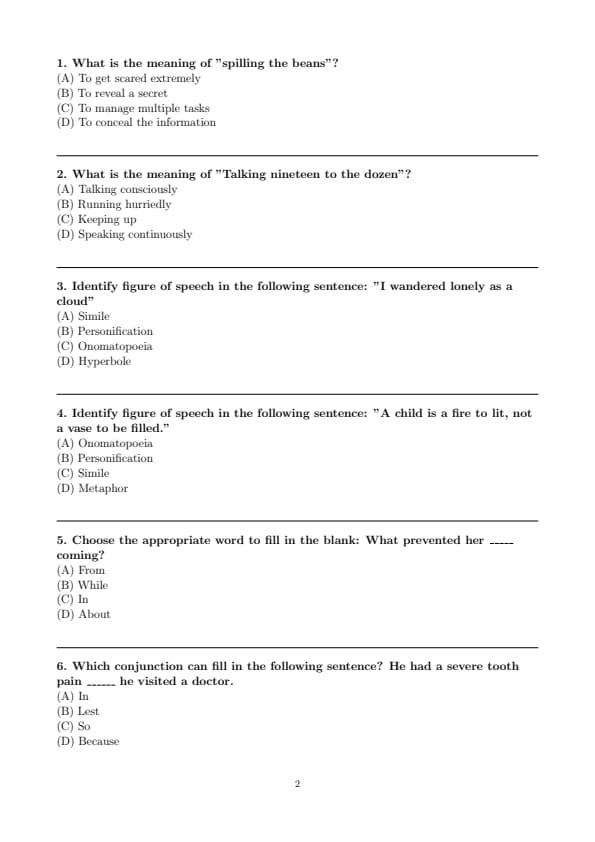
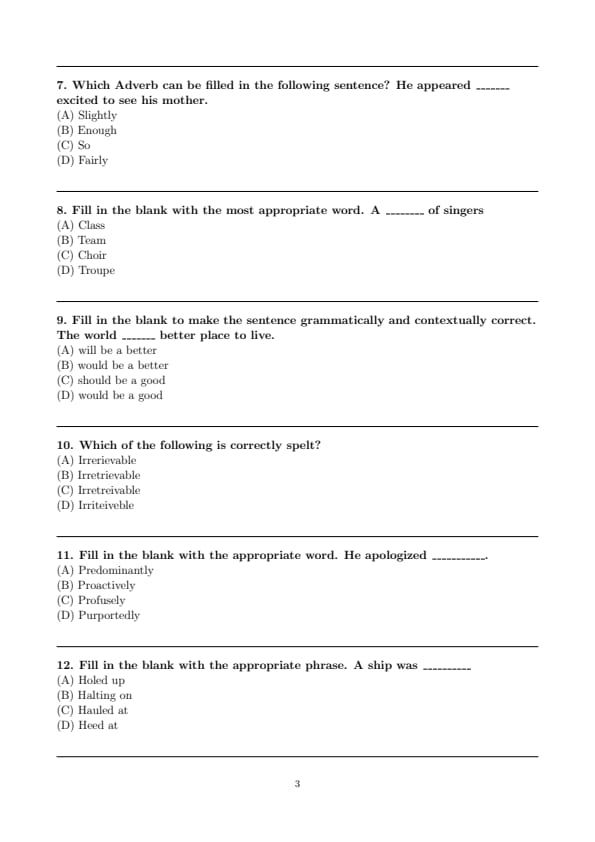
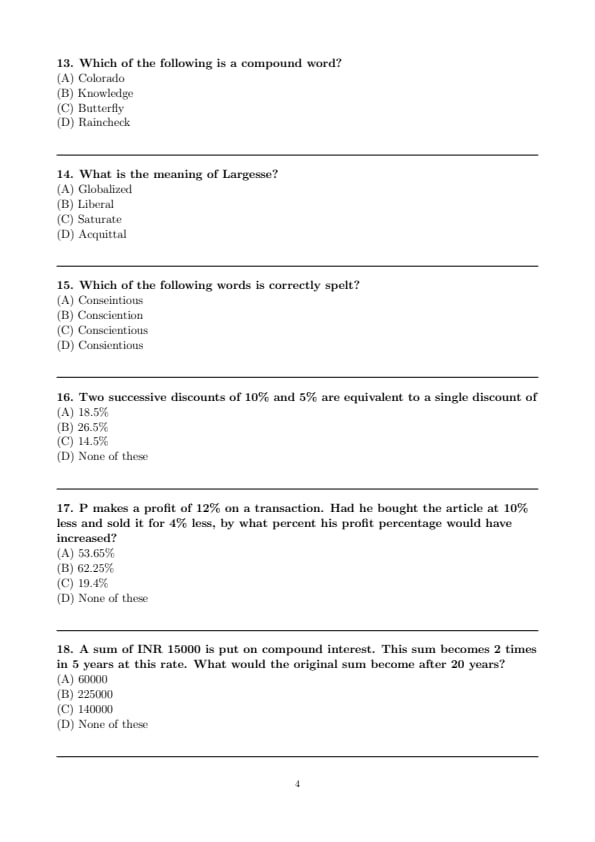
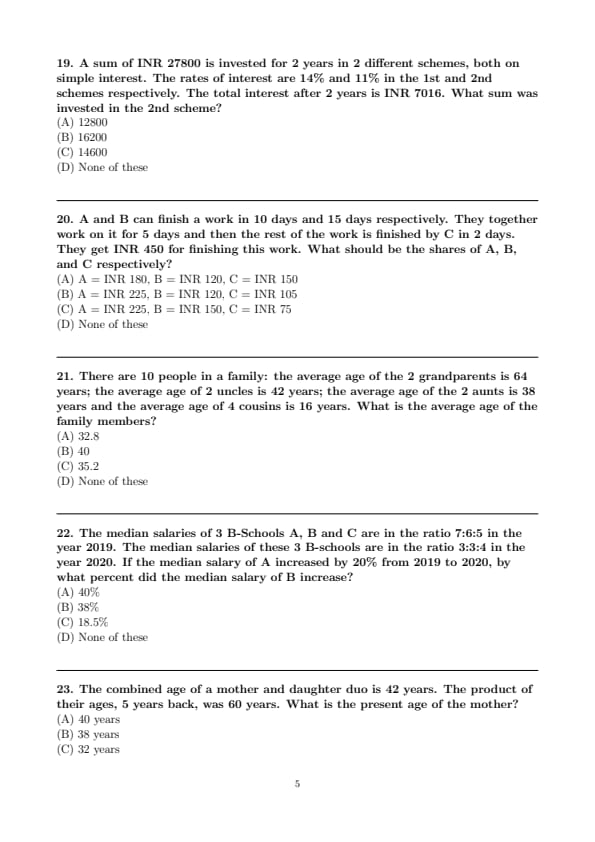
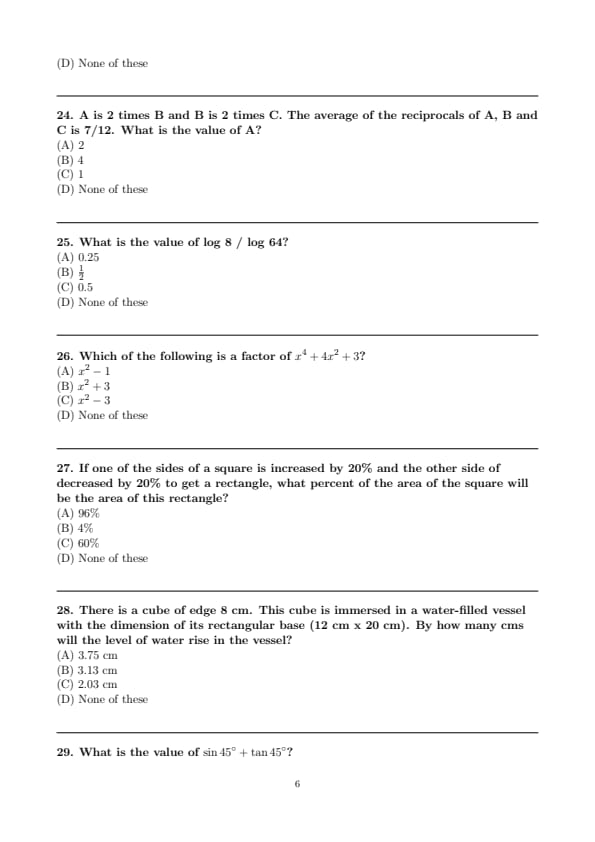
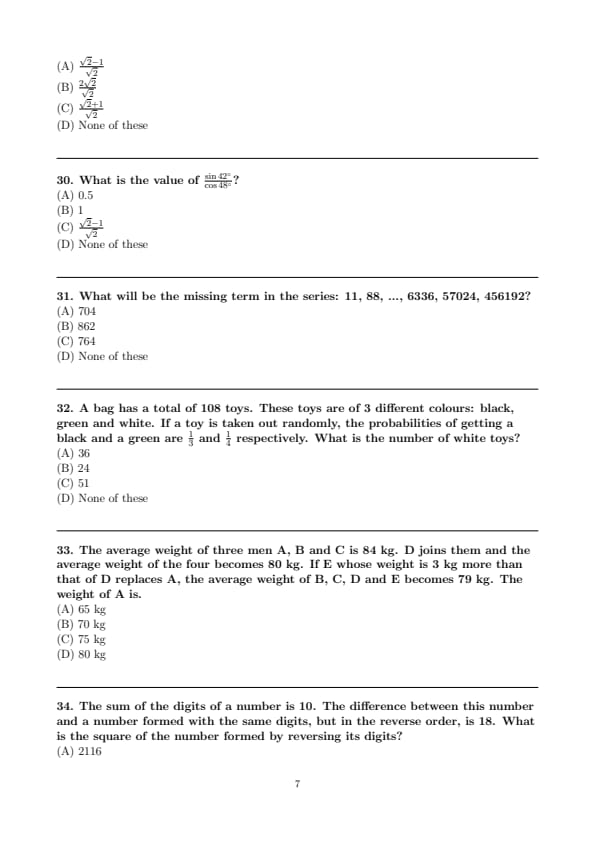
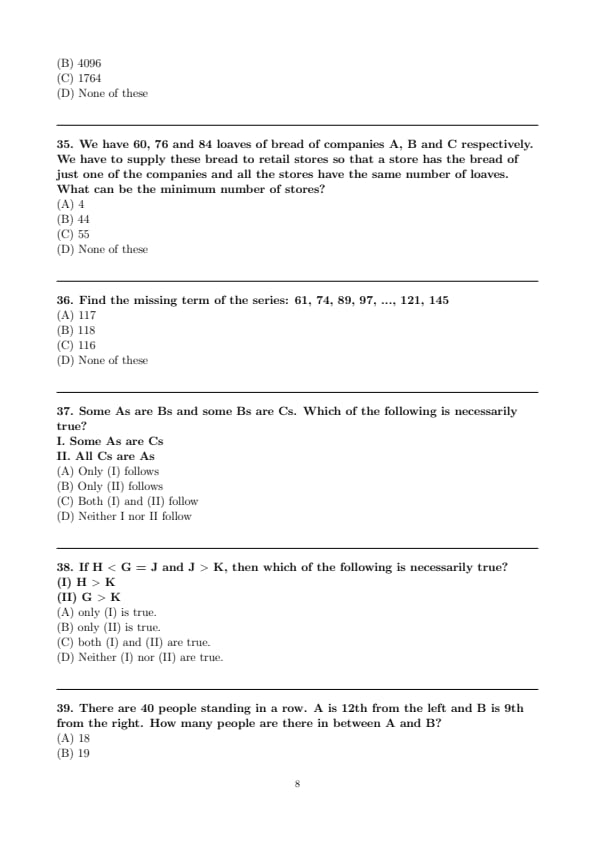
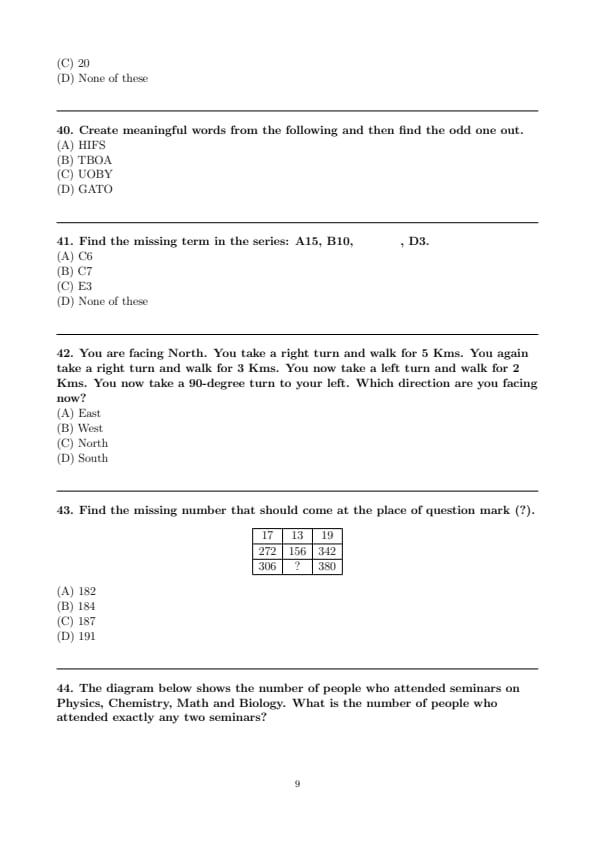
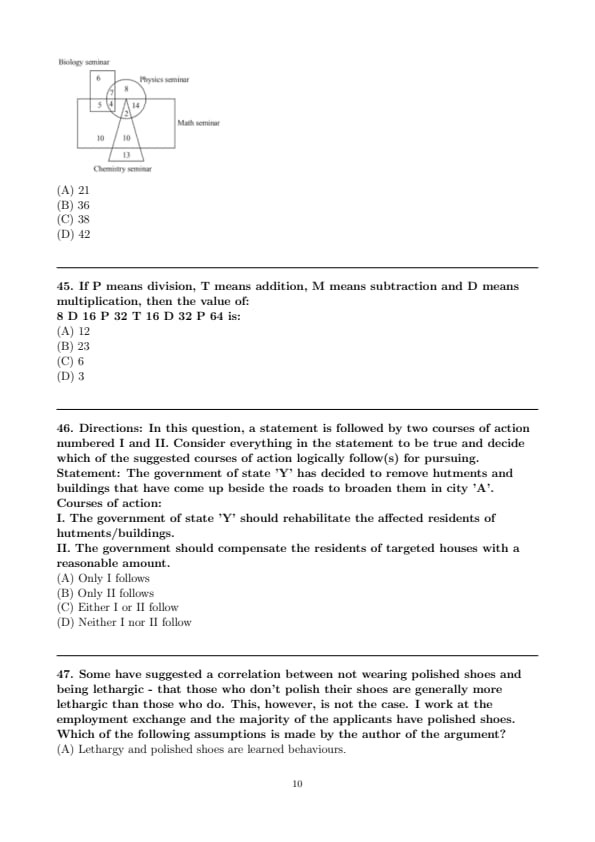
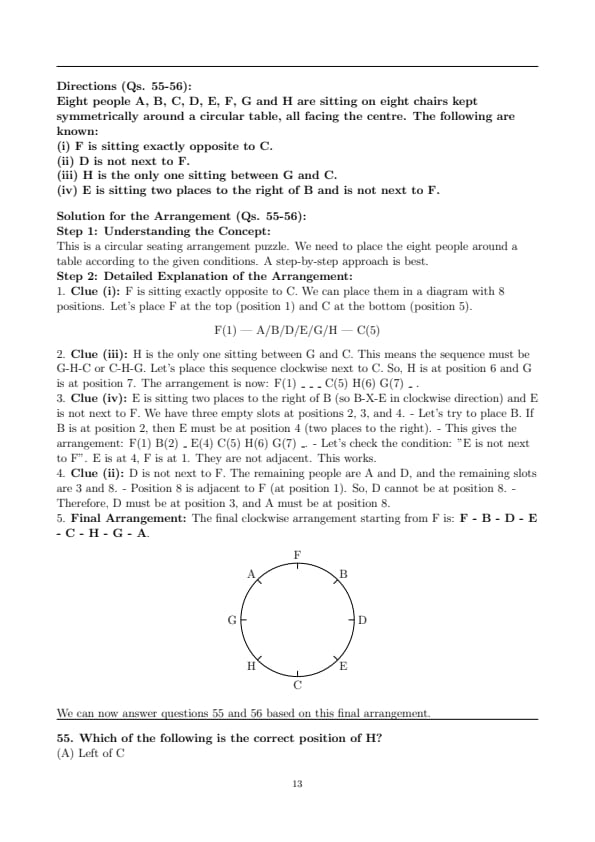
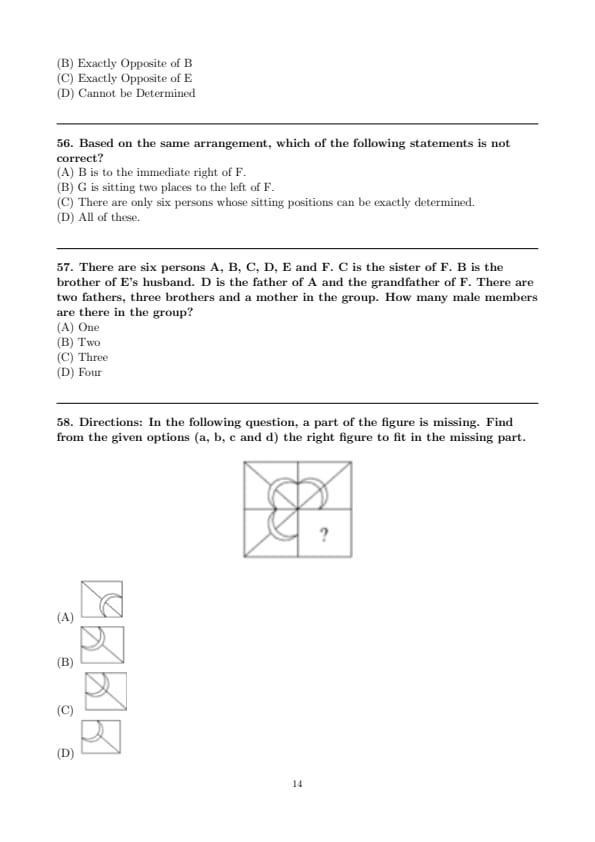
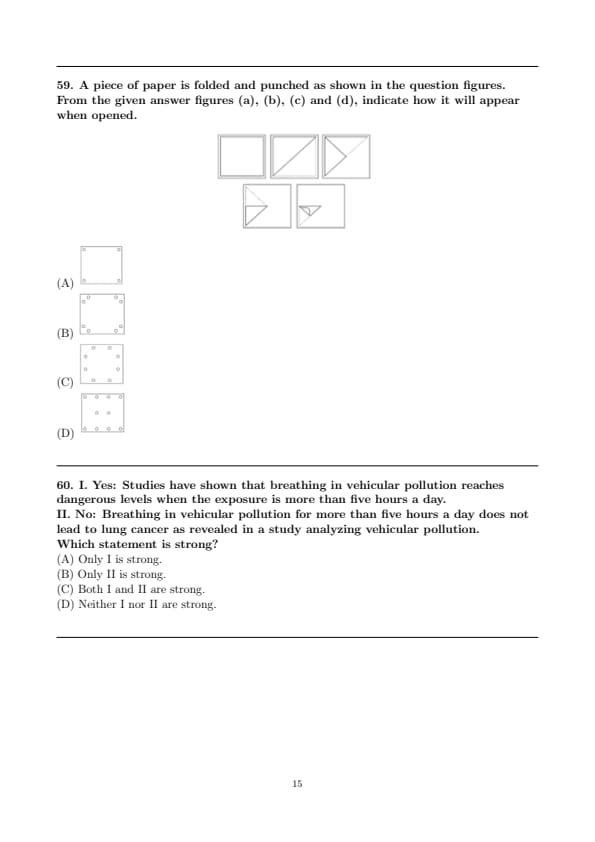
*The article might have information for the previous academic years, please refer the official website of the exam.