
SNAP 2022 Question Paper with Solution PDF


Content Writer | Updated On - Oct 7, 2025
SNAP Question Papers are crucial for effective exam preparation and are available for free download with solutions in PDF format. Conducted by Symbiosis International University (SIU) for MBA/PGDM admissions, practicing with these past papers helps aspirants understand the exam's difficulty, syllabus, and pattern, thereby improving speed and accuracy. The SNAP test is a 60-minute online exam with 60 multiple-choice questions covering General English; Quantitative, Data Interpretation & Data Sufficiency; and Analytical & Logical Reasoning. For more details and registration, visit the official website, snaptest.org.
SNAP 2022 Question Paper with Solution PDF
| SNAP 2022 Question Paper with Solutions PDF | Download PDF | Check Solutions |

Directions: In the question below, each passage consists of six sentences. The first and sixth sentences are given in the beginning. The middle four sentences in each have been removed and jumbled up. These are labeled as P, Q, R, and S. Find out the proper order for the four sentences.
S1: In the middle of one side of the square sits the Chairman of the committee, the most important person in the room.
P: For a committee is not just a mere collection of individuals.
Q: On him rests much of the responsibility for the success or failure of the committee.
R: While this is happening we have an opportunity to get the 'feel' of this committee.
S: As the meeting opens, he runs briskly through a number of formalities.
S6: From the moment its members meet, it begins to have a sort of nebulous life of its own.
View Solution
Step 1: Understanding the Task
The objective is to arrange the four jumbled sentences (P, Q, R, S) between the fixed opening (S1) and closing (S6) sentences to form a coherent and logical paragraph. This requires identifying connections between sentences based on subject, pronouns, temporal cues, and overall thematic flow.
Step 2: Identifying the Opening Link with S1
S1 introduces the central subject: "the Chairman of the committee." The next sentence should logically follow this introduction. Let's analyze the options:
- Q: "On him rests much of the responsibility..." The pronoun "him" directly refers to the Chairman introduced in S1. This creates a strong and immediate connection, elaborating on the Chairman's importance.
- P, R, S: These sentences either introduce a new action (S), a general idea (P), or an observation (R) without a direct pronoun link back to the Chairman in S1.
Therefore, Q is the most logical sentence to follow S1. This establishes the initial pair S1-Q.
Step 3: Building the Sequence from Q
After establishing the Chairman's responsibility in Q, the narrative should progress.
- S: "As the meeting opens, he runs briskly through a number of formalities." This sentence describes the action taken by the Chairman ("he") at the beginning of the meeting. It logically follows the statement about his responsibility (Q). First, we are told his role, and then we are shown what he does. This forms the sequence Q \(\rightarrow\) S.
Step 4: Using Demonstrative Pronouns to Find the Next Link
Now we have the sequence Q-S. Let's look for the next connection.
- R: "While this is happening we have an opportunity to get the 'feel' of this committee." The deictic reference "this" must refer to an action mentioned in the immediately preceding sentence. The action described in S ("he runs briskly through a number of formalities") is exactly what "this" refers to. Thus, R must follow S. This extends our sequence to Q \(\rightarrow\) S \(\rightarrow\) R.
Step 5: Finding the Bridge to the Concluding Sentence S6
Our sequence is now Q-S-R. The only remaining sentence is P. Let's see if it fits between R and S6.
- The sequence so far has focused on the Chairman and his actions.
- S6 introduces a philosophical idea about the committee itself: "it begins to have a sort of nebulous life of its own."
- P: "For a committee is not just a mere collection of individuals." This sentence provides a general, abstract statement about the nature of a committee. It acts as a perfect transition or a semantic bridge from the specific observation in R to the abstract conclusion in S6. It explains \textit{why a committee can have a "life of its own."
This completes the final sequence: Q \(\rightarrow\) S \(\rightarrow\) R \(\rightarrow\) P.
The full, coherent paragraph reads: S1 \(\rightarrow\) Q \(\rightarrow\) S \(\rightarrow\) R \(\rightarrow\) P \(\rightarrow\) S6.
Quick Tip: In para-jumble questions, start by identifying "anchors." Look for pronoun references (like "he," "him," "it," "this") that link back to a noun in a preceding sentence. Also, watch for thematic flow, such as a shift from a specific subject (the Chairman) to a general concept (the committee).
Idiom: To make clean breast of
View Solution
Step 1: Understanding the Concept
An idiom is a phrase whose meaning is not deducible from the literal definitions of the individual words. The phrase "to make clean breast of" is a classic example, where the meaning is figurative.
Step 2: Analyzing the Metaphor in the Idiom
Let's break down the metaphorical components:
- Breast: Historically and poetically, the breast or heart is considered the seat of one's deepest feelings, secrets, and conscience.
- To make clean: This implies a process of purification, of removing something that is hidden, burdensome, or "unclean" (like a secret or guilt).
Combining these, "to make clean breast of" metaphorically means to cleanse one's conscience by revealing everything hidden within, essentially telling the whole truth.
Step 3: Evaluating the Options
- (A) To gain prominence: This means to become famous or important, which is unrelated to confession.
- (B) To praise oneself: This means to boast or show vanity, which is the opposite of admitting a fault.
- (C) To confess without reserve: This means to admit everything fully and honestly, without holding anything back. This meaning aligns perfectly with the metaphor of "cleansing" one's conscience by revealing all secrets.
- (D) To destroy before it blooms: This is a different idiom, often phrased as "to nip in the bud," meaning to stop something at an early stage. It is unrelated to confession.
Step 4: Final Answer
The idiom "to make clean breast of" means to confess completely and openly. Therefore, option (C) is the correct answer.
Quick Tip: When faced with an unfamiliar idiom, try to understand the underlying metaphor. Think about the symbolic meaning of the words (like 'breast' for heart/secrets) rather than their literal definitions. This can often lead you to the correct figurative meaning.
Idiom: To keep one's temper
View Solution
Step 1: Understanding the Concept
This idiom is best understood by considering its direct opposite, which is a more commonly used phrase: "to lose one's temper." Understanding the antonymous phrase helps clarify the meaning of the given idiom.
Step 2: Analyzing the Antonymous Idiom
- "To lose one's temper" means to suddenly become very angry and unable to control one's emotions.
- The word "temper" in this context refers to a state of mind, particularly related to anger or calmness.
Therefore, "to keep one's temper" must mean the opposite: to succeed in controlling one's anger and to remain calm and composed, especially in a provocative situation.
Step 3: Evaluating the Options
- (A) To become hungry: This is related to a physical state and has no connection to emotional control.
- (B) To be in a good mood: Remaining calm and not getting angry is a key characteristic of being in a good mood or, at the very least, a stable and pleasant state of mind. This option aligns closely with the meaning of staying composed. While one can keep their temper without being overtly joyful, this is the best fit among the choices.
- (C) To preserve one's energy: While outbursts of anger can be draining, preserving energy is a consequence, not the primary meaning of the idiom.
- (D) To be aloof from: This means to be distant and uninvolved, which is different from being calm while involved in a situation.
Step 4: Final Answer
The idiom "to keep one's temper" means to stay calm and avoid getting angry. "To be in a good mood" is the closest available option that captures this state of emotional control and pleasantness.
Quick Tip: Many idioms come in pairs of opposites (e.g., "keep one's temper" vs. "lose one's temper"). If you know the meaning of one, you can often deduce the meaning of the other. This antonym pattern is a useful shortcut in vocabulary questions.
In the following question, choose the word which is the exact OPPOSITE of the given word: ENORMOUS
View Solution
Step 1: Understanding the Task
The question asks for the antonym of the word "ENORMOUS." An antonym is a word that has the exact opposite meaning. The primary attribute we need to focus on is the one described by the given word.
Step 2: Defining the Given Word
The word "Enormous" is an adjective used to describe something that is extremely large in size, scale, quantity, or degree. Its synonyms include huge, massive, gigantic, and immense. The core attribute is size.
Step 3: Searching for the Opposite Attribute
The opposite of being extremely large is being extremely small. We must find an option that conveys this meaning.
Step 4: Evaluating the Options
- (A) Soft: This word describes texture. Its opposite is "hard." It is unrelated to size.
- (B) Average: This word describes something that is moderate or typical. While an average object is not enormous, "average" is the opposite of "extreme," not specifically "large." The direct opposite of large is small.
- (C) Tiny: This word means extremely small. It is the direct and precise antonym for "enormous," as both are words of extreme scale but on opposite ends.
- (D) Weak: This word describes strength. Its opposite is "strong." It is unrelated to size.
Step 5: Final Answer
"Tiny" is the only word that represents the exact opposite of the core meaning of "Enormous." Therefore, it is the correct antonym.
Quick Tip: For antonym questions, first identify the primary quality the given word describes (e.g., size, color, speed, strength). Then, eliminate options that describe different qualities. This helps you focus on finding the true opposite.
Direct speech: "If you don't keep quiet I shall shoot you", he said to her in a calm voice. Convert to Indirect speech.
View Solution
Step 1: Understanding the Task
The task is to convert a sentence from direct speech (the exact words spoken) to indirect or reported speech. This involves several standard grammatical changes.
Step 2: Key Rules for Conversion
1. Reporting Verb: Change "said to" to a more suitable verb that reflects the tone of the sentence. A sentence like "I shall shoot you" is a threat or warning, so "warned" is more appropriate than "said" or "told."
2. Conjunction: Use "that" to connect the reporting clause and the reported speech.
3. Pronoun Change: Pronouns must be changed according to the subject and object. "I" (the speaker) becomes "he." "you" (the listener) becomes "her."
4. Tense Backshift: Since the reporting verb ("said") is in the past tense, the tenses within the quoted speech must shift one step back into the past.
- Simple Present ("don't keep") becomes Simple Past ("didn't keep").
- Simple Future ("shall shoot") becomes Conditional ("would shoot"). Note: 'Shall' with 'I' in a threat indicates determination, which is best converted to 'would'.
5. Adverbial Change: Phrases of manner are often converted into adverbs. "in a calm voice" becomes "calmly."
Step 3: Applying the Rules to the Sentence
- Reporting Verb: "he said to her" \(\rightarrow\) "he warned her"
- Manner: "in a calm voice" \(\rightarrow\) "calmly"
- Clause 1 ("If you don't keep quiet"):
- Pronoun: "you" \(\rightarrow\) "she"
- Tense: "don't keep" \(\rightarrow\) "didn't keep"
- Result: "...if she didn't keep quiet."
- Clause 2 ("I shall shoot you"):
- Pronoun: "I" \(\rightarrow\) "he" ; "you" \(\rightarrow\) "her"
- Tense: "shall shoot" \(\rightarrow\) "would shoot"
- Result: "...he would shoot her."
Step 4: Assembling the Final Sentence
Combining all the changes, we get: "He warned her calmly that he would shoot her if she didn't keep quiet." This matches option (C).
Quick Tip: In converting direct to indirect speech, pay close attention to the tone. The choice of the reporting verb (e.g., `warned`, `threatened`, `advised`, `asked`) is crucial for retaining the original meaning of the speaker's words.
Indirect speech: I told him that he was not working hard. Identify the correct direct speech form.
View Solution
Step 1: Understanding the Task
The task is to convert a sentence from indirect speech back to direct speech. This involves reversing the changes made during the direct-to-indirect conversion.
Step 2: Key Rules for Reverse Conversion
1. Reporting Verb: The indirect reporting verb "told [object]" typically converts to "said to [object]" in direct speech.
2. Punctuation: Add a comma after the reporting clause and enclose the exact spoken words in quotation marks. The first word inside the quotes must be capitalized.
3. Pronoun Change: The pronoun referring to the listener ("he") becomes "You" in direct speech, as the speaker is now addressing them directly.
4. Tense Forward Shift: Since the reporting verb ("told") is in the past, the tense inside the quote must shift forward from past to present.
- Past Continuous ("was not working") becomes Present Continuous ("are not working").
Step 3: Applying the Rules to the Sentence
- Reporting Verb: "I told him" \(\rightarrow\) "I said to him,"
- Pronoun: "he" \(\rightarrow\) "You"
- Tense: "was not working" \(\rightarrow\) "are not working"
- Punctuation: Add quotation marks.
Step 4: Assembling the Final Direct Speech Sentence
Combining these reversed changes, we get: I said to him, "You are not working hard."
Step 5: Evaluating the Options
- (A) I said to him, "You are not working hard.": This correctly applies all the rules of conversion.
- (B) I told to him, "You are not working hard.": This is grammatically incorrect. The verb "told" is transitive and does not take the preposition "to" before its object.
- (C) I said, "You are not working hard.": This changes the meaning. By omitting "to him," it is no longer clear who the speaker was addressing. The original sentence specifies the listener was "him."
Therefore, option (A) is the only correct conversion.
Quick Tip: Remember the rule for reporting verbs: In direct speech, use `said to + object`. In indirect speech, use `told + object`. The construction `told to + object` is always incorrect.
Despite his best efforts to conceal his anger ___
View Solution
Step 1: Understanding the Task
This is a sentence completion question. We need to choose the option that logically and grammatically completes the initial clause (the stem).
Step 2: Analyzing the Stem
The key phrase in the stem is "Despite his best efforts...". The word "Despite" is a conjunction that introduces a contrast or a contradiction. It sets up an expectation that the outcome will be the opposite of what was intended by the effort.
- Effort: to conceal his anger.
- Expected Outcome (due to "Despite"): The anger was not concealed; it became known.
Step 3: Evaluating the Options based on Logical Contrast
We are looking for a clause that shows the failure of his efforts.
- (A) we could detect that he was very happy: This is illogical. The stem is about concealing anger, not revealing happiness.
- (B) he failed to give us an impression of his agony: "Agony" (intense suffering) is not the same as "anger." This option is thematically inconsistent and awkwardly phrased.
- (C) he succeeded in camouflaging his emotions: This is a direct contradiction to the meaning of "Despite." If he succeeded, a word like "Because of" or "Thanks to" would be used, not "Despite."
- (D) people came to know that he was annoyed: This option provides the perfect contrast. He tried to hide his anger ("annoyed" is a synonym for angry), but despite his efforts, people became aware of it. This outcome shows that his efforts failed, which is exactly what "Despite" implies.
Step 4: Final Answer
Option (D) is the only one that creates a logical and meaningful sentence by providing the contrast required by the word "Despite."
Quick Tip: In sentence completion, always identify "signal words" like `Despite`, `Although`, `However` (which signal contrast) or `Because`, `Therefore`, `Since` (which signal cause and effect). These words are the key to determining the logical relationship between the clauses.
Even if it rains I shall come means ----
View Solution
Step 1: Understanding the Concept
The question asks for the meaning of a sentence that uses the phrase "Even if." This phrase is a concessive conjunction. It is used to introduce a condition that, even if it is true, does not prevent the action in the main clause from happening. It emphasizes the speaker's determination.
Step 2: Analyzing the Given Sentence
The sentence is "Even if it rains I shall come."
- The Condition: "it rains."
- The Action: "I shall come."
The phrase "Even if" indicates that the rain is a potential obstacle, but it will not be strong enough to stop the speaker from coming. The speaker's decision to come is firm and not dependent on the weather.
Step 3: Evaluating the Options
- (A) If I come it will not rain: This changes the logic entirely, making the speaker's arrival a cause for the rain to stop, which is not what the original sentence implies.
- (B) If it rains I shall not come: This is the direct opposite of the original sentence's meaning. It makes the coming conditional on the absence of rain.
- (C) I will certainly come whether it rains or not: This option perfectly captures the essence of "Even if." It states that the action (coming) is certain and will happen under both possibilities (if it rains and if it does not rain). This shows the speaker's determination.
- (D) Whenever there is rain I shall come: This incorrectly suggests that rain is the trigger or reason for coming. The original sentence implies coming \textit{despite the rain, not \textit{because of it.
Step 4: Final Answer
The most accurate interpretation of the sentence is that the speaker will come regardless of the rain. Option (C) expresses this certainty correctly.
Quick Tip: The phrase "Even if" signals determination. It means an action will proceed regardless of a hypothetical or real obstacle. Look for the option that expresses this unconditional certainty.
His appearance is unsmiling but \hspace{3cm}
View Solution
Step 1: Understanding the Concept
This is a sentence completion question that hinges on the function of the conjunction "but." "But" is a contrastive conjunction, meaning it connects two statements where the second one presents an idea that is unexpected or opposite to the first.
Step 2: Analyzing the Stem
The first part of the sentence is "His appearance is unsmiling." This describes his external look as serious, stern, or perhaps unfriendly. The word "but" signals that the next part of the sentence will reveal a contrasting or surprising internal quality. We expect to learn something about him that contradicts his stern exterior.
Step 3: Evaluating the Options for Contrast
- (A) his heart is full of compassion for others: This provides a perfect contrast. An "unsmiling" appearance suggests a lack of warmth, while a heart "full of compassion" represents a very warm and kind inner nature. This is a classic "don't judge a book by its cover" scenario.
- (B) he looks very serious on most occasions: This statement is consistent with an "unsmiling" appearance. It reinforces the idea rather than contrasting it.
- (C) people are afraid of him: This would be a logical consequence of an unsmiling appearance, not a contrast to it.
- (D) he is uncompromising on matters of task performance: This trait (being strict or stern in work) aligns well with an unsmiling appearance. There is no contrast here.
Step 4: Final Answer
Only option (A) offers a true contrast to the idea presented in the first clause, making it the only logical and meaningful completion for the sentence.
Quick Tip: When you encounter a sentence with "but," actively look for the option that presents an opposite or unexpected idea. Eliminate any options that are consistent with, or a logical result of, the first part of the sentence.
Choose the word which best expresses the meaning of the given word: CORPULENT
View Solution
Step 1: Understanding the Task
The question requires finding the best synonym for the word "CORPULENT" from the given options. A synonym is a word that has the same or a very similar meaning.
Step 2: Defining the Given Word
"Corpulent" is an adjective used to describe a person who is fat, stout, or has a large, bulky body. It generally refers to being overweight.
Step 3: Evaluating the Options
- (A) Lean: This means thin, especially in a healthy and fit way. It is an antonym (opposite) of corpulent.
- (B) Gaunt: This means excessively thin and bony, often due to illness, hunger, or age. It is also an antonym.
- (C) Emaciated: This means abnormally thin or weak, typically because of severe illness or lack of food. It is a strong antonym.
- (D) Obese: This means grossly fat or overweight, to a degree that is often considered unhealthy. This is a direct and precise synonym for "corpulent."
Step 4: Final Answer
Comparing the definitions, "Obese" is the word that most closely matches the meaning of "Corpulent." The other three options are all antonyms.
Quick Tip: In vocabulary questions, even if you are unsure of the exact definition, try to determine the word's connotation (positive, negative, neutral). "Corpulent" sounds heavy and is generally negative, just like "obese." The other options ("lean," "gaunt," "emaciated") refer to thinness.
Find the correctly spelt word.
View Solution
Step 1: Understanding the Task
The goal is to identify which of the four given options is the correct spelling of the word.
Step 2: Analyzing Common Spelling Patterns
The word in question involves the vowel combination 'ei' or 'ie' and the ending 'gn'. The correct English spelling often follows specific, though sometimes irregular, patterns. The pattern "-eign" is seen in words like `reign`, `sovereign`, and `foreign`. This specific pattern needs to be memorized.
Step 3: Checking Each Option
- (A) Foreign: This spelling correctly uses 'o', 're', followed by the 'eign' pattern. This adheres to the standard English spelling.
- (B) Foreine: This spelling incorrectly adds an extra 'e' at the end and misplaces the 'i'.
- (C) Fariegn: This spelling incorrectly uses 'a' instead of 'o' and misplaces the 'i'. The order of 'ie' is also incorrect for this word pattern.
- (D) Forein: This spelling incorrectly omits the letter 'g', which is essential to the '-eign' ending.
Step 4: Final Answer
Based on the standard rules of English orthography, "Foreign" is the only correctly spelled word among the choices.
Quick Tip: When unsure of a spelling, try to recall other words with similar sounds or letter combinations. For example, remembering the spelling of "reign" or "sovereign" can help you confirm the "-eign" pattern in "foreign."
Fate smiles \hspace{3cm} those who untiringly grapple with the stark realities of life.
View Solution
Step 1: Understanding the Concept
This question tests knowledge of idiomatic expressions, specifically the preposition that correctly follows the verb "smiles" in a figurative sense. An idiom is a fixed expression whose meaning is not literal.
Step 2: Identifying the Idiom
The sentence uses the phrase "Fate smiles..." This is part of the common English idiom "to smile on someone" or "to smile upon someone." This idiom means for fate, luck, or fortune to be favorable or to bring good things to a person.
Step 3: Evaluating the Prepositional Options
- (A) smiles with: This is not idiomatic in this context. One can "smile with" another person (sharing a smile), but fate does not "smile with" someone.
- (B) smiles over: This is not the correct preposition for this expression.
- (C) smiles on: This is the correct preposition to complete the idiom. "Fate smiles on those..." means that fate favors or blesses those people.
- (D) smiles round: This does not form a recognized English idiom.
Step 4: Final Answer
The only preposition that correctly completes the idiomatic expression is "on." The full, correct sentence is: "Fate smiles on those who untiringly grapple with the stark realities of life."
Quick Tip: Many verbs in English form idiomatic phrases when paired with specific prepositions (phrasal verbs or prepositional phrases). It's crucial to learn these as complete units, as changing the preposition can drastically alter the meaning or make the phrase nonsensical.
The miser gazed \hspace{3cm} at the pile of gold coins in front of him.
View Solution
Step 1: Understanding the Context
The sentence describes a "miser" looking at a "pile of gold coins." A miser is a person who hoards wealth and spends as little money as possible. This character is defined by greed and a powerful desire for money. The adverb we choose must reflect this specific emotional state.
Step 2: Analyzing the Options
We need an adverb that describes \textit{how a greedy person would gaze at a large amount of wealth.
- (A) avidly: This means with great eagerness, enthusiasm, or intense desire. This word perfectly captures the passionate greed and excitement a miser would feel.
- (B) admiringly: This means with respect, pleasure, and approval. While a miser admires gold, this word is too mild. It lacks the intensity of the greed and desire that defines a miser.
- (C) thoughtfully: This means in a pensive or contemplative manner. This is completely out of character for a miser's immediate reaction to gold; it suggests deep thought rather than raw desire.
- (D) earnestly: This means with sincere and intense conviction. It relates more to sincerity or seriousness of purpose, which doesn't quite fit the context of greedy desire.
Step 3: Selecting the Best Fit
Comparing the options, "avidly" is the most precise and vivid word to describe the miser's gaze. It conveys the necessary intensity of greed and eagerness that the context demands.
Step 4: Final Answer
The word "avidly" best completes the sentence by accurately reflecting the miser's emotional state.
Quick Tip: In fill-in-the-blank questions involving adverbs, pay close attention to the subject of the sentence (e.g., 'miser', 'hero', 'child'). The subject's inherent traits often provide the biggest clue to the correct adverb.
Directions to Solve: Each question consists of two words that have a certain relationship to each other followed by four pairs of related words. Select the pair that has the same relationship.
DIVA : OPERA
View Solution
Step 1: Understanding the Concept
This is an analogy question where we must first identify the relationship between the two words in the given pair (the stem) and then find the option that shares the exact same relationship.
Step 2: Decoding the Relationship in the Stem
The relationship between DIVA and OPERA is as follows:
- A Diva is a celebrated female singer, who is a principal \textit{performer.
- An Opera is a form of musical theatre, which is the \textit{domain or performance in which the diva performs.
So, the core relationship is Performer : Performance/Genre.
Step 3: Analyzing the Options
We will test each option against the "Performer : Performance/Genre" relationship.
- (A) producer : theatre: A producer is a manager or organizer responsible for the financial and administrative aspects of a production. A producer is not an on-stage performer. A theatre is a venue, not a performance genre itself. The relationship does not match.
- (B) director : drama: A director is responsible for the artistic vision and staging of a performance. Like a producer, a director is a crucial creator but not typically a performer within the drama. The relationship does not match.
- (C) thespian : play: A thespian is a synonym for an actor, who is a \textit{performer. A play is a theatrical \textit{performance. This pair perfectly matches the "Performer : Performance" relationship established in the stem.
- (D) None of these: This option is incorrect because option (C) is a valid match.
Step 4: Final Answer
The relationship between a thespian (performer) and a play (performance) is analogous to the relationship between a diva (performer) and an opera (performance). Therefore, option (C) is the correct answer.
Quick Tip: In analogy questions involving roles and domains, first classify the role precisely. Is it a performer, a creator, a manager, or a tool? This initial classification helps eliminate mismatched options quickly.
GRAIN : SALT
View Solution
Step 1: Understanding the Concept
This analogy is based on the relationship between a whole substance and a single, small unit or piece of that substance.
Step 2: Decoding the Relationship in the Stem
The relationship between GRAIN and SALT is:
- A grain is a single, tiny particle or fundamental unit of the substance salt.
The relationship is Smallest Unit : Whole Substance.
Step 3: Analyzing the Options
We will check which pair best represents the "Smallest Unit : Whole Substance" relationship.
- (A) shard : pottery: A shard is a broken piece of pottery. While it is a piece of the whole, "shard" emphasizes fragmentation or breakage rather than a standard, naturally occurring small unit like a grain.
- (B) shred : wood: A "shred" is a torn strip, a term more commonly associated with paper or cloth. For wood, words like "splinter" or "chip" are more appropriate. This is a weak pairing.
- (C) blades : grass: A "blade" of grass is indeed a single unit of grass, making this a strong potential analogy. However, the option is given in the plural ("blades"), which creates a mismatch with the singular "grain" in the stem. Analogy questions require precision in form as well as meaning.
- (D) chip : glass: A chip is a small, broken-off piece of glass. Like a "grain of salt," a "chip of glass" represents a small, singular piece of a larger material. This parallel is very strong and maintains the singular form.
Step 4: Final Answer
Comparing the options, `chip : glass` provides the best parallel to `grain : salt`. Both represent a singular small particle or fragment of a larger substance, and both are common collocations. Therefore, option (D) is the correct answer.
Quick Tip: For part-to-whole analogies, pay close attention to nuances. Is the "part" a fundamental unit (like a grain of salt, blade of grass) or a fragment from breakage (like a shard, chip)? Also, check for grammatical parallels like singular vs. plural forms.
A, B, C, D, E, F, and G are members of a sports club who enjoy a variety of activities, including Carrom, Table Tennis, Badminton, Bridge, Hockey, Football, and Lawn Tennis, albeit not necessary in that order. They all have distinct musical preferences, such as Sitar, Guitar, Harmonium, Flute, Tabla, Banjo, and Santoor, though not necessarily in that order. B enjoys playing Carrom and Banjo. E enjoys playing bridge but not the harmonium or the tabla. Sitar is played by the person who plays hockey. F does not play table tennis or lawn tennis. A is a badminton and flute player. Tabla is not played by those who play lawn tennis. G plays hockey and C plays the Harmonium.
Which of the following game-person-instrument pairings is absolutely correct?
View Solution
Step 1: Organize the Information
Let's break down the given facts and create a table to track the assignments for each person (A, B, C, D, E, F, G) with their Game and Instrument.
\begin{tabular{|c|c|c|
\hline
Person & Game & Instrument
\hline
A & &
B & &
C & &
D & &
E & &
F & &
G & &
\hline
\end{tabular
Step 2: Fill in Direct Assignments and Deductions
We will process each clue to fill the table.
1. A is a badminton and flute player. \(\rightarrow\) A = Badminton, Flute.
2. B enjoys playing Carrom and Banjo. \(\rightarrow\) B = Carrom, Banjo.
3. G plays hockey. \(\rightarrow\) G = Hockey.
4. From "Sitar is played by the person who plays hockey" and G playing hockey \(\rightarrow\) G = Hockey, Sitar.
5. C plays the Harmonium. \(\rightarrow\) C = Harmonium.
6. E enjoys playing bridge... \(\rightarrow\) E = Bridge.
Our table now looks like this:
\begin{tabular{|c|c|c|
\hline
Person & Game & Instrument
\hline
A & Badminton & Flute
B & Carrom & Banjo
C & ? & Harmonium
D & ? & ?
E & Bridge & ?
F & ? & ?
G & Hockey & Sitar
\hline
\end{tabular
Step 3: Narrow Down Remaining Possibilities
- Games Assigned: Badminton, Carrom, Bridge, Hockey.
- Games Remaining: Table Tennis, Football, Lawn Tennis.
- People needing Games: C, D, F.
- Clue: F does not play table tennis or lawn tennis. Since Football is the only game left for F, F must play Football. \(\rightarrow\) F = Football.
- Now, the remaining games {Table Tennis, Lawn Tennis must be played by {C, D.
Step 4: Apply the Negative Constraints
Let's use the remaining rules to check the options.
- Clue: Tabla is not played by those who play lawn tennis.
- Clue: E ... not the harmonium or the tabla.
The player of Lawn Tennis is either C or D. C already has the Harmonium. If D plays Lawn Tennis, D cannot play Tabla. This means the combination of (D, Lawn Tennis, Tabla) is impossible.
Step 5: Test Each Option
- (A) Badminton-B-Flute: This is incorrect. The table clearly shows that A plays Badminton and plays the Flute.
- (B) Table Tennis-E-Santoor: This is incorrect. The table shows that E plays Bridge, not Table Tennis.
- (C) Lawn Tennis-D-Tabla: This is incorrect. As deduced in Step 4, the person who plays Lawn Tennis cannot play the Tabla. Therefore, D cannot have this combination.
Step 6: Final Answer
Since options (A), (B), and (C) have all been proven false based on the given information and logical deductions, the correct choice is (D) None of these.
Quick Tip: For logic puzzles, create a grid or table. First, fill in all the definite positive information (X is Y). Then, use the definite negative information (X is not Z) and process-of-elimination to solve for the remaining variables. Always double-check options against all rules.
Directions to Solve: Each of the following questions consists of two sets of figures. Figures A, B, C and D constitute the Problem Set while figures 1, 2, 3, and 4 constitute the Answer Set. There is a definite relationship between figures A and B. Establish a similar relationship between figures C and D by selecting a suitable figure from the Answer Set that would replace the question mark (?) in fig. (D).
View Solution
Step 1: Understanding the Concept
This is a figure analogy problem. We must first identify the rules of transformation that change Figure A into Figure B. Then, we apply the exact same set of rules to Figure C to find the correct Figure D.
Step 2: Analyzing the Transformation from Figure A to Figure B
Let's observe the changes between Figure A and Figure B carefully.
- Change in Number of Elements: Figure A has two identical leaf-shaped motifs. Figure B has only one of these motifs. The count changes from two to one.
- Change in Orientation of Elements: In Figure A, the motifs are pointing to the left. In Figure B, the motif is pointing to the right. This is a horizontal flip, or a mirroring across a vertical axis.
Step 3: Formulating the Transformation Rule
The transformation from the first figure to the second involves two simultaneous operations:
1. The orientation is mirrored horizontally (left \(\leftrightarrow\) right).
2. The number of elements is toggled (one \(\leftrightarrow\) two).
Step 4: Applying the Transformation Rule to Figure C
Now we apply this two-part rule to Figure C to determine what Figure D should look like.
- Initial State (Figure C): Contains one swirl-shaped motif, pointing to the left.
- Applying Rule 1 (Orientation): We must mirror the motif horizontally. The left-pointing swirl must become a right-pointing swirl.
- Applying Rule 2 (Number): The count of motifs is one. We must toggle this, so the count must become two.
Step 5: Determining the Final Figure D
Combining the results, Figure D must contain two identical swirl-shaped motifs, and both must be pointing to the right.
Step 6: Matching with the Answer Set
We now look at the answer figures:
- Figure (1) has one motif pointing left. (Incorrect count and orientation)
- Figure (2) has two motifs pointing right. (Correct count and orientation)
- Figure (3) has one motif pointing right. (Incorrect count)
- Figure (4) has two motifs pointing left. (Incorrect orientation)
The figure that matches our prediction is Figure (2).
Quick Tip: In figure analogy questions, always look for multiple concurrent changes, such as rotation, reflection (mirroring), addition/subtraction of elements, or change in size. Deconstruct the transformation into a clear set of rules before applying them to the second pair.
Directions to Solve: In each question below is given a statement followed by two assumptions numbered I and II. You have to consider the statement and the following assumptions and decide which of the assumptions is implicit in the statement. Give answer
(A) If only assumption I is implicit
(B) If only assumption II is implicit
(C) If either I or II is implicit
(D) If both I and II are implicit.
Statement: "You are hereby appointed as a programmer with a probation period of one year and your performance will be reviewed at the end of the period for confirmation." — A line in an appointment letter.
Assumptions:
I. The performance of an individual generally is not known at the time of appointment offer.
II. Generally, an individual tries to prove his worth in the probation period.
View Solution
Step 1: Understanding the Concept
An assumption is something that is taken for granted or supposed to be true for a statement to make sense. We need to determine if the given assumptions are logically necessary for the statement about the probation period to be meaningful.
Step 2: Analyzing the Statement
The statement establishes a "probation period" of one year, at the end of which the employee's "performance will be reviewed" for "confirmation." The core ideas are:
1. A trial/observation period (probation).
2. A performance evaluation.
3. A decision on permanent employment (confirmation).
Step 3: Evaluating Assumption I
Assumption I states: "The performance of an individual generally is not known at the time of appointment offer."
- Reasoning: Why would an employer need a probation period and a performance review? Precisely because they cannot be 100% certain of the new employee's on-the-job performance based solely on interviews and resumes. The very existence of a probation period is to gather this unknown information.
- Conclusion: If the performance were already fully known, the probation period would be redundant. Therefore, Assumption I is implicit in the statement.
Step 4: Evaluating Assumption II
Assumption II states: "Generally, an individual tries to prove his worth in the probation period."
- Reasoning: The concept of a "performance review for confirmation" is based on the expectation that the employee is motivated to perform well to secure their job. The employer sets up this system assuming the employee will put in the effort to meet the required standards. The review would be pointless if the employer assumed the employee would not try.
- Conclusion: The system of review and confirmation is built on the expectation of effort from the employee. Therefore, Assumption II is also implicit.
Step 5: Final Answer
Since both assumptions are necessary for the statement to be logical and meaningful, both I and II are implicit.
Quick Tip: When a statement mentions a period of evaluation or a test, it almost always implicitly assumes two things: (1) there is a need to gather information that is currently unknown, and (2) there is an expectation that the subject being evaluated will make an effort to succeed.
Directions to Solve: In each question below is given a statement followed by two conclusions numbered I and II. You have to assume everything in the statement to be true, then consider the two conclusions together and decide which of them logically follows beyond a reasonable doubt from the information given in the statement. Give answer:
(A) If only conclusion I follows
(B) If only conclusion II follows
(C) If either I or II follows
(D) If neither I nor II follows
Statement: In a one-day cricket match, the total runs made by a team were 200. Out of these, 160 runs were made by spinners.
Conclusions:
I. 80% of the team consists of spinners.
II. The opening batsmen were spinners.
View Solution
Step 1: Understanding the Concept
A conclusion must be a statement that can be logically and directly inferred from the given statement. We cannot use any outside knowledge or make any assumptions beyond what is explicitly provided.
Step 2: Analyzing the Statement
The statement provides two pieces of factual data:
- Total runs scored by the team = 200.
- Runs scored by spinners = 160.
From this, we can calculate the percentage of runs scored by spinners:
\[ Percentage of runs by spinners = \left( \frac{Runs by spinners}{Total runs} \right) \times 100 = \left( \frac{160}{200} \right) \times 100 = 80% \]
So, the only certain fact is that spinners scored 80% of the total runs.
Step 3: Evaluating Conclusion I
Conclusion I states: "80% of the team consists of spinners."
- Reasoning: The statement is about the \textit{distribution of runs, not the \textit{composition of the team. It is possible that one very skilled spinner scored all 160 runs, or that several spinners contributed. A cricket team has 11 players. 80% of the team would be \(0.80 \times 11 = 8.8\) players, which is not even a whole number. We have no information about the number of spinners in the team.
- Conclusion: This conclusion does not logically follow.
Step 4: Evaluating Conclusion II
Conclusion II states: "The opening batsmen were spinners."
- Reasoning: The statement gives no information about the batting order. The 160 runs could have been scored by spinners batting at any position, from opening to the lower order. We cannot make any certain inference about who the opening batsmen were.
- Conclusion: This conclusion does not logically follow.
Step 5: Final Answer
Since neither Conclusion I nor Conclusion II can be logically derived from the statement, the correct option is (D).
Quick Tip: In logical deduction questions, be very strict about what the data represents. Here, the data is about performance (runs scored), not structure (team composition or batting order). Do not conflate the two. A high percentage of runs from one type of player does not mean a high percentage of that type of player is in the team.
Directions to Solve: Each question given below consists of a statement, followed by two arguments numbered I and II. You have to decide which of the arguments is a 'strong' argument and which is a 'weak' argument. Give answer:
(A) If only argument I is strong
(B) If only argument II is strong
(C) If either I or II is strong
(D) If neither I nor II is strong
Statement: Should India encourage exports, when most things are insufficient for internal use itself?
Arguments:
I. Yes. We have to earn foreign exchange to pay for our imports.
II. No. Even selective encouragement would lead to shortages.
View Solution
Step 1: Understanding the Concept
A 'strong' argument is one that is both important and directly related to the question. It should be realistic, logical, and based on widely accepted facts. A 'weak' argument may be trivial, ambiguous, irrelevant, or based on an unsupported generalization.
Step 2: Analyzing the Statement
The core dilemma is a trade-off: Should a country export goods (to gain benefits) even if it faces domestic shortages of those goods? This requires weighing the benefits of exporting against the costs of domestic scarcity.
Step 3: Evaluating Argument I
Argument I states: "Yes. We have to earn foreign exchange to pay for our imports."
- Relevance: This is highly relevant. Foreign exchange is essential for any country to purchase critical imports like crude oil, technology, and advanced medicines that it cannot produce itself. This is a fundamental concept of international trade and national economic health.
- Strength: The argument is strong because it points to a non-negotiable economic reality. A country cannot function in isolation. Earning foreign exchange through exports is a primary way to fund necessary imports. This provides a compelling reason to encourage exports, even in the face of domestic scarcity.
- Conclusion: Argument I is a strong argument.
Step 4: Evaluating Argument II
Argument II states: "No. Even selective encouragement would lead to shortages."
- Relevance: This is relevant as it addresses the negative consequence mentioned in the statement.
- Strength: This argument is weak because it is an over-generalization and an absolute claim. The word "selective" implies a policy that is carefully designed to avoid causing shortages. A country can export goods or services where it has a surplus (e.g., IT services, tourism) or can manage through quotas, without necessarily causing widespread shortages of essential items. The argument assumes that any export, no matter how managed, will inevitably lead to a negative outcome, which is an unsupported and extreme assertion.
- Conclusion: Argument II is a weak argument.
Step 5: Final Answer
Argument I is strong because it is based on a fundamental and unavoidable economic principle. Argument II is weak because it is an overly pessimistic and sweeping generalization that ignores the possibility of effective policy-making. Therefore, only argument I is strong.
Quick Tip: In argument analysis, favor arguments that are based on core principles (economic, social, legal) and allow for nuance. Reject arguments that make absolute, sweeping claims ("it will always lead to...") without providing justification, as they often represent a weak or simplistic viewpoint.
Look at this series: 2, 1, 1/2, 1/4, ... What number should come next?
View Solution
Step 1: Understanding the Task
The task is to identify the pattern in the given numerical series and use it to determine the next term.
Step 2: Analyzing the Pattern
The series is: 2, 1, 1/2, 1/4, ...
Let's examine the relationship between consecutive terms.
- To get from 2 to 1, we can either subtract 1 or divide by 2.
- To get from 1 to 1/2, we can either subtract 1/2 or divide by 2.
- To get from 1/2 to 1/4, we can either subtract 1/4 or divide by 2.
A consistent pattern emerges: each term is obtained by dividing the previous term by 2. This is a geometric progression.
Step 3: Key Formula or Approach
The series is a geometric progression (GP) with the first term \(a_1 = 2\). The common ratio (\(r\)) is the factor by which we multiply each term to get the next. \[ r = \frac{a_2}{a_1} = \frac{1}{2} \]
We can verify this: \(a_3 / a_2 = (1/2)/1 = 1/2\), and \(a_4 / a_3 = (1/4)/(1/2) = 1/2\). The common ratio is constant.
The formula for the \(n\)-th term of a GP is \(a_n = a_1 \cdot r^{n-1}\).
Step 4: Calculating the Next Term
The given series has four terms, so we need to find the fifth term (\(a_5\)).
The fourth term is \(a_4 = 1/4\). To find the next term, we multiply \(a_4\) by the common ratio \(r = 1/2\).
\[ a_5 = a_4 \times r = \frac{1}{4} \times \frac{1}{2} = \frac{1}{8} \]
Step 5: Final Answer
The next number in the series is 1/8.
Quick Tip: When a series involves fractions or terms that are decreasing rapidly, it's a strong indicator of a geometric progression. Immediately test for a constant common ratio (dividing each term by its preceding term).
Look at this series: 7, 10, 8, 11, 9, 12, ... What number should come next?
View Solution
Step 1: Understanding the Task
The task is to identify the pattern in the given numerical series and determine the next number. The series does not appear to have a simple arithmetic or geometric progression.
Step 2: Exploring Potential Patterns
When a series goes up and down, there are two common types of patterns to check for: an alternating operation pattern or two interleaved series.
Method A: Alternating Operations
Let's look at the difference between consecutive terms:
- From 7 to 10: +3
- From 10 to 8: -2
- From 8 to 11: +3
- From 11 to 9: -2
- From 9 to 12: +3
A clear pattern of alternating operations emerges: +3, -2, +3, -2, +3, ...
To find the next term, we apply the next operation in the sequence, which is -2.
\[ Next Term = 12 - 2 = 10 \]
Method B: Two Interleaved Series
Let's split the series into two sub-series based on their positions (odd and even).
- Odd Positions (1st, 3rd, 5th, ...): 7, 8, 9, ...
This is a simple arithmetic progression with a common difference of +1. The next term in this sub-series would be 10.
- Even Positions (2nd, 4th, 6th, ...): 10, 11, 12, ...
This is also a simple arithmetic progression with a common difference of +1. The next term in this sub-series would be 13.
Step 3: Determining the Next Term's Position
The given series has 6 terms. The next number will be the 7th term in the series. Since 7 is an odd number, we need to find the next term in the odd-position sub-series.
The odd-position series is 7, 8, 9. Following the pattern of adding 1, the next term is \(9 + 1 = 10\).
Step 4: Final Answer
Both methods yield the same result. The next number in the series is 10.
Quick Tip: If a number series seems erratic (increasing and decreasing), always check for two common patterns: (1) an alternating sequence of operations (e.g., +3, -2, +3, -2...) or (2) two separate, independent series interleaved in the odd and even positions.
Directions to Solve: In each of the following questions, two statements numbered I and II are given. There may be cause and effect relationship between the two statements. These two statements may be the effect of the same cause or independent causes. These statements may be independent causes without having any relationship. Read both the statements in each question and mark your answer as
(A) If statement I is the cause and statement II is its effect;
(B) If statement II is the cause and statement I is its effect;
(C) If both the statements I and II are independent causes;
(D) If both the statements I and II are effects of independent causes;
Statements:
I. The prices of petrol and diesel in the domestic market have remained unchanged for the past few months.
II. The crude oil prices in the international market have gone up substantially in the last few months.
View Solution
Step 1: Understanding the Concept
This question requires us to analyze two statements and determine if there is a direct cause-and-effect relationship between them, or if they are effects of other causes, or if they are unrelated.
Step 2: Analyzing Statement I
Statement I describes a situation in a specific domestic market: "The prices of petrol and diesel... have remained unchanged." This is a statement about a local economic outcome.
Step 3: Analyzing Statement II
Statement II describes a situation in the global market: "The crude oil prices in the international market have gone up substantially." This is a statement about a global economic event.
Step 4: Testing for a Direct Cause-and-Effect Relationship
- Can I cause II? Can unchanged domestic fuel prices cause international crude oil prices to rise? No. The fuel pricing policy of a single country (unless it is a massive global player drastically changing its consumption) does not drive global crude prices. Global prices are driven by factors like OPEC decisions, global demand, geopolitical conflicts, etc. So, (A) is incorrect.
- Can II cause I? If international crude oil prices go up (cause), what is the natural, direct effect on domestic fuel prices? The natural effect would be an \textit{increase in domestic prices, as the cost of raw material has risen. However, Statement I says the prices have remained \textit{unchanged. This is the opposite of the expected natural effect. Therefore, II is not the direct cause of I. So, (B) is incorrect.
Step 5: Differentiating Between Independent Causes and Common Effects
Since there is no direct cause-effect link, we must decide between options (C) and (D). The key is to recognize that both statements are \textit{outcomes or \textit{effects of underlying events.
- The cause of Statement II (rising global prices) could be factors like increased global demand, a war in an oil-producing region, or production cuts by OPEC. These are the independent causes. Statement II is the effect.
- The cause of Statement I (stable domestic prices despite rising global prices) must be an intervening factor, such as a government policy to absorb the price hike through subsidies, a reduction in taxes, or a decision to freeze prices for political reasons. This policy is the independent cause. Statement I is the effect.
Step 6: Final Answer
Both statements are effects, but they are effects of different, independent causes. Statement I is an effect of a domestic policy decision, while Statement II is an effect of global market forces. Therefore, both statements I and II are effects of independent causes.
Quick Tip: When a question contrasts a global market trend with a domestic market outcome, look for a hidden cause. If the domestic outcome is the opposite of what the global trend would naturally cause, it's almost certainly the effect of a specific domestic policy (like subsidies, taxes, or price controls).
Two statements are given. Identify the cause-effect relationship, if any.
I. The government has recently fixed the fees for professional courses offered by the unaided institutions which are much lower than the fees charged last year.
II. The parents of the aspiring students launched a severe agitation last year protesting against the high fees charged by the unaided institutions.
View Solution
Step 1: Understanding the Concept
This question requires analyzing two events to determine if one caused the other. A cause must precede its effect, and there must be a logical and plausible link between the two events.
Step 2: Analyzing the Timeline of Events
- Statement II describes an event that happened "last year": parents' agitation against high fees.
- Statement I describes an event that happened "recently": the government fixing fees at a lower rate.
The timeline is clear: The agitation (event II) occurred before the government's action (event I). For a cause-and-effect relationship to exist, the cause must happen before the effect. This chronological order supports the possibility that II is the cause and I is the effect.
Step 3: Checking for a Plausible Causal Link
Is it plausible that a "severe agitation" by parents would cause the government to fix fees? Yes. Public protests and agitations are common methods for citizens to voice grievances, and they often lead to policy changes or regulatory interventions by the government. An agitation against high fees provides a strong and direct reason for the government to step in and regulate the fees. The link is logical and strong.
Step 4: Evaluating Other Options
- (A) Statement I is the cause and statement II is its effect: This is impossible because the effect (agitation in statement II) happened "last year," before the cause (government action in statement I) which happened "recently." The chronological order is reversed.
- (C) Both the statements I and II are independent causes: This is unlikely. Statement I (a government policy) is clearly a response or an effect of some situation, not an independent cause in this context. The direct link to the protest in statement II is too strong to ignore.
- (D) Both the statements I and II are effects of independent causes: This is also unlikely. While both events could be linked to a broader issue like the rising cost of education, the specific protest in II provides a direct and sufficient explanation for the specific government action in I. Treating them as effects of different causes would be an unnecessary complication when a direct link exists.
Step 5: Final Answer
The event in Statement II occurred before the event in Statement I, and there is a direct, plausible connection between them. The parents' protest (cause) led to the government's fee regulation (effect).
Quick Tip: In cause-and-effect questions, always establish the timeline first. Look for temporal keywords like "recently," "last year," "in the past," etc. Causation can only flow from an earlier event to a later one. Once the timeline is set, check if the link between the events is logical and plausible.
Pointing to a photograph of a boy Mr. Ram said, "He is the son of the only son of my mother." How is Mr. Ram related to that boy?
View Solution
Step 1: Understanding the Concept
This is a blood relations problem that requires decoding a complex statement by working from the inside out. We need to resolve the possessive phrases first.
Step 2: Decoding the Innermost Phrase
The speaker is Mr. Ram. Let's analyze the phrase: "the only son of my mother".
- "My mother" refers to Mr. Ram's mother.
- "The only son of my mother" refers to the only male child of Mr. Ram's mother.
- Since Mr. Ram is a male ("Mr."), and he is a son of his mother, he himself must be that "only son."
Therefore, the phrase "the only son of my mother" is a descriptive way of saying "myself" or "Mr. Ram".
Step 3: Substituting the Decoded Phrase back into the Statement
The original statement is: "He (the boy in the photograph) is the son of [the only son of my mother]."
By substituting our decoded phrase, the statement becomes:
"He (the boy in the photograph) is the son of [Mr. Ram]."
Step 4: Concluding the Relationship
If the boy in the photograph is the son of Mr. Ram, then Mr. Ram's relationship to the boy is that of a father.
Quick Tip: For blood relation puzzles with nested possessives (e.g., "son of my mother's brother"), always solve the innermost part first (my mother's brother = my uncle). Then substitute this simpler relationship back into the sentence to solve the next layer.
Ravi is the son of Aman's father's sister. Sahil is the son of Divya who is the mother of Gaurav and grandmother of Aman. Ashok is the father of Tanya and grandfather of Ravi. Divya is the wife of Ashok. How is Ravi related to Divya?
View Solution
Step 1: Understanding the Concept
This complex blood relations problem requires us to establish a family tree by connecting the individuals mentioned in each statement. The best approach is to map out the relationships piece by piece.
Step 2: Analyzing the Relationships
Let's break down each piece of information:
1. "Ravi is the son of Aman's father's sister."
- Aman's father's sister is Aman's paternal aunt.
- Ravi is the son of Aman's paternal aunt. This makes Ravi and Aman paternal cousins. They are in the same generation.
2. "Sahil is the son of Divya who is the mother of Gaurav and grandmother of Aman."
- Divya is the grandmother of Aman. This places Divya two generations above Aman.
- Divya is the mother of Gaurav. This means Gaurav is Aman's parent (either father or mother).
3. "Ashok is the father of Tanya and grandfather of Ravi."
- Ashok is the grandfather of Ravi. This places Ashok two generations above Ravi.
- Ashok is the father of Tanya. This means Tanya is Ravi's parent (mother, since Ravi is the son).
4. "Divya is the wife of Ashok."
- We already know Ashok is the grandfather of Ravi. Since Divya is Ashok's wife, she must be the grandmother of Ravi.
Step 3: Concluding the Relationship between Ravi and Divya
From the deductions in Step 2, we have established that:
- Divya is the grandmother of Ravi.
Therefore, Ravi's relationship to Divya is that of a Grandson.
Step 4: Visualizing the Family Tree (Optional)
- Top Generation: [Ashok (+)] married to [Divya (-)]
- Middle Generation: They have a child, [Tanya (-)]. (Gaurav is also their child or child-in-law).
- Bottom Generation: Tanya has a son, [Ravi (+)]. Gaurav has a child, [Aman].
This confirms that Divya is the grandmother and Ravi is the grandson.
Quick Tip: For complex blood relation problems, drawing a simple family tree is the most reliable method. Use symbols like (+) for male, (-) for female, and draw lines to represent marriage and parent-child relationships. This helps visualize the connections and avoid confusion.
The angle between the minute hand and the hour hand of a clock when the time is 4:20 is:
View Solution
Step 1: Understanding the Concept
To find the angle between the hands of a clock, we can calculate the angular position of each hand relative to a fixed point (usually the 12 o'clock position) and then find the absolute difference between these two positions. A clock face is a full circle of 360°.
Step 2: Key Formula or Approach
The angular position of the hands can be calculated as follows, where H is the hour and M is the minute:
- Position of the Minute Hand (\(\theta_{min}\)): The minute hand completes 360° in 60 minutes. So, its speed is \(360/60 = 6^\circ\) per minute.
\[ \theta_{min} = 6 \times M \]
- Position of the Hour Hand (\(\theta_{hour}\)): The hour hand completes 360° in 12 hours (720 minutes). So, its speed is \(360/720 = 0.5^\circ\) per minute.
\[ \theta_{hour} = 30 \times H + 0.5 \times M \]
(The \(30 \times H\) part gives the base position at the hour, and the \(0.5 \times M\) part adds the extra movement due to the passing minutes).
- Angle between hands (\(\theta\)):
\[ \theta = |\theta_{hour} - \theta_{min}| \]
Step 3: Detailed Calculation for 4:20
Here, H = 4 and M = 20.
1. Calculate the minute hand's position:
\[ \theta_{min} = 6 \times 20 = 120^\circ \]
2. Calculate the hour hand's position:
\[ \theta_{hour} = (30 \times 4) + (0.5 \times 20) = 120 + 10 = 130^\circ \]
3. Find the difference:
\[ \theta = |130^\circ - 120^\circ| = 10^\circ \]
Step 4: Final Answer
The angle between the minute hand and the hour hand at 4:20 is 10°.
Quick Tip: A common mistake is to assume the hour hand only moves when the hour changes. Remember that the hour hand moves continuously. The formula component `+ 0.5 * M` is crucial for accuracy as it accounts for this continuous movement.
At 3:40, the hour hand and the minute hand of a clock form an angle of:
View Solution
Step 1: Understanding the Concept
As with the previous question, we will calculate the individual angular positions of the hour and minute hands from the 12 o'clock mark and then find the absolute difference between them. The smaller of the two possible angles (the angle and its reflex angle) is generally taken as the answer unless specified otherwise.
Step 2: Key Formula or Approach
We use the standard formulas for the positions of the clock hands:
- Position of the Minute Hand: \(\theta_{min} = 6 \times M\)
- Position of the Hour Hand: \(\theta_{hour} = 30 \times H + 0.5 \times M\)
- Angle: \(\theta = |\theta_{hour} - \theta_{min}|\)
Step 3: Detailed Calculation for 3:40
Here, H = 3 and M = 40.
1. Calculate the minute hand's position:
The minute hand is at the 40-minute mark (the number 8 on the clock).
\[ \theta_{min} = 6 \times 40 = 240^\circ \]
2. Calculate the hour hand's position:
The hour hand has moved past the 3, and is two-thirds of the way towards the 4.
\[ \theta_{hour} = (30 \times 3) + (0.5 \times 40) = 90 + 20 = 110^\circ \]
3. Find the difference:
\[ \theta = |240^\circ - 110^\circ| = 130^\circ \]
Step 4: Final Answer
The angle between the hands is 130°. The reflex angle would be \(360^\circ - 130^\circ = 230^\circ\). Since 130° is the smaller angle, it is the correct answer. The correct option is (C), not (B). The provided answer key may contain an error.
Quick Tip: A quick shortcut formula for the angle is \(\theta = |30H - 5.5M|\). For 3:40, this gives \(|30(3) - 5.5(40)| = |90 - 220| = |-130| = 130^\circ\). This formula combines the steps and can be faster.
Directions to Solve: In each of the following questions two statements are given and these statements are followed by two conclusions numbered (1) and (2). You have to take the given two statements to be true even if they seem to be at variance from commonly known facts. Read the conclusions and then decide which of the given conclusions logically follows from the two given statements, disregarding commonly known facts. Give answer:
(A) If only (1) conclusion follows
(B) If only (2) conclusion follows
(C) If either (1) or (2) follows
(D) If neither (1) nor (2) follows
Statements:
1. Some actors are singers.
2. All the singers are dancers.
Conclusions:
1. Some actors are dancers.
2. No singer is an actor.
View Solution
Step 1: Understanding the Concept
This is a syllogism problem. We need to determine which conclusions logically follow from the given premises. A good method is to use Venn diagrams to visualize the relationships between the sets (Actors, Singers, Dancers).
Step 2: Diagramming the Statements
- Statement 1: "Some actors are singers." This means there is an overlap between the set of actors and the set of singers. We draw two intersecting circles, one for Actors (A) and one for Singers (S). The overlapping area represents actors who are also singers.
- Statement 2: "All the singers are dancers." This means the entire set of singers is contained within the set of dancers. We draw a larger circle for Dancers (D) that completely encloses the Singers (S) circle.
\begin{tikzpicture
\draw (0,0) circle (1.5cm) node[below] {Actors;
\draw (2.5,0) circle (1.2cm) node[below] {Singers;
\draw (2.5,0) circle (2.2cm) node[above=2cm] {Dancers;
\node at (1.25,0) {X; % Overlap for "Some"
\end{tikzpicture
Step 3: Evaluating Conclusion 1
Conclusion 1 states: "Some actors are dancers."
- From our diagram, we see that the overlapping area (marked 'X') representing "actors who are singers" is inside the Singers circle.
- Since the entire Singers circle is inside the Dancers circle, the overlapping area 'X' must also be inside the Dancers circle.
- This means that the individuals who are both actors and singers are necessarily also dancers. Therefore, it is true that "Some actors are dancers."
- Conclusion 1 logically follows.
Step 4: Evaluating Conclusion 2
Conclusion 2 states: "No singer is an actor."
- This is a direct contradiction of Statement 1, which explicitly says, "Some actors are singers." If some actors are singers, it is impossible for no singer to be an actor.
- Conclusion 2 does not follow; in fact, it is false.
Step 5: Final Answer
Only Conclusion 1 logically follows from the given statements. Conclusion 2 is a direct contradiction of a premise. Therefore, the correct option is (A).
Quick Tip: Venn diagrams are a powerful tool for solving syllogisms. Always start by diagramming the "All" statements, as they create clear containers. Then, add the "Some" statements by showing an overlap. The valid conclusions will be visually apparent from the final diagram.
Statements:
I. All Actors are Musicians.
II. No Musician is a Singer.
III. Some Singers are Dancers.
IV. Some Dancers are Musicians.
Conclusions:
1. Some actors are singers.
2. Some dancers are actors.
3. No actor is a singer.
View Solution
Note: The conclusions for this question were not explicitly numbered in the provided material, and the options seem to refer to a different numbering scheme. The following solution analyzes the logical relationships based on the provided statements to justify the given answer. We will refer to the potential conclusions as C1: "Some actors are singers," C2: "Some dancers are actors," and C3: "No actor is a singer."
Step 1: Understanding the Concept
This is a complex syllogism problem. We will use the given statements (premises) to check the validity of potential conclusions. The key is to see how the sets (Actors, Musicians, Singers, Dancers) relate to each other.
Step 2: Analyzing the Premises
- From Statement I (All Actors are Musicians), we can say the set of Actors (A) is a subset of the set of Musicians (M). \(A \subset M\).
- From Statement II (No Musician is a Singer), we know the set of Musicians (M) and the set of Singers (S) have no overlap. \(M \cap S = \emptyset\).
- From Statement III (Some Singers are Dancers), there is an overlap between Singers (S) and Dancers (D). \(S \cap D \neq \emptyset\).
- From Statement IV (Some Dancers are Musicians), there is an overlap between Dancers (D) and Musicians (M). \(D \cap M \neq \emptyset\).
Step 3: Evaluating the Relationship Between Actors and Singers
- We know that \(A \subset M\) (all actors are musicians).
- We also know that \(M \cap S = \emptyset\) (no musician is a singer).
- Since the entire set of Actors is inside the Musicians set, and the Musicians set has no overlap with the Singers set, it logically follows that the Actors set cannot overlap with the Singers set either.
- Therefore, we can definitively conclude that No Actor is a Singer. This means Conclusion C3 is a certain and valid deduction. Consequently, its contradictory, Conclusion C1 ("Some actors are singers"), is definitely false.
Step 4: Justifying the "Either/Or" Answer
- In standard logical deduction, since we have proven C3 ("No actor is a singer") to be true, that would be the correct conclusion.
- However, some logic puzzle formats present an "Either/Or" option for conclusions that are \textit{contradictory pairs. A contradictory pair consists of two statements that cannot both be true and cannot both be false (e.g., "Some A are B" and "No A are B").
- In this question, Conclusion C1 ("Some actors are singers") and Conclusion C3 ("No actor is a singer") form such a contradictory pair. According to the principle of the excluded middle, one of them must be true and the other must be false.
- The question format, by offering an "Either (1) or (3)" answer, implies that we must choose the option representing this logically necessary pair, acknowledging that one must be true and the other false. While our analysis shows C3 is definitively true, this answer choice reflects the fundamental logical relationship between the two contradictory statements.
Quick Tip: In syllogisms, when you see a pair of conclusions that are perfect contradictories (like "Some X are Y" and "No X are Y"), be alert for an "Either/Or" option. This option is often used to test the recognition of such logical pairs.
In this series, you will be looking at both the letter pattern and the number pattern. Fill the blank in the middle of the series or the end of the series.
Series: SCD, TEF, UGH, \hspace{3cm}, WKL
View Solution
Step 1: Understanding the Concept
This is an alphabet series where the pattern is hidden within groups of three letters. The best approach is to analyze the pattern of the first letters of each group, the second letters of each group, and the third letters of each group independently.
Step 2: Analyzing the Pattern for Each Letter Position
Let's convert the letters to their numerical positions in the alphabet (A=1, B=2, ... Z=26).
First Letter Series: S (19), T (20), U (21), ?, W (23)
The pattern is a simple arithmetic progression: 19, 20, 21, ... The numbers are increasing by 1. The missing number is 22, which corresponds to the letter V.
Second Letter Series: C (3), E (5), G (7), ?, K (11)
The pattern is an arithmetic progression of odd numbers: 3, 5, 7, ... The numbers are increasing by 2. The missing number is 9, which corresponds to the letter I.
Third Letter Series: D (4), F (6), H (8), ?, L (12)
The pattern is an arithmetic progression of even numbers: 4, 6, 8, ... The numbers are increasing by 2. The missing number is 10, which corresponds to the letter J.
Step 3: Assembling the Missing Block
Combining the letters we found for each position:
- First letter: V
- Second letter: I
- Third letter: J
The missing block is VIJ.
Step 4: Verifying the Pattern
Let's check if the pattern continues from VIJ to the next block, WKL.
- V (22) + 1 = W (23). Correct.
- I (9) + 2 = K (11). Correct.
- J (10) + 2 = L (12). Correct.
The pattern holds, confirming our answer.
Quick Tip: For series with blocks of letters, don't try to find a relationship between the letters within a block (like S, C, D). Instead, treat it as multiple interleaved series: one for the first letters, one for the second, and so on. Converting letters to their numerical positions makes arithmetic patterns easier to spot.
Statement: A large number of people in ward X of the city are diagnosed to be suffering from a fatal malaria type.
Courses of Action:
I. The city municipal authority should take immediate steps to carry out extensive fumigation in ward X.
II. The people in the area should be advised to take steps to avoid mosquito bites.
View Solution
Step 1: Understanding the Concept
A course of action question requires us to evaluate suggested actions based on a given problem statement. A valid course of action should be a practical and logical step towards solving the problem or mitigating its effects.
Step 2: Analyzing the Problem
The problem is a severe public health crisis: a "large number of people" are suffering from a "fatal malaria type" in a specific area (ward X). The key elements are the severity (fatal), the scale (large number), and the cause (malaria, which is transmitted by mosquitoes).
Step 3: Evaluating Course of Action I
Action I suggests "extensive fumigation in ward X."
- Logic: Fumigation is a standard and effective method for killing adult mosquitoes, the vectors that transmit malaria. By reducing the mosquito population, fumigation helps to break the chain of transmission and prevent new infections.
- Effectiveness: This action directly addresses the root cause of the spread of the disease. It is a necessary public health intervention. Therefore, Course of Action I logically follows.
Step 4: Evaluating Course of Action II
Action II suggests advising people to "take steps to avoid mosquito bites."
- Logic: This involves public awareness and promoting personal protective measures (like using mosquito nets, repellents, and wearing protective clothing). This empowers individuals to protect themselves and their families, reducing their risk of infection.
- Effectiveness: This complements the large-scale fumigation effort. While fumigation reduces the overall mosquito population, it may not eliminate all of them. Personal protection remains a crucial line of defense. Therefore, Course of Action II also logically follows.
Step 5: Final Answer
Both actions are logical, practical, and necessary. They address different facets of the problem: Action I is a large-scale environmental control measure, while Action II is a personal protection and awareness measure. A comprehensive public health response requires both. Thus, both I and II follow.
Quick Tip: In problems related to public health emergencies or disasters, an effective response usually involves a multi-pronged approach. Look for actions that combine large-scale, official intervention (like fumigation) with public awareness and individual responsibility (like personal protection). Both are often valid and necessary.
Statement: Severe drought is reported to have set in several parts of the country.
Courses of Action:
I. Government should immediately make arrangement for providing financial assistance to those affected.
II. Food, water, and fodder should immediately be sent to all these areas to save the people and cattle.
View Solution
Step 1: Understanding the Concept
We need to determine if the proposed courses of action are logical and appropriate responses to the problem described in the statement.
Step 2: Analyzing the Problem
The problem is a "severe drought" affecting "several parts of the country." Drought has multiple consequences:
- Scarcity of Resources: Lack of water, which leads to a shortage of food for people and fodder for livestock.
- Economic Hardship: Crop failure and loss of livestock lead to a loss of income and severe financial distress for affected populations, especially farmers.
Step 3: Evaluating Course of Action I
Action I is to provide "financial assistance to those affected."
- Logic: This directly addresses the economic hardship caused by the drought. Financial aid helps people purchase essentials that may not be covered by direct supply (like medicine, clothing), pay off debts, and begin the process of economic recovery. This is a standard and necessary part of disaster relief. Therefore, Course of Action I logically follows.
Step 4: Evaluating Course of Action II
Action II is to send "food, water, and fodder" to the affected areas.
- Logic: This directly addresses the immediate survival needs caused by the scarcity of resources. People and cattle need food and water to survive. Providing these essential supplies is the most critical first response to a drought to prevent starvation and death. Therefore, Course of Action II also logically follows.
Step 5: Final Answer
Both actions are essential components of a comprehensive drought relief effort. Action II addresses the immediate, life-threatening scarcity of essentials, while Action I addresses the equally critical economic impact. They are not mutually exclusive; they address different needs and should be implemented together. Thus, both I and II follow.
Quick Tip: When dealing with disaster management scenarios (like floods, droughts, or earthquakes), a proper course of action must address both the immediate survival needs (food, water, shelter) and the short-to-medium term economic recovery (financial aid, livelihood support). Both aspects are crucial.
It was Sunday on Jan 1, 2006. What was the day of the week on Jan 1, 2010?
View Solution
Step 1: Understanding the Concept
The day of the week for a particular date shifts forward each year due to the number of days in a year. An ordinary year has 365 days, while a leap year has 366 days. We need to count the total number of "odd days" (days beyond a complete number of weeks) between the two dates.
Step 2: Key Formula or Approach
- An ordinary year (365 days) has \(365 \div 7 = 52\) weeks and 1 odd day. So, the day of the week shifts forward by 1.
- A leap year (366 days) has \(366 \div 7 = 52\) weeks and 2 odd days. So, the day of the week shifts forward by 2.
- A leap year is a year divisible by 4, except for century years which must be divisible by 400.
Step 3: Detailed Calculation
We need to find the total number of odd days between Jan 1, 2006, and Jan 1, 2010. The period includes the full years 2006, 2007, 2008, and 2009.
- Year 2006: Not divisible by 4. It's an ordinary year. 1 odd day.
- Year 2007: Not divisible by 4. It's an ordinary year. 1 odd day.
- Year 2008: Divisible by 4. It's a leap year. 2 odd days.
- Year 2009: Not divisible by 4. It's an ordinary year. 1 odd day.
Total number of odd days = \(1 + 1 + 2 + 1 = 5\) odd days.
Step 4: Determining the Final Day
The day of the week on Jan 1, 2010, will be 5 days after the day on Jan 1, 2006.
The starting day is Sunday.
Sunday + 5 days = Friday.
(Sunday+1=Monday, +2=Tuesday, +3=Wednesday, +4=Thursday, +5=Friday)
Quick Tip: To find the day of the week for the same date in a future year, simply count the number of intervening years. Add +1 for each ordinary year and +2 for each leap year to find the total day shift. Remember to check carefully which years are leap years.
What was the day of the week on 28th May 2006?
Reference Information: Jan 1, 2006 was a Sunday.
View Solution
Step 1: Understanding the Concept
We need to find the day of the week for a future date within the same year, given a reference date and its day. This is done by counting the total number of days between the two dates and finding the number of odd days (the remainder when the total days are divided by 7).
Step 2: Counting the Number of Days
We need to count the number of days from Jan 1, 2006, to May 28, 2006. First, we note that 2006 is not a leap year, so February has 28 days.
Let's count the number of days in each month of the period:
- January: 31 days
- February: 28 days
- March: 31 days
- April: 30 days
- May: 28 days (up to the 28th)
Total number of days from Jan 1 to May 28 (inclusive) = \(31 + 28 + 31 + 30 + 28 = 148\) days.
Step 3: Calculating the Odd Days
To find the day of the week, we can find the total shift in days from the reference date. The number of days that have passed after January 1st is \(148 - 1 = 147\).
Now, we find the number of odd days in this period of 147 days.
\[ Number of odd days = 147 \pmod{7 \]
Since \(147 = 7 \times 21\), the division gives a remainder of 0.
\[ 147 \div 7 = 21 with a remainder of 0 \]
This means there are exactly 21 full weeks between Jan 1 and May 28. A shift of 0 odd days means the day of the week will be the same.
Step 4: Determining the Final Day
The day on May 28, 2006 will be the starting day (Sunday) + 0 odd days.
\[ Sunday + 0 days = Sunday \]
Therefore, May 28, 2006 was a Sunday.
Quick Tip: An efficient way to count odd days within a year is to sum the odd days for each month: Jan (3), Feb (0 or 1), Mar (3), Apr (2), etc. For the final month, use the date itself modulo 7. Sum all these odd day values and take the final sum modulo 7 for the total shift.
There are 8 houses in a line and in each house, only one boy lives with the conditions as given below:
Jack is not the neighbour of Siman.
Harry is just next to the left of Larry.
There is at least one to the left of Larry.
Paul lives in one of the two houses in the middle.
Mike lives in between Paul and Larry.
If at least one lives to the right of Robert and Harry is not between Taud and Larry, then which one of the following statements is not correct?
View Solution
Step 1: Understanding the Concept
This is a linear arrangement puzzle. The question asks which statement is "not correct," which in this context means not necessarily true in all possible valid arrangements that satisfy the given conditions. We need to find a statement that might be true in one case but false in another.
Step 2: Decoding the Given Conditions
Let the houses be numbered 1 to 8 from left to right.
1. Harry and Larry: Harry (H) is immediately to the left of Larry (L). They form a block: HL.
2. Larry's Position: "At least one to the left of Larry" means L cannot be in house 1. So, the HL block cannot be in positions 1-2.
3. Paul's Position: The two middle houses are 4 and 5. Paul (P) must be in either house 4 or house 5.
4. Mike's Position: Mike (M) lives between Paul (P) and Larry (L). This means the order is either P...M...L or L...M...P.
5. Conditional Rules: We must also satisfy these: "at least one lives to the right of Robert" (Robert is not in house 8) and "Harry is not between Taud and Larry" (the sequence T-H-L is forbidden).
Step 3: Testing Possible Arrangements for Paul
Let's consider the two possible positions for Paul.
Case A: Paul is in house 5.
- The order must be L...M...P or P...M...L. If P is in 5, L must be to his left for M to be in between. For instance, L could be in house 2 (with H in 1), and M could be in 3 or 4. Or L could be in 3 (H in 2), M in 4.
- Let's try to place the HL block to the right. If P=5, L must be to his right. Let's place the HL block at 7-8. So, P=5, H=7, L=8. M must be between them, so M=6. The arrangement is: _ _ _ _ P M H L.
- In this arrangement, there are three people (M, H, L) to the right of Paul. This arrangement is valid and satisfies all conditions. So, the statement "There are three persons to the right of Paul" is TRUE in this case.
Case B: Paul is in house 4.
- If P is in 4, L must be to his right for M to be in between.
- Let's place the HL block at 6-7. So, P=4, H=6, L=7. M must be between them, so M=5. The arrangement is: _ _ _ P M H L _.
- In this arrangement, there are four people (M, H, L, and the person in house 8) to the right of Paul. This is also a valid arrangement. So, the statement "There are three persons to the right of Paul" is FALSE in this case.
Step 4: Conclusion
Since the statement "There are three persons to the right of Paul" is true in one valid scenario (Case A) but false in another (Case B), it is not a statement that is always correct. Therefore, it is the one that is "not correct" in the sense of not being a necessary truth.
Quick Tip: In linear arrangement puzzles, when a question asks what is "not true" or "not correct," it often refers to a statement that is not a logical certainty. Test different valid scenarios. If a statement is true in one case and false in another, it is not a necessary conclusion.
Direction: Study the following information carefully to answer these questions. A, B, C, D, E, F and G are members of a sports club and have a liking for different games, viz Carrom, Table Tennis, Badminton, Bridge, Hockey, Football and Lawn Tennis but not necessarily in the same order. Each one of them has a liking for different musical instruments, viz Sitar, Guitar, Harmonium, Flute, Tabla, Banjo, and Santoor, not necessarily in the same order. B likes Carrom and Banjo. E likes to play Bridge but not Harmonium or Tabla. The one who plays Hockey plays Sitar. F plays Guitar but not Table Tennis or Lawn Tennis. A plays badminton and Flute. The one who plays Lawn Tennis does not play Tabla. C plays Harmonium and G plays Hockey.
Question: D plays which game?
View Solution
Step 1: Understanding the Concept
This is an assignment puzzle where we need to match each person with one game and one instrument based on a set of direct and indirect clues. The best approach is to create a table and fill it step-by-step using elimination.
Step 2: Assigning Direct Information
Let's list the definite assignments from the clues:
- A: Badminton, Flute
- B: Carrom, Banjo
- C: Game?, Harmonium
- E: Bridge, Instrument?
- F: Game?, Guitar
- G: Hockey. Since the hockey player plays Sitar, G = Hockey, Sitar.
Step 3: Deductions for Remaining Games
- Games Assigned: Badminton (A), Carrom (B), Bridge (E), Hockey (G).
- Games Remaining: Table Tennis, Football, Lawn Tennis.
- People needing Games: C, F, D.
- Clue: F does not play Table Tennis or Lawn Tennis. The only remaining game for F is Football. So, F = Football.
- Games Remaining for {C, D}: Table Tennis, Lawn Tennis.
Step 4: Deductions for Remaining Instruments
- Instruments Assigned: Flute (A), Banjo (B), Harmonium (C), Guitar (F), Sitar (G).
- Instruments Remaining: Tabla, Santoor.
- People needing Instruments: D, E.
- Clue: E does not play Harmonium or Tabla. The only remaining instrument for E is Santoor. So, E = Santoor.
- This leaves the last instrument, Tabla, for the last person, D. So, D = Tabla.
Step 5: Final Assignment of Games for C and D
- We know that {C, D play {Table Tennis, Lawn Tennis, and we have just deduced that D plays the Tabla.
- Final Clue: The one who plays Lawn Tennis does not play Tabla.
- Since D plays the Tabla, he cannot be the person who plays Lawn Tennis.
- Therefore, D must play the other remaining game: Table Tennis.
- This means C must play Lawn Tennis.
The final assignment for D is Table Tennis and Tabla. The question asks which game D plays. The answer is Table Tennis.
Quick Tip: In assignment puzzles, solve for one category (e.g., games) and then the other (e.g., instruments). Use negative constraints (e.g., "person X does not like Y") as powerful tools for elimination, especially towards the end of the puzzle.
Arrange the given words in the sequence in which they occur in the dictionary and choose the correct sequence:
1. Preach
2. Praise
3. Precinct
4. Precept
View Solution
Step 1: Understanding the Concept
The task is to arrange the given words according to lexicographical (dictionary) order. This involves comparing the words letter by letter from left to right.
Step 2: Comparing the First Few Letters
Let's look at the beginning of each word:
- 1. Preach
- 2. Praise
- 3. Precinct
- 4. Precept
We compare the third letter. 'a' (in Praise) comes before 'e' (in the other words) in the alphabet. Therefore, Praise (2) is the first word in the sequence.
Step 3: Comparing the Remaining "Pre..." Words
Now we need to order Preach, Precinct, and Precept. We compare the fourth letter.
- Preach
- Precinct
- Precept
'a' (in Preach) comes before 'c' (in the other two). Therefore, Preach (1) is the second word in the sequence. Our sequence so far is 2, 1.
Step 4: Comparing "Precinct" and "Precept"
These two words share the first four letters ('Prec'). We compare the fifth letter.
- Precept
- Precinct
'e' (in Precept) comes before 'i' (in Precinct). Therefore, Precept (4) comes before Precinct (3).
Step 5: Final Sequence
Combining our findings, the correct dictionary order is:
1st: Praise (2)
2nd: Preach (1)
3rd: Precept (4)
4th: Precinct (3)
The correct sequence is 2, 1, 4, 3.
Quick Tip: For dictionary order problems, compare words character by character from left to right. As soon as you find a letter that is different, the word with the letter that comes earlier in the alphabet is placed first.
Choose the alternative that closely resembles the mirror image of the given combination: ANS43Q12
View Solution
Step 1: Understanding Mirror Imaging
A mirror image, when the mirror is placed vertically to the right of the object, has two main properties:
1. Reversal of Order: The sequence of characters is reversed. The rightmost character becomes the leftmost, and so on.
2. Lateral Inversion: Each individual character is flipped horizontally. Symmetrical characters like 'A' remain unchanged.
Step 2: Reversing the Order of the Combination
The original combination is ANS43Q12.
Reversing the order of the characters gives us: 21Q34SNA.
Step 3: Applying Lateral Inversion to Each Character
Now we must visualize the mirror image of each character in the new sequence.
- The '2' will be flipped horizontally.
- The '1' will be flipped.
- The 'Q' will be flipped (the tail will point to the right).
- The '3' will be flipped.
- The '4' will be flipped.
- The 'S' will be flipped.
- The 'N' will be flipped.
- The 'A' is vertically symmetrical, so it will look the same.
Step 4: Comparing with the Options
We need to find the option that shows the sequence 21Q34SNA with each character correctly inverted horizontally. By visually inspecting the provided options in the image, Option (2) correctly depicts this transformation. It starts with a flipped '2', followed by a flipped '1', a flipped 'Q', and so on, matching the required mirror image.
Quick Tip: To solve mirror image problems quickly, first write down the reversed sequence of characters. Then, focus on a unique or non-symmetrical character (like Q, S, 4) and find the option that shows both its new position and its correct horizontal flip. This can help you eliminate incorrect options faster.
Find out from amongst the four alternatives how the pattern would appear when the transparent sheet is folded at the dotted vertical line (right-edge axis). The figure (X) shows the pattern before folding; choose the correct folded appearance from (1)-(4).
View Solution
Step 1: Understanding the Concept
The question asks to visualize the result of folding a transparent sheet along a dotted vertical line. Since the sheet is transparent, the pattern on the side being folded will be superimposed on the other side. A vertical fold means the left part is folded onto the right part.
Step 2: Analyzing the Folding Process
- The fold line is the vertical dotted line.
- The pattern exists entirely on the left half of the sheet. The right half is blank.
- When the left half is folded over onto the right half, the pattern will appear on the right side.
- The appearance of the pattern on the right side will be a mirror image (lateral inversion) of its original form on the left. The top parts remain at the top, and bottom parts remain at the bottom.
Step 3: Visualizing the Transformed Pattern
Let's look at the key features in the original figure (X):
- There is a small loop in the upper-left portion.
- There is a broader, open curve in the lower-left portion.
After folding:
- The small loop from the upper-left will appear as a mirrored loop in the upper-right.
- The broad curve from the lower-left will appear as a mirrored curve in the lower-right.
Step 4: Comparing with the Options
- Option (1): Shows the pattern remaining on the left side. Incorrect.
- Option (2): Shows the small loop mirrored in the upper-right and the broad curve mirrored in the lower-right. This perfectly matches our prediction.
- Option (3): Shows the pattern flipped vertically (top and bottom are swapped). A vertical fold does not cause a vertical flip. Incorrect.
- Option (4): Shows parts of the pattern in incorrect positions and shapes. It is not a correct mirror image. Incorrect.
Therefore, Option (2) is the correct representation of the folded sheet.
Quick Tip: For transparent paper folding problems, the key is superposition. The part of the image being folded over is essentially reflected across the fold line and drawn on top of the other half. For a vertical fold, think "left becomes a mirror image on the right."
Which one of the following is not a prime number?
View Solution
Step 1: Understanding the Concept
A prime number is a natural number greater than 1 that has no positive divisors other than 1 and itself. To determine if a number is prime, we need to check for divisibility by other numbers.
Step 2: Key Formula or Approach
A key optimization for checking if a number \(n\) is prime is to test for divisibility only by prime numbers up to the square root of \(n\) (\(\sqrt{n}\)). If \(n\) has no prime factors less than or equal to its square root, then \(n\) must be prime.
Step 3: Detailed Explanation - Testing Each Number
A) Testing 31:
- Calculate the square root: \(\sqrt{31} \approx 5.57\).
- Prime numbers to check are 2, 3, and 5.
- Is 31 divisible by 2? No, it's an odd number.
- Is 31 divisible by 3? No, the sum of digits is \(3+1=4\), which is not divisible by 3.
- Is 31 divisible by 5? No, it does not end in 0 or 5.
- Since 31 is not divisible by any prime up to its square root, 31 is a prime number.
B) Testing 61:
- Calculate the square root: \(\sqrt{61} \approx 7.81\).
- Prime numbers to check are 2, 3, 5, and 7.
- Is 61 divisible by 2, 3, or 5? No, for the same reasons as above.
- Is 61 divisible by 7? No, \(7 \times 8 = 56\) and \(7 \times 9 = 63\).
- Since 61 is not divisible by any prime up to its square root, 61 is a prime number.
C) Testing 71:
- Calculate the square root: \(\sqrt{71} \approx 8.42\).
- Prime numbers to check are 2, 3, 5, and 7.
- Is 71 divisible by 2, 3, or 5? No.
- Is 71 divisible by 7? No, \(7 \times 10 = 70\).
- Since 71 is not divisible by any prime up to its square root, 71 is a prime number.
D) Testing 91:
- Calculate the square root: \(\sqrt{91} \approx 9.54\).
- Prime numbers to check are 2, 3, 5, and 7.
- Is 91 divisible by 2, 3, or 5? No.
- Is 91 divisible by 7? Let's check: \(91 \div 7 = 13\). Yes, it is.
- Since 91 is divisible by 7 (and 13), it has factors other than 1 and itself.
- Therefore, 91 is not a prime number.
Step 4: Final Answer
The only number in the list that is not prime is 91.
Quick Tip: When testing for primality, always use the square root rule to minimize your checks. Memorizing small prime numbers (2, 3, 5, 7, 11, 13...) is very helpful. For 91, it's a commonly mistaken number; remember the factorization \(7 \times 13 = 91\).
Evaluate: \((112 \times 5^4) = ?\)
View Solution
Step 1: Understanding the Concept
The problem requires the calculation of a product involving a power of 5. While direct multiplication is possible, there is a more efficient trick for multiplying by powers of 5.
Step 2: Key Formula or Approach
The trick is to use the relationship \(5 = 10/2\). This allows us to convert multiplication by powers of 5 into multiplication by powers of 10 and division by powers of 2, which is often easier.
Specifically, \(5^k = (10/2)^k = 10^k / 2^k\).
So, \(n \times 5^k = n \times \frac{10^k}{2^k} = \frac{n}{2^k} \times 10^k\).
Step 3: Detailed Calculation using the Trick
In this problem, we have \(112 \times 5^4\). Here, \(n=112\) and \(k=4\).
Using the formula: \[ 112 \times 5^4 = \frac{112}{2^4} \times 10^4 \]
First, calculate \(2^4\): \[ 2^4 = 2 \times 2 \times 2 \times 2 = 16 \]
Now, substitute this back into the equation: \[ \frac{112}{16} \times 10^4 \]
Perform the division: \[ 112 \div 16 = 7 \]
Finally, perform the multiplication by \(10^4\): \[ 7 \times 10^4 = 7 \times 10000 = 70000 \]
Step 4: Verification by Direct Multiplication (Optional)
First, calculate \(5^4\): \[ 5^4 = 5 \times 5 \times 5 \times 5 = 25 \times 25 = 625 \]
Now, multiply by 112: \[ 112 \times 625 = 112 \times (600 + 25) = (112 \times 600) + (112 \times 25) \] \[ = 67200 + 2800 = 70000 \]
Both methods yield the same result.
Quick Tip: Whenever you see a multiplication by a power of 5, check if the other number is easily divisible by the corresponding power of 2. This trick (\(n \times 5^k = \frac{n}{2^k} \times 10^k\)) can turn a difficult multiplication into a simple division followed by adding zeros.
A, B and C can do a piece of work in 20, 30 and 60 days respectively. In how many days can A do the work if he is assisted by B and C on every third day?
View Solution
Step 1: Understanding the Concept
This is a work and time problem with a cyclical pattern of assistance. The best way to solve it is to find the amount of work done in one complete cycle and then determine how many cycles are needed to complete the total work.
Step 2: Calculating Individual Work Rates
To make calculations easier, we assume the total work is the Least Common Multiple (LCM) of the days taken by A, B, and C.
LCM(20, 30, 60) = 60 units.
Let the total work be 60 units. Now we can find the rate of work (units per day) for each person:
- Rate of A = \( \frac{60 units}{20 days} = 3 \) units/day.
- Rate of B = \( \frac{60 units}{30 days} = 2 \) units/day.
- Rate of C = \( \frac{60 units}{60 days} = 1 \) unit/day.
Step 3: Analyzing the 3-Day Work Cycle
The problem states that A works alone for two days and is assisted by B and C on the third day.
- Day 1: A works alone. Work done = 3 units.
- Day 2: A works alone. Work done = 3 units.
- Day 3: A, B, and C work together. Work done = \(3 + 2 + 1 = 6\) units.
Total work done in one 3-day cycle = \(3 + 3 + 6 = 12\) units.
Step 4: Calculating the Total Time
We need to complete a total of 60 units of work. We know that 12 units of work are completed in each 3-day cycle.
Number of cycles required = \( \frac{Total Work}{Work per cycle} \) \[ Number of cycles = \frac{60 units}{12 units/cycle} = 5 cycles \]
Each cycle lasts for 3 days.
Total time taken = Number of cycles \( \times \) Days per cycle \[ Total time = 5 cycles \times 3 days/cycle = 15 days \]
Step 5: Final Answer
It will take 15 days to complete the work.
Quick Tip: For work-and-time problems with periodic help, always calculate the total work done in one full cycle. This simplifies the problem, allowing you to see how many full cycles are needed to complete the job, which avoids complex calculations with fractions of days.
Two students appeared at an examination. One of them secured 9 marks more than the other and his marks was 56% of the sum of their marks. The marks obtained by them are:
View Solution
Step 1: Understanding the Concept
This is a problem that can be solved by setting up and solving a system of linear equations based on the given information.
Step 2: Setting up the Variables and Equations
Let the marks of the two students be \(x\) and \(y\).
From the problem statement:
1. "One of them secured 9 marks more than the other."
Let \(x\) be the higher score. Then:
\[ x = y + 9 \quad (Equation 1) \]
2. "his marks (the higher score) was 56% of the sum of their marks."
The sum of their marks is \(x + y\).
\[ x = 0.56 \times (x + y) \quad (Equation 2) \]
Step 3: Solving the System of Equations
Substitute Equation 1 into Equation 2 to eliminate \(x\): \[ y + 9 = 0.56 \times ((y + 9) + y) \] \[ y + 9 = 0.56 \times (2y + 9) \]
Now, distribute 0.56: \[ y + 9 = 1.12y + 5.04 \]
Rearrange the equation to solve for \(y\): \[ 9 - 5.04 = 1.12y - y \] \[ 3.96 = 0.12y \] \[ y = \frac{3.96}{0.12} = \frac{396}{12} = 33 \]
So, the lower score (\(y\)) is 33.
Now, find the higher score (\(x\)) using Equation 1: \[ x = y + 9 = 33 + 9 = 42 \]
Step 4: Final Answer
The marks obtained by the two students are 42 and 33. This corresponds to option (C).
Step 5: Verification (Optional)
- Condition 1: Is the difference 9? Yes, \(42 - 33 = 9\).
- Condition 2: Is the higher score (42) 56% of the sum?
Sum = \(42 + 33 = 75\).
56% of Sum = \(0.56 \times 75 = 42\). Yes.
Both conditions are satisfied.
Quick Tip: For problems like this, you can also test the options directly. For option (C) {42, 33}: check if the difference is 9 (it is) and then check if \(42 / (42+33) = 42/75 = 0.56\). Since it matches, this is the correct answer. This can be faster than solving algebraically.
A fruit seller had some apples. He sells 40% apples and still has 420 apples. Originally, he had:
View Solution
Step 1: Understanding the Concept
This is a percentage problem. We are given the number of items remaining after a certain percentage has been sold, and we need to find the original total number of items.
Step 2: Key Formula or Approach
If a certain percentage of items is sold, the remaining percentage can be calculated.
Percentage Remaining = 100% - Percentage Sold
The number of remaining items corresponds to this remaining percentage of the original total.
Original Total = \( \frac{Number Remaining}{Percentage Remaining (as a decimal)} \)
Step 3: Detailed Calculation
- Percentage of apples sold = 40%.
- Percentage of apples remaining = 100% - 40% = 60%.
- Number of apples remaining = 420.
Let \(x\) be the original number of apples. The problem states that 60% of the original number is 420.
We can write this as an equation: \[ 0.60 \times x = 420 \]
Now, solve for \(x\): \[ x = \frac{420}{0.60} = \frac{4200}{6} = 700 \]
Step 4: Final Answer
The fruit seller originally had 700 apples. This corresponds to option (D).
Step 5: Verification (Optional)
If the original number was 700 apples:
- Apples sold = 40% of 700 = \(0.40 \times 700 = 280\).
- Apples remaining = Original - Sold = \(700 - 280 = 420\).
This matches the information given in the problem, so our answer is correct.
Quick Tip: In "percentage remaining" problems, it's often easiest to work with the percentage of what's left. If 40% is gone, you have 60% left. The equation `Remaining Quantity = (Remaining Percentage) * Original Quantity` is a direct way to solve for the original amount.
A sum of money at simple interest amounts to Rs. 815 in 3 years and to Rs. 854 in 4 years. The sum is:
View Solution
Step 1: Understanding the Concept
This problem involves simple interest, where the interest earned each year is constant. The "amount" at any time is the sum of the initial principal and the total simple interest accrued up to that time. We can find the annual interest by looking at the increase in the amount from one year to the next.
Step 2: Key Formula or Approach
Let P be the principal sum and SI be the simple interest for one year.
The amount (A) after t years is given by \(A = P + (t \times SI)\).
Given:
- Amount after 3 years = \(P + 3 \times SI = 815\)
- Amount after 4 years = \(P + 4 \times SI = 854\)
Step 3: Calculating the Simple Interest for 1 Year
By subtracting the amount after 3 years from the amount after 4 years, we can find the interest earned in the fourth year.
\[ Interest for 1 year = (Amount after 4 years) - (Amount after 3 years) \] \[ SI = 854 - 815 = Rs. 39 \]
Since it's simple interest, the interest earned each year is Rs. 39.
Step 4: Calculating the Principal Sum
We know the amount after 3 years is Rs. 815. This amount includes the principal and the interest for 3 years.
First, calculate the total interest for 3 years:
\[ Interest for 3 years = 3 \times SI = 3 \times 39 = Rs. 117 \]
Now, subtract this interest from the total amount after 3 years to find the principal:
\[ P = (Amount after 3 years) - (Interest for 3 years) \] \[ P = 815 - 117 = Rs. 698 \]
Step 5: Verification (Optional)
Let's check if our principal (P=698) and annual interest (SI=39) match the amount after 4 years.
\[ Amount after 4 years = P + (4 \times SI) = 698 + (4 \times 39) = 698 + 156 = Rs. 854 \]
This matches the given information, confirming our calculation is correct.
Quick Tip: In simple interest problems, the difference between the amounts at the end of two consecutive years is always equal to the simple interest for one year. This is the quickest way to find the annual interest.
Mr. Thomas invested an amount of Rs. 13,900 divided in two different schemes A and B at the simple interest rate of 14% p.a. and 11% p.a. respectively. If the total amount of simple interest earned in 2 years is Rs. 3,508, what was the amount invested in Scheme A?
Note: The provided solution calculates the amount in Scheme B. This solution will find the amount in Scheme A as requested by the question.
View Solution
Step 1: Understanding the Concept
This is a problem of splitting an investment into two parts with different interest rates. The total interest earned is the sum of the interests from both parts. We can set up an equation to represent this.
Step 2: Setting up Variables and Equations
Let the amount invested in Scheme A be \(x\).
The total investment is Rs. 13,900.
Therefore, the amount invested in Scheme B is \(13,900 - x\).
The formula for Simple Interest (SI) is \(SI = \frac{P \times R \times T}{100}\), where P is principal, R is rate, and T is time.
- Interest from Scheme A (\(SI_A\)): P = \(x\), R = 14%, T = 2 years.
\[ SI_A = \frac{x \times 14 \times 2}{100} = \frac{28x}{100} = 0.28x \]
- Interest from Scheme B (\(SI_B\)): P = \(13,900 - x\), R = 11%, T = 2 years.
\[ SI_B = \frac{(13,900 - x) \times 11 \times 2}{100} = \frac{22(13,900 - x)}{100} = 0.22(13,900 - x) \]
The total interest is given as Rs. 3,508.
\[ SI_A + SI_B = 3508 \] \[ 0.28x + 0.22(13,900 - x) = 3508 \]
Step 3: Solving the Equation
First, distribute the 0.22: \[ 0.28x + (0.22 \times 13900) - 0.22x = 3508 \] \[ 0.28x + 3058 - 0.22x = 3508 \]
Combine the terms with \(x\): \[ (0.28 - 0.22)x + 3058 = 3508 \] \[ 0.06x = 3508 - 3058 \] \[ 0.06x = 450 \]
Solve for \(x\): \[ x = \frac{450}{0.06} = \frac{45000}{6} = 7500 \]
Step 4: Final Answer
The variable \(x\) represents the amount invested in Scheme A.
Therefore, the amount invested in Scheme A is Rs. 7500.
Step 5: Finding Amount in Scheme B (for verification)
Amount in Scheme B = \(13,900 - x = 13,900 - 7500 = Rs. 6400\).
Let's recheck the total interest:
\(SI_A = 0.28 \times 7500 = 2100\)
\(SI_B = 0.22 \times 6400 = 1408\)
Total Interest = \(2100 + 1408 = 3508\). This matches the given information.
Quick Tip: To avoid decimals, you can multiply the entire interest equation by 100 at the beginning: \(28x + 22(13900 - x) = 350800\). This can reduce calculation errors. Always read the question carefully to ensure you are solving for the correct variable (Scheme A or B).
Two numbers are respectively 20% and 50% more than a third number. The ratio of the two numbers is:
View Solution
Step 1: Understanding the Concept
The problem compares two numbers to a common base (a third number). To find the ratio between these two numbers, we should first express them in terms of the common base.
Step 2: Setting up Variables
Let the third number be \(x\).
- The first number is "20% more than" the third number.
First Number = \(x + 20% of x = x + 0.20x = 1.20x\)
- The second number is "50% more than" the third number.
Second Number = \(x + 50% of x = x + 0.50x = 1.50x\)
Step 3: Forming the Ratio
The question asks for the ratio of the two numbers (First Number : Second Number).
\[ Ratio = 1.20x : 1.50x \]
The common factor \(x\) can be cancelled from both sides of the ratio: \[ Ratio = 1.20 : 1.50 \]
Step 4: Simplifying the Ratio to Integers
To work with whole numbers, we can multiply both sides of the ratio by 100: \[ Ratio = 120 : 150 \]
Now, we find the greatest common divisor (GCD) to simplify the ratio to its lowest terms.
The GCD of 120 and 150 is 30.
Divide both parts of the ratio by 30: \[ \frac{120}{30} : \frac{150}{30} \] \[ 4 : 5 \]
Step 5: Final Answer
The ratio of the two numbers is 4:5.
Quick Tip: When dealing with percentages relative to a base, it's often easiest to assume the base is 100. Let the third number be 100. Then the first number is \(100+20=120\), and the second is \(100+50=150\). The ratio is \(120:150\), which simplifies to \(4:5\).
In the first 10 overs of a cricket game, the run rate was only 3.2. What should be the run rate in the remaining 40 overs to reach the target of 282 runs?
View Solution
Step 1: Understanding the Concept
This is a problem about averages (run rate). We are given a target, the performance over an initial period, and we need to calculate the required performance over the remaining period.
Step 2: Calculate Runs Scored in the First 10 Overs
Run Rate = Total Runs / Total Overs. So, Total Runs = Run Rate \( \times \) Overs.
- Run rate for first 10 overs = 3.2 runs/over.
- Runs scored = \(3.2 \times 10 = 32\) runs.
Step 3: Calculate Runs Required in the Remaining Overs
- Total target = 282 runs.
- Runs already scored = 32 runs.
- Runs still required = Total Target - Runs Scored
\[ Runs required = 282 - 32 = 250 runs \]
Step 4: Calculate the Required Run Rate
We are given that there are 40 remaining overs to score these 250 runs.
Required Run Rate = \( \frac{Runs Required}{Overs Remaining} \) \[ Required Run Rate = \frac{250}{40} \]
Simplify the fraction: \[ \frac{250}{40} = \frac{25}{4} = 6.25 runs per over \]
Step 5: Final Answer
The required run rate for the remaining 40 overs is 6.25.
Quick Tip: For multi-stage average problems like run rates, follow a three-step process: (1) Calculate the total achieved in the first stage. (2) Subtract this from the overall target to find the remaining target. (3) Divide the remaining target by the remaining duration/quantity to find the required average.
A person crosses a 600 m long street in 5 minutes. What is his speed in km per hour?
View Solution
Step 1: Understanding the Concept
The problem asks for speed, which is distance divided by time. The key challenge here is to convert the given units (meters and minutes) into the required units (kilometers and hours).
Step 2: Unit Conversion
We need to convert the distance from meters (m) to kilometers (km) and the time from minutes to hours.
- Distance Conversion:
\(1 km = 1000 m\)
\[ Distance = 600 m = \frac{600}{1000} km = 0.6 km \]
- Time Conversion:
\(1 hour = 60 minutes\)
\[ Time = 5 minutes = \frac{5}{60} hours = \frac{1}{12} hours \]
Step 3: Calculating the Speed
Now we use the formula Speed = Distance / Time with our converted units.
\[ Speed = \frac{0.6 km}{1/12 hours} \]
To divide by a fraction, we multiply by its reciprocal: \[ Speed = 0.6 \times 12 km/h \] \[ Speed = 7.2 km/h \]
Step 4: Final Answer
The person's speed is 7.2 km per hour.
Quick Tip: To convert a speed from meters per second (m/s) to kilometers per hour (km/h), multiply by the conversion factor 18/5. First find the speed in m/s: \( \frac{600 m}{5 \times 60 s} = \frac{600}{300} = 2 m/s \). Then convert: \( 2 \times \frac{18}{5} = \frac{36}{5} = 7.2 km/h \).
The cost price of 20 articles is the same as the selling price of x articles. If the profit is 25%, then the value of x is:
View Solution
Step 1: Understanding the Concept
This problem relates cost price (CP), selling price (SP), and profit percentage. The core is to establish a relationship between the CP and SP of a single article and then use the given condition to solve for \(x\).
Step 2: Relating SP and CP using Profit Percentage
A profit of 25% means the selling price is 25% more than the cost price.
Let CP be the cost price of one article.
Let SP be the selling price of one article.
\[ SP = CP + 25% of CP \] \[ SP = CP + 0.25 \times CP \] \[ SP = 1.25 \times CP \]
This can also be written as a ratio: \[ \frac{SP}{CP} = 1.25 = \frac{5}{4} \]
Step 3: Using the Given Condition to Form an Equation
The problem states: "Cost price of 20 articles is the same as the selling price of \(x\) articles."
Mathematically, this is: \[ 20 \times CP = x \times SP \]
We can rearrange this to find another expression for the ratio SP/CP: \[ \frac{20}{x} = \frac{SP}{CP} \]
Step 4: Solving for x
Now we equate the two expressions for the SP/CP ratio: \[ \frac{20}{x} = \frac{5}{4} \]
To solve for \(x\), we can cross-multiply: \[ 20 \times 4 = 5 \times x \] \[ 80 = 5x \] \[ x = \frac{80}{5} = 16 \]
Step 5: Final Answer
The value of \(x\) is 16.
Quick Tip: For problems of the form "CP of A articles = SP of B articles," the profit/loss percentage can be found directly by the formula \( \left( \frac{A-B}{B} \right) \times 100% \). Here, profit = 25%, A = 20, B = x. So, \( 0.25 = \frac{20-x}{x} \). Solving this gives \(0.25x = 20 - x\), so \(1.25x = 20\), and \(x = 16\).
What is the average amount of interest per year which the company had to pay during this period?
\textbf{Note:} The provided PDF answer key says (B) Rs. 33.72 lakhs, but the calculation shown in the PDF's solution correctly yields Rs. 36.66 lakhs. This solution will follow the correct calculation.
View Solution
Step 1: Understanding the Concept
The question asks for the average amount of "Interest on Loans" over the entire period shown in the table. The average is calculated by summing the values for each year and dividing by the number of years.
Step 2: Extracting the Data
From the "Interest on Loans" column in the table, we extract the values for the years 1998 to 2002:
- 1998: 23.4 lakhs
- 1999: 32.5 lakhs
- 2000: 41.6 lakhs
- 2001: 36.4 lakhs
- 2002: 49.4 lakhs
Step 3: Calculating the Total Interest
Sum the values extracted in the previous step: \[ Total Interest = 23.4 + 32.5 + 41.6 + 36.4 + 49.4 \] \[ Total Interest = 183.3 lakhs \]
Step 4: Calculating the Average
There are 5 years in the period (from 1998 to 2002). \[ Average Interest = \frac{Total Interest}{Number of Years} \] \[ Average Interest = \frac{183.3}{5} = 36.66 lakhs \]
Step 5: Final Answer
The average amount of interest per year is Rs. 36.66 lakhs.
Quick Tip: When calculating averages from a table, first sum all the relevant data points carefully. A common error is mis-addition. Then, ensure you are dividing by the correct number of data points (in this case, 5 years).
The total amount of bonus paid by the company during the given period is approximately what percent of the total amount of salary paid during this period?
View Solution
Step 1: Understanding the Concept
The question asks us to calculate a percentage. Specifically, we need to express the total bonus as a percentage of the total salary over the 5-year period. The formula is: \[ Percentage = \left( \frac{Total Bonus}{Total Salary} \right) \times 100% \]
Step 2: Calculating the Total Bonus
From the "Bonus" column, we sum the values: \[ Total Bonus = 3.00 + 2.52 + 3.84 + 3.68 + 3.96 = 17.00 lakhs \]
Step 3: Calculating the Total Salary
From the "Salary" column, we sum the values: \[ Total Salary = 288 + 342 + 324 + 336 + 420 = 1710 lakhs \]
Step 4: Calculating the Percentage
Now we plug the total values into our formula: \[ Percentage = \left( \frac{17}{1710} \right) \times 100% \] \[ Percentage = \frac{1700}{1710} % \]
This value is very close to 1. To be more precise: \[ \frac{1700}{1710} = \frac{170}{171} \approx 0.99415% \]
This is approximately 1%.
Step 5: Final Answer
The total bonus is approximately 1% of the total salary.
Quick Tip: In data interpretation percentage questions, it's often useful to estimate before calculating. Here, Total Bonus (17) is about 1/100th of the Total Salary (1710), so the answer should be around 1%. This helps quickly verify if your final calculation is reasonable.
From a group of 7 men and 6 women, five persons are to be selected to form a committee so that at least 3 men are there on the committee. In how many ways can it be done?
View Solution
Step 1: Understanding the Concept
This is a problem of combinations with constraints. We need to form a 5-member committee with the condition "at least 3 men." This means the number of men can be 3, 4, or 5. We must calculate the number of ways for each possible case and then add them up.
Step 2: Key Formula or Approach
The number of ways to choose \(r\) items from a set of \(n\) items is given by the combination formula: \[ ^nC_r = \binom{n}{r} = \frac{n!}{r!(n-r)!} \]
Step 3: Identifying the Cases
The committee must have 5 members and at least 3 men. The group consists of 7 men and 6 women. The possible compositions of the committee are:
- Case 1: 3 men and 2 women
- Case 2: 4 men and 1 woman
- Case 3: 5 men and 0 women
Step 4: Calculating the Number of Ways for Each Case
- Case 1 (3 men, 2 women):
Number of ways = (Ways to choose 3 men from 7) \( \times \) (Ways to choose 2 women from 6)
\[ \binom{7}{3} \times \binom{6}{2} = \frac{7!}{3!4!} \times \frac{6!}{2!4!} = 35 \times 15 = 525 \]
- Case 2 (4 men, 1 woman):
Number of ways = (Ways to choose 4 men from 7) \( \times \) (Ways to choose 1 woman from 6)
\[ \binom{7}{4} \times \binom{6}{1} = \frac{7!}{4!3!} \times \frac{6!}{1!5!} = 35 \times 6 = 210 \]
- Case 3 (5 men, 0 women):
Number of ways = (Ways to choose 5 men from 7) \( \times \) (Ways to choose 0 women from 6)
\[ \binom{7}{5} \times \binom{6}{0} = \frac{7!}{5!2!} \times 1 = 21 \times 1 = 21 \]
Step 5: Calculating the Total Number of Ways
The total number of ways is the sum of the ways for each disjoint case: \[ Total Ways = 525 + 210 + 21 = 756 \]
Step 6: Final Answer
The committee can be formed in 756 ways.
Quick Tip: For problems with "at least" or "at most" conditions, break the problem down into mutually exclusive cases that satisfy the condition. Calculate the combinations for each case separately and then add the results.
Tickets numbered 1 to 20 are mixed up and one ticket is drawn at random. What is the probability that the ticket drawn has a number which is a multiple of 3 or 5?
\textbf{Note:} The provided PDF solution correctly calculates the probability as 9/20 but notes it's not listed. Option D matches this correct probability.
View Solution
Step 1: Understanding the Concept
This is a probability problem. The probability of an event is the ratio of the number of favorable outcomes to the total number of possible outcomes. The word "or" suggests we need to be careful about double-counting outcomes that satisfy both conditions.
Step 2: Key Formula or Approach
The total number of possible outcomes is 20 (since there are 20 tickets).
For events A and B, the probability of A or B is given by the inclusion-exclusion principle: \[ P(A \cup B) = P(A) + P(B) - P(A \cap B) \]
Here, let A be the event of drawing a multiple of 3, and B be the event of drawing a multiple of 5.
Step 3: Finding the Number of Favorable Outcomes
- Multiples of 3 (Event A): We list the multiples of 3 from 1 to 20.
\{3, 6, 9, 12, 15, 18\. There are 6 such numbers.
- Multiples of 5 (Event B): We list the multiples of 5 from 1 to 20.
\{5, 10, 15, 20\. There are 4 such numbers.
- Multiples of both 3 and 5 (Event A \(\cap\) B): These are multiples of their LCM, which is 15.
\{15\. There is 1 such number.
Using the inclusion-exclusion principle for counts:
Number of favorable outcomes = (Number of multiples of 3) + (Number of multiples of 5) - (Number of common multiples) \[ Favorable Count = 6 + 4 - 1 = 9 \]
Step 4: Calculating the Probability
\[ Probability = \frac{Number of Favorable Outcomes}{Total Number of Outcomes} \] \[ P(multiple of 3 or 5) = \frac{9}{20} \]
Step 5: Final Answer
The probability is 9/20.
Quick Tip: Whenever a probability question uses the word "or" with two conditions that are not mutually exclusive (i.e., they can happen at the same time), always remember to use the inclusion-exclusion principle. Find the number of outcomes for each condition, and then subtract the number of outcomes that they have in common to avoid double counting.
Two ships are sailing in the sea on the two sides of a lighthouse. The angle of elevation of the top of the lighthouse is observed from the ships as 30° and 45° respectively. If the lighthouse is 100 m high, the distance between the two ships is:
View Solution
Step 1: Understanding the Concept
This is a trigonometry problem involving heights and distances. We have a lighthouse and two ships on opposite sides, forming two right-angled triangles. The height of the lighthouse is the common perpendicular side for both triangles. The distance between the ships will be the sum of the bases of these two triangles.
Step 2: Visualizing the Problem
Let T be the top of the lighthouse and O be its base on the sea level. The height of the lighthouse is \(OT = 100\) m.
Let Ship 1 be at point A and Ship 2 be at point B. They are on opposite sides of O.
This forms two right-angled triangles: \(\triangle TOA\) and \(\triangle TOB\).
- The angle of elevation from Ship A to T is \(\angle TAO = 30^\circ\).
- The angle of elevation from Ship B to T is \(\angle TBO = 45^\circ\).
We need to find the total distance \(AB = AO + OB\).
Step 3: Calculating the Distance of Each Ship from the Lighthouse
We use the tangent trigonometric ratio, where \(\tan(\theta) = \frac{Opposite}{Adjacent}\).
For Ship A (\(\triangle TOA\)):
\[ \tan(30^\circ) = \frac{OT}{AO} \]
We know \(\tan(30^\circ) = \frac{1}{\sqrt{3}}\) and \(OT = 100\). \[ \frac{1}{\sqrt{3}} = \frac{100}{AO} \] \[ AO = 100\sqrt{3} m \]
For Ship B (\(\triangle TOB\)):
\[ \tan(45^\circ) = \frac{OT}{OB} \]
We know \(\tan(45^\circ) = 1\) and \(OT = 100\). \[ 1 = \frac{100}{OB} \] \[ OB = 100 m \]
Step 4: Calculating the Total Distance Between the Ships
The total distance is the sum of the individual distances from the lighthouse base. \[ Total Distance = AB = AO + OB = 100\sqrt{3} + 100 \] \[ Total Distance = 100(\sqrt{3} + 1) m \]
To get a numerical answer, we use the approximation \(\sqrt{3} \approx 1.732\). \[ Total Distance \approx 100(1.732 + 1) = 100(2.732) = 273.2 m \]
Step 5: Final Answer
The distance between the two ships is approximately 273 m.
Quick Tip: In height and distance problems with two objects on opposite sides of a tower/lighthouse, the total distance between them is the sum of their individual horizontal distances from the base. Calculate each distance using the tangent function and then add them.
A train running at the speed of 60 km/hr crosses a pole in 9 seconds. What is the length of the train?
View Solution
Step 1: Understanding the Concept
When a train crosses a point object like a pole or a standing person, the distance it covers in the process is equal to its own length. To solve this, we need to use the formula Distance = Speed \( \times \) Time, ensuring all units are consistent.
Step 2: Converting Units
The speed is given in km/hr, but the time is in seconds. The length (distance) is required in meters. Therefore, it is best to convert the speed from km/hr to m/s.
The conversion factor is: \(1 km/hr = \frac{1000 m}{3600 s} = \frac{5}{18} m/s\).
\[ Speed in m/s = 60 km/hr \times \frac{5}{18} m/s \] \[ Speed = \frac{300}{18} = \frac{50}{3} m/s \]
Step 3: Calculating the Length of the Train
The length of the train (L) is the distance covered while crossing the pole.
\[ L = Speed \times Time \] \[ L = \left( \frac{50}{3} m/s \right) \times 9 s \] \[ L = 50 \times \frac{9}{3} m \] \[ L = 50 \times 3 m = 150 m \]
Step 4: Final Answer
The length of the train is 150 meters.
Quick Tip: Always ensure unit consistency in speed-distance-time problems. The conversion from km/hr to m/s by multiplying by 5/18 is a crucial shortcut to remember for competitive exams.
A right triangle with sides 3 cm, 4 cm and 5 cm is rotated about the side of 3 cm to form a cone. The volume of the cone so formed is:
View Solution
Step 1: Understanding the Concept
When a right-angled triangle is rotated about one of its perpendicular sides (a leg), it forms a right circular cone. The side it is rotated about becomes the height of the cone, and the other perpendicular side becomes the radius of the cone's base. The hypotenuse of the triangle becomes the slant height of the cone.
Step 2: Identifying the Cone's Dimensions
The sides of the right triangle are 3 cm, 4 cm, and 5 cm. Since \(3^2 + 4^2 = 9 + 16 = 25 = 5^2\), the perpendicular sides are 3 cm and 4 cm, and the hypotenuse is 5 cm.
- The triangle is rotated about the side of 3 cm. This side becomes the cone's height (\(h\)). So, \(h = 3\) cm.
- The other perpendicular side, 4 cm, becomes the radius of the base (\(r\)). So, \(r = 4\) cm.
- The hypotenuse, 5 cm, becomes the slant height (\(l\)). So, \(l = 5\) cm (not needed for volume calculation, but good for a check).
Step 3: Key Formula or Approach
The volume (\(V\)) of a cone is given by the formula: \[ V = \frac{1}{3}\pi r^2 h \]
Step 4: Calculating the Volume
Substitute the values of \(r = 4\) cm and \(h = 3\) cm into the formula: \[ V = \frac{1}{3} \pi (4)^2 (3) \] \[ V = \frac{1}{3} \pi (16) (3) \]
The 3 in the numerator and denominator cancel out: \[ V = 16\pi cm^3 \]
Step 5: Final Answer
The volume of the cone so formed is 16\(\pi\) cm\(^3\).
Quick Tip: In problems involving rotating a right triangle to form a cone, remember: the axis of rotation is the height (\(h\)), the other leg is the radius (\(r\)), and the hypotenuse is the slant height (\(l\)). Be careful not to mix up the height and radius.
A hall is 15 m long and 12 m broad. If the sum of the areas of the floor and the ceiling is equal to the sum of the areas of four walls, the volume of the hall is:
View Solution
Step 1: Understanding the Concept
This problem involves the surface areas and volume of a cuboid (the hall). We are given a condition relating the areas, which will allow us to find the height of the hall. Once the height is known, we can calculate the volume.
Step 2: Key Formulas
Let length = \(l\), breadth = \(b\), and height = \(h\).
- Area of the floor = \(l \times b\)
- Area of the ceiling = \(l \times b\)
- Area of four walls (Lateral Surface Area) = \(2(l+b)h\)
- Volume of the hall = \(l \times b \times h\)
Step 3: Using the Given Condition to Find the Height
We are given: Length \(l = 15\) m, Breadth \(b = 12\) m.
The condition is: (Area of floor + Area of ceiling) = (Area of four walls).
\[ (l \times b) + (l \times b) = 2(l+b)h \] \[ 2(l \times b) = 2(l+b)h \]
Cancel the 2 from both sides: \[ l \times b = (l+b)h \]
Substitute the given values of \(l\) and \(b\): \[ 15 \times 12 = (15+12)h \] \[ 180 = 27h \]
Solve for the height \(h\): \[ h = \frac{180}{27} \]
Simplify the fraction by dividing both by 9: \[ h = \frac{20}{3} m \]
Step 4: Calculating the Volume
Now we calculate the volume using \(V = l \times b \times h\). \[ V = 15 \times 12 \times \frac{20}{3} \] \[ V = (15 \times 4) \times 20 \] \[ V = 60 \times 20 = 1200 m^3 \]
Step 5: Final Answer
The volume of the hall is 1200 m\(^3\).
Quick Tip: For cuboid problems, the condition `Sum of areas of floor and ceiling = Area of four walls` simplifies to the neat formula `l * b = (l + b) * h`. This allows you to find one dimension if the other two are known.
Find the greatest number that will divide 43, 91, and 183 so as to leave the same remainder in each case.
View Solution
Step 1: Understanding the Concept
Let the required greatest number be \(N\) and the common remainder be \(R\). According to the problem, when 43, 91, and 183 are divided by \(N\), the remainder is \(R\).
This can be written as:
\(43 = N \times q_1 + R\)
\(91 = N \times q_2 + R\)
\(183 = N \times q_3 + R\)
If we subtract these equations pairwise, the remainder \(R\) will be eliminated. For example, \(91 - 43 = N(q_2 - q_1)\). This means \(N\) must be a divisor of the differences between the numbers. Since we want the greatest such number, \(N\) must be the Highest Common Factor (HCF) of these differences.
Step 2: Key Approach
The required number is the HCF of the differences between the given numbers.
Given numbers: 43, 91, 183.
Step 3: Calculate the Pairwise Differences
- \(91 - 43 = 48\)
- \(183 - 91 = 92\)
- \(183 - 43 = 140\)
We need to find the HCF of 48, 92, and 140.
Step 4: Finding the HCF
We can use the Euclidean algorithm or prime factorization. Let's use prime factorization.
- \(48 = 2 \times 24 = 2^2 \times 12 = 2^3 \times 6 = 2^4 \times 3\)
- \(92 = 2 \times 46 = 2^2 \times 23\)
- \(140 = 10 \times 14 = (2 \times 5) \times (2 \times 7) = 2^2 \times 5 \times 7\)
The common prime factors are powers of 2. The highest power of 2 that divides all three numbers is \(2^2 = 4\).
Therefore, HCF(48, 92, 140) = 4.
Step 5: Verification (Optional)
Let's divide the original numbers by 4 to check if the remainder is the same.
- \(43 \div 4 = 10\) with a remainder of 3.
- \(91 \div 4 = 22\) with a remainder of 3.
- \(183 \div 4 = 45\) with a remainder of 3.
The remainder is the same in all cases, so our answer is correct.
Quick Tip: For problems asking for the greatest number that leaves the same remainder when dividing a set of numbers, the method is always the same: find the differences between all pairs of the given numbers, and then calculate the HCF of these differences.
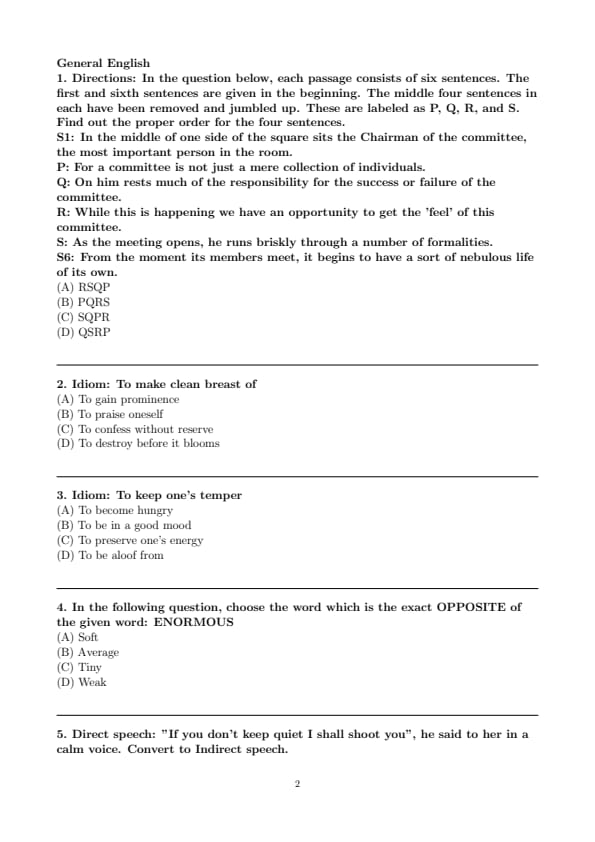
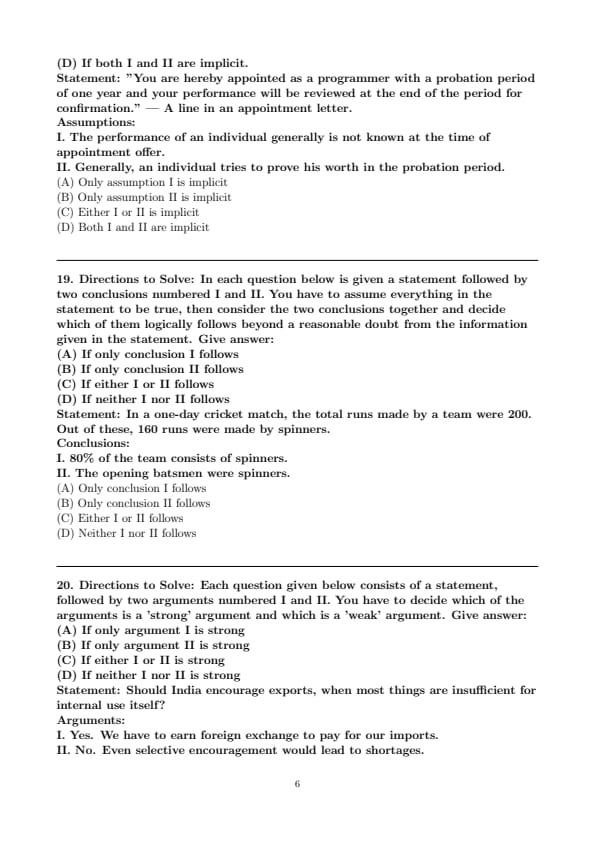
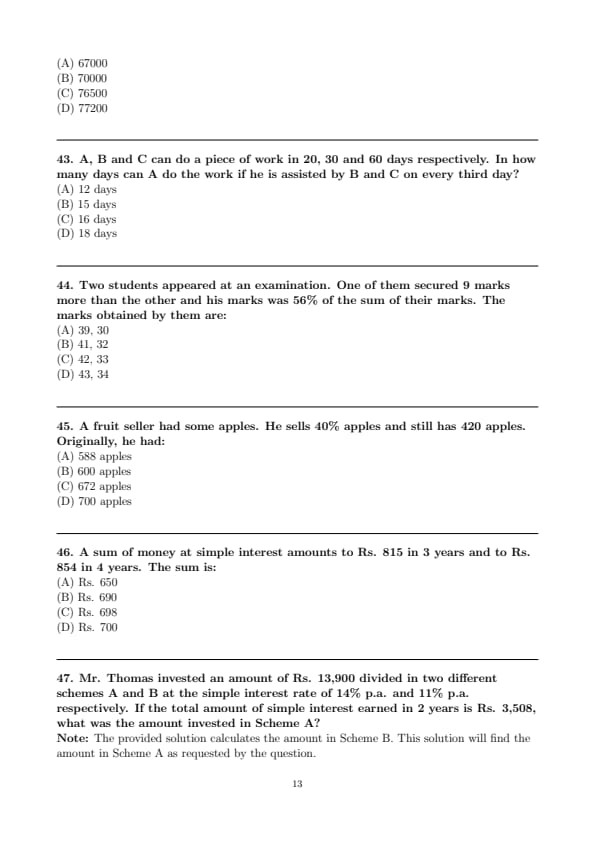
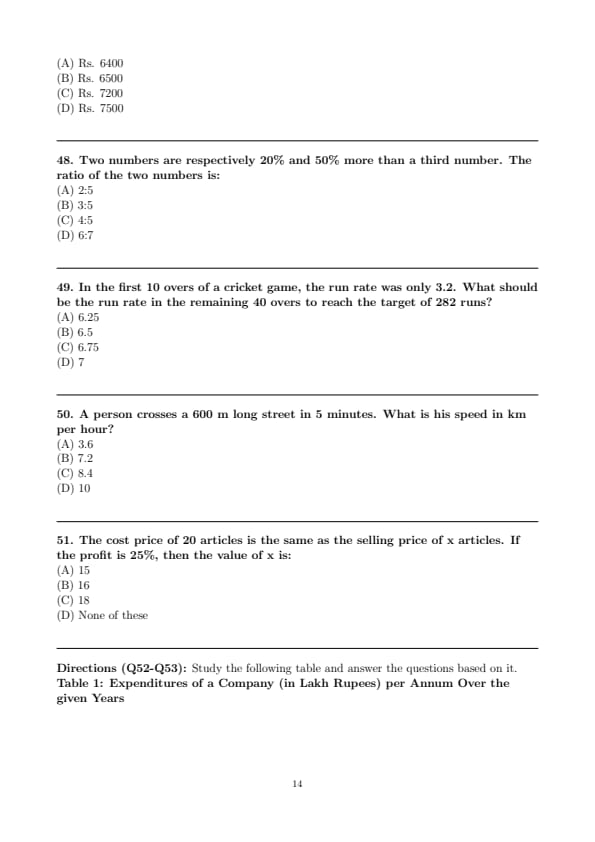
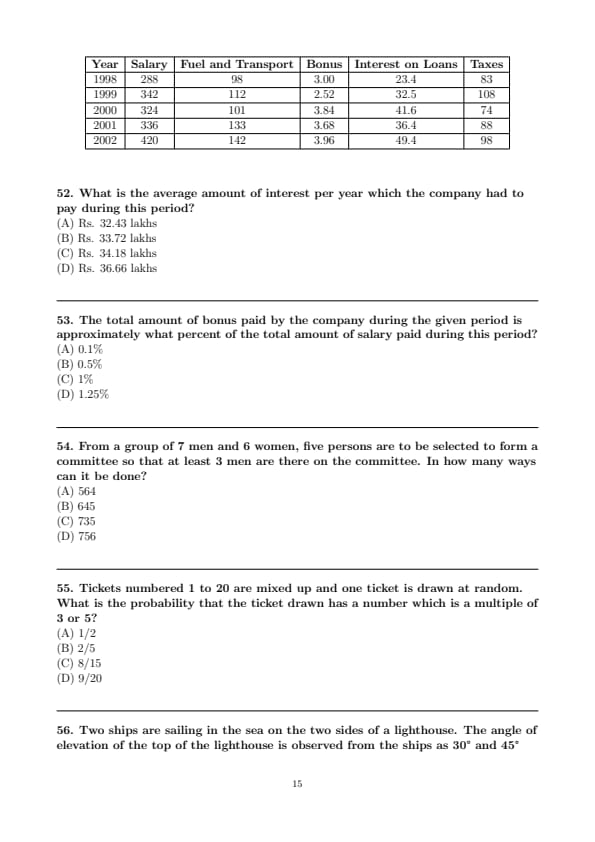
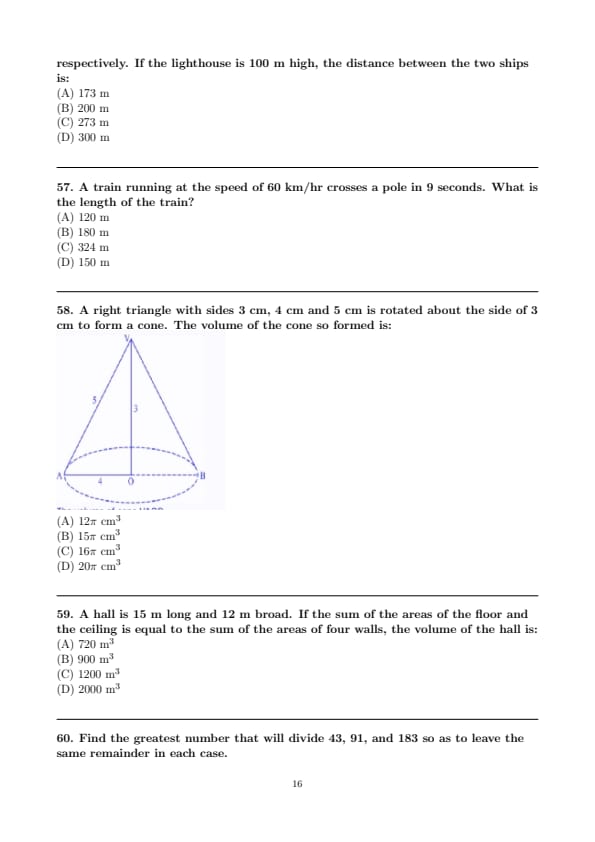

*The article might have information for the previous academic years, please refer the official website of the exam.