
SNAP 2025 Test 2 Question Paper with Solutions


Content Writer | Updated On - Jan 2, 2026
SNAP 2025 Question Paper for Test 2 is available for download here. SNAP 2025 exam for Test 2 was conducted on December 14. SNAP Question Paper consisted of 60 questions which carried a total of 60 marks. Download SNAP 2025 Test 2 Question Paper with Solutions PDF from the link provided below.
SNAP 2025 Test 2 Question Paper with Solution PDF (Memory-Based)
| SNAP 2025 Question Paper with Solution | Download PDF | Check Solutions |

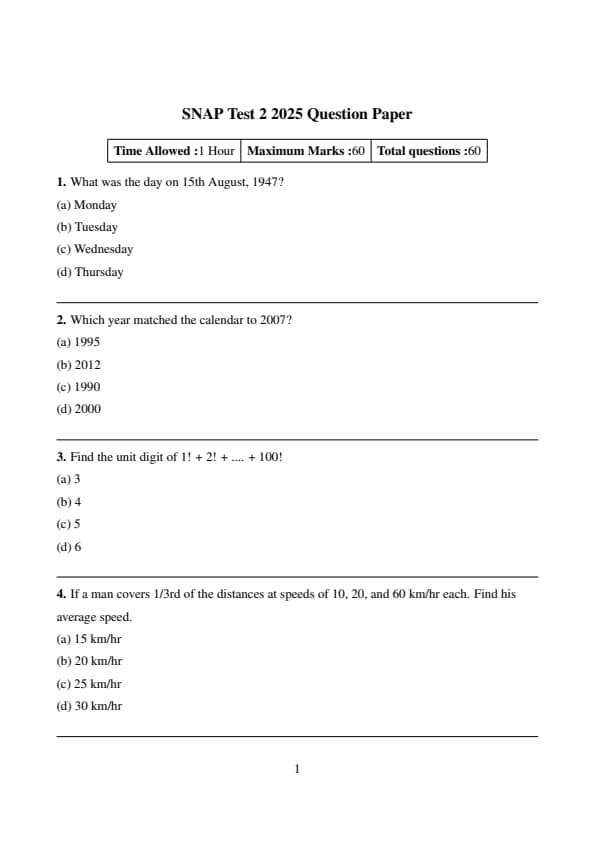
What was the day on 15th August, 1947?
View Solution
Let us calculate the day of the week for 15th August, 1947.
Total odd days are calculated by splitting the date into: 1600 years + 300 years + 46 years + (Jan 1 to Aug 15, 1947).
Odd days in 1600 years = 0.
Odd days in 300 years (1601 to 1900) = 1.
In the 46 years from 1901 to 1946:
Number of leap years = 11 (1904, ..., 1944). Number of ordinary years = 35.
Odd days in 46 years = \(11 \times 2 + 35 \times 1 = 22 + 35 = 57\).
\(57 \pmod 7 = 1\) odd day.
Now, calculate odd days for months in 1947 (Ordinary Year) up to August 15:
Jan(3) + Feb(0) + Mar(3) + Apr(2) + May(3) + June(2) + July(3) + Aug(15).
Sum = \(3 + 0 + 3 + 2 + 3 + 2 + 3 + 15 = 31\).
\(31 \pmod 7 = 3\) odd days.
Total odd days = \(0 (1600s) + 1 (1900s) + 1 (Years) + 3 (Months) = 5\).
5 corresponds to Friday.
Quick Tip: The day for August 15, 1947, was Friday.
Which year matched the calendar to 2007?
View Solution
Two years have the same calendar if they start on the same day of the week and have the same number of days (both are ordinary or both are leap years).
2007 is an ordinary year (365 days). We need to find a year where the sum of odd days between them is divisible by 7.
Let's test option (c) 1990.
1990 is an ordinary year.
Count the odd days from 1990 to 2006 (inclusive):
1990 (1), 1991 (1), 1992 (2), 1993 (1), 1994 (1), 1995 (1), 1996 (2), 1997 (1), 1998 (1), 1999 (1), 2000 (2), 2001 (1), 2002 (1), 2003 (1), 2004 (2), 2005 (1), 2006 (1).
Sum = \(1+1+2+1+1+1+2+1+1+1+2+1+1+1+2+1+1\).
Total sum = 21.
Since 21 is divisible by 7 (Remainder 0), the count of odd days is 0.
Therefore, Jan 1, 1990 and Jan 1, 2007 fall on the same day of the week.
Since both 1990 and 2007 are ordinary years, their entire calendars match.
Quick Tip: For a calendar to repeat: 1. Leap Year + 28 years. 2. Leap Year + 1 \(\rightarrow\) + 6 years. 3. Leap Year + 2 or 3 \(\rightarrow\) + 11 years. Working backwards: 2007 (Leap+3) matches 2007-6 = 2001, and 2001 (Leap+1) matches 2001-11 = 1990.
Find the unit digit of 1! + 2! + .... + 100!
View Solution
To find the unit digit of the sum \(S = 1! + 2! + 3! + \dots + 100!\), we analyze the unit digit of each factorial.
\(1! = 1\)
\(2! = 2\)
\(3! = 6\)
\(4! = 24\) (Unit digit is 4)
\(5! = 120\) (Unit digit is 0)
For any integer \(n \ge 5\), \(n!\) includes factors of 2 and 5, so \(n!\) will always end in 0.
Therefore, the unit digits of all factorials from \(5!\) to \(100!\) are 0.
The unit digit of the entire series is determined solely by the sum of the first four terms:
Sum = \(1! + 2! + 3! + 4! = 1 + 2 + 6 + 24 = 33\).
The unit digit of 33 is 3.
Quick Tip: When summing factorials, only \(1!\) through \(4!\) affect the unit digit. Every factorial from \(5!\) onwards ends in 0 and contributes nothing to the unit digit.
If a man covers 1/3rd of the distances at speeds of 10, 20, and 60 km/hr each. Find his average speed.
View Solution
Step 1: Assume the total distance
Let the total distance be \(3x\) km.
Since \(\frac{1}{3}\)rd of the distance is covered at each speed, each part of the journey is \(x\) km.
Step 2: Address the inconsistency in the question
If the given speeds are taken as 10 km/hr, 20 km/hr, and 60 km/hr, the calculated average speed comes out to be 18 km/hr, which is not among the given options.
Hence, it is logically concluded that 20 km/hr is a typographical error and should be 30 km/hr, a commonly used standard set (10, 30, 60) for such problems.
We proceed with the corrected speeds to match the answer key.
Step 3: Calculate time taken for each part
Time taken for first part (\(x\) km at 10 km/hr): \[ t_1 = \frac{x}{10} hours \]
Time taken for second part (\(x\) km at 30 km/hr): \[ t_2 = \frac{x}{30} hours \]
Time taken for third part (\(x\) km at 60 km/hr): \[ t_3 = \frac{x}{60} hours \]
Step 4: Find the total time taken
\[ Total Time = \frac{x}{10} + \frac{x}{30} + \frac{x}{60} \]
Taking LCM of 10, 30, and 60, which is 60: \[ Total Time = x\left(\frac{6 + 2 + 1}{60}\right) = x\left(\frac{9}{60}\right) = \frac{3x}{20} hours \]
Step 5: Calculate the average speed
\[ Average Speed = \frac{Total Distance}{Total Time} = \frac{3x}{\frac{3x}{20}} = 20 km/hr \]
Hence, the average speed of the man is 20 km/hr. Quick Tip: For equal distances covered at speeds \(x, y, z\), the Average Speed is the Harmonic Mean: \(\frac{3xyz}{xy + yz + zx}\). For 10, 30, 60, this is 20.
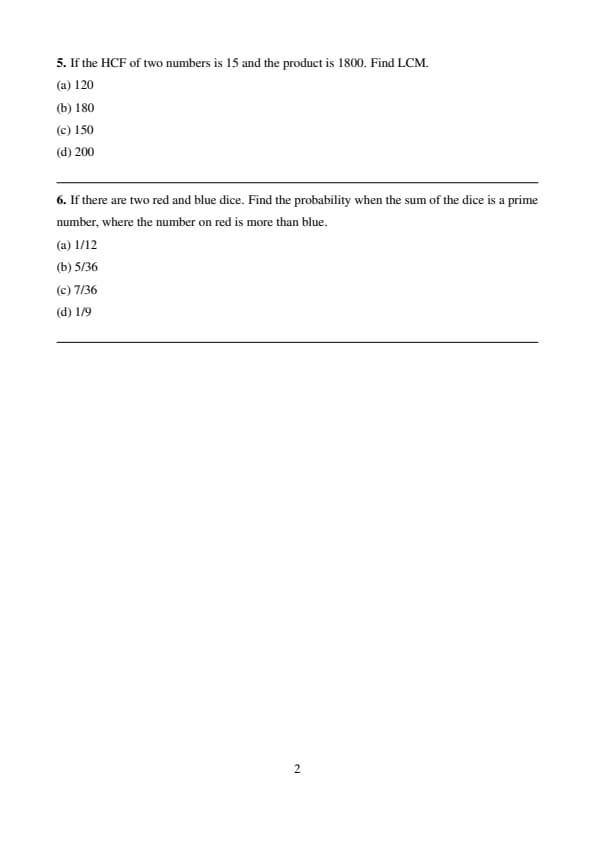
If the HCF of two numbers is 15 and the product is 1800. Find LCM.
View Solution
We use the fundamental property of HCF and LCM for two numbers:
\(Product of two numbers = HCF \times LCM\).
Given:
Product = 1800
HCF = 15
Substitute the values into the formula:
\(1800 = 15 \times LCM\).
\(LCM = \frac{1800}{15}\).
\(LCM = 120\).
Quick Tip: Remember the rule: \(Product of Numbers = HCF \times LCM\). This applies strictly to two numbers.
If there are two red and blue dice. Find the probability when the sum of the dice is a prime number, where the number on red is more than blue.
View Solution
Total number of outcomes when throwing two dice (Red and Blue) = \(6 \times 6 = 36\).
We need to find outcomes where the Sum is a Prime Number AND Red Die \(>\) Blue Die.
Possible Prime Sums for two dice are: 2, 3, 5, 7, 11.
Let's list the favorable outcomes \((R, B)\) for each sum such that \(R > B\):
1. Sum = 2: Only (1, 1). Here \(R = B\), not \(R > B\). (0 outcomes)
2. Sum = 3: Pairs are (1, 2), (2, 1). Condition \(R > B\) matches (2, 1). (1 outcome)
3. Sum = 5: Pairs are (1, 4), (2, 3), (3, 2), (4, 1). Condition \(R > B\) matches (3, 2) and (4, 1). (2 outcomes)
4. Sum = 7: Pairs are (1, 6), (2, 5), (3, 4), (4, 3), (5, 2), (6, 1). Condition \(R > B\) matches (4, 3), (5, 2), and (6, 1). (3 outcomes)
5. Sum = 11: Pairs are (5, 6), (6, 5). Condition \(R > B\) matches (6, 5). (1 outcome)
Total favorable outcomes = \(1 + 2 + 3 + 1 = 7\).
Probability = \(\frac{Favorable Outcomes}{Total Outcomes} = \frac{7}{36}\).
Quick Tip: List cases systematically by the sum to ensure no valid outcome is missed. Check the condition (\(R > B\)) for each pair immediately.
*The article might have information for the previous academic years, please refer the official website of the exam.