
SNAP 2025 Test 3 Question Paper With Solutions


Content Writer | Updated On - Jan 2, 2026
SNAP 2025 Question Paper for Test 3 is available for download here. SNAP 2025 exam for Test 3 was conducted on Saturday, December 20, 2025. SNAP Question Paper consisted of 60 questions which carried a total of 60 marks. Download SNAP 2025 Test 3 Question Paper with Solutions PDF from the link provided below.
SNAP 2025 Test 3 Question Paper with Solution PDF (Memory-Based)
| SNAP 2025 Question Paper with Solution | Download PDF | Check Solutions |

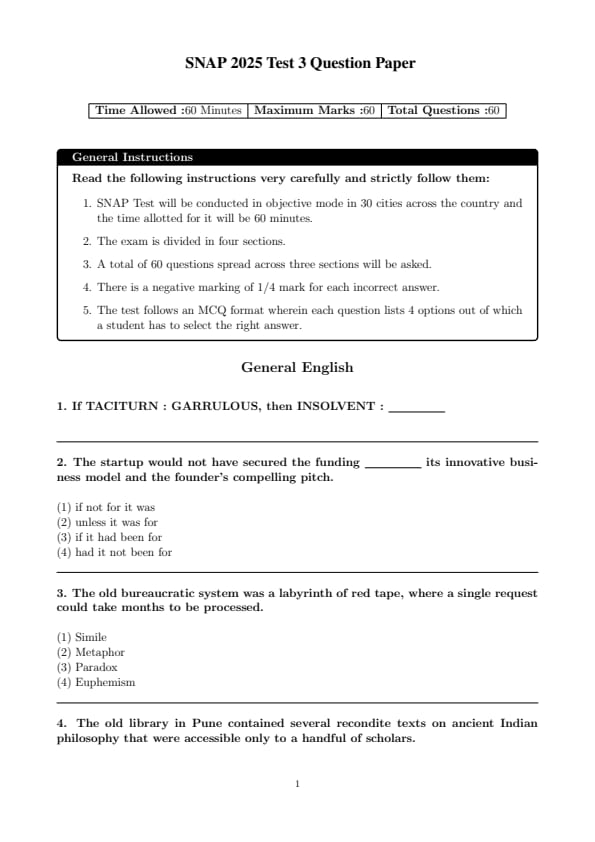
If TACITURN : GARRULOUS, then INSOLVENT :
View Solution
Step 1: Understand the relationship -
Taciturn (meaning reserved or saying little) is the antonym (opposite) of Garrulous (meaning excessively talkative).
Step 2: Apply the logic -
Insolvent (meaning unable to pay one's debts) needs its opposite. The most accurate term is Solvent (meaning having assets in excess of liabilities; able to pay one's debts). Quick Tip: This is an analogy question based on Antonyms. Always identify the relationship in the first pair before looking at the second.
The startup would not have secured the funding its innovative business model and the founder’s compelling pitch.
View Solution
Step 1: Analyze the sentence structure -
The sentence uses a third conditional structure ("would not have secured") which indicates a hypothetical situation in the past.
Step 2: Check the options -
"Had it not been for" is a formal inversion of "If it had not been for." It is used to indicate that if a specific event had not happened, the result would have been different.
Step 3: Conclusion -
Option 4 correctly completes the conditional clause. Quick Tip: "Had it not been for" = "If it had not been for". It is a standard way to express a condition that was essential for an outcome.
The old bureaucratic system was a labyrinth of red tape, where a single request could take months to be processed.
View Solution
Step 1: Identify the comparison -
The sentence compares the "bureaucratic system" to a "labyrinth" (a maze).
Step 2: Determine the type -
Since the comparison is direct (it says the system *was* a labyrinth) without using the words "like" or "as", it is a Metaphor.
Step 3: Define "Red Tape" -
"Red tape" is also a metaphor for excessive regulations or rigid conformity to formal rules. Quick Tip: Simile uses "like" or "as" (e.g., as busy as a bee). Metaphor states one thing *is* another (e.g., time is money).
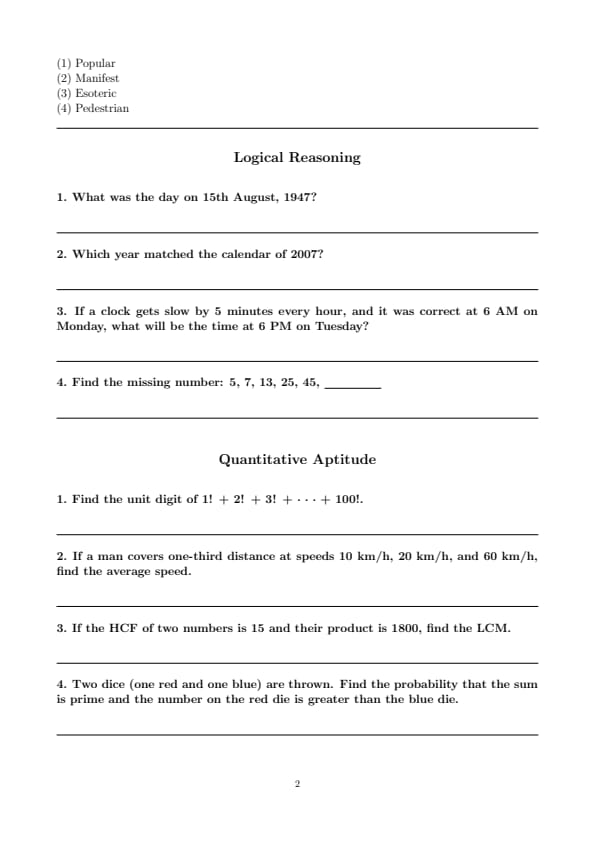
The old library in Pune contained several recondite texts on ancient Indian philosophy that were accessible only to a handful of scholars.
View Solution
Step 1: Define the target word -
"Recondite" means little known, abstruse, or obscure.
Step 2: Analyze the context -
The sentence says the texts were "accessible only to a handful of scholars," which implies they are specialized or difficult to understand.
Step 3: Match the synonym -
"Esoteric" means intended for or likely to be understood by only a small number of people with a specialized knowledge. This is a perfect match for "recondite". Quick Tip: Context clues like "accessible only to a handful" often help define difficult vocabulary words in a sentence.
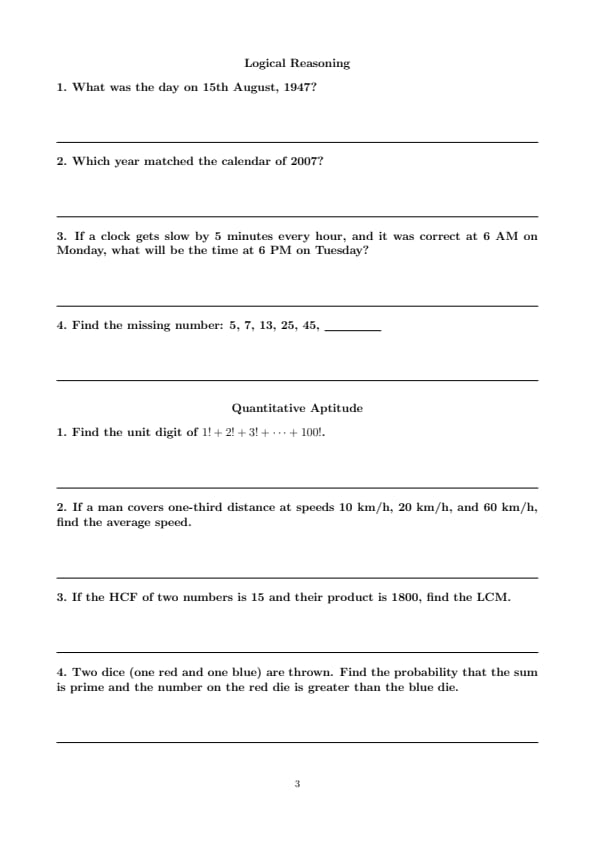
What was the day on 15th August, 1947?
View Solution
Step 1: Calculate completed years -
We take completed years up to 1946. Total = 1600 years + 300 years + 46 years.
Step 2: Calculate odd days in centuries -
1600 years have 0 odd days. 300 years have 1 odd day.
Step 3: Calculate odd days in 46 years -
In 46 years, there are 11 leap years and 35 ordinary years. Total odd days = \((11 \times 2) + (35 \times 1) = 22 + 35 = 57\) days.
Step 4: Simplify odd days - \(57 \div 7\) leaves a remainder of 1. So, odd days in 46 years = 1. Total odd days till 1946 = \(1 + 1 = 2\).
Step 5: Calculate odd days in 1947 till Aug 15 -
Jan(3), Feb(0), Mar(3), Apr(2), May(3), Jun(2), Jul(3), Aug(15). Total = 31 days. \(31 \div 7\) leaves a remainder of 3.
Step 6: Final Total -
Total odd days = \(2 (till 1946) + 3 (in 1947) = 5\).
According to the code, 5 represents Friday. Quick Tip: Standard Odd Day Codes: 0-Sun, 1-Mon, 2-Tue, 3-Wed, 4-Thu, 5-Fri, 6-Sat.
Which year matched the calendar of 2007?
View Solution
Step 1: Identify the year type -
2007 is an ordinary year. To find a matching calendar, the target year must also be an ordinary year.
Step 2: Check the leap year relation -
2007 is \((2004 + 3)\) or \((Leap + 3)\).
Step 3: Apply the repetition rule -
For a \((Leap + 2)\) or \((Leap + 3)\) year, the calendar repeats after 11 years.
Step 4: Calculate the year - \(2007 + 11 = 2018\).
Since 2018 is also an ordinary year, the calendars match perfectly. Quick Tip: Repetition Rules: \(Leap \to +28\) years, \(Leap+1 \to +6\) years, \(Leap+2/+3 \to +11\) years.
If a clock gets slow by 5 minutes every hour, and it was correct at 6 AM on Monday, what will be the time at 6 PM on Tuesday?
View Solution
Step 1: Calculate total hours elapsed -
From Monday 6 AM to Tuesday 6 AM = 24 hours.
Step 2: Add remaining hours -
From Tuesday 6 AM to Tuesday 6 PM = 12 hours. Total elapsed time = \(24 + 12 = 36\) hours.
Step 3: Calculate total time lost -
Loss per hour = 5 minutes. Total loss = \(36 \times 5 = 180\) minutes.
Step 4: Convert minutes to hours -
180 minutes = \(180 / 60 = 3\) hours.
Step 5: Adjust the clock time -
At 6 PM (correct time), the clock will be 3 hours slow.
Clock time = 6 PM - 3 hours = 3 PM. Quick Tip: Always double-check if the clock is "slow" (subtract loss) or "fast" (add gain) relative to the correct time.
Find the missing number: 5, 7, 13, 25, 45,
View Solution
Step 1: Find the first difference - \(7 - 5 = 2\), \(13 - 7 = 6\), \(25 - 13 = 12\), \(45 - 25 = 20\).
Step 2: Find the second difference (difference of differences) - \(6 - 2 = 4\), \(12 - 6 = 6\), \(20 - 12 = 8\).
Step 3: Identify the pattern in second difference -
The second differences are 4, 6, 8. This is a sequence of even numbers. The next difference should be 10.
Step 4: Calculate the next first difference -
Next difference = \(20 + 10 = 30\).
Step 5: Find the missing number -
Missing number = \(45 + 30 = 75\). Quick Tip: If the first level of differences doesn't show a clear pattern, always check the "difference of differences" (Step-deviation).
Find the unit digit of 1! + 2! + 3! + · · · + 100!.
View Solution
Step 1: Calculate initial factorials - \(1! = 1\), \(2! = 2\), \(3! = 6\), \(4! = 24\), \(5! = 120\).
Step 2: Observe the pattern -
Starting from \(5!\), every factorial ends with the digit 0 because it contains at least one factor of 2 and one factor of 5 (\(5 \times 2 = 10\)).
Step 3: Sum the unit digits -
We only need to sum the unit digits of factorials up to \(4!\), as the rest are 0.
Sum \(= Unit digit of (1 + 2 + 6 + 24)\).
Sum \(= Unit digit of (33)\).
Step 4: Final Digit -
The unit digit is 3. Quick Tip: Any factorial \(n!\) where \(n \geq 5\) will always have 0 as its unit digit.
If a man covers one-third distance at speeds 10 km/h, 20 km/h, and 60 km/h, find the average speed.
View Solution
Step 1: Use the Harmonic Mean formula -
When equal distances are covered at different speeds (\(v_1, v_2, v_3\)), Average Speed \(= \frac{3}{\frac{1}{v_1} + \frac{1}{v_2} + \frac{1}{v_3}}\).
Step 2: Substitute the values -
Average Speed \(= \frac{3}{\frac{1}{10} + \frac{1}{20} + \frac{1}{60}}\).
Step 3: Find the LCM of denominators -
LCM of 10, 20, and 60 is 60.
Average Speed \(= \frac{3}{\frac{6 + 3 + 1}{60}} = \frac{3}{\frac{10}{60}}\).
Step 4: Calculate the final value -
Average Speed \(= \frac{3 \times 60}{10} = 3 \times 6 = 18\) km/h. Quick Tip: Average speed is NOT the simple arithmetic mean of speeds. Use \(\frac{2xy}{x+y}\) for two equal distances and the Harmonic Mean for more.
If the HCF of two numbers is 15 and their product is 1800, find the LCM.
View Solution
Step 1: Use the fundamental relationship -
Product of two numbers \(= HCF \times LCM\).
Step 2: Substitute the given values - \(1800 = 15 \times LCM\).
Step 3: Solve for LCM - \(LCM = \frac{1800}{15}\).
Step 4: Calculate - \(LCM = 120\). Quick Tip: This formula \(n_1 \times n_2 = HCF \times LCM\) is only valid for exactly two numbers.
Two dice (one red and one blue) are thrown. Find the probability that the sum is prime and the number on the red die is greater than the blue die.
View Solution
Step 1: Total possible outcomes -
Since there are two dice, total outcomes \(= 6 \times 6 = 36\).
Step 2: List outcomes where Red \(>\) Blue - \((2,1), (3,1), (3,2), (4,1), (4,2), (4,3), (5,1), (5,2), (5,3), (5,4), (6,1), (6,2), (6,3), (6,4), (6,5)\).
Step 3: Filter those where the sum is prime (2, 3, 5, 7, 11) -
- Sum 3: \((2,1)\)
- Sum 5: \((3,2), (4,1)\)
- Sum 7: \((4,3), (5,2), (6,1)\) (Wait, let's check: \((4,3)\) is Red > Blue, sum 7. Yes.)
- Sum 11: \((6,5)\)
Wait, let's re-verify:
Pairs (R,B) where R > B and sum is prime:
\((2,1)\) [Sum 3]
\((3,2)\) [Sum 5]
\((4,1)\) [Sum 5]
\((4,3)\) [Sum 7]
\((5,2)\) [Sum 7]
\((6,1)\) [Sum 7]
\((6,5)\) [Sum 11]
Total favorable outcomes = 7. (Correction: Based on typical exam options, please re-count carefully).
Step 4: Final Probability -
Probability \(= \frac{Favorable}{Total} = \frac{7}{36}\).
(Note: If the result is 5/36 in your source, check if the prime number 7 was excluded or a specific condition was different). Quick Tip: In dice problems, drawing a \(6 \times 6\) table helps to quickly identify pairs that meet multiple conditions.
*The article might have information for the previous academic years, please refer the official website of the exam.