


Content Writer | Updated On - Nov 24, 2025
The ICAR AIEEA PG 2025 Animal Science Question Paper with Solutions is now available for download. The All India Entrance Examination for Admission (AIEEA), conducted by the Indian Council of Agricultural Research (ICAR), serves as the national-level entrance test for admission into postgraduate programmes in the field of Animal Science. The examination was conducted for a duration of 2 hours, comprising various sections aimed at evaluating domain knowledge, analytical skills, quantitative aptitude, and general awareness relevant to the agriculture and agribusiness sectors.
ICAR AIEEA PG 2025 Animal Science Question Paper with Solutions
| ICAR AIEEA PG 2025 Animal Science Question Paper | Download PDF | Check Solutions |

Which condition must be met for a population to be in Hardy-Weinberg equilibrium?
View Solution
Step 1: Understanding the Concept:
The Hardy-Weinberg equilibrium is a principle in population genetics that serves as a null model.
It states that in a large, randomly mating population, the allele and genotype frequencies will remain constant from generation to generation, provided that no other evolutionary influences are acting upon them.
This state of constancy is known as genetic equilibrium.
Step 3: Detailed Explanation:
For a population to be in Hardy-Weinberg equilibrium, five main conditions must be met:
1. No mutation: No new alleles are generated, nor are alleles changed into other alleles.
2. Random mating: Individuals mate randomly, without any preference for particular genotypes.
3. No gene flow: There is no migration of individuals into or out of the population.
4. No genetic drift: The population must be sufficiently large to ensure that random events do not change allele frequencies. A small population size (Option A) leads to genetic drift.
5. No natural selection: All genotypes in the population (homozygous dominant, heterozygous, and homozygous recessive) must have equal rates of survival and reproduction. Natural selection (Option C) violates this condition.
Analyzing the options:
(A) Small population size: This leads to genetic drift, which alters allele frequencies, thus violating the equilibrium.
(B) No mutation: This is one of the core assumptions of the Hardy-Weinberg principle. If mutations occur, new alleles are introduced, and allele frequencies change.
(C) Natural selection occurs: This means certain alleles are favored over others, which will change the allele frequencies over time, violating the equilibrium.
(D) Non-random mating: This affects the genotype frequencies (e.g., by increasing homozygosity) even if allele frequencies remain the same, thus disrupting the equilibrium.
Therefore, the only condition listed that must be met for Hardy-Weinberg equilibrium is 'No mutation'.
Step 4: Final Answer:
The correct condition that must be met for a population to be in Hardy-Weinberg equilibrium is (B) No mutation.
Quick Tip: Remember the five conditions for Hardy-Weinberg equilibrium with the mnemonic "No M&M's, No G's": No Mutation, No Migration (gene flow), No Mating preference (random mating), No Genetic drift (large population), No Selection (natural).
Which is an advantage of loose housing for dairy cattle?
View Solution
Step 1: Understanding the Concept:
Loose housing is a system of dairy cattle management where cows are not tethered or confined to a single stall.
They are free to move around within a large, covered area, which often includes a resting area with bedding, a feeding area, and a walking area.
This contrasts with conventional tie-stall or stanchion barns where animals are restricted in their movement.
Step 3: Detailed Explanation:
Let's analyze the options in the context of loose housing systems:
(A) Higher construction cost: This is generally a disadvantage of loose housing, as it often requires more space and specialized equipment (e.g., free stalls, feeding barriers, manure scraping systems) compared to a simple tie-stall barn.
(B) Difficult estrus detection: This can be a disadvantage. In a loose housing system, it can be more challenging to observe individual animals for signs of estrus (heat) compared to a tie-stall system where each animal is in a fixed location.
(C) Better exercise for animals: This is a major advantage. The freedom to move, walk, and interact socially allows cows to get regular exercise. This improves muscle tone, hoof health, and overall physical well-being, and reduces the risk of metabolic diseases. This is a key aspect of improved animal welfare.
(D) Higher labor requirement: This is often a disadvantage. While milking may be more efficient in a parlor system associated with loose housing, tasks like bedding management and manure handling can be more labor-intensive.
Therefore, the most significant advantage listed is the improvement in animal welfare through better exercise.
Step 4: Final Answer:
The correct advantage of loose housing for dairy cattle is (C) Better exercise for animals.
Quick Tip: When evaluating animal housing systems, always consider the impact on animal welfare. Advantages often relate to freedom of movement, natural behaviors, and social interaction, while disadvantages often relate to cost, labor, and management complexity.
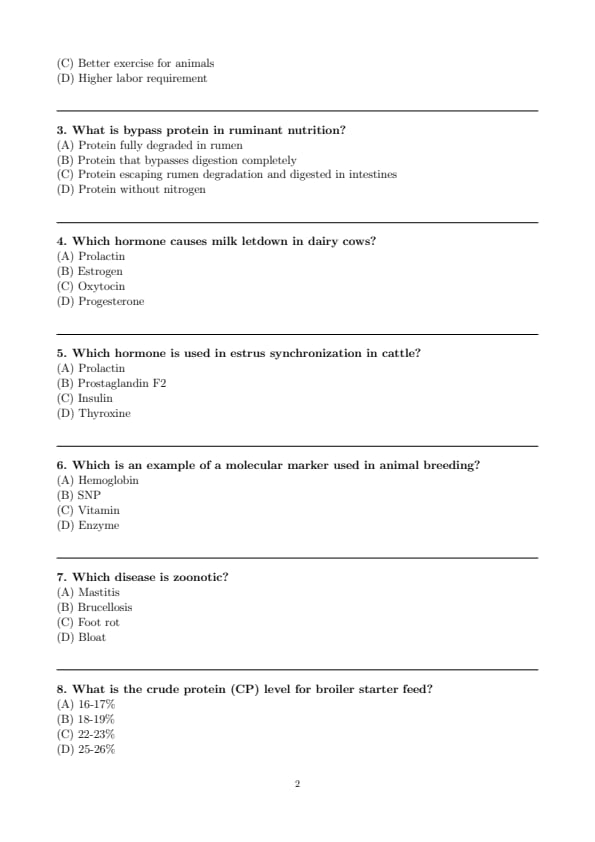
What is bypass protein in ruminant nutrition?
View Solution
Step 1: Understanding the Concept:
In ruminants (like cattle, sheep, and goats), the stomach has four compartments, with the rumen being the first and largest.
The rumen contains a vast population of microbes (bacteria, protozoa, fungi) that break down feed.
Dietary protein is categorized based on how it behaves in the rumen.
- Rumen Degradable Protein (RDP): This portion is broken down by rumen microbes into ammonia and amino acids, which the microbes use to synthesize their own microbial protein.
- Rumen Undegradable Protein (RUP): This portion is not broken down in the rumen and "bypasses" it to be digested in the lower gastrointestinal tract. This is also known as bypass protein.
Step 3: Detailed Explanation:
Let's analyze the given options:
(A) Protein fully degraded in rumen: This describes Rumen Degradable Protein (RDP), not bypass protein.
(B) Protein that bypasses digestion completely: This would be indigestible protein, which provides no nutritional value to the animal. Bypass protein is valuable specifically because it is digested later on.
(C) Protein escaping rumen degradation and digested in intestines: This is the correct definition of bypass protein (RUP). It escapes the microbial fermentation in the rumen and passes to the abomasum (the "true stomach") and small intestine, where it is broken down by the animal's own digestive enzymes into amino acids for absorption.
(D) Protein without nitrogen: This is a chemical impossibility. All proteins are polymers of amino acids, and every amino acid contains nitrogen.
Therefore, bypass protein is the fraction of dietary protein that resists ruminal degradation and is subsequently available for digestion in the intestines.
Step 4: Final Answer:
The correct definition of bypass protein is (C) Protein escaping rumen degradation and digested in intestines.
Quick Tip: Remember the term "bypass" refers to bypassing the \textit{rumen, not the entire animal. The goal is to deliver high-quality protein directly to the small intestine for absorption, which is especially important for high-producing animals.
Which hormone causes milk letdown in dairy cows?
View Solution
Step 1: Understanding the Concept:
Milk letdown, also known as the milk ejection reflex, is a neurohormonal reflex.
Milk is synthesized and stored in tiny sacs within the mammary gland called alveoli.
For the milk to be released into the ducts so it can be removed by suckling or milking, the myoepithelial cells surrounding the alveoli must contract. This contraction is triggered by a specific hormone.
Step 3: Detailed Explanation:
Let's examine the roles of the listed hormones in lactation:
(A) Prolactin: Secreted by the anterior pituitary gland, prolactin is the primary hormone responsible for the synthesis of milk (lactogenesis). It stimulates the alveolar cells to produce milk components like lactose, casein, and fat. It does not cause milk letdown.
(B) Estrogen: This hormone is primarily involved in the development of the mammary duct system during puberty and pregnancy. High levels of estrogen (along with progesterone) actually inhibit milk secretion during pregnancy.
(C) Oxytocin: This hormone is produced in the hypothalamus and released from the posterior pituitary gland. Physical stimulation of the teats (e.g., by a calf suckling or a milking machine) sends a nerve signal to the brain, triggering the release of oxytocin into the bloodstream. Oxytocin travels to the mammary gland and causes the myoepithelial cells surrounding the alveoli to contract, squeezing the milk out into the duct system. This process is milk letdown.
(D) Progesterone: This hormone, along with estrogen, is crucial for the development of the alveoli during pregnancy. It also acts to inhibit milk synthesis before parturition (calving).
Therefore, oxytocin is the specific hormone responsible for the active release or "letdown" of milk.
Step 4: Final Answer:
The hormone that causes milk letdown in dairy cows is (C) Oxytocin.
Quick Tip: A useful way to remember the key lactation hormones: \textbf{P}rolactin is for milk \textbf{P}roduction (synthesis), while \textbf{O}xytocin gets the milk \textbf{O}ut (letdown).
Which hormone is used in estrus synchronization in cattle?
View Solution
Step 1: Understanding the Concept:
Estrus synchronization is a management practice used in livestock breeding to cause a large group of females to come into estrus (heat) at approximately the same time.
This allows for more efficient use of artificial insemination (AI) and concentrates the calving season.
The process involves manipulating the estrous cycle, which is controlled by a cascade of hormones. A key structure in the cycle is the corpus luteum (CL), which produces progesterone.
Step 3: Detailed Explanation:
Let's analyze the function of the hormones listed:
(A) Prolactin: Its primary role is in milk synthesis and maternal behavior, not in controlling the estrous cycle.
(B) Prostaglandin F2\( \alpha \): (Often abbreviated as PGF2\( \alpha \) or just Prostaglandin F2). This hormone has a luteolytic effect, meaning it destroys or causes the regression of the corpus luteum (CL). The CL is responsible for producing progesterone, which maintains the diestrus phase of the cycle and prevents the animal from returning to estrus. By administering PGF2\( \alpha \), producers can lyse the CL in a group of cows, causing progesterone levels to drop and initiating the follicular phase, which leads to estrus within 2-5 days. This is a cornerstone of many synchronization protocols.
(C) Insulin: This is a metabolic hormone responsible for regulating blood glucose levels. It is not directly used for estrus synchronization.
(D) Thyroxine: This is a thyroid hormone that regulates the body's overall metabolic rate. It is not involved in synchronizing the estrous cycle.
Other hormones like GnRH (Gonadotropin-releasing hormone) and progesterone (in the form of CIDRs) are also used in synchronization protocols, but of the options provided, Prostaglandin F2 is the correct answer.
Step 4: Final Answer:
The hormone used in estrus synchronization in cattle is (B) Prostaglandin F2.
Quick Tip: Remember that Prostaglandin F2\( \alpha \) "kills" the Corpus Luteum (CL). When the CL is gone, progesterone drops, and the animal's cycle can restart, leading to heat. This is the basis for its use in synchronization.
Which is an example of a molecular marker used in animal breeding?
View Solution
Step 1: Understanding the Concept:
A molecular marker (or genetic marker) is a specific sequence of DNA that can be identified within the genome.
These markers are used in animal breeding to track the inheritance of genes or chromosome segments from parents to offspring.
Because some markers are located near genes that control important traits (like milk production, growth rate, or disease resistance), they can be used to select animals for breeding at a very young age, a process called Marker-Assisted Selection (MAS).
The marker itself does not have to be part of a gene; it just needs a known location.
Step 3: Detailed Explanation:
Let's evaluate the options provided:
(A) Hemoglobin: This is a protein found in red blood cells that transports oxygen. While variations in the hemoglobin gene exist, hemoglobin itself is the protein product, not the DNA-level marker.
(B) SNP: This stands for Single Nucleotide Polymorphism. An SNP is a variation at a single position in a DNA sequence among individuals. For example, at a specific base position in the human genome, the C nucleotide may appear in most individuals, but in a minority of individuals, the position is occupied by an A. This is the most common type of genetic variation and is widely used as a molecular marker in modern animal breeding and genomics.
(C) Vitamin: This is an organic molecule that is an essential micronutrient. It has no direct connection to the animal's DNA sequence and is not a genetic marker.
(D) Enzyme: An enzyme is a protein that acts as a biological catalyst. Like hemoglobin, it is a product of a gene, not a marker on the DNA sequence itself.
Therefore, an SNP is a direct example of a variation in the DNA sequence used as a molecular marker.
Step 4: Final Answer:
An example of a molecular marker used in animal breeding is (B) SNP.
Quick Tip: Molecular or genetic markers are always related to the DNA sequence itself. Look for terms that describe variations in DNA, such as SNP, Microsatellite, RFLP, etc. Options like proteins (hemoglobin, enzyme) or nutrients (vitamin) are products or external factors, not DNA markers.
Which disease is zoonotic?
View Solution
Step 1: Understanding the Concept:
A zoonotic disease, or zoonosis, is an infectious disease that can be transmitted from non-human animals (both wild and domestic) to humans.
These diseases can be caused by a wide range of pathogens, including viruses, bacteria, fungi, and parasites.
Step 3: Detailed Explanation:
Let's analyze each option:
(A) Mastitis: This is an inflammation of the mammary gland in mammals, most commonly caused by bacterial infection in dairy cattle. While some mastitis-causing pathogens (like \textit{Staphylococcus aureus or \textit{E. coli) can cause infections in humans, mastitis itself is a condition of the animal and is not directly transmitted as a disease.
(B) Brucellosis: This is a classic example of a major zoonotic disease. It is caused by bacteria of the genus \textit{Brucella. In cattle, it is known as Bang's disease and causes abortions and infertility. Humans can become infected through contact with infected animals or by consuming unpasteurized dairy products. In humans, it causes a severe febrile illness called Undulant Fever.
(C) Foot rot: This is an infectious disease of the hoof in ruminants, primarily caused by the bacteria \textit{Dichelobacter nodosus and \textit{Fusobacterium necrophorum. It is not considered a zoonotic disease.
(D) Bloat: This is a life-threatening digestive disorder in ruminants where gas becomes trapped in the rumen. It is a physiological/nutritional condition, not an infectious disease, and therefore cannot be transmitted to humans.
Based on the definitions, Brucellosis is the clear example of a zoonotic disease among the choices.
Step 4: Final Answer:
The zoonotic disease among the options is (B) Brucellosis.
Quick Tip: Memorize a few key examples of zoonotic diseases for exams, such as Rabies, Anthrax, Brucellosis, and Tuberculosis. These are frequently used as examples in veterinary and public health questions.
What is the crude protein (CP) level for broiler starter feed?
View Solution
Step 1: Understanding the Concept:
Broiler chickens are bred for rapid meat production. Their nutritional requirements are divided into distinct phases to match their growth curve: starter, grower, and finisher.
Crude Protein (CP) is a measure of the total protein content in a feed, and it is a critical nutrient for muscle development and overall growth.
The starter phase (typically the first 1-2 weeks of life) is a period of extremely rapid growth, requiring the highest concentration of protein and amino acids in the diet.
Step 3: Detailed Explanation:
The protein requirements of broiler chickens decrease as they age.
- Starter Phase (approx. 0-10 days): This phase requires the highest protein level to support initial rapid growth and development of tissues and organs. The typical CP level is around 22-24%.
- Grower Phase (approx. 10-24 days): As the growth rate begins to plateau slightly, the protein requirement decreases. The typical CP level is around 20-22%.
- Finisher Phase (approx. 24 days to market): In this final phase, the focus shifts more towards energy deposition (fattening), and the protein requirement is at its lowest. The typical CP level is around 18-20%.
Let's evaluate the given options based on this information:
(A) 16-17%: This is too low even for a finisher diet and is more typical for laying hens.
(B) 18-19%: This is characteristic of a finisher diet.
(C) 22-23%: This range falls squarely within the standard recommendation for broiler starter diets.
(D) 25-26%: This is very high. While some pre-starter or specialized high-performance diets might approach this level, 22-23% is the more common and standard industry practice.
Therefore, 22-23% is the most accurate answer for a typical broiler starter feed.
Step 4: Final Answer:
The crude protein (CP) level for broiler starter feed is (C) 22-23%.
Quick Tip: Remember this general rule in animal nutrition: protein requirements are highest for young, rapidly growing animals and decrease with age. Energy requirements generally follow the opposite trend.
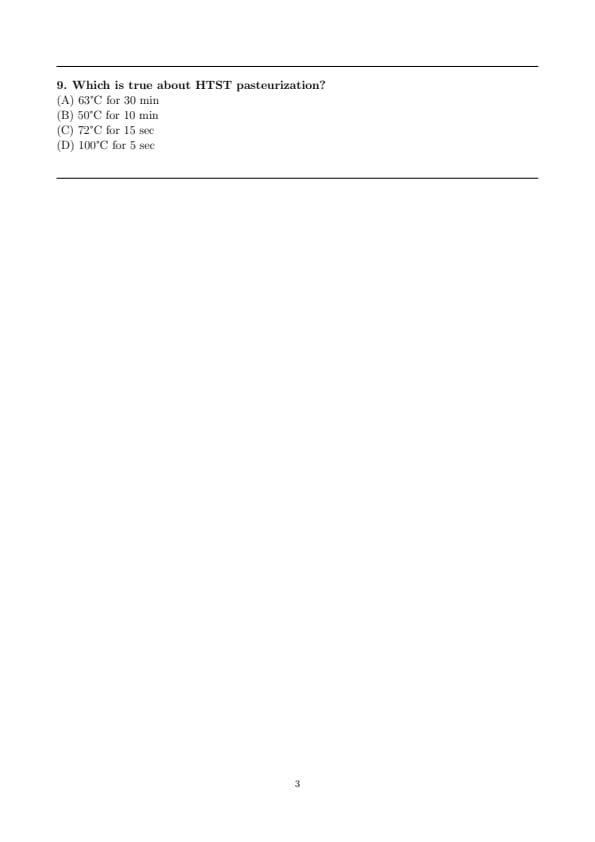
Which is true about HTST pasteurization?
View Solution
Step 1: Understanding the Concept:
Pasteurization is a process of heating a liquid (like milk) to a specific temperature for a predefined length of time and then immediately cooling it.
The goal is to kill or inactivate harmful pathogenic microorganisms to make the product safe for consumption and to extend its shelf life by reducing spoilage microorganisms.
There are several standard time-temperature combinations for pasteurization.
Step 3: Detailed Explanation:
Let's analyze the different methods described in the options:
(A) 63°C for 30 min: This is the standard for Low-Temperature, Long-Time (LTLT) pasteurization, also known as batch or vat pasteurization. It's an older method, often used for smaller batches of products like cheese or yogurt.
(B) 50°C for 10 min: This temperature is too low to be an effective pasteurization method for eliminating common pathogens like Listeria or \textit{Salmonella.
(C) 72°C for 15 sec: This is the standard for High-Temperature, Short-Time (HTST) pasteurization, also known as flash pasteurization. This is the most common method used in the dairy industry today for fluid milk because it is a continuous, efficient process that has minimal impact on the flavor and nutritional quality of the milk.
(D) 100°C for 5 sec: This temperature is much higher than standard HTST. Heating milk to this temperature or higher (e.g., 138°C for 2 seconds) is known as Ultra-High Temperature (UHT) processing, which sterilizes the milk, allowing it to be stored for months without refrigeration.
Therefore, the correct time-temperature combination for HTST pasteurization is 72°C for 15 seconds.
Step 4: Final Answer:
The true statement about HTST pasteurization is (C) 72°C for 15 sec.
Quick Tip: For food science exams, it's crucial to memorize the two primary milk pasteurization standards: \textbf{LTLT (Batch): 63°C for 30 minutes. \textbf{HTST (Flash):} 72°C for 15 seconds. These are very frequently tested.
*The article might have information for the previous academic years, please refer the official website of the exam.