


Content Writer | Updated On - Nov 24, 2025
The ICAR AIEEA PG 2025 Fisheries Science Question Paper with Solutions is now available for download. The All India Entrance Examination for Admission (AIEEA), conducted by the Indian Council of Agricultural Research (ICAR), serves as the national-level entrance test for admission into postgraduate programmes in the field of Fisheries Science. The examination was conducted for a duration of 2 hours, comprising various sections aimed at evaluating domain knowledge, analytical skills, quantitative aptitude, and general awareness relevant to the agriculture and agribusiness sectors.
ICAR AIEEA PG 2025 Fisheries Science Question Paper with Solutions
| ICAR AIEEA PG 2025 Fisheries Science Question Paper | Download PDF | Check Solutions |

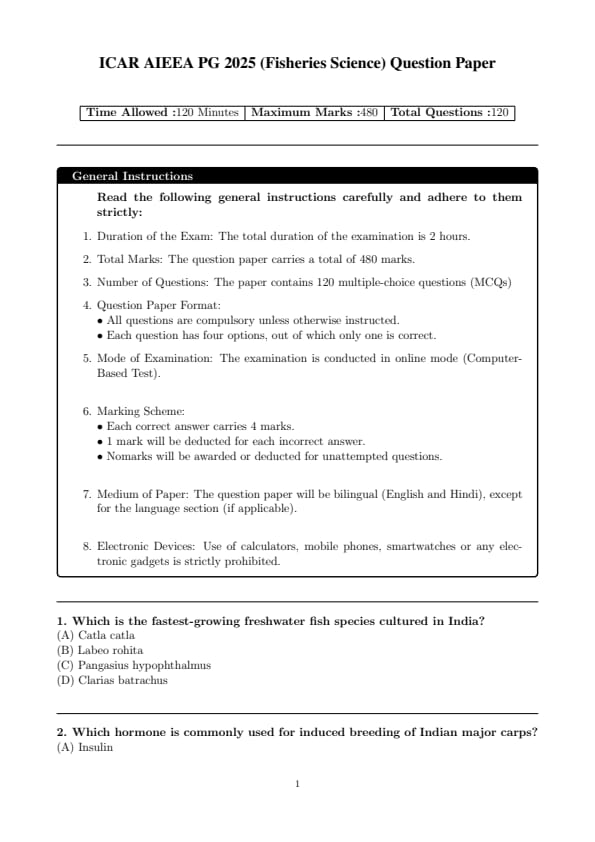
Which is the fastest-growing freshwater fish species cultured in India?
View Solution
Step 1: Understanding the Concept:
The question asks to identify the fish species with the most rapid growth rate among the given options, specifically in the context of Indian freshwater aquaculture. The growth rate is a crucial factor for farmers as it determines the production cycle duration and profitability.
Step 2: Detailed Explanation:
Let's analyze the growth characteristics of each species:
(A) Catla catla (Catla): This is an Indian major carp and is known for its fast growth, especially compared to other Indian carps like Rohu and Mrigal. It is a surface feeder.
(B) Labeo rohita (Rohu): This is another Indian major carp. It is a column feeder and has a good growth rate, but it is generally slower than Catla.
(C) Pangasius hypophthalmus (Pangas or Sutchi Catfish): This is an exotic catfish species that has become extremely popular in Indian aquaculture. It is known for several commercially valuable traits:
Very rapid growth: It can reach a marketable size of 1-1.5 kg in just 6-8 months under optimal conditions.
Air-breathing ability: It can tolerate low dissolved oxygen levels, which allows for high-density stocking.
Acceptance of supplementary feed: It readily consumes formulated feeds, which contributes to its fast growth.
(D) Clarias batrachus (Magur): This is an indigenous air-breathing catfish. It also has a fast growth rate and can be cultured at high densities, but the growth rate of Pangasius is generally considered to be faster in commercial farming systems.
Step 3: Final Answer:
Comparing the options, \textit{Pangasius hypophthalmus is widely recognized in aquaculture as one of the fastest-growing freshwater fish species, out-pacing the Indian major carps and even other catfishes under intensive culture conditions. Therefore, it is the correct answer.
Quick Tip: For questions about "fastest-growing," "most suitable," or "most common" in aquaculture, always consider the economic and practical aspects for farmers. Species like Pangasius are popular because their rapid growth and hardiness translate to quicker returns on investment.
Which hormone is commonly used for induced breeding of Indian major carps?
View Solution
Step 1: Understanding the Concept:
Induced breeding is a technique used in aquaculture to stimulate fish to breed in captivity when they do not do so naturally. This process involves administering hormones to mature fish to trigger the final stages of gamete maturation, ovulation (in females), and spawning. This is crucial for the mass production of fish seed for farming.
Step 2: Detailed Explanation:
Let's examine the function of each hormone listed:
(A) Insulin: This hormone is primarily involved in regulating blood sugar (glucose) levels and metabolism. It has no direct role in stimulating fish reproduction.
(B) Gonadotropin-releasing hormone analogues (GnRH): The natural reproductive process in vertebrates is controlled by the brain-pituitary-gonad axis. The hypothalamus in the brain produces GnRH, which stimulates the pituitary gland to release gonadotropin hormones (GtH). These gonadotropins then act on the gonads (ovaries and testes) to promote the production of eggs and sperm.
In induced breeding, synthetic analogues of GnRH (like sGnRHa) are used. They are more potent and have a longer-lasting effect than the natural hormone. They are often combined with a dopamine antagonist (like domperidone) in commercially available formulations (e.g., Ovaprim, Ovatide). This combination is highly effective in inducing spawning in carps.
(C) Thyroxine: This is a thyroid hormone that regulates metabolism, growth, and development. It is not used for inducing spawning.
(D) Melatonin: This hormone is primarily associated with regulating circadian rhythms (sleep-wake cycles). It does not play a primary role in induced breeding.
Step 3: Final Answer:
Gonadotropin-releasing hormone (GnRH) analogues are the key components of modern hormonal formulations used for the induced breeding of Indian major carps and many other fish species. Therefore, this is the correct answer.
Quick Tip: Remember the key pathway for reproduction: Brain (GnRH) -> Pituitary (Gonadotropins) -> Gonads (Eggs/Sperm). Induced breeding agents like Ovaprim work by mimicking the first step of this pathway with a powerful GnRH analogue.
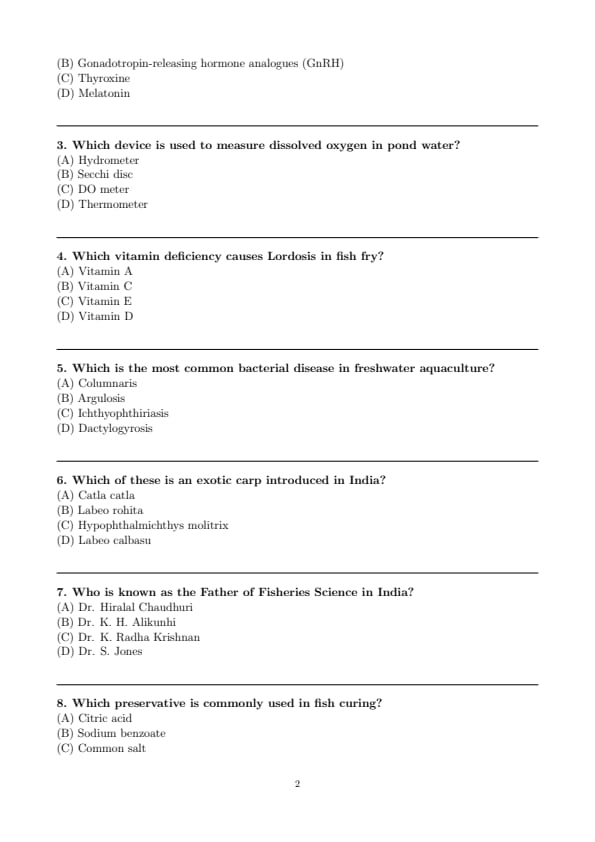
Which device is used to measure dissolved oxygen in pond water?
View Solution
Step 1: Understanding the Concept:
Dissolved oxygen (DO) refers to the amount of gaseous oxygen dissolved in water. It is one of the most critical water quality parameters in aquaculture, as fish require sufficient oxygen for respiration. Monitoring DO levels is essential for managing a healthy pond environment.
Step 2: Detailed Explanation:
Let's analyze the function of each device:
(A) Hydrometer: This instrument measures the specific gravity (or relative density) of a liquid. It is commonly used to measure the salinity of water, not dissolved oxygen.
(B) Secchi disc: This is a simple, circular disc (usually black and white) used to measure water transparency or turbidity. The depth at which the disc is no longer visible is known as the Secchi depth, which gives an indication of plankton density and water clarity. It does not measure oxygen.
(C) DO meter: This is an electronic device specifically designed to measure the concentration of dissolved oxygen in water. The name "DO meter" is an abbreviation for "Dissolved Oxygen meter". It typically consists of a probe connected to a digital meter that displays the DO level, often in milligrams per liter (mg/L) or parts per million (ppm).
(D) Thermometer: This device is used to measure temperature, which is another important water quality parameter, but it does not measure dissolved oxygen.
Step 3: Final Answer:
The device used explicitly for measuring dissolved oxygen in water is the DO meter. Therefore, it is the correct answer.
Quick Tip: Associate key aquaculture terms with their specific tools. For example: Dissolved Oxygen -> DO meter, Transparency -> Secchi disc, Salinity -> Hydrometer or Refractometer, Temperature -> Thermometer, pH -> pH meter.
Which vitamin deficiency causes Lordosis in fish fry?
View Solution
Step 1: Understanding the Concept:
Lordosis is a skeletal deformity characterized by an abnormal inward (ventral) curvature of the spine. In fish, proper skeletal development is heavily dependent on adequate nutrition, especially during the early life stages like fry and fingerlings. Deficiencies in certain vitamins can interfere with bone and cartilage formation, leading to such deformities.
Step 2: Detailed Explanation:
Let's consider the roles of the listed vitamins in fish health:
(A) Vitamin A: Essential for vision, immune function, and epithelial tissue health. Deficiency can lead to eye problems and poor growth.
(B) Vitamin C (Ascorbic acid): This vitamin is a crucial cofactor in the synthesis of collagen, which is the primary structural protein in connective tissues, including cartilage and the organic matrix of bone. A deficiency of Vitamin C impairs collagen formation, leading to weakened skeletal structures. This results in deformities like Lordosis (inward spinal curve) and Scoliosis (lateral spinal curve).
(C) Vitamin E: Primarily acts as an antioxidant, protecting cells from oxidative damage. Deficiency can lead to conditions like muscular dystrophy and anemia.
(D) Vitamin D: Essential for calcium and phosphorus metabolism and their deposition in bones. While its deficiency can cause skeletal issues like rickets, Lordosis is more specifically and strongly linked to Vitamin C deficiency.
Step 3: Final Answer:
The deficiency of Vitamin C (ascorbic acid) is the most well-documented nutritional cause of skeletal deformities like lordosis in fish due to its critical role in collagen synthesis. Therefore, this is the correct answer.
Quick Tip: Remember the direct link: \textbf{Vitamin C} -> \textbf{Collagen} -> \textbf{Cartilage/Bone} -> \textbf{Spinal Column}. A break in this chain due to Vitamin C deficiency leads to spinal deformities like Lordosis and Scoliosis.
Which is the most common bacterial disease in freshwater aquaculture?
View Solution
Step 1: Understanding the Concept:
The question asks to identify the most common bacterial disease from the given options. It is important to distinguish between diseases caused by bacteria, parasites, fungi, and viruses.
Step 2: Detailed Explanation:
Let's identify the causative agent for each disease listed:
(A) Columnaris: This disease is caused by the bacterium \textit{Flavobacterium columnare. It is a widespread and highly common bacterial infection in freshwater fish, often causing lesions on the skin, gills, and fins, sometimes appearing as "saddleback" lesions. It is indeed a bacterial disease.
(B) Argulosis: This is an infestation caused by a crustacean parasite known as the fish louse (\textit{Argulus sp.). It is not a bacterial disease.
(C) Ichthyophthiriasis: Commonly known as "Ich" or "White Spot Disease," this is one of the most common diseases in freshwater aquaria and aquaculture. However, it is caused by a ciliated protozoan parasite, \textit{Ichthyophthirius multifiliis. It is not a bacterial disease.
(D) Dactylogyrosis: This is an infestation of the gills caused by monogenean trematode parasites (flatworms) of the genus \textit{Dactylogyrus, commonly known as gill flukes. It is not a bacterial disease.
Step 3: Final Answer:
Among the four options provided, only Columnaris is a bacterial disease. The other three are caused by parasites (two by worms/flukes and one by a protozoan). Columnaris is also one of the most prevalent bacterial diseases affecting freshwater fish globally. Therefore, it is the correct answer.
Quick Tip: In fish disease questions, first categorize the disease by its causative agent: bacterial, viral, fungal, or parasitic. This can often eliminate incorrect options immediately, as seen in this question where three of the four options were parasitic diseases.
Which of these is an exotic carp introduced in India?
View Solution
Step 1: Understanding the Concept:
The question asks to identify an "exotic" carp species from the list. An exotic species is one that is not native to a particular area or country and has been introduced from another region. In this context, we need to distinguish between native Indian carps and those introduced from other countries.
Step 2: Detailed Explanation:
Let's examine the origin of each species:
(A) Catla catla (Catla): This is a major component of the Indian Major Carps (IMCs). It is native to the river systems of India, Pakistan, Bangladesh, and Nepal. It is an indigenous species.
(B) Labeo rohita (Rohu): This is another of the three primary Indian Major Carps. It is also native to the rivers of South Asia, including India. It is an indigenous species.
(C) Hypophthalmichthys molitrix (Silver Carp): This species is native to large rivers in China and Eastern Siberia. It was introduced to India in 1959 for aquaculture purposes, primarily for its phytoplankton-feeding habit, which makes it suitable for polyculture systems (composite fish culture) with Indian carps. It is an exotic species.
(D) Labeo calbasu (Calbasu or Orange-fin Labeo): This is considered a minor carp but is also native to the Indian subcontinent. It is an indigenous species.
Step 3: Final Answer:
Based on their origins, Catla catla, \textit{Labeo rohita, and \textit{Labeo calbasu are all native to India. \textit{Hypophthalmichthys molitrix (Silver Carp) is native to China and was introduced to India, making it the exotic species in the list.
Quick Tip: Remember the two main groups of carps used in Indian aquaculture: \textbf{Indian Major Carps (IMC): Catla, Rohu, Mrigal. (Native) \textbf{Exotic Carps:} Silver Carp, Grass Carp, Common Carp. (Introduced) This classification will help you quickly answer such questions.
Who is known as the Father of Fisheries Science in India?
View Solution
Step 1: Understanding the Concept:
This question asks to identify the individual widely regarded as the "Father of Fisheries Science in India". This title is typically bestowed upon a person whose pioneering work fundamentally transformed the field and laid the groundwork for its future development.
Step 2: Detailed Explanation:
Let's look at the contributions of the key figures mentioned:
(A) Dr. Hiralal Chaudhuri: He is a legendary figure in Indian aquaculture. His most significant contribution was the development of the technology for induced breeding of Indian Major Carps using pituitary hormone administration in 1957. This breakthrough solved the critical problem of fish seed availability and paved the way for the "Blue Revolution" in India, transforming aquaculture from a traditional practice to a modern industry. For this monumental achievement, he is widely celebrated as the "Father of Induced Breeding" and often considered the Father of modern Indian aquaculture or fisheries science.
(B) Dr. K. H. Alikunhi: He was also an eminent fisheries scientist who made immense contributions, particularly in fish breeding, larval rearing, and pond management. He worked closely on induced breeding techniques and is also a revered pioneer in the field.
(C) Dr. K. Radha Krishnan: A notable scientist in the field of marine biology and fisheries.
(D) Dr. S. Jones: A renowned ichthyologist and fisheries scientist, known for his work at the Central Marine Fisheries Research Institute (CMFRI).
Step 3: Final Answer:
While all the scientists listed are distinguished, Dr. Hiralal Chaudhuri's successful demonstration of induced breeding is considered the single most important breakthrough in the history of Indian fisheries. This singular achievement that revolutionized the entire sector has earned him the title of "Father of the Blue Revolution" and makes him the most fitting answer for the "Father of Fisheries Science in India".
Quick Tip: Associate key historical figures with their major breakthroughs. For Indian fisheries, Dr. Hiralal Chaudhuri and "Induced Breeding" are inextricably linked. This connection is a common topic in competitive exams.
Which preservative is commonly used in fish curing?
View Solution
Step 1: Understanding the Concept:
Fish curing is one of the oldest methods of fish preservation. The process involves treating fish to prevent spoilage and extend its shelf life. The primary mechanisms are dehydration and inhibition of microbial growth. The question asks for the most common preservative used in this process.
Step 2: Detailed Explanation:
Let's evaluate the options as fish preservatives:
(A) Citric acid: It is a weak organic acid used in food as a flavouring agent and a mild preservative, primarily by reducing pH. It is not the main agent used in traditional fish curing.
(B) Sodium benzoate: This is a chemical food preservative that is effective in acidic conditions. It inhibits the growth of bacteria and fungi. While it can be used in some processed fish products like pickles, it is not the primary preservative in traditional "curing" methods like salting and drying.
(C) Common salt (Sodium Chloride, NaCl): This is the cornerstone of fish curing. Salting preserves fish through two main actions:
Osmosis: Salt draws water out of the fish tissues, dehydrating them. Most spoilage bacteria cannot survive in such a low-moisture environment.
Direct Inhibition: High concentrations of salt are toxic to many microorganisms, directly inhibiting their growth.
Methods like dry salting, wet salting (brining), and salt-drying are fundamental curing techniques.
(D) Formaldehyde (formalin): This is a powerful disinfectant and preservative, but it is highly toxic and carcinogenic. It is used to preserve biological specimens for dissection or museums, but it is illegal and unsafe for use in food preservation.
Step 3: Final Answer:
Common salt is the most traditional, widespread, and fundamental preservative used in the curing of fish. Therefore, it is the correct answer.
Quick Tip: When you see the term "fish curing," immediately think of the traditional methods: salting, drying, and smoking. The most essential ingredient in these processes is common salt (NaCl).
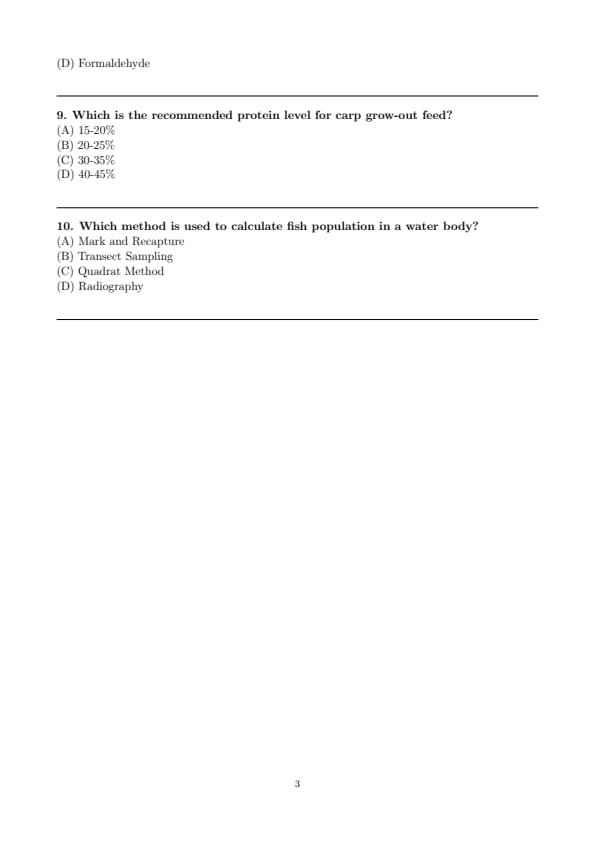
Which is the recommended protein level for carp grow-out feed?
View Solution
Step 1: Understanding the Concept:
The protein requirement of fish varies significantly with their life stage. Fry and fingerlings (early stages) require a very high protein diet for rapid muscle and tissue development. As fish grow larger (the "grow-out" stage), their metabolic rate and relative growth rate decrease, so their dietary protein requirement also decreases. The question asks for the recommended protein level for carps during this grow-out phase.
Step 2: Detailed Explanation:
Let's analyze the protein levels:
(A) 15-20%: This protein level is too low for efficient growth in most commercial carp farming systems. It might be used in very extensive systems with high natural productivity, but it would not be considered optimal.
(B) 20-25%: This is a lower-end range for grow-out feed. It can support growth but may not be optimal for achieving the best growth rates or feed conversion ratios (FCR) in semi-intensive farming.
(C) 30-35%: This range is widely considered optimal for the grow-out stage of Indian major carps in semi-intensive and intensive culture systems. It provides a good balance between rapid growth and the cost of the feed (protein is the most expensive component). Many commercial carp feeds are formulated within this range to maximize production.
(D) 40-45%: This is a very high protein level, typically required by carnivorous fish species (like trout, salmon, or seabass) or during the larval/fry stages of many fish. For omnivorous carps in the grow-out stage, this level of protein is unnecessary and not economically viable, as the excess protein would be used inefficiently for energy.
Step 3: Final Answer:
For achieving good growth rates in commercial carp culture during the grow-out phase, a protein level of 30-35% is generally recommended and used in standard feed formulations.
Quick Tip: Remember the general rule for fish nutrition: Protein requirements are highest in the early stages (fry/larvae >40%) and decrease as the fish gets older (fingerling 35-40%, grow-out 25-35%, broodstock ~35%). Carps, being omnivores, have lower protein needs than carnivores.
Which method is used to calculate fish population in a water body?
View Solution
Step 1: Understanding the Concept:
The question asks for a standard method to estimate the total number of fish (a mobile population) in a large water body like a lake or pond. It is usually impossible to count every single fish, so ecologists use sampling techniques to estimate the population size.
Step 2: Key Formula or Approach:
The Mark and Recapture method often uses the Lincoln-Petersen index, which is calculated as:
\[ N = \frac{M \times C}{R} \]
Where:
\(N\) = Estimated total population size
\(M\) = Number of individuals caught, marked, and released in the first sample
\(C\) = Total number of individuals caught in the second sample
\(R\) = Number of marked individuals recaptured in the second sample
Step 3: Detailed Explanation:
Let's analyze the applicability of each method for a fish population:
(A) Mark and Recapture: This is the classic and most widely used method for estimating the population size of mobile animals. The process involves capturing a sample of fish, marking them in a way that doesn't harm them (e.g., fin clipping, tagging), releasing them back into the population, and then taking a second sample after some time. The proportion of marked fish in the second sample is used to estimate the entire population size. This is perfectly suited for fish.
(B) Transect Sampling: This involves counting organisms along a pre-determined line (transect). It is more suitable for sessile (non-moving) organisms like plants or slow-moving animals in a defined habitat, not for freely swimming fish in a large water body.
(C) Quadrat Method: This involves placing a square frame (quadrat) at random locations and counting the number of individuals within it to estimate density. Like transect sampling, this is used for plants and slow-moving or sessile animals, not for mobile fish populations.
(D) Radiography: This is an imaging technique using X-rays. It is used in medicine and biology to view the internal structure of an organism (e.g., to check for skeletal deformities in fish), not for estimating population size in the wild.
Step 4: Final Answer:
The Mark and Recapture method is the standard ecological technique specifically designed for estimating the population size of mobile organisms like fish in a water body.
Quick Tip: For population estimation questions, think about the mobility of the organism. For mobile animals (fish, birds, insects), use Mark and Recapture. For stationary or slow-moving organisms (plants, barnacles), use Quadrat or Transect methods.
*The article might have information for the previous academic years, please refer the official website of the exam.