
CBSE Class 10 Exam 2024 Question Paper with Answer Key PDF for English (February 26 - Shift 1)


| Updated On - Jan 3, 2025
CBSE Class 10 Exam 2024 Question Papers are the most important study material for effective exam preparation. We at Zollege have provided all CBSE Class 10 Exam 2024 Previous Year Papers with Solution PDFs here. CBSE Class 10 Exam 2024 English exam was conducted successfully on February 26 by CBSE.
Students can freely download the CBSE Class 10 Exam 2024 previous year's question paper PDFs along with their solutions here. We strongly encourage CBSE Class 10 aspirants to scan through all the CBSE Class 10 Exam 2024 Question Paper to know the overall difficulty level,CBSE Class 10 Exam 2024 Syllabus and understand the changes in CBSE Class 10 Exam 2024 Exam Pattern over the years.
CBSE Class 10 English 2024 Question Paper with Answer Key PDF
| CBSE Class 10 English 2024 Question Paper with Answer Key (Set 2-2/1/2) |  Download Download |
Check Solution |
| Question | Answer | Detailed Solution |
|---|---|---|
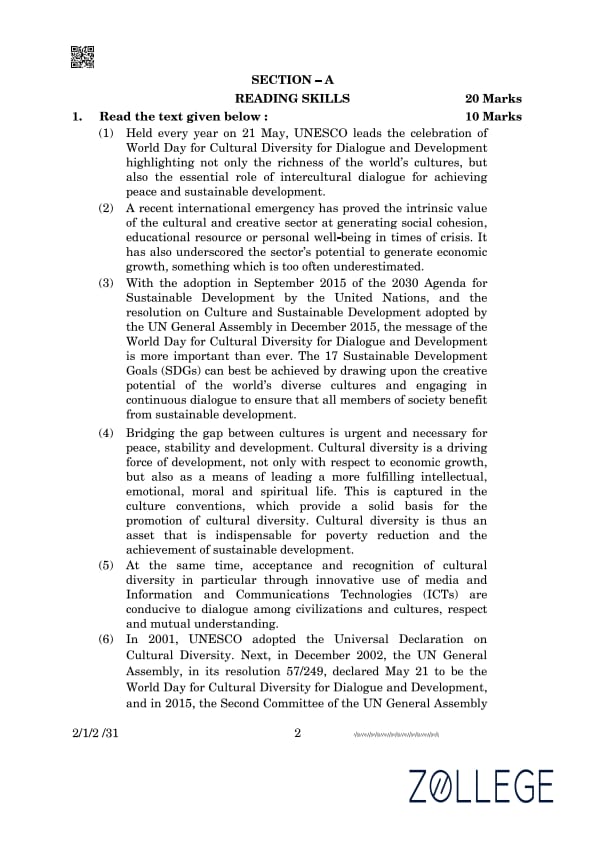
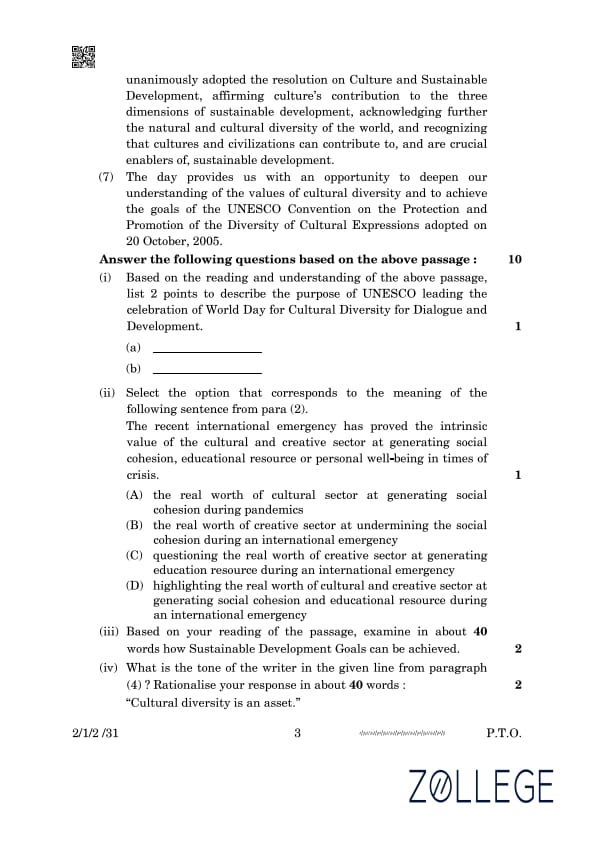
| Question 1: (i) Based on the reading and understanding of the above passage, list 2 points to describe the purpose of UNESCO leading the celebration of World Day for Cultural Diversity for Dialogue and Development. (a)_____ (b)_____ | (a) Promoting the importance of cultural diversity in fostering dialogue among different societies and communities. (b) Encouraging sustainable development through cultural understanding and mutual respect. | The passage highlights the celebration of World Day for Cultural Diversity, led by UNESCO, to promote intercultural dialogue for peace and sustainable development. The provided answer explicitly states these two key purposes. |
| (ii) Select the option that corresponds to the meaning of the following sentence: "The recent international emergency has proved the intrinsic value of the cultural and creative sector at generating social cohesion, educational resource or personal well-being in times of crisis." (A) the real worth of cultural sector at generating social cohesion during pandemics (B) the real worth of creative sector at undermining the social cohesion during an international emergency (C) questioning the real worth of creative sector at generating education resource during an international emergency (D) highlighting the real worth of cultural and creative sector at generating social cohesion and educational resource during an international emergency |
(D) highlighting the real worth of cultural and creative sector at generating social cohesion and educational resource during an international emergency | The sentence emphasizes that recent emergencies have demonstrated the inherent value of the cultural and creative sector in promoting social unity, providing educational resources, and supporting personal well-being. Option D accurately captures this core message. |
| (iii): Based on your reading of the passage, examine in about 40 words how Sustainable Development Goals can be achieved. | Sustainable Development Goals can be achieved by promoting cultural diversity, fostering dialogue, and strengthening educational and creative sectors. These actions enhance social cohesion, empower communities, and ensure inclusive development, contributing to long-term sustainability across diverse societies. | The passage suggests that the SDGs can be achieved by utilizing the creative potential of diverse cultures and engaging in continuous dialogue. The answer concisely addresses how promoting cultural diversity and dialogue, along with strengthening educational and creative sectors, can contribute to these goals. |
| (iv): What is the tone of the writer in the given line from paragraph (4)? "Cultural diversity is an asset.” | The tone of the writer is affirmative and optimistic. The line conveys the writer's positive belief in the inherent value of cultural diversity, portraying it as a critical strength for fostering unity, growth, and inclusive development in society. | The phrase "cultural diversity is an asset" indicates a positive and confident perspective. The detailed answer correctly identifies this as an affirmative and optimistic tone, highlighting the writer’s belief in the value of cultural diversity. |
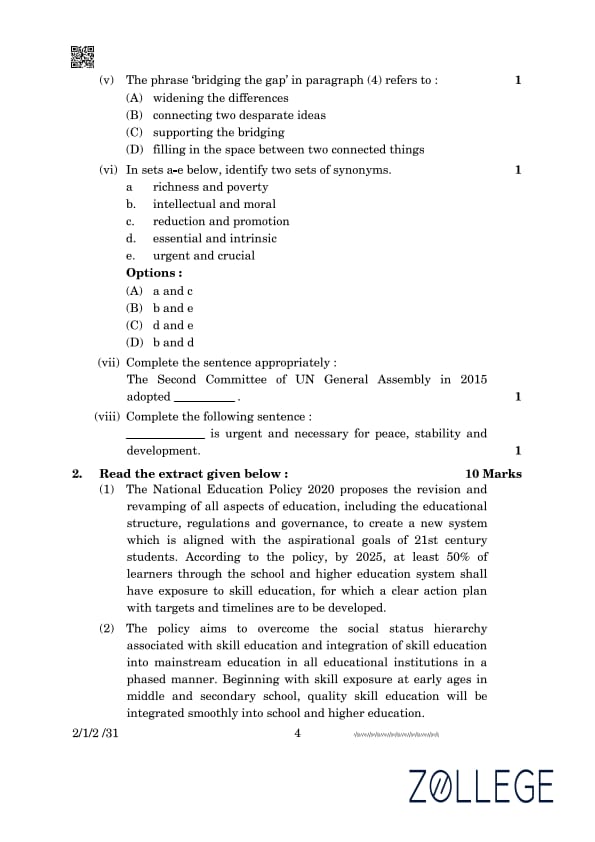
| (v): The phrase ‘bridging the gap' in paragraph (4) refers to: (A) Widening the differences. (B) Connecting two disparate ideas. (C) Supporting the bridging. (D) Filling in the space between two connected things. |
(B) Connecting two disparate ideas. | The phrase 'bridging the gap' implies connecting two things that are different or separated. Therefore, option B accurately reflects the meaning by stating 'Connecting two disparate ideas.' |
| (vi): In sets a–e below, identify two sets of synonyms. Sets: a. Richness and poverty. b. Intellectual and moral. c. Reduction and promotion. d. Essential and intrinsic. e. Urgent and crucial. (A) a and c. (B) b and e. (C) d and e. (D) b and d. |
(C) d and e. | Synonyms are words with similar meanings. 'Essential' and 'intrinsic' have similar meanings, as do 'urgent' and 'crucial.' Thus, option C, which contains d and e, is the correct choice. |
| (vii): Complete the sentence appropriately: The Second Committee of UN General Assembly in 2015 adopted _______. | a resolution on culture and sustainable development. | Based on the passage, the Second Committee of the UN General Assembly in 2015 adopted a resolution related to culture and sustainable development. This fits directly with the information provided. |
| (viii): Complete the following sentence: _______ is urgent and necessary for peace, stability and development. | Cultural diversity | The passage emphasizes the importance of cultural diversity for peace, stability, and development. The correct answer, 'Cultural diversity', aligns perfectly with the text's message. |
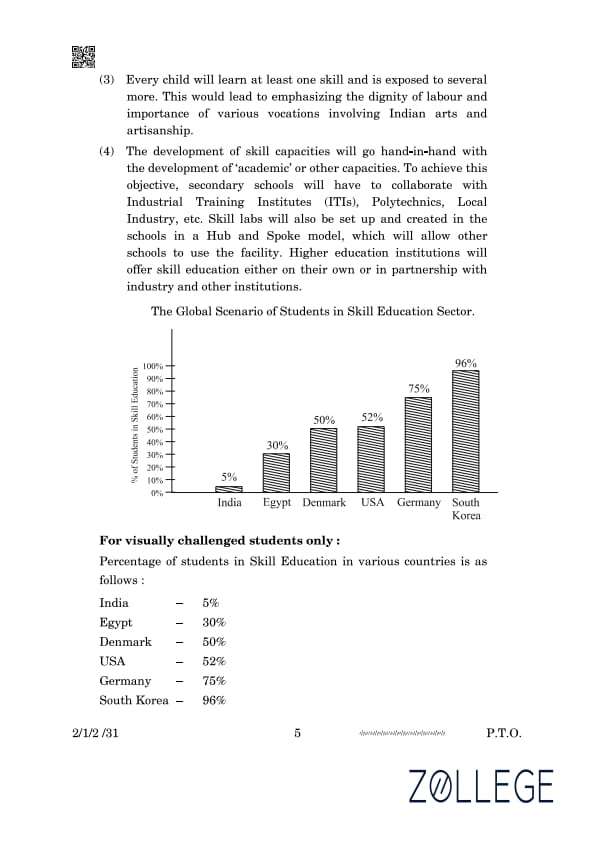
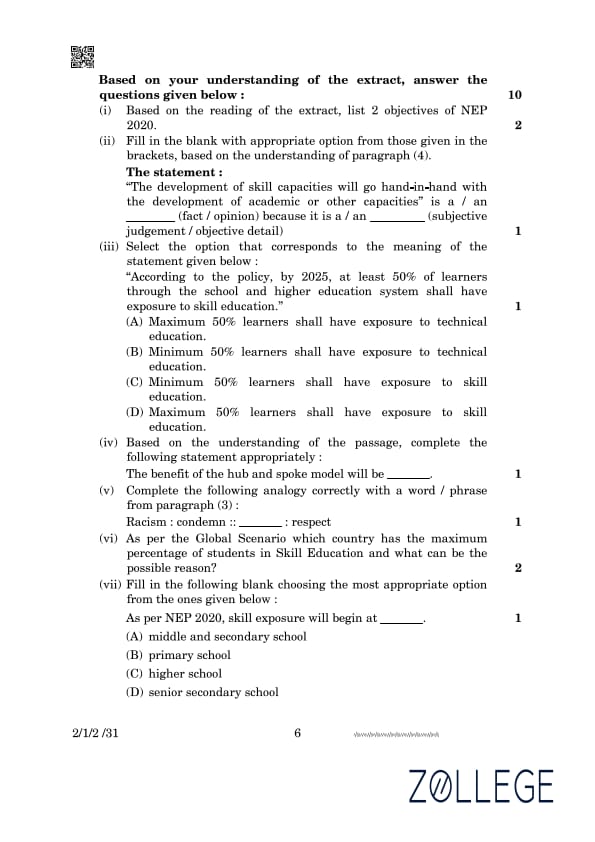
| Question 2: (i): Based on the reading of the extract, list 2 objectives of NEP 2020. | 1. To create a holistic and multidisciplinary education system with flexibility in course choices for students. 2. To achieve equitable access to quality education for all, irrespective of socio-economic background. | Based on the extract, NEP 2020 aims to create a flexible, holistic education system and to ensure equal access to quality education. These points are derived from the given text and correctly identify the key objectives of the policy. |
| (ii): Fill in the blank with the appropriate option from those given in the brackets, based on the understanding of paragraph (4). The statement: “The development of skill capacities will go hand-in-hand with the development of academic or other capacities” is a/an (fact) because it is a/an (objective detail). | fact, objective detail | The statement in paragraph (4) presents a correlation supported by educational policies, making it a factual claim. This is reinforced because the claim is based on objective details, rather than subjective views. |
| (iii): Select the option that corresponds to the meaning of the statement: “According to the policy, by 2025, at least 50% of learners through the school and higher education system shall have exposure to skill education." (A) Maximum 50% learners shall have exposure to technical education. (B) Minimum 50% learners shall have exposure to technical education. (C) Minimum 50% learners shall have exposure to skill education. (D) Maximum 50% learners shall have exposure to skill education. |
(C) Minimum 50% learners shall have exposure to skill education. | The phrase "at least" specifies a minimum target, not a maximum. Additionally, it refers to skill education not technical education. So, the correct option is (C), indicating that a minimum of 50% of learners should have skill exposure. |
| (iv) Based on the understanding of the passage, complete the following statement appropriately: The benefit of the hub and spoke model will be _______. | efficient connectivity and reduced costs. | The passage implies that the hub and spoke model allows for better coordination and reduced operational costs. Therefore, the completed sentence should highlight these benefits, which are identified as 'efficient connectivity and reduced costs'. |
| (v) Complete the following analogy correctly with a word/phrase from paragraph (3): Racism : condemn :: tolerance : __________. | respect | The given analogy is based on cause and effect. Racism leads to condemnation, so tolerance logically leads to respect, aligning with the inherent relationship between the concepts. |
| (vi) As per the Global Scenario, which country has the maximum percentage of students in Skill Education and what can be the possible reason? | Germany has the maximum percentage of students in skill education. Reason: Germany's education system emphasizes vocational training and skill development from a young age. Programs like the dual education system combine classroom learning with practical, on-the-job training. |
Based on the provided data, Germany has the highest percentage of students in skill education. The reason aligns with the strong vocational training focus in Germany’s educational system, combining theory with practical training. |
| (vii) Fill in the following blank choosing the most appropriate option from the ones given below: As per NEP 2020, skill exposure will begin at _______. (A) middle and secondary school (B) primary school (C) higher school (D) senior secondary school |
(A) middle and secondary school | The text states that skill exposure will begin in middle and secondary schools as per NEP 2020, making 'middle and secondary school' the correct option for the blank. |
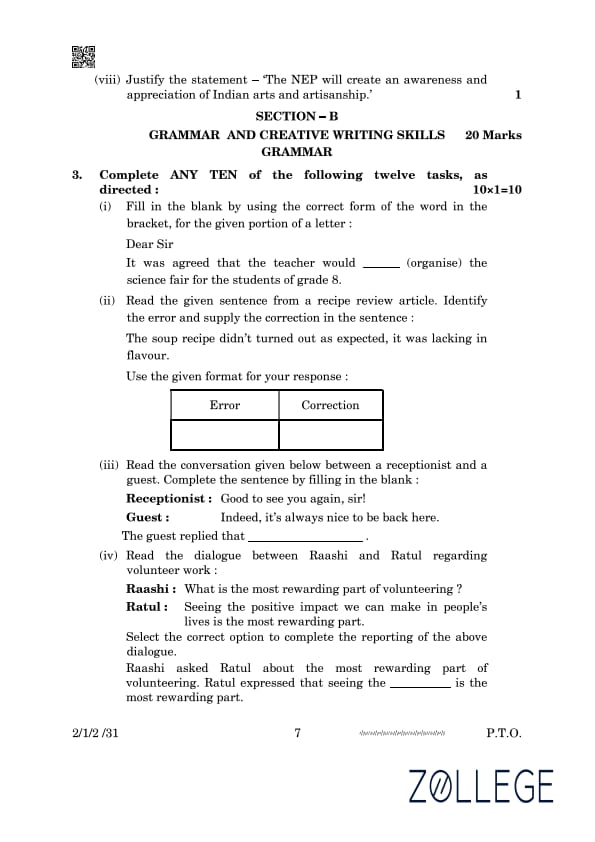
| (viii) Justify the statement – “The NEP will create an awareness and appreciation of Indian arts and artisanship." | The NEP 2020 aims to promote Indian arts and artisanship through: • Including traditional arts, crafts, and culture in the curriculum. • Encouraging students to learn about Indian heritage and diverse cultural traditions. • Providing platforms for artists and artisans to showcase their skills. This initiative fosters respect, awareness, and pride for India's rich cultural heritage while equipping students with creative and artistic skills. | The provided justification highlights how NEP 2020 integrates traditional arts, encourages learning about Indian heritage, and provides platforms for showcasing artists. These methods foster appreciation and awareness of Indian arts and artisanship. |
| Question 3: (i): Fill in the blank by using the correct form of the word in the bracket, for the given portion of a letter: It was agreed that the teacher would ____ (organise) the science fair for the students of grade 8. | organise | The phrase "It was agreed that..." implies a future action planned in the past, therefore, the base form of the verb 'organise' is needed. |
| 3 (ii): Read the given sentence from a recipe review article. Identify the error and supply the correction in the sentence: The soup recipe didn't turned out as expected, it was lacking in flavour. | Error: didn't turned Correction: didn't turn |
With the use of the auxiliary verb 'didn't', the main verb should be in its base form, hence, "turned" should be corrected to "turn". |
| 3 (iii): Read the conversation given below between a receptionist and a guest. Complete the sentence by filling in the blank: The guest replied that ______. | it was always nice to be back there. | Converting the direct speech of "it's always nice to be back here" into indirect speech requires changing "is" to "was" and "here" to "there". Thus, the complete reported sentence becomes "it was always nice to be back there." |
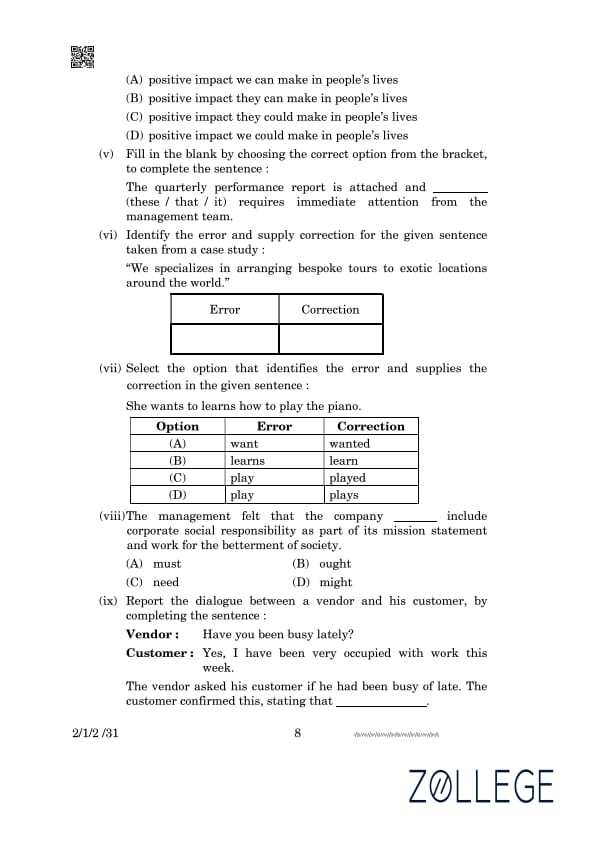
| 3 (iv): Read the dialogue between Raashi and Ratul regarding volunteer work: Raashi: What is the most rewarding part of volunteering? Ratul: Seeing the positive impact we can make in people's lives is the most rewarding part. Select the correct option to complete the reporting of the above dialogue: Raashi asked Ratul about the most rewarding part of volunteering. Ratul expressed that seeing the ______ is the most rewarding part. (A) positive impact we can make in people's lives (B) positive impact they can make in people's lives (C) positive impact they could make in people's lives (D) positive impact we could make in people's lives |
positive impact we can make in people's lives | Converting direct speech into indirect speech requires summarizing the speaker's answer. In this case, it requires replacing the exact words with a summarized version while keeping the verb in the present tense since it is universal truth. Therefore, option A is correct. |
| 3 (v): Fill in the blank by choosing the correct option from the bracket, to complete the sentence: The quarterly performance report is attached and _____(these / that / it) requires immediate attention from the management team. | it | The singular subject "the quarterly performance report" requires the singular pronoun "it", which is the correct option. |
| 3 (vi): Identify the error and supply correction for the given sentence taken from a case study: “We specializes in arranging bespoke tours to exotic locations around the world.” | Error: specializes Correction: specialize |
Since the subject is "We" (plural), the verb must be in its base form, thus "specializes" is incorrect and should be "specialize". |
| 3 (vii): Select the option that identifies the error and supplies the correction in the given sentence: She wants to learns how to play the piano. Option Error Correction (A) want wanted (B) learns learn (C) play played (D) play plays |
(B) learns → learn | The error lies with the verb "learns" because it follows the infinitive "to", which requires the base form of the verb. The correct form should be "learn". |
| 3 (viii): The management felt that the company _______ include corporate social responsibility as part of its mission statement and work for the betterment of society. (A) must (B) ought (C) need (D) might |
(A) must | The word "must" indicates a strong necessity or obligation. It aligns with the context of including corporate social responsibility as part of a mission statement. |
| 3 (ix): Report the dialogue between a vendor and his customer, by completing the sentence: The vendor asked his customer if he had been busy of late. The customer confirmed this, stating that _______. | he had been very occupied with work that week. | Converting the direct speech "Yes, I have been very occupied with work this week." into indirect speech requires the following changes: present perfect tense "have been" changes to past perfect tense "had been" and "this week" changes to "that week". |
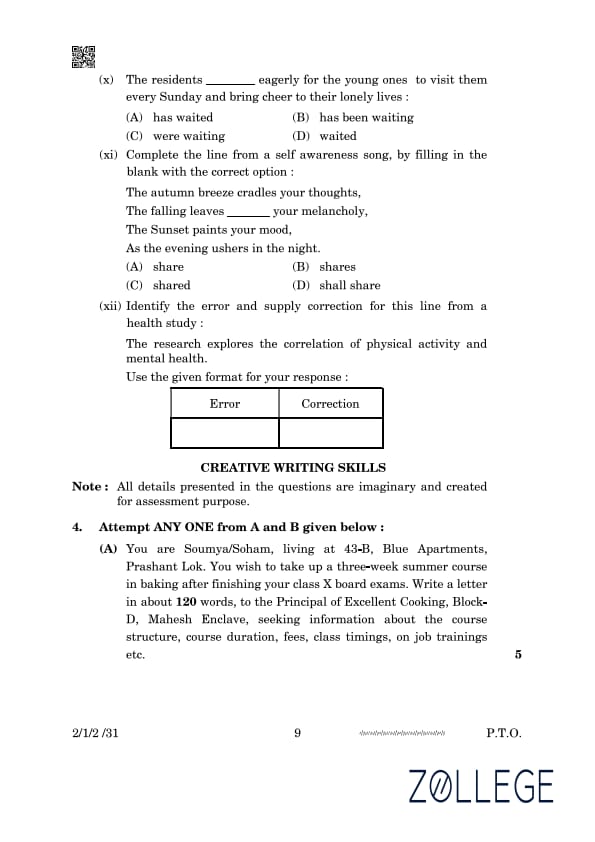
| (x) The residents eagerly _______ for the young ones to visit them every Sunday and bring cheer to their lonely lives: (A) has waited (B) has been waiting (C) were waiting (D) waited |
(D) waited | The sentence describes a habitual past action, where the residents regularly anticipate the visits on Sundays, thus the simple past tense "waited" is the appropriate answer. |
| (xi) Complete the line from a self-awareness song, by filling in the blank with the correct option: The autumn breeze cradles your thoughts, The falling leaves your melancholy, The Sunset paints your mood, As the evening ushers in the night. _______. (A) share (B) shares (C) shared (D) shall share |
(A) share | The verb should be in the same tense as other verbs in the line. Hence, the correct answer is "share", which is in the base form of the verb. |
| (xii) Identify the error and supply correction for this line from a health study: The research explores the correlation of physical activity and mental health. | Error: of Correction: between |
The word "of" should be replaced with "between" when describing the relationship between two elements such as physical activity and mental health. |
| Question 4 (A): You are Soumya/Soham, living at 43-B, Blue Apartments, Prashant Lok. You wish to take up a three-week summer course in baking after finishing your class X board exams. Write a letter in about 120 words, to the Principal of Excellent Cooking, Block-D, Mahesh Enclave, seeking information about the course structure, course duration, fees, class timings, on job trainings, etc. | [Date] Το, The Principal Excellent Cooking Block-D, Mahesh Enclave Subject: Request for Information on Baking Summer Course Respected Sir/Madam, I am Soham/Soumya, a student who has recently completed Class X. I am interested in enrolling for your three-week summer course in baking. I kindly request you to provide the following details about the course: • Course structure and syllabus • Course duration and class timings • Fees for the program • Information about on-job training opportunities I would be grateful if you could provide me with the necessary details at your earliest convenience so I can plan accordingly. Thank you. Yours sincerely, Soham/Soumya |
This is a formal letter requesting information about a summer course. It is well structured with clear subject, salutation, and concise request for specific details. |
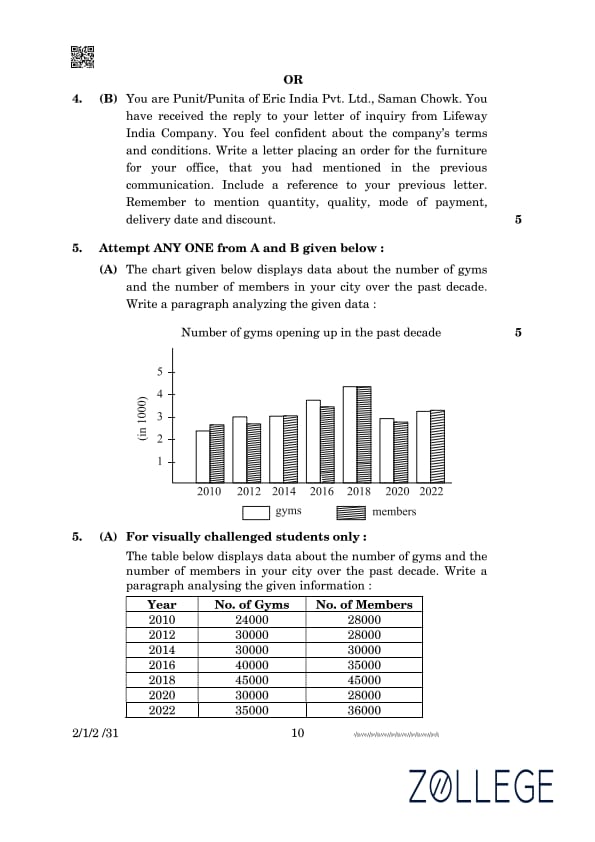
| Question 4 (B): You are Punit/Punita of Eric India Pvt. Ltd., Saman Chowk. You have received the reply to your letter of inquiry from Lifeway India Company. You feel confident about the company's terms and conditions. Write a letter placing an order for the furniture for your office, that you had mentioned in the previous communication. Include a reference to your previous letter. Remember to mention quantity, quality, mode of payment, delivery date, and discount. | Eric India Pvt. Ltd., Saman Chowk [Date] Το, The Manager Lifeway India Company Subject: Order for Office Furniture Dear Sir/Madam, This is with reference to our previous letter dated [mention date] regarding office furniture requirements. After reviewing your reply and being satisfied with your terms and conditions, we would like to place an order for the following items: • 10 Office Chairs (Model XYZ, High-back, black) • 5 Office Tables (Model ABC, Wooden, 4x3 ft) • 3 Filing Cabinets (Model LMN, Metal) Mode of Payment: 50% advance and the remaining on delivery. Delivery Date: Kindly deliver the order by [mention date]. Discount: As per the agreed terms, a 10% discount will be applied. We request you to confirm the order and ensure timely delivery. Please acknowledge receipt of this order. Thank you. Yours sincerely, Punit/Punita Eric India Pvt. Ltd. |
The letter is well-structured and contains the necessary details for a formal order, including references to previous communication, item descriptions, mode of payment, delivery date and discount. |
| Question 5 (A): For visually challenged students only: Write a paragraph analyzing the data in the table about the number of gyms and the number of members in your city over the past decade. Year No. of Gyms No. of Members 2010 24000 28000 2012 30000 28000 2014 30000 30000 2016 40000 35000 2018 45000 45000 2020 30000 28000 2022 35000 36000 |
The chart highlights trends in the number of gyms and gym memberships over the past decade from 2010 to 2022. In 2010, the number of gyms was around 2,400, while memberships stood at 2,800. This shows moderate interest in fitness facilities. Between 2012 and 2014, gyms increased to 3,000, and memberships grew to 3,000 as well, reflecting balanced growth. The trend accelerated in 2016, where gyms surged to 4,000, while memberships increased to 3,500, suggesting increased fitness awareness. The peak occurred in 2018, with gyms reaching 4,500 and memberships matching this figure, indicating maximum engagement with fitness services. However, in 2020, there was a decline, with gyms falling to 3,000 and memberships dropping to 2,800, likely due to the pandemic. By 2022, there was a slight recovery, as gyms rose to 3,500 and memberships to 3,600. Overall, the data shows significant growth, especially in 2016 and 2018, with a temporary decline in 2020, followed by partial recovery in 2022. | The paragraph gives a structured analysis, including starting points, major shifts, peaks, declines, and the overall growth, along with possible explanations for certain trends, such as the decline in 2020 due to the pandemic. |
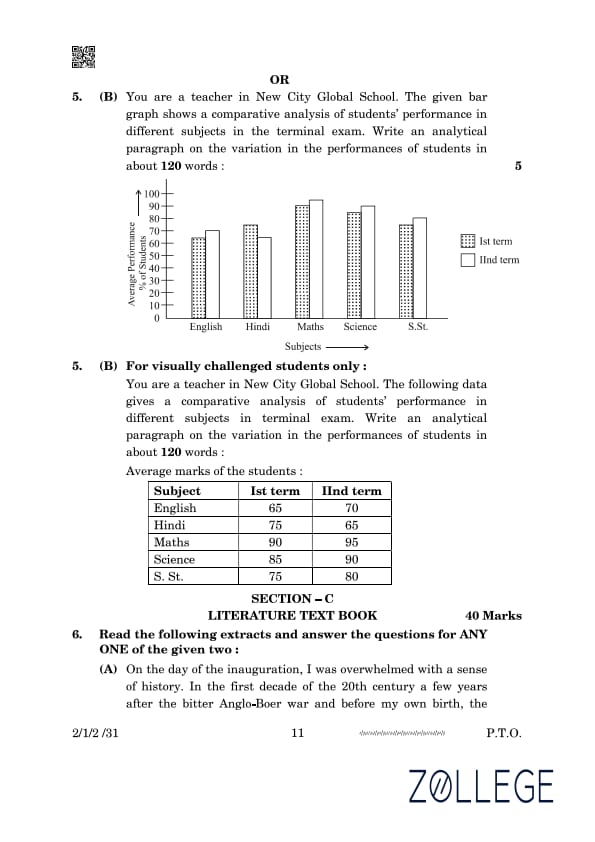
| Question 5 (B): You are a teacher in New City Global School. The given bar graph shows a comparative analysis of students' performance in different subjects in the terminal exam. Write an analytical paragraph on the variation in the performances of students in about 120 words. | The bar graph compares the average performance of students in five subjects—English, Hindi, Mathematics, Science, and Social Studies—across the 1st and 2nd terminal exams. In English, there was a slight improvement, with scores increasing from 65 to 70. Conversely, Hindi showed a decline, where scores dropped from 75 in the 1st term to 65 in the 2nd term, indicating a need for targeted efforts. Mathematics displayed exceptional improvement, rising from 90 to 95, reflecting strong student performance. Science also saw progress, as scores increased from 85 to 90. Social Studies recorded a modest rise, improving from 75 to 80. Overall, the analysis highlights improvements in most subjects, with Mathematics showing the best progress, while Hindi requires intervention to address the decline. | This analytical paragraph provides a subject-wise comparison of student performance across two terms. It notes which subjects showed improvement, declines, and identifies which subjects require intervention. |
|
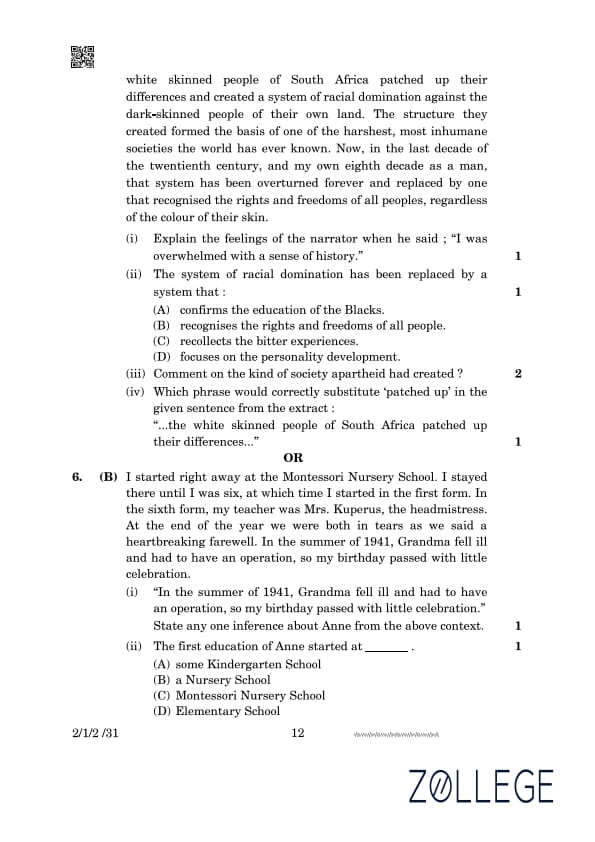
Question 6. Read the following extracts and answer the questions for ANY ONE of the given two: Question (A) Extract: On the day of the inauguration, I was overwhelmed with a sense of history. In the first decade of the 20th century a few years after the bitter Anglo-Boer war and before my own birth, the white-skinned people of South Africa patched up their differences and created a system of racial domination against the dark-skinned people of their own land. The structure they created formed the basis of one of the harshest, most inhumane societies the world has ever known. Now, in the last decade of the twentieth century and my own eighth decade as a man, that system has been overturned forever and replaced by one that recognised the rights and freedoms of all peoples, regardless of the colour of their skin. (i) Explain the feelings of the narrator when he said; “I was overwhelmed with a sense of history." |
The narrator is expressing a profound feeling of awe and emotion as he reflects on the historical significance of the moment. The narrator understands that the system of racial domination, which had existed for decades, is now being replaced with a system of equality and freedom for all, regardless of their race. The sense of history refers to witnessing a monumental change, the end of apartheid, which had long oppressed the black population in South Africa. | The narrator's feeling is one of deep emotion, understanding that he is experiencing a monumental historical change. The answer correctly explains the context and significance of his words. |
| (ii) The system of racial domination has been replaced by a system that: (A) confirms the education of the Blacks. (B) recognises the rights and freedoms of all people. (C) recollects the bitter experiences. (D) focuses on the personality development. |
(B) recognises the rights and freedoms of all people. | The passage emphasizes the end of apartheid and the new system's recognition of equality. The correct option is B, which aligns with the text's explicit focus on the rights and freedoms of all people regardless of skin color. |
| (iii) Comment on the kind of society apartheid had created? | Apartheid created a deeply segregated society in which racial discrimination was institutionalized. The white-skinned people of South Africa created a system that oppressed and marginalized the dark-skinned people, denying them their basic rights, freedoms, and equality. It was one of the most inhumane and unjust systems the world had ever known, as it perpetuated racial hatred and division. | The answer accurately describes apartheid as a system of racial segregation and discrimination, denying rights to dark-skinned individuals and promoting hatred and division. |
| (iv) Which phrase would correctly substitute ‘patched up' in the given sentence from the extract: “… … … the white-skinned people of South Africa patched up their differences..." | A suitable phrase to replace "patched up" would be "resolved their differences” or "settled their differences.” These phrases indicate that the conflicting parties reached an agreement, which in this context led to the establishment of the racially discriminatory system. | The phrase "patched up" implies resolving conflicts. The answer correctly suggests "resolved their differences" or "settled their differences," which are more formal substitutes in this context. |
|
Question 6: (B) Extract: I started right away at the Montessori Nursery School. I stayed there until I was six, at which time I started in the first form. In the sixth form, my teacher was Mrs. Kuperus, the headmistress. At the end of the year we were both in tears as we said a heartbreaking farewell. In the summer of 1941, Grandma fell ill and had to have an operation, so my birthday passed with little celebration. (i) “In the summer of 1941, Grandma fell ill and had to have an operation, so my birthday passed with little celebration.” State any one inference about Anne from the above context. |
From the given context, we can infer that Anne was deeply concerned and possibly saddened by her grandmother's illness. The lack of celebration on her birthday suggests that Anne's priorities were focused on her grandmother's health rather than her own birthday, reflecting her caring and empathetic nature. | The inference is correctly drawn from the text, highlighting Anne's empathy and care for her grandmother over her own celebration. |
| (ii) The first education of Anne started at _____. (A) some Kindergarten School (B) a Nursery School (C) Montessori Nursery School (D) Elementary School |
(C) Montessori Nursery School | The answer is directly stated in the text: Anne mentions that she started her education at the Montessori Nursery School. |
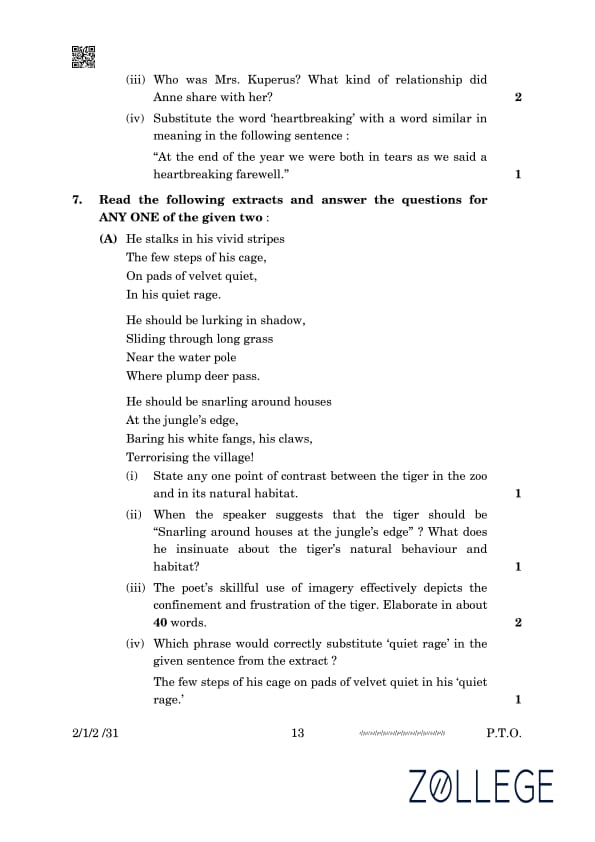
| (iii) Who was Mrs. Kuperus? What kind of relationship did Anne share with her? | Mrs. Kuperus was Anne's teacher and the headmistress of the school. Anne shared a warm and affectionate relationship with her, as indicated by the emotional farewell they shared at the end of the year. Their bond was one of mutual respect and fondness, which was evident from the tears shed during their goodbye. | The relationship is clearly described based on the text - Mrs. Kuperus as Anne's teacher and headmistress and their affectionate, emotional bond. |
| (iv) Substitute the word ‘heartbreaking' with a word similar in meaning in the following sentence: “At the end of the year we were both in tears as we said a heartbreaking farewell.” | A suitable substitute for "heartbreaking" could be "tearful", "emotional”, or "painful". These words convey a similar sense of sadness and deep emotion during the farewell. | The answer correctly suggests similar words that convey the feeling of sadness and deep emotion associated with "heartbreaking". |
|
Question 7: (A) Read the following extracts and answer the questions for ANY ONE of the given two: Question (A) Extract: He stalks in his vivid stripes The few steps of his cage, On pads of velvet quiet, In his quiet rage. He should be lurking in shadow, Sliding through long grass Near the water pole Where plump deer pass. He should be snarling around houses At the jungle's edge, Baring his white fangs, his claws, Terrorising the village! |
The tiger in the zoo is confined to a cage, moving slowly and quietly, whereas in its natural habitat, it roams freely, prowling through the jungle and hunting for prey, exhibiting wild and aggressive behavior. | The contrast is clearly stated, highlighting the restriction of the tiger in the zoo versus its freedom and natural behavior in its habitat. |
| (ii) When the speaker suggests that the tiger should be “snarling around houses at the jungle's edge”? What does he insinuate about the tiger's natural behaviour and habitat? | The speaker insinuates that the tiger, in its natural habitat, is a fierce and dominant creature, one that prowls and hunts at the edges of the jungle, where it can scare villagers with its powerful presence. The tiger's natural behavior is aggressive, wild, and untamed. | The speaker insinuates that in its natural habitat the tiger is wild, powerful and capable of instilling fear. This correctly describes the implied aspects of the tiger's natural behaviour. |
| (iii) The poet's skillful use of imagery effectively depicts the confinement and frustration of the tiger. Elaborate in about 40 words. | The poet uses vivid imagery such as "pads of velvet quiet" and "quiet rage" to show the contrast between the tiger's graceful, restrained movements in the cage and its suppressed fury. The tiger's frustration is depicted through its unnatural stillness and longing for freedom. | The answer aptly identifies and explains the use of imagery like "pads of velvet quiet" and "quiet rage" to describe the tiger's confinement and suppressed emotions. |
| (iv) Which phrase would correctly substitute ‘quiet rage' in the given sentence from the extract? "The few steps of his cage on pads of velvet quiet in his ‘quiet rage'." | The phrase "suppressed fury” or “hidden anger" would correctly substitute "quiet rage," as both phrases convey the idea of the tiger's contained but intense emotional state. | The substitutes are apt and accurately portray the meaning of "quiet rage" as a hidden but intense emotion. |
|
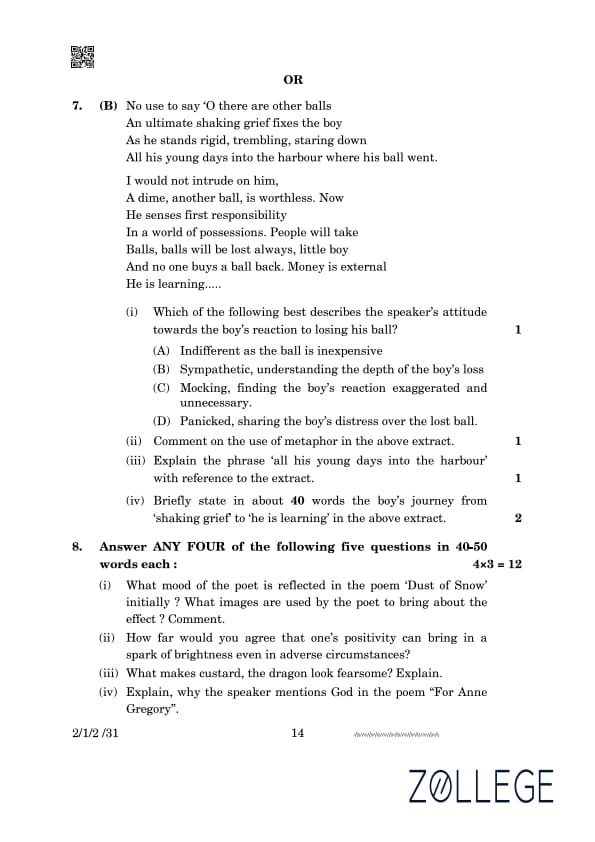
Question 7 (B) Extract: No use to say ‘O there are other balls An ultimate shaking grief fixes the boy As he stands rigid, trembling, staring down All his young days into the harbour where his ball went. I would not intrude on him, A dime, another ball, is worthless. Now He senses first responsibility In a world of possessions. People will take Balls, balls will be lost always, little boy And no one buys a ball back. Money is external He is learning...... (i) Which of the following best describes the speaker's attitude towards the boy's reaction to losing his ball? |
(B) sympathetic, understanding the depth of the boy's loss. | The speaker shows understanding and empathy for the boy's grief. The correct choice is B, which identifies the speaker's sympathy and comprehension. |
| (ii) Comment on the use of metaphor in the above extract. | The metaphor "all his young days into the harbour where his ball went” represents the boy's lost childhood and innocence. The ball symbolizes the carefree days of youth, and losing it reflects the boy's transition from childhood to adulthood, where responsibility and loss are inevitable. | The explanation correctly identifies the metaphor and its symbolic significance within the context of the poem. |
| (iii) Explain the phrase ‘all his young days into the harbour' with reference to the extract. | The phrase symbolizes the loss of the boy's innocence and carefree childhood. The "harbour” where the ball went is a metaphor for the moment of growing up, where the boy realizes that certain things, like his childhood, cannot be retrieved once lost. | The explanation effectively interprets the symbolic meaning of the phrase, connecting it to the loss of innocence and the irreversible nature of time. |
| (iv) Briefly state in about 40 words the boy's journey from ‘shaking grief' to 'he is learning' in the above extract. | The boy's “shaking grief" shows his immediate distress over the loss of the ball, symbolizing his initial shock and helplessness. As the speaker reflects on the loss, the boy begins to understand that possessions can be lost and life moves forward, signaling his emotional growth. | The answer concisely outlines the boy's emotional journey, highlighting his initial shock and eventual understanding. |
|
Question 8. Answer ANY FOUR of the following five questions in 40–50 words each: (i) What mood of the poet is reflected in the poem 'Dust of Snow' initially? What images are used by the poet to bring about the effect? Comment. |
Initially, the mood of the poet in "Dust of Snow” is one of sorrow and melancholy, which is then uplifted by the positive effect of nature. The poet uses the image of snow falling from a hemlock tree, symbolizing both gloom and purity. The dusting of snow brings a sudden change in the poet's mood, lifting his spirits. | The answer correctly describes the initial sorrowful mood and explains how the images of snow and hemlock bring about a change in the poet's mood. |
| (ii) How far would you agree that one's positivity can bring in a spark of brightness even in adverse circumstances? | Positivity can indeed bring brightness even in adverse circumstances. The poem "Dust of Snow” shows how a small change in perspective, triggered by nature, can lift the poet's mood. In life, optimism can help people find hope, even in the darkest of situations, turning challenges into opportunities. | The response effectively connects the theme of positivity to real-life situations, affirming that optimism can help people find hope and opportunities despite difficulties. |
| (iii) What makes Custard, the dragon look fearsome? Explain. | Custard, the dragon, is initially described as a fearsome creature due to its size, its fiery breath, and sharp claws. However, it is revealed that Custard, despite these terrifying attributes, is actually quite cowardly and only becomes brave when the situation demands it, making the contrast humorous. | The answer correctly points out that Custard’s fearsome image is based on its size, fire and sharp claws, but it also explains the humorous twist related to its behaviour. |
| (iv) Explain why the speaker mentions God in the poem “For Anne Gregory." | In "For Anne Gregory,” the speaker mentions God to emphasize that true beauty lies beyond physical appearance, which is often praised by society. By invoking God, the poet suggests that Anne's real worth is not in her beauty but in her inner qualities and spiritual essence, which cannot be judged by the eyes alone. | The explanation correctly highlights the speaker's intention to emphasize the value of inner beauty, invoking God to contrast with societal norms of judging by physical appearance. |
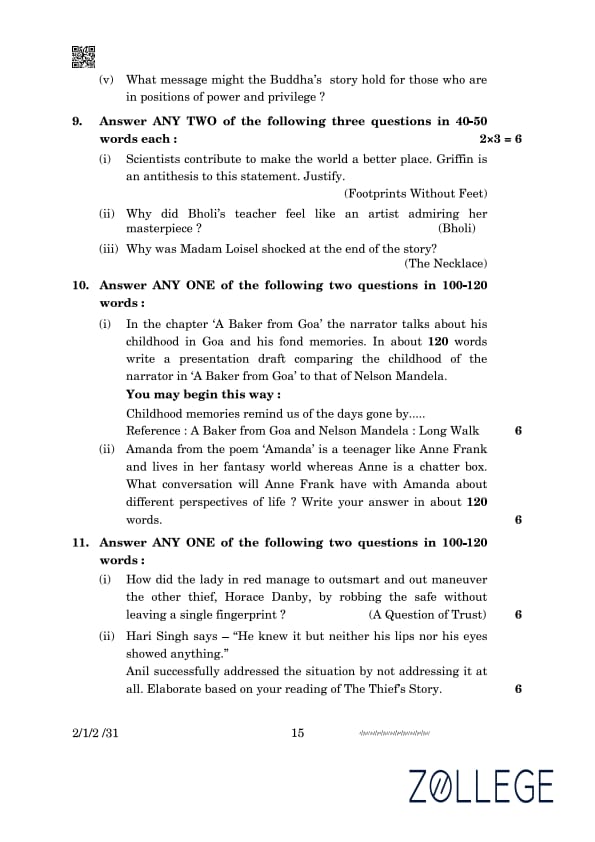
| (v) What message might the Buddha's story hold for those who are in positions of power and privilege? | Buddha's story teaches humility and compassion. Those in power and privilege should recognize their responsibility to help others and not be consumed by wealth and status. His story reminds people that true wisdom and peace come from understanding, kindness, and selflessness, rather than material gains. | The answer correctly identifies and explains the main message of Buddha's story: humility, compassion, and responsibility for the less privileged, rather than material wealth. |
|
Question 9. Answer ANY TWO of the following three questions in 40–50 words each: (i) Scientists contribute to making the world a better place. Griffin is an antithesis to this statement. Justify. (Footprints Without Feet) |
Griffin's actions in "Footprints Without Feet” reflect selfishness and disregard for societal well-being, making him an antithesis to the statement. Instead of using his scientific discovery of invisibility for good, he exploits it for personal gain and unethical deeds. He commits theft, vandalizes property, and instills fear in others. Unlike scientists who work for humanity's progress, Griffin uses his brilliance destructively, causing harm instead of improving lives. | The justification accurately contrasts Griffin's actions with those of other scientists. His actions are unethical and harmful, which makes him an antithesis. |
| (ii) Why did Bholi's teacher feel like an artist admiring her masterpiece? (Bholi) | Bholi's teacher felt immense pride in her transformation, comparing herself to an artist admiring their masterpiece. Through her encouragement and teaching, Bholi overcame her fears, gained confidence, and learned to stand up for herself. The teacher witnessed Bholi reject an unfair marriage proposal with courage, demonstrating her growth into a strong and independent individual. This remarkable change was the result of the teacher's patience and dedication, making her feel as though she had created a masterpiece. | The answer correctly identifies that the teacher's pride is due to her pivotal role in Bholi's personal growth, which is compared to an artist's satisfaction with their creation. |
| (iii) Why was Madam Loisel shocked at the end of the story? (The Necklace) | Madam Loisel was shocked at the end of the story when she discovered that the necklace she had borrowed from her friend, Madame Forestier, was fake. After working tirelessly for ten years to repay the loan they had taken to replace the lost necklace, the revelation that the original necklace was made of paste and worth only a fraction of the amount devastated her. This twist highlights the irony of her situation and the futility of her suffering. | The answer accurately reflects why Madam Loisel was shocked, highlighting the irony and futility of her suffering due to the fake necklace. |
|
Question 10. Answer ANY ONE of the following two questions in 100–120 words: (i) In the chapter ‘A Baker from Goa' the narrator talks about his childhood in Goa and his fond memories. In about 120 words write a presentation draft comparing the childhood of the narrator in 'A Baker from Goa' to that of Nelson Mandela. |
Childhood memories remind us of the days gone by, filled with innocence and simplicity. In "A Baker from Goa,” the narrator fondly recalls his childhood in the coastal village of Goa. He remembers the sweet aroma of freshly baked bread from the baker's oven and the joy of watching the baker's rhythmic dance as he delivered the bread. The narrator's childhood was carefree, marked by simple pleasures like watching the baker's daily routine and playing with friends. In contrast, Nelson Mandela's childhood in "Long Walk to Freedom" was shaped by a harsh political environment, as he grew up during apartheid in South Africa. Mandela's early life involved awareness of racial inequalities and the struggles of his people. While both childhoods involved moments of joy, Mandela's experience was deeply affected by the societal struggles for freedom and equality, while the narrator's childhood in Goa was marked by peace and simplicity. | The comparison accurately contrasts the narrator’s carefree childhood marked by simple pleasures, with Mandela’s childhood shaped by social struggles and political unrest. |
| (ii) Amanda from the poem ‘Amanda' is a teenager like Anne Frank and lives in her fantasy world whereas Anne is a chatter box. What conversation will Anne Frank have with Amanda about different perspectives of life? Write your answer in about 120 words. | If Anne Frank were to meet Amanda, she would likely advise Amanda to balance her fantasy world with the reality around her. Anne, known for her vivid imagination, would sympathize with Amanda's desire to escape into her dreams, but would remind her that it's essential to also live in the real world. Anne, who lived through the trauma of hiding from the Nazis, would probably tell Amanda that her fantasies should not become a way to avoid dealing with life's challenges. Anne would emphasize the importance of speaking up, as she did in her diary, to express one's thoughts, fears, and dreams. While Amanda lives in her own world, Anne would explain that communication and connecting with others help in coping with adversity. Anne would encourage Amanda to embrace life's challenges and face them head-on, rather than retreating into fantasy. | The conversation is well-imagined, with Anne's advice reflecting her life experiences and emphasizing the balance between fantasy and reality while focusing on facing challenges head-on. |
|
Question 11. Answer ANY ONE of the following two questions in 100–120 words: 1. (i) How did the lady in red manage to outsmart and outmaneuver the other thief, Horace Danby, by robbing the safe without leaving a single fingerprint? (A Question of Trust) |
The lady in red outsmarts Horace Danby by using her intelligence, charm, and quick thinking. When Horace enters the house to rob the safe, she pretends to be a helpless woman, trapped in the house. She manipulates him into believing that she needs his help to open the safe. As a professional thief, she takes advantage of Horace's gullibility and ensures that there are no fingerprints left behind. She carefully avoids touching any surface that could leave a trace, showing her expert knowledge of committing a crime without getting caught. In the process, she gains his trust and even convinces him to open the safe. After she robs the safe, she leaves without a trace of evidence, and Horace, unaware of her true identity, is left confused and defeated. | The explanation effectively describes how the lady manipulates Horace to accomplish her goal. It mentions her charm, intelligence, and expertise as a thief, as well as his trust and gullibility. |
| (ii) Hari Singh says– “He knew it but neither his lips nor his eyes showed anything." Anil successfully addressed the situation by not addressing it at all. Elaborate based on your reading of The Thief's Story. | In "The Thief's Story," Hari Singh, after stealing from Anil, feels guilty but does not express it outwardly. He tries to hide his feelings, but Anil, sensing his inner turmoil, does not confront him about the theft. Instead of accusing Hari or showing anger, Anil chooses to remain silent, treating him as he would any other day. This response allows Hari to reflect on his actions without feeling humiliated or defensive. Anil's calm and non-reactive approach helps Hari realize the trust and kindness he has been shown. Eventually, this leads Hari to regret his actions and decide to change. Anil's handling of the situation, by not addressing the theft directly, demonstrates the power of trust and understanding in helping someone grow, making it a story of redemption and transformation through kindness. | The answer correctly explains how Anil's silent and kind approach had a greater impact on Hari’s transformation than a direct confrontation could have. The explanation notes that Anil allows Hari to reflect on his actions. |

*The article might have information for the previous academic years, please refer the official website of the exam.