
CBSE Class 10 Exam 2024 Question Paper with Answer Key PDF for English (February 26 - Shift 1)


| Updated On - Jan 3, 2025
CBSE Class 10 Exam 2024 Question Papers are the most important study material for effective exam preparation. We at Zollege have provided all CBSE Class 10 Exam 2024 Previous Year Papers with Solution PDFs here. CBSE Class 10 Exam 2024 English exam was conducted successfully on February 26 by CBSE.
Students can freely download the CBSE Class 10 Exam 2024 previous year's question paper PDFs along with their solutions here. We strongly encourage CBSE Class 10 aspirants to scan through all the CBSE Class 10 Exam 2024 Question Paper to know the overall difficulty level,CBSE Class 10 Exam 2024 Syllabus and understand the changes in CBSE Class 10 Exam 2024 Exam Pattern over the years.
CBSE Class 10 English 2024 Question Paper with Answer Key PDF
| CBSE Class 10 English 2024 Question Paper with Answer Key (Set 3-2/1/3) |  Download Download |
Check Solution |
| Question | Answer | Detailed Solution |
|---|---|---|
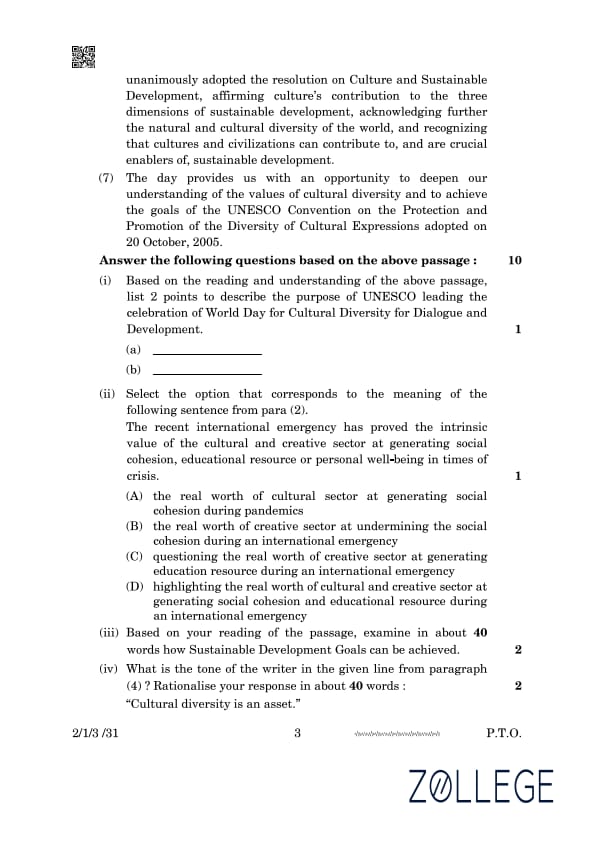
| Question 1 (i): Based on the reading and understanding of the above passage, list 2 points to describe the purpose of UNESCO leading the celebration of World Day for Cultural Diversity for Dialogue and Development. (A)_____ (b)_____ |
(A) Promoting the importance of cultural diversity in fostering dialogue among different societies and communities. (b) Encouraging sustainable development through cultural understanding and mutual respect. |
The passage states that UNESCO leads the celebration to highlight the richness of the world's cultures and the essential role of intercultural dialogue for achieving peace and sustainable development. |
| (ii): Select the option that corresponds to the meaning of the following sentence: "The recent international emergency has proved the intrinsic value of the cultural and creative sector at generating social cohesion, educational resource or personal well-being in times of crisis." (A) the real worth of cultural sector at generating social cohesion during pandemics (B) the real worth of creative sector at undermining the social cohesion during an international emergency (C) questioning the real worth of creative sector at generating education resource during an international emergency (D) highlighting the real worth of cultural and creative sector at generating social cohesion and educational resource during an international emergency |
(D) Highlighting the real worth of cultural and creative sector at generating social cohesion and educational resource during an international emergency | The sentence emphasizes the proven value of the cultural and creative sector in times of crisis for social cohesion, education, and well-being. Option D captures this meaning. |
| (iii): Based on your reading of the passage, examine in about 40 words how Sustainable Development Goals can be achieved. | Sustainable Development Goals can be achieved by promoting cultural diversity, fostering dialogue, and strengthening educational and creative sectors. These actions enhance social cohesion, empower communities, and ensure inclusive development, contributing to long-term sustainability across diverse societies. | The passage highlights how the SDGs can be achieved by drawing on the creative potential of diverse cultures and continuous dialogue for the benefit of society, this response encapsulates that. |
| (iv): What is the tone of the writer in the given line from paragraph (4)? ”Cultural diversity is an asset.” | The tone of the writer is affirmative and optimistic. The line conveys the writer's positive belief in the inherent value of cultural diversity, portraying it as a critical strength for fostering unity, growth, and inclusive development in society. | The tone is positive, as the writer is clearly seeing cultural diversity as something beneficial and valuable, hence the tone being affirmative and optimistic. |
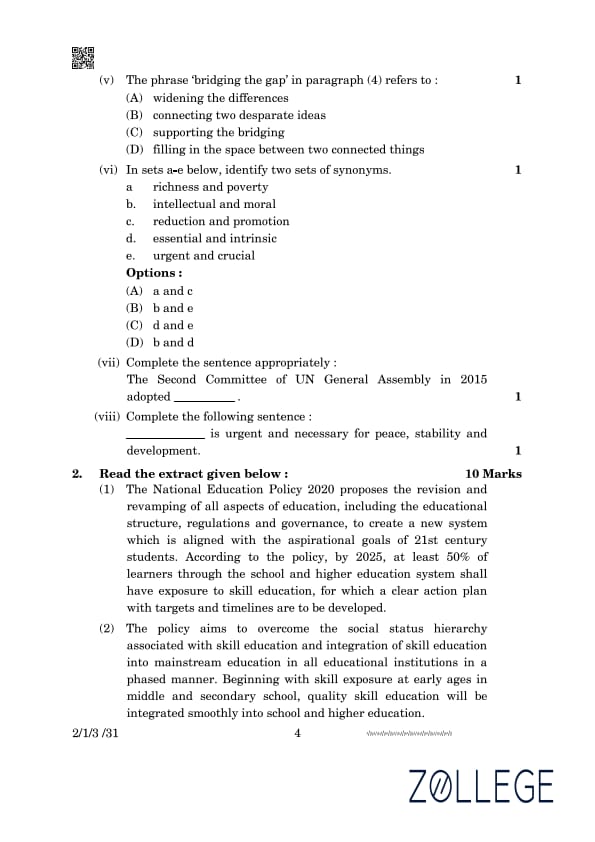
| (v): The phrase ‘bridging the gap' in paragraph (4) refers to: (A) Widening the differences. (B) Connecting two disparate ideas. (C) Supporting the bridging. (D) Filling in the space between two connected things. |
(B) Connecting two disparate ideas. | The phrase 'bridging the gap' means establishing a connection between two differing or unrelated concepts, ideas, or groups. |
| (vi): In sets a–e below, identify two sets of synonyms. Sets: a. Richness and poverty. b. Intellectual and moral. c. Reduction and promotion. d. Essential and intrinsic. e. Urgent and crucial. Options: (A) a and c. (B) b and e. (C) d and e. (D) b and d. |
(C) d and e. | Essential and intrinsic are synonyms as both imply something fundamental or inherent. Urgent and crucial are synonyms as both suggest something of immediate importance or necessity. |
| (vii): Complete the sentence appropriately: The Second Committee of UN General Assembly in 2015 adopted _______. | The Second Committee of UN General Assembly in 2015 adopted a resolution on culture and sustainable development. | The passage specifies that the resolution emphasized the critical role of culture in fostering sustainable development and its integration into the global development agenda. |
| (viii): Complete the following sentence: _________ is urgent and necessary for peace, stability and development. | Cultural diversity is urgent and necessary for peace, stability and development. | The text states that cultural diversity fosters mutual understanding, dialogue, and cooperation among different communities, which are essential for achieving global peace, stability, and sustainable development. |
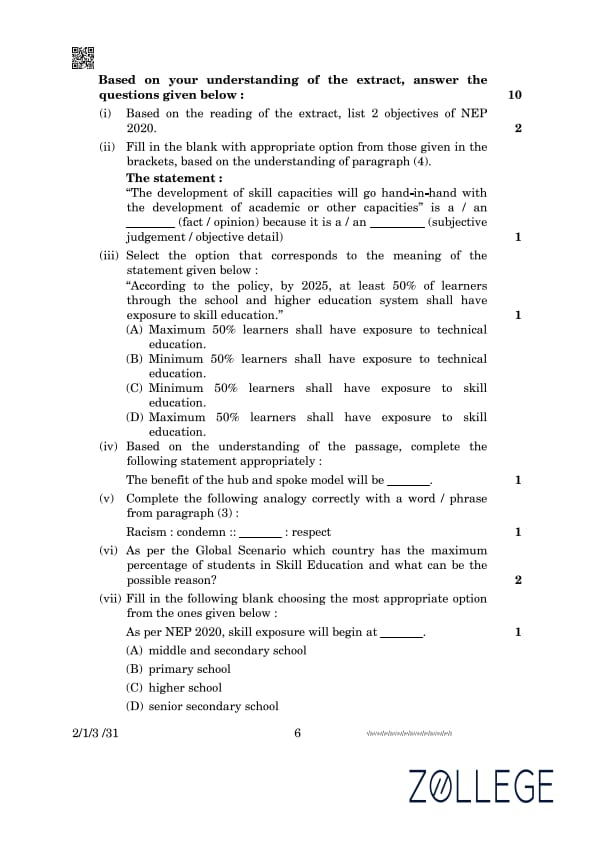
| Question 2 (i): Based on the reading of the extract, list 2 objectives of NEP 2020. | 1. To create a holistic and multidisciplinary education system with flexibility in course choices for students. 2. To achieve equitable access to quality education for all, irrespective of socio-economic background. |
NEP 2020 aims at transforming the education system by focusing on a student-centered approach and improving access. |
| (ii): Fill in the blank with the appropriate option from those given in the brackets, based on the understanding of paragraph (4). The statement: “The development of skill capacities will go hand-in-hand with the development of academic or other capacities” is a/an _________ because it is a/an ________. | fact; objective detail | The statement indicates a correlation supported by educational policies, making it a factual assertion based on verifiable details rather than subjective judgment. |
| (iii): Select the option that corresponds to the meaning of the statement: “According to the policy, by 2025, at least 50% of learners through the school and higher education system shall have exposure to skill education." (A) Maximum 50% learners shall have exposure to technical education. (B) Minimum 50% learners shall have exposure to technical education. (C) Minimum 50% learners shall have exposure to skill education. (D) Maximum 50% learners shall have exposure to skill education. |
(C) Minimum 50% learners shall have exposure to skill education. | The statement specifies a minimum target of 50% exposure to skill education, emphasizing a floor value rather than a ceiling. |
| (iv): Based on the understanding of the passage, complete the following statement appropriately: The benefit of the hub and spoke model will be ________. | efficient connectivity and reduced costs. | The hub and spoke model helps in better coordination and reduced operational costs by centralizing services at a hub and distributing to various spokes. It ensures optimal resource utilization. |
| (v): Complete the following analogy correctly with a word/phrase from paragraph (3): Racism : condemn :: tolerance : __________. | respect | The word “tolerance” matches the analogy because tolerance leads to respect, just as racism leads to condemnation. Both pairs show a cause-and-effect relationship. |
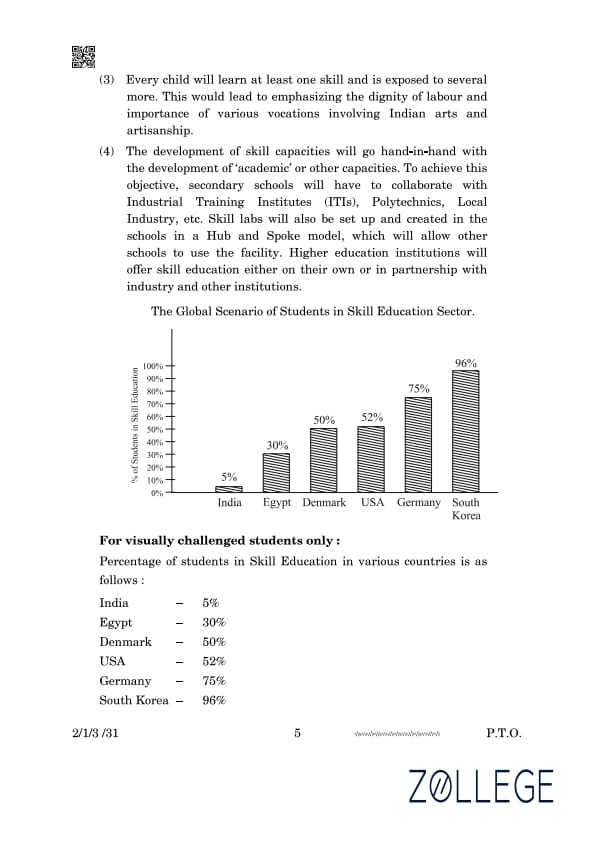
| (vi): As per the Global Scenario, which country has the maximum percentage of students in Skill Education and what can be the possible reason? | Germany has the maximum percentage of students in skill education. Reason: Germany's education system emphasizes vocational training and skill development from a young age. Programs like the dual education system combine classroom learning with practical, on-the-job training. |
The graph shows Germany has the highest percentage. Countries with strong vocational education systems often have better employability rates. Practical training helps students gain job-ready skills early. |
| (vii): Fill in the following blank choosing the most appropriate option from the ones given below: As per NEP 2020, skill exposure will begin at _________. (A) middle and secondary school (B) primary school (C) higher school (D) senior secondary school |
(A) middle and secondary school | The National Education Policy (NEP) 2020 emphasizes skill exposure at the middle and secondary school levels to prepare students for vocational education, practical skills, and future employment opportunities. |
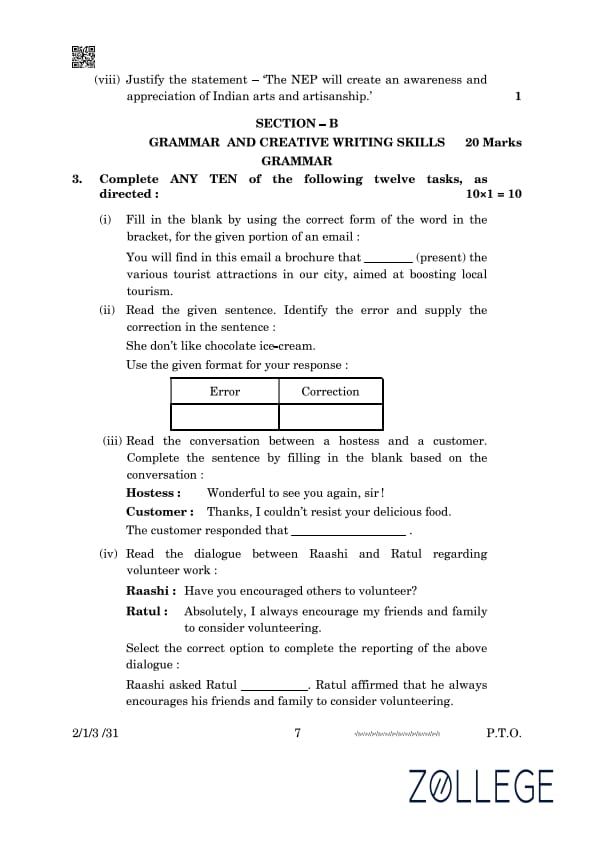
| (viii): Justify the statement – “The NEP will create an awareness and appreciation of Indian arts and artisanship." | The NEP 2020 aims to promote Indian arts and artisanship through: • Including traditional arts, crafts, and culture in the curriculum. • Encouraging students to learn about Indian heritage and diverse cultural traditions. • Providing platforms for artists and artisans to showcase their skills. This initiative fosters respect, awareness, and pride for India's rich cultural heritage while equipping students with creative and artistic skills. | The NEP promotes holistic education by integrating art, culture, and creative skills, ensuring students develop a connection with Indian heritage. |
| Question 3 (i): Fill in the blank by using the correct form of the word in the bracket, for the given portion of an email: You will find in this email a brochure that (present) the various tourist attractions in our city, aimed at boosting local tourism. | presents | The correct verb is “presents” because the subject “brochure" is singular. In the present tense, singular subjects require verbs ending with “-s” or “-es.” |
| (ii): Read the given sentence. Identify the error and supply the correction in the sentence: She don't like chocolate ice-cream. Use the given format for your response Error Correction | Error: don't Correction: doesn't |
The error lies in the use of “don't” for the singular subject “she.” The correct form is "doesn't" as “does” is used with singular subjects in present tense. |
| (iii): Read the conversation between a hostess and a customer. Complete the sentence by filling in the blank based on the conversation: Hostess: Wonderful to see you again, sir! Customer: Thanks, I couldn't resist your delicious food. The customer responded that........ | he couldn't resist her delicious food | The response is in indirect speech, requiring pronoun and tense changes. “I” changes to "he” and “your” becomes “her” to align with the speaker's perspective. |
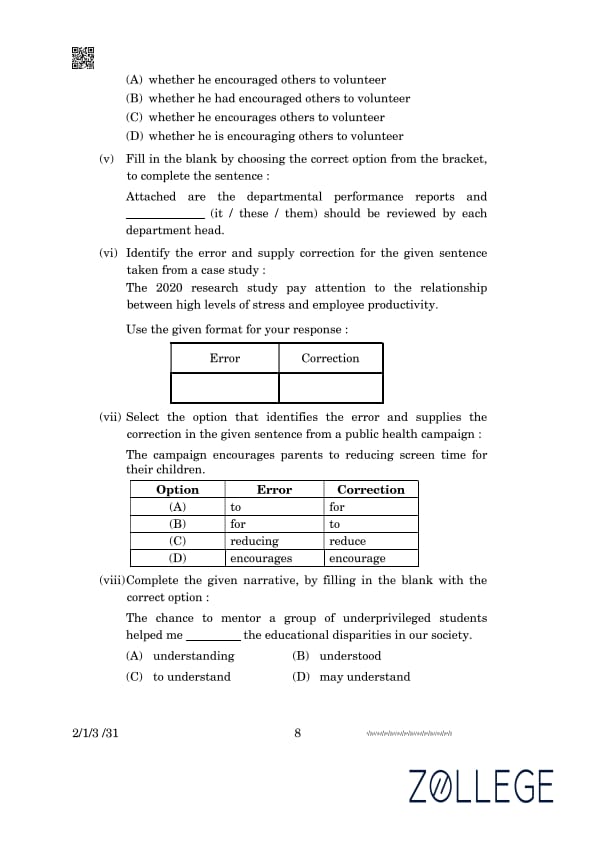
| (iv): Read the dialogue between Raashi and Ratul regarding volunteer work: Raashi: Have you encouraged others to volunteer? Ratul: Absolutely, I always encourage my friends and family to consider volunteering. Select the correct option to complete the reporting of the above dialogue: Raashi asked Ratul . Ratul affirmed that he always encourages his friends and family to consider volunteering. (A) whether he encouraged others to volunteer (B) whether he had encouraged others to volunteer (C) whether he encourages others to volunteer (D) whether he is encouraging others to volunteer |
(B) whether he had encouraged others to volunteer | In reported speech, present perfect tense in the question (“Have you encouraged") changes to past perfect tense (“he had encouraged"). |
| (v): Fill in the blank by choosing the correct option from the bracket, to complete the sentence: Attached are the departmental performance reports and (it / these / them) should be reviewed by each department head. | these | The pronoun “these” is correct as it refers to the plural noun “performance reports." "It" is singular and “them” is an object pronoun, making them unsuitable here. |
| (vi): Identify the error and supply correction for the given sentence taken from a case study: The 2020 research study pay attention to the relationship between high levels of stress and employee productivity. Use the given format for your response Error Correction | Error: pay Correction: pays |
The singular subject “The 2020 research study" requires the verb "pays” to ensure subject-verb agreement. |
| (vii): Select the option that identifies the error and supplies the correction in the given sentence from a public health campaign: The campaign encourages parents to reducing screen time for their children. Option Error Correction (A) to for (B) for to (C) reducing reduce (D) encourages encourage |
(C) reducing → reduce | The phrase “to reducing” is incorrect. The infinitive “to” must be followed by the base form of the verb, “reduce." |
| (viii): Complete the given narrative, by filling in the blank with the correct option: The chance to mentor a group of underprivileged students helped me _________ the educational disparities in our society. (A) understanding (B) understood (C) to understand (D) may understand |
(C) to understand | The phrase "helped me to understand” is correct as it uses the base form of the verb following “helped me." |
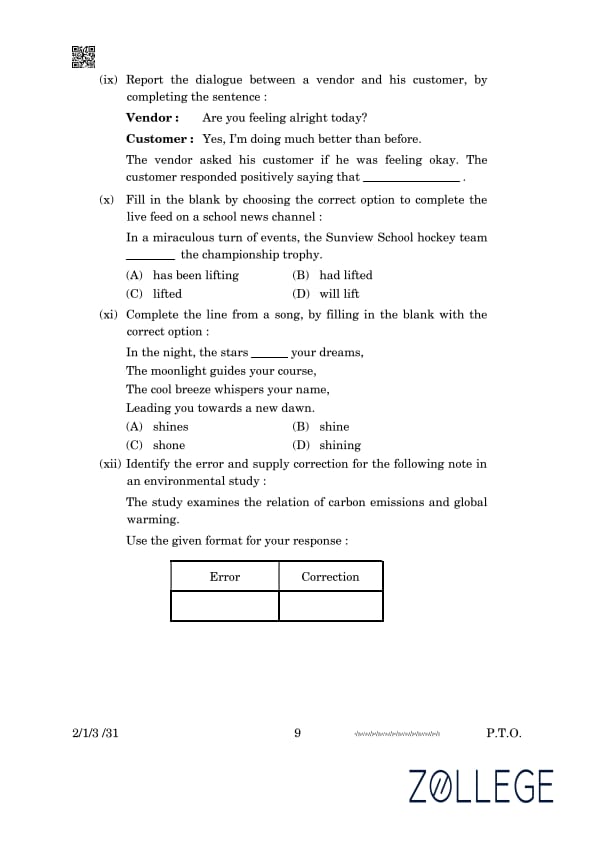
| (ix): Report the dialogue between a vendor and his customer, by completing the sentence: Vendor: Are you feeling alright today? Customer: Yes, I'm doing much better than before. The vendor asked his customer if he was feeling okay. The customer responded positively saying that __________. | he was doing much better than before | The customer's response is in indirect speech. The present continuous tense "I'm doing” changes to past continuous “he was doing." |
| (x): Fill in the blank by choosing the correct option to complete the live feed on a school news channel: In a miraculous turn of events, the Sunview School hockey team _________ the championship trophy. (A) has been lifting (B) had lifted (C) lifted (D) will lift |
(C) lifted | The simple past tense “lifted” is correct as the event has already concluded. |
| (xi): Complete the line from a song, by filling in the blank with the correct option: In the night, the stars _________ your dreams, The moonlight guides your course, The cool breeze whispers your name, Leading you towards a new dawn. (A) shines (B) shine (C) shone (D) shining |
(B) shine | The verb “shine” matches the plural subject “stars” in present tense. Singular forms like "shines” or past tense forms like “shone" are incorrect. |
| (xii): Identify the error and supply correction for the following note in an environmental study: The study examines the relation of carbon emissions and global warming. Use the given format for your response Error Correction | Error: relation Correction: relationship |
The correct term is “relationship" instead of “relation” because “relationship" provides a clearer and more precise description of the connection or link between two factors, such as carbon emissions and global warming, in academic and formal contexts. |
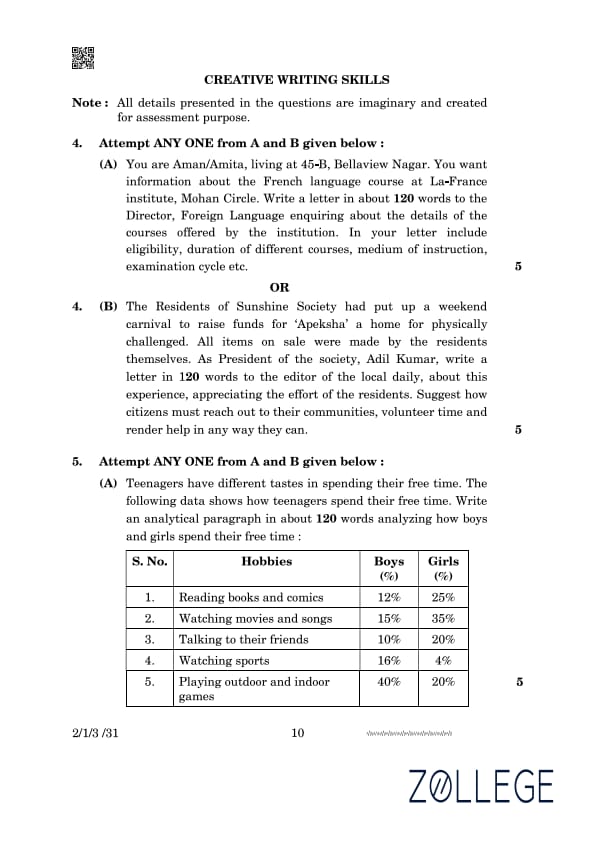
| Question 4(A): You are Aman/Amita, living at 45-B, Bellaview Nagar. You want information about the French language course at La-France institute, Mohan Circle. Write a letter in about 120 words to the Director, Foreign Language enquiring about the details of the courses offered by the institution. In your letter include eligibility, duration of different courses, medium of instruction, examination cycle, etc. | 45-B, Bellaview Nagar Mohan Circle New Delhi - 110001 March 25, 2024 The Director La-France Institute Mohan Circle New Delhi - 110002 Subject: Enquiry Regarding French Language Course Details Respected Sir/Madam, I hope this letter finds you well. I am Amita, a resident of Bellaview Nagar, interested in enrolling in the French language courses offered by your esteemed institute. Kindly provide the following details: • Eligibility criteria for beginner, intermediate, and advanced levels. • Duration and structure of each level of the course. • Medium of instruction (online/offline options). • Examination cycle, certification details, and assessment process. • Fee structure, installment options, and availability of weekend classes. I request you to send me a brochure or any relevant information regarding the courses at your earliest convenience. I look forward to your guidance and response. Yours sincerely, Amita Sharma Contact: 9876543210 Email: amita.sharma@example.com |
This is a formal letter following all proper formats and containing the required information. |
| Question 4(B): The Residents of Sunshine Society had put up a weekend carnival to raise funds for 'Apeksha,' a home for physically challenged. All items on sale were made by the residents themselves. As President of the society, Adil Kumar, write a letter in 120 words to the editor of the local daily, about this experience, appreciating the effort of the residents. Suggest how citizens must reach out to their communities, volunteer time and render help in any way they can. | Sunshine Society Sector 14, Green Park New Delhi - 110070 March 25, 2024 The Editor The Daily Times New Delhi - 110001 Subject: Appreciation for Residents' Efforts in Fundraising Carnival Respected Sir/Madam, Through your esteemed publication, I, Adil Kumar, President of Sunshine Society, wish to share a commendable initiative undertaken by our residents to support a noble cause. Last weekend, we organized a carnival to raise funds for ‘Apeksha,' a home for the physically challenged. The event showcased the residents' creativity and dedication as they prepared handmade crafts, delicious food, and engaging games. Families and local citizens participated enthusiastically, enabling us to collect significant funds for Apeksha. This effort highlights the importance of community service and the power of collective contributions. I encourage citizens to participate in such initiatives, volunteering their time, skills, and resources to make a tangible difference. Your platform can inspire readers to step up for social causes and contribute meaningfully to society. Yours sincerely, Adil Kumar President, Sunshine Society Contact: 9876543210 Email: adil.kumar@example.com |
This is a formal letter to the editor including appreciation for effort by the society's residents, and call to action for the community. |
| Question 5(A): Teenagers have different tastes in spending their free time. The following data shows how teenagers spend their free time. Write an analytical paragraph in about 120 words analyzing how boys and girls spend their free time: S. No. Hobbies Boys (%) Girls (%) 1. Reading books and comics 12% 25% 2. Watching movies and songs 15% 35% 3. Talking to their friends 10% 20% 4. Watching sports 16% 4% 5. Playing outdoor and indoor games 40% 20% |
The data provided reveals distinct differences in how boys and girls spend their free time. Boys predominantly favor physical activities, with 40% choosing outdoor and indoor games. In contrast, only 20% of girls engage in such activities, indicating a lower preference for physical exertion among them. Watching movies and songs is the top choice for girls, with 35% participation compared to 15% for boys, showcasing their preference for passive and relaxing forms of entertainment. Additionally, 25% of girls enjoy reading books and comics, double the percentage of boys (12%), reflecting a creative and intellectual inclination. Boys, on the other hand, display a stronger interest in sports, with 16% watching sports versus just 4% of girls. Talking to friends is more common among girls (20%) than boys (10%), suggesting that girls are more inclined towards social and emotional interactions. In summary, the data highlights gender-based differences in hobbies, with boys favoring competitive and physical activities, while girls lean towards intellectual, passive, and social engagements. | The paragraph provides a comparative analysis of the data, highlighting the gender-based preferences. |
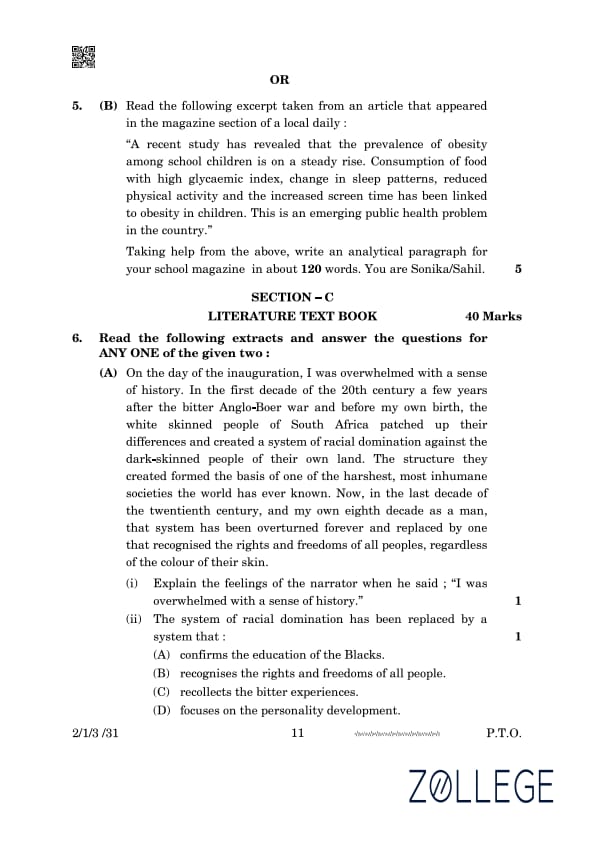
| Question 5(B): Read the following excerpt taken from an article that appeared in the magazine section of a local daily: "A recent study has revealed that the prevalence of obesity among school children is on a steady rise. Consumption of food with high glycaemic index, change in sleep patterns, reduced physical activity and the increased screen time has been linked to obesity in children. This is an emerging public health problem in the country.” Taking help from the above, write an analytical paragraph for your school magazine in about 120 words. You are Sonika/Sahil. | The increasing prevalence of childhood obesity is a pressing public health issue. Unhealthy modern lifestyles, such as consuming high glycaemic index foods, reduced physical activity, and prolonged screen time, are significant contributors to this crisis. Fast foods and sugary beverages, replacing nutritious meals, lead to unhealthy weight gain by spiking blood sugar and increasing fat storage. Technological advancements have encouraged children to spend more time on screens—watching TV, playing video games, or browsing—while neglecting outdoor physical activities. Additionally, irregular sleep patterns disrupt metabolism and contribute to obesity. This issue poses long-term risks, including diabetes, cardiovascular diseases, and low self-esteem among children. Addressing this requires collective action. Parents should ensure balanced diets and promote active lifestyles. Schools must incorporate physical education programs and awareness campaigns. Communities can play a role by encouraging healthy habits through public initiatives. In conclusion, fostering healthier habits and spreading awareness can help combat childhood obesity and secure a healthier future generation. | The paragraph effectively analyses the causes and consequences of childhood obesity and also suggests the ways to address the problem. |
| Question 6(A)(i): Explain the feelings of the narrator when he said; “I was overwhelmed with a sense of history." | The narrator is expressing a profound feeling of awe and emotion as he reflects on the historical significance of the moment. The narrator understands that the system of racial domination, which had existed for decades, is now being replaced with a system of equality and freedom for all, regardless of their race. The sense of history refers to witnessing a monumental change, the end of apartheid, which had long oppressed the black population in South Africa. | This explains the narrator’s feelings towards the historical moment. |
| (ii): The system of racial domination has been replaced by a system that: (A) confirms the education of the Blacks. (B) recognises the rights and freedoms of all people. (C) recollects the bitter experiences. (D) focuses on the personality development. | (B) recognises the rights and freedoms of all people. | The narrator mentions that the apartheid system, which denied basic rights to black people, has been replaced by a system that acknowledges the equality and freedoms of all individuals, irrespective of their skin colour. |
| (iii): Comment on the kind of society apartheid had created? | Apartheid created a deeply segregated society in which racial discrimination was institutionalized. The white-skinned people of South Africa created a system that oppressed and marginalized the dark-skinned people, denying them their basic rights, freedoms, and equality. It was one of the most inhumane and unjust systems the world had ever known, as it perpetuated racial hatred and division. | This explains the type of society created by Apartheid. |
| (iv): Which phrase would correctly substitute ‘patched up' in the given sentence from the extract: “… … … the white-skinned people of South Africa patched up their differences..." | A suitable phrase to replace "patched up" would be "resolved their differences” or "settled their differences.” These phrases indicate that the conflicting parties reached an agreement. | This is a substitution of the phrase "patched up" with a synonym in context. |
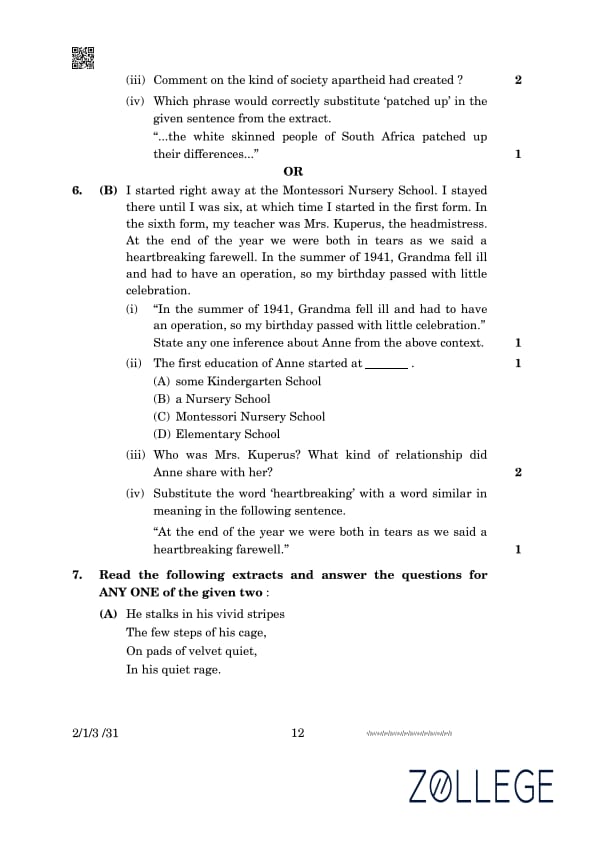
| Question 6(B) (i): “In the summer of 1941, Grandma fell ill and had to have an operation, so my birthday passed with little celebration.” State any one inference about Anne from the above context. | From the given context, we can infer that Anne was deeply concerned and possibly saddened by her grandmother's illness. The lack of celebration on her birthday suggests that Anne's priorities were focused on her grandmother's health rather than her own birthday, reflecting her caring and empathetic nature. | This inference is based on context from the text. |
| (ii): The first education of Anne started at ________. (A) some Kindergarten School (B) a Nursery School (C) Montessori Nursery School (D) Elementary School |
(C) Montessori Nursery School | Anne mentions that she started her education at the Montessori Nursery School, which is the correct answer. |
| (iii): Who was Mrs. Kuperus? What kind of relationship did Anne share with her? | Mrs. Kuperus was Anne's teacher and the headmistress of the school. Anne shared a warm and affectionate relationship with her, as indicated by the emotional farewell they shared at the end of the year. Their bond was one of mutual respect and fondness, which was evident from the tears shed during their goodbye. | The answer explains who Mrs.Kuperus was and the kind of relation she shared with Anne. |
| (iv): Substitute the word ‘heartbreaking' with a word similar in meaning in the following sentence: “At the end of the year we were both in tears as we said a heartbreaking farewell." | A suitable substitute for "heartbreaking" could be "tearful," "emotional," or "painful." These words convey a similar sense of sadness and deep emotion during the farewell. | This question involves substituting a word with a synonym in context. |
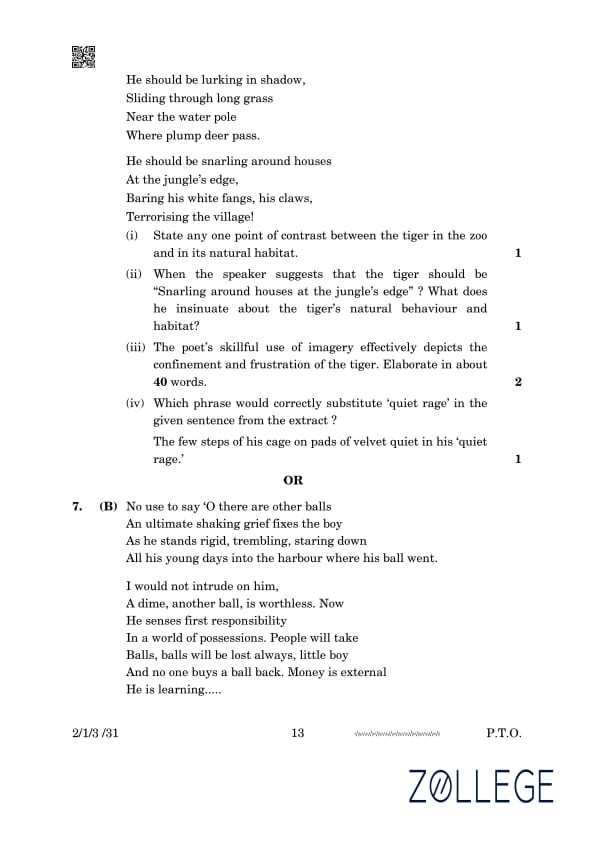
| Question 7(A) (i): State any one point of contrast between the tiger in the zoo and in its natural habitat. | The tiger in the zoo is confined to a cage, moving slowly and quietly, whereas in its natural habitat, it roams freely, prowling through the jungle and hunting for prey, exhibiting wild and aggressive behavior. | The answer highlights a key contrast in the tiger's behavior based on different environments. |
| (ii): When the speaker suggests that the tiger should be “snarling around houses at the jungle's edge”? What does he insinuate about the tiger's natural behaviour and habitat? | The speaker insinuates that the tiger, in its natural habitat, is a fierce and dominant creature, one that prowls and hunts at the edges of the jungle, where it can scare villagers with its powerful presence. The tiger's natural behavior is aggressive, wild, and untamed. | This explains the speaker's insinuation of the tiger's natural characteristics. |
| (iii): The poet's skillful use of imagery effectively depicts the confinement and frustration of the tiger. Elaborate in about 40 words. | The poet uses vivid imagery such as "pads of velvet quiet" and "quiet rage" to show the contrast between the tiger's graceful, restrained movements in the cage and its suppressed fury. The tiger's frustration is depicted through its unnatural stillness and longing for freedom. | The answer explains the use of imagery to depict confinement. |
| (iv): Which phrase would correctly substitute ‘quiet rage' in the given sentence from the extract? "The few steps of his cage on pads of velvet quiet in his ‘quiet rage'." | The phrase "suppressed fury” or “hidden anger" would correctly substitute "quiet rage," as both phrases convey the idea of the tiger's contained but intense emotional state. | The answer provides correct substitute for the given phrase. |
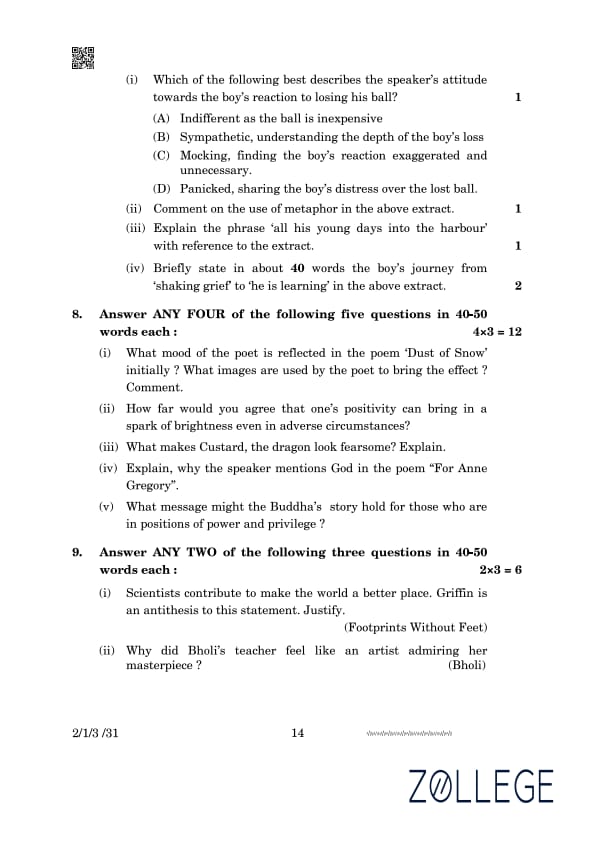
| Question 7(B) (i): Which of the following best describes the speaker's attitude towards the boy's reaction to losing his ball? (A) indifferent as the ball is inexpensive (B) sympathetic, understanding the depth of the boy's loss (C) mocking, finding the boy's reaction exaggerated and unnecessary (D) panicked, sharing the boy's distress over the lost ball |
(B) sympathetic, understanding the depth of the boy's loss. | The speaker sympathizes with the boy's grief over the lost ball, acknowledging that the boy's reaction is not just about the ball but about growing up and learning the deeper responsibilities of life. |
| (ii): Comment on the use of metaphor in the above extract. | The metaphor "all his young days into the harbour where his ball went” represents the boy's lost childhood and innocence. The ball symbolizes the carefree days of youth, and losing it reflects the boy's transition from childhood to adulthood, where responsibility and loss are inevitable. | This answer explains the use of a metaphor in the extract. |
| (iii): Explain the phrase ‘all his young days into the harbour' with reference to the extract. | The phrase symbolizes the loss of the boy's innocence and carefree childhood. The "harbour” where the ball went is a metaphor for the moment of growing up, where the boy realizes that certain things, like his childhood, cannot be retrieved once lost. | The answer explains the meaning of the phrase in context. |
| (iv): Briefly state in about 40 words the boy's journey from ‘shaking grief' to 'he is learning' in the above extract. | The boy's “shaking grief" shows his immediate distress over the loss of the ball, symbolizing his initial shock and helplessness. As the speaker reflects on the loss, the boy begins to understand that possessions can be lost and life moves forward, signaling his emotional growth. | The answer explains the journey of the boy's emotional state. |
| Question 8 (i): What mood of the poet is reflected in the poem 'Dust of Snow' initially? What images are used by the poet to bring about the effect? Comment. | Initially, the mood of the poet in "Dust of Snow” is one of sorrow and melancholy, which is then uplifted by the positive effect of nature. The poet uses the image of snow falling from a hemlock tree, symbolizing both gloom and purity. The dusting of snow brings a sudden change in the poet's mood, lifting his spirits. | This explains the mood and the images used to create that mood in the poem. |
| (ii): How far would you agree that one's positivity can bring in a spark of brightness even in adverse circumstances? | Positivity can indeed bring brightness even in adverse circumstances. The poem "Dust of Snow” shows how a small change in perspective, triggered by nature, can lift the poet's mood. In life, optimism can help people find hope, even in the darkest of situations, turning challenges into opportunities. | This discusses the power of positivity in the context of the poem and life. |
| (iii): What makes Custard, the dragon look fearsome? Explain. | Custard, the dragon, is initially described as a fearsome creature due to its size, its fiery breath, and sharp claws. However, it is revealed that Custard, despite these terrifying attributes, is actually quite cowardly and only becomes brave when the situation demands it, making the contrast humorous. | This answer explains the factors that make Custard look fearsome and the humor in this description. |
| (iv): Explain why the speaker mentions God in the poem “For Anne Gregory." | In "For Anne Gregory,” the speaker mentions God to emphasize that true beauty lies beyond physical appearance, which is often praised by society. By invoking God, the poet suggests that Anne's real worth is not in her beauty but in her inner qualities and spiritual essence, which cannot be judged by the eyes alone. | This explains the importance of the speaker mentioning God. |
| (V): What message might the Buddha's story hold for those who are in positions of power and privilege? | Buddha's story teaches humility and compassion. Those in power and privilege should recognize their responsibility to help others and not be consumed by wealth and status. His story reminds people that true wisdom and peace come from understanding, kindness, and selflessness, rather than material gains. | This answers how the story of Buddha is relevant to those in power. |
| Question 9 (i): Scientists contribute to making the world a better place. Griffin is an antithesis to this statement. Justify. (Footprints Without Feet) | While scientists are often seen as individuals who work for the betterment of humanity, Griffin, the protagonist of "Footprints Without Feet,” stands in stark contrast to this notion. Instead of using his scientific discovery—the formula for invisibility—for noble causes, Griffin employs it for selfish and destructive purposes. He robs shops, sets houses on fire, and spreads fear among people. His actions show a lack of ethics and responsibility, making him an antithesis to the idea that scientists aim to make the world better. | This answers why Griffin is the opposite of scientists helping make the world better. |
| (ii): Why did Bholi's teacher feel like an artist admiring her masterpiece? (Bholi) | Bholi's teacher felt like an artist admiring her masterpiece because of the remarkable transformation she saw in Bholi. The once-timid and hesitant girl, who struggled with speech and lacked confidence, had grown into a courageous and articulate individual under her teacher's guidance. This transformation was a result of the teacher's persistent efforts to educate and encourage Bholi. Witnessing Bholi stand up for her rights and reject an unfair marriage proposal made the teacher feel immense pride and satisfaction, akin to an artist admiring a finished work of art. | This answer explains why the teacher felt like an artist admiring her masterpiece. |
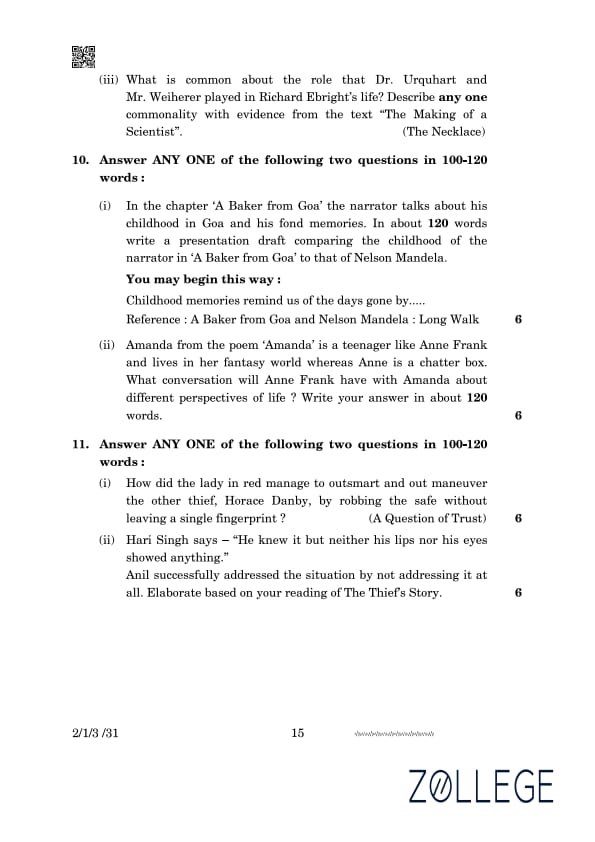
| (iii): What is common about the role that Dr. Urquhart and Mr. Weiherer played in Richard Ebright's life? Describe any one commonality with evidence from the text “The Making of a Scientist". | Both Dr. Urquhart and Mr. Weiherer played pivotal roles in inspiring and guiding Richard Ebright in his journey as a scientist. One commonality between them is their mentorship. Dr. Urquhart, as an expert on monarch butterflies, encouraged Ebright to pursue his curiosity and provided him with scientific guidance. Similarly, Mr. Weiherer, Ebright's teacher, nurtured his talent and motivated him to excel in academics and science fairs. Their unwavering support helped shape Ebright's scientific career, as he received both technical knowledge and emotional encouragement from them. | This answer discusses the roles and the commonalities of Dr. Urquhart and Mr. Weiherer in Richard's life. |
| Question 10 (i): In the chapter ‘A Baker from Goa' the narrator talks about his childhood in Goa and his fond memories. In about 120 words write a presentation draft comparing the childhood of the narrator in ‘A Baker from Goa' to that of Nelson Mandela. | Childhood memories remind us of the days gone by, filled with innocence and simplicity. In "A Baker from Goa,” the narrator fondly recalls his childhood in the coastal village of Goa. He remembers the sweet aroma of freshly baked bread from the baker's oven and the joy of watching the baker's rhythmic dance as he delivered the bread. The narrator's childhood was carefree, marked by simple pleasures like watching the baker's daily routine and playing with friends. In contrast, Nelson Mandela's childhood in "Long Walk to Freedom" was shaped by a harsh political environment, as he grew up during apartheid in South Africa. Mandela's early life involved awareness of racial inequalities and the struggles of his people. While both childhoods involved moments of joy, Mandela's experience was deeply affected by the societal struggles for freedom and equality, while the narrator's childhood in Goa was marked by peace and simplicity. | This answer compares the childhood of the narrator in ‘A Baker from Goa' to that of Nelson Mandela. |
| (ii): Amanda from the poem ‘Amanda' is a teenager like Anne Frank and lives in her fantasy world whereas Anne is a chatter box. What conversation will Anne Frank have with Amanda about different perspectives of life? Write your answer in about 120 words. | If Anne Frank were to meet Amanda, she would likely advise Amanda to balance her fantasy world with the reality around her. Anne, known for her vivid imagination, would sympathize with Amanda's desire to escape into her dreams, but would remind her that it's essential to also live in the real world. Anne, who lived through the trauma of hiding from the Nazis, would probably tell Amanda that her fantasies should not become a way to avoid dealing with life's challenges. Anne would emphasize the importance of speaking up, as she did in her diary, to express one's thoughts, fears, and dreams. While Amanda lives in her own world, Anne would explain that communication and connecting with others help in coping with adversity. Anne would encourage Amanda to embrace life's challenges and face them head-on, rather than retreating into fantasy. | This answer explains the conversation that Anne and Amanda would have about their perspectives of life. |
| Question 11 (i): How did the lady in red manage to outsmart and outmaneuver the other thief, Horace Danby, by robbing the safe without leaving a single fingerprint? (A Question of Trust) | The lady in red outsmarts Horace Danby by using her intelligence, charm, and quick thinking. When Horace enters the house to rob the safe, she pretends to be a helpless woman, trapped in the house. She manipulates him into believing that she needs his help to open the safe. As a professional thief, she takes advantage of Horace's gullibility and ensures that there are no fingerprints left behind. She carefully avoids touching any surface that could leave a trace, showing her expert knowledge of committing a crime without getting caught. In the process, she gains his trust and even convinces him to open the safe. After she robs the safe, she leaves without a trace of evidence, and Horace, unaware of her true identity, is left confused and defeated. | This explains how the lady in red outsmarted Horace Danby. |
| (ii): Hari Singh says– “He knew it but neither his lips nor his eyes showed anything." Anil successfully addressed the situation by not addressing it at all. Elaborate based on your reading of The Thief's Story. | In "The Thief's Story," Hari Singh, after stealing from Anil, feels guilty but does not express it outwardly. He tries to hide his feelings, but Anil, sensing his inner turmoil, does not confront him about the theft. Instead of accusing Hari or showing anger, Anil chooses to remain silent, treating him as he would any other day. This response allows Hari to reflect on his actions without feeling humiliated or defensive. Anil's calm and non-reactive approach helps Hari realize the trust and kindness he has been shown. Eventually, this leads Hari to regret his actions and decide to change. Anil's handling of the situation, by not addressing the theft directly, demonstrates the power of trust and understanding in helping someone grow, making it a story of redemption and transformation through kindness. | This answer explains how Anil handled the situation in "The Thief's Story" by being silent about it. |


*The article might have information for the previous academic years, please refer the official website of the exam.