
CBSE Class 10 2024 Question Paper with Answer Key PDF for Science (March 2 - Shift 1)


Content Curator | Updated On - Jan 4, 2025
CBSE Class 10 Question Papers are the most important study material for effective exam preparation. We at Zollege have provided all CBSE Class 10 Previous Year Papers with Solution PDFs here. CBSE Class 10 2024 Science exam was conducted successfully on March 2 by CBSE.
Students can freely download the CBSE Class 10 previous year's question paper PDFs along with their solutions here. We strongly encourage CBSE 10 aspirants to scan through all the CBSE Class 10 Question Paper to know the overall difficulty level, CBSE Class 10 Syllabus and understand the changes in CBSE Class 10 Exam Pattern over the years.
CBSE Class 10 2024 Science Question Paper with Solution PDF
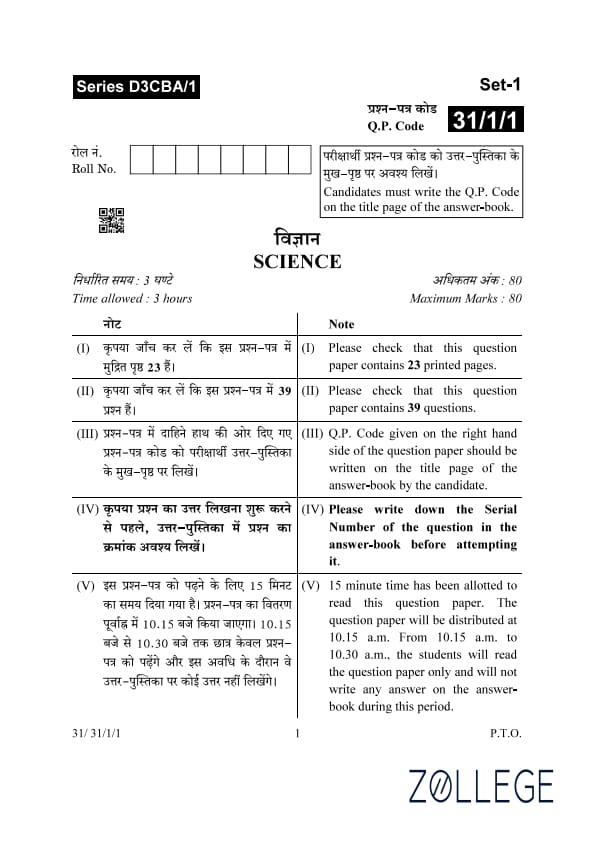
| CBSE Class 10 Science 2024 Question Paper with Answer Key (Set 1 31/1/1) |  Download Download |
Check Solution |
CBSE Class 10 Science 2024 Question Paper (Set 1 – 31/1/1) Solution
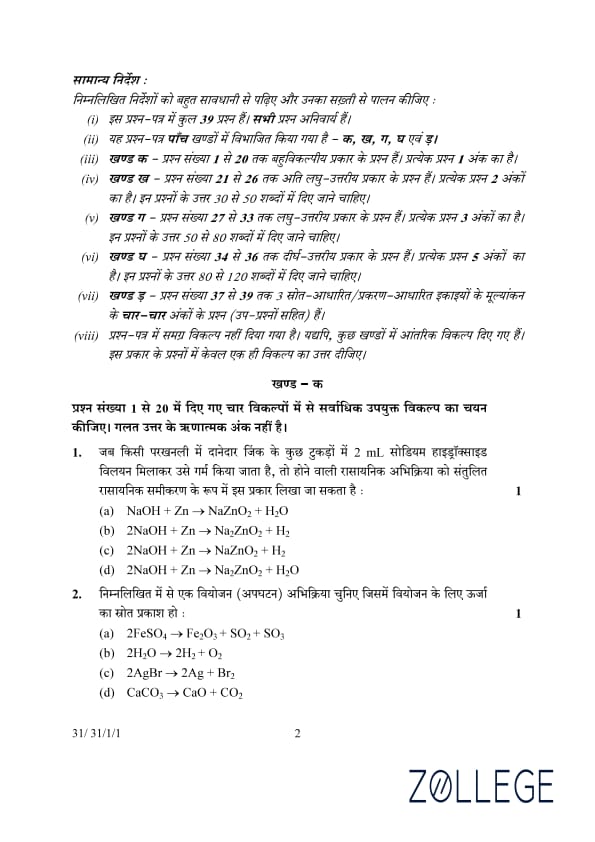
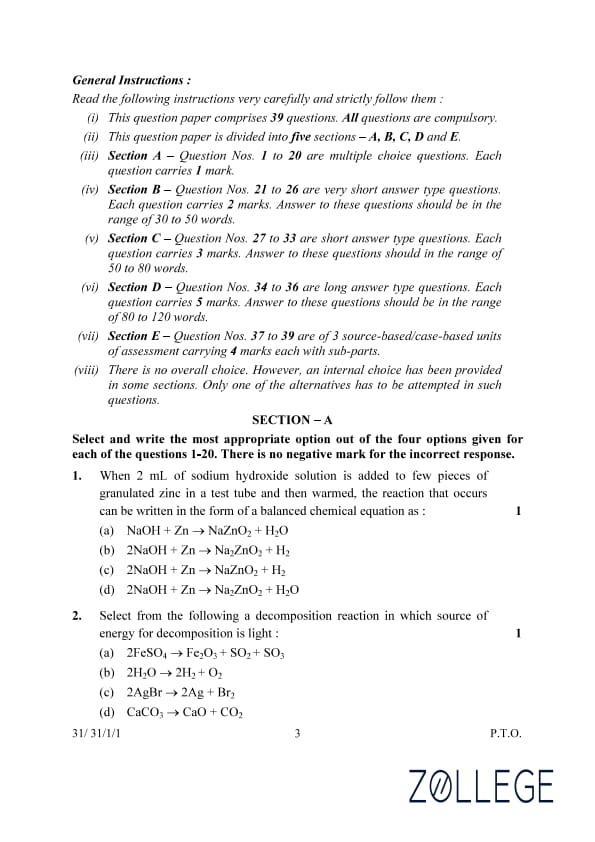
Question 1:
When 2 mL of sodium hydroxide solution is added to a few pieces of granulated zinc in a test tube and then warmed, the reaction that occurs can be written in the form of a balanced chemical equation as:
- (a) NaOH + Zn → NaZnO₂ + H₂O
- (b) 2NaOH + Zn → Na₂ZnO₂ + H₂
- (c) 2NaOH + Zn → NaZnO₂ + H₂
- (d) 2NaOH + Zn → Na₂ZnO₂ + H₂O
To determine the correct balanced chemical equation...
Read More
To determine the correct balanced chemical equation, we need to consider the reaction between sodium hydroxide (NaOH) and zinc (Zn). Zinc reacts with sodium hydroxide to form sodium zincate (Na₂ZnO₂) and hydrogen gas (H₂). Let's analyze the options:Option (a): NaOH + Zn → NaZnO₂ + H₂O This equation is not balanced. The number of sodium (Na) and hydrogen (H) atoms are not equal on both sides.
Option (b): 2NaOH + Zn → Na₂ZnO₂ + H₂ This equation is balanced. We have 2 Na atoms, 2 O atoms, 2 H atoms, and 1 Zn atom on both sides.
Option (c): 2NaOH + Zn → NaZnO₂ + H₂ This equation is not balanced. The number of sodium (Na) atoms is not equal on both sides.
Option (d): 2NaOH + Zn → Na₂ZnO₂ + H₂O This equation is not balanced. The number of hydrogen (H) atoms is not equal on both sides.
Therefore, the only balanced chemical equation representing the reaction is option (b).
Question 2:
Select from the following a decomposition reaction in which the source of energy for decomposition is light:
- (a) 2FeSO₄ → Fe₂O₃ + SO₂ + SO₃
- (b) 2H₂O → 2H₂ + O₂
- (c) 2AgBr → 2Ag + Br₂
- (d) CaCO₃ → CaO + CO₂
A decomposition reaction is a reaction where a single compound breaks down into two or more simpler substances. The question specifies that the source of energy for the decomposition is light.
Read More
This is characteristic of photochemical reactions. Let's analyze the options:Option (a) 2FeSO₄ → Fe₂O₃ + SO₂ + SO₃ This is a decomposition reaction, but it's typically thermally driven (requires heat), not light.
Option (b) 2H₂O → 2H₂ + O₂ This is a decomposition reaction, but it requires a significant amount of energy, usually electrical energy (electrolysis) or heat.
Option (c) 2AgBr → 2Ag + Br₂ This is a decomposition reaction where silver bromide (AgBr) decomposes into silver (Ag) and bromine (Br₂) when exposed to light. This is a classic example of a photochemical decomposition reaction used in photography.
Option (d) CaCO₃ → CaO + CO₂ This is a decomposition reaction, but it is typically driven by heat.
Therefore, the decomposition reaction driven by light is option (c).
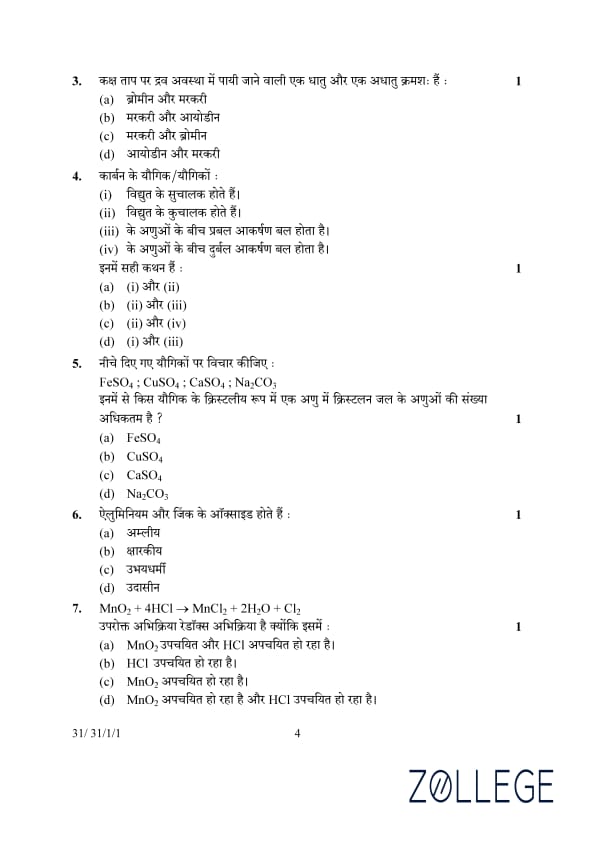
Question 3:
A metal and a non-metal that exists in liquid state at the room temperature are respectively:
- (a) Bromine and Mercury
- (b) Mercury and Iodine
- (c) Mercury and Bromine
- (d) Iodine and Mercury
The question asks for a metal and a non-metal that are liquid at room temperature.
Read More
Let's examine the properties of the elements listed:Mercury (Hg): Mercury is a metal and is liquid at room temperature. Its melting point is -38.83°C.
Bromine (Br): Bromine is a non-metal and is liquid at room temperature. Its melting point is -7.2°C.
Iodine (I): Iodine is a non-metal and is a solid at room temperature. Its melting point is 113.7°C.
Therefore, the only combination that correctly identifies a liquid metal and a liquid non-metal at room temperature is Mercury and Bromine.
Question 4:
Carbon compounds :
- (i) are good conductors of electricity.
- (ii) are bad conductors of electricity.
- (iii) have strong forces of attraction between their molecules.
- (iv) have weak forces of attraction between their molecules.
- (a) (i) and (ii)
- (b) (ii) and (iii)
- (c) (ii) and (iv)
- (d) (i) and (iii)
Carbon compounds, in general, are poor conductors of electricity. This is because they do not have free electrons or ions that can move and carry an electric current. Additionally, the forces of attraction between the molecules in most carbon compounds are relatively weak. These are generally van der Waals forces or London Dispersion Forces.
Read More
These weak forces contribute to the relatively low melting and boiling points of many organic compounds. So, statements (ii) "are bad conductors of electricity" and (iv) "have weak forces of attraction between their molecules" are correct.Question 5:
Consider the following compounds:
FeSO4, CuSO4, CaSO4, Na2CO3
The compound having maximum number of water of crystallisation in its crystalline form in one molecule is:
- (a) FeSO4
- (b) CuSO4
- (c) CaSO4
- (d) Na2CO3
Na2CO3 has 10 water molecules in its crystalline form.
Read More
The question asks about the water of crystallization, which refers to the water molecules present in the crystal structure of a compound. Let's examine the hydrated forms of the given compounds:
- FeSO4: Commonly exists as FeSO4 · 7H2O (heptahydrate).
- CuSO4: Commonly exists as CuSO4 · 5H2O (pentahydrate).
- CaSO4: Commonly exists as CaSO4 · 2H2O (dihydrate).
- Na2CO3: Commonly exists as Na2CO3 · 10H2O (decahydrate).
Comparing the water of crystallization: 7 (heptahydrate), 5 (pentahydrate), 2 (dihydrate), and 10 (decahydrate), we find that sodium carbonate (Na2CO3) has the highest number of water molecules (10) in its crystalline form.
Question 6:
Oxides of aluminium and zinc are :
- (a) acidic
- (b) basic
- (c) amphoteric
- (d) neutral
Amphoteric substances can react as both acids and bases. Aluminum oxide ($Al₂O₃$) and zinc oxide ($ZnO$) are classic examples of amphoteric oxides.
Read More
They can react with both acids and bases to form salts and water. For example, zinc oxide reacts with hydrochloric acid (an acid):ZnO + 2HCl → ZnCl₂ + H₂O
And it also reacts with sodium hydroxide (a base):
ZnO + 2NaOH + H₂O → Na₂[Zn(OH)₄] (sodium zincate)
Aluminum oxide behaves similarly.
Question 7:
MnO2 + 4HCl → MnCl2 + 2H2O + Cl2
The reaction given above is a redox reaction because in this case :
- (a) MnO2 is oxidised and HCl is reduced.
- (b) HCl is oxidised.
- (c) MnO2 is reduced.
- (d) MnO2 is reduced and HCl is oxidised.
MnO2 gains electrons while HCl loses electrons.
Read More
A redox reaction involves both reduction (gain of electrons) and oxidation (loss of electrons). Let's analyze the oxidation states of the elements:- In MnO2, Mn has an oxidation state of +4.
- In MnCl2, Mn has an oxidation state of +2.
- In HCl, Cl has an oxidation state of -1.
- In Cl2, Cl has an oxidation state of 0.
Manganese's oxidation state changes from +4 to +2, meaning it has gained electrons (reduction). Chlorine's oxidation state changes from -1 to 0, meaning it has lost electrons (oxidation). Therefore, MnO2 is reduced and HCl is oxidised.
Question 8:
Consider the following statements :
- (i) The sex of a child is determined by what it inherits from the mother.
- (ii) The sex of a child is determined by what it inherits from the father.
- (iii) The probability of having a male child is more than that of a female child.
- (iv) The sex of a child is determined at the time of fertilisation when male and female gametes fuse to form a zygote.
- (a) (i) and (iii)
- (b) (ii) and (iv)
- (c) (iii) and (iv)
- (d) (i), (iii) and (iv)
The sex of a child is determined by the sex chromosomes inherited from the parents.
Read More
Mothers always contribute an X chromosome. Fathers can contribute either an X or a Y chromosome. If the child inherits an X chromosome from the father (XX combination), the child will be female. If the child inherits a Y chromosome from the father (XY combination), the child will be male.Therefore, statement (ii) "The sex of a child is determined by what it inherits from the father" is correct. Statement (iv) is also correct as fertilization is the moment when the sperm (carrying either an X or Y chromosome) fuses with the egg (carrying an X chromosome), determining the sex of the zygote.
Statement (i) is incorrect because the mother always contributes an X chromosome. Statement (iii) is generally considered incorrect; the probability is very close to 50/50, though slightly skewed towards male births in some populations.
Question 9:
Chromosomes :
- (i) carry hereditary information from parents to the next generation.
- (ii) are thread like structures located inside the nucleus of an animal cell.
- (iii) always exist in pairs in human reproductive cells.
- (iv) are involved in the process of cell division.
- (a) (i) and (ii)
- (b) (iii) and (iv)
- (c) (i), (ii) and (iv)
- (d) (i) and (iv)
Let's examine each statement:
Read More
(i) Chromosomes carry genes, which are made of DNA, the molecule that carries hereditary information. This statement is correct.(ii) Chromosomes are thread-like structures located within the nucleus of eukaryotic cells. This statement is incorrect.
(iii) Human reproductive cells (gametes – sperm and egg) are haploid, meaning they contain only one set of chromosomes (23 chromosomes, not pairs). So, this statement is incorrect.
(iv) Chromosomes are crucial for cell division. They are replicated and then separated into daughter cells during mitosis and meiosis. This statement is correct.
Therefore, the correct statements are (i) and (iv).
Question 10:
In a nerve cell, the site where the electrical impulse is converted into a chemical signal is known as :
- (a) Axon
- (b) Dendrites
- (c) Neuromuscular junction
- (d) Cell body
In a nerve cell, the neuromuscular junction is where electrical impulses are converted into chemical signals.
Read More
The neuromuscular junction is the specialized synapse between a motor neuron and a muscle fiber. It is at this junction that the electrical impulse traveling along the axon is converted into a chemical signal, typically using the neurotransmitter acetylcholine, which triggers muscle contraction.Question 11:
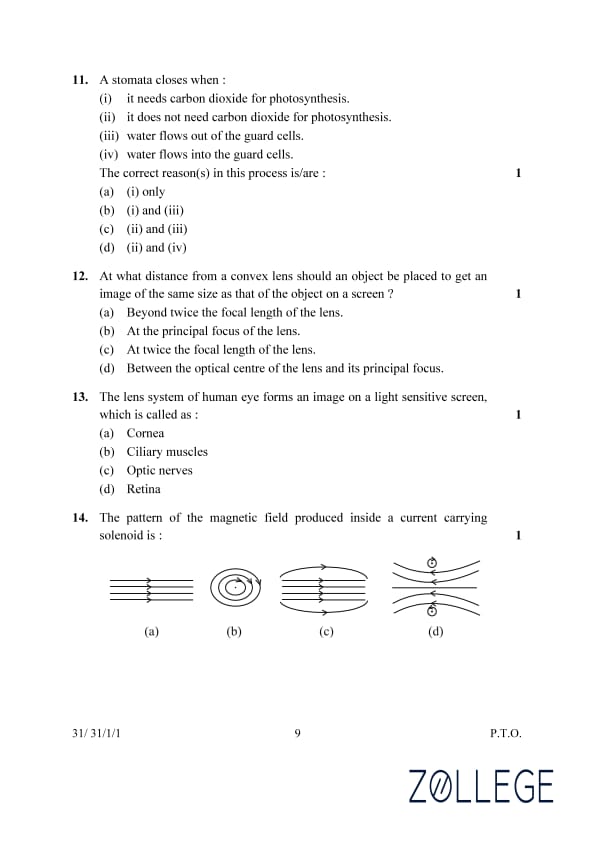
A stomata closes when:
- (i) it needs carbon dioxide for photosynthesis.
- (ii) it does not need carbon dioxide for photosynthesis.
- (iii) water flows out of the guard cells.
- (iv) water flows into the guard cells.
The correct reason(s) in this process is/are:
- (a) (i) only
- (b) (i) and (iii)
- (c) (ii) and (iii)
- (d) (ii) and (iv)
A stomata closes when photosynthesis is inactive or water flows out of guard cells.
Read More
Guard cells regulate stomatal opening and closing based on turgor pressure. When water flows out of guard cells, they become flaccid, causing the stomatal pore to close.
Question 12:
At what distance from a convex lens should an object be placed to get an image of the same size as that of the object on a screen?
- (a) Beyond twice the focal length of the lens.
- (b) At the principal focus of the lens.
- (c) At twice the focal length of the lens.
- (d) Between the optical center of the lens and its principal focus.
The object must be placed at 2f for a same-sized, real image.
Read More
A convex lens forms a real, inverted image at 2f when the object is placed at 2f. This satisfies the magnification condition \(m = 1\).
Question 13:
The lens system of the human eye forms an image on a light-sensitive screen, which is called:
- (a) Cornea
- (b) Ciliary muscles
- (c) Optic nerves
- (d) Retina
The retina acts as the screen for image formation in the eye.
Read More
The lens focuses light onto the retina, where photoreceptor cells (rods and cones) convert light into neural signals transmitted via the optic nerve.
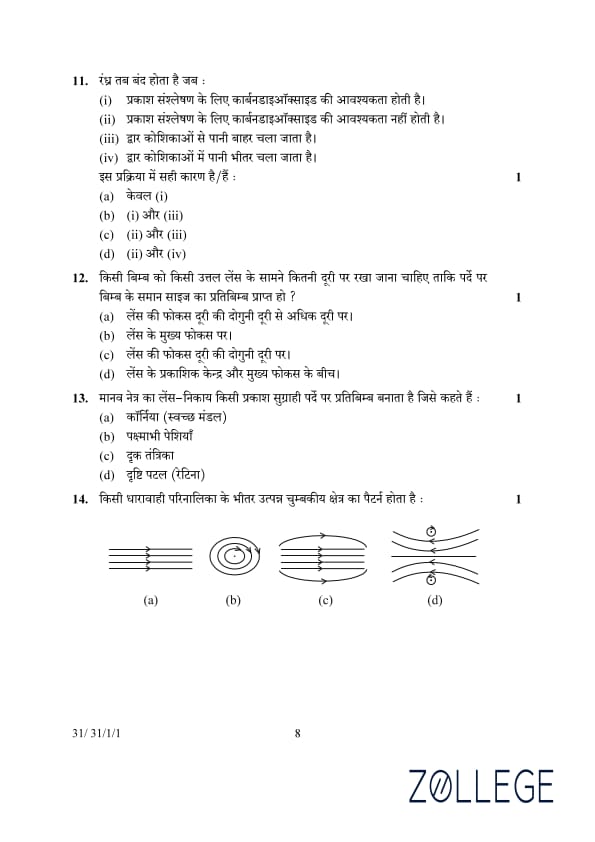
Question 14:
The pattern of the magnetic field produced inside a current-carrying solenoid is:
- (a) Uniform and parallel lines
- (b) Concentric circles
- (c) Curved field lines inside
- (d) Diverging lines outside
Inside a solenoid, the magnetic field is strong, uniform, and parallel.
Read More
A solenoid's magnetic field resembles that of a bar magnet, with parallel lines indicating a uniform field inside and weaker lines outside.
Question 15:
Identify the food chain in which the organisms of the second trophic level are missing:
- (a) Grass, goat, lion
- (b) Zooplankton, Phytoplankton, small fish, large fish
- (c) Tiger, grass, snake, frog
- (d) Grasshopper, grass, snake, frog, eagle
The second trophic level (herbivores) is absent in this chain.
Read More
A typical food chain starts with producers, followed by primary consumers (herbivores). In this chain, the herbivores are absent.
Question 16:
In which of the following organisms is multiple fission a means of asexual reproduction?
- (a) Yeast
- (b) Leishmania
- (c) Paramecium
- (d) Plasmodium
Plasmodium reproduces via multiple fission during its life cycle.
Read More
Multiple fission involves a single parent organism dividing into many daughter cells. Plasmodium undergoes this process in its liver stage (schizogony), producing numerous merozoites.
Question 17:
Assertion (A): Hydrogen gas is not evolved when zinc reacts with nitric acid.
Reason (R): Nitric acid oxidizes the hydrogen gas produced to water and itself gets reduced.
- (a) Both Assertion (A) and Reason (R) are true, and Reason (R) is the correct explanation of the Assertion (A).
- (b) Both Assertion (A) and Reason (R) are true, but Reason (R) is not the correct explanation of the Assertion (A).
- (c) Assertion (A) is true, but Reason (R) is false.
- (d) Assertion (A) is false, but Reason (R) is true.
Hydrogen gas is oxidized by nitric acid to form water, preventing its release.
Read More
Nitric acid acts as a strong oxidizing agent. During the reaction, nascent hydrogen is oxidized to water, and nitric acid is reduced to nitrogen oxides such as NO or NO₂.
Question 18:
Assertion (A): Accumulation of harmful chemicals is maximum in the organisms at the highest trophic level of a food chain.
Reason (R): Harmful chemicals are sprayed on the crops to protect them from diseases and pests.
- (a) Both Assertion (A) and Reason (R) are true, and Reason (R) is the correct explanation of the Assertion (A).
- (b) Both Assertion (A) and Reason (R) are true, but Reason (R) is not the correct explanation of the Assertion (A).
- (c) Assertion (A) is true, but Reason (R) is false.
- (d) Assertion (A) is false, but Reason (R) is true.
Biomagnification leads to higher chemical concentrations at the top trophic levels.
Read More
While harmful chemicals often enter the food chain via agricultural pesticides, the primary cause of their high accumulation at top levels is their non-biodegradable nature and concentration increase at each trophic level (biomagnification).
Question 19:
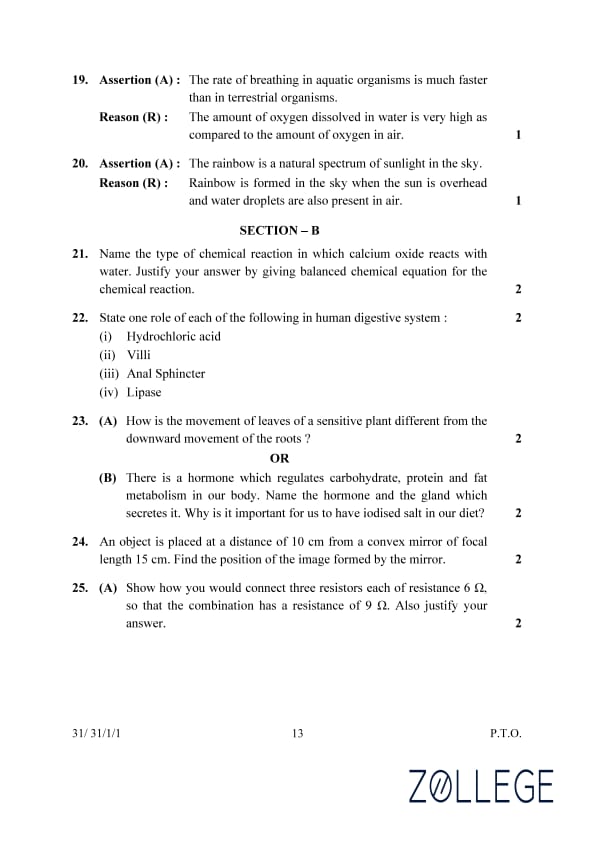
Assertion (A): The rate of breathing in aquatic organisms is much faster than in terrestrial organisms.
Reason (R): The amount of oxygen dissolved in water is very high as compared to the amount of oxygen in air.
- (a) Both Assertion (A) and Reason (R) are true, and Reason (R) is the correct explanation of the Assertion (A).
- (b) Both Assertion (A) and Reason (R) are true, but Reason (R) is not the correct explanation of the Assertion (A).
- (c) Assertion (A) is true, but Reason (R) is false.
- (d) Assertion (A) is false, but Reason (R) is true.
Oxygen availability in water is lower, requiring faster breathing in aquatic organisms.
Read More
Aquatic organisms compensate for low oxygen levels in water by breathing more rapidly. Air contains approximately 21% oxygen, while dissolved oxygen in water is significantly lower.
Question 20:
Assertion (A): The rainbow is a natural spectrum of sunlight in the sky.
Reason (R): A rainbow is formed in the sky when the sun is overhead and water droplets are also present in air.
- (a) Both Assertion (A) and Reason (R) are true, and Reason (R) is the correct explanation of the Assertion (A).
- (b) Both Assertion (A) and Reason (R) are true, but Reason (R) is not the correct explanation of the Assertion (A).
- (c) Assertion (A) is true, but Reason (R) is false.
- (d) Assertion (A) is false, but Reason (R) is true.
Rainbows form when sunlight is dispersed by water droplets with the sun behind the observer.
Read More
Rainbows occur due to the dispersion of sunlight into its constituent colors through water droplets. The sun must be behind the observer, and the angle between sunlight and the observer must be around 42 degrees.
Question 21:
Name the type of chemical reaction in which calcium oxide reacts with water. Justify your answer by giving a balanced chemical equation for the chemical reaction.
The reaction between calcium oxide and water is a combination reaction.
Read More
Calcium oxide (CaO) reacts with water (H₂O) to form calcium hydroxide (Ca(OH)₂):
CaO + H₂O → Ca(OH)₂
This exothermic reaction releases heat and combines two reactants to form a single product.
Question 22:
State one role of each of the following in the human digestive system:
- Hydrochloric acid
- Villi
- Anal Sphincter
- Lipase
Each component has specific roles in digestion, such as HCl creating acidity, villi aiding absorption, the sphincter controlling defecation, and lipase digesting fats.
Read More
(i) HCl creates an acidic environment for enzyme activity and kills bacteria.
(ii) Villi increase the surface area for nutrient absorption.
(iii) The anal sphincter regulates waste expulsion.
(iv) Lipase breaks down fats into fatty acids and glycerol.
Question 23:
(A) How is the movement of leaves of a sensitive plant different from the downward movement of the roots?
OR
(B) There is a hormone that regulates carbohydrate, protein, and fat metabolism in our body. Name the hormone and the gland which secretes it. Why is it important to have iodised salt in our diet?
Nastic movements in sensitive plants are rapid and non-directional, unlike geotropism in roots which is slower and directional.
Read More
Nastic movements result from turgor changes, while geotropism is growth-driven, influenced by auxins and gravity.
The hormone thyroxine, secreted by the thyroid gland, regulates metabolism. Iodised salt prevents iodine deficiency, crucial for thyroxine production.
Question 24:
An object is placed at a distance of 10 cm from a convex mirror of focal length 15 cm. Find the position of the image formed by the mirror.
The image is formed 6 cm behind the mirror.
Read More
Using the mirror formula, 1/f = 1/v + 1/u, substituting values gives:
1/15 = 1/v + 1/(-10), solving gives v = 6 cm.
Question 25:
(A) Show how you would connect three resistors of 6 Ω each to get a total resistance of 9 Ω. Justify your answer.
OR
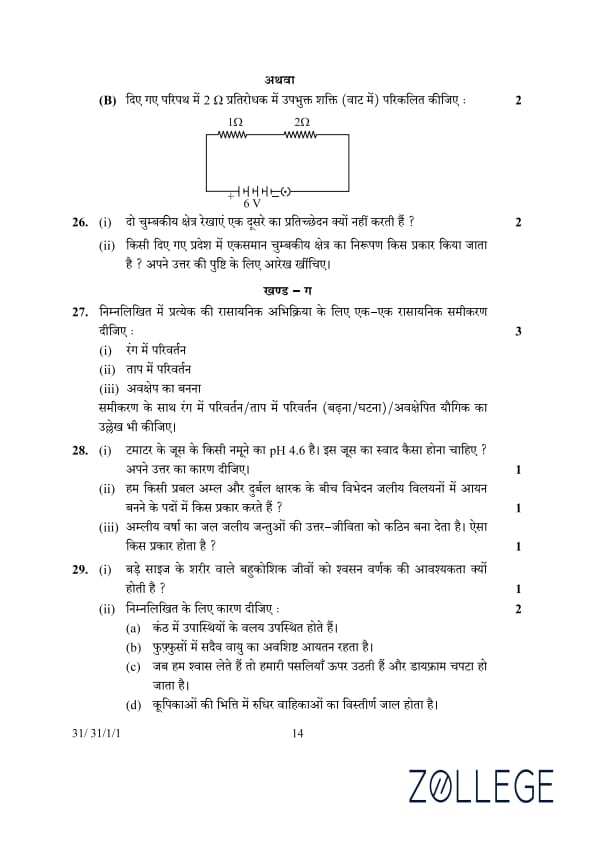
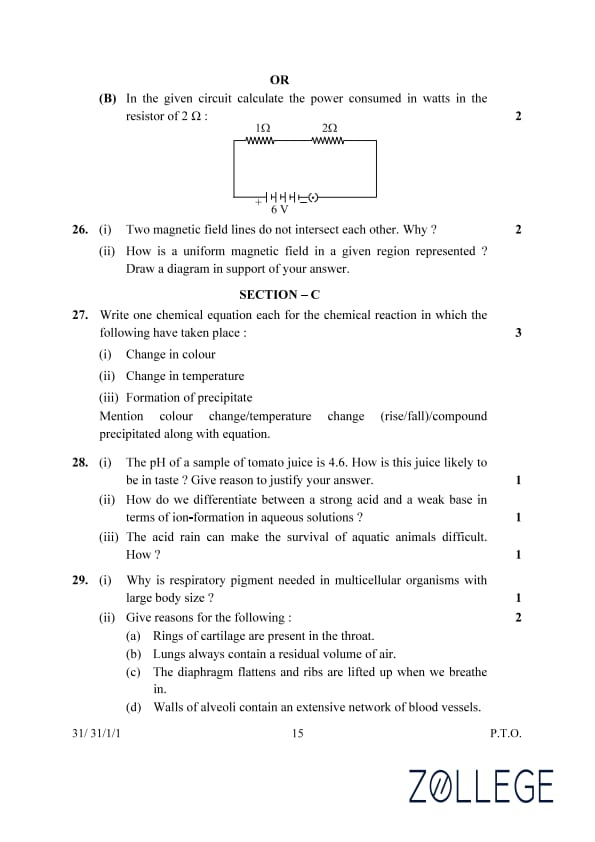
(B) Calculate the power consumed in a 2 Ω resistor in a given circuit.
Connect two resistors in parallel and one in series to achieve 9 Ω total resistance.
Read More
Parallel combination gives Rₚ = 3 Ω, adding the third in series gives Rₜ = 9 Ω.
The power consumed in the 2 Ω resistor is 8 W.
Read More
Using P = I²R, where current I = 2 A, gives P = 8 W.
Question 26:
(i) Why do two magnetic field lines not intersect each other?
(ii) How is a uniform magnetic field represented? Draw a diagram in support of your answer.
Magnetic field lines do not intersect because a field cannot have two directions at one point.
Read More
Intersecting lines would mean conflicting force directions, which is physically impossible.
Uniform magnetic fields are represented by parallel, equally spaced lines.
Read More
Diagram: Parallel lines indicating uniform strength and direction.
Question 27:
Write one chemical equation each for:
- Change in colour
- Change in temperature
- Formation of precipitate
Each reaction illustrates a specific observation: colour change, temperature change, and precipitate formation.
Read More
(i) Colour change: Fe + CuSO₄ → FeSO₄ + Cu (blue to colourless).
(ii) Temperature change: CaO + H₂O → Ca(OH)₂ (exothermic, heat release).
(iii) Precipitate formation: AgNO₃ + NaCl → AgCl + NaNO₃ (white precipitate).
Question 28:
(i) How does the pH of tomato juice indicate its taste?
(ii) How do we differentiate between a strong acid and a weak base?
(iii) How does acid rain affect aquatic animals?
Tomato juice is acidic (pH 4.6) and tastes sour.
Read More
The low pH is due to hydrogen ions, giving it its characteristic sour taste.
Strong acids fully ionize, while weak bases partially ionize in water.
Read More
Examples: HCl (strong acid, full ionization) vs. NH₃ (weak base, partial ionization).
Acid rain lowers water pH, harming aquatic life.
Read More
It disrupts enzyme activity, damages tissues, and introduces toxic metals like aluminum.
Question 29:
(i) Why is a respiratory pigment needed in multicellular organisms?
(ii) Reasons for:
- Cartilage in the throat
- Residual air in lungs
- Diaphragm movement during inhalation
- Blood vessels in alveoli walls
Respiratory pigments increase oxygen transport efficiency for large organisms.
Read More
Hemoglobin binds oxygen, enabling transport from lungs to distant tissues.
Each anatomical feature has a specific role in ensuring efficient respiration.
Read More
(a) Cartilage prevents airway collapse.
(b) Residual air maintains alveoli inflation.
(c) Diaphragm/ribs expand chest cavity for inhalation.
(d) Blood vessels ensure efficient gas exchange.
Question 30:
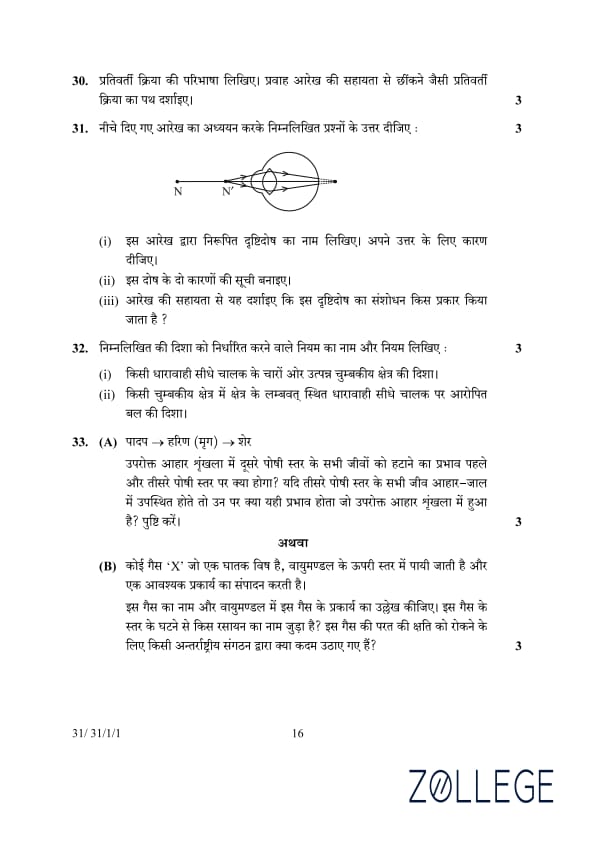
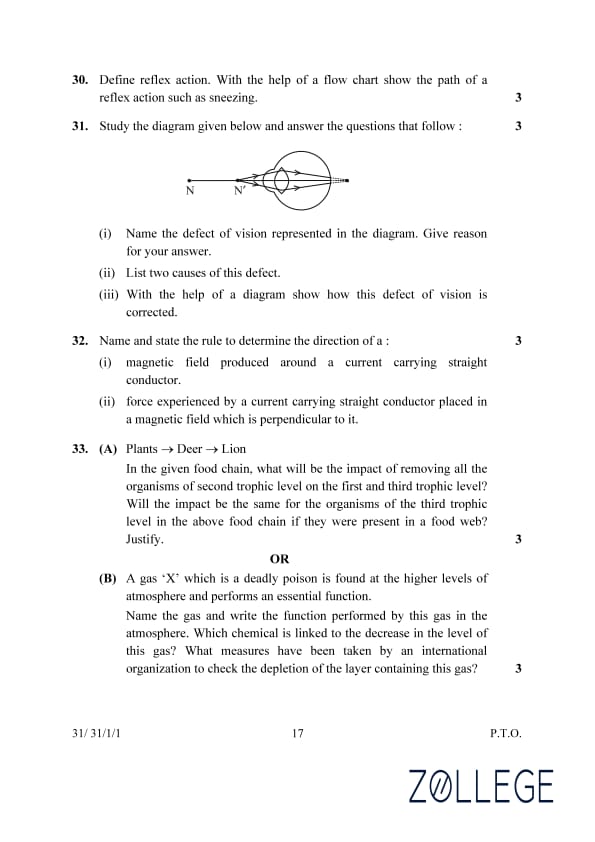
Define reflex action. With the help of a flow chart, show the path of a reflex action such as sneezing.
A reflex action is an involuntary and nearly instantaneous response to a stimulus, occurring without conscious thought.
Read More
Reflex actions are protective mechanisms that minimize harm to the body by providing rapid responses to stimuli.
Flowchart for Sneezing Reflex:
- Stimulus: Irritant in nasal passage
- Receptor: Sensory neurons in the nose
- Relay Neuron: Located in the spinal cord
- Motor Neuron: Sends signals to effector muscles
- Effector: Muscles involved in sneezing
- Response: Sneezing
Question 31:
(i) Name the defect of vision represented in the diagram. Give a reason for your answer.
(ii) List two causes of this defect.
(iii) With the help of a diagram, show how this defect of vision is corrected.
The defect is hypermetropia, as light rays converge behind the retina. Causes include a shorter eyeball or weak lens.
Read More
This defect is corrected using a convex lens, which converges the light rays to focus them on the retina.
Question 32:
(i) Name and state the rule to determine the direction of a magnetic field around a current-carrying conductor.
(ii) Name and state the rule to determine the force on a current-carrying conductor in a perpendicular magnetic field.
(i) Right-hand thumb rule: Curl your fingers around the conductor with your thumb pointing in the direction of current.
(ii) Fleming’s left-hand rule: Align your thumb, forefinger, and middle finger perpendicular to determine force, field, and current.
Question 33:
(A) What happens to the first and third trophic levels in the given food chain if the second trophic level is removed?
(B) Name the gas that performs an essential function in the upper atmosphere. What causes its depletion, and what measures are taken to control it?
(A) Removing the second trophic level increases the first (plants) and decreases the third (lions). In a food web, lions may switch to other prey.
(B) Ozone (O₃) absorbs UV radiation. CFCs cause depletion. The Montreal Protocol limits CFC use to protect the ozone layer.
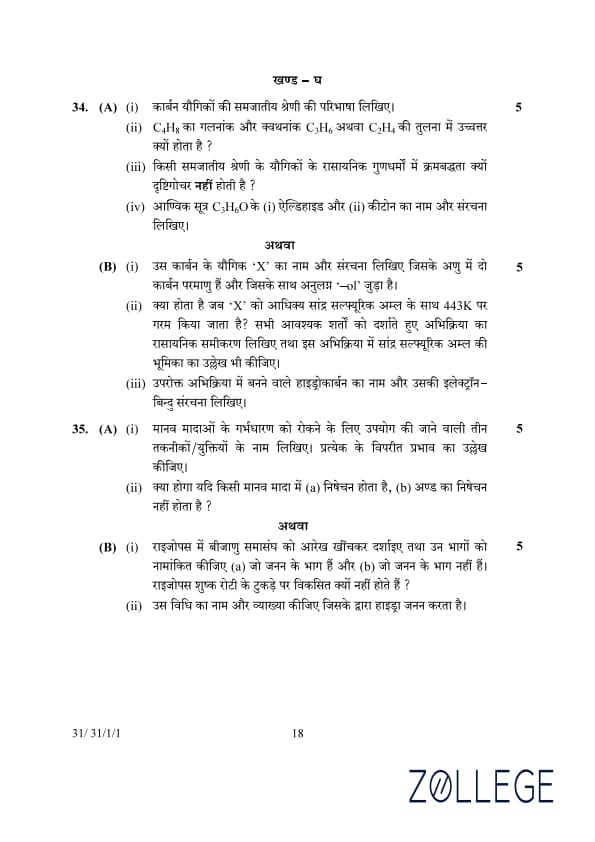
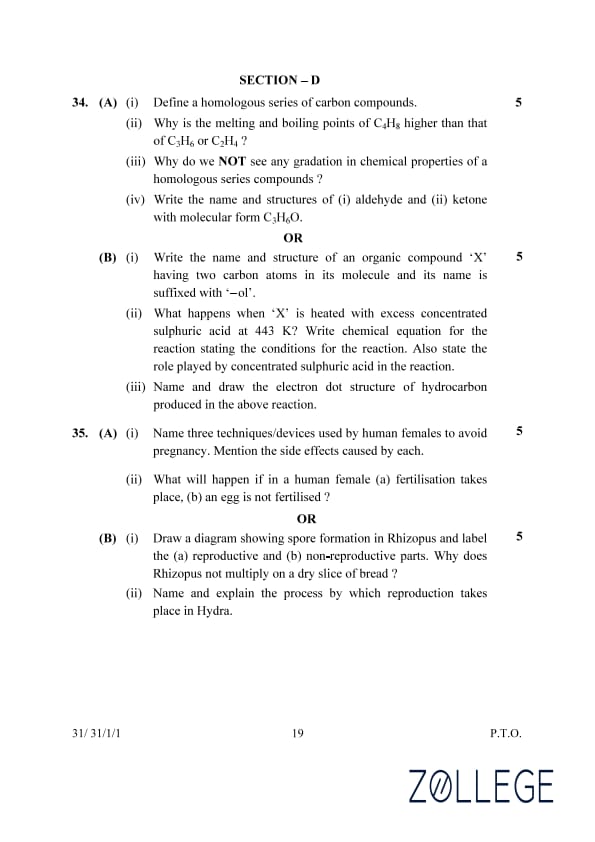
Question 34:
(A) Define a homologous series and explain its properties. Provide an example of an aldehyde and ketone.
(B) Name an organic compound with two carbons ending in ‘-ol.’ Describe its dehydration reaction.
(A) Homologous series are organic compounds with the same functional group and properties. Examples include aldehydes (C₃H₆O: propanal) and ketones (C₃H₆O: propanone).
(B) Ethanol (C₂H₅OH) dehydrates to ethene (C₂H₄) in the presence of concentrated H₂SO₄ at 443 K.
Question 35:
(A) List methods of contraception and their side effects. What happens during fertilization and menstruation?
(B) Describe reproduction in Rhizopus and Hydra.
(A) Contraception methods include pills, IUDs, and condoms with side effects like nausea, cramping, or allergies. Fertilization leads to zygote formation, while menstruation occurs if the egg is unfertilized.
(B) Rhizopus reproduces via spore formation, requiring moisture. Hydra reproduces asexually by budding.
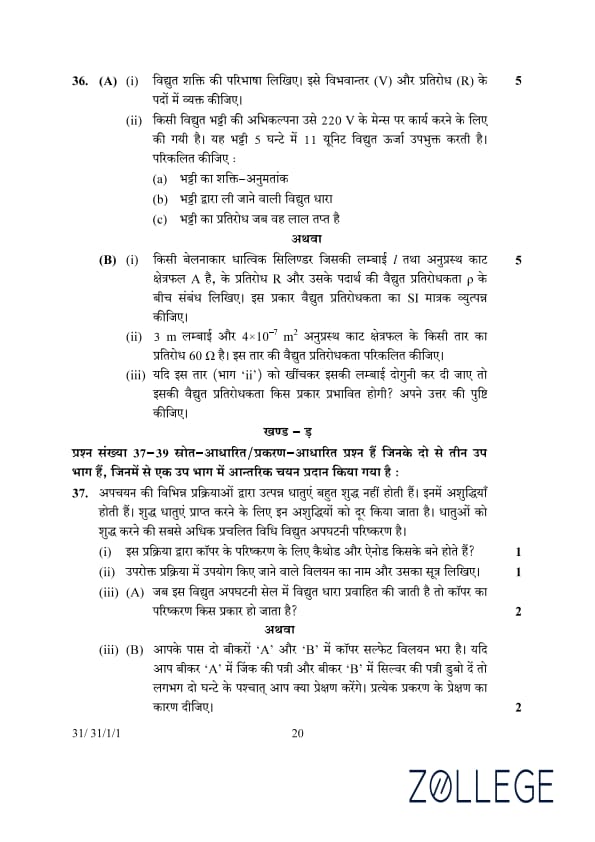
Question 36:
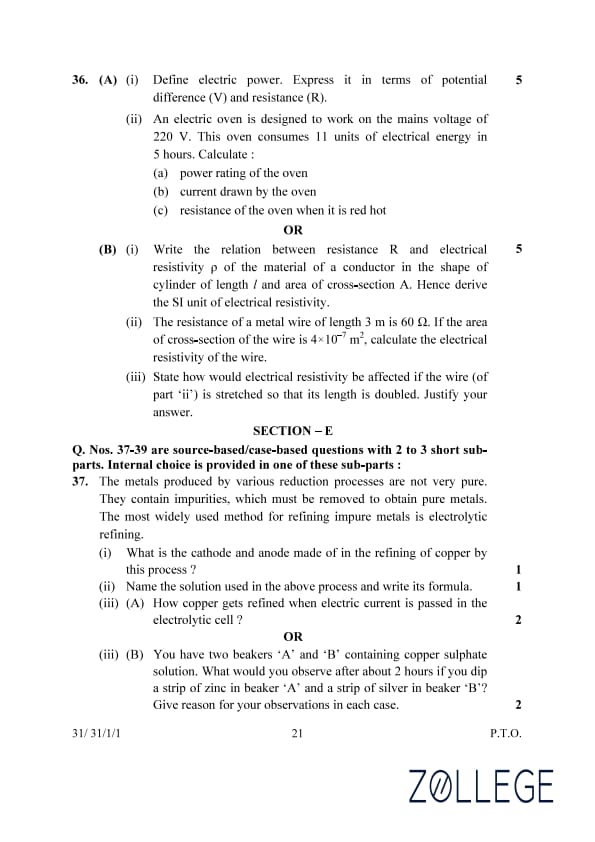
(A) Define electric power. Calculate the power rating, current, and resistance of an oven.
(B) Derive the formula for resistivity and calculate it for a metal wire. What happens when the wire is stretched?
(A) Electric power is the rate of energy consumption. Oven: Power = 2200 W, Current = 10 A, Resistance = 22 Ω.
(B) Resistivity = RA/l. Calculated as 8 × 10⁻⁶ Ω·m. Stretching doubles the resistance but does not affect resistivity.
Question 37:
(i) What are the anode and cathode in electrolytic refining of copper?
(ii) What is the solution used?
(iii) How is copper refined in this process? OR Describe observations when zinc or silver strips are dipped in copper sulfate.
(i) Anode: Impure copper; Cathode: Pure copper.
(ii) Solution: Acidified copper sulfate (CuSO₄).
(iii) Copper ions migrate to the cathode, depositing pure copper. Zinc displaces copper; silver shows no reaction.
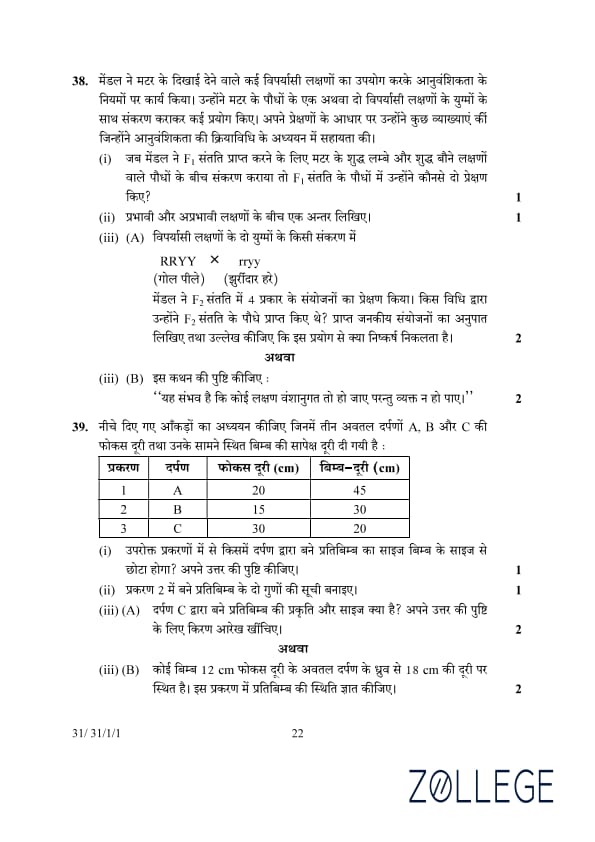
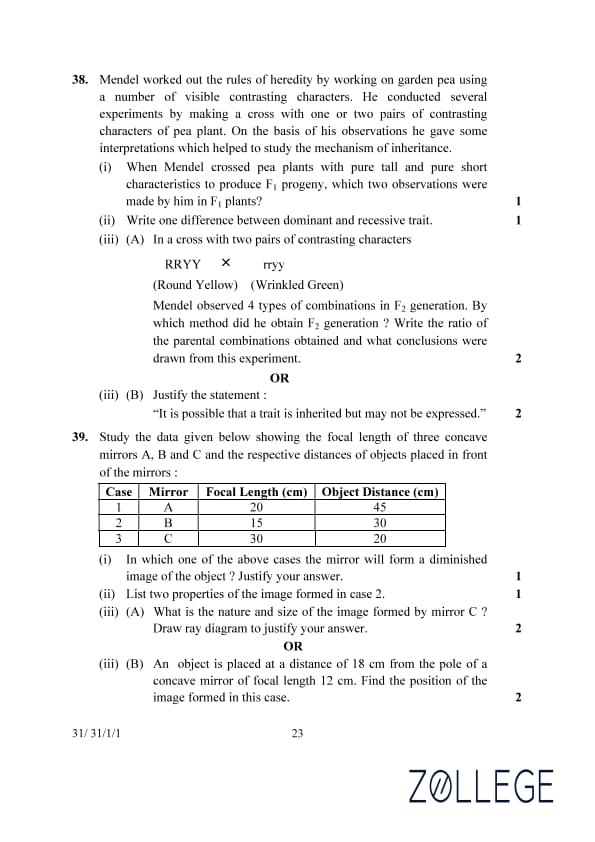
Question 38:
(i) What observations did Mendel make in the F₁ generation?
(ii) Differentiate between dominant and recessive traits.
(iii) Describe Mendel’s dihybrid cross. OR Explain why inherited traits may not always be expressed.
(i) F₁ plants were tall and uniform.
(ii) Dominant traits mask recessive ones in heterozygous conditions.
(iii) Dihybrid cross shows independent assortment with a 9:3:3:1 ratio. Recessive traits require two copies to be expressed.
Question 39:
(i) Which mirror forms a diminished image? Justify.
(ii) List properties of the image in Case 2.
(iii) Describe the image formed by Mirror C. OR Calculate the image position for a concave mirror.
(i) Mirror A forms a diminished image, as the object is beyond the center of curvature.
(ii) Real, inverted, and same size as the object.
(iii) Mirror C forms a virtual, enlarged image. OR Image position = -36 cm (real, inverted).

*The article might have information for the previous academic years, please refer the official website of the exam.