
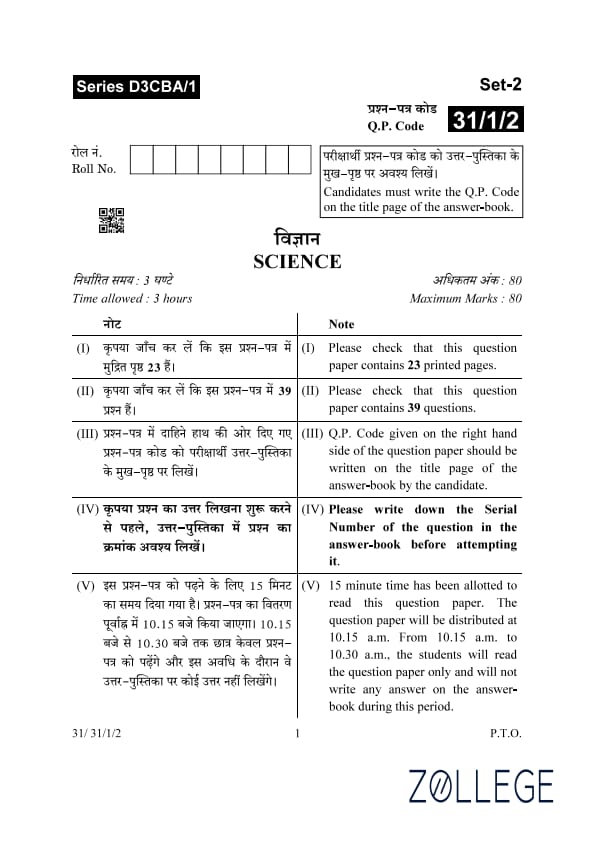
CBSE Class 10 2024 Question Paper with Answer Key PDF for Science (March 2 - Shift 1)


Content Strategist | Updated On - Jan 5, 2025
CBSE Class 10 Question Papers are the most important study material for effective exam preparation. We at Zollege have provided all CBSE Class 10 Previous Year Papers with Solution PDFs here. CBSE Class 10 2024 Science exam was conducted successfully on March 2 by CBSE.
Students can freely download the CBSE Class 10 previous year's question paper PDFs along with their solutions here. We strongly encourage CBSE 10 aspirants to scan through all the CBSE Class 10 Question Paper to know the overall difficulty level, CBSE Class 10 Syllabus and understand the changes in CBSE Class 10 Exam Pattern over the years.
CBSE Class 10 2024 Science Question Paper with Answer Key PDF
| CBSE Class 10 Science 2024 Question Paper with Answer Key (Set 2 31/1/2) |  Download Download |
Check Solution |
Question 1:
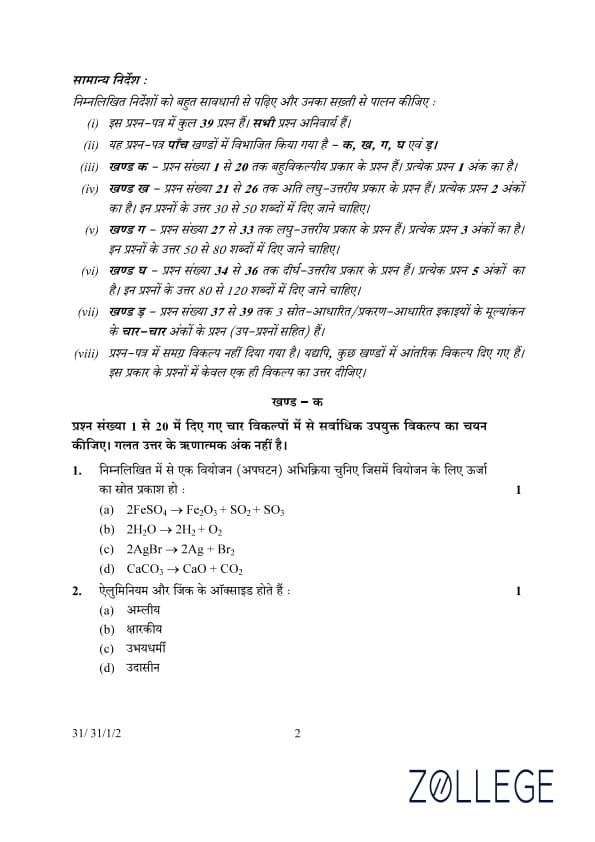
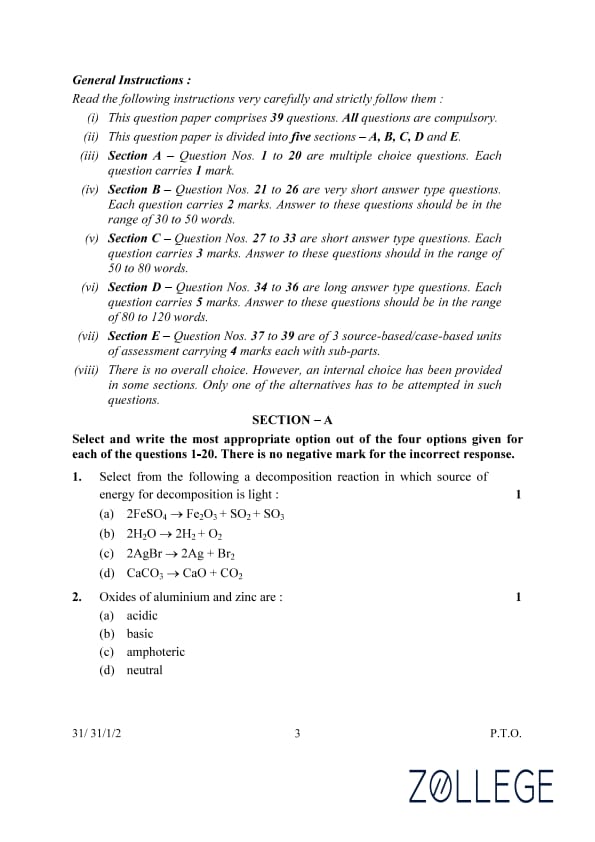
Select from the following a decomposition reaction in which the source of energy for decomposition is light:
A decomposition reaction is a reaction where a single compound breaks down into two or more simpler substances. The question specifies that the source of energy for the decomposition is light. This is characteristic of photochemical reactions.
Read More
Let's analyze the options:
Option (a): 2FeSO4 → Fe2O3 + SO2 + SO3 This is a decomposition reaction, but it's typically thermally driven (requires heat), not light.
Option (b): 2H2O → 2H2 + O2 This is a decomposition reaction, but it requires a significant amount of energy, usually electrical energy (electrolysis) or heat.
Option (c): 2AgBr → 2Ag + Br2 This is a decomposition reaction where silver bromide (AgBr) decomposes into silver (Ag) and bromine (Br2) when exposed to light. This is a classic example of a photochemical decomposition reaction used in photography.
Option (d): CaCO3 → CaO + CO2 This is a decomposition reaction, but it is typically driven by heat.
Therefore, the decomposition reaction driven by light is option (c).
Question 2:
Oxides of aluminium and zinc are:
Amphoteric substances can react as both acids and bases. Aluminum oxide (Al2O3) and zinc oxide (ZnO) are classic examples of amphoteric oxides. They can react with both acids and bases to form salts and water.
Read More
For example, zinc oxide reacts with hydrochloric acid (an acid): ZnO + 2HCl → ZnCl2 + H2O
And it also reacts with sodium hydroxide (a base): ZnO + 2NaOH + H2O → Na2[Zn(OH)4] (sodium zincate)
Aluminum oxide behaves similarly.
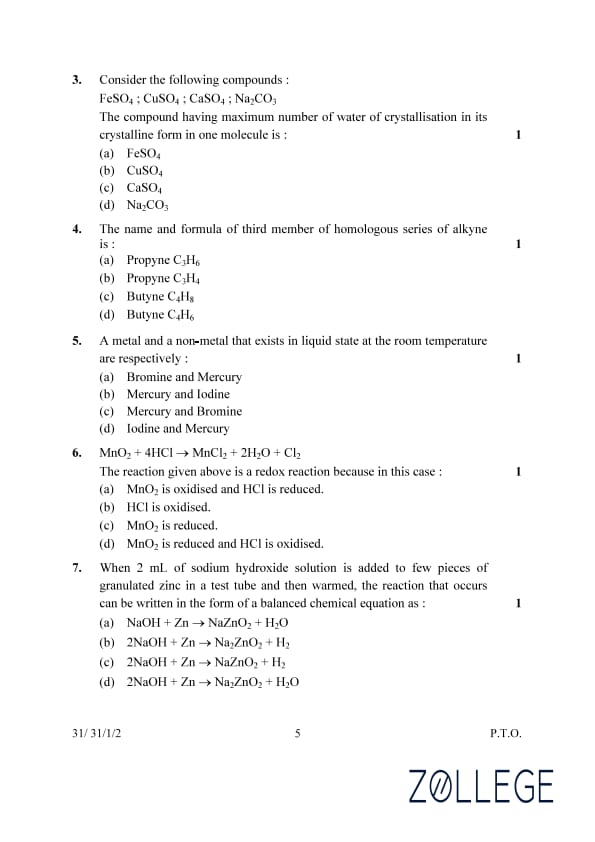
Question 3:
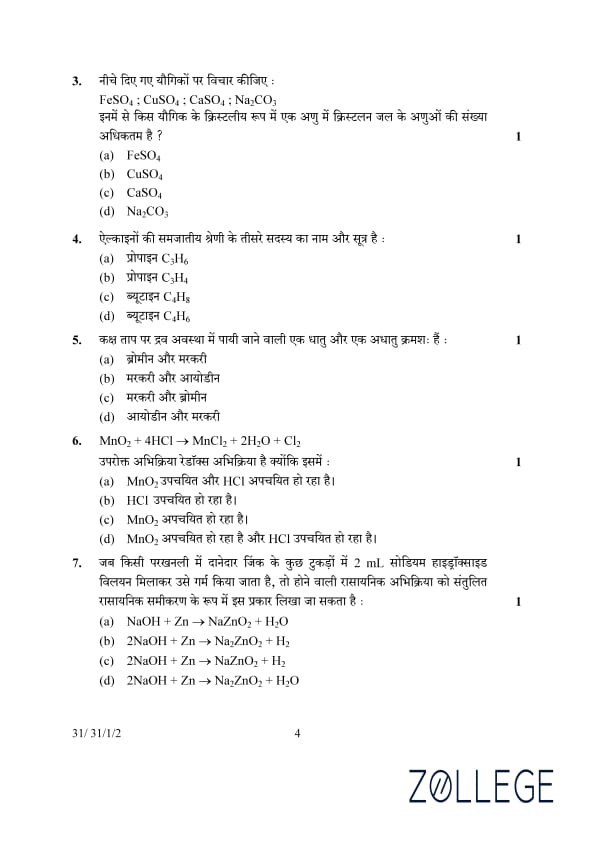
Consider the following compounds:
- FeSO4
- CuSO4
- CaSO4
- Na2CO3
The compound having the maximum number of water of crystallisation in its crystalline form in one molecule is:
The question asks about the water of crystallization, which refers to the water molecules that are present inside crystals. Sodium Carbonate (Na2CO3) has the maximum number of water molecules (10) in its crystalline form.
Read More
Let’s examine the common hydrated forms of these compounds: FeSO4: Commonly exists as FeSO4·7H2O (heptahydrate) CuSO4: Commonly exists as CuSO4·5H2O (pentahydrate) CaSO4: Commonly exists as CaSO4·2H2O (dihydrate) or anhydrous CaSO4 Na2CO3: Commonly exists as Na2CO3·10H2O (decahydrate)
Comparing the number of water molecules in the common hydrated forms (7, 5, 2, and 10), we find that Sodium Carbonate (Na2CO3) has the maximum number of water molecules.
Question 4:
The name and formula of the third member of the homologous series of alkynes is:
Alkynes are hydrocarbons with a triple bond between two carbon atoms. The general formula for alkynes is CnH2n-2. The first member of the alkyne series is ethyne (C2H2), also known as acetylene.
Read More
Let’s list the first few members: 1. Ethyne: C2H2 2. Propyne: C3H4 3. Butyne: C4H6
Therefore, the third member is butyne with the formula C4H6.
Question 5:
A metal and a non-metal that exists in liquid state at the room temperature are respectively:
Mercury (Hg) is a metal that exists as a liquid at room temperature. Bromine (Br) is a non-metal that exists as a liquid at room temperature. Iodine (I) is a non-metal, but it exists as a solid at room temperature.
Read More
Mercury is the only metal that is liquid at standard room temperature. Bromine is one of the few non-metals that are liquid at standard room temperature.
Question 6:
MnO2 + 4HCl → MnCl2 + 2H2O + Cl2
The reaction given above is a redox reaction because in this case:
Let’s look at the oxidation states of Mn and Cl: In MnO2, the oxidation state of Mn is +4. In MnCl2, the oxidation state of Mn is +2. Mn has gained electrons (its oxidation state has decreased), so it has been reduced. In HCl, the oxidation state of Cl is -1. In Cl2, the oxidation state of Cl is 0. Cl has lost electrons (its oxidation state has increased), so it has been oxidized.
Read More
In redox reactions, oxidation and reduction occur simultaneously. "OIL RIG" helps remember: Oxidation Is Loss (of electrons), Reduction Is Gain (of electrons).
Question 7:
When 2 mL of sodium hydroxide solution is added to a few pieces of granulated zinc in a test tube and then warmed, the reaction that occurs can be written in the form of a balanced chemical equation as:
To determine the correct balanced chemical equation, we need to consider the reaction between sodium hydroxide (NaOH) and zinc (Zn). Zinc reacts with sodium hydroxide to form sodium zincate (Na2ZnO2) and hydrogen gas (H2).
Read More
Option (a): NaOH + Zn → NaZnO2 + H2O This equation is not balanced. Option (b): 2NaOH + Zn → Na2ZnO2 + H2 This equation is balanced. Option (c): 2NaOH + Zn → NaZnO2 + H2 This equation is not balanced. Option (d): 2NaOH + Zn → Na2ZnO2 + H2O This equation is not balanced.
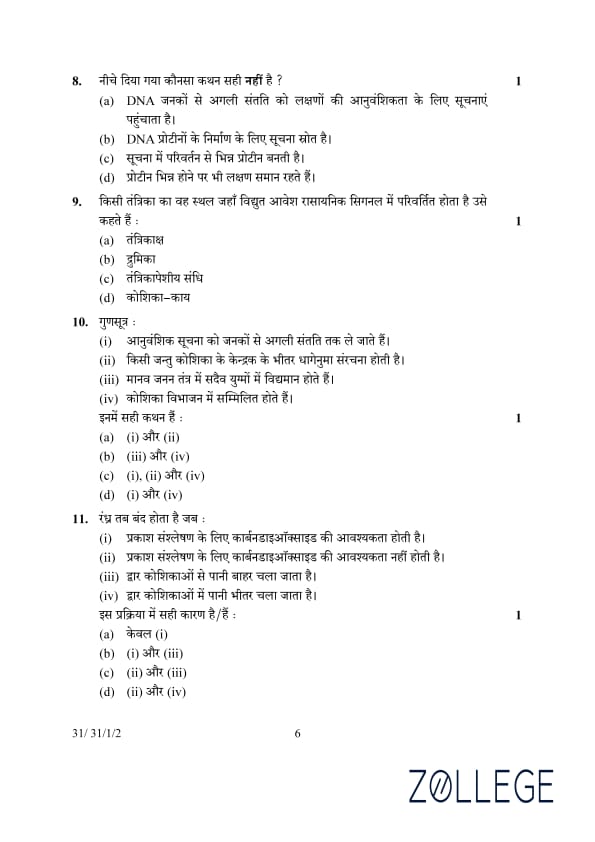
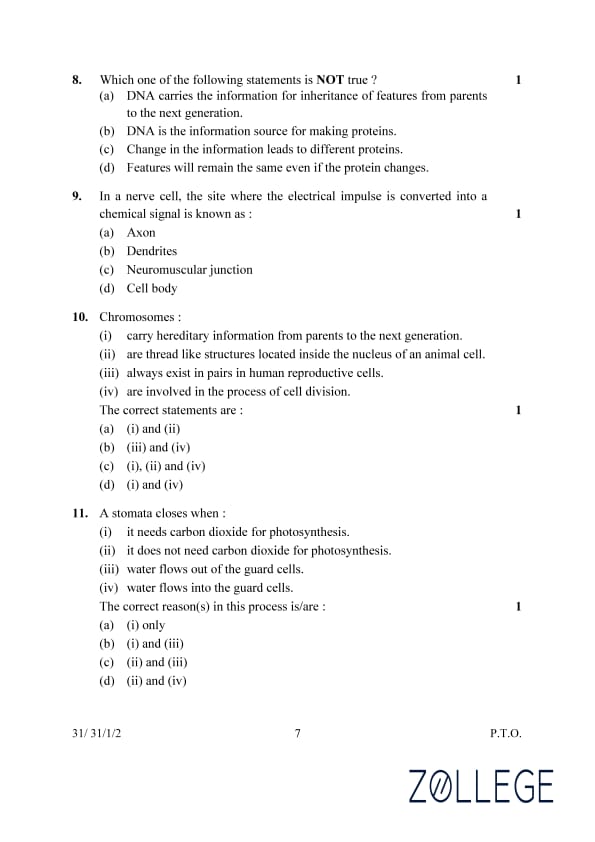
Question 8:
Which one of the following statements is NOT true?
Options (a), (b), and (c) are all true statements related to the central dogma of molecular biology: DNA carries genetic information, which is used to make proteins, and changes in DNA (mutations) can lead to different proteins.
Read More
Option (d) is NOT true. Features of an organism (phenotype) are largely determined by the proteins they produce. If the proteins change (due to changes in DNA), the features of the organism are also likely to change.
Question 9:
In a nerve cell, the site where the electrical impulse is converted into a chemical signal is known as:
Axon: Transmits the electrical impulse. Dendrites: Receive signals from other neurons. Cell body: Integrates signals. Neuromuscular junction: The specialized synapse where a motor neuron connects to a muscle fiber. Here, the electrical impulse is converted into a chemical signal (neurotransmitter) that stimulates the muscle.
Read More
The neuromuscular junction is where the nervous system communicates with the muscular system to cause muscle contractions.
Question 10:
Chromosomes:
(i) carry hereditary information from parents to the next generation.
(ii) are thread-like structures located inside the nucleus of an animal cell.
(iii) always exist in pairs in human reproductive cells.
(iv) are involved in the process of cell division.
The correct statements are:
Let’s evaluate each statement:
(i) True. Chromosomes carry genes, which are the units of heredity. They transmit genetic information from parents to offspring.
(ii) False. Chromosomes are thread-like structures made of DNA and proteins. They are found within the nucleus of eukaryotic cells but it is not exclusive to animal cells.
(iii) False. While human somatic (body) cells have chromosomes in pairs (diploid), human reproductive cells (gametes—sperm and egg) have only one set of chromosomes (haploid).
(iv) True. Chromosomes play a vital role in cell division (mitosis and meiosis), ensuring that each daughter cell receives a complete set of chromosomes.
Read More
Therefore, statements (i) and (iv) are correct.
Question 11:
A stomata closes when:
(i) it needs carbon dioxide for photosynthesis.
(ii) it does not need carbon dioxide for photosynthesis.
(iii) water flows out of the guard cells.
(iv) water flows into the guard cells.
The correct reason(s) in this process is/are:
Stomata close when water flows out of the guard cells and photosynthesis is not active.
Read More
Stomata are tiny pores on the surface of leaves, primarily responsible for gas exchange (taking in carbon dioxide for photosynthesis and releasing oxygen). They are surrounded by guard cells that regulate their opening and closing.
Stomata open when the guard cells become turgid (swollen) due to an influx of water. Conversely, stomata close when the guard cells lose water and become flaccid. This happens when potassium ions leave the guard cells, causing water to flow out by osmosis.
(ii) It does not need carbon dioxide for photosynthesis: When photosynthesis is not active (e.g., at night or during water stress), the stomata tend to close to conserve water.
(iii) Water flows out of the guard cells: This loss of water makes the guard cells flaccid, causing the stomatal pore to close.
Question 12:
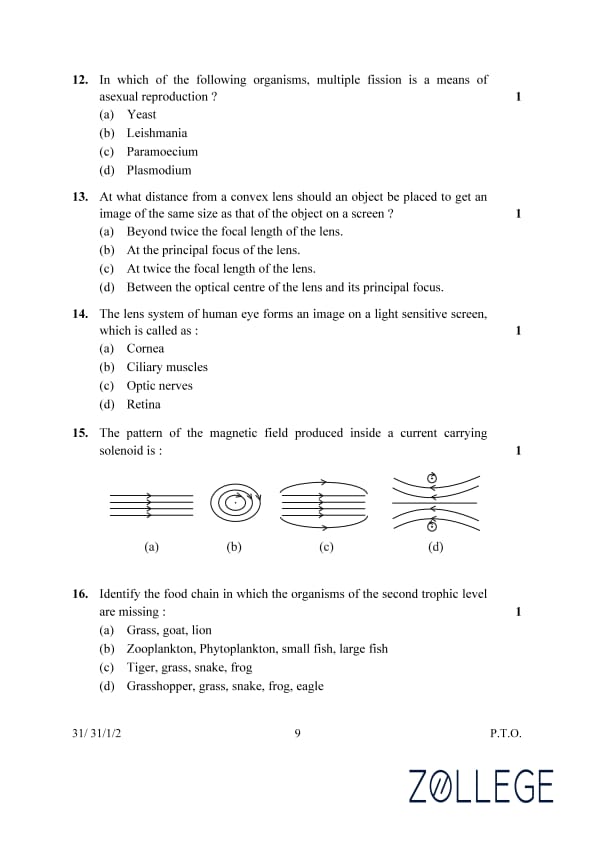
In which of the following organisms, multiple fission is a means of asexual reproduction?
Plasmodium reproduces through multiple fission during its life cycle, specifically in the liver stage (schizogony).
Read More
Multiple fission is a type of asexual reproduction where the parent organism divides into multiple daughter cells simultaneously. Plasmodium, the parasite that causes malaria, utilizes multiple fission during its life cycle, specifically in the liver stage (schizogony), where it rapidly multiplies. Yeast reproduces through budding, while Leishmania and Paramecium typically undergo binary fission (splitting into two).
Question 13:
At what distance from a convex lens should an object be placed to get an image of the same size as that of the object on a screen?
A convex lens forms an image of the same size as the object when placed at twice the focal length.
Read More
A convex lens forms a real, inverted image of the same size as the object when the object is placed at twice the focal length (2f). You can derive this using the lens formula:
Lens Formula: \( \frac{1}{f} = \frac{1}{v} - \frac{1}{u} \)
Magnification Formula: \( m = \frac{v}{u} \)
When the image size is equal to the object size, the magnitude of magnification is 1. For a real, inverted image, \( m = -1 \). Substituting \( v = -u \) into the lens formula gives:
\( \frac{1}{f} = \frac{1}{-u} - \frac{1}{u} \)
\( u = -2f \)
This shows that the object should be placed at twice the focal length of the lens.
Question 14:
The lens system of the human eye forms an image on a light-sensitive screen, which is called as:
The retina is the light-sensitive layer at the back of the eye that captures the image formed by the lens.
Read More
The retina contains photoreceptor cells (rods and cones) that convert light into electrical signals, which are then transmitted to the brain via the optic nerve. The cornea and lens refract (bend) light to focus it on the retina. The ciliary muscles control the shape of the lens to adjust focus.
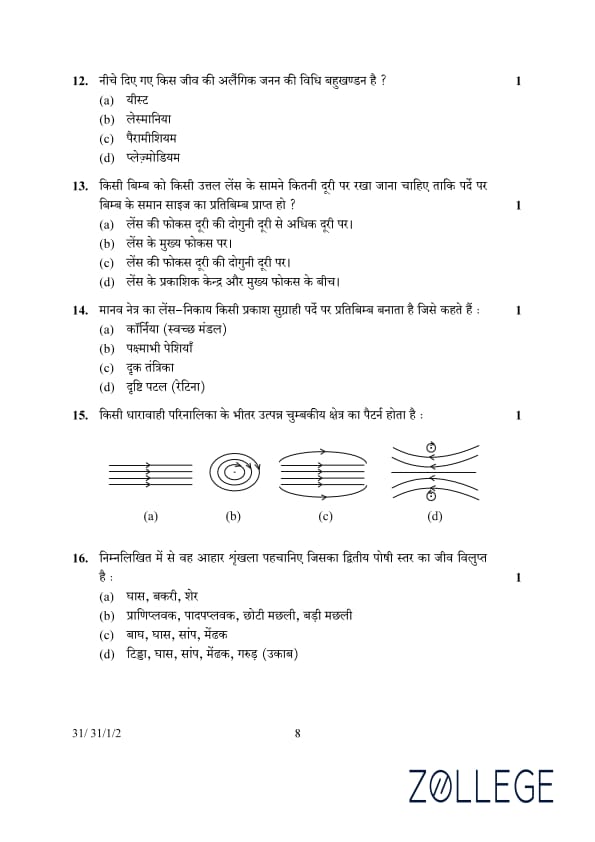
Question 15:
The pattern of the magnetic field produced inside a current-carrying solenoid is:


 Solution:
Inside the solenoid, the magnetic field is strong, uniform, and resembles the field of a bar magnet.
Read More
A solenoid is a coil of wire wrapped around a cylindrical core. When a current flows through the solenoid, it creates a magnetic field. Inside the solenoid, the magnetic field lines are nearly parallel and uniform. Option (a) correctly depicts this pattern. The parallel lines inside represent the uniform magnetic field.
Option (b) shows concentric circles, which is the magnetic field pattern around a straight current-carrying wire. Option (c) shows curved field lines inside, which is not representative of the uniform field inside a solenoid. Option (d) depicts a field pattern more characteristic of two opposite magnetic poles facing each other.
Question 16:
Identify the food chain in which the organisms of the second trophic level are missing:
The food chain "Tiger, grass, snake, frog" lacks organisms from the second trophic level.
Read More
Trophic levels represent the different levels in a food chain or food web:
- First Trophic Level: Producers (plants) – These organisms produce their own food through photosynthesis.
- Second Trophic Level: Primary Consumers (herbivores) – These organisms consume producers.
- Third Trophic Level: Secondary Consumers (carnivores) – These organisms consume primary consumers.
- Fourth Trophic Level (and higher): Tertiary Consumers (top carnivores) – These organisms consume secondary consumers.
In the given food chain "Tiger, grass, snake, frog," the primary consumers (herbivores) are missing, making it incomplete.
Question 17:
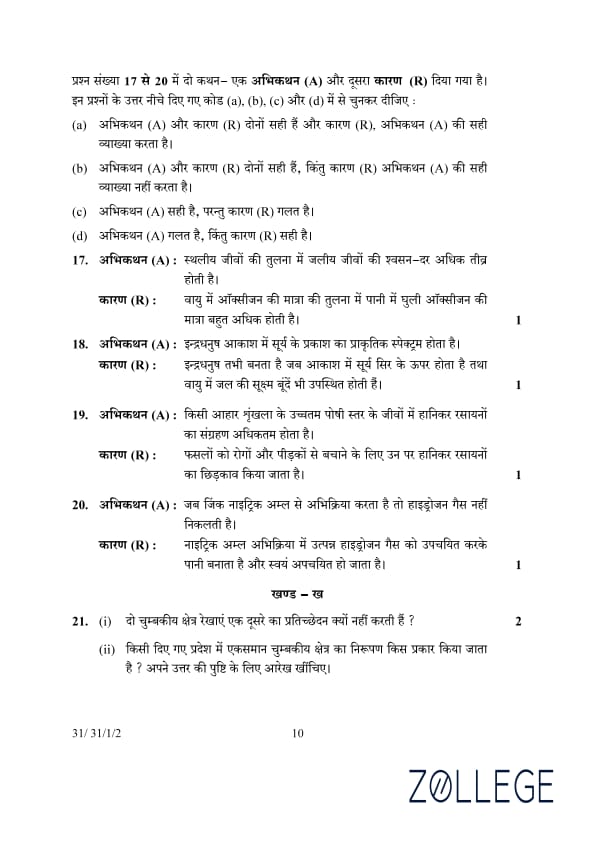
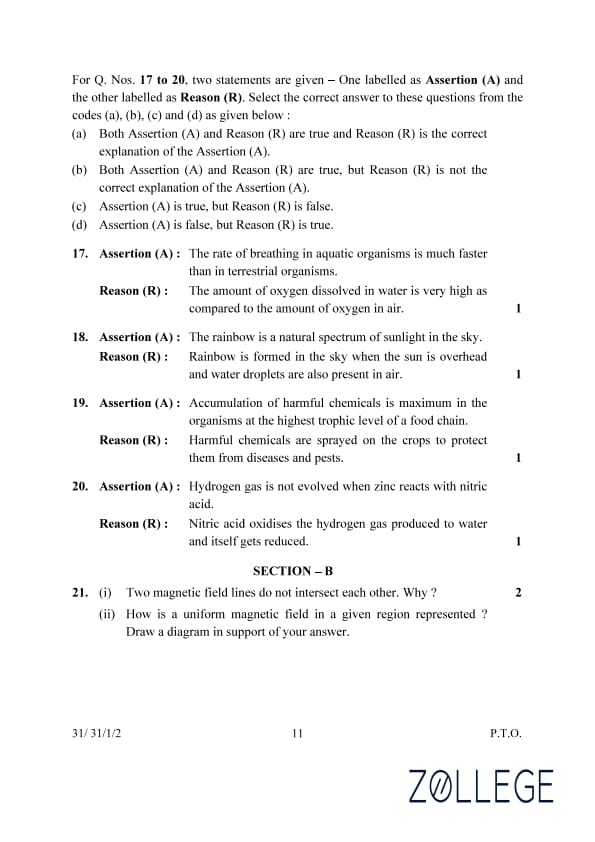
Assertion (A): The rate of breathing in aquatic organisms is much faster than in terrestrial organisms.
Reason (R): The amount of oxygen dissolved in water is very high as compared to the amount of oxygen in air.
Assertion is true because aquatic organisms breathe faster to extract sufficient oxygen from water.
Read More
Reason is false because the amount of oxygen dissolved in water is significantly lower than in air. While air contains about 21% oxygen, dissolved oxygen in water is much less and varies depending on temperature and pollution levels.
Question 18:
Assertion (A): The rainbow is a natural spectrum of sunlight in the sky.
Reason (R): Rainbow is formed in the sky when the sun is overhead and water droplets are also present in air.
Assertion is true as a rainbow is formed by the dispersion of sunlight by water droplets in the atmosphere.
Read More
Reason is false because rainbows are not formed when the sun is directly overhead. They occur when the sun is behind the observer, and sunlight is refracted, reflected, and dispersed by water droplets at an angle of approximately 42 degrees.
Question 19:
Assertion (A): Accumulation of harmful chemicals is maximum in the organisms at the highest trophic level of a food chain.
Reason (R): Harmful chemicals are sprayed on the crops to protect them from diseases and pests.
Assertion is true as biomagnification causes the accumulation of harmful chemicals at higher trophic levels.
Read More
Reason is also true as harmful chemicals enter the food chain through agricultural activities. However, the primary reason for biomagnification is the non-biodegradable nature of these chemicals and their accumulation as they move up the food chain.
Question 20:
Assertion (A): Hydrogen gas is not evolved when zinc reacts with nitric acid.
Reason (R): Nitric acid oxidizes the hydrogen gas produced to water and itself gets reduced.
Assertion is true because hydrogen gas is oxidized by nitric acid during the reaction.
Read More
Reason is true as nitric acid is a strong oxidizing agent. When zinc reacts with nitric acid, the nascent hydrogen is immediately oxidized to water, while nitric acid gets reduced to nitrogen oxides (e.g., NO2, NO, or N2O).
The overall reaction for moderately concentrated nitric acid is:
Zn + 4HNO3 → Zn(NO3)2 + 2NO2 + 2H2O
Question 21:
(i) Two magnetic field lines do not intersect each other. Why?
(ii) How is a uniform magnetic field in a given region represented? Draw a diagram in support of your answer.
Magnetic field lines never intersect because a magnetic field can only have one direction at any given point.
Read More
Magnetic field lines represent the direction of the magnetic force that a small north magnetic pole would experience if placed at that point. If two magnetic field lines were to intersect, it would mean that at the point of intersection, the magnetic force would have two different directions, which is not possible.
A uniform magnetic field is represented by parallel and equally spaced magnetic field lines.
Read More
This indicates that the magnetic field strength and direction are the same at all points in that region.

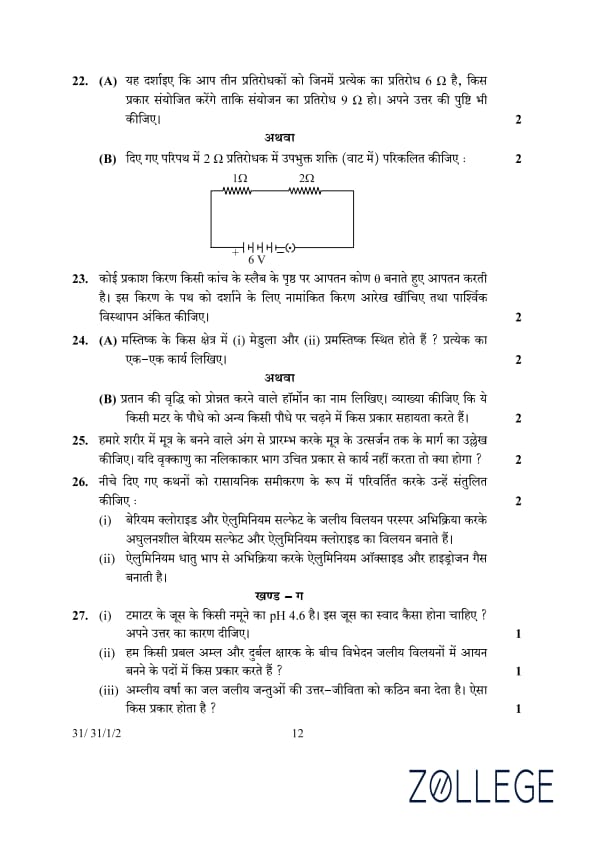
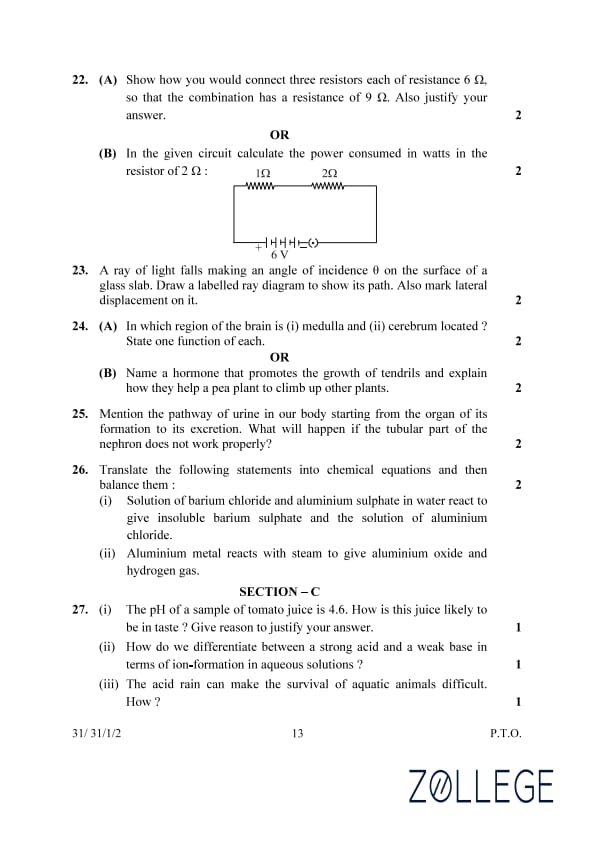
Question 22 (A):
Show how you would connect three resistors each of resistance 6 Ω, so that the combination has a resistance of 9 Ω. Also justify your answer.
To obtain a combined resistance of 9 Ω, connect two resistors in parallel, and then connect this parallel combination in series with the third resistor.
Read More
Justification:
1. Parallel Combination:
The equivalent resistance (Rp) of two 6 Ω resistors in parallel is:
1/Rp = 1/6 + 1/6 = 2/6 = 1/3
Rp = 3 Ω
2. Series Combination:
The total resistance (RT) is the sum of Rp and the third resistor in series:
RT = Rp + 6
RT = 3 + 6 = 9 Ω
Thus, connecting two resistors in parallel and then in series with the third gives the desired total resistance of 9 Ω.
Question 22 (B):
In the given circuit calculate the power consumed in watts in the resistor of 2 Ω:

The power consumed by the 2 Ω resistor is 8 W.
Read More
Steps:
1. Total Resistance:
The two resistors are connected in series, so the total resistance (RT) is:
RT = 1 Ω + 2 Ω
RT = 3 Ω
2. Current Calculation:
Using Ohm’s Law (V = IR):
I = V / RT
I = 6 V / 3 Ω
I = 2 A
3. Power Consumed:
The power consumed by the 2 Ω resistor is:
P = I2R
P = (2 A)2 × 2 Ω
P = 4 × 2
P = 8 W
Question 23:
A ray of light falls making an angle of incidence θ on the surface of a glass slab. Draw a labelled ray diagram to show its path. Also mark lateral displacement on it.
The diagram shows the path of a ray of light passing through a glass slab. The incident ray strikes the surface of the glass slab at an angle of incidence θ, is refracted within the glass, and emerges parallel to the incident ray, with a lateral displacement.
Read More
The incident ray is refracted towards the normal upon entering the denser medium (glass) and then refracted away from the normal upon exiting into the rarer medium (air). The emergent ray is parallel to the incident ray but laterally displaced.

Question 24:
(A) In which region of the brain is (i) medulla and (ii) cerebrum located? State one function of each.
OR
(B) Name a hormone that promotes the growth of tendrils and explain how they help a pea plant to climb up other plants.
(i) Medulla: The medulla oblongata is located in the brainstem, at the base of the brain, connecting the brain to the spinal cord.
Function: Controls vital involuntary functions like breathing, heart rate, and blood pressure.
(ii) Cerebrum: The cerebrum is the largest part of the brain and is located in the forebrain.
Function: Responsible for higher-level cognitive functions such as thinking, learning, memory, language, and voluntary movement.
Solution (B):
The hormone that promotes the growth of tendrils is auxin.
Read More
Tendrils are specialized thread-like structures that help climbing plants, like pea plants, to attach to and climb up supports. Auxin promotes the growth of tendrils on the side away from the support. This difference in auxin concentration causes the tendril to grow faster on the opposite side, curling around the support and providing anchorage.
Question 25:
Mention the pathway of urine in our body starting from the organ of its formation to its excretion. What will happen if the tubular part of the nephron does not work properly?
Pathway of urine:
1. Kidneys: Urine is formed in the kidneys.
2. Ureters: Urine passes from the kidneys to the urinary bladder through the ureters.
3. Urinary Bladder: The urinary bladder stores urine.
4. Urethra: Urine is expelled from the body through the urethra.
Malfunctioning tubular part of the nephron:
If the tubular part of the nephron does not work properly, essential substances like glucose, amino acids, water, and salts may not be reabsorbed efficiently and will be lost in the urine.
Read More
This can lead to dehydration, electrolyte imbalances, and other serious health problems as the body fails to maintain proper homeostasis.
Question 26:
Translate the following statements into chemical equations and then balance them:
- Solution of barium chloride and aluminium sulphate in water react to give insoluble barium sulphate and the solution of aluminium chloride.
- Aluminium metal reacts with steam to give aluminium oxide and hydrogen gas.
Balanced Equation: 3BaCl2(aq) + Al2(SO4)3(aq) → 3BaSO4(s) ↓ + 2AlCl3(aq)
Read More
Unbalanced Equation:
BaCl2(aq) + Al2(SO4)3(aq) → BaSO4(s) + AlCl3(aq)
The downward arrow indicates that barium sulfate is a precipitate (insoluble solid).
Balanced Equation: 2Al(s) + 3H2O(g) → Al2O3(s) + 3H2(g)
Read More
Unbalanced Equation:
Al(s) + H2O(g) → Al2O3(s) + H2(g)
Steam is represented as H2O(g) (gaseous water).
Question 27:
(i) The pH of a sample of tomato juice is 4.6. How is this juice likely to be in taste? Give reason to justify your answer.
(ii) How do we differentiate between a strong acid and a weak base in terms of ion-formation in aqueous solutions?
(iii) The acid rain can make the survival of aquatic animals difficult. How?
Tomato juice with a pH of 4.6 is likely to be acidic in taste.
Read More
A pH below 7 indicates an acidic solution. The lower the pH, the higher the concentration of hydrogen ions (H+), which is responsible for the sour taste of tomato juice.
Strong acids completely ionize in water, while weak bases partially ionize.
Read More
Strong Acids: Completely ionize in water, e.g., HCl(aq) → H+(aq) + Cl-(aq).
Weak Bases: Partially ionize, e.g., NH3(aq) + H2O(l) ⇌ NH4+(aq) + OH-(aq).
Acid rain lowers pH, interferes with enzyme activity, and causes toxicity.
Read More
Interference with enzyme activity: Low pH disrupts metabolic processes.
Damage to gills and skin: Acidic water irritates sensitive tissues.
Aluminum toxicity: Leached aluminum from soil affects respiration and osmoregulation in fish.
Disruption of food chains: Impacts plankton populations, affecting aquatic ecosystems.
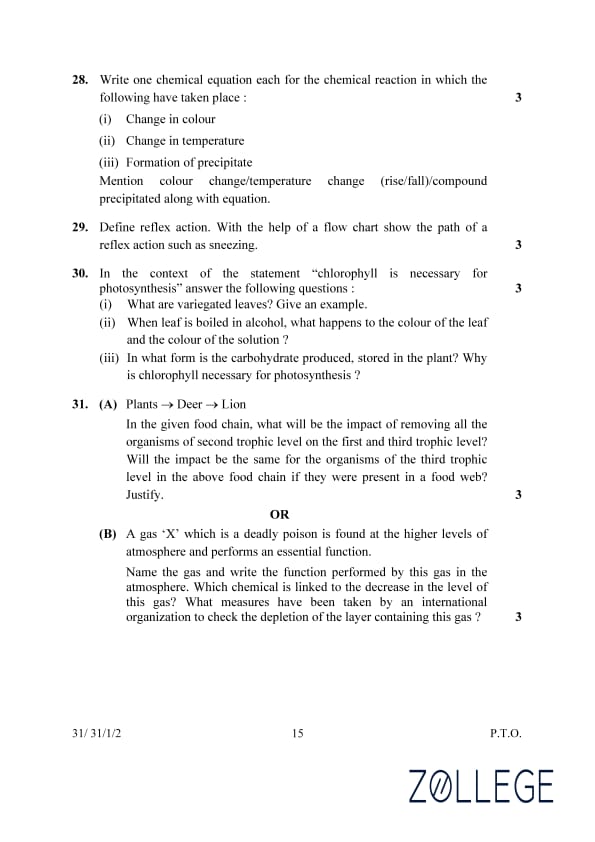
Question 28:
Write one chemical equation each for the chemical reaction in which the following have taken place:
- Change in colour
- Change in temperature
- Formation of precipitate
Change in Colour: Fe(s) + CuSO4(aq) → FeSO4(aq) + Cu(s)
Read More
Colour Change: The blue colour of copper sulfate fades, and reddish-brown copper forms on the iron.
Change in Temperature: CaO(s) + H2O(l) → Ca(OH)2(aq)
Read More
Temperature Change: The reaction is exothermic, releasing heat.
Formation of Precipitate: AgNO3(aq) + NaCl(aq) → AgCl(s) ↓ + NaNO3(aq)
Read More
Precipitate Formed: A white precipitate of silver chloride (AgCl).
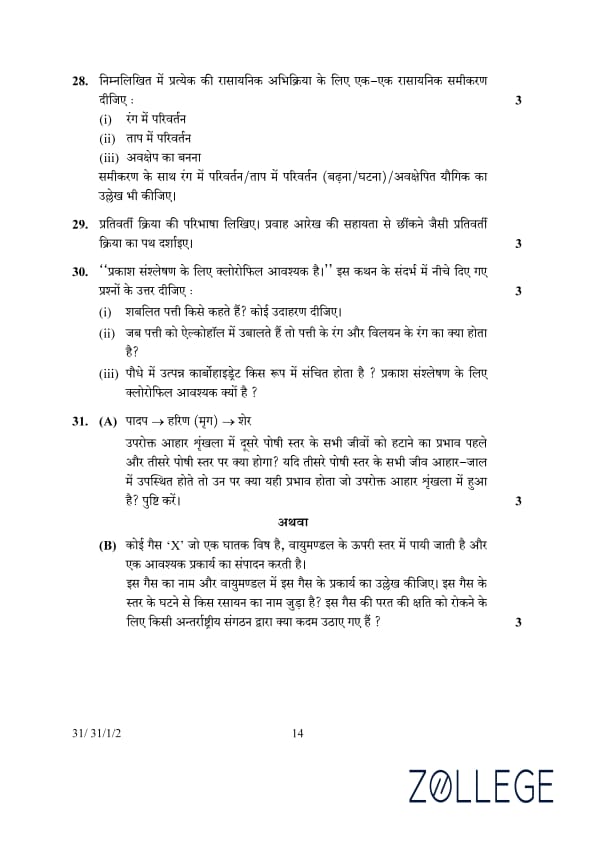
Question 29:
Define reflex action. With the help of a flowchart show the path of a reflex action such as sneezing.
Definition of Reflex Action: A reflex action is an involuntary and nearly instantaneous movement in response to a stimulus. It occurs without conscious thought and provides a rapid, automatic response to protect the body.
Flowchart for Sneezing Reflex:

Read More
Explanation of the Sneezing Reflex Pathway:
- Stimulus: An irritant, such as dust or pollen, enters the nasal passage.
- Receptor: Sensory neurons in the nose detect the irritant.
- Relay Neuron: The sensory neurons send signals to the spinal cord, bypassing the brain for faster response.
- Motor Neuron: Relay neurons transmit the signal to motor neurons.
- Effector: Motor neurons signal effector muscles, like abdominal muscles and the diaphragm.
- Response: The muscles contract forcefully, resulting in a sneeze.
Question 30:
In the context of the statement “chlorophyll is necessary for photosynthesis,” answer the following questions:
- What are variegated leaves? Give an example.
- When a leaf is boiled in alcohol, what happens to the color of the leaf and the color of the solution?
- In what form is the carbohydrate produced stored in the plant? Why is chlorophyll necessary for photosynthesis?
Variegated leaves have different colored zones or patterns, such as green and white, due to the presence or absence of chlorophyll.
Read More
Example: Coleus, Croton, Prayer Plant.
Color of the leaf: The leaf loses its green color and becomes pale or whitish.
Color of the solution: The alcohol turns green as it dissolves the chlorophyll from the leaf.
Read More
When a leaf is boiled in alcohol, chlorophyll dissolves into the alcohol, leaving the leaf decolorized and the solution green.
Carbohydrates produced during photosynthesis are stored as starch, an insoluble form of glucose.
Read More
Why chlorophyll is necessary: Chlorophyll absorbs light energy, primarily from the red and blue regions of visible light, to drive the light-dependent reactions of photosynthesis. These reactions produce ATP and NADPH, which are then used in the Calvin cycle to convert CO2 into glucose. This glucose is stored as starch for long-term storage without affecting osmotic balance.
Question 31:
(A) Plants → Deer → Lion
In the given food chain, what will be the impact of removing all the organisms of the second trophic level on the first and third trophic level? Will the impact be the same for the organisms of the third trophic level in the above food chain if they were present in a food web? Justify.
OR
(B) A gas ‘X’ which is a deadly poison is found at the higher levels of atmosphere and performs an essential function. Name the gas and write the function performed by this gas in the atmosphere. Which chemical is linked to the decrease in the level of this gas? What measures have been taken by an international organization to check the depletion of the layer containing this gas?
Removing the second trophic level (deer) increases the first trophic level (plants) and negatively impacts the third trophic level (lions).
Read More
Impact on Plants: Without deer grazing, plant populations will increase.
Impact on Lions: Lions would face food shortages and their population would decline or go extinct.
In a Food Web: Lions might switch to alternate prey, reducing the impact on their population compared to a food chain.
The gas ‘X’ is ozone (O3). Its essential function is to absorb harmful ultraviolet (UV) radiation from the sun.
Read More
Chemical Linked to Ozone Depletion: Chlorofluorocarbons (CFCs).
International Measure: The Montreal Protocol (1987) phased out CFC production and consumption to protect the ozone layer.
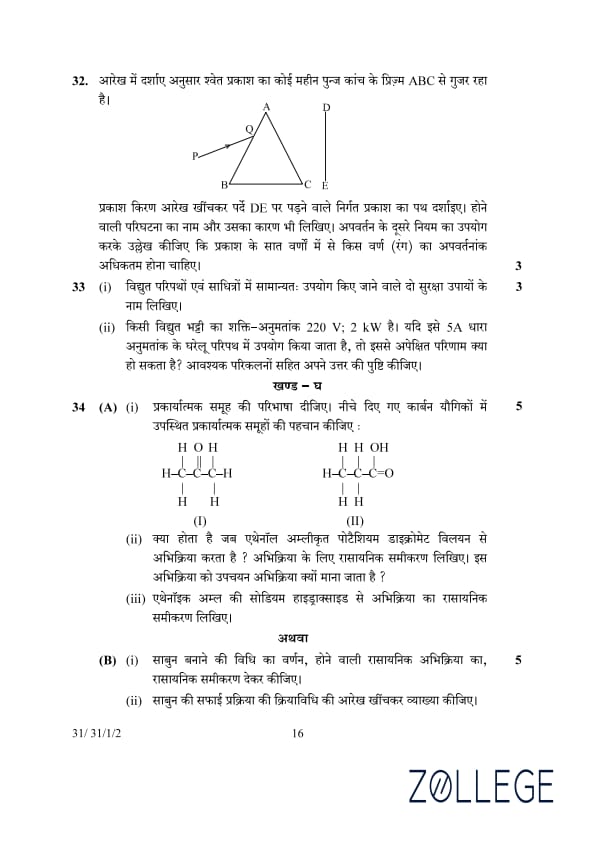
Question 32:
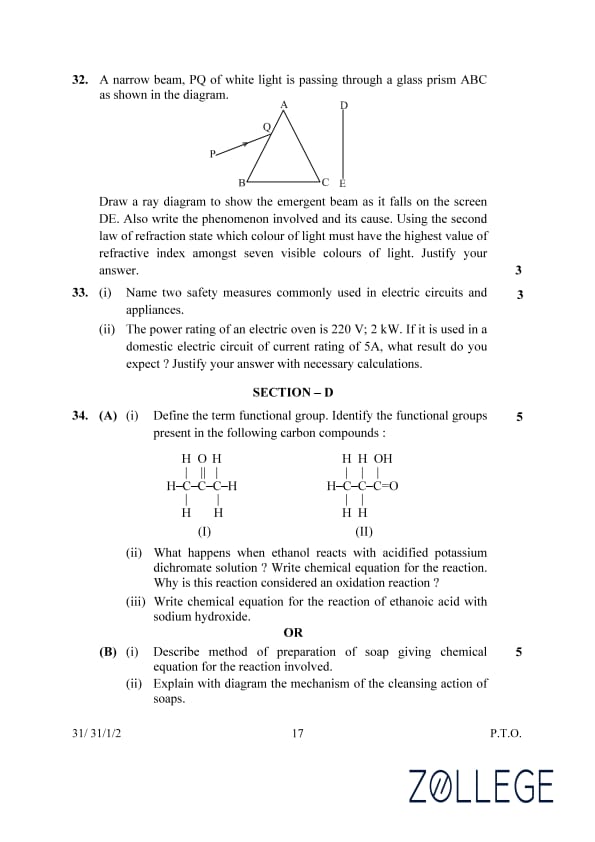
A narrow beam, PQ of white light is passing through a glass prism ABC as shown in the diagram.

The phenomenon involved is dispersion, caused by different wavelengths of light refracting at different angles.
Read More
Ray Diagram:

Cause of Dispersion: Each wavelength of light has a different refractive index in the prism, causing them to refract at different angles and separate into a spectrum.
Highest Refractive Index: Violet light bends the most and has the highest refractive index due to its shortest wavelength.
Question 33:
(i) Name two safety measures commonly used in electric circuits and appliances.
(ii) The power rating of an electric oven is 220 V; 2 kW. If it is used in a domestic electric circuit of current rating of 5 A, what result do you expect? Justify your answer with necessary calculations.
1. Fuse: Protects against overloading and short circuits by breaking the circuit when current exceeds a safe limit.
2. Earthing: Prevents electric shocks by providing a path for fault currents to flow to the ground.
Solution (ii):
The current drawn by the oven is 9.1 A, which exceeds the 5 A circuit rating, causing the fuse to blow.
Read More
Given:
Power of oven (P) = 2000 W
Voltage (V) = 220 V
Current rating of circuit (Icircuit) = 5 A
Calculation:
Ioven = P / V = 2000 W / 220 V = 9.1 A
Expected Result: The oven draws more current than the circuit can handle, causing the fuse to blow. The oven will not work.
Question 34:
(A) (i) Define the term functional group. Identify the functional groups present in the following carbon compounds:
(i) Functional group: A functional group is a specific atom or group of atoms within a molecule responsible for its characteristic chemical reactions.
Functional groups in the given compounds:
Compound (I): Ketone (-C=O).
Compound (II): Carboxylic acid (-COOH).
(ii) Reaction of ethanol with acidified potassium dichromate:
$CH_3CH_2OH + 2[O] \xrightarrow{Acidified\ K_2Cr_2O_7} CH_3COOH + H_2O$
Read More
Ethanol is oxidized to ethanoic acid in the presence of acidified potassium dichromate. This is an oxidation reaction as ethanol gains oxygen.
$CH_3COOH + NaOH → CH_3COONa + H_2O$
Read More
This is a neutralization reaction where ethanoic acid reacts with sodium hydroxide to form sodium ethanoate and water.
(B) (i) Describe the method of preparation of soap giving the chemical equation for the reaction involved.
(ii) Explain with a diagram the mechanism of the cleansing action of soaps.
(i) Preparation of soap (Saponification): Soaps are prepared by heating fats or oils with a strong alkali like sodium hydroxide (NaOH).
Chemical Equation:
(RCOO)3C3H5 + 3NaOH → 3RCOONa + C3H5(OH)3
Read More
This reaction produces soap (sodium salt of fatty acid) and glycerol.

Read More
Soap molecules form micelles, with hydrophobic tails dissolving grease and hydrophilic heads interacting with water, allowing the grease to be washed away.
Question 35:
(A)
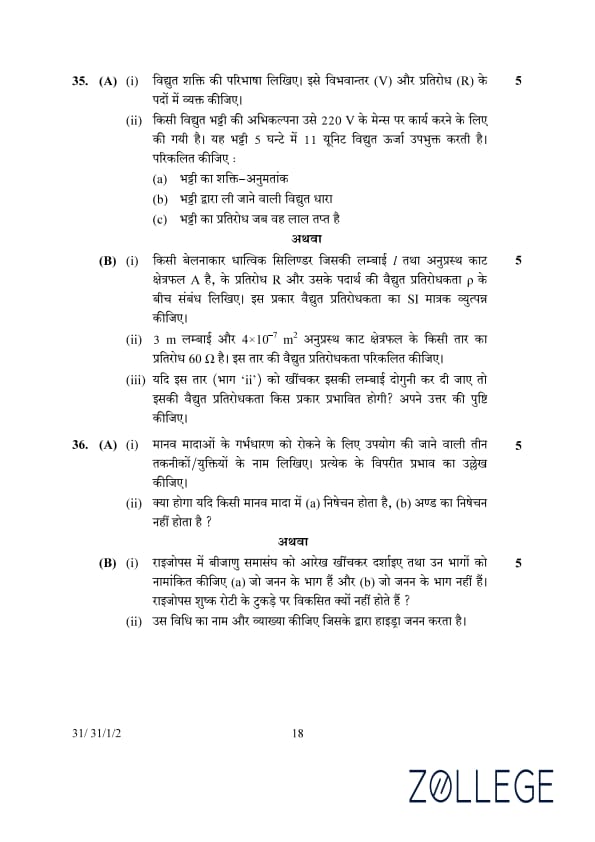
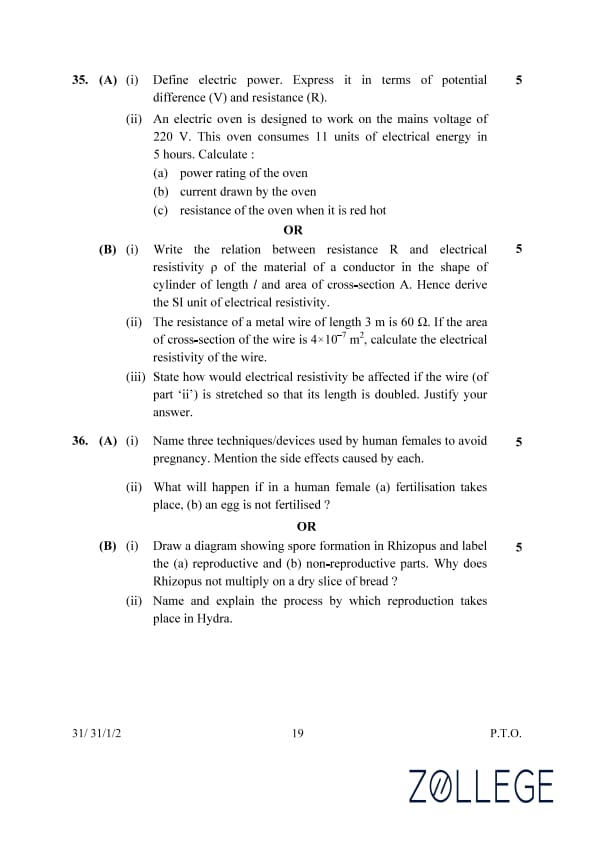
(i) Define electric power. Express it in terms of potential difference (V) and resistance (R).
(ii) An electric oven is designed to work on the mains voltage of 220 V. This oven consumes 11 units of electrical energy in 5 hours. Calculate:
- Power rating of the oven
- Current drawn by the oven
- Resistance of the oven when it is red hot
OR
(B)
(i) Write the relation between resistance R and electrical resistivity ρ of the material of a conductor in the shape of a cylinder of length l and area of cross-section A. Hence derive the SI unit of electrical resistivity.
(ii) The resistance of a metal wire of length 3 m is 60 Ω. If the area of cross-section of the wire is 4 × 10⁻⁷ m2, calculate the electrical resistivity of the wire.
(iii) State how would electrical resistivity be affected if the wire (of part ‘ii’) is stretched so that its length is doubled. Justify your answer.
(i) Electric Power: Electric power is the rate at which electrical energy is consumed or dissipated. It is expressed as:
P = V2 / R
Read More
Where P is power, V is potential difference, and R is resistance. Using Ohm’s law (V = IR), power can also be expressed as P = VI or P = I2R.
1. Power Rating:
P = E / t
Read More
Given: Voltage (V) = 220 V, Energy consumed (E) = 11 kWh = 11000 Wh, Time (t) = 5 hours.
P = 11000 / 5 = 2200 W = 2.2 kW.
I = P / V
Read More
I = 2200 W / 220 V = 10 A.
R = V2 / P
Read More
R = 2202 / 2200 = 48400 / 2200 = 22 Ω.
(i) Relation between R and ρ: The resistance (R) of a cylindrical conductor is related to resistivity (ρ) by the formula:
R = ρ × (l / A)
Read More
Where R is resistance (Ω), l is length (m), and A is cross-sectional area (m2). The SI unit of resistivity (ρ) is ohm-meter (Ω·m).
ρ = (R × A) / l
Read More
Given: Length (l) = 3 m, Resistance (R) = 60 Ω, Area (A) = 4 × 10⁻⁷ m2.
ρ = (60 × 4 × 10-7) / 3 = 8 × 10⁻⁷ Ω·m.
Resistivity remains unchanged as it is a material property.
Read More
Stretching the wire doubles its length and reduces its cross-sectional area, but resistivity (ρ) depends only on the material composition and remains unaffected.
Question 36:
(A) (i) Name three techniques/devices used by human females to avoid pregnancy. Mention the side effects caused by each.
(ii) What will happen if in a human female (a) fertilisation takes place, (b) an egg is not fertilised?
OR
(B) (i) Draw a diagram showing spore formation in Rhizopus and label the (a) reproductive and (b) non-reproductive parts. Why does Rhizopus not multiply on a dry slice of bread?
(ii) Name and explain the process by which reproduction takes place in Hydra.
(i) Techniques/devices to avoid pregnancy:
1. Oral Contraceptive Pills: Prevent ovulation using synthetic hormones.
Side effects: Nausea, weight gain, mood swings.
2. Intrauterine Device (IUD): Prevents implantation of a fertilized egg.
Side effects: Cramping, heavier periods.
3. Condoms: Prevent sperm from entering the vagina.
Side effects: Rare allergic reactions.
(ii) Fertilisation vs. No Fertilisation:
(a) If fertilisation occurs: The zygote implants in the uterus, leading to pregnancy.
(b) If no fertilisation: The egg disintegrates, and the uterine lining is shed during menstruation.
(i) Spore formation in Rhizopus:

Reason: Rhizopus requires moisture for spore germination and hyphal growth, which are not possible on dry bread.
(ii) Reproduction in Hydra:
Hydra reproduces asexually through budding. A bud forms, grows into a new Hydra, and detaches to become independent.
<
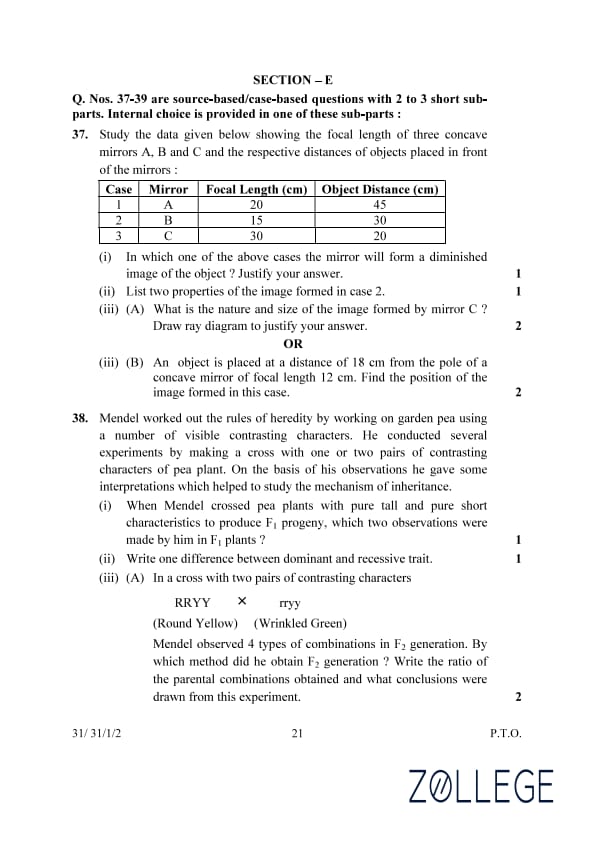
Question 37:
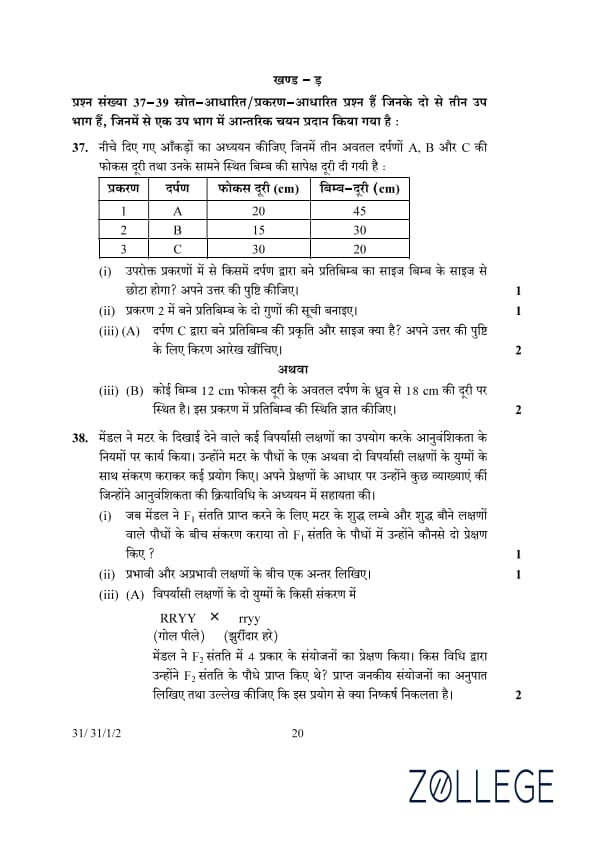
Study the data given below showing the focal length of three concave mirrors A, B, and C and the respective distances of objects placed in front of the mirrors:
| Case | Mirror | Focal Length (cm) | Object Distance (cm) |
|---|---|---|---|
| 1 | A | 20 | 45 |
| 2 | B | 15 | 30 |
| 3 | C | 30 | 20 |
(i) In which one of the above cases the mirror will form a diminished image of the object? Justify your answer.
(ii) List two properties of the image formed in case 2.
(iii) (A) What is the nature and size of the image formed by Mirror C? Draw a ray diagram to justify your answer.
OR
(iii) (B) An object is placed at a distance of 18 cm from the pole of a concave mirror of focal length 12 cm. Find the position of the image formed in this case.
The mirror in Case 1 will form a diminished image as the object is placed beyond 2f (center of curvature).
Read More
Case 1 (Mirror A): Object distance (45 cm) > 2 × focal length (40 cm).
Case 2 (Mirror B): Object distance (30 cm) = 2 × focal length (30 cm). The image will be of the same size.
Case 3 (Mirror C): Object distance (20 cm) < focal length (30 cm). The image will be enlarged.
Properties of the image formed in Case 2:
1. Real and inverted.
2. Same size as the object.
Read More
The object is placed at the center of curvature (C), so the image is formed at the same location and size.
In Case 3, the image is virtual, erect, and enlarged.

Read More
When the object is placed between the pole (P) and the principal focus (F), the reflected rays appear to diverge, forming a virtual and enlarged image behind the mirror.
Given:
u = -18 cm, f = -12 cm.Using the mirror formula:
1/f = 1/v + 1/u.
Read More
1/(-12) = 1/v + 1/(-18)
1/v = 1/18 - 1/12
1/v = (2 - 3) / 36
1/v = -1/36
v = -36 cm.
The image is formed 36 cm in front of the mirror, indicating a real and inverted image.
Question 38:
Mendel's rules of heredity were based on experiments with garden peas using contrasting characters:
(i) When Mendel crossed pea plants with pure tall and pure short characteristics to produce F1 progeny, which two observations were made by him in F1 plants?
(ii) Write one difference between dominant and recessive traits.
(iii) (A) In a cross with two pairs of contrasting characters RRYY × rryy:
Mendel observed 4 types of combinations in F2 generation. By which method did he obtain F2 generation? Write the ratio of the parental combinations obtained and what conclusions were drawn from this experiment.
OR
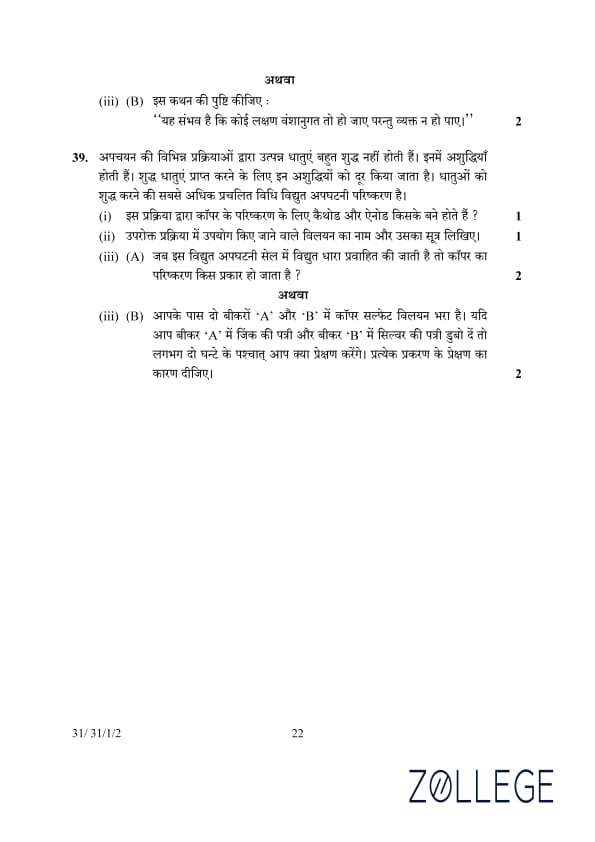
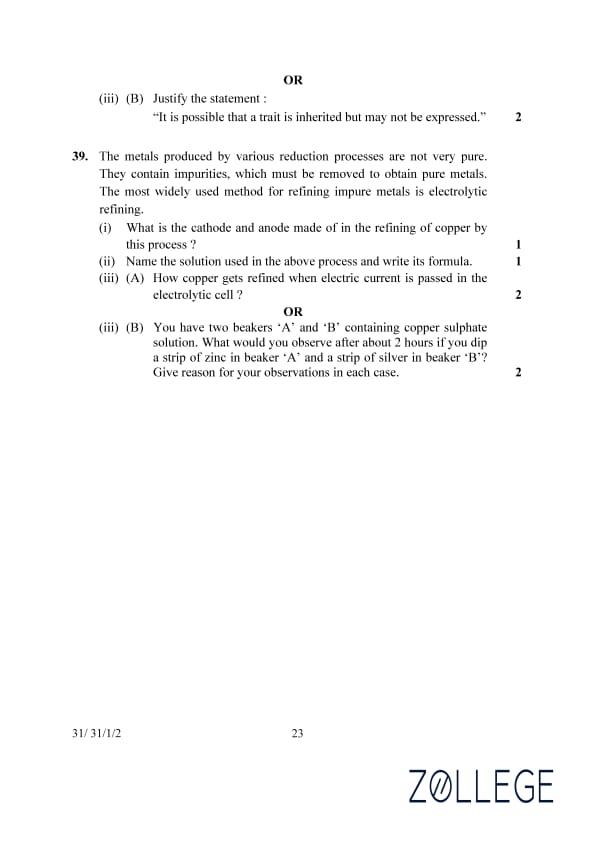
(iii) (B) Justify the statement: "It is possible that a trait is inherited but may not be expressed."
1. All F1 plants were tall.
2. Uniformity in the F1 generation.
Solution (ii):
Dominant traits are expressed with one allele, while recessive traits require two alleles.
Solution (iii) (A):
Mendel self-pollinated the F1 plants to obtain the F2 generation.
Phenotypic ratio: 9:3:3:1.
Conclusion: Traits assort independently during gamete formation (Law of Independent Assortment).
Solution (iii) (B):
Recessive traits can be inherited but are only expressed when no dominant allele is present.
Question 39:
The metals produced by various reduction processes are not very pure. The most widely used method for refining impure metals is electrolytic refining:
(i) What is the cathode and anode made of in the refining of copper by this process?
(ii) Name the solution used in the above process and write its formula.
(iii) (A) How copper gets refined when electric current is passed in the electrolytic cell?
OR
(iii) (B) What would you observe if you dip a strip of zinc in copper sulfate solution and a strip of silver in copper sulfate solution? Explain your observations.
Cathode: A pure copper strip.
Anode: An impure copper slab.
Solution (ii):
Solution: Acidified copper sulfate solution (CuSO4 with a small amount of H2SO4).
Solution (iii) (A):
Copper ions from the anode dissolve into the electrolyte and deposit on the cathode.
Read More
When electric current passes through the electrolytic cell:
- At the anode (impure copper), copper atoms oxidize to Cu2+ ions and dissolve into the solution:
Cu(s) → Cu2+(aq) + 2e-. - At the cathode (pure copper), Cu2+ ions are reduced and deposit as copper metal:
Cu2+(aq) + 2e- → Cu(s). - Impurities either settle as "anode mud" or remain in the solution.
Beaker A (Zinc in Copper Sulfate): Zinc displaces copper from the copper sulfate solution as it is more reactive.
Read More
The reaction occurs because zinc is higher than copper in the reactivity series:
Zn(s) + CuSO4(aq) → ZnSO4(aq) + Cu(s).
You would observe the zinc strip coated with reddish-brown copper, and the blue color of the solution would fade as copper ions are displaced.
Read More
Silver cannot displace copper from the copper sulfate solution as it is lower in the reactivity series. The solution and the silver strip remain unchanged.

*The article might have information for the previous academic years, please refer the official website of the exam.