
CBSE Class 10 2024 Question Paper with Answer Key PDF for Science (March 2 - Shift 1)


Content Curator | Updated On - Jan 3, 2025
CBSE Class 10 Question Papers are the most important study material for effective exam preparation. We at Zollege have provided all CBSE Class 10 Previous Year Papers with Solution PDFs here. CBSE Class 10 2024 Science exam was conducted successfully on March 2 by CBSE.
Students can freely download the CBSE Class 10 previous year's question paper PDFs along with their solutions here. We strongly encourage CBSE 10 aspirants to scan through all the CBSE Class 10 Question Paper to know the overall difficulty level, CBSE Class 10 Syllabus and understand the changes in CBSE Class 10 Exam Pattern over the years.
CBSE Class 10 2024 Science Question Paper with Answer Key PDF
| CBSE Class 10 Science 2024 Question Paper with Answer Key (Set 3 31/1/3) |  Download Download |
Check Solution |
| Question | Answer | Solution |
|---|---|---|
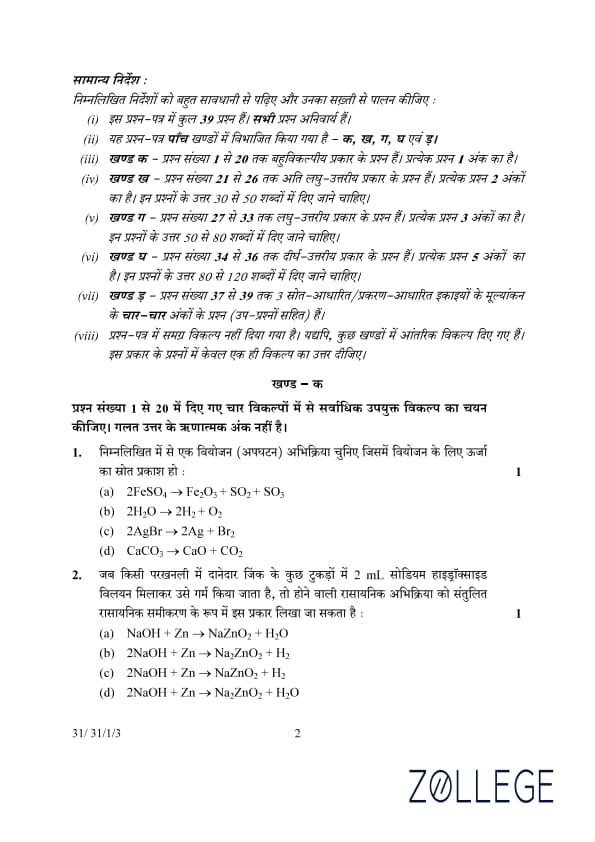
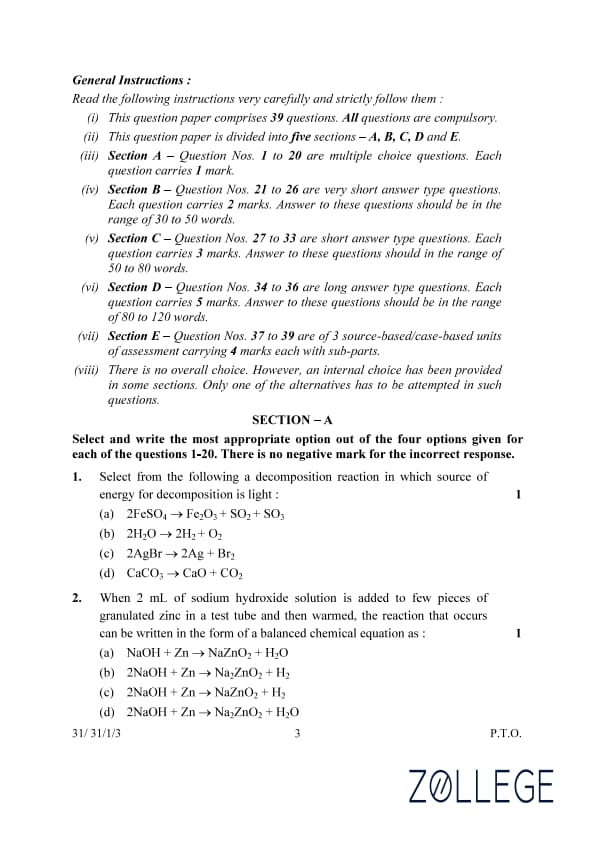
| 1. Select from the following a decomposition reaction in which the source of energy for decomposition is light: (a) 2FeSO4 → Fe2O3 + SO2 + SO3 (b) 2H2O → 2H2 + O2 (c) 2AgBr → 2Ag + Br2 (d) CaCO3 → CaO + CO2 |
(c) 2AgBr → 2Ag + Br2 | A decomposition reaction where the energy source is light is a photochemical reaction. The decomposition of silver bromide (AgBr) under light is a well-known example used in photography. |
| 2. When 2 mL of sodium hydroxide solution is added to a few pieces of granulated zinc in a test tube and then warmed, the reaction that occurs can be written in the form of a balanced chemical equation as: (a) NaOH + Zn → NaZnO2 + H2O (b) 2NaOH + Zn → Na2ZnO2 + H2 (c) 2NaOH + Zn → NaZnO2 + H2 (d) 2NaOH + Zn → Na2ZnO2 + H2O |
(b) 2NaOH + Zn → Na2ZnO2 + H2 | The reaction between zinc and sodium hydroxide produces sodium zincate (Na2ZnO2) and hydrogen gas. This is a balanced reaction where 2 molecules of NaOH react with 1 atom of Zn. |
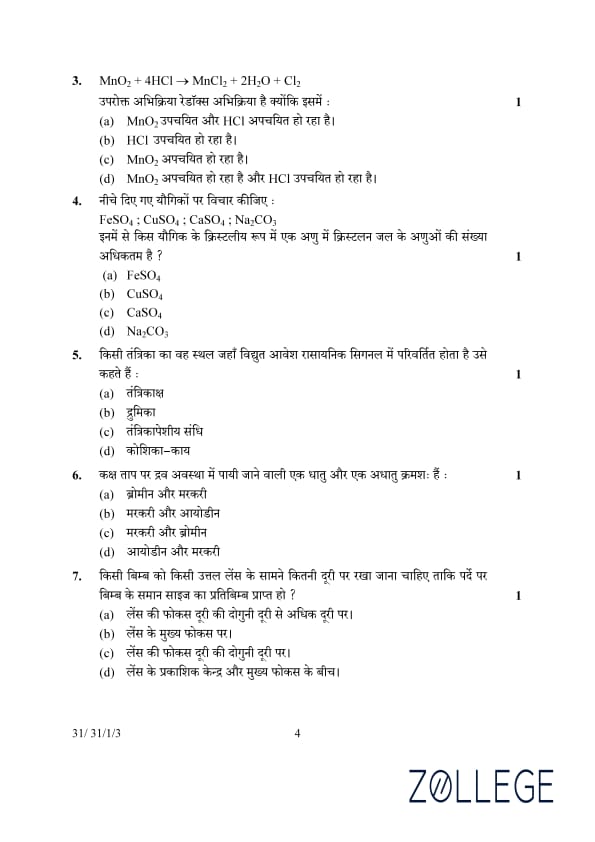
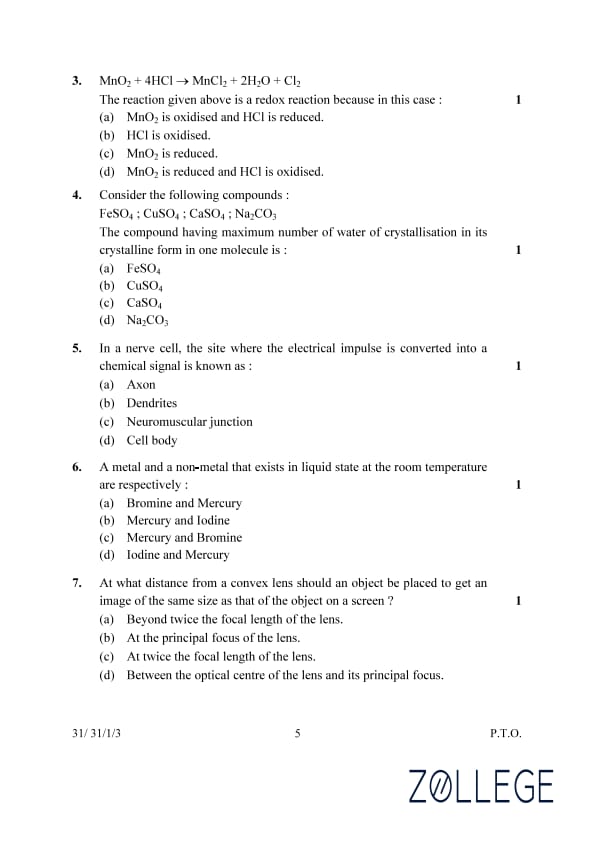
| 3. The reaction MnO2 + 4HCl → MnCl2 + 2H2O + Cl2 is a redox reaction because in this case: (a) MnO2 is oxidised and HCl is reduced. (b) HCl is oxidised. (c) MnO2 is reduced. (d) MnO2 is reduced and HCl is oxidised. |
(d) MnO2 is reduced and HCl is oxidised. | In this redox reaction, manganese oxide (MnO2) undergoes reduction by gaining electrons, while hydrochloric acid (HCl) is oxidized as chlorine gas (Cl2) is released. |
| 4. The compound having maximum number of water of crystallisation in its crystalline form in one molecule is: (a) FeSO4 (b) CuSO4 (c) CaSO4 (d) Na2CO3 |
(d) Na2CO3 | Sodium carbonate (Na2CO3) commonly exists as a decahydrate (Na2CO3·10H2O), containing 10 water molecules of crystallization, which is the highest among the options listed. |
| 5. In a nerve cell, the site where the electrical impulse is converted into a chemical signal is known as: (a) Axon (b) Dendrites (c) Neuromuscular junction (d) Cell body |
(c) Neuromuscular junction | The neuromuscular junction is the site where a motor neuron communicates with a muscle fiber by converting the electrical impulse into a chemical signal, allowing muscle contraction. |
| 6. A metal and a non-metal that exist in liquid state at room temperature are respectively: (a) Bromine and Mercury (b) Mercury and Iodine (c) Mercury and Bromine (d) Iodine and Mercury |
(c) Mercury and Bromine | Mercury is the only metal that is liquid at room temperature, and bromine is a non-metal that also exists as a liquid at room temperature. |
| 7. At what distance from a convex lens should an object be placed to get an image of the same size as that of the object on a screen? (a) Beyond twice the focal length of the lens. (b) At the principal focus of the lens. (c) At twice the focal length of the lens. (d) Between the optical centre of the lens and its principal focus. |
(c) At twice the focal length of the lens. | For a convex lens, an object placed at twice the focal length (2f) results in an image that is real, inverted, and of the same size as the object. |
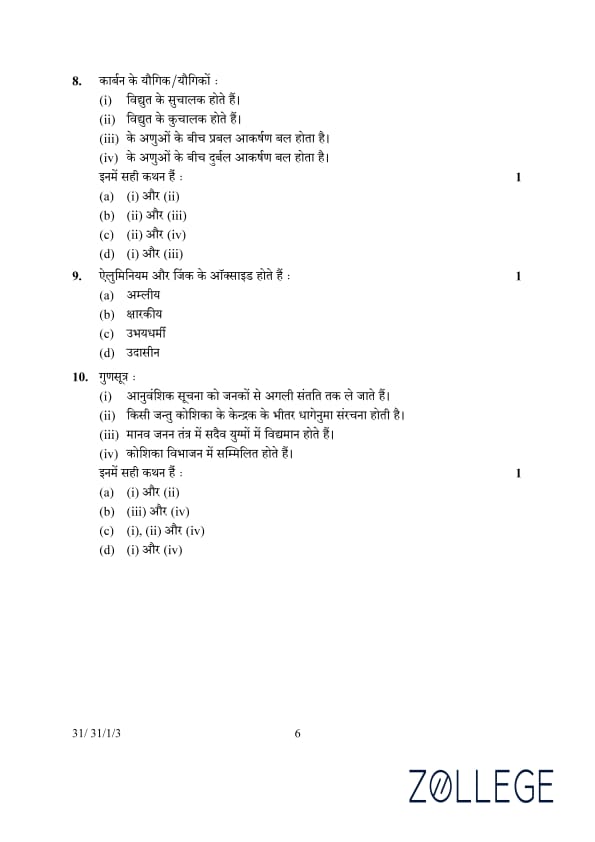
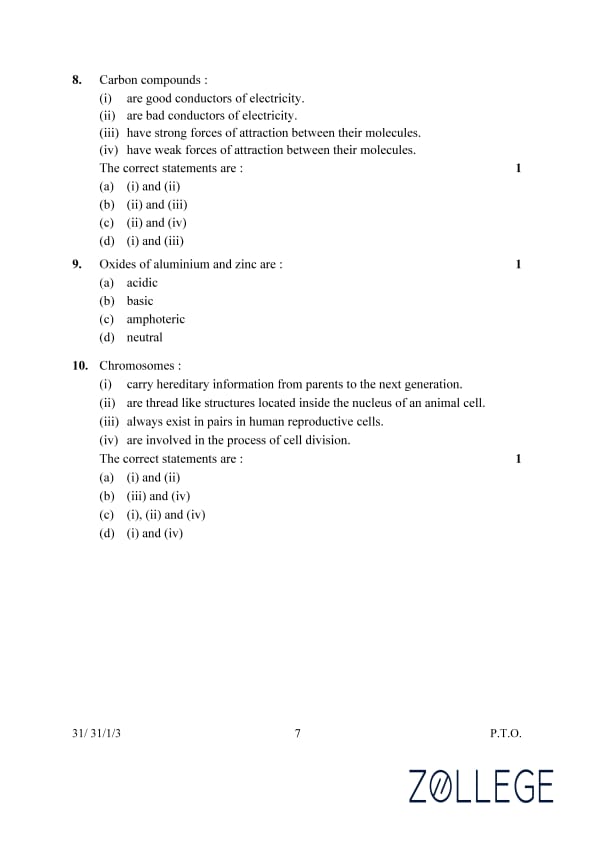
| 8. Carbon compounds: (i) are good conductors of electricity. (ii) are bad conductors of electricity. (iii) have strong forces of attraction between their molecules. (iv) have weak forces of attraction between their molecules. |
(c) (ii) and (iv) | Carbon compounds, being covalent in nature, generally have weak forces of attraction between molecules and do not conduct electricity well, except for some forms like graphite. |
| 9. Oxides of aluminium and zinc are : (a) acidic (b) basic (c) amphoteric (d) neutral |
(c) amphoteric | Amphoteric substances can react as both acids and bases. Aluminum oxide (Al2O3) and zinc oxide (ZnO) are classic examples of amphoteric oxides. They can react with both acids and bases to form salts and water. For example, zinc oxide reacts with hydrochloric acid (an acid): ZnO + 2HCl → ZnCl2 + H2O, and it also reacts with sodium hydroxide (a base): ZnO + 2NaOH + H2O → Na2[Zn(OH)4] (sodium zincate). Aluminum oxide behaves similarly. |
| 10. Chromosomes : (i) carry hereditary information from parents to the next generation. (ii) are thread-like structures located inside the nucleus of an animal cell. (iii) always exist in pairs in human reproductive cells. (iv) are involved in the process of cell division. |
(d) (i) and (iv) | Let's evaluate each statement: (i) True. Chromosomes carry genes, which are the units of heredity. They transmit genetic information from parents to offspring. (ii) False. Chromosomes are thread-like structures made of DNA and proteins, found in the nucleus of eukaryotic cells, not exclusive to animal cells. (iii) False. Human somatic cells have chromosomes in pairs (diploid), while human reproductive cells (gametes) have only one set of chromosomes (haploid). (iv) True. Chromosomes play a vital role in cell division (mitosis and meiosis), ensuring that each daughter cell receives a complete set of chromosomes. Thus, statements (i) and (iv) are correct. |
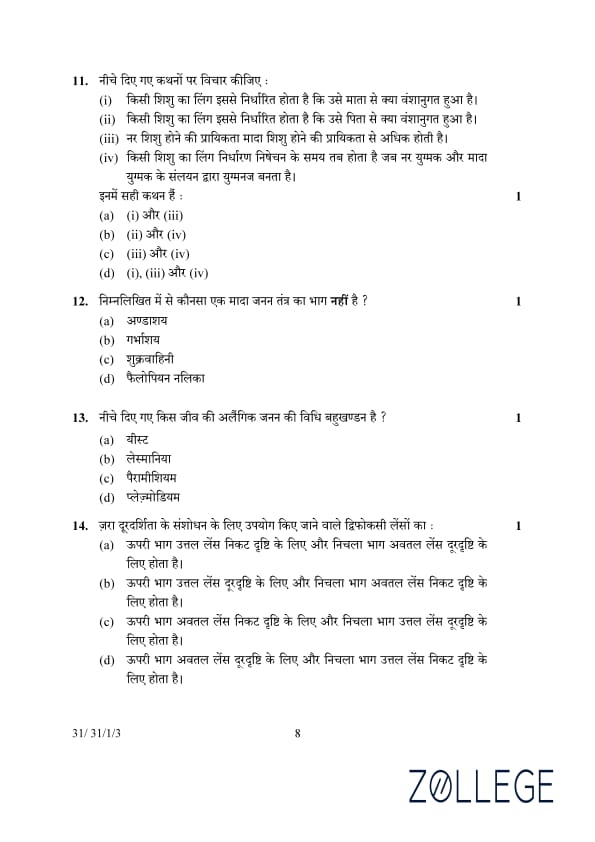
| 11. Consider the following statements: (i) The sex of a child is determined by what it inherits from the mother. (ii) The sex of a child is determined by what it inherits from the father. (iii) The probability of having a male child is more than that of a female child. (iv) The sex of a child is determined at the time of fertilisation when male and female gametes fuse to form a zygote. |
(b) (ii) and (iv) | Explanation of statements: (i) Incorrect. The sex of a child is determined by what the father contributes, as the mother contributes only an X chromosome. (ii) Correct. The father determines the sex of a child as he contributes either an X or Y chromosome, which decides the sex. (iii) Incorrect. The probability of having a male or female child is equal (50:50). (iv) Correct. The sex of a child is determined at fertilisation when the male gamete (X or Y) fuses with the female gamete (X). |
| 12. Which one of the following organ is NOT a part of the human female reproductive system? (a) Ovary (b) Uterus (c) Vas deferens (d) Fallopian tube |
(c) Vas deferens | The ovary, uterus, and fallopian tube are parts of the female reproductive system. The vas deferens is part of the male reproductive system, responsible for transporting sperm from the testis to the urethra. |
| 13. In which of the following organisms, multiple fission is a means of asexual reproduction? (a) Yeast (b) Leishmania (c) Paramecium (d) Plasmodium |
(d) Plasmodium | Multiple fission is a type of asexual reproduction where the parent organism divides into multiple daughter cells simultaneously. Plasmodium, the parasite causing malaria, utilizes multiple fission, specifically in the liver stage (schizogony). Yeast reproduces through budding, while Leishmania and Paramecium use binary fission. |
| 14. In bifocal lenses used for the correction of presbyopia: (a) The upper portion is of convex lens for the near vision and lower part is of concave lens for the distant vision. (b) The upper portion is of convex lens for the distant vision and lower part is of concave lens for the near vision. (c) The upper portion is of concave lens for the near vision and lower part is of convex lens for the distant vision. (d) The upper portion is of concave lens for the distant vision and lower part is of convex lens for the near vision. |
(d) The upper portion is of concave lens for the distant vision and lower part is of convex lens for the near vision. | Presbyopia is a condition where the eye loses its flexibility to focus on both near and distant objects. In bifocal lenses, the upper portion is a concave lens for distant vision, and the lower portion is a convex lens for near vision. This helps in focusing on objects at different distances. |
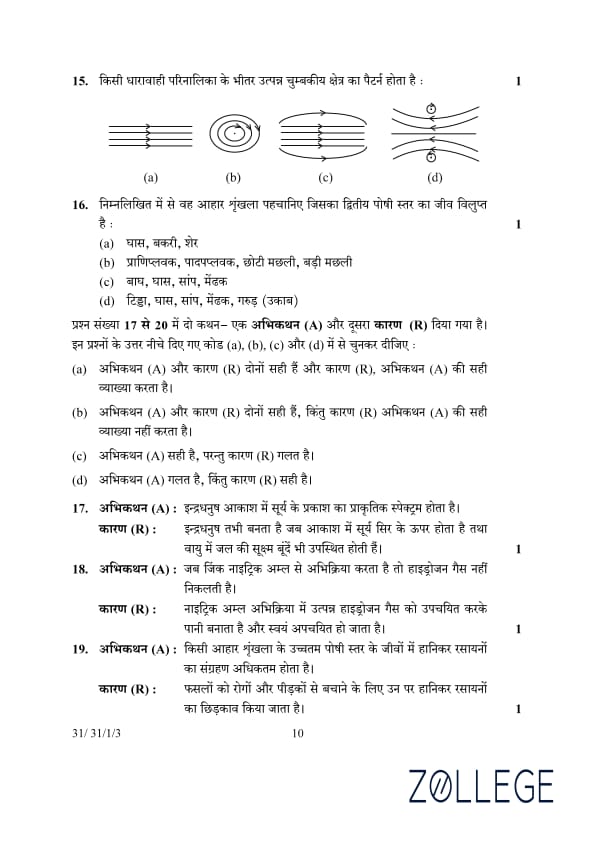
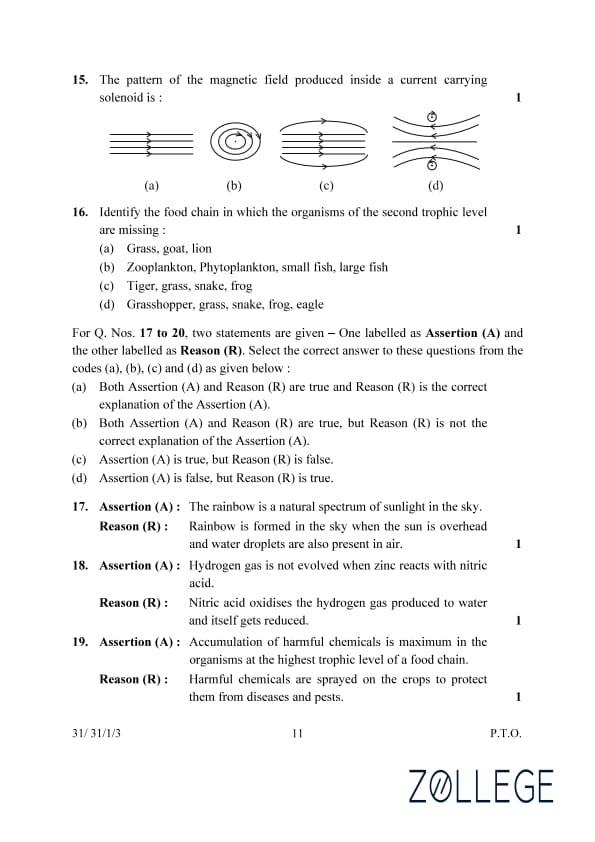
| 15.The pattern of the magnetic field produced inside a current carrying solenoid is : | (a) | A solenoid is a coil of wire wrapped around a cylindrical core. When a current flows through the solenoid, it creates a magnetic field. Inside the solenoid, the magnetic field lines are nearly parallel and uniform, resembling the field of a bar magnet. The field lines are close together inside the solenoid, indicating a strong magnetic field, and they loop around outside the solenoid, returning to the opposite end. Option (a) correctly depicts this pattern. The parallel lines inside the solenoid represent the uniform magnetic field. Option (b) shows concentric circles, which is the magnetic field pattern around a straight current-carrying wire.Option (c) shows curved field lines inside, which is not representative of the uniform field inside a solenoid. Option (d) depicts a field pattern that’s more characteristic of two opposite magnetic poles facing each other. |
| 16. Identify the food chain in which the organisms of the second trophic level are missing (a) Grass, goat, lion (b) Zooplankton, Phytoplankton, small fish, large fish (c) Tiger, grass, snake, frog (d) Grasshopper, grass, snake, frog, eagle |
(c) Tiger, grass, snake, frog | Trophic levels represent the different levels in a food chain or food web. First Trophic Level: Producers (plants) – These organisms produce their own food through photosynthesis. Second Trophic Level: Primary Consumers (herbivores) – These organisms consume producers. Third Trophic Level: Secondary Consumers (carnivores) – These organisms consume primary consumers. Fourth Trophic Level (and higher): Tertiary Consumers (top carnivores) – These organisms consume secondary consumers. |
| 17.Assertion (A) : The rainbow is a natural spectrum of sunlight in the sky. Reason (R) : Rainbow is formed in the sky when the sun is overhead and water droplets are also present in air. (a) Both Assertion (A) and Reason (R) are true and Reason (R) is the correct explanation of the Assertion (A). (b) Both Assertion (A) and Reason (R) are true, but Reason (R) is not the correct explanation of the Assertion (A). (c) Assertion (A) is true, but Reason (R) is false. (d) Assertion (A) is false, but Reason (R) is true |
(c) Assertion (A) is true, but Reason (R) is false. | Assertion (A): True. A rainbow is indeed a natural spectrum of sunlight. It is formed by the dispersion of sunlight by water droplets in the atmosphere. Sunlight is composed of different wavelengths (colors), and when it passes through a water droplet, these wavelengths are refracted (bent) at different angles, causing them to separate and form a spectrum. Reason (R): False. Rainbows are not formed when the sun is directly overhead. They are formed when the sun is behind the observer and sunlight is refracted, reflected, and dispersed by water droplets in the air. The angle between the sunlight, the water droplets, and the observer’s eye is crucial for rainbow formation (around 42 degrees). |
| 18.Assertion (A) : Hydrogen gas is not evolved when zinc reacts with nitric acid. Reason (R) : Nitric acid oxidises the hydrogen gas produced to water and itself gets reduced. Correct Answer: (a) Both Assertion (A) and Reason (R) are true and Reason (R) is the correct explanation of the Assertion (A). (a) Both Assertion (A) and Reason (R) are true and Reason (R) is the correct explanation of the Assertion (A). (b) Both Assertion (A) and Reason (R) are true, but Reason (R) is not the correct explanation of the Assertion (A). (c) Assertion (A) is true, but Reason (R) is false. (d) Assertion (A) is false, but Reason (R) is true |
||
|
19.Assertion (A) : Accumulation of harmful chemicals is maximum in the organisms at the highest trophic level of a food chain. Reason (R) : Harmful chemicals are sprayed on the crops to protect them from diseases and pests (a) Both Assertion (A) and Reason (R) are true and Reason (R) is the correct explanation of the Assertion (A). |
(b) Both Assertion (A) and Reason (R) are true, but Reason not the correct explanation of the Assertion (A) | Assertion (A): True. This phenomenon is known as biomagnification or bioaccumulation. Non-biodegradable harmful chemicals (like DDT, PCBs) enter the food chain at the producer level. As these chemicals move up the trophic levels, their concentration increases in the tissues of organisms at each successive level. Organisms at higher trophic levels consume larger quantities of organisms from lower levels, thus accumulating more of these chemicals. Reason (R): True. Harmful chemicals such as pesticides and insecticides are commonly used in agriculture to protect crops. This is one of the ways these chemicals can enter the food chain. However, while both statements are true, the reason is not the primary explanation for the assertion. The key reason for biomagnification is the non-biodegradable nature of the chemicals and their tendency to accumulate in organisms’ tissues, amplified as you move up the food chain. The reason just describes one way these chemicals can get introduced into the environment and the food chain. |
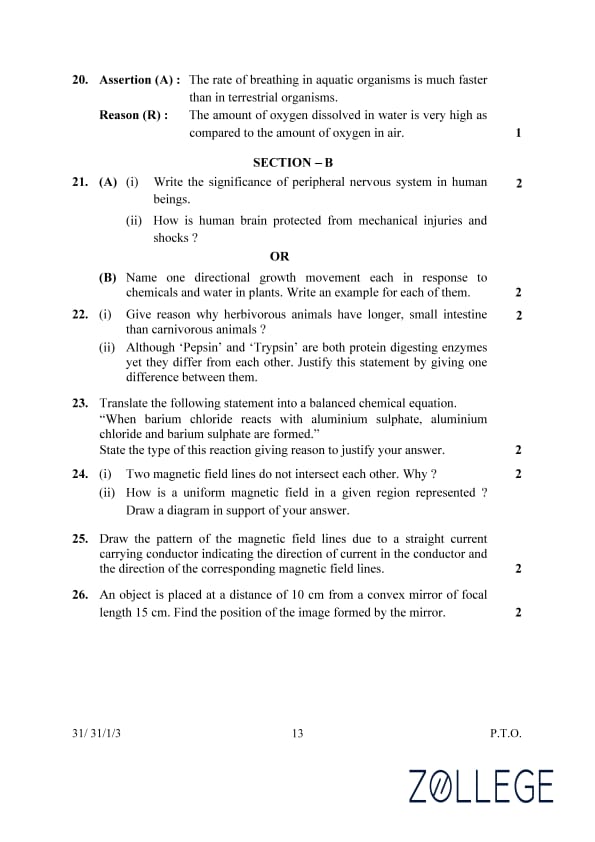
| 20.Assertion (A) : The rate of breathing in aquatic organisms is much faster than in terrestrial organisms. Reason (R) : The amount of oxygen dissolved in water is very high as compared to the amount of oxygen in air. (a) Both Assertion (A) and Reason (R) are true and Reason (R) is the correct explanation of the Assertion (A). (b) Both Assertion (A) and Reason (R) are true, but Reason (R) is not the correct explanation of the Assertion (A). (c) Assertion (A) is true, but Reason (R) is false. (d) Assertion (A) is false, but Reason (R) is true |
(c) Assertion (A) is true, but Reason (R) is false. | Assertion (A): True. Aquatic organisms generally have a faster breathing rate than terrestrial organisms. This is because the amount of dissolved oxygen available in water is considerably less than the amount of oxygen available in the air. Aquatic animals, therefore, have to breathe more rapidly to extract sufficient oxygen from the water. Reason (R): False. The amount of dissolved oxygen in water is significantly lower than the amount of oxygen in the air. Air is composed of approximately 21% oxygen, while dissolved oxygen in water is much less and can vary depending on temperature, pollution, etc |
|
21. (A).(i) Write the significance of peripheral nervous system in human beings. (ii) How is the human brain protected from mechanical injuries and shocks? |
(i) Significance of the peripheral nervous system: The peripheral nervous system (PNS) connects the central nervous system (CNS) to the limbs and organs. Its significance includes: • It transmits signals between the CNS and the rest of the body (muscles, glands, and sensory organs). 15 • It controls voluntary actions (somatic nervous system) and involuntary actions (autonomic nervous system). (ii) Protection of the human brain: The human brain is protected from mechanical injuries and shocks by: • Cranial bones: The skull forms a hard protective covering around the brain. • Cerebrospinal fluid (CSF): CSF surrounds the brain and acts as a shock absorber to prevent damage from impacts. • Meninges: These are three protective membranes (dura mater, arachnoid mater, and pia mater) that enclose the brain and provide cushioning. | |
| 21 (B): Name one directional growth movement each in response to chemicals and water in plants. Write an example for each of them. | (i) Growth movement in response to chemicals: The directional growth movement of a plant in response to chemicals is called Chemotropism. Example: The growth of the pollen tube towards the ovule in response to chemical signals during fertilization. (ii) Growth movement in response to water: The directional growth movement of a plant in response to water is called Hydrotropism. Example: The growth of roots towards a water source in the soil |
|
| 22. (i) Give reason why herbivorous animals have longer small intestine than carnivorous animals? (ii) Although ‘Pepsin’ and ‘Trypsin’ are both protein-digesting enzymes, yet they differ from each other. Justify this statement by giving one difference between them. |
(i) Herbivorous animals have a longer small intestine: Herbivorous animals consume plant-based food, which is rich in cellulose. The digestion of cellulose is a slow process and requires more time. A longer small intestine allows sufficient time for the complete digestion and absorption of nutrients from plant material. In contrast, carnivorous animals eat meat, which is easier to digest and does not require an extended small intestine. (ii) Difference between Pepsin and Trypsin: • Pepsin: It is a protein-digesting enzyme that acts in the stomach under acidic conditions (pH 1.5–2.5). • Trypsin: It is a protein-digesting enzyme that acts in the small intestine under alkaline conditions (pH 7.5–8.5). | |
| 23. Translate the following statement into a balanced chemical equation. “When barium chloride reacts with aluminium sulphate, aluminium chloride and barium sulphate are formed.” | Balanced chemical equation: 3 BaCl2 + Al2(SO4)3 → 2 AlCl3 + 3 BaSO4 Type of reaction: This is a double displacement reaction because the ions in the reactants are exchanged to form new products. • Barium (Ba2+) and sulphate (SO2− 4 ) combine to form barium sulphate (BaSO4), which is a white precipitate. • Aluminium (Al3+) and chloride (Cl−) combine to form aluminium chloride (AlCl3). Reason: A double displacement reaction involves the exchange of ions between two compounds, resulting in the formation of two new compounds. |
|
| 24.(i) Two magnetic field lines do not intersect each other. Why? (ii) How is a uniform magnetic field in a given region represented? Draw a diagram in support of your answer. |
(i): Magnetic field lines represent the direction of the magnetic force that a small north magnetic pole would experience if placed at that point. If two magnetic field lines were to intersect, it would mean that at the point of intersection, the magnetic force would have two different directions. This is not possible, as a magnetic field can only have one direction at any given point. Thus, magnetic field lines never intersect. (ii): A uniform magnetic field is represented by parallel and equally spaced magnetic field lines. This indicates that the magnetic field strength and direction are the same at all points in that region. |
|
| 25.Draw the pattern of the magnetic field lines due to a straight currentcarrying conductor indicating the direction of current in the conductor and the direction of the corresponding magnetic field lines. | When an electric current flows through a straight conductor (like a wire), it generates a magnetic field around it. The direction of the magnetic field lines can be determined using the Right-Hand Thumb Rule:• If the thumb of the right hand points in the direction of the current, the fingers curl around the conductor, showing the direction of the magnetic field lines. • The magnetic field lines are circular in nature and concentric around the conductor. | |
| 26.An object is placed at a distance of 10 cm from a convex mirror of focal length 15 cm. Find the position of the image formed by the mirror. | To determine the image position for a convex mirror, we use the mirror formula: 1 f = 1 u + 1 v Where: • f = +15 cm (focal length is positive for a convex mirror), • u = −10 cm (object distance is negative), • v = image distance (to be determined).Step 1: Substitute values into the formula: 1 15 = 1 −10 + 1 v Step 2: Solve for 1 v : 1 v = 1 15 − 1 −10 Take the LCM of 15 and 10, which is 30: 1 v = 2 30 + 3 30 1 v = 5 30 Step 3: Find v: v = 30 5 = +6 cm Conclusion: The image is formed at a distance of +6 cm behind the mirror. The image is virtual, erect, and diminished. | |
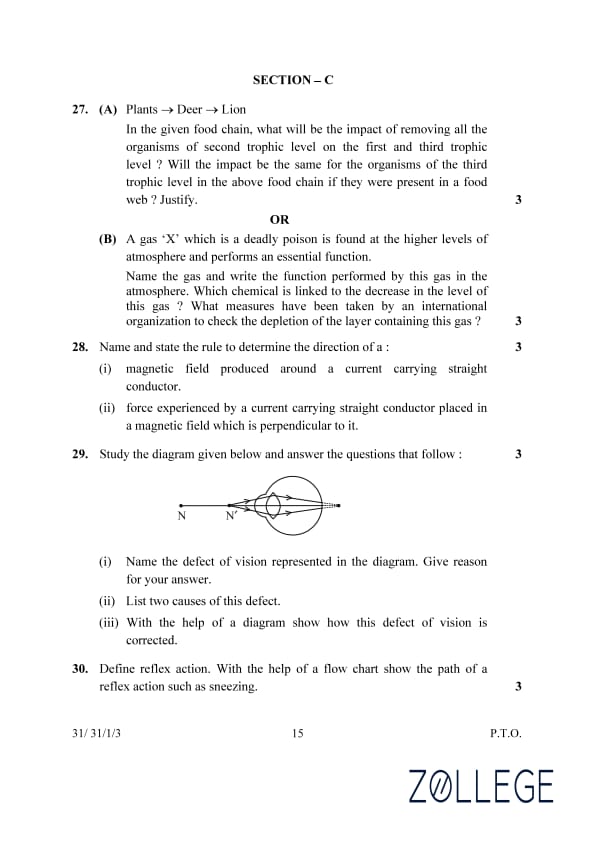
| 27.(A) Plants → Deer → Lion In the given food chain, what will be the impact of removing all the organisms of second trophic level on the first and third trophic level? Will the impact be the same for the organisms of the third trophic level in the above food chain if they were present in a food web? Justify. OR (B) A gas ‘X’ which is a deadly poison is found at the higher levels of atmosphere and performs an essential function. Name the gas and write the function performed by this gas in the atmosphere. Which chemical is linked to the decrease in the level of this gas? What measures have been taken by an international organization to check the depletion of the layer containing this gas? |
In the food chain Plants → Deer → Lion: 20 Impact on the first trophic level (Plants): Removing all the deer (second trophic level) would lead to an increase in the population of plants (first trophic level) because their primary consumer is absent. The plants would face less grazing pressure and their numbers would grow. Impact on the third trophic level (Lions): Removing all the deer would have a negative impact on the lions (third trophic level). Deer are the lions’ primary food source, so their removal would lead to a food shortage for the lions. The lion population would likely decrease or even become locally extinct. Impact on Lions if Present in a Food Web: If lions were part of a food web (rather than a simple food chain), the impact of removing deer might be less severe. In a food web, organisms have multiple food sources. If deer were removed, lions might be able to switch to other prey. The impact on the lions would depend on the availability and abundance of alternative prey in the food web. They might face some decline, but complete extinction would be less likely.(B): The gas ’X’ described in the question is ozone (O3). Function of Ozone: Ozone is found in the stratosphere (upper atmosphere) and forms the ozone layer. The essential function of the ozone layer is to absorb most of the harmful ultraviolet (UV) radiation from the sun. This protects living organisms on Earth from the damaging effects of UV radiation, which can cause skin cancer, cataracts, and damage to the immune system. Chemical linked to ozone depletion: Chlorofluorocarbons (CFCs) are the primary chemicals linked to the depletion of the ozone layer. CFCs were widely used in refrigerants, aerosols, and other industrial applications. When released into the atmosphere, CFCs break down in the stratosphere, releasing chlorine atoms that catalytically destroy ozone molecules. International measures to check ozone depletion: The Montreal Protocol, an international treaty adopted in 1987, is the main measure taken by the international community to protect the ozone layer. The Montreal Protocol phased out the production and consumption of ozone-depleting substances like CFCs. | |
| 28: Name and state the rule to determine the direction of a: (i) Magnetic field produced around a current-carrying straight conductor. (ii) Force experienced by a current-carrying straight conductor placed in a magnetic field which is perpendicular to it. |
(i) Rule for magnetic field around a current-carrying conductor: Name of the Rule: Right-Hand Thumb Rule. Statement: If the thumb of the right hand points in the direction of the current through a straight conductor, then the fingers curled around the conductor represent the direction of the magnetic field lines. Explanation: The magnetic field lines are circular and concentric around the conductor. The direction of the magnetic field depends on the direction of the current. (ii) Rule for force on a current-carrying conductor in a magnetic field: Name of the Rule: Fleming’s Left-Hand Rule. Statement: If the thumb, forefinger, and middle finger of the left hand are stretched mutually perpendicular to each other: • The forefinger points in the direction of the magnetic field (B). • The middle finger points in the direction of the current (I). • The thumb points in the direction of the force (F) acting on the conductor. Explanation: The conductor experiences a force when placed in a magnetic field perpendicular to the current direction due to the interaction between the current and the magnetic field. | |
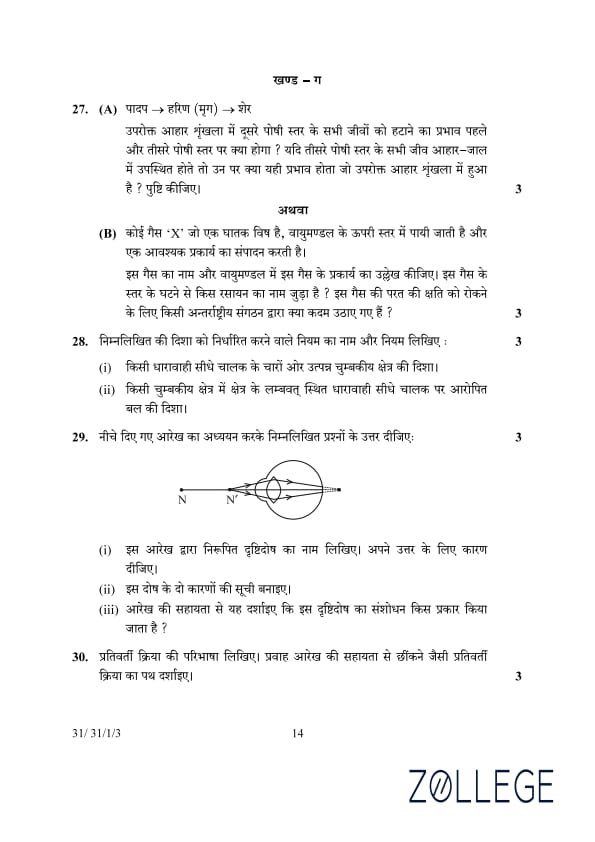
| 29 Study the diagram given below and answer the questions that follow: (i) Name the defect of vision represented in the diagram. Give reason for your answer. (ii) List two causes of this defect. (iii) With the help of a diagram show how this defect of vision is corrected. |
(i) Image is formed behind the retina. / Near point for the person is farther away from the normal near point (25 cm) (ii) Causes of Hypermetropia: 1. Focal length of the eye lens is too long. 2. The eyeball has become too small |
|
| 30.Define reflex action. With the help of a flow chart show the path of a reflex action such as sneezing. | Definition of Reflex Action: A reflex action is an involuntary and nearly instantaneous movement in response to a stimulus. It occurs without conscious thought or decision-making by the brain. Reflex actions are rapid, automatic responses that protect the body from harm.Explanation of the Sneezing Reflex Pathway: 1. Stimulus: An irritant, such as dust, pollen, or a virus, enters the nasal passage. 2. Receptor: Sensory neurons in the lining of the nose detect the irritant. 3. Relay Neuron: The sensory neurons send a signal to the spinal cord, where a relay neuron connects the sensory neuron to a motor neuron. (This bypasses the brain for a faster response.) 4. Motor Neuron: The relay neuron transmits the signal to a motor neuron. 5. Effector: The motor neuron sends a signal to the effector muscles, which are the muscles involved in the act of sneezing (abdominal muscles, diaphragm, chest muscles). 6. Response: The effector muscles contract forcefully, expelling air and the irritant from the nasal passage, resulting in a sneeze. | |
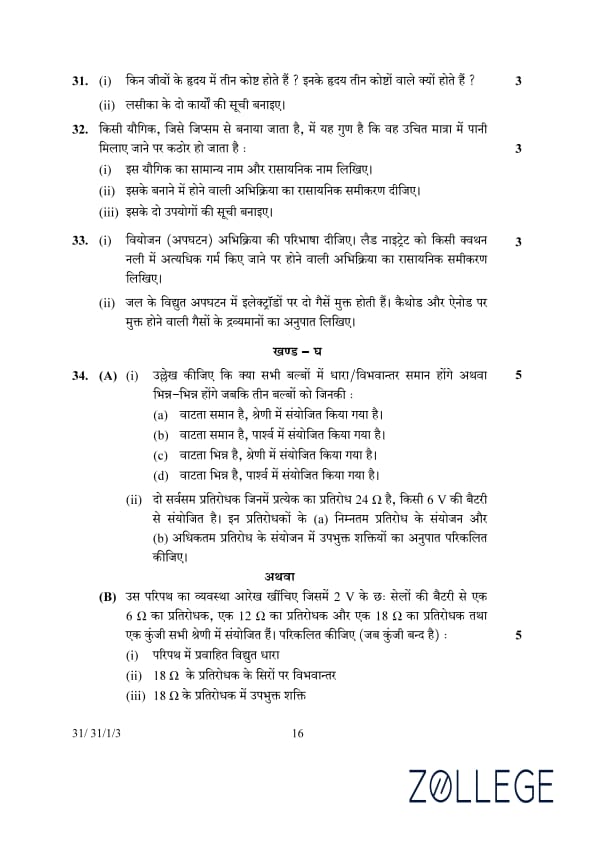
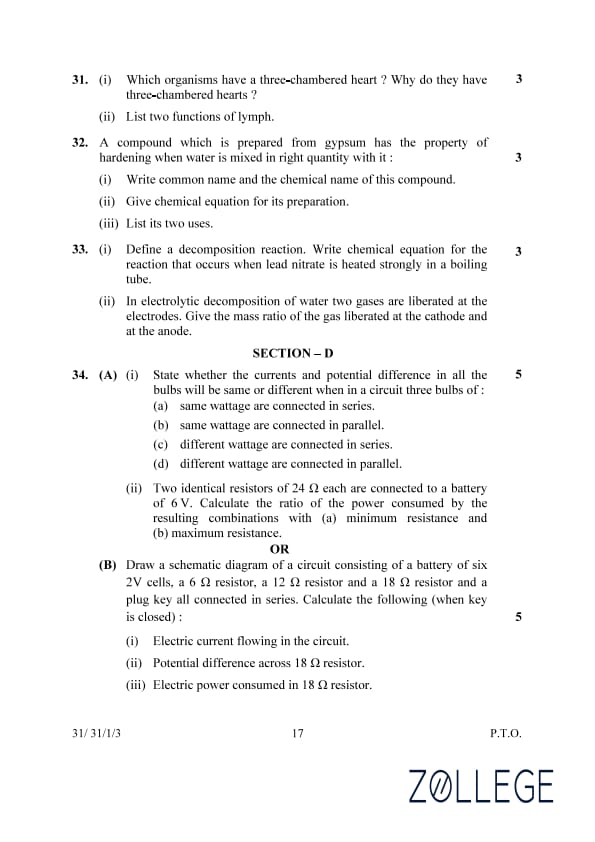
| 31. (i) Which organisms have a three-chambered heart? Why do they have three-chambered hearts? (ii) List two functions of lymph. |
(i) Organisms with three-chambered hearts: • Amphibians (e.g., frogs) and reptiles (except crocodiles) have a three-chambered heart. • Reason: These organisms are cold-blooded (ectothermic) and do not require complete separation of oxygenated and deoxygenated blood. A three-chambered heart allows partial mixing of blood, which is sufficient for their metabolism. (ii) Two functions of lymph: 1. Lymph helps in the transport of nutrients and hormones to various parts of the body. 2. It plays a crucial role in the immune system by transporting white blood cells and antibodies to fight infections. | |
| 32.A compound prepared from gypsum hardens when water is mixed with it: (i) Write the common name and the chemical name of this compound. (ii) Give the chemical equation for its preparation. (iii) List its two uses. |
(i) Common name and chemical name: • Common name: Plaster of Paris (POP) • Chemical name: Calcium sulphate hemihydrate (CaSO4 · 1 2H2O) (ii) Chemical equation for preparation: Plaster of Paris is prepared by heating gypsum (CaSO4 · 2H2O) at 373 K: CaSO4 · 2H2O Heat at 373 K −−−−−−−−→ CaSO4 · 1 2 H2O + 3 2 H2O (iii) Two uses of Plaster of Paris: 1. Used for making moulds and casts in the medical field for fractured bones. 2. Used for making decorative materials, such as false ceilings and sculptures. | |
| 33. (i) Define a decomposition reaction. Write the chemical equation for the reaction that occurs when lead nitrate is heated strongly in a boiling tube. (ii) In electrolytic decomposition of water, two gases are liberated at the electrodes. Give the mass ratio of the gas liberated at the cathode and at the anode. |
Definition of decomposition reaction: A decomposition reaction is a type of chemical reaction in which a single compound breaks down into two or more simpler substances when energy is supplied in the form of heat, light, or electricity. Reaction for heating lead nitrate: When lead nitrate (P b(NO3)2) is heated strongly, it decomposes into lead oxide (P bO), nitrogen dioxide (NO2), and oxygen (O2).2 P b(NO3)2 Heat −−−→ 2 P bO + 4 NO2 + O2 - Lead oxide (P bO) appears as a yellow residue. - Nitrogen dioxide (NO2) is a brown gas. - Oxygen gas (O2) supports combustion. (ii) Mass ratio of gases in electrolysis of water: In the electrolysis of water: • Hydrogen gas is liberated at the cathode. • Oxygen gas is liberated at the anode.The chemical equation is: 2 H2O Electrolysis −−−−−−−→ 2 H2 + O2 The molar masses are: • H2 = 2 g/mol (Hydrogen gas) • O2 = 32 g/mol (Oxygen gas) The mass ratio of hydrogen to oxygen is: Mass ratio = Mass of Hydrogen Mass of Oxygen = 4 32 = 1 : 8 Conclusion: The mass ratio of gases liberated at the cathode and anode is 1:8 (Hydrogen:Oxygen). |
|
| 34 (A): (i) State whether the currents and potential difference in all the bulbs will be same or different when in a circuit three bulbs of: (a) Same wattage are connected in series. (b) Same wattage are connected in parallel. (c) Different wattage are connected in series. (d) Different wattage are connected in parallel. (ii) Two identical resistors of 24 Ω each are connected to a battery of 6 V . Calculate the ratio of the power consumed by the resulting combinations with: (a) Minimum resistance and (b) Maximum resistance |
(i) Currents and potential difference in the bulbs: 1. (a) Same wattage in series: The current in all bulbs will be same, but the potential difference will be different depending on the resistance of each bulb. 2. (b) Same wattage in parallel: The potential difference across all bulbs will be same, but the current through each bulb will be different. 3. (c) Different wattage in series: The current in all bulbs will be same, but the potential difference across each bulb will be different. 4. (d) Different wattage in parallel: The potential difference across all bulbs will be same, but the current through each bulb will be different. (ii) Power consumed with minimum and maximum resistance: Step 1: Resistance for series and parallel combinations: • Series combination (maximum resistance): Rtotal = R1 + R2 = 24 Ω + 24 Ω = 48 Ω• Parallel combination (minimum resistance): 1 Rtotal = 1 R1 + 1 R2 = 1 24 + 1 24 = 2 24 =⇒ Rtotal = 12 Ω Step 2: Power consumed: The power consumed is given by: P = V 2 R • Power in series (maximum resistance): Pseries = 6 2 48 = 36 48 = 0.75 W • Power in parallel (minimum resistance): Pparallel = 6 2 12 = 36 12 = 3.0 W Step 3: Ratio of power consumed: Power ratio = Pparallel Pseries = 3.0 0.75 = 4 : 1 Answer: The ratio of power consumed is 4:1 for minimum to maximum resistance. |
|
|
34 (B): Draw a schematic diagram of a circuit consisting of a battery of six 2 V cells, a 6 Ω resistor, a 12 Ω resistor, and an 18 Ω resistor, all in series. Calculate the following when the key is closed:(i) Electric current flowing in the circuit. |
Step 1: Total voltage and total resistance: • Total voltage (Vtotal) = 6 × 2 = 12 V • Total resistance (Rtotal): Rtotal = 6 Ω + 12 Ω + 18 Ω = 36 Ω (i) Electric current in the circuit: Using Ohm’s Law: I = Vtotal Rtotal = 12 36 = 0.33 A (ii) Potential difference across 18 Ω resistor: V18 Ω = I × R = 0.33 × 18 = 6 V (iii) Electric power consumed in 18 Ω resistor: The power consumed is: P = I 2 × R = (0.33)2 × 18 = 0.1089 × 18 = 1.96 W Answers: 1. Electric current = 0.33 A 2. Potential difference across 18 Ω = 6 V 3. Power consumed = 1.96 W |
|
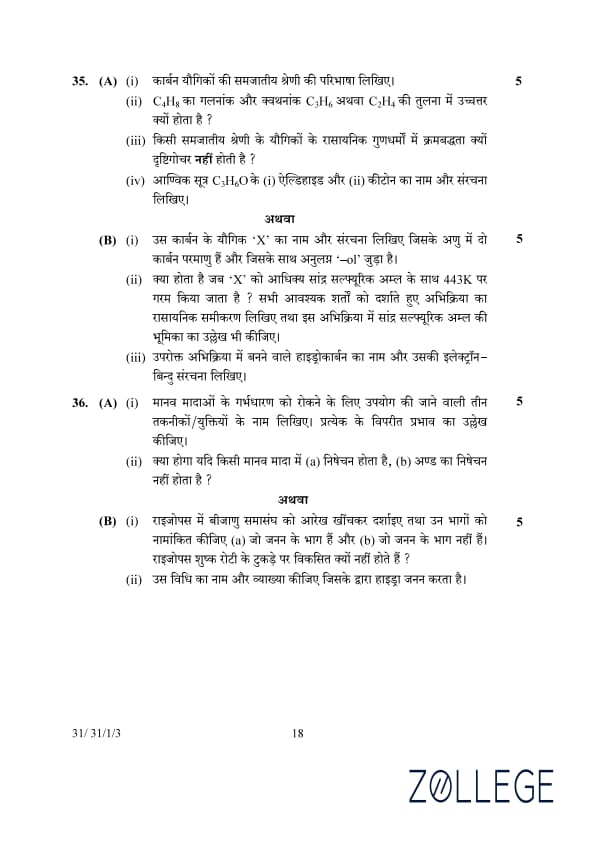
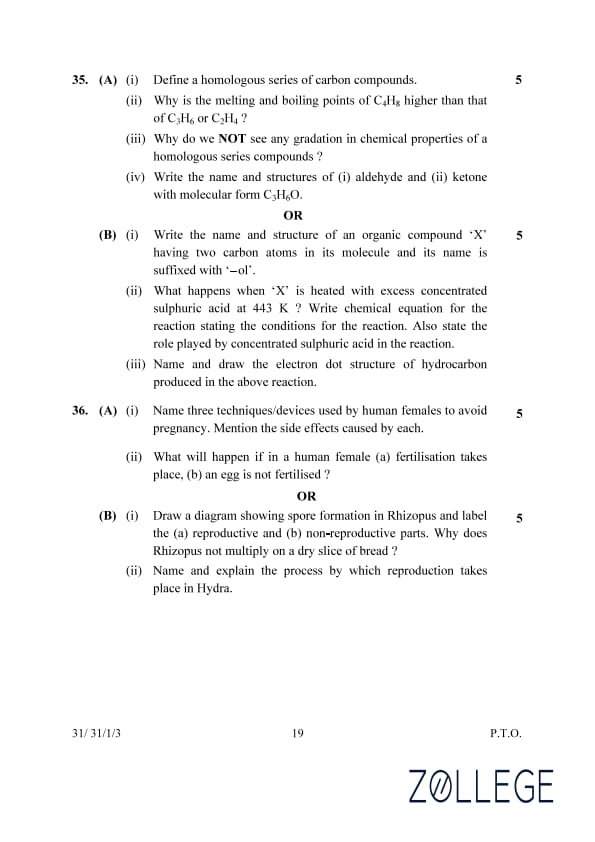
| 35 (A): (i) Define a homologous series of carbon compounds. (ii) Why is the melting and boiling points of C4H8 higher than that of C3H6 or C2H4? (iii) Why do we NOT see any gradation in chemical properties of homologous series compounds? (iv) Write the name and structures of (i) aldehyde and (ii) ketone with molecular form C3H6O. |
(i) Definition of homologous series: A homologous series is a group of organic compounds with the same general formula, similar chemical properties, and a gradation in physical properties. Each successive member differs by a −CH2 group and has a difference of 14 u in molecular mass. (ii) Reason for higher melting and boiling points of C4H8: The melting and boiling points of C4H8 are higher than C3H6 or C2H4 because: • C4H8 has a larger molecular size and higher molecular mass. • It has more surface area for intermolecular forces (Van der Waals forces) to act, requiring more energy to break these forces. (iii) No gradation in chemical properties: There is no gradation in the chemical properties of homologous series compounds because they have the same functional group, which governs their chemical behavior. The functional group reacts in the same way, regardless of the chain length. (iv) Name and structures of C3H6O: • (i) Aldehyde: Propanal (CH3CH2CHO) Structure: CH3 − CH2 − CHO • (ii) Ketone: Propanone (CH3COCH3) Structure: CH3 − CO − CH3 |
|
| (B): (i) Write the name and structure of an organic compound ‘X’ having two carbon atoms in its molecule and its name is suffixed with ‘-ol’. (ii) What happens when ‘X’ is heated with excess concentrated sulphuric acid at 443 K? Write the chemical equation and role of concentrated sulphuric acid. (iii) Name and draw the electron dot structure of the hydrocarbon produced in the above reaction. | (i) Name and structure of compound ‘X’: The organic compound ‘X’ with two carbon atoms and the suffix ‘-ol’ is Ethanol (C2H5OH). Structure: CH3 − CH2 − OH (ii) Reaction with concentrated sulphuric acid: When ethanol (C2H5OH) is heated with excess concentrated sulphuric acid at 443 K, it undergoes dehydration to form ethene (C2H4): C2H5OH Conc. H2SO4,443K −−−−−−−−−−−−→ C2H4 + H2O Role of concentrated sulphuric acid: Concentrated sulphuric acid acts as a dehydrating agent and removes a water molecule from ethanol. (iii) Name and electron dot structure of the hydrocarbon: The hydrocarbon produced is Ethene (C2H4). Electron dot structure of Ethene: H: C = C :H H H |
|
|
36 (A): (i) Name three techniques/devices used by human females to avoid pregnancy. Mention the side effects caused by each. (ii) What will happen if in a human female: |
(i) Techniques to avoid pregnancy and their side effects: 1. Oral contraceptive pills: Side effects: Nausea, headache, weight gain, and hormonal imbalance. 30 2. Intrauterine devices (IUDs): Side effects: Abdominal pain, irregular bleeding, and risk of infections. 3. Barrier methods (condoms): Side effects: Rare allergic reactions to latex. (ii) Events after fertilisation or no fertilisation: • (a) If fertilisation takes place: The zygote is formed, which attaches to the uterine wall (implantation). It develops into an embryo, leading to pregnancy. • (b) If the egg is not fertilised: The unfertilised egg, along with the uterine lining, is shed during menstruation. |
|
| 36 (B): (i) Draw a diagram showing spore formation in Rhizopus and label the: (a) Reproductive parts, and (b) Non-reproductive parts. Why does Rhizopus not multiply on a dry slice of bread? (ii) Name and explain the process by which reproduction takes place in Hydra. |
(i) Spore formation in Rhizopus: Answer: Rhizopus reproduces asexually by spore formation. Reproductive parts include sporangium and spores, while non-reproductive parts include hyphae.Rhizopus requires moisture to germinate and grow. A dry surface does not support spore germination. (ii) Reproduction in Hydra: • Hydra reproduces by budding, an asexual mode of reproduction. • A small outgrowth called a bud develops on the parent Hydra. The bud grows, matures, and eventually detaches to form a new individual. Diagram for Budding in Hydra: Diagram for Budding in Hydra: |
|
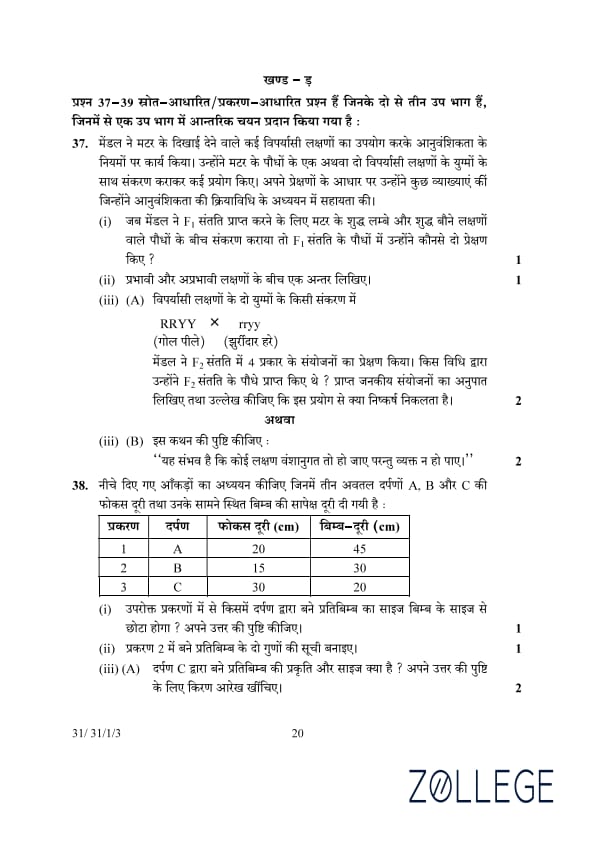
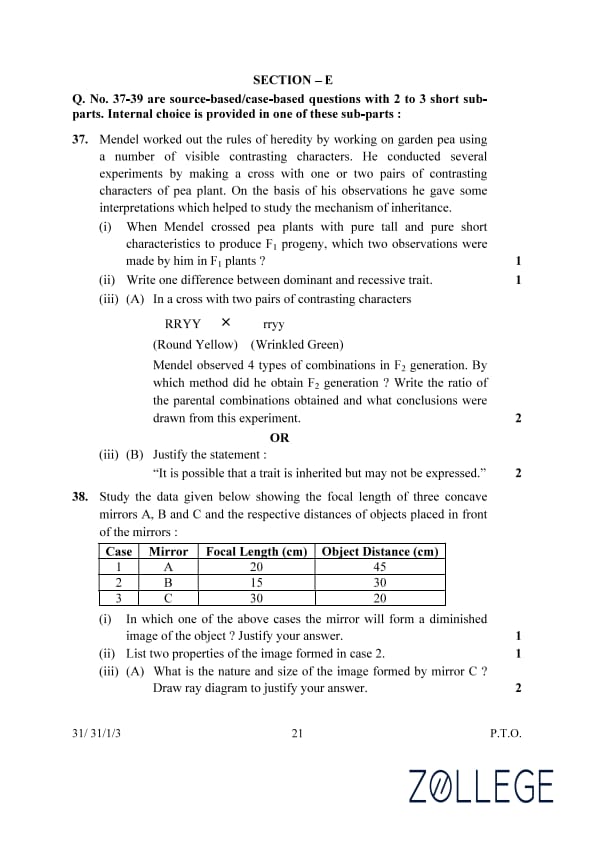
| 37. Mendel worked out the rules of heredity by working on garden pea using a number of visible contrasting characters. He conducted several experiments by making a cross with one or two pairs of contrasting characters of pea plant. On the basis of his observations he gave some interpretations which helped to study the mechanism of inheritance. (i) When Mendel crossed pea plants with pure tall and pure short characteristics to produce F1 progeny, which two observations were made by him in F1 plants? (ii) Write one difference between dominant and recessive trait. (iii) (A) In a cross with two pairs of contrasting characters RRYY × rryy (Round Yellow) (Wrinkled Green) Mendel observed 4 types of combinations in F2 generation. By which method did he obtain F2 generation ? Write the ratio of the parental combinations obtained and what conclusions were drawn from this experiment. |
(i): When Mendel crossed pure tall pea plants (TT) with pure short pea plants (tt), he made the following two observations in the F1 generation: 1. All F1 plants were tall: There were no short plants, even though one parent was short. 2. Uniformity in F1 generation: All the F1 plants had a similar height (tall), indicating uniformity in the trait. (ii): Dominant vs. Recessive Trait: A dominant trait is expressed even when only one copy of the allele is present (e.g., Tt results in a tall plant). A recessive trait is expressed only when two copies of the allele are present (e.g., tt results in a short plant). In other words, a dominant trait masks the expression of a recessive trait in a heterozygous condition (Tt). (iii) (A): Mendel obtained the F2 generation by self-pollinating the F1 generation plants. In the dihybrid cross RRYY × rryy, the F1 generation would all be RrYy (Round Yellow). Upon self-pollination of the F1 plants, he observed four types of combinations in the F2 generation in a 9:3:3:1 phenotypic ratio (Round Yellow : Round Green : Wrinkled Yellow : Wrinkled Green). |
|
| OR (iii) (B) Justify the statement : “It is possible that a trait is inherited but may not be expressed.” | The statement “It is possible that a trait is inherited but may not be expressed” is justified because of the concept of recessive traits. A recessive trait is inherited from both parents (carriers) but is only expressed when an individual has two copies of the recessive allele. If an individual inherits one dominant allele and one recessive allele (heterozygous), the dominant allele masks the expression of the recessive allele. The recessive trait is present in the genotype but not expressed in the phenotype. For example, a person might inherit the allele for cystic fibrosis (a recessive disorder) from both parents but only show symptoms if they have two copies of the allele. If they have one normal allele and one cystic fibrosis allele, they will be a carrier but not have the disease. | |
| 38: Study the data given below showing the focal length of three concave mirrors A, B and C and the respective distances of objects placed in front of the mirrors : Case Mirror Focal Length (cm) Object Distance (cm) 1 A 20 45 2 B 15 30 3 C 30 20 (i) In which one of the above cases the mirror will form a diminished image of the object? Justify your answer. (ii) List two properties of the image formed in case 2. (iii) (A) What is the nature and size of the image formed by mirror C ? Draw ray diagram to justify your answer. |
A concave mirror forms a diminished image when the object is placed beyond the center of 34 curvature (C), which is located at twice the focal length (2f). Case 1 (Mirror A): Object distance (45 cm) > 2 × focal length (40 cm). Therefore, Mirror A will form a diminished image. Case 2 (Mirror B): Object distance (30 cm) = 2 × focal length (30 cm). Mirror B will form an image of the same size as the object. Case 3 (Mirror C): Object distance (20 cm) < focal length (30 cm). Mirror C will form an enlarged image. Therefore, the mirror in Case 1 will form a diminished image. (ii): In Case 2, the object is placed at the center of curvature (C) of the concave mirror. The image formed will have the following properties: Real and inverted: The image is formed on the same side of the mirror as the object. Same size as the object: The image size is equal to the object size. Located at the center of curvature: The image is formed at the same location as the object. (iii) (A): In Case 3, the object is placed between the pole (P) and the principal focus (F) of the concave mirror. The image formed will be: Virtual and erect: The image is formed behind the mirror. Enlarged: The image is larger than the object. |
|
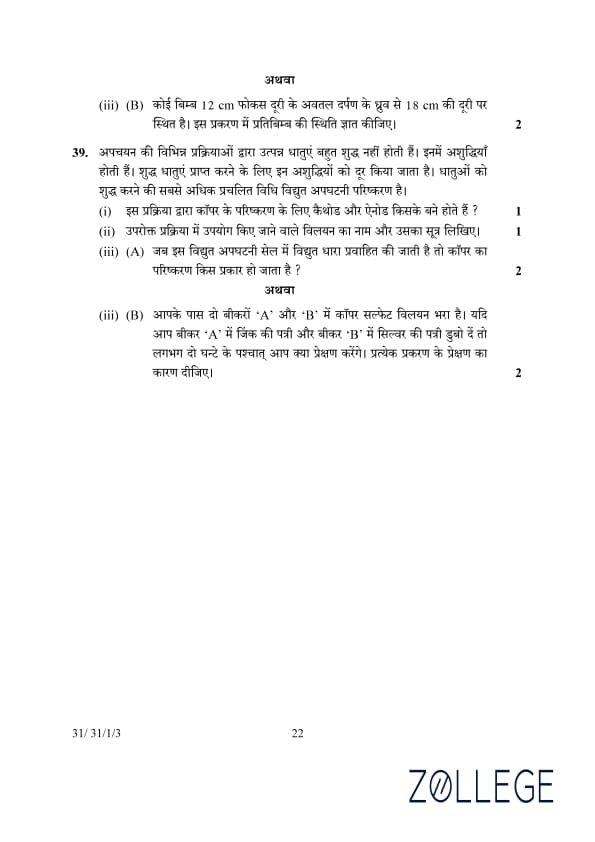
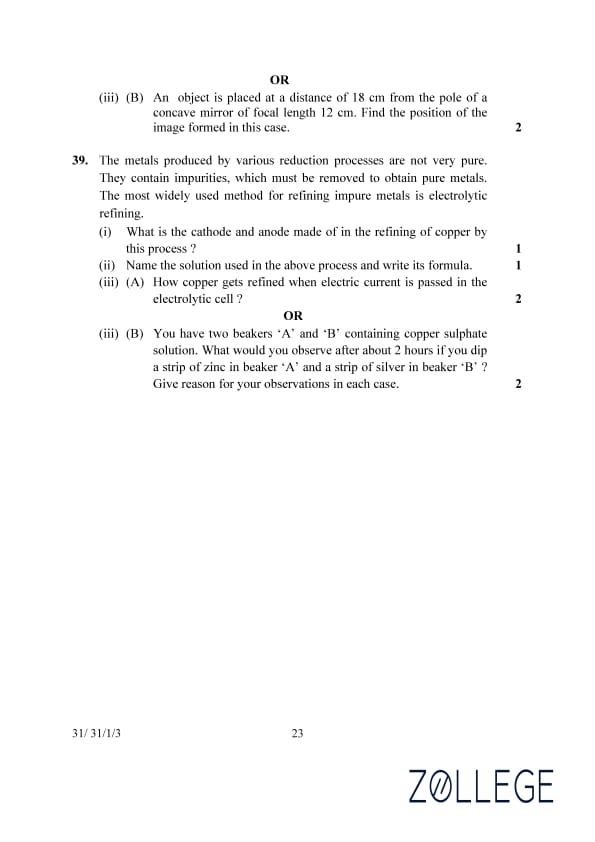
| (iii) (B) An object is placed at a distance of 18 cm from the pole of a concave mirror of focal length 12 cm. Find the position of the image formed in this case. | Given: Object distance, u = −18 cm (negative for real object) Focal length, f = −12 cm (negative for concave mirror) Using the mirror formula: 1 f = 1 v + 1 u 1 −12 = 1 v + 1 −18 1 v = 1 18 − 1 12 35 1 v = 2−3 36 1 v = −1 36 v = −36 cm The image distance is negative, which means the image is formed 36 cm in front of the mirror (real image). | |
| 39: The metals produced by various reduction processes are not very pure. They contain impurities, which must be removed to obtain pure metals. The most widely used method for refining impure metals is electrolytic refining. (i) What is the cathode and anode made of in the refining of copper by this process ? (ii) Name the solution used in the above process and write its formula. (iii) (A) How copper gets refined when electric current is passed in the electrolytic cell ? |
(i): In the electrolytic refining of copper: Cathode: A thin strip of pure copper is used as the cathode. Anode: A thick slab of impure copper is used as the anode. (ii): The solution used in the electrolytic refining of copper is an acidified copper sulfate solution. Its chemical formula is CuSO4 (with a small amount of sulfuric acid added). (iii) (A): During electrolytic refining of copper: 1. When an electric current is passed through the electrolytic cell, copper ions (Cu2+) from the anode (impure copper) dissolve into the copper sulfate solution. 2. These Cu2+ ions then migrate towards the cathode (pure copper strip). 3. At the cathode, the Cu2+ ions gain electrons and are reduced to copper atoms (Cu), which deposit on the cathode, making it thicker. Cu2+ (aq) + 2e − → Cu(s) Impurities from the anode either settle at the bottom of the cell as ”anode mud” or remain in the solution. The pure copper deposits on the cathode. |
|
| OR (iii) (B) You have two beakers ‘A’ and ‘B’ containing copper sulphate solution. What would you observe after about 2 hours if you dip a strip of zinc in beaker ‘A’ and a strip of silver in beaker ‘B’ ? Give reason for your observations in each case | Beaker A (Zinc in Copper Sulfate): After about 2 hours, you would observe that the zinc strip has become coated with a reddish-brown deposit, and the blue color of the copper sulfate solution starts to fade. This is because zinc is more reactive than copper, so it displaces copper from the copper sulfate solution. Zn(s) + CuSO4(aq) → ZnSO4(aq) + Cu(s) Beaker B (Silver in Copper Sulfate): After about 2 hours, you would observe no significant change. This is because silver is less reactive than copper and cannot displace it from the copper sulfate solution. No reaction occurs. |

*The article might have information for the previous academic years, please refer the official website of the exam.