
CBSE Class 10 2024 Question Paper with Answer Key PDF for Social Science (March 7 - Shift 1)


Content Curator | Updated On - Jan 4, 2025
CBSE Class 10 Question Papers are the most important study material for effective exam preparation. We at Zollege have provided all CBSE Class 10 Previous Year Papers with Solution PDFs here. CBSE Class 10 2024 Social Science exam was conducted successfully on March 7 by CBSE.
Students can freely download the CBSE Class 10 previous year's question paper PDFs along with their solutions here. We strongly encourage CBSE 10 aspirants to scan through all the CBSE Class 10 Question Paper to know the overall difficulty level, CBSE Class 10 Syllabus and understand the changes in CBSE Class 10 Exam Pattern over the years.
CBSE Class 10 Social Science 2024 Question Paper with Solution PDF
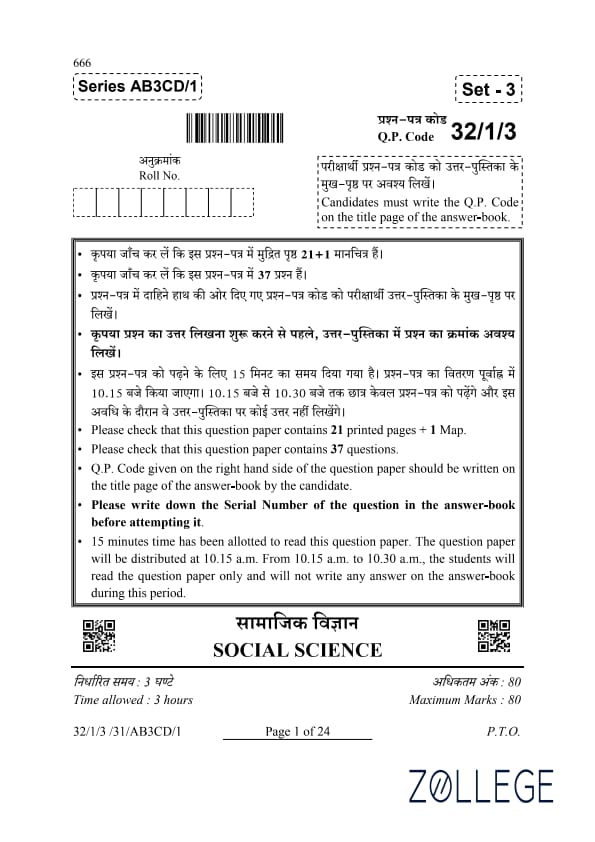
| CBSE Class 10 Social Science 2024 Question Paper with Answer Key (Set 3-32/1/3) |  Download Download |
Check Solution |
CBSE Class 10 Social Science 2024 Questions with Solutions
| Question | Answer | Solution | ||||||||||
|---|---|---|---|---|---|---|---|---|---|---|---|---|
|
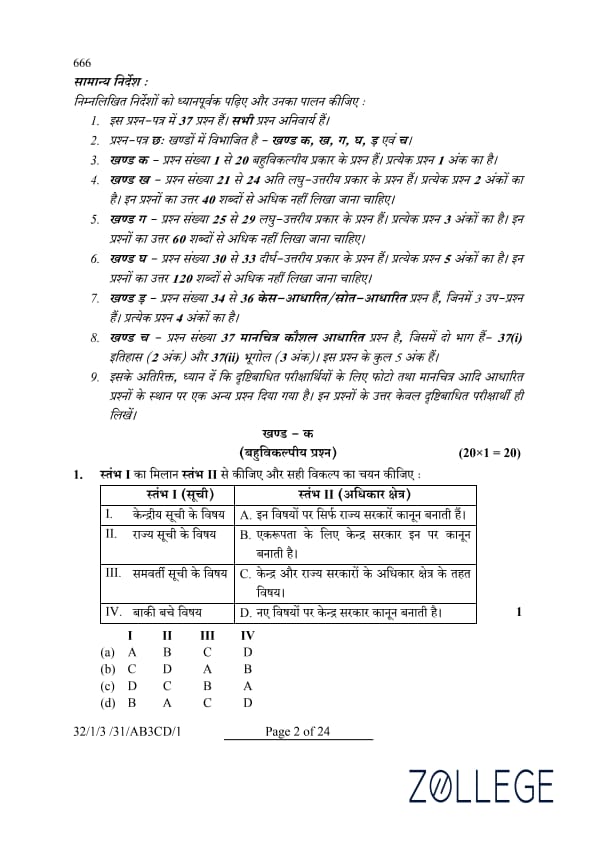
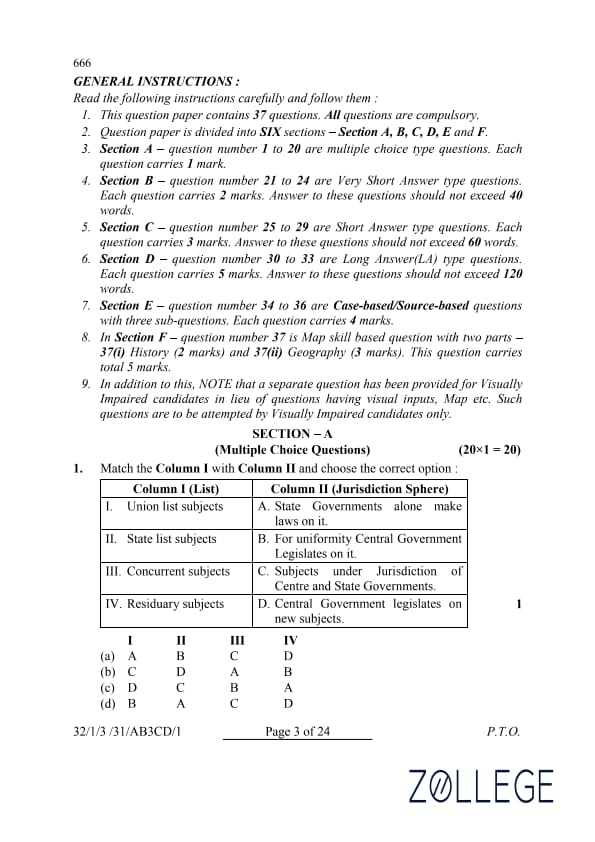
1. Match the items in Column I with those in Column II and choose the correct option:
Options: |
(d) B, A, C, D | The correct matching is as follows: 1. Union list subjects (B): These are subjects of national importance, and for uniformity, only the Central Government legislates on them (e.g., defense, foreign affairs). 2. State list subjects (A): These are of local importance, and only the State Governments can legislate on them (e.g., police, public health). 3. Concurrent subjects (C): Both the Centre and State Governments have jurisdiction over these subjects (e.g., education, forests). 4. Residuary subjects (D): Subjects not included in any list are legislated by the Central Government (e.g., cyber laws). |
||||||||||
|
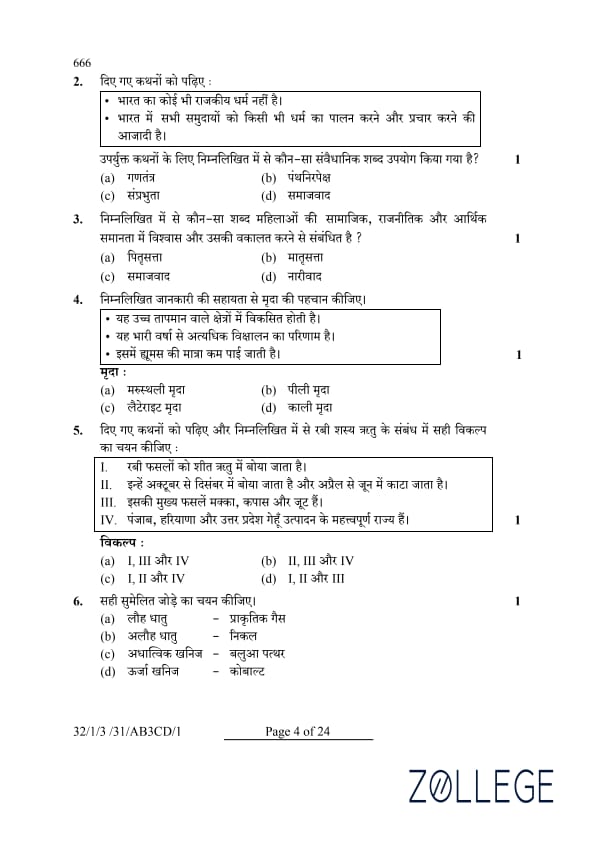
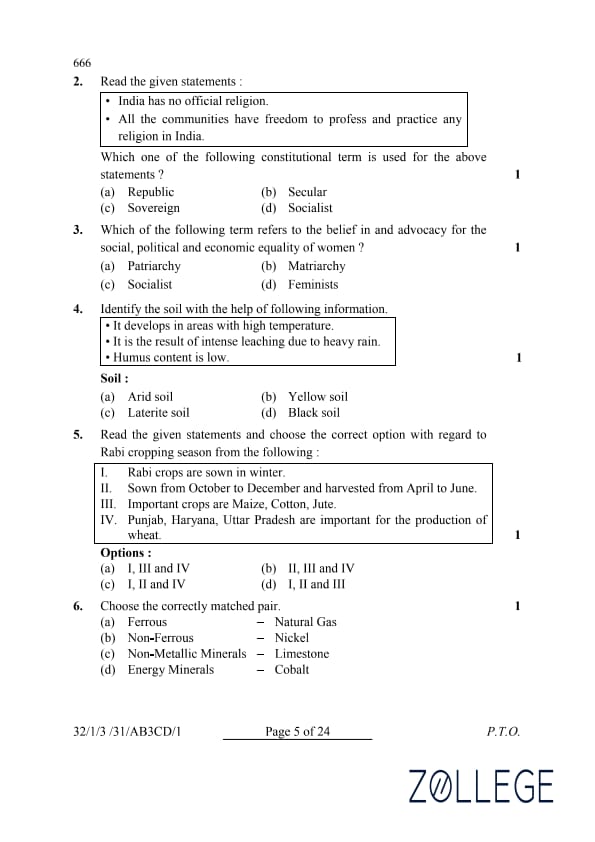
2. Read the given statements:
Which one of the following constitutional terms is used for the above statements?
|
(b) Secular | The term Secular is used to describe a constitutional principle where the state does not recognize or promote any official religion. In India: 1. Citizens have the freedom to profess, practice, and propagate any religion (Article 25 of the Constitution). 2. The government maintains neutrality in matters of religion, ensuring equal treatment of all religious communities. |
||||||||||
|
3. Which of the following terms refers to the belief in and advocacy for the social, political, and economic equality of women?
|
(d) Feminists | The correct term is Feminists, which refers to individuals who advocate for the equality of women in social, political, and economic spheres. Feminism is a movement that seeks to challenge and dismantle the systemic inequalities and patriarchal structures that perpetuate gender discrimination. | ||||||||||
|
4. Identify the soil with the help of the following information:
Soil:
|
(c) Laterite soil | The characteristics described match Laterite soil, which: 1. Develops in regions with high temperatures and heavy rainfall. 2. Forms due to intense leaching, where nutrients are washed away by rain, leaving the soil infertile. 3. Has low humus content because the warm and humid conditions accelerate the decomposition of organic matter. |
||||||||||
|
5. Read the given statements and choose the correct option with regard to Rabi cropping season from the following:
|
(c) I, II and IV | The correct statements regarding the Rabi cropping season are: I. Rabi crops are sown in winter (Statement I): Rabi crops are planted in the winter season. II. Sown from October to December and harvested from April to June (Statement II): This is the typical growing cycle for Rabi crops. III. Punjab, Haryana, Uttar Pradesh are important for wheat production (Statement IV): These states are key wheat-producing regions during the Rabi season. However, Statement III is incorrect because Maize, Cotton, and Jute are Kharif crops, not Rabi crops. |
||||||||||
|
6. Choose the correctly matched pair.
|
(c) Non-Metallic Minerals - Limestone | Ferrous: Refers to minerals containing iron, not natural gas. Non-Ferrous: Includes metals like Nickel, but not in the provided context. Non-Metallic Minerals: Limestone is a correct example of this category. Energy Minerals: Include coal, petroleum, and uranium, but not cobalt. |
||||||||||
|
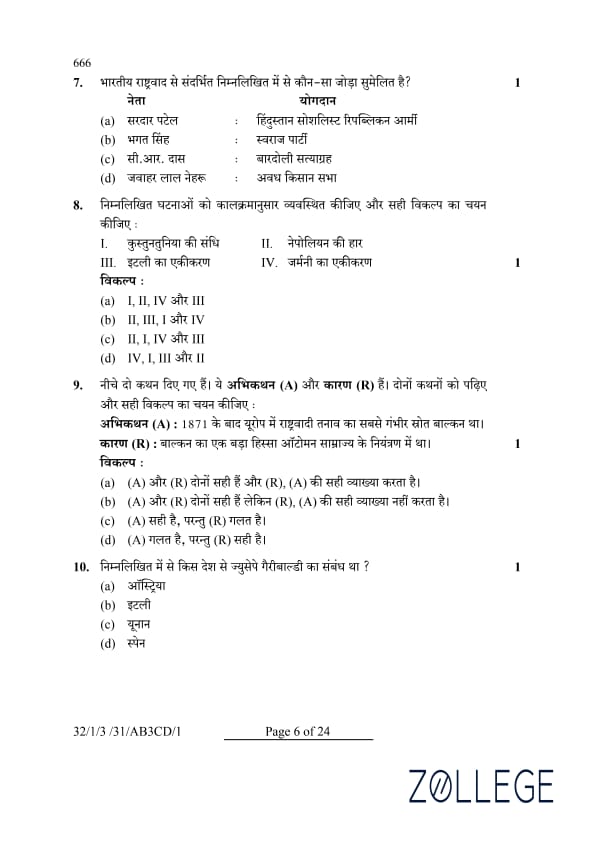
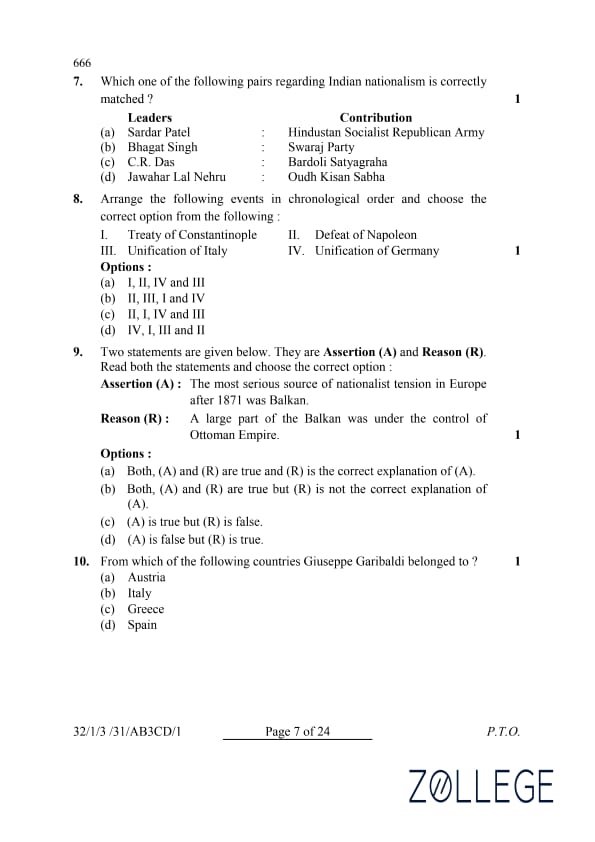
7. Which one of the following pairs regarding Indian nationalism is correctly matched?
Correct Answer: (d) Jawahar Lal Nehru - Oudh Kisan Sabha |
(d) Jawahar Lal Nehru - Oudh Kisan Sabha | Sardar Patel: Known for his role in the Bardoli Satyagraha, not the Hindustan Socialist Republican Army. (Incorrect) Bhagat Singh: A revolutionary freedom fighter, not associated with the Swaraj Party. (Incorrect) C.R. Das: A key leader of the Swaraj Party, not related to the Bardoli Satyagraha. (Incorrect) Jawahar Lal Nehru: Played a significant role in national politics but not associated with the Oudh Kisan Sabha, which was led by others. (Correct) |
||||||||||
|
8. Arrange the following events in chronological order and choose the correct option:
Options: |
(b) II, I, III and IV | The chronological order of the events is: 1. Defeat of Napoleon (1815): Marked the end of the Napoleonic era and reshaped the political landscape of Europe. 2. Treaty of Constantinople (1832): Established Greece as an independent nation. 3. Unification of Italy (1861): A significant step in the unification of Italian states. 4. Unification of Germany (1871): Led by Otto von Bismarck, it established the German Empire. |
||||||||||
|
9. Two statements are given below. They are Assertion (A) and Reason (R). Read both the statements and choose the correct option: Assertion (A): The most serious source of nationalist tension in Europe after 1871 was the Balkans. Options: |
(a) Both (A) and (R) are true and (R) is the correct explanation of (A) | The Balkans were a region of diverse ethnic groups and nationalist aspirations, creating significant tensions in Europe after 1871. A large portion of the Balkans was under Ottoman rule, and various nationalist movements sought independence, which was often supported or opposed by major European powers based on their strategic interests. | ||||||||||
|
10. From which of the following countries did Giuseppe Garibaldi belong to?
|
(b) Italy | Giuseppe Garibaldi was a key figure in the Italian unification movement, known as the Risorgimento. He was a military leader and nationalist who significantly contributed to the liberation and unification of Italy in the 19th century. He is celebrated for his role in the Expedition of the Thousand and his dedication to the cause of Italian independence. | ||||||||||
|
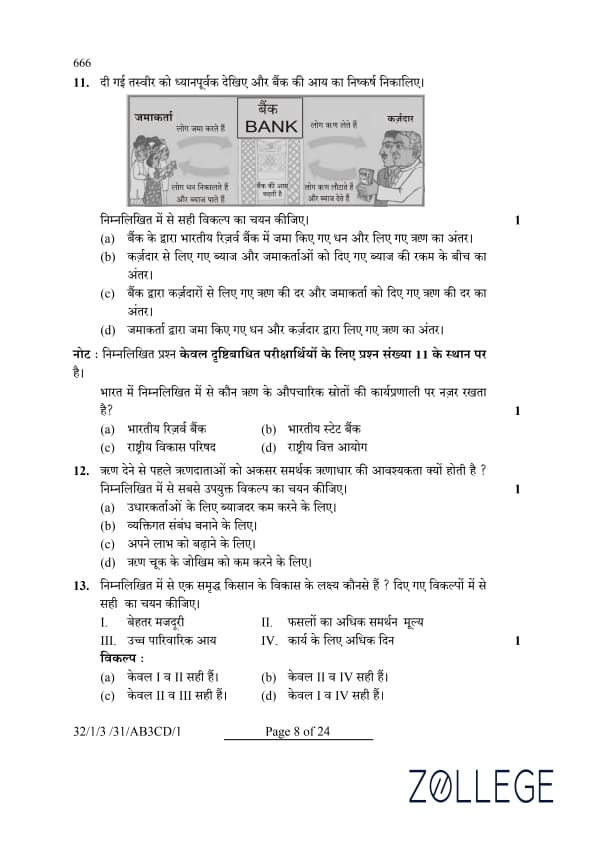
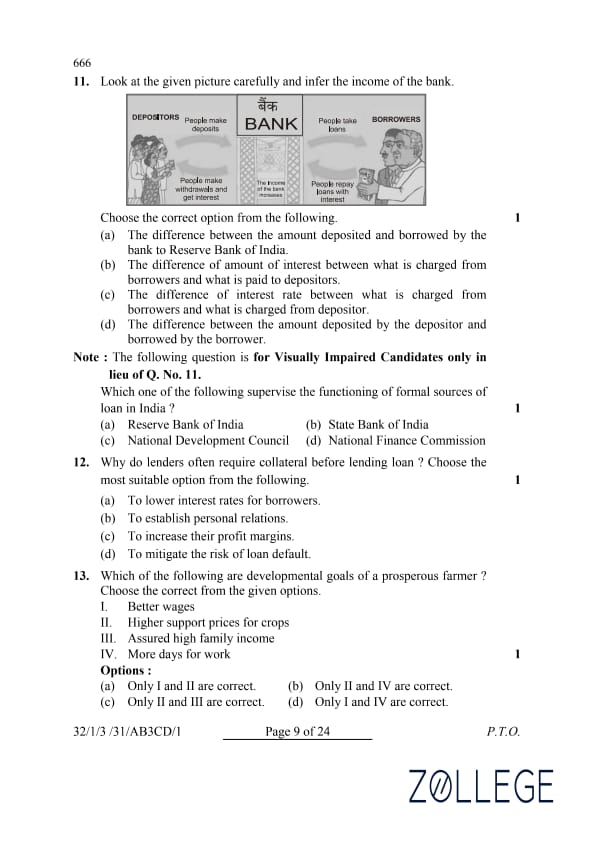
11. Look at the given picture carefully and infer the income of the bank. 
Choose the correct option from the following: |
(b) The difference of amount of interest between what is charged from borrowers and what is paid to depositors. | The income of a bank primarily comes from the spread, which is the difference between: 1. The interest rate charged to borrowers (loans). 2. The interest rate paid to depositors (savings or fixed deposits). This spread represents the bank's earnings and is a crucial component of its profitability. |
||||||||||
|
12. Why do lenders often require collateral before lending a loan? Choose the most suitable option from the following:
|
(d) To mitigate the risk of loan default. | Lenders require collateral as a security measure to reduce the risk of default. Collateral is an asset pledged by the borrower that the lender can claim if the borrower fails to repay the loan. It ensures that the lender's financial interests are protected. | ||||||||||
|
13. Which of the following are developmental goals of a prosperous farmer?
Choose the correct option from the given options: |
(c) Only II and III are correct. | The developmental goals of a prosperous farmer include: 1. Higher support prices for crops (II): Ensures better income for farmers by guaranteeing minimum prices for their produce. 2. Assured high family income (III): Reflects the desire for economic stability and security. But better wages (I) and more days for work (IV) are typically goals associated with laborers or marginal farmers, not prosperous farmers. |
||||||||||
|
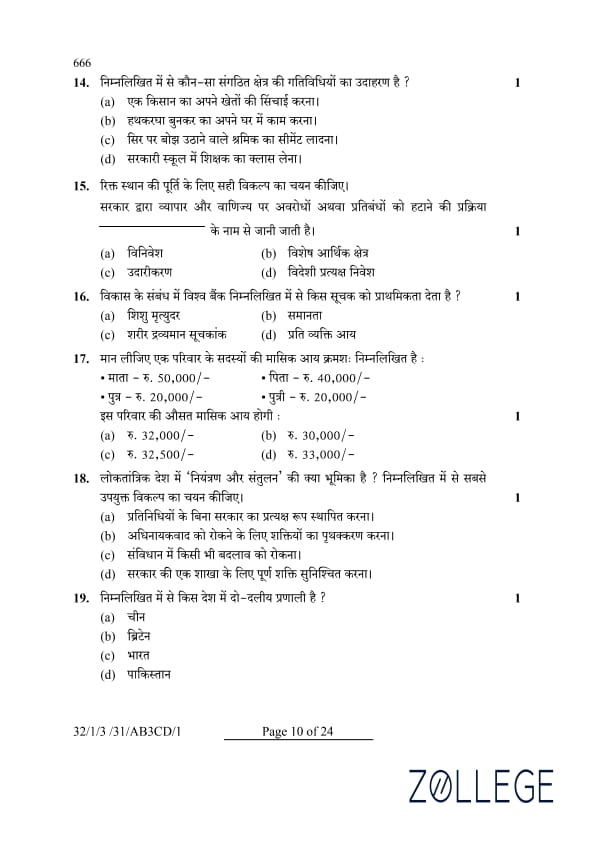
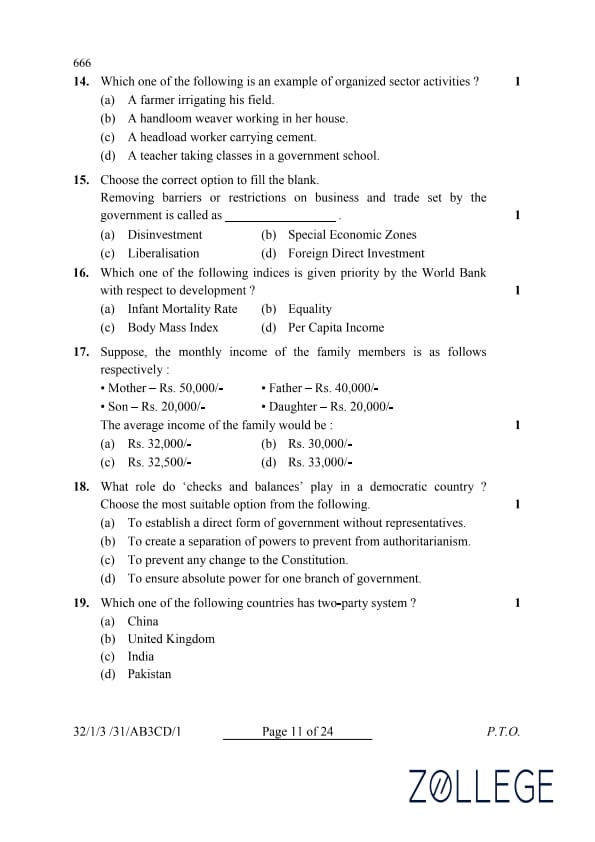
14. Which one of the following is an example of organized sector activities?
|
(d) A teacher taking classes in a government school | The organized sector refers to employment that provides regular wages, benefits, and security under government regulations. A teacher in a government school is an example of an organized sector activity because it involves structured employment with formal contracts and legal protections. | ||||||||||
|
15. Choose the correct option to fill the blank. Removing barriers or restrictions on business and trade set by the government is called as -------.
|
(c) Liberalisation | Liberalisation refers to the process of removing restrictions or barriers on business and trade imposed by the government. This policy is implemented to encourage private enterprise and attract foreign investment, leading to economic growth. | ||||||||||
|
16. Which one of the following indices is given priority by the World Bank with respect to development?
|
(d) Per Capita Income | The World Bank prioritizes Per Capita Income as a measure of development. It is an indicator of the average income of individuals in a country and is commonly used to classify countries as low, middle, or high-income economies. Other indices, like Infant Mortality Rate, are also important but not given the same priority by the World Bank in its economic classifications. | ||||||||||
|
17. Suppose, the monthly income of the family members is as follows respectively:
The average income of the family would be:
|
(c) Rs. 32,500/- | To find the average income, we use the formula: Average Income = Total Income / Number of Members Total Income = 50,000 + 40,000 + 20,000 + 20,000 = 1,30,000 Number of Members = 4 Average Income = 1,30,000 / 4 = 32,500 The average monthly income of the family is Rs. 32,500/-. |
||||||||||
|
18. What role do "checks and balances" play in a democratic country?
|
(b) To create a separation of powers to prevent authoritarianism | Checks and balances are essential for maintaining the democratic principle of separation of powers among the executive, legislative, and judicial branches. This ensures that no single branch becomes too powerful and helps prevent authoritarianism. | ||||||||||
|
19. Which one of the following countries has a two-party system?
|
(b) United Kingdom | The United Kingdom has a two-party system, dominated historically by the Conservative Party and the Labour Party. While smaller parties exist, these two have traditionally held the majority of power in Parliament. | ||||||||||
|
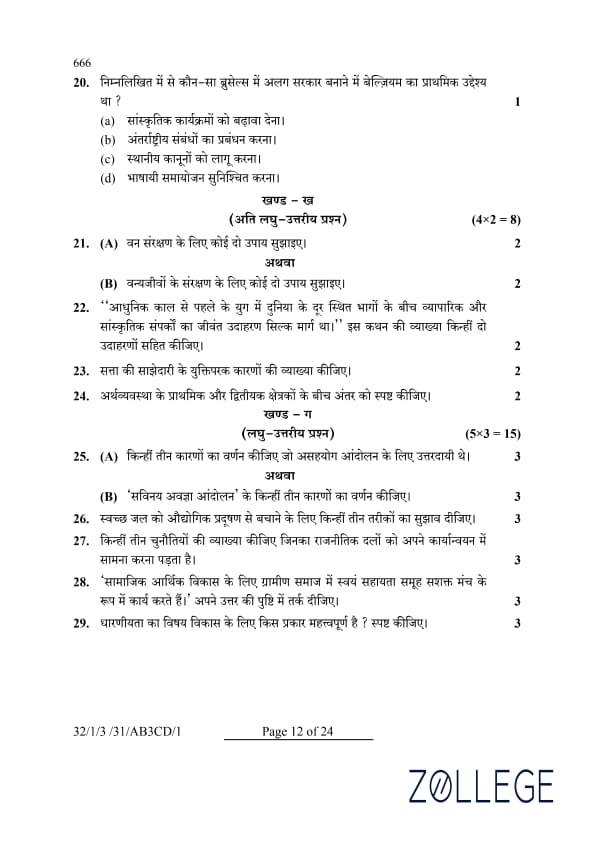
20. Which of the following was the primary objective of Belgium to form the separate government in Brussels?
|
(d) Ensuring linguistic accommodation | The primary objective of forming a separate government in Brussels was to ensure linguistic accommodation. Belgium is a country with multiple linguistic communities (primarily French and Dutch), and Brussels being a bilingual city required policies that balanced the needs of both communities. This step aimed to prevent conflicts and promote harmony among the linguistic groups. | ||||||||||
|
21(a). Suggest any two measures for the conservation of forests. |
1. Promote afforestation by planting trees and restoring degraded forest lands. 2. Enforce strict laws to prevent illegal logging and encroachment on forest areas. |
Conservation of forests can be achieved through afforestation and enforcing laws against illegal activities. These steps ensure the sustainability of ecosystems and combat climate change. | ||||||||||
|
21(b). Suggest any two measures for the conservation of wildlife. |
1. Establish wildlife sanctuaries and national parks. 2. Conduct awareness programs to educate people about wildlife conservation. |
Conservation of wildlife involves protecting habitats through sanctuaries and educating communities about the importance of biodiversity for maintaining ecological balance. | ||||||||||
|
22. "The Silk Route was a good example of vibrant pre-modern trade and cultural links between distant parts of the world." Explain the statement with any two examples. |
1. Facilitated trade of silk, spices, and textiles from Asia to Europe. 2. Spread religions like Buddhism from India to Central Asia and China. |
The Silk Route enabled vibrant trade and cultural exchanges. It transported goods like silk and spices globally and facilitated the spread of religions, enriching diverse cultures. | ||||||||||
|
23. Explain the prudential reasons for power sharing. |
1. Reduces social conflict and promotes stability. 2. Protects minority interests and ensures inclusivity. |
Prudential reasons for power sharing focus on reducing conflicts, promoting political stability, and protecting minority interests, ensuring a balanced and inclusive governance system. | ||||||||||
|
24. Differentiate between primary and secondary sectors of the economy. |
1. Primary sector involves resource extraction like agriculture and mining. 2. Secondary sector focuses on manufacturing and industrial activities. |
The primary sector extracts natural resources, forming the economic base. The secondary sector adds value by transforming raw materials into finished products, driving industrial growth. | ||||||||||
|
25(a). Describe any three causes that led to the Non-Cooperation Movement. |
1. Jallianwala Bagh Massacre: Shocked the nation and fueled anger. 2. Rowlatt Act: Allowed arrests without trial, sparking protests. 3. Khilafat Movement: United Hindus and Muslims against British rule. |
The Non-Cooperation Movement was driven by events like the Jallianwala Bagh massacre, the oppressive Rowlatt Act, and Gandhi's support for the Khilafat Movement to promote unity and resist colonial rule. | ||||||||||
|
25(b). Describe any three causes of the Civil Disobedience Movement. |
1. Salt Law: Symbolized British oppression, leading to the Dandi March. 2. Economic Depression: Worsened conditions for Indian farmers. 3. Simon Commission: Sparked protests due to lack of Indian representation. |
The Civil Disobedience Movement arose from grievances like the unjust Salt Law, the global economic depression, and the exclusion of Indians from the Simon Commission. | ||||||||||
|
26. Suggest any three ways to protect fresh water from industrial pollution. |
1. Install Effluent Treatment Plants (ETPs). 2. Enforce strict environmental laws. 3. Adopt cleaner technologies in industries. |
Freshwater can be protected by treating industrial waste through ETPs, enforcing environmental regulations, and adopting cleaner production technologies to reduce pollution. | ||||||||||
|
27. Explain any three challenges that political parties often face in their functioning. |
1. Lack of internal democracy within parties. 2. Corruption and dependence on money power. 3. Dynastic succession, limiting fair opportunities. |
Political parties face challenges like internal decision-making being concentrated among a few leaders, financial corruption due to election funding needs, and dynastic control that undermines merit-based opportunities. | ||||||||||
|
28. "Self-help-groups (SHGs) in rural society serve as empowering platforms towards socio-economic development." Give arguments in support of your answer. |
1. Provide micro-credit for financial independence. 2. Improve social status, especially for women. 3. Encourage teamwork and collective decision-making. |
SHGs empower rural communities by providing financial support for businesses, enhancing social status for women, and fostering teamwork and unity through collective decision-making. | ||||||||||
|
29. How is the issue of sustainability important for development? Explain. |
1. Ensures resources for future generations. 2. Minimizes environmental degradation. 3. Promotes long-term economic growth. |
Sustainability is essential for preserving resources, reducing environmental damage, and fostering long-term economic growth without compromising ecological balance. | ||||||||||
|
30(a). How did the ideology of 'liberalism' affect Europe in the early nineteenth century? |
1. Influenced revolutions advocating liberty and equality. 2. Promoted free markets and industrial growth. 3. Inspired movements for national unification. |
Liberalism in 19th-century Europe fostered political and economic changes, inspiring revolutions, supporting industrial growth, and advocating for unification in nations like Italy and Germany. | ||||||||||
|
30(b). Explain the process of formation of 'United Kingdom of Great Britain'. |
1. Union of England and Wales (1536). 2. Union with Scotland through the Act of Union (1707). 3. Suppression of Ireland, forming the UK of Great Britain and Ireland (1801). |
The United Kingdom was formed through acts of union integrating England, Wales, and Scotland, later including Ireland, leading to a centralized political structure. | ||||||||||
|
31(a). Analyse the advantages of Natural Gas as a source of energy. |
1. Cleaner energy source with fewer pollutants. 2. Cost-effective and efficient. 3. Versatile for power, cooking, and transportation. |
Natural gas is a clean, efficient, and versatile energy source used for electricity generation, cooking, and as fuel for vehicles, making it a sustainable choice. | ||||||||||
|
31(b). 'Minerals generally occur in different rocks.' Examine the statement. |
1. Igneous rocks host minerals like feldspar and mica. 2. Sedimentary rocks contain gypsum and limestone. 3. Metamorphic rocks host marble and graphite. |
Minerals are found in various rocks formed through geological processes, with igneous, sedimentary, and metamorphic rocks hosting distinct types. | ||||||||||
|
32(a). Analyse any five values of democracy. |
1. Promotes equality and justice. 2. Protects fundamental freedoms. 3. Encourages citizen participation. 4. Ensures government accountability. 5. Resolves conflicts peacefully. |
Democracy values equality, justice, freedom, participation, and accountability, ensuring fair governance and societal harmony. | ||||||||||
|
32(b). "The passion for respect and freedom are the basis of democracy." Justify the statement. |
1. Respects dignity and equality for all. 2. Ensures freedom of choice and decision-making. 3. Protects fundamental rights and promotes harmony. |
Democracy thrives on respect for individuals and freedom, ensuring equality, dignity, and societal harmony for a just governance system. | ||||||||||
|
33(a). "Globalisation is the process of rapid integration or interconnection between countries." Explain the statement with examples. |
1. Encourages global trade and commerce. 2. Facilitates cultural exchanges. 3. Provides global job opportunities. |
Globalization integrates nations through trade, technology, and culture, enabling the exchange of goods, ideas, and opportunities on a global scale. | ||||||||||
|
33(b). "Improvement in technology has stimulated the globalization process." Explain the statement with examples. |
1. Advances in communication and transport. 2. E-commerce connects global markets. 3. Automation aids in worldwide production. |
Technology accelerates globalization by improving communication, transportation, and production processes, fostering international trade and collaboration. | ||||||||||
|
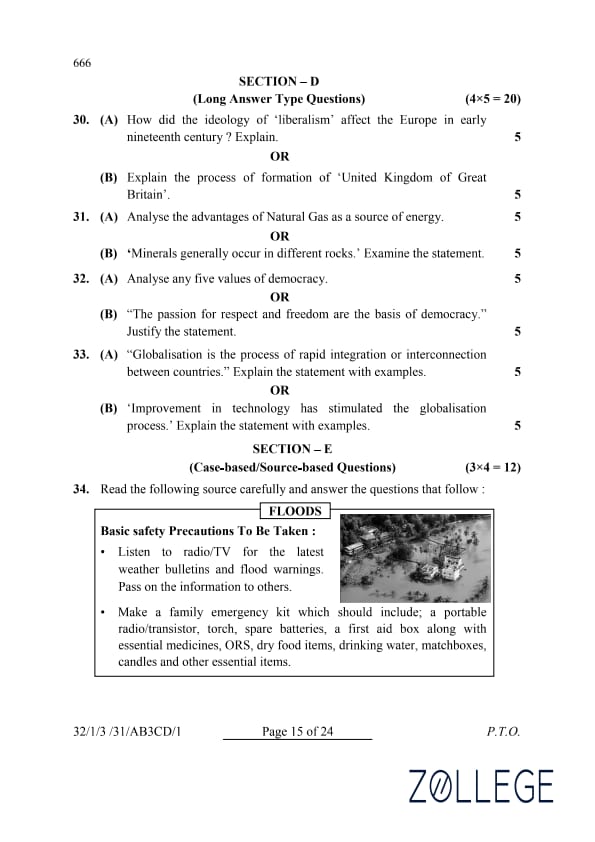
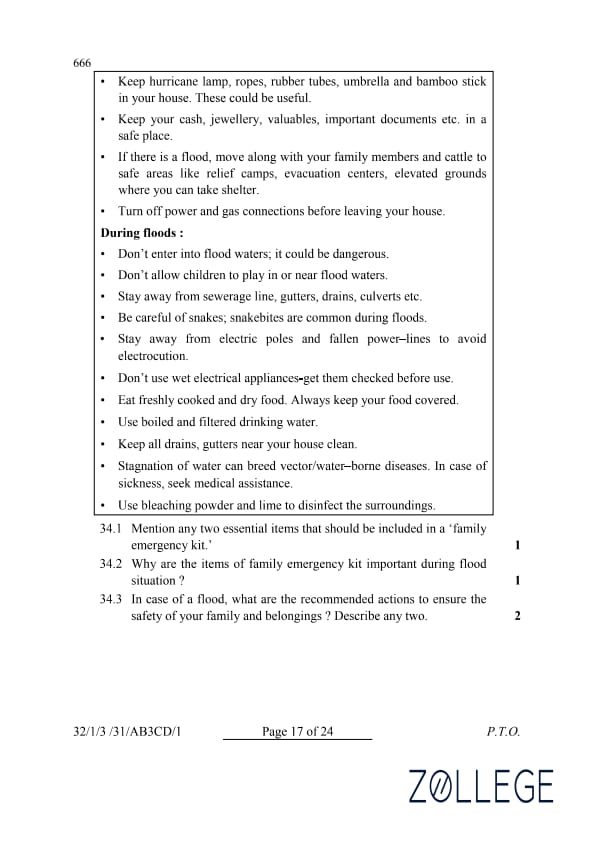
34.1. Mention any two essential items that should be included in a 'family emergency kit'. |
1. Portable radio or transistor. 2. Dry food items and clean drinking water. |
A family emergency kit ensures survival and safety during floods. Items like a portable radio keep families updated, while food and water prevent dehydration and hunger in emergencies. | ||||||||||
|
34.2. Why are the items of family emergency kit important during flood situations? |
1. Survival and safety. 2. Communication during emergencies. |
Emergency kits provide essentials like food, water, and a radio for survival. Radios keep families informed about evacuation plans and safety measures during floods. | ||||||||||
|
34.3. In case of a flood, what are the recommended actions to ensure the safety of your family and belongings? |
1. Move to safe areas like relief camps. 2. Turn off power and gas connections. |
Moving to safe areas reduces the risk of harm, while turning off power and gas prevents accidents like fires or electrocution during floods. | ||||||||||
|
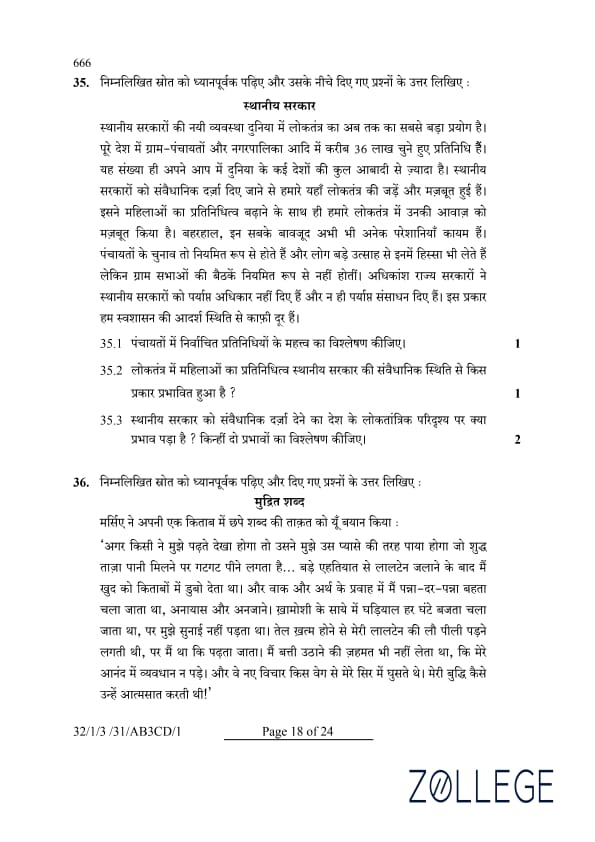
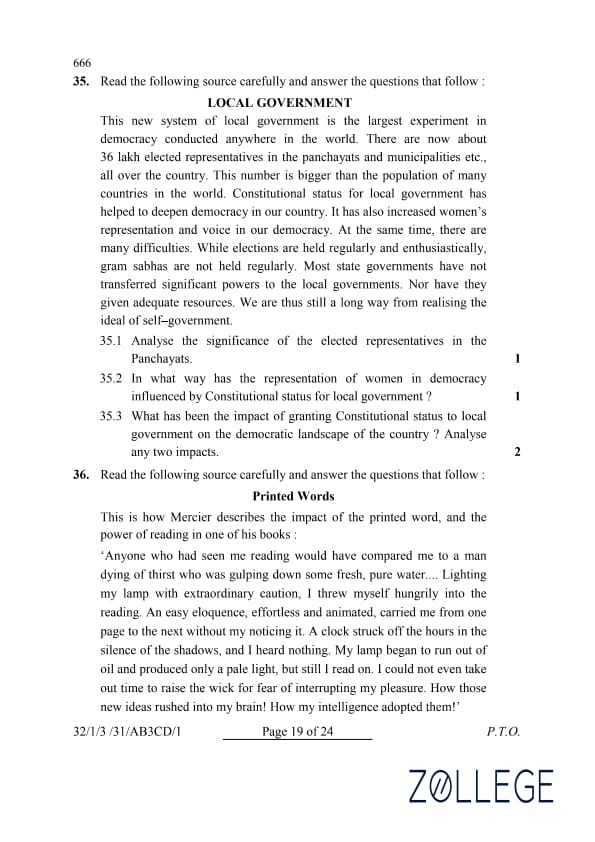
Question 35: Read the following source carefully and answer the questions that |
1. Grassroots governance. 2. Addressing local issues effectively. |
Elected representatives in Panchayats empower local communities by addressing grassroots issues, ensuring efficient governance, and enhancing public participation in decision-making. | ||||||||||
|
35.2. In what way has the representation of women in democracy been influenced by Constitutional status for local government? |
1. Reservation of seats for women. 2. Promoting gender equality in governance. |
Constitutional status ensures reserved seats for women in Panchayats, enabling their participation in governance and fostering gender equality in decision-making. | ||||||||||
|
35.3. What has been the impact of granting Constitutional status to local government on the democratic landscape of the country? Analyse any two impacts. |
1. Decentralisation of power. 2. Promoting inclusive development. |
Constitutional status decentralizes governance, empowering local bodies to address community needs. It also promotes inclusivity by giving marginalized groups a voice in governance. | ||||||||||
|
Question 36: Read the following source carefully and answer the questions that |
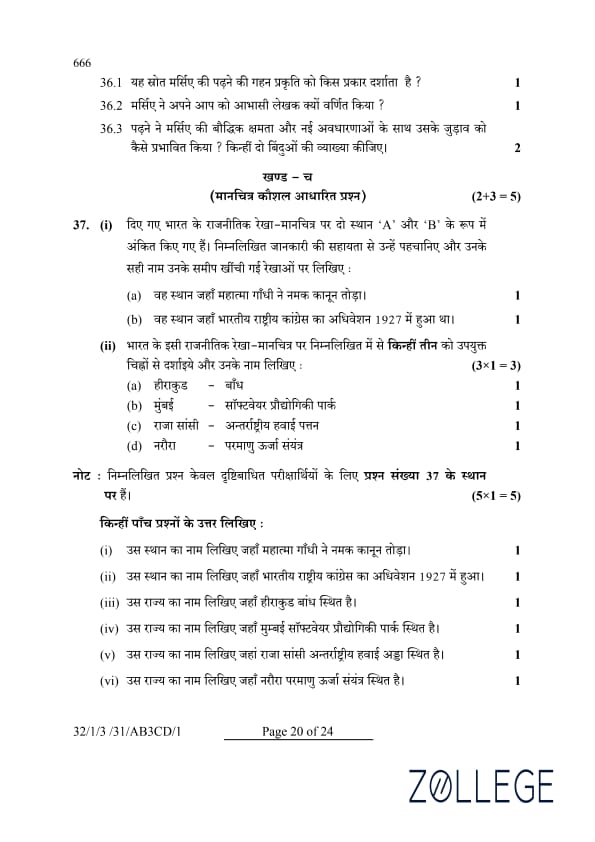
Mercier was deeply captivated, moving effortlessly through pages and losing track of time while reading. | The passage shows Mercier's absorption in reading as he compared it to quenching thirst, describing how he became completely engrossed in the text, losing awareness of his surroundings. | ||||||||||
|
36.2. Why did Mercier describe himself as a virtual writer? |
He lived through the characters and ideas, as if he were creating them himself. | Mercier's deep imaginative connection with the books allowed him to internalize and re-live the ideas and characters, highlighting the transformative impact of reading. | ||||||||||
|
36.3. How did reading influence Mercier's intellectual capacity and his engagement with new concepts? Explain in any two points. |
1. Broadened his understanding of the world. 2. Encouraged critical thinking and connection with evolving ideologies. |
Reading exposed Mercier to diverse ideas and perspectives, enhancing his intellectual horizon. It also stimulated critical thinking and a deeper engagement with contemporary concepts. | ||||||||||
|
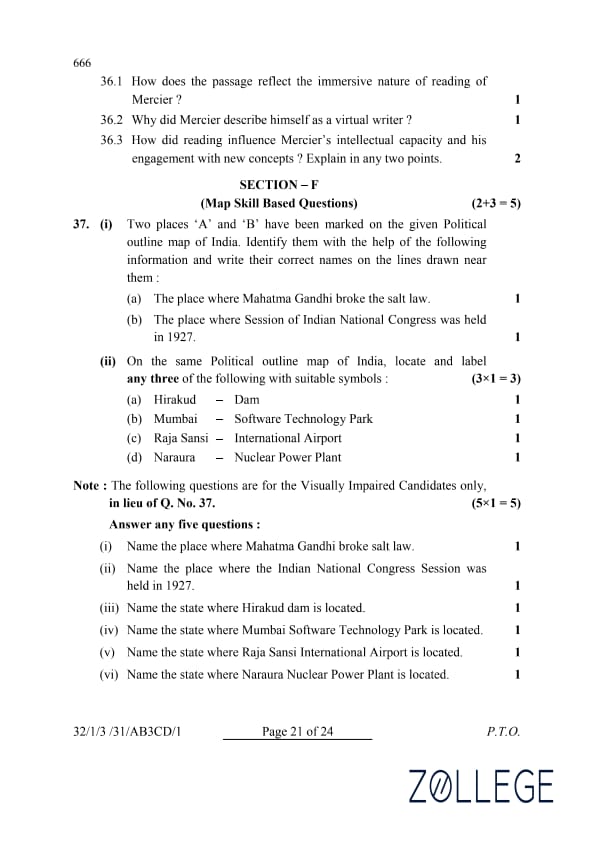
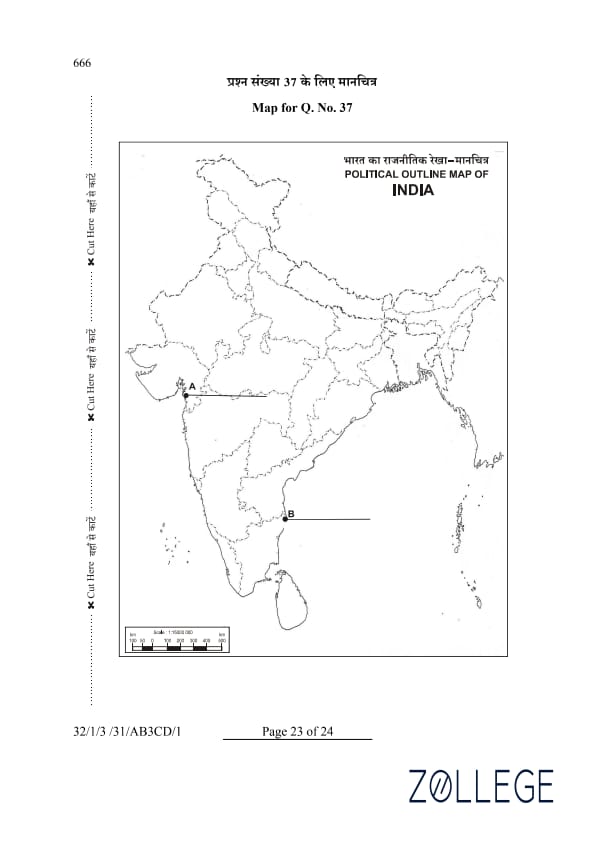
37.1. Two places 'A' and 'B' have been marked on the given Political outline map of India. Identify them with the help of the given information:
|
1. Dandi 2. Madras |
Dandi is significant for the Salt March led by Gandhi, symbolizing defiance of British laws. Madras hosted the 1927 Congress session, emphasizing India's push for independence. | ||||||||||
|
37.2. Locate and label any three of the following on the Political outline map of India:
|
1. Hirakud Dam - Odisha 2. Mumbai Software Technology Park - Maharashtra 3. Raja Sansi International Airport - Amritsar, Punjab |
Locations like Hirakud Dam (Odisha) and Mumbai Software Park (Maharashtra) highlight India's infrastructural and technological development. Raja Sansi Airport (Punjab) emphasizes connectivity. |


*The article might have information for the previous academic years, please refer the official website of the exam.