
CBSE Class 10 2025 Social Science Question Paper Set-1 32/4/ 1 (Available): Download Answer Key and Solution PDF

.jpg?tr=h-55,w-55,c-force)
Content Strategist|Tech-innovator|National Hackathon Winner | Updated On - Oct 15, 2025
CBSE 2025 Class 10th Board Social Science exam was held on February 25, 2025. The CBSE Class 10 Social Science exam is worth 80 marks, with an extra 20 Marks for internal assessment. The question paper contains MCQs, short and long answers that test students' knowledge.
The CBSE Class 10th Social Science Examination question paper and solution PDF is available for download here.
CBSE Class 10 2025 Social Science Question Paper Set 1- (32/4/1) With Solution PDF
| CBSE Class 10 Social Science Question Paper With Answer Key |  Download PDF Download PDF |
Check Solution |
CBSE Board Class 10 Social Science Questions with Solutions
Question 1:
Why was the Silk Route considered a good example of vibrant pre-modern trade?
View Solution
The Silk Route was not only a major trade route for goods such as silk, spices, and precious metals but also played a significant role in the cultural and intellectual exchange between the East and the West. This trade route connected various regions, including China, Central Asia, India, the Middle East, and Europe, facilitating the exchange of ideas, art, religions, and culture. Therefore, the main reason for considering the Silk Route as a good example of vibrant pre-modern trade is the trade and cultural exchange it enabled.
Conclusion.
The correct answer is (D) due to trade and cultural exchange.
Quick Tip: Black soil is very rich in minerals and is particularly good for crops like cotton due to its fertility.
How did the British East India Company use Print Culture to promote its interests in India?
View Solution
The British East India Company used print culture as a tool to suppress nationalist ideas in India. They imposed strict censorship on Indian newspapers to prevent the spread of anti-colonial sentiment. By controlling the flow of information, they aimed to maintain their hold on power and prevent any movements that could challenge British rule.
Conclusion.
The correct answer is (A) by censoring the Indian newspapers.
Quick Tip: Coffee is widely cultivated in India, particularly in the Western Ghats of Karnataka and Tamil Nadu, and is known for its strong aroma.
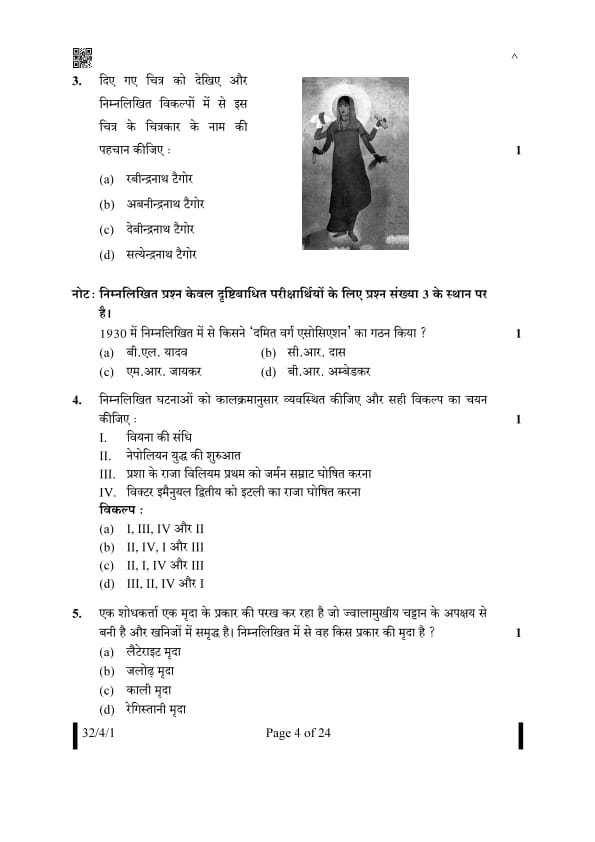
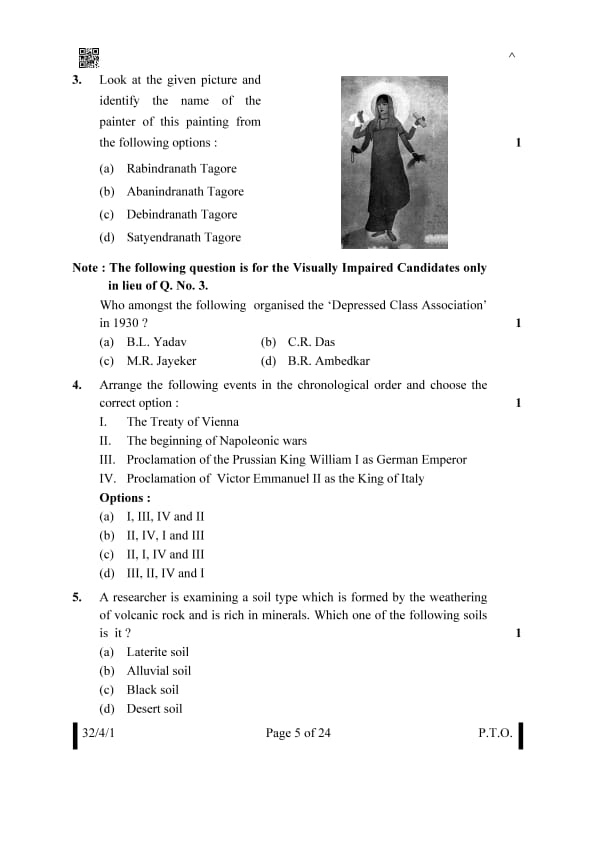
Look at the given picture and identify the name of the painter of this painting from the following options:

View Solution
Abanindranath Tagore, a prominent artist, was known for his contributions to the Indian art movement. He was one of the leaders of the Bengal Renaissance and played a significant role in developing modern Indian art with an influence of both Indian traditions and Western styles. Rabindranath Tagore, his elder brother, was a well-known poet, not a painter.
Conclusion.
The correct answer is (B) Abanindranath Tagore.
Quick Tip: Abanindranath Tagore, a prominent artist, was known for his contributions to the Indian art movement.
Arrange the following events in chronological order and choose the correct option:
1. The Treaty of Vienna
II. The beginning of Napoleonic wars
III. Proclamation of the Prussian King William I as German Emperor
IV. Proclamation of Victor Emmanuel II as the King of Italy
View Solution
The chronological order of the events is as follows:
1. The beginning of the Napoleonic wars (II) started in 1799.
2. The Proclamation of Victor Emmanuel II as the King of Italy (IV) took place in 1861.
3. The Treaty of Vienna (I) was signed in 1815, which concluded the Napoleonic wars.
Thus, the correct order is II, IV, and I.
Conclusion.
The correct answer is (D) II, IV, and I.
Quick Tip: Remember the chronological order of the events carefully with the exact timeline.
A researcher is examining a soil type which is formed by the weathering of volcanic rock and is rich in minerals. Which one of the following soils is it?
View Solution
Black soil is formed by the weathering of volcanic rocks and is rich in minerals such as iron, magnesium, and calcium. It is highly fertile and well-suited for growing cotton. This soil type is found primarily in regions with a volcanic origin, such as parts of Maharashtra, Madhya Pradesh, and Gujarat.
Conclusion.
The correct answer is (C) Black soil.
Quick Tip: It is highly fertile and well-suited for growing cotton. This soil type is found primarily in regions with a volcanic origin.
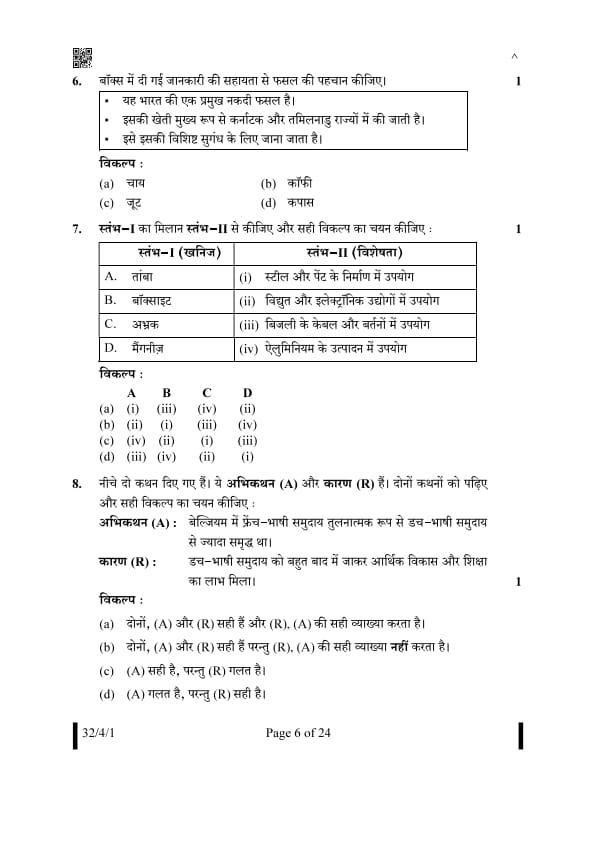
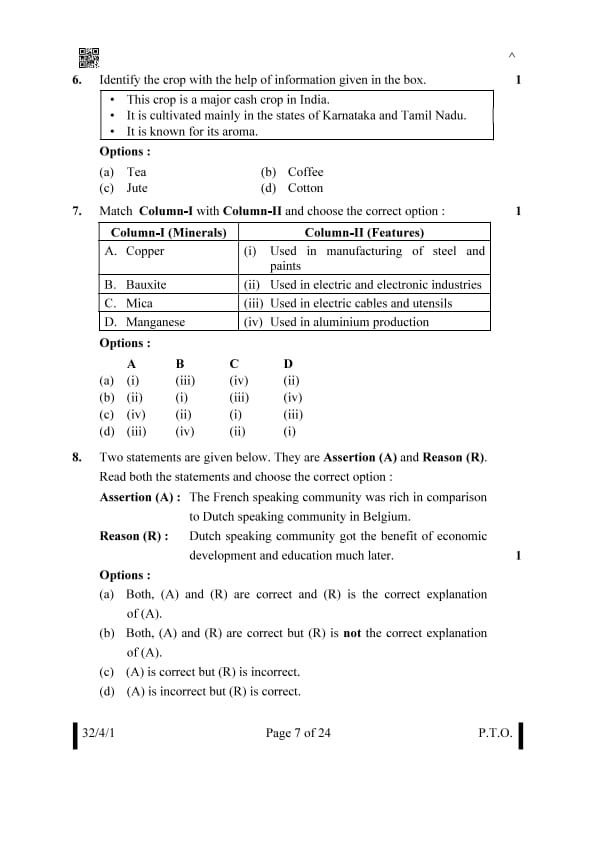
Identify the crop with the help of information given in the box:
This crop is a major cash crop in India. It is cultivated mainly in the states of Karnataka and Tamil Nadu. It is known for its aroma.
Correct Answer: (B) Coffee
View Solution
Coffee is a major cash crop in India, especially in the southern states of Karnataka and Tamil Nadu. Known for its aroma and distinctive taste, it is one of the most important agricultural exports of India.
Conclusion.
The correct answer is (B) Coffee.
Quick Tip: Coffee is one of the most important agricultural exports of India.
Match Column-I with Column-II and choose the correct option:
Column-I (Minerals) Column-II (Features)
A. Copper (i) Used in manufacturing of steel and plants
B. Bauxite (ii) Used in electric and electronic industries
C. Mica (iii) Used in electric cables and utensils
D. Manganese (iv) Used in aluminium production
View Solution
The correct matching of minerals and their features is:
- Copper is used in manufacturing steel and plants (i)
- Bauxite is used in aluminium production (ii)
- Mica is used in electric cables and utensils (iii)
- Manganese is used in the manufacture of steel and iron (iv)
Conclusion.
The correct answer is (B) A - (i), B - (ii), C - (iii), D - (iv).
Quick Tip: The correct matching of minerals and their features like plants, production and more.
Two statements are given below. They are Assertion (A) and Reason (R). Read both the statements and choose the correct option:
Assertion (A): The French speaking community was rich in comparison to the Dutch speaking community in Belgium.
Reason (R): Dutch speaking community got the benefit of economic development and education much later.
View Solution
In Belgium, the French-speaking community was wealthier and had more access to education and economic development compared to the Dutch-speaking community, who were marginalized for a long time. The Dutch-speaking community only started gaining access to economic benefits and education later on, especially after reforms that promoted equality. This made Reason (R) a valid explanation for Assertion (A).
Conclusion.
Both Assertion (A) and Reason (R) are correct, and Reason (R) correctly explains Assertion (A), making option (A) the correct answer.
Quick Tip: Remember that Assertion-Reason questions require evaluating the relationship between both statements to determine if they are connected and if one explains the other.
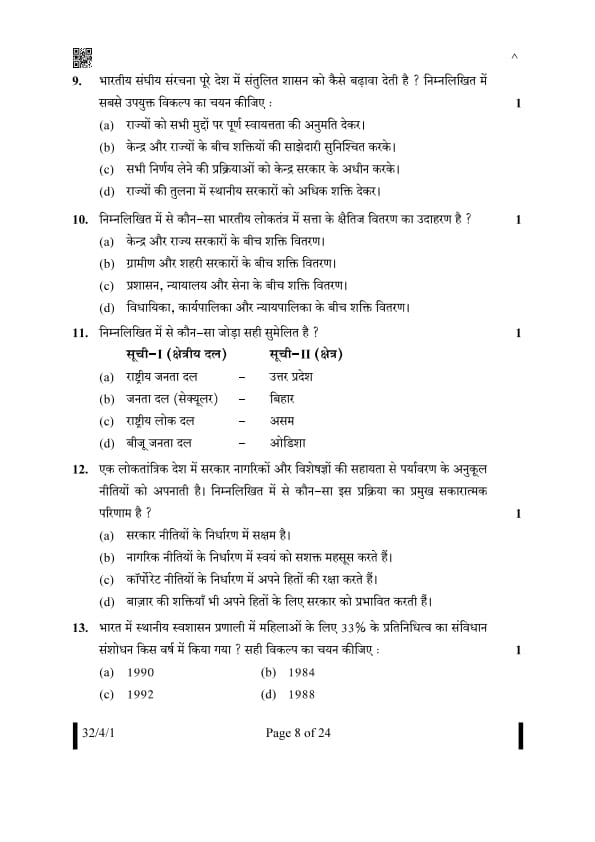
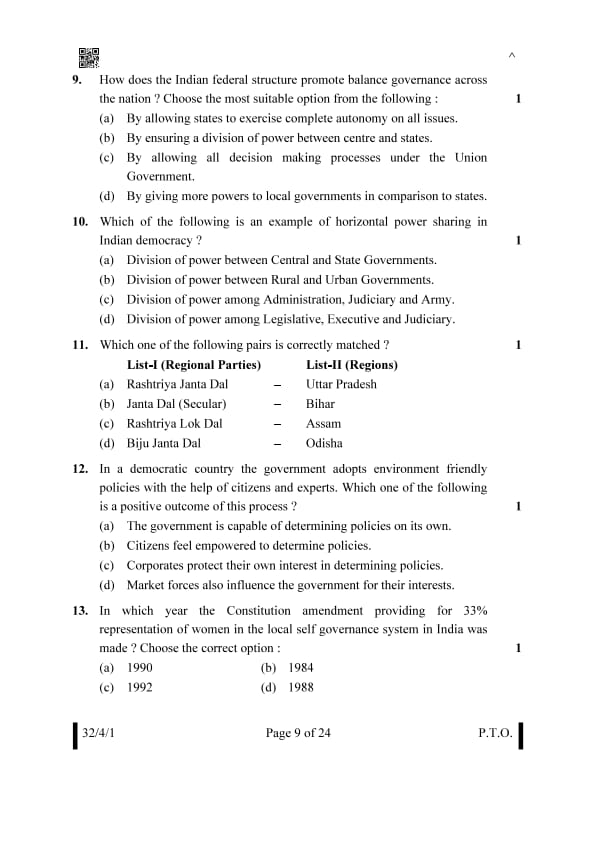
How does the Indian federal structure promote balanced governance across the nation?
View Solution
The Indian federal structure is based on the distribution of powers between the central government and state governments. This division of responsibilities ensures that governance is balanced across the country and both levels of government function effectively. The Constitution of India outlines a list of subjects that are managed by the centre, the states, and both jointly, promoting a cooperative federalism model.
Conclusion.
The Indian federal structure promotes balanced governance by ensuring a division of power between the centre and states, making option (B) the correct answer.
Quick Tip: Keep in mind that the Indian system of federalism is unique because it is not based on equality of powers but on a division of powers, ensuring cooperation between levels of government.
Which of the following is an example of horizontal power sharing in Indian democracy?
View Solution
Horizontal power sharing refers to the distribution of powers among different branches of government at the same level. In India, the power is divided among the three branches of government: the Legislative, Executive, and Judiciary. This ensures that no single branch becomes too powerful, and each branch can check and balance the others. This system is a core aspect of the Indian Constitution's framework of governance.
Conclusion.
The division of power among the Legislative, Executive, and Judiciary is an example of horizontal power sharing, making option (D) the correct answer.
Quick Tip: Horizontal power sharing ensures that no single branch of government dominates, which helps in maintaining a balance of power and accountability.
Which one of the following pairs is correctly matched?
List-I (Regional Parties) List-II (Regions)
View Solution
- Rashtriya Janta Dal is primarily associated with the state of Bihar.
- Janta Dal (Secular) is associated with Karnataka.
- Rashtriya Lok Dal is associated with Uttar Pradesh.
- Biju Janata Dal is based in Odisha.
Conclusion.
The correct answer is (D) A - (iii), B - (iv), C - (i), D - (ii).
Quick Tip: All are primarily associated with the respective states.
In a democratic country, the government adopts environment-friendly policies with the help of citizens and experts. Which one of the following is a positive outcome of this process?
View Solution
In a democratic setup, when citizens and experts are involved in determining policies, it results in the empowerment of citizens. They get a sense of participation and contribution to policy-making, especially in the areas of environment, which impact their daily lives. This process also ensures that the policies are informed and beneficial to society.
Conclusion.
The positive outcome of the process is that citizens feel empowered to determine policies, making option (B) the correct answer.
Quick Tip: A sense of participation and contribution to policy-making, especially in the areas of environment, which impact their daily lives.
In which year the Constitution amendment providing for 33 percentage representation of women in the local self-governance system in India was made?
View Solution
The 73rd and 74th Constitutional Amendments of 1992 were significant milestones for women's participation in local governance. These amendments provided for 33 percentage reservation of seats for women in Panchayats and Municipalities. This was a major step in ensuring women's participation in decision-making at the grassroots level.
Conclusion.
The correct year of the amendment is 1992, making option (C) the correct answer.
Quick Tip: These amendments provided for 33 percentage reservation of seats for women in Panchayats and Municipalities.
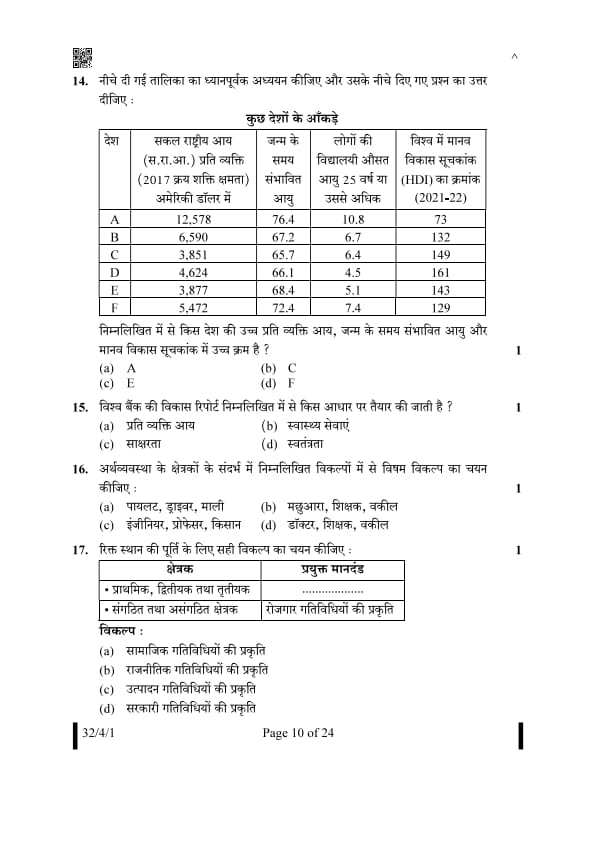
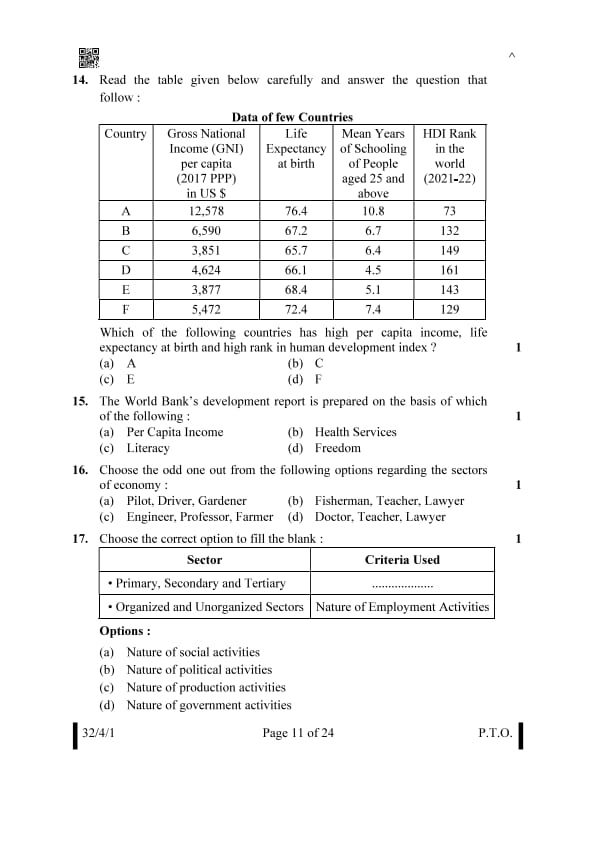
Choose the odd one out from the following:
View Solution
- Per Capita Income: A monetary measure used to assess economic well-being.
- Health Services, Literacy, and Freedom: Indicators of human development, focusing on social welfare and quality of life.
Conclusion: Since Per Capita Income is an economic measure while the others are social indicators, the odd one out is \( \mathbf{(A)} \).
Quick Tip: Economic indicators like Per Capita Income measure financial aspects, while social indicators assess quality of life and development.
Choose the odd one out from the following options regarding the sectors of economy:
View Solution
- Pilot, Driver, Gardener: Engage in service-based activities (tertiary sector).
- Fisherman, Teacher, Lawyer: Belong to different economic sectors, but majorly service-oriented.
- Doctor, Teacher, Lawyer: Belong to the tertiary sector (service industry).
- Engineer, Professor, Farmer: Farmer belongs to the primary sector (agriculture), making this group inconsistent.
Conclusion: The odd one out is \( \mathbf{(C)} \) because the farmer is from the primary sector while the others belong to different sectors.
Quick Tip: Economic sectors classify jobs into Primary (natural resource extraction), Secondary (manufacturing), and Tertiary (services).
Choose the correct option to fill the blank:
Sector Criteria Used
Primary, Secondary, and Tertiary
Organized and Unorganized Sectors
View Solution
- Economic sectors (Primary, Secondary, Tertiary) are classified based on nature of production activities.
- Organized and Unorganized sectors are based on employment structure, not social or political factors.
Conclusion: The correct answer is \( \mathbf{(C)} \), as economic sectors are classified based on the nature of production activities.
Quick Tip: Primary, Secondary, and Tertiary sectors focus on production activities, while Organized and Unorganized sectors classify employment conditions.
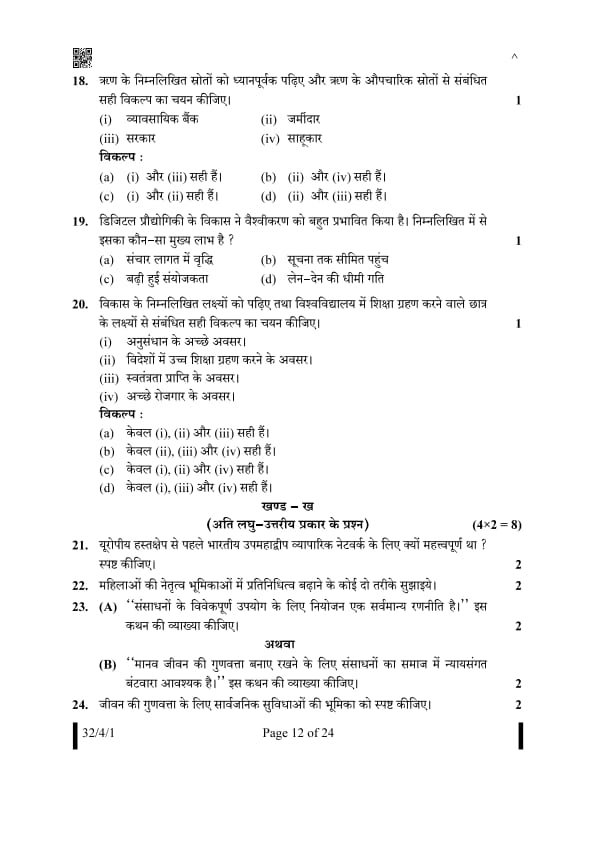
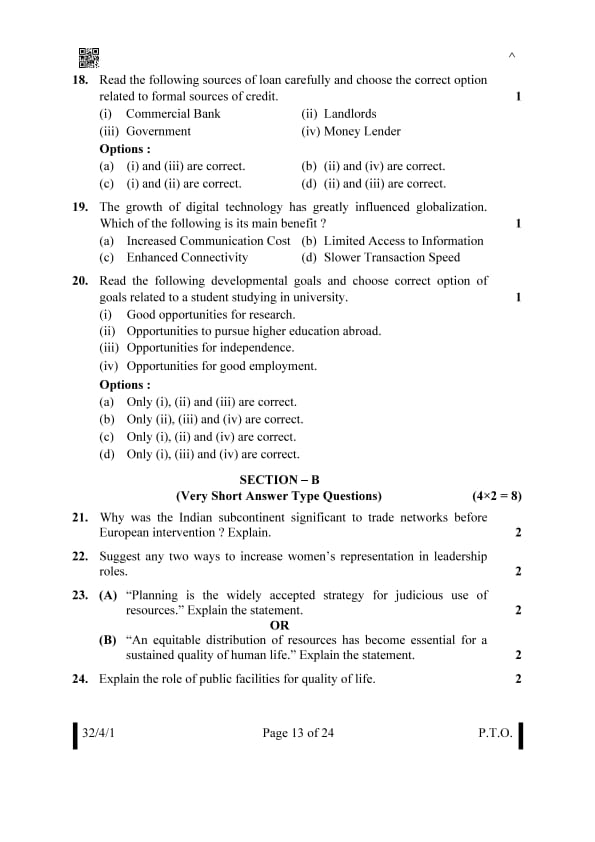
Read the following sources of loan carefully and choose the correct option related to formal sources of credit:
View Solution
- Formal sources of credit: These are institutions regulated by the government, ensuring fair lending practices.
- Commercial Banks and Government are formal sources as they follow legal procedures and offer fair interest rates.
- Landlords and Money Lenders are informal sources, often charging high interest rates without legal regulations.
Conclusion: The correct answer is \( \mathbf{(A)} \), as Commercial Banks and Government institutions are formal credit sources.
Quick Tip: Formal credit sources include banks and government schemes, while informal sources involve private lenders who may charge high interest rates.
The growth of digital technology has greatly influenced globalization. Which of the following is its main benefit?
View Solution
- Digital technology enables instant global communication, linking people and businesses across countries.
- It reduces communication costs rather than increasing them.
- It provides easier and faster access to information instead of limiting it.
- It speeds up transactions instead of slowing them down.
Conclusion: The main benefit of digital technology in globalization is \( \mathbf{(C)} \) Enhanced Connectivity.
Quick Tip: Digital technology boosts globalization by improving communication, increasing information access, and enabling faster transactions.
Read the following developmental goals and choose the correct option related to a student studying in university:
(i) Good opportunities for research.
(ii) Opportunities to pursue higher education abroad.
(iii) Opportunities for independence.
(iv) Opportunities for good employment.
View Solution
- A university student aims for research opportunities, higher education abroad, and good employment prospects.
- While independence is important, it is not a direct developmental goal related to university education.
Conclusion: The correct answer is \( \mathbf{(C)} \), as research, international education, and employment opportunities are key university goals.
Quick Tip: University education primarily focuses on academic growth, career opportunities, and advanced learning rather than personal independence.
Why was the Indian subcontinent significant to trade networks before European intervention? Explain.
View Solution
1. Strategic Location: India was located between the East and West, serving as a crucial link in the Silk Route and Indian Ocean trade.
2. Rich Resources: The subcontinent was known for its spices, textiles, and precious stones, making it a valuable trade hub.
3. Flourishing Ports: Ancient ports like Lothal, Calicut, and Surat facilitated maritime trade with Arab, Chinese, and Roman merchants.
Quick Tip: India's geographical location and abundant resources made it a vital center for trade even before European colonization.
Suggest any two ways to increase women's representation in leadership roles.
View Solution
1. Reservation Policies: Implementing quotas in political and corporate sectors ensures fair representation.
2. Education and Skill Development: Encouraging higher education and leadership training programs for women boosts their participation.
Quick Tip: Promoting education and enforcing policies for gender inclusion are key to increasing women's leadership roles.
(A) “Planning is the widely accepted strategy for judicious use of resources.” Explain the statement.
View Solution
- Planning helps in preventing resource depletion by ensuring systematic and sustainable usage.
- It allows for the equitable distribution of resources among all regions, preventing overexploitation.
- Proper planning supports economic growth while preserving the environment.
OR
(B) “An equitable distribution of resources has become essential for a sustained quality of human life.” Explain the statement.
% Solution
Solution:
- Unequal resource distribution leads to social and economic disparities.
- Fair distribution ensures every individual has access to basic needs like water, energy, and food.
- It promotes social harmony and reduces conflicts over resources.
Quick Tip: Proper planning and equitable resource distribution are essential for long-term sustainability and balanced development.
(B) Explain the role of public facilities for quality of life.
View Solution
- Public facilities such as education, healthcare, transport, and sanitation improve the standard of living.
- They ensure that essential services are accessible to all, reducing inequalities.
- Government investment in public facilities contributes to economic growth and social well-being.
Quick Tip: Strong public infrastructure is crucial for economic development and improving people's quality of life.
Explain the role of public facilities for quality of life.
View Solution
- Public facilities such as education, healthcare, transport, and sanitation improve the standard of living.
- They ensure that essential services are accessible to all, reducing inequalities.
- Government investment in public facilities contributes to economic growth and social well-being.
Quick Tip: Strong public infrastructure is crucial for economic development and improving people's quality of life.
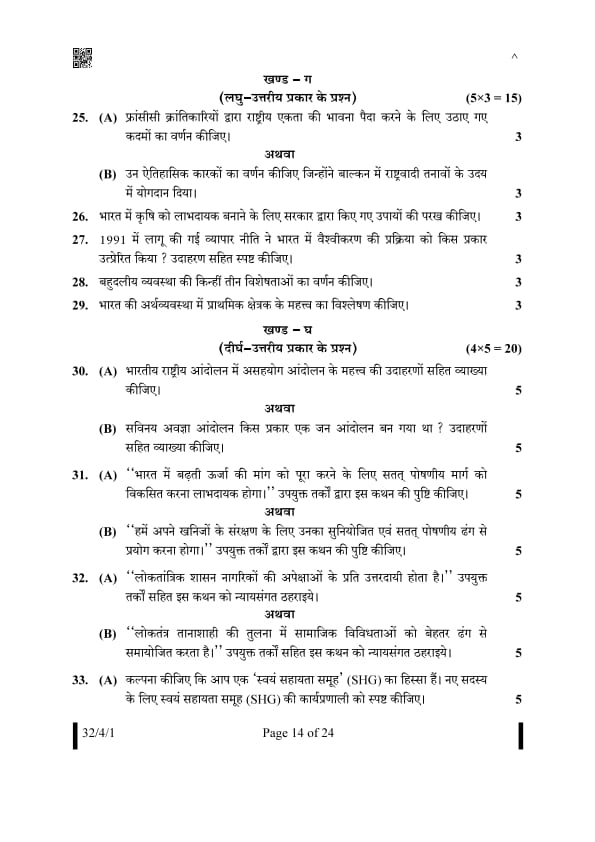
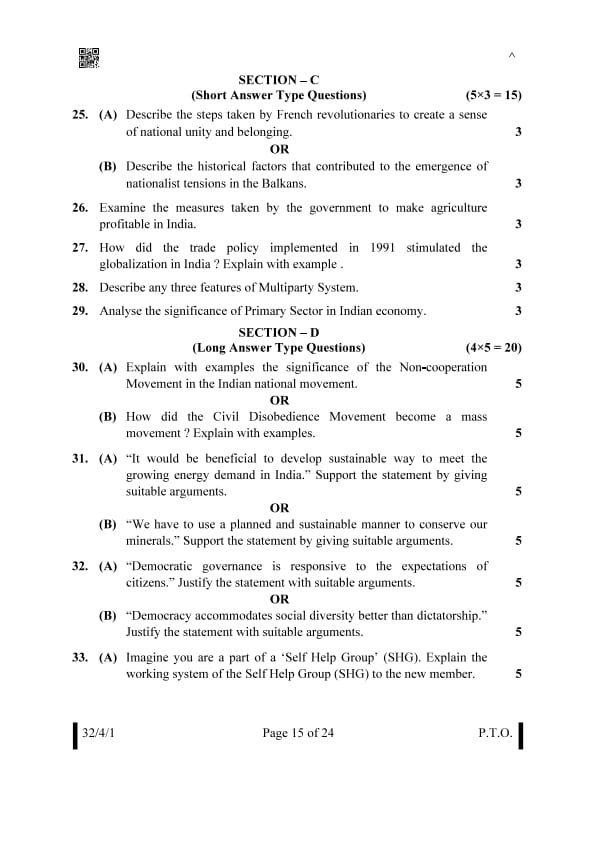
Describe the steps taken by French revolutionaries to create a sense of national unity and belonging.
View Solution
1. Introduction of a Common Identity: The revolutionaries introduced the idea of the nation as a united entity with common laws and customs.
2. Abolition of Monarchy: The monarchy was removed, and democratic principles were established to unify the people.
3. Promotion of National Symbols: The tricolor flag, the national anthem (La Marseillaise), and new administrative units were introduced to foster unity.
Quick Tip: The French Revolution played a crucial role in shaping modern nationalism through common identity and democratic values.
(A) Describe the historical factors that contributed to the emergence of nationalist tensions in the Balkans.
View Solution
1. Decline of the Ottoman Empire: The weakening of Ottoman rule led to power struggles among various ethnic groups.
2. Rise of Romantic Nationalism: Different communities in the Balkans developed a sense of identity and demanded independence.
3. European Interference: Rivalry among European powers such as Russia, Austria, and Britain further fueled tensions.
Quick Tip: The Balkans became a region of conflicts due to nationalist aspirations, weakening empires, and foreign interventions.
(B)Examine the measures taken by the government to make agriculture profitable in India.
View Solution
1. Introduction of Green Revolution: Adoption of high-yielding variety (HYV) seeds, fertilizers, and irrigation techniques.
2. Government Support: Implementation of Minimum Support Price (MSP) and subsidies for farmers.
3. Development of Infrastructure: Expansion of irrigation facilities, rural roads, and agricultural research centers.
Quick Tip: Government policies like MSP, irrigation development, and Green Revolution have significantly boosted India's agricultural sector.
How did the trade policy implemented in 1991 stimulate globalization in India? Explain with examples.
View Solution
1. Liberalization: Reduced restrictions on imports, leading to increased foreign goods in Indian markets.
2. Privatization: Reduced government control over industries, allowing private companies to expand globally.
3. Foreign Direct Investment (FDI): Allowed multinational companies (MNCs) like Coca-Cola and Samsung to invest in India.
Quick Tip: Economic reforms of 1991 transformed India’s economy by integrating it with the global market through liberalization and FDI.
Describe any three features of the multiparty system.
View Solution
1. Diverse Political Representation: Multiple parties represent different sections of society, ensuring broader political participation.
2. Coalition Governments: No single party may achieve a majority, leading to coalition governments and consensus-based decision-making.
3. Democratic Stability: Voters have more choices, leading to fair competition and reducing dominance by a single party.
Quick Tip: A multiparty system promotes political diversity and allows for coalition governments, increasing democratic representation.
Analyse the significance of the Primary Sector in the Indian economy.
View Solution
1. Employment Generation: The primary sector provides livelihoods to nearly half of India’s workforce, especially in agriculture.
2. Contribution to GDP: Agriculture, fishing, and forestry contribute significantly to India’s economy.
3. Supply of Raw Materials: Essential industries such as textiles and food processing depend on primary sector outputs.
Quick Tip: The primary sector remains crucial for India's economy due to its role in employment, GDP contribution, and raw material supply.
(A) Explain with examples the significance of the Non-Cooperation Movement in the Indian national movement.
View Solution
1. Mass Mobilization: The movement united people from different regions, bringing the national movement to the grassroots level.
2. Boycott of British Goods: Indians stopped using British goods, schools, and courts, leading to economic setbacks for the British.
3. Promotion of Swadeshi: The movement encouraged the use of Indian-made products, boosting indigenous industries.
4. Political Awakening: Millions became politically aware and actively participated in the freedom struggle.
5. End of Fear of British Rule: Indians gained confidence in their ability to resist colonial rule non-violently.
Quick Tip: The Non-Cooperation Movement (1920-1922) marked the first large-scale participation of Indians in the freedom struggle through non-violent means.
(B) How did the Civil Disobedience Movement become a mass movement? Explain with examples.
View Solution
1. Salt March (Dandi March): Mahatma Gandhi’s march to produce salt symbolized defiance against British laws.
2. Participation of Different Communities: Farmers, women, tribals, and factory workers joined the movement.
3. Boycott of Foreign Goods: People refused to pay taxes and stopped buying British goods.
4. Strengthened Nationalism: The movement spread to rural and urban areas, increasing nationalist sentiments.
5. British Suppression and Arrests: The repressive measures of the British led to further unity and determination among Indians.
Quick Tip: The Civil Disobedience Movement (1930-1934) expanded the freedom struggle by involving common citizens in defying British laws.
(A) "It would be beneficial to develop sustainable ways to meet the growing energy demand in India." Support the statement.
View Solution
1. Reduces Environmental Impact: Sustainable energy sources like solar and wind reduce pollution and carbon emissions.
2. Long-Term Availability: Renewable resources ensure a continuous supply of energy, unlike fossil fuels.
3. Economic Growth: Investment in renewable energy creates jobs and promotes technological advancement.
4. Energy Security: Dependence on imported fuel is reduced, strengthening India’s self-sufficiency.
5. Improved Quality of Life: Rural electrification and clean energy improve living conditions.
Quick Tip: Sustainable energy ensures a balance between economic growth and environmental protection.
(B) "We have to use a planned and sustainable manner to conserve our minerals." Support the statement.
View Solution
1. Limited and Non-Renewable: Minerals take millions of years to form, so they must be used wisely.
2. Prevention of Environmental Damage: Excessive mining causes land degradation and pollution.
3. Efficient Utilization: Recycling and using alternatives reduce wastage of minerals.
4. Economic Stability: Sustainable use ensures long-term economic benefits for industries.
5. Protection of Future Generations: Conservation helps maintain resources for future needs.
Quick Tip: Planned mineral use through conservation, recycling, and efficient mining practices ensures long-term benefits.
(A) "Democratic governance is responsive to the expectations of citizens." Justify the statement.
View Solution
1. Accountability: Elected leaders are responsible for addressing the needs of citizens.
2. Rule of Law: Ensures justice and equality through a transparent legal system.
3. Public Participation: People have the right to vote, protest, and express opinions.
4. Welfare Policies: Governments provide education, healthcare, and employment opportunities.
5. Social Justice: Democracy protects minority rights and promotes equality.
Quick Tip: Democracy ensures accountability, participation, and welfare, making governance responsive to people's needs.
(B) "Democracy accommodates social diversity better than dictatorship." Justify the statement.
View Solution
1. Equal Representation: Democracy allows different groups to voice their opinions.
2. Freedom of Speech: Citizens can express their views without fear.
3. Negotiation and Compromise: Democratic governments resolve conflicts peacefully.
4. Protection of Minority Rights: All communities have equal rights under democratic laws.
5. Long-Term Stability: Social harmony is maintained through fair governance.
Quick Tip: Democracy respects diversity by ensuring equal rights, representation, and peaceful conflict resolution.
(A) Imagine you are a part of a 'Self Help Group' (SHG). Explain the working system of the Self Help Group (SHG) to the new member.
View Solution
1. Small Group Formation: SHGs consist of 10-20 members, mostly women, who save money together.
2. Regular Savings and Loans: Members contribute small amounts regularly, and the group provides loans to those in need.
3. Low-Interest Credit: SHGs provide financial help at lower interest rates compared to banks and moneylenders.
4. Empowerment and Skill Development: Members receive training for income-generating activities like tailoring, handicrafts, and dairy farming.
5. Improved Social Status: SHGs promote self-reliance, decision-making, and women's empowerment.
Quick Tip: Self Help Groups (SHGs) empower people financially by encouraging savings, loans, and skill development.
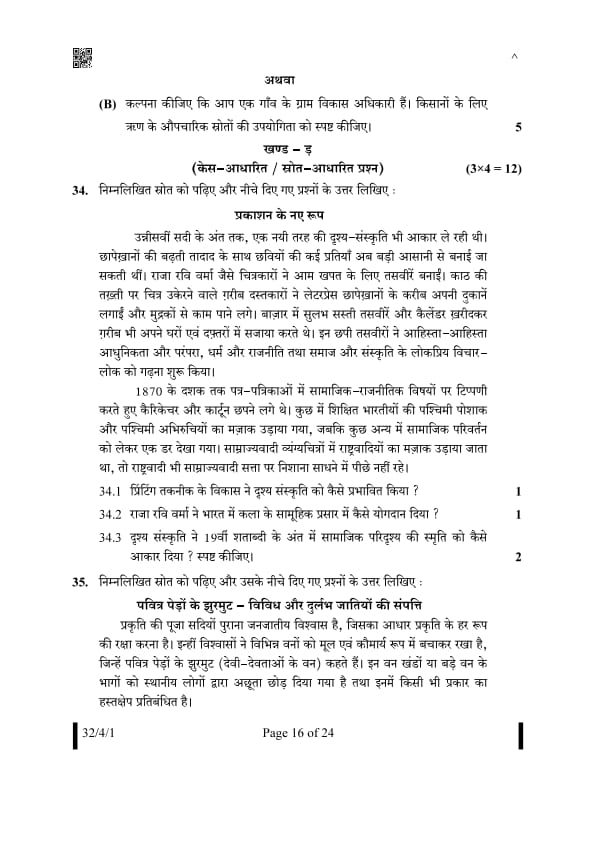
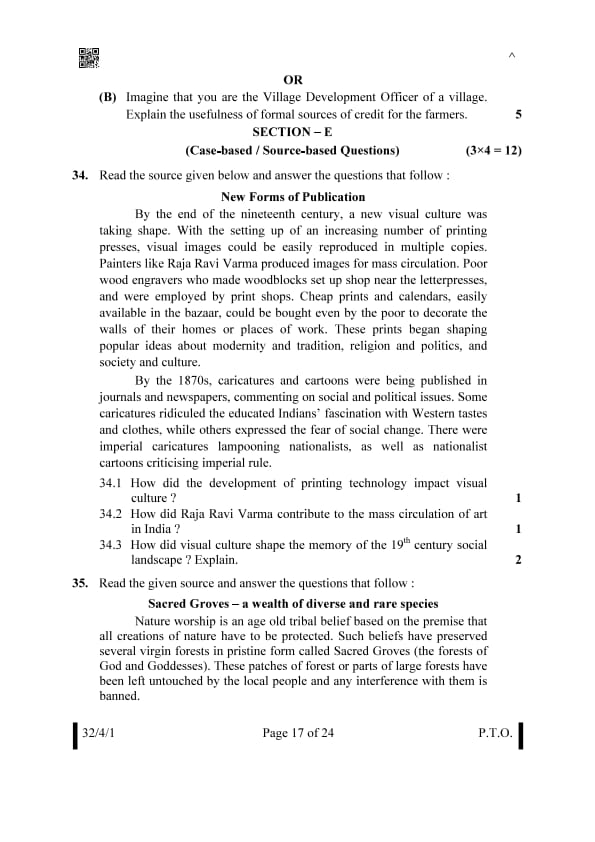
(B) Imagine you are a Village Development Officer of a village. Explain the usefulness of formal sources of credit for the farmers.
View Solution
1. Lower Interest Rates: Formal sources such as banks and cooperatives provide loans at lower interest rates compared to moneylenders.
2. Regulated and Transparent Process: Banks follow legal procedures, ensuring fair practices and protecting farmers from exploitation.
3. Long-Term Loans: Farmers can access long-term credit for purchasing equipment, seeds, and fertilizers, improving agricultural productivity.
4. Encourages Savings: Many banks provide savings accounts, helping farmers manage finances efficiently.
5. Government Subsidies and Support: Formal financial institutions often provide subsidies and special schemes for small and marginal farmers.
Quick Tip: Formal credit sources like banks and cooperatives offer affordable loans with legal protection, ensuring financial security for farmers.
(A) How did the development of printing technology impact visual culture?
View Solution
1. Mass Production of Images: Printing technology allowed the reproduction of images on a large scale, making art and literature accessible to the masses.
2. Dissemination of Ideas: It facilitated the spread of political, social, and religious messages through posters, cartoons, and newspapers.
3. Growth of Commercial Art: Advertisements, book illustrations, and calendars incorporated artistic visuals, influencing public perception.
Quick Tip: Printing technology revolutionized visual culture by making images widely accessible, influencing education, politics, and media.
(B) How did Raja Ravi Varma contribute to the mass circulation of art in India?
View Solution
1. Lithographic Prints: Raja Ravi Varma established a printing press to produce affordable lithographs of his paintings, making art accessible to the common people.
2. Depiction of Indian Mythology: His artwork, portraying Hindu gods and goddesses, popularized Indian culture and traditions.
3. Fusion of Indian and Western Art Styles: He blended Indian themes with European techniques, creating a distinct style that appealed to the masses.
Quick Tip: Raja Ravi Varma’s printing press democratized art, allowing people from all social backgrounds to access and appreciate fine artwork.
(C) How did visual culture shape the memory of the 19th-century social landscape? Explain.
View Solution
1. Political Cartoons and Posters: These visuals were used to criticize colonial rule and social injustices, shaping public opinion.
2. Religious and Cultural Identity: Visual representations in books and calendars helped preserve Indian traditions and strengthen nationalistic sentiments.
3. Photography and Documentation: The emergence of photography helped record historical events, social movements, and everyday life, influencing historical memory.
Quick Tip: Visual culture in the 19th century played a crucial role in preserving historical events, shaping national identity, and influencing public discourse.
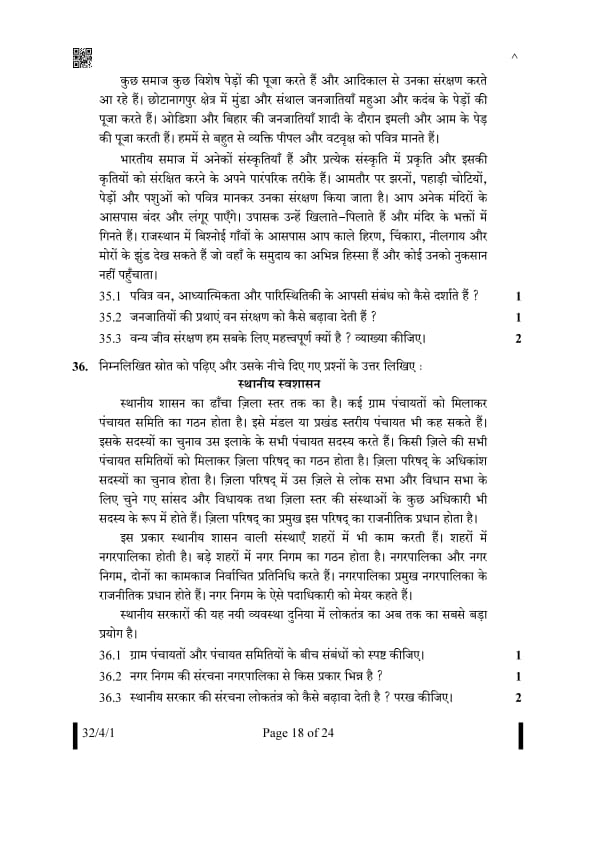
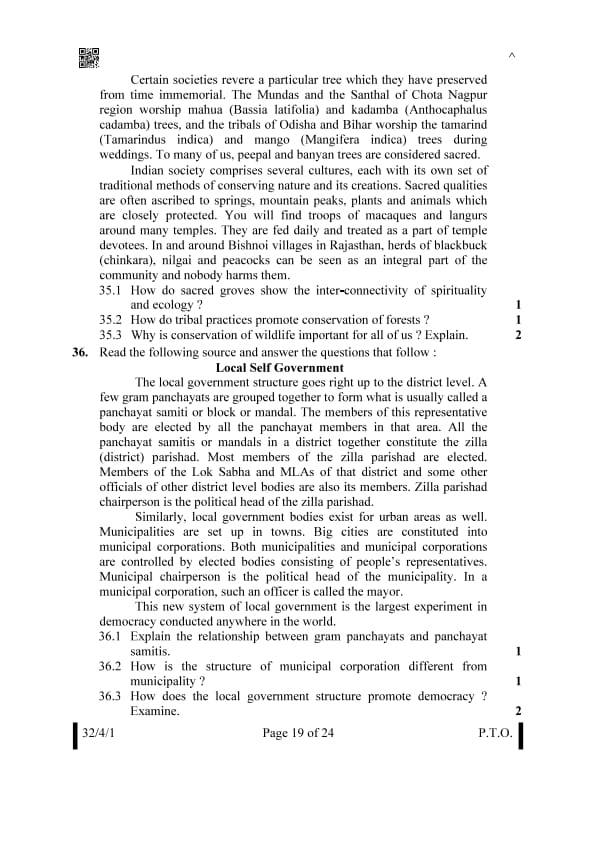
(A) How do sacred groves show the interconnectivity of spirituality and ecology?
View Solution
1. Spiritual Protection of Nature: Sacred groves are forest patches preserved due to religious beliefs, ensuring conservation of biodiversity.
2. Flourishing Biodiversity: These groves serve as habitats for rare species, preventing deforestation and maintaining ecological balance.
Quick Tip: Sacred groves reflect the deep connection between cultural traditions and environmental conservation, promoting biodiversity protection.
(B) How do tribal practices promote conservation of forests?
View Solution
1. Sustainable Harvesting: Tribes use traditional methods to collect forest resources without harming the ecosystem.
2. Sacred Conservation Practices: Many tribal communities consider certain trees and animals sacred, preventing deforestation and hunting.
Quick Tip: Tribal conservation methods, including sustainable resource use and spiritual beliefs, help protect forests and wildlife.
(C) Why is conservation of wildlife important for all of us? Explain.
View Solution
1. Maintaining Ecological Balance: Wildlife plays a crucial role in maintaining food chains and natural ecosystems.
2. Sustaining Human Livelihoods: Many communities depend on forests and wildlife for resources such as food, medicine, and tourism.
3. Preventing Species Extinction: Conservation efforts ensure the survival of endangered species, preserving biodiversity for future generations.
Quick Tip: Wildlife conservation is essential for maintaining ecological stability, protecting resources, and ensuring biodiversity for future generations.
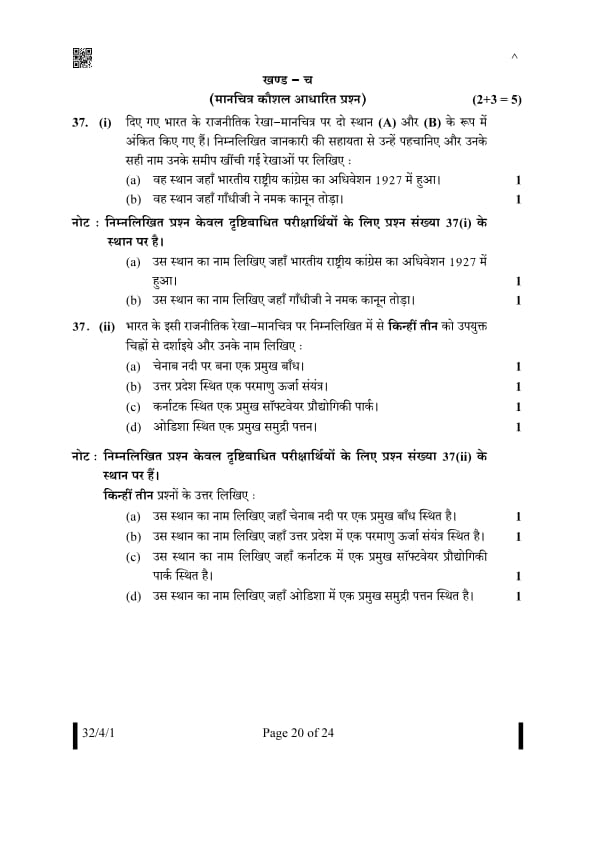
Question 36:
Read the source given below and answer the questions that follow :
LOCAL GOVERNMENT
The local government structure goes right up to the district level. A
few gram panchayats are grouped together to form what is usually called a
panchayat samiti or block or mandal. The members of this representative
body are elected by all the panchayat members in that arca. All the
panchayat samitis or mandals in a district together constitute the zilla
(A) Explain the relationship between Gram Panchayats and Panchayat Samitis.
View Solution
1. Hierarchical Relationship: Gram Panchayats function at the village level, while Panchayat Samitis operate at the block level, supervising multiple Gram Panchayats.
2. Administrative Link: Panchayat Samitis coordinate development programs and allocate funds to Gram Panchayats for local governance.
Quick Tip: Gram Panchayats work at the grassroots level, while Panchayat Samitis provide guidance and resources at the block level.
(B) How is the structure of Municipal Corporation different from a Municipality?
View Solution
1. Municipal Corporation: Governs large cities, headed by a Mayor, and has multiple administrative departments.
2. Municipality: Governs smaller towns and cities, led by a Chairperson, with fewer administrative responsibilities.
Quick Tip: Municipal Corporations manage metropolitan cities, while Municipalities govern smaller urban areas with limited administrative powers.
(C) How does the local government structure promote democracy? Examine.
View Solution
1. Decentralization of Power: Local governments empower citizens by allowing decision-making at grassroots levels.
2. Participation of People: Villagers and urban residents elect representatives, ensuring democratic governance.
3. Efficient Public Service Delivery: Local bodies address region-specific issues, improving governance efficiency.
Quick Tip: Local governments strengthen democracy by involving people in decision-making and ensuring better governance at the grassroots level.


*The article might have information for the previous academic years, please refer the official website of the exam.