
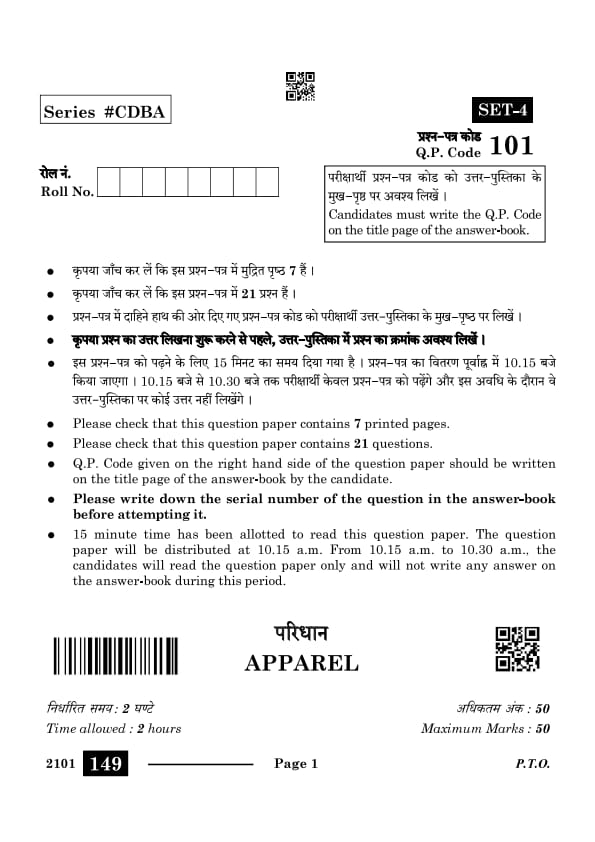
CBSE Class 10 Apparel 2024 Question Paper with Solution PDF (Available)


Content Curator | Updated On - Jan 4, 2025
CBSE Class 10 Question Papers are the most important study material for effective exam preparation. We at Zollege have provided all CBSE Class 10 Previous Year Papers with Solution PDFs here.
Students can freely download the CBSE Class 10 previous year's question paper PDFs along with their solutions here. We strongly encourage CBSE 10 aspirants to scan through all the CBSE Class 10 Question Paper to know the overall difficulty level, CBSE Class 10 Syllabus and understand the changes in CBSE Class 10 Exam Pattern over the years.
CBSE Class 10 Apparel 2024 Question Paper with Solution PDF
| CBSE Class 10 Apparel 2024 Question Paper with Solution PDF |  Download Download |
Check Solution |
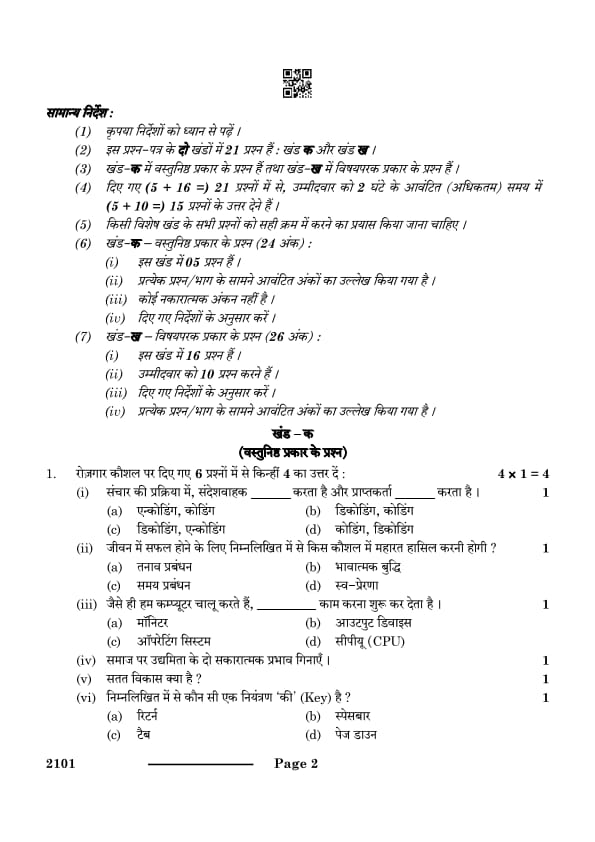
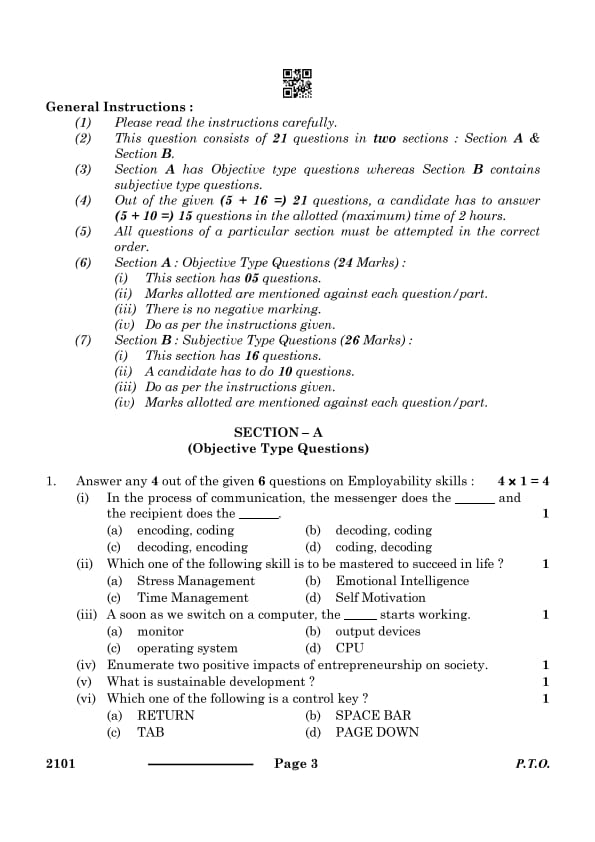
Question 1 (i):
In the process of communication, the messenger does the ________ and the recipient does the ________.
- (A) encoding, coding
- (B) decoding, coding
- (C) decoding, encoding
- (D) coding, decoding
In the communication process, the messenger encodes the message, and the recipient decodes it. This is essential for the effective transmission of information. Hence, the correct answer is "coding, decoding."
Question 1 (ii):
Which one of the following skill is to be mastered to succeed in life?
- (A) Stress Management
- (B) Emotional Intelligence
- (C) Time Management
- (D) Self Motivation
Time management is a crucial skill for success in life as it helps individuals prioritize tasks and utilize their time effectively, leading to greater productivity. Hence, the correct answer is "Time Management."
Question 1 (iii):
As soon as we switch on a computer, the ________ starts working.
- (A) monitor
- (B) output devices
- (C) operating system
- (D) CPU
When a computer is switched on, the operating system is the first to start working. It controls the system's resources and manages hardware and software functions. Hence, the correct answer is "operating system."
Question 1 (iv):
Enumerate two positive impacts of entrepreneurship on society.
Entrepreneurship drives economic growth by fostering innovation and creating jobs. It contributes to the economy by introducing new products and services that improve the standard of living. Hence, the correct answer is "Boosts economic growth and creates jobs."
Question 1 (v):
What is sustainable development?
Sustainable development meets the needs of the present without compromising the ability of future generations to meet their own needs. This approach ensures that resources are used responsibly and the environment is protected for future use. Hence, the correct answer is "Development that satisfies current needs without compromising future generations."
Question 1 (vi):
Which one of the following is a control key?
- (A) RETURN
- (B) SPACE BAR
- (C) TAB
- (D) PAGE DOWN
The "TAB" key is a control key used to move the cursor to the next tab stop, typically used in forms or to navigate between fields in a document. Hence, the correct answer is "TAB."
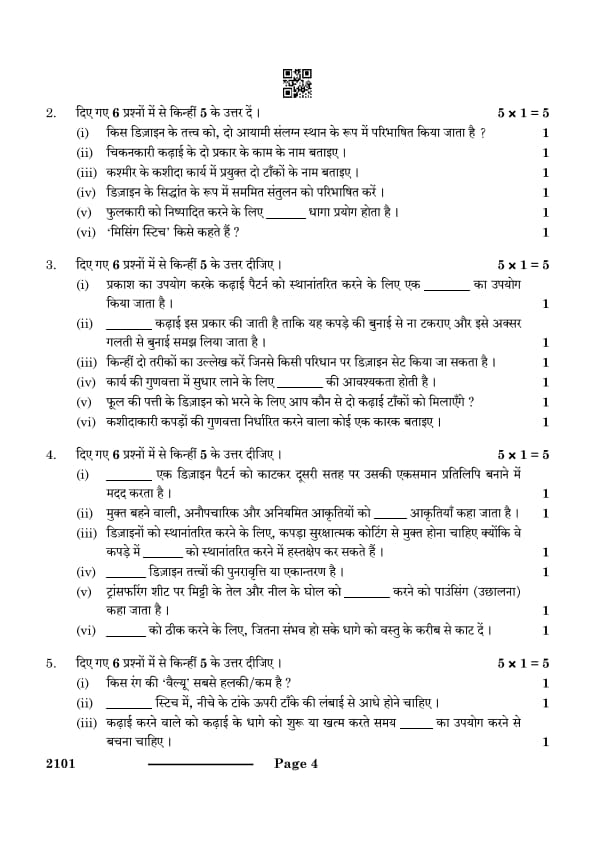
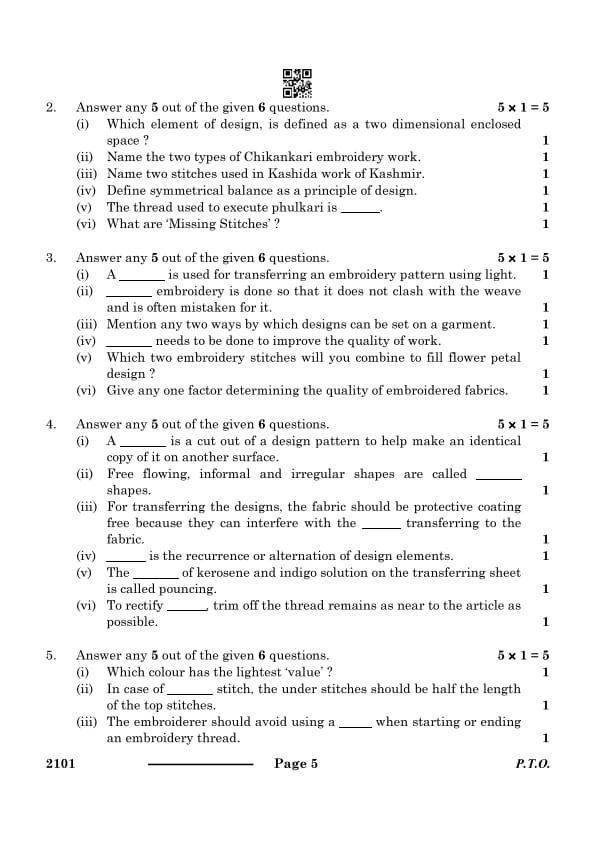
Question 2 (i):
Which element of design, is defined as a two dimensional enclosed space?
In design, "Shape" refers to a two-dimensional enclosed space that can be formed by boundaries such as lines.
Question 2 (ii):
Name the two types of Chikankari embroidery work.
The two primary types of Chikankari embroidery work are Jaali and Keel Kangan. Jaali involves open-work embroidery, while Keel Kangan is a type of floral design.
Question 2 (iii):
Name two stitches used in Kashida work of Kashmir.
Two common stitches used in Kashida work are Satin and Chain stitches. Satin stitch is used for filling in areas, and Chain stitch is used for outlining shapes.
Question 2 (iv):
Define symmetrical balance as a principle of design.
Symmetrical balance refers to the even distribution of visual weight on either side of a central axis in a design. This creates harmony and stability.
Question 2 (v):
The thread used to execute phulkari is ________.
The thread used to execute phulkari is cotton. Cotton threads are preferred for phulkari work because of their strength and texture, making them suitable for the intricate patterns.
Question 2 (vi):
What are 'Missing Stitches'?
"Missing Stitches" refer to the stitches that are unintentionally skipped or omitted during the embroidery process, which can lead to gaps in the design.
Question 3 (i):
A ________ is used for transferring an embroidery pattern using light.
A carbon paper is often used for transferring embroidery patterns onto fabric by applying light pressure.
Question 3 (ii):
______ embroidery is done so that it does not clash with the weave and is often mistaken for it.
"Flat" embroidery is done in such a way that it aligns with the weave of the fabric, making it appear as part of the fabric itself.
Question 3 (iii):
Mention any two ways by which designs can be set on a garment.
Designs can be set on a garment using methods like tracing (using carbon paper) or direct embroidery (stitching patterns directly onto the fabric).
Question 3 (iv):
______ needs to be done to improve the quality of work.
To improve the quality of embroidery work, proper tension control and using high-quality threads and needles are essential.
Question 3 (v):
Which two embroidery stitches will you combine to fill flower petal design?
Satin stitch and French knots are commonly combined to fill flower petal designs in embroidery.
Question 3 (vi):
Give any one factor determining the quality of embroidered fabrics.
One important factor determining the quality of embroidered fabrics is the evenness and neatness of the stitches.
Question 4 (i):
A ______ is a cut out of a design pattern to help make an identical copy of it on another surface.
A "template" is a cut-out design pattern used to replicate an identical shape on another surface. It is commonly used in various crafts, including embroidery, where it guides the placement of stitches or patterns on fabric. Templates ensure that the design remains consistent and accurate when reproduced on different materials or surfaces. They are an essential tool for precision in design work.
Question 4 (ii):
Free flowing, informal and irregular shapes are called ________.
Free flowing, informal, and irregular shapes are called "organic shapes." These shapes are often seen in nature, such as the shape of a leaf, flower, or cloud, and they do not follow strict geometric rules. Organic shapes are typically used in artistic and design contexts to create a natural, flowing aesthetic that contrasts with more structured, geometric shapes. They convey a sense of freedom and creativity.
Question 4 (iii):
For transferring the designs, the fabric should be protective coating free because they can interfere with the ________ transferring to the fabric.
The fabric should be free of any "coating" because protective coatings like starch or wax can interfere with the smooth transfer of the design. These coatings can block the transfer medium (e.g., carbon paper or ink) from adhering to the fabric properly, resulting in inaccurate or faint patterns. It is important to ensure the fabric is clean and free of such substances to achieve precise design transfers.
Question 4 (iv):
______ is the recurrence or alternation of design elements.
"Repetition" refers to the recurrence or alternation of design elements such as lines, colors, shapes, or patterns. Repetition creates rhythm and unity in a design, providing a sense of consistency and harmony. It is an effective technique to emphasize particular elements and establish a visual connection throughout the design. This principle is widely used in both fine arts and commercial design to create cohesive and balanced work.
Question 4 (v):
The ______ of kerosene and indigo solution on the transferring sheet is called pouncing.
The "application" of kerosene and indigo solution on the transferring sheet is called pouncing. Pouncing is a technique used to transfer designs onto fabric by creating small holes along the lines of the pattern. The solution helps the pattern to be more visible on the fabric when pouncing is done, as the ink or powder will pass through the holes, leaving an impression on the fabric.
Question 4 (vi):
To rectify ________, trim off the thread remains as near to the article as possible.
To rectify "loose threads," trim off the thread remains as near to the article as possible. Loose threads can detract from the overall appearance of the embroidery and lead to unraveling over time. Neatly trimming these threads ensures a clean finish and enhances the quality of the embroidery. It is essential to use sharp scissors to avoid damaging the fabric while trimming the threads.
Question 5 (i):
Which colour has the lightest ‘value’?
The lightest value color is typically "yellow." In the color value scale, yellow is a light color, often associated with brightness and lightness. It is one of the colors with the least saturation and darkness. Light value colors like yellow are commonly used in design to create airy, bright, and uplifting atmospheres, contrasting with darker hues that provide depth and weight.
Question 5 (ii):
In case of ______ stitch, the under stitches should be half the length of the top stitches.
In the case of "satin" stitch, the under stitches should be half the length of the top stitches. This ensures that the top stitches cover the base fabric properly while creating a smooth, even surface. Satin stitch is often used for filling in shapes or areas in embroidery, and the technique requires precise control to prevent gaps between the stitches and to achieve a glossy, satin-like finish.
Question 5 (iii):
The embroiderer should avoid using a ______ when starting or ending an embroidery thread.
The embroiderer should avoid using a "knot" when starting or ending an embroidery thread. Knots can create lumps in the fabric and affect the smoothness of the design. Instead, it is recommended to use a method such as securing the thread by weaving it through the stitches or using a small hidden stitch at the start and end of the thread to avoid visible knots.
Question 5 (iv):
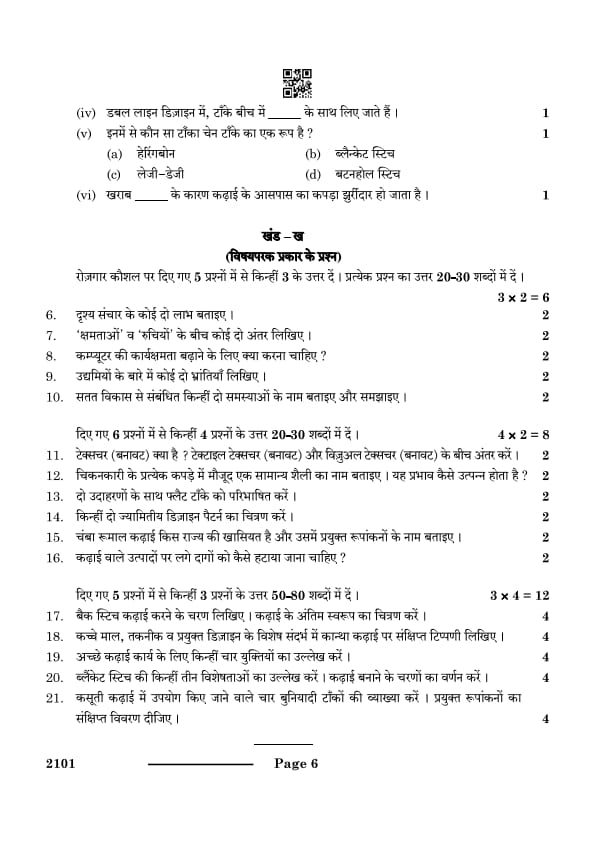
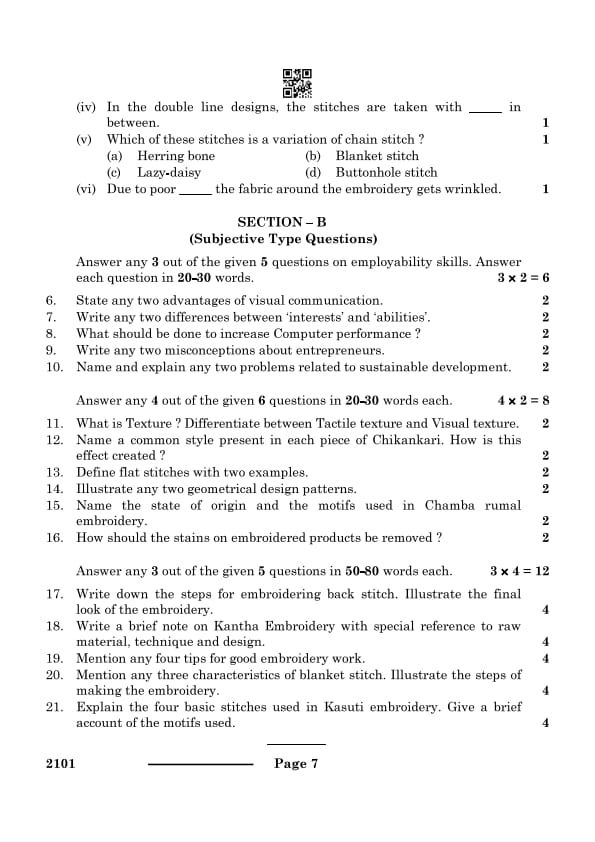
In the double line designs, the stitches are taken with ______ in between.
In double line designs, the stitches are taken with "spaces" in between. This technique creates a clear distinction between the two lines, ensuring that the design remains defined and distinct. The spaces between the stitches add texture and allow the design to stand out more prominently on the fabric. Double line designs are often used in embroidery and decorative stitching to add dimension to patterns.
Question 5 (v):
Which of these stitches is a variation of chain stitch?
- (A) Herring bone
- (B) Blanket stitch
- (C) Lazy-daisy
- (D) Buttonhole stitch
The "Buttonhole stitch" is a variation of the chain stitch. It is commonly used in embroidery for finishing edges or creating decorative borders. In this stitch, the needle is inserted in a looped manner similar to chain stitch, but it is more structured and often used to create a raised or outlined effect, making it more rigid compared to the chain stitch.
Question 5 (vi):
Due to poor ______, the fabric around the embroidery gets wrinkled.
Due to poor "tension," the fabric around the embroidery gets wrinkled. In embroidery, proper tension is crucial to ensure that the fabric remains smooth and that the stitches sit evenly. If the tension is too tight, it can cause the fabric to bunch up, creating unwanted wrinkles. Conversely, if the tension is too loose, the stitches may not be secure, and the fabric may stretch unevenly.
Question 6:
State any two advantages of visual communication.
Visual communication has several key advantages:
1. Clarity and Understanding: Visual elements such as charts, graphs, and diagrams can simplify complex information, making it easier for the audience to understand and remember.
2. Engagement and Retention: Visual content is often more engaging and memorable compared to text-based content. People are generally more likely to retain information when it is presented visually, helping in better learning and retention.
Question 7:
Write any two differences between ‘interests’ and ‘abilities’.
Interests and abilities are often related but distinct concepts:
1. Interests refer to what a person enjoys doing or what captures their attention. They are driven by curiosity, passion, or enjoyment in a particular activity, such as painting, reading, or playing sports.
2. Abilities, on the other hand, refer to the skills or talents that a person possesses, which enable them to perform certain tasks. Abilities are developed through practice and experience and are related to a person’s capacity to do something well, such as problem-solving, critical thinking, or technical skills.
Question 8:
What should be done to increase Computer performance?
To increase computer performance, consider the following actions:
1. Upgrade Hardware: Adding more RAM or installing a faster processor can significantly improve a computer's speed and responsiveness.
2. Optimize Software: Regularly updating the operating system, defragmenting the hard drive, and cleaning up unnecessary files can free up system resources and enhance overall performance.
3. Close Unnecessary Programs: Running too many applications simultaneously can slow down the computer. Closing unused programs frees up memory and processing power.
Question 9:
Write any two misconceptions about entrepreneurs.
Two common misconceptions about entrepreneurs are:
1. Entrepreneurs Are Born, Not Made: Many people believe that entrepreneurs are born with certain traits, such as risk-taking and leadership. However, entrepreneurship can be learned and developed through experience and education.
2. Entrepreneurs Always Take Huge Risks: Another misconception is that all entrepreneurs take significant risks. In reality, successful entrepreneurs often minimize risks through careful planning, research, and risk management strategies.
Question 10:
Name and explain any two problems related to sustainable development.
Two problems related to sustainable development are:
1. Resource Depletion: As the global population increases, the demand for natural resources such as water, energy, and raw materials also rises. Overuse of these resources leads to depletion, threatening the ability of future generations to meet their needs.
2. Environmental Pollution: Industrialization and urbanization have led to the pollution of air, water, and soil. This pollution harms ecosystems, endangers wildlife, and contributes to climate change, making it difficult to achieve sustainability goals.
Question 11:
What is Texture? Differentiate between Tactile texture and Visual texture.
Texture refers to the surface characteristics or feel of an object, which can be experienced through touch (tactile texture) or visually (visual texture).
- Tactile Texture: This is the texture that can be physically felt, such as roughness, smoothness, bumpiness, or softness. It refers to the actual physical surface of an object, like the feel of fabric, wood, or stone.
- Visual Texture: This texture refers to the perceived texture seen through sight. It does not involve touch but gives the illusion of texture, like a painting of a rough surface, even though it might be smooth to touch.
In design, both types of texture are used to enhance the visual appeal or to create realistic, three-dimensional effects.
Question 12:
Name a common style present in each piece of Chikanari. How is this effect created?
A common style in Chikanari embroidery is the Jaali work. This style involves creating open, lace-like patterns using delicate stitches, typically in geometric or floral designs. The effect is achieved by combining straight stitches in parallel lines that form intricate patterns, leaving spaces that create an open, net-like appearance. Jaali work adds texture to the fabric while maintaining a light and airy aesthetic. The precision in these stitches and the strategic placement of gaps are what make the design stand out.
Question 13:
Define flat stitches with two examples.
Flat stitches are those that lie flat against the fabric surface, creating a smooth and even texture. They are primarily used to fill areas in embroidery with minimal elevation or bulk.
- Satin Stitch: This is a popular flat stitch used to fill areas in embroidery. The stitches are placed close together, running parallel to each other, and when done properly, they create a smooth, shiny surface that resembles satin fabric.
- Long and Short Stitch: This technique involves using varying lengths of stitches to create a shaded effect. Short stitches are placed near each other and longer stitches are used to cover larger areas. This stitch gives a smooth finish and is perfect for depicting gradients or shadows in designs.
Question 14:
Illustrate any two geometrical design patterns.
Geometrical design patterns are based on shapes such as circles, squares, triangles, and other forms. These patterns create balance and symmetry in designs.
1. Circular Pattern: This design is formed by arranging concentric circles, one inside another. It is often used in traditional designs such as mandalas or floral motifs. The repeated circle pattern creates harmony and unity within the design, and is widely used in both textile and graphic design.
2. Triangular Pattern: In this design, triangles are arranged to form a larger geometric shape. They can be arranged symmetrically or asymmetrically, depending on the desired effect. Triangular patterns are commonly used in architectural designs and in modern geometric embroidery to create dynamic and striking compositions.
Question 15:
Name the state of origin and the motifs used in Chamba rumal embroidery.
Chamba Rumal is a traditional embroidery style that originates from the Chamba district in Himachal Pradesh, India. This art form is renowned for its fine, detailed stitches and vibrant colors, which are used to create intricate designs.
- State of Origin: Chamba Rumal is native to the state of Himachal Pradesh, particularly from the Chamba region.
- Motifs Used: The motifs in Chamba Rumal embroidery are mostly inspired by nature, featuring designs such as flowers, animals, and birds. The floral patterns, such as lotus and poppy, are common, as well as intricate depictions of Hindu deities and mythological themes. The embroidery often reflects the local culture and religious significance.
The embroidery is usually done on a piece of muslin or cotton fabric, and the designs are created using fine silk threads in a technique called ‘do-rukha’ or double-sided embroidery.
Question 16:
How should the stains on embroidered products be removed?
Stains on embroidered products must be removed carefully to preserve both the fabric and the embroidery. Here are some steps to follow:
1. Pre-treat the Stain: Gently dab the stain with a clean cloth soaked in water. Avoid rubbing, as this could damage the delicate threads. For stubborn stains, use a mild detergent or stain remover on a small, inconspicuous area to test for colorfastness.
2. Hand Wash: Wash the embroidered fabric by hand in cold water. Avoid using harsh chemicals or bleach, as these can damage the threads and colors. Use a mild detergent suitable for delicate fabrics.
3. Dry Carefully: After washing, press the fabric with a towel to absorb excess water, then air-dry it flat. Avoid wringing or twisting the fabric.
4. Iron with Caution: Iron the fabric at a low temperature, placing a cloth between the iron and the embroidery to prevent direct contact with the heat.
By following these steps, stains can be removed without harming the delicate embroidery.
Question 17:
Write down the steps for embroidering back stitch. Illustrate the final look of the embroidery.
Back stitch is a simple, yet effective stitch used to create continuous lines in embroidery. Here are the steps to embroider a back stitch:
1. Step 1: Start by bringing the needle up through the fabric at the beginning of the line you wish to stitch.
2. Step 2: Insert the needle back into the fabric a little behind where you started the stitch. This creates the first small stitch.
3. Step 3: Bring the needle up again where the first stitch ended, but insert it slightly behind to create another stitch.
4. Step 4: Repeat this process, making sure that the stitches are evenly spaced and aligned, creating a continuous line.
The final look of the embroidery will be a series of uniform, smooth stitches running in a straight line, providing a clean and defined outline.
Question 18:
Write a brief note on Kantha Embroidery with special reference to raw material, technique and design.
Kantha embroidery is a traditional form of hand-stitched embroidery originating from Bengal, India. It is known for its simple, running stitch technique used to create patterns on fabric.
- Raw Material: The primary materials used in Kantha embroidery are cotton fabric, often repurposed from old sarees or cloth, and cotton threads for stitching. The fabric is typically soft and lightweight.
- Technique: The embroidery is done using a simple running stitch that creates a quilted effect. Multiple layers of fabric are stacked, and the stitches are used to bind them together, forming decorative patterns like flowers, animals, and geometric shapes.
- Design: Kantha designs are often inspired by nature, including motifs like birds, flowers, animals, and geometric patterns, representing the rich cultural heritage of Bengal.
These patterns are essential for adding structure and order to a design, making it visually appealing and balanced.
Question 19:
Mention any four tips for good embroidery work.
Here are four essential tips for achieving good embroidery work:
1. Use Proper Thread and Needle: Choose threads that match the fabric type and thickness. Select needles with the appropriate size for the threads being used.
2. Maintain Even Tension: Ensure that the tension of the thread is consistent throughout the work. Too tight a thread can cause puckering, while too loose can cause uneven stitches.
3. Work in Good Lighting: Adequate lighting is crucial to avoid eye strain and ensure the stitches are clear and even.
4. Practice Consistent Stitching: Practice your stitching techniques to ensure uniformity and neatness, especially in repetitive stitch types like satin or back stitch.
Question 20:
Mention any three characteristics of blanket stitch. Illustrate the steps of making the embroidery.
Blanket Stitch Characteristics:
1. Edge Finishing: Blanket stitch is often used to finish the edges of fabric, preventing fraying.
2. Even Stitches: The stitches are evenly spaced and form a uniform line along the edge of the fabric.
3. Versatile: It can be used for both functional and decorative purposes in various embroidery designs.
Steps for Blanket Stitch:
1. Step 1: Begin by inserting the needle at the edge of the fabric and pulling it through.
2. Step 2: Insert the needle again at the same spot, but keep the thread looped over the edge.
3. Step 3: Pull the needle through the fabric, creating a loop that lies along the edge.
4. Step 4: Repeat the process along the edge, ensuring the stitches are uniform in size.
Question 21:
Explain the four basic stitches used in Kasuti embroidery. Give a brief account of the motifs used.
Kasuti is a traditional form of Karnataka embroidery known for its intricate designs. The four basic stitches used in Kasuti are:
1. Murgi (Chicken Stitch): This stitch is used for creating delicate floral and geometric patterns, often used for outlining.
2. Nandi (Bullock Stitch): Used to create thicker lines, this stitch is often employed in border designs.
3. Menthi (Coriander Stitch): A distinctive stitch used to create dense, intricate patterns, often seen in circular motifs.
4. Kasuti (Cross Stitch): The primary stitch used in Kasuti embroidery to form geometric shapes, typically crosses, which create a structured look.
Kasuti embroidery is known for its detailed motifs, often inspired by nature and temples. Common motifs include flowers, birds, animals, and geometric patterns, representing the rich cultural heritage of Karnataka.

*The article might have information for the previous academic years, please refer the official website of the exam.