
CBSE Class 10 Artificial Intelligence 2024 Question Paper with Solution PDF (Available)


Content Curator | Updated On - Jan 4, 2025
CBSE Class 10 Question Papers are the most important study material for effective exam preparation. We at Zollege have provided all CBSE Class 10 Previous Year Papers with Solution PDFs here.
Students can freely download the CBSE Class 10 previous year's question paper PDFs along with their solutions here. We strongly encourage CBSE 10 aspirants to scan through all the CBSE Class 10 Question Paper to know the overall difficulty level, CBSE Class 10 Syllabus and understand the changes in CBSE Class 10 Exam Pattern over the years.
CBSE Class 10 Artificial Intelligence 2024 Question Paper with Solution PDF
| CBSE Class 10 Artificial Intelligence 2024 Question Paper with Solution PDF |  Download Download |
Check Solution |
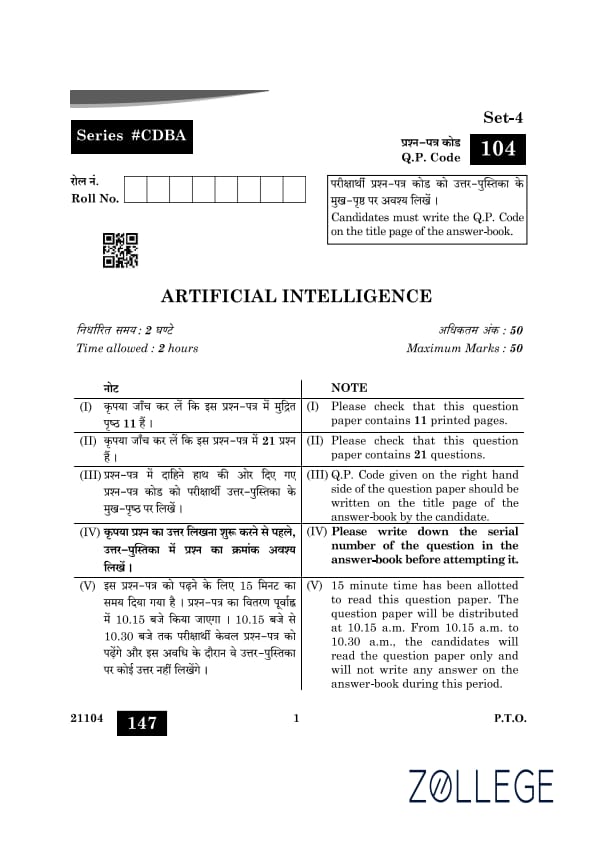
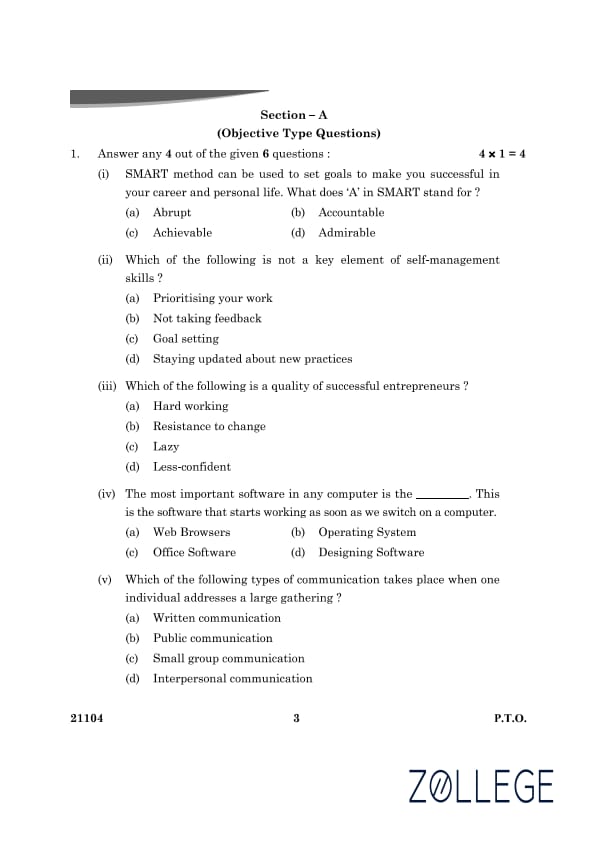
Question 1(i):
SMART method can be used to set goals to make you successful in your career and personal life. What does ‘A’ in SMART stand for?
Solution:
In the SMART method, 'A' stands for Achievable. SMART is an acronym for Specific, Measurable, Achievable, Relevant, and Time-bound. The 'A' emphasizes setting realistic and attainable goals. Goals should be challenging but not impossible to achieve. Ensuring a goal is achievable helps maintain motivation and fosters success.
Question 1(ii):
Which of the following is not a key element of self-management skills?
Solution:
Self-management skills involve managing your time, tasks, and emotions effectively. These skills include prioritizing work, setting goals, and staying updated on new practices. The key element that is not part of self-management is not taking feedback, as feedback is crucial for personal and professional growth. Being open to feedback helps improve performance and adapt to new situations.
Question 1(iii):
Which of the following is a quality of successful entrepreneurs?
Solution:
Successful entrepreneurs are typically hardworking individuals. They put in the time and effort necessary to achieve their goals and overcome challenges. They are driven by their passion and dedication to their business. Resistance to change, laziness, and lack of confidence are qualities that can hinder entrepreneurial success. Entrepreneurs must be adaptable, driven, and proactive.
Question 1(iv):
The most important software in any computer is the ___. This is the software that starts working as soon as we switch on a computer.
Solution:
The operating system is the most important software on a computer. It is responsible for managing hardware and software resources and allows the computer to run applications. It starts as soon as the computer is switched on and serves as the foundation for other programs to run. Examples of operating systems include Windows, macOS, and Linux.
Question 1(v):
Which of the following types of communication takes place when one individual addresses a large gathering?
Solution:
Public communication occurs when one individual addresses a large audience or gathering. This type of communication is typically used in speeches, presentations, and public speaking events. It involves conveying information or persuading a large group of people, usually in a formal or structured setting. In contrast, written communication, small group communication, and interpersonal communication involve smaller audiences or direct interactions.
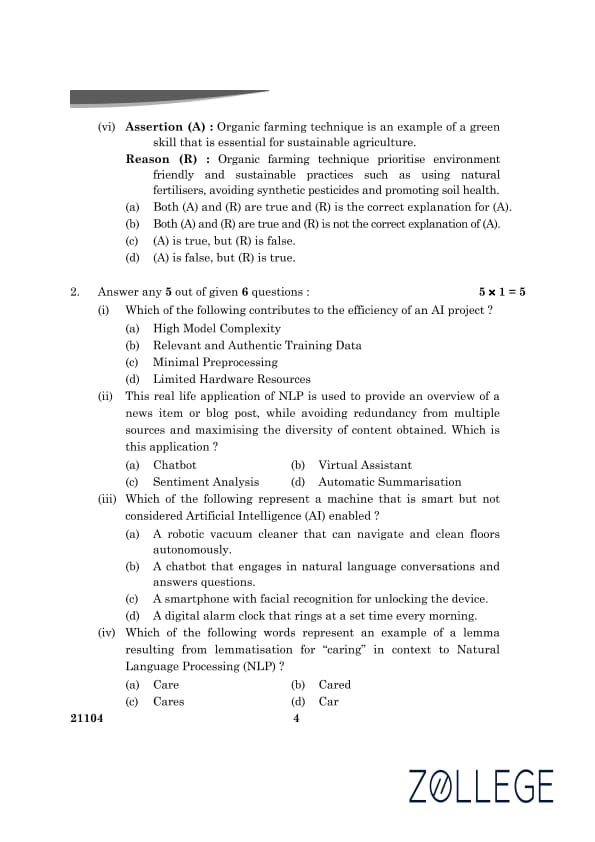
Question 1(vi):
Assertion (A): Organic farming technique is an example of a green skill that is essential for sustainable agriculture.
Reason (R): Organic farming technique prioritizes environment-friendly and sustainable practices such as using natural fertilizers, avoiding synthetic pesticides, and promoting soil health.
Solution:
The assertion (A) is correct because organic farming is indeed an essential green skill that focuses on sustainability and the environment. The reason (R) provides a clear explanation for the assertion by emphasizing the environmental benefits of organic farming, such as using natural fertilizers and avoiding harmful pesticides. Therefore, both the assertion and reason are true, and the reason correctly explains the assertion.

Question 2(i):
Which of the following contributes to the efficiency of an AI project?
Solution:
Relevant and authentic training data is crucial for the success of AI projects. High-quality, accurate, and representative data allows the AI model to learn effectively and make accurate predictions. The efficiency of an AI model is highly dependent on the data it is trained on. While other factors such as model complexity and preprocessing are important, the data quality and relevance are the most significant factors.
Question 2(ii):
This real-life application of NLP is used to provide an overview of a news item or blog post, while avoiding redundancy from multiple sources and maximizing the diversity of content obtained. Which is this application?
Solution:
Automatic summarisation in Natural Language Processing (NLP) refers to the process of generating a concise summary of a larger content piece, such as a news item or blog post. This technique avoids redundancy by pulling the most relevant information from multiple sources and presents it in a concise form. It is useful for efficiently obtaining the key points from long documents or articles.
Question 2(iii):
Which of the following represents a machine that is smart but not considered Artificial Intelligence (AI) enabled?
Solution:
A digital alarm clock, while smart in functionality, does not qualify as an AI-enabled device because it does not adapt, learn, or process data in an intelligent manner. AI involves machines that can learn from data, make decisions, and improve over time, which is not the case with a simple alarm clock that operates based on pre-set functionality.
Question 2(iv):
Which of the following words represent an example of a lemma resulting from lemmatization for “caring” in context to Natural Language Processing (NLP)?
Solution:
In Natural Language Processing (NLP), lemmatization is the process of reducing a word to its base or root form. For the word “caring,” the lemma is “care,” which is the root form. Lemmatization ensures that variations of a word, such as "caring" or "cared," are reduced to the same base form, allowing NLP algorithms to process text more effectively.
Question 2(v):
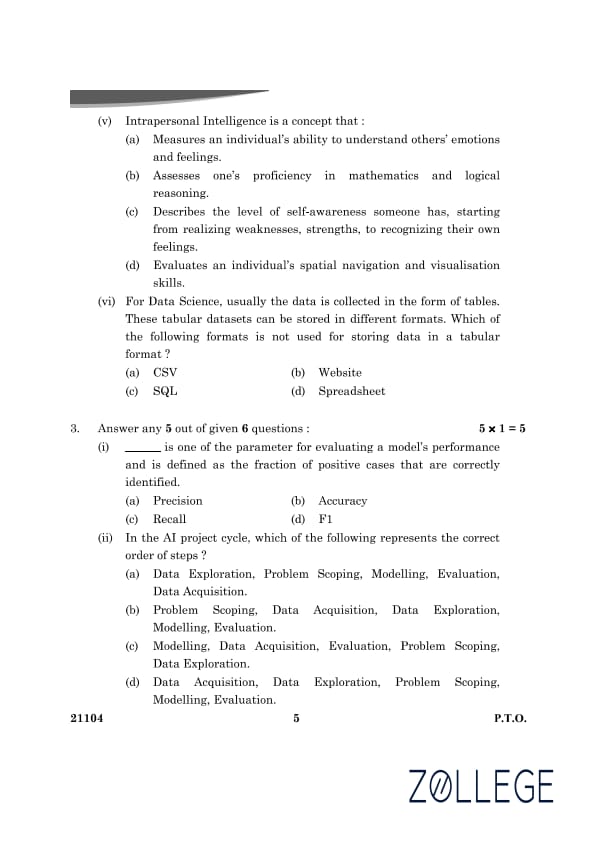
Intrapersonal Intelligence is a concept that:
Solution:
Intrapersonal intelligence refers to the capacity for self-awareness, introspection, and the ability to understand one’s own emotions, motivations, and inner thoughts. This type of intelligence is concerned with how well an individual can recognize their own strengths and weaknesses, as well as manage their feelings and thoughts effectively. This intelligence allows people to be more reflective and in tune with their own emotional and mental states.
Question 2(vi):
For Data Science, usually the data is collected in the form of tables. These tabular datasets can be stored in different formats. Which of the following formats is not used for storing data in a tabular format?
Solution:
For data science, data is typically stored in structured formats such as CSV (Comma Separated Values), SQL databases, and spreadsheets like Excel. These formats allow data to be organized in rows and columns, making it easier to analyze and process. Websites, however, are not a format used for storing tabular data, as they are more focused on displaying and providing content rather than structuring it for data analysis.
Question 3(i):
___ is one of the parameters for evaluating a model’s performance and is defined as the fraction of positive cases that are correctly identified.
Solution:
Precision is a metric used to evaluate the performance of a classification model. It measures the proportion of true positive predictions out of all the positive predictions made by the model. In other words, precision tells us how many of the predicted positive cases are actually correct. A high precision indicates that the model does not frequently misclassify negative cases as positive.
Question 3(ii):
In the AI project cycle, which of the following represents the correct order of steps?
Solution:
The correct order of steps in an AI project cycle begins with Data Acquisition, where relevant data is gathered. Next, Data Exploration takes place to understand the dataset and its properties. After that, Problem Scoping is done to define the problem and determine how the data can be used to solve it. Then, Modelling is performed, where machine learning models are created. Finally, Evaluation is done to assess the performance of the models. This sequence ensures a structured approach to building and deploying AI models.
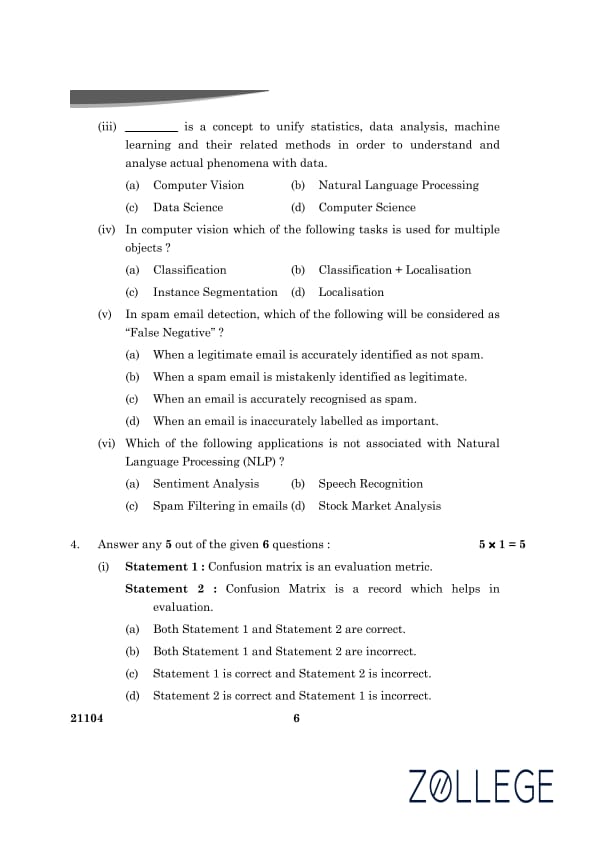
Question 3(iii):
___ is a concept to unify statistics, data analysis, machine learning and their related methods in order to understand and analyze actual phenomena with data.
Solution:
Data Science is an interdisciplinary field that uses scientific methods, processes, algorithms, and systems to extract knowledge and insights from structured and unstructured data. It combines various techniques from statistics, machine learning, data analysis, and related fields to understand and analyze actual phenomena with data. This makes Data Science a powerful tool for problem-solving and decision-making across various domains.
Question 3(iv):
In computer vision, which of the following tasks is used for multiple objects?
Solution:
Instance segmentation is a computer vision task that involves detecting and delineating each object instance in an image. Unlike traditional segmentation, which only labels regions as objects, instance segmentation also differentiates between individual objects of the same class, making it useful for tasks involving multiple objects. This task is crucial for applications that require precise object identification and segmentation, such as autonomous vehicles or medical imaging.
Question 3(v):
In spam email detection, which of the following will be considered as "False Negative"?
Solution:
A False Negative occurs when a spam email is mistakenly classified as legitimate, meaning the model fails to identify it as spam. This is problematic because spam emails are allowed through the system and could lead to unwanted consequences, such as security breaches or spam content being delivered to the user's inbox. In contrast, False Positives occur when legitimate emails are incorrectly flagged as spam.
Question 3(vi):
Which of the following applications is not associated with Natural Language Processing (NLP)?
Solution:
Natural Language Processing (NLP) is a field of Artificial Intelligence that focuses on the interaction between computers and human language. Applications such as Sentiment Analysis, Speech Recognition, and Spam Filtering in emails all involve NLP as they deal with analyzing, understanding, and processing human language in text or speech. However, Stock Market Analysis does not directly involve NLP, as it is more related to financial analysis and data modeling, though NLP may sometimes be applied for processing market-related news and reports.
Question 4(i):
Statement 1: Confusion matrix is an evaluation metric.
Statement 2: Confusion Matrix is a record which helps in evaluation.
Solution:
A confusion matrix is a fundamental evaluation metric in machine learning, used for assessing the performance of classification algorithms. It is a table that summarizes the number of correct and incorrect predictions made by a model, broken down by class. Statement 1 is correct because the confusion matrix is used for evaluation, and Statement 2 is also correct because it records the predicted vs actual outcomes, providing insights into model performance.
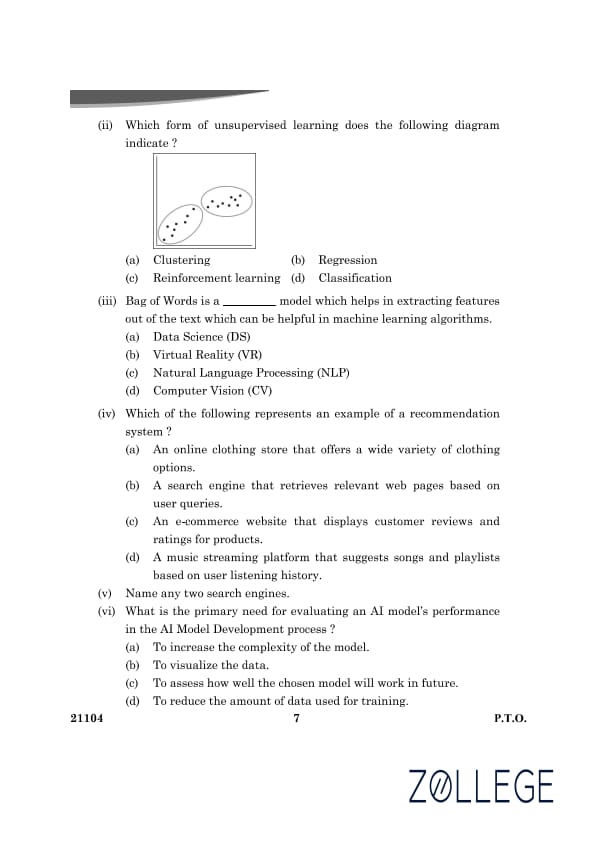
Question 4(ii):
Which form of unsupervised learning does the following diagram indicate?

Solution:
The diagram represents a common form of unsupervised learning known as clustering. Clustering is a technique where similar data points are grouped together based on their features, without predefined labels. This technique is used in scenarios where the algorithm needs to find patterns or groupings within data that are not previously labeled. For example, customer segmentation based on purchasing behavior.
Question 4(iii):
Bag of Words is a ___ model which helps in extracting features out of the text which can be helpful in machine learning algorithms.
Solution:
The Bag of Words (BoW) model is a representation used in Natural Language Processing (NLP) to extract features from text. It represents text data in the form of a "bag" of words, ignoring grammar and word order but keeping track of the frequency of words. This model is useful for text classification tasks, where each document is represented as a vector of word counts. NLP algorithms such as spam detection and sentiment analysis often use BoW for feature extraction.
Question 4(iv):
Which of the following represents an example of a recommendation system?
Solution:
A recommendation system is designed to suggest products, content, or services to users based on their preferences, behavior, or historical data. The example of a music streaming platform that suggests songs and playlists based on user listening history is a classic recommendation system. It uses user interaction data to predict and recommend new music that aligns with the user's tastes.
Question 4(v):
Name any two search engines.
Two widely used search engines are:
1. Google – The most popular search engine, known for its speed, accuracy, and vast database of indexed web pages.
2. Bing – A search engine developed by Microsoft, offering features like image search, video search, and integration with other Microsoft products.
Question 4(vi):
What is the primary need for evaluating an AI model’s performance in the AI Model Development process?
Solution:
Evaluating an AI model’s performance is crucial to determine how well it will perform in real-world scenarios. The evaluation helps assess the model’s accuracy, generalization, and robustness, ensuring it will work effectively on new, unseen data. This evaluation process involves measuring performance metrics such as accuracy, precision, recall, and F1-score, helping decide if the model is ready for deployment or needs further refinement.
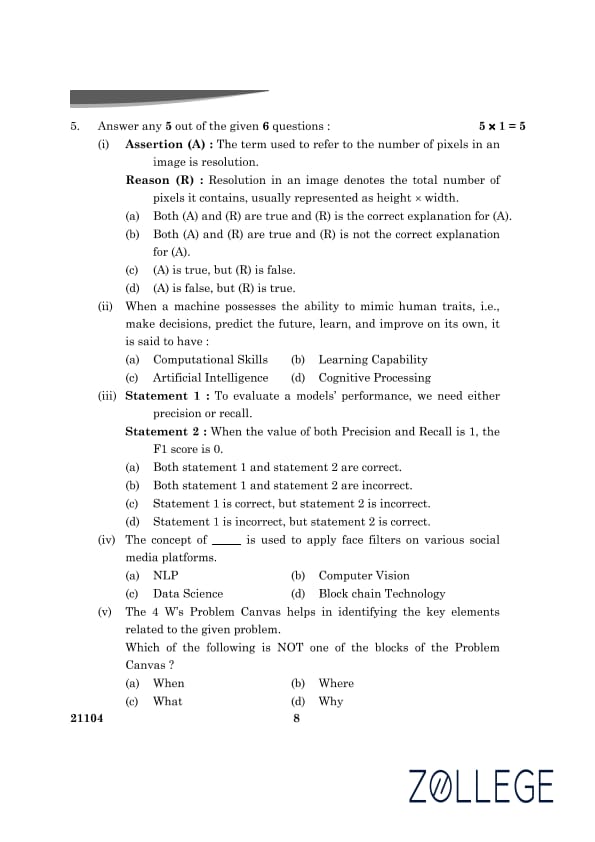
Question 5(i):
Assertion (A): The term used to refer to the number of pixels in an image is resolution.
Reason (R): Resolution in an image denotes the total number of pixels it contains, usually represented as height x width.
Solution:
Resolution refers to the clarity of an image, determined by the number of pixels it contains. The higher the resolution, the more pixels the image has, which results in more detail and sharpness. The assertion (A) is true, and the reason (R) accurately explains that resolution is determined by the total number of pixels, represented by height and width.
Question 5(ii):
When a machine possesses the ability to mimic human traits, i.e., make decisions, predict the future, learn, and improve on its own, it is said to have:
Solution:
Artificial Intelligence (AI) is the field of computer science that focuses on creating systems capable of performing tasks that typically require human intelligence. This includes learning from data, making decisions, predicting future outcomes, and adapting based on experiences. AI encompasses many methods such as machine learning and deep learning to enable machines to mimic human cognitive abilities.
Question 5(iii):
Statement 1: To evaluate a model’s performance, we need either precision or recall.
Statement 2: When the value of both Precision and Recall is 1, the F1 score is 0.
Solution:
Precision and Recall are performance metrics used to evaluate classification models. Precision measures the accuracy of positive predictions, while recall measures the ability to capture all positive instances. The F1 score is the harmonic mean of precision and recall, and when both precision and recall are 1, the F1 score is also 1, not 0. Hence, Statement 1 is correct, and Statement 2 is incorrect.
Question 5(iv):
The concept of ___ is used to apply face filters on various social media platforms.
Solution:
Computer Vision is a field of AI that enables machines to interpret and understand visual information, such as images and videos. It is used in applications like face recognition, object detection, and augmented reality, including the application of face filters on social media platforms. Computer vision algorithms process and analyze facial features to apply various filters in real-time.
Question 5(v):
The 4 W’s Problem Canvas helps in identifying the key elements related to the given problem.
Which of the following is NOT one of the blocks of the Problem Canvas?
Solution:
The 4 W’s Problem Canvas is a tool used in problem-solving to identify the key components of a problem. It focuses on the Who, What, Why, and When aspects of the problem. The Where aspect is not part of the 4 W's framework. These elements help teams understand the problem from various angles and generate solutions effectively.
Question 5(vi):
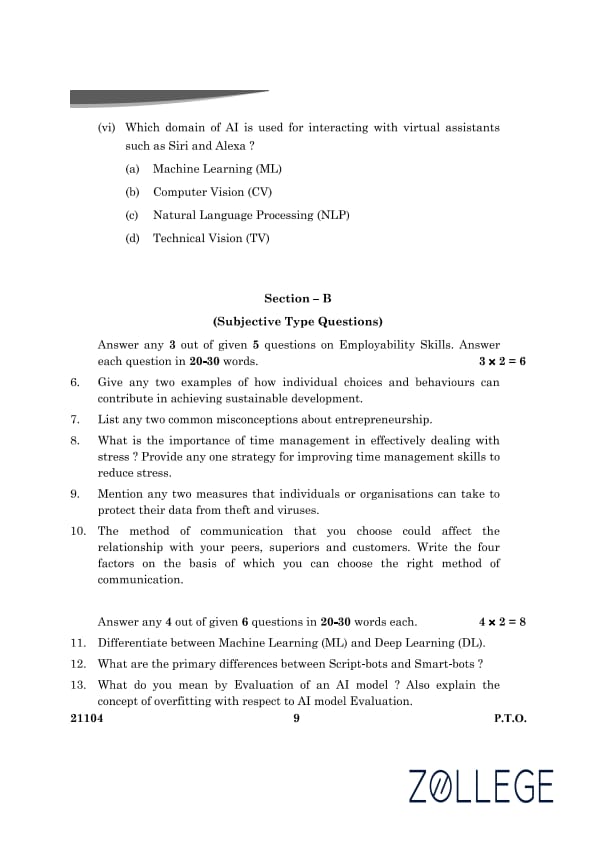
Which domain of AI is used for interacting with virtual assistants such as Siri and Alexa?
Solution:
Virtual assistants like Siri and Alexa rely on Natural Language Processing (NLP) to interpret and respond to human speech. NLP allows computers to understand, interpret, and generate human language in a way that is valuable for interaction. It is a subfield of Artificial Intelligence that enables voice-based AI systems to process spoken language, understand context, and generate meaningful responses, making it essential for voice assistants.
Question 6:
Give any two examples of how individual choices and behaviours can contribute to achieving sustainable development.
1. Reducing Waste: By making conscious choices to reduce waste, such as reusing items, recycling, and avoiding single-use plastics, individuals can reduce their environmental impact. This contributes to sustainable development by conserving resources and reducing pollution.
2. Energy Conservation: Choosing energy-efficient appliances, reducing electricity consumption, and using renewable energy sources like solar power contribute to sustainability by minimizing the carbon footprint and reducing dependence on non-renewable energy resources.
Question 7:
List any two common misconceptions about entrepreneurship.
1. Entrepreneurs are born, not made: Many believe entrepreneurship is an innate skill. However, it involves learned skills like problem-solving, resilience, and adaptability.
2. Entrepreneurship is only for risk-takers: While it involves risk, entrepreneurs often take calculated risks based on careful planning and strategy rather than blind risks.
Question 8:
What is the importance of time management in effectively dealing with stress? Provide any one strategy for improving time management skills to reduce stress.
Time management reduces stress by prioritizing tasks, avoiding procrastination, and allocating time for rest and recreation.
Strategy: The Pomodoro Technique, which involves working for 25 minutes followed by a 5-minute break, promotes focus, productivity, and prevents burnout.
Question 9:
Mention any two measures that individuals or organisations can take to protect their data from theft and viruses.
1. Use Strong Passwords: Implement strong, unique passwords for all accounts and change them regularly. Organizations should consider multi-factor authentication.
2. Install Antivirus Software: Regularly updated antivirus software protects against viruses, malware, and other threats to data security.
Question 10:
The method of communication that you choose could affect the relationship with your peers, superiors, and customers. Write the four factors on the basis of which you can choose the right method of communication.
1. Audience: Consider who the message is intended for and their preferred communication style.
2. Message Complexity: For complex messages, use face-to-face or written communication.
3. Urgency: Use instant messaging or phone calls for urgent matters.
4. Formality: Choose professional channels like email for formal messages and quick chats for informal ones.
Question 11:
Differentiate between Machine Learning (ML) and Deep Learning (DL).
Machine Learning (ML): Involves algorithms that learn from data to make predictions. Requires less data and computational power.
Deep Learning (DL): A subset of ML using neural networks with many layers. Excels in complex tasks like image recognition but requires more data and computational power.
Question 12:
What are the primary differences between Script-bots and Smart-bots?
Script-bots: Rule-based bots that perform predefined tasks. Limited in flexibility and cannot learn.
Smart-bots: AI-powered bots that learn from interactions, adapt, and handle complex tasks using machine learning.
Question 13:
What do you mean by Evaluation of an AI model? Also explain the concept of overfitting with respect to AI model Evaluation.
Evaluation of an AI model refers to assessing its performance using metrics such as accuracy, precision, recall, and F1-score. It ensures the model generalizes well on unseen data.
Overfitting: Overfitting occurs when a model learns the training data too well, including noise, resulting in poor performance on new data. It leads to high accuracy on training data but poor generalization.
Question 14:
For a healthcare organisation’s objective of predicting disease outbreaks and efficiently allocating resources through the analysis of medical records, would you recommend using supervised learning or unsupervised learning as the preferred machine learning approach? Explain your choice briefly.
Supervised learning is recommended as it trains a model on labeled data (e.g., past disease outbreaks). This allows the model to identify patterns and predict future outbreaks effectively. Unsupervised learning is better suited for clustering or anomaly detection tasks.
Question 15:
What role does data play in AI-based applications? Name any two sources of online data collection for building any AI-based application.
Data forms the foundation of AI applications, enabling model training, testing, and validation. High-quality data improves model performance and predictions.
Two data sources:
1. Web Scraping: Extracting data from websites.
2. Public Datasets: Available on platforms like Kaggle and UCI Machine Learning Repository.
Question 16:
Differentiate between grayscale and RGB images.
Grayscale Images: Consist of shades of gray, with each pixel containing a single intensity value.
RGB Images: Use three channels (Red, Green, Blue) to represent color, with each pixel containing three intensity values.
Question 17:
What are Neural networks? Briefly explain all the layers of a neural network.
Neural Networks are machine learning models inspired by the human brain, consisting of interconnected layers of nodes (neurons).
Layers:
1. Input Layer: Receives data.
2. Hidden Layers: Process data using activation functions.
3. Output Layer: Provides predictions.
Question 18:
Give any four examples of applications of AI that we see around us.
1. Speech Recognition: Used in Siri and Alexa.
2. Recommendation Systems: Netflix and Amazon recommend content.
3. Autonomous Vehicles: Self-driving cars make decisions using AI.
4. Medical Diagnosis: AI analyzes medical images to assist doctors.
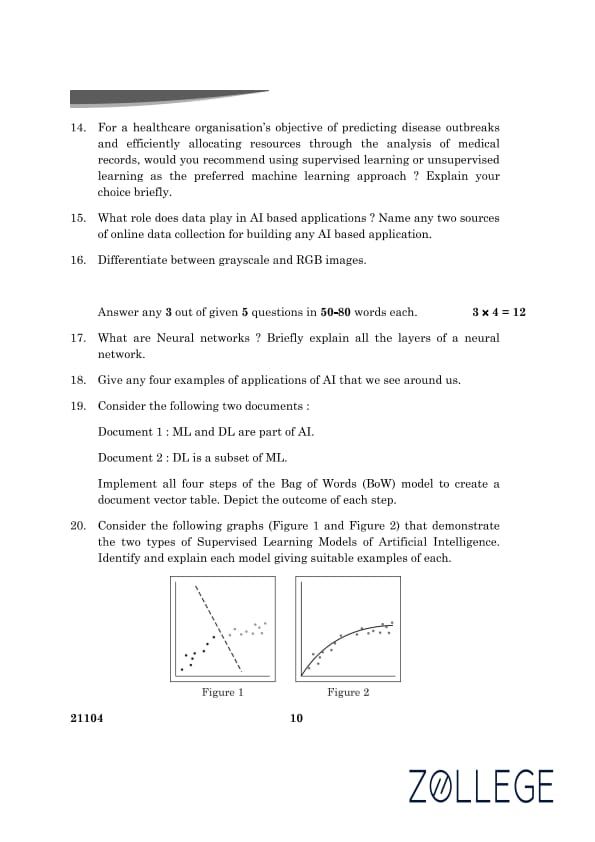
Question 20:
Consider the following graphs (Figure 1 and Figure 2) that demonstrate the two types of Supervised Learning Models of Artificial Intelligence. Identify and explain each model giving suitable examples of each.

Figure 1: This graph represents Linear Regression (a regression model) where a straight line fits the data points, predicting a continuous output.
Example: Predicting house prices based on square footage.
Figure 2: This graph represents Logistic Regression (a classification model) where data points are classified into two categories, usually indicated by a sigmoid curve.
Example: Classifying emails as spam or not.
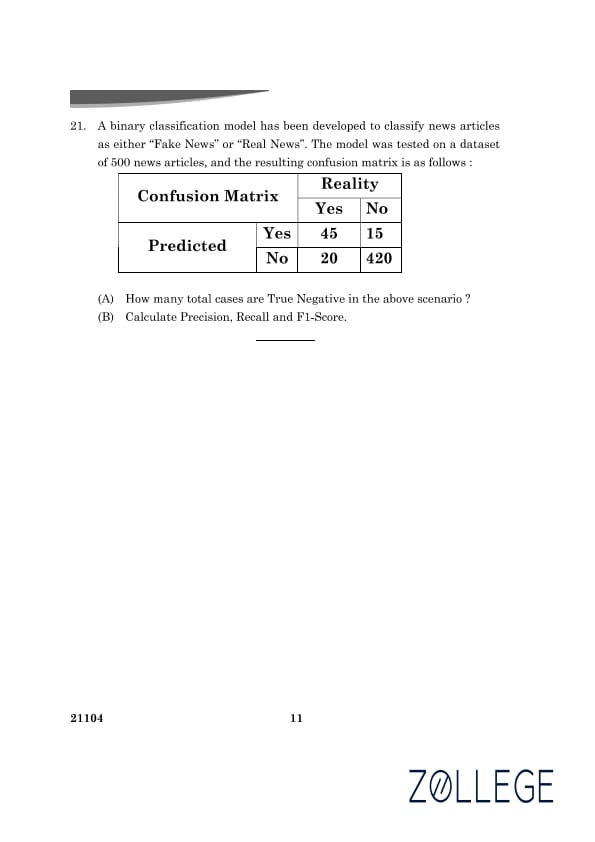
Question 21:
A binary classification model has been developed to classify news articles as either “Fake News” or “Real News.” The model was tested on a dataset of 500 news articles, and the resulting confusion matrix is as follows:
| Confusion Matrix | Reality Yes | Reality No |
|---|---|---|
| Predicted Yes | 45 | 15 |
| Predicted No | 20 | 420 |
(A) How many total cases are True Negative in the above scenario?
True Negative (TN) refers to the number of cases where the model correctly predicted “No” when the actual value was also “No.”
From the confusion matrix, there are 420 cases where the model predicted "No" and the reality was also "No."
Total True Negative Cases: 420.
(B) Calculate Precision, Recall, and F1-Score.
Using the confusion matrix values:
- True Positives (TP): 45
- False Positives (FP): 15
- False Negatives (FN): 20
- True Negatives (TN): 420
Precision (P):
Precision = TP / (TP + FP) = 45 / (45 + 15) = 45 / 60 = 0.75
Recall (R):
Recall = TP / (TP + FN) = 45 / (45 + 20) = 45 / 65 ≈ 0.6923
F1-Score:
F1 = 2 × (P × R) / (P + R) = 2 × (0.75 × 0.6923) / (0.75 + 0.6923) ≈ 2 × 0.5192 / 1.4423 ≈ 0.718
Results:
- Precision = 0.75
- Recall = 0.6923
- F1-Score = 0.718
*The article might have information for the previous academic years, please refer the official website of the exam.