
CBSE Class 10 Electronics Hardware 2024 Question Paper with Solution PDF (Available)


Content Strategist | Updated On - Jan 5, 2025
CBSE Class 10 Question Papers are the most important study material for effective exam preparation. We at Zollege have provided all CBSE Class 10 Previous Year Papers with Solution PDFs here.
Students can freely download the CBSE Class 10 previous year's question paper PDFs along with their solutions here. We strongly encourage CBSE 10 aspirants to scan through all the CBSE Class 10 Question Paper to know the overall difficulty level, CBSE Class 10 Syllabus and understand the changes in CBSE Class 10 Exam Pattern over the years.
CBSE Class 10 Electronics Hardware 2024 Question Paper with Solution PDF
| CBSE Class 10 Electronics Hardware 2024 Question Paper with Solution PDF |  Download Download |
Check Solution |
Section - A
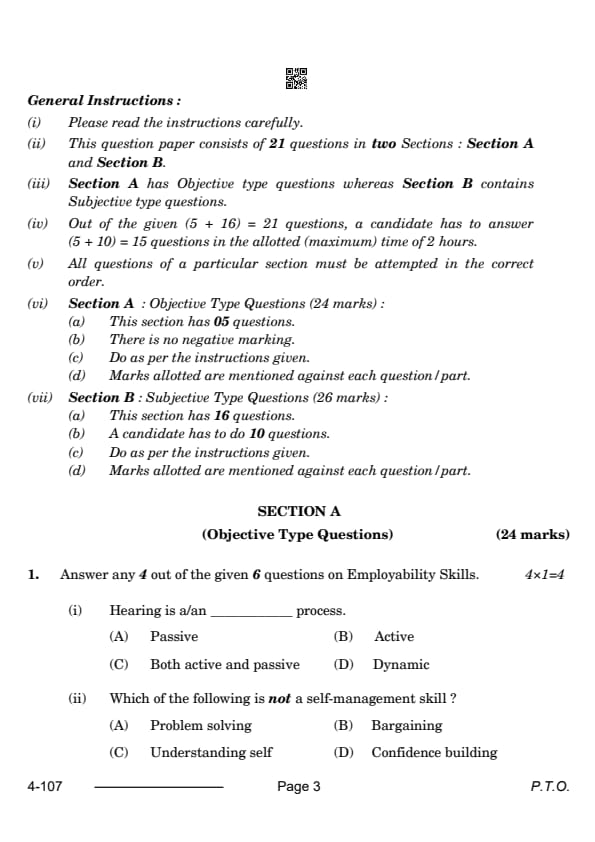
1. Answer any 4 out of the given 6 questions on Employability Skills.
(i) Hearing is a/an ______ process.
Hearing is a passive process that occurs without any active involvement. It is the physiological process of perceiving sound, whereas listening involves actively paying attention to and understanding the sound.
Read More
Listening, unlike hearing, requires cognitive effort to interpret and respond to the sound being perceived.
(ii) Which of the following is not a self-management skill?
Bargaining involves negotiating with others and is not considered a self-management skill, which typically focuses on managing one's own behavior, emotions, and time effectively.
Read More
Self-management skills include self-awareness, time management, and emotional regulation to enhance personal and professional effectiveness.
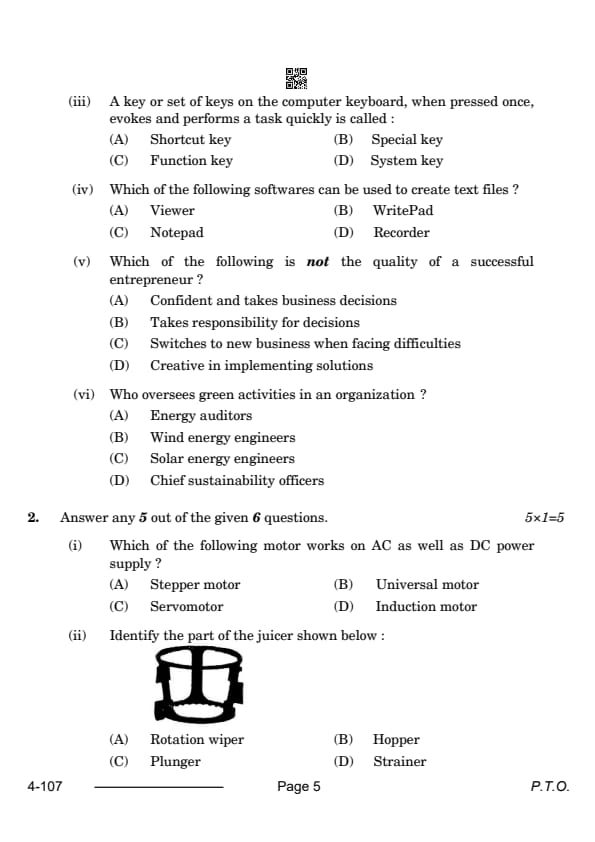
(iii) A key or set of keys on the computer keyboard, when pressed once, evokes and performs a task quickly is called:
A shortcut key allows a user to quickly perform a task or action with a single key combination. It is used to improve efficiency and productivity by bypassing multiple clicks or commands.
Read More
Examples of shortcut keys include Ctrl+C for copy and Ctrl+V for paste, which enhance workflow efficiency in computing.
(iv) Which of the following softwares can be used to create text files?
Notepad is a simple text editor used to create and edit plain text files. It is a basic tool for creating text documents without any formatting.
Read More
Notepad is commonly used for quick notes and editing configuration files due to its simplicity and availability in most operating systems.
(v) Which of the following is not the quality of a successful entrepreneur?
A successful entrepreneur focuses on overcoming challenges rather than abandoning their business. Persistence, adaptability, and creative problem-solving are key to success, not abandoning a business when facing difficulties.
Read More
Successful entrepreneurs demonstrate resilience and seek innovative solutions to problems rather than avoiding challenges.
(vi) Who oversees green activities in an organization?
Chief sustainability officers (CSOs) are responsible for overseeing and managing sustainability initiatives within an organization, ensuring that business operations align with environmental and social responsibility goals.
Read More
CSOs play a vital role in integrating sustainability into business strategies and promoting eco-friendly practices within the organization.
Section - B
2. Answer any 5 out of the given 6 questions.
(i) Which of the following motor works on AC as well as DC power supply?
Solution: A Universal motor is designed to work on both AC and DC power supplies.
Read More
It is commonly used in applications like household appliances due to its high speed and versatility. Unlike induction motors, which require AC, universal motors can operate on both AC and DC.
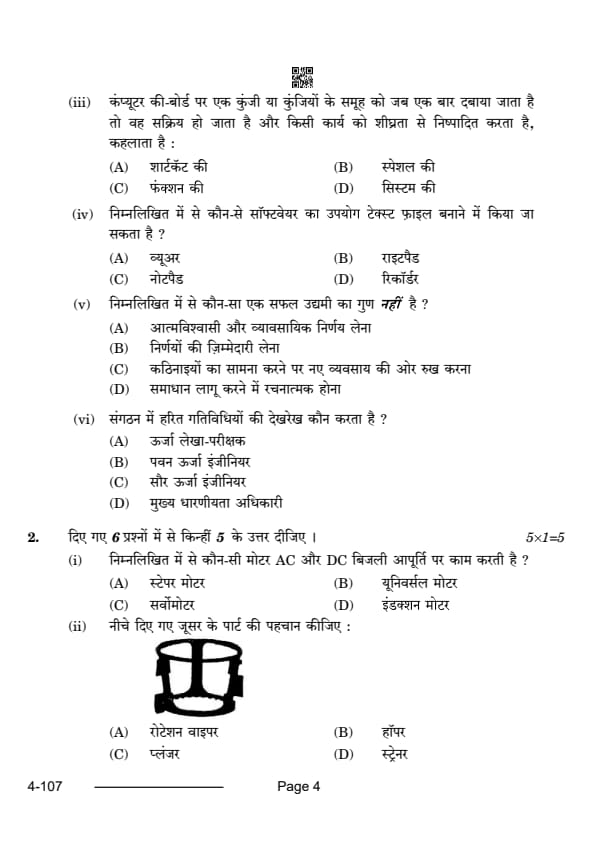
(ii) Identify the part of the juicer shown below:

Solution: The Hopper is the part of the juicer where the fruit or vegetables are placed before being processed.
Read More
It is the entry point for the raw material that is then extracted or juiced. The rotation wiper, plunger, and strainer are other components but serve different functions.
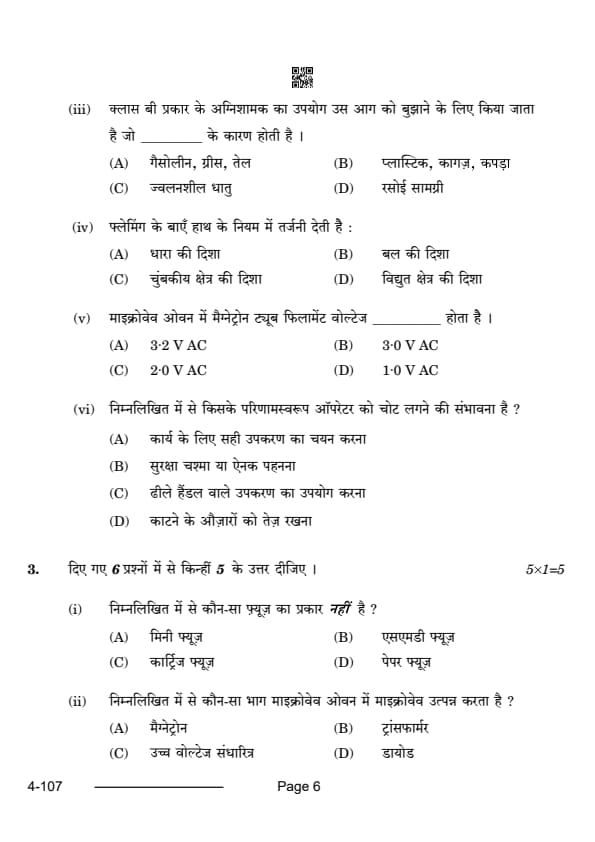
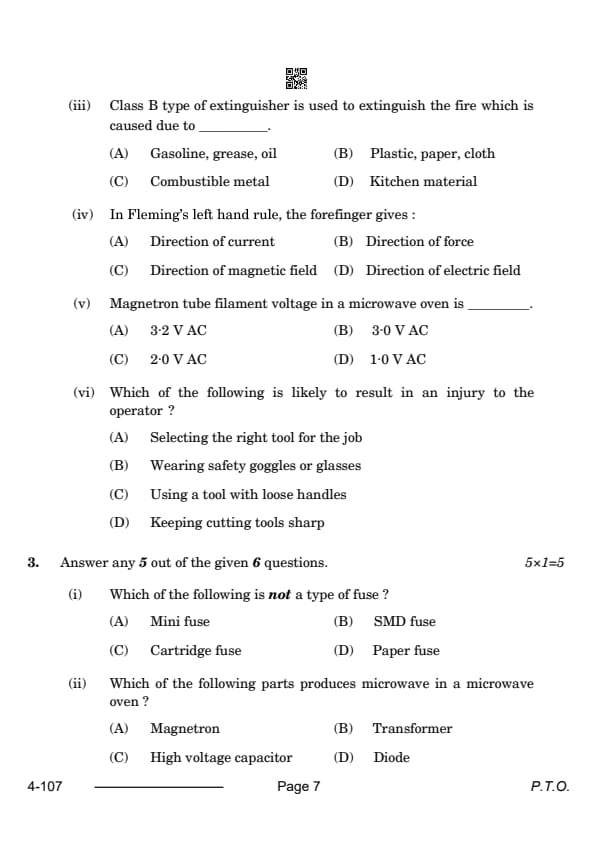
(iii) Class B type of extinguisher is used to extinguish the fire which is caused due to ______.
Solution: Class B extinguishers are used to put out fires caused by flammable liquids such as gasoline, grease, or oil.
Read More
These fires cannot be extinguished by water, so Class B fire extinguishers use foam, dry chemical powder, or CO2 to suppress the flames.
(iv) In Fleming’s left hand rule, the forefinger gives:
Solution: Fleming’s left hand rule helps in understanding the direction of force experienced by a conductor carrying current in a magnetic field.
Read More
The thumb gives the direction of motion (force), the forefinger shows the direction of the magnetic field, and the middle finger points in the direction of the current.
(v) Magnetron tube filament voltage in a microwave oven is:
Solution: The magnetron tube in a microwave oven requires a low-voltage alternating current (AC), typically around 2V AC.
Read More
This is critical for producing microwaves that heat food.
(vi) Which of the following is likely to result in an injury to the operator?
Solution: Using a tool with loose handles is hazardous because it can slip or break during use, leading to injuries.
Read More
It's important to ensure that all tools are in proper condition and handled safely.
Answer any 5 out of the given 6 questions:
(i) Which of the following is not a type of fuse?
A paper fuse is not a type of fuse. Common types of fuses include mini fuses, SMD (surface-mounted device) fuses, and cartridge fuses, but paper is not used as a material for fuses.
Read More
Fuses are typically made from materials like metals or alloys that melt under excessive current, providing safety by interrupting the circuit.
(ii) Which of the following parts produces microwave in a microwave oven?
The magnetron is the component in a microwave oven responsible for generating microwave radiation. This radiation is used to heat food.
Read More
The transformer, capacitor, and diode are vital for the operation of the microwave oven but do not produce microwaves.
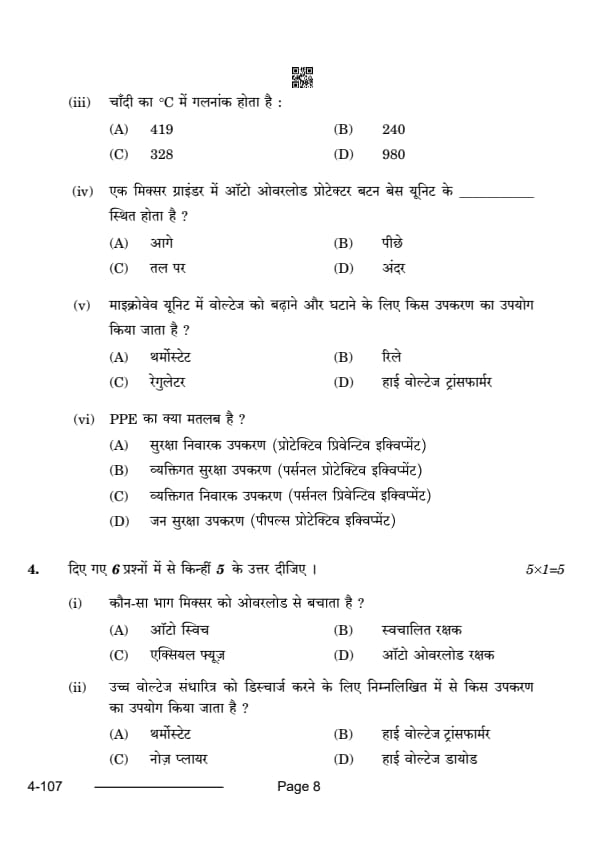
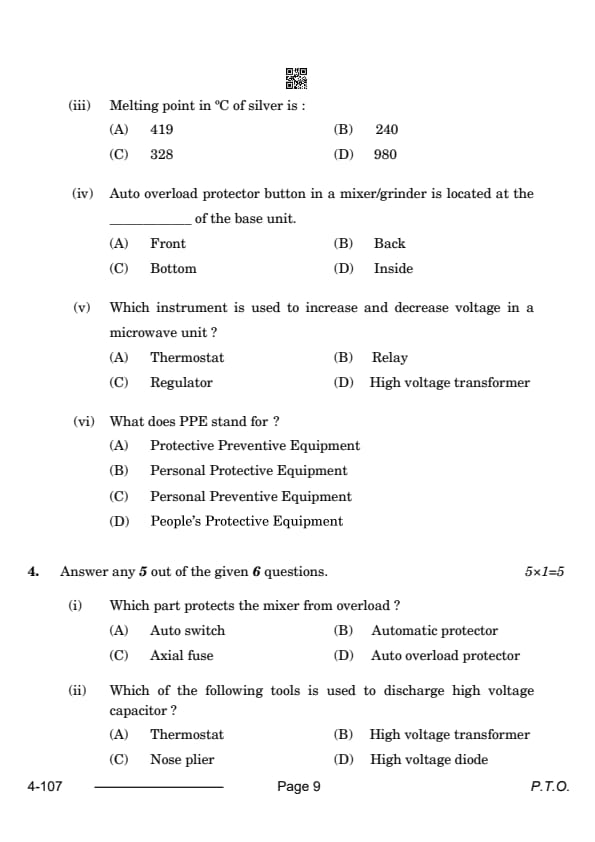
(iii) Melting point in °C of silver is:
The melting point of silver is 328°C. This temperature is the point at which silver transitions from solid to liquid.
Read More
Silver's relatively low melting point compared to other metals makes it versatile for applications like jewelry and industrial uses.
(iv) Auto overload protector button in a mixer/grinder is located at the ______ of the base unit.
The auto overload protector button is typically located at the bottom of the base unit. This button is used to reset the mixer/grinder if it overheats due to excessive load.
Read More
Overload protectors safeguard appliances from damage due to electrical or mechanical strain, ensuring durability.
(v) Which instrument is used to increase and decrease voltage in a microwave unit?
A regulator is used in microwave units to increase or decrease the voltage for appropriate functioning. It helps in controlling the power supply for the microwave.
Read More
Regulators ensure that voltage remains within the safe operating range to prevent appliance damage or inefficient performance.
(vi) What does PPE stand for?
PPE stands for Personal Protective Equipment. It includes all clothing and accessories designed to protect workers from injury or harm in the workplace.
Read More
Common examples of PPE include helmets, gloves, goggles, and masks, essential for ensuring safety in hazardous environments.
Answer any 5 out of the given 6 questions:
(i) Which part protects the mixer from overload?
The auto overload protector is the part that protects the mixer from electrical overload by disconnecting the power supply when the load exceeds the safe limit.
Read More
Overload protection is crucial for appliances like mixers to prevent overheating and electrical damage.
(ii) Which of the following tools is used to discharge high voltage capacitors?
Nose pliers are commonly used to safely discharge high voltage capacitors. This tool ensures that the capacitor is not holding a dangerous charge.
Read More
Always use proper insulated tools like nose pliers when working with high voltage components to avoid electric shocks.
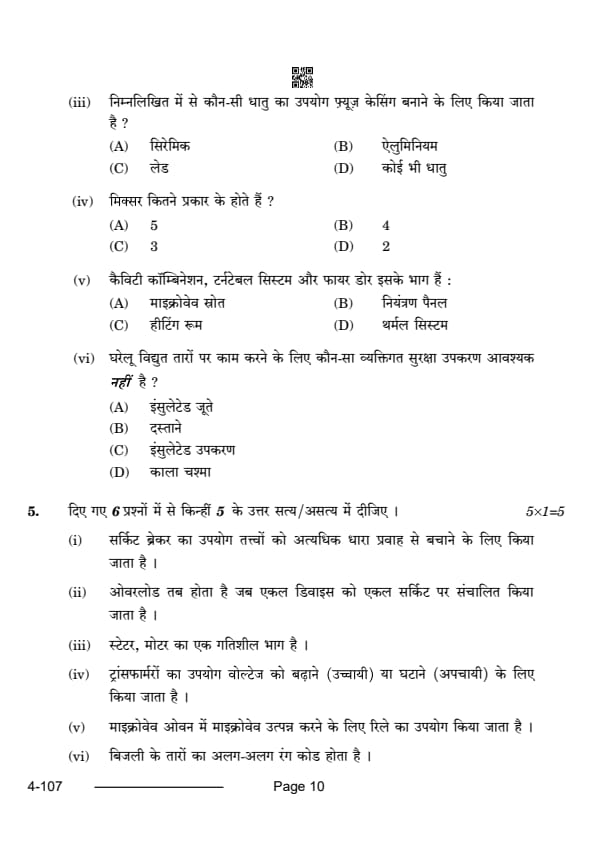
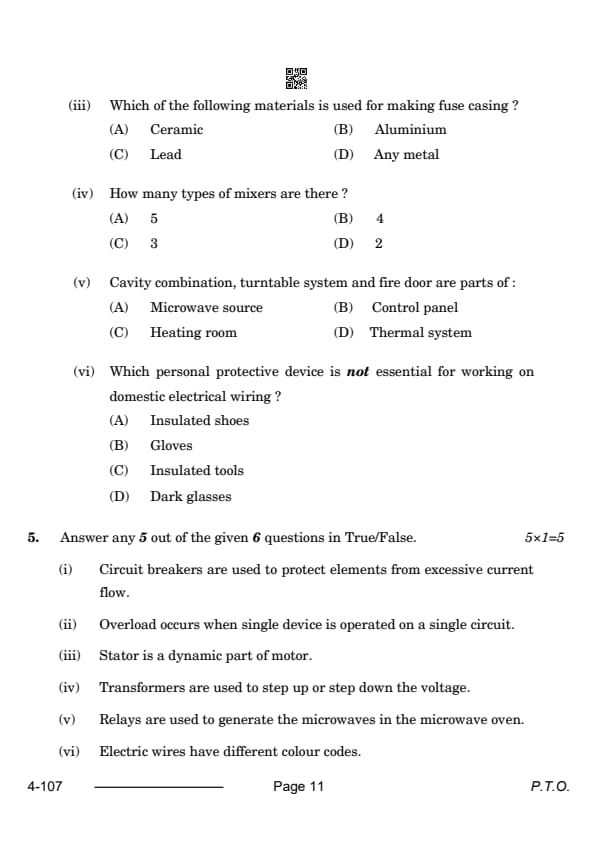
(iii) Which of the following materials is used for making fuse casing?
Fuse casings are typically made of ceramic because it has good insulating properties and can withstand high temperatures without melting.
Read More
Ceramic is commonly used for fuse casings due to its insulating properties and resistance to heat.
(iv) How many types of mixers are there?
There are 4 types of mixers available based on their functionality and motor capacity.
Read More
These types include hand mixers, stand mixers, electric mixers, and planetary mixers. Each is designed to suit different needs in the kitchen.
(v) Cavity combination, turntable system, and fire door are parts of:
The heating room in a microwave is where the cavity combination, turntable system, and fire door are located.
Read More
These components help in distributing the heat evenly and ensuring safety during operation.
(vi) Which personal protective device is not essential for working on domestic electrical wiring?
When working with electrical wiring, personal protective equipment (PPE) such as insulated shoes, gloves, and tools are essential to prevent electrical shock. However, dark glasses are not necessary for electrical work, as they do not protect against electrical hazards.
Read More
For electrical work, ensure the use of insulated shoes, gloves, and tools to avoid electrical hazards. Dark glasses are not necessary for this type of work.
Answer any 5 out of the given 6 questions:
(i) Circuit breakers are used to protect elements from excessive current flow.
Correct Answer: True.
Circuit breakers are safety devices designed to interrupt the flow of electric current when it exceeds a safe level, protecting electrical components from damage caused by overcurrent.
Read More
Circuit breakers help prevent damage from overcurrent by automatically disconnecting the power when the current exceeds safe limits.
(ii) Overload occurs when a single device is operated on a single circuit.
Correct Answer: False.
Overload occurs when too many devices are operating on a single circuit, causing the circuit to exceed its capacity.
Read More
A single device typically does not cause overload unless it is faulty or too powerful for the circuit. Overload happens when the circuit is overloaded with multiple devices, not just one.
(iii) Stator is a dynamic part of motor.
Correct Answer: False.
The stator is the stationary part of a motor. It provides a magnetic field that interacts with the rotor, the dynamic part of the motor, to generate mechanical motion.
Read More
In a motor, the stator is stationary, while the rotor is the moving part that generates mechanical motion.
(iv) Transformers are used to step up or step down the voltage.
Correct Answer: True.
Transformers are electrical devices used to increase (step up) or decrease (step down) the voltage level in an alternating current (AC) circuit.
Read More
They work based on the principle of electromagnetic induction and are essential for power distribution systems. For example, in power transmission, high voltages are used for efficient transmission, and the voltage is then stepped down for safe usage in homes and industries.
(v) Relays are used to generate the microwaves in the microwave oven.
Correct Answer: False.
Relays are electrical switches used for controlling a circuit by a low-power signal or in automatically controlled circuits.
Read More
In a microwave oven, magnetrons generate microwaves, not relays. Magnetrons convert electrical energy into microwave radiation, which is then used for cooking food.
(vi) Electric wires have different colour codes.
Correct Answer: True.
Electric wires are typically color-coded to indicate their function in electrical circuits.
Read More
These color codes help to avoid confusion and ensure safety during electrical installation and repairs. For instance, in many regions, the following color codes are used: Black/Red for Live wire, White for Neutral, and Green or Green with Yellow stripes for Ground. These codes vary by region, but the primary purpose is to distinguish between wires for correct installation and safety.
Section - B
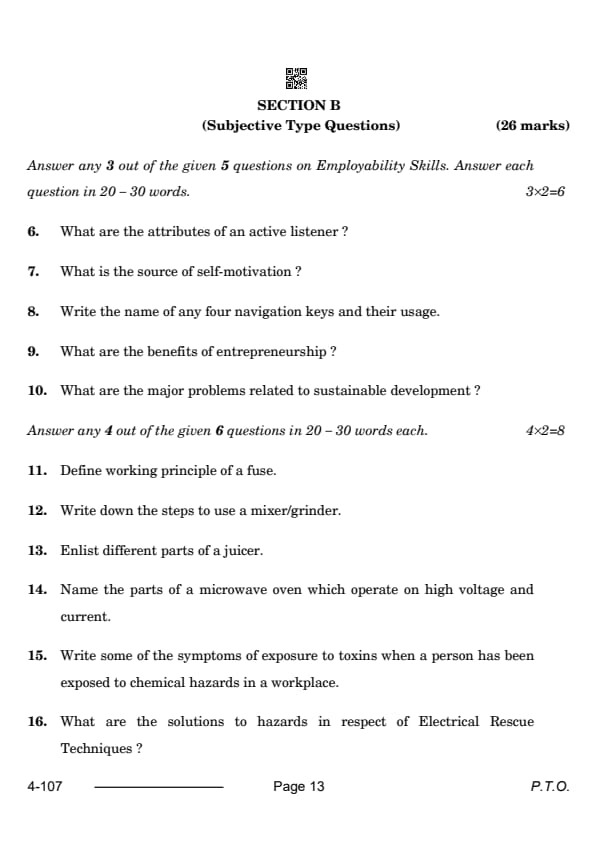
Answer any 3 out of the given 5 questions on Employability Skills. Answer each question in 20-30 words each.
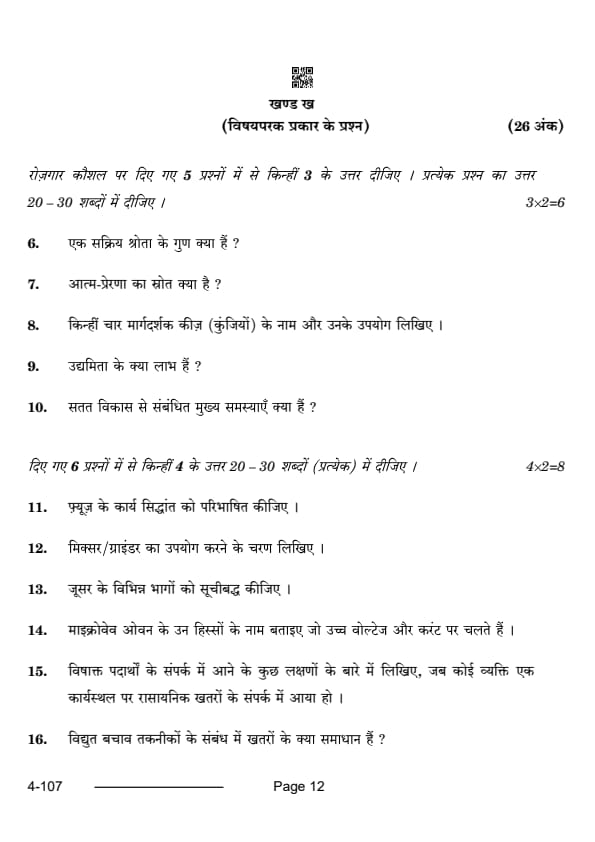
6. What are the attributes of an active listener?
An active listener is someone who is fully engaged in the communication process. They exhibit the following attributes:
Read More
1. Attentiveness: They focus on the speaker without distractions.
2. Understanding: They comprehend the message and its context.
3. Feedback: They provide appropriate verbal and non-verbal feedback to show understanding.
4. Empathy: They understand the emotions behind the message and respond appropriately.
5. Retention: They remember key details of the conversation for future reference.
7. What is the source of self-motivation?
Self-motivation is driven by an internal desire to achieve personal goals and values. Key sources of self-motivation include:
Read More
1. Personal goals: Having clear, meaningful objectives.
2. Passion and interest: A deep interest in the task at hand.
3. Self-discipline: The ability to stay focused despite challenges.
4. Positive reinforcement: Rewarding oneself after achieving small milestones.
5. Sense of purpose: A belief that the effort contributes to a larger cause.
8. Write the name of any four navigation keys and their usage.
The four commonly used navigation keys are:
Read More
1. Arrow Keys: Used to move the cursor in different directions.
2. Home: Moves the cursor to the beginning of the line or document.
3. End: Moves the cursor to the end of the line or document.
4. Page Up: Moves the view up by one page.
5. Page Down: Moves the view down by one page.
9. What are the benefits of entrepreneurship?
Entrepreneurship offers several key benefits, such as:
Read More
1. Economic Growth: Entrepreneurs create jobs, stimulate innovation, and contribute to GDP growth.
2. Independence: Entrepreneurs have the freedom to make decisions and run their businesses as they see fit.
3. Wealth Creation: Successful entrepreneurs can generate substantial wealth for themselves and others.
4. Personal Development: Entrepreneurship promotes skill development, creativity, and problem-solving.
5. Community Impact: Entrepreneurs can address social issues by offering innovative solutions.
10. What are the major problems related to sustainable development?
Sustainable development faces several challenges, including:
Read More
1. Resource Depletion: Overuse of natural resources leads to scarcity.
2. Climate Change: Environmental degradation contributes to global warming and extreme weather conditions.
3. Pollution: Industrial waste and plastic pollution harm ecosystems and human health.
4. Social Inequality: Unequal access to resources and opportunities undermines sustainable progress.
5. Economic Challenges: Balancing economic growth with environmental protection remains difficult.
11. Define working principle of a fuse.
A fuse is a safety device that protects electrical circuits from overcurrent. It works on the principle of melting under heat:
Read More
1. Current flow: When current flows through the fuse, it heats the wire inside.
2. Excessive current: If the current exceeds a safe level, the wire melts due to the heat generated.
3. Circuit protection: The melting of the wire breaks the circuit, preventing further damage to electrical components.
12. Write down the steps to use a mixer/grinder.
To safely use a mixer/grinder, follow these steps:
Read More
1. Assemble the parts: Attach the jar to the base and ensure it is tightly secured.
2. Add ingredients: Place the ingredients into the jar, ensuring it is not overloaded.
3. Set speed: Adjust the speed settings according to the type of food to be blended.
4. Start the appliance: Turn on the mixer and monitor its operation.
5. Turn off and clean: Once done, switch off the mixer, unplug it, and clean the jar and base thoroughly.
13. Enlist different parts of a juicer.
The main parts of a juicer include:
Read More
1. Motor: Powers the juicer and drives the blades.
2. Blades: Chop and crush the fruits or vegetables.
3. Juicer jar: Collects the juice.
4. Pulp container: Collects the leftover pulp.
5. Feeding tube: Holds and guides the fruit into the blades.
6. On/off switch: Controls the juicer's operation.
14. Name the parts of a microwave oven which operate on high voltage and current.
The parts of a microwave oven that operate on high voltage and current are:
Read More
1. Magnetron: Generates microwave radiation.
2. High-voltage capacitor: Stores energy for the magnetron.
3. High-voltage transformer: Increases the voltage to operate the magnetron.
15. Write some of the symptoms of exposure to toxins when a person has been exposed to chemical hazards in a workplace.
Symptoms of exposure to toxins in the workplace may include:
Read More
1. Headaches: Caused by inhaling chemical fumes.
2. Dizziness: A common sign of poisoning or lack of oxygen.
3. Nausea and vomiting: Common when exposed to harmful chemicals.
4. Respiratory issues: Difficulty breathing or coughing due to inhalation of toxic gases.
5. Skin irritation: Redness, itching, or rashes caused by direct contact with chemicals.
16. What are the solutions to hazards in respect of Electrical Rescue Techniques?
Electrical hazards require quick and safe responses to prevent injuries. Solutions to hazards in electrical rescue include:
Read More
1. Cutting off the power: The first step is to disconnect the electrical supply to prevent further exposure.
2. Using non-conductive tools: Ensure the use of rubber gloves and tools to avoid direct contact with electrical currents.
3. Providing CPR: If the person is unconscious or not breathing, administer CPR until emergency services arrive.
4. Calling emergency services: Always seek professional help in case of a serious electrical shock.
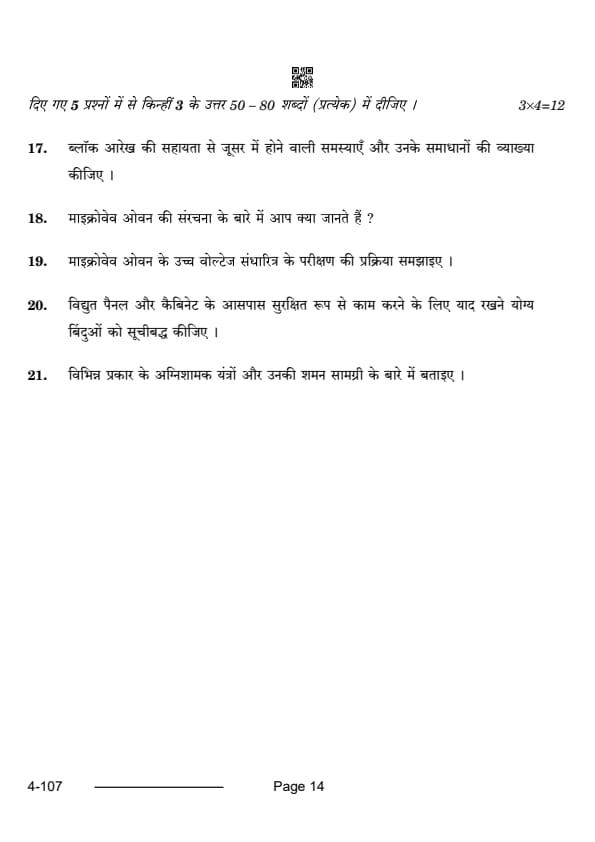
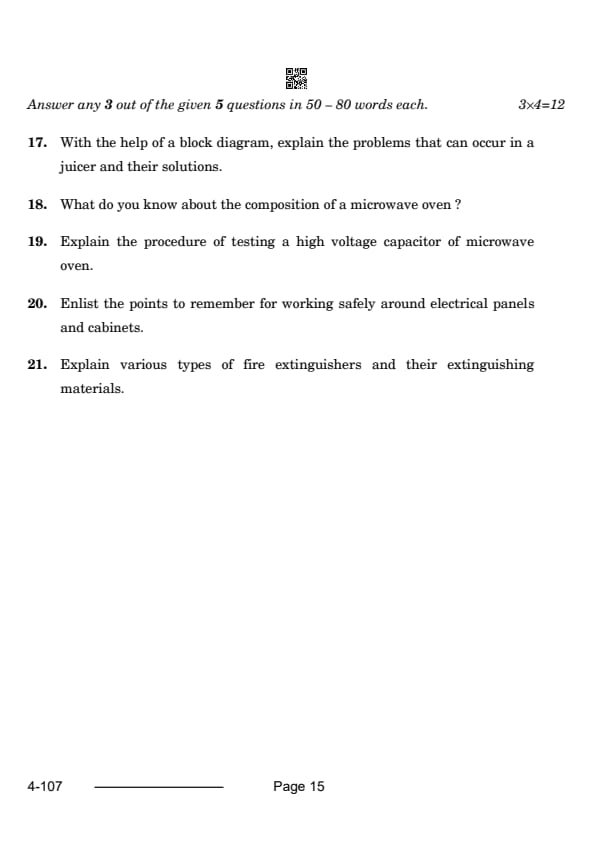
17. With the help of a block diagram, explain the problems that can occur in a juicer and their solutions.
A juicer consists of several key parts, including the motor, blades, jar, feeding tube, and pulp container. The following problems can occur during its operation:
Read More
1. Motor Overload: The motor may overheat or stop working due to overload.
- Solution: Ensure the jar is not overloaded with ingredients. Check for any obstructions.
2. Blades Not Rotating: The blades may not rotate properly due to improper assembly or blockage.
- Solution: Disassemble and clean the blade area. Ensure the lid is correctly placed.
3. Juice Leaks: Leakage from the jar or base could occur due to loose parts or improper sealing.
- Solution: Tighten all screws and check for any cracks or worn seals.
4. Power Supply Issue: If the juicer does not turn on, there could be an issue with the power cord or fuse.
- Solution: Check the power connection and fuse; replace if needed.
18. What do you know about the composition of a microwave oven?
A microwave oven consists of the following components:
Read More
1. Magnetron: The core part of the microwave oven that generates microwave radiation.
2. High-voltage transformer: Increases the voltage to the magnetron for microwave generation.
3. Waveguide: Directs the microwaves from the magnetron into the cooking chamber.
4. Turntable: Rotates food for even cooking by distributing the microwaves evenly.
5. Control Panel: Allows users to set cooking time, power levels, and other functions.
6. Cavity: The space inside the microwave where food is placed for heating.
19. Explain the procedure of testing a high voltage capacitor of microwave oven.
Testing a high voltage capacitor in a microwave oven involves the following steps:
Read More
1. Power off the microwave: Unplug the microwave oven and discharge any residual charge from the capacitor by shorting it with an insulated tool.
2. Use a multimeter: Set the multimeter to the resistance mode and connect it across the terminals of the capacitor.
3. Observe the reading:
- If the capacitor is good, the meter will show a low resistance value initially, which will gradually increase as the capacitor charges.
- If the meter shows no change, the capacitor is likely faulty and needs replacement.
4. Check for leakage: Use the multimeter’s continuity setting to ensure no leakage current.
20. Enlist the points to remember for working safely around electrical panels and cabinets.
To ensure safety when working around electrical panels and cabinets, keep in mind the following:
Read More
1. Power off the circuit: Always turn off the power before working on any electrical panel.
2. Use insulated tools: Use tools that are insulated to prevent electrical shock.
3. Check for live wires: Verify that no wires are live before touching them using a voltage tester.
4. Wear protective gear: Wear rubber gloves, safety goggles, and other appropriate protective equipment.
5. Avoid water: Ensure the work area is dry to prevent electrical hazards.
6. Keep the work area clear: Avoid unnecessary clutter around the panel or cabinet to ensure you can access the equipment safely.
21. Explain various types of fire extinguishers and their extinguishing materials.
Fire extinguishers come in various types, each suited for different fire classes:
Read More
1. Water Fire Extinguisher (Class A): Used for common combustibles like wood, paper, and cloth. It works by cooling the fire and removing heat.
2. Foam Fire Extinguisher (Class B): Used for flammable liquids like gasoline or oil. It forms a foam layer to suppress vapors and cool the fire.
3. Dry Chemical Fire Extinguisher (Class A, B, C): Suitable for electrical fires and flammable liquids. It works by interrupting the chemical reaction of the fire.
4. Carbon Dioxide (CO2) Fire Extinguisher (Class B, C): Used for electrical fires and flammable liquids. It works by displacing oxygen to suffocate the fire.
5. Wet Chemical Fire Extinguisher (Class K): Used for kitchen fires involving oils and fats. It cools and forms a barrier between the fuel and oxygen.
*The article might have information for the previous academic years, please refer the official website of the exam.