
CBSE Class 10 Elements of Business Question Paper 2026 with Solutions PDF


| Updated On - Feb 24, 2026
CBSE is conducting the Class 10 Elements of Business Board Exam 2026 on February 24, 2026. Class 10 Elements of Business Question Paper with Solution PDF is available here for download.
The official question paper of CBSE Class 10 Elements of Business Board Exam 2026 is provided below. Students can download the official paper in PDF format for reference.
CBSE Class 10 2026 Elements of Business Question Paper with Solution PDF
| CBSE Class 10 Elements of Business Question Paper 2026 | Download PDF | Check Solutions |
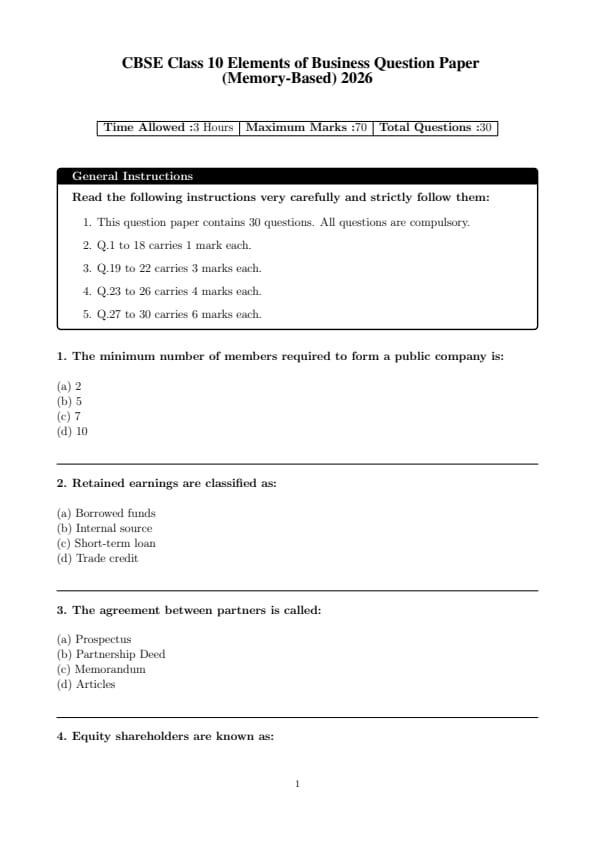
The minimum number of members required to form a public company is:
View Solution
Step 1: Understanding the Concept:
A public company is a corporation whose shares are traded freely on a stock exchange. Under the Companies Act, there are specific statutory requirements regarding the number of members (shareholders) for different types of companies.
Step 3: Detailed Explanation:
According to the Companies Act, 2013 (India):
- A **Private Company** requires a minimum of **2** members.
- A **Public Company** requires a minimum of **7** members.
- A **One Person Company (OPC)** requires only **1** member.
There is no maximum limit for members in a public company, whereas a private company is limited to 200.
Step 4: Final Answer:
The minimum number of members required for a public company is 7. Quick Tip: To remember the minimums, use the "2-7" rule: 2 for Private, 7 for Public.
Retained earnings are classified as:
View Solution
Step 1: Understanding the Concept:
Retained earnings represent the portion of a company's net income that is kept (ploughed back) into the business rather than being distributed as dividends to shareholders.
Step 3: Detailed Explanation:
Sources of finance are categorized into internal and external.
- **Internal Sources:** Funds generated from within the business (e.g., Retained Earnings, Depreciation funds).
- **External Sources:** Funds raised from outside (e.g., Loans, Debentures, Equity).
Since retained earnings are part of the company's own accumulated profits, they are an internal source of financing.
Step 4: Final Answer:
Retained earnings are classified as an Internal source. Quick Tip: Retained earnings are often called "Self-Financing" or "Ploughing back of profits" as they involve no explicit cost like interest or dividends.
The agreement between partners is called:
View Solution
Step 1: Understanding the Concept:
Partnership is a voluntary association. While a written agreement is not legally mandatory, it is highly recommended to prevent future disputes.
Step 3: Detailed Explanation:
- **Prospectus/Memorandum/Articles:** These are documents related to the formation and operation of a **Company**.
- **Partnership Deed:** This is the specific legal document that contains the terms and conditions of the partnership, such as profit-sharing ratios, interest on capital, and duties of partners.
Step 4: Final Answer:
The agreement between partners is known as the Partnership Deed. Quick Tip: In the absence of a Partnership Deed, the provisions of the Indian Partnership Act, 1932 apply (e.g., profits are shared equally).
Equity shareholders are known as:
View Solution
Step 1: Understanding the Concept:
Equity shares represent the ownership capital of a company. Those who hold these shares bear the maximum risk and enjoy the rewards of the business.
Step 3: Detailed Explanation:
- **Creditors/Debenture holders:** These are lenders who provide borrowed capital and have a fixed claim on the company's assets.
- **Equity Shareholders:** They have voting rights, control over management, and a claim on residual profits. Because they hold the ultimate risk of loss and the right to residual gains, they are the true owners.
Step 4: Final Answer:
Equity shareholders are known as the Real owners of the company. Quick Tip: Equity shareholders are "residual claimants," meaning they receive their share only after all other liabilities (creditors, tax, preference shares) are paid.
Trade credit is generally a:
View Solution
Step 1: Understanding the Concept:
Trade credit is the credit extended by one trader to another for the purchase of goods and services. It facilitates the purchase of supplies without immediate payment.
Step 3: Detailed Explanation:
Trade credit is a common practice in business-to-business (B2B) transactions. It is usually granted for a short duration, ranging from 15 days to 90 days. Therefore, it is used to fund "Working Capital" requirements rather than fixed assets.
Step 4: Final Answer:
Trade credit is generally a Short-term source of finance. Quick Tip: Trade credit is "spontaneous" financing; it increases automatically as the volume of purchases increases.
Video conferencing is an example of:
View Solution
Step 1: Understanding the Concept:
Communication is the process of exchanging information. It is categorized based on the channels used, such as verbal (using words), non-verbal (body language), and written.
Step 3: Detailed Explanation:
Verbal communication includes both oral (spoken) and written forms. However, in many contexts, "verbal" is specifically associated with the use of spoken words. Video conferencing involves real-time oral interaction and visual cues, making it a form of oral-verbal communication. Unlike "Grapevine" (informal/rumor-based) or "Written" communication, it relies on spoken language and immediate feedback.
Step 4: Final Answer:
Video conferencing is an example of Verbal communication. Quick Tip: While video conferencing is verbal, the "visual" aspect (gestures and facial expressions) adds a layer of non-verbal communication to the interaction.
Liability of a sole proprietor is:
View Solution
Step 1: Understanding the Concept:
Liability refers to the legal responsibility for the debts of the business. In business law, liability can either be limited to the investment in the business or extend to personal assets.
Step 3: Detailed Explanation:
In a sole proprietorship, the owner and the business are considered a single legal entity. This means there is no "corporate veil" protecting the owner. If the business cannot pay its debts, creditors have the legal right to claim the owner's personal property (like their car or house) to recover their money. This is known as unlimited liability.
Step 4: Final Answer:
The liability of a sole proprietor is Unlimited. Quick Tip: Unlimited liability is the biggest disadvantage of sole proprietorships and traditional partnerships, which is why many choose to form a "Limited Liability Partnership" (LLP) or a "Company."
Debentures represent:
View Solution
Step 1: Understanding the Concept:
Companies raise funds through different instruments. These instruments are broadly classified as "Owned Funds" (Equity) or "Borrowed Funds" (Debt).
Step 3: Detailed Explanation:
A debenture is a debt instrument issued by a company to the public as an acknowledgment of a loan. The company pays a fixed rate of interest to debenture holders at regular intervals. Unlike equity shareholders, debenture holders do not own the company; they are creditors. Therefore, the funds raised via debentures are considered borrowed capital.
Step 4: Final Answer:
Debentures represent Borrowed capital. Quick Tip: Debenture interest must be paid even if the company makes a loss, making it a "charge against profit."
A cooperative society is formed to promote:
View Solution
Step 1: Understanding the Concept:
A cooperative society is a voluntary association of persons who join together with the objective of promoting their common economic interests.
Step 3: Detailed Explanation:
The primary objective of most business forms (like companies or partnerships) is profit. However, a cooperative society is driven by the principle of "Each for all and all for each." Its main goal is to provide goods or services to its members at reasonable rates and protect them from exploitation by middlemen. This is defined as the service motive.
Step 4: Final Answer:
A cooperative society is formed to promote a Service motive. Quick Tip: The motto of a cooperative society is "Not for profit, but for service," though they can earn a surplus to be distributed among members as a dividend.
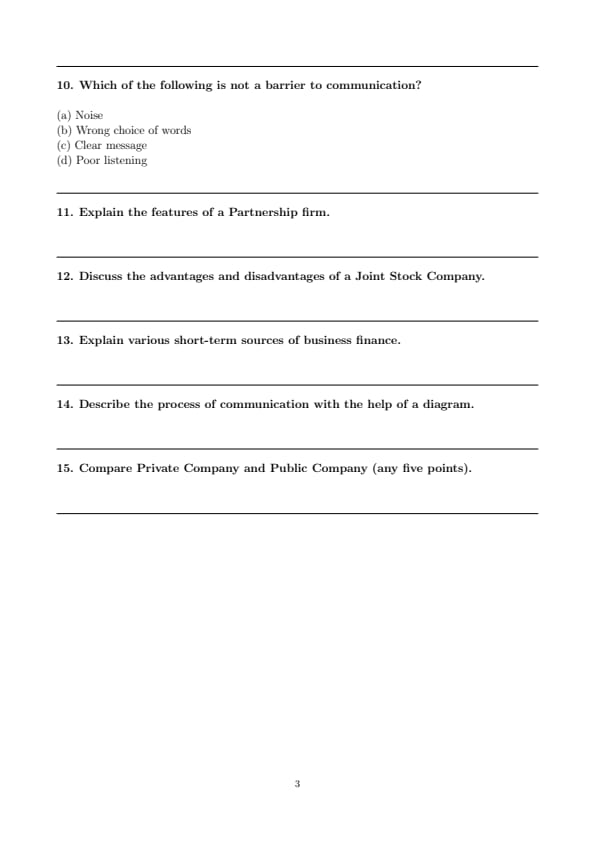
Which of the following is not a barrier to communication?
View Solution
Step 1: Understanding the Concept:
Communication barriers are obstacles that distort or prevent the message from reaching the receiver accurately. They can be physical, semantic, psychological, or organizational.
Step 3: Detailed Explanation:
- **Noise:** A physical barrier that disrupts the channel.
- **Wrong choice of words:** A semantic barrier where the language used is confusing.
- **Poor listening:** A psychological barrier on the receiver's end.
- **Clear message:** This is a characteristic of *effective* communication. It aids the process rather than hindering it.
Step 4: Final Answer:
Clear message is not a barrier to communication. Quick Tip: To avoid barriers, remember the "7 Cs of Communication": Clear, Concise, Concrete, Correct, Coherent, Complete, and Courteous.
Explain the features of a Partnership firm.
View Solution
Step 1: Understanding the Concept:
A partnership is a form of business organization where two or more persons agree to join hands for setting up a business and sharing its profits as well as risks. In India, it is governed by the Indian Partnership Act, 1932.
Step 3: Detailed Explanation:
The key features of a partnership firm are:
Two or More Persons: There must be at least two people to form a partnership. The maximum limit is generally 50.
Agreement: It is the result of an agreement (Partnership Deed) between two or more persons to do business. The agreement can be oral or written.
Lawful Business: Partnerships can be formed only for the purpose of carrying out a legal business.
Profit Sharing: The agreement must be to share the profits and losses of the business in a specified ratio.
Unlimited Liability: Partners are personally liable for the debts of the firm. Their personal assets can be used to pay back creditors.
Mutual Agency: Every partner is both an agent and a principal. They can bind other partners by their actions and are bound by the actions of others.
Step 4: Final Answer:
A partnership is characterized by mutual trust, an agreement to share profits from a lawful business, and the shared unlimited liability of the partners involved. Quick Tip: The "Mutual Agency" is considered the true test of a partnership; it distinguishes it from mere co-ownership of property.
Discuss the advantages and disadvantages of a Joint Stock Company.
View Solution
Step 1: Understanding the Concept:
A Joint Stock Company is an artificial person created by law, having a separate legal entity, perpetual succession, and a common seal.
Step 3: Detailed Explanation:
Advantages:
Limited Liability: Shareholders are only liable for the unpaid amount on the shares held by them.
Perpetual Succession: The company's existence is not affected by the death or retirement of members. "Members may come and members may go, but the company goes on forever."
Large Capital: It can raise vast amounts of capital by issuing shares to the general public.
Transferability of Shares: Shares of a public company can be easily sold or transferred in the stock market.
Disadvantages:
Complexity in Formation: Forming a company requires many legal formalities and documentation (Memorandum, Articles, etc.).
Lack of Secrecy: Public companies must publish their accounts and share information with the Registrar, making it hard to keep secrets.
Impersonal Work Environment: Due to the large scale, there is often a lack of personal contact between owners (shareholders) and managers.
Government Control: Companies are subject to many regulations and strict compliance under the Companies Act.
Step 4: Final Answer:
While a Joint Stock Company offers the benefit of limited liability and massive capital, it comes at the cost of high regulatory compliance and loss of operational privacy. Quick Tip: The "Separate Legal Entity" status means the company can sue and be sued in its own name, independent of its members.
Explain various short-term sources of business finance.
View Solution
Step 1: Understanding the Concept:
Short-term finance refers to funds required for a period of less than one year. These are primarily used to meet working capital needs like buying raw materials or paying salaries.
Step 3: Detailed Explanation:
Common short-term sources include:
Trade Credit: Credit extended by one trader to another for the purchase of goods. It allows a business to use the goods now and pay later.
Bank Overdraft: A facility where a customer can withdraw more money than what is available in their current account, up to a certain limit.
Cash Credit: A loan given against the security of current assets like stock or inventory.
Commercial Paper (CP): An unsecured promissory note issued by highly rated companies to raise funds from the money market.
Factoring: A financial service where a business sells its accounts receivable (invoices) to a third party (a factor) at a discount to get immediate cash.
Step 4: Final Answer:
Short-term sources like trade credit and bank overdrafts provide the necessary liquidity for a business to maintain its day-to-day operations. Quick Tip: Trade credit is often called "free" finance because it usually doesn't carry an explicit interest rate if paid within the credit period.
Describe the process of communication with the help of a diagram.
View Solution
Step 1: Understanding the Concept:
The communication process is a circular flow that involves a sender transmitting a message to a receiver through a channel, ensuring the meaning is understood.
Step 3: Detailed Explanation:
The elements of the communication process are:
1. Sender: The person who initiates the communication.
2. Message: The information or idea to be conveyed.
3. Encoding: Converting the message into symbols (words, pictures, or gestures).
4. Media/Channel: The path through which the encoded message is sent (email, phone, face-to-face).
5. Decoding: The receiver converting the symbols back into understandable information.
6. Receiver: The person for whom the message was intended.
7. Feedback: The response of the receiver to the sender, indicating whether the message was understood.
8. Noise: Any disturbance that hinders the flow of communication.
Step 4: Final Answer:
Communication is complete only when the receiver provides feedback to the sender, confirming that the message has been interpreted correctly. Quick Tip: Effective communication is a "two-way street." Without feedback, the sender cannot be sure if the communication was successful.
Compare Private Company and Public Company (any five points).
View Solution
Step 1: Understanding the Concept:
Companies are classified based on the number of members and the restrictions on the transfer of their shares.
Step 3: Detailed Explanation:
Basis of Comparison & Private Company & Public Company
Minimum Members & 2 & 7
Maximum Members & 200 & Unlimited
Transfer of Shares & Restricted & Freely transferable
Index of Members & Not mandatory & Mandatory
Minimum Directors & 2 & 3
Invitation to Public & Cannot invite public & Can invite public to subscribe
Step 4: Final Answer:
The primary difference lies in the scale of operation and public involvement; a public company has a minimum of 7 members and can raise funds from the general public, whereas a private company is more closely held with a 200-member limit. Quick Tip: A private company must add the words "Private Limited" (Pvt. Ltd.) to its name, while a public company adds "Limited" (Ltd.).

*The article might have information for the previous academic years, please refer the official website of the exam.