
CBSE Class 10 Food Production 2024 Question Paper with Solution PDF (Available)


Content Curator | Updated On - Jan 5, 2025
CBSE Class 10 Question Papers are the most important study material for effective exam preparation. We at Zollege have provided all CBSE Class 10 Previous Year Papers with Solution PDFs here.
Students can freely download the CBSE Class 10 previous year's question paper PDFs along with their solutions here. We strongly encourage CBSE 10 aspirants to scan through all the CBSE Class 10 Question Paper to know the overall difficulty level, CBSE Class 10 Syllabus and understand the changes in CBSE Class 10 Exam Pattern over the years.
CBSE Class 10 Food Production 2024 Question Paper with Solution PDF
| CBSE Class 10 Food Production 2024 Question Paper with Solution PDF |  Download Download |
Check Solution |
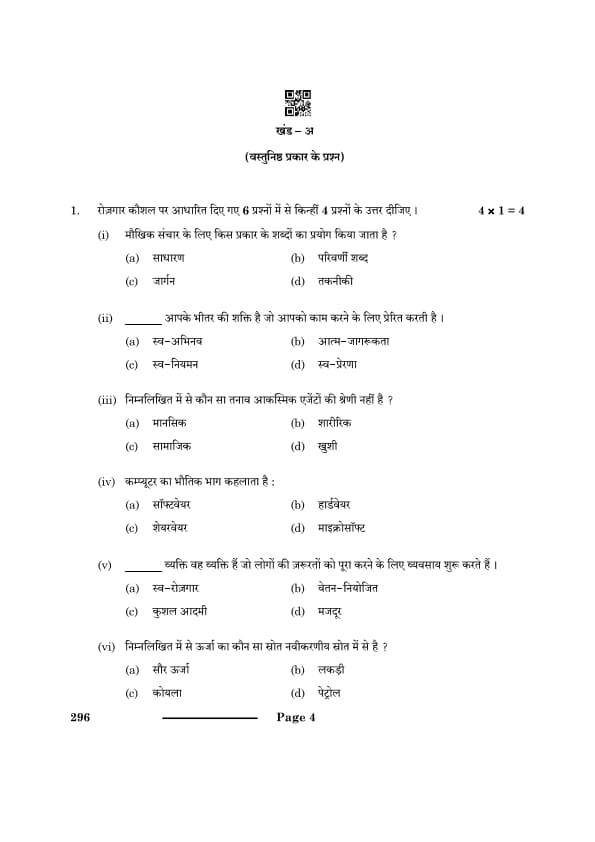
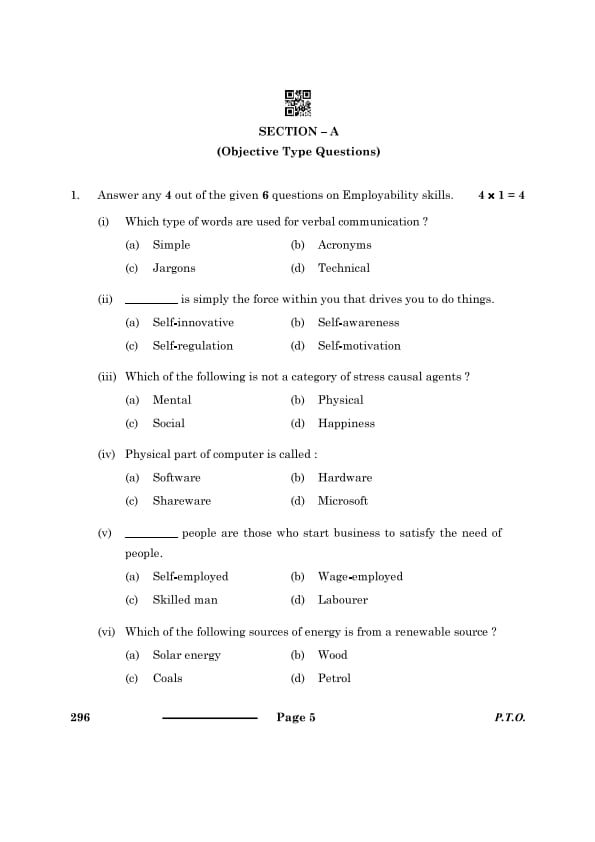
Question 1: Answer any 4 out of the given 6 questions on Employability skills.
(i) Which type of words are used for verbal communication?
- (a) Simple
- (b) Acronyms
- (c) Jargons
- (d) Technical
When we speak to others, we should use simple words because they are easy to understand. Complex words, technical terms, or jargons might confuse people, especially if they are not familiar with those terms.
(ii) _______ is simply the force within you that drives you to do things.
- (a) Self-innovative
- (b) Self-awareness
- (c) Self-regulation
- (d) Self-motivation
Self-motivation means pushing yourself to do something even when no one else is asking you to. It is this internal drive that helps you achieve your goals, even when the task is tough.
(iii) Which of the following is not a category of stress causal agents?
- (a) Mental
- (b) Physical
- (c) Social
- (d) Happiness
Happiness is a positive emotion and does not cause stress. It helps reduce stress instead of causing it.
(iv) Physical part of computer is called:
- (a) Software
- (b) Hardware
- (c) Shareware
- (d) Microsoft
Hardware refers to the physical parts of a computer that we can touch and see, like the keyboard, mouse, monitor, and CPU. Software, on the other hand, is something we cannot touch but is necessary to run the hardware.
(v) _______ people are those who start business to satisfy the need of people.
- (a) Self-employed
- (b) Wage-employed
- (c) Skilled man
- (d) Labourer
Self-employed people are entrepreneurs who start their own businesses. They see what people need, like food, clothes, or services, and set up businesses to provide these.
(vi) Which of the following sources of energy is from a renewable source?
- (a) Solar energy
- (b) Wood
- (c) Coals
- (d) Petrol
Solar energy comes from the sun, which will not run out. This makes it renewable. On the other hand, coal and petrol take millions of years to form, so once used, they are gone.
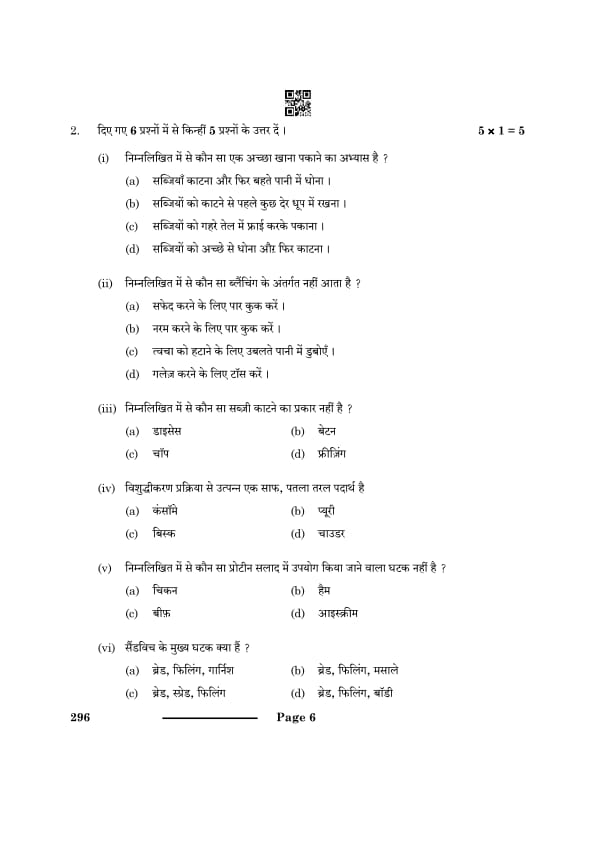
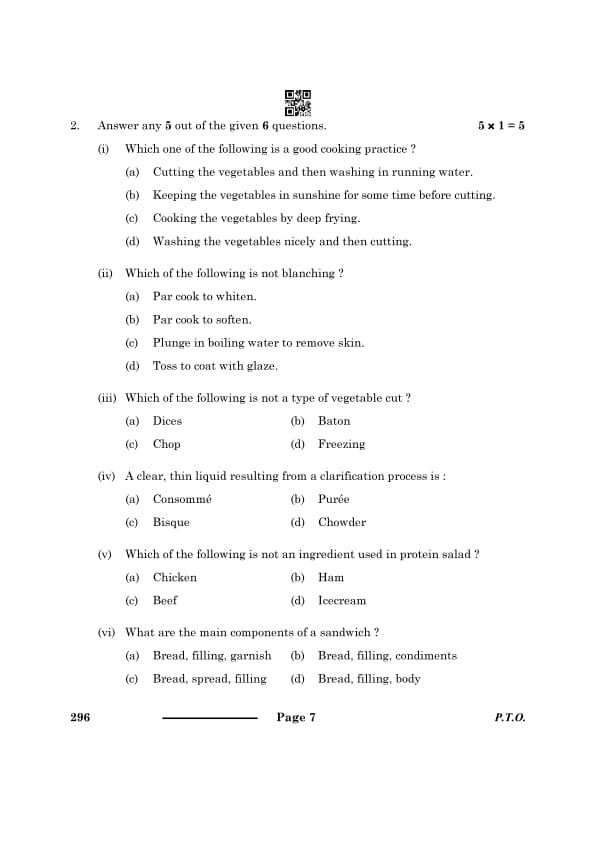
Question 2: Answer any 5 out of the given 6 questions.
(i) Which one of the following is a good cooking practice?
- (a) Cutting the vegetables and then washing in running water.
- (b) Keeping the vegetables in sunshine for some time before cutting.
- (c) Cooking the vegetables by deep frying.
- (d) Washing the vegetables nicely and then cutting.
Read More
Before cutting vegetables, it is important to wash them thoroughly to remove any dirt, bacteria, or pesticides. Washing them after cutting may lead to the loss of nutrients. Always handle vegetables hygienically to ensure food safety.
Quick Tip: Always wash vegetables under running water to avoid contamination from stagnant water.
(ii) Which of the following is not blanching?
- (a) Par cook to whiten.
- (b) Par cook to soften.
- (c) Plunge in boiling water to remove skin.
- (d) Toss to coat with glaze.
Read More
Blanching involves boiling or steaming vegetables for a short time and then placing them in cold water to stop the cooking process. It is not related to coating with glaze, which is a different cooking technique.
Quick Tip: Blanching helps preserve the color, texture, and nutrients of vegetables before freezing or further cooking.
(iii) Which of the following is not a type of vegetable cut?
- (a) Dices
- (b) Baton
- (c) Chop
- (d) Freezing
Read More
Freezing is a method of food preservation and not a cutting technique. Cutting techniques like dices, baton, and chop refer to how vegetables are cut for cooking or presentation purposes.
Quick Tip: Understanding vegetable cuts helps in cooking efficiently and achieving even cooking results.
(iv) A clear, thin liquid resulting from a clarification process is:
- (a) Consommé
- (b) Purée
- (c) Bisque
- (d) Chowder
Read More
Consommé is a clarified broth that is clear and flavorful. It is made by simmering stock or broth with egg whites, which capture impurities, leaving the liquid clear. Other options like purée and chowder refer to thick soups.
Quick Tip: For a perfect consommé, cook it on low heat to avoid disturbing the clarification process.
(v) Which of the following is not an ingredient used in protein salad?
- (a) Chicken
- (b) Ham
- (c) Beef
- (d) Ice cream
Read More
Protein salads are made with protein-rich ingredients like chicken, ham, or beef. Ice cream is a dessert and does not fit into a protein salad, as it is high in sugar and fat but low in protein.
Quick Tip: Protein salads are healthy meals that provide essential nutrients for growth and repair of the body.
(vi) What are the main components of a sandwich?
- (a) Bread, filling, garnish
- (b) Bread, filling, condiments
- (c) Bread, spread, filling
- (d) Bread, filling, body
Read More
A sandwich typically consists of bread, a spread (like butter or mayonnaise), and a filling (like vegetables, meat, or cheese). The spread adds flavor and prevents the bread from becoming soggy.
Quick Tip: Choose whole-grain bread and fresh fillings for a healthier sandwich option.
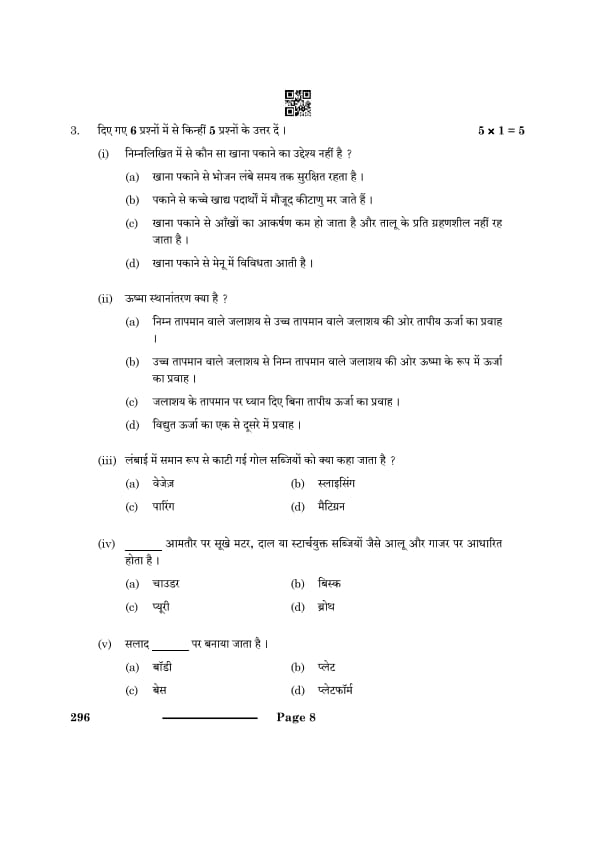
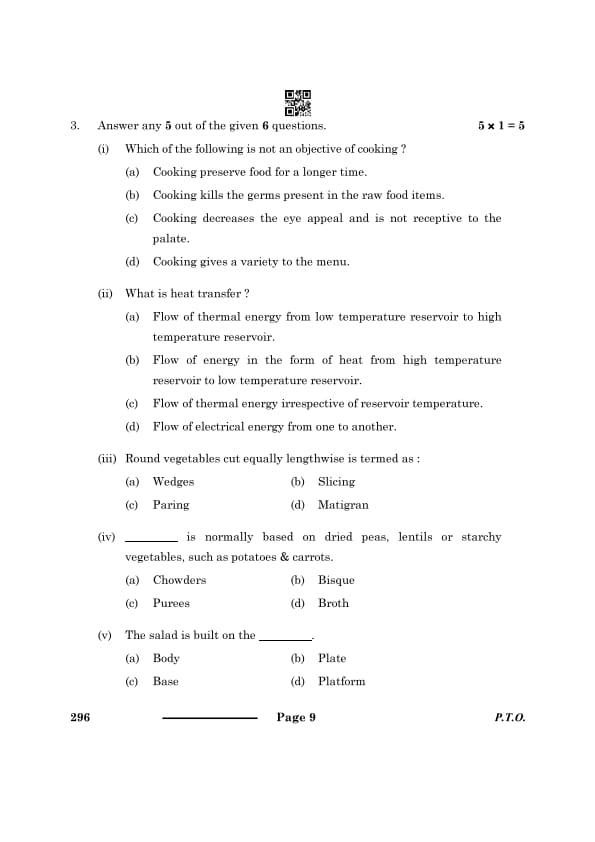
Question 3: Answer any 5 out of the given 6 questions.
(i) Which of the following is not an objective of cooking?
- (a) Cooking preserve food for a longer time.
- (b) Cooking kills the germs present in the raw food items.
- (c) Cooking decreases the eye appeal and is not receptive to the palate.
- (d) Cooking gives a variety to the menu.
Read More
Cooking enhances the food's appearance, taste, and nutritive value. It makes the food more palatable and digestible. Decreasing the eye appeal contradicts the objectives of cooking, which include improving presentation and ensuring it is pleasing to the consumer.
Quick Tip: Always aim for balanced cooking that preserves the food's texture and appeal.
(ii) What is heat transfer?
- (a) Flow of thermal energy from low temperature reservoir to high temperature reservoir.
- (b) Flow of energy in the form of heat from high temperature reservoir to low temperature reservoir.
- (c) Flow of thermal energy irrespective of reservoir temperature.
- (d) Flow of electrical energy from one to another.
Read More
Heat transfer refers to the movement of thermal energy from a hotter object to a cooler one. This process continues until both objects reach thermal equilibrium. Examples include conduction, convection, and radiation.
Quick Tip: Understanding heat transfer helps in effective cooking and temperature management.
(iii) Round vegetables cut equally lengthwise is termed as:
- (a) Wedges
- (b) Slicing
- (c) Paring
- (d) Matignon
Read More
Wedges are a cutting technique where vegetables are sliced into equal triangular shapes. This is common for potatoes and citrus fruits and ensures even cooking or presentation.
Quick Tip: Practicing uniform cuts ensures even cooking and better presentation.
(iv) .............. is normally based on dried peas, lentils, or starchy vegetables, such as potatoes & carrots.
- (a) Chowders
- (b) Bisque
- (c) Purees
- (d) Broth
Read More
Purees are thick, smooth dishes prepared by mashing cooked ingredients. Starchy vegetables like potatoes and lentils are common ingredients in purees, often used as side dishes or bases.
Quick Tip: Always blend or mash cooked ingredients thoroughly for a smooth puree.
(v) The salad is built on the ...............
- (a) Body
- (b) Plate
- (c) Base
- (d) Platform
Read More
The base is the foundational layer of a salad, usually made from lettuce or leafy greens. It provides structure and complements the other components like toppings and dressings.
Quick Tip: Choose fresh greens for a crisp and healthy salad base.
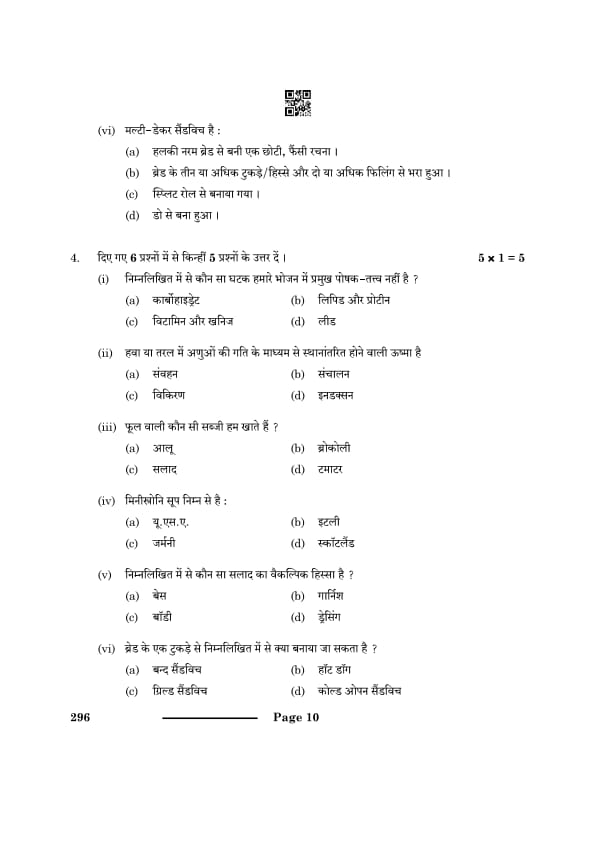
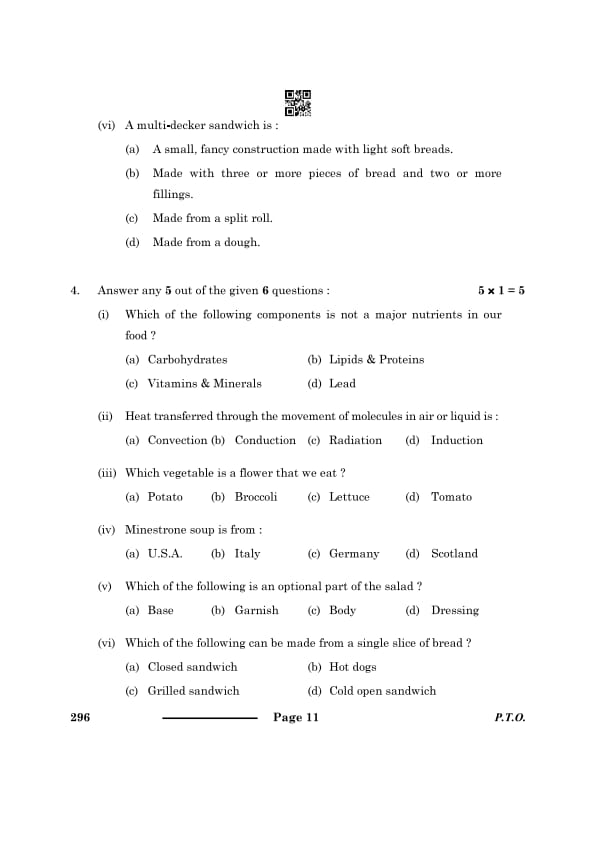
(vi) A multi-decker sandwich is:
- (a) A small, fancy construction made with light soft breads.
- (b) Made with three or more pieces of bread and two or more fillings.
- (c) Made from a split roll.
- (d) Made from a dough.
Read More
A multi-decker sandwich contains multiple layers of bread and fillings, creating a visually appealing and filling meal. Examples include club sandwiches.
Quick Tip: Layer fillings carefully to maintain stability in a multi-decker sandwich.
Question 4: Answer any 5 out of the given 6 questions.
(i) Which of the following components is not a major nutrient in our food?
- (a) Carbohydrates
- (b) Lipids & Proteins
- (c) Vitamins & Minerals
- (d) Lead
Read More
Nutrients are essential substances required by our body for growth and survival. Major nutrients include carbohydrates, proteins, fats (lipids), vitamins, and minerals. Lead is a toxic metal and not a nutrient; in fact, it is harmful to the body.
Quick Tip: Always focus on the six essential nutrients: carbohydrates, proteins, fats, vitamins, minerals, and water. Anything outside this list is not a nutrient.
(ii) Heat transferred through the movement of molecules in air or liquid is:
- (a) Convection
- (b) Conduction
- (c) Radiation
- (d) Induction
Read More
Convection is the process of heat transfer in fluids (liquids and gases) through the movement of molecules. For example, when water is heated, the hot water molecules rise, and cooler molecules sink, forming a circulation pattern. Conduction, on the other hand, occurs through direct contact, while radiation transfers heat through electromagnetic waves. Induction involves electric currents and is not related to molecular movement.
Quick Tip: Remember, convection occurs only in liquids and gases, conduction happens in solids, and radiation works without any medium.
(iii) Which vegetable is a flower that we eat?
- (a) Potato
- (b) Broccoli
- (c) Lettuce
- (d) Tomato
Read More
Broccoli is the edible flower part of the plant. It is rich in nutrients like vitamins, minerals, and antioxidants. Other options, like potatoes, are roots; lettuce is a leaf, and tomatoes are fruits. This makes broccoli unique as an edible flower vegetable.
Quick Tip: Flowers like broccoli and cauliflower are nutrient-dense. Including them in your diet is a good way to improve health.
(iv) Minestrone soup is from:
- (a) U.S.A.
- (b) Italy
- (c) Germany
- (d) Scotland
Read More
Minestrone is a traditional Italian soup made with vegetables, beans, pasta, or rice. It is a hearty and healthy dish. The other countries listed have their own traditional soups, but Minestrone is specifically Italian in origin.
Quick Tip: Try associating dishes with their origins. For example, Minestrone = Italy, Gazpacho = Spain, and Mulligatawny = India.
(v) Which of the following is an optional part of the salad?
- (a) Base
- (b) Garnish
- (c) Body
- (d) Dressing
Read More
A salad typically consists of three main parts: the base (like lettuce), the body (main ingredient like vegetables or protein), and the dressing (sauce). Garnish, like herbs or toppings, is optional and used for decoration or flavor enhancement.
Quick Tip: Focus on the main components: Base, Body, and Dressing. Garnish is a bonus and not always necessary.
(vi) Which of the following can be made from a single slice of bread?
- (a) Closed sandwich
- (b) Hot dogs
- (c) Cold open sandwich
- (d) Hot open sandwich
Read More
A cold open sandwich uses a single slice of bread as the base, with toppings like vegetables, meats, or spreads arranged attractively on top. It does not have a second bread slice to "close" it, unlike a closed sandwich. Hot open sandwiches are heated, but cold open ones are served at room temperature or chilled.
Quick Tip: Remember, "open" sandwiches have one slice of bread, while "closed" ones use two slices. Hot or cold depends on serving temperature.
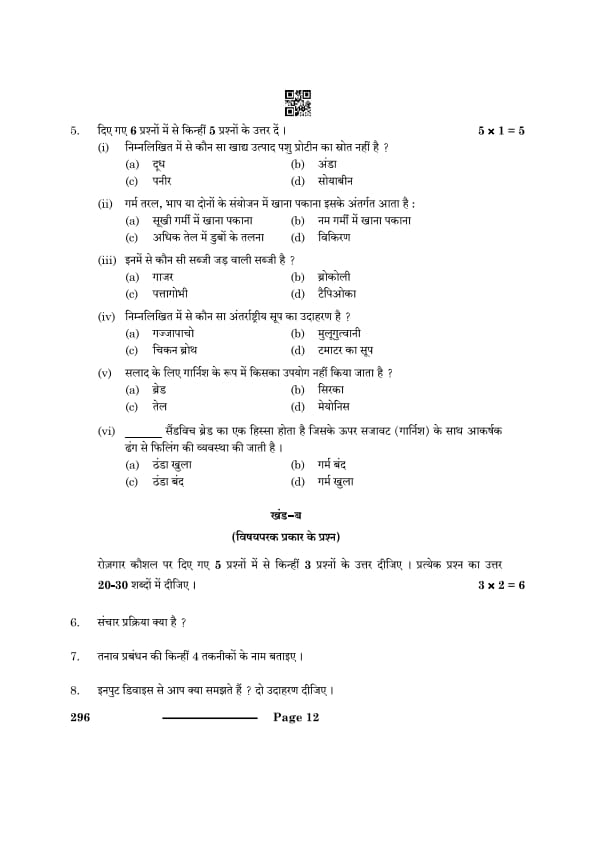
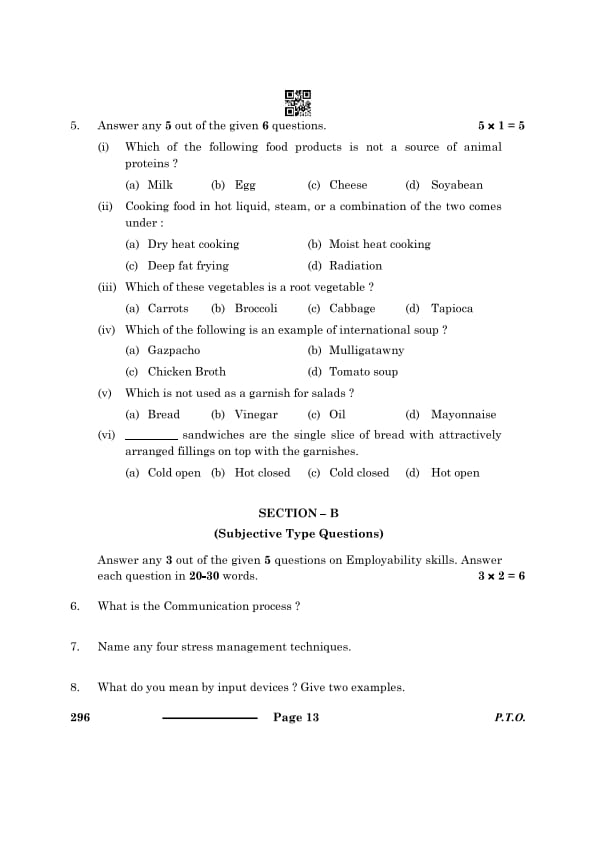
Question 5: Answer any 5 out of the given 6 questions.
(i) Which of the following food products is not a source of animal proteins?
- (a) Milk
- (b) Egg
- (c) Cheese
- (d) Soybean
Read More
Animal proteins are found in products derived from animals, such as milk, eggs, and cheese. Soybean, however, is a plant-based protein source and is not considered an animal protein.
Quick Tip: To differentiate, remember that animal proteins come from dairy, eggs, or meat, while plant proteins are found in beans, nuts, and seeds.
(ii) Cooking food in hot liquid, steam, or a combination of the two comes under:
- (a) Dry heat cooking
- (b) Moist heat cooking
- (c) Deep fat frying
- (d) Radiation
Read More
Moist heat cooking involves cooking food using water, steam, or other liquids. Examples include boiling, steaming, and braising. Dry heat cooking uses hot air, while deep fat frying uses oil, and radiation involves electromagnetic waves.
Quick Tip: Boiling, steaming, and poaching are all forms of moist heat cooking. Think of water-based methods to identify them.
(iii) Which of these vegetables is a root vegetable?
- (a) Carrots
- (b) Broccoli
- (c) Cabbage
- (d) Tapioca
Read More
Carrots are root vegetables, as they grow underground and store nutrients in their roots. Broccoli and cabbage are leafy vegetables, and tapioca is derived from the root of cassava, but it is processed and not directly consumed as a vegetable.
Quick Tip: Root vegetables like carrots, radishes, and turnips are nutrient-rich and grow underground.
(iv) Which of the following is an example of international soup?
- (a) Gazpacho
- (b) Mulligatawny
- (c) Chicken Broth
- (d) Tomato soup
Read More
Gazpacho is a cold Spanish soup made from raw vegetables like tomatoes, cucumbers, and peppers. Mulligatawny is an Indian-inspired soup, chicken broth is universal, and tomato soup is common but not specific to any one cuisine.
Quick Tip: Match dishes to their countries. Gazpacho = Spain, Minestrone = Italy, Tom Yum = Thailand.
(v) Which is not used as a garnish for salads?
- (a) Bread
- (b) Vinegar
- (c) Oil
- (d) Mayonnaise
Read More
Garnishes enhance the flavor and appearance of salads. Vinegar, oil, and mayonnaise are dressings that can also act as garnishes. Bread, however, is not used as a garnish; it is served on the side or used as a base.
Quick Tip: Focus on toppings and dressings like herbs, oils, and sauces for garnishes, not staples like bread.
(vi) Sandwiches are the single slice of bread with attractively arranged fillings on top with the garnishes.
- (a) Cold open
- (b) Hot closed
- (c) Cold closed
- (d) Hot open
Read More
Cold open sandwiches are made using a single slice of bread, topped with ingredients like cheese, vegetables, or meats. The toppings are arranged attractively, and garnishes enhance the presentation. Unlike closed sandwiches, they are not covered with another bread slice.
Quick Tip: "Open" sandwiches = one slice of bread. "Cold" indicates serving temperature without heating.
SECTION-B (SUBJECTIVE TYPE QUESTIONS)
Answer any 3 out of the given 5 questions on Employability skills. Answer each question in 20-30 words.
Question 6: What is the Communication Process?
Solution:
The communication process involves the transfer of information between a sender and a receiver. It includes the following steps:
- Sender: The person who wants to share information or an idea.
- Message: The actual content that needs to be communicated.
- Medium: The channel or method used to deliver the message (e.g., speaking, writing, or using devices).
- Receiver: The person who receives the message.
- Feedback: The response given by the receiver, indicating that the message was understood.
Read More
Communication works effectively when the message is clear and the receiver provides constructive feedback.
Question 7: Name any four stress management techniques.
Solution:
Four effective stress management techniques are:
- Deep Breathing Exercises: Helps calm the mind and reduces anxiety by improving oxygen flow.
- Time Management: Organizing your tasks to avoid last-minute stress and pressure.
- Physical Exercise: Activities like walking, yoga, or cycling can reduce stress hormones and boost mood.
- Relaxation Techniques: Meditation or listening to music can help relax the mind and body.
Read More
Start with simple breathing exercises or short walks to feel instant stress relief.
Question 8: What do you mean by input devices? Give two examples.
Solution:
Input devices are hardware components used to provide data and instructions to a computer system. They help in interacting with the computer. Examples include:
- Keyboard: Used to type text and commands.
- Mouse: Used to point, click, and navigate on the screen.
Read More
Remember, any device that helps "input" information into a computer is an input device, like microphones and scanners.
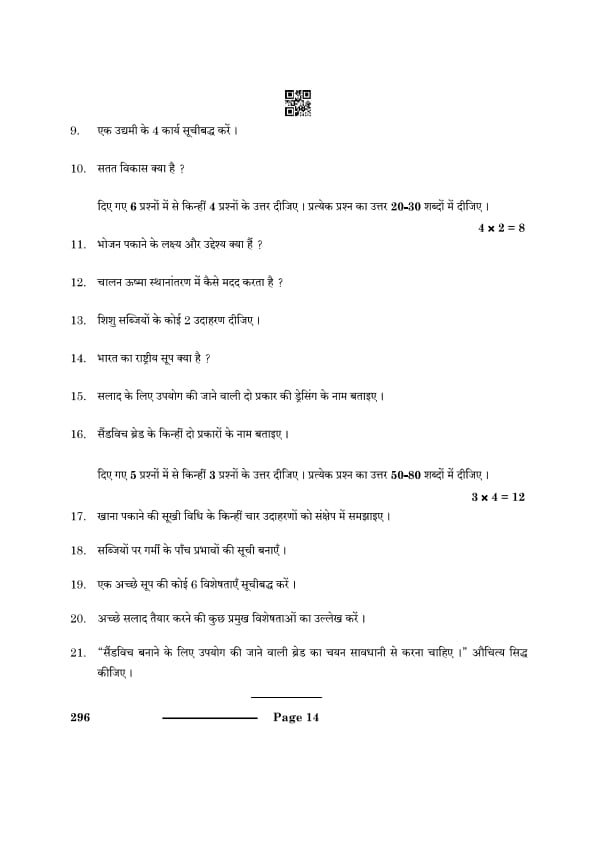
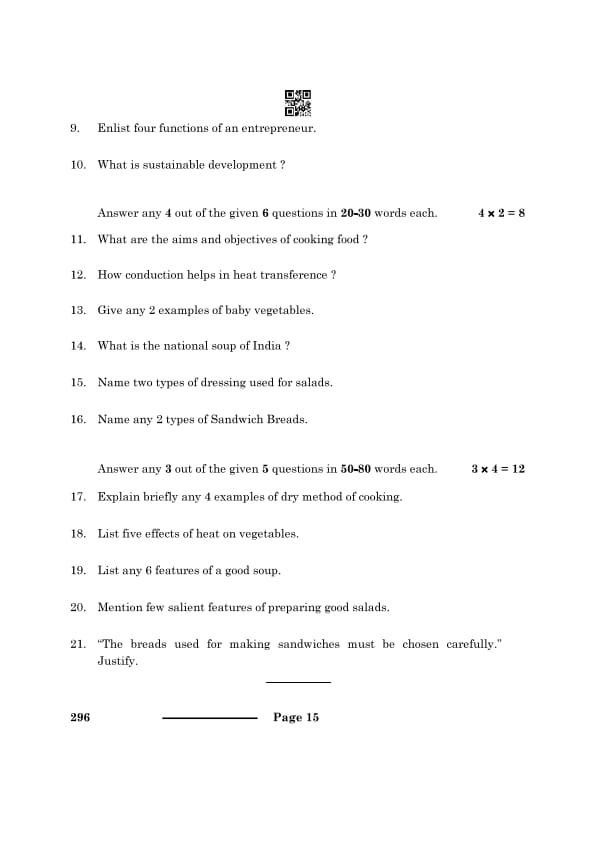
Question 9: Enlist four functions of an entrepreneur.
Solution:
The main functions of an entrepreneur are:
- Idea Generation: Coming up with innovative products or services.
- Risk-taking: Managing financial, operational, and market risks to achieve business goals.
- Decision-making: Making strategic and operational decisions to run the business smoothly.
- Resource Management: Efficiently managing labor, capital, and materials to maximize output.
Read More
Think of an entrepreneur as a problem-solver who turns ideas into businesses by taking calculated risks.
SECTION-B (SUBJECTIVE TYPE QUESTIONS)
Answer any 4 out of the given 6 questions in 20-30 words each.
Question 10: What is Sustainable Development?
Solution: Sustainable development refers to meeting the needs of the present without compromising the ability of future generations to meet their own needs. It focuses on:
- Environmental Protection: Conserving natural resources like water, air, and forests.
- Social Equity: Ensuring equal opportunities and well-being for all.
- Economic Growth: Promoting development without harming the environment.
Read More
Sustainable development is about balance—taking care of people, the planet, and the economy simultaneously.
Question 11: What are the aims and objectives of cooking food?
Solution: The aims and objectives of cooking food are to enhance flavor, kill harmful organisms, improve digestibility, and preserve food.
Read More
Remember, cooking is not just about taste; it's about making food safe and nutritious too.
Question 12: How does conduction help in heat transference?
Solution: Conduction transfers heat through direct contact between molecules in solids, ensuring even cooking.
Read More
Always use good conductors like aluminum or copper for faster and even cooking.
Question 13: Give any two examples of baby vegetables.
Solution: Examples include baby carrots and baby corn, known for their tender texture and mild flavor.
Read More
Baby vegetables are harvested early for their tender texture and mild flavor.
Question 14: What is the national soup of India?
Solution: Mulligatawny, a spiced lentil soup with origins in South Indian cuisine.
Read More
The name Mulligatawny comes from Tamil words meaning "pepper water."
Question 15: Name two types of dressings used for salads.
Solution: Vinaigrette and mayonnaise are common; vinaigrette is oil-based, while mayonnaise is creamy.
Read More
Dressings enhance the taste and texture of salads. Try combining them for unique flavors.
Question 16: Name any two types of sandwich breads.
Solution: Whole wheat and sourdough breads are popular choices for different types of sandwiches.
Read More
Choose the right bread for your sandwich; sturdy breads like sourdough are best for heavy fillings.
SECTION-B (SUBJECTIVE TYPE QUESTIONS)
Answer any 3 out of the given 5 in 50-80 words.
Question 17: Explain briefly any 4 examples of dry methods of cooking.
Solution: Dry methods of cooking use heat without moisture. Examples include:
- Baking: Cooking food in an oven using dry heat.
- Roasting: Cooking food, often meat or vegetables, in an oven or open flame.
- Grilling: Cooking food on a grill with direct heat.
- Frying: Cooking food in hot oil or fat.
Read More
Use frying sparingly as it adds extra calories; prefer baking or roasting for healthier options.
Question 18: List five effects of heat on vegetables.
Solution: Heat affects vegetables in ways such as:
- Texture: Softens, making them easier to chew and digest.
- Color: Enhances or retains natural colors when properly cooked.
- Flavor: Releases aromatic compounds, enhancing taste.
- Nutrient Loss: Possible loss of vitamins like Vitamin C if overcooked.
- Shape: May cause vegetables to lose their shape if overcooked.
Read More
Steam vegetables lightly to retain nutrients and texture.
Question 19: List any six features of a good soup.
Solution: Features of a good soup include:
- Flavorful: Balanced and rich taste.
- Aromatic: Enhances the appetite.
- Nutritional Value: Contains a good mix of ingredients.
- Consistency: Right texture, neither too thick nor too watery.
- Color: Appealing and suitable for the ingredients used.
- Serving Temperature: Served at the right temperature, hot or warm.
Read More
Garnish soups with fresh herbs like coriander or parsley for a professional touch.
Question 20: Mention few salient features of preparing good salads.
Solution: Key features in preparing good salads include:
- Fresh Ingredients: Always use fresh and clean ingredients.
- Proper Dressing: Dressing should complement the ingredients.
- Balanced Flavors: A mix of different taste profiles.
- Good Presentation: Neat arrangement of ingredients.
- Right Temperature: Serve chilled for freshness.
Read More
Add a mix of colorful vegetables like bell peppers and carrots for a visually appealing and nutritious salad.
Question 21: "The breads used for making sandwiches must be chosen carefully." Justify.
Solution: Choosing the right bread is crucial for sandwiches for reasons such as:
- Freshness: Enhances flavor and texture.
- Texture: Suitable for the type of sandwich being made.
- Flavor Compatibility: Complements the fillings.
- Structural Integrity: Must hold the fillings without becoming soggy.
- Appearance: Enhances the overall presentation.
Read More
Always choose bread based on the type of sandwich and its fillings. For example, use focaccia for gourmet sandwiches and pita for wraps to suit the cuisine.

*The article might have information for the previous academic years, please refer the official website of the exam.