
CBSE Class 10 2025 Mathematics Basic Set-2 Question Paper: Download Solution PDF With Answer Key


| Updated On - Sep 12, 2025
The CBSE 2025 Class 10 Mathematics exam was held on 10th March, from 10:30 AM to 1:30 PM. CBSE Class 10 Mathematics Question Paper 2025 is available here with Solution PDF.
The Mathematics theory paper is of 80 marks, while 20 marks are allocated for the internal assessment. The paper covers topics such as Algebra, Geometry, Trigonometry, Mensuration, Statistics & Probability, and Coordinate Geometry. It includes formula-based, conceptual, and application-based problems.
CBSE Class 10 Mathematics Basic Question Paper 2025 with Solutions (Set 2- 430/6/2)
| CBSE Class 10 Mathematics Question Paper (Set 2 – 430/6/2) | Download PDF | Check Solutions |

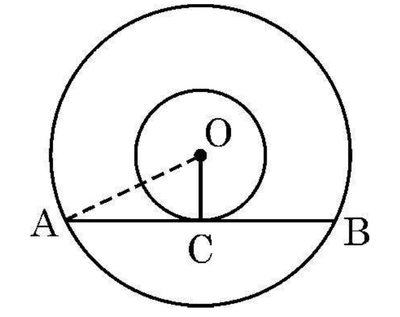
In two concentric circles centred at O, a chord AB of the larger circle touches the smaller circle at C. If OA = 3.5 cm, OC = 2.1 cm, then AB is equal to
View Solution
Solution steps would go here.
In \(\triangle OCA\), \(\angle OCA = 90^\circ\) (radius to tangent is perpendicular).
By Pythagoras theorem: \(OA^2 = OC^2 + AC^2\) \( (3.5)^2 = (2.1)^2 + AC^2 \) \( 12.25 = 4.41 + AC^2 \) \( AC^2 = 12.25 - 4.41 = 7.84 \) \( AC = \sqrt{7.84} = 2.8 \) cm.
Since C is the point of tangency, it bisects the chord AB.
So, \( AB = 2 \times AC = 2 \times 2.8 = 5.6 \) cm. \[ \boxed{5.6 cm} \] Quick Tip: \textbf{Quick Tip:} The radius to the point of tangency is perpendicular to the tangent. The perpendicular from the center to a chord bisects the chord. Use Pythagoras theorem in the right-angled triangle formed.
Three coins are tossed together. The probability that exactly one coin shows head, is
View Solution
Total possible outcomes when tossing three coins = \(2^3 = 8\).
These are: HHH, HHT, HTH, THH, HTT, THT, TTH, TTT.
Favorable outcomes for exactly one head are: HTT, THT, TTH.
Number of favorable outcomes = 3.
Probability = (Number of favorable outcomes) / (Total number of outcomes) \[ P(exactly one head) = \frac{3}{8} \] \[ \boxed{\frac{3}{8}} \] Quick Tip: \textbf{Quick Tip:} List all possible outcomes for small sample spaces. Identify the favorable outcomes based on the condition. Probability = Favorable Outcomes / Total Outcomes.
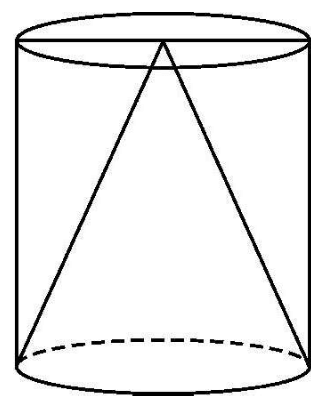
The volume of air in a hollow cylinder is 450 cm\(^3\). A cone of same height and radius as that of cylinder is kept inside it. The volume of empty space in the cylinder is
View Solution
Let the radius of the cylinder be \(r\) and height be \(h\).
Volume of cylinder, \(V_{cylinder} = \pi r^2 h\).
Given, \(V_{cylinder} = 450\) cm\(^3\).
A cone of the same height and radius is kept inside it.
Volume of cone, \(V_{cone} = \frac{1}{3} \pi r^2 h\).
Since \( \pi r^2 h = 450 \), \( V_{cone} = \frac{1}{3} (450) = 150 \) cm\(^3\).
Volume of empty space = Volume of cylinder - Volume of cone \( V_{empty} = V_{cylinder} - V_{cone} = 450 - 150 = 300 \) cm\(^3\). \[ \boxed{300 cm^3} \] Quick Tip: \textbf{Quick Tip:} Volume of a cone is \(1/3\) the volume of a cylinder with the same base radius and height. Empty space = Volume of outer shape - Volume of inner shape.
In \(\triangle ABC, \angle B = 90^\circ\). If \( \frac{AB}{AC} = \frac{1}{2} \), then cos C is equal to
View Solution
Given \(\triangle ABC\) with \(\angle B = 90^\circ\).
We are given \( \frac{AB}{AC} = \frac{1}{2} \).
In a right-angled triangle, \( \sin C = \frac{Opposite side}{Hypotenuse} = \frac{AB}{AC} \).
So, \( \sin C = \frac{1}{2} \).
This means \( C = 30^\circ \).
We need to find \(\cos C\). \( \cos C = \cos 30^\circ = \frac{\sqrt{3}}{2} \).
Alternatively, using trigonometric identities: \( \cos^2 C + \sin^2 C = 1 \) \( \cos^2 C + \left(\frac{1}{2}\right)^2 = 1 \) \( \cos^2 C + \frac{1}{4} = 1 \) \( \cos^2 C = 1 - \frac{1}{4} = \frac{3}{4} \)
Since C is an angle in a triangle, \( \cos C \) must be positive (as C is acute, \(0 < C < 90^\circ\)). \( \cos C = \sqrt{\frac{3}{4}} = \frac{\sqrt{3}}{2} \). \[ \boxed{\frac{\sqrt{3}}{2}} \] Quick Tip: \textbf{Quick Tip:} Recall trigonometric ratios in a right-angled triangle: SOH CAH TOA. \( \sin C = \frac{AB}{AC} \) (Opposite/Hypotenuse). Use the identity \( \sin^2 \theta + \cos^2 \theta = 1 \). Standard trigonometric values for angles like \(30^\circ, 45^\circ, 60^\circ\) are useful.
15th term of the A.P. \( \frac{13}{3}, \frac{9}{3}, \frac{5}{3}, \dots \) is
View Solution
The given Arithmetic Progression (A.P.) is \( \frac{13}{3}, \frac{9}{3}, \frac{5}{3}, \dots \)
First term, \( a = \frac{13}{3} \).
Common difference, \( d = \frac{9}{3} - \frac{13}{3} = -\frac{4}{3} \).
The \(n\)-th term of an A.P. is given by \( a_n = a + (n-1)d \).
We need to find the 15th term, so \( n = 15 \). \[ a_{15} = \frac{13}{3} + (15-1)\left(-\frac{4}{3}\right) \] \[ a_{15} = \frac{13}{3} + 14\left(-\frac{4}{3}\right) \] \[ a_{15} = \frac{13}{3} - \frac{56}{3} \] \[ a_{15} = \frac{13 - 56}{3} = \frac{-43}{3} \] \[ \boxed{-\frac{43}{3}} \] Quick Tip: \textbf{Quick Tip:} Identify the first term (\(a\)) and common difference (\(d\)) correctly. Use the formula \(a_n = a + (n-1)d\) for the \(n\)-th term. Be careful with arithmetic involving fractions and negative signs.
If probability of happening of an event is 57%, then probability of non-happening of the event is
View Solution
Let E be the event.
Given, probability of happening of event E, \( P(E) = 57% \).
Converting percentage to decimal: \( P(E) = \frac{57}{100} = 0.57 \).
The probability of non-happening of the event E (denoted as \(E'\) or \(E^c\)) is given by: \[ P(E') = 1 - P(E) \] \[ P(E') = 1 - 0.57 \] \[ P(E') = 0.43 \] \[ \boxed{0.43} \] Quick Tip: \textbf{Quick Tip:} The sum of probabilities of an event happening and not happening is always 1, i.e., \( P(E) + P(E') = 1 \). Convert percentages to decimals or fractions for calculation if needed.
A quadratic polynomial having zeroes 0 and -2, is
View Solution
Let the zeroes of the quadratic polynomial be \( \alpha \) and \( \beta \).
Given zeroes are \( \alpha = 0 \) and \( \beta = -2 \).
A quadratic polynomial with zeroes \( \alpha \) and \( \beta \) can be written in the form \( k(x - \alpha)(x - \beta) \), where \( k \) is any non-zero constant.
Substituting the given zeroes: \[ P(x) = k(x - 0)(x - (-2)) \] \[ P(x) = k(x)(x + 2) \] \[ P(x) = k(x^2 + 2x) \]
Now let's check the options:
(A) \( x(x-2) = x^2 - 2x \). Zeroes are 0 and 2. (Incorrect)
(B) \( 4x(x+2) = 4(x^2 + 2x) \). This is of the form \( k(x^2 + 2x) \) with \( k=4 \). Zeroes are 0 and -2. (Correct)
(C) \( x^2 + 2 \). For zeroes, \( x^2 + 2 = 0 \Rightarrow x^2 = -2 \Rightarrow x = \pm i\sqrt{2} \). (Incorrect)
(D) \( 2x^2 + 2x = 2x(x+1) \). Zeroes are 0 and -1. (Incorrect)
Thus, \( 4x(x+2) \) is a quadratic polynomial having zeroes 0 and -2. \[ \boxed{4x(x+2)} \] Quick Tip: \textbf{Quick Tip:} If \( \alpha \) and \( \beta \) are the zeroes of a quadratic polynomial, then the polynomial can be expressed as \( k(x-\alpha)(x-\beta) \) or \( k[x^2 - (\alpha+\beta)x + \alpha\beta] \). Check each option by finding its zeroes or by matching the form.
OAB is sector of a circle with centre O and radius 7 cm. If length of arc \( \widehat{AB} = \frac{22}{3} \) cm, then \( \angle AOB \) is equal to
View Solution
Let the radius of the circle be \( r \) and the angle of the sector be \( \theta \) (in degrees).
Given \( r = 7 \) cm.
Length of arc \( \widehat{AB} = \frac{22}{3} \) cm.
The formula for the length of an arc is \( L = \frac{\theta}{360^\circ} \times 2 \pi r \).
Substituting the given values: \[ \frac{22}{3} = \frac{\theta}{360} \times 2 \times \frac{22}{7} \times 7 \] \[ \frac{22}{3} = \frac{\theta}{360} \times 2 \times 22 \] \[ \frac{22}{3} = \frac{44\theta}{360} \]
Divide both sides by 22: \[ \frac{1}{3} = \frac{2\theta}{360} \] \[ \frac{1}{3} = \frac{\theta}{180} \] \[ \theta = \frac{180}{3} \] \[ \theta = 60^\circ \]
So, \( \angle AOB = 60^\circ \). \[ \boxed{60^\circ} \] Quick Tip: \textbf{Quick Tip:} Remember the formula for the length of an arc: \( L = \frac{\theta}{360^\circ} \times 2 \pi r \) when \( \theta \) is in degrees, or \( L = r\theta \) when \( \theta \) is in radians. Ensure consistent units for angle (degrees or radians) throughout the calculation.
To calculate mean of a grouped data, Rahul used assumed mean method. He used \( d = (x - A) \), where A is assumed mean. Then \( \bar{x} \) is equal to
View Solution
In the assumed mean method for calculating the mean \( \bar{x} \) of a grouped data:
Let A be the assumed mean.
The deviation of each observation \( x_i \) from the assumed mean A is \( d_i = x_i - A \).
The mean of these deviations is \( \bar{d} = \frac{\sum f_i d_i}{\sum f_i} \), where \( f_i \) is the frequency of \( x_i \).
The formula for the actual mean \( \bar{x} \) is given by: \[ \bar{x} = A + \bar{d} \]
The question uses \( d = (x - A) \), which corresponds to \( d_i \).
So, \( \bar{x} = A + \bar{d} \).
The term \(h\) is used in the step-deviation method where \( u_i = \frac{x_i - A}{h} \), and then \( \bar{x} = A + h\bar{u} \). Since \(d\) is used directly as \(x-A\), option (A) is correct. \[ \boxed{A + \bar{d}} \] Quick Tip: \textbf{Quick Tip:} Assumed Mean Method: \( \bar{x} = A + \bar{d} \), where \( d_i = x_i - A \) and \( \bar{d} = \frac{\sum f_i d_i}{\sum f_i} \). Step-Deviation Method: \( \bar{x} = A + h\bar{u} \), where \( u_i = \frac{x_i - A}{h} \) and \( \bar{u} = \frac{\sum f_i u_i}{\sum f_i} \). Distinguish between the deviation \(d_i\) and the step-deviation \(u_i\).
If the sum of first n terms of an A.P. is given by \( S_n = \frac{n}{2}(3n+1) \), then the first term of the A.P. is
View Solution
The sum of the first \(n\) terms of an A.P. is given by \( S_n = \frac{n}{2}(3n+1) \).
The first term of an A.P., \( a_1 \), is equal to the sum of the first 1 term, \( S_1 \).
To find the first term, we substitute \( n = 1 \) into the formula for \( S_n \): \[ S_1 = \frac{1}{2}(3(1)+1) \] \[ S_1 = \frac{1}{2}(3+1) \] \[ S_1 = \frac{1}{2}(4) \] \[ S_1 = 2 \]
Therefore, the first term of the A.P. is 2. \[ \boxed{2} \] Quick Tip: \textbf{Quick Tip:} The first term (\(a_1\)) of a sequence is always equal to \(S_1\). The \(n\)-th term can also be found using \(a_n = S_n - S_{n-1}\) for \(n > 1\).
ABCD is a rectangle with its vertices at (2, --2), (8, 4), (4, 8) and (--2, 2) taken in order. Length of its diagonal is
View Solution
Let the vertices of the rectangle be A(2, --2), B(8, 4), C(4, 8), and D(--2, 2).
The length of a diagonal can be found using the distance formula \(d = \sqrt{(x_2-x_1)^2 + (y_2-y_1)^2}\).
Let's find the length of the diagonal AC.
A = (2, --2) and C = (4, 8). \[ AC = \sqrt{(4-2)^2 + (8 - (-2))^2} \] \[ AC = \sqrt{(2)^2 + (8+2)^2} \] \[ AC = \sqrt{2^2 + 10^2} \] \[ AC = \sqrt{4 + 100} \] \[ AC = \sqrt{104} \]
To simplify \(\sqrt{104}\), we find its prime factorization: \(104 = 2 \times 52 = 2 \times 2 \times 26 = 4 \times 26\).
So, \(AC = \sqrt{4 \times 26} = \sqrt{4} \times \sqrt{26} = 2\sqrt{26}\).
Alternatively, we can find the length of the diagonal BD.
B = (8, 4) and D = (--2, 2). \[ BD = \sqrt{(-2-8)^2 + (2-4)^2} \] \[ BD = \sqrt{(-10)^2 + (-2)^2} \] \[ BD = \sqrt{100 + 4} \] \[ BD = \sqrt{104} \] \[ BD = 2\sqrt{26} \]
The length of the diagonal is \(2\sqrt{26}\). \[ \boxed{2\sqrt{26}} \] Quick Tip: \textbf{Quick Tip:} The distance between two points \((x_1, y_1)\) and \((x_2, y_2)\) is given by the distance formula: \(d = \sqrt{(x_2-x_1)^2 + (y_2-y_1)^2}\). In a rectangle, the diagonals are equal in length. You can calculate the length of either diagonal AC or BD.
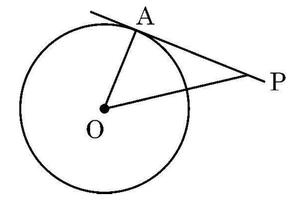
In the given figure, PA is tangent to a circle with centre O. If \(\angle APO = 30^\circ\) and OA = 2.5 cm, then OP is equal to
View Solution
Given that PA is tangent to the circle at point A, and OA is the radius of the circle.
We know that the radius to a tangent at the point of contact is perpendicular to the tangent.
Therefore, \(\angle OAP = 90^\circ\).
We are given \(\angle APO = 30^\circ\) and OA = 2.5 cm.
Consider the right-angled triangle \(\triangle OAP\).
We need to find the length of OP.
Using trigonometry, we have: \[ \sin(\angle APO) = \frac{Opposite side}{Hypotenuse} = \frac{OA}{OP} \] \[ \sin(30^\circ) = \frac{2.5}{OP} \]
We know that \(\sin(30^\circ) = \frac{1}{2}\).
So, \[\frac{1}{2} = \frac{2.5}{OP}\]
Cross-multiplying, we get: \[ OP = 2 \times 2.5 \] \[ OP = 5 cm \] \[ \boxed{5 cm} \] Quick Tip: \textbf{Quick Tip:} The radius drawn to the point of tangency is always perpendicular to the tangent. This forms a right-angled triangle. Use trigonometric ratios (SOH CAH TOA) to solve for unknown sides or angles in a right-angled triangle. For this problem, \(\sin \theta = \frac{Opposite}{Hypotenuse}\) is useful.
Two dice are rolled together. The probability of getting an outcome (a, b) such that b = 2a, is
View Solution
When two dice are rolled together, the total number of possible outcomes is \(6 \times 6 = 36\).
Let (a, b) be the outcome, where 'a' is the number on the first die and 'b' is the number on the second die.
We are looking for outcomes where b = 2a.
We list the possible values for 'a' (from 1 to 6) and find the corresponding 'b', ensuring 'b' is also between 1 and 6.
If a = 1, then b = 2(1) = 2. The outcome is (1, 2). This is a valid outcome.
If a = 2, then b = 2(2) = 4. The outcome is (2, 4). This is a valid outcome.
If a = 3, then b = 2(3) = 6. The outcome is (3, 6). This is a valid outcome.
If a = 4, then b = 2(4) = 8. This is not a valid outcome since b must be \(\leq 6\).
If a = 5, then b = 2(5) = 10. This is not a valid outcome.
If a = 6, then b = 2(6) = 12. This is not a valid outcome.
The favorable outcomes are (1, 2), (2, 4), and (3, 6).
The number of favorable outcomes is 3.
The probability of an event is given by the formula: \[ P(Event) = \frac{Number of favorable outcomes}{Total number of outcomes} \]
So, the probability of getting b = 2a is: \[ P(b=2a) = \frac{3}{36} = \frac{1}{12} \] \[ \boxed{\frac{1}{12}} \] Quick Tip: \textbf{Quick Tip:} The total number of outcomes when \(n\) dice are rolled is \(6^n\). For two dice, it's \(6^2 = 36\). Systematically list all pairs (a, b) that satisfy the given condition. Ensure that both a and b are integers from 1 to 6 (inclusive).
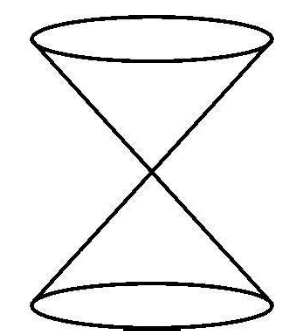
Two identical cones are joined as shown in the figure. If radius of base is 4 cm and slant height of the cone is 6 cm, then height of the solid is
View Solution
Let \(r\) be the radius of the base of each cone, and \(l\) be the slant height of each cone.
Given \(r = 4\) cm and \(l = 6\) cm.
Let \(h\) be the height of one cone.
In a right-angled triangle formed by the height, radius, and slant height of a cone, we have the relationship (Pythagorean theorem): \[ l^2 = r^2 + h^2 \]
Substituting the given values: \[ 6^2 = 4^2 + h^2 \] \[ 36 = 16 + h^2 \] \[ h^2 = 36 - 16 \] \[ h^2 = 20 \] \[ h = \sqrt{20} \]
To simplify \(\sqrt{20}\), we find its prime factorization: \(20 = 2 \times 10 = 2 \times 2 \times 5 = 4 \times 5\).
So, \(h = \sqrt{4 \times 5} = \sqrt{4} \times \sqrt{5} = 2\sqrt{5}\) cm.
The solid is formed by joining two identical cones at their bases. The total height of the solid will be the sum of the heights of the two cones.
Height of the solid \(H = h + h = 2h\). \[ H = 2 \times (2\sqrt{5}) \] \[ H = 4\sqrt{5} cm \] \[ \boxed{4\sqrt{5} cm} \] Quick Tip: \textbf{Quick Tip:} For a right circular cone, the relationship between height (h), radius (r), and slant height (l) is \(l^2 = r^2 + h^2\). When two identical cones are joined at their bases, the total height of the resulting solid is twice the height of a single cone.
If \(\sin \theta = \frac{1}{9}\), then \(\tan \theta\) is equal to
View Solution
Given \(\sin \theta = \frac{1}{9}\).
We know that \(\sin \theta = \frac{Opposite}{Hypotenuse}\).
Let the opposite side be \(O = 1k\) and the hypotenuse be \(H = 9k\) for some positive constant \(k\).
Using the Pythagorean theorem, \(H^2 = O^2 + A^2\), where \(A\) is the adjacent side. \( (9k)^2 = (1k)^2 + A^2 \) \( 81k^2 = 1k^2 + A^2 \) \( A^2 = 81k^2 - 1k^2 \) \( A^2 = 80k^2 \) \( A = \sqrt{80k^2} = k\sqrt{80} = k\sqrt{16 \times 5} = 4k\sqrt{5} \).
Now, \(\tan \theta = \frac{Opposite}{Adjacent} = \frac{1k}{4k\sqrt{5}} = \frac{1}{4\sqrt{5}}\).
Alternatively, using trigonometric identities:
We know that \(\cos^2 \theta = 1 - \sin^2 \theta\). \( \cos^2 \theta = 1 - \left(\frac{1}{9}\right)^2 = 1 - \frac{1}{81} = \frac{81-1}{81} = \frac{80}{81} \)
Since \(\theta\) is typically acute in such problems unless specified, \(\cos \theta = \sqrt{\frac{80}{81}} = \frac{\sqrt{80}}{\sqrt{81}} = \frac{4\sqrt{5}}{9}\).
Then, \(\tan \theta = \frac{\sin \theta}{\cos \theta} = \frac{1/9}{4\sqrt{5}/9} = \frac{1}{9} \times \frac{9}{4\sqrt{5}} = \frac{1}{4\sqrt{5}}\). \[ \boxed{\frac{1}{4\sqrt{5}}} \] Quick Tip: \textbf{Quick Tip:} If \(\sin \theta = \frac{O}{H}\), you can find the adjacent side \(A\) using \(A = \sqrt{H^2 - O^2}\). Then \(\tan \theta = \frac{O}{A}\). Alternatively, use the identity \(\tan \theta = \frac{\sin \theta}{\cos \theta}\) after finding \(\cos \theta\) from \(\cos^2 \theta = 1 - \sin^2 \theta\).
In \(\triangle ABC, DE || BC\). If AE = (2x + 1) cm, EC = 4 cm, AD = (x + 1) cm and DB = 3 cm, then value of x is
% To include the image:

View Solution
Given \(\triangle ABC\) with \(DE || BC\).
By the Basic Proportionality Theorem (Thales' Theorem), if a line is drawn parallel to one side of a triangle intersecting the other two sides, then it divides the two sides proportionally.
So, \(\frac{AD}{DB} = \frac{AE}{EC}\).
We are given:
AD = (x + 1) cm
DB = 3 cm
AE = (2x + 1) cm
EC = 4 cm
Substituting these values into the proportion: \[ \frac{x+1}{3} = \frac{2x+1}{4} \]
Cross-multiply: \[ 4(x+1) = 3(2x+1) \] \[ 4x + 4 = 6x + 3 \]
Subtract \(4x\) from both sides: \[ 4 = 2x + 3 \]
Subtract 3 from both sides: \[ 4 - 3 = 2x \] \[ 1 = 2x \] \[ x = \frac{1}{2} \]
We should check if this value of x gives positive lengths:
AD = \(x+1 = \frac{1}{2} + 1 = \frac{3}{2}\) cm (Positive)
AE = \(2x+1 = 2\left(\frac{1}{2}\right) + 1 = 1 + 1 = 2\) cm (Positive)
So, the value of x is \(\frac{1}{2}\). \[ \boxed{\frac{1}{2}} \] Quick Tip: \textbf{Quick Tip:} The Basic Proportionality Theorem (Thales' Theorem) states that if a line parallel to one side of a triangle intersects the other two sides, it divides them in the same ratio. Set up the proportion \(\frac{AD}{DB} = \frac{AE}{EC}\) and solve for the unknown variable.
The value of k for which the system of equations \(3x - 7y = 1\) and \(kx + 14y = 6\) is inconsistent, is
View Solution
A system of linear equations \(a_1x + b_1y = c_1\) and \(a_2x + b_2y = c_2\) is inconsistent (has no solution) if \[ \frac{a_1}{a_2} = \frac{b_1}{b_2} \neq \frac{c_1}{c_2} \]
The given equations are:
1) \(3x - 7y = 1\) (\(a_1 = 3, b_1 = -7, c_1 = 1\))
2) \(kx + 14y = 6\) (\(a_2 = k, b_2 = 14, c_2 = 6\))
For inconsistency, we first set \(\frac{a_1}{a_2} = \frac{b_1}{b_2}\): \[ \frac{3}{k} = \frac{-7}{14} \] \[ \frac{3}{k} = -\frac{1}{2} \]
Cross-multiply: \[ 3 \times 2 = -1 \times k \] \[ 6 = -k \] \[ k = -6 \]
Now, we must check that \(\frac{b_1}{b_2} \neq \frac{c_1}{c_2}\) for this value of k. \[ \frac{b_1}{b_2} = \frac{-7}{14} = -\frac{1}{2} \] \[ \frac{c_1}{c_2} = \frac{1}{6} \]
Since \(-\frac{1}{2} \neq \frac{1}{6}\), the condition for inconsistency is satisfied when \(k = -6\). \[ \boxed{-6} \] Quick Tip: \textbf{Quick Tip:} For a system of equations \(a_1x + b_1y = c_1\) and \(a_2x + b_2y = c_2\): Unique solution: \(\frac{a_1}{a_2} \neq \frac{b_1}{b_2}\) No solution (inconsistent): \(\frac{a_1}{a_2} = \frac{b_1}{b_2} \neq \frac{c_1}{c_2}\) Infinitely many solutions (dependent): \(\frac{a_1}{a_2} = \frac{b_1}{b_2} = \frac{c_1}{c_2}\)
The line \(2x - 3y = 6\) intersects x-axis at
View Solution
A line intersects the x-axis when the y-coordinate is 0.
Given the equation of the line: \(2x - 3y = 6\).
Substitute \(y = 0\) into the equation: \[ 2x - 3(0) = 6 \] \[ 2x - 0 = 6 \] \[ 2x = 6 \]
Divide by 2: \[ x = \frac{6}{2} \] \[ x = 3 \]
So, the point of intersection with the x-axis is (3, 0). \[ \boxed{(3, 0)} \] Quick Tip: \textbf{Quick Tip:} To find the x-intercept of a line, set \(y=0\) in its equation and solve for \(x\). The x-intercept is the point \((x, 0)\). To find the y-intercept of a line, set \(x=0\) in its equation and solve for \(y\). The y-intercept is the point \((0, y)\).
Assertion (A) : \(\triangle ABC \sim \triangle PQR\) such that \(\angle A = 65^\circ\), \(\angle C = 60^\circ\). Hence \(\angle Q = 55^\circ\).
Reason (R) : Sum of all angles of a triangle is \(180^\circ\).
View Solution
Reason (R): The statement "Sum of all angles of a triangle is \(180^\circ\)" is a fundamental property of triangles and is true.
Assertion (A):
Given \(\triangle ABC \sim \triangle PQR\). This implies that corresponding angles are equal: \(\angle A = \angle P\), \(\angle B = \angle Q\), \(\angle C = \angle R\).
In \(\triangle ABC\), we are given \(\angle A = 65^\circ\) and \(\angle C = 60^\circ\).
Using the property that the sum of angles in a triangle is \(180^\circ\) (which is Reason R): \(\angle B = 180^\circ - (\angle A + \angle C)\) \(\angle B = 180^\circ - (65^\circ + 60^\circ)\) \(\angle B = 180^\circ - 125^\circ\) \(\angle B = 55^\circ\).
Since \(\triangle ABC \sim \triangle PQR\), we have \(\angle Q = \angle B\).
Therefore, \(\angle Q = 55^\circ\).
The assertion states "Hence \(\angle Q = 55^\circ\)", which is true.
Explanation:
Reason (R) states that the sum of angles in a triangle is \(180^\circ\). This fact was used to find \(\angle B\) in \(\triangle ABC\). Once \(\angle B\) was found, the property of similar triangles (\(\angle B = \angle Q\)) allowed us to determine \(\angle Q\). Thus, Reason (R) is essential for deriving the conclusion in Assertion (A).
So, both Assertion (A) and Reason (R) are true, and Reason (R) is the correct explanation of Assertion (A). \[ \boxed{Option (A)} \] Quick Tip: \textbf{Quick Tip:} For similar triangles, corresponding angles are equal. The sum of angles in any triangle is always \(180^\circ\). To evaluate an Assertion-Reason question, first check the truthfulness of the Reason, then the Assertion. Finally, check if the Reason correctly explains the Assertion.
Assertion (A) : \((a + \sqrt{b})(a - \sqrt{b})\) is a rational number, where a and b are positive integers.
Reason (R) : Product of two irrationals is always rational.
View Solution
Reason (R): The statement "Product of two irrationals is always rational" is false.
For example, \(\sqrt{2}\) is irrational and \(\sqrt{3}\) is irrational. Their product \(\sqrt{2} \times \sqrt{3} = \sqrt{6}\), which is also irrational.
Another example: \(\sqrt{2} \times \sqrt{8} = \sqrt{16} = 4\), which is rational. Since the product is not *always* rational, the statement is false.
Assertion (A):
Consider the expression \((a + \sqrt{b})(a - \sqrt{b})\).
This is of the form \((x+y)(x-y) = x^2 - y^2\).
So, \((a + \sqrt{b})(a - \sqrt{b}) = a^2 - (\sqrt{b})^2 = a^2 - b\).
Given that 'a' and 'b' are positive integers.
If 'a' is an integer, \(a^2\) is an integer.
Since 'b' is an integer, \(a^2 - b\) is the difference of two integers, which is always an integer.
All integers are rational numbers. Therefore, \(a^2 - b\) is a rational number.
Thus, Assertion (A) is true.
Conclusion:
Assertion (A) is true, but Reason (R) is false. \[ \boxed{Option (C)} \] Quick Tip: \textbf{Quick Tip:} Remember the algebraic identity: \((x+y)(x-y) = x^2 - y^2\). An integer is always a rational number (as it can be expressed as integer/1). The product of two irrational numbers can be rational or irrational. For example, \(\sqrt{2} \times \sqrt{2} = 2\) (rational), but \(\sqrt{2} \times \sqrt{3} = \sqrt{6}\) (irrational).
(a) Evaluate : \(\frac{\cos 45^\circ}{\tan 30^\circ + \sin 60^\circ}\)
View Solution
N/A
(b) Verify that \(\sin 2A = \frac{2 \tan A}{1 + \tan^2 A}\) for \(A = 30^\circ\).
View Solution
N/A Quick Tip: \textbf{Quick Tip:} For part (a), memorize or derive standard trigonometric values for \(30^\circ, 45^\circ, 60^\circ\). Be careful with fraction arithmetic. For part (b), substitute the value of A into both LHS and RHS separately and show they are equal. This is a standard trigonometric identity. Rationalizing the denominator is often a good practice for the final answer.
A box contains 120 discs, which are numbered from 1 to 120. If one disc is drawn at random from the box, find the probability that
(i) it bears a 2-digit number
(ii) the number is a perfect square.
View Solution
Total number of discs in the box = 120.
So, the total number of possible outcomes is 120.
(i) it bears a 2-digit number
The 2-digit numbers range from 10 to 99, inclusive.
Number of 2-digit numbers = (Last number - First number) + 1
Number of 2-digit numbers = (99 - 10) + 1 = 89 + 1 = 90.
Number of favorable outcomes = 90.
Probability (2-digit number) = \(\frac{Number of favorable outcomes}{Total number of outcomes} = \frac{90}{120}\).
Simplifying the fraction: \(\frac{90}{120} = \frac{9}{12} = \frac{3}{4}\). \[ P(2-digit number) = \boxed{\frac{3}{4}} \]
(ii) the number is a perfect square
We need to find the perfect squares between 1 and 120, inclusive. \(1^2 = 1\) \(2^2 = 4\) \(3^2 = 9\) \(4^2 = 16\) \(5^2 = 25\) \(6^2 = 36\) \(7^2 = 49\) \(8^2 = 64\) \(9^2 = 81\) \(10^2 = 100\) \(11^2 = 121\) (which is greater than 120)
The perfect squares are 1, 4, 9, 16, 25, 36, 49, 64, 81, 100.
Number of perfect squares = 10.
Number of favorable outcomes = 10.
Probability (perfect square) = \(\frac{Number of favorable outcomes}{Total number of outcomes} = \frac{10}{120}\).
Simplifying the fraction: \(\frac{10}{120} = \frac{1}{12}\). \[ P(perfect square) = \boxed{\frac{1}{12}} \] Quick Tip: \textbf{Quick Tip:} Probability = (Number of Favorable Outcomes) / (Total Number of Outcomes). To count numbers in a range [a, b], use b - a + 1. List perfect squares systematically to avoid missing any or including ones out of range.
Using prime factorisation, find the HCF of 144, 180 and 192.
View Solution
We need to find the HCF (Highest Common Factor) of 144, 180, and 192 using prime factorisation.
First, find the prime factorisation of each number:
For 144: \(144 = 2 \times 72\) \(72 = 2 \times 36\) \(36 = 2 \times 18\) \(18 = 2 \times 9\) \(9 = 3 \times 3\)
So, \(144 = 2 \times 2 \times 2 \times 2 \times 3 \times 3 = 2^4 \times 3^2\).
For 180: \(180 = 10 \times 18 = (2 \times 5) \times (2 \times 9) = (2 \times 5) \times (2 \times 3 \times 3)\)
So, \(180 = 2^2 \times 3^2 \times 5^1\).
For 192: \(192 = 2 \times 96\) \(96 = 2 \times 48\) \(48 = 2 \times 24\) \(24 = 2 \times 12\) \(12 = 2 \times 6\) \(6 = 2 \times 3\)
So, \(192 = 2 \times 2 \times 2 \times 2 \times 2 \times 2 \times 3 = 2^6 \times 3^1\).
Now, identify the common prime factors and their lowest powers:
Prime factorisations: \(144 = 2^4 \times 3^2\) \(180 = 2^2 \times 3^2 \times 5^1\) \(192 = 2^6 \times 3^1\)
The common prime factors are 2 and 3.
The lowest power of 2 is \(2^{\min(4, 2, 6)} = 2^2\).
The lowest power of 3 is \(3^{\min(2, 2, 1)} = 3^1\).
The prime factor 5 is not common to all three numbers.
HCF = Product of the lowest powers of common prime factors.
HCF = \(2^2 \times 3^1 = 4 \times 3 = 12\). \[ \boxed{12} \] Quick Tip: \textbf{Quick Tip:} Prime factorise each number completely. The HCF is the product of the lowest powers of all common prime factors.
(a) Solve the equation \(4x^2 - 9x + 3 = 0\), using quadratic formula.
View Solution
N/A
(b) Find the nature of roots of the equation \(3x^2 - 4\sqrt{3}x + 4 = 0\).
View Solution
N/A Quick Tip: \textbf{Quick Tip:} For a quadratic equation \(ax^2+bx+c=0\), the discriminant is \(D = b^2-4ac\). If \(D > 0\), roots are real and distinct. If \(D = 0\), roots are real and equal. If \(D < 0\), roots are not real (complex conjugates). Quadratic formula: \(x = \frac{-b \pm \sqrt{D}}{2a}\).
In the given figure, AB \(||\) DE and BD \(||\) EF. Prove that \(DC^2 = CF \times AC\).

View Solution
Given: In \(\triangle ABC\), D is a point on AC and E is a point on BC.
Also, \(AB \parallel DE\).
And F is a point on CD, such that \(BD \parallel EF\).
% Simple text description of the figure, assuming a figure is present in the context.
% Alternatively, for a complete LaTeX document, one might use tikz to draw the figure.
Figure: \(\triangle ABC\) with D on AC, E on BC. DE \(\parallel\) AB. F is on CD. EF \(\parallel\) BD.
Consider \(\triangle CAB\).
Since \(DE \parallel AB\) (given), by the Basic Proportionality Theorem (or properties of similar triangles), \(\triangle CDE \sim \triangle CAB\).
Therefore, the ratio of corresponding sides is equal: \(\frac{CD{CA} = \frac{CE}{CB} = \frac{DE}{AB}\) --- (1)
Now consider \(\triangle CDB\).
F is a point on CD and E is a point on CB.
Since \(EF \parallel DB\) (given), by the Basic Proportionality Theorem (or properties of similar triangles), \(\triangle CEF \sim \triangle CDB\).
Therefore, the ratio of corresponding sides is equal: \(\frac{CF}{CD} = \frac{CE}{CB} = \frac{EF}{DB}\) --- (2)
From equation (1), we have \(\frac{CE}{CB} = \frac{CD}{CA}\).
From equation (2), we have \(\frac{CE}{CB} = \frac{CF}{CD}\).
Equating the expressions for \(\frac{CE}{CB}\) from (1) and (2): \[ \frac{CD}{CA} = \frac{CF}{CD} \]
Cross-multiplying, we get: \[ CD \times CD = CF \times CA \] \[ CD^2 = CF \times CA \]
Since \(CD = DC\) and \(CA = AC\), we can write: \[ DC^2 = CF \times AC \]
This proves the required relation. \[ \boxed{DC^2 = CF \times AC (Proved)} \] Quick Tip: \textbf{Quick Tip:} When lines are parallel within a triangle, look for similar triangles or apply the Basic Proportionality Theorem (Thales' Theorem). Identify pairs of similar triangles based on the parallel lines. Write down the ratios of corresponding sides for each pair of similar triangles. Look for common ratios to link the equations.
Three friends plan to go for a morning walk. They step off together and their steps measures 48 cm, 52 cm and 56 cm respectively. What is the minimum distance each should walk so that each can cover the same distance in complete steps ten times?
View Solution
Let the step lengths of the three friends be \(s_1 = 48\) cm, \(s_2 = 52\) cm, and \(s_3 = 56\) cm.
We need to find the minimum distance that each friend can cover in a whole number of steps. This distance will be the Least Common Multiple (LCM) of their step lengths.
First, find the prime factorisation of each step length: \(48 = 2 \times 24 = 2 \times 2 \times 12 = 2 \times 2 \times 2 \times 6 = 2 \times 2 \times 2 \times 2 \times 3 = 2^4 \times 3^1\) \(52 = 2 \times 26 = 2 \times 2 \times 13 = 2^2 \times 13^1\) \(56 = 2 \times 28 = 2 \times 2 \times 14 = 2 \times 2 \times 2 \times 7 = 2^3 \times 7^1\)
The LCM is the product of the highest powers of all prime factors that appear in any of the numbers:
Highest power of 2: \(2^4\)
Highest power of 3: \(3^1\)
Highest power of 7: \(7^1\)
Highest power of 13: \(13^1\)
LCM(48, 52, 56) = \(2^4 \times 3^1 \times 7^1 \times 13^1\)
LCM = \(16 \times 3 \times 7 \times 13\)
LCM = \(48 \times 7 \times 13\)
LCM = \(336 \times 13\)
336
\(\times\) 13
-----
1008 (\(336 \times 3\))
3360 (\(336 \times 10\))
-----
4368
So, the minimum distance they can all cover in complete steps is 4368 cm.
The question asks: "What is the minimum distance each should walk so that each can cover the same distance in complete steps ten times?"
This phrasing can be interpreted as: what is the minimum common distance (D) that they can all cover in complete steps? The "ten times" part implies that this action of covering distance D is repeated ten times. The question asks for D itself.
If the question meant that the number of steps taken by each person to cover the common distance must be a multiple of 10, the problem would be different (LCM of 10*48, 10*52, 10*56). However, the phrasing "cover the same distance ... ten times" suggests the "same distance" is the LCM, and this is done 10 times. The "minimum distance" refers to this "same distance".
Therefore, the minimum distance is 4368 cm.
Number of steps for each friend to cover this distance:
Friend 1: \(4368 / 48 = 91\) steps.
Friend 2: \(4368 / 52 = 84\) steps.
Friend 3: \(4368 / 56 = 78\) steps.
Each covers 4368 cm in complete steps. They can do this ten times. The minimum such distance is 4368 cm. \[ \boxed{4368 cm} \] Quick Tip: \textbf{Quick Tip:} The minimum distance that multiple entities can cover in complete units of their respective measures is the LCM of those measures. Prime factorise each number, then find the LCM by taking the highest power of each prime factor present in any of the numbers. Carefully interpret what "ten times" refers to. In this context, it likely refers to repeating the action of covering the LCM distance.
Prove that \(\left(1 + \frac{1}{\tan^2 \theta}\right) \left(1 + \frac{1}{\cot^2 \theta}\right) = \frac{1}{\sin^2 \theta - \sin^4 \theta}\).
View Solution
We need to prove the trigonometric identity: \[ \left(1 + \frac{1}{\tan^2 \theta}\right) \left(1 + \frac{1}{\cot^2 \theta}\right) = \frac{1}{\sin^2 \theta - \sin^4 \theta} \]
Let's start with the Left Hand Side (LHS):
LHS = \(\left(1 + \frac{1}{\tan^2 \theta}\right) \left(1 + \frac{1}{\cot^2 \theta}\right)\)
We know that \(\frac{1}{\tan \theta} = \cot \theta\) and \(\frac{1}{\cot \theta} = \tan \theta\).
So, \(\frac{1}{\tan^2 \theta} = \cot^2 \theta\) and \(\frac{1}{\cot^2 \theta} = \tan^2 \theta\).
LHS = \((1 + \cot^2 \theta) (1 + \tan^2 \theta)\)
Using the Pythagorean identities: \(1 + \cot^2 \theta = \csc^2 \theta\) \(1 + \tan^2 \theta = \sec^2 \theta\)
So, LHS = \((\csc^2 \theta) (\sec^2 \theta)\)
We also know that \(\csc \theta = \frac{1}{\sin \theta}\) and \(\sec \theta = \frac{1}{\cos \theta}\).
Therefore, \(\csc^2 \theta = \frac{1}{\sin^2 \theta}\) and \(\sec^2 \theta = \frac{1}{\cos^2 \theta}\).
LHS = \(\left(\frac{1}{\sin^2 \theta}\right) \left(\frac{1}{\cos^2 \theta}\right) = \frac{1}{\sin^2 \theta \cos^2 \theta}\).
Now let's simplify the Right Hand Side (RHS):
RHS = \(\frac{1}{\sin^2 \theta - \sin^4 \theta}\)
Factor out \(\sin^2 \theta\) from the denominator:
RHS = \(\frac{1}{\sin^2 \theta (1 - \sin^2 \theta)}\)
Using the Pythagorean identity \( \sin^2 \theta + \cos^2 \theta = 1 \), we have \(1 - \sin^2 \theta = \cos^2 \theta\).
So, RHS = \(\frac{1}{\sin^2 \theta \cos^2 \theta}\).
Comparing LHS and RHS:
LHS = \(\frac{1}{\sin^2 \theta \cos^2 \theta}\)
RHS = \(\frac{1}{\sin^2 \theta \cos^2 \theta}\)
Since LHS = RHS, the identity is proven. \[ \boxed{LHS = RHS, Proved} \] Quick Tip: \textbf{Quick Tip:} Use fundamental trigonometric identities: \(\cot \theta = 1/\tan \theta\), \(\tan \theta = 1/\cot \theta\). Use Pythagorean identities: \(1 + \tan^2 \theta = \sec^2 \theta\), \(1 + \cot^2 \theta = \csc^2 \theta\), and \(\sin^2 \theta + \cos^2 \theta = 1\). Simplify both sides of the equation independently until they become identical, or transform one side into the other. Factoring can be a useful algebraic manipulation for simplification.
AB and CD are diameters of a circle with centre O and radius 7 cm. If \(\angle BOD = 30^\circ\), then find the area and perimeter of the shaded region.
Figure shows a circle with centre O. AB and CD are diameters. Angle BOD is 30 degrees.
The shaded regions are sector BOD and sector AOC.
View Solution
Given: Radius of the circle, \(r = 7\) cm.
AB and CD are diameters. \(\angle BOD = 30^\circ\).
Since AB and CD are diameters intersecting at O, \(\angle AOC = \angle BOD = 30^\circ\) (vertically opposite angles).
The shaded regions are sector BOD and sector AOC.
Area of the shaded region:
The shaded region consists of two identical sectors, each with a central angle of \(30^\circ\).
Area of one sector = \(\frac{\theta}{360^\circ} \times \pi r^2\).
Area of sector BOD = \(\frac{30^\circ}{360^\circ} \times \pi (7)^2 = \frac{1}{12} \times \frac{22}{7} \times 49 = \frac{1}{12} \times 22 \times 7 = \frac{154}{12} = \frac{77}{6}\) cm\(^2\).
Since sector AOC is identical to sector BOD, its area is also \(\frac{77}{6}\) cm\(^2\).
Total shaded area = Area of sector BOD + Area of sector AOC = \(2 \times \frac{77}{6} = \frac{77}{3}\) cm\(^2\). \(\frac{77}{3} \approx 25.67\) cm\(^2\).
Perimeter of the shaded region:
The perimeter consists of the arc lengths of BD and AC, and the radii OB, OD, OA, OC.
Arc length of one sector = \(\frac{\theta}{360^\circ} \times 2 \pi r\).
Arc length BD = \(\frac{30^\circ}{360^\circ} \times 2 \times \frac{22}{7} \times 7 = \frac{1}{12} \times 2 \times 22 = \frac{44}{12} = \frac{11}{3}\) cm.
Arc length AC is also \(\frac{11}{3}\) cm.
The radii are OA = OB = OC = OD = 7 cm.
Perimeter of shaded region = Arc BD + Arc AC + OB + OD + OA + OC
Perimeter = \(\frac{11}{3} + \frac{11}{3} + 7 + 7 + 7 + 7\)
Perimeter = \(\frac{22}{3} + 28 = \frac{22 + 28 \times 3}{3} = \frac{22 + 84}{3} = \frac{106}{3}\) cm. \(\frac{106}{3} \approx 35.33\) cm.
Area = \(\frac{77}{3}\) cm\(^2\). Perimeter = \(\frac{106}{3}\) cm. \[ \boxed{Area = \frac{77}{3} cm^2, Perimeter = \frac{106}{3} cm} \] Quick Tip: \textbf{Quick Tip:} Vertically opposite angles are equal. Area of a sector = \((\theta/360^\circ) \times \pi r^2\). Arc length of a sector = \((\theta/360^\circ) \times 2 \pi r\). The perimeter of a region is the total length of its boundary.
(a) Find the A.P. whose third term is 16 and seventh term exceeds the fifth term by 12. Also, find the sum of first 29 terms of the A.P.
View Solution
N/A
(b) Find the sum of first 20 terms of an A.P. whose n\(^{th}\) term is given by \(a_n = 5 + 2n\). Can 52 be a term of this A.P. ?
View Solution
N/A Quick Tip: \textbf{Quick Tip:} \(a_n = a + (n-1)d\). \(S_n = \frac{n}{2} [2a + (n-1)d]\) or \(S_n = \frac{n}{2} [a_1 + a_n]\). For a number to be a term of an A.P., the term number 'n' must be a positive integer.
(a) If \(\alpha, \beta\) are zeroes of the polynomial \(8x^2 - 5x - 1\), then form a quadratic polynomial in x whose zeroes are \(\frac{2}{\alpha}\) and \(\frac{2}{\beta}\).
View Solution
N/A
(b) Find the zeroes of the polynomial \(p(x) = 3x^2 + x - 10\) and verify the relationship between zeroes and its coefficients.
View Solution
N/A Quick Tip: \textbf{Quick Tip:} For a quadratic \(ax^2+bx+c\), sum of roots \(\alpha+\beta = -b/a\), product \(\alpha\beta = c/a\). A quadratic with roots \(\alpha', \beta'\) is \(k(x^2 - (sum of roots)x + (product of roots))\). Factorization or quadratic formula can be used to find zeroes.
The sum of a number and its reciprocal is \(\frac{13}{6}\). Find the number.
View Solution
Let the number be \(x\).
Its reciprocal is \(\frac{1}{x}\).
According to the problem, the sum of the number and its reciprocal is \(\frac{13}{6}\).
So, \(x + \frac{1}{x} = \frac{13}{6}\).
To solve for \(x\), first combine the terms on the left side: \(\frac{x^2 + 1}{x} = \frac{13}{6}\).
Cross-multiply: \(6(x^2 + 1) = 13x\) \(6x^2 + 6 = 13x\)
Rearrange into a standard quadratic equation form: \(6x^2 - 13x + 6 = 0\).
We can solve this by factorization. We need two numbers whose product is \(6 \times 6 = 36\) and whose sum is -13. These numbers are -9 and -4. \(6x^2 - 9x - 4x + 6 = 0\) \(3x(2x - 3) - 2(2x - 3) = 0\) \((3x - 2)(2x - 3) = 0\).
This gives two possible values for x:
1) \(3x - 2 = 0 \Rightarrow 3x = 2 \Rightarrow x = \frac{2}{3}\).
2) \(2x - 3 = 0 \Rightarrow 2x = 3 \Rightarrow x = \frac{3}{2}\).
If the number is \(\frac{2}{3}\), its reciprocal is \(\frac{3}{2}\). Their sum is \(\frac{2}{3} + \frac{3}{2} = \frac{4+9}{6} = \frac{13}{6}\).
If the number is \(\frac{3}{2}\), its reciprocal is \(\frac{2}{3}\). Their sum is \(\frac{3}{2} + \frac{2}{3} = \frac{9+4}{6} = \frac{13}{6}\).
Both values satisfy the condition.
So, the number is \(\frac{2}{3}\) or \(\frac{3}{2}\). \[ \boxed{The number is \frac{2}{3} or \frac{3}{2}} \] Quick Tip: \textbf{Quick Tip:} Set up an algebraic equation based on the problem statement. If a number is \(x\), its reciprocal is \(1/x\). Solving the equation often leads to a quadratic equation. Check if the solutions obtained fit the context of the problem.
Two poles of equal heights are standing opposite each other on either side of the road which is 85 m wide. From a point between them on the road, the angles of elevation of the top of the poles are \(60^\circ\) and \(30^\circ\) respectively. Find the height of the poles and the distances of the point from the poles. (Use \(\sqrt{3} = 1.73\))
View Solution
Let \(h\) be the height of each pole (AB and CD).
Let P be the point on the road between the poles.
The width of the road BD = 85 m.
Let the distance of the point P from pole AB be \(x\) m. So, BP = \(x\).
Then the distance of the point P from pole CD is \((85-x)\) m. So, DP = \(85-x\).
The angles of elevation from P to the top of poles A and C are \(60^\circ\) and \(30^\circ\) respectively.
Let \(\angle APB = 60^\circ\) and \(\angle CPD = 30^\circ\).
(Diagram: Two vertical poles AB, CD of height h. Road BD of width 85. Point P on BD. BP=x, DP=85-x. Lines AP, CP forming angles of elevation.)
In right-angled \(\triangle ABP\): \(\tan 60^\circ = \frac{AB}{BP} = \frac{h}{x}\) \(\sqrt{3} = \frac{h}{x} \Rightarrow h = x\sqrt{3}\) --- (1)
In right-angled \(\triangle CDP\): \(\tan 30^\circ = \frac{CD}{DP} = \frac{h}{85-x}\) \(\frac{1}{\sqrt{3}} = \frac{h}{85-x} \Rightarrow h = \frac{85-x}{\sqrt{3}}\) --- (2)
Equating the expressions for \(h\) from (1) and (2): \(x\sqrt{3} = \frac{85-x}{\sqrt{3}}\) \(x\sqrt{3} \times \sqrt{3} = 85-x\) \(3x = 85-x\) \(3x + x = 85\) \(4x = 85\) \(x = \frac{85}{4} = 21.25\) m.
So, the distance of the point from one pole is \(x = 21.25\) m.
The distance of the point from the other pole is \(85-x = 85 - 21.25 = 63.75\) m.
Now, find the height \(h\) using equation (1): \(h = x\sqrt{3} = 21.25 \times \sqrt{3}\).
Given \(\sqrt{3} = 1.73\). \(h = 21.25 \times 1.73\).
21.25
\(\times\) 1.73
--------
6375 (21.25 \(\times\) 0.03)
148750 (21.25 \(\times\) 0.70)
2125000 (21.25 \(\times\) 1.00)
--------
36.7625
So, \(h = 36.7625\) m.
The height of the poles is 36.7625 m.
The distances of the point from the poles are 21.25 m and 63.75 m. \[ \boxed{Height of poles = 36.7625 m; Distances from point = 21.25 m and 63.75 m} \] Quick Tip: \textbf{Quick Tip:} Draw a clear diagram representing the situation. Use trigonometric ratios (tan, sin, cos) in right-angled triangles. \(\tan \theta = \frac{opposite}{adjacent}\). Set up equations based on the given information and solve them simultaneously. Remember standard values: \(\tan 60^\circ = \sqrt{3}\), \(\tan 30^\circ = 1/\sqrt{3}\).
(a) Solve the following pair of linear equations by graphical method : \(2x + y = 9\) and \(x - 2y = 2\).
View Solution
N/A
(b) Nidhi received simple interest of \(\‚¹\) 1,200 when invested \(\‚¹\) x at 6% p.a. and \(\‚¹\) y at 5% p.a. for 1 year. Had she invested \(\‚¹\) x at 3% p.a. and \(\‚¹\) y at 8% p.a. for that year, she would have received simple interest of \(\‚¹\) 1,260. Find the values of x and y.
View Solution
N/A Quick Tip: \textbf{Quick Tip:} For graphical solutions, find at least two points for each line. A third point helps verify correctness. The intersection is the solution. For simple interest problems, use SI = (P*R*T)/100. Set up a system of linear equations from the given conditions. Solve the system using elimination or substitution.
Find 'mean' and 'mode' of the following data :
Class & 0 -- 15 & 15 -- 30 & 30 -- 45 & 45 -- 60 & 60 -- 75 & 75 -- 90
Frequency & 11 & 8 & 15 & 7 & 10 & 9
View Solution
To find the mean and mode, we first create a table with class mid-points (\(x_i\)) and \(f_i x_i\).
\begin{tabular{|c|c|c|c|
\hline
Class Interval & Frequency (\(f_i\)) & Mid-point (\(x_i\)) & \(f_i x_i\)
\hline
0 -- 15 & 11 & 7.5 & 82.5
15 -- 30 & 8 & 22.5 & 180.0
30 -- 45 & 15 & 37.5 & 562.5
45 -- 60 & 7 & 52.5 & 367.5
60 -- 75 & 10 & 67.5 & 675.0
75 -- 90 & 9 & 82.5 & 742.5
\hline
Total & \(\Sigma f_i = 60\) & & \(\Sigma f_i x_i = 2610.0\)
\hline
\end{tabular
Mean Calculation:
The mean \(\bar{x}\) is given by the formula \(\bar{x} = \frac{\Sigma f_i x_i}{\Sigma f_i}\). \[ \bar{x} = \frac{2610}{60} = \frac{261}{6} = 43.5 \]
Mode Calculation:
The class with the highest frequency is the modal class.
Highest frequency = 15, which corresponds to the class interval 30 -- 45.
So, the modal class is 30 -- 45.
Lower limit of the modal class (\(l\)) = 30.
Frequency of the modal class (\(f_1\)) = 15.
Frequency of the class preceding the modal class (\(f_0\)) = 8.
Frequency of the class succeeding the modal class (\(f_2\)) = 7.
Class size (\(h\)) = 15.
The mode is given by the formula:
Mode = \(l + \left(\frac{f_1 - f_0}{2f_1 - f_0 - f_2}\right) \times h\)
Mode = \(30 + \left(\frac{15 - 8}{2(15) - 8 - 7}\right) \times 15\)
Mode = \(30 + \left(\frac{7}{30 - 15}\right) \times 15\)
Mode = \(30 + \left(\frac{7}{15}\right) \times 15\)
Mode = \(30 + 7 = 37\) \[ \boxed{Mean = 43.5, Mode = 37} \] Quick Tip: \textbf{Quick Tip:} Mean for grouped data: \(\bar{x} = \frac{\Sigma f_i x_i}{\Sigma f_i}\), where \(x_i\) is the mid-point of the class. Mode for grouped data: Mode = \(l + \left(\frac{f_1 - f_0}{2f_1 - f_0 - f_2}\right) \times h\). Identify the modal class (class with highest frequency) correctly to find \(l, f_1, f_0, f_2\).
(a) The given figure shows a circle with centre O and radius 4 cm circumscribed by \(\triangle ABC\). BC touches the circle at D such that BD = 6 cm, DC = 10 cm. Find the length of AE.

The figure shows a triangle ABC circumscribing a circle with center O. The circle touches sides BC, AC, AB at D, E, F respectively. OD, OE, OF are radii (4cm). BD=6cm, DC=10cm.
View Solution
N/A
(b) PA and PB are tangents drawn to a circle with centre O. If \(\angle AOB = 120^\circ\) and OA = 10 cm, then
The figure shows a circle with centre O. P is an external point. PA and PB are tangents. OA and OB are radii. OP is joined. Angle AOB = 120 degrees. OA = 10cm.
(i) Find \(\angle OPA\).
(ii) Find the perimeter of \(\triangle OAP\).
(iii) Find the length of chord AB.
View Solution
Let \(r_i\) be the inner radius of the bowl, \(r_i = 10\) cm.
Let \(r_o\) be the outer radius of the bowl, \(r_o = 10.5\) cm.
(i) Dimensions of the cuboidal box.
Since the hemispherical bowl "just fits" in the box, the box must accommodate the outer dimensions of the bowl. Assuming the circular base of the hemisphere rests on the base of the cuboid:
Length of the box (\(l\)) = Outer diameter of the bowl = \(2 \times r_o = 2 \times 10.5 = 21\) cm.
Width of the box (\(w\)) = Outer diameter of the bowl = \(2 \times r_o = 2 \times 10.5 = 21\) cm.
Height of the box (\(h\)) = Outer radius of the bowl = \(r_o = 10.5\) cm.
Dimensions are 21 cm \(\times\) 21 cm \(\times\) 10.5 cm. \[ \boxed{Dimensions: 21 cm (length), 21 cm (width), 10.5 cm (height)} \]
(ii) Total outer surface area of the box.
The box is a cuboid with \(l=21\) cm, \(w=21\) cm, \(h=10.5\) cm.
Total Surface Area (TSA) = \(2(lw + wh + hl)\)
TSA = \(2((21 \times 21) + (21 \times 10.5) + (10.5 \times 21))\)
TSA = \(2(441 + 220.5 + 220.5)\)
TSA = \(2(441 + 441)\)
TSA = \(2(882)\)
TSA = \(1764\) cm\(^2\). \[ \boxed{Total outer surface area of the box = 1764 cm^2} \]
(iii) (a) Difference between the capacity of the bowl and the volume of the box.
Capacity of the bowl = Inner volume of the hemisphere = \(\frac{2}{3} \pi r_i^3\).
Capacity = \(\frac{2}{3} \times 3.14 \times (10)^3 = \frac{2}{3} \times 3.14 \times 1000 = \frac{2 \times 3140}{3} = \frac{6280}{3} \approx 2093.33\) cm\(^3\).
Volume of the box = \(l \times w \times h = 21 \times 21 \times 10.5 = 441 \times 10.5\). \(441 \times 10.5 = 441 \times (10 + 0.5) = 4410 + 441 \times 0.5 = 4410 + 220.5 = 4630.5\) cm\(^3\).
Difference = Volume of the box - Capacity of the bowl
Difference = \(4630.5 - 2093.333...\)
Difference = \(4630.5 - \frac{6280}{3} = \frac{13891.5 - 6280}{3} = \frac{7611.5}{3} \approx 2537.166...\) cm\(^3\).
As \(2093.33\) is an approximation, using fractions:
Difference = \(4630.5 - \frac{6280}{3} = \frac{9261}{2} - \frac{6280}{3} = \frac{27783 - 12560}{6} = \frac{15223}{6} \approx 2537.166...\) cm\(^3\). \[ \boxed{Difference \approx 2537.17 cm^3 (Box volume is greater)} \]
OR
(iii) (b) The inner surface of the bowl and the thickness (rim area) is to be painted. Find the area to be painted.
Inner surface area of the bowl (hemisphere) = \(2 \pi r_i^2 = 2 \times 3.14 \times (10)^2 = 2 \times 3.14 \times 100 = 628\) cm\(^2\).
Area of the rim (top annular surface representing thickness) = Area of outer circle - Area of inner circle
Area of rim = \(\pi r_o^2 - \pi r_i^2 = \pi (r_o^2 - r_i^2)\)
Area of rim = \(3.14 \times ((10.5)^2 - (10)^2) = 3.14 \times (110.25 - 100) = 3.14 \times 10.25\). \(3.14 \times 10.25 = 3.14 \times (10 + 0.25) = 31.4 + 3.14 \times 0.25 = 31.4 + 0.785 = 32.185\) cm\(^2\).
Total area to be painted = Inner surface area + Area of the rim
Total area = \(628 + 32.185 = 660.185\) cm\(^2\). \[ \boxed{Area to be painted = 660.185 cm^2} \] Quick Tip: \textbf{Quick Tip:} For 35(a): Tangents from an external point to a circle are equal. Area of a triangle circumscribing a circle (incircle) = \(r \times s\), where \(r\) is inradius and \(s\) is semi-perimeter. This is derived from Area(\(\triangle ABC\)) = Area(\(\triangle OAB\)) + Area(\(\triangle OBC\)) + Area(\(\triangle OCA\)). Equate this with Heron's formula. For 35(b): Radius is perpendicular to the tangent at the point of contact. Tangents from an external point are equally inclined to the line joining the point to the centre. Use trigonometric ratios in right-angled triangles. The cosine rule or splitting into right triangles can find chord length.
*The article might have information for the previous academic years, please refer the official website of the exam.