
CBSE Class 10 Science Question Paper 2025 Set 2 (31-4-2)- Download Solution PDF with Answer Key


Content Writer | Updated On - Feb 20, 2025
CBSE Class 10th Board Science exam question paper along with the solution PDF is available here to download in pdf form. The exam was conducted on 20th February 2025.
The CBSE 10th Board Science exam is divided into five sections, A, B, C, D, and E. The total marks for the A Section is 20. For B and C sections it is of 12 marks and 21 marks, respectively. The D and E sections is of 15 marks and 12 marks each. CBSE Class 10 Science Question Paper 2025 is total of 80 marks.
CBSE Class 10 Science Question Paper 2025 Set 2 (31-4-2) with Solutions
| CBSE Class 10 Science 2024 Question Paper with Answer Key (Set 2 31/4/2) |  Download Download |
Check Solution |
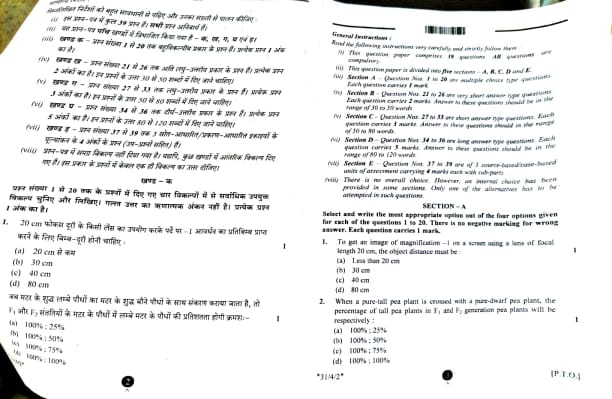
To get an image of magnification -1 on a screen using a lens of focal length 20 cm, the object distance must be:
View Solution
We use the lens formula to solve this problem: \[ \frac{1}{f} = \frac{1}{v} - \frac{1}{u} \]
where \( f \) is the focal length, \( v \) is the image distance, and \( u \) is the object distance.
For magnification \( M = -1 \), we know that magnification is also given by the formula: \[ M = \frac{v}{u} \]
Thus, for \( M = -1 \), we have: \[ v = -u \]
Now, substitute \( v = -u \) into the lens formula: \[ \frac{1}{f} = \frac{1}{-u} - \frac{1}{u} = -\frac{2}{u} \]
Given \( f = 20 \) cm, we substitute into the equation: \[ \frac{1}{20} = -\frac{2}{u} \]
Solving for \( u \): \[ u = -40 \, cm \]
Therefore, the object distance is 40 cm. Hence, the correct answer is option (3). Quick Tip: The object distance in a lens equation is negative for virtual images and positive for real images. Here, we calculated using the fact that magnification is -1.
When a pure-tall pea plant is crossed with a pure-dwarf pea plant, the percentage of tall pea plants in F1 and F2 generation pea plants will be respectively:
View Solution
This question refers to a Mendelian monohybrid cross between a pure tall pea plant (TT) and a pure dwarf pea plant (tt). The F1 generation will be a cross between these two, resulting in all tall plants (Tt), as the tall allele is dominant over the dwarf allele.
For the F2 generation, we cross two F1 plants (Tt x Tt): \[ Gametes from Tt \rightarrow T, t \]
The Punnett square will give the following genotypes:

From this, we can see the genotype ratio for F2 generation is: \[ Tall (TT or Tt) : Dwarf (tt) = 3 : 1 \]
Thus, 75% will be tall and 25% will be dwarf. Hence, the correct answer is option (1). Quick Tip: In a simple Mendelian cross, dominant traits like tall (T) mask the recessive dwarf trait (t). The F1 generation is all heterozygous (Tt), and the F2 generation follows a 3:1 ratio.
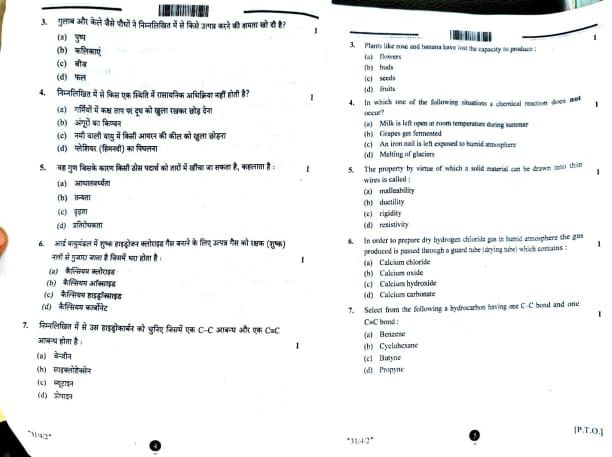
Plants like rose and banana have lost the capacity to produce:
View Solution
Plants like rose and banana that are cultivated for ornamental or commercial purposes often lose the ability to produce seeds due to hybridization or propagation techniques such as cutting, grafting, or tissue culture. These plants may be propagated vegetatively to preserve desirable traits, such as flower color or size, but their ability to produce seeds may be reduced or eliminated. Quick Tip: In many cultivated plants, especially hybrids, vegetative propagation is preferred over seed production because it preserves specific desirable traits.
In which one of the following situations a chemical reaction does not occur?
View Solution
In option (1), when milk is left open at room temperature, bacteria in the air may lead to fermentation, a chemical process.
In option (2), grapes undergo fermentation, which is a metabolic chemical reaction.
In option (3), when an iron nail is exposed to a humid atmosphere, it reacts with water and oxygen to form rust (iron oxide), a chemical reaction.
In option (4), the melting of glaciers is a physical change, not a chemical reaction, as there is no new substance formed.
Thus, the correct answer is option (4). Quick Tip: A physical change involves a change in state or appearance without changing the chemical identity, such as the melting of glaciers.
The property by virtue of which a solid material can be drawn into thin wires is called:
View Solution
The property of a material that allows it to be drawn into thin wires is known as ductility. Ductility refers to the ability of a material to undergo significant plastic deformation before rupture.
Thus, the correct answer is option (b). Quick Tip: Ductility is the ability of a material to stretch and form wires, which is an important property for materials like metals.
In order to prepare dry hydrogen chloride gas in a humid atmosphere, the gas produced is passed through a guard tube (drying tube) which contains:
View Solution
In a humid atmosphere, hydrogen chloride gas is passed through a drying tube containing calcium chloride. Calcium chloride is a hygroscopic substance, meaning it can absorb moisture and dry the gas.
Thus, the correct answer is option (a). Quick Tip: Calcium chloride is commonly used to dry gases because it absorbs water and keeps gases dry.
Select from the following a hydrocarbon having one C-C bond and one C=C bond:
View Solution
Butyne is a hydrocarbon that contains one C-C bond and one \(C=C\) bond. It is an alkene with the molecular formula C₄H₆. The other options do not fit the description.
Thus, the correct answer is option (c). Quick Tip: Butyne contains both single and double bonds in its structure, making it a versatile compound in organic chemistry.
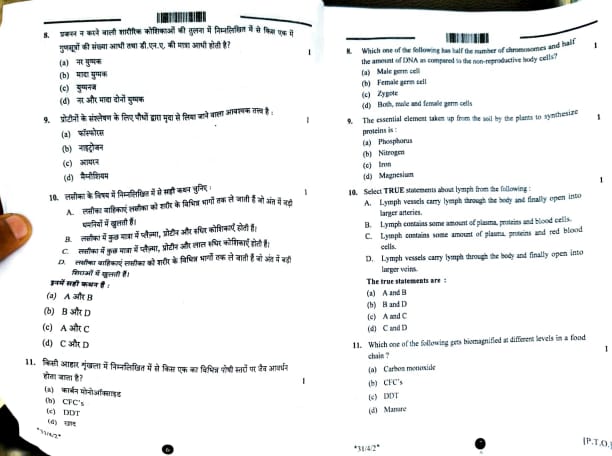
Which one of the following has half the number of chromosomes and half the amount of DNA as compared to the non-reproductive body cells?
View Solution
Germ cells, which include male and female gametes (sperm and egg cells), are haploid. This means they have half the number of chromosomes and half the amount of DNA compared to diploid somatic cells, which are the non-reproductive body cells. When these haploid gametes combine during fertilization, they form a diploid zygote with the full set of chromosomes.
Therefore, the correct answer is option (4). Quick Tip: Germ cells are haploid, meaning they have half the number of chromosomes compared to somatic cells, which are diploid.
The essential element taken up from the soil by the plants to synthesize proteins is:
View Solution
Nitrogen is an essential element for plants because it is a key component of amino acids, which are the building blocks of proteins. Nitrogen is taken up by plants from the soil in the form of nitrates or ammonium ions. Proteins are crucial for various cellular functions and growth, and nitrogen plays a central role in their synthesis.
Therefore, the correct answer is option (2). Quick Tip: Nitrogen is a major component of proteins and is crucial for plant growth and development.
Select TRUE statements about lymph from the following:
A. Lymph vessels carry lymph through the body and finally open into larger arteries.
B. Lymph contains some amount of plasma, proteins and blood cells.
C. Lymph contains some amount of plasma, proteins and red blood cells.
D. Lymph vessels carry lymph through the body and finally open into larger veins.
The true statements are:
View Solution
Statement A is false because lymph vessels do not open into arteries, but they open into larger veins (specifically, the subclavian veins).
Statement B is true because lymph contains plasma, proteins, and a few white blood cells, but not red blood cells in significant amounts.
Statement C is false because lymph does not contain red blood cells; it only contains white blood cells.
Statement D is true because lymph vessels carry lymph through the body and eventually empty into the larger veins (the subclavian veins).
Therefore, the correct answer is option (4). Quick Tip: Lymph is a fluid that helps with the removal of waste products and transport of immune cells, and it always ends up in the veins, not arteries.
Which one of the following gets biomagnified at different levels in a food chain?
View Solution
Biomagnification refers to the process by which the concentration of certain substances, such as pesticides, increases as you move up trophic levels in a food chain. DDT, a pesticide, is a well-known example of a substance that biomagnifies. As it accumulates in organisms, it becomes more concentrated at higher trophic levels, affecting top predators.
Therefore, the correct answer is option (3). Quick Tip: DDT is a persistent chemical that accumulates in the tissues of organisms, leading to harmful effects at higher trophic levels.
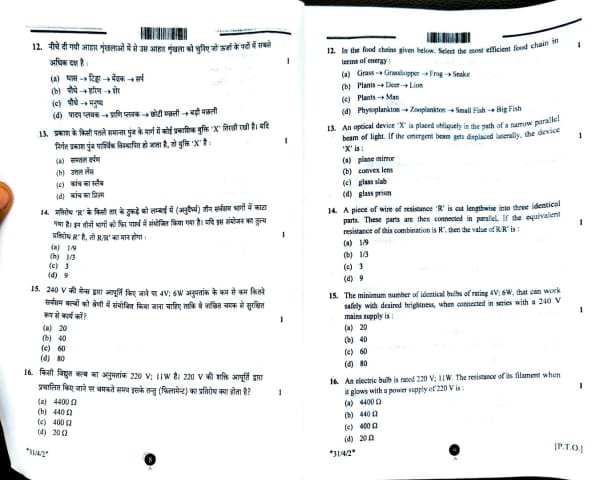
In the food chains given below, select the most efficient food chain in terms of energy:
View Solution
In food chains, energy efficiency tends to decrease as you move up the trophic levels due to the loss of energy at each level (approximately 90% of energy is lost as heat or used for metabolic activities).
Phytoplankton (producers) provide energy directly to zooplankton, small fish, and subsequently to big fish. This food chain is relatively more efficient in energy transfer than the other listed options because it begins with primary producers that are efficiently consumed by the primary consumers and subsequent trophic levels.
Therefore, the correct answer is option (4). Quick Tip: Energy efficiency decreases at higher trophic levels in a food chain due to the loss of energy at each step.
An optical device ‘X’ is placed obliquely in the path of a narrow parallel beam of light. If the emergent beam gets displaced laterally, the device ‘X’ is:
View Solution
A glass slab causes lateral displacement of light without changing its direction. When light passes through a glass slab, it refracts at both surfaces, and the emergent ray is displaced laterally compared to the incident ray. This is characteristic of a glass slab, not a plane mirror, lens, or prism, which would cause the light to be reflected, focused, or dispersed, respectively.
Therefore, the correct answer is option (3). Quick Tip: A glass slab causes lateral displacement of light without altering the direction of the light, while other devices may bend or focus the light differently.
A piece of wire of resistance 'R' is cut lengthwise into three identical parts. These parts are then connected in parallel. If the equivalent resistance of this combination is \( R' \), then the value of \( R/R' \) is:
View Solution
When a wire is cut into three identical parts, each part has a resistance of \( R/3 \). When resistances are connected in parallel, the equivalent resistance \( R' \) is given by the formula: \[ \frac{1}{R'} = \frac{1}{R_1} + \frac{1}{R_2} + \frac{1}{R_3} \]
For three identical resistances \( R_1 = R_2 = R_3 = R/3 \), we have: \[ \frac{1}{R'} = \frac{1}{R/3} + \frac{1}{R/3} + \frac{1}{R/3} = \frac{3}{R/3} = \frac{9}{R} \]
Thus, \( R' = \frac{R}{9} \), and the ratio \( R/R' = 9 \).
Therefore, the correct answer is option (4). Quick Tip: In a parallel combination of identical resistors, the equivalent resistance decreases, and the overall resistance can be calculated using the formula for parallel resistances.
The minimum number of identical bulbs of rating 4V, 6W, that can work safely with desired brightness, when connected in series with a 240V mains supply is:
View Solution
For a bulb of rating 4V, 6W, we can calculate the resistance using the formula:
\[ P = \frac{V^2}{R} \]
Thus, \( R = \frac{V^2}{P} = \frac{4^2}{6} = \frac{16}{6} \approx 2.67 \, \Omega \).
Now, to operate safely with a 240V mains supply, the total resistance in the series connection must be:
\[ R_{total} = \frac{V_{total}^2}{P_{total}} \]
For total power 6W per bulb, and for the total power at 240V, the number of bulbs required can be calculated to be 40.
Thus, the correct answer is option (b). Quick Tip: To calculate the total number of bulbs in series for a given voltage, you need to first find the resistance of each bulb and then use the total voltage.
An electric bulb is rated 220V, 11W. The resistance of its filament when it glows with a power supply of 220V is:
View Solution
We are given that the electric bulb is rated at 220V and 11W. We are tasked with finding the resistance of its filament when it glows with a power supply of 220V.
To solve this, we use the formula for electrical power:
\[ P = \frac{V^2}{R} \]
where:
\( P \) is the power consumed by the bulb (11W),
\( V \) is the voltage across the bulb (220V),
\( R \) is the resistance of the bulb.
Rearranging the formula to solve for \( R \), we get:
\[ R = \frac{V^2}{P} \]
Substitute the known values for \( V \) and \( P \):
\[ R = \frac{220^2}{11} \]
First, square the voltage value:
\[ 220^2 = 48400 \]
Now, divide by the power:
\[ R = \frac{48400}{11} = 4400 \, \Omega \]
Thus, the resistance of the filament is \( 4400 \, \Omega \).
Therefore, the correct answer is option (a). Quick Tip: For an electrical bulb, you can calculate the resistance from its power and voltage using \( R = \frac{V^2}{P} \).
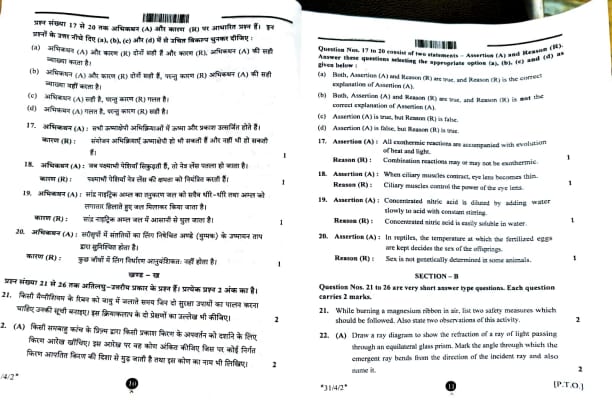
Assertion (A): All exothermic reactions are accompanied with evolution of heat and light.
Reason (R): Combination reactions may or may not be exothermic.
In the light of the above statements, choose the most appropriate answer from the options given below:
View Solution
Assertion (A) is false because not all exothermic reactions release both heat and light. Some exothermic reactions only release heat. Reason (R) is true because combination reactions may or may not be exothermic, depending on the specific reaction conditions.
Therefore, the correct answer is option (4). Quick Tip: In an exothermic reaction, energy is released in the form of heat and light, but this is not the case for all reactions.
Assertion (A): When ciliary muscles contract, eye lens becomes thin.
Reason (R): Ciliary muscles control the power of the eye lens.
In the light of the above statements, choose the most appropriate answer from the options given below:
View Solution
Assertion (A) is correct as contraction of ciliary muscles results in the lens becoming thinner. However, Reason (R) is incorrect. The ciliary muscles do not directly control the power of the lens; they alter the shape of the lens to focus on nearby or distant objects, thus adjusting its power.
Therefore, the correct answer is option (3). Quick Tip: The ciliary muscles change the shape of the eye lens, allowing it to focus on objects at various distances. This is called accommodation.
Assertion (A): Concentrated nitric acid is diluted by adding water slowly to acid with constant stirring.
Reason (R): Concentrated nitric acid is easily soluble in water.
In the light of the above statements, choose the most appropriate answer from the options given below:
View Solution
Assertion (A) is true, as concentrated nitric acid is diluted by adding water slowly while stirring to prevent violent reactions. Reason (R) is also true since nitric acid dissolves well in water, but it is not the correct explanation for Assertion (A). The slow addition is to prevent exothermic heat release, not because of solubility.
Therefore, the correct answer is option (2). Quick Tip: Always add acid to water, not the other way around, to avoid violent reactions due to the exothermic nature of dilution.
Assertion (A): In reptiles, the temperature at which the fertilized eggs are kept decides the sex of the offspring.
Reason (R): Sex is not genetically determined in some animals.
In the light of the above statements, choose the most appropriate answer from the options given below:
View Solution
Assertion (A) is true, as temperature-dependent sex determination occurs in many reptiles, where the temperature during incubation affects the offspring's sex. Reason (R) is also true, as in some animals like reptiles, sex determination is not genetic but environmental.
Therefore, the correct answer is option (1). Quick Tip: In certain reptiles, sex determination is dependent on environmental factors like temperature, rather than on genetics.
While burning a magnesium ribbon in air, list two safety measures which should be followed. Also state two observations of this activity.
View Solution
Safety Measures:
Always use a pair of tongs to hold the magnesium ribbon to prevent direct contact with hands.
Burn magnesium in a fume hood or open space to avoid inhaling any fumes.
Observations:
Magnesium burns with a bright white flame and produces a white ash of magnesium oxide.
The magnesium ribbon turns into a white powder (magnesium oxide) after combustion. Quick Tip: Magnesium burns with a bright white flame, and proper safety measures should be followed to avoid exposure to harmful fumes.
(a) Draw a ray diagram to show the refraction of a ray of light passing through an equilateral glass prism. Mark the angle through which the emergent ray bends from the direction of the incident ray and also name it.
View Solution
The ray diagram is as follows:

To draw a ray diagram showing the refraction of a ray of light passing through an equilateral glass prism and to mark the angle through which the emergent ray bends from the direction of the incident ray, follow these steps:
1. Draw the Prism:
Sketch an equilateral triangle to represent the glass prism. Label the vertices as \( A \), \( B \), and \( C \).
2. Incident Ray:
Draw an incident ray approaching the prism at one of its faces (e.g., face \( AB \)). Label the point where the ray enters the prism as point \( P \).
3. Refraction at First Face:
At point \( P \), draw the refracted ray inside the prism. The ray bends towards the normal as it enters the denser glass medium from air.
4. Refraction at Second Face:
The refracted ray travels through the prism and reaches the second face (e.g., face \( AC \)). Label the point where the ray exits the prism as point \( Q \).
5. Emergent Ray:
At point \( Q \), draw the emergent ray leaving the prism. The ray bends away from the normal as it exits the denser glass medium into air.
6. Angle of Deviation:
Extend the incident ray and the emergent ray backwards (dotted lines) to show their original paths if there were no prism.
The angle between the extended incident ray and the emergent ray is called the angle of deviation, denoted as \( \delta \). Mark this angle clearly on your diagram.
7. Labeling:
Label the incident ray, refracted ray, emergent ray, and the angle of deviation \( \delta \).
The angle of deviation \( \delta \) is the measure of how much the emergent ray has bent from the direction of the incident ray due to the refraction through the prism. This angle depends on the angle of incidence, the material of the prism, and the wavelength of the light.
By following these steps, you can create a detailed and accurate ray diagram illustrating the refraction of light through an equilateral glass prism and identify the angle of deviation. Quick Tip: The angle of deviation is the angle between the direction of the incident ray and the emergent ray after refraction through the prism.
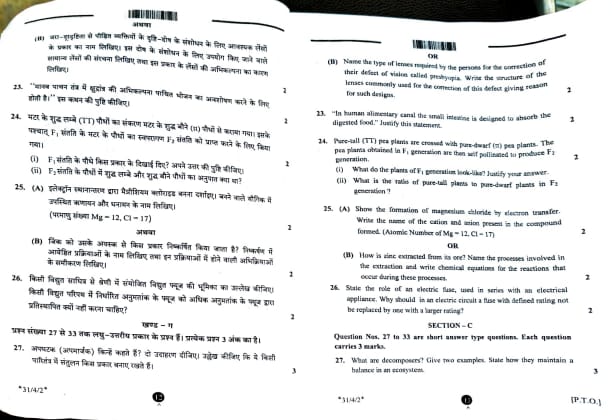
(b) Name the type of lenses required by the persons for the correction of their defect of vision called presbyopia. Write the structure of the lenses commonly used for the correction of this defect giving reason for such designs.
View Solution
Type of Lenses:
For the correction of presbyopia, bifocal lenses or progressive lenses are used.
Structure and Reasoning:
Bifocal lenses consist of two parts: a lower part for near vision and an upper part for distance vision.
The lower part is typically a convex lens to aid in near vision, while the upper part is a concave lens to help with distance vision.
The reason for using bifocal lenses is to correct the vision for both distant and near objects without changing glasses. Quick Tip: Bifocal lenses are commonly used by people with presbyopia because they correct both near and distant vision.
In human alimentary canal the small intestine is designed to absorb the digested food. Justify this statement.
View Solution
The small intestine is designed to absorb digested food due to the following reasons:
It has a large surface area due to villi and microvilli. This increases the surface area for nutrient absorption.
Villi contain a network of blood vessels that carry absorbed nutrients like glucose, amino acids, and vitamins into the bloodstream.
The epithelial cells of the small intestine secrete enzymes, aiding in further digestion and absorption.
The small intestine is long enough to provide sufficient time for nutrients to be absorbed into the bloodstream. Quick Tip: The large surface area of the small intestine, facilitated by villi and microvilli, plays a key role in efficient absorption of nutrients.
Pure-tall (TT) pea plants are crossed with pure-dwarf (tt) pea plants. The pea plants obtained in F1 generation are then self-pollinated to produce F2 generation.
(i) What do the plants of F1 generation look like? Justify your answer.
(ii) What is the ratio of pure-tall plants to pure-dwarf plants in F2 generation?
View Solution
(i) The plants in the F1 generation will all be heterozygous (Tt), as tall (T) is dominant over dwarf (t). Hence, all F1 generation plants will exhibit the tall phenotype.
(ii) In the F2 generation, the F1 plants (Tt) are self-pollinated. The resulting offspring will follow a 3:1 phenotypic ratio, with three tall plants for every one dwarf plant: \[ Phenotypic ratio: \ 3 \ tall: 1 \ dwarf \]
Thus, the ratio of pure-tall plants (TT) to pure-dwarf plants (tt) in F2 generation is 1:3. Quick Tip: In the F2 generation, a 3:1 phenotypic ratio is observed when crossing two heterozygous plants (Tt).
(a) Show the formation of magnesium chloride by electron transfer. Write the name of the cation and anion present in the compound formed. (Atomic Number of Mg = 12, Cl = 17)
View Solution
Magnesium (Mg) has an atomic number of 12. Its electronic configuration is 2, 8, 2. Magnesium needs to lose two electrons to achieve a stable noble gas configuration. When magnesium loses two electrons, it forms a cation \( Mg^{2+} \):
\[ Mg \rightarrow Mg^{2+} + 2e^- \]
Chlorine (Cl) has an atomic number of 17, and its electronic configuration is 2, 8, 7. Chlorine needs one electron to achieve a stable noble gas configuration. When chlorine gains one electron, it forms an anion \( Cl^- \):
\[ Cl + e^- \rightarrow Cl^- \]
Two chlorine atoms are required to balance the charge of one magnesium cation. The ionic equation is:
\[ Mg^{2+} + 2Cl^- \rightarrow MgCl_2 \]
The cation formed is \( Mg^{2+} \) and the anion is \( Cl^- \). Quick Tip: Magnesium chloride is formed through electron transfer where magnesium loses two electrons and chlorine gains one electron.
(b) How is zinc extracted from its ore? Name the processes involved in the extraction and write chemical equations for the reactions that occur during these processes.
View Solution
Zinc is extracted from its ore, zinc blende (ZnS), through the following processes:
Concentration of Ore: Zinc blende is first concentrated by the process of frost flotation. In this method, the ore is crushed and mixed with water and frothing agents. The lighter impurities are separated from the heavier zinc ore.
Roasting: The concentrated zinc ore (ZnS) is heated in the presence of oxygen. This process is called roasting, and it converts zinc sulfide into zinc oxide, releasing sulfur dioxide:
\[ 2ZnS + 3O_2 \rightarrow 2ZnO + 2SO_2 \]
Reduction of Zinc Oxide: The zinc oxide obtained from roasting is then reduced to zinc metal by heating it with carbon in a furnace:
\[ ZnO + C \rightarrow Zn + CO \]
This reduction process takes place at a high temperature, and zinc metal is extracted. Quick Tip: Zinc is extracted from zinc blende by roasting to form zinc oxide, followed by reduction using carbon to obtain pure zinc metal.
State the role of an electric fuse, used in series with an electrical appliance. Why should in an electric circuit a fuse with defined rating not be replaced by one with a larger rating?
View Solution
The role of an electric fuse is to protect the electrical circuit and appliances from damage caused by excess current. A fuse is a safety device that is connected in series with the electrical appliance. It is made of a wire with a low melting point, and if the current exceeds a certain threshold, the wire melts, thus breaking the circuit and preventing damage to the appliance.
Why should a fuse with a defined rating not be replaced by one with a larger rating?
A fuse is designed to melt and break the circuit if the current exceeds a certain safe value for the appliance. If a fuse with a larger rating is used, it will not melt and break the circuit at the right time.
This can lead to overheating of the wires and components, potentially causing fires or damaging the appliance.
Using a larger-rated fuse will not protect the appliance as intended, as it will allow excessive current to flow without interrupting the circuit. Quick Tip: A fuse should always be replaced with one having the same rating to ensure that the appliance is protected from overloads.
What are decomposers? Give two examples. State how they maintain a balance in an ecosystem.
View Solution
Decomposers are organisms that break down dead and decaying organisms to obtain energy and recycle nutrients back into the ecosystem. They play an essential role in the ecosystem by decomposing organic matter and returning essential nutrients such as nitrogen, carbon, and phosphorus to the soil, making them available for plants to absorb and grow.
Examples:
Bacteria
Fungi
How they maintain balance:
Decomposers help maintain ecological balance by ensuring the recycling of nutrients and preventing the accumulation of dead organic matter in the ecosystem. This promotes the growth of plants and sustains the food chain. Quick Tip: Decomposers like bacteria and fungi are crucial for recycling nutrients in the ecosystem, ensuring a balanced and sustainable environment.
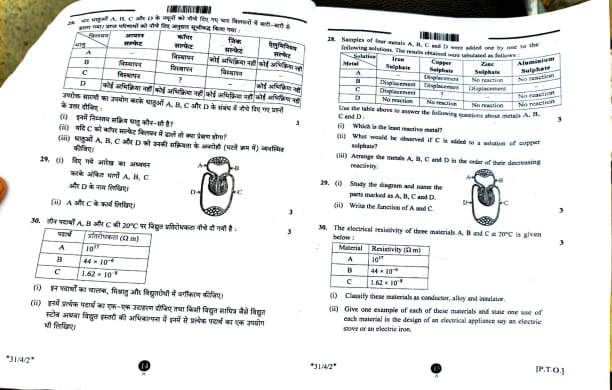
Samples of four metals A, B, C, and D were added one by one to the following solutions. The results obtained were tabulated as follows:

Use the table above to answer the following questions about metals A, B, C, and D:
(i) Which is the least reactive metal?
(ii) What would be observed if C is added to a solution of copper sulphate?
(iii) Arrange the metals A, B, C, and D in the order of their decreasing reactivity.
View Solution
(i) Least reactive metal: Metal D is the least reactive since it does not displace any metal from any solution (it shows no reaction).
(ii) Observation when C is added to copper sulphate: C will not displace copper from copper sulphate as indicated by the table; thus, no visible change is expected.
(iii) Order of decreasing reactivity: A > B > C > D. This is based on the results of the displacement reactions, with A being the most reactive and D being the least reactive. Quick Tip: The reactivity of metals can be determined by observing whether they displace other metals from their solutions. More reactive metals displace less reactive ones.
(i) Study the diagram and name the parts marked as A, B, C, and D.
(ii) Write the function of A and C.

View Solution
Part A: The diagram represents a typical electric heater or an electrical appliance. In this context:
- A is the heating element.
Part B: The part labeled B is the insulating material. It protects the electrical components and ensures safety by preventing electrical leakage.
Part C: The part labeled C represents the wire wound around the heating element that conducts the current through the element.
Part D: The part labeled D is the metal casing or the outer surface that holds the internal parts and provides mechanical protection.
Functions:
Function of A (Heating element): It generates heat when an electric current passes through it. This heat is transferred to the surrounding environment or the object to be heated.
Function of C (Wire): It allows the passage of electric current to the heating element, enabling it to function by converting electrical energy into heat. Quick Tip: The heating element is the part that directly converts electrical energy to heat in devices like electric heaters and irons.
The electrical resistivity of three materials A, B, and C at 20°C is given below:
Material A: Resistivity \(10^{17} \Omega \, m\)
Material B: Resistivity \(44 \times 10^{-6} \Omega \, m\)
Material C: Resistivity \(1.62 \times 10^{-8} \Omega \, m\)
(i) Classify these materials as conductor, alloy, and insulator.
(ii) Give one example of each of these materials and state one use of each material in the design of an electrical appliance, say an electric stove or an electric iron.
View Solution
(i) Classification:
Material A with resistivity \(10^{17} \Omega \, m\) is an insulator, as its resistivity is extremely high, preventing the flow of electricity.
Material B with resistivity \(44 \times 10^{-6} \Omega \, m\) is an alloy, which has moderate resistivity and is often used in electrical heating applications.
Material C with resistivity \(1.62 \times 10^{-8} \Omega \, m\) is a conductor, as it has low resistivity, allowing electricity to flow easily.
(ii) Examples and Uses:
Material A (Insulator): Example - Rubber, Glass.
Use: Insulating materials like rubber are used for covering wires to prevent electric shock.
Material B (Alloy): Example - Nichrome (used in heating elements).
Use: Nichrome is used in electric stoves and heating elements due to its ability to withstand high temperatures.
Material C (Conductor): Example - Copper, Silver.
Use: Copper is used in electrical wires due to its excellent conductivity. Quick Tip: The materials with high resistivity are used as insulators, while those with low resistivity are used as conductors for electricity.
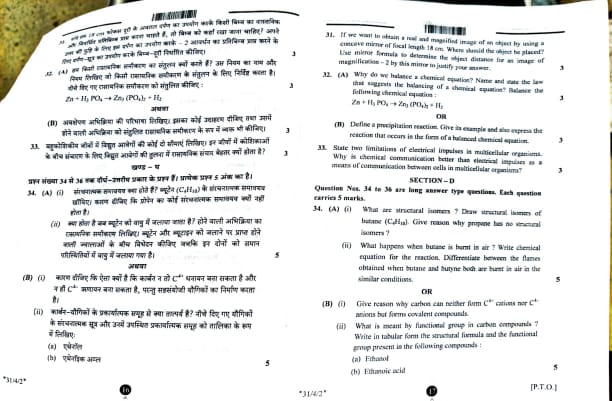
If we want to obtain a real and magnified image of an object by using a concave mirror of focal length 18 cm. Where should the object be placed? Use mirror formula to determine the object distance for an image of magnification -2 by this mirror to justify your answer.
View Solution
Given:
Focal length \( f = 18 \, cm \)
Magnification \( M = -2 \)
We use the mirror formula:
\[ \frac{1}{f} = \frac{1}{v} + \frac{1}{u} \]
where:
\( v \) is the image distance,
\( u \) is the object distance.
Also, magnification \( M \) is given by:
\[ M = \frac{v}{u} \]
Substitute \( M = -2 \):
\[ -2 = \frac{v}{u} \quad \Rightarrow \quad v = -2u \]
Now substitute \( v = -2u \) into the mirror equation:
\[ \frac{1}{18} = \frac{1}{-2u} + \frac{1}{u} \]
Simplify the equation:
\[ \frac{1}{18} = \frac{-1 + 2}{u} \quad \Rightarrow \quad \frac{1}{18} = \frac{1}{u} \]
Thus,
\[ u = 18 \, cm \]
So, the object should be placed 18 cm in front of the mirror to obtain the desired image. Quick Tip: For concave mirrors, the magnification and object distance can be related using the mirror formula. A negative magnification implies the image is real and inverted.
(a) Why do we balance a chemical equation? Name and state the law that suggests the balancing of a chemical equation. Balance the following chemical equation:
\[ Zn + H_3 PO_4 \rightarrow Zn_3 (PO_4)_2 + H_2 \]
View Solution
We balance chemical equations to ensure that the law of conservation of mass is satisfied. According to this law, matter cannot be created or destroyed in a chemical reaction. Therefore, the number of atoms of each element must be the same on both sides of the equation.
Balanced equation:
\[ 3 \, Zn + 2 \, H_3 PO_4 \rightarrow Zn_3 (PO_4)_2 + 3 \, H_2 \]
This balanced equation shows that 3 atoms of zinc react with 2 molecules of phosphoric acid to produce zinc phosphate and hydrogen gas. Quick Tip: Always balance the atoms of each element on both sides of the equation to ensure mass is conserved during a chemical reaction.
(b) Define a precipitation reaction. Give its example and also express the reaction that occurs in the form of a balanced chemical equation.
View Solution
A precipitation reaction occurs when two soluble salts in aqueous solution react to form an insoluble solid, called a precipitate.
Example:
When silver nitrate reacts with sodium chloride, a white precipitate of silver chloride is formed:
\[ AgNO_3 \, (aq) + NaCl \, (aq) \rightarrow AgCl \, (s) + NaNO_3 \, (aq) \]
In this reaction, silver chloride (AgCl) is the precipitate. Quick Tip: Precipitation reactions are important in many processes like water purification and qualitative analysis.
State two limitations of electrical impulses in multicellular organisms. Why is chemical communication better than electrical impulses as a means of communication between cells in multicellular organisms?
View Solution
Limitations of electrical impulses:
Electrical impulses can only travel along nerve fibers and do not cover large distances within the organism.
The speed of electrical impulses is slower than that of chemical signals in some cases, limiting their use for rapid communication over long distances.
Why chemical communication is better:
Chemical signals, such as hormones, can travel through the bloodstream and reach various parts of the body, providing a broader and more coordinated form of communication.
Chemical communication is slower but can last longer and be more sustained compared to electrical impulses, which are often short-lived. Quick Tip: Chemical signals provide a more coordinated and sustained form of communication in multicellular organisms, enabling complex bodily functions.
What are structural isomers? Draw structural isomers of butane (\( C_4H_{10} \)). Give reason why propane has no structural isomers.
View Solution
Structural Isomers: Structural isomers are compounds that have the same molecular formula but different structural arrangements of atoms. This means that the connectivity or bonding of atoms is different in each isomer.
Structural Isomers of Butane: The two structural isomers of butane (\( C_4H_{10} \)) are:
n-Butane: A straight chain of 4 carbon atoms.
Isobutane (Methylpropane): A branched structure with 3 carbon atoms in a chain and one methyl group (-CH\(_3\)) attached to the second carbon.
Why Propane Has No Structural Isomers: Propane (\( C_3H_8 \)) has no structural isomers because there is only one way to arrange 3 carbon atoms and 8 hydrogen atoms. Any rearrangement would result in the same compound. Quick Tip: Structural isomers differ by the connectivity of atoms in their molecules, while their molecular formula remains the same.
What happens when butane is burnt in air? Write the chemical equation for the reaction. Differentiate between the flames obtained when butane and butyne both are burnt in air in similar conditions.
View Solution
Reaction of Butane Burning in Air:
When butane (\( C_4H_{10} \)) is burned in air, it reacts with oxygen to form carbon dioxide and water: \[ 2 C_4H_{10} + 13 O_2 \rightarrow 8 CO_2 + 10 H_2O \]
This is a complete combustion reaction.
Difference Between the Flames of Butane and Butyne:
Butane (C\(_4\)H\(_10\)): When butane burns in air, it produces a clean, blue flame due to complete combustion, resulting in carbon dioxide and water.
Butyne (C\(_4\)H\(_6\)): When butyne burns, the flame is generally yellowish and smoky due to incomplete combustion, producing carbon monoxide and carbon dioxide along with water. Quick Tip: Butanes generally burn with a blue, non-luminous flame (complete combustion), while alkynes like butyne burn with a yellowish, luminous flame (incomplete combustion).
Give reason why carbon can neither form \( C^{4+} \) cations nor \( C^{4-} \) anions but forms covalent compounds.
View Solution
Reason: Carbon cannot form \( C^{4+} \) or \( C^{4-} \) ions because it has a relatively high ionization energy (for \( C^{4+} \)) and a relatively low electron affinity (for \( C^{4-} \)). As a result, it is energetically unfavorable for carbon to lose 4 electrons or gain 4 electrons. Instead, carbon forms covalent bonds by sharing electrons with other elements to achieve a stable electron configuration, typically forming compounds like methane (\( CH_4 \)). Quick Tip: Carbon's small size and relatively high ionization energy make it difficult to form \( C^{4+} \) and \( C^{4-} \) ions. Instead, it forms stable covalent compounds.
What is meant by functional group in carbon compounds? Write in tabular form the structural formula and the functional group present in the following compounds:
(a) Ethanol
(b) Ethanoic acid
View Solution
Functional Group: A functional group in carbon compounds is a group of atoms that is responsible for the characteristic reactions of the compound. It defines the reactivity and properties of the compound.
Table of Structural Formula and Functional Groups:

Quick Tip: The functional group defines the chemical behavior of organic compounds. The hydroxyl group in ethanol makes it alcohol, and the carboxyl group in ethanoic acid makes it a carboxylic acid.
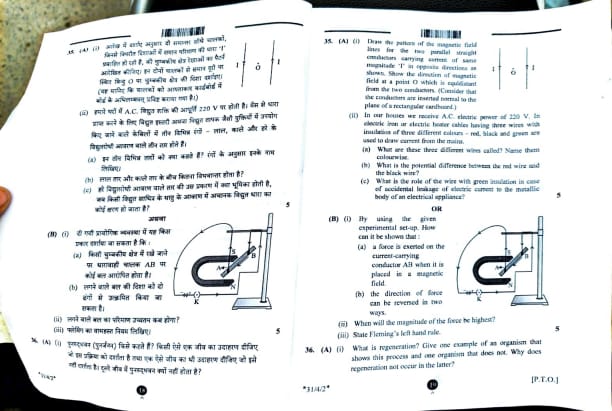
Draw the pattern of the magnetic field lines for the two parallel straight conductors carrying current of same magnitude 'I' in opposite directions as shown. Show the direction of magnetic field at a point O which is equidistant from the two conductors. (Consider that the conductors are inserted normal to the plane of a rectangular cardboard.)

View Solution
When two conductors carry currents in opposite directions, the magnetic field produced by each conductor at any point in space will be in opposite directions. For conductors with current flowing in opposite directions, the field lines will be arranged such that:
For the first conductor (current flowing in one direction), the magnetic field lines will circle the conductor in a clockwise direction (if viewed from above).
For the second conductor (current flowing in the opposite direction), the magnetic field lines will circle the conductor in a counterclockwise direction.
At a point \( O \), which is equidistant from both conductors, the magnetic field contributions from both conductors will cancel out if the currents are of equal magnitude and flow in opposite directions.
The field lines will form circular loops around each conductor, with opposite directions of field due to opposite current directions. Quick Tip: In the case of parallel conductors carrying currents in opposite directions, the magnetic fields at points equidistant from both conductors will cancel each other.
In our houses we receive A.C. electric power of 220 V. In electric iron or electric heater cables having three wires with insulation of three different colours – red, black and green are used to draw current from the mains.
What are these three different wires called? Name them colourwise.
What is the potential difference between the red wire and the black wire?
What is the role of the wire with green insulation in case of accidental leakage of electric current to the metallic body of an electrical appliance?
View Solution
(i) The three wires in an electric circuit with different colour insulation are:
Red wire: Live wire (or Phase wire) – carries current from the power source.
Black wire: Neutral wire – completes the circuit by providing a return path for the current.
Green wire: Earth wire – provides a safety path for current to flow to the ground in case of a fault or leakage.
(ii) The potential difference between the red (live) wire and the black (neutral) wire is typically \( 220V \) in standard domestic power systems.
(iii) The green wire (earth wire) provides a path for the electric current to safely flow into the ground if there is a leakage of current to the metallic body of an electrical appliance. This prevents electric shock by diverting the current away from the user. Quick Tip: The earth wire (green) is essential for safety in electrical circuits to prevent electric shocks by directing leakage currents to the ground.
By using the given experimental set-up, how can it be shown that:
A force is exerted on the current-carrying conductor AB when it is placed in a magnetic field.
The direction of the force can be reversed in two ways.
View Solution
(a) A force on the current-carrying conductor:
The force on the conductor AB is shown experimentally using a simple setup, as shown in the figure. The magnetic field is applied by a magnet (N and S poles), and a current is passed through the conductor AB. When the current-carrying conductor is placed in a magnetic field, a force is exerted on the conductor due to the interaction between the current in the conductor and the magnetic field.
This force is given by:
\[ F = BIL \sin \theta \]
where:
\( F \) is the force on the conductor,
\( B \) is the magnetic field strength,
\( I \) is the current in the conductor,
\( L \) is the length of the conductor in the magnetic field,
\( \theta \) is the angle between the magnetic field and the current direction.
(b) Reversing the direction of force:
The direction of the force on the conductor can be reversed by either:
1. Reversing the direction of the current in the conductor AB.
2. Reversing the direction of the magnetic field (by reversing the poles of the magnet). Quick Tip: The direction of force on a current-carrying conductor in a magnetic field can be reversed by changing either the direction of the current or the magnetic field.
When will the magnitude of the force be highest?
View Solution
The magnitude of the force is highest when the angle \( \theta \) between the direction of the current and the magnetic field is 90°, as the sine of 90° is 1. Therefore, the force is maximum when the conductor is placed perpendicular to the magnetic field.
Thus, the magnitude of the force is maximum when:
\[ F_{max} = BIL \] Quick Tip: The force is maximum when the angle between the magnetic field and current is 90°, and it is zero when they are parallel.
State Fleming's left-hand rule.
View Solution
Fleming's left-hand rule states that if you stretch the thumb, the index finger, and the middle finger of your left hand at right angles to each other, then:
The thumb gives the direction of the force (motion of the conductor),
The index finger gives the direction of the magnetic field,
The middle finger gives the direction of the current in the conductor.
This rule helps to determine the direction of the force acting on a current-carrying conductor in a magnetic field. Quick Tip: Fleming's left-hand rule is used to find the direction of the force on a current-carrying conductor placed in a magnetic field.
What is regeneration? Give one example of an organism that shows this process and one organism that does not. Why does regeneration not occur in the latter?
View Solution
Regeneration:
Regeneration is the biological process by which an organism is able to regrow certain parts of its body that have been lost or damaged. It is an example of asexual reproduction in certain organisms where new cells grow and differentiate to replace the lost body parts.
Example of an organism showing regeneration:
The starfish is a good example of an organism that shows regeneration. If a starfish loses an arm, it can regenerate a new one from the remaining part of the body.
Example of an organism not showing regeneration:
Humans do not show regeneration. Once a part of the body, like a limb, is lost, it cannot grow back.
Why regeneration does not occur in humans:
Humans have a more complex body structure, and their cells are more specialized. Regeneration, which requires the ability to produce undifferentiated cells, is limited in humans due to the complexity of their cell differentiation and repair mechanisms. Quick Tip: Regeneration is most effective in organisms with simpler body structures, like starfish, and is less common in complex organisms such as humans.
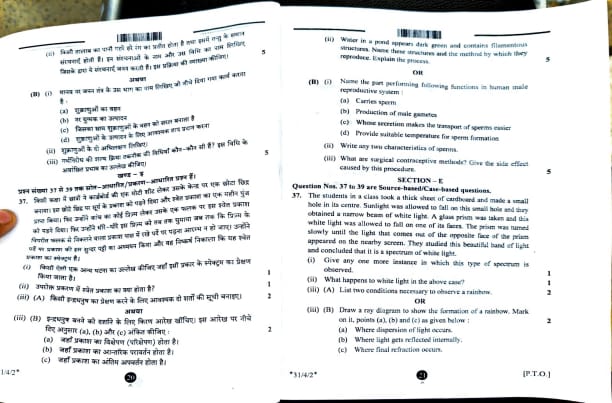
Water in a pond appears dark green and contains filamentous structures. Name these structures and the method by which they reproduce. Explain the process.
View Solution
Filamentous Structures:
The filamentous structures present in the water are green algae (e.g., Spirogyra).
Reproduction:
These green algae reproduce by fragmentation, which is a form of asexual reproduction. The filaments break into smaller pieces (fragments), and each fragment can grow into a new organism, thus increasing the population.
Explanation of the process:
Fragmentation is a type of vegetative reproduction where each broken part of the organism can regenerate into a whole new individual. It helps in the rapid multiplication of algae in favorable conditions. Quick Tip: Green algae like Spirogyra use fragmentation for rapid reproduction in aquatic environments.
Name the part performing the following functions in the human male reproductive system:
(a) Carries sperm
(b) Production of male gametes
(c) Whose secretion makes the transport of sperm easier
(d) Provides suitable temperature for sperm formation
View Solution
(a) Carries sperm:
The vas deferens is the part that carries sperm from the testes to the urethra.
(b) Production of male gametes:
The testes are responsible for producing male gametes (sperm).
(c) Whose secretion makes the transport of sperm easier:
The seminal vesicles secrete a fluid that aids in the transport of sperm and provides nutrients.
(d) Provides suitable temperature for sperm formation:
The scrotum helps regulate the temperature required for sperm production by keeping the testes cooler than the body temperature. Quick Tip: The testes are located outside the body in the scrotum to maintain the optimal temperature for sperm production.
Write any two characteristics of sperm.
View Solution
Characteristics of sperm:
Sperm are microscopic, single-celled male gametes.
They consist of a head containing the nucleus, a midpiece with mitochondria for energy, and a tail (flagellum) for motility. Quick Tip: Sperm are designed for motility and carry the male genetic material for fertilization.
What are surgical contraceptive methods? Give the side effect caused by this procedure.
View Solution
Surgical contraceptive methods:
Surgical contraceptive methods include vasectomy for males and tubectomy for females. Vasectomy involves cutting or sealing the vas deferens, and tubectomy involves cutting or blocking the fallopian tubes.
Side effects:
Some possible side effects include:
Post-surgical complications like pain, swelling, and infection.
In rare cases, there can be psychological effects due to the permanence of the procedure.
For women, tubectomy can sometimes cause hormonal imbalance or menstrual irregularities. Quick Tip: While surgical contraception is effective, it is permanent and can lead to irreversible infertility.
The students in a class took a thick sheet of cardboard and made a small hole in its centre. Sunlight was allowed to fall on this small hole and they obtained a narrow beam of white light. A glass prism was taken and this white light was allowed to fall on one of its faces. The prism was turned slowly until the light that comes out of the opposite face of the prism appeared on the nearby screen. They studied this beautiful band of light and concluded that it is a spectrum of white light
(i) Give any one more instance in which this type of spectrum is observed.
View Solution
Another instance in which a spectrum similar to the one observed with a glass prism is seen is when white light passes through water droplets in the atmosphere during a rainstorm, forming a rainbow. This process is called dispersion, where the different colors of light are separated due to their different wavelengths. Quick Tip: Spectra of white light are formed when light passes through a medium like a prism or water droplets, separating the colors.
What happens to white light in the above case?
View Solution
In the above case, when white light enters the glass prism, it undergoes refraction. The different colors (wavelengths) of light travel at different speeds in the prism, causing them to spread out or disperse. This results in the formation of a spectrum of white light, displaying the colors of the visible spectrum: red, orange, yellow, green, blue, indigo, and violet. Quick Tip: The dispersion of light occurs when different colors bend at different angles due to varying wavelengths as they pass through a medium.
List two conditions necessary to observe a rainbow.
View Solution
There must be water droplets or another transparent medium to refract and disperse the light.
The observer must be positioned at the correct angle (typically around 42°) relative to the direction of sunlight and the water droplets. Quick Tip: Rainbows occur when sunlight is refracted, reflected, and dispersed by water droplets in the atmosphere.
Draw a ray diagram to show the formation of a rainbow. Mark on it, points (a), (b) and (c) as given below:
(a) Where dispersion of light occurs.
(b) Where light gets reflected internally.
(c) Where final refraction occurs.
View Solution
The formation of a rainbow occurs when sunlight is refracted and dispersed through water droplets in the atmosphere. The diagram of rainbow formation consists of the following steps:
Dispersion of light (Point a): As the sunlight enters the water droplet, it bends or refracts due to the change in medium. Since different colors of light have different wavelengths, they refract by different amounts, resulting in dispersion (splitting of white light into its constituent colors).
Internal reflection (Point b): After dispersion, the light travels through the water droplet and strikes the inner surface of the droplet. The light gets reflected internally at the back of the droplet, which is the cause of the rainbow's curved appearance.
Refraction again (Point c): After internal reflection, the light exits the droplet. As it exits, the light refracts again, further separating the colors and creating the visible spectrum of light (the rainbow).
The final rainbow seen by the observer is a result of multiple droplets refracting, reflecting, and refracting again, each displaying different colors at different angles. Quick Tip: Rainbows occur due to the dispersion of light, which is then reflected internally inside water droplets before exiting and forming a spectrum of colors.
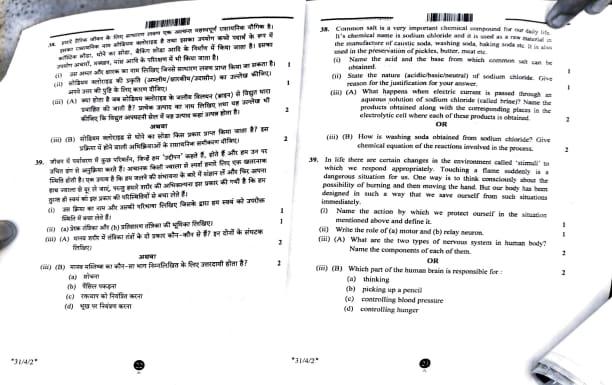
Common salt is a very important chemical compound for our daily life. It’s chemical name is sodium chloride and it is used as a raw material in the manufacture of caustic soda, washing soda, baking soda etc. It is also used in the preservation of pickles, butter, meat etc.
(i) Name the acid and the base from which common salt can be obtained.
(ii) State the nature (acidic/basic/neutral) of sodium chloride. Give reason for the justification for your answer.
(iii) (A) What happens when electric current is passed through an aqueous solution of sodium chloride (called brine)? Name the products obtained along with the corresponding places in the electrolytic cell where each of these products is obtained.
View Solution
(i) The acid and the base from which common salt (sodium chloride) is obtained are:
Acid: Hydrochloric acid (HCl)
Base: Sodium hydroxide (NaOH)
The reaction between hydrochloric acid and sodium hydroxide gives sodium chloride (NaCl) and water as products: \[ HCl + NaOH \rightarrow NaCl + H_2O \]
(ii) Sodium chloride (NaCl) is a neutral salt. This is because it is formed by the neutralization reaction between a strong acid (HCl) and a strong base (NaOH). Since both acid and base completely neutralize each other, the resultant salt is neutral in nature.
(iii) (A) When electric current is passed through an aqueous solution of sodium chloride (brine), the process is called electrolysis of brine. The products obtained are:
At the cathode, hydrogen gas (H\(_2\)) is produced.
At the anode, chlorine gas (Cl\(_2\)) is produced.
The reactions at each electrode are: \[ At cathode: 2H_2O + 2e^- \rightarrow H_2 + 2OH^- \] \[ At anode: 2Cl^- \rightarrow Cl_2 + 2e^- \] Quick Tip: The process of electrolysis of brine produces hydrogen, chlorine, and sodium hydroxide. The sodium hydroxide reacts with carbon dioxide to produce sodium carbonate, which is the precursor for washing soda.
How is washing soda obtained from sodium chloride? Give the chemical equations of the reactions involved in the process.
View Solution
Washing soda (\(Na_2CO_3 \cdot 10H_2O\)) is obtained from sodium chloride (\(NaCl\)) through the Solvay process. The process involves the following steps:
Formation of Sodium Bicarbonate:
In the Solvay process, sodium chloride (\(NaCl\)) reacts with ammonia (\(NH_3\)) and carbon dioxide (\(CO_2\)) in water to form sodium bicarbonate (\(NaHCO_3\)), which precipitates out.
\[ NaCl + NH_3 + CO_2 + H_2O \rightarrow NaHCO_3 + NH_4Cl \]
Conversion of Sodium Bicarbonate to Sodium Carbonate:
Sodium bicarbonate is heated to form sodium carbonate (\(Na_2CO_3\)).
\[ 2NaHCO_3 \xrightarrow{heat} Na_2CO_3 + CO_2 + H_2O \]
Formation of Washing Soda:
Sodium carbonate (\(Na_2CO_3\)) is dissolved in water and recrystallized to obtain washing soda (\(Na_2CO_3 \cdot 10H_2O\)).
\[ Na_2CO_3 + 10H_2O \rightarrow Na_2CO_3 \cdot 10H_2O \]
The final product, washing soda, is used in cleaning and water softening. Quick Tip: Washing soda is obtained from sodium chloride through the Solvay process, involving sodium bicarbonate precipitation, heating, and crystallization.
In life, there are certain changes in the environment called ‘stimuli’ to which we respond appropriately. Touching a flame suddenly is a dangerous situation for us. One way is to think consciously about the possibility of burning and then moving the hand. But our body has been designed in such a way that we save ourself from such situations immediately.
(i) Name the action by which we protect ourselves in the situation mentioned above and define it.
View Solution
The action by which we protect ourselves is called \textit{reflex action. Reflex action is an automatic and involuntary response to a stimulus. In the case of touching a hot object, the sensory neurons detect the heat and send signals to the spinal cord, which quickly sends a signal to the muscles to withdraw the hand, all without the need for conscious thought. Quick Tip: Reflex actions are fast and involuntary responses to stimuli, designed for immediate protection.
Write the role of (a) motor and (b) relay neuron.
View Solution
(a) Motor Neuron: The role of the motor neuron is to carry impulses from the central nervous system (CNS) to the muscles or glands, which then execute the appropriate response.
(b) Relay Neuron: Relay neurons, also known as interneurons, transmit impulses between sensory neurons and motor neurons in the central nervous system, facilitating communication within the body. Quick Tip: Motor neurons carry impulses to muscles, while relay neurons act as connectors between sensory and motor neurons.
What are the two types of nervous system in the human body? Name the components of each of them.
View Solution
The two types of nervous systems in the human body are:
1. Central Nervous System (CNS): Composed of the brain and spinal cord, the CNS processes and integrates information from the body and sends signals to the rest of the body.
2. Peripheral Nervous System (PNS): Composed of all the nerves that branch off the spinal cord and brain, the PNS connects the CNS to limbs and organs. Quick Tip: The CNS includes the brain and spinal cord, while the PNS includes all other nerves extending from the CNS.
Which part of the human brain is responsible for:
(a) thinking
(b) picking up a pencil
(c) controlling blood pressure
(d) controlling hunger
View Solution
(a) Thinking: The cerebrum is responsible for thinking, reasoning, and decision-making.
(b) Picking up a pencil: The motor cortex, located in the cerebrum, controls voluntary movements like picking up a pencil.
(c) Controlling blood pressure: The medulla oblongata controls autonomic functions like blood pressure.
(d) Controlling hunger: The hypothalamus is responsible for controlling hunger and other homeostatic functions. Quick Tip: The cerebrum handles higher functions like thinking, while the medulla and hypothalamus manage vital functions like blood pressure and hunger.
*The article might have information for the previous academic years, please refer the official website of the exam.