
CBSE Class 10 Science Question Paper 2025 Set 3 (31-6-3)- Download Solution PDF with Answer Key


Content Writer | Updated On - Oct 15, 2025
CBSE Class 10th Board Science exam question paper along with the solution PDF is available here to download in pdf form. The exam was conducted on 20th February 2025.
The CBSE 10th Board Science exam is divided into five sections, A, B, C, D, and E. The total marks for the A Section is 20. For B and C sections it is of 12 marks and 21 marks, respectively. The D and E sections is of 15 marks and 12 marks each. CBSE Class 10 Science Question Paper 2025 is total of 80 marks.
CBSE Class 10 Science Question Paper 2025 Set 3- (31-6-3) with Solutions
| CBSE Board Class 10 Science Question Paper with Answer Key | Download PDF | Check Solution |
Examples of thermal decomposition reactions are:
(i) \( 2 \, AgCl \rightarrow 2 \, Ag + Cl_2 \)
(ii) \( CaCO_3 \rightarrow CaO + CO_2 \)
(iii) \( 2 \, H_2O \rightarrow 2 \, H_2 + O_2 \)
(iv) \( 2 \, KClO_3 \rightarrow 2 \, KCl + 3 \, O_2 \)
View Solution
- Thermal decomposition reactions are processes where heat breaks down a compound into simpler substances.
- Reaction (ii) \( CaCO_3 \rightarrow CaO + CO_2 \) represents a typical example of a thermal decomposition reaction.
- Reaction (iv) \( 2 \, KClO_3 \rightarrow 2 \, KCl + 3 \, O_2 \) is also a thermal decomposition reaction.
Hence, the correct answer is (D). Quick Tip: In thermal decomposition reactions, a compound is broken down into simpler compounds or elements when heated.
You have three aqueous solutions A, B and C as given below:
A - Potassium nitrate
B - Ammonium chloride
C - Sodium carbonate
The ascending order of the pH of these solutions is:
View Solution
- Potassium nitrate (A) is a neutral salt and has a pH close to 7.
- Ammonium chloride (B) is an acidic salt, so its pH will be less than 7.
- Sodium carbonate (C) is a basic salt, so its pH will be greater than 7.
Thus, the correct order of pH is \( B < C < A \). Quick Tip: - Ammonium chloride produces an acidic solution in water. - Sodium carbonate produces a basic solution in water.
Which one of the following metals is protected from corrosion by a layer of its own oxide?
View Solution
- Aluminium forms a protective oxide layer (Al\(_2\)O\(_3\)) on its surface, shielding it from further corrosion.
- This oxide layer is highly stable and serves as a barrier, preventing further reactions with the environment.
Therefore, the correct answer is (A) Aluminium. Quick Tip: Metals like aluminium develop a protective oxide layer that prevents corrosion.
The colour of the solution observed after about 1 hour of placing iron nails in copper sulphate solution is:
View Solution
When iron nails are placed in copper sulphate solution, a **displacement reaction** occurs. In this reaction, iron (Fe) displaces copper (Cu) from its salt \(CuSO_4\) because iron is more reactive than copper.
The reaction is:
\[ Fe (s) + CuSO_4 (aq) \rightarrow FeSO_4 (aq) + Cu (s) \]
During this reaction, copper metal precipitates as a reddish-brown solid, while iron enters the solution as iron(II) sulphate. The colour change is caused by the formation of solid copper.
Thus, the correct answer is (D) Reddish brown. Quick Tip: In displacement reactions, a more reactive metal (iron) displaces a less reactive metal (copper) from its solution, resulting in a colour change.
A Hydrocarbon which does not belong to the same homologous series of carbon compounds is:
View Solution
Hydrocarbons are classified into homologous series such as alkanes, alkenes, and alkynes based on their molecular formulas and functional groups.
- Alkanes follow the general formula \( C_nH_{2n+2} \) (saturated hydrocarbons).
- Alkenes follow the formula \( C_nH_{2n} \) (unsaturated hydrocarbons with a double bond).
- Alkynes follow the formula \( C_nH_{2n-2} \) (unsaturated hydrocarbons with a triple bond).
- \( C_4H_{10} \) (Butane) fits the alkane formula.
- \( C_6H_{14} \) (Hexane) fits the alkane formula.
- \( C_{10}H_{22} \) (Decane) fits the alkane formula.
- However, \( C_7H_{14} \) does not strictly fit the alkane formula, indicating it could be part of a different homologous series.
Thus, the correct answer is (C) \( C_7H_{14} \). Quick Tip: The general formula for alkanes is \( C_nH_{2n+2} \), for alkenes is \( C_nH_{2n} \), and for alkynes is \( C_nH_{2n-2} \).
The water of crystallization is present in:
(i) Bleaching Powder
(ii) Plaster of Paris
(iii) Washing Soda
(iv) Baking Soda
View Solution
Water of crystallization refers to water molecules that are chemically bound in the crystal structure of salts. This water is integral to the crystalline structure.
- **Plaster of Paris** (Calcium sulphate hemihydrate, \( CaSO_4 \cdot ½H_2O \)) contains water of crystallization.
- **Washing Soda** (Sodium carbonate decahydrate, \( Na_2CO_3 \cdot 10H_2O \)) also contains water of crystallization.
- **Bleaching Powder** and **Baking Soda** do not contain water of crystallization.
Thus, the correct answer is (B) (ii) and (iii). Quick Tip: Water of crystallization is the water in the crystal lattice of certain salts, such as plaster of Paris and washing soda.
Juice of tamarind turns blue litmus to red. It is because of the presence of a chemical compound called:
View Solution
Tamarind juice is acidic, which is why it turns blue litmus paper red due to the presence of acids.
- **Tartaric acid**, a naturally occurring organic acid found in tamarind and other fruits, is the primary acid responsible for this reaction.
- Tartaric acid, like other acids, has the ability to change the colour of blue litmus paper to red.
Thus, the correct answer is (D) Tartaric acid. Quick Tip: Acidic substances like tartaric acid turn blue litmus paper red, indicating their acidic nature.
Electrical impulse travels in a neuron from:
View Solution
The sequence of electrical impulse travel in a neuron is as follows:
- The impulse is first received by the dendrites.
- Then, it moves to the cell body, where the nucleus is located.
- From the cell body, the signal travels down the axon to the nerve endings.
- Finally, the impulse is passed to the next neuron or muscle at the nerve endings.
Thus, the correct answer is (B) Dendrite \( \rightarrow \) Cell body \( \rightarrow \) Axon \( \rightarrow \) Nerve ending. Quick Tip: The impulse follows a fixed path: dendrite \( \rightarrow \) cell body \( \rightarrow \) axon \( \rightarrow \) nerve ending.
A tall pea plant with round seeds (TTRR) is crossed with a short pea plant with wrinkled seeds (ttrr). The \( F_1 \) generation will be:
View Solution
In this dihybrid cross involving pea plants, the genes responsible for plant height (T for tall, t for short) and seed shape (R for round, r for wrinkled) segregate independently.
The parental plants are:
- Tall with round seeds: TTRR
- Short with wrinkled seeds: ttrr
Upon applying the Punnett square for this cross:
- The tall parent (TTRR) produces gametes with the alleles TR.
- The short, wrinkled parent (ttrr) produces gametes with the alleles tr.
As a result, all offspring in the \( F_1 \) generation will inherit one dominant T allele for height and one dominant R allele for seed shape, resulting in 100% tall plants with round seeds.
Thus, the correct answer is (D) 100% tall with round seeds. Quick Tip: In dihybrid crosses, offspring inherit dominant traits if at least one dominant allele is present in each gene pair.
The basic filtration unit of the excretory system in human beings is:
View Solution
The nephron is the primary structural and functional unit in the kidney responsible for the filtration of blood. It filters the blood and removes waste products to form urine.
- The nephron comprises various components such as the glomerulus, Bowman's capsule, and renal tubules, which work collectively to filter blood and selectively reabsorb vital substances.
Thus, the correct answer is (A) Nephron. Quick Tip: Nephrons are key to the body's filtration system, helping to regulate water, salts, and waste products.
Which one of the following is not an excretory product in plants?
View Solution
Excretory products in plants refer to byproducts of metabolism that are no longer useful to the plant.
- \(CO_2\) is a waste product released during cellular respiration.
- Resins and gums are produced and excreted by plants as part of their defense mechanism.
- Dead cells are considered waste as they no longer contribute to the plant's functions.
However, starch is a form of energy storage, not an excretory product.
Thus, the correct answer is (B) Starch. Quick Tip: Excretory products in plants include gases like \(CO_2\), resins, gums, and dead cells, but starch is not an excretory product.
In human alimentary canal, the digestive juice secreted by the gastric glands are:
View Solution
The gastric glands in the stomach secrete digestive juices to aid in digestion:
- Hydrochloric acid (HCl) is secreted to create an acidic environment, which helps in the activation of the enzyme pepsin.
- Pepsin is an enzyme that breaks down proteins into smaller peptides.
- Mucus protects the stomach lining from damage due to the acidity and helps prevent ulcers.
Thus, the correct answer is (B) Hydrochloric acid, Pepsin, Mucus. Quick Tip: Gastric juices include hydrochloric acid for digestion, pepsin for protein breakdown, and mucus for protection against the acid.
The curvature of the eye lens of the human eye:
View Solution
The eye lens's curvature is adjustable. This ability to change the lens's curvature is controlled by the ciliary muscles. When these muscles contract or relax, they modify the shape of the lens to help focus light on the retina.
- The curvature is increased to focus on nearby objects and decreased to focus on distant objects.
Thus, the correct answer is (D) increases or decreases as the case may be. Quick Tip: The ciliary muscles allow the lens curvature to adjust, enabling the eye to focus on objects at varying distances.
Identify from the following the ray diagram which shows the correct path of the reflected ray for the ray incident on a concave mirror as shown:

View Solution
The incident ray strikes the concave mirror. According to the law of reflection, the angle of incidence equals the angle of reflection.
- The ray diagram corresponding to option (B) correctly shows the reflected ray following the law of reflection.
Thus, the correct answer is (B). Quick Tip: In concave mirrors, parallel rays reflect through the focal point, as shown in the ray diagram.
In the following groups of wastes, which group contains only non-biodegradable wastes?
View Solution
Non-biodegradable wastes are those that do not naturally decompose.
- Leather footwear, plastic plates, and polythene bags are examples of materials that do not decompose easily and remain in the environment for long periods.
- Biodegradable wastes, such as used tea leaves and cardboard, decompose naturally.
Thus, the correct answer is (A) Leather footwear, Plastic plate, Polythene bag. Quick Tip: Non-biodegradable wastes persist in the environment for a long time because they do not break down naturally.
Consider the following food chain:
Grass \( \rightarrow \) Grasshopper \( \rightarrow \) Frog \( \rightarrow \) Snake \( \rightarrow \) Eagle
If the amount of energy available at third trophic level is 50 kJ, the available energy at the producer level was:
View Solution
Energy is transferred through trophic levels with about 90% being lost at each level, and only about 10% is passed on.
- If 50 kJ of energy is available at the third trophic level (the snake), then at the second trophic level (the frog), the energy would be 500 kJ (10 times greater).
- At the producer level (grass), the energy would be 5000 kJ (10 times greater than at the second level).
Thus, the correct answer is (D) 5000 kJ. Quick Tip: At each level in a food chain, approximately 90% of energy is lost, and only 10% is transferred to the next level.
Assertion (A): Xylem tissue moves water and minerals obtained from the soil by the roots.
Reason (R): Xylem tissue is found only in the roots of a plant.
View Solution
Xylem tissue plays a crucial role in transporting water and minerals from the soil throughout the plant, including the leaves.
However, contrary to the Reason (R), xylem tissue is not confined to the roots; it extends through the stems and leaves as well.
Thus, Assertion (A) is correct, but Reason (R) is incorrect. Quick Tip: Xylem is found in all parts of a plant, including roots, stems, and leaves, where it helps in the transport of water and minerals.
Assertion (A): Carbon and its compounds are our major sources of fuels.
Reason (R): Most of the carbon compounds on burning release a large amount of heat and light.
View Solution
Carbon compounds like coal, petroleum, and natural gas serve as primary sources of energy.
Upon burning, these compounds release substantial energy in the form of heat and light, which makes them valuable as fuels.
Thus, both Assertion (A) and Reason (R) are correct, with Reason (R) explaining Assertion (A). Quick Tip: When carbon compounds burn, they release energy in the form of heat and light, making them important fuel sources.
Assertion (A): Food web is a network of several food chains operating in an ecosystem.
Reason (R): Food web decreases the stability of an ecosystem.
View Solution
A food web is an interconnected system of food chains within an ecosystem that facilitates energy transfer.
In fact, food webs enhance the stability of ecosystems by offering multiple pathways for energy transfer, making the system more resilient to disruptions.
Contrary to Reason (R), food webs actually stabilize ecosystems rather than decrease their stability.
Thus, Assertion (A) is true, but Reason (R) is false. Quick Tip: Food webs provide ecological stability by offering various energy pathways and making ecosystems more robust against changes.
Assertion (A): In the common domestic circuits, the earth wire is connected to a metallic plate buried deep inside the earth.
Reason (R): Earth wire ensures that any leakage of current to the metallic body of the appliance keeps its potential to that of the earth, so the user may not get a severe electric shock.
View Solution
The earth wire in domestic circuits is indeed connected to a metallic plate deep in the earth to ensure safety.
It provides a safe path for any leakage current to flow into the earth, preventing metal parts of appliances from becoming live and reducing the risk of electrical shocks.
Thus, both Assertion (A) and Reason (R) are true, with Reason (R) providing a correct explanation of Assertion (A). Quick Tip: The earth wire helps ensure safety by providing a path for leakage current to flow into the ground, preventing electric shocks.
Question 21:
Name a metal found in the earth's crust:
(i) in free state and
(ii) in the form of its compound.
State where each of these metals are placed in the reactivity series of metals.
View Solution
(i) In Free State: Gold (Au) is found in free state in the Earth's crust. It is one of the least reactive metals and is placed low in the reactivity series.
(ii) In Compound Form: Aluminium (Al) is found in the form of its compound, such as in bauxite. It is a highly reactive metal and is placed high in the reactivity series.
Thus, gold is placed low in the reactivity series, while aluminium is placed high in the reactivity series. Quick Tip: Metals found in free state are usually those that are least reactive, like gold, whereas metals in compound forms like aluminium are more reactive.
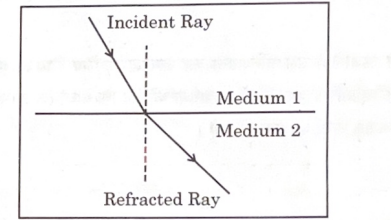
Study the figure in which the path of a ray of light going from Medium 1 to Medium 2 is shown:
Question 22:
Out of the two media - Medium 1 and Medium 2, in which is the speed of light more?
View Solution
The bending of light as it passes from one medium to another occurs due to a change in its speed. The ray bends away from the normal when it moves from a denser medium to a rarer one.
Since the ray bends away from the normal as it passes from Medium 1 (incident medium) to Medium 2 (refracted medium), this indicates that the speed of light in Medium 1 is greater than the speed of light in Medium 2. This is because light speeds up when moving into a less dense medium, bending away from the normal.
Thus, the speed of light is more in Medium 1. Quick Tip: When light moves from a denser medium to a rarer one, it speeds up and bends away from the normal.
(b) State the reason for the bending of the refracted ray away from the normal.
View Solution
The bending of light, also called refraction, occurs when light passes from one medium to another with a different refractive index. The light ray bends because its speed changes as it enters a new medium.
Since Medium 2 is denser than Medium 1, light slows down upon entering Medium 2. However, the refracted ray bends away from the normal, indicating that the speed of light in Medium 2 is slower than in Medium 1. This bending occurs as a result of the difference in refractive indices between the two media.
Thus, the light bends away from the normal because it is slowing down in the denser medium (Medium 2). Quick Tip: Refraction occurs when light travels from one medium to another, and the direction of bending depends on the speed of light in the media.
(c) Express the refractive index of Medium 2 with respect to Medium 1 in terms of the speed of light in both media.
View Solution
The refractive index \( n \) of a medium is defined as the ratio of the speed of light in a vacuum \( c \) to the speed of light in the medium \( v \): \[ n = \frac{c}{v} \]
where \( c \) is the speed of light in vacuum and \( v \) is the speed of light in the medium.
The refractive index of Medium 2 with respect to Medium 1 is given by: \[ n_{21} = \frac{v_1}{v_2} \]
where \( v_1 \) is the speed of light in Medium 1, and \( v_2 \) is the speed of light in Medium 2.
Thus, the refractive index of Medium 2 with respect to Medium 1 is \( n_{21} = \frac{v_1}{v_2} \). Quick Tip: The refractive index \( n \) is the ratio of the speed of light in a vacuum to the speed of light in the medium, and it determines how much light bends when passing through the medium.
(a) Give reasons:
(i) The sky appears dark to passengers flying at very high altitude.
View Solution
At high altitudes, the atmosphere becomes thinner, and there are fewer air molecules to scatter sunlight.
Scattering of light is what causes the blue color of the sky at ground level, but at higher altitudes, this scattering is much weaker, and thus, the sky appears dark.
Thus, the sky appears dark to passengers flying at very high altitude because there is less scattering of light. Quick Tip: The sky appears blue due to scattering of sunlight by air molecules. At high altitudes, there is less scattering, so the sky appears dark.
(a) (ii) 'Danger' signal lights are red in colour.
View Solution
Red light has the longest wavelength among all visible colors, which allows it to travel longer distances without scattering as much as other colors.
This makes red light more visible and noticeable even in poor visibility conditions, such as fog or rain, which is why it is used for danger signals.
Thus, danger signal lights are red because red light travels further and is more visible, especially in low visibility conditions. Quick Tip: Red light is used for danger signals because it has the longest wavelength and can be seen from a longer distance with minimal scattering.
(b) What is a rainbow? 'We see a rainbow in the sky only after the rainfall.' Why?
View Solution
A rainbow is a meteorological phenomenon caused by reflection, refraction, and dispersion of light, usually sunlight, in water droplets.
Rainbows are typically seen when there is sunlight and water droplets in the air, which is why they are seen after rainfall. The sunlight gets refracted as it enters the water droplet, reflects off the inside surface, and then refracts again as it exits, creating a spectrum of colors.
Thus, a rainbow is seen only after rainfall because water droplets in the air disperse sunlight into its constituent colors. Quick Tip: Rainbows are formed when sunlight is refracted and dispersed by water droplets in the air, creating a spectrum of colors.
(a) "Proteins control the expression of various characters." Explain this statement by taking an example of "tallness" as a characteristic in plants.
View Solution
In genetics, the expression of characteristics such as "tallness" in plants is controlled by specific genes, which are sections of DNA found in chromosomes. These genes code for proteins that directly influence the development and functioning of cells. These proteins regulate various biological processes, including growth.
Tallness in plants can be explained using the example of Mendelian inheritance. In pea plants, for example, tallness is governed by a dominant allele "T," while the allele for shortness is recessive, "t."
- The dominant allele "T" codes for a protein that promotes cell division and elongation, thus resulting in tall plants.
- The recessive allele "t" does not produce the same protein, resulting in shorter plants when inherited in a homozygous form (tt).
- When a plant inherits one "T" allele (from either parent), it produces enough of the protein to exhibit the tall phenotype.
Thus, proteins (encoded by genes) control the expression of tallness by regulating growth-related proteins in plants. Quick Tip: Proteins, encoded by genes, are the key regulators of various traits such as height, by influencing growth processes at the cellular level.
(b) Explain the mechanism of inheritance used by sexually reproducing organisms to ensure the stability of DNA of the species.
View Solution
(b) Inheritance and stability of DNA:
The mechanism of inheritance involves the transmission of genetic information from parents to offspring. In sexually reproducing organisms, this process begins with the formation of gametes (egg and sperm) through meiosis, a type of cell division that halves the chromosome number.
When the male and female gametes combine during fertilization, they form a zygote with a complete set of chromosomes, ensuring the stability of the species' DNA. This fertilized zygote contains genetic material from both parents, preserving genetic diversity while maintaining the integrity of the DNA.
The stability of the DNA is maintained by accurate DNA replication during cell division, ensuring that each new cell contains the correct genetic information. Additionally, sexual reproduction introduces genetic variation, which enhances the adaptability of the species over time, without altering the overall DNA structure.
Thus, the stability of DNA is maintained through the processes of meiosis, fertilization, and accurate DNA replication during cell division. Quick Tip: Sexual reproduction combines genetic material from two parents, ensuring stability and diversity in the DNA of offspring, while maintaining the integrity of the species' genetic code.
(a) How is the brain protected in our body?
View Solution
(a) Brain Protection:
The brain is one of the most vital organs in the body, and it is protected by several mechanisms:
- The skull, or cranium, is a strong bony structure that encases the brain and protects it from physical trauma and injury.
- The brain is surrounded by three layers of protective membranes called the meninges. These include the dura mater (outer layer), arachnoid mater (middle layer), and pia mater (inner layer).
- The cerebrospinal fluid (CSF), which fills the space between the arachnoid mater and pia mater, cushions the brain and absorbs shocks, preventing sudden movements from causing injury.
- Additionally, the blood-brain barrier protects the brain from harmful substances that may be carried in the blood.
Thus, the brain is protected by the skull, meninges, cerebrospinal fluid, and the blood-brain barrier. Quick Tip: The brain is protected by the skull, meninges, cerebrospinal fluid, and the blood-brain barrier to prevent injury and ensure proper functioning.
(b) A doctor finds in one of his patients that he is not maintaining a proper posture and balance of his body. State the region of brain and also the part of brain which is responsible for it.
View Solution
(b) Posture and Balance:
The cerebellum, a part of the brain located at the back of the skull, is primarily responsible for maintaining posture, balance, and coordinated movement. It processes sensory input from various body parts and helps regulate the coordination of voluntary movements.
The cerebellum receives signals from the inner ear (which detects changes in head position) and from the muscles and joints (which detect body position and movement). It then integrates this information and adjusts muscle activity to maintain balance and posture.
If there is a dysfunction in the cerebellum, a person may have difficulty maintaining balance, as the body loses the ability to coordinate movement properly.
Thus, the cerebellum is the part of the brain responsible for posture and balance. Quick Tip: The cerebellum is responsible for coordinating movement and maintaining balance by processing sensory input from the body and adjusting muscle activity.
Write the percentage of the energy of sunlight captured by green plants, to convert it into food energy. Explain the fate of this energy when green plants are eaten by primary consumers.
View Solution
Green plants, through the process of photosynthesis, capture a small portion of the energy from sunlight. Only about 1-2% of the total sunlight energy is used by plants to produce food through photosynthesis. This energy is stored in the form of glucose, starch, and other organic compounds.
When herbivores (primary consumers) eat plants, they obtain this stored energy. However, only about 10% of the energy stored in the plant is passed on to the herbivore, as energy is lost in the form of heat, respiration, and excretion during the process of consumption and digestion. The rest is used for metabolic functions, movement, and growth.
Thus, only a small fraction of the solar energy captured by plants is transferred to the herbivores. Quick Tip: Only about 1-2% of sunlight energy is captured by plants for photosynthesis, and when plants are eaten, about 10% of this energy is transferred to herbivores.
Section C
Explain why respiration is considered an exothermic reaction. Give the chemical equation for this reaction.
View Solution
Respiration is considered an exothermic reaction because it releases energy. During cellular respiration, glucose is broken down in the presence of oxygen to produce carbon dioxide, water, and energy. This energy is released in the form of ATP, which is used by cells for various functions such as growth, repair, and maintenance.
The chemical equation for aerobic respiration, which takes place in the presence of oxygen, is:
\[ C_6H_{12}O_6 (aq) + 6O_2 (g) \rightarrow 6CO_2 (g) + 6H_2O (l) + Energy \]
This equation shows that glucose and oxygen react to produce carbon dioxide, water, and energy.
Thus, respiration is considered an exothermic reaction because energy is released during the process. Quick Tip: Respiration is exothermic because it releases energy in the form of ATP, which is used for cell functions.
(a) State the chemical property in each case on which the following uses of baking soda are based upon:
(i) As an antacid
(ii) As a constituent in making baking powder
(iii) In soda-acid fire extinguishers
View Solution
(i) As an Antacid:
Baking soda (sodium bicarbonate, NaHCO₃) neutralizes excess acid in the stomach. When it reacts with hydrochloric acid (HCl), it forms sodium chloride (NaCl), water, and carbon dioxide, which relieves acidity: \[ NaHCO_3 (aq) + HCl (aq) \rightarrow NaCl (aq) + H_2O (l) + CO_2 (g) \]
(ii) As a Constituent in Making Baking Powder:
Baking soda is a key ingredient in baking powder. When baking soda reacts with an acid (such as tartaric acid or citric acid), it produces carbon dioxide gas. This gas helps dough rise by creating bubbles: \[ NaHCO_3 (aq) + H_2O (l) \rightarrow NaOH (aq) + CO_2 (g) \]
(iii) In Soda-Acid Fire Extinguishers:
In soda-acid fire extinguishers, baking soda reacts with sulfuric acid to produce carbon dioxide gas, which helps in extinguishing the fire by displacing oxygen: \[ NaHCO_3 (s) + H_2SO_4 (aq) \rightarrow Na_2SO_4 (aq) + CO_2 (g) + H_2O (l) \] Quick Tip: Baking soda works as an antacid, leavening agent, and in fire extinguishers by reacting with acids to produce carbon dioxide, which neutralizes acidity or displaces oxygen.
(b) Write chemical equations to show what happens when an acid reacts with a:
(i) Metal
(ii) Base
(iii) Carbonate
Write the name of the main product formed in each case.
View Solution
(i) Acid + Metal:
When an acid reacts with a metal, a salt and hydrogen gas are produced. For example, when hydrochloric acid (HCl) reacts with zinc (Zn), zinc chloride \((ZnCl_2)\) and hydrogen gas \((H_2)\) are formed: \[ Zn (s) + 2HCl (aq) \rightarrow ZnCl_2 (aq) + H_2 (g) \]
Main product: Zinc chloride and hydrogen gas.
(ii) Acid + Base:
When an acid reacts with a base, a salt and water are formed. For example, when hydrochloric acid (HCl) reacts with sodium hydroxide (NaOH), sodium chloride (NaCl) and water \((H_2O)\) are formed: \[ NaOH (aq) + HCl (aq) \rightarrow NaCl (aq) + H_2O (l) \]
Main product: Sodium chloride and water.
(iii) Acid + Carbonate:
When an acid reacts with a carbonate, a salt, water, and carbon dioxide gas are produced. For example, when hydrochloric acid (HCl) reacts with sodium carbonate \((Na₂CO_3)\), sodium chloride (NaCl), water, and carbon dioxide \((CO_2)\) are formed: \[ Na_2CO_3 (aq) + 2HCl (aq) \rightarrow 2NaCl (aq) + H_2O (l) + CO_2 (g) \]
Main product: Sodium chloride, water, and carbon dioxide. Quick Tip: Acids react with metals, bases, and carbonates to produce salts, water, and gases, each type of reaction yielding different products.
Question 29:
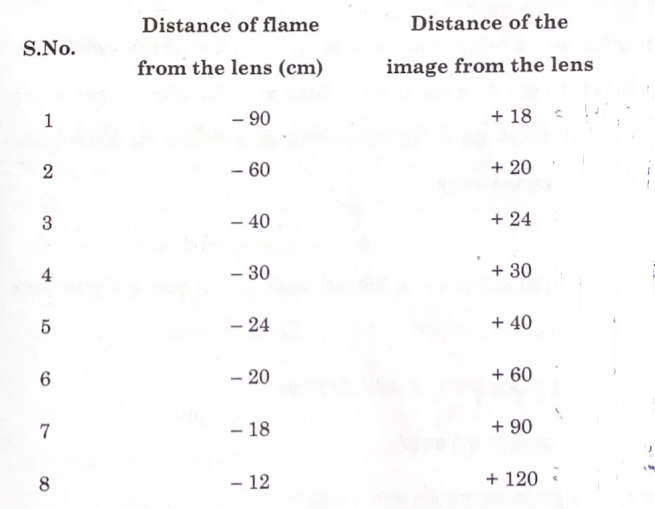
A student placed a candle flame at different distances from a convex lens and focused its image on a screen. He recorded his observation in tabular form as given below:
Question 29:
(a) What is the focal length of the convex lens used? Give reason to justify your answer.
View Solution
(a) Focal Length of the Convex Lens:
We will calculate the focal length using the lens formula:
\[ \frac{1}{f} = \frac{1}{v} - \frac{1}{u} \]
where:
- \( f \) is the focal length,
- \( v \) is the image distance,
- \( u \) is the object distance.
We will consider two observations to calculate the focal length.
Observation 1: Object distance \( u = -60 \, cm, \, v = +20 \, cm \)
Using the lens formula: \[ \frac{1}{f} = \frac{1}{v} - \frac{1}{u} = \frac{1}{20} - \frac{1}{-60} \]
\[ \frac{1}{f} = \frac{1}{20} + \frac{1}{60} = \frac{3}{60} = \frac{1}{20} \]
Thus, the focal length is: \[ f = 20 \, cm \]
Observation 2: Object distance \( u = -40 \, cm, \, v = +24 \, cm \)
Using the lens formula: \[ \frac{1}{f} = \frac{1}{v} - \frac{1}{u} = \frac{1}{24} - \frac{1}{-40} \]
\[ \frac{1}{f} = \frac{1}{24} + \frac{1}{40} = \frac{5}{120} = \frac{1}{24} \]
Thus, the focal length is: \[ f = 24 \, cm \]
The average of the focal lengths from the two observations is:
\[ f_{avg} = \frac{20 + 24}{2} = 22 \, cm \]
Thus, the focal length of the convex lens is approximately \( \boxed{22 \, cm} \). Quick Tip: The focal length of a convex lens is positive and can be calculated using the lens formula with object and image distances.
(b) Which one of the sets of observations is not correct and why?
View Solution
Let us analyze the data provided:
The object distances are all negative (since the object is placed on the left side of the lens), and the image distances are positive, indicating the formation of a real and inverted image.
We observe the following trend: As the object distance becomes smaller (i.e., as the object approaches the lens), the image distance increases. This is the expected behavior for a convex lens, where the image distance should increase as the object distance decreases.
The pattern follows the general trend, except for the following observation:
- When the object is at a distance of -24 cm, the image distance is +40 cm.
- However, when the object is at -20 cm, the image distance increases to +60 cm, which is expected.
Thus, the set where the object distance is -24 cm and the image distance is +40 cm does not align with the general rate of change between object and image distances.
Conclusion: The observation set with the object at -24 cm and the image at +40 cm is not correct because it does not follow the expected pattern of increasing image distance with decreasing object distance. Quick Tip: In convex lenses, as the object distance decreases, the image distance increases for real and inverted images.
Question 29:
(c) Draw Ray Diagram to show Image Formation for any correct set of observation.
View Solution
A ray diagram for a convex lens will show how light rays from the object (candle flame) pass through the lens and form an image on the screen. In this case, for object distances such as -60 cm and -40 cm, the rays converge on the other side of the lens to form a real and inverted image.
A ray diagram for any set of observations, such as when the object is placed at a distance of -60 cm from the lens, is as follows:
1. Draw a convex lens in the center.
2. Mark the focal point (F) on both sides of the lens.
3. Draw the object (the candle flame) to the left of the lens.
4. Draw two light rays from the object: one parallel to the principal axis, which refracts through the focal point on the opposite side, and the other passing through the center of the lens without bending.
5. The point where the refracted rays meet is where the image is formed on the screen. Quick Tip: In ray diagrams for convex lenses, parallel rays converge at the focal point on the opposite side of the lens, forming real and inverted images.
(a) "In human beings the genes inherited from the parents decide whether the newborn individual is male or female." Explain this statement with the help of a flow diagram.
View Solution
In humans, the sex of an individual is determined by the sex chromosomes inherited from the parents. Males have one X and one Y chromosome (XY), while females have two X chromosomes (XX).
The father can pass on either an X or a Y chromosome, while the mother can only pass on an X chromosome.
If the child inherits an X chromosome from both parents, the result is a female (XX).
If the child inherits an X chromosome from the mother and a Y chromosome from the father, the result is a male (XY).
Thus, the genes inherited from the parents (X and Y chromosomes) determine the sex of the child. Quick Tip: The combination of sex chromosomes (XX or XY) inherited from the parents determines the biological sex of the offspring.
(b) "Some animals rely on environmental cues for sex determination." Justify this statement giving an example.
View Solution
Some animals rely on environmental factors for sex determination. For example, in many species of reptiles such as certain turtles, the sex of the offspring is determined by the temperature at which the eggs are incubated.
- At higher temperatures, more females are produced.
- At lower temperatures, more males are produced.
Thus, in these species, the environmental temperature is the primary cue for sex determination. Quick Tip: Some species, like certain reptiles, use environmental factors such as temperature to determine the sex of their offspring.
Name the blood vessel that brings (i) oxygenated blood (ii) deoxygenated blood to the human heart. Also name that chamber of the heart which receives deoxygenated blood and state how deoxygenated blood from this chamber is sent to lungs for oxygenation.
View Solution
(i) Oxygenated Blood to the Heart:
The oxygenated blood is carried to the heart by the pulmonary veins, which bring oxygen-rich blood from the lungs to the left atrium of the heart.
(ii) Deoxygenated Blood to the Heart:
The deoxygenated blood is carried to the heart by the superior and inferior vena cavae, which bring oxygen-poor blood from the body to the right atrium of the heart.
The deoxygenated blood enters the right atrium.
From the right atrium, the blood is pumped into the right ventricle.
The right ventricle then pumps the deoxygenated blood through the pulmonary artery to the lungs for oxygenation.
Thus, deoxygenated blood from the right atrium is sent to the lungs for oxygenation through the pulmonary artery. Quick Tip: Deoxygenated blood enters the right atrium, then moves to the right ventricle, which pumps it to the lungs for oxygenation via the pulmonary artery. Oxygenated blood returns through the pulmonary veins to the left atrium.
A person uses lenses of power -0.5 D in his spectacles for the correction of his vision.
(a) Name the defect of vision the person is suffering from.
View Solution
The person is suffering from myopia (nearsightedness), which is corrected using concave lenses. In myopia, distant objects appear blurred, and the person requires a concave lens to diverge the light rays before they enter the eye, allowing the eye to focus correctly. Quick Tip: Myopia (nearsightedness) is corrected using concave lenses, which diverge light rays to focus images on the retina.
(b) List two causes of this defect.
View Solution
The two main causes of myopia are:
1. Excessive elongation of the eyeball: The eyeball is too long, so the light entering the eye focuses in front of the retina instead of on it.
2. Excessive curvature of the cornea: The cornea is too curved, causing light rays to focus before reaching the retina. Quick Tip: Myopia can be caused by an elongated eyeball or an overly curved cornea, both of which prevent light from focusing properly on the retina.
(c) Determine the focal length of the lenses used in the spectacles.
View Solution
The power of a lens is related to its focal length by the formula: \[ P = \frac{1}{f} \]
where \( P \) is the power of the lens and \( f \) is the focal length.
Given that the power of the lens is \( P = -0.5 \, D \), we can calculate the focal length as follows: \[ f = \frac{1}{P} = \frac{1}{-0.5} = -2 \, m \]
Thus, the focal length of the lens used in the spectacles is \( \boxed{-2 \, m} \). Quick Tip: The focal length of a concave lens is negative, and it is determined by the inverse of the lens power. For \( P = -0.5 \, D \), the focal length is \( f = -2 \, m \).
(a) Explain the statement "Potential difference between two points is 1 volt".
View Solution
The potential difference (also called voltage) between two points in an electric circuit is a measure of the work required to move a charge from one point to another in an electric field. The unit of potential difference is the volt (V), and it is defined as follows:
\[ 1 \, Volt = \frac{1 \, Joule}{1 \, Coulomb}. \]
This means that 1 volt is the potential difference that requires 1 joule of work to move 1 coulomb of charge from one point to another.
Step-by-Step Explanation:
1. Electric Field and Work Done:
In an electric field, a charged particle experiences a force. The amount of energy required to move a charge within this electric field is the work done. If we move a positive charge against the electric field, work is done on the charge.
2. Relationship between Work and Charge:
The potential difference between two points in an electric field is defined as the work done per unit charge to move a charge from one point to the other.
3. Mathematical Expression:
The potential difference \( V \) between two points can be expressed mathematically as:
\[ V = \frac{W}{Q} \]
where:
- \( V \) is the potential difference (measured in volts),
- \( W \) is the work done (measured in joules),
- \( Q \) is the charge (measured in coulombs).
4. Example:
If we move a charge of 1 coulomb and the work done in this process is 1 joule, the potential difference is 1 volt. This means that 1 volt is the potential difference between two points if 1 joule of energy is needed to move 1 coulomb of charge between those two points.
Thus, the statement "Potential difference between two points is 1 volt" means that 1 joule of work is required to move 1 coulomb of charge between two points. Quick Tip: The potential difference of 1 volt means 1 joule of work is needed to move 1 coulomb of charge between two points. It represents the energy per unit charge in an electric circuit.
(b) What do the symbols given below represent in an electric circuit? Write one function of each.

View Solution
In an electric circuit, several symbols are used to represent different components. Let us explain the two given symbols:
(i) Symbol of an Ammeter:
The first symbol represents an ammeter. The ammeter is a device used to measure the electric current flowing through a circuit.
Working of an Ammeter:
- An ammeter is connected in series with the circuit because the current remains the same through all series components.
- It measures the flow of charge (the current) in amperes (A).
- The ammeter is designed to have very low resistance, ideally zero, so that it does not interfere with the flow of current in the circuit.
Function of the Ammeter:
The function of an ammeter is to measure the amount of current flowing through a circuit. The reading is displayed on the ammeter in amperes (A).
(ii) Symbol of a Resistor:
The second symbol represents a resistor. A resistor is a passive component used in circuits to resist or limit the flow of electric current.
Working of a Resistor:
- A resistor works on the principle of Ohm's law, which states that the current \( I \) through a conductor between two points is directly proportional to the potential difference \( V \) across the two points and inversely proportional to the resistance \( R \). \[ V = IR \]
- The resistor converts electrical energy into heat and is used to control the amount of current in various parts of the circuit.
Function of the Resistor:
The main function of a resistor is to limit or control the current flowing through the circuit. Resistors are used in voltage dividers, current limiters, and to protect sensitive components from high currents. Quick Tip: An ammeter measures current in amperes and is connected in series, while a resistor controls the flow of current in a circuit and is connected in series or parallel as needed.
Section D
(a) What are magnetic field lines? How is the direction of magnetic field at a point determined? Draw the pattern of magnetic field lines of the magnetic field produced by a current-carrying circular loop. Mark on it the direction of (i) current and (ii) magnetic field lines. Name the two factors on which the magnitude of the magnetic field due to a current-carrying coil depends.
View Solution
Magnetic field lines are the imaginary lines used to represent the magnetic field in space. The field lines show the direction and the strength of the magnetic field. The direction of the magnetic field at any point is defined as the direction of the force that would act on a positive magnetic pole placed at that point.
Direction of Magnetic Field at a Point:
The direction of the magnetic field at a point is determined by the right-hand thumb rule. According to this rule:
- If you hold the current-carrying wire with your right hand such that your thumb points in the direction of the current, your fingers will curl around the wire in the direction of the magnetic field lines.
Magnetic Field due to a Current-Carrying Circular Loop:
When a current flows through a circular loop, it produces a magnetic field in the form of concentric circles around the wire. The magnetic field at the center of the loop is along the axis of the loop.
To draw the pattern of magnetic field lines:
- The magnetic field lines form concentric circles around the wire.
- The direction of the field lines is determined using the right-hand thumb rule.
In the center of the loop, the field lines are nearly straight and parallel to the axis of the loop. Quick Tip: The right-hand thumb rule helps determine the direction of magnetic field lines around a current-carrying wire. The magnetic field lines form concentric circles around the wire, with the field direction determined by the right hand rule.
(b) Why can't two magnetic field lines cross each other? Draw magnetic field lines showing the direction of the magnetic field due to a current-carrying long straight solenoid. State the conclusion which can be drawn from the pattern of magnetic field lines inside the solenoid. Name any two factors on which the magnitude of the magnetic field due to this solenoid depends.
View Solution
Two factors affecting the magnitude of the magnetic field due to a current-carrying coil:
1. Current (I): The magnetic field strength is directly proportional to the current flowing through the coil. An increase in current results in a stronger magnetic field.
2. Number of turns (N): The magnetic field strength is directly proportional to the number of turns in the coil. More turns result in a stronger magnetic field.
Two magnetic field lines cannot cross each other because if they did, it would mean that the magnetic field has two different directions at the same point, which is not possible. The magnetic field at any given point has a definite direction, and the field lines represent the path of the magnetic field in space.
Magnetic Field Due to a Current-Carrying Solenoid:
A solenoid is a long coil of wire that produces a uniform magnetic field inside. When a current flows through the solenoid, it generates a magnetic field with the following properties:
- The magnetic field inside the solenoid is strong and uniform.
- The field lines are parallel to each other and point in the same direction inside the solenoid.
- Outside the solenoid, the magnetic field lines form closed loops and resemble the field lines of a bar magnet.
Magnetic field lines inside the solenoid are straight and parallel, indicating a uniform magnetic field.
The direction of the magnetic field can be determined using the right-hand rule for solenoids:
- If you curl the fingers of your right hand in the direction of current flow in the solenoid, your thumb will point in the direction of the magnetic field inside the solenoid.
Conclusion:
From the pattern of magnetic field lines inside the solenoid, we can conclude that the solenoid creates a uniform magnetic field inside, similar to that of a bar magnet. The magnetic field outside the solenoid behaves like the field of a simple magnet, with field lines emerging from one end and curving around to the other.
Two Factors Affecting the Magnitude of the Magnetic Field in a Solenoid:
1. Current (I): The magnetic field strength is directly proportional to the current passing through the solenoid.
2. Number of turns per unit length (n): The magnetic field strength increases with the number of turns per unit length. More turns result in a stronger magnetic field.
Quick Tip: The magnetic field inside a solenoid is uniform and strong, resembling the field of a bar magnet. The strength of the field depends on the current and the number of turns per unit length of the solenoid.
(a) Name the method by which Amoeba and Leishmania reproduce. Write a major difference in the way they divide to produce new individuals.
View Solution
Amoeba and Leishmania both reproduce by binary fission, but the process in each is slightly different:
- Amoeba: In Amoeba, binary fission occurs by the simple process where the cell elongates, the nucleus divides, and the cell then splits into two genetically identical daughter cells. The process involves only the division of the nucleus, followed by the division of the cytoplasm.
- Leishmania: Leishmania, a protozoan parasite, also reproduces by binary fission. However, unlike Amoeba, Leishmania divides by longitudinal fission, where the parent cell elongates, and the nucleus divides into two, but the cytoplasm divides much later. In the process of division, the daughter cells often remain connected by a small thread of cytoplasm before separating completely.
Major Difference:
The key difference lies in the division of the cytoplasm:
- In Amoeba, cytoplasmic division happens simultaneously with nuclear division.
- In Leishmania, the cytoplasm divides later, and the daughter cells remain connected for a brief time. Quick Tip: Both Amoeba and Leishmania reproduce by binary fission, but in Leishmania, the division of cytoplasm is delayed compared to Amoeba.
(b) What is asexual reproduction? Explain the process of budding in Hydra.
View Solution
Asexual Reproduction is a form of reproduction where a single organism can produce offspring without the involvement of gametes. It is often done through processes like binary fission, budding, spore formation, and fragmentation.
Budding in Hydra:
- Hydra reproduces asexually by budding. In this process, a small outgrowth (bud) develops on the body of the parent organism.
- The bud is initially smaller than the parent and grows by the division of cells in the body of the parent.
- As it matures, the bud develops a mouth and tentacles, resembling a miniature version of the parent.
- Once the bud reaches full size, it detaches from the parent and becomes a separate individual. Quick Tip: Budding is a type of asexual reproduction where an organism produces a smaller outgrowth (bud) that detaches to become a new individual.
(c) Give two methods used to grow rose and jasmine plants by vegetative propagation.
View Solution
Vegetative Propagation is a method of asexual reproduction where new plants are grown from vegetative parts like roots, stems, and leaves, without the involvement of seeds.
Methods of Vegetative Propagation:
1. For Rose Plants:
- Cutting: A stem or branch is cut from a healthy rose plant and planted in the soil or water. Roots develop from the cutting, and a new rose plant grows.
2. For Jasmine Plants:
- Layering: A low branch of the jasmine plant is bent to the ground, and a part of it is buried in the soil. The buried part forms roots, and eventually, a new plant grows.
These methods are commonly used to propagate plants that have desirable traits. Quick Tip: Cutting and layering are common methods of vegetative propagation used for plants like rose and jasmine.
OR
(a) Write one function each of the parts - (i) petals (ii) anther (iii) style and (iv) ovary of a bisexual flower.
View Solution
In a bisexual flower, the different parts of the flower serve specific functions:
1. Petals: The petals attract pollinators such as bees, butterflies, and birds. Their bright color and fragrance help in the process of pollination.
2. Anther: The anther produces pollen, which contains male gametes (sperm cells). This pollen is transferred to the stigma for fertilization to occur.
3. Style: The style is the long tube that connects the stigma to the ovary. It provides a passage for the pollen tube to travel down to the ovary during fertilization.
4. Ovary: The ovary contains ovules, which are female gametes (eggs). After fertilization, the ovary develops into a fruit that contains the seeds. Quick Tip: Petals attract pollinators, anthers produce pollen, styles guide pollen to the ovary, and the ovary contains ovules that become seeds after fertilization.
(b) Give one example each of a unisexual flower and a bisexual flower. Mention the changes which a flower undergoes after fertilization.
View Solution
Unisexual Flower: A unisexual flower has only one sex organ, either male or female.
- Example: The male flower of corn (maize) produces only pollen (male gametes).
Bisexual Flower: A bisexual flower has both male and female reproductive organs.
- Example: A rose is a bisexual flower, as it contains both stamens (male part) and pistils (female part).
Changes After Fertilization:
1. After fertilization, the ovule in a bisexual flower develops into a seed, and the ovary develops into a fruit.
2. The petals and other non-reproductive parts of the flower usually fall off after fertilization.
Quick Tip: Unisexual flowers have only one reproductive organ, while bisexual flowers have both male and female organs. After fertilization, the ovule becomes a seed and the ovary becomes a fruit.
(a) Name an alcohol and a carboxylic acid having two carbon atoms in their structures. Draw their structures and state how this alcohol can be converted into a carboxylic acid. What happens when these two compounds react in the presence of an acid? Write chemical equations for the reactions involved in the two cases mentioned above.
View Solution
Let us consider ethanol (C\(_2\)H\(_5\)OH) as the alcohol and acetic acid (CH\(_3\)COOH) as the carboxylic acid. Both of these compounds contain two carbon atoms.
- Ethanol (C\(_2\)H\(_5\)OH):
Ethanol is a simple alcohol. Its structure is shown below:
\[ CH_3CH_2OH \]
- Acetic Acid (CH\(_3\)COOH):
Acetic acid is a carboxylic acid with two carbon atoms. Its structure is shown below:
\[ CH_3COOH \]
Conversion of Ethanol to Acetic Acid:
When ethanol is oxidized in the presence of an oxidizing agent like potassium dichromate (K\(_2\)Cr\(_2\)O\(_7\)) or oxygen (O\(_2\)), it is converted into acetic acid.
\[ CH_3CH_2OH \xrightarrow{Oxidizing Agent} CH_3COOH \]
Reaction Between Ethanol and Acetic Acid in Presence of Acid (Esterification):
When ethanol and acetic acid react in the presence of an acid catalyst (such as sulfuric acid), they undergo an esterification reaction to form ethyl acetate and water.
The reaction is as follows:
\[ CH_3CH_2OH + CH_3COOH \xrightarrow{H^+} CH_3COOCH_2CH_3 + H_2O \]
Here, ethyl acetate (CH\(_3\)COOCH\(_2\)CH\(_3\)) is the ester formed, and water is a byproduct. Quick Tip: Ethanol is oxidized to acetic acid in the presence of an oxidizing agent. In esterification, ethanol and acetic acid react with an acid catalyst to form an ester and water.
(b) What are soaps? Write the structure of a soap molecule. Explain the cleansing action of a soap. Why are soaps not considered suitable for washing clothes in a region where water is hard? How is this problem overcome?
View Solution
Soaps are sodium or potassium salts of fatty acids. These fatty acids are long-chain carboxylic acids, and soaps are formed by the reaction of these acids with an alkali like sodium hydroxide (NaOH) or potassium hydroxide (KOH).
Structure of a Soap Molecule:
The general structure of a soap molecule is shown below:
\[ CH_3(CH_2)_{14}COONa \]
- The long hydrocarbon chain (CH\(_3\)(CH\(_2\))\(_{14}\)) is hydrophobic (repellent to water).
- The carboxylate group (COONa) is hydrophilic (water-attracting).
Cleansing Action of Soap:
Soaps work by emulsifying oils and grease. The hydrophobic tail of the soap molecule interacts with non-polar substances like oil or grease, while the hydrophilic head interacts with water. This results in the formation of micelles, where the oils or grease are trapped in the center of the soap molecules, which are then rinsed away by water.
Soap molecules surround and dissolve the grease or oil particles by forming micelles.
The hydrophilic heads of soap molecules interact with water, causing the micelles to be washed away.
Problem of Soaps in Hard Water:
Soaps do not work efficiently in hard water because hard water contains a high concentration of calcium (Ca\(^{2+}\)) and magnesium (Mg\(^{2+}\)) ions. These ions react with the soap molecules to form insoluble salts (soap scum), which do not dissolve in water and thus reduce the effectiveness of soap in cleaning.
Overcoming the Problem:
This problem is overcome by using synthetic detergents. Detergents are soap-like substances that work efficiently in hard water because they do not form insoluble salts with calcium or magnesium ions. Quick Tip: Soaps are effective in soft water, but in hard water, they form soap scum. Synthetic detergents are used in hard water as they do not form insoluble salts.
Section E
Many pure metals like copper, iron and gold are very soft and as such are considered unsuitable for certain uses. Metallic objects around us such as cooking utensils, statues, ornaments, guns etc. are actually not made up of pure metals. Instead of pure metals, alloys are used in the design of most of the useful objects. Making alloys enhances the basic properties of a metal which is the primary constituent (metal) of an alloy.
Question 37:
(I) How does electrical conductivity and melting point of a metal change when it is converted to its alloy by mixing a small amount of an element in it?
View Solution
When a metal is converted into its alloy by mixing a small amount of another element, its electrical conductivity and melting point typically change in the following ways:
1. Electrical Conductivity: The electrical conductivity of a metal generally decreases when it forms an alloy. This is because the addition of another element disturbs the regular arrangement of atoms in the metal, making it harder for electrons to flow freely.
- In pure metals, free electrons move easily, providing good electrical conductivity. However, in alloys, the foreign atoms act as obstacles to the flow of electrons, reducing conductivity.
2. Melting Point: The melting point of a metal is often lowered when it is converted into an alloy. The presence of a second element disrupts the uniformity of the metal’s crystal lattice, making it easier for the alloy to melt compared to the pure metal.
For example, the addition of zinc to copper to form brass reduces the melting point and decreases electrical conductivity. Quick Tip: Alloying generally reduces the electrical conductivity and the melting point of a metal. The change depends on the type and amount of the alloying element.
(II) Name an alloy used for welding two wires together in an electric circuit. Write its major constituents.
View Solution
An alloy used for welding two wires together in an electric circuit is solder. It is commonly used for joining electrical components.
Major Constituents of Solder:
- Tin (Sn): 60-70%
- Lead (Pb): 30-40%
This alloy has a relatively low melting point, making it easy to use for soldering electrical wires together. However, modern solders often use other elements like silver to reduce toxicity and improve strength. Quick Tip: Solder is an alloy of tin and lead used for joining electrical components. It has a low melting point, which makes it ideal for welding wires.
(III) (a) What are alloys? How is 'Brass' (an alloy) prepared?
View Solution
Alloys are homogeneous mixtures composed of two or more metals or a metal and a non-metal. The purpose of making alloys is to enhance the properties of the metal, such as increasing strength, corrosion resistance, or altering melting points.
Preparation of Brass:
Brass is an alloy of copper (Cu) and zinc (Zn). It is prepared by melting copper and then adding zinc to it. The amount of zinc can vary, but typically, brass contains around 60-70% copper and 30-40% zinc.
Properties of Brass:
- It is stronger and more durable than copper.
- It has better resistance to corrosion.
- It is more easily worked into shapes than pure copper.
Quick Tip: Brass is an alloy of copper and zinc, and it is prepared by melting copper and adding zinc. It is used for its strength and resistance to corrosion.
(III) (b) What is stainless steel? How is it prepared? Write one important property which makes it more useful in making cooking utensils as compared to its primary metal.
View Solution
Stainless Steel is an alloy made primarily of iron (Fe), chromium (Cr), and small amounts of other elements like nickel (Ni) and molybdenum (Mo). The chromium content gives stainless steel its resistance to corrosion, making it highly durable and suitable for various applications, including cooking utensils.
Preparation of Stainless Steel:
Stainless steel is prepared by melting iron and adding chromium to it. Depending on the type of stainless steel, nickel and other elements may also be added. The alloy is then processed into sheets, rods, or other forms.
Important Property of Stainless Steel:
One of the most important properties of stainless steel that makes it suitable for cooking utensils is its corrosion resistance. The chromium in stainless steel forms a thin, protective oxide layer on the surface that prevents rusting and corrosion, even when exposed to water and air. Quick Tip: Stainless steel, made of iron and chromium, is highly resistant to corrosion. This makes it ideal for use in cooking utensils, where durability and resistance to rust are important.
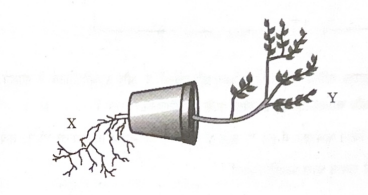
The growth movements of plant parts in which the direction of the stimulus determines the direction of the response is known as tropic movements or tropism. Plants also have non-directional movements which may not be growth dependent.
Question 38:
(I) Name the movement which causes 'X' and 'Y' to grow downwards and upwards respectively.
View Solution
The movement which causes 'X' (roots) to grow downwards is known as geotropism (or gravitropism), which is the growth of plant parts in response to gravity. In this case, the roots grow downwards due to gravity.
The movement which causes 'Y' (stem) to grow upwards is known as phototropism, which is the growth of plant parts in response to light. In this case, the stem grows upwards towards the light source. Quick Tip: - Geotropism is responsible for downward growth of roots. - Phototropism is responsible for upward growth of stems towards light.
(II) Write the name of a hormone that plays a major role in (i) falling of leaves (ii) rapid cell division.
View Solution
The following plant hormones are involved in the processes mentioned:
1. Falling of leaves (abscission): The hormone responsible for the falling of leaves is Abscisic acid (ABA). It plays a significant role in promoting leaf senescence and abscission, which leads to the leaves falling from the plant.
2. Rapid cell division: The hormone responsible for rapid cell division, particularly during growth phases, is Cytokinin. Cytokinins promote cell division and play a role in delaying leaf senescence. Quick Tip: - Abscisic acid (ABA) regulates leaf abscission. - Cytokinin promotes cell division and growth.
Question 38:
(III) (a) Leaves of the sensitive plant move very quickly in response to 'touch'. How is this stimulus of touch communicated and explain how the movement takes place.
View Solution
The sensitive plant, Mimosa pudica, exhibits rapid movement of its leaves in response to touch. This movement is known as thigmotropism, which is the plant's response to mechanical stimuli.
Communication of the Touch Stimulus:
1. When the plant's leaves are touched, it triggers a change in turgor pressure in the cells of the leaf. This is caused by the movement of water out of the vacuoles in certain cells of the leaf.
2. The change in turgor pressure leads to the folding of the leaflets. The rapid movement occurs because the plant cells respond to the mechanical stimulus through changes in ion concentration and water movement.
3. This response is an adaptation to protect the plant from herbivores. The quick movement of leaves makes the plant appear less palatable to herbivores or insects. Quick Tip: Thigmotropism is the plant's response to touch. Rapid movement occurs due to changes in turgor pressure and water movement in response to mechanical stimuli.
(III) (b) Name the plant hormone which is synthesized at the shoot tip. How does this hormone help the plant to bend towards light?
View Solution
The plant hormone that is synthesized at the shoot tip is Auxin.
Role of Auxin in Bending Towards Light:
- Auxin is a growth hormone that is responsible for phototropism (growth in response to light). When light shines on one side of a plant, auxin accumulates on the shaded side of the plant.
- The increased concentration of auxin on the shaded side promotes cell elongation, causing the cells on that side to grow longer than those on the lighted side.
- This differential growth results in the bending of the plant towards the light source.
Quick Tip: Auxin accumulates on the shaded side of a plant, causing cells to elongate and bend the plant towards light (phototropism).
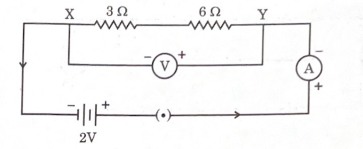
Study the circuit shown in which two resistors X and Y of resistances 3 Ω and 6 Ω respectively are joined in series, with a battery of 2 V
Question 39:
(I) Draw a circuit diagram showing the above two resistors X and Y joined in parallel with the same battery and same ammeter and voltmeter.
View Solution
the parallel combination where the resistors are in parallel with each other, and the
battery is connected across them, with the ammeter and voltmeter placed.
(II) In which combination of resistors will the (i) potential difference across X and Y and (ii) current through X and Y, be the same?
View Solution
In the case of parallel combination:
- Potential Difference Across X and Y: In parallel, the potential difference across both resistors X and Y will be the same because both resistors are connected across the same battery.
Therefore, the potential difference across X and Y is the same in a parallel combination.
- Current Through X and Y: In a parallel combination, the total current supplied by the battery divides between the two resistors. However, the current through each resistor will not be the same unless their resistances are equal.
In the case of series combination:
- The same current flows through both X and Y as they are connected in series.
- However, the potential difference across each resistor will be different due to the difference in their resistances. Quick Tip: In parallel combination, the potential difference across each resistor is the same. In series combination, the current through each resistor is the same.
(III) (a) Find the current drawn from the battery by the series combination of the two resistors (X and Y).
View Solution
To find the current drawn from the battery when the resistors are connected in series, we first calculate the total resistance of the series combination.
\[ R_{total} = R_X + R_Y = 3 \, \Omega + 6 \, \Omega = 9 \, \Omega \]
Now, we use Ohm's law to find the current drawn from the battery:
\[ I = \frac{V}{R_{total}} = \frac{2 \, V}{9 \, \Omega} = 0.222 \, A \]
Therefore, the current drawn from the battery by the series combination is 0.222 A. Quick Tip: In a series circuit, the total resistance is the sum of the individual resistances. The current is given by \( I = \frac{V}{R_{total}} \).
(III) (b) Determine the equivalent resistance of the parallel combination of the two resistors (X and Y).
View Solution
To calculate the equivalent resistance of the parallel combination of resistors X and Y, we use the formula for parallel resistors:
\[ \frac{1}{R_{eq}} = \frac{1}{R_X} + \frac{1}{R_Y} \]
Substituting the given values:
\[ \frac{1}{R_{eq}} = \frac{1}{3 \, \Omega} + \frac{1}{6 \, \Omega} = \frac{2}{6} + \frac{1}{6} = \frac{3}{6} = \frac{1}{2} \]
Thus, the equivalent resistance is:
\[ R_{eq} = 2 \, \Omega \] Quick Tip: For parallel resistors, the reciprocal of the equivalent resistance is the sum of the reciprocals of the individual resistances: \( \frac{1}{R_{eq}} = \frac{1}{R_1} + \frac{1}{R_2} \).


*The article might have information for the previous academic years, please refer the official website of the exam.