
CBSE Class 10 2025 Social Science Question Paper with Solution (Set 2 - 32/4/2)


| Updated On - Feb 10, 2026
CBSE 2025 Class 10th Board Social Science exam was held on February 25, 2025. The CBSE Class 10 Social Science exam is worth 80 marks, with an extra 20 Marks for internal assessment. The question paper contains MCQs, short and long answers that test students' knowledge.
The CBSE Class 10th Social Science Examination question paper and solution PDF is available for download here.
CBSE Class 10 2025 Social Science Question Paper (Set 2 - 32/4/2) With Solutions PDF
| CBSE Class 10 Social Science Question Paper With Solutions | Download PDF | Check Solutions |
Read the following developmental goals and choose correct option of goals related to a student studying in university.
(i) Good opportunities for research.
(ii) Opportunities to pursue higher education abroad.
(iii) Opportunities for independence.
(iv) Opportunities for good employment.
View Solution
Step 1: Developmental goals for a university student primarily revolve around their academic progress and future career prospects.
Step 2: Goal (i), good research opportunities, is a key academic objective within a university setting.
Step 3: Goal (ii), pursuing higher education abroad, is a common and significant goal related to academic and personal advancement.
Step 4: Goal (iv), opportunities for good employment, is a primary outcome expected from a university education.
Step 5: Goal (iii), opportunities for independence, is a general life goal but is often a consequence of achieving other goals like good employment, rather than a direct developmental goal of the university experience itself.
Step 6: Therefore, the most relevant goals directly associated with a university student's development are (i), (ii), and (iv).
Step 7: Option (C) correctly combines these three goals.
Quick Tip: When analyzing developmental goals, focus on the specific context provided. For a student, academic and career-related goals are the most direct and relevant. General life goals are often secondary or resultant.
The growth of digital technology has greatly influenced globalization. Which of the following is its main benefit ?
View Solution
Step 1: Globalization is the process of interaction and integration among people, companies, and governments worldwide.
Step 2: Digital technology, like the internet, has been a major catalyst for globalization.
Step 3: Let's evaluate the options. Digital technology has drastically decreased communication costs, making (A) incorrect.
Step 4: It has vastly increased, not limited, access to information, making (B) incorrect.
Step 5: It has made transactions faster, not slower, making (D) incorrect.
Step 6: The core function of digital technology in this context is to connect people and markets across geographical boundaries instantly. This is best described as 'Enhanced Connectivity'.
Quick Tip: Globalization is fundamentally about increased interconnectedness. Technology that facilitates communication and the movement of information, goods, and capital is a driver of globalization. 'Connectivity' is a keyword for this process.
Read the following sources of loan carefully and choose the correct option related to formal sources of credit.
(i) Commercial Bank
(ii) Landlords
(iii) Government
(iv) Money Lender
View Solution
Step 1: Formal sources of credit are those that are supervised by the Reserve Bank of India (RBI) or another government body. Informal sources are not regulated.
Step 2: (i) Commercial Banks are regulated by the RBI. Thus, they are a formal source.
Step 3: (ii) Landlords are private individuals not registered or regulated as lenders. Thus, they are an informal source.
Step 4: (iii) The Government and its cooperative societies are part of the formal lending structure. Thus, they are a formal source.
Step 5: (iv) Money Lenders are private individuals who operate outside the formal banking system. Thus, they are an informal source.
Step 6: The formal sources listed are (i) Commercial Bank and (iii) Government.
Step 7: Option (A) correctly identifies both (i) and (iii).
Quick Tip: Remember the key distinction: Formal sector loans come from banks and cooperatives (supervised by RBI), while informal sector loans come from moneylenders, traders, employers, relatives, and friends (unsupervised).
Choose the correct option to fill the blank :

View Solution
Step 1: The economy is classified into Primary, Secondary, and Tertiary sectors based on the type of economic activity performed.
Step 2: The Primary sector involves activities that directly use natural resources (e.g., agriculture).
Step 3: The Secondary sector involves activities that transform natural products into other forms through manufacturing (e.g., factories).
Step 4: The Tertiary sector involves activities that provide services (e.g., transport, banking).
Step 5: The common basis for this classification is the nature of the work or activity involved in producing goods or services.
Step 6: This is best described as the 'Nature of production activities'. Option (C) is the correct choice.
Quick Tip: Always link the economic classifications to their basis. Primary/Secondary/Tertiary is about WHAT is being produced (raw materials/goods/services). Organized/Unorganized is about HOW people are employed (job security/rules).
Choose the odd one out from the following options regarding the sectors of economy :
View Solution
Step 1: The task is to find the group of professions that is different from the others based on economic sector classification.
Step 2: Analyze the sectors for each profession in the options.
Step 3: Option (A): Pilot (Tertiary), Driver (Tertiary), Gardener (Primary). This is a mix of sectors.
Step 4: Option (B): Fisherman (Primary), Teacher (Tertiary), Lawyer (Tertiary). This is a mix of sectors.
Step 5: Option (C): Engineer (Secondary/Tertiary), Professor (Tertiary), Farmer (Primary). This is a mix of sectors.
Step 6: Option (D): Doctor (Tertiary), Teacher (Tertiary), Lawyer (Tertiary). All professions in this group belong to the Tertiary sector.
Step 7: Options (A), (B), and (C) are all heterogeneous groups containing professions from at least two different sectors. Option (D) is a homogeneous group with all professions from a single sector.
Step 8: Therefore, (D) is the odd one out.
Quick Tip: In 'odd one out' questions, look for a single, consistent classification rule. Here, the rule is the economic sector. Three options mix sectors, while one does not.
The World Bank's development report is prepared on the basis of which of the following :
View Solution
Step 1: The question asks for the primary criterion used by the World Bank in its development reports to compare countries.
Step 2: The World Bank's main criterion for classifying countries is Gross National Income (GNI) per capita.
Step 3: This measure allows the World Bank to categorize countries into high-income, upper-middle-income, lower-middle-income, and low-income economies.
Step 4: 'Per Capita Income' is the term in the options that corresponds to this criterion.
Step 5: While Health Services and Literacy are important development indicators, they are the central components of the Human Development Index (HDI) published by the UNDP, not the primary classification tool for the World Bank.
Quick Tip: Distinguish between the reports of major international bodies. World Bank's World Development Report primarily uses Income (GNI per capita). UNDP's Human Development Report uses the HDI (income, health, and education).
Read the table given below carefully and answer the question that follow :
Which of the following countries has high per capita income, life expectancy at birth and high rank in human development index?

View Solution
Step 1: The question requires us to identify the country that performs best across three indicators: per capita income, life expectancy, and HDI rank.
Step 2: A 'high rank' in the HDI means a lower numerical value (e.g., rank 73 is higher than rank 132).
Step 3: Compare the data for the countries listed in the options.
Step 4: Country A: GNI per capita =
(12,578, Life Expectancy = 76.4 years, HDI Rank = 73.
Step 5: Country C: GNI per capita =
)3,851, Life Expectancy = 65.7 years, HDI Rank = 149.
Step 6: Country E: GNI per capita =
(3,877, Life Expectancy = 68.4 years, HDI Rank = 143.
Step 7: Country F: GNI per capita =
)5,472, Life Expectancy = 72.4 years, HDI Rank = 129.
Step 8: By comparing these values, Country A has the highest per capita income, the highest life expectancy, and the highest HDI rank (lowest number) among all the countries shown in the table.
Step 9: Therefore, Country A is the correct answer.
Quick Tip: When interpreting HDI ranks, remember that a lower number signifies a higher rank and better human development. Rank 1 is the best, rank 189 is the lowest.
In which year the Constitution amendment providing for 33% representation of women in the local self governance system in India was made? Choose the correct option :
View Solution
Step 1: The question asks for the year of the constitutional amendment that mandated representation for women in local self-governance bodies.
Step 2: This provision was introduced by the 73rd and 74th Constitutional Amendment Acts.
Step 3: The 73rd Amendment Act deals with rural local bodies (Panchayats), and the 74th Amendment Act deals with urban local bodies (Municipalities).
Step 4: Both of these landmark amendments were passed by the Parliament of India in the year 1992.
Step 5: These acts came into force in 1993, but the amendments were made in 1992.
Step 6: Therefore, the correct year is 1992.
Quick Tip: Associate the 73rd and 74th Amendments with Panchayati Raj and Municipalities, respectively. Both were passed in 1992 and are foundational to decentralized governance and women's political representation in India.
In a democratic country the government adopts environment friendly policies with the help of citizens and experts. Which one of the following is a positive outcome of this process ?
View Solution
Step 1: The question describes a democratic process where policies are made with the involvement of citizens and experts. We need to identify a positive outcome of this specific process.
Step 2: The key phrase is "with the help of citizens and experts". This points towards participatory governance.
Step 3: Option (A) suggests the government acts alone, which contradicts the premise.
Step 4: Option (C) and (D) mention the influence of corporate and market interests, which are often seen as pressures on democratic policy-making, not necessarily positive outcomes of citizen participation.
Step 5: Option (B) states that citizens feel empowered. When citizens are included in the policy-making process, it enhances their sense of agency and involvement in governance, which is a core positive outcome of democratic participation.
Step 6: Therefore, citizen empowerment is the most direct positive outcome of the described process.
Quick Tip: Democracy is not just about voting. It is also about citizen participation in decision-making. Any process that involves citizens (consultations, public hearings, etc.) aims to increase accountability, legitimacy, and citizen empowerment.
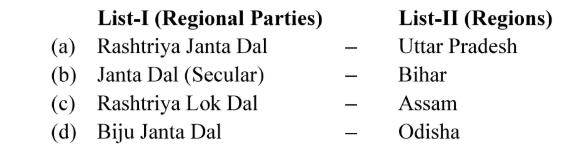
Which one of the following pairs is correctly matched ?
View Solution
Step 1: The question requires matching regional political parties with their primary state of influence.
Step 2: Evaluate option (a): Rashtriya Janata Dal (RJD) is a major political party primarily based in Bihar, not Uttar Pradesh. So, (a) is incorrect.
Step 3: Evaluate option (b): Janata Dal (Secular) [JD(S)] has its main political base in Karnataka, not Bihar. So, (b) is incorrect.
Step 4: Evaluate option (c): Rashtriya Lok Dal (RLD) has its influence concentrated in Western Uttar Pradesh, not Assam. So, (c) is incorrect.
Step 5: Evaluate option (d): Biju Janata Dal (BJD) is the ruling regional party of Odisha, named after its founder's father, Biju Patnaik, a former chief minister of the state. This match is correct.
Quick Tip: For questions on political parties, it's helpful to remember the main states of influence for major national and regional parties. Associating the party name with a key leader or state (e.g., Biju Patnaik -> Odisha) can be a useful memory aid.
Which of the following is an example of horizontal power sharing in Indian democracy ?
View Solution
Step 1: Understand the concept of horizontal power sharing. It refers to the distribution of power among different organs of the government placed at the same level.
Step 2: These organs can check and balance each other's power, ensuring that no single organ becomes too powerful. This is the principle of 'checks and balances'.
Step 3: Evaluate the options. (A) Division of power between Central and State Governments is an example of vertical power sharing, as it involves different levels of government.
Step 4: (B) Division of power between Rural and Urban Governments is also a form of vertical (or tiered) power sharing.
Step 5: (C) The Army is part of the Executive and not a separate organ in the power-sharing arrangement, making this option incorrect.
Step 6: (D) The Legislative (makes laws), Executive (implements laws), and Judiciary (interprets laws) are the three organs of government at the same level. Their power division is the classic example of horizontal power sharing.
Quick Tip: Remember the difference: Horizontal sharing is among organs at the same level (Legislative, Executive, Judiciary). Vertical sharing is among different levels of government (Central, State, Local).
How does the Indian federal structure promote balance governance across the nation? Choose the most suitable option from the following :
View Solution
Step 1: The core principle of a federal structure is the division of powers between different levels of government.
Step 2: Balanced governance in a large, diverse country like India requires that neither the central government becomes all-powerful (unitary system) nor the states become completely independent.
Step 3: Option (A) is incorrect. States do not have complete autonomy; subjects are divided into Union, State, and Concurrent lists.
Step 4: Option (C) describes a unitary system, which is the opposite of federalism. So, it is incorrect.
Step 5: Option (D) is incorrect. In India's federal structure, states have more powers than local governments.
Step 6: Option (B) correctly identifies the key mechanism of federalism for balanced governance: a clear division of legislative and administrative powers between the central and state governments, as laid out in the Constitution. This prevents the concentration of power and allows for regional issues to be handled at the state level.
Quick Tip: Federalism is synonymous with the division of power between central and regional governments. The goal is to achieve a balance that maintains national unity while respecting regional diversity.
Two statements are given below. They are Assertion (A) and Reason (R). Read both the statements and choose the correct option :
Assertion (A): The French speaking community was rich in comparison to Dutch speaking community in Belgium.
Reason (R) : Dutch speaking community got the benefit of economic development and education much later.
View Solution
Step 1: Analyze the Assertion (A). Historically in Belgium, the minority French-speaking community was relatively more prosperous and powerful than the majority Dutch-speaking community. So, Assertion (A) is correct.
Step 2: Analyze the Reason (R). The Dutch-speaking community resented the dominance of the French-speakers because they received the benefits of economic development and education later. This historical lag in development was a major source of tension. So, Reason (R) is also correct.
Step 3: Evaluate the relationship between (A) and (R). The reason why the French-speaking community was richer (A) is precisely because the Dutch-speaking community was marginalized and only gained access to economic and educational opportunities much later (R).
Step 4: Therefore, (R) is the direct and correct explanation for (A).
Step 5: This corresponds to option (A).
Quick Tip: For Assertion-Reason questions, follow a three-step process: 1. Is (A) true? 2. Is (R) true? 3. Does (R) correctly explain (A)? You can test the explanation by linking the statements with 'because' or 'therefore'.
Match Column-I with Column-II and choose the correct option :

View Solution
Step 1: Let's match each mineral in Column-I with its correct use or feature from Column-II.
Step 2: A. Copper is an excellent conductor of electricity. It is malleable and ductile, making it ideal for use in electric cables and utensils. So, A matches with (iii).
Step 3: B. Bauxite is the primary ore from which aluminium is extracted. So, B matches with (iv).
Step 4: C. Mica has excellent dielectric strength and insulating properties, making it indispensable in electric and electronic industries. So, C matches with (ii).
Step 5: D. Manganese is a key raw material for manufacturing steel alloys. It is also used in paints and as a chemical. So, D matches with (i).
Step 6: The correct set of matches is A-(iii), B-(iv), C-(ii), D-(i).
Step 7: This combination corresponds to option (D).
Quick Tip: Focus on the most distinctive property of each mineral: Copper -> Conductor (cables), Bauxite -> Aluminium, Mica -> Insulator (electronics), Manganese -> Steel. Matching even one or two correctly can often help eliminate incorrect options.
Identify the crop with the help of information given in the box.
• This crop is a major cash crop in India.
• It is cultivated mainly in the states of Karnataka and Tamil Nadu.
• It is known for its aroma.
View Solution
Step 1: Analyze the first clue: "major cash crop in India". All four options are cash crops.
Step 2: Analyze the second clue: "cultivated mainly in the states of Karnataka and Tamil Nadu". Tea is primarily grown in Assam and West Bengal. Jute is mainly in West Bengal and Bihar. Cotton is grown in Gujarat, Maharashtra, and Telangana. Coffee cultivation in India is dominated by the southern states, especially Karnataka. This strongly points to coffee.
Step 3: Analyze the third clue: "known for its aroma". While tea also has an aroma, coffee is particularly famous for its strong and distinct aroma.
Step 4: Combining the clues, especially the geographical location (Karnataka and Tamil Nadu), confirms that the crop is Coffee.
Quick Tip: For crop identification questions, geographical location is often the most decisive clue. Associate major crops with their key producing states (e.g., Coffee -> Karnataka, Tea -> Assam, Jute -> West Bengal, Cotton -> Gujarat/Maharashtra).
A researcher is examining a soil type which is formed by the weathering of volcanic rock and is rich in minerals. Which one of the following soils is it?
View Solution
Step 1: The question provides two key characteristics of a soil: formation from weathering of volcanic rock and richness in minerals.
Step 2: Let's analyze the options based on these characteristics. Laterite soil is formed due to intense leaching in tropical regions and is not rich in minerals.
Step 3: Alluvial soil is formed by deposits from rivers and is very fertile, but its parent material is not volcanic rock.
Step 4: Black soil, also known as Regur soil, is formed from the weathering of lava flows (volcanic rocks) in the Deccan Plateau region. It is known for its high mineral content and moisture-retentive capacity.
Step 5: Desert soil is sandy and saline, formed in arid conditions, and is not derived from volcanic rock.
Step 6: Based on the formation from volcanic rock, Black soil is the correct answer.
{
\begin{quicktipbox
Remember the key associations for Indian soils: Black Soil -> Volcanic/Deccan/Cotton, Alluvial Soil -> Rivers/Northern Plains, Laterite Soil -> Leaching/High Rainfall, Red Soil -> Crystalline Rocks.
\end{quicktipbox Quick Tip: Remember the key associations for Indian soils: Black Soil -> Volcanic/Deccan/Cotton, Alluvial Soil -> Rivers/Northern Plains, Laterite Soil -> Leaching/High Rainfall, Red Soil -> Crystalline Rocks.
Arrange the following events in the chronological order and choose the correct option :
I. The Treaty of Vienna
II. The beginning of Napoleonic wars
III. Proclamation of the Prussian King William I as German Emperor
IV. Proclamation of Victor Emmanuel II as the King of Italy
View Solution
Step 1: We need to determine the years of these historical events to arrange them in chronological order.
Step 2: II. The beginning of the Napoleonic Wars is generally dated to 1803.
Step 3: I. The Treaty of Vienna, which marked the end of the Napoleonic Wars, was signed in 1815.
Step 4: IV. Victor Emmanuel II was proclaimed King of a unified Italy in 1861.
Step 5: III. The Prussian King William I was proclaimed German Emperor at Versailles in 1871, following the Franco-Prussian War.
Step 6: The correct chronological sequence is 1803 (II), then 1815 (I), then 1861 (IV), and finally 1871 (III).
Step 7: The sequence is II, I, IV, III. This corresponds to option (C).
Quick Tip: Remember key anchor dates in 19th-century European history: 1815 (End of Napoleon/Congress of Vienna), 1848 (Year of Revolutions), and 1871 (Unification of Germany and Italy completed). These can help you place other events in order.
Look at the given picture and identify the name of the painter of this painting from the following options :

View Solution
Step 1: The painting shown in the image is the iconic 'Bharat Mata' (Mother India).
Step 2: This specific depiction of Bharat Mata as an ascetic figure with four arms holding a book, sheaves of paddy, a piece of white cloth, and a rosary is one of the most famous works of the Bengal School of Art.
Step 3: The painter of this seminal artwork, created in 1905, was Abanindranath Tagore, the nephew of Rabindranath Tagore.
Step 4: He painted it to create a nationalist icon in the wake of the Swadeshi movement.
Step 5: Therefore, the correct painter is Abanindranath Tagore.
Quick Tip: Associate the famous painting of 'Bharat Mata' (the four-armed ascetic version) with Abanindranath Tagore and the Swadeshi Movement (1905). He was a key figure in establishing a modern Indian style of art, moving away from Western models.
Note: The following question is for the Visually Impaired Candidates only in lieu of Q. No. 18.
Who amongst the following organised the ‘Depressed Class Association’ in 1930 ?
View Solution
Step 1: The ‘Depressed Class Association’ was formed to organize the Dalits (then referred to as the Depressed Classes) politically and to voice their demands for social and political equality.
Step 2: Dr. B.R. Ambedkar was the foremost leader of the Dalits in India and dedicated his life to fighting for their rights and empowerment.
Step 3: He organised the Depressed Class Association in August 1930 at the All India Depressed Classes Congress held in Nagpur.
Step 4: The primary aim of this association was to secure separate electorates for the Dalits in the upcoming constitutional reforms, a demand he passionately advocated for at the Second Round Table Conference.
Step 5: Other options are incorrect. C.R. Das had passed away in 1925, and M.R. Jayeker and B.L. Yadav were not the founders of this organization.
Quick Tip: Always associate Dr. B.R. Ambedkar with the political mobilization of the Depressed Classes and the demand for separate electorates. This was a point of significant disagreement between him and Mahatma Gandhi, leading to the Poona Pact of 1932.
How did the British East India Company use Print Culture to promote its interests in India? Choose the correct option from the following :
View Solution
Step 1: The question asks how the British East India Company used print culture to serve its own interests. The interests of a colonial power are primarily to maintain control and suppress dissent.
Step 2: Option (B) and (C) are incorrect. The British were wary of a free and funded regional press, as it could (and did) become a vehicle for nationalist ideas and criticism of colonial rule.
Step 3: Option (D) is incorrect. The British generally promoted Western culture and education to create a class of loyal administrators, rather than spreading eastern culture.
Step 4: Option (A) is correct. As the nationalist press grew and became more critical, the British government enacted several stringent laws to control it, such as the Vernacular Press Act of 1878. This censorship was a direct use of their power over print culture to suppress opposition and protect their interests.
Quick Tip: Colonial powers typically seek to control information to maintain their rule. Therefore, actions like censorship and suppression of the native press are common methods used to protect their interests. Encouraging an independent press is contrary to this goal.
Why was the silk route considered a good example of vibrant pre-modern trade ? Choose the most appropriate option from the following :
View Solution
Step 1: The question asks for the best reason why the Silk Route is a prime example of vibrant pre-modern trade. The term 'vibrant' suggests more than just the movement of a single commodity.
Step 2: Option (A) is partially correct, as silk was a major commodity, but it is too narrow. The routes carried many other goods like spices, textiles, and precious metals.
Step 3: Option (B) is also partially correct but incomplete. The routes were about more than just the flow of precious metals.
Step 4: Option (C) is factually incorrect. The Silk Routes primarily connected Asia with Europe and North Africa, not Australia.
Step 5: Option (D) provides the most comprehensive answer. The Silk Routes were not just conduits for trade in goods; they were also major channels for the transmission of ideas, philosophies (like Buddhism), technologies (like papermaking), and even diseases. This rich interplay of commerce and culture made them truly 'vibrant'.
Quick Tip: When thinking about major historical trade routes like the Silk Route, always consider their impact beyond just economic exchange. They were crucial for cultural, religious, and technological diffusion, making them arteries of global connection.
“Planning is the widely accepted strategy for judicious use of resources." Explain the statement.
View Solution
Planning is a crucial strategy for the judicious use of resources in a country like India due to the following reasons:
1. Resource Diversity and Scarcity: India has enormous diversity in the availability of resources, with some regions being rich in certain resources and deficient in others. Planning helps in ensuring balanced resource development.
2. Avoiding Over-exploitation: Unplanned use of resources can lead to their rapid depletion and cause environmental degradation. Planning helps in sustainable development by regulating resource extraction and use.
3. Equitable Distribution: It helps in identifying and mapping resources across different regions of the country, ensuring that development benefits are distributed equitably among all sections of society.
4. National Development Goals: Resource planning aligns the use of resources with the overall national development goals, ensuring that resources are utilized for priority sectors to achieve economic growth and social welfare.
Quick Tip: Resource planning involves three main stages: (i) Identification and inventory of resources, (ii) Evolving a planning structure with appropriate technology and skills, and (iii) Matching the resource development plans with overall national development plans.
OR
“An equitable distribution of resources has become essential for a sustained quality of human life." Explain the statement.
View Solution
An equitable distribution of resources is essential for a sustained quality of life for the following reasons:
1. Prevents Concentration of Wealth: If resources are accumulated in the hands of a few individuals, it leads to a society divided into 'haves' and 'have-nots', creating social unrest and inequality.
2. Ensures Global Peace: The indiscriminate accumulation and use of resources by a few countries or individuals is a root cause of global ecological crises like global warming and ozone depletion, threatening the survival of all.
3. Sustainable Development: For a sustained quality of life, it is vital that resources are used in a way that does not compromise the needs of future generations. Equitable distribution is a cornerstone of sustainable development.
4. Access to Basic Needs: Equitable distribution helps ensure that all members of society have access to the basic resources necessary for a decent standard of living, such as clean water, food, and energy.
Quick Tip: The concept of equitable distribution is closely linked to 'Sustainable Development', which aims to meet the needs of the present without compromising the ability of future generations to meet their own needs.
How did the feminist movements help to enhance the role of women in public life? Explain.
View Solution
Feminist movements helped to enhance the role of women in public life in the following ways:
1. Raising Awareness: These movements raised awareness about women's rights and the inequalities they faced in social, economic, and political spheres, challenging traditional gender roles.
2. Advocating for Political Rights: A major focus was demanding equal political rights, including the right to vote (suffrage). Gaining suffrage was a critical step that allowed women to participate directly in the democratic process.
3. Improving Educational and Career Opportunities: Feminists agitated for equal access to education and career opportunities for women. This enabled women to enter professions that were previously dominated by men, increasing their visibility and influence in public life.
4. Demand for Political Representation: In many countries, including India, feminist movements have demanded reservations for women in elected bodies, leading to laws that ensure a certain percentage of seats are held by women, thus directly enhancing their role in governance.
Quick Tip: Feminism is a range of social movements, political movements, and ideologies that aim to define and establish the political, economic, personal, and social equality of the sexes. Its impact on public life is primarily through achieving legal and political equality.
Explain the role of public facilities for quality of life.
View Solution
Public facilities, provided by the government, play a crucial role in ensuring a good quality of life for all citizens:
1. Ensuring Basic Needs: Public facilities like public distribution systems (PDS) for food, government hospitals for healthcare, and public water supply ensure that even the poorest citizens can access basic necessities.
2. Promoting Equity: These facilities are essential because the private sector may not provide them at an affordable cost for everyone. The government's role is to ensure universal access, which helps reduce inequality in society.
3. Developing Human Capital: Public facilities like government schools and colleges provide education, which is fundamental to individual development and the nation's economic progress. A healthy and educated population has a better quality of life.
4. Providing Infrastructure: Facilities such as public transport, electricity, and sanitation are the backbone of a modern economy and society. They improve living standards, safety, and convenience for the entire population.
Quick Tip: Money in your pocket cannot buy all the goods and services that you may need to live well. For example, you cannot buy a pollution-free environment or unadulterated medicines unless the whole community takes corrective steps. This is the rationale for public facilities.
Why was the Indian subcontinent significant to trade networks before European intervention ? Explain.
View Solution
The Indian subcontinent was highly significant to trade networks before European intervention for these reasons:
1. Central Geographic Location: India was centrally located at the head of the Indian Ocean, connecting the flourishing trade of Southeast Asia and China with the markets of the Middle East, Africa, and Europe.
2. Hub of Trade Routes: It was a crucial transit point on both land routes (like branches of the Silk Road) and sea routes, making it a bustling hub of international trade.
3. High-Demand Goods: The subcontinent was a major producer of high-quality goods that were in great demand globally. These included fine cotton textiles, spices (like pepper and cardamom), precious stones, and steel.
4. Vibrant Port Cities: India had a network of prosperous port cities like Surat, Masulipatnam, and Hooghly, which were centers of international trade, finance, and production, attracting merchants from all over the world.
Quick Tip: Before the age of European dominance, the Indian Ocean trade network was one of the richest in the world, and India was at its very heart. The quest for direct access to Indian spices was a primary motivation for European voyages of discovery.
How did the trade policy implemented in 1991 stimulated the globalization in India ? Explain with example.
View Solution
The New Economic Policy of 1991 significantly stimulated the process of globalization in India by fundamentally changing its trade policy:
1. Removal of Trade Barriers: The policy removed or drastically reduced tariffs (taxes on imports) and quantitative restrictions (quotas) on imports and exports. This made foreign goods cheaper in India and Indian goods more competitive abroad.
2. Encouraging Foreign Investment: The government opened up the economy to Foreign Direct Investment (FDI) and Foreign Institutional Investors (FIIs). This allowed multinational corporations (MNCs) to set up factories and offices in India.
3. Devaluation of the Rupee: The Indian Rupee was devalued, which made Indian exports cheaper and more attractive to foreign buyers, thus boosting India's integration with the global market.
Example: A clear example of this stimulation is the entry of numerous foreign automobile companies like Ford, Hyundai, and Suzuki into the Indian market. They set up manufacturing plants in India, introduced new technologies, created jobs, and offered a wider choice of cars to Indian consumers, integrating the Indian auto industry with the global supply chain.
Quick Tip: The 1991 reforms are often summarized as LPG: Liberalisation (reducing government controls), Privatisation (transferring ownership of public sector companies to the private sector), and Globalisation (integrating the national economy with the world economy).
Describe the steps taken by French revolutionaries to create a sense of national unity and belonging.
View Solution
The French revolutionaries took several measures to create a sense of collective identity and national unity:
1. Ideas of 'La Patrie' and 'Le Citoyen': They introduced the ideas of 'la patrie' (the fatherland) and 'le citoyen' (the citizen), emphasizing a community of citizens enjoying equal rights under a constitution.
2. New National Symbols: A new French tricolour flag was chosen to replace the former royal standard. The monarchy's symbols were replaced with symbols of the republic and liberty.
3. Centralized Administration: A uniform, centralized administrative system was established, which formulated uniform laws for all citizens within its territory, abolishing internal customs duties.
4. Uniform System of Weights and Measures: A uniform system of weights and measures was adopted, which facilitated trade and a sense of economic unity.
5. Promotion of a Common Language: French, as spoken and written in Paris, was promoted as the common language of the nation, and regional dialects were discouraged to foster a common identity.
Quick Tip: Nationalism is often forged through the creation of common symbols, a common language, and a shared sense of history and destiny. The French Revolution was a pioneering example of this process of nation-building.
OR
Describe the historical factors that contributed to the emergence of nationalist tensions in the Balkans.
View Solution
Several historical factors contributed to the explosive nationalist tensions in the Balkans in the late 19th and early 20th centuries:
1. Ethnic and Religious Diversity: The Balkans was a region of immense geographical and ethnic variation, inhabited by various Slavic nationalities like Serbs, Croats, Slovenes, Bulgarians, as well as Greeks and Albanians, who were often in conflict over territory and identity.
2. Decline of the Ottoman Empire: For centuries, most of the Balkans had been under the control of the Ottoman Empire. As the empire weakened and disintegrated, the different subject nationalities struggled to gain independence, creating instability.
3. Spread of Romantic Nationalism: The ideas of romantic nationalism spread across Europe, inspiring the Balkan peoples to assert their unique national identities and demand independent nation-states based on language and ethnicity.
4. Rivalry of Great European Powers: The region became an arena for the intense rivalry among European powers like Russia, Germany, England, and Austria-Hungary. Each power was keen on extending its own control over the area, and they often supported different Balkan nationalist groups to further their own strategic interests. This interference made the situation even more volatile.
Quick Tip: The Balkans became known as the "powder keg of Europe" because of this explosive mix of local nationalisms, the collapse of an old empire (Ottoman), and the competing ambitions of new imperial powers. This tension eventually ignited World War I.
Examine the measures taken by the government to make agriculture profitable in India.
View Solution
The Indian government has taken several institutional and technological measures to make agriculture more profitable:
1. Minimum Support Price (MSP): The government announces MSP for various crops before the sowing season to insure farmers against a sharp fall in prices and ensure a minimum profit.
2. Input Subsidies: Farmers are provided with subsidies on crucial inputs like fertilizers, power for irrigation, and high-quality seeds to reduce their cost of cultivation.
3. Crop Insurance Schemes: Schemes like the Pradhan Mantri Fasal Bima Yojana (PMFBY) have been launched to provide insurance coverage and financial support to farmers in the event of crop failure due to natural calamities, pests, or diseases.
4. Investment in Infrastructure: The government invests in irrigation facilities (canals, dams), rural roads for better market access, and warehousing facilities to reduce post-harvest losses.
5. Access to Credit: Institutional credit is made available to farmers at lower interest rates through cooperative societies and rural banks, saving them from the clutches of informal moneylenders. For example, the Kisan Credit Card (KCC) scheme.
Quick Tip: Government intervention in agriculture aims to address its inherent risks (weather, price volatility) and structural problems (small landholdings, lack of infrastructure) to ensure food security and improve farmer incomes.
Explain the role of opposition in democracy.
View Solution
The opposition plays a crucial and constructive role in a healthy democracy:
1. Check on Power: The primary role of the opposition is to keep a check on the ruling party, preventing it from becoming arbitrary or authoritarian. It scrutinizes the government's policies and actions.
2. Voicing Alternative Views: The opposition represents the sections of society whose views may differ from the majority. It ensures that diverse opinions and interests are heard in the parliament and in public debate.
3. Upholding Accountability: By asking questions, participating in debates, and using parliamentary committees, the opposition holds the government accountable for its decisions and expenditure.
4. Providing an Alternative Government: The opposition presents itself as a 'government-in-waiting'. By formulating alternative policies, it provides a choice to the electorate in the next election.
5. Mobilising Public Opinion: Opposition parties often mobilise public opinion against government policies they deem harmful, through protests, rallies, and media campaigns, thus acting as a bridge between the people and the government.
Quick Tip: A democracy without a strong and effective opposition is like a vehicle with an accelerator but no brakes. The opposition provides the necessary checks and balances that are essential for accountable and responsive governance.
Examine the role of government policies in promoting economic growth in India.
View Solution
Government policies play a pivotal role in promoting economic growth in India through various mechanisms:
1. Fiscal Policy: The government uses its budget to influence the economy. By increasing public expenditure on infrastructure projects like roads, ports, and power plants, it creates jobs and stimulates demand. Tax policies can be used to encourage investment and savings.
2. Monetary Policy: Through the Reserve Bank of India (RBI), the government manages the money supply and interest rates. Lowering interest rates can make loans cheaper, encouraging businesses to invest and consumers to spend, thus boosting growth.
3. Industrial and Trade Policies: Policies like 'Make in India' and the liberalisation of trade (as in 1991) are designed to boost domestic manufacturing, attract foreign investment, and increase exports, all of which contribute to economic growth.
4. Investment in Human Capital: Government spending on education and healthcare improves the skills and productivity of the workforce. A more productive workforce is a key driver of long-term economic growth.
5. Regulatory Framework: The government provides a stable legal and regulatory framework that enforces contracts, protects property rights, and ensures fair competition, which is essential for a well-functioning market economy.
Quick Tip: Economic growth is a key objective of any government. It is typically achieved through a mix of policies that encourage investment (both public and private), boost production, and improve the productivity of its people and industries.
Explain the role of Gandhiji in the Non-cooperation Movement with examples.
View Solution
Mahatma Gandhi played the central role in conceptualizing, launching, and leading the Non-cooperation Movement (1920-22):
1. Conceptualization and Persuasion: In his book 'Hind Swaraj' (1909), Gandhiji declared that British rule survived in India only because of Indian cooperation. He proposed that if Indians refused to cooperate, British rule would collapse. He successfully persuaded the Congress at the Calcutta session in 1920 to adopt a program of non-cooperation.
2. Defining the Programme: Gandhiji outlined a clear, phased programme of non-cooperation. This included the surrender of titles and honours awarded by the government, and the boycott of civil services, army, police, courts, legislative councils, schools, and foreign goods.
3. Mobilising the Masses: Gandhiji's leadership and message of non-violence appealed to vast sections of Indian society. For example, thousands of students left government-controlled schools and colleges, lawyers gave up their legal practices, and peasants in regions like Awadh joined the movement against landlords.
4. Emphasis on Swadeshi and Constructive Work: He linked non-cooperation with a constructive programme. For instance, the boycott of foreign cloth was accompanied by the promotion of khadi, which provided employment and fostered self-reliance.
5. Upholding Non-Violence: His insistence on 'Ahimsa' (non-violence) was the movement's cornerstone. When the Chauri Chaura incident occurred in 1922, where protestors turned violent, he immediately called off the movement, demonstrating his unwavering commitment to this principle.
Quick Tip: The Non-cooperation Movement was the first truly mass-based movement of the Indian freedom struggle. Gandhi's genius lay in turning the Congress from a deliberative body of elites into an organization of mass action, using the simple yet powerful idea of non-cooperation.
OR
How did the Civil Disobedience Movement able to bring all communities together in India? Explain with examples.
View Solution
The Civil Disobedience Movement, launched in 1930, made a significant effort to bring different communities together, although with mixed success:
1. Unifying Symbol of Salt: Gandhiji chose salt as the central issue because it was a commodity consumed by both the rich and the poor, and it united Hindus and Muslims alike. The Salt March from Sabarmati to Dandi saw widespread participation from various communities, becoming a powerful symbol of national unity against an unjust colonial tax.
2. Participation of Business Classes: Industrialists like G.D. Birla and Purshottamdas Thakurdas supported the movement financially and participated in the boycott of foreign goods. This brought the powerful merchant and industrial communities, including Marwaris and Gujaratis, into the national struggle.
3. Significant Participation of Women: The movement saw large-scale participation of women for the first time. For example, thousands of women came out of their homes to listen to Gandhiji, participate in protest marches, manufacture salt, and picket foreign cloth and liquor shops.
4. Involvement of Peasants and Workers: Rich peasant communities like the Patidars of Gujarat and the Jats of Uttar Pradesh were active in the boycott programs. Industrial workers in regions like Nagpur also participated in strikes.
However, the movement had its limitations in achieving complete unity. The participation of Dalits was limited as many were drawn to Dr. B.R. Ambedkar's demand for separate electorates. Similarly, after the decline of the Non-Cooperation-Khilafat movement, a large section of Muslims felt alienated from the Congress, leading to a lukewarm response from them in the Civil Disobedience Movement.
Quick Tip: While the Civil Disobedience Movement was broader than the Non-cooperation Movement, achieving complete unity in a diverse country like India was a major challenge. It's important to understand both the successes (salt as a unifier, women's participation) and the limitations (alienation of some Dalit and Muslim groups) of the movement.
“It would be beneficial to develop sustainable way to meet the growing energy demand in India." Support the statement by giving suitable arguments.
View Solution
It is immensely beneficial and necessary for India to develop sustainable ways to meet its growing energy demand due to the following reasons:
1. Rising Energy Consumption: India is a rapidly developing country with a huge population. Its energy needs are increasing at a very fast rate, and the over-dependence on fossil fuels like coal and oil is not sustainable.
2. Environmental Concerns: The burning of fossil fuels is a major source of air pollution and the release of greenhouse gases, which lead to global warming and climate change. Sustainable energy sources like solar and wind power are clean and do not harm the environment.
3. Economic Considerations: India imports a large percentage of its petroleum needs, which puts a heavy burden on the country's foreign exchange reserves. Developing domestic renewable energy sources promotes energy self-reliance and insulates the economy from international oil price shocks.
4. Long-term Energy Security: Fossil fuels are finite and will eventually run out. Shifting to renewable and sustainable sources of energy like solar, wind, hydro, and geothermal energy is the only way to ensure long-term energy security for the country and future generations.
Quick Tip: Sustainable development is the mantra for the 21st century. When discussing energy, always link the need for sustainable sources to environmental protection (reducing pollution/climate change) and economic security (reducing import dependence).
OR
“We have to use a planned and sustainable manner to conserve our minerals." Support the statement by giving suitable arguments.
View Solution
It is imperative to use minerals in a planned and sustainable manner for the following reasons:
1. Finite Nature of Minerals: Mineral resources are non-renewable. They have taken millions of years to form, and their stocks are limited. Continued extraction will eventually lead to their exhaustion.
2. Foundation of Industry: Minerals are the backbone of industrial development. A planned approach ensures a steady supply for industries over a longer period, promoting sustained economic growth.
3. Reducing Environmental Impact: Mining activities often cause severe environmental damage, including deforestation, water pollution, and land degradation. A sustainable approach involves using technologies that minimize this impact.
4. Conservation Strategies: A planned approach includes strategies for conservation, such as improving the technology of extraction to reduce waste, recycling metals like aluminium and copper, and using substitutes, which helps in preserving our finite mineral resources for the future.
Quick Tip: Mineral conservation is about using our resources wisely. The key strategies are: using them in a planned way, reducing waste through better technology, recycling existing metals, and finding viable substitutes.
“Democracy elevates humans from the status of subject to citizen." Justify the statement with suitable arguments.
View Solution
This statement is justified as democracy fundamentally changes the relationship between an individual and the state:
1. Source of Authority: In a non-democratic regime (like a monarchy), an individual is a 'subject' of the ruler, who holds power by birthright or force. In a democracy, an individual is a 'citizen', and the citizens collectively are the source of political authority; they choose their rulers.
2. Possession of Rights: A subject has duties and obligations but few guaranteed rights. A citizen in a democracy is endowed with fundamental rights, such as the right to equality, freedom of speech, and expression, which protect their dignity and allow for their full development.
3. Right to Participate: A subject is passively ruled. A citizen has the right to actively participate in the governance of their country through elections and by taking part in public debate and decision-making processes.
4. Accountability and Equality: Citizens can hold their rulers accountable for their actions, something a subject cannot do. Democracy is based on the principle of political equality, where every citizen has one vote and each vote has one value, making them equal partners in the political process.
Quick Tip: The core difference lies in sovereignty. In a monarchy, the king is sovereign. In a democracy, the people (citizens) are sovereign. This shift from being ruled to being the ruler is the elevation from 'subject' to 'citizen'.
OR
“Democracy and Development go together." Justify the statement with suitable arguments.
View Solution
While some dictatorships have shown faster economic growth, the statement that "Democracy and Development go together" can be justified based on the quality and sustainability of development:
1. Accountable and Legitimate Government: Democratic governments are accountable to the people. This accountability makes them more responsive to the needs and demands of the people, leading to policies that favour broad-based development rather than the interests of a small elite.
2. Accommodation of Social Diversity: Democracies provide a mechanism to negotiate differences and resolve conflicts among different social groups peacefully. This social stability is a prerequisite for long-term and sustainable economic development.
3. Guaranteed Rights and Freedoms: Development is not just about income; it is about expanding people's freedoms and quality of life. Democracies guarantee fundamental rights, which are an integral part of human development.
4. People-centric Development: In a democracy, people have a say in their governance. This can lead to development projects that are more aligned with local needs and are more likely to succeed. Evidence suggests that democracies are better at preventing large-scale catastrophes like famines because of a free press and political accountability.
Quick Tip: When arguing for democracy's link with development, focus on the broader definition of development which includes not just economic growth, but also political freedom, social justice, stability, and quality of life.
Analyse the role of credit in rural economy.
View Solution
Credit plays a crucial, dual role in the rural economy:
Positive Role (Growth and Development):
1. Meeting Production Needs: A majority of farmers, especially small farmers, depend on loans to meet the costs of cultivation, such as buying seeds, fertilizers, and pesticides. Timely credit helps in increasing agricultural productivity.
2. Capital Investment: Credit allows farmers to make long-term investments in their farms, such as digging wells, buying tractors, or setting up irrigation systems, which can significantly boost their income.
3. Supporting Non-farm Activities: Credit is also vital for supporting rural artisans and small businesses, promoting diversification of the rural economy.
Negative Role (Debt Trap):
1. Risk of Crop Failure: Agriculture is a high-risk activity due to its dependence on the monsoon. If a crop fails, farmers are unable to repay their loans.
2. High Cost of Informal Credit: When farmers borrow from informal sources like moneylenders at very high interest rates, a crop failure can push them into a debt trap. They have to sell a portion of their land to repay the loan, making their condition worse. Credit in this situation leads to impoverishment instead of prosperity.
Quick Tip: Credit is a double-edged sword in rural areas. Affordable credit from formal sources (banks, cooperatives) is a key driver of growth. Expensive credit from informal sources (moneylenders) can lead to a vicious cycle of debt.
OR
Analyse the differences between formal and informal sectors of credit.
View Solution
The formal and informal sectors of credit differ significantly in the following ways:
1. Supervision: The formal sector, which includes banks and cooperative societies, is supervised by the Reserve Bank of India (RBI). The informal sector, which includes moneylenders, traders, relatives, etc., has no organization to supervise its lending activities.
2. Interest Rates: Formal sector lenders have to charge a reasonable and uniform rate of interest. Informal sector lenders can charge whatever interest rate they choose, which is typically much higher than the formal sector.
3. Collateral and Documentation: Loans from formal sources generally require proper documentation and collateral (a security against the loan). Informal loans are often given without collateral, based on personal acquaintance, but this comes with higher interest rates.
4. Motive and Practices: The motive of formal lenders is to earn profit within the rules set by the RBI. Informal lenders often use unfair means to get their money back and their primary motive is profit, which can be exploitative and can trap the borrower in debt.
Quick Tip: The most important distinguishing feature is REGULATION. Because the formal sector is regulated by the RBI, it is more transparent, has lower interest rates, and follows set procedures. The informal sector is unregulated, making it more flexible but also potentially more exploitative.
Read the following source and answer the questions that follow :
Local Self Government
The local government structure goes right up to the district level. A few gram panchayats are grouped together to form what is usually called a panchayat samiti or block or mandal. The members of this representative body are elected by all the panchayat members in that area. All the panchayat samitis or mandals in a district together constitute the zilla (district) parishad. Most members of the zilla parishad are elected. Members of the Lok Sabha and MLAs of that district and some other officials of other district level bodies are also its members. Zilla parishad chairperson is the political head of the zilla parishad.
Similarly, local government bodies exist for urban areas as well. Municipalities are set up in towns. Big cities are constituted into municipal corporations. Both municipalities and municipal corporations are controlled by elected bodies consisting of people's representatives. Municipal chairperson is the political head of the municipality. In a municipal corporation, such an officer is called the mayor.
This new system of local government is the largest experiment in democracy conducted anywhere in the world.
Question 34.1:
Explain the relationship between gram panchayats and panchayat samitis.
View Solution
The relationship is based on the three-tier structure of Panchayati Raj in India:
1. Gram Panchayat is the foundational, village-level tier of local self-government.
2. A Panchayat Samiti (also known as block or mandal) is the intermediate, second tier.
3. It is formed by grouping together a few Gram Panchayats in a specific area or block.
4. The members of the Panchayat Samiti are elected by all the Gram Panchayat members within that area, thus establishing a direct link between the two tiers. The Panchayat Samiti coordinates the activities of all the Gram Panchayats under it.
Quick Tip: Think of the structure as a pyramid: Gram Panchayats form the wide base, a few of them combine to form the Panchayat Samiti in the middle, and all the Samitis in a district form the Zilla Parishad at the top.
How is the structure of municipal corporation different from municipality ?
View Solution
The structure of a Municipal Corporation differs from a Municipality mainly in scale and nomenclature:
1. Area of Operation: Municipalities are set up in towns and smaller urban areas, while Municipal Corporations are constituted for big cities like Delhi or Mumbai.
2. Political Head: The political head of a Municipality is called the Municipal Chairperson. The political head of a Municipal Corporation is an officer called the Mayor.
3. Administrative Structure and Powers: Due to the larger size and population they serve, Municipal Corporations generally have a more complex administrative structure, a larger budget, and greater powers and responsibilities compared to a Municipality.
Quick Tip: The key difference is size: Municipality for towns, Municipal Corporation for big cities. This difference in size leads to differences in the name of the head (Chairperson vs. Mayor) and the scale of operations.
How does the local government structure promote democracy ? Examine.
View Solution
The local government structure promotes and deepens democracy in several significant ways:
1. Grassroots Participation: It takes democracy to the local level, allowing a large number of common people to directly participate in public affairs and decision-making that affects their daily lives.
2. Effective Problem Solving: Local people have a better knowledge of local problems. The local government structure empowers them to find solutions for these problems effectively and efficiently.
3. Political Empowerment: It provides a training ground for future leaders. More importantly, the constitutional mandate for reserving at least one-third of the seats for women has led to their massive political empowerment and participation in public life.
4. Decentralization of Power: It is a practical realization of the principle of decentralization, which reduces the concentration of power in the hands of the state and central governments, making the overall democratic structure more robust and people-centric. The passage notes this system is the "largest experiment in democracy conducted anywhere in the world".
Quick Tip: Decentralization is the core concept here. By transferring power to local governments, democracy becomes more participatory, more effective, and more inclusive, especially for marginalized groups like women.
New Forms of Publication
By the end of the nineteenth century, a new visual culture was taking shape. With the setting up of an increasing number of printing presses, visual images could be easily reproduced in multiple copies. Painters like Raja Ravi Varma produced images for mass circulation. Poor wood engravers who made woodblocks set up shop near the letterpresses, and were employed by print shops. Cheap prints and calendars, easily available in the bazaar, could be bought even by the poor to decorate the walls of their homes or places of work. These prints began shaping popular ideas about modernity and tradition, religion and politics, and society and culture.
By the 1870s, caricatures and cartoons were being published in journals and newspapers, commenting on social and political issues. Some caricatures ridiculed the educated Indians' fascination with Western tastes and clothes, while others expressed the fear of social change. There were imperial caricatures lampooning nationalists, as well as nationalist cartoons criticising imperial rule.
Question 35.1:
How did the development of printing technology impact visual culture?
View Solution
The development of printing technology profoundly impacted visual culture in the nineteenth century:
1. Mass Reproduction: For the first time, printing presses made it possible to easily reproduce visual images in multiple copies.
2. Accessibility and Affordability: This mass reproduction made images, which were once the preserve of the rich, available to everyone. Cheap prints and calendars could be bought even by the poor.
3. Democratization of Art: Visual images were no longer confined to art galleries or palaces. They entered the homes and workplaces of ordinary people, decorating their walls and becoming a part of their daily lives.
4. Creation of a New Visual Culture: This widespread circulation of images led to the shaping of a new, shared visual culture, influencing popular ideas about everything from religion and politics to modernity and tradition.
Quick Tip: The keyword for the impact of printing is 'mass circulation'. Printing took what was unique and expensive (like a painting) and made it common and cheap (like a print or calendar), fundamentally changing who could see and own art.
How did Raja Ravi Varma contribute to the mass circulation of art in India ?
View Solution
Raja Ravi Varma played a pivotal role in the mass circulation of art in India:
1. Painting for the Masses: Unlike earlier artists who catered to royal patrons, Ravi Varma produced images of Hindu gods, goddesses, and scenes from epics specifically for mass circulation.
2. Use of Modern Technology: He set up his own printing press (the Ravi Varma Press) to create affordable colour lithographs of his paintings.
3. Making Art Affordable: These cheap prints and calendars made his art accessible to the common people, who could now own and worship images of deities in their own homes, thus democratizing art and religious imagery.
Quick Tip: Raja Ravi Varma is a key figure who bridged traditional Indian themes (mythology) with Western artistic techniques and modern printing technology to create art for the masses, not just the classes.
How did visual culture shape the memory of the 19th century social landscape ? Explain.
View Solution
Visual culture actively shaped the memory and perception of the 19th-century social landscape:
1. Shaping Popular Ideas: As the text states, these widely circulated prints began "shaping popular ideas about modernity and tradition, religion and politics, and society and culture." They provided a common visual language for these concepts.
2. Social and Political Commentary: Caricatures and cartoons, which became common by the 1870s, offered powerful commentary on social changes and political realities. They created a visual record of the era's debates and anxieties.
3. Critique and Satire: Some cartoons ridiculed educated Indians for adopting Western tastes and clothes, expressing a conservative fear of social change. This captured and reinforced certain social attitudes.
4. Nationalist and Imperialist Narratives: Visuals became a tool in the political struggle. Imperial caricatures lampooned Indian nationalists, while nationalist cartoons criticized British imperial rule, thus shaping the collective memory of the colonial encounter from competing perspectives.
Quick Tip: Visuals are not just passive reflections of society; they actively shape how people think and remember. 19th-century prints and cartoons acted as a public forum, debating social change and political conflict through images.
Sacred Groves – a wealth of diverse and rare species
Nature worship is an age old tribal belief based on the premise that all creations of nature have to be protected. Such beliefs have preserved several virgin forests in pristine form called Sacred Groves (the forests of God and Goddesses). These patches of forest or parts of large forests have been left untouched by the local people and any interference with them is banned.
Certain societies revere a particular tree which they have preserved from time immemorial. The Mundas and the Santhal of Chota Nagpur region worship mahua (Bassia latifolia) and kadamba (Anthocaphalus cadamba) trees, and the tribals of Odisha and Bihar worship the tamarind (Tamarindus indica) and mango (Mangifera indica) trees during weddings. To many of us, peepal and banyan trees are considered sacred.
Indian society comprises several cultures, each with its own set of traditional methods of conserving nature and its creations. Sacred qualities are often ascribed to springs, mountain peaks, plants and animals which are closely protected. You will find troops of macaques and langurs around many temples. They are fed daily and treated as a part of temple devotees. In and around Bishnoi villages in Rajasthan, herds of blackbuck (chinkara), nilgai and peacocks can be seen as an integral part of the community and nobody harms them.
Question 36.1:
How do sacred groves show the inter-connectivity of spirituality and ecology ?
View Solution
Sacred groves demonstrate a deep and direct inter-connectivity between spirituality and ecology:
1. Spiritual Belief: The core of the sacred grove concept is the spiritual belief that certain forests are the abode of gods and goddesses ("forests of God and Goddesses").
2. Ecological Action: This spiritual belief translates directly into an ecological action: the complete protection of these forest patches. The text states they are "left untouched" and "any interference with them is banned."
3. Conservation Outcome: The spiritual reverence for the grove results in the preservation of virgin forests in their pristine form, thereby conserving biodiversity and rare species. In this way, a religious or spiritual value directly leads to a positive ecological outcome.
Quick Tip: The link is simple: Spirituality provides the 'why' (this place is holy), and ecology gets the 'what' (a protected, biodiverse forest). The sacred grove is a perfect example of how cultural beliefs can be a powerful tool for conservation.
How do tribal practices promote conservation of forests ?
View Solution
Tribal practices, rooted in age-old beliefs, are inherently conservationist:
1. Worship of Specific Trees: As the passage mentions, the Mundas and Santhals worship Mahua and Kadamba trees, and tribals in Odisha and Bihar worship Tamarind and Mango trees during weddings. This veneration ensures these specific trees are protected and not cut down.
2. Belief in Nature as Sacred: Tribal belief is often based on the premise that "all creations of nature have to be protected." This holistic worldview fosters a deep respect for the entire ecosystem.
3. Traditional Conservation Methods: The passage notes that each culture has its "own set of traditional methods of conserving nature." These practices, passed down through generations, are often highly sustainable and effective.
Quick Tip: Tribal conservation is often based on a worldview that sees humans as part of nature, not separate from or superior to it. This leads to practices of reverence and sustainable use rather than exploitation.
Why is conservation of wildlife important for all of us ? Explain.
View Solution
Conservation of wildlife is crucial for all of us for several interconnected reasons:
1. Maintaining Ecological Balance: Wildlife is an integral part of the food chain and the ecosystem. Protecting species like tigers (predators) and bees (pollinators) is essential for maintaining a healthy and balanced ecosystem, which provides us with clean air, water, and fertile soil.
2. Preserving Biodiversity: Protecting wildlife means preserving genetic diversity. This biodiversity is a vital resource for humanity, providing sources for new medicines, food crops, and scientific knowledge.
3. Economic Benefits: Wildlife supports tourism, which is a major source of income and employment for many communities. A healthy ecosystem also provides invaluable services like pollination and pest control that support our agriculture.
4. Ethical and Cultural Reasons: Many believe that every species has an intrinsic right to exist. Wildlife is also part of our natural heritage, as seen in the Bishnoi community's protection of blackbucks, and its conservation is a cultural and ethical responsibility for future generations.
Quick Tip: Think of wildlife conservation in four dimensions: Ecological (balance of nature), Economic (tourism, ecosystem services), Scientific (biodiversity, research), and Ethical (right to exist, natural heritage).
Identify the following places on the map:
(a) The place where the Session of Indian National Congress was held in 1927.
(b) The place where Gandhiji broke the Salt Law.

View Solution
(a) The place marked 'A' is Madras (now Chennai), where the 1927 session of the Indian National Congress was held.
(b) The place marked 'B' is Dandi, the coastal village in Gujarat where Gandhiji and his followers broke the colonial Salt Law on April 6, 1930, marking the beginning of the Civil Disobedience Movement.

Quick Tip: For map questions related to the freedom struggle, remember key locations: Dandi (Salt March), Chauri Chaura (end of Non-Cooperation), and the locations of important Congress Sessions like Calcutta, Lahore, and Madras.
On the same political outline map of India, locate and label any three of the following with suitable symbols :
(a) A major dam on the Chenab river.
(b) Nuclear Power Plant located in Uttar Pradesh.
(c) A major Software Technology Park located in Karnataka.
(d) A major Sea Port located in Odisha.
View Solution
The following locations should be marked on the political map of India:
(a) Salal Dam: Located on the Chenab river in the Reasi district of Jammu and Kashmir.
(b) Narora Nuclear Power Plant: Located in the Bulandshahr district of Uttar Pradesh.
(c) Bengaluru (Bangalore) Software Technology Park: Located in the state of Karnataka.
(d) Paradip Port: A major seaport located on the coast of Odisha.
Quick Tip: When preparing for map work, create a list of key items for each chapter (dams, nuclear plants, ports, mines, historical sites) and practice locating them on a blank political map of India.
Note : The following questions are for the Visually Impaired Candidates only in lieu of Q. No. 37(i).
(a) Name the place where the Session of Indian National Congress was held in 1927.
(b) Name the place where Gandhiji broke the Salt Law.
View Solution
(a) The place where the Indian National Congress session was held in 1927 is Madras (now known as Chennai).
This session was presided over by M. A. Ansari.
It is famous for passing a resolution to boycott the Simon Commission "at every stage and in every form".
It also passed a resolution declaring the goal of the Indian people to be "complete National Independence".
(b) The place where Gandhiji broke the Salt Law is Dandi.
Dandi is a coastal village in the state of Gujarat.
On April 6, 1930, after completing the 240-mile march from Sabarmati Ashram, Gandhiji symbolically broke the colonial salt law by picking up a lump of salt.
This act marked the beginning of the nationwide Civil Disobedience Movement.
Quick Tip: Remember the key outcomes of major Congress sessions. The 1927 Madras session is significant for its firm stand against the all-white Simon Commission and for officially declaring complete independence as the national goal.
Note : The following questions are for the Visually Impaired Candidates only in lieu of Q. No. 37(ii).
Attempt any three questions :
(a) Name the place where the major dam is located on the Chenab river.
(b) Name the place where Nuclear Power Plant is located in Uttar Pradesh.
(c) Name the place where a major Software Technology Park is located in Karnataka.
(d) Name the place where a major Sea Port is located in Odisha.
View Solution
(a) A major dam located on the Chenab river is the Salal Dam.
The Salal Dam is a run-of-the-river hydropower project.
It is located in the Reasi district of Jammu and Kashmir.
(b) The Nuclear Power Plant in Uttar Pradesh is located at Narora.
The name of the plant is the Narora Atomic Power Station (NAPS).
It is located in the Bulandshahr district of Uttar Pradesh.
(c) A major Software Technology Park in Karnataka is located in Bengaluru (also known as Bangalore).
Bengaluru is famously known as the "Silicon Valley of India".
It is the nation's leading information technology (IT) exporter and a major hub for software development and tech startups.
(d) A major seaport located in Odisha is Paradip Port.
It is an artificial, deep-water port situated on the east coast of India.
Paradip is one of the major ports of India and handles a large volume of cargo, especially iron ore, coal, and petroleum products.
Quick Tip: When asked to name a place for a dam, providing the name of the dam itself is usually the expected answer. Associate major rivers of North India (Indus, Jhelum, Chenab, Ravi, Beas, Sutlej) with their key dam projects.
*The article might have information for the previous academic years, please refer the official website of the exam.