
CBSE Class 10 2025 Social Science Question Paper with Solutions (Set 1 - 32/1/1)


| Updated On - Feb 10, 2026
CBSE 2025 Class 10th Board Social Science exam was held on February 25, 2025. The CBSE Class 10 Social Science exam is worth 80 marks, with an extra 20 Marks for internal assessment. The question paper contains MCQs, short and long answers that test students' knowledge.
The CBSE Class 10th Social Science Examination question paper and solution PDF is available for download here.
CBSE Class 10 2025 Social Science Question Paper (Set 1 - 32/1/1) With Solutions PDF
| CBSE Class 10 Social Science Question Paper With Solutions | Download PDF | Check Solutions |
Which one of the following regions became a part of unified Italy in 1866 ?
View Solution
Step 1: Understanding the Concept:
The unification of Italy occurred in stages during the 19th century.
Step 2: Timeline of Unification:
1859: Sardinia-Piedmont acquired Lombardy from Austria.
1860: Parma, Modena, Tuscany, and Romagna joined via plebiscites. Garibaldi's "Expedition of the Thousand" liberated Sicily and Naples (Kingdom of the Two Sicilies).
1861: The Kingdom of Italy was proclaimed with Victor Emmanuel II as King.
1866: Italy allied with Prussia in the Austro-Prussian War. Upon Austria's defeat, Italy was awarded Venetia (Venice).
1870: The Papal States (Rome) were annexed after the French troops withdrew during the Franco-Prussian War.
Step 3: Conclusion:
The region added in 1866 was Venetia. Quick Tip: Remember the sequence: \textbf{Lombardy (1859) \(\rightarrow\) Sicily/South (1860) \(\rightarrow\) Venetia (1866) \(\rightarrow\) Rome (1870)}.
Read the following reasons of migration of people from Europe to America till the 19th century and choose the correct option :
I. Poverty and hunger
II. Slaves for sale
III. Wide spread of diseases
IV. Religious conflicts and persecution
Options :
View Solution
Step 1: Analyzing the Migration Context:
The question specifically asks about migration from Europe to America in the 19th century.
Step 2: Evaluating Statements:
I. Poverty and hunger: True. Cities were crowded and poverty was widespread in Europe.
II. Slaves for sale: False in this context. The slave trade involved the forced migration of people from Africa to America, not Europeans. While some Europeans were indentured servants, "Slaves for sale" is the terminology for the Atlantic Slave Trade from Africa.
III. Wide spread of diseases: True. Deadly diseases decimated populations in crowded European cities.
IV. Religious conflicts and persecution: True. Religious dissenters were persecuted in Europe and fled to America for freedom.
Step 3: Selecting the Option:
Statements I, III, and IV are correct. This matches Option (C). Quick Tip: Always distinguish between the \textbf{European migration} (driven by push factors like poverty/persecution) and the \textbf{African migration} (forced slavery).
The author of `Book of Marvels' is :
View Solution
Step 1: Identifying the Book:
The "Book of Marvels of the World" (French: \textit{Livre des Merveilles du Monde), also known as The Travels of Marco Polo, describes Marco Polo's voyages through Asia and his experiences at the court of Kublai Khan.
Step 2: Evaluating Options:
(A) Marco Polo: Correct.
(B) Columbus: Known for discovering the Americas, not this book.
(C) Vasco da Gama: Known for the sea route to India.
(D) Alfred Crosby: A modern historian known for the "Columbian Exchange". Quick Tip: Marco Polo returned to Italy in 1295. His accounts of Asia introduced Europe to Chinese woodblock printing and spaghetti (noodles).
Assume you are doing research on 15th century print culture. Which of the following would be the most significant advantage for your research ?
View Solution
Step 1: Understanding the Impact of Print Culture:
The shift from handwritten manuscripts to mechanical printing in the 15th century (Gutenberg's press) revolutionized how information was produced and shared.
Step 2: Analyzing the Options:
(A) Easier access to rare manuscripts: Printing made copies of texts available, but it didn't necessarily make the original rare manuscripts easier to access. It made the content accessible.
(B) Reduced need for libraries: Print actually increased the number of books, leading to more libraries, not fewer.
(C) Increase in ability to copy text by hand: Print replaced hand copying; it did not increase the ability to do it.
(D) Increased speed and accuracy of print: This is the primary technical advantage. Mechanical printing allowed for the mass production of identical texts much faster than scribes could write. It eliminated copying errors common in manuscripts, ensuring accuracy for research.
Step 3: Conclusion:
The most significant advantage provided by the technology itself was the speed of production and the standardization (accuracy) of the text. Quick Tip: \textbf{Standardization} is a key keyword for print culture. Hand-written manuscripts varied per copy; printed books were identical, allowing scholars to cite the same page and text.
Arrange the following categories of forests in India from the largest to the smallest in terms of area and choose the correct option :
I. \quad Reserved
II. \quad Protected
III. \quad Unclassed
Options :
View Solution
Step 1: Understanding Forest Classification in India:
According to the Forest Department and NCERT Geography curriculum:
Reserved Forests: Constitute more than half (50%+) of the total forest land. They are the most valuable for conservation.
Protected Forests: Constitute almost one-third (approx 33%) of the total forest area.
Unclassed Forests: These are the remaining forests and wastelands belonging to both government and private individuals. This covers the smallest portion compared to the other two categories.
Step 2: Ordering:
Largest to Smallest: Reserved (I) \(>\) Protected (II) \(>\) Unclassed (III).
Step 3: Matching Option:
Sequence I, II, III matches Option (B). Quick Tip: Remember: \textbf{R}eserved \(>\) \textbf{P}rotected \(>\) \textbf{U}nclassed. (R-P-U). Madhya Pradesh has the largest area under permanent forests (Reserved + Protected).
`Sariska Tiger Reserve' is located in which one of the following states ?
View Solution
Step 1: Knowledge Retrieval:
The Sariska Tiger Reserve is a famous wildlife sanctuary located in the Alwar district of Rajasthan. It is known for its tiger conservation efforts and was declared a wildlife reserve in 1955.
Step 2: Checking Options:
(A) Madhya Pradesh: Has Kanha, Bandhavgarh, etc.
(B) Rajasthan: Correct (Sariska, Ranthambore).
(C) Uttar Pradesh: Has Dudhwa.
(D) Maharashtra: Has Tadoba. Quick Tip: Map work tip: Sariska is near Alwar, Rajasthan. Ranthambore is also in Rajasthan. Corbet is in Uttarakhand. Periyar is in Kerala.
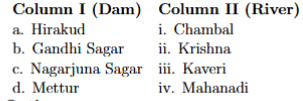
Match Column I with Column II and choose the correct option :
Options :
View Solution
Step 1: Matching Dams to Rivers:
a. Hirakud: Located on the Mahanadi river in Odisha. \(\rightarrow\) (iv)
b. Gandhi Sagar: Located on the Chambal river in Madhya Pradesh. \(\rightarrow\) (i)
c. Nagarjuna Sagar: Located on the Krishna river between Telangana and Andhra Pradesh. \(\rightarrow\) (ii)
d. Mettur: Located on the Kaveri (Cauvery) river in Tamil Nadu. \(\rightarrow\) (iii)
Step 2: Forming the Sequence:
a-(iv), b-(i), c-(ii), d-(iii).
Step 3: Selecting the Option:
This sequence corresponds to Option (C). Quick Tip: Mnemonic for Hirakud: "Maha" (Mahanadi) means great, Hirakud is the longest dam.
Mnemonic for Nagarjuna: Nagarjuna/Arjuna is related to Krishna (Mahabharata) \(\rightarrow\) Krishna River.
Choose the correct option regarding major states involved in the Krishna -- Godavari issue :
View Solution
Step 1: Understanding the Dispute:
The Krishna-Godavari water dispute arose due to the objection raised by the Karnataka and Andhra Pradesh governments regarding the diversion of more water at Koyna by the Maharashtra government for a multi-purpose project.
Step 2: Identifying the States:
The river Krishna flows through Maharashtra (origin), Karnataka, and Andhra Pradesh (and now Telangana). The dispute primarily involves these riparian states.
Step 3: Selecting the Option:
Option (B) lists these exact three states. Quick Tip: Geography tip: The Krishna river basin is shared by Maharashtra, Karnataka, Telangana, and Andhra Pradesh. The Godavari basin covers Maharashtra, Madhya Pradesh, Chhattisgarh, Odisha, Telangana, Andhra Pradesh, and parts of Karnataka/Puducherry. However, the specific "Krishna-Godavari dispute" mentioned in NCERT text refers to the \textbf{Maharashtra, Karnataka, and AP} conflict.
Imagine you are travelling from Delhi to Chandigarh to attend a wedding, by road in January. Which of the following crops will you notice prominently in the fields during the journey ?
View Solution
Step 1: Identifying the Season:
The travel is taking place in January. This falls under the Rabi cropping season (sown in winter: Oct-Dec, harvested in summer: April-June).
Step 2: Analyzing the Region:
The route is Delhi to Chandigarh, passing through Haryana and Punjab. This region is the "Wheat Bowl of India".
Step 3: Analyzing the Crops:
(A) Paddy (Rice): Kharif crop (monsoon). It is harvested by October/November. Fields would be empty or sown with Rabi crops in January.
(B) Maize: Typically a Kharif crop.
(C) Wheat: The main Rabi crop in North India. In January, wheat crops are in the vegetative growth stage and prominent in fields.
(D) Jowar: Coarse grain, mostly Kharif (though Rabi varieties exist in the south), but not the dominant visual in Punjab/Haryana in winter.
Step 4: Conclusion:
You would see vast fields of Wheat. Quick Tip: \textbf{Rabi = Winter = Wheat}. \textbf{Kharif = Monsoon = Rice}. Remember "W" for Winter and Wheat.
Two statements are given below. They are Assertion (A) and Reason (R). Read both the statements carefully and choose the correct option :
Assertion (A) : Minerals are an indispensable part of our lives.
Reason (R) : All living things need minerals.
Options :
View Solution
Step 1: Analyzing Assertion (A):
"Minerals are an indispensable part of our lives."
Truth: This is correct. Almost everything used in modern life (cars, buildings, electronics) and biological life requires minerals.
Step 2: Analyzing Reason (R):
"All living things need minerals."
\textit{Truth: This is correct. Life processes (metabolism, bone formation, etc.) cannot occur without minerals (like iron, calcium, magnesium).
Step 3: Determining the Relationship:
Does the fact that "living things need minerals" explain why minerals are "indispensable to our lives"?
Yes. While minerals are also indispensable for industry, the most fundamental level of indispensability is biological survival. If living things (us) need minerals to survive, then minerals are undeniably indispensable to our lives. Therefore, R explains A. Quick Tip: In Assertion-Reason questions, add the word "\textbf{because" between A and R. "Minerals are indispensable part of our lives \textbf{because} all living things need minerals." This makes logical sense for the biological aspect of "our lives".
Match Column I with Column II and choose the correct option :

Options :
View Solution
Step 1: Matching Minerals to Locations:
b. Mica: The major mica belt in India is the Hazaribagh-Gaya-Munger belt in Bihar/Jharkhand. So, Mica matches with Gaya (i).
d. Coal: Singarauli is a famous coalfield (spread across MP and UP). So, Coal matches with Singarauli (ii).
c. Bauxite: The Maikala hills and Amarkantak plateau are major bauxite deposits. So, Bauxite matches with Maikala (iv).
a. Iron ore: Chandrapur (in Maharashtra) has iron ore deposits. So, Iron ore matches with Chandrapur (iii).
Step 2: Forming the Sequence:
a-(iii), b-(i), c-(iv), d-(ii).
Step 3: Selecting the Option:
This sequence corresponds to Option (A). Quick Tip: If you know \textbf{Mica \(\rightarrow\) Gaya} (famous Bihar belt) and \textbf{Coal \(\rightarrow\) Singarauli} (famous power plant), you can often eliminate other options.
Belgium solved its problem of majoritarianism by strengthening which of the following types of government ?
View Solution
Step 1: Understanding the Belgian Model:
Belgium faced tensions between Dutch-speaking and French-speaking communities. Between 1970 and 1993, they amended their constitution four times.
Step 2: Identifying the Change:
The key change was shifting from a Unitary to a Federal structure. The regional governments were given constitutional powers that were no longer dependent on the central government. This power-sharing arrangement prevented the domination of the majority community (Majoritarianism).
Step 3: Conclusion:
They adopted a Federal system (a "holding together" federation). Quick Tip: Contrast this with Sri Lanka, which maintained a Unitary system and faced civil war due to Majoritarianism. Belgium chose Federalism and Peace.
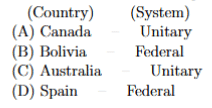
Choose the correctly matched pair from the following :
View Solution
Step 1: Analyzing Federal vs Unitary States (Based on NCERT context):
(A) Canada: It is a classic Federal country. (Mismatch)
(B) Bolivia: Typically unitary with autonomous regions, but not the standard example of Federalism in this curriculum context.
(C) Australia: It is a "Coming Together" Federation. (Mismatch)
(D) Spain: The NCERT textbook specifically lists India, Belgium, and Spain as examples of "Holding Together" Federations.
Step 2: Conclusion:
Option (D) is the correctly matched pair according to the standard textbook examples. Quick Tip: \textbf{Coming Together Federations:} USA, Switzerland, Australia.
\textbf{Holding Together Federations:} India, Spain, Belgium.
Which of the following are the main components of a political party ? Choose the correct option :
I. Leaders
II. Active members
III. Followers
IV. Pressure groups
Options :
View Solution
Step 1: Defining a Political Party:
A political party is a group of people who come together to contest elections and hold power in the government.
Step 2: Identifying Components:
According to political science (and NCERT text), a political party has three essential components:
1. The Leaders: Those who formulate policies and contest elections.
2. The Active Members: Those who work for the party, organize campaigns, and link the leaders to the people.
3. The Followers: The ordinary citizens who believe in the party's ideology and support it with their votes.
Step 3: Filtering Options:
"Pressure groups" (IV) are separate organizations that try to influence government policies but do not aim to control political power directly. Thus, IV is not a component of a political party.
Step 4: Conclusion:
Items I, II, and III are correct. This matches Option (A). Quick Tip: Remember the triad: \textbf{Leaders (Top) -- Active Members (Middle) -- Followers (Base)}.
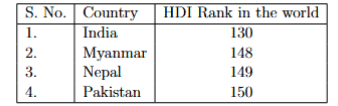
Study the following table related to `World Human Development Index' and answer the questions given below :
Amongst the given countries, which one of the following countries has the highest rank in `Human Development Index'?
Options :
View Solution
Step 1: Understanding HDI Ranking:
The Human Development Index (HDI) ranks countries based on key dimensions of human development: a long and healthy life, being knowledgeable, and having a decent standard of living.
Step 2: Interpreting Ranks:
In ranking systems, a lower numerical value indicates a higher (better) rank. For example, Rank 1 is the best possible rank.
Step 3: Comparing the Data:
India: 130
Myanmar: 148
Nepal: 149
Pakistan: 150
Comparing the numbers: \(130 < 148 < 149 < 150\).
Since 130 is the lowest number, India holds the highest (best) position among the countries listed. Quick Tip: Always remember: In rankings (like class rank or sports), \textbf{Smallest Number = Best Performance}.
`X' lives in a town. He cultivates flowers along with animal husbandry. The work of `X' will fall under which sector of the economy ?
View Solution
Step 1: Understanding Economic Sectors:
Primary Sector: Activities undertaken by directly using natural resources (e.g., agriculture, dairy, fishing, forestry).
Secondary Sector: Activities where natural products are changed into other forms through manufacturing (e.g., factories, construction).
Tertiary Sector: Activities that generate services rather than goods (e.g., transport, banking, teaching).
Step 2: Analyzing the Activity:
'X' cultivates flowers (agriculture) and engages in animal husbandry (dairy/livestock). Both activities rely directly on biological processes and natural resources.
Step 3: Conclusion:
Therefore, these activities fall under the Primary sector. Quick Tip: The Primary sector is also called the \textbf{Agriculture and Related Sector} because most of the natural products we get are from agriculture, dairy, fishing, and forestry.
Look at the given picture and answer the question that follow :

The work being done in the picture falls under which sector of the economy ?
View Solution
Step 1: Analyzing the Image:
The picture depicts workers handling textiles/garments. This represents a manufacturing or processing activity where raw materials (cloth/fabric) are being finished into final products (garments).
Step 2: Classification of Sectors:
Manufacturing and industrial activities, where goods are produced or processed, belong to the Secondary sector. It covers industries that produce finished goods from raw materials. Quick Tip: The Secondary sector is also known as the \textbf{Industrial Sector}. If it involves a factory, workshop, or manufacturing, it is likely Secondary.
Note : The following question is for the Visually Impaired Candidates only, in lieu of Q. No. 17.
The work of which of the following comes in the secondary sector of the economy ?
View Solution
Step 1: Analyzing the Options:
(A) Bee-keeper: Involves raising living organisms/natural processes. \(\rightarrow\) Primary Sector.
(B) Moneylender: Provides a service (finance). \(\rightarrow\) Tertiary Sector.
(C) Basket weaver: Converts raw material (like bamboo or twigs) into a finished product (basket). This is a manufacturing/craft activity. \(\rightarrow\) Secondary Sector.
(D) Fisherman: Harvesting natural resources directly from nature. \(\rightarrow\) Primary Sector.
Step 2: Conclusion:
The Basket weaver is engaged in the Secondary sector. Quick Tip: Small-scale cottage industries and crafts like weaving, pottery, and brick-making are parts of the Secondary sector, not just large factories.
Why does it become difficult for farmers in rural areas to take loans from government banks ? Read the following reasons and choose the most appropriate option :
I. Lack of collateral
II. Complicated procedure
III. Higher cost of borrowing
IV. Lack of awareness
Options :
View Solution
Step 1: Analyzing the Barriers to Formal Credit:
I. Lack of collateral: True. Banks require assets (land, livestock) as security (collateral), which poor farmers often lack.
II. Complicated procedure: True. Bank loans require documentation and filling out forms, which is difficult for illiterate or less educated farmers.
III. Higher cost of borrowing: False. The formal sector (banks) has a much lower interest rate compared to the informal sector (moneylenders). High cost is a disadvantage of the informal sector, not banks.
IV. Lack of awareness: True. Many rural people are unaware of bank schemes and procedures.
Step 2: Selecting the Option:
Reasons I, II, and IV are correct. This matches Option (C). Quick Tip: Remember: \textbf{Formal Sector (Banks) = Low Interest, High Documentation.
\textbf{Informal Sector (Moneylenders)} = High Interest, Low/No Documentation.
Which of the following groups in urban India depend on informal sources to meet their credit needs ?
View Solution
Step 1: Credit Usage Patterns (NCERT Data):
According to data on the sources of credit for urban households in India:
Poor households: Approximately 85% of their loans come from informal sources.
Households with few assets: Approximately 53% of their loans come from informal sources.
Well-off households: Only about 28% from informal sources (mostly formal).
Rich households: Only about 10% from informal sources.
Step 2: Identifying Dependent Groups:
The groups that primarily or significantly rely on informal sources are the "Poor households" and "Households with few assets".
Step 3: Conclusion:
Option (C) correctly includes both vulnerable groups. Quick Tip: Dependence on informal credit is inversely proportional to wealth. Richer households have collateral and documents, so they access cheap bank loans. Poor households lack these and are forced to go to moneylenders.
Two statements I and II are given below. Read both the statements carefully and choose the correct option :
Statement I : Rapid improvement in technology has been one major factor to stimulate the globalisation process.
Statement II : This has made much faster delivery of goods across long distances possible at lower costs.
Options :
View Solution
Step 1: Analyzing Statement I:
"Rapid improvement in technology has been one major factor to stimulate the globalisation process."
True. Improvements in transportation and communication are the backbone of modern globalisation.
Step 2: Analyzing Statement II:
"This has made much faster delivery of goods across long distances possible at lower costs."
True. Innovations like containers for shipping, air cargo, and the internet have drastically reduced travel time and cost.
Step 3: Establishing the Link:
Does the faster delivery at lower costs (Statement II) explain why technology stimulated globalisation (Statement I)?
Yes. Globalisation involves the integration of markets. The ability to move goods quickly and cheaply is exactly the mechanism through which technology enabled this integration. Therefore, II is the correct explanation of I. Quick Tip: Key Technologies for Globalisation: 1. \textbf{Transportation: Containers, Jets (Physical movement). 2. \textbf{ICT (Information and Communication Technology):} Internet, Satellites (Flow of information and services).
Explain the role of anti-colonial movement in the rise of `modern nationalism' in India.
View Solution
Step 1: Understanding the Concept:
Modern nationalism in India, as in many other colonies, is intimately connected to the anti-colonial movement. The shared experience of oppression under British rule provided a unifying factor for diverse groups.
Step 2: Detailed Explanation:
The rise of modern nationalism can be explained through the following points:
Unity through Struggle: People began discovering their unity in the process of their struggle with colonialism. The sense of being oppressed under colonial rule provided a shared bond that tied many different groups together.
Common Enemy: The British Raj affected various sections of society—peasants, tribals, workers, and the middle class—in different ways, but the source of their grievance was the same. This allowed leaders like Mahatma Gandhi to channel these specific grievances into a broad-based movement for independence.
Collective Identity: Movements like the Non-Cooperation Movement and the Civil Disobedience Movement brought people from different religions, castes, and regions under one umbrella, fostering a sense of collective belonging and national identity.
Step 3: Conclusion:
Thus, the anti-colonial movement served as a catalyst, transforming vague anti-British sentiments into a structured and unified force of modern nationalism. Quick Tip: Key phrase to remember: "Shared bond of oppression." This is the core reason why diverse groups united against a common enemy.
OR
Question 21(b):
Why did Gandhiji say `Satyagraha is pure soul-force' ? Explain by giving two arguments.
View Solution
Step 1: Understanding the Concept:
Gandhiji distinguished Satyagraha from passive resistance. He defined Satyagraha not as a weapon of the weak, but as a power that relies on truth and moral courage, which he termed "soul-force."
Step 2: Detailed Explanation:
Gandhiji described Satyagraha as pure soul-force for the following reasons:
Truth is the Substance of the Soul: According to Gandhiji, 'Satya' (Truth) implies love and firmness. The soul is informed by knowledge and burns with the flame of love. Since truth is the very substance of the soul, the force derived from it is called soul-force.
Non-Violence is Supreme: Unlike physical force, which relies on inflicting pain to achieve goals, soul-force relies on non-violence (Ahimsa). A Satyagrahi does not seek to destroy or inflict pain on the adversary but appeals to their conscience and moral sense to see the truth.
Step 3: Conclusion:
It is called soul-force because it uses spiritual strength and moral conviction rather than physical brutality to win over the opponent. Quick Tip: Remember the contrast: \textbf{Physical Force} = Body/Violence/Pain vs. \textbf{Soul Force} = Spirit/Truth/Conversion of heart.
Explain any two problems of the `global ecology' arising due to indiscriminate use of resources.
View Solution
Step 1: Understanding the Concept:
The indiscriminate exploitation of natural resources to satisfy human greed has led to severe ecological crises that affect the entire planet, not just specific regions.
Step 2: Detailed Explanation:
Two major problems of global ecology are:
Global Warming: The burning of fossil fuels and deforestation has led to an increase in greenhouse gases (like Carbon Dioxide) in the atmosphere. This traps heat, causing a rise in global temperatures, melting polar ice caps, and changing weather patterns.
Ozone Layer Depletion: The excessive use of chemicals like chlorofluorocarbons (CFCs) in industries and refrigeration has damaged the ozone layer. This depletion allows harmful ultraviolet (UV) rays to reach the earth's surface, causing skin cancer and harming aquatic life.
Step 3: Conclusion:
These problems demonstrate that resource depletion is not a local issue but a threat to the sustenance of life on Earth globally. Quick Tip: When listing global ecological problems, focus on issues that transcend national boundaries, such as \textbf{Global Warming} and \textbf{Ozone Depletion}, rather than local issues like noise pollution.
Suggest any two measures to remove gender inequality.
View Solution
Step 1: Understanding the Concept:
Gender inequality refers to the social, economic, and political disparity between men and women. Removing it requires structural and social changes.
Step 2: Detailed Explanation:
Two effective measures to remove gender inequality are:
Promoting Education for Girls: Education is the most powerful tool for empowerment. Governments and society must ensure equal access to schooling and higher education for girls to make them economically independent and aware of their rights.
Implementation of Equal Wages: Strictly enforcing laws like the \textit{Equal Remuneration Act, 1976 ensures that women are paid the same wages as men for equal work, reducing economic disparity.
Step 3: Conclusion:
Empowerment through education and economic independence are the most sustainable ways to bridge the gender gap. Quick Tip: Focus on "Education" and "Economic Independence" as the two pillars of gender equality.
How did the process of liberalisation initiated in India in the 1990s, promote globalisation ? Explain.
View Solution
Step 1: Understanding the Concept:
Liberalisation refers to the removal of government-imposed restrictions or barriers on trade and investment. In 1991, India adopted the New Economic Policy which paved the way for globalisation.
Step 2: Detailed Explanation:
Liberalisation promoted globalisation in the following ways:
Removal of Trade Barriers: The government removed taxes and restrictions on imports and exports. This allowed goods to flow freely between India and other countries, integrating Indian markets with the global market.
Promotion of Foreign Investment: Barriers to foreign investment were removed, encouraging Multinational Corporations (MNCs) to set up factories and offices in India. This led to the transfer of technology and integration of production across borders.
Increased Competition: Liberalisation forced domestic producers to compete with global brands, leading to improvements in quality and efficiency to match international standards.
Step 3: Conclusion:
By opening up the economy to foreign trade and investment, liberalisation acted as the key facilitator for the globalisation process in India. Quick Tip: Liberalisation is the \textbf{Policy} (removing barriers), and Globalisation is the \textbf{Outcome} (interconnectedness). One leads to the other.
``Tribal peasants interpreted the message of Mahatma Gandhi and the idea of `Swaraj' in yet another way.'' Explain the statement in the context of Non-Cooperation Movement.
View Solution
Step 1: Understanding the Concept:
The Non-Cooperation Movement was interpreted differently by various social groups. For tribal peasants, "Swaraj" meant the restoration of their traditional rights over forests, which had been taken away by colonial forest laws.
Step 2: Detailed Explanation:
Context of Grievances: In the Gudem Hills of Andhra Pradesh, the colonial government had closed large forest areas, preventing people from entering the forests to graze their cattle or collect fuelwood and fruits. This enraged the hill people as it affected their livelihood and traditional rights.
Role of Alluri Sitarama Raju: The movement was led by Alluri Sitarama Raju, who claimed to have special powers and was inspired by Gandhiji. He persuaded people to wear khadi and give up drinking, aligning with the Gandhian program.
Interpretation of Methods: However, the tribals did not follow the path of non-violence strictly. They believed that India could be liberated only by the use of force, not non-violence.
Actions Taken: The Gudem rebels attacked police stations, attempted to kill British officials, and carried on guerrilla warfare for achieving Swaraj.
Step 3: Conclusion:
Thus, while they resonated with Gandhi's name and the goal of Swaraj, their interpretation focused on regaining forest rights through violent means, diverging from the mainstream Congress policy. Quick Tip: Keywords to remember: \textbf{Gudem Hills}, \textbf{Alluri Sitarama Raju}, \textbf{Forest Laws}, \textbf{Guerrilla Warfare}.
Read the story of Rinjha and answer the question that follows :
Story of Rinjha
Rinjha lived with her family in a small village at the outskirts of Diphu in Assam. She enjoys watching her family members clearing, slashing and burning a patch of land for cultivation. She often helps them in irrigating the fields with water running through a bamboo canal from the nearby spring. She loves the surroundings and wants to stay here as long as she can, but this little girl has no idea about the declining fertility of the soil and her family's search for a fresh patch of land in the next season.
What type of farming is Rinjha's family doing ? Describe any two of its characteristics.
View Solution
Step 1: Identifying the Farming Type:
Based on the description ``clearing, slashing and burning a patch of land'' and the location ``Assam'' (North-East India), Rinjha's family is practising Primitive Subsistence Farming, also known as Shifting Cultivation or Jhumming.
Step 2: Characteristics of this Farming:
Slash and Burn Method: Farmers clear a patch of land by cutting down vegetation and burning it. The ash is mixed with the soil to add potash/nutrients.
Dependence on Nature: This type of farming depends entirely on the monsoon for irrigation, natural fertility of the soil, and suitable environmental conditions. No modern fertilizers or tools are used.
Low Productivity and Migration: Once the soil fertility decreases (usually after a couple of years), the farmers abandon the land and move to a fresh patch. This allows nature to replenish the fertility of the soil through natural processes. Quick Tip: This farming has different names: \textbf{Jhumming} (North-East India), \textbf{Milpa} (Mexico), \textbf{Roca} (Brazil). The key identifier is the "Slash and Burn" technique.
``That democratic system of government is considered good in which maximum number of citizens are made stakeholders in political power.'' Explain the statement with suitable arguments.
View Solution
Step 1: Understanding the Concept:
The statement refers to the principle of Power Sharing in a democracy. A legitimate government is one where citizens acquire a stake in the system through participation.
Step 2: Detailed Arguments:
Reduces Conflict: Power sharing is desirable because it helps to reduce the possibility of conflict between social groups. By including diverse groups in governance, social harmony is maintained.
Political Stability: It ensures the stability of political order. Imposing the will of the majority community over others may look like an attractive option in the short run, but in the long run, it undermines the unity of the nation.
Spirit of Democracy: A democratic rule involves sharing power with those affected by its exercise. People have a right to be consulted on how they are to be governed.
Legitimacy: Active participation helps people feel that the government belongs to them, increasing the system's legitimacy.
Step 3: Conclusion:
Therefore, maximizing stakeholders through power sharing is the very essence of a good democracy. Quick Tip: This question relates to the \textbf{Prudential} (stability/peace) and \textbf{Moral} (spirit of democracy) reasons for power sharing.
Explain the importance of political parties in democracy.
View Solution
Step 1: Understanding the Concept:
Political parties are institutions that gather public opinion and transform it into government policy. They are visible institutions essential for the working of a representative democracy.
Step 2: Key Functions/Importance:
Contesting Elections: Parties recruit candidates and contest elections to gain power.
Policy Formulation: They put forward different policies and programmes, and the voters choose from them. They reduce a multitude of opinions into a few basic positions.
Formation of Government: The winning party forms and runs the government, making major policy decisions.
Role of Opposition: Losing parties play the role of opposition by voicing different views and criticizing government failures.
Link between People and Government: Parties provide people access to government machinery and welfare schemes. For an ordinary citizen, it is easier to approach a local party leader than a government officer. Quick Tip: Mnemonics for functions: \textbf{C-P-F-O-L} (Contest, Policies, Form govt, Opposition, Link).
OR
Question 28(b):
Why did India adopt the multiparty system ? Explain with suitable arguments.
View Solution
Step 1: Understanding the Context:
India follows a multiparty system where more than two parties have a reasonable chance of coming to power either on their own strength or in alliance with others.
Step 2: Arguments for Adoption:
Social and Geographical Diversity: India is a vast country with immense social, cultural, and regional diversity. No single or dual party system could adequately represent such a wide variety of interests and opinions.
Evolutionary Process: The party system is not something a country chooses purely by law; it evolves over a long time depending on the nature of society. India's complex society naturally led to the rise of multiple regional and national parties.
Democratic Representation: A multiparty system allows a variety of interests and opinions to enjoy political representation. It ensures that different sections of society (like linguistic or caste groups) have a voice in governance.
Step 3: Conclusion:
India adopted this system because it is best suited to accommodate the vast diversity of its population. Quick Tip: Remember: A party system is a reflection of the \textbf{social divisions} and \textbf{history} of a country, not just a constitutional choice.
Explain the difference between public and private sector of Indian economy with example.
View Solution
Step 1: Concept:
Sectors are classified into public and private based on who owns the assets and is responsible for the delivery of services.
Step 2: Differences:
Ownership:
Public Sector: The government owns most of the assets and provides all the services.
\textit{Private Sector: Ownership of assets and delivery of services is in the hands of private individuals or companies.
Objective/Motive:
\textit{Public Sector: The primary motive is social welfare and public service, not just earning profits.
\textit{Private Sector: The primary motive is to earn profits.
Examples:
\textit{Public Sector: Railways, Post Office, BSNL.
\textit{Private Sector: Tata Iron and Steel Company Limited (TISCO), Reliance Industries Limited (RIL). Quick Tip: Key difference: \textbf{Service vs. Profit. Public sector ensures essential services (like water, health) are affordable for all.
Analyse the significance of the `Napoleonic Code' in making the administrative system rational and efficient.
View Solution
Step 1: Understanding the Concept:
Napoleon Bonaparte introduced the Civil Code of 1804, commonly known as the Napoleonic Code, in France and the regions under French control. Its primary aim was to sweep away the feudal structures and establish a rational, uniform legal system.
Step 2: Detailed Analysis of Significance:
The significance of the code lies in the following reforms:
Abolition of Privileges: It did away with all privileges based on birth, establishing the principle of equality before the law for all citizens.
Right to Property: It secured the right to property, making it a legal right for citizens, which promoted economic stability.
Administrative Simplification: In the Dutch Republic, Switzerland, Italy, and Germany, Napoleon simplified administrative divisions.
End of Feudalism: He abolished the feudal system and freed peasants from serfdom and manorial dues.
Guild Restrictions Removed: In towns, guild restrictions were removed, allowing artisans and merchants to trade freely.
Standardization: Uniform laws, standardized weights and measures, and a common national currency were introduced. This facilitated the movement and exchange of goods and capital from one region to another.
Step 3: Conclusion:
By implementing these measures, the Napoleonic Code replaced the confusing patchwork of local laws with a unified system, making the administration more rational and efficient. Quick Tip: Remember the key phrase: "Civil Code of 1804". It focused on \textbf{Equality}, \textbf{Property}, and \textbf{Administrative Uniformity}.
OR
How was liberalism allied to national unity in Europe in the early decades of the 19th century ? Analyse.
View Solution
Step 1: Understanding Liberalism:
Derived from the Latin root liber (free), liberalism stood for freedom for the individual and equality of all before the law. In 19th-century Europe, it had both political and economic dimensions that contributed to national unity.
Step 2: Political Liberalism and Unity:
Liberals emphasized the concept of government by consent.
They demanded the end of autocracy and clerical privileges, a constitution, and a representative government through parliament. This political ideology united people against monarchies.
Step 3: Economic Liberalism and Unity:
Market Integration: Liberalism stood for the freedom of markets and the abolition of state-imposed restrictions on the movement of goods and capital.
Zollverein (1834): In the German-speaking regions, a customs union called Zollverein was formed at the initiative of Prussia. It abolished tariff barriers and reduced the number of currencies from over thirty to two.
Railways: The creation of a network of railways further stimulated mobility, harnessing economic interests to national unification.
Step 4: Conclusion:
Economic nationalism strengthened the wider nationalist sentiments. By binding the region economically, liberalism laid the groundwork for political national unity. Quick Tip: Connect \textbf{Economic Liberalism} (Zollverein) directly to \textbf{National Unity}. A unified market creates a unified nation.
``Manufacturing industries are considered the backbone of the economic development of a country.'' Justify the statement.
View Solution
Step 1: Understanding the Concept:
The manufacturing sector involves processing raw materials into more valuable finished goods. It is considered the backbone of development because it drives growth in all other sectors.
Step 2: Justification (Key Points):
Modernizing Agriculture: Manufacturing industries provide essential tools (tractors, fertilizers, pumps) that modernize agriculture, increasing productivity.
Job Creation: It reduces the heavy dependence of people on agricultural income by providing jobs in secondary and tertiary sectors.
Eradication of Poverty: Industrial development is a precondition for the eradication of unemployment and poverty. It helps bring down regional disparities by establishing industries in tribal and backward areas.
Foreign Exchange: Export of manufactured goods expands trade and commerce and brings in much-needed foreign exchange.
Economic Prosperity: Countries that transform their raw materials into a wide variety of finished goods of higher value are prosperous (value addition). Quick Tip: Key sequence: \textbf{Modern Agriculture \(\rightarrow\) Jobs \(\rightarrow\) Exports \(\rightarrow\) Wealth}.
OR
``Agriculture and industries complement each other.'' Justify the statement.
View Solution
Step 1: Understanding Interdependence:
Agriculture and industry are not exclusive of each other; they move hand in hand.
Step 2: How Agriculture helps Industry:
Raw Materials: Agriculture provides the basic raw materials (like cotton, jute, sugarcane, oilseeds) required by agro-based industries.
Market: The farming population acts as a huge market for industrial products.
Step 3: How Industry helps Agriculture:
Inputs: Industries provide agricultural inputs such as fertilizers, pesticides, insecticides, PVC pipes, machines, and tools.
Efficiency: These industrial products assist farmers in increasing productivity and making production processes more efficient.
Step 4: Conclusion:
Thus, the development and competitiveness of the manufacturing industry have not only assisted agriculturists in increasing their production but also made the production process very efficient. Quick Tip: Focus on the cycle: \textbf{Farm to Factory (Raw Material)} and \textbf{Factory to Farm (Tools/Fertilizers)}.
Explain any five bases for assessing the outcomes of democracy.
View Solution
Step 1: Understanding the Concept:
Democracy is assessed not just as a form of government but by the practical outcomes it produces for citizens.
Step 2: Five Bases for Assessment:
Accountable, Responsive, and Legitimate Government: A democracy must ensure that people choose their rulers and have control over them. It should be accountable to citizens, responsive to their needs, and legitimate (elected by the people).
Economic Growth and Development: While democracy isn't a guarantee of economic growth, it is expected to not lag significantly behind dictatorships and to foster an environment for development.
Reduction of Inequality and Poverty: Democracy should work towards equitable distribution of income and opportunities, ensuring that the poor have a voice and basic needs are met.
Accommodation of Social Diversity: Democracy must provide mechanisms to negotiate differences and resolve conflicts among various social groups peacefully.
Dignity and Freedom of the Citizen: This is the strongest outcome. Democracy promotes the dignity of the individual and recognizes the principle of equality (e.g., rights of women, caste equality). Quick Tip: Mnemonic: \textbf{A-R-E-D-D} (Accountability, Reduction of poverty, Economic growth, Diversity accommodation, Dignity).
OR
Explain any five values of democracy.
View Solution
Step 1: Understanding Democratic Values:
Values are the ethical principles that form the foundation of a democratic system.
Step 2: Five Key Values:
Liberty/Freedom: Citizens have the freedom of speech, expression, and the right to form associations.
Equality: All citizens are equal before the law, regardless of caste, creed, gender, or religion. It includes political equality (one person, one vote).
Justice: Democracy ensures fairness in the distribution of resources and opportunities. The judiciary acts as the guardian of justice.
Fraternity/Tolerance: It encourages respect for differences and promotes a sense of brotherhood among citizens to maintain social harmony.
Rule of Law: No one is above the law. Governance is based on established laws and procedures, not on the whims of a ruler. Quick Tip: These values are mirrored in the Preamble of the Indian Constitution: \textbf{Justice, Liberty, Equality, Fraternity}.
``Recent evidence suggests that overuse of groundwater is becoming a serious threat in many parts of the country.'' Evaluate the statement in the context of sustainability of development.
View Solution
Step 1: Understanding the Concept:
Sustainable development means meeting the needs of the present without compromising the ability of future generations to meet their own needs. Groundwater overuse violates this principle.
Step 2: Evaluation of the Statement:
Evidence of Overuse: In India, about one-third of the country is overusing groundwater reserves. This is particularly severe in agriculturally prosperous regions like Punjab, Haryana, and Western UP due to the Green Revolution and tubewell irrigation.
Renewable but Limited: Groundwater is a renewable resource, replenished by rain. However, if we extract more than what is being replenished by rain, we are overusing this resource.
Falling Water Tables: Continuous overuse leads to a decline in the water table, causing water scarcity for drinking and irrigation.
Threat to Sustainability: If the current rate of extraction continues, 60% of the country may face critical shortages in the next 20 years. This compromises the agricultural future and food security of the next generation.
Step 3: Conclusion:
Overuse depletes the "stock" of nature. For development to be sustainable, we must use resources within their regenerative capacity. Quick Tip: Keywords: \textbf{Replenishable Resource}, \textbf{Water Table Decline}, \textbf{Future Generations}, \textbf{Food Security}.
OR
``The development goals of different categories of people may differ.'' Evaluate the statement.
View Solution
Step 1: Understanding the Concept:
Development is subjective. What may be development for one person may not be development for another.
Step 2: Different People, Different Goals:
People have different life situations, so their aspirations vary.
Example 1 (Farmers): A prosperous farmer from Punjab wants high support prices and cheap labor. A landless rural laborer wants more days of work and better wages.
\textit{Example 2 (Gender): A girl expects as much freedom and opportunity as her brother, and that he shares in the household work. The brother may not like this.
Step 3: Conflicting Goals:
Sometimes goals conflict.
\textit{Example (Dams): An industrialist wants dams for more electricity. However, this may submerge the land and disrupt the lives of tribals living there, who might prefer small check dams or tanks.
Step 4: Conclusion:
Therefore, development is not a uniform concept. It involves a mix of goals (income, equality, freedom) and necessitates balancing conflicting interests. Quick Tip: Remember the two key aspects: 1. \textbf{Different Goals (Landless laborer vs Rich Farmer) and 2. \textbf{Conflicting Goals} (Industrialist vs Tribal).
Comprehension for Q34.
Read the given source and answer the questions that follow :
Print and Censorship
The power of the printed word is most often seen in the way governments seek to regulate and suppress print. The colonial government kept continuous track of all books and newspapers published in India and passed numerous laws to control the press.
During the First World War, under the Defence of India Rules, 22 newspapers had to furnish securities. Of these, 18 shut down rather than comply with government orders. The Sedition Committee Report under Rowlatt in 1919 further strengthened controls that led to imposition of penalties on various newspapers. At the outbreak of the Second World War, the Defence of India Act was passed, allowing censoring of reports of war-related topics. All reports about the Quit India movement came under its purview. In August 1942, about 90 newspapers were suppressed.
Explain the meaning of `censor'.
View Solution
Step 1: Understanding the Concept:
Censorship refers to the suppression of speech, public communication, or other information.
Step 2: Detailed Explanation:
To 'censor' means to officially examine books, films, news, etc., that are about to be published and suppress any parts that are considered obscene, politically unacceptable, or a threat to security. In the context of colonial India, it meant the government's power to control and prohibit the printing of nationalist literature and news that criticized British rule. Quick Tip: Censorship is the opposite of "Freedom of the Press". It is a tool often used by authoritarian regimes to control public opinion.
Why did the colonial administration keep an eye on books and newspapers ?
View Solution
Step 1: Understanding Colonial Motivation:
The British administration was wary of the growing nationalist movement and the power of print to spread seditious ideas.
Step 2: Detailed Explanation:
The colonial administration kept a close watch on books and newspapers to:
Prevent Rebellion: They wanted to curb the spread of anti-colonial and nationalist sentiments that could incite people to rebel against British rule.
Control Information: By regulating print, they aimed to control the narrative and prevent the criticism of government policies from reaching a wider audience.
Enforce Loyalty: Laws like the Vernacular Press Act (1878) were specifically designed to silence critics and ensure that the vernacular press did not spread "disaffection" against the government. Quick Tip: Connect this to the \textbf{Vernacular Press Act}, which gave the government extensive rights to censor reports and editorials in the vernacular press.
Why did Gandhiji start a nationwide Satyagraha against the Rowlatt Act ? Explain any two reasons.
View Solution
Step 1: Understanding the Rowlatt Act (1919):
The Rowlatt Act was a repressive law hurriedly passed by the Imperial Legislative Council despite united opposition from Indian members.
Step 2: Reasons for Satyagraha:
Gandhiji launched the Satyagraha because the Act was unjust and oppressive:
Detention without Trial: The Act gave the government enormous powers to repress political activities and allowed the detention of political prisoners without trial for two years. This suspended the right of Habeas Corpus.
Civil Liberties Violated: It was seen as a direct attack on the fundamental rights of citizens. Gandhiji famously called it a "Black Act" and wanted non-violent civil disobedience against such unjust laws. Quick Tip: Remember the timeline: \textbf{1919 Rowlatt Act \(\rightarrow\) \textbf{Rowlatt Satyagraha} \(\rightarrow\) \textbf{Jallianwala Bagh Massacre} \(\rightarrow\) \textbf{Khilafat-Non Cooperation Movement}.
Comprehension Passage Q35:
An Experiment in Brazil
A city called Porto Alegre in Brazil has carried out an extraordinary experiment in combining
decentralisation with participative democracy. The city has set up a parallel organisation
operating alongside the municipal council, enabling local inhabitants to take real decisions for
their city. The nearly 13 lakh people in this city get to participate in making the budget for
their own city. The city is divided into many sectors or what we call wards. Each sector has a
meeting, like that of the gram sabha, in which anyone living in that area can participate.
There are some meetings to discuss issues that affect the entire city. Any citizen of the city
can participate in those meetings. The budget of the city is discussed in these meetings. The
proposals are put to the municipality that takes a final decision about it.
Explain the meaning of `participatory democracy'.
View Solution
Step 1: Understanding the Concept:
Participatory democracy means involvement of ordinary citizens in the decision-making process of public affairs.
It emphasizes direct engagement of people rather than leaving all decisions solely to elected representatives.
Step 2: Key Formula or Approach:
(Not applicable — this is a conceptual/theory question.)
Step 3: Detailed Explanation:
In participatory democracy citizens are given opportunities to debate, propose and decide on policies and allocations.
In the Porto Alegre example, residents meet in ward-level gatherings (similar to a gram sabha) to discuss local issues and the city budget.
These meetings let people present proposals and priorities which are then considered by the municipal authority.
Thus, decision-making is shared: citizens prepare and prioritise proposals; municipality takes final administrative decisions.
Step 4: Final Answer:
Participatory democracy is a democratic practice where citizens directly engage in public decision-making — for example, by attending ward meetings, discussing the municipal budget, proposing priorities and influencing the final choices made by local government.
Quick Tip: For passage-based questions, quote a specific line from the passage (e.g., "meeting, like that of the gram sabha") to show you used the passage.
Keep the definition concise and then link it to the example given.
In the context of separation of powers, the given example defines which type of government ?
View Solution
Step 1: Understanding the Concept:
Separation of powers typically refers to distribution of functions among different institutions.
In the context of local administration and participatory budgeting, the key idea is decentralisation — transfer of decision-making to local units.
Step 2: Key Formula or Approach:
(Not a formula question — approach: match passage description with types of government structures.)
Step 3: Detailed Explanation:
The passage describes transfer of budgetary decision-making to ward-level meetings and a parallel organisation operating alongside the municipal council.
This shows local units (wards/meetings) having real authority to propose and decide on priorities — a hallmark of decentralised or local self-government.
It is not centralized control (options A, B), nor any non-democratic form (D, E).
Hence the example defines a decentralised/local self-government model strengthened by participatory mechanisms.
Step 4: Final Answer:
The example defines a decentralised form of government — specifically local self-government (municipal decentralisation) enhanced with participatory democracy.
Quick Tip: When a question asks to identify the 'type of government', pick the term that best matches the power structure described (here: decentralisation/local self-government).
Underline keywords in the passage like "parallel organisation" and "wards" to justify your choice.
Describe the structure of the system in India which is almost similar to the above example of Brazil.
View Solution
Step 1: Understanding the Concept:
The passage's key feature is devolution of powers to local bodies where citizens participate in decision-making.
India has formal structures of local self-government that perform similar roles.
Step 2: Key Formula or Approach:
(Not a formula question — approach: describe the institutional tiers and functions.)
Step 3: Detailed Explanation:
India's comparable system is the Panchayati Raj (rural) and urban local bodies system.
For rural areas (Panchayati Raj):
\(\bullet\) Gram Panchayat (village level): primary unit where villagers meet, discuss local needs and development.
\(\bullet\) Panchayat Samiti (block/ intermediate level): coordinates between several Gram Panchayats.
\(\bullet\) Zilla Parishad (district level): plans and oversees development for the entire district.
For urban areas:
\(\bullet\) Municipal Corporations: large cities.
\(\bullet\) Municipal Councils: smaller urban areas.
\(\bullet\) Nagar Panchayats: for areas in transition from rural to urban.
These bodies are empowered to prepare budgets, plan local development, and often hold public meetings or hearings.
The expectation of citizen participation (e.g., gram sabha in rural India) is directly analogous to the ward-level meetings described for Porto Alegre.
Step 4: Final Answer:
The Indian system similar to Porto Alegre's experiment is the three-tier local self-government — Panchayati Raj in rural areas (Gram Panchayat, Panchayat Samiti, Zilla Parishad) and municipal bodies in urban areas — which provides decentralised governance and opportunities for citizen participation.
Quick Tip: Mention the names of tiers (Gram Sabha/Gram Panchayat, Panchayat Samiti, Zilla Parishad) to score full marks.
When asked for 'structure', present it as bullet points or numbered tiers for clarity.
Comprehension Passage Q36 :
Loans From Cooperatives
Besides banks, the other major source of cheap credit in rural areas are the cooperative
societies (or cooperatives). Members of a cooperative pool their resources for cooperation in
certain areas. There are several types of cooperatives possible such as farmers cooperatives,
weavers cooperatives, industrial workers cooperatives, etc. Krishak Cooperative functions in a
village not very far away from Sonpur. It has 2300 farmers as members. It accepts deposits
from its members. With these deposits as collateral, the Cooperative has obtained a large
loan from the bank. These funds are used to provide loans to members. Once these loans are
repaid, another round of lending can take place.
Krishak Cooperative provides loans for the purchase of agricultural implements, loans for
cultivation and agricultural trade, fishery loans, loans for construction of houses and for a
variety of other expenses.
Cooperative societies come under which source of credit ?
View Solution
Step 1: Understanding the Concept:
Sources of credit are broadly classified as institutional (banks, cooperatives, regional rural banks, government schemes) and non-institutional (moneylenders, traders).
Step 2: Key Formula or Approach:
(Not applicable — classification based on definition.)
Step 3: Detailed Explanation:
The passage explicitly names cooperative societies as a major source of cheap credit in rural areas and describes formal mechanisms: member deposits, collateral, and bank loans obtained by the cooperative.
Cooperatives are organized bodies registered under law and function as formal financial institutions in rural credit systems.
Step 4: Final Answer:
Cooperative societies are an institutional source of credit (organized/structured lending institutions in rural finance).
Quick Tip: Use the passage wording "other major source of cheap credit" to show the cooperatives are part of the organised/institutional sector.
Remember the institutional vs non-institutional classification for credit questions.
Mention any two sources of capital of cooperative societies.
View Solution
Step 1: Understanding the Concept:
Sources of capital for cooperatives are the funds they mobilise plus funds they can borrow from formal lenders.
Step 2: Key Formula or Approach:
(Not applicable — list-based answer.)
Step 3: Detailed Explanation:
From the passage: the Krishak Cooperative "accepts deposits from its members" and "with these deposits as collateral, the Cooperative has obtained a large loan from the bank."
Thus two clear sources of capital are:
\(\bullet\) Member deposits (share capital and savings): funds pooled from the cooperative's own members.
\(\bullet\) Loans from banks (borrowed funds): funds obtained from commercial or regional rural banks using member deposits as collateral.
Step 4: Final Answer:
Two sources of capital of cooperative societies are member deposits and bank loans/borrowed funds.
Quick Tip: Answer directly from the passage when possible — quote "accepts deposits from its members" and "obtained a large loan from the bank."
If asked for two sources, write them in bullet form for clarity.
Explain the role of cooperative societies in increasing the income of farmers.
View Solution
Step 1: Understanding the Concept:
Cooperative societies are designed to pool resources and provide services that individual farmers cannot easily secure alone.
Step 2: Key Formula or Approach:
(Not a formula question — present organised points showing mechanisms.)
Step 3: Detailed Explanation:
Cooperatives help increase farmers' income through multiple mechanisms:
\(\bullet\) Cheap and timely credit: Cooperatives provide loans for cultivation, purchase of implements and inputs at lower interest rates than informal moneylenders, reducing cost of production.
\(\bullet\) Access to inputs and implements: They finance purchase of agricultural implements and inputs which improve productivity.
\(\bullet\) Support for allied activities: They offer fishery loans, housing loans and other credits that improve livelihoods and reduce vulnerability.
\(\bullet\) Collective bargaining and market access: By pooling produce, cooperatives can negotiate better prices or reduce middlemen costs (improves net income).
\(\bullet\) Recycling of funds: As loans are repaid, cooperatives relend the funds — creating a continuing source of support for farmers.
\(\bullet\) Lower transaction costs and risk sharing: Cooperatives reduce individual transaction costs and spread risk across members.
Step 4: Final Answer:
Cooperative societies increase farmers' income by providing affordable credit for cultivation and implements, enabling productive investment, facilitating access to markets and inputs, and recycling funds for continued lending — all of which reduce costs and raise net returns for farmers.
Quick Tip: List 3–4 mechanisms (cheap credit, inputs, markets, recycling funds) and give one short explanation for each to secure full marks.
Use examples like "loans for agricultural implements" from the passage to strengthen your answer.
Two places `A' and `B' have been marked on the given political outline map of India. Identify them with the help of the following information and write their correct names on the lines drawn near them :
A. The place where the session of Indian National Congress was held in 1920.
View Solution
Step 1: Understanding the Historical Context:
In the year 1920, the Indian National Congress held two significant sessions during the Non-Cooperation Movement era.
Step 2: Identifying the Sessions:
Special Session (September 1920): Held in Calcutta (West Bengal). Here, Mahatma Gandhi moved the resolution for the Non-Cooperation Movement. If the map point `A' is located in West Bengal, the answer is Calcutta.
Annual Session (December 1920): Held in Nagpur (Maharashtra). Here, the Non-Cooperation program was adopted and ratified. If the map point `A' is located in Maharashtra, the answer is Nagpur.
Step 3: Conclusion:
Depending on the specific location marked on the map provided in the exam:
Mark in West Bengal \(\rightarrow\) Calcutta.
Mark in Maharashtra \(\rightarrow\) Nagpur. Quick Tip: Map Work Tip: Remember the locations. \textbf{Calcutta} is in the East (Bengal), and \textbf{Nagpur} is in the Centre (Maharashtra). 1920 is unique because it had two sessions.
Two places `A' and `B' have been marked on the given political outline map of India. Identify them with the help of the following information and write their correct names on the lines drawn near them :
B. The place where Gandhiji started Dandi March.
View Solution
Step 1: Understanding the Event:
The Dandi March (Salt March) was a pivotal event in the Civil Disobedience Movement initiated by Mahatma Gandhi in 1930.
Step 2: Locating the Start Point:
Gandhiji started the march on 12th March 1930 with 78 volunteers. They walked from his ashram to the coastal village of Dandi.
Start Point: Sabarmati Ashram (located in Ahmedabad, Gujarat).
End Point: Dandi (Navsari District, Gujarat).
Step 3: Conclusion:
The place marked on the map representing the start of the march is Sabarmati Ashram. Quick Tip: Do not confuse the start and end points. \textbf{Started} at Sabarmati. \textbf{Ended} (broke salt law) at Dandi. Both are in Gujarat.
On the same political outline map of India, locate and label the following with suitable symbols :
(i) Leading state in production of Jute
View Solution
Step 1: Understanding Jute Cultivation:
Jute is known as the "Golden Fibre". It requires high temperature, heavy rainfall, and fertile soil found in flood plains which are renewed every year.
Step 2: Identifying the Region:
The Hugli river basin in West Bengal provides the ideal geographical conditions for jute cultivation. Consequently, West Bengal is the largest producer of jute in India. Quick Tip: Map Location: Locate the state in eastern India bordering Bangladesh. Bangladesh is the world's largest exporter, and West Bengal (India) is the adjacent major producer.
On the same political outline map of India, locate and label the following with suitable symbols :
(ii) Atomic Power Plant located in Gujarat
View Solution
Step 1: Identifying Nuclear Plants in India:
Major nuclear power plants include Tarapur (Maharashtra), Rawatbhata (Rajasthan), Narora (UP), Kaiga (Karnataka), Kalpakkam (Tamil Nadu), and Kakrapar (Gujarat).
Step 2: Specific Location:
The Atomic Power Plant located in the state of Gujarat is Kakrapar. It is situated near Surat. Quick Tip: Mnemonic: \textbf{Kakrapar} sounds like "Khakhra" (a famous Gujarati snack). So, Kakrapar is in Gujarat.
On the same political outline map of India, locate and label the following with suitable symbols :
(iii) Iron and Steel Plant located in Jharkhand
View Solution
Step 1: Identifying Steel Plants in Jharkhand:
Jharkhand is rich in iron ore and coal reserves, making it a hub for steel industries.
There are two major plants to consider for map work:
Bokaro Steel Plant: A public sector plant.
Jamshedpur (TISCO): The oldest private sector steel plant.
Step 2: Map Work Strategy:
Marking either Bokaro or Jamshedpur is usually accepted unless a specific dot is provided. Jamshedpur is located in the southeastern part of the state, while Bokaro is more central-east. Quick Tip: Map Tip: Jamshedpur is very close to the border of West Bengal and Odisha. Bokaro is slightly to the north of Jamshedpur.
On the same political outline map of India, locate and label the following with suitable symbols :
(iv) Sri Guru Ram Das Jee International Airport
View Solution
Step 1: Identifying the Airport:
Sri Guru Ram Das Jee was the fourth Sikh Guru and the founder of the city of Amritsar. The international airport in Amritsar is named after him.
Step 2: Location:
It is located in Amritsar, in the state of Punjab. Quick Tip: Other major airports to remember: - Indira Gandhi International (Delhi) - Chhatrapati Shivaji Maharaj (Mumbai) - Meenambakkam (Chennai) - Netaji Subhash Chandra Bose (Kolkata) - Rajiv Gandhi (Hyderabad)
Note : The following questions are for the Visually Impaired Candidates only, in lieu of Q. No. 37 (a).
(i) Name the place where the session of Indian National Congress was held in 1920.
(ii) Name the place where Gandhiji started Dandi March.
View Solution
Step 1: Question (i):
There were two sessions in 1920.
- Special Session: Calcutta (September).
- Annual Session: Nagpur (December).
Both are historically correct answers for "a session held in 1920".
Step 2: Question (ii):
Gandhiji started the historic Salt March from his Sabarmati Ashram in Ahmedabad, Gujarat, on 12 March 1930. Quick Tip: For text-based questions, mentioning "Nagpur (Annual)" or "Calcutta (Special)" adds clarity.
Note : The following questions are for the Visually Impaired Candidates only, in lieu of Q. No. 37 (b). Attempt any three questions.
(i) Name the leading state in production of Jute.
(ii) Name the place where an Atomic Power Plant is located in Gujarat.
(iii) Name the place where an Iron and Steel Plant is located in Jharkhand.
(iv) Name the place where Sri Guru Ram Das Jee International Airport is located.
View Solution
Step 1: Direct Answers:
(i) West Bengal is the largest producer of Jute due to the fertile Hooghly basin.
(ii) Kakrapar Atomic Power Station is in Gujarat.
(iii) Bokaro and Jamshedpur are the major steel cities in Jharkhand.
(iv) The airport is in Amritsar, Punjab. Quick Tip: These refer to the same syllabus items as the map work. Memorizing the text list covers both map and theory questions.
*The article might have information for the previous academic years, please refer the official website of the exam.