
Bihar Board Class 10 English Question Paper 2024 (Set B) Available- Download Solution PDF with Answer Key


| Updated On - Jan 30, 2026
The Bihar Board 2024 Class 10th English exam is being conducted (February 21, 2024). The question paper along with the solution PDF is available here for download once the exam is conducted successfully.
The Bihar Board 10th Boards English exam was easy to moderate based on student reactions. The English exam includes reading comprehension, writing (letters, essays, stories), grammar (tenses, voice, speech, sentence transformation), and literature (prose, poetry, supplementary reader).
CBSE Board Class 10 English (Set B) Question Paper 2024 with Solutions
| CBSE Board Class 10 English Question Paper with Answer Key | Download | Check Solution |

CBSE Board Class 10 English Question Paper 2024 with Solutions
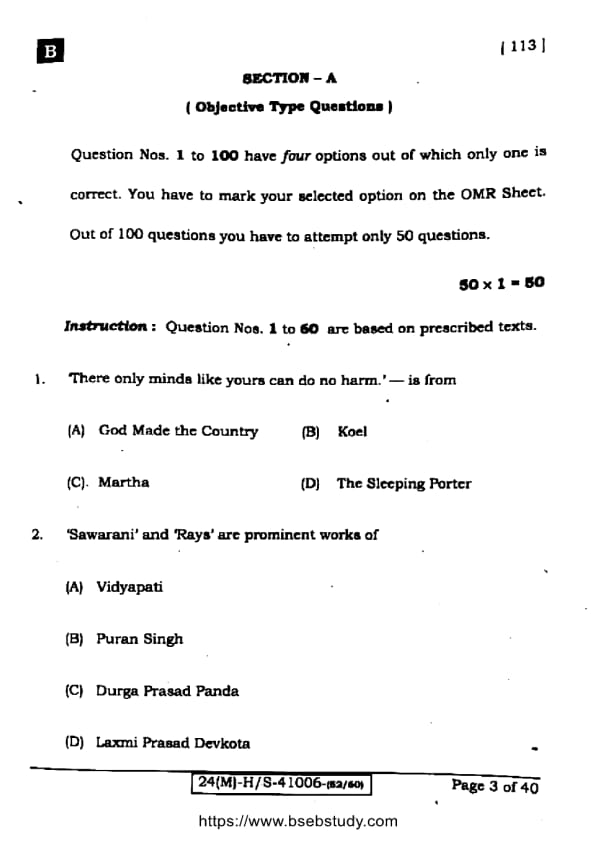
‘There only minds like yours can do no harm.’ — is from
View Solution
The line 'There only minds like yours can do no harm.' is from the work Martha. Quick Tip: In literature, remember that some works are often referenced through distinct lines or quotes. Identifying the key line from a piece can help you pinpoint the author or the specific work quickly.
‘Sawarani’ and ‘Rays’ are prominent works of
View Solution
The works ‘Sawarani’ and ‘Rays’ are famous writings of Laxmi Prasad Devkota. Quick Tip: When dealing with Indian literature, certain authors like Laxmi Prasad Devkota are widely recognized for their contributions to regional literary works, which often serve as primary references in many exams.
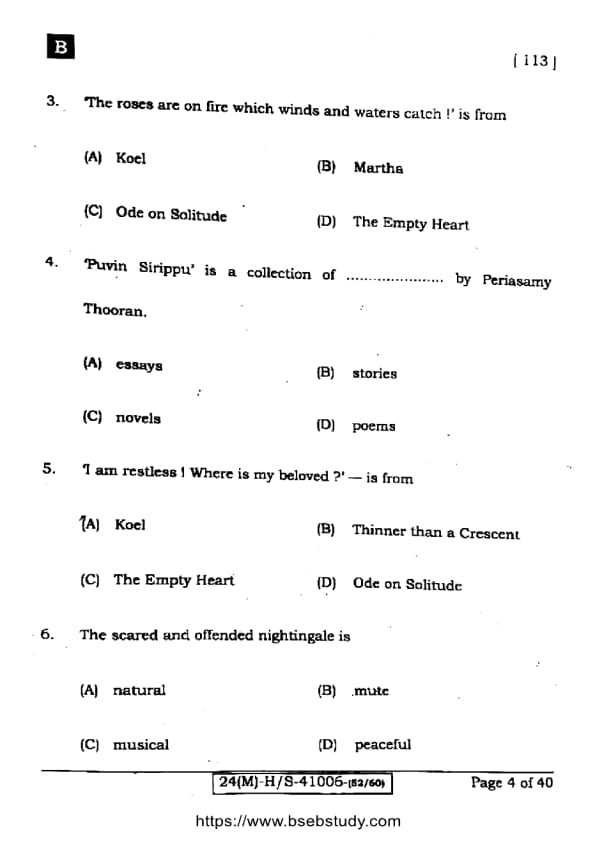
The roses are on fire which winds and waters catch! is from
View Solution
The line ‘The roses are on fire which winds and waters catch!’ is from the work The Empty Heart. Quick Tip: In poetry, paying attention to distinct lines can help identify the work. If a line evokes nature or emotional turbulence, it often belongs to works that reflect deep philosophical or emotional themes.
‘Puvin Sirippu’ is a collection of ……………. by Periasamy Thooran.
View Solution
‘Puvin Sirippu’ is a collection of poems by Periasamy Thooran. Quick Tip: For collections by prominent poets, identify the literary form by checking their genre. Periasamy Thooran is known for his contributions to Tamil poetry.
‘I am restless! Where is my beloved?’ is from
View Solution
The line ‘I am restless! Where is my beloved?’ is from the work The Empty Heart. Quick Tip: When studying literary works, remember that recurring themes such as longing or separation are often highlighted in poems that reflect deep emotional conflict.
The scared and offended nightingale is
View Solution
The nightingale in this context is described as mute, indicating a quiet or restrained state due to fear or offense. Quick Tip: In poetry, adjectives such as "scared" or "offended" are often used to describe an emotional or physical state of being, which can help you identify the correct description or metaphor.
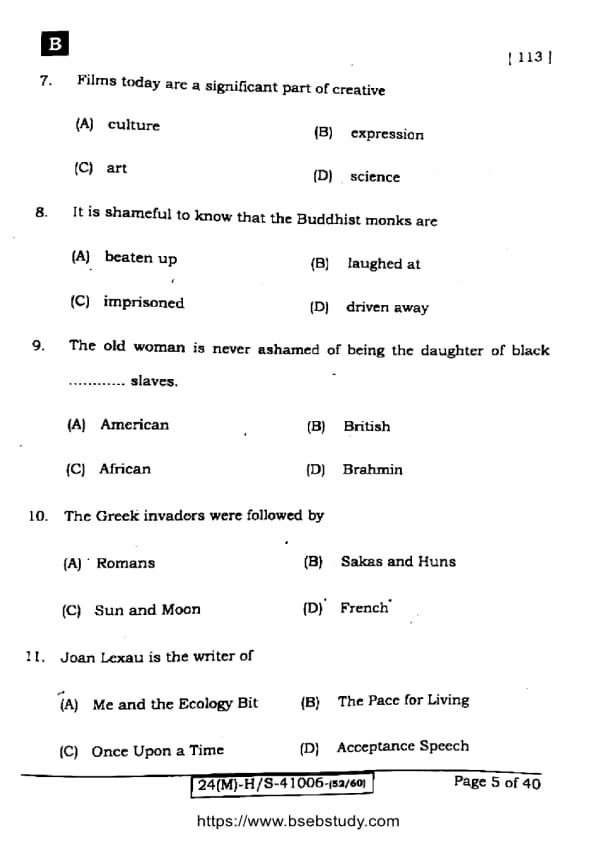
Films today are a significant part of creative
View Solution
Films today are primarily considered a significant form of art, representing a creative medium that expresses various forms of culture and emotion. Quick Tip: When thinking about different forms of expression, films often stand as an art form that combines storytelling, visuals, and sound to create an emotional impact.
It is shameful to know that the Buddhist monks are
View Solution
The sentence indicates that the Buddhist monks are driven away, suggesting a shameful act of their displacement. Quick Tip: When analyzing social issues, pay attention to terms that imply forced actions, such as "driven away," which can indicate oppression or exile.
The old woman is never ashamed of being the daughter of black ……….. slaves.
View Solution
The old woman in the sentence is proud of her heritage, particularly being the daughter of African slaves. Quick Tip: In literature, terms like "daughter of black slaves" point to the identity and historical significance tied to race and oppression. Recognizing the context is crucial in understanding the question.
The Greek invaders were followed by
View Solution
The Greek invaders were followed by the Romans, who succeeded them in power and influence in ancient history. Quick Tip: When studying history, it is important to know the sequence of empires. The Romans followed the Greeks and became dominant in the Mediterranean world.
Joan Lexau is the writer of
View Solution
Joan Lexau is the writer of the famous book Once Upon a Time, which is a notable work in children’s literature. Quick Tip: When recalling authors and their works, consider their genre or primary audience. Joan Lexau is known for her contributions to children's books.
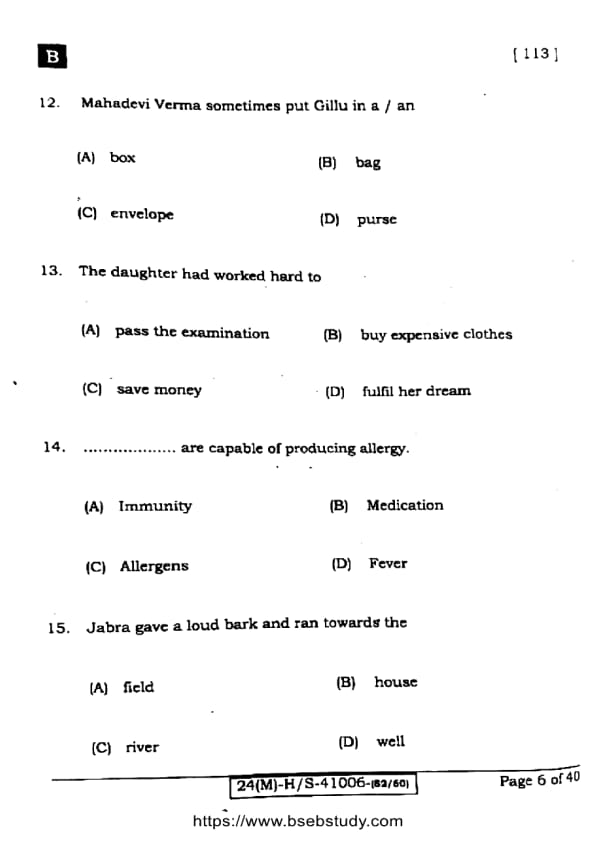
Mahadevi Verma sometimes put Gillu in a / an
View Solution
In this sentence, Mahadevi Verma sometimes put Gillu in a bag, as it is the most appropriate item for placing someone or something. Quick Tip: In literary contexts, words like "bag" or "box" often symbolize containment. Choose the word that makes most sense for the context.
The daughter had worked hard to
View Solution
The daughter had worked hard to fulfil her dream, which suggests that her efforts were directed toward achieving something important in her life. Quick Tip: In sentences about personal goals or struggles, "fulfil her dream" indicates a long-term goal, while others like "save money" or "pass the examination" are more specific.
………….. are capable of producing allergy.
View Solution
Allergens are substances capable of producing allergic reactions in sensitive individuals. Quick Tip: When studying health and biology, remember that allergens are the primary cause of allergic reactions, while immunity helps protect the body.
Jabra gave a loud bark and ran towards the
View Solution
The sentence implies that Jabra, likely a dog, gave a loud bark and ran towards the house. Quick Tip: In literary descriptions, animals like dogs are often shown running towards familiar places like a house. Use context clues to determine the most appropriate choice.
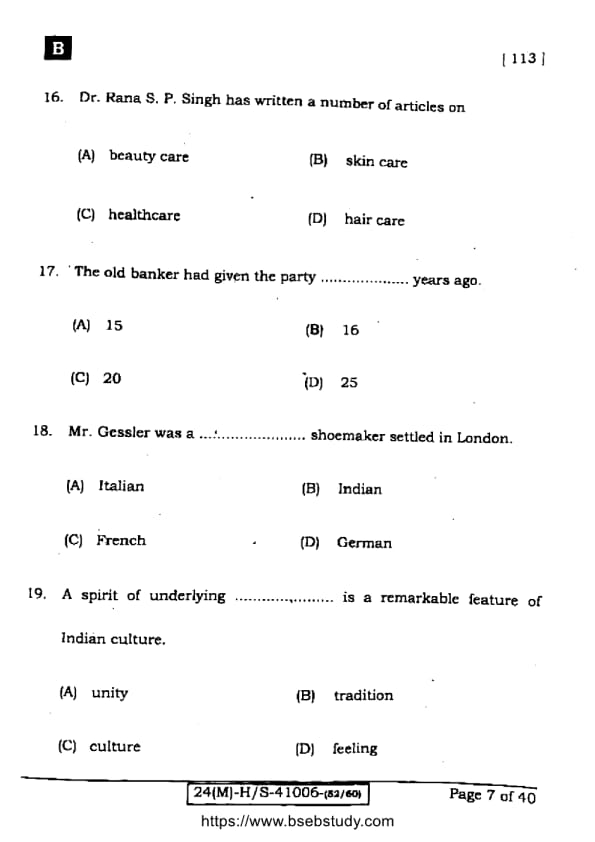
Dr. Rana S. P. Singh has written a number of articles on
View Solution
Dr. Rana S. P. Singh is known for his articles on healthcare, addressing important aspects of public health. Quick Tip: When identifying fields of study or expertise, look for keywords like "healthcare" that encompass a broad range of medical and wellness topics.
The old banker had given the party \hspace{2cm} years ago.
View Solution
The old banker had given the party 20 years ago, marking a significant passage of time. Quick Tip: Look at the context in a sentence to determine specific numbers or years that could relate to events or time spans in the narrative.
Mr. Gessler was a ……………. shoemaker settled in London.
View Solution
Mr. Gessler was an Italian shoemaker known for his skilled craftsmanship and his dedication to his craft in London. Quick Tip: When identifying characters, pay attention to clues about nationality or background. In this case, Italian suggests a rich tradition of shoemaking expertise.
A spirit of underlying ………….. is a remarkable feature of Indian culture.
View Solution
A spirit of underlying unity is one of the most important and defining features of Indian culture. Quick Tip: When considering cultural traits, unity often forms the basis of collective values, particularly in diverse cultures like India.
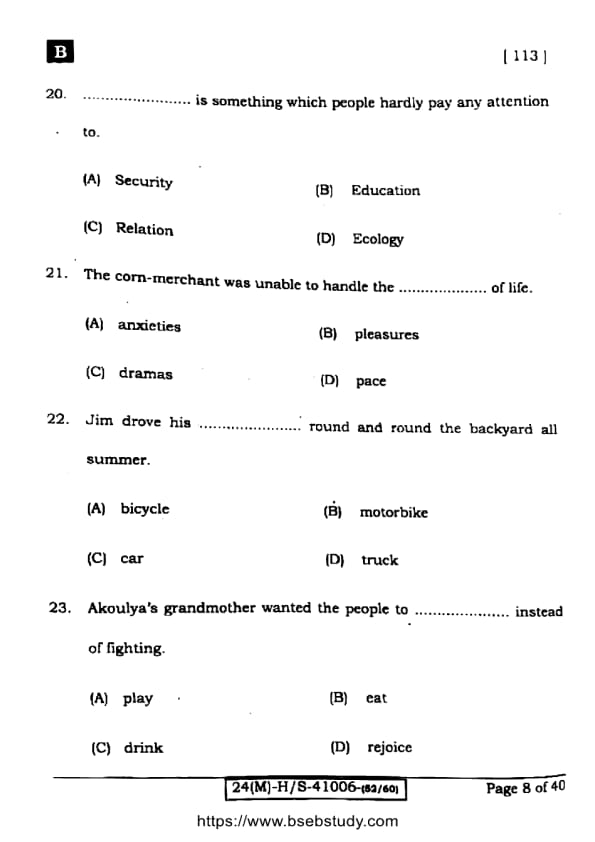
……………. is something which people hardly pay any attention to.
View Solution
Ecology is often overlooked despite its significance, as people tend to ignore environmental issues until they become pressing. Quick Tip: Pay attention to how environmental topics like ecology are presented in discussions, often underscored by global challenges.
The corn-merchant was unable to handle the ……...…... of life.
View Solution
The corn-merchant was unable to handle the pace of life, suggesting a struggle to keep up with the demands and speed of life. Quick Tip: When discussing life's challenges, words like pace can refer to the speed or demands of daily life.
Jim drove his ……………. round and round the backyard all summer.
View Solution
Jim drove his bicycle around the backyard, emphasizing a light and playful activity during the summer. Quick Tip: In childhood stories, bicycles are often used as symbols of freedom and play. Look for context that suggests light activity.
Akoulya's grandmother wanted the people to ………….. instead of fighting.
View Solution
Akoulya's grandmother wanted the people to rejoice instead of fighting, promoting peace and happiness in the community. Quick Tip: In stories about peace and harmony, terms like rejoice or celebrate often suggest a call for positive community interaction.
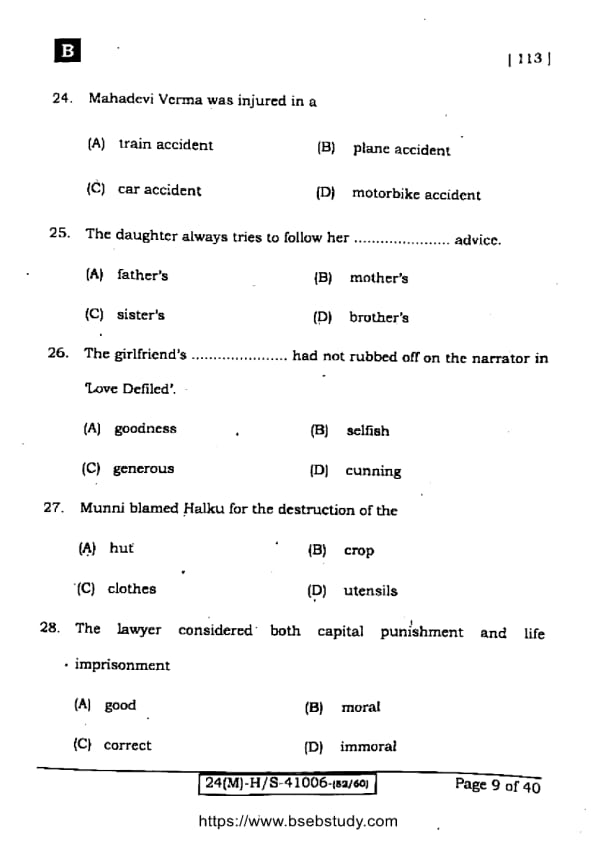
Mahadevi Verma was injured in a
View Solution
Mahadevi Verma was injured in a car accident, which is mentioned in the context of her life story. Quick Tip: When reading biographies or memoirs, keep track of significant life events, such as accidents, which may be pivotal to the narrative.
The daughter always tries to follow her …………. advice.
View Solution
The daughter always tries to follow her mother's advice, which is a common phrase in familial contexts. Quick Tip: When considering familial relationships, mother's advice is often viewed as a guiding principle in many cultures.
The girlfriend's …….…….. had not rubbed off on the narrator in 'Love Defiled'.
View Solution
The girlfriend's cunning had not rubbed off on the narrator, suggesting a contrast in character traits. Quick Tip: Look for words like "rubbed off" to identify influence or character traits that are passed on in literary works.
Munni blamed Halka for the destruction of the
View Solution
Munni blamed Halka for the destruction of the crop, which is a critical element in the story's plot. Quick Tip: In agricultural settings, the destruction of crops often symbolizes loss and hardship in stories. Pay attention to such key events.
The lawyer considered both capital punishment and life imprisonment
View Solution
The lawyer considered both capital punishment and life imprisonment from a moral perspective, weighing their ethical implications. Quick Tip: When discussing legal and ethical issues, pay attention to terms like moral, which highlight the philosophical aspect of the law.
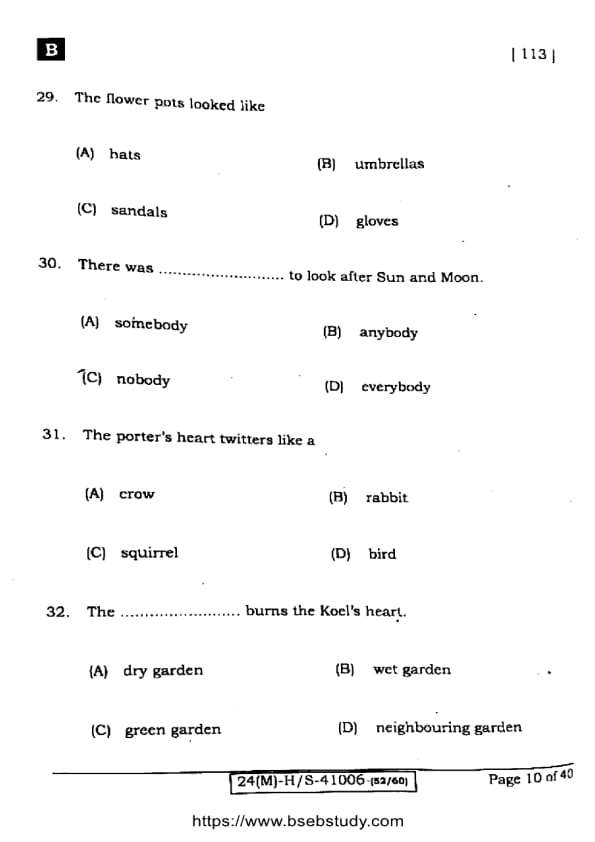
The flower pots looked like
View Solution
The flower pots looked like umbrellas, which evokes the shape and coverage typically associated with umbrellas. Quick Tip: In descriptive writing, look for comparisons that evoke common shapes and familiar objects to understand the author's imagery.
There was …………. to look after Sun and Moon.
View Solution
There was nobody to look after Sun and Moon, emphasizing a sense of neglect or abandonment in the story. Quick Tip: In literary contexts, nobody often suggests a lack of support or care for important characters or elements.
The porter's heart twitters like a
View Solution
The porter's heart twitters like a bird, suggesting lightness and fluttering emotions. Quick Tip: In figurative language, words like "twitters" often suggest a sound or movement, with animals like birds representing such qualities.
The …………….. burns the Koel's heart.
View Solution
The green garden burns the Koel's heart, likely evoking a sense of longing or discomfort in the bird. Quick Tip: In stories with animals, settings like green gardens often symbolize nature's beauty or the contrast between desire and reality.
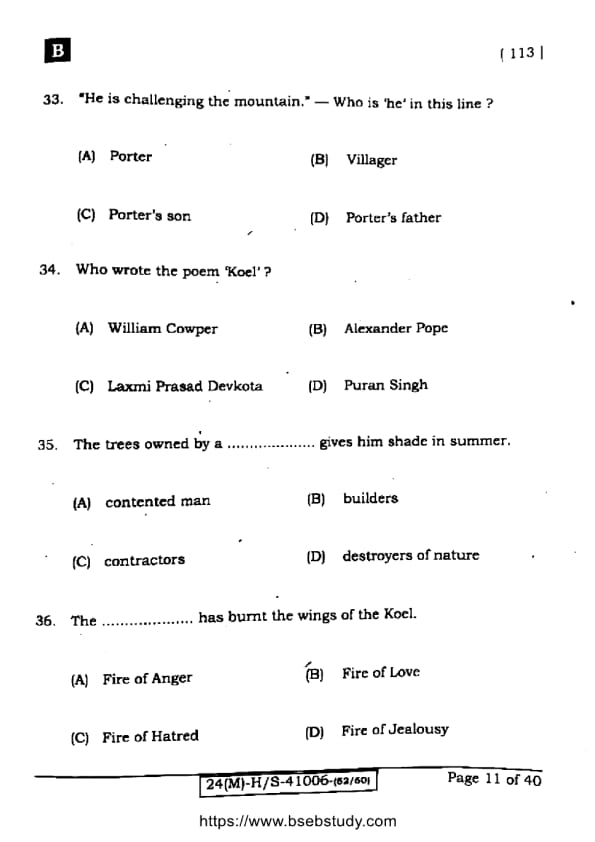
“He is challenging the mountain.” - Who is 'he' in this line?
View Solution
In this line, he refers to the Porter, as the context suggests a person undertaking the challenge of carrying heavy loads. Quick Tip: In literature, identifying the subject of a sentence is essential to understanding the context. Look for clues that hint at who is performing the action.
Who wrote the poem 'Koel'?
View Solution
The poem 'Koel' was written by Laxmi Prasad Devkota, a prominent poet known for his contributions to Nepali literature. Quick Tip: Remember to associate literary works with their authors based on cultural and historical contexts. Devkota's works often feature deep emotional themes.
The trees owned by a …….……... gives him shade in summer.
View Solution
The trees owned by a contented man provide him shade in summer, symbolizing peace and tranquility. Quick Tip: In literature, the idea of ownership and nature often reflects the inner state of the character. A "contented man" is likely to have a harmonious relationship with his surroundings.
The …………... has burnt the wings of the Koel.
View Solution
The Fire of Jealousy has burnt the wings of the Koel, symbolizing the destructive power of negative emotions. Quick Tip: Pay attention to metaphorical expressions. "Fire" often represents intense feelings such as anger, hatred, or jealousy.
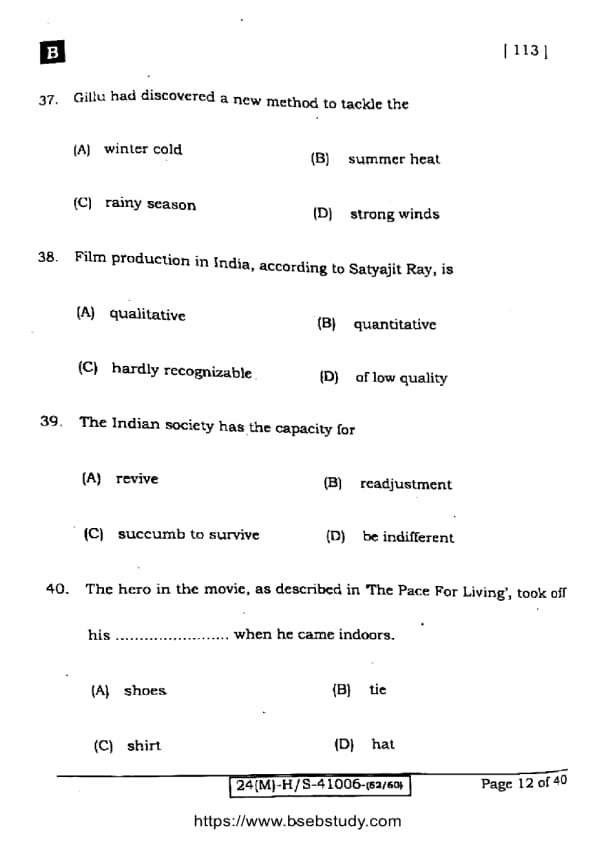
Gillu had discovered a new method to tackle the
View Solution
Gillu had discovered a new method to tackle the summer heat, which is a common struggle in hot climates. Quick Tip: Look for the context of the challenge in a story. Summer heat is often used as a metaphor for harsh conditions or struggles.
Film production in India, according to Satyajit Ray, is
View Solution
Satyajit Ray believed that film production in India was often of low quality compared to international standards, a critique he made about the industry during his time. Quick Tip: When analyzing criticism of art or culture, pay attention to the specific aspects being criticized, such as quality in this case.
The Indian society has the capacity for
View Solution
Indian society has the capacity for readjustment, which helps it adapt to changing circumstances over time. Quick Tip: In analyzing societies, look for terms like readjustment that describe resilience and the ability to cope with change.
The hero in the movie, as described in 'The Pace For Living', took off his …………. when he came indoors.
View Solution
The hero took off his hat when he came indoors, a common gesture associated with entering a home or respectful behavior. Quick Tip: In stories, paying attention to small actions like removing a hat can indicate respect or a transition between environments.
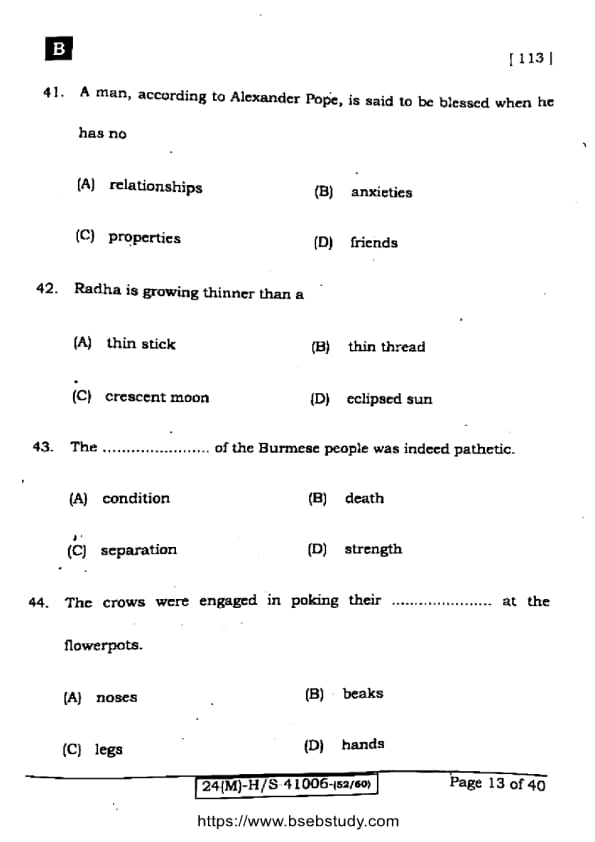
A man, according to Alexander Pope, is said to be blessed when he has no
View Solution
According to Alexander Pope, a man is blessed when he has no anxieties, emphasizing peace of mind as a form of blessing. Quick Tip: When studying literature, philosophers like Alexander Pope often emphasize mental peace over material wealth, as seen in the absence of anxieties.
Radha is growing thinner than a
View Solution
Radha is growing thinner than a crescent moon, a metaphor that suggests a very delicate or frail appearance. Quick Tip: Metaphors like crescent moon are often used to depict something fragile or diminishing in literature.
The …….………. of the Burmese people was indeed pathetic.
View Solution
The condition of the Burmese people was indeed pathetic, indicating their dire situation. Quick Tip: In literature, the term condition often refers to the general state or well-being of a group or individual.
The crows were engaged in poking their ………... at the flowerpots.
View Solution
The crows were engaged in poking their beaks at the flowerpots, as birds typically use their beaks for such activities. Quick Tip: In stories involving animals, beaks are often associated with actions like pecking or poking, which are common behaviors in birds.
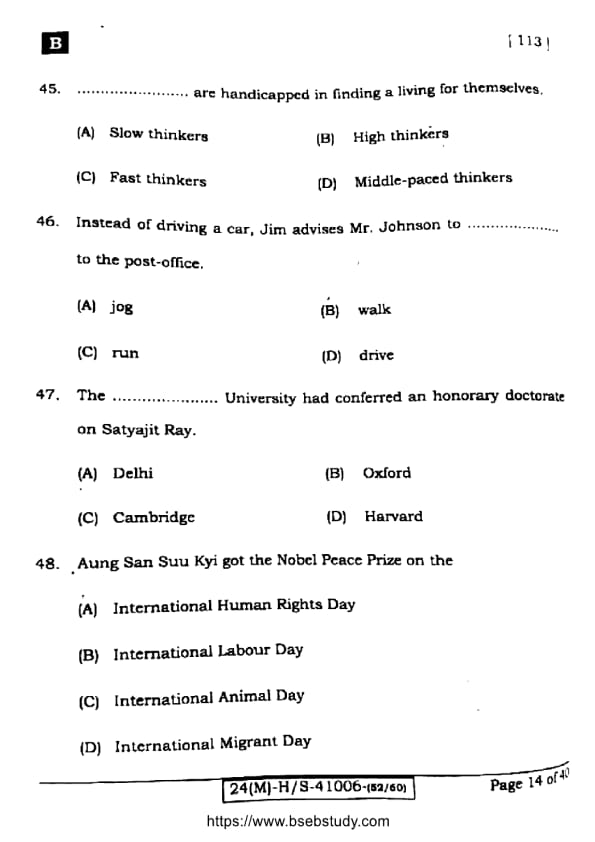
.......................... are handicapped in finding a living for themselves.
View Solution
Slow thinkers are handicapped in finding a living for themselves, as speed and quick thinking are often critical in competitive environments. Quick Tip: In general discussions about success, attributes like speed or adaptability are key. Consider how pace impacts decision-making and problem-solving.
Instead of driving a car, Jim advises Mr. Johnson to ………... to the post-office.
View Solution
Jim advises Mr. Johnson to walk to the post-office, which suggests a preference for a more relaxed or environmentally friendly mode of transport. Quick Tip: Walking is often advised for short distances and is healthier compared to driving. It also suggests a more reflective or leisurely approach to tasks.
The …………... University had conferred an honorary doctorate on Satyajit Ray.
View Solution
Oxford University conferred an honorary doctorate on Satyajit Ray, recognizing his significant contributions to cinema and culture. Quick Tip: Honorary degrees are often conferred by prestigious universities to individuals who have made outstanding contributions in their fields.
Aung San Suu Kyi got the Nobel Peace Prize on the
View Solution
Aung San Suu Kyi received the Nobel Peace Prize on International Human Rights Day, a day celebrating the protection of human rights globally. Quick Tip: When discussing figures like Aung San Suu Kyi, consider how international observances such as Human Rights Day align with their contributions to global peace.
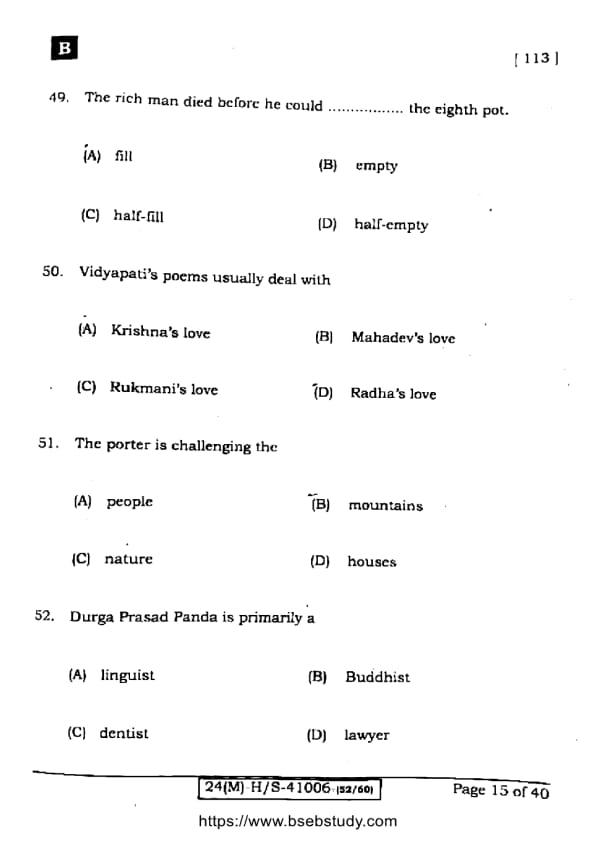
The rich man died before he could ………….. the eighth pot.
View Solution
The rich man died before he could fill the eighth pot, which implies an incomplete or unachieved goal before his death. Quick Tip: Look for symbolic meanings when discussing pots or containers. They often symbolize goals, achievements, or life stages.
Vidyapati's poems usually deal with
View Solution
Vidyapati's poems are known for their themes of Radha's love, exploring deep emotional and spiritual connections. Quick Tip: In the study of classical literature, themes of divine love, such as Radha's love, are significant in devotional poetry.
The porter is challenging the
View Solution
The porter is challenging the mountains, symbolizing the difficulties and struggles faced in his profession or life. Quick Tip: When characters are depicted as challenging nature, such as mountains, it often symbolizes their determination or struggle against overwhelming odds.
Durga Prasad Panda is primarily a
View Solution
Durga Prasad Panda is primarily a dentist, focusing on his professional identity. Quick Tip: When identifying an individual's primary profession, consider their educational background and the context in which they are mentioned.
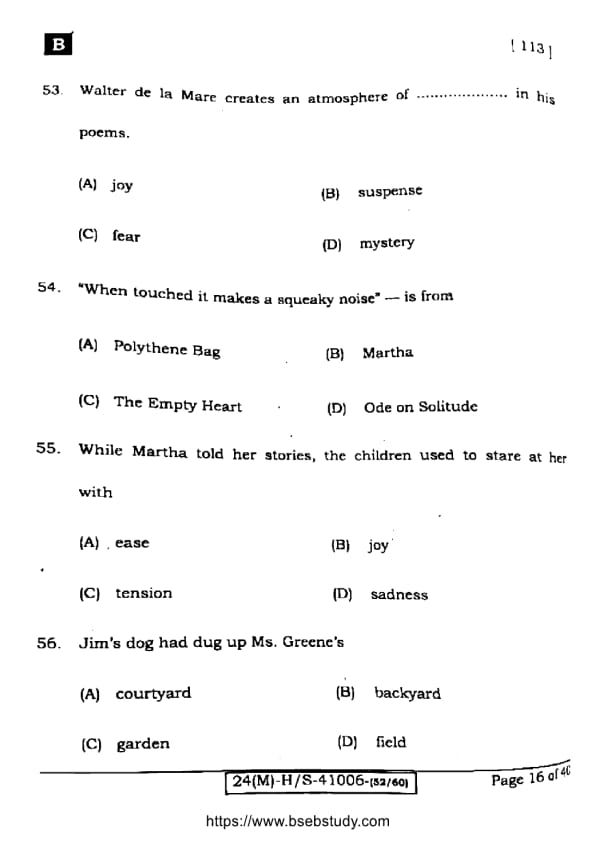
Walter de la Mare creates an atmosphere of ………….. in his poems.
View Solution
Walter de la Mare is known for creating an atmosphere of mystery in his poems, often invoking elements of the unknown. Quick Tip: In poetry, atmosphere is often created through word choice and setting. Mystery is a common theme in the works of writers like Walter de la Mare.
“When touched it makes a squeaky noise” – is from
View Solution
The line “When touched it makes a squeaky noise” is from Polythene Bag, referencing the sound associated with a plastic bag. Quick Tip: Sound-related descriptions, like "squeaky noise," are often used in poetry to evoke sensory experiences and enhance imagery.
While Martha told her stories, the children used to stare at her with
View Solution
While Martha told her stories, the children used to stare at her with joy, reflecting their enjoyment of the tales. Quick Tip: When children are involved in stories, their expressions like joy often highlight their fascination and engagement.
Jim's dog had dug up Ms. Greene's
View Solution
Jim's dog had dug up Ms. Greene's backyard, a common place for dogs to explore or dig. Quick Tip: In stories, places like the backyard often symbolize personal space or private areas, where unexpected events can occur.
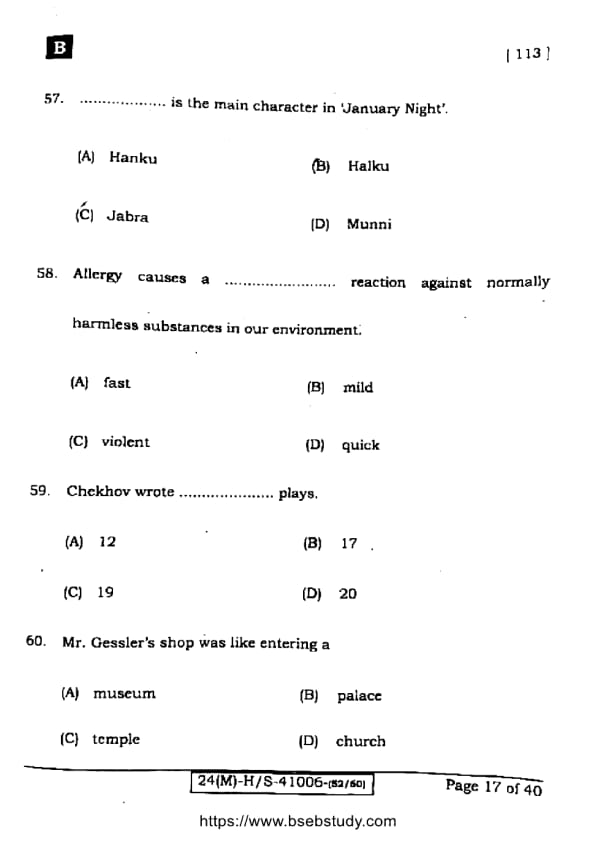
.......................... is the main character in 'January Night'.
View Solution
Jabra is the main character in 'January Night', a central figure in the narrative. Quick Tip: In stories, identifying the main character early on is essential for understanding the plot and themes.
Allergy causes a …………. reaction against normally harmless substances in our environment.
View Solution
Allergy usually causes a mild reaction, although it can vary depending on the sensitivity of the individual. Quick Tip: Allergy reactions are often mild but can escalate in severity depending on exposure to allergens.
Chekhov wrote …………. plays.
View Solution
Chekhov wrote 19 plays, which were highly influential in shaping modern theater. Quick Tip: When studying authors, knowing the exact number of works they have produced helps to understand their contributions to literature.
Mr. Gessler's shop was like entering a
View Solution
Mr. Gessler's shop was described as being like a temple, suggesting a place of quiet reverence and deep dedication. Quick Tip: In literature, comparing a shop to a temple often signifies a sacred or serious atmosphere, especially in a place of craftsmanship.
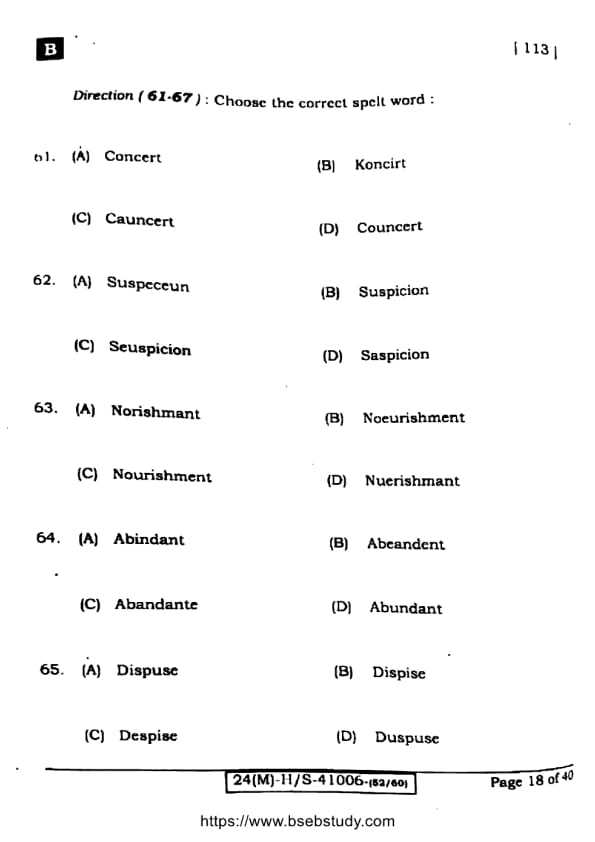
Choose the correct spelt word:
View Solution
The correct spelling is Concert, which refers to a musical performance. Quick Tip: When faced with multiple spellings, check for the most common form of the word in everyday usage.
Choose the correct spelt word:
View Solution
The correct spelling is Suspicion, which refers to a feeling of doubt or mistrust. Quick Tip: When trying to decide on spelling, focus on phonetics and common word endings to help you identify the correct option.
Choose the correct spelt word:
View Solution
The correct spelling is Nourishment, which refers to the process of providing food necessary for growth. Quick Tip: When spelling words related to nutrition, the correct form is often derived from Latin or Greek roots, like Nourishment.
Choose the correct spelt word:
View Solution
The correct spelling is Abundant, which refers to something existing in large quantities. Quick Tip: When in doubt about spelling, look for the root of the word, like Abundant, which is rooted in the Latin word for "overflowing."
Choose the correct spelt word:
View Solution
The correct spelling is Despise, which means to regard with contempt or scorn. Quick Tip: When words have similar spellings, pay attention to consonants that are silent or commonly paired to help you choose the correct one.
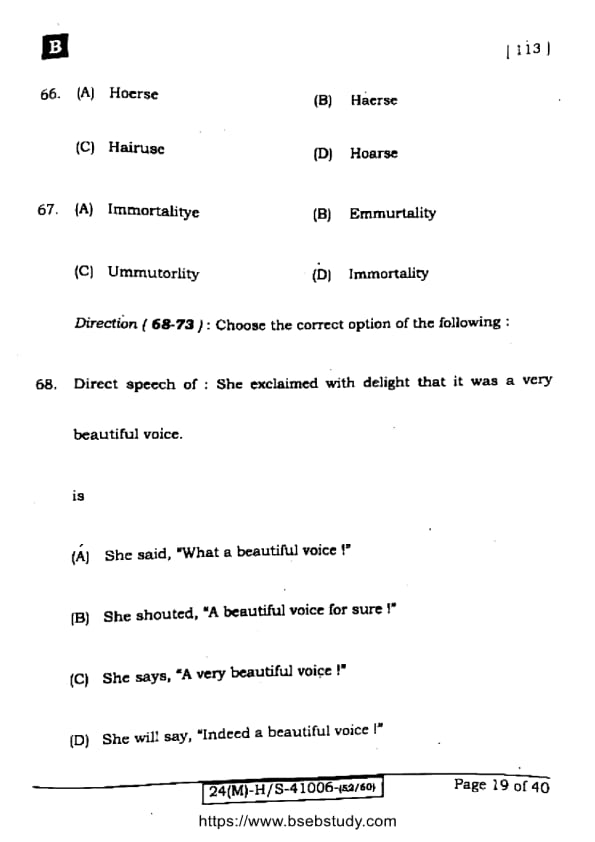
Choose the correct spelling of the word:
View Solution
The correct spelling of the word is "Hoarse," which means rough or harsh in sound. The other options contain incorrect spellings. Quick Tip: Remember that in English, homophones (words that sound the same but have different spellings) can often confuse spelling. In this case, "hoarse" refers to roughness in voice, while "horse" refers to the animal.
Choose the correct spelling of the word:
View Solution
The correct spelling is "Immortality," which refers to the state of being immortal. The other options contain incorrect spellings. Quick Tip: When faced with multiple spelling options, focus on the word's meaning and root. "Immortality" comes from the Latin "immortalis," meaning "not dying."
Direct speech of: She exclaimed with delight that it was a very beautiful voice.
View Solution
The sentence is in reported speech, so the correct conversion maintains the exclamation and the original meaning. The correct transformation for this is: "She said, 'What a beautiful voice!'" Quick Tip: When converting direct speech to reported speech, be sure to adjust punctuation and pronouns accordingly, but maintain the exclamation or questioning tone when necessary.
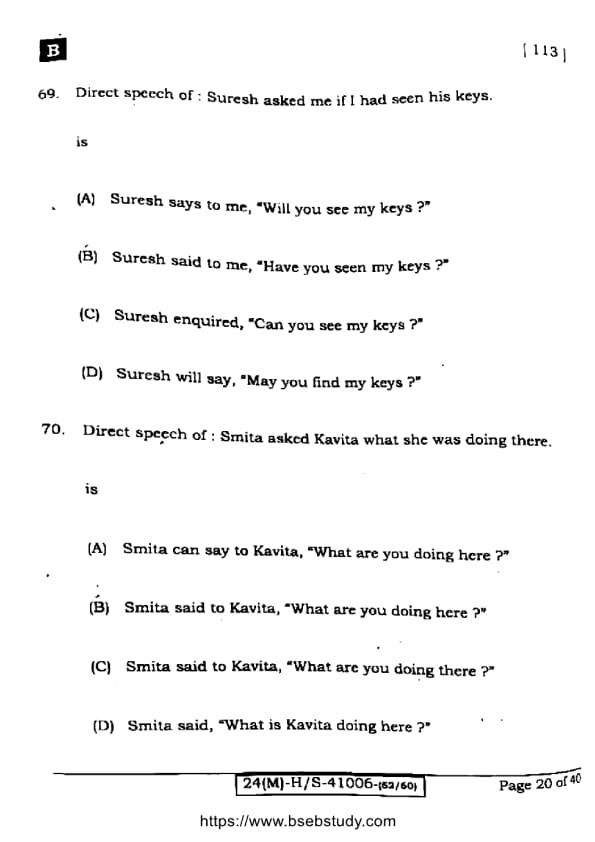
Direct speech of: Suresh asked me if I had seen his keys.
View Solution
This is an example of a question in reported speech. The correct option transforms the direct question to indirect speech appropriately. Quick Tip: When changing direct questions to indirect speech, ensure the question word ("have", "can", etc.) remains in the correct tense.
Direct speech of: Smita asked Kavita what she was doing there.
View Solution
The correct option is a direct question, where the question remains the same. The indirect form has been appropriately converted from direct speech. Quick Tip: For indirect questions, maintain the word order while changing pronouns. The question mark is omitted in indirect speech.
Indirect speech of: Ramesh said to me, "Thank you!"
View Solution
In indirect speech, the reporting verb is in the past tense. The phrase "Thank you" is reported as "Ramesh thanked me." Quick Tip: When converting direct speech to indirect speech in past tense, ensure the reporting verb aligns with the tense of the original statement.
Indirect speech of: Chotu said to Vishal, "Work hard."
View Solution
The correct transformation involves changing the imperative sentence into a suggestion or advice, making it: "Chotu advised Vishal to work hard." Quick Tip: In indirect speech, imperative sentences are often reported as requests, suggestions, or orders depending on the context.
Indirect speech of: He said to Veenu, "Are you tired?"
View Solution
The correct indirect speech conversion involves using the past tense in the reporting verb and switching the question format to a declarative sentence. The correct option is: "He asked Veenu whether she was tired." Quick Tip: When converting direct questions into indirect speech, remember to change the tense of the reporting verb and switch the auxiliary verb to match the past tense.
Atul agreed .................. my suggestion.
View Solution
The correct preposition after "agreed" is "with," making the sentence: "Atul agreed with my suggestion." Quick Tip: When someone agrees to something, the preposition "with" is generally used to indicate the person or thing they agreed with.
The Principal is known .................. me.
View Solution
The correct preposition after "known" in this context is "to," as in: "The Principal is known to me." Quick Tip: When referring to someone being recognized or familiar to another, use the preposition "to."
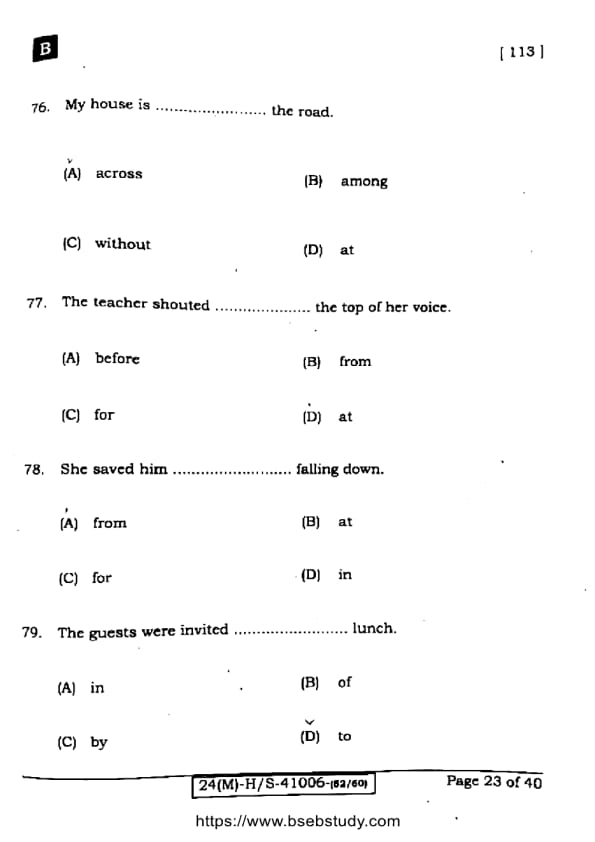
My house is ................. the road.
View Solution
The correct preposition is "across," as it refers to something being on the opposite side of the road: "My house is across the road." Quick Tip: Use "across" when referring to something located on the opposite side of a specific area or road.
The teacher shouted ............ the top of her voice.
View Solution
The correct preposition is "from," indicating the source of the shouting: "The teacher shouted from the top of her voice." Quick Tip: When referring to the origin or source of a loud sound or action, use the preposition "from."
She saved him ................. falling down.
View Solution
The correct preposition is "from," as it denotes prevention or protection: "She saved him from falling down." Quick Tip: Use "from" when referring to preventing someone or something from an undesirable action.
The guests were invited ................. lunch.
View Solution
The correct preposition is "to," indicating the purpose of the invitation: "The guests were invited to lunch." Quick Tip: When inviting someone to an event, use the preposition "to," such as "invited to lunch."
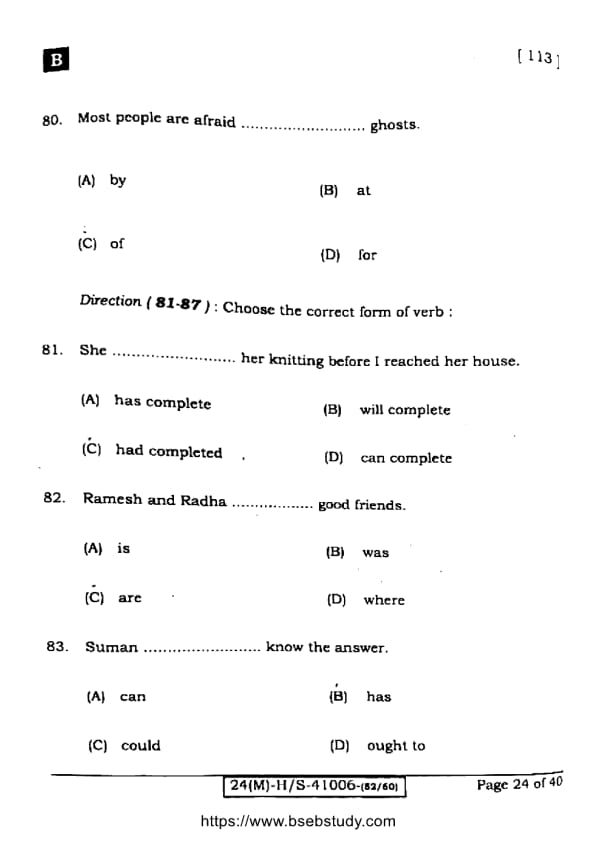
Most people are afraid ............... ghosts.
View Solution
The correct preposition is "of," as we typically say "afraid of" when referring to something one fears. Quick Tip: Use "afraid of" when talking about something one fears, such as "afraid of ghosts."
She ................... her knitting before I reached her house.
View Solution
The correct verb form is "had completed" as it refers to an action completed before another event in the past. Quick Tip: Use the past perfect tense ("had completed") when talking about an action that was completed before another past event.
Ramesh and Radha ................. good friends.
View Solution
The correct verb form is "are" since Ramesh and Radha are two people, making the subject plural. Quick Tip: Use "are" when the subject is plural, such as "Ramesh and Radha are good friends."
Suman ................. know the answer.
View Solution
The correct modal verb is "can," indicating ability in the present tense: "Suman can know the answer." Quick Tip: Use "can" to express ability or possibility in the present or future.
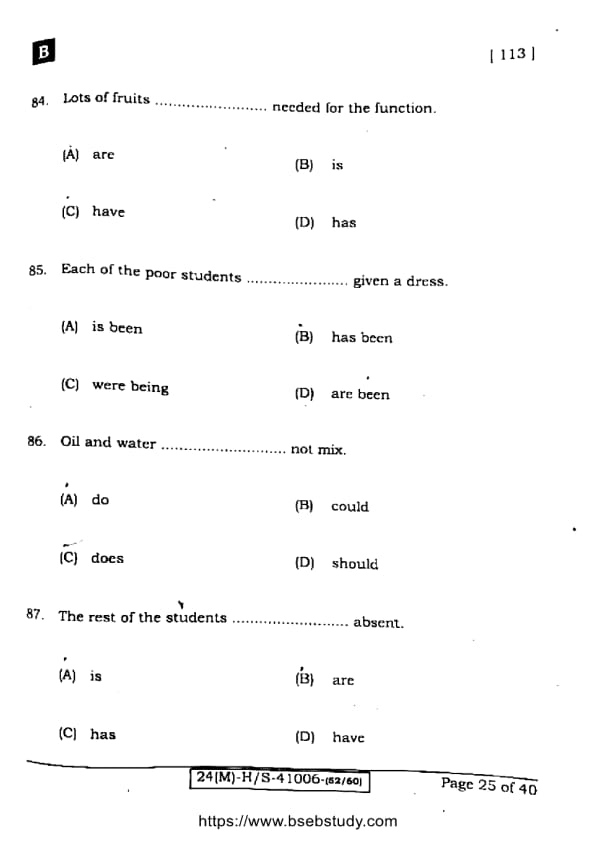
Lots of fruits ................. needed for the function.
View Solution
Since "fruits" is plural, the correct verb form is "are": "Lots of fruits are needed." Quick Tip: When the subject is plural, use the plural form of the verb, such as "are needed" in this case.
Each of the poor students ................. given a dress.
View Solution
The correct verb phrase is "has been" since "each" is singular: "Each of the poor students has been given a dress." Quick Tip: When using "each" as the subject, treat it as singular and use "has" instead of "have."
Oil and water ................. not mix.
View Solution
The correct verb form is "does" because "oil and water" is considered a singular subject in this case: "Oil and water does not mix." Quick Tip: Use "does" when a singular subject or a collective noun is involved in the verb agreement.
The rest of the students ................. absent.
View Solution
Since "rest" is singular, the correct verb is "is": "The rest of the students is absent." Quick Tip: "Rest" is a singular noun, so use "is" to match the subject.
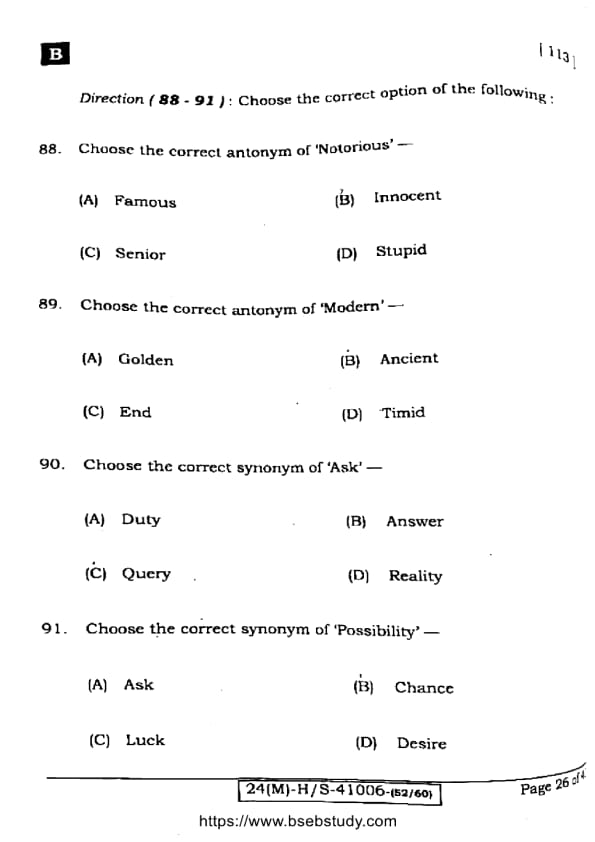
Choose the correct antonym of 'Notorious':
View Solution
The antonym of "Notorious" (which means well-known for bad reasons) is "Innocent," meaning free from guilt. Quick Tip: "Notorious" means famous for something bad, while "Innocent" refers to someone free from wrongdoing.
Choose the correct antonym of 'Modern':
View Solution
The antonym of "Modern" is "Ancient," as it refers to something very old or from the past. Quick Tip: "Modern" refers to the present time, while "Ancient" refers to something that is very old or from an earlier time period.
Choose the correct synonym of 'Ask':
View Solution
The synonym of "Ask" is "Query," as both refer to seeking information. Quick Tip: "Ask" and "Query" both mean to request information or an answer.
Choose the correct synonym of 'Possibility':
View Solution
The synonym of "Possibility" is "Chance," as both refer to something that could happen. Quick Tip: "Possibility" and "Chance" both refer to an event or outcome that may or may not occur.
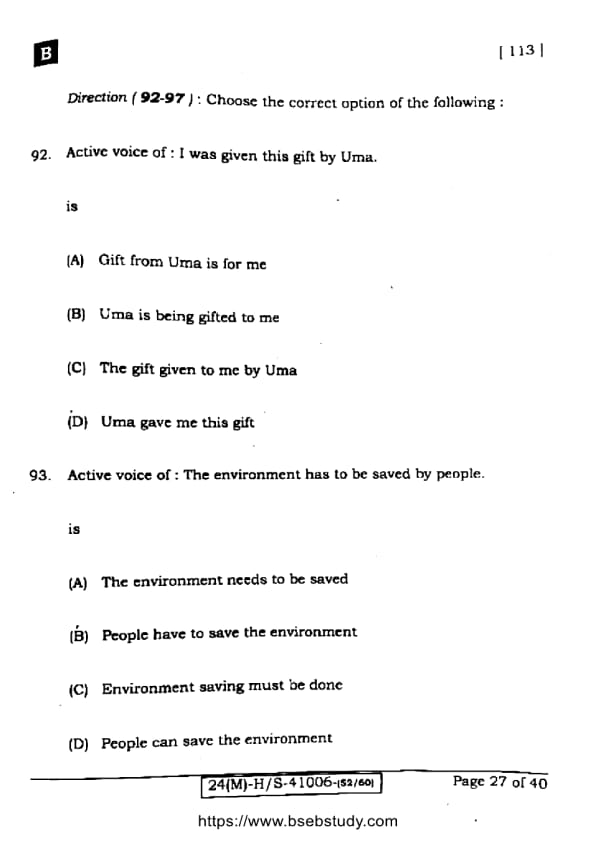
Active voice of: I was given this gift by Uma.
View Solution
The correct transformation to active voice is: "Uma gave me this gift," where the subject "Uma" performs the action. Quick Tip: When changing from passive to active voice, the subject (doer) comes first, followed by the verb and object.
Active voice of: The environment has to be saved by people.
View Solution
The correct active voice transformation is: "People can save the environment," where the subject "people" performs the action. Quick Tip: When transforming passive voice into active, the agent (doer of the action) becomes the subject of the sentence.
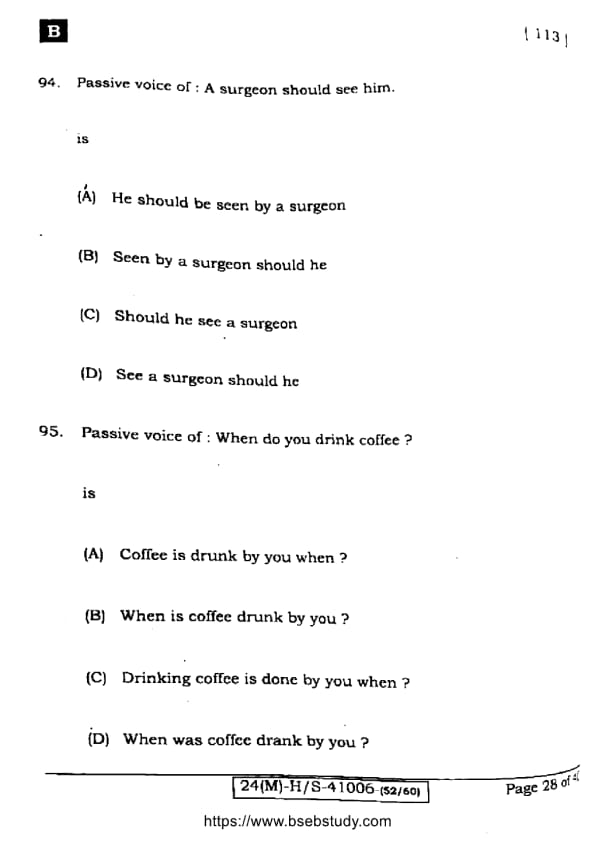
Passive voice of: A surgeon should see him.
View Solution
The correct passive transformation is: "He should be seen by a surgeon." Quick Tip: In passive voice, the object of the sentence becomes the subject, and the form of the verb changes accordingly.
Passive voice of: When do you drink coffee?
View Solution
The correct passive transformation is: "When is coffee drunk by you?" Quick Tip: When converting a question to passive voice, ensure that the subject becomes the object, and adjust the auxiliary verb appropriately.
Active voice of: Chicken is to be eaten by Suchi.
View Solution
The correct active voice transformation is: "Suchi must eat chicken," where "Suchi" is the subject who performs the action. Quick Tip: When transforming passive to active, the subject performing the action should come first in the sentence.
Passive voice of: Sinha likes his subordinates to flatter him.
View Solution
The correct passive voice transformation is: "Sinha likes to be flattered by his subordinates." Quick Tip: In passive voice, the action is received by the subject, and the agent (doer) is placed after "by."
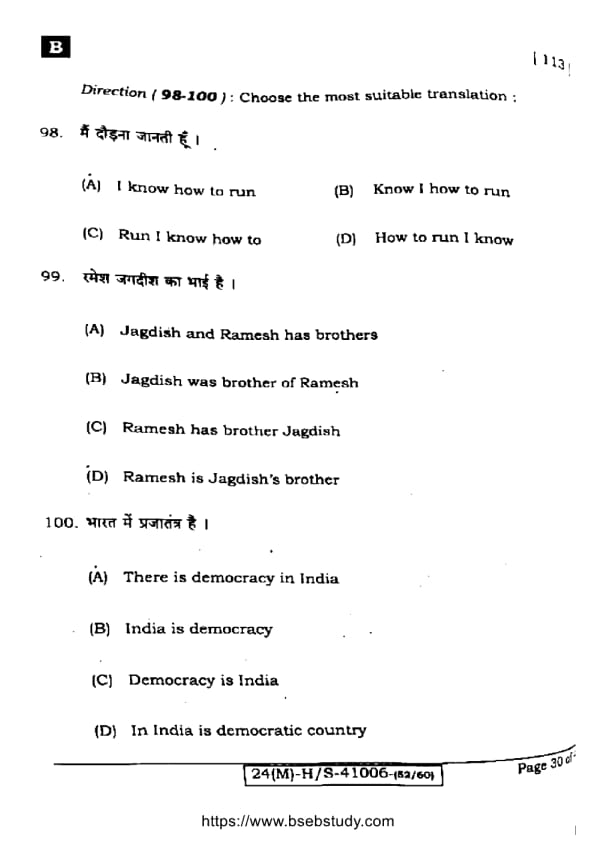
Translate:

View Solution
The correct translation is: "I know how to run," where "I" is the subject, followed by the verb "know" and the object phrase "how to run." Quick Tip: When translating from Hindi to English, pay attention to the word order. In Hindi, the verb often comes at the end, while in English it typically comes after the subject.
Translate:

View Solution
The correct translation is: "Ramesh is Jagdish's brother," where "Ramesh" is the subject, followed by the verb "is" and the possessive structure "Jagdish's brother." Quick Tip: In possessive sentences, use "is" for linking the subject and the object. Pay attention to possessive forms in English, like "Jagdish's brother."
Translate:

View Solution
The correct translation is: "There is democracy in India." Quick Tip: In sentences involving existence or presence, use the phrase "There is" in English, especially when describing things like democracy or systems in a place.
Section-B
(Descriptive Type Questions)
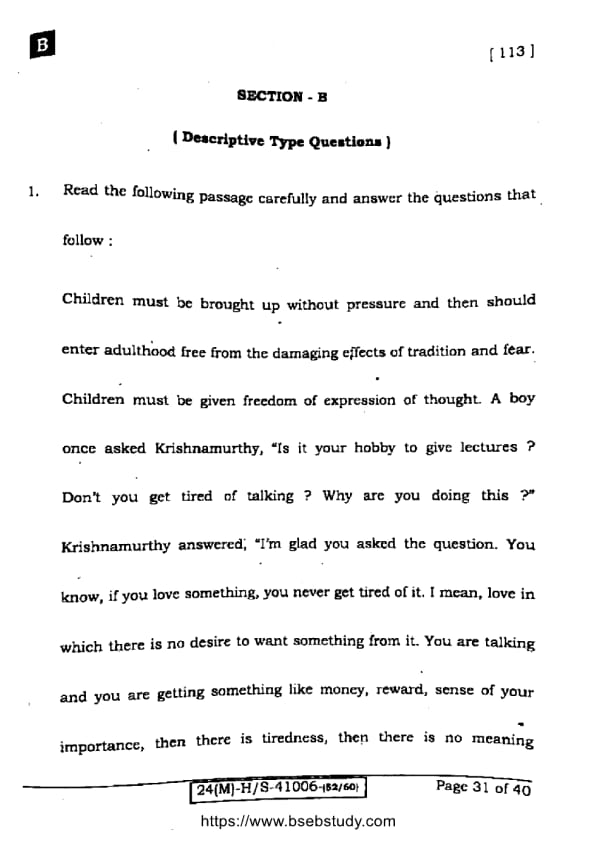
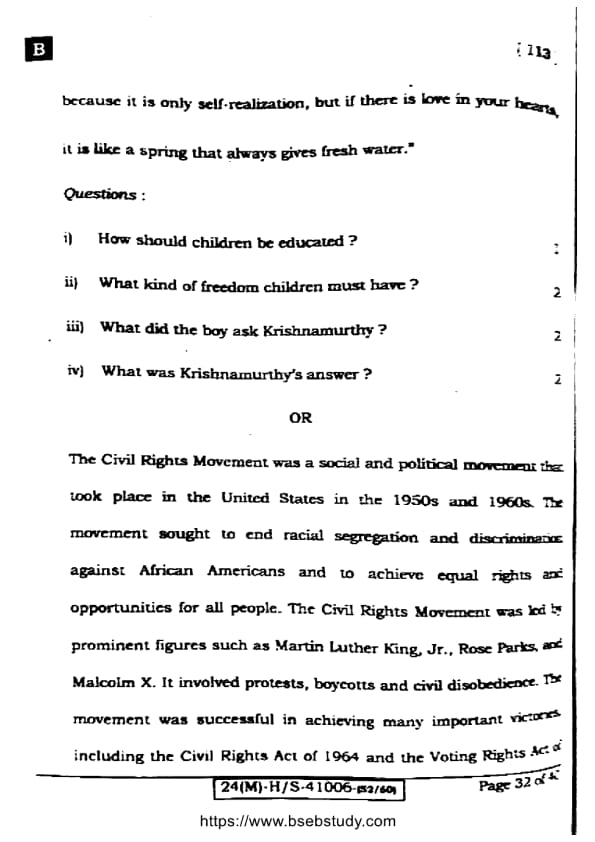
(i) How should children be educated?
View Solution
Children should be educated without pressure and must be allowed to enter adulthood free from the damaging effects of tradition and fear. They must be provided with the freedom to express their thoughts and opinions freely. Quick Tip: When discussing child education, emphasize the importance of creating an environment that nurtures free thought and emotional development without imposing societal pressures.
(ii) What kind of freedom children must have?
View Solution
Children must have the freedom of expression of thought. They should be free to think independently and should not be bound by traditional constraints or fearful influences. Quick Tip: Freedom of expression is vital for children's intellectual growth. Allowing them to voice their opinions helps them build confidence and develop a critical mindset.
(iii) What did the boy ask Krishnamurthy?
View Solution
The boy asked Krishnamurthy, "Is it your hobby to give lectures? Don't you get tired of talking? Why are you doing this?" Quick Tip: When answering questions, always try to understand the underlying curiosity. The boy's question stems from wondering about Krishnamurthy's passion and the source of his energy.
(iv) What was Krishnamurthy's answer?
View Solution
Krishnamurthy answered, "I'm glad you asked the question. You know, if you love something, you never get tired of it. I mean, love in which there is no desire to want something from it. You are talking and getting something like money, reward, and sense of your importance, then there is tiredness, and there is no meaning. But if there is love in your heart, it is like a spring that always gives fresh water." Quick Tip: Krishnamurthy’s response teaches that when you do something out of pure love and self-realization, there is no fatigue. It’s the difference between doing something for a reward and doing something because you truly enjoy it.
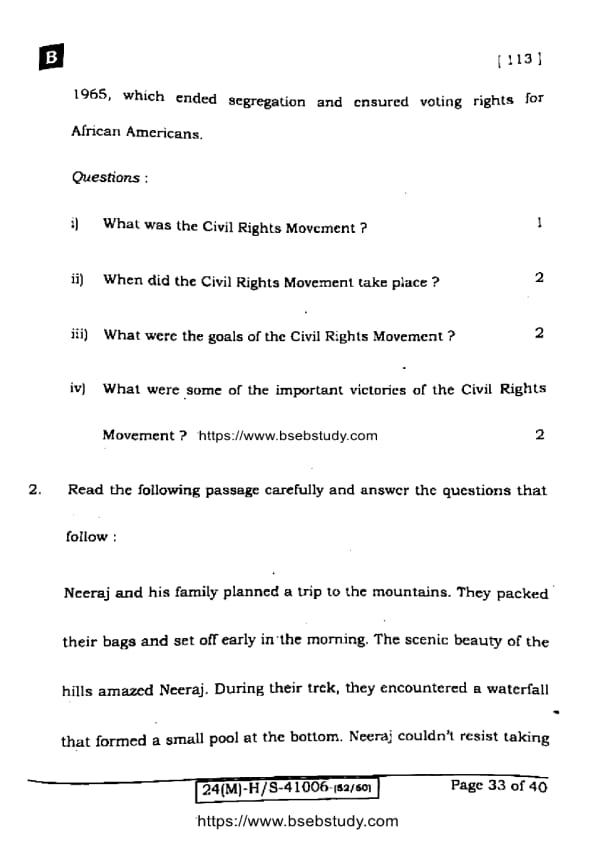
(i) What was the Civil Rights Movement?
View Solution
The Civil Rights Movement was a social and political movement in the United States that aimed to end racial segregation and discrimination against African Americans. It sought to achieve equal rights and opportunities for all people, particularly for African Americans. Quick Tip: The Civil Rights Movement was a critical period in U.S. history that involved numerous protests and legal challenges aimed at achieving equality and justice for African Americans. Keep in mind the importance of key events like the Civil Rights Act and Voting Rights Act.
(ii) When did the Civil Rights Movement take place?
View Solution
The Civil Rights Movement took place in the 1950s and 1960s in the United States. Quick Tip: The Civil Rights Movement occurred during the mid-20th century when the U.S. was facing significant issues of racial inequality. Understanding the historical context helps in recognizing the movement’s lasting impact on American society.
(iii) What were the goals of the Civil Rights Movement?
View Solution
The primary goals of the Civil Rights Movement were to end racial segregation, fight against discrimination, and ensure equal rights and opportunities for African Americans and other marginalized communities. Quick Tip: Focus on the main objectives of the Civil Rights Movement: ending segregation, achieving racial equality, and promoting civil rights for African Americans. The movement led to key legislative changes.
(iv) What were some of the important victories of the Civil Rights Movement?
View Solution
Some of the important victories of the Civil Rights Movement include the Civil Rights Act of 1964, which outlawed discrimination based on race, color, religion, sex, or national origin, and the Voting Rights Act of 1965, which ensured voting rights for African Americans by prohibiting racial discrimination in voting practices. Quick Tip: Key victories like the Civil Rights Act of 1964 and the Voting Rights Act of 1965 were pivotal in dismantling legalized racial discrimination. These pieces of legislation marked important progress toward equality.
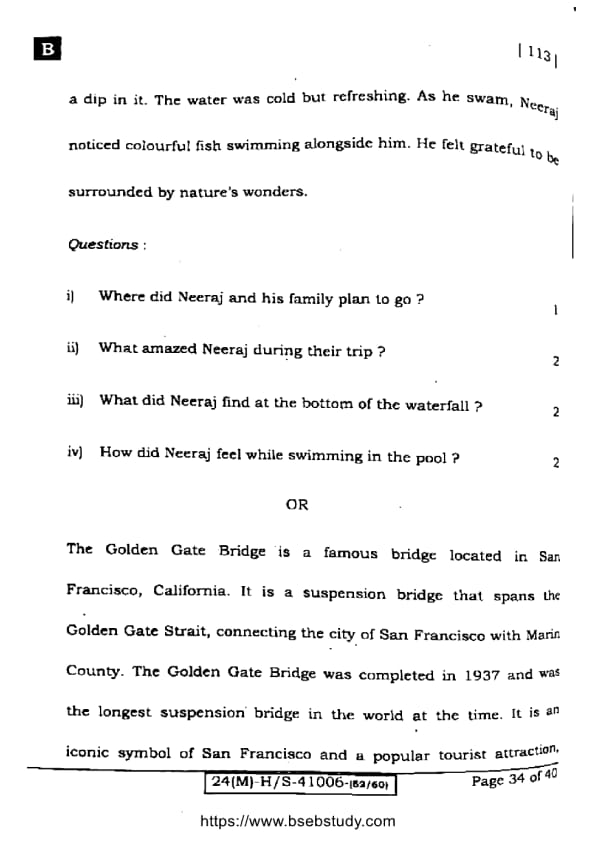
(i) Where did Neeraj and his family plan to go?
View Solution
Neeraj and his family planned to go to the mountains. Quick Tip: When writing answers, make sure to provide a direct response to the question with details from the passage.
(ii) What amazed Neeraj during their trip?
View Solution
The scenic beauty of the hills amazed Neeraj during their trip. Quick Tip: Always focus on the key event in the passage when answering "what amazed" or "what impressed" questions.
(iii) What did Neeraj find at the bottom of the waterfall?
View Solution
At the bottom of the waterfall, Neeraj found a small pool of water. Quick Tip: For questions that ask "what did the character find," ensure you focus on the specific object or event discovered in the passage.
(iv) How did Neeraj feel while swimming in the pool?
View Solution
Neeraj felt grateful and refreshed while swimming in the pool, surrounded by nature's wonders. Quick Tip: For "how did the character feel" questions, highlight the emotional or sensory experience described in the passage.
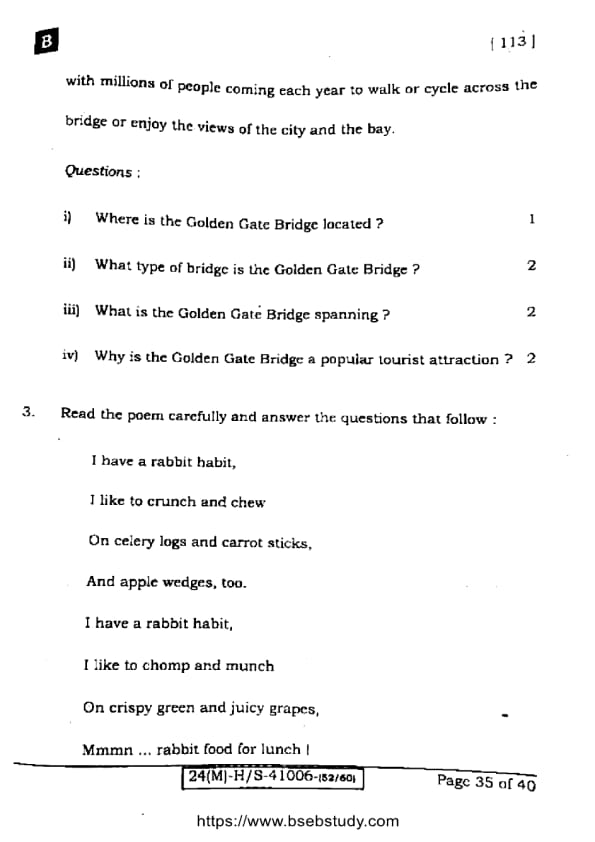
(i) Where is the Golden Gate Bridge located?
View Solution
The Golden Gate Bridge is located in San Francisco, California. Quick Tip: When answering "where" questions, focus on the location or place mentioned in the passage.
(ii) What type of bridge is the Golden Gate Bridge?
View Solution
The Golden Gate Bridge is a suspension bridge. Quick Tip: When asked for the type or category, highlight the specific terminology used in the passage, like "suspension bridge."
(iii) What is the Golden Gate Bridge spanning?
View Solution
The Golden Gate Bridge spans the Golden Gate Strait, connecting San Francisco with Marin County. Quick Tip: For questions about what something spans, focus on the distance or area it covers, like in this case, the Golden Gate Strait.
(iv) Why is the Golden Gate Bridge a popular tourist attraction?
View Solution
The Golden Gate Bridge is a popular tourist attraction because it is an iconic symbol of San Francisco and millions of people visit each year to walk, cycle, or enjoy the views of the city and the bay. Quick Tip: For questions on "why something is popular," explain the reasons provided in the passage, such as symbolism, activities, or views.
Question 3: I have a rabbit habit,
I like to crunch and chew
On celery logs and carrot sticks,
And apple wedges, too.
I have a rabbit habit,
I like to chomp and munch
On crispy green and juicy grapes,
Mmmm ... rabbit food for lunch!
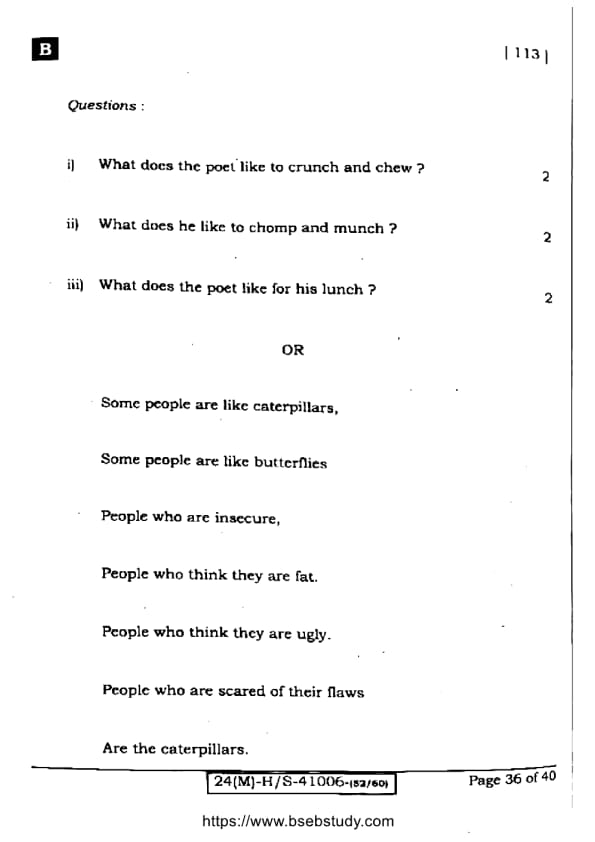
(i) What does the poet like to crunch and chew?
View Solution
The poet likes to crunch and chew celery logs, carrot sticks, and apple wedges. Quick Tip: When asked for specific details from the poem, always focus on the exact items or actions described in the text.
(ii) What does he like to chomp and munch?
View Solution
The poet likes to chomp and munch on crispy green and juicy grapes. Quick Tip: "Chomp" and "munch" describe actions related to eating, so focus on the specific foods mentioned in these lines.
(iii) What does the poet like for his lunch?
View Solution
The poet likes rabbit food for his lunch, which includes celery logs, carrot sticks, apple wedges, and grapes. Quick Tip: For questions about "likes for lunch," think about the specific foods mentioned as part of the poet's preferred meals.
Question 3(b): Some people are like caterpillars,
Some people are like butterflies
People who are insecure,
People who think they are fat.
People who think they are ugly.
People who are scared of their flaws
Are the caterpillars.
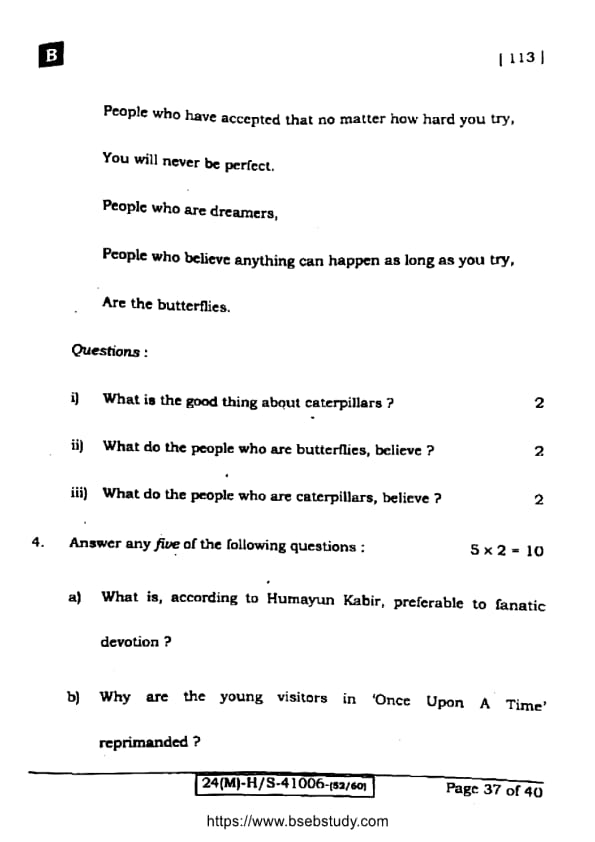
People who have accepted that no matter how hard you try,
You will never be perfect.
People who are dreamers,
People who believe anything can happen as long as you try,
Are the butterflies.
(i) What is the good thing about caterpillars?
View Solution
The good thing about caterpillars is that they represent people who are insecure or scared of their flaws. They symbolize the idea of transformation and growth, which comes after facing one’s fears. Quick Tip: The caterpillars symbolize the challenges or fears people face. The positive side is that they grow, just as a caterpillar transforms into a butterfly.
(ii) What do the people who are butterflies believe?
View Solution
People who are butterflies believe that anything can happen as long as you try. They are dreamers who have accepted imperfections and understand the importance of perseverance. Quick Tip: The butterflies represent people who have a positive mindset, believing that hard work and perseverance can bring success.
(iii) What do the people who are caterpillars believe?
View Solution
People who are caterpillars believe that no matter how hard you try, you will never be perfect. They are people who are insecure and focus on their flaws. Quick Tip: Caterpillars are used symbolically to represent people with self-doubt and insecurity. This can be an important lesson in overcoming negative thinking.
Answer any five of the following questions:
(a) What is, according to Humayun Kabir, preferable to fanatic devotion?
View Solution
According to Humayun Kabir, reason is preferable to fanatic devotion. He suggests that rational thinking and understanding are more valuable than blind or extreme devotion without a logical basis. Quick Tip: When dealing with opinion-based questions, focus on the author's central argument. Kabir contrasts reason with fanaticism, making reason the preferable choice.
(b) Why are the young visitors in 'Once Upon A Time' reprimanded?
View Solution
The young visitors in 'Once Upon A Time' are reprimanded because they were disrespectful, which shows a lack of manners and appreciation for the traditions and values of the elderly. Quick Tip: For questions about behavior, focus on the specific actions described in the text that led to the reprimand.
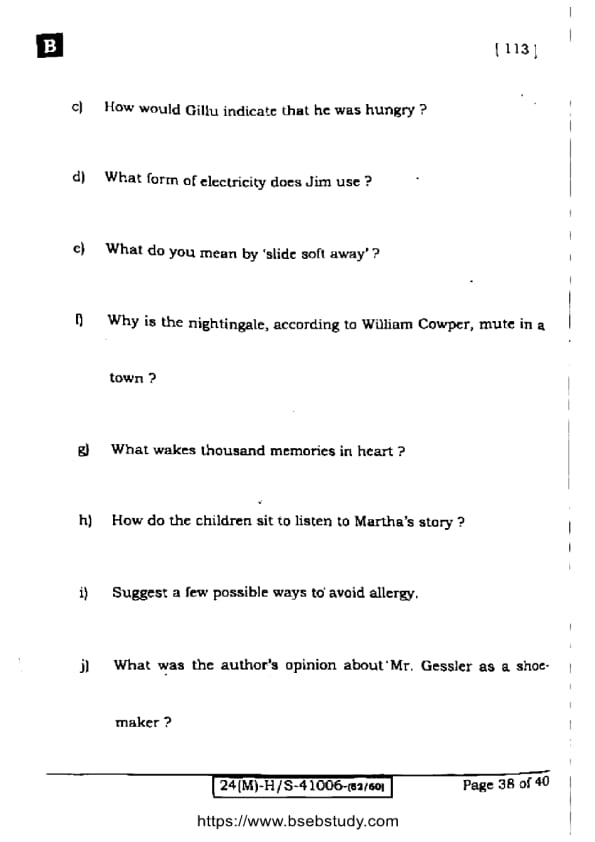
(c) How would Gillu indicate that he was hungry?
View Solution
Gillu would indicate that he was hungry by making gestures or sounds that draw attention to his need for food, such as pointing to food or whining. Quick Tip: For questions regarding communication, think about how non-verbal cues or actions are described in the passage.
(d) What form of electricity does Jim use?
View Solution
Jim uses direct current (DC) electricity, which is a specific form of electricity used for particular devices or applications. Quick Tip: When asked about specific forms of technology or technical details, focus on the terminology used in the passage to identify the exact type or method.
(e) What do you mean by 'slide soft away'?
View Solution
'Slide soft away' refers to something gently or gradually moving away, often used to describe a smooth or effortless motion, suggesting something fading or becoming less noticeable. Quick Tip: For figurative language, focus on the context and look for clues in the passage that explain the symbolic meaning of the phrase.
(f) Why is the nightingale, according to William Cowper, mute in a town?
View Solution
According to William Cowper, the nightingale is mute in a town because the noise and distractions of urban life prevent the bird from singing, symbolizing the loss of nature's peace in modern settings. Quick Tip: When answering questions about symbolism, look for the metaphorical meaning behind natural elements like animals and how they reflect human experiences or environments.
(g) What wakes thousand memories in the heart? \hspace{2cm
View Solution
The sound of a particular song or melody is what wakes thousand memories in the heart, evoking emotional responses from the listener. Quick Tip: Songs and melodies often symbolize memories or emotions. Pay attention to sensory experiences in the text that trigger memories or past events.
(h) How do the children sit to listen to Martha’s story?
View Solution
The children sit quietly, with attention focused on Martha, displaying their interest and respect for her storytelling. Quick Tip: When describing posture or positioning, focus on how the actions of the characters show their feelings or engagement with the moment.
(i) Suggest a few possible ways to avoid allergy.
View Solution
To avoid allergies, one can avoid exposure to allergens, use air purifiers, wear protective gear like masks, and consult with a doctor for appropriate medications or treatments. Quick Tip: For health-related questions, consider common preventive measures and lifestyle adjustments that address the issue at hand, such as allergies.
(j) What was the author’s opinion about Mr. Gessler as a shoemaker?
View Solution
The author had a high opinion of Mr. Gessler as a shoemaker, appreciating his craftsmanship and dedication to his work. Mr. Gessler was portrayed as an artisan who put great care into making shoes. Quick Tip: When discussing opinions of characters, focus on adjectives or phrases used to describe their qualities, especially how the author evaluates their work or character.
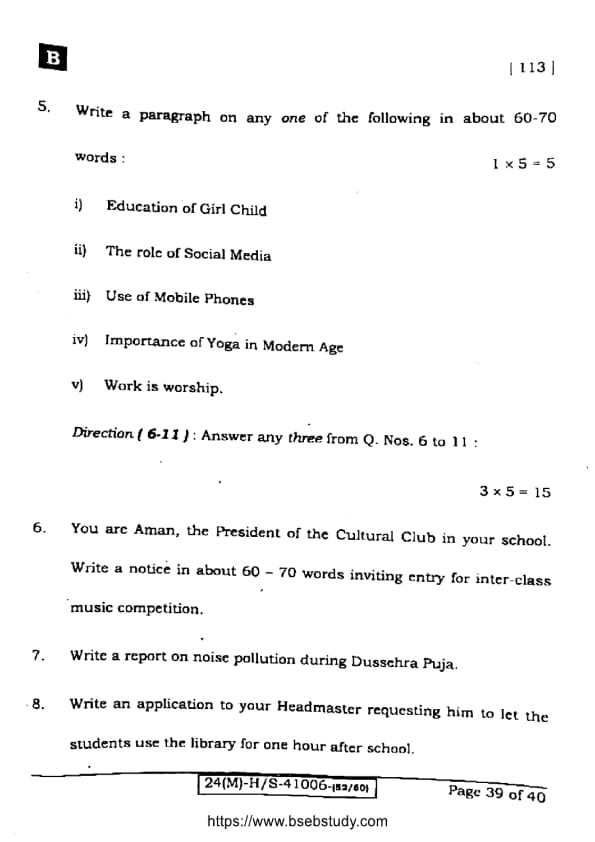
(i) Education of Girl Child
View Solution
Education of the girl child is essential for the progress of any society. Educating girls empowers them to make informed decisions, improve their health, and contribute to the economy. Education ensures gender equality and equips young girls with the tools they need to fight discrimination. It also reduces child marriage and provides opportunities for a brighter future. Therefore, it is crucial for governments, NGOs, and communities to prioritize girls' education. Quick Tip: When writing about social issues, focus on the benefits and importance of the topic. For the education of girls, you could mention its impact on individuals, families, and society.
(ii) The role of Social Media
View Solution
Social media plays a crucial role in modern communication. It connects people from all over the world, allowing them to share information, ideas, and opinions. Social media is used for various purposes, including education, business, and entertainment. However, it also has drawbacks such as the spread of misinformation and the impact on mental health. To maximize its benefits, users should engage in responsible online behavior and be aware of its potential consequences. Quick Tip: When writing about a technology or trend, discuss both its advantages and challenges. This gives a balanced view, like in the case of social media.
(iii) Use of Mobile Phones
View Solution
Mobile phones have revolutionized communication by making it easy to stay connected with people anytime and anywhere. They are used not only for making calls and sending messages but also for accessing the internet, entertainment, and various services. However, excessive use of mobile phones can lead to addiction, decreased productivity, and social isolation. It is essential to use mobile phones responsibly and limit screen time to maintain a healthy balance. Quick Tip: When writing about the use of technology, highlight its positive aspects while also addressing the potential risks or challenges. This will provide a comprehensive view.
(iv) Importance of Yoga in Modern Age
View Solution
Yoga is an ancient practice that has gained immense popularity in the modern age. It helps individuals maintain both physical and mental well-being by reducing stress, improving flexibility, and enhancing concentration. Yoga also promotes mindfulness and self-awareness, helping people to find balance in their busy lives. In today’s fast-paced world, yoga provides a much-needed break to rejuvenate the body and mind. Quick Tip: When writing about wellness or health topics, focus on the benefits of the practice and its relevance in today’s society. Be sure to connect it with current challenges.
(v) Work is Worship
View Solution
The saying "Work is Worship" emphasizes the importance of work in one's life. It suggests that the work we do should be approached with dedication, honesty, and respect, just as one would approach religious worship. Every task, no matter how small, has value and should be performed with full commitment. This philosophy encourages a positive attitude toward work and helps individuals find fulfillment in their daily tasks. Quick Tip: For philosophical topics, focus on explaining the concept clearly, showing its importance in daily life. Use examples or analogies if possible to make the concept relatable.
You are Aman, the President of the Cultural Club in your school. Write a notice in about 60-70 words inviting entry for inter-class music competition.
View Solution
NOTICE
Date: [Insert Date]
The Cultural Club is organizing an inter-class music competition. We invite all students to participate in this exciting event. The competition will be held on [Insert Date] at [Insert Time] in the school auditorium. Interested students should submit their names to the Cultural Club office by [Insert Last Date]. Don’t miss the chance to showcase your musical talent!
Aman
President, Cultural Club Quick Tip: In a notice, be clear and concise. Provide all the necessary details (date, time, venue) and include instructions for the participants.
Write a report on noise pollution during Dussehra Puja.
View Solution
Report on Noise Pollution During Dussehra Puja
Date: [Insert Date]
Dussehra Puja is a major festival celebrated with great enthusiasm. However, during this celebration, noise pollution becomes a serious concern. Loudspeakers blare music, and firecrackers create unbearable noise levels. This affects both the environment and the health of the public, particularly children and elderly people. It is crucial to raise awareness about the harmful effects of noise pollution and encourage a more peaceful celebration by using soundproof measures and minimizing the use of loudspeakers. Quick Tip: In a report, focus on the main issue, its impact, and suggest possible solutions. Reports are factual and should be clear and concise.
Write an application to your Headmaster requesting him to let the students use the library for one hour after school.
View Solution
To,
The Headmaster,
[School Name],
[City],
[Date]
Subject: Request for Extended Library Hours
Respected Sir,
I, [Your Name], the undersigned, request you to kindly allow the students to use the library for one hour after school hours. This extra time would help us complete our research, read additional books, and improve our knowledge. It would be highly beneficial for the students who need more time to study in a peaceful environment.
I hope you will consider my request favorably.
Yours sincerely,
[Your Name]
President, [Your Class Name] Quick Tip: When writing an application, be polite and formal. Clearly state your request, provide reasons, and conclude with a respectful closing.
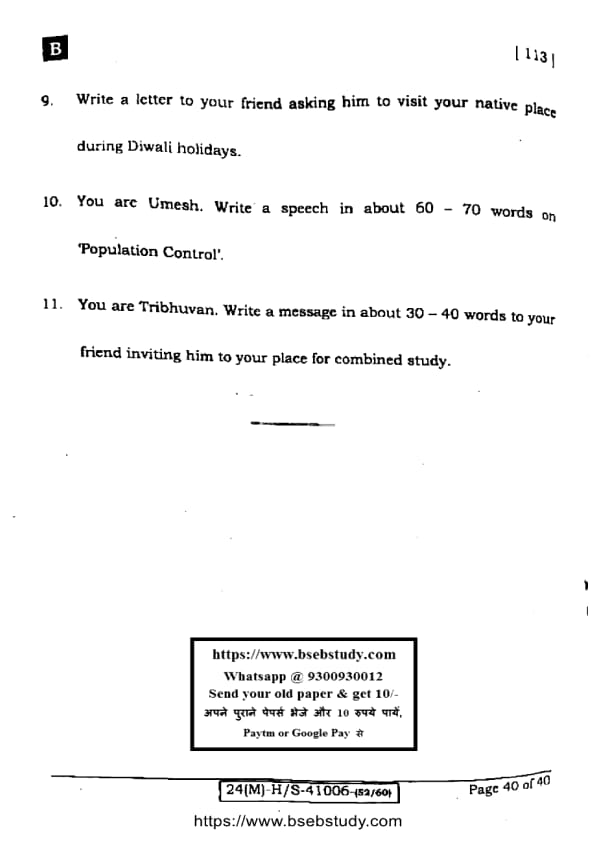
Write a letter to your friend asking him to visit your native place during Diwali holidays.
View Solution
To,
[Friend’s Name]
[Friend’s Address]
[City]
[Date]
Dear [Friend’s Name],
I hope this letter finds you in the best of health and spirits. Diwali is around the corner, and I am writing to invite you to spend the holidays at my native place. The festivities here are grand, with a lot of cultural events and family celebrations. We can enjoy the local sweets, visit the temples, and have a great time together.
I really hope you will be able to make it. Please let me know your plans.
Yours sincerely,
[Your Name] Quick Tip: In a letter, always make the invitation personal and warm. Mention specific activities and explain why your friend should come, making the letter engaging and friendly.
You are Umesh. Write a speech in about 60-70 words on ‘Population Control’.
View Solution
Speech on Population Control
Good morning to everyone,
Today, I would like to speak about the importance of population control. With the increasing global population, resources are becoming limited, and the environment is suffering. It is essential for us to focus on controlling the population growth through awareness, family planning, and government policies. By educating people and providing better healthcare, we can ensure that we have a sustainable future for generations to come.
Thank you. Quick Tip: In a speech, be clear and direct. State the problem, discuss possible solutions, and keep the message focused and concise.
You are Tribhuvan. Write a message in about 30-40 words to your friend inviting him to your place for combined study.
View Solution
Message
Hi [Friend's Name],
I hope you are doing well. I’m planning to have a combined study session at my place tomorrow. It will be a great chance to revise for the exams. Let me know if you can join.
Regards,
Tribhuvan \ Quick Tip: In a message, be concise and to the point. Provide the essential information and make the invitation clear. Keep it informal yet polite.





*The article might have information for the previous academic years, please refer the official website of the exam.