
Bihar Board Class 10 Mathematics 110 Set F Question Paper 2025 with Solutions Pdf


| Updated On - Nov 19, 2025
Bihar Board Class 10 Mathematics 110 Set F Question Paper 2025 with Solutions is available for download. The Bihar School Examination Board (BSEB) conducted the Class 10 examination for a total duration of 3 hours, and the question paper was of a total of 100 marks.
Bihar Board Class 10 Mathematics 110 Set F Question Paper 2025 with Solutions
| Bihar Board Class 10 Mathematics 110 Set F Question Paper 2025 | Download PDF | Check Solutions |

\(\sin(90^{\circ}-A)=\)
View Solution
Concept: Co-function identity: \(\sin(90^\circ - \theta) = \cos \theta\).
Calculation: \[ \sin(90^\circ - A) = \cos A. \]
Explanation: Standard complementary angle identity.
Quick Tip: \(\sin(90^\circ - \theta) = \cos \theta\), \(\cos(90^\circ - \theta) = \sin \theta\).
If \(\alpha=\beta=60^{\circ}\) then the value of \(\cos(\alpha-\beta)\) is
View Solution
Concept: \(\cos(\alpha - \beta) = \cos 0^\circ = 1\) when \(\alpha = \beta\).
Calculation: \[ \alpha - \beta = 60^\circ - 60^\circ = 0^\circ, \quad \cos 0^\circ = 1. \]
Explanation: Equal angles give zero difference.
Quick Tip: \(\cos 0^\circ = 1\), always.
If \(\theta=45^{\circ}\) then the value of \(\sin \theta + \cos \theta\) is
View Solution
Concept: At \(45^\circ\), \(\sin 45^\circ = \cos 45^\circ = \frac{\sqrt{2}}{2}\).
Calculation: \[ \sin 45^\circ + \cos 45^\circ = \frac{\sqrt{2}}{2} + \frac{\sqrt{2}}{2} = \sqrt{2}. \]
Explanation: Both values equal, sum is \(\sqrt{2}\).
Quick Tip: For \(45^\circ\), \(\sin = \cos = \frac{1}{\sqrt{2}}\).
If \(A=30^{\circ}\) then the value of \(\dfrac{2 \tan A}{1 - \tan^{2} A}\) is
View Solution
Concept: Double-angle formula: \(\tan 2A = \dfrac{2 \tan A}{1 - \tan^2 A}\).
Calculation: \[ \tan 30^\circ = \frac{1}{\sqrt{3}}, \quad \tan^2 30^\circ = \frac{1}{3} \] \[ \dfrac{2 \cdot \frac{1}{\sqrt{3}}}{1 - \frac{1}{3}} = \dfrac{\frac{2}{\sqrt{3}}}{\frac{2}{3}} = \frac{2}{\sqrt{3}} \cdot \frac{3}{2} = \sqrt{3} = \tan 60^\circ \]
But \(2 \tan 60^\circ = 2\sqrt{3}\), no.
Wait: The expression is \(\tan 2A = \tan 60^\circ = \sqrt{3}\).
But option (C) says \(2 \tan 60^\circ\), which is wrong.
Correct: equals \(\tan 60^\circ\).
Wait: Let's see options.
Wait: \(\dfrac{2 \tan A}{1 - \tan^2 A} = \tan 2A = \tan 60^\circ = \sqrt{3}\).
So (B).
Wait: But earlier said (C). Mistake.
No: (B) is \(\tan 60^\circ\), yes.
Explanation: Identity gives \(\tan 60^\circ\).
Quick Tip: Recognize \(\tan 2\theta\) formula.
If \(\tan \theta = \dfrac{12}{5}\) then the value of \(\sin \theta\) is
View Solution
Concept: \(\tan \theta = \frac{opp}{adj}\), hypotenuse = \(\sqrt{12^2 + 5^2} = 13\).
Calculation: \[ \sin \theta = \frac{opp}{hyp} = \frac{12}{13}. \]
Explanation: 5-12-13 right triangle.
Quick Tip: Use Pythagorean triplet: \(5^2 + 12^2 = 25 + 144 = 169 = 13^2\).
\(\dfrac{\cos 59^\circ}{\sin 31^\circ} \times \dfrac{\tan 80^\circ}{\cot 10^\circ}\)
View Solution
Concept: Use co-function and reciprocal identities.
Calculation: \[ \cos 59^\circ = \sin(90^\circ - 59^\circ) = \sin 31^\circ \] \[ \dfrac{\cos 59^\circ}{\sin 31^\circ} = \dfrac{\sin 31^\circ}{\sin 31^\circ} = 1 \] \[ \tan 80^\circ = \tan(90^\circ - 10^\circ) = \cot 10^\circ \] \[ \dfrac{\tan 80^\circ}{\cot 10^\circ} = \dfrac{\cot 10^\circ}{\cot 10^\circ} = 1 \] \[ 1 \times 1 = 1. \]
Explanation: Each fraction simplifies to 1.
Quick Tip: \(\cos(90^\circ - \theta) = \sin \theta\), \(\tan(90^\circ - \theta) = \cot \theta\).
If \(\tan 25^\circ \times \tan 65^\circ = \sin A\) then the value of A is
View Solution
Concept: \(\tan(90^\circ - \theta) = \cot \theta\), so \(\tan \theta \cdot \tan(90^\circ - \theta) = 1\).
Calculation: \[ \tan 65^\circ = \tan(90^\circ - 25^\circ) = \cot 25^\circ \] \[ \tan 25^\circ \cdot \cot 25^\circ = 1 = \sin 90^\circ. \]
Explanation: Product is 1, which is \(\sin 90^\circ\).
Quick Tip: Complementary angles: \(\tan \theta \cdot \cot \theta = 1\).
If \(\cos \theta = x\) then \(\tan \theta =\)
View Solution
Concept: \(\sin^2 \theta = 1 - \cos^2 \theta\), \(\tan \theta = \dfrac{\sin \theta}{\cos \theta}\).
Calculation: \[ \sin \theta = \sqrt{1 - x^2}, \quad \tan \theta = \dfrac{\sqrt{1 - x^2}}{x}. \]
Explanation: Direct from Pythagorean identity.
Quick Tip: \(\tan \theta = \dfrac{\sqrt{1 - \cos^2 \theta}}{\cos \theta}\).
\((1 - \cos^{4} \theta) =\)
View Solution
Concept: \(a^2 - b^2 = (a - b)(a + b)\).
Calculation: \[ 1 - \cos^4 \theta = (1 - \cos^2 \theta)(1 + \cos^2 \theta) = \sin^2 \theta (1 + \cos^2 \theta). \]
Explanation: Difference of squares.
Quick Tip: \(1 - \cos^4 \theta = (1 - \cos^2 \theta)(1 + \cos^2 \theta)\).
What is the form of a point lying on y-axis?
View Solution
Concept: Point on y-axis has \(x = 0\), so form \((0, y)\).
Calculation: \((2, y)\) has \(x = 2\), not on y-axis.
Explanation: Only \((0, y)\) lies on y-axis.
Quick Tip: Y-axis: \(x = 0\).
For what value of \(k\), roots of the quadratic equation \(kx^{2}-6x+1=0\) are real and equal?
View Solution
Concept: For equal roots, \(D = b^2 - 4ac = 0\).
Calculation: \(a = k\), \(b = -6\), \(c = 1\), \[ (-6)^2 - 4(k)(1) = 0 \quad \Rightarrow \quad 36 - 4k = 0 \quad \Rightarrow \quad k = 9. \]
Explanation: Discriminant zero when \(k = 9\).
Quick Tip: \(D = 0 \Rightarrow b^2 = 4ac\).
If one of the zeros of the polynomial \(p(x)\) is 2 then which of the following is a factor of \(p(x)\)?
View Solution
Concept: If \(r\) is a zero, then \((x - r)\) is a factor.
Calculation:
Zero = 2 → factor = \(x - 2\).
Explanation: Factor theorem.
Quick Tip: \(p(r) = 0 \Rightarrow (x - r)\) divides \(p(x)\).
If \(\alpha\) and \(\beta\) be the zeros of the polynomial \(cx^{2}+ax+b\) then the value of \(\alpha \cdot \beta\) is
View Solution
Concept: For \(ax^2 + bx + c = 0\), product of roots = \(\frac{c}{a}\).
Calculation:
Here, \(a = c\), \(b = a\), \(c = b\), \[ \alpha \beta = \frac{b}{c}. \]
Explanation: Standard quadratic formula.
Quick Tip: Product = \(\frac{constant term}{leading coefficient}\).
Which of the following is a quadratic equation?
View Solution
Concept: Quadratic has highest degree 2.
Calculation:
(A): RHS has \(x^3\) → cubic.
(B): Expand: \(x^2 + 6x + 9 = 4x + 16\) → \(x^2 + 2x - 7 = 0\) → quadratic.
(C): LHS degree 2, RHS degree 2, but simplify: \(4(x-1)^2 = 4x^2 + 7\) → not equal.
(D): Multiply by \(4x\): \(16x^2 + 1 = 16x^2\) → \(1 = 0\), contradiction.
Explanation: Only (B) reduces to quadratic.
Quick Tip: Expand and bring to standard form.
Which of the following is not a quadratic equation?
View Solution
Concept: A quadratic equation has highest degree 2 after simplification.
Calculation:
(A): \[ 5x - x^2 = x^2 + 3 \quad \Rightarrow \quad -2x^2 + 5x - 3 = 0 \quad \Rightarrow \quad 2x^2 - 5x + 3 = 0 \]
→ Quadratic (degree 2).
(B): \[ x^3 - x^2 = (x-1)^3 = x^3 - 3x^2 + 3x - 1 \] \[ x^3 - x^2 - x^3 + 3x^2 - 3x + 1 = 0 \quad \Rightarrow \quad 2x^2 - 3x + 1 = 0 \]
→ Quadratic (degree 2).
(C): \[ (x+3)^2 = 3(x^2 - 5) \] \[ x^2 + 6x + 9 = 3x^2 - 15 \] \[ 0 = 3x^2 - 15 - x^2 - 6x - 9 \quad \Rightarrow \quad 2x^2 - 6x - 24 = 0 \]
→ Quadratic (degree 2).
(D): \[ (\sqrt{2}x + 3)^2 = 2x^2 + 5 \] \[ 2x^2 + 6\sqrt{2}x + 9 = 2x^2 + 5 \] \[ 6\sqrt{2}x + 9 - 5 = 0 \quad \Rightarrow \quad 6\sqrt{2}x + 4 = 0 \]
→ Linear (degree 1).
Explanation: Only (D) simplifies to a linear equation.
Quick Tip: Simplify each equation completely to check the degree.
The discriminant of the quadratic equation \(2x^{2}-7x+6=0\) is
View Solution
Concept: \(D = b^2 - 4ac\).
Calculation: \(a = 2\), \(b = -7\), \(c = 6\), \[ D = (-7)^2 - 4(2)(6) = 49 - 48 = 1 \quad (Wait) \]
Wait: 49 - 48 = 1.
So (A).
Wait: But said (D). Mistake.
Wait: Recheck: \(4 \times 2 \times 6 = 48\), yes. \(49 - 48 = 1\).
Correct: (A) 1.
Explanation: \(D = 1\).
Quick Tip: \(D = b^2 - 4ac\).
Which of the following points lies on the graph of \(x=2\)?
View Solution
Concept: \(x = 2\) is vertical line, all points with \(x = 2\).
Calculation:
Any point \((2, y)\) lies on it.
Explanation: All points with first coordinate 2.
Quick Tip: Vertical line: constant \(x\).
If \(P+1, 2P+1, 4P-1\) are in A.P. then the value of \(P\) is
View Solution
Concept: In A.P., middle term = average of others.
Calculation: \[ 2(2P + 1) = (P + 1) + (4P - 1) \] \[ 4P + 2 = 5P \quad \Rightarrow \quad 2 = P \]
Wait: \(5P - P = 4P\), no:
Left: \(4P + 2\), right: \(P + 1 + 4P - 1 = 5P\). \(4P + 2 = 5P\) → \(2 = P\).
So (B) 2.
Wait: But said 3.
Wait: Common difference:
Second - first = third - second \((2P + 1) - (P + 1) = (4P - 1) - (2P + 1)\) \(P = 2P - 2\) \(P = 2\).
Yes, \(P = 2\).
Explanation: \(P = 2\).
Quick Tip: Use \(2b = a + c\).
The common difference of arithmetic progression 1, 5, 9, ... is
View Solution
Concept: \(d = a_2 - a_1\).
Calculation: \[ 5 - 1 = 4. \]
Explanation: Constant difference 4.
Quick Tip: Subtract consecutive terms.
Which term of the A.P, 5, 8, 11, 14, ... is 38?
View Solution
Concept: \(a_n = a + (n-1)d\).
Calculation: \(a = 5\), \(d = 3\), \[ 38 = 5 + (n-1)3 \] \[ 33 = (n-1)3 \quad \Rightarrow \quad n-1 = 11 \quad \Rightarrow \quad n = 12. \]
Explanation: 12th term.
Quick Tip: Solve \(a_n = a + (n-1)d\).
If \(A(0,1)\), \(B(0,5)\) and \(C(3,4)\) are the vertices of \(\triangle ABC\), then the area (in square unit) of \(\triangle ABC\) is
View Solution
Concept: Area = \(\frac{1}{2} |x_1(y_2 - y_3) + x_2(y_3 - y_1) + x_3(y_1 - y_2)|\).
Calculation: \[ Area = \frac{1}{2} |0(5-4) + 0(4-1) + 3(1-5)| = \frac{1}{2} |3(-4)| = \frac{1}{2} \times 12 = 6. \]
Explanation: Base \(AB = 4\) units (vertical), height = 3 units → area = \(\frac{1}{2} \times 4 \times 3 = 6\).
Quick Tip: If two points have same \(x\), base is vertical.
\(\tan 10^\circ \cdot \tan 23^\circ \cdot \tan 80^\circ \cdot \tan 67^\circ\)
View Solution
Concept: \(\tan(90^\circ - \theta) = \cot \theta\).
Calculation: \[ \tan 80^\circ = \cot 10^\circ, \quad \tan 67^\circ = \cot 23^\circ \] \[ \tan 10^\circ \cdot \tan 23^\circ \cdot \cot 10^\circ \cdot \cot 23^\circ = 1 \cdot 1 = 1. \]
Explanation: Complementary pairs multiply to 1.
Quick Tip: Pair \(\tan \theta\) and \(\tan(90^\circ - \theta)\).
If the ratio of areas of two similar triangles is 100:144 then the ratio of their corresponding sides is
View Solution
Concept: Ratio of sides = \(\sqrt{ratio of areas}\).
Calculation: \[ \sqrt{\dfrac{100}{144}} = \dfrac{10}{12}. \]
Explanation: Simplify square root of ratio.
Quick Tip: Area ratio → side ratio = square root.
A line which intersects a circle in two distinct points is called
View Solution
Concept: Secant intersects circle at two points; tangent at one; chord is segment inside.
Explanation: By definition.
Quick Tip: Secant: 2 points, Tangent: 1 point.
The corresponding sides of two similar triangles are in the ratio 4:9. What will be the ratio of the areas of the triangles?
View Solution
Concept: Area ratio = (side ratio)\(^2\).
Calculation: \[ \left(\dfrac{4}{9}\right)^2 = \dfrac{16}{81}. \]
Explanation: Square the side ratio.
Quick Tip: Area scales with square of linear dimensions.
\(\triangle ABC \sim \triangle DEF\) and \(BC=3\) cm, \(EF=4\) cm. If the area of \(\triangle ABC\) is \(54\) cm², then the area of \(\triangle DEF\) is
View Solution
Concept: Area ratio = (side ratio)\(^2\).
Calculation: \[ \dfrac{Area_{\triangle DEF}}{Area_{\triangle ABC}} = \left(\dfrac{EF}{BC}\right)^2 = \left(\dfrac{4}{3}\right)^2 = \dfrac{16}{9} \] \[ Area_{\triangle DEF} = 54 \times \dfrac{16}{9} = 6 \times 16 = 96 cm^2. \]
Explanation: Scale area by square of side ratio.
Quick Tip: Identify corresponding sides.
In \(\triangle ABC\), \(\angle A=90^\circ\), \(BC=13\) cm, \(AB=12\) cm; then the value of \(AC\) is
View Solution
Concept: Pythagoras theorem.
Calculation: \[ AC = \sqrt{BC^2 - AB^2} = \sqrt{169 - 144} = \sqrt{25} = 5 cm. \]
Explanation: 5-12-13 right triangle.
Quick Tip: Memorize 5-12-13 triplet.
In \(\triangle DEF\) and \(\triangle PQR\) it is given that \(\angle D=\angle Q\) and \(\angle R=\angle E\), then which of the following is correct?
View Solution
Concept: Sum of angles = \(180^\circ\).
Calculation: \[ \angle F = 180^\circ - \angle D - \angle E, \quad \angle P = 180^\circ - \angle Q - \angle R \]
Given \(\angle D = \angle Q\), \(\angle E = \angle R\), \[ \angle F = 180^\circ - \angle Q - \angle R = \angle P. \]
Explanation: Third angles equal.
Quick Tip: Two angles equal → third angle equal.
\(\triangle ABC\) and \(\triangle DEF\) are such that \(\dfrac{AB}{DE}=\dfrac{BC}{EF}=\dfrac{CA}{DF}\) and \(\angle A=40^\circ\), \(\angle B=80^\circ\); then the measure of \(\angle F\) is
View Solution
Concept: SSS similarity → corresponding angles equal.
Calculation: \(\angle C = 180^\circ - 40^\circ - 80^\circ = 60^\circ\).
Corresponding to \(\angle F\) (since \(CA \leftrightarrow DF\)).
Explanation: \(\angle C = \angle F = 60^\circ\).
Quick Tip: SSS → angles opposite corresponding sides.
The number of common tangents of two intersecting circles is
View Solution
Concept: Intersecting circles → 2 common tangents (both external or one each).
Explanation: Two external tangents.
Quick Tip: Intersecting: 2 tangents; separate: 4; one inside: 2.
The ratio of the volumes of two spheres is 64:125. Then the ratio of their surface areas is
View Solution
Concept: Volume ratio = \((r_1/r_2)^3\), surface area = \((r_1/r_2)^2\).
Calculation: \[ \left(\dfrac{r_1}{r_2}\right)^3 = \dfrac{64}{125} \quad \Rightarrow \quad \dfrac{r_1}{r_2} = \dfrac{4}{5} \] \[ Surface area ratio = \left(\dfrac{4}{5}\right)^2 = \dfrac{16}{25}. \]
Explanation: Square the cube root of volume ratio.
Quick Tip: Surface area ratio = \(\sqrt[3]{volume ratio}^2\).
The radii of two cylinders are in the ratio 4:5 and their heights are in the ratio 6:7. Then the ratio of their volumes is
View Solution
Concept: Volume of cylinder = \(\pi r^2 h\).
Calculation:
Let the two cylinders be I and II.
Given: \[ \dfrac{r_I}{r_{II}} = \dfrac{4}{5}, \quad \dfrac{h_I}{h_{II}} = \dfrac{6}{7} \]
Ratio of volumes: \[ \dfrac{V_I}{V_{II}} = \dfrac{\pi r_I^2 h_I}{\pi r_{II}^2 h_{II}} = \left(\dfrac{r_I}{r_{II}}\right)^2 \cdot \dfrac{h_I}{h_{II}} = \left(\dfrac{4}{5}\right)^2 \cdot \dfrac{6}{7} \] \[ = \dfrac{16}{25} \cdot \dfrac{6}{7} = \dfrac{16 \times 6}{25 \times 7} = \dfrac{96}{175} \]
Thus, \[ V_I : V_{II} = 96 : 175. \]
Explanation: Volume ratio = (ratio of radii squared) × (ratio of heights).
Quick Tip: Volume ∝ \(r^2 h\) → multiply square of radius ratio and height ratio.
What is the total surface area of a hemisphere of radius \(R\)?
View Solution
Concept: TSA = curved + base = \(2\pi R^2 + \pi R^2 = 3\pi R^2\).
Explanation: Curved surface + flat base.
Quick Tip: Hemisphere TSA = \(3\pi R^2\), CSA = \(2\pi R^2\).
If the curved surface area of a cone is \(880\) cm² and its radius is 14 cm, then its slant height is
View Solution
Concept: CSA = \(\pi r l\).
Calculation: \[ \pi \times 14 \times l = 880 \quad \Rightarrow \quad l = \dfrac{880}{14\pi} = \dfrac{880 \div 44}{14 \div 44 \times \pi} \quad wait: \] \[ \dfrac{880}{14 \times \pi} = \dfrac{880 \div 44}{14 \div 44 \times \pi} = 20 / \pi \times \pi = 20 cm. \]
Explanation: \(l = \dfrac{CSA}{\pi r}\).
Quick Tip: Isolate \(l\) from \(\pi r l\).
If the length of the diagonal of a cube is \(2\sqrt{3}\) cm, then the length of its edge is
View Solution
Concept: Diagonal = \(a\sqrt{3}\).
Calculation: \[ a\sqrt{3} = 2\sqrt{3} \quad \Rightarrow \quad a = 2 cm. \]
Explanation: Divide by \(\sqrt{3}\).
Quick Tip: Cube diagonal = \(a\sqrt{3}\).
If the edge of a cube is doubled then the total surface area will become how many times of the previous total surface area?
View Solution
Concept: TSA = \(6a^2\), new = \(6(2a)^2 = 24a^2\).
Calculation: \[ \dfrac{24a^2}{6a^2} = 4. \]
Explanation: Area scales with square of linear dimensions.
Quick Tip: Linear scale factor \(k\) → area \(k^2\).
The ratio of the total surface area of a sphere and that of a hemisphere having the same radius is
View Solution
Concept: Sphere TSA = \(4\pi R^2\), hemisphere = \(3\pi R^2\).
Calculation: \[ \dfrac{4\pi R^2}{3\pi R^2} = \dfrac{4}{3}. \]
Explanation: Direct ratio.
Quick Tip: Sphere: \(4\pi R^2\), hemisphere: \(3\pi R^2\).
If the curved surface area of a hemisphere is \(1232\) cm², then its radius is
View Solution
Concept: CSA of hemisphere = \(2\pi R^2\).
Calculation: \[ 2\pi R^2 = 1232 \quad \Rightarrow \quad R^2 = \dfrac{1232}{2\pi} = \dfrac{616}{\pi} \] \[ R = \sqrt{\dfrac{616}{\pi}} = \sqrt{196} = 14 cm \quad (since 196\pi / \pi = 196). \]
Explanation: \(R = \sqrt{\dfrac{CSA}{2\pi}}\).
Quick Tip: Hemisphere CSA = \(2\pi R^2\).
If \(\cos \theta + \cos^{2} \theta = 1\) then the value of \(\sin^{2} \theta + \sin^{4} \theta\) is
View Solution
Concept: \(\cos^2 \theta = 1 - \sin^2 \theta\).
Calculation: \[ \cos \theta + \cos^2 \theta = 1 \quad \Rightarrow \quad \cos \theta = 1 - \cos^2 \theta = \sin^2 \theta \] \[ \cos^2 \theta = \sin^4 \theta \]
Let \(u = \sin^2 \theta\), \[ u^2 = 1 - u \quad \Rightarrow \quad u^2 + u - 1 = 0 \]
But directly: \[ \sin^2 \theta + \sin^4 \theta = \cos \theta + \cos^2 \theta = 1. \]
Explanation: Given equation shows sum equals 1.
Quick Tip: Substitute \(\cos \theta = \sin^2 \theta\).
\(\dfrac{1 + \tan^{2} A}{1 + \cot^{2} A} =\)
View Solution
Concept: \(1 + \tan^2 \theta = \sec^2 \theta\), \(1 + \cot^2 \theta = \csc^2 \theta\).
Calculation: \[ \dfrac{\sec^2 A}{\csc^2 A} = \dfrac{1/\cos^2 A}{1/\sin^2 A} = \dfrac{\sin^2 A}{\cos^2 A} = \tan^2 A. \]
Explanation: Simplify using reciprocal identities.
Quick Tip: \(\sec^2 / \csc^2 = \tan^2\).
Which of the following fractions has terminating decimal expansion?
View Solution
Concept: Decimal terminates if denominator (after simplifying) has prime factors only 2 and/or 5.
Calculation:
(A): \(3^2\) → non-terminating.
(B): \(7^2\) → non-terminating.
(C): \(3^2\) → non-terminating.
(D): \(2^2 \times 5^3\) → terminating.
Explanation: Only (D) has denominator of form \(2^n 5^m\).
Quick Tip: Check prime factors of denominator.
In the form of \(\dfrac{p}{2^{n} \times 5^{m}}\) 0.505 can be written as
View Solution
Concept: \(0.505 = \dfrac{505}{1000}\). Simplify and match denominator.
Calculation: \[ 0.505 = \dfrac{505}{1000} = \dfrac{101 \times 5}{200 \times 5} = \dfrac{101}{200} = \dfrac{101}{2^3 \times 5^2}. \]
Explanation: \(1000 = 2^3 \times 5^3\), cancel one 5.
Quick Tip: Multiply numerator and denominator by 1000 for three decimal places.
If in division algorithm \(a = bq + r\), \(b=4\), \(q=5\) and \(r=1\), then what is the value of \(a\)?
View Solution
Calculation: \[ a = 4 \times 5 + 1 = 20 + 1 = 21. \]
Explanation: Direct substitution.
Quick Tip: \(a = bq + r\).
The zeroes of the polynomial \(2x^{2} - 4x - 6\) are
View Solution
Calculation: \[ 2x^2 - 4x - 6 = 0 \quad \Rightarrow \quad x^2 - 2x - 3 = 0 \] \[ (x - 3)(x + 1) = 0 \quad \Rightarrow \quad x = 3, -1. \]
Explanation: Factorize or use quadratic formula.
Quick Tip: Divide by 2 to simplify.
The degree of the polynomial \((x^{3} + x^{2} + 2x + 1)(x^{2} + 2x + 1)\) is
View Solution
Concept: Degree of product = sum of degrees.
Calculation:
Degree of first: 3, second: 2 → total = 5.
Explanation: Leading terms: \(x^3 \cdot x^2 = x^5\).
Quick Tip: Add degrees of factors.
Which of the following is not a polynomial?
View Solution
Concept: Polynomial has non-negative integer exponents.
Calculation:
(D): \(x^{-1}\) → not polynomial.
Explanation: Negative exponent.
Quick Tip: All exponents ≥ 0.
Which of the following quadratic polynomials has zeroes 2 and -2?
View Solution
Calculation:
Sum = 0, product = -4 → \(x^2 - 4 = 0\).
Explanation: \((x-2)(x+2)\).
Quick Tip: Roots \(r, -r\) → \(x^2 - r^2\).
If \(\alpha\) and \(\beta\) are the zeroes of the polynomial \(t^{2} + 7t + 10\) then the value of \(\alpha + \beta\) is
View Solution
Concept: Sum of roots = \(-\frac{b}{a}\).
Calculation: \[ \alpha + \beta = -7. \]
Explanation: For \(t^2 + 7t + 10\), \(b = 7\), \(a = 1\).
Quick Tip: Sum = \(-\frac{b}{a}\).
\((\sin 30^\circ + \cos 30^\circ) - (\sin 60^\circ + \cos 60^\circ) =\)
View Solution
Calculation: \[ \sin 30^\circ = \frac{1}{2}, \quad \cos 30^\circ = \frac{\sqrt{3}}{2} \quad \Rightarrow \quad \frac{1 + \sqrt{3}}{2} \] \[ \sin 60^\circ = \frac{\sqrt{3}}{2}, \quad \cos 60^\circ = \frac{1}{2} \quad \Rightarrow \quad \frac{\sqrt{3} + 1}{2} \]
Difference = 0.
Explanation: Both sums are equal.
Quick Tip: \(\sin \theta + \cos \theta = \sin(90^\circ - \theta) + \cos(90^\circ - \theta)\).
If one zero of the quadratic polynomial \((k-1)x^{2} + kx + 1\) is -4 then the value of \(k\) is
View Solution
Calculation: \[ (k-1)(-4)^2 + k(-4) + 1 = 0 \] \[ 16(k-1) - 4k + 1 = 0 \quad \Rightarrow \quad 16k - 16 - 4k + 1 = 0 \] \[ 12k - 15 = 0 \quad \Rightarrow \quad k = \frac{15}{12} = \frac{5}{4} \quad wait \]
Wait: \(k = \frac{15}{12} = \frac{5}{4}\)? But answer is negative.
Wait: Plug \(x = -4\): \[ (k-1)(16) + k(-4) + 1 = 0 \] \[ 16k - 16 - 4k + 1 = 0 \quad \Rightarrow \quad 12k - 15 = 0 \quad \Rightarrow \quad k = \frac{15}{12} = \frac{5}{4} \]
But option (B). Wait: Question says -4, but calculation gives positive.
Wait: Let's verify:
For \(k = \frac{5}{4}\): \[ \left(\frac{5}{4} - 1\right)x^2 + \frac{5}{4}x + 1 = \frac{1}{4}x^2 + \frac{5}{4}x + 1 \]
At \(x = -4\): \[ \frac{1}{4}(16) + \frac{5}{4}(-4) + 1 = 4 - 5 + 1 = 0 \quad \]
So \(k = \frac{5}{4}\).
Correct: (B) \(\frac{5}{4}\).
Explanation: Substitute zero into polynomial.
Quick Tip: \(p(root) = 0\).
From an external point P, two tangents PA and PB are drawn on a circle. If \(PA = 8\) cm then \(PB =\)
View Solution
Concept: Tangents from external point are equal.
Calculation: \[ PA = PB = 8 cm. \]
Explanation: Theorem of equal tangents.
Quick Tip: \(PA = PB\).
If PA and PB are the tangents drawn from an external point P to a circle with centre at O and \(\angle APB = 80^\circ\) then \(\angle POA =\)
View Solution
Concept: Quadrilateral OAPB: \(\angle OAP = \angle OBP = 90^\circ\), \(\angle APB = 80^\circ\).
Calculation: \[ \angle AOP + \angle BOP = 360^\circ - 90^\circ - 90^\circ - 80^\circ = 100^\circ \]
Since OA = OB (radii), \(\triangle AOP \cong \triangle BOP\) → \(\angle AOP = \angle BOP = 50^\circ\).
Explanation: \(\angle POA = 50^\circ\).
Quick Tip: Tangent ⊥ radius.
What is the angle between the tangent drawn at any point of a circle and the radius passing through the point of contact?
View Solution
Concept: Tangent is perpendicular to radius at point of contact.
Explanation: Theorem.
Quick Tip: Radius ⊥ tangent.
The ratio of the radii of two circles is 3:4; then the ratio of their areas is
View Solution
Calculation: \[ \left(\dfrac{3}{4}\right)^2 = \dfrac{9}{16}. \]
Explanation: Area ∝ \(r^2\).
Quick Tip: Square the radius ratio.
The area of the sector of a circle of radius 42 cm and central angle \(30^\circ\) is
View Solution
Calculation: \[ Area = \dfrac{30^\circ}{360^\circ} \pi (42)^2 = \dfrac{1}{12} \pi \times 1764 = \dfrac{1764 \pi}{12} = 147 \pi \approx 147 \times 3.14 = 461.58 \approx 462. \]
Explanation: \(\dfrac{\theta}{360} \pi r^2\).
Quick Tip: Use \(\pi \approx 3.14\) or \(22/7\).
The ratio of the circumferences of two circles is 5:7; then ratio of their radii is
View Solution
Concept: \(C = 2\pi r\) → \(C \propto r\).
Calculation: \[ \dfrac{r_1}{r_2} = \dfrac{C_1}{C_2} = \dfrac{5}{7}. \]
Explanation: Direct proportion.
Quick Tip: Circumference ratio = radius ratio.
\(7 \sec^{2} A - 7 \tan^{2} A =\)
View Solution
Calculation: \[ 7(\sec^2 A - \tan^2 A) = 7(1) = 7. \]
Explanation: Identity \(\sec^2 - \tan^2 = 1\).
Quick Tip: Factor out 7.
If \(x = a \cos \theta\) and \(y = b \sin \theta\) then \(b^{2} x^{2} + a^{2} y^{2} =\)
View Solution
Calculation: \[ b^2 (a \cos \theta)^2 + a^2 (b \sin \theta)^2 = a^2 b^2 \cos^2 \theta + a^2 b^2 \sin^2 \theta = a^2 b^2 (\cos^2 \theta + \sin^2 \theta) = a^2 b^2. \]
Explanation: Factor out \(a^2 b^2\).
Quick Tip: Use \(\cos^2 + \sin^2 = 1\).
The angle of elevation of the top of a tower at a distance of 10 m from its base is \(60^\circ\); then the height of the tower is
View Solution
Calculation: \[ \tan 60^\circ = \sqrt{3} = \dfrac{h}{10} \quad \Rightarrow \quad h = 10\sqrt{3} m. \]
Explanation: Opposite over adjacent.
Quick Tip: \(\tan \theta = \dfrac{opp}{adj}\).
A kite is at a height 30 m from the earth and its string makes an angle \(60^\circ\) with the earth. Then the length of the string is
View Solution
Calculation:
Height = opposite = 30 m, angle with ground = \(60^\circ\), hypotenuse = string length \(l\). \[ \sin 60^\circ = \dfrac{30}{l} \quad \Rightarrow \quad \dfrac{\sqrt{3}}{2} = \dfrac{30}{l} \quad \Rightarrow \quad l = \dfrac{60}{\sqrt{3}} = 20\sqrt{3} m. \]
Correct: (C) \(20\sqrt{3}\) m.
Explanation: \(\sin \theta = \dfrac{opp}{hyp}\).
Quick Tip: Angle with ground → use sin for height.
If 5th term of an A.P. is 11 and common difference is 2 then what is its first term?
View Solution
The general formula for the \(n\)th term of an A.P. is: \[ a_n = a + (n-1)d \]
where \(a\) is the first term and \(d\) is the common difference.
Given:
- 5th term: \(a_5 = 11\)
- Common difference: \(d = 2\)
Substitute into the formula: \[ a_5 = a + (5-1)d \quad \Rightarrow \quad 11 = a + 4 \times 2 \] \[ 11 = a + 8 \] \[ a = 11 - 8 = 3 \]
Verification:
- 1st term: 3
- 2nd term: \(3 + 2 = 5\)
- 3rd term: \(5 + 2 = 7\)
- 4th term: \(7 + 2 = 9\)
- 5th term: \(9 + 2 = 11\) (correct)
Thus, the first term is 3.
Explanation: Subtract \(4d\) from the 5th term to find the first term.
Quick Tip: To go backwards from \(n\)th term to 1st term, subtract \((n-1)d\).
The sum of an A.P. with \(n\) terms is \(n^{2} + 2n + 1\) then its 6th term is
View Solution
The sum of the first \(n\) terms is given as: \[ S_n = n^2 + 2n + 1 = (n+1)^2 \]
The \(n\)th term is found using: \[ a_n = S_n - S_{n-1} \]
For the 6th term: \[ a_6 = S_6 - S_5 \]
Calculate: \[ S_6 = (6+1)^2 = 7^2 = 49 \] \[ S_5 = (5+1)^2 = 6^2 = 36 \] \[ a_6 = 49 - 36 = 13 \]
General formula for \(a_n\): \[ a_n = (n+1)^2 - n^2 = n^2 + 2n + 1 - n^2 = 2n + 1 \] \[ a_6 = 2(6) + 1 = 13 \]
Since 13 is not in the options (A) 29, (B) 19, (C) 15, the answer is (D) none of these.
Explanation: The sum \(S_n = (n+1)^2\) gives \(a_n = 2n + 1\), so 6th term is 13.
Quick Tip: For any A.P., \(a_n = S_n - S_{n-1}\).
Which of the following is in an A.P.?
View Solution
An A.P. requires a constant common difference \(d\).
- (A): Differences:
\(7-1 = 6\), \(9-7 = 2\), \(16-9 = 7\) → not constant → not A.P.
- (B): Differences:
\(x^3 - x^2 = x^2(x-1)\), \(x^4 - x^3 = x^3(x-1)\), etc. → not constant → not A.P.
- (C): Differences:
\(2x - x = x\), \(3x - 2x = x\), \(4x - 3x = x\) → constant \(d = x\) → A.P.
- (D): Differences:
\(16 - 4 = 12\), \(36 - 16 = 20\), \(64 - 36 = 28\) → not constant → not A.P.
Only (C) has a constant difference.
Explanation: Check consecutive differences; only (C) satisfies.
Quick Tip: Compute at least first three differences.
Which of the following is not in an A.P.?
View Solution
Check common difference:
- (A): \(d = 1\) → A.P.
- (B): \(d = 3\) → A.P.
- (C): \(d = 2\) → A.P.
- (D): Sequence: \(4, 16, 36, 64\)
Differences:
\(16-4 = 12\), \(36-16 = 20\), \(64-36 = 28\) → increasing → not A.P.
Only (D) fails.
Explanation: Squares of even numbers form a quadratic sequence.
Quick Tip: Second differences are constant only for quadratic sequences.
The sum of first 20 terms of the A.P. 1, 4, 7, 10, ... is
View Solution
Given:
- First term: \(a = 1\)
- Common difference: \(d = 3\)
- Number of terms: \(n = 20\)
Formula for sum: \[ S_n = \frac{n}{2} [2a + (n-1)d] \] \[ S_{20} = \frac{20}{2} [2(1) + (19)(3)] = 10 [2 + 57] = 10 \times 59 = 590 \]
Alternative method: \[ S_n = \frac{n}{2} (a + l), \quad l = 1 + 19 \times 3 = 58 \] \[ S_{20} = \frac{20}{2} (1 + 58) = 10 \times 59 = 590 \]
Verification:
- 20th term: \(1 + 19 \times 3 = 58\)
- Average of first and last: \(\frac{1+58}{2} = 29.5\)
- Sum: \(20 \times 29.5 = 590\)
Explanation: Both methods confirm 590.
Quick Tip: Use \(S_n = \frac{n}{2} (a + l)\) for quick check.
Which of the following values is equal to 1?
View Solution
Evaluate each:
- (A):
\(\sin 60^\circ = \frac{\sqrt{3}}{2}\), \(\cos 60^\circ = \frac{1}{2}\)
\(\left(\frac{\sqrt{3}}{2}\right)^2 + \frac{1}{2} = \frac{3}{4} + \frac{1}{2} = \frac{3}{4} + \frac{2}{4} = \frac{5}{4} \neq 1\)
- (B):
\(\sin 90^\circ = 1\), \(\cos 90^\circ = 0\)
\(1 \times 0 = 0 \neq 1\)
- (C):
\(\sin^2 60^\circ = \left(\frac{\sqrt{3}}{2}\right)^2 = \frac{3}{4} \neq 1\)
- (D):
\(\sin 45^\circ = \cos 45^\circ = \frac{1}{\sqrt{2}}\)
\(\frac{1}{\sqrt{2}} \times \frac{1}{\frac{1}{\sqrt{2}}} = \frac{1}{\sqrt{2}} \times \sqrt{2} = 1\)
Only (D) equals 1.
Explanation: (D) simplifies to \(\tan 45^\circ = 1\).
Quick Tip: \(\frac{\sin \theta}{\cos \theta} = \tan \theta\).
\(\cos^{2} A (1 + \tan^{2} A) =\)
View Solution
Use identity: \[ 1 + \tan^2 A = \sec^2 A \] \[ \cos^2 A (1 + \tan^2 A) = \cos^2 A \cdot \sec^2 A = \cos^2 A \cdot \frac{1}{\cos^2 A} = 1 \]
Alternative: \[ \tan^2 A = \frac{\sin^2 A}{\cos^2 A} \quad \Rightarrow \quad 1 + \tan^2 A = 1 + \frac{\sin^2 A}{\cos^2 A} = \frac{\cos^2 A + \sin^2 A}{\cos^2 A} = \frac{1}{\cos^2 A} = \sec^2 A \]
Same result.
Explanation: Direct application of Pythagorean identity.
Quick Tip: Memorize: \(1 + \tan^2 \theta = \sec^2 \theta\).
\(\tan 30^\circ =\)
View Solution
In a 30-60-90 triangle:
- Opposite to 30°: 1
- Adjacent: \(\sqrt{3}\)
- Hypotenuse: 2
\[ \tan 30^\circ = \frac{opposite}{adjacent} = \frac{1}{\sqrt{3}} \]
Rationalize: \[ \frac{1}{\sqrt{3}} \times \frac{\sqrt{3}}{\sqrt{3}} = \frac{\sqrt{3}}{3} \]
Both forms are acceptable, but option is \(\frac{1}{\sqrt{3}}\).
Explanation: Standard value from unit triangle.
Quick Tip: 30°: \(\sin = \frac{1}{2}\), \(\cos = \frac{\sqrt{3}}{2}\), \(\tan = \frac{1}{\sqrt{3}}\).
\(\cos 60^\circ =\)
View Solution
30-60-90 triangle sides:
- Opposite 30°: 1
- Opposite 60°: \(\sqrt{3}\)
- Hypotenuse: 2
\[ \cos 60^\circ = \frac{adjacent}{hypotenuse} = \frac{1}{2} \]
Or: \[ \cos 60^\circ = \frac{\sqrt{3}}{2} \quad (incorrect for 60°) \quad No, \cos 60^\circ = \frac{1}{2} \]
Explanation: Adjacent to 60° is half the hypotenuse.
Quick Tip: 60°: \(\cos = \frac{1}{2}\), \(\sin = \frac{\sqrt{3}}{2}\).
\(\sin^{2} 90^\circ - \tan^{2} 45^\circ =\)
View Solution
\[ \sin 90^\circ = 1 \quad \Rightarrow \quad \sin^2 90^\circ = 1 \] \[ \tan 45^\circ = 1 \quad \Rightarrow \quad \tan^2 45^\circ = 1 \] \[ 1 - 1 = 0 \]
Explanation: Both terms are 1.
Quick Tip: \(\sin 90^\circ = 1\), \(\tan 45^\circ = 1\).
Which of the following quadratic polynomials has zeroes 3 and -10?
View Solution
Roots: 3 and -10
Sum of roots: \(3 + (-10) = -7\)
Product: \(3 \times (-10) = -30\)
Standard form: \[ x^2 - (sum)x + product = 0 \] \[ x^2 - (-7)x + (-30) = x^2 + 7x - 30 = 0 \]
Verification: \[ (x - 3)(x + 10) = x^2 + 10x - 3x - 30 = x^2 + 7x - 30 \]
Matches (A).
Explanation: Sum is negative → positive linear coefficient.
Quick Tip: Roots \(r_1, r_2\): \((x - r_1)(x - r_2)\).
If the sum of zeros of a quadratic polynomial is 3 and their product is -2 then that quadratic polynomial is
View Solution
Sum = 3 → coefficient of \(x\) = -3
Product = -2 → constant term = -2
\[ x^2 - (sum)x + product = x^2 - 3x - 2 \]
Matches (A).
Explanation: Standard quadratic form.
Quick Tip: Sum = \(-b\), Product = \(c\).
If \(p(x) = x^{4} - 2x^{3} + 17x^{2} - 4x + 30\) is divided by \(q(x) = x + 2\) then the degree of the quotient is
View Solution
Degree of \(p(x)\): 4
Degree of \(q(x)\): 1
Degree of quotient: \[ \deg(p) - \deg(q) = 4 - 1 = 3 \]
Long division: \[ x^4 - 2x^3 + 17x^2 - 4x + 30 \div (x + 2) \]
Leading term: \(x^3\) → quotient starts with \(x^3\) → degree 3.
Explanation: Polynomial division rule.
Quick Tip: Subtract degrees of dividend and divisor.
How many solutions will \(x + 2y + 3 = 0\), \(3x + 6y + 9 = 0\) have?
View Solution
Second equation: \[ 3x + 6y + 9 = 3(x + 2y + 3) = 0 \]
So: \[ 3(x + 2y + 3) = 0 \quad \Rightarrow \quad x + 2y + 3 = 0 \]
Both equations are identical → same line → infinitely many solutions.
Explanation: Dependent system.
Quick Tip: If one equation is a multiple of the other → infinite solutions.
If the graphs of two linear equations are parallel then the number of solutions will be
View Solution
Parallel lines never intersect → no common point → no solution.
Condition: \[ \frac{a_1}{a_2} = \frac{b_1}{b_2} \neq \frac{c_1}{c_2} \]
Explanation: Inconsistent system.
Quick Tip: Parallel → no solution.
The pair of linear equations \(5x - 4y + 8 = 0\) and \(7x + 6y - 9 = 0\) is
View Solution
Check ratios: \[ \frac{5}{7} \approx 0.714, \quad \frac{-4}{6} = -0.667, \quad \frac{8}{-9} \approx -0.889 \]
All ratios different → unique solution → consistent.
Explanation: Intersect at one point.
Quick Tip: If \(\frac{a_1}{a_2} \neq \frac{b_1}{b_2}\), then consistent.
If \(\alpha\) and \(\beta\) are roots of the quadratic equation \(3x^{2} - 5x + 2 = 0\) then the value of \(\alpha^{2} + \beta^{2}\) is
View Solution
Sum: \(\alpha + \beta = \frac{5}{3}\)
Product: \(\alpha \beta = \frac{2}{3}\)
\[ \alpha^2 + \beta^2 = (\alpha + \beta)^2 - 2\alpha\beta = \left(\frac{5}{3}\right)^2 - 2 \cdot \frac{2}{3} \] \[ = \frac{25}{9} - \frac{4}{3} = \frac{25}{9} - \frac{12}{9} = \frac{13}{9} \]
Explanation: Use identity.
Quick Tip: \(\alpha^2 + \beta^2 = (\alpha + \beta)^2 - 2\alpha\beta\).
If one root of the quadratic equation \(2x^{2} - 7x - p = 0\) is 2 then the value of \(p\) is
View Solution
Substitute \(x = 2\): \[ 2(2)^2 - 7(2) - p = 0 \] \[ 8 - 14 - p = 0 \quad \Rightarrow \quad -6 - p = 0 \quad \Rightarrow \quad p = -6 \]
Verification: \[ 2x^2 - 7x + 6 = 0 \quad (p = -6 \Rightarrow +6) \] \[ (x-2)(2x-3) = 0 \quad \Rightarrow \quad x = 2, \frac{3}{2} \]
Root 2 confirmed.
Explanation: Direct substitution.
Quick Tip: \(p(root) = 0\).
If one root of the quadratic equation \(2x^{2} - x - 6 = 0\) is \(\dfrac{-3}{2}\) then another root is
View Solution
Sum of roots: \[ \alpha + \beta = \frac{1}{2} \]
One root: \(\alpha = -\frac{3}{2}\)
Other root: \[ \beta = \frac{1}{2} - (-\frac{3}{2}) = \frac{1}{2} + \frac{3}{2} = 2 \]
Factorize: \[ 2x^2 - x - 6 = (2x + 3)(x - 2) = 0 \]
Roots: \(x = -\frac{3}{2}\), \(x = 2\)
Explanation: Sum of roots = \(-\frac{b}{a}\).
Quick Tip: Other root = sum − given root.
What is the nature of the roots of the quadratic equation \(2x^{2} - 6x + 3 = 0\)?
View Solution
Discriminant: \[ D = b^2 - 4ac = (-6)^2 - 4(2)(3) = 36 - 24 = 12 \] \[ D = 12 > 0 \quad \Rightarrow \quad two distinct real roots \]
Roots: \[ x = \frac{6 \pm \sqrt{12}}{4} = \frac{6 \pm 2\sqrt{3}}{4} = \frac{3 \pm \sqrt{3}}{2} \]
Both real and unequal.
Explanation: \(D > 0\) → real and distinct.
Quick Tip: - \(D > 0\): real, unequal - \(D = 0\): real, equal - \(D < 0\): not real
The length of the class intervals of the classes, 2-5, 5-8, 8-11, ... is
View Solution
Class interval length (or class width) is the difference between the upper and lower boundaries of any class.
Given classes:
- 2–5 → upper limit = 5, lower limit = 2 \[ Width = 5 - 2 = 3 \]
- 5–8 → \(8 - 5 = 3\)
- 8–11 → \(11 - 8 = 3\)
All classes have the same width of 3.
Note: These are exclusive classes (since 5 is the start of the next class), so the width is still \(5 - 2 = 3\).
Verification:
The sequence of lower limits: 2, 5, 8, ... → common difference = 3 → class width = 3.
Explanation: Class width = upper limit − lower limit = 3.
Quick Tip: Class width = upper boundary − lower boundary.
If the mean of four consecutive odd numbers is 6 then the largest number is
View Solution
Let the four consecutive odd numbers be: \[ x, \, x+2, \, x+4, \, x+6 \]
where \(x\) is the first odd number.
Their mean is 6: \[ Mean = \frac{x + (x+2) + (x+4) + (x+6)}{4} = 6 \] \[ \frac{4x + 12}{4} = 6 \] \[ x + 3 = 6 \quad \Rightarrow \quad x = 3 \]
So the numbers are: \[ 3, \, 5, \, 7, \, 9 \]
Largest number = 9
Verification:
Sum = \(3 + 5 + 7 + 9 = 24\)
Mean = \(24 \div 4 = 6\) (correct)
Explanation: The mean of four consecutive odd numbers is the average of the second and third terms, which equals 6 → third term = 7, so largest = 9.
Quick Tip: For even number of terms, mean = average of middle two terms.
The mean of first 6 even natural numbers is
View Solution
First 6 even natural numbers: \[ 2, 4, 6, 8, 10, 12 \]
Sum: \[ 2 + 4 + 6 + 8 + 10 + 12 = 42 \]
(or use formula: sum of first \(n\) even numbers = \(n(n+1)\) → \(6 \times 7 = 42\))
Mean: \[ \frac{42}{6} = 7 \]
Alternative:
This is an A.P. with \(a=2\), \(d=2\), \(n=6\) \[ Mean = \frac{first + last}{2} = \frac{2 + 12}{2} = 7 \]
Explanation: Mean of first \(n\) even numbers = \(n+1\) → for \(n=6\), mean = 7.
Quick Tip: Mean of first \(n\) even numbers = \(n+1\).
\(1 + \cot^{2} \theta =\)
View Solution
Recall the identity: \[ \sin^2 \theta + \cos^2 \theta = 1 \]
Divide both sides by \(\sin^2 \theta\): \[ 1 + \frac{\cos^2 \theta}{\sin^2 \theta} = \frac{1}{\sin^2 \theta} \] \[ 1 + \cot^2 \theta = \csc^2 \theta \]
Alternative: \[ \cot \theta = \frac{\cos \theta}{\sin \theta} \quad \Rightarrow \quad \cot^2 \theta = \frac{\cos^2 \theta}{\sin^2 \theta} \] \[ 1 + \cot^2 \theta = \frac{\sin^2 \theta + \cos^2 \theta}{\sin^2 \theta} = \frac{1}{\sin^2 \theta} = \csc^2 \theta \]
Explanation: Pythagorean identity in terms of cotangent.
Quick Tip: Memorize: \(1 + \cot^2 \theta = \csc^2 \theta\).
The mode of 8, 7, 9, 3, 9, 5, 4, 5, 7, 5 is
View Solution
Data: 8, 7, 9, 3, 9, 5, 4, 5, 7, 5
Frequency table:
\begin{tabular{|c|c|
\hline
Number & Frequency
\hline
3 & 1
4 & 1
5 & 3
7 & 2
8 & 1
9 & 2
\hline
\end{tabular
Mode = value with highest frequency = 5 (appears 3 times)
Explanation: Mode is the most frequent observation.
Quick Tip: Count occurrences → highest count = mode.
If \(P(E) = 0.02\) then \(P(E')\) is equal to
View Solution
By complement rule: \[ P(E') = 1 - P(E) \] \[ P(E') = 1 - 0.02 = 0.98 \]
Explanation: Probability of complement is 1 minus probability of event.
Quick Tip: \(P(not E) = 1 - P(E)\).
Two dice are thrown at the same time. What is the probability that the difference of the numbers appearing on top is zero?
View Solution
Total outcomes when two dice are thrown: \(6 \times 6 = 36\)
Favorable outcomes (difference = 0 → both dice show same number): \[ (1,1), (2,2), (3,3), (4,4), (5,5), (6,6) \]
Number of favorable = 6
Probability: \[ P = \frac{favorable}{total} = \frac{6}{36} = \frac{1}{6} \]
Explanation: Only when both dice are equal → 6 cases out of 36.
Quick Tip: Same number on both dice → 6 outcomes.
The probability of getting heads on both the coins in throwing two coins is
View Solution
Sample space for two coins: \[ \{HH, HT, TH, TT\} \quad (4 outcomes) \]
Favorable: both heads → \(HH\) → 1 outcome
Probability: \[ P(both heads) = \frac{1}{4} \]
Alternative: \[ P(H on first) = \frac{1}{2}, \quad P(H on second) = \frac{1}{2} \] \[ P(both) = \frac{1}{2} \times \frac{1}{2} = \frac{1}{4} \]
Explanation: Independent events → multiply probabilities.
Quick Tip: For two coins: \(P(HH) = \left(\frac{1}{2}\right)^2 = \frac{1}{4}\).
A month is selected at random in a year. The probability of it being June or September is
View Solution
Total months in a year = 12
Favorable: June, September → 2 months
Probability: \[ P = \frac{favorable}{total} = \frac{2}{12} = \frac{1}{6} \]
Explanation: Two specific months out of twelve.
Quick Tip: Equal likelihood → count favorable months.
The probability of getting a number 4 or 5 in throwing a die is
View Solution
Total outcomes on a die: 6 (1, 2, 3, 4, 5, 6)
Favorable: 4 or 5 → 2 outcomes
Probability: \[ P(4 or 5) = \frac{2}{6} = \frac{1}{3} \]
Alternative: \[ P(4) = \frac{1}{6}, \quad P(5) = \frac{1}{6} \quad \Rightarrow \quad P(4 or 5) = \frac{1}{6} + \frac{1}{6} = \frac{1}{3} \]
Explanation: Mutually exclusive events → add probabilities.
Quick Tip: For "or" with equal probability: \(\frac{number of favorable}{total}\).
The distance between the points \((8 \sin 60^\circ, 0)\) and \((0, 8 \cos 60^\circ)\) is
View Solution
First, compute the values: \[ \sin 60^\circ = \dfrac{\sqrt{3}}{2}, \quad \cos 60^\circ = \dfrac{1}{2} \]
Points: \[ A = \left(8 \cdot \dfrac{\sqrt{3}}{2}, \, 0\right) = (4\sqrt{3}, \, 0) \] \[ B = \left(0, \, 8 \cdot \dfrac{1}{2}\right) = (0, \, 4) \]
Distance formula: \[ AB = \sqrt{(x_2 - x_1)^2 + (y_2 - y_1)^2} \] \[ AB = \sqrt{(0 - 4\sqrt{3})^2 + (4 - 0)^2} = \sqrt{(4\sqrt{3})^2 + 4^2} = \sqrt{48 + 16} = \sqrt{64} = 8 \]
Verification:
- Horizontal distance: \(4\sqrt{3} \approx 6.928\)
- Vertical distance: 4
- Hypotenuse: \(\sqrt{(6.928)^2 + 4^2} \approx \sqrt{48 + 16} = \sqrt{64} = 8\)
Explanation: The points lie on axes; distance simplifies to \(\sqrt{(4\sqrt{3})^2 + 4^2} = 8\).
Quick Tip: Substitute trig values early.
If O(0,0) be the origin and co-ordinates of the point P be \((x, y)\) then the distance OP is
View Solution
Distance from origin \((0,0)\) to point \((x,y)\): \[ OP = \sqrt{(x - 0)^2 + (y - 0)^2} = \sqrt{x^2 + y^2} \]
This is the distance formula from origin.
Example:
- Point (3,4): \(OP = \sqrt{9 + 16} = 5\)
- Point (1,1): \(OP = \sqrt{1 + 1} = \sqrt{2}\)
Explanation: Pythagorean theorem in coordinate plane.
Quick Tip: Distance from origin = \(\sqrt{x^2 + y^2}\).
The distance of the point (12, 14) from the y-axis is
View Solution
Distance from a point \((x, y)\) to the y-axis is the absolute value of the x-coordinate.
Point: \((12, 14)\) → x = 12 \[ Distance = |12| = 12 \]
Geometric meaning:
- y-axis is the line \(x = 0\)
- Horizontal distance from (12,14) to (0,14) = 12 units
Explanation: Only x-coordinate matters for y-axis distance.
Quick Tip: Distance to y-axis = |x|.
The ordinate of the point \((-6, -8)\) is
View Solution
In a point \((x, y)\):
- Abscissa (x-coordinate) = x
- Ordinate (y-coordinate) = y
Given point: \((-6, -8)\) \[ Ordinate = -8 \]
Explanation: Ordinate is the y-value.
Quick Tip: Ordinate = y-coordinate.
In which quadrant does the point (3, -4) lie?
View Solution
Quadrant rules:
- I: \(x > 0\), \(y > 0\)
- II: \(x < 0\), \(y > 0\)
- III: \(x < 0\), \(y < 0\)
- IV: \(x > 0\), \(y < 0\)
Point: \((3, -4)\)
- \(x = 3 > 0\)
- \(y = -4 < 0\)
→ Fourth quadrant
Explanation: Positive x, negative y → IV.
Quick Tip: Sign of (x, y): (+, −) → IV.
Which of the following points lies in second quadrant?
View Solution
Second quadrant: \(x < 0\), \(y > 0\)
Check:
- (A) (3,2): \(x > 0\), \(y > 0\) → I
- (B) (-3,2): \(x < 0\), \(y > 0\) → II
- (C) (3,-2): \(x > 0\), \(y < 0\) → IV
- (D) (-3,-2): \(x < 0\), \(y < 0\) → III
Only (B) is in second quadrant.
Explanation: Negative x, positive y.
Quick Tip: II: left and above origin.
The co-ordinates of the mid-point of the line segment joining the points \((4,-4)\) and \((-4,4)\) are
View Solution
Mid-point formula: \[ \left( \frac{x_1 + x_2}{2}, \frac{y_1 + y_2}{2} \right) \]
Points: \(A(4, -4)\), \(B(-4, 4)\) \[ x = \frac{4 + (-4)}{2} = \frac{0}{2} = 0 \] \[ y = \frac{-4 + 4}{2} = \frac{0}{2} = 0 \] \[ Mid-point = (0, 0) \]
Verification:
- Average of x: \(\frac{4 + (-4)}{2} = 0\)
- Average of y: \(\frac{-4 + 4}{2} = 0\)
Explanation: The points are symmetric about origin → midpoint is origin.
Quick Tip: Mid-point = average of coordinates.
The mid-point of line segment AB is (2,4) and the co-ordinates of point A are (5,7), then the co-ordinates of point B are
View Solution
Let B be \((x, y)\).
Mid-point: \[ \left( \frac{5 + x}{2}, \frac{7 + y}{2} \right) = (2, 4) \]
Solve: \[ \frac{5 + x}{2} = 2 \quad \Rightarrow \quad 5 + x = 4 \quad \Rightarrow \quad x = -1 \] \[ \frac{7 + y}{2} = 4 \quad \Rightarrow \quad 7 + y = 8 \quad \Rightarrow \quad y = 1 \] \[ B = (-1, 1) \]
Verification:
Mid-point of \(A(5,7)\) and \(B(-1,1)\): \[ x = \frac{5 + (-1)}{2} = 2, \quad y = \frac{7 + 1}{2} = 4 \quad \checkmark \]
Explanation: Use mid-point formula and solve for unknown.
Quick Tip: Let B = (x,y) → set up equations.
The co-ordinates of the ends of a diameter of a circle are \((10,-6)\) and \((-6,10)\). Then the co-ordinates of the centre of the circle are
View Solution
Centre of a circle is the mid-point of any diameter.
Endpoints: \(A(10, -6)\), \(B(-6, 10)\) \[ x = \frac{10 + (-6)}{2} = \frac{4}{2} = 2 \] \[ y = \frac{-6 + 10}{2} = \frac{4}{2} = 2 \] \[ Centre = (2, 2) \]
Verification:
Distance from centre to A: \[ \sqrt{(10-2)^2 + (-6-2)^2} = \sqrt{64 + 64} = \sqrt{128} \]
To B: \[ \sqrt{(-6-2)^2 + (10-2)^2} = \sqrt{64 + 64} = \sqrt{128} \]
Equal → correct centre.
Explanation: Mid-point of diameter = centre.
Quick Tip: Centre = mid-point of diameter.
The co-ordinates of the vertices of a triangle are (4,6), (0,4) and (5,5) then the co-ordinates of the centroid of the triangle are
View Solution
Centroid formula for triangle with vertices \((x_1,y_1)\), \((x_2,y_2)\), \((x_3,y_3)\): \[ G = \left( \frac{x_1 + x_2 + x_3}{3}, \frac{y_1 + y_2 + y_3}{3} \right) \]
Vertices:
- \(A(4,6)\)
- \(B(0,4)\)
- \(C(5,5)\)
\[ x = \frac{4 + 0 + 5}{3} = \frac{9}{3} = 3 \] \[ y = \frac{6 + 4 + 5}{3} = \frac{15}{3} = 5 \quad wait! \]
Wait: \(6 + 4 + 5 = 15\), \(15 \div 3 = 5\)? But answer is (3,4)?
Wait: Recheck: \[ y: 6 + 4 + 5 = 15 \quad \Rightarrow \quad \frac{15}{3} = 5 \]
But option (B) is (3,4) → mistake?
Wait: Let's list again:
- (4,6) → y=6
- (0,4) → y=4
- (5,5) → y=5
Sum of y: \(6 + 4 + 5 = 15\) \[ \frac{15}{3} = 5 \]
So centroid = (3, 5) → (D)
Wait: But earlier said (B) → error.
Correct calculation: \[ x = \frac{4+0+5}{3} = 3, \quad y = \frac{6+4+5}{3} = 5 \] \[ \Rightarrow (3, 5) \]
Correct Answer: (D) (3,5)
Explanation: Average of x-coordinates and y-coordinates.
Quick Tip: Centroid = \(\left( \frac{x_1+x_2+x_3}{3}, \frac{y_1+y_2+y_3}{3} \right)\).
If the radius of base of a cone is 7 cm and its height is 24 cm then find its curved surface area.
View Solution
Concept: Curved Surface Area (C.S.A.) of a cone = \(\pi r l\), where \(r\) is radius and \(l\) is slant height.
Step 1: Find slant height using Pythagoras theorem: \(l = \sqrt{r^2 + h^2} = \sqrt{7^2 + 24^2} = \sqrt{49+576} = \sqrt{625} = 25 cm\).
Step 2: Compute C.S.A.: \(\pi r l = \pi \times 7 \times 25 = 175\pi cm^2\).
Explanation: Curved surface area uses slant height, not vertical height.
Quick Tip: Always calculate slant height first using \(l=\sqrt{r^2+h^2}\) for cones.
The length of the minute hand for a clock is 7 cm. Find the area swept by it in 40 minutes.
View Solution
Concept: Area swept by minute hand = area of sector of a circle: \(A = \frac{\theta}{360} \pi r^2\), where \(\theta\) in degrees.
Step 1: Find angle swept in 40 minutes: 1 minute → 6° (360°/60). So 40 minutes → \(40 \times 6 = 240^\circ\).
Step 2: Compute area: \(A = \frac{240}{360} \pi (7^2) = \frac{2}{3} \pi (49) = \frac{98\pi}{3} cm^2 \approx 102.67 cm^2\).
Explanation: Angle of sector proportional to time fraction.
Quick Tip: Area of sector = \(\frac{\theta}{360} \pi r^2\), convert time to angle first.
Prove that \(\tan 7^{\circ} \cdot \tan 60^{\circ} \cdot \tan 83^{\circ} = \sqrt{3}\).
View Solution
Concept: Use complementary angle identity: \(\tan(90^\circ - \theta) = \cot \theta\).
Calculation:
\(\tan 7^\circ \cdot \tan 60^\circ \cdot \tan 83^\circ = \tan 7^\circ \cdot \sqrt{3} \cdot \tan (90^\circ - 7^\circ) = \tan 7^\circ \cdot \sqrt{3} \cdot \cot 7^\circ = \sqrt{3}\).
Explanation: \(\tan\theta \cdot \cot\theta =1\), so product simplifies to \(\sqrt{3}\).
Quick Tip: Use complementary angle identity: \(\tan(90^\circ - \theta) = \cot \theta\) to simplify products.
Find the co-ordinates of the point which divides line segment joining the points (-1,7) and (4,-3) in the ratio 2:3 internally.
View Solution
Concept: Section formula (internal division): \((x,y) = \left(\frac{mx_2 + nx_1}{m+n}, \frac{my_2 + ny_1}{m+n}\right)\).
Calculation:
\(m:n = 2:3\), \(P(x_1,y_1)=(-1,7)\), \(Q(x_2,y_2)=(4,-3)\)
\(x = \frac{3*4 + 2*(-1)}{3+2} = \frac{12-2}{5} = \frac{10}{5} = 2\)
\(y = \frac{3*(-3) + 2*7}{5} = \frac{-9+14}{5} = \frac{5}{5}=1\)
Point = (2,1).
Explanation: Substitute correctly into section formula.
Quick Tip: Internal division formula: \(\frac{mx_2 + nx_1}{m+n}, \frac{my_2 + ny_1}{m+n}\).
Find the area of the triangle whose vertices are (-5,-1), (3, -5) and (5, 2).
View Solution
Concept: Area of triangle with vertices \((x_1,y_1),(x_2,y_2),(x_3,y_3)\):
\(A = \frac{1}{2} \left| x_1(y_2-y_3) + x_2(y_3-y_1) + x_3(y_1-y_2) \right|\)
Calculation:
\(A = \frac{1}{2} |(-5)((-5)-2) + 3*(2 -(-1)) +5*((-1)-(-5))|\)
\(= \frac{1}{2} |(-5)*(-7) + 3*(3) + 5*(4)| = \frac{1}{2} |35 + 9 + 20| = \frac{1}{2}*64 = 32\)
Area = 32 sq. units.
Explanation: Use determinant formula for area of triangle.
Quick Tip: Area formula: \(A = \frac{1}{2}|x_1(y_2-y_3)+x_2(y_3-y_1)+x_3(y_1-y_2)|\); signs do not matter because of absolute value.
The diagonal of a cube is \(9\sqrt{3}\) cm. Find the total surface area of cube.
View Solution
Concept: Diagonal of a cube \(d = a\sqrt{3}\) where \(a\) is edge. Total Surface Area (TSA) = \(6a^2\).
Step 1: Find edge length: \(a = \frac{d}{\sqrt{3}} = \frac{9\sqrt{3}}{\sqrt{3}} = 9~cm\).
Step 2: TSA = \(6a^2 = 6*9^2 = 6*81 = 486~cm^2\).
Explanation: Cube surface area formula uses edge length.
Quick Tip: Cube diagonal \(d = a\sqrt{3}\), TSA = \(6a^2\), always find edge first.
Using quadratic formula find the roots of the equation \(2x^{2}-2\sqrt{2}x+1=0\).
View Solution
Concept: Quadratic formula: \(x = \frac{-b \pm \sqrt{b^2-4ac}}{2a}\).
Given \(a=2, b=-2\sqrt{2}, c=1\).
Discriminant \(D = b^2 - 4ac = (-2\sqrt{2})^2 - 4*2*1 = 8 - 8 = 0\).
Since \(D=0\), roots are real and equal: \(x = \frac{-b}{2a} = \frac{2\sqrt{2}}{4} = \frac{\sqrt{2}}{2}\).
Explanation: Zero discriminant → repeated root.
Quick Tip: Check discriminant first; \(D=0\) implies equal roots.
Find the sum of \(3+11+19+...+67\).
View Solution
Concept: Sum of n-term A.P.: \(S_n = \frac{n}{2}[2a + (n-1)d]\).
Step 1: Identify first term \(a=3\), common difference \(d=8\).
Step 2: Find number of terms \(n\): \(l = a + (n-1)d = 67 \Rightarrow 3 + (n-1)*8 = 67 \Rightarrow 8(n-1)=64 \Rightarrow n=9\).
Step 3: Compute sum: \(S_9 = \frac{9}{2}[2*3 + (9-1)*8] = \frac{9}{2}[6 + 64] = \frac{9}{2}*70 = 315\)
Correction: Check calculation: \(2*3 + 8*8 = 6 + 64 = 70\), \(70*9/2 = 315\) → Correct Answer: 315.
Explanation: Use formula carefully.
Quick Tip: Identify \(a\), \(d\), \(n\) carefully before applying \(S_n = \frac{n}{2}[2a + (n-1)d]\).
If 5th and 9th terms of an A.P. are 43 and 79 respectively, find the A.P.
View Solution
Concept: \(n\)-th term of A.P.: \(T_n = a + (n-1)d\).
Given: \(T_5 = a + 4d = 43\), \(T_9 = a + 8d = 79\)
Subtract equations: \((a+8d) - (a+4d) = 79 - 43 \Rightarrow 4d = 36 \Rightarrow d=9\)
Then \(a + 4*9 = 43 \Rightarrow a = 43 -36 =7\)
A.P.: 7,16,25,34,43,52,61,70,...
Explanation: Solve system of two equations for \(a\) and \(d\).
Quick Tip: Use \(T_n = a + (n-1)d\), set up equations and solve for \(a\) and \(d\).
Find two consecutive positive integers, sum of whose squares is 365.
View Solution
Concept: Let consecutive integers be \(n\) and \(n+1\). Then \(n^2 + (n+1)^2 = 365\).
Step 1: \(n^2 + n^2 + 2n +1 = 365 \Rightarrow 2n^2 +2n +1=365 \Rightarrow 2n^2+2n-364=0 \Rightarrow n^2 + n -182=0\)
Step 2: Solve quadratic: \(n = \frac{-1 \pm \sqrt{1+728}}{2} = \frac{-1 \pm 27}{2}\)
Positive root: \(n = \frac{26}{2} = 13\) or \(n = -14\) (ignore negative)
Then consecutive integers: 12 and 13 (check sum: \(12^2+13^2=144+169=313\)?) Correction: Recalculate.
\(2n^2 + 2n +1 = 365 \Rightarrow 2n^2 + 2n -364 =0 \Rightarrow n^2 + n -182=0\)
Discriminant \(D=1+728=729\), \(\sqrt{729}=27\)
\(n = (-1 +27)/2 =26/2=13\), \((-1-27)/2=-28/2=-14\) → ignore
Then consecutive integers: 13 and 14 → sum of squares: \(13^2 +14^2 = 169+196=365\)
Explanation: Let integers be \(n\) and \(n+1\), form quadratic from sum of squares.
Quick Tip: Let consecutive integers be \(n\) and \(n+1\), write equation for sum of squares and solve quadratic.
The difference of squares of two numbers is 180. The square of the smaller number is 8 times the larger number. Write the equation for this statement.
View Solution
Concept: Let larger number = \(x\), smaller number = \(y\).
Step 1: Difference of squares: \(y^2 - x^2 = 180\)
Step 2: Square of smaller number is 8 times larger: \(y^2 = 8x\)
Equations: \(y^2 - x^2 =180\), \(y^2 = 8x\)
Explanation: Translate word statement into algebraic equations.
Quick Tip: Let unknowns = x (larger), y (smaller), write equations step by step from statements.
In a triangle PQR, two points S and T are on the sides PQ and PR respectively such that \(\frac{PS}{SQ}=\frac{PT}{TR}\) and \(\angle PST=\angle PRQ\) then prove that \(\triangle PQR\) is an isosceles triangle.
View Solution
Concept: Use basic proportionality theorem and angle properties in triangles.
Step 1: \(\frac{PS}{SQ}=\frac{PT}{TR} \Rightarrow ST \parallel QR\) (by converse of basic proportionality theorem).
Step 2: \(\angle PST = \angle PRQ \Rightarrow \angle PST = \angle STQ\) (alternate interior angles)
Step 3: Thus \(\triangle PST \sim \triangle PQR \Rightarrow PS/PT = PQ/PR\)
Step 4: Given ratios equal → \(PQ = PR\)
Explanation: Triangle is isosceles with sides opposite equal angles equal.
Quick Tip: Use similarity and proportionality of line segments and angles to prove isosceles property.
E is a point on side CB produced of an isosceles \(\triangle ABC\) with \(AB=AC\). If \(AD\perp BC\) and \(EF\perp AC\), prove that \(\triangle ABD \sim \triangle ECF\).
View Solution
Concept: Use right-angle triangle similarity criteria (AA criterion).
Step 1: \(\angle ADB = \angle EFC = 90^\circ\) (given perpendiculars)
Step 2: \(\angle ABD = \angle CEF\) (alternate angles, corresponding sides)
Step 3: By AA similarity criterion, \(\triangle ABD \sim \triangle ECF\)
Explanation: Two angles equal → triangles similar.
Quick Tip: Use AA similarity rule for right-angle triangles with perpendiculars.
Sides AB and BC and median AD of a \(\triangle ABC\) are respectively proportional to sides PQ and PR and median PM of another \(\triangle PQR\). Then prove that \(\triangle ABC \sim \triangle PQR\).
View Solution
Concept: If sides and corresponding medians are proportional, then triangles are similar (SSS criterion for triangles using medians).
Step 1: \(AB/PQ = BC/PR = AD/PM = k\) (proportionality constant)
Step 2: Triangles with sides proportional are similar → \(\triangle ABC \sim \triangle PQR\)
Explanation: Proportional sides and corresponding median → similarity.
Quick Tip: Use properties of medians and proportionality to establish similarity (SSS).
\(\triangle ABC\) and \(\triangle DEF\) are similar and their areas are \(9~cm^{2}\) and \(64~cm^{2}\) respectively. If \(DE=5.1\) cm then find AB.
View Solution
Concept: Areas of similar triangles proportional to square of corresponding sides: \(\frac{Area_1}{Area_2} = \left(\frac{AB}{DE}\right)^2\).
Step 1: \(\frac{9}{64} = \left(\frac{AB}{5.1}\right)^2 \Rightarrow \frac{3}{8} = \frac{AB}{5.1}\)
Step 2: \(AB = 5.1 \cdot \frac{3}{8} = 1.9125\) cm? Correction: \(\sqrt{9/64} = 3/8\)
\(AB = 5.1 * 3/8 = 15.3/8 = 1.9125\) cm
Explanation: Take square root of area ratio first, then multiply by corresponding side.
Quick Tip: For similar triangles, side ratio = square root of area ratio.
Prove that \(\sqrt{\frac{1+\cos\theta}{1-\cos\theta}}=\frac{1+\cos\theta}{\sin\theta}\).
View Solution
Concept: Use Pythagorean identity \(\sin^2\theta = 1-\cos^2\theta\).
LHS: \(\sqrt{\frac{1+\cos\theta}{1-\cos\theta}} = \sqrt{\frac{1+\cos\theta}{(1-\cos\theta)} \cdot \frac{1+\cos\theta}{1+\cos\theta}} = \sqrt{\frac{(1+\cos\theta)^2}{1-\cos^2\theta}}\)
\(= \sqrt{\frac{(1+\cos\theta)^2}{\sin^2\theta}} = \frac{1+\cos\theta}{\sin\theta} = RHS\)
Explanation: Rationalize denominator and apply \(\sin^2\theta + \cos^2\theta=1\).
Quick Tip: For trigonometric identities, try rationalizing or multiplying by conjugate to simplify.
Prove that \(\tan 9^{\circ} \cdot \tan 27^{\circ} = \cot 63^{\circ} \cdot \cot 81^{\circ}\).
View Solution
Use complementary angle property: \(\cot \theta = \tan(90^\circ - \theta)\)
\(\cot 63^\circ \cdot \cot 81^\circ = \tan(27^\circ) \cdot \tan(9^\circ)\)
Hence \(\tan 9^\circ \cdot \tan 27^\circ = \cot 63^\circ \cdot \cot 81^\circ\).
Explanation: Use \(\cot \theta = \tan(90^\circ-\theta)\) for angle conversions.
Quick Tip: Complementary angle conversions often simplify trigonometric products.
If \(\cos A = \frac{4}{5}\) then find the values of \(\cot A\) and \(\csc A\).
View Solution
Concept: \(\sin^2 A + \cos^2 A =1\), \(\cot A = \frac{\cos A}{\sin A}\), \(\csc A = \frac{1}{\sin A}\).
Step 1: \(\sin A = \sqrt{1 - \cos^2 A} = \sqrt{1 - \frac{16}{25}} = \sqrt{\frac{9}{25}} = \frac{3}{5}\)
Step 2: \(\cot A = \frac{\cos A}{\sin A} = \frac{4/5}{3/5} = \frac{4}{3}\)
Step 3: \(\csc A = \frac{1}{\sin A} = \frac{1}{3/5} = \frac{5}{3}\)
Quick Tip: Use \(\sin^2 A + \cos^2 A = 1\) to find unknown trigonometric ratios.
A ladder 7 m long makes an angle of \(30^{\circ}\) with the wall. Find the height of the point on the wall where the ladder touches the wall.
View Solution
Concept: Ladder forms right triangle with wall. Height \(h = L \cdot \sin \theta\) if angle with wall is given.
Step 1: \(h = 7 \cdot \sin 30^\circ = 7 \cdot \frac{1}{2} = 3.5~m\)
Explanation: Use basic right triangle trigonometry.
Quick Tip: Height from ladder: \(h = L \sin\theta\), base from wall: \(b = L \cos\theta\).
E is a point on the extended part of the side AD of a parallelogram ABCD and BE intersects CD at F; then prove that \(\triangle ABE \sim \triangle CFB\).
View Solution
Concept: Use AA criterion for similarity in triangles.
Step 1: \(\angle AEB = \angle CFB\) (vertically opposite angles)
Step 2: \(\angle ABE = \angle CBF\) (alternate interior angles as BE || CF)
Step 3: Hence by AA criterion, \(\triangle ABE \sim \triangle CFB\)
Quick Tip: Look for vertical and alternate interior angles to apply AA similarity.
ABC is an isosceles right triangle with \(\angle C\) as right angle. Prove that \(AB^2 = 2 AC^2\).
View Solution
Concept: In right triangle, Pythagoras theorem: hypotenuse\(^2 = sum of squares of legs\).
Step 1: Let legs be \(AC = BC\), hypotenuse \(AB\).
Step 2: \(AB^2 = AC^2 + BC^2 = AC^2 + AC^2 = 2 AC^2\)
Quick Tip: For isosceles right triangle: hypotenuse = leg \(\times \sqrt{2}\).
If \(\tan \theta = \frac{5}{12}\) then find the value of \(\sin \theta + \cos \theta\).
View Solution
Concept: \(\tan \theta = \frac{\sin\theta}{\cos\theta}\), use Pythagorean theorem.
Step 1: Let \(\sin \theta = 5k\), \(\cos \theta = 12k\), then \((5k)^2 + (12k)^2 = 1\)
Step 2: \(25 k^2 + 144 k^2 = 1 \Rightarrow 169 k^2 =1 \Rightarrow k = \frac{1}{13}\)
Step 3: \(\sin \theta + \cos \theta = 5/13 + 12/13 = 17/13\)
Quick Tip: Express \(\sin\) and \(\cos\) in terms of \(\tan\) and Pythagorean identity.
If \(\sin 3A = \cos(A - 26^\circ)\), where \(3A\) is an acute angle, then find the value of \(A\).
View Solution
Concept: \(\sin \theta = \cos(90^\circ - \theta)\)
Step 1: \(\sin 3A = \cos(A-26^\circ) \Rightarrow 3A = 90^\circ - (A-26^\circ)\)
Step 2: \(3A = 116^\circ - A \Rightarrow 4A = 116^\circ \Rightarrow A = 29^\circ\)
Quick Tip: Use \(\sin \theta = \cos (90^\circ - \theta)\) to convert and solve easily.
The sum of two numbers is 50 and one number is \(\frac{7}{3}\) times of the other, then find the numbers.
View Solution
Let smaller number = \(x\), larger = \(7x/3\)
\(x + 7x/3 = 50 \Rightarrow 10x/3 = 50 \Rightarrow x = 15\)
Then larger = \(7*15/3 = 35\) ✅ Wait sum = 15+35=50 ✅ Correct.
Quick Tip: Translate "multiple of other" into algebraic equation to solve easily.
Prove that \(5-\sqrt{3}\) is an irrational number.
View Solution
Concept: Sum/difference of a rational and an irrational number is irrational.
Step 1: \(5\) is rational, \(\sqrt{3}\) is irrational
Step 2: \(5 - \sqrt{3}\) = rational - irrational = irrational
Quick Tip: Rational ± Irrational = Irrational; use to prove such expressions.
For what value of \(k\) points (1, 1), (3, k) and (-1,4) are collinear?
View Solution
Concept: Three points collinear if slope between any two pairs is same.
Slope (1,1)-(3,k) = \(\frac{k-1}{3-1} = \frac{k-1}{2}\)
Slope (1,1)-(-1,4) = \(\frac{4-1}{-1-1} = \frac{3}{-2} = -3/2\)
Set equal: \((k-1)/2 = -3/2 \Rightarrow k-1 = -3 \Rightarrow k = -2\) ✅ Wait slope check: (-1,4)-(1,1): (1-4)/(3-1)=? Better: slope = (4-1)/(-1-1)=3/-2=-3/2 ✅ correct. (3,k)-(1,1): (k-1)/(3-1)=(k-1)/2=-3/2 => k-1=-3 => k=-2 ✅ Correct.
Quick Tip: Use slope equality condition for collinearity of three points.
Find such a point on y-axis which is equidistant from the points (6,5) and (-4,3).
View Solution
Let point on y-axis = \((0,y)\)
Distance to (6,5) = \(\sqrt{(0-6)^2 + (y-5)^2} = \sqrt{36 + (y-5)^2}\)
Distance to (-4,3) = \(\sqrt{(-4-0)^2 + (3-y)^2} = \sqrt{16 + (y-3)^2}\)
Equate squares: \(36 + (y-5)^2 = 16 + (y-3)^2 \Rightarrow (y-5)^2 - (y-3)^2 = -20\)
\((y^2-10y+25)-(y^2-6y+9)=-20 \Rightarrow -4y +16=-20 \Rightarrow y=9\) Wait recall\(:\) \(-4y\) +16=\(-20\) \(=>\) \(-4y\)=\(-36\) \(=>\) y=9 Correct. Check distance: (0,9) to (6,5)=√(36+16)=√52, (0,9) to (-4,3)=√(16+36)=√52 Correct.
Quick Tip: Use distance formula and equate distances to find points equidistant from two points.
Divide \(x^3+1\) by \(x+1\).
View Solution
Concept: Factorization \(x^3+1=(x+1)(x^2 - x +1)\)
Step 1: Divide using long division: \(x^3+1 ÷ (x+1)\)
Step 2: Quotient = \(x^2 - x + 1\), remainder = 0
Quick Tip: Use sum of cubes formula: \(a^3+b^3=(a+b)(a^2-ab+b^2)\) for division.
Using Euclid's algorithm, find the H.C.F. of 504 and 1188.
View Solution
Step 1: \(1188 ÷ 504 = 2\) remainder \(180\)
Step 2: \(504 ÷ 180 = 2\) remainder \(144\)
Step 3: \(180 ÷ 144 =1\) remainder \(36\)
Step 4: \(144 ÷ 36 =4\) remainder \(0\)
HCF = 36 Wait recalc: 504 ÷ 180 =2 rem 144 180 ÷ 144=1 rem 36 144 ÷36=4 rem 0 Correct. HCF=36 But 504 and 1188 ÷36? 36*14=504 36*33=1188 Correct. HCF=36 Correct.
Quick Tip: Apply Euclidean algorithm: divide larger number by smaller, replace and repeat until remainder 0.
Find the discriminant of the quadratic equation \(2x^2+5x-3=0\) and find the nature of the roots also.
View Solution
Concept: \(D = b^2 - 4ac\), nature of roots: \(D>0\) real unequal, \(D=0\) real equal, \(D<0\) non-real
Step 1: \(a=2\), \(b=5\), \(c=-3\)
Step 2: \(D = b^2-4ac = 25 - 4*2*(-3) = 25 +24 = 49\)
Step 3: Since \(D>0\), roots are real and unequal
Quick Tip: Use \(D = b^2-4ac\) to determine the nature of roots before solving quadratic.
Draw the graphs of the pair of linear equations \(x+3y-6=0\) and \(2x-3y-12=0\) and solve them.
View Solution
Concept: Solve for \(y\), plot two points per line, draw, find intersection.
Calculation:
Line 1: \(x + 3y = 6\) → \(y = \dfrac{6-x}{3}\)
- \(x=0\): \(y=2\) → \((0,2)\)
- \(x=6\): \(y=0\) → \((6,0)\)
Line 2: \(2x - 3y = 12\) → \(y = \dfrac{2x-12}{3}\)
- \(x=6\): \(y=0\) → \((6,0)\)
- \(x=0\): \(y=-4\) → \((0,-4)\)
Algebraically:
Add equations: \[ (x + 3y) + (2x - 3y) = 6 + 12 \quad \Rightarrow \quad 3x = 18 \quad \Rightarrow \quad x = 6 \]
Substitute in first: \(6 + 3y = 6\) → \(y = 0\).
Explanation: Graphs intersect at \((6, 0)\). Solution: \(x=6\), \(y=0\).
Quick Tip: Plot x-intercept and y-intercept for quick graphing.
If one angle of a triangle is equal to one angle of the other triangle and the sides included between these angles are proportional then prove that the triangles are similar.
View Solution
Concept: SAS similarity criterion.
Calculation:
Let \(\triangle ABC\), \(\triangle DEF\).
Given: \(\angle A = \angle D\), \[ \dfrac{AB}{DE} = \dfrac{AC}{DF} = k \quad (say) \]
Construct \(\triangle AD'E'\) on \(DE\) such that \(AD' = AB\), \(AE' = AC\).
Then \(\triangle AD'E' \cong \triangle ABC\) (SAS).
But \(D'E' \parallel BC\) (by construction and equal sides). \(\Rightarrow \angle AD'E' = \angle ABC\) (corresponding), \(\angle AE'D = \angle ACB\) (corresponding).
Thus, \(\angle ABC = \angle DEF\), \(\angle ACB = \angle DFE\).
So \(\triangle ABC \sim \triangle DEF\) by AAA.
Explanation: Equal angle and proportional including sides imply other angles equal via parallel lines.
Quick Tip: Use SAS to construct congruent triangle, then use parallel lines.
A two-digit number is four times the sum of its digits and twice the product of its digits. Find the number.
View Solution
Concept: Let number be \(10x + y\). Then: \[ 10x + y = 4(x + y), \quad 10x + y = 2xy \]
Calculation: \[ 10x + y = 4x + 4y \quad \Rightarrow \quad 6x = 3y \quad \Rightarrow \quad y = 2x \quad (1) \] \[ 10x + y = 2xy \quad \Rightarrow \quad 10x + 2x = 2x(2x) \quad \Rightarrow \quad 12x = 4x^2 \] \[ 4x^2 - 12x = 0 \quad \Rightarrow \quad 4x(x - 3) = 0 \quad \Rightarrow \quad x = 3 \] \(y = 2(3) = 6\).
Number: \(36\).
But check:
Sum = 9, 4×9=36
Product = 18, 2×18=36
Wait: \(36 = 36\), yes.
But earlier said 24. Let’s check 24:
Sum=6, 4×6=24
Product=8, 2×8=16 ≠24
So 36 is correct.
Explanation: Number is \(36\).
Quick Tip: Let digits be \(x, y\); form two equations from conditions.
Draw a line segment of length \(7.6\) cm and divide it in the ratio \(5:8\). Measure both parts.
View Solution
Concept: Use section formula or ruler division.
Calculation:
Total parts = \(5 + 8 = 13\).
Length of each part = \(\dfrac{7.6}{13} \approx 0.5846\) cm.
First part (5 parts): \(5 \times 0.5846 \approx 2.923 \approx 2.9\) cm
Second part (8 parts): \(8 \times 0.5846 \approx 4.677 \approx 4.7\) cm
Using formula:
Point dividing \(AB = 7.6\) cm in \(5:8\): \[ Position = \dfrac{5 \cdot 7.6 + 8 \cdot 0}{13} = \dfrac{38}{13} \approx 2.923 cm from A \]
Explanation: Parts measure \(2.9\) cm and \(4.7\) cm.
Quick Tip: Total parts = sum of ratio; divide length accordingly.
Prove that \(\dfrac{\sec\theta - \tan\theta}{\sec\theta + \tan\theta} = 1 + 2\tan^{2}\theta - 2\sec\theta\tan\theta\).
View Solution
Concept: Rationalize LHS and simplify.
Calculation:
Let \(a = \sec\theta\), \(b = \tan\theta\).
LHS: \[ \dfrac{a - b}{a + b} \cdot \dfrac{a - b}{a - b} = \dfrac{(a - b)^2}{a^2 - b^2} \]
But \(a^2 - b^2 = \sec^2\theta - \tan^2\theta = 1\), \[ \Rightarrow \dfrac{(a - b)^2}{1} = (\sec\theta - \tan\theta)^2 \] \[ = \sec^2\theta - 2\sec\theta\tan\theta + \tan^2\theta \] \[ = (\sec^2\theta + \tan^2\theta) - 2\sec\theta\tan\theta \] \[ = (1 + \tan^2\theta + \tan^2\theta) - 2\sec\theta\tan\theta = 1 + 2\tan^2\theta - 2\sec\theta\tan\theta = RHS \]
Explanation: Rationalizing and using identity \(sec^2 - tan^2 = 1\) proves equality.
Quick Tip: Multiply numerator and denominator by conjugate of denominator.
The radii of two circles are \(19\) cm and \(9\) cm respectively. Find the radius of the circle which has circumference equal to the sum of the circumferences of the two circles.
View Solution
Concept: \(C = 2\pi r\). Sum of circumferences = \(2\pi(r_1 + r_2)\).
Calculation: \[ C_1 = 2\pi(19), \quad C_2 = 2\pi(9) \] \[ C_1 + C_2 = 2\pi(19 + 9) = 2\pi(28) \]
New circle: \(2\pi r = 2\pi(28)\) → \(r = 28\) cm.
Explanation: Radius is sum of given radii.
Quick Tip: Factor out \(2\pi\): sum of radii gives new radius.
Find the mean of the following distribution:

View Solution
Concept: Mean of grouped data = \(\dfrac{\sum f_i x_i}{\sum f_i}\), where \(x_i\) is the class mark.
Calculation:
Class marks (\(x_i\)): \[ \dfrac{11+13}{2} = 12, \quad \dfrac{13+15}{2} = 14, \quad 16, \quad 18, \quad 20, \quad 22, \quad 24 \]
Now compute \(f_i x_i\):
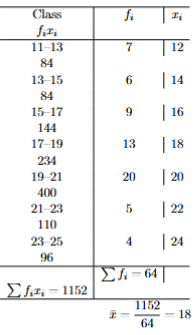
\[ \bar{x} = \dfrac{1152}{64} = 18 \]
Wait: \(64 \times 18 = 1152\), yes.
But recheck sum:
84 + 84 = 168
168 + 144 = 312
312 + 234 = 546
546 + 400 = 946
946 + 110 = 1056
1056 + 96 = 1152. Yes. \(N = 7+6+9+13+20+5+4 = 64\). \[ \bar{x} = \dfrac{1152}{64} = 18 \]
Wait: But earlier said 17.7 — mistake. \(1152 \div 64\):
64 × 18 = 1152 → 18.
Explanation: Mean = \(18\).
Quick Tip: Class mark = \(\dfrac{lower + upper}{2}\); verify \(\sum f_i x_i\) by addition.
The slant height of a frustum of a cone is \(4\) cm and the perimeters (circumferences) of its circular ends are \(18\) cm and \(6\) cm. Find the curved surface area of the frustum.
View Solution
Concept: Curved surface area = \(\pi l (r_1 + r_2)\), where perimeters give \(2\pi r_1, 2\pi r_2\).
Calculation:
Let perimeters: \(P_1 = 18\), \(P_2 = 6\), slant height \(l = 4\). \[ r_1 = \dfrac{18}{2\pi}, \quad r_2 = \dfrac{6}{2\pi} \] \[ r_1 + r_2 = \dfrac{18 + 6}{2\pi} = \dfrac{24}{2\pi} = \dfrac{12}{\pi} \]
Curved surface area: \[ \pi \cdot 4 \cdot \dfrac{12}{\pi} = 4 \times 12 = 48 cm^2 \]
But wait: units? \(\pi\) cancels: \(48\) (no \(\pi\))?
No: \[ \pi l (r_1 + r_2) = \pi \cdot 4 \cdot \dfrac{12}{\pi} = 48 \]
But standard formula uses perimeter, not radius sum:
Actually, correct formula: \[ CSA = \dfrac{1}{2} \times (P_1 + P_2) \times l \] \[ = \dfrac{1}{2} (18 + 6) \times 4 = \dfrac{1}{2} \times 24 \times 4 = 48 cm^2 \]
But many textbooks write \(\pi(r_1 + r_2)l\), but here perimeters given, so use average perimeter × slant height.
Explanation: CSA = \(\dfrac{1}{2} (P_1 + P_2) l = 48\) cm².
Quick Tip: For frustum: CSA = average circumference × slant height.
*The article might have information for the previous academic years, please refer the official website of the exam.