


| Updated On - Jul 4, 2026
AIIMS Paramedical 2026 Question Paper is available for download here. AIIMS, New Delhi conducted the exam on July 4, 2026, from 9:00 AM to 10:30 AM. The paper consists of 90 questions carrying 90 marks, with a duration of 90 minutes.
The question paper includes Physics, Chemistry, and Mathematics or Biology, with 30 questions in each section. Each correct answer carries 1 mark, while 1/3 mark is deducted for every incorrect response.
Candidates can download the AIIMS Paramedical 2026 Question Paper, along with the Answer Key and Solution PDF, from the links provided below.
AIIMS Paramedical 2026 Question Paper with Solution PDF
| AIIMS Paramedical 2026 Question Paper | Download PDF | Check Solution |
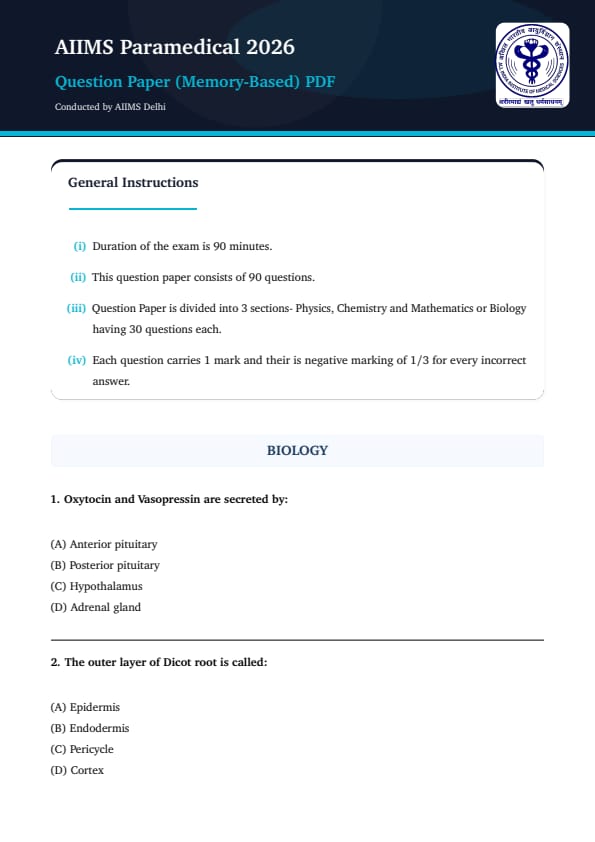
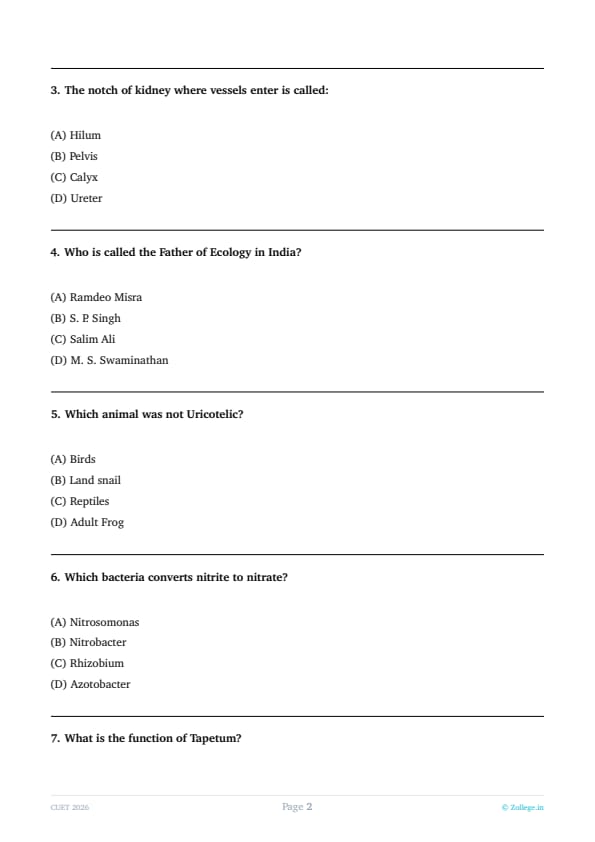
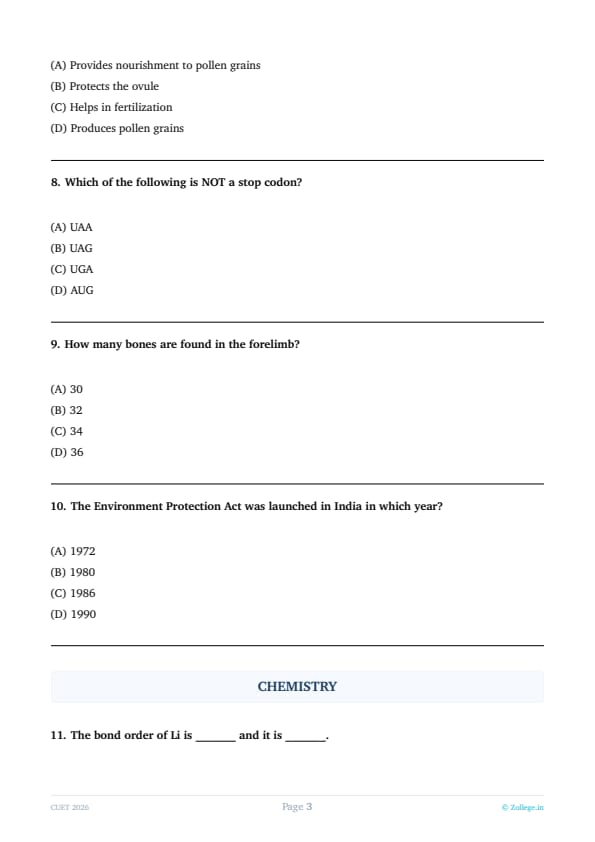
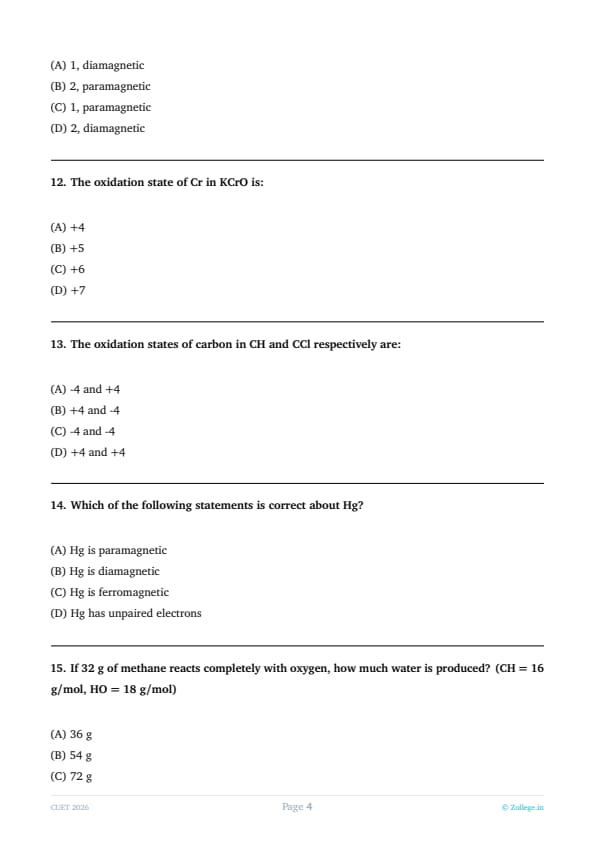
Oxytocin and Vasopressin are secreted by:
View Solution
Step 1: Understanding the Concept:
Oxytocin and Vasopressin (also known as Antidiuretic Hormone or ADH) are neurohypophysial hormones.
Step 2: Key Formula or Approach:
These hormones are synthesized in the magnocellular neurons of the supraoptic and paraventricular nuclei of the hypothalamus.
Step 3: Detailed Explanation:
Although they are released into the blood from the posterior pituitary, they are synthesized in the hypothalamus.
The posterior pituitary acts as a storage and release site for these hormones, not as a site of production.
Step 4: Final Answer:
The hormones are secreted by the hypothalamus, corresponding to option (B). Quick Tip: For arithmetic progressions, use the mean and variance formulas effectively: - Mean = \( \frac{Sum of terms}{Number of terms} \), - Variance = \( Mean of squares - (Square of mean) \).
The outer layer of Dicot root is called:
View Solution
Step 1: Understanding the Concept:
Plant root anatomy consists of concentric layers starting from the outermost surface.
Step 2: Key Formula or Approach:
The outermost layer of the root is known as the epidermis or epiblema.
Step 3: Detailed Explanation:
The epidermis is the primary protective layer of the root, often bearing unicellular root hairs.
It functions mainly in the absorption of water and minerals from the soil.
The other layers listed (cortex, endodermis, pericycle) are located internally.
Step 4: Final Answer:
The outer layer is the epidermis, corresponding to option (A). Quick Tip: For arithmetic progressions, use the mean and variance formulas effectively: - Mean = \( \frac{Sum of terms}{Number of terms} \), - Variance = \( Mean of squares - (Square of mean) \).
The notch of kidney where vessels enter is called:
View Solution
Step 1: Understanding the Concept:
The kidney has a characteristic medial indentation through which major structures pass.
Step 2: Key Formula or Approach:
The anatomical gateway of an organ where vessels and nerves enter or exit is termed the hilum.
Step 3: Detailed Explanation:
The hilum of the kidney is a deep concave notch on the medial border.
Structures such as the renal artery, renal vein, lymphatics, and the ureter enter or exit the kidney through this region.
The renal pelvis is the basin-like structure located inside the hilum.
Step 4: Final Answer:
The notch is called the hilum, corresponding to option (A). Quick Tip: For arithmetic progressions, use the mean and variance formulas effectively: - Mean = \( \frac{Sum of terms}{Number of terms} \), - Variance = \( Mean of squares - (Square of mean) \).
Who is called the Father of Ecology in India?
View Solution
Step 1: Understanding the Concept:
Professor Ramdeo Misra is recognized for his pioneering contributions to ecology and his foundational work in establishing ecological research in India.
Step 2: Detailed Explanation:
Ramdeo Misra was an Indian botanist whose work focused on tropical forest ecosystems and community ecology.
He established the Department of Botany at Banaras Hindu University as a center for advanced research in ecology, training generations of Indian ecologists.
Step 3: Final Answer:
The person called the Father of Ecology in India is Ramdeo Misra, corresponding to option (A). Quick Tip: While Salim Ali is the "Birdman of India" and M.S. Swaminathan is the "Father of the Green Revolution," R. Misra is the figurehead for Indian ecology.
Which animal was not Uricotelic?
View Solution
Step 1: Understanding the Concept:
Uricotelic animals excrete nitrogenous waste primarily in the form of uric acid to conserve water.
Step 2: Detailed Explanation:
Birds, land snails, and reptiles are uricotelic as an adaptation to terrestrial environments.
Adult frogs are "ureotelic" because they excrete nitrogenous waste primarily in the form of urea, which requires more water for excretion than uric acid.
Step 3: Final Answer:
The animal that is not uricotelic is the adult frog, corresponding to option (D). Quick Tip: Ammonotelic (ammonia) animals live in water, Ureotelic (urea) animals live in semi-terrestrial/terrestrial habitats, and Uricotelic (uric acid) animals are mostly terrestrial desert/dry-climate species.
Which bacteria converts nitrite to nitrate?
View Solution
Step 1: Understanding the Concept:
Nitrification is a two-step biological process that converts ammonia into nitrate.
Step 2: Detailed Explanation:
First, Nitrosomonas bacteria oxidize ammonia to nitrite: \( 2NH_3 + 3O_2 \rightarrow 2NO_2^- + 2H^+ + 2H_2O \).
Then, Nitrobacter bacteria oxidize nitrite to nitrate: \( 2NO_2^- + O_2 \rightarrow 2NO_3^- \).
Step 3: Final Answer:
The bacteria that converts nitrite to nitrate is Nitrobacter, corresponding to option (B). Quick Tip: Remember: Nitrosomonas starts with "Nitroso-" (nitrite production), and Nitrobacter ends in "-bacter" (but specifically completes the conversion to nitrate).
What is the function of Tapetum?
View Solution
Step 1: Understanding the Concept:
The tapetum is the innermost layer of the microsporangium wall in flowering plants.
Step 2: Key Formula or Approach:
The tapetum is specialized to provide essential nutrients to the developing pollen grains within the anther.
Step 3: Detailed Explanation:
The tapetal cells are multinucleated and rich in cytoplasm, allowing them to secrete enzymes, hormones, and nutrients required for the maturation of microspores.
Additionally, they contribute to the formation of the sporopollenin-rich exine (the outer wall) of the pollen grain.
Step 4: Final Answer:
The function of the tapetum is to provide nourishment to developing pollen grains, corresponding to option (A). Quick Tip: For arithmetic progressions, use the mean and variance formulas effectively: - Mean = \( \frac{Sum of terms}{Number of terms} \), - Variance = \( Mean of squares - (Square of mean) \).
Which of the following is NOT a stop codon?
View Solution
Step 1: Understanding the Concept:
Stop codons are nucleotide triplets that signal the termination of protein synthesis during translation.
Step 2: Key Formula or Approach:
The three standard stop codons are UAA, UAG, and UGA. Any triplet that is not one of these is not a stop codon.
Step 3: Detailed Explanation:
UAA, UAG, and UGA are the termination signals for ribosomes.
AUG is the universal "start codon," which codes for the amino acid Methionine and initiates the process of translation.
Step 4: Final Answer:
AUG is not a stop codon, corresponding to option (D). Quick Tip: For arithmetic progressions, use the mean and variance formulas effectively: - Mean = \( \frac{Sum of terms}{Number of terms} \), - Variance = \( Mean of squares - (Square of mean) \).
How many bones are found in the forelimb?
View Solution
Step 1: Understanding the Concept:
The human forelimb (arm) consists of a specific series of bones organized into segments.
Step 2: Key Formula or Approach:
The total count is derived by summing bones in the humerus, radius, ulna, carpals, metacarpals, and phalanges.
Step 3: Detailed Explanation:
The breakdown of the 30 bones is as follows:
- 1 Humerus
- 1 Radius
- 1 Ulna
- 8 Carpals (wrist bones)
- 5 Metacarpals (palm bones)
- 14 Phalanges (finger bones)
Sum = \( 1+1+1+8+5+14 = 30 \).
Step 4: Final Answer:
There are 30 bones found in the forelimb, corresponding to option (A). Quick Tip: For arithmetic progressions, use the mean and variance formulas effectively: - Mean = \( \frac{Sum of terms}{Number of terms} \), - Variance = \( Mean of squares - (Square of mean) \).
The Environment Protection Act was launched in India in which year?
View Solution
Step 1: Understanding the Concept:
The Environment Protection Act is an umbrella legislation enacted by the Parliament of India to provide for the protection and improvement of the environment.
Step 2: Key Formula or Approach:
The Act was enacted in the wake of the Bhopal Gas Tragedy to implement the decisions made at the United Nations Conference on the Human Environment held in Stockholm in 1972.
Step 3: Detailed Explanation:
The Environment Protection Act (EPA) was passed in March 1986 and came into force on November 19, 1986.
It grants the Central Government of India the authority to establish standards for the quality of the environment and to restrict areas in which industries, operations, or processes may be carried out.
Step 4: Final Answer:
The Act was launched in 1986, corresponding to option (C). Quick Tip: For arithmetic progressions, use the mean and variance formulas effectively: - Mean = \( \frac{Sum of terms}{Number of terms} \), - Variance = \( Mean of squares - (Square of mean) \).
The bond order of Li₂ is _______ and it is _______.
View Solution
Step 1: Understanding the Concept:
Molecular Orbital Theory (MOT) describes the electronic structure of molecules by assigning electrons to molecular orbitals.
Step 2: Key Formula or Approach:
The Bond Order is calculated as: \[ Bond Order = \frac{Number of bonding electrons - Number of antibonding electrons}{2} \]
Diamagnetic substances have all electrons paired, while paramagnetic substances have unpaired electrons.
Step 3: Detailed Explanation:
The electronic configuration of a Lithium atom (\(Z=3\)) is \( 1s^2 2s^1 \). For a \( Li_2 \) molecule (6 electrons total), the configuration is: \[ (\sigma 1s)^2 (\sigma^ 1s)^2 (\sigma 2s)^2 \]
Bonding electrons = 4, Antibonding electrons = 2.
Bond Order = \( \frac{4 - 2}{2} = 1 \).
Since all electrons are paired in the \( \sigma 2s \) orbital, the molecule is diamagnetic.
Step 4: Final Answer:
The bond order is 1 and it is diamagnetic, corresponding to option (A). Quick Tip: For diatomic molecules, a bond order of 0 indicates the molecule is unstable and does not exist.
The oxidation state of Cr in K₂Cr₂O₇ is:
View Solution
Step 1: Understanding the Concept:
The oxidation state is the charge an atom would have if all bonds to atoms of different elements were 100% ionic.
Step 2: Key Formula or Approach:
The sum of oxidation states in a neutral compound is zero. Let the oxidation state of Cr be \( x \).
Step 3: Detailed Explanation:
Assign oxidation numbers: K = +1, O = -2.
\[ 2(+1) + 2(x) + 7(-2) = 0 \] \[ 2 + 2x - 14 = 0 \] \[ 2x = 12 \] \[ x = +6 \]
Step 4: Final Answer:
The oxidation state of Cr is +6, corresponding to option (C). Quick Tip: Always remember the standard oxidation states: Oxygen is usually -2 (except in peroxides), and Group 1 metals like Potassium are always +1.
The oxidation states of carbon in CH₄ and CCl₄ respectively are:
View Solution
Step 1: Understanding the Concept:
Oxidation states depend on the electronegativity of the atoms bonded to the central atom.
Step 2: Detailed Explanation:
In CH₄: Carbon is more electronegative than Hydrogen. Each H is +1. \[ x + 4(+1) = 0 \implies x = -4 \]
In CCl₄: Chlorine is more electronegative than Carbon. Each Cl is -1. \[ x + 4(-1) = 0 \implies x = +4 \]
Step 3: Final Answer:
The oxidation states are -4 and +4, corresponding to option (A). Quick Tip: Carbon is the "pivot." If bonded to less electronegative atoms (like H), it takes a negative state. If bonded to more electronegative atoms (like Cl, O), it takes a positive state.
Which of the following statements is correct about Hg?
View Solution
Step 1: Understanding the Concept:
Magnetic properties of elements are determined by their electronic configuration and the presence of unpaired electrons.
Step 2: Key Formula or Approach:
The electronic configuration of Mercury (Hg, Atomic Number 80) is \( [Xe] 4f^{14} 5d^{10} 6s^2 \).
Step 3: Detailed Explanation:
In the ground state electronic configuration of Hg, all the subshells, including the 5d and 6s orbitals, are completely filled.
Since there are no unpaired electrons in the mercury atom, it does not exhibit paramagnetism.
Consequently, it is weakly repelled by a magnetic field, classifying it as diamagnetic.
Step 4: Final Answer:
Hg is diamagnetic, corresponding to option (B). Quick Tip: For arithmetic progressions, use the mean and variance formulas effectively: - Mean = \( \frac{Sum of terms}{Number of terms} \), - Variance = \( Mean of squares - (Square of mean) \).
If 32 g of methane reacts completely with oxygen, how much water is produced? (CH₄ = 16 g/mol, H₂O = 18 g/mol)
View Solution
Step 1: Understanding the Concept:
To find the amount of product, we must first write the balanced chemical equation for the combustion of methane.
Step 2: Key Formula or Approach:
The balanced equation is: \[ CH_4 + 2O_2 \rightarrow CO_2 + 2H_2O \]
From the equation, 1 mole of methane produces 2 moles of water.
Step 3: Detailed Explanation:
Calculate the moles of methane: \[ Moles of CH_4 = \frac{Given mass}{Molar mass} = \frac{32 g}{16 g/mol} = 2 moles \]
Since 1 mole of CH₄ produces 2 moles of H₂O, 2 moles of CH₄ will produce: \[ 2 \times 2 = 4 moles of H_2O \]
Calculate the mass of water produced: \[ Mass of H_2O = moles \times molar mass = 4 mol \times 18 g/mol = 72 g \]
Step 4: Final Answer:
The mass of water produced is 72 g, corresponding to option (C). Quick Tip: For arithmetic progressions, use the mean and variance formulas effectively: - Mean = \( \frac{Sum of terms}{Number of terms} \), - Variance = \( Mean of squares - (Square of mean) \).
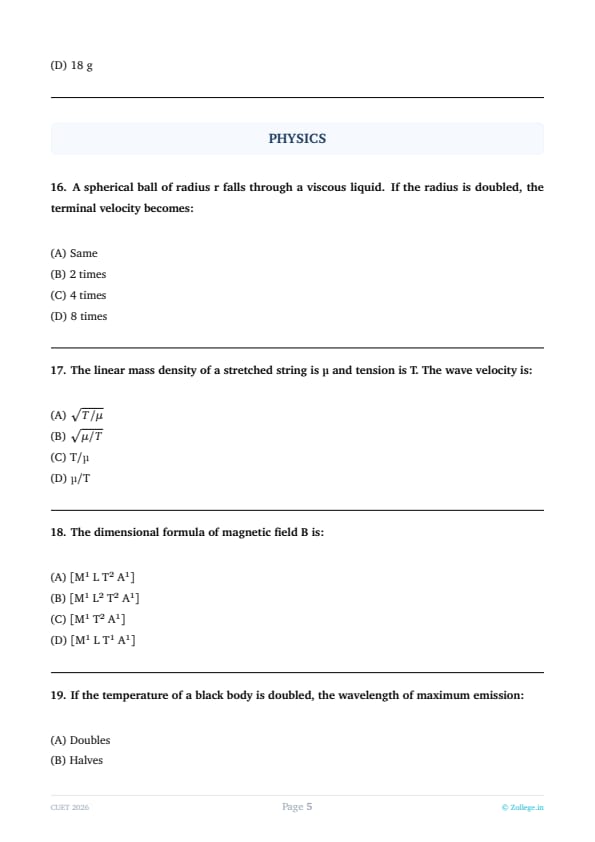
A spherical ball of radius r falls through a viscous liquid. If the radius is doubled, the terminal velocity becomes:
View Solution
Step 1: Understanding the Concept:
Terminal velocity (\(v_t\)) of a spherical body falling through a viscous fluid is governed by Stokes' Law, where the weight of the sphere is balanced by the buoyancy and viscous drag.
Step 2: Key Formula or Approach:
The formula for terminal velocity is: \[ v_t = \frac{2}{9} \frac{r^2 (\rho - \sigma) g}{\eta} \]
where \(r\) is the radius, \(\rho\) is the density of the ball, \(\sigma\) is the density of the liquid, \(\eta\) is the viscosity, and \(g\) is gravity.
Step 3: Detailed Explanation:
From the formula, we see that \(v_t \propto r^2\).
If the radius is doubled (\(r' = 2r\)), the new terminal velocity \(v'_t\) is: \[ v'_t \propto (2r)^2 \] \[ v'_t \propto 4r^2 \] \[ v'_t = 4v_t \]
Step 4: Final Answer:
The terminal velocity becomes 4 times the original velocity, corresponding to option (C). Quick Tip: Remember the relationship \(v_t \propto r^2\); any change in radius is squared, while changes in density or viscosity are linear or inverse.
The linear mass density of a stretched string is µ and tension is T. The wave velocity is:
View Solution
Step 1: Understanding the Concept:
The speed of a transverse wave on a stretched string depends on the restoring force (tension) and the inertia per unit length (linear mass density).
Step 2: Key Formula or Approach:
The velocity of a transverse wave in a string is given by the formula: \[ v = \sqrt{\frac{T}{\mu}} \]
where \(T\) is the tension and \(\mu\) is the linear mass density.
Step 3: Detailed Explanation:
The derivation comes from Newton's second law applied to a small segment of the string as the wave passes through.
The tension (\(T\)) acts as the restoring force, and the linear mass density (\(\mu = mass/length\)) provides the resistance to acceleration.
Step 4: Final Answer:
The wave velocity is \(\sqrt{T/\mu}\), corresponding to option (A). Quick Tip: Higher tension makes waves travel faster, while a heavier string (higher \(\mu\)) slows them down.
The dimensional formula of magnetic field B is:
View Solution
Step 1: Understanding the Concept:
The magnetic field \(B\) can be derived from the Lorentz force equation, \(F = qvB\sin\theta\).
Step 2: Key Formula or Approach:
Rearranging for \(B\): \[ B = \frac{F}{qv} \]
Using dimensional analysis: \(F = [M L T^{-2}]\), \(q = [A T]\), and \(v = [L T^{-1}]\).
Step 3: Detailed Explanation:
Substitute dimensions into the formula: \[ B = \frac{[M L T^{-2}]}{[A T][L T^{-1}]} \] \[ B = \frac{[M L T^{-2}]}{[A L]} \]
Canceling the \(L\) terms: \[ B = [M L^0 T^{-2} A^{-1}] \]
Step 4: Final Answer:
The dimensional formula is [M¹ L⁰ T⁻² A⁻¹], corresponding to option (A). Quick Tip: You can also derive this from \(F = IlB\), giving \(B = F/Il = [M L T^{-2}] / [A L] = [M T^{-2} A^{-1}]\).
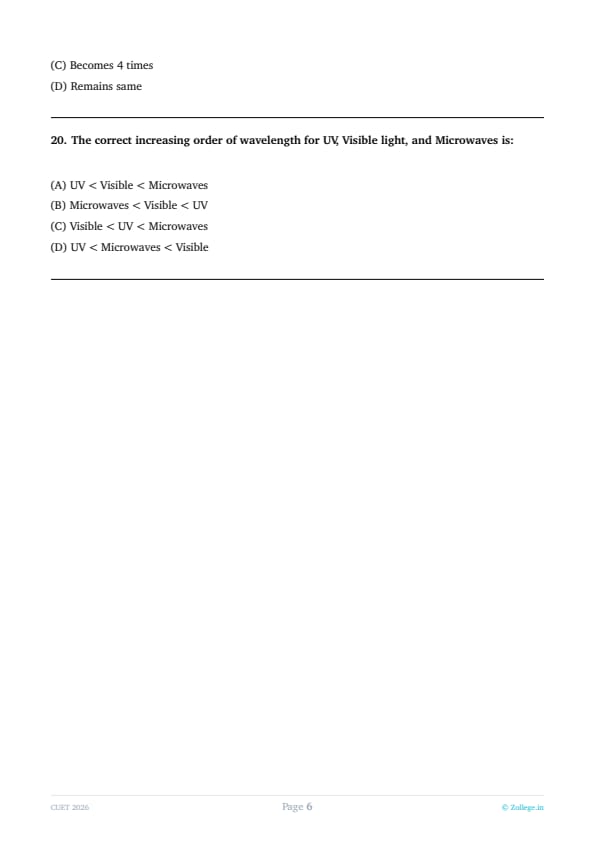
If the temperature of a black body is doubled, the wavelength of maximum emission:
View Solution
Step 1: Understanding the Concept:
This phenomenon is governed by Wien's Displacement Law, which relates the temperature of a black body to the wavelength at which it emits the most radiation.
Step 2: Key Formula or Approach:
Wien's Displacement Law is expressed as: \[ \lambda_{max} T = b \]
where \(\lambda_{max}\) is the wavelength of maximum emission, \(T\) is the absolute temperature, and \(b\) is Wien's displacement constant.
Step 3: Detailed Explanation:
From the formula, \(\lambda_{max} \propto \frac{1}{T}\).
If the temperature is doubled (\(T' = 2T\)), the new wavelength (\(\lambda'_{max}\)) becomes: \[ \lambda'_{max} \propto \frac{1}{2T} = \frac{1}{2} \lambda_{max} \]
Step 4: Final Answer:
The wavelength of maximum emission halves, corresponding to option (B). Quick Tip: Higher temperatures shift the peak of the emission spectrum toward shorter wavelengths (blue end), while lower temperatures shift it toward longer wavelengths (red end).
The correct increasing order of wavelength for UV, Visible light, and Microwaves is:
View Solution
Step 1: Understanding the Concept:
The electromagnetic spectrum is organized by wavelength, frequency, and photon energy.
Step 2: Detailed Explanation:
Wavelengths across the electromagnetic spectrum generally increase in the following order: Gamma rays < X-rays < Ultraviolet (UV) < Visible light < Infrared < Microwaves < Radio waves.
Comparing the three given types:
- UV radiation has shorter wavelengths than visible light.
- Visible light has shorter wavelengths than microwaves.
Therefore, the increasing order is UV < Visible < Microwaves.
Step 3: Final Answer:
The correct increasing order is UV < Visible < Microwaves, corresponding to option (A). Quick Tip: As you move from UV towards Microwaves, energy and frequency decrease, while wavelength increases.
AIIMS Paramedical 2026 Exam Pattern
| Particulars | Details |
|---|---|
| Exam Mode | Computer Based Test (CBT) |
| Total Questions | 90 |
| Total Marks | 90 |
| Duration | 90 minutes |
| Question Type | Multiple Choice Questions (MCQs) with 4 options |
| Correct Answer | +1 mark |
| Wrong Answer | -1/3 mark (negative marking) |
| Unattempted Question | 0 marks (no penalty) |
| Language | English |
AIIMS Paramedical 2026 Revision
*The article might have information for the previous academic years, please refer the official website of the exam.