Highlights
- There are around 560 MBA programs in the US alone
- You’ll need a strong and diverse application to get into the best Business schools in USA
- The overall reported average GMAT score for MBA students is 609
- Average accepted GPA scores at US MBA programs are higher at 3.5
USA is known to offer world-class MBA programs through its globally top ranked universities. As per QS MBA rankings 2024, Stanford Graduate School of Business, The Wharton School and Harvard Business School are the top 3 universities offering MBA in USA. You must be worried about the acceptance rates, as these are highly ambitious universities, right? MBA Acceptance Rates at top US Business Schools are competitive, slightly higher than those in Canada. Some of the most well-known MBA programs in the world are found in the US, and admission to these programs can be very competitive. You need to submit a GMAT score, a strong GPA, an excellent MBA resume, and some standout essays to have the best chance of being accepted into a top MBA program. In the MBA entrance essays and admission interview, you need to show how you distinguish yourself from a group of similarly remarkable applicants. Want to know how to increase your chances of getting into the program? Come along to know the details and acceptance rates for MBA programs in the US.
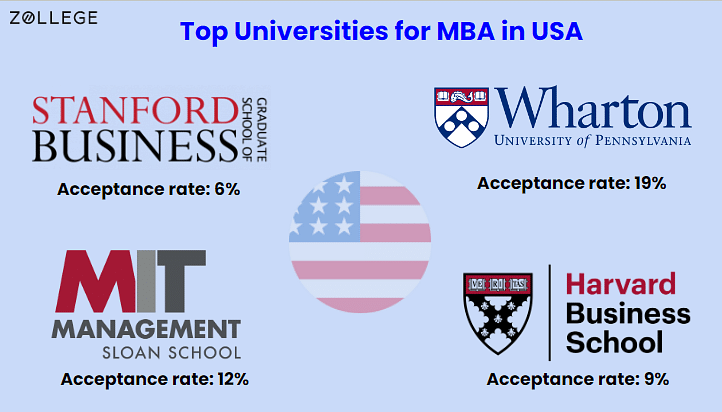
MBA Acceptance Rates in the US
Candidates wonder, “Why are MBA acceptance rates so high?” The acceptance rates for MBA programs in the US are low, especially at top-tier institutions like Stanford MBA acceptance rate, MBA acceptance rate Harvard, and Wharton MBA acceptance rate, which also happens to boast some of the best MBA programs in the world. In the US, MBA programs are exceptionally well-liked; thousands of applications from both domestic and foreign students are submitted to most schools each year. Even though typical acceptance rates have increased in recent years, getting an MBA from any of the top universities in USA is still considered relatively hard due to the continued high demand for MBA graduates in the US.
There are almost 560 MBA programs in the US alone, and each institution has a different acceptance rate, average acceptable GPA, and GMAT requirements. The average acceptance rate at the top 10 institutions, including Kellogg Business School and Harvard Business School, is roughly 18%. Candidates will need a robust and interesting application to stand out and be admitted to the undergraduate business schools with high acceptance rate. Even if you can enroll in an MBA program with a low GPA, you should give each component of your MBA application your best effort.
Highest MBA Acceptance Rates at the Top U.S. Programs for the Class of 2024
Most MBA programs in the US will demand strong GMAT or GRE scores, while admission requirements vary somewhat amongst programs. Even while passing these examinations is not compulsory, doing so will help your application. The reported average GMAT score for those pursuing an MBA was 609, which is fairly high but not out of reach. According to a scale of 4.0, the average accepted GPA for US MBA programs is 3.5 or higher.
To be accepted into a STEM MBA in USA, you must have exceptional entrance essays, typically two MBA letters of recommendation, strong test results, and impressive transcripts. Of course, you also need an MBA CV to show your professional experience. Although it's not always necessary, professional experience is favored by many schools and greatly aids in persuading admissions committees.
The MBA acceptance rates for 2024, average GPAs, school acceptance rates, and GMAT scores accepted by the top MBA programs in the US are shown in the table below.
|
School |
2024 QS ranking |
Applications Received |
Accepted |
Enrolled |
Acceptance Rate |
Yield rate |
|
Harvard Business School |
#3 |
8264 |
1021 |
1015 |
9.5% |
87% |
|
The Wharton School of Business |
#2 |
6692 |
1287 |
863 |
19.20% |
67.10% |
|
#12 |
4595 |
926 |
478 |
20.20% |
51.60% |
|
|
#1 |
8173 |
469 |
418 |
5.70% |
89.10% |
|
|
Sloan School of Management |
#6 |
5798 | 670 |
404 |
11.60% |
60.30% |
|
Yale School of Management |
#16 |
4098 |
713 |
348 |
17.40% |
48.40% |
|
#7 |
6188 | 1019 |
753 |
16.50% | 73.90% | |
|
Haas School of Business |
#13 |
4007 |
515 |
261 |
12.90% |
50.90% |
|
Ross School of Business |
#22 |
3484 | 880 |
422 |
25.30% | 48% |
|
Tuck School of Business |
#55 |
2610 | 601 |
293 |
23.00% |
48.80% |
|
Fuqua School of Business |
#23 |
3796 | 851 |
433 |
22.40% | 50.90% |
|
Stern School of Business |
#17 |
3927 |
822 |
399 | 20.90% | 48.50% |
|
Darden School of Business |
#59 |
2743 | 671 |
326 |
24.50% | 48.60% |
|
Cornell Johnson Graduate School of Management |
#3 |
1653 | 495 |
277 |
29.90% | 56% |
|
Tepper School of Business |
#43 |
1804 | 540 |
220 |
29.90% | 40.70% |
|
Anderson School of Management |
#15 |
3315 | 740 | 363 | 22.30% | 49.10% |
|
McCombs School of Business |
#41 |
2586 | 720 |
265 |
27.80% | 36.80% |
|
Kenan-Flagler Business School |
#87 |
2151 | 800 |
291 |
37.20% | 36.40% |
|
Marshall School of Business |
#37 |
1998 | 581 |
225 |
29.10% | 38.70% |
Selectivity Rate for top MBA in USA
The United States has the most world-class MBA programs, including the Ivy League Universities. The Financial Times, The Economist, and The QS Global 200 Business Schools all rank the best MBA programs in the world, and more than 50% of them are from the United States. Here is a list of the top US MBA programs by selectivity rate.
|
Business School |
Selectivity Rate |
|
11% |
|
|
Stanford |
6% |
|
Wharton |
19.2% |
|
Chicago Booth |
20.8% |
|
16.5% |
|
|
Northwestern Kellogg |
20.2% |
|
Dartmouth Tuck |
23% |
|
MIT Sloan |
11.5% |
|
Duke Fuqua |
22% |
|
Michigan Ross |
25% |
|
17.4% |
|
|
Cornell Johnson |
30% |
|
12% |
|
|
Virginia Darden |
24.5% |
|
NYU Stern |
21% |
|
UCLA Anderson |
22% |
|
CMU Tepper |
29.5% |
|
Washington Foster |
22% |
|
UT Austin McCombs |
28% |
|
Rice Jones |
27% |
|
Indiana Kelley |
35% |
|
UNC Kenan-Flagler |
37% |
|
Notre Dame Mendoza |
42% |
|
Emory Goizueta |
40.8% |
|
Penn State Smeal |
20.4% |
|
Vanderbilt Owen |
43% |
|
Maryland Smith |
36.2% |
|
Georgetown McDonough |
47.8% |
|
USC Marshall |
29% |
|
Ohio State Fisher |
37% |
How To Improve Your Chances of Being Selected?
One of the most significant characteristics of schools and universities is their acceptance rates, which reveal how selective they are. At the time of application, US universities with high acceptance rates take on a significant role, since they enable applicants to evaluate their own applications and forecast their chances of admission to a particular business school. The reputation a college enjoys in the market, the standard of instruction, the conduct and qualifications of faculty, the campus atmosphere, the graduation rate, the volume of applications received annually, etc., all affect an institution's acceptance rate. However, consider the below-mentioned points to improve your chances:
- Good scores in exams to study in USA
- Good hold in GMAT
- Well written SOP for MBA
- Apply with higher work experience
Selecting a business school is a difficult task. GMAT and GRE scores, essays, references, interviews, and, of course, if the business school is a suitable fit for you and your professional aspirations are just a few of the numerous application process factors to take into account. But acceptance rates are also a crucial consideration when making an application to business school. Acceptance rates, which show how many candidates are accepted into a school's MBA program, are a good indication of how difficult it truly is to get into your preferred MBA program.
FAQs
Ques: What are the average acceptance rates for MBA programs at top US business schools?
Ans: Acceptance rates vary by school, but typically range between 5% and 30%.
Ques: Which business schools have the lowest acceptance rates?
Ans: Business schools such as Stanford Graduate School of Business, Harvard Business School, and Wharton School of the University of Pennsylvania are known for their low acceptance rates.
Ques: Are acceptance rates more competitive for full-time MBA programs or part-time MBA programs?
Ans: Full-time MBA programs generally have more competitive acceptance rates compared to part-time MBA programs.
Ques: Do acceptance rates differ between different MBA program formats, such as online or executive MBA?
Ans: Acceptance rates can vary between different MBA program formats. Generally, full-time MBA programs have lower acceptance rates compared to online or executive MBA programs.
Ques: How do acceptance rates at top US business schools compare to other graduate programs?
Ans: Acceptance rates for MBA programs tend to be lower than many other graduate programs due to their highly competitive nature and the limited number of available spots.
Ques: Are there any business schools with acceptance rates above 30%?
Ans: Yes, some business schools have acceptance rates above 30%. Schools like Kellogg School of Management and UCLA Anderson School of Management have acceptance rates around that range.
Ques: Can a strong GMAT/GRE score compensate for a lower acceptance rate?
Ans: While a strong GMAT/GRE score can certainly enhance your application, acceptance rates are influenced by various factors, including academic qualifications, work experience, recommendations, and more.
Ques: Are international applicants at a disadvantage when it comes to MBA acceptance rates?
Ans: International applicants may face additional challenges due to visa requirements and language proficiency tests. However, top business schools actively seek diverse perspectives and often have dedicated resources for international applicants.
Ques: Can a high undergraduate GPA improve chances of acceptance into a top business school?
Ans: A high undergraduate GPA is one of the factors considered in the application process. However, business schools evaluate candidates holistically, taking into account various aspects such as work experience, essays, and recommendations.
Ques: Do acceptance rates vary by industry or career background?
Ans: Acceptance rates may vary based on industry or career background, as business schools aim to create diverse cohorts. However, it ultimately depends on the applicant pool and the specific preferences of each business school.
Ques: What factors influence MBA acceptance rates?
Ans: MBA acceptance rates are influenced by a variety of factors, including academic qualifications (such as undergraduate GPA and GMAT/GRE scores), work experience, essays, letters of recommendation, interviews, and diversity considerations. Each business school weighs these factors differently in their admissions process, so it's crucial for applicants to highlight their strengths and fit with the specific school's values and culture.
Ques: How can I improve my chances of getting accepted into a top MBA program?
Ans: To improve your chances of acceptance, focus on showcasing a strong academic record, gaining relevant work experience, preparing thoroughly for standardized tests, crafting compelling essays that demonstrate your unique qualities and career goals, securing impactful letters of recommendation, and performing well in admissions interviews. Additionally, engaging in extracurricular activities, leadership roles, and community service can enhance your application.
Ques: Are there any strategies for navigating the competitive MBA admissions process?
Ans: Several strategies can help applicants navigate the competitive admissions process. These include applying to a range of programs that match your qualifications and career aspirations, considering early decision or early action options if available, networking with current students and alumni to learn more about the program.
Ques: Do business schools have quotas for different demographics or regions?
Ans: While business schools strive for diversity in their student bodies, including factors such as gender, ethnicity, nationality, and professional background, they do not have specific quotas for different demographics or regions. Admissions decisions are based on a holistic review of each applicant's qualifications and potential contributions to the MBA community.
Ques: Are there any trends or shifts in MBA acceptance rates at top US business schools in recent years?
Ans: There have been some notable trends and shifts in MBA acceptance rates at top US business schools in recent years. One significant trend is the overall increase in applications to MBA programs, driven by factors such as a strong job market, economic uncertainty, and the growing popularity of remote work and online learning options. As a result, some schools have reported declining acceptance rates as they face greater competition for a limited number of seats


![Massachusetts Institute of Technology [MIT]](https://static.zollege.in/public/college_data/images/studyabroad/logos/college_1087_29-14:42_download.png?tr=w-50,h-50,c-force?tr=h-40,w-35,c-force)
![University of California [UC Berkeley]](https://static.zollege.in/public/college_data/images/studyabroad/logos/college_982_24-16:13_download.png?tr=w-50,h-50,c-force?tr=h-40,w-35,c-force)

![University of Chicago [UChicago]](https://static.zollege.in/public/college_data/images/studyabroad/logos/college_1129_06-15:23_logo.png?tr=w-50,h-50,c-force?tr=h-40,w-35,c-force)