International nationals have the option to live and work in Australia permanently through the Australia PR point system. It is known as Australia Permanent Residency (PR) system. Although eligibility requirements for Australia work visa can vary, they frequently include age, skill levels, and occupation relevancy. In Australia PR point system, applicants are given a point-based evaluation, and those who score the highest are invited to apply for PR. Australia PR new point system skills evaluation, the filing of an Expression of Interest (EOI) through SkillSelect, and being invited to apply for a particular visa subclass are all steps in the application process. After receiving PR, holders are entitled to several advantages, such as access to healthcare and education as well as the opportunity to apply for Australian citizenship after satisfying the residency criteria.
- Benefits of Australian Permanent Resident
- Australia PR 65 Point-Based System
- Australia PR Point System Calculator
3.1 Age for Australia PR Point System
3.2 Australia PR Point System English Proficiency
3.3 Australia PR Point System Work Experience
3.4 Australia PR Point System for Education
3.5 Skilled Occupation Lists
3.6 Partner Skills
3.7 Australian Specialist Education - Documents Required for Australia PR
- Australian PR Cost from India
5.1 Skill Assessment - Australia PR Processing Time
- FAQs
Benefits of Australian Permanent Resident
A candidate who mimigrate to Australia with a permanent residence visa is granted the status of an Australian permanent resident. However, candidates with Australia PR do not have citizenship in Australia. For five years, Permanent Residents of Australia are permitted to reside, work, and attend school there. The individual can submit a citizenship application based on eligibility after residing in Australia for 4 years under Australia PR new point system.
- Access to healthcare: The candidates will be qualified for all of the healthcare benefits provided to Australian citizens as permanent residents.
- Benefits from Social Security: All Social Security benefits are available to the candidates once they have been permanent residents for two working years.
- Children of Permanent Residents Have Benefits: Children of permanent residents who are born in Australia are regarded as Australian citizens. As per Australia PR new point system, they eligible for all benefits accorded to them. This makes their healthcare and education incredibly accessible and cost-effective.
- Students will Have Loan Access: They are free to apply for student loans if they are Australian permanent residents as per new point system for Australia PR.
- Eligible to Apply for Citizenship of Australia: Candidates holding Australian student visa can apply for Australian citizenship after four years of working as a permanent resident in Australia.
Australia PR 65 Point-Based System
The Australian government facilitates skilled students' immigration by adopting a point-based system to calculate eligibility. The Australia PR point system changes is pretty easy. To be qualified to apply for a subclass 189 (Skilled Independent visa) or a subclass 190 (Skilled Nominated visa), students must fulfil the following requirements:
- Obtain an application request for new PR point system in Australia
- Jobs for international students in Australia must be included in the list of Australian Skilled Occupations on the MLTSSL.
- Perform a job-specific skill analysis.
Australia PR Point System Calculator
The chances of students being invited to apply for Australia PR point system increase as their eligibility score rises. They may be eligible for a quicker invitation to apply for PR if they receive 80 to 85 point. The minimum score needed as per Australia PR point system calculator to be qualified for an Australia PR visa is 65 point. They can apply for an Australia PR visa in several different categories, each of which has a distinct eligibility standard. The following are the typical Australia point systems for PR:
| Category | Maximum point |
| Age Range (25-32 years) | 30 point |
| English proficiency Tets (8 bands) | 20 point |
| Work Experience outside Australia (8-10 years) | 15 point |
| Work Experience within Australia (8-10 years) | 20 point |
| Education (outside Australia) – Doctorate | 20 point |
| Niche skills like Doctorate or master’s degree by research in Australia | 10 point |
| Study in a regional area (Australia) | 5 point |
| Studied in community language | 5 point |
| Professional year in a skilled program in Australia | 5 point |
| State sponsorship (190 visas) | 5 point |
| Skilled spouse or de facto partner (with Age, Skills & English language requirements) | 10 point |
| Spouse or de facto partner with ‘competent English’ ( 6 or more in IELTS - No need to meet Skills requirement or age factor) | 5 point |
| Applicants without a spouse or de facto partner or a spouse an Australian citizen or PR holder | 10 point |
| Relatives or regional sponsorship (491 visa) | 15 point |
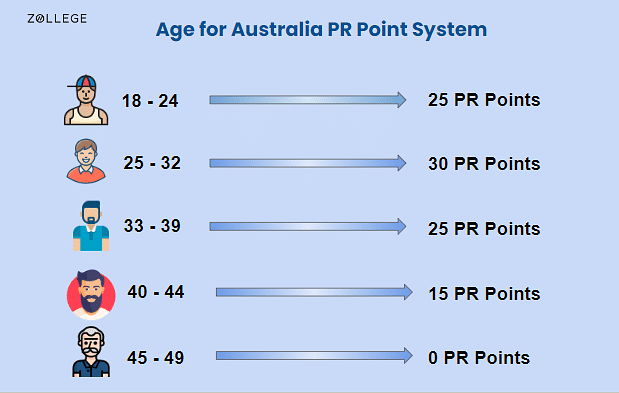
Age for Australia PR Point System
As per Australia PR point system calculator, if the applicants are between the ages of 25 and 32, they can earn up to 30 point. For a PR visa, They must be under 45 years of age. The Australia PR application point system are:
Australia PR Point System English Proficiency
The students can receive up to 20 point on the IELTS exam with a score of 8 bands. Australia PR point system for Indian permit students to take any of the English proficiency exams - TOEFL, PTE, and IELTS. The required scores are as follows:
| English Language Skills | IELTS Band | PR point |
| Superior | 8 | 20 |
| Proficient | 7 | 10 |
| Competent | 6 | 0 |
Australia PR Point System Work Experience
The applicants will receive 15 point if they have held skilled employment outside of Australia for more than 8 years in the last 10 years; fewer years of experience score fewer point. They can score up to 20 point for skilled employment in Australia with 8 to 10 years of experience as of the application date.
| Skilled employment in Australia | Point |
| Less than 1 year | 0 |
| 1-2 years | 5 |
| 3-4 years | 10 |
| 5-7 years | 15 |
| 8-10 years | 20 |
Australia PR Point System for Education
The level of education determines how many point are awarded for the education category. A doctorate from a top universities in Australia or one outside of Australia that has been approved by the Australian government will gain the most point.
| Qualifications | Point |
| Doctorate Degree | 20 |
| A Bachelor’s (or Masters) | 15 |
| Diploma or trade qualification in Australia | 10 |
| Any recognised qualification or award | 10 |
| Master by research or a Doctorate from an Australian educational institution in the STEM fields | 10 |
Skilled Occupation Lists
The applicant must select a profession from one of the following categories of skilled occupations. Candidates must be aware of the reasons for rejection for Australia PR before applying. The list includes the professions now approved for immigration to Australia. The occupations in the list are periodically updated to reflect shifts in the Australian labour market. The SOL is divided into three categories. They are:
- Medium- and Long-term Strategic Skills List (MLTSSL)
- Short-term Skilled Occupation List (SSOL)
- Regional Occupations List (ROL)
Spouse application: If the candidate’s spouse is also an applicant for the PR courses for visa, they will be eligible for additional point to their Skill Select Expression of Interest. To get these additional 10 point, Their spouse must meet the following requirements:
- Should be less than 45 years of age
- Should have good scores in English
- Job occupation code should appear in the same occupation list as the primary applicant list
Sponsorship/Nomination
The point may increase if students have Australian relatives who could sponsor them. In some instances, the state will support a candidate based on their stream of work.
| Nomination/Sponsorship | PR point |
| Nomination by a Family Member | 10 |
| Sponsorship by the State | 5 |
Partner Skills
Under specific circumstances, the presence of a spouse helps gain point as follows.
- Students receive 10 point if they are single (i.e., have no spouse or de facto partner).
- They receive 10 point if their partner is an Australian citizen or permanent resident.
- They receive 10 PR point if their spouse is under 45 years of age, scored "competent" on the English proficiency exam, and falls under the same occupational code, and type of visa.
- They receive 5 point if their spouse speaks English well but does not share their skill set or falls under the same Australia PR visa point system category.
Australian Specialist Education
Students will receive 5 point if they have a doctorate or a master's by research from an Australian university and have worked in the same field for at least two academic years. As per Australia current point system PR, study in regional or metropolitan area will receive 5 points. They are awarded 5 point if they plan to attend school in a rural or sparsely populated area of Australia.
| Study in a regional area | 5 point |
| Accredited in community language | 5 point |
| Professional year in a skilled program in Australia | 5 point |
| State sponsorship (190 visas) | 5 point |
| Relative or regional sponsorship (491 visa) | 15 point |
Documents Required for Australia PR
Candidates might ask what is the point system for PR in Australia or what are the documents required. Here are the compulsory documents required for your Australia PR:
- PR Application form
- Valid Passport
- Company Offer Letters
- Character Certificate
- Nomination
- ECA Report
- IELTS or TOEFL Scorecards
- 2 recent Passport size photographs
- Medical Certificate
- Police Clearance Certificate
Australian PR Cost from India
The total cost of Australian PR is AUD 4200 or roughly INR 250,000 for Indian citizens. Students calculate the entire cost of the PR visa and the application fees by adding up all of these expenses.
| Visa subclass | Base application charge (primary applicant) | Additional Applicant charge 18 and over (Secondary applicant) | Additional applicant charge under 18 (child applicants) |
| Subclass 189 Visa | AUD 4,240 | AUD 2,120 | AUD 1,060 |
| Subclass 190 Visa | AUD 4,240 | AUD 2,120 | AUD 1,060 |
| Subclass 491 Visa | AUD 4,240 | AUD 2,120 | AUD 1,060 |
Skill Assessment
Skill assessment fees are given below:
| Application type | Fees |
| Temporary Graduate – 485 Skills Assessment | AUD 500 |
| Post Australian Study Skills Assessment | AUD 530 |
| Skills (general application) | AUD 530 |
| Recognition of Prior Learning (RPL) | AUD 575 |
| Review Application | AUD 395 |
| Appeal Application | AUD 395 |
Australia PR Processing Time
The processing of the application for an Australia PR visa generally takes 6.5 to 8 months. The timing differs for each stage. There is a breakdown of how long each stage took. The total processing time for your PR visa is calculated by adding the times required for each stage.
- Skill assessment: 45 to 90 days.
- Visa Approval: 3 to 12 months.
- Preparation for Departure: 2 to 3 weeks
The minimum number of points required for PR in Australia is 65 points. However, the actual number of points required may vary depending on the visa subclass you are applying for and the current demand for skilled migrants in Australia.
FAQs
Ques: What is the Australia points-based immigration system?
Ans: The Australia points-based immigration system is a system that assesses skilled migrants based on their skills, qualifications, work experience, English language proficiency, and other factors. Applicants who score enough points are eligible to apply for permanent residency (PR) in Australia.
Ques: How many points do I need to get PR in Australia?
Ans: The minimum number of points required for PR in Australia is 65 points. However, the actual number of points required may vary depending on the visa subclass you are applying for and the current demand for skilled migrants in Australia.
Ques: What are the factors that are considered in the Australia points-based immigration system?
Ans: The factors that are considered in the Australia points-based immigration system include Age, Education, Work experience, English language proficiency, Skilled occupation, Australian study, Partner visa, State nomination.
Ques: What are the different visa subclasses under the Australia points-based immigration system?
Ans: There are many different visa subclasses under the Australia points-based immigration system. Some of the most popular visa subclasses include Skilled Independent visa, Skilled Nominated visa, Skilled Regional visa, Employer-sponsored visa, Family visa.
Ques: What are the documents required for an Australia PR application?
Ans: The documents required for an Australia PR application will vary depending on the visa subclass you are applying for. However, some of the most common documents required include Passport, Birth certificate, Marriage certificate (if applicable), Educational transcripts, English language test results, Proof of work experience, Police clearance certificate, Medical examination report.
Ques: How long does it take to get PR in Australia?
Ans: The processing time for an Australia PR application can vary depending on the visa subclass you are applying for and the current demand for skilled migrants in Australia. However, it typically takes between 6 and 12 months to process an application.
Ques: How much does it cost to apply for PR in Australia?
Ans: The application fee for an Australia PR application varies depending on the visa subclass you are applying for. However, it typically costs around AUD$4,000 to apply for PR in Australia.
Ques: What are the benefits of having PR in Australia?
Ans: There are many benefits to having PR in Australia, including:
The ability to live, work, and study in Australia permanently.
The ability to sponsor family members for PR.
The ability to access Australian healthcare and education.
The ability to vote in Australian elections.
Ques: How can I get more information about the Australia points-based immigration system?
Ans: You can get more information about the Australia points-based immigration system by visiting the website of the Department of Home Affairs. You can also contact a registered migration agent for help with your application.? ?
![Australian National University [ANU]](https://static.zollege.in/public/college_data/images/studyabroad/logos/college_597_12-11:31_anu_logo_fb_350.png?tr=w-50,h-50,c-force?tr=h-40,w-35,c-force)
![The University of Melbourne [unimelb]](https://static.zollege.in/public/college_data/images/studyabroad/logos/college_609_20-15:00_mel-Logo.jpeg?tr=w-50,h-50,c-force?tr=h-40,w-35,c-force)
![University of New South Wales [UNSW]](https://static.zollege.in/public/college_data/images/studyabroad/logos/college_603_29-10:36_logo.jpeg?tr=w-50,h-50,c-force?tr=h-40,w-35,c-force)
![The University of Sydney [USYD]](https://static.zollege.in/public/college_data/images/studyabroad/logos/college_620_29-11:04_logo.jpeg?tr=w-50,h-50,c-force?tr=h-40,w-35,c-force)
![The University of Queensland [UQ]](https://static.zollege.in/public/college_data/images/studyabroad/logos/college_596_29-11:20_queensland_Logo.jpeg?tr=w-50,h-50,c-force?tr=h-40,w-35,c-force)