Masters in forensic science in Canada is a 2 years postgraduate degree with an average salary of CAD 76,752 per year (INR 47,07,327). There are multiple MSc forensic science colleges for study in Canada. MSc forensic science in Canada deals with the study of crime related investigations of materials found at the place of crime. It is the relation between the crime suspects and the reason for the crime. The average tuition fees for forensic science in Canada Masters is CAD 17,000 - 47,000. The minimum requirement of IELTS for international students is 6.5 to 7.0 bands for forensic Masters programs Canada. The minimum GPA score requirement is 3.0 to 3.5 on a scale of 4.0.
The masters in forensic science in top universities in Canada includes a wide range of topics like forensic biology, forensic chemistry, forensic psychology, and forensic anthropology. The course also includes classes in crime scene investigation, forensic evidence analysis, and legal issues related to forensic science. The admission details required includes Online application, work experience, updated CV, academic transcripts, valid passport, proof of proficiency in the English language and others.
If you are graduating with forensic science in Canada, you have multiple career options open. These career options for post graduate courses in Canada include forensic laboratory analyst, forensic investigator, crime scene investigator, and forensic consultant. You will also be eligible for a post study work permit. This will allow you to gain valuable work experience in Canada for up to three years after graduation.
|
Table of Contents |
Why Study MSc Forensic Science in Canada?
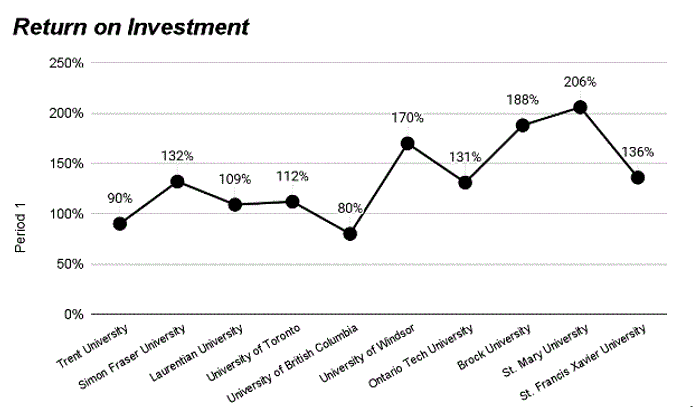
There are multiple reasons to study masters in Forensic Science in Canada or any higher education courses in Canada. From high salary to high return on investment, the forensic science in Canada degree also offers multiple job openings. The reason why you should study masters in Forensic cience in Canada are:
- Canada comes on the rank of 3 in top countries for MSc forensic science.
- With the increased rate of crime the demand for forensic scientists has grown in Canada which offers more job employment to students.
- Over the period 2022-2031, new job openings are expected to be around 10,100, with only 9,600 new job seekers
- Cities like Nova Scotia, Ontario and Manitoba will have more job opportunities.
- The base salary for graduates with masters in forensic science is CAD 58,000 per year which is more than most degrees.
- Students can easily apply for a job after Masters in Canada which also allows them a permanent residency in the country.
Masters in Forensic Science in Canada vs India
The masters in forensic science in Canada is different if compared to similar degree in India. The MS in Canada cost in Indian rupees is differently which makes the price higher. The difference between masters in forensic science in Canada and India are provided below:
| Particulars | Masters in Forensic Science in Canada | Masters in Forensic Science in India |
| Duration | 1-2 years | 2 years |
| Fees | Higher (CAD $15,000 - $25,000/year for international students) | Lower (INR 2-5 lakhs/year) |
| Coursework | Broad range of disciplines (biology, chemistry, psychology, anthropology, law) | More focused on specific disciplines (e.g., biology, chemistry) |
| Average Living Cost | Higher (around CAD $15,000/year) | Lower (around INR 2-5 lakhs/year) |
| Job opportunities | Diverse opportunities in forensics, law enforcement, government agencies | Primarily government jobs in forensics or research |
Admission Process For MSc Forensic Science in Canada
The admission process for MSc forensic Science in Canada is hosted by the official website of the university. You can visit the official website, create an account and apply to the course for admission in Canada. the process for admission are:
- Select the university and check the last date for application. Also, check eligibility criteria.
- Visit the official website of the University and fill in the necessary details.
- Submit all required documents and pay fees for application.
- Submit the application and wait for the response.
Admission Deadline for MSc Forensic Science
You must apply to the course before the intakes in Canada are over. This will allow the university ample time to review your documents and share the outcome. The deadlines for the universities are:
| University Name | Application Deadline |
|---|---|
| Trent University |
February 1 for Fall applications June 1st for Winter applications |
| Simon Fraser University | Fall 2024 (September): March 1 - April 15 |
| Laurentian University |
September 2024 Intake: April 15, 2024 January 2025 Intake: August 15, 2024 |
| University of Toronto |
Fall 2024 entry: 15-Jun-2024 |
| University of British Columbia | 31-June-2024 |
| University of Windsor | Closed |
| Ontario Tech university | May 2024 Intake: December 15,2023 |
| Brock University | Rolling |
| St. Mary University | Mid-August 2024 |
| St. Francis Xavier University | May 1, 2024 |
Eligibility Criteria for MSc Forensic Science Canada
The eligibility criteria depends on multiple factors like English language score, GPA and other academic records. The score requirements and exams to study in Canada are:
- GPA: above 3.0 out of 4.0
- TOEFL: 75 Overall
- IELTS: Overall 6.5 bands or higher
- Bachelor degree or equivalent with minimum 60%.
Admission Requirements for MSc Forensic Science
You need to submit multiple documents for admission to MSc Forensic Science courses. These include academic records, LOR, SOP, Student visa and many more. You can also check the details on how to apply to study in Canada. The list of documents required are:
- Official Transcripts
- Scores of IELTS/TOEFL
- GPA
- Financial documents
- Resume
- Valid passport
- Letter of recommendation
- Statement of Purpose
- Bachelor degree or equivalent
- Application Fees
- Visa for international students
- Work experience
- Affidavit
- Bank statements
- Passport
- Medical insurance
MSc Forensic Science in Canada Fees
The average fee of forensic science masters programs Canada is CAD 27,000 - 47,000 (INR 16,55,954 - 28,82,588). Fees of various universities are different for post graduate diploma in forensic science in Canada. You can check cheap universities in Canada for lower tuition fees. The following table provide details regarding fees of different universities and the course duration of MSC in forensic science in Canada:
| University Name | Tuition Fees |
|---|---|
| Trent University | CAD 40,000 (INR 24,53,266) |
| Simon Fraser University | CAD 1,985.88 per term |
| Laurentian University | CAD 28,920.15 |
| University of Toronto | CAD 27,520 |
| University of British Columbia | CAD 49,518 |
| University of Windsor | CAD 9101.85 |
| Ontario Tech University | CAD 20,124.30 |
| Brock University | CAD 6,725.34 |
| St. Mary University | CAD 13,847 |
| St. Francis Xavier University | CAD 18,500 |
Cost of Living For MSc Forensic Science in Canada
The cost of living in Canada includes accomodation, travel, food and personal expense. You can check the official website of the university for the accommodation details of the university hostel. The average cost of living in Canada details are:
| Category | Cost per month |
|---|---|
| Accommodation shared apartments | CAD 400 - CAD 800 (INR 24,510 - 49,020) |
| Travel | CAD 80 - CAD 110 (INR 4,902 - 6,740) |
| Food | CAD 300 - CAD 400 (INR 18,382 - 24,510) |
| Entertainment | CAD 150 (INR 9,191) |
| Health Insurance | CAD 74 (INR 4,534) |
| Utilities | CAD 164 (INR 10,049) |
| Internet | CAD 79 (INR 4,840) |
Scholarships for MSc Forensic Science in Canada
The scholarships for international students in Canada helps to reduce the cost of study. Some scholarships also provides grants and loans along with cost of living expenses. The eligibility and the amount for scholarships are:
| Scholarship Name | Eligibility | Award |
|---|---|---|
| Ritchie Jennings Memorial Scholarship Program | Completed scholarship application, official transcript(s), and two letters of recommendation from either a professor or someone who knows them on a professional level. | CAD 1,321 - 13,309 (INR 81,000 - 8,16,000) |
| Vanier Canada Graduate Scholarships | The candidate must be nominated by only one Canadian institution Must be pursuing first master’s or doctoral degree |
CAD 50,000 per year |
| Ontario Graduate Scholarships Master's program |
Have not exceeded the lifetime maximum of government-funded support or maximum OGS support available Must have achieved a first-class average (minimum A-) in each of the last two completed years of study |
CAD 11,417 - 17,941 (INR 7,00,000 - 11,00,000) |
| Ontario Graduate Scholarship |
Valid study permits must be effective as of the graduate units’ OGS international application deadline Have not exceeded the lifetime maximum of government-funded support or maximum OGS support available Must have achieved a first-class average (minimum A-) in each of the last two completed years of study |
CAD 5,000 (INR 3,06,552) |
| Pierre Elliott Trudeau Foundation Doctoral Scholarships | International students with good Academic Records | Varies |
| University of Waterloo International Funding | All International students with good Academic Records are eligible to apply | CAD 2500 - CAD 50,000 |
| Aga Khan Foundation Scholarship | Have excellent academic records; Hold a Bachelor’s degree or equivalent training/professional experience; Demonstrate genuine financial need Construct a thoughtful, reliable, multi-source funding plan Have strong leadership potential, professional experience, |
50% grant and 50% loan |
| UBC International Leader of Tomorrow Award | All international students are eligible to apply | CAD 1500 - CAD 50,000 |
| University of Windsor Graduate Scholarship | Must submit the full application package for admission into the academic program by the individual program's application deadline or the entrance scholarship deadline | CAD 3,750 - 7,500 (INR 2,29,914 - 4,59,829) |
| IDRC Research Awards | Candidates from developing countries enrolled in PG and PhD programs are eligible | Travel and research support for up to CAD 15,000 |
Jobs after MSc Forensic Science in Canada
The average salary of a student after MSc Forensic Science in Canada is CAD 76,752 (INR 47,07,327). There are several jobs after masters in forensic programs Canada including, forensic lab scientist, lab technician, analyst, investigator and more. The following table shows a few common Forensic science jobs and average salaries:
| Job Title | Salary |
|---|---|
| Evidence Technician | CAD 73,272 (INR 44,92,345) |
| Forensic Analyst | CAD 85,625 (INR 52,49,715) |
| Forensic Technician | CAD 67,251 (INR 41,23,194) |
| Forensic Investigator | CAD 89,404 (INR 54,81,907) |
The salaries also vary from different locations within Canada. The following table contains average salary based on different locations for MSc Forensic Science:
| Location | Salary |
|---|---|
| Ontario | CAD 80,324 (INR 49,24,707) |
| British Columbia | CAD 78, 655 (INR 48,40,834) |
| Manitoba | CAD 38,124 (INR 23,37,402) |
| Nova Scotia | CAD 78,956 (INR 2,29,917) |
| Alberta | CAD 97,851 (INR 59,99,297) |
Top Recruiters of MSc Forensic Science in Canada
The following list contains top recruiting sectors of Msc Forensic Science in Canada:
- Hospitals
- Forensic lab
- Crime Department
- Research and Analytical labs
- Intelligence Bureau
- Detective agencies
- Universities
Work Permit after MSc Forensic Science in Canada
You can apply for a PGWP from outside Canada as long as you’re eligible and you’ve been approved for a study permit. You have up to 180 days after you graduate to apply for a PGWP. When you apply, you must confirm that you attended and completed your program, name of your program and the length of your program. You can also opt for part time jobs in Canada while studying.
- After completing MSc Forensic science for 2 years, students can get 3 years of work permit in Canada.
- Students get a period of 180 days to apply for a work permit and start working, otherwise the visa is not extended.
- On the basis of work permit, students can also apply for permanent residency in the country.
- Work permit allows students to work after completing the degree.
- For work permit students will have to provide proof of completion of their study and its duration.
MSc in Forensic science is one of the most famous and developing fields emerging in Canada with maximum number of enrollments every semester. It is a part of psychology and offers many job opportunities and internships. Students also get financial aid and monetary help.
FAQs
Ques: What are the different types of Forensic Science Masters programs in Canada?
Ans: There are various types of forensic science degrees in Canada. The types include general Forensic Science, Digital Forensics, Forensic Biology, Forensic Chemistry, and others. You can choose based on your specific interests.
Ques: What are the admission requirements for masters of forensic science in Canada?
Ans: The admission requirements for a master’s degree in science includes bachelor’s degree with specific course requirements. You also need a strong academics record, research experience, and GRE scores (sometimes), Enlish language proficiency scores etc.
Ques: Are there any international student specific requirements?
Ans: Yes, international students need English proficiency proof (IELTS/TOEFL) and may require transcripts to be evaluated. You also need to file for a student visa before you can travel to Canada.
Ques: What is the application process like?
Ans: The application process for masters in forensic science in Canada includes contacting universities directly for deadlines and required documents. You can also apply for admission from the official website of the university. The application documents involve transcripts, CV, letter of intent, reference letters, and sometimes GRE scores.
Can I study masters of forensic science online?
Ans: yes, you can study masters of forensic science in Canada online. There are very limited online options that exist, but most programs require in-person lab work and practical experience. You can check individual universities for details.
Ques: What are the job prospects for Forensic Science graduates in Canada?
The career propects and job demands are very high in Canada for masters in forensic science. Demand is good, particularly for specialized areas like digital forensics. Research, government, law enforcement, and private labs offer potential career options to candidates.
Ques: What is the average salary for Forensic Science graduates?
Ans: The average base salary for forensic science masters degree in canada is CAD 58,000 per year. Salaries vary based on experience, specialization, and employer. Entry-level positions typically start around $50,000 CAD annually.
Ques: What additional certifications or training might be needed?
Ans: There are no additional training or certification required for masters in forensic science in Canada. Certain professional associations offer certifications, depending on your chosen specialization. Research may require further academic qualifications.
Ques: What are the career paths I can pursue after a Masters in Forensic Science?
Ans: The career paths that you can pursue after masters in forensic science are multiple. Options include forensic scientist, crime scene investigator, digital forensics analyst, research scientist, and expert witness.
Ques: What is the average cost of a Masters in Forensic Science in Canada?
Ans: The averae tuition cost for masters in forensic science in canada varies by university and program. The fees range from $20,000 to $40,000 CAD per year (international students may pay higher fees).
Ques: What funding options are available for Masters students?
Ans: There are multiple funding options available which includes university scholarships, research assistantships, government grants, and private loans are potential funding sources. You must check the scholarship options available before taking admission.
Ques: Can I work while studying for my Masters?
Ans: Yes, you can work while studying masters in Canada. Part-time work is possible, but be aware of visa restrictions and program workload demands. You must first prioritize your studies to ensure success.
![University of Toronto [U of T]](https://static.zollege.in/public/college_data/images/studyabroad/logos/college_104_25-12:44_University_of_Toronto-logo-2417C8AF32-seeklogo.jpeg?tr=w-50,h-50,c-force?tr=h-40,w-35,c-force)
![The University of British Columbia [UBC]](https://static.zollege.in/public/college_data/images/studyabroad/logos/college_64_25-11:13_Capture.jpeg?tr=w-50,h-50,c-force?tr=h-40,w-35,c-force)

![University of Montreal [U de M]](https://static.zollege.in/public/college_data/images/studyabroad/logos/college_71_24-17:54_udem.jpeg?tr=w-50,h-50,c-force?tr=h-40,w-35,c-force)
![University of Alberta [UAlberta]](https://static.zollege.in/public/college_data/images/studyabroad/logos/college_9_24-17:46_alberta-.jpeg?tr=w-50,h-50,c-force?tr=h-40,w-35,c-force)