Canada is a popular place to study and work from the perspective of an International Student. In order to study in Canada, candidates need to shortlist the course they need to pursue and apply to a Designated Learning Institution. Studying in Canada also requires students to possess a Canada Student Visa and Study permit. This study permit serves an essential eligibility requirement to several working opportunities and work permits across Canada. Study and Work in Canada while studying includes on and off campus jobs whose permission is explicitly mentioned in the study permit. The best place in Canada to study and work can be considered with higher working opportunities even after students have graduated, this is helpful towards gaining permanent residency and work experience.
There are plenty of options in Canada for students looking to advance and develop their careers. In order to pursue graduate and postgraduate studies as well as a variety of specializations, many students are moving to Canada. Selecting Canada for education is a wise decision due to its world-class education, highly regarded universities, cutting-edge infrastructure, simple admissions procedures, reasonable tuition costs, and international recognition. Students are allowed to work and settle in the nation after completing their studies and avail Canada PNP.
Canada is among the most developed nations in the world. In the last ten years, it has emerged as the most popular place to study. Canada is home to numerous universities featured in the QS World University Rankings. Students can apply for Express Entry Canada visa, or through other visa options. employer references, SOP, and other documents are rquired along with English language certificates to avail any Canada visa.
Can I Work And Study In Canada?
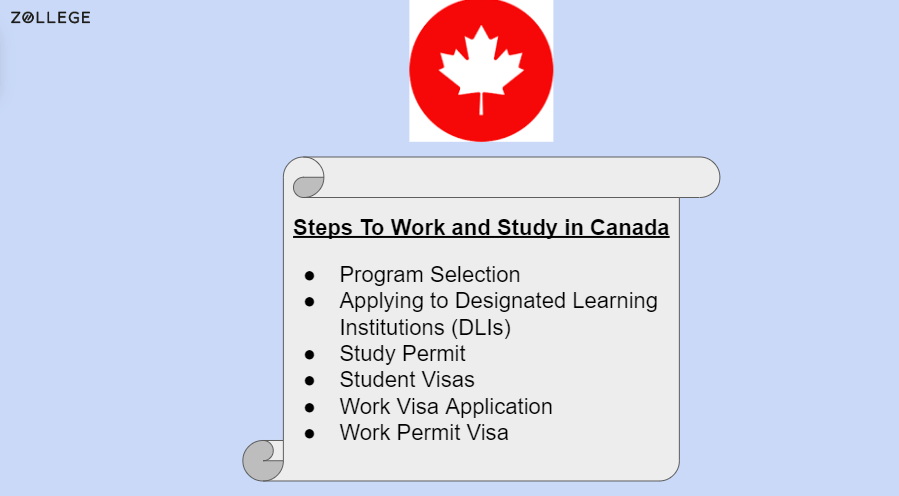
Candidates wonder, “can you study and work in Canada?” Canada has an excellent educational infrastructure, which is the primary reason for studying in Canada. The Candidates wanting to study in Canada should follow the broad steps given below:
- Program Selection: Students need to find a suitable program that has professional relevance and academic merit to study in Canada.
- Applying to Designated Learning Institutions (DLIs): These are Canadian Schools that are capable of hosting International Students and confer benefits accordingly. So, International students should find an appropriate institution best suited for their program of choice provided students meet its eligibility criteria.
- Study Permit: In order to study in Canada, students are required to have a study permit which allows the student to be present in Canada for purposes of studies. It is applied for by students after they receive their acceptance letter from the universities in Canada applied to.
- Student Visas: To enter and stay in Canada, students need to apply for a Student Visa. This application has to be submitted with Canadian IRCC through their official website.
Work While Studying In Canada
Candidate can check study in Canada vs India before applying to either of the one. Canada offers job opportunities to its students whether they are still pursuing their program or have finished the same. The Study and Work in Canada for international students is given in the table below:
| Work Opportunity Type | Eligibility | Other Information |
| Work On Campus | Study Permit that allows working on campus OR Without Work Permit, a student:
|
Although on-campus work means working with employers and buildings associated with the Institution, but one can work outside as:
|
| Work Off Campus | Study Permit that allows working off campus Without Work Permit, the requirements are:
|
Students can work up to 20 hours/week during regular school term During Scheduled breaks a student is free to work:
|
| Work as Co-op Student/Intern | A Co-op/Intern work permit requires:
|
Those who are taking the following aren’t eligible to apply:
|
Working while Studying in Canada Eligibility
Canada also has work permit after graduation, which is a way to gain PR in Canada. International students studying full-time at a Designated Learning Institution (DLI) in Canada with a study permit are eligible to work off campus without a work permit. This implies that you can work anywhere in Canada for any company and in any profession. If they so want, international students may also work on campus. Your study permit will specify the terms of employment, including whether you are allowed to work in Canada. With the help of this declaration, you can apply to Service Canada for a Social Insurance Number (SIN), which is necessary before you can start working while you are a student in Canada.If your study program is fewer than six months in length or if you are enrolled in an English as a Second Language (ESL) or French as a Second Language (FSL) program, you are not permitted to work in Canada unless you have another type of authorization. Additionally, it is not permissible for visiting or exchange students to work while attending a DLI in Canada.
Documents Required to Study and Work in Canada
Students need various important documents required if students want Express Entry/ Provincial Nominee Program (PNP)/ Family Sponsorship. IELTS score for Canada student visa is required to justify language proficiency of students immigrating to study in Canada. Apart from IELTS required for Canada student visa, it is also required for immigration programs mentioned below. Here are the list of documents required for study and work in Canada:
- Have a valid passport
- Age requirement: 19 or older
- Has at least a high school diploma
- English fluency - equivalent to IELTS 5.0 and TOEIC 780
- Evidence of your acceptance to study at a DLI in Canada
- Evidence showing you have the means to sustain yourself financially while studying in Canada. Please review the IRCC website for further information regarding this requirement.
- Letter of justification or motivation outlining your motives for doing this course
Working after Graduation in Canada
Work and study program in Canada for international students offers work opportunity to people who have completed their program of study from Designated Learning Institutions in Canada. The table given below contains the types and eligibility requirements of the Canada work permits available to students who have graduated:
| Work Permit Type | Eligibility requirements |
| PGWP Canada | Apply within 180 days Confirm the completion, name, and length of study program by submitting degree, diploma, or certificate Currently hold or held (for 180 days) a valid study permit The study program was at least 8 months long Full time student status was maintained Graduated from a Designated Learning Institution while being enrolled in a vocational, academic, or professional training program |
| Employer specific work permit | Academic Credentials Entrepreneurs Applicants of Atlantic Immigration Pilot Program Intra-company transferees Researchers at Canadian Institutions Start-up Visa program applicants People engaged in professions related to entertainment, sports, religion |
| Open Work permit | International Student, graduated from any DLI, who require a Canada student Visa and is eligible for PGWP Destitute Student Have an employer specific work permit and at the risk of being abused at current job |
Canada is sought after by Students from more than 200 countries due to its high-quality education standards. t’s also possible to work while studying in Canada through various opportunities it offers like on and off campus work, co-op placements, internships etc. Studying in Canada is facilitated by several private educational establishments along with the network of 150+ community colleges.
FAQs
Ques: Can international students work while studying in Canada?
Ans: Yes, international students with a valid study permit can work up to 20 hours per week during regular academic sessions and full-time during scheduled breaks.
Ques: What is a Co-op program, and can I participate as an international student?
Ans: A Co-op (cooperative education) program allows students to gain practical work experience related to their field of study. International students are eligible to participate in Co-op programs with a valid study permit.
Ques: What is a Post-Graduation Work Permit (PGWP)?
Ans: The PGWP allows international students who have completed a program of study in Canada to work for up to three years after graduation, providing valuable Canadian work experience.
Ques: Are there any restrictions on the type of work international students can do?
Ans: Generally, there are no restrictions on the type of work for students during their studies or after graduation with a PGWP. However, certain jobs in high-security sectors might have restrictions.
Ques: How can I apply for a study permit in Canada?
Ans: To apply for a study permit, you need an acceptance letter from a Designated Learning Institution (DLI), proof of funds to cover tuition and living expenses, and meet health and security requirements. Apply online or through a Visa Application Center.
Ques: How many hours of work is allowed in Canada while studying?
Ans: While doing off campus work, during a regular school term students can work up to 20 hours a week. This time can be extended during scheduled breaks at the Institution.
Ques: How much can one earn in Canada while studying?
Ans: The minimum wage ranges between 11.45 CAD to 22.50 CAD per hour. Apart from that, depending upon experience and expertise, International Students can earn up to 30 – 75 CAD per hour.
Ques: How to get PR in Canada?
Ans: The candidates have to collect the relevant documents, complete the application, and pay the application in the IRCC website. The permanent residence can be applied through Provincial Nominee Class, Express Entry Class etc.
Ques: What are the benefits of studying in Canada?
Ans: Canada is a leading study destination and some benefits of studying here are:Quality education, Work opportunities, Multiculturalism, Easy Immigration process.
Ques: What are the eligibility requirements to get admission in Canada?
Ans: The eligibility differs from one course to another, but broad requisites include: Academic Transcripts, GMAT/GRE Scores, English Language Proficiency Test Scores, Statement of Purpose, Letters of Recommendation, Work Experience.
Ques: Can I study & work in Canada without IELTS?
Ans: You do not need to take the IELTS to work in Canada. Even though the majority of foreign countries consider the IELTS to be a major requirement for entry, Canada will grant a work visa if you have passed other language proficiency exams. This covers CAEL, PET, TOEFL, and Duolingo.
Ques: What is eligibility to work in Canada?
Ans: Regardless of their country of residence, Canadian citizens and permanent residents are not required to have a work permit or visa in order to work in Canada. In order to enter Canada for work or travel, foreign nationals may need to obtain a work permit, a visitor visa, or both.
Ques: Can I get PR without IELTS?
Ans: While it's possible to enter Canada without taking the IELTS, proving your language skills is a requirement for applying for permanent residence. To boost your chances of obtaining permanent residence in Canada, it is therefore always preferable to study and sit for the language proficiency exam.
Ques: What is the age limit for work in Canada?
Ans: To get a work permit in Canada, foreign employees must be at least eighteen years old. Applicants for work permits are not limited in age unless they are applying through the International Experience Canada (IEC) program.
Ques: Can my sister sponsor me in Canada?
Ans: Your siblings may be sponsored to come to Canada, but there are strict requirements for eligibility. If your orphaned brother or sister is under the age of eighteen, single (not married or in a common-law relationship), and related to you by blood or adoption, you can sponsor them.
![University of Toronto [U of T]](https://static.zollege.in/public/college_data/images/studyabroad/logos/college_104_25-12:44_University_of_Toronto-logo-2417C8AF32-seeklogo.jpeg?tr=w-50,h-50,c-force?tr=h-40,w-35,c-force)
![The University of British Columbia [UBC]](https://static.zollege.in/public/college_data/images/studyabroad/logos/college_64_25-11:13_Capture.jpeg?tr=w-50,h-50,c-force?tr=h-40,w-35,c-force)

![University of Montreal [U de M]](https://static.zollege.in/public/college_data/images/studyabroad/logos/college_71_24-17:54_udem.jpeg?tr=w-50,h-50,c-force?tr=h-40,w-35,c-force)
![University of Alberta [UAlberta]](https://static.zollege.in/public/college_data/images/studyabroad/logos/college_9_24-17:46_alberta-.jpeg?tr=w-50,h-50,c-force?tr=h-40,w-35,c-force)