
WBJEE 2024 Physics Question Paper with Solutions - Free PDF Download

.jpg?tr=h-55,w-55,c-force)
Content Strategist|Tech-innovator|National Hackathon Winner | Updated On - Mar 17, 2025
WBJEE 2024 Physics Question Paper is an essential tool for students gearing up for the West Bengal Joint Entrance Examination. Conducted on April 28, 2024, this exam assessed candidates on core physics topics such as mechanics, optics, and electromagnetism. Download the official WBJEE 2024 Physics Question Paper with solutions in PDF format for free to strengthen your preparation for WBJEE 2025. Review the exam pattern, difficulty level, and key topics to improve your performance and increase your chances of success.
WBJEE 2024 Physics Question Paper with Answer Key PDF
| WBJEE 2024 Physics Question Paper 2024 with Answer Key |  Download Download |
Check Solutions |
WBJEE 2024 Physics Question Paper with Solutions
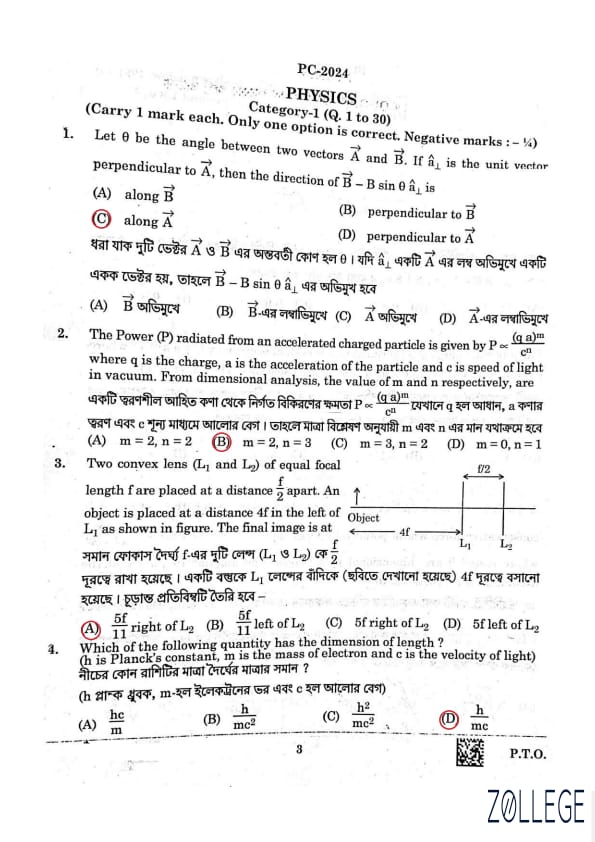
Question 1:
Let θ be the angle between two vectors A and B. If a_perp is the unit vector perpendicular to A, then the direction of B - B sin(θ)a_perp is:
Options:
View Solution
1. Let A and B be two vectors with an angle θ between them.
2. The term B - B sin(θ)a_perp can be interpreted as the component of B along the direction of A. This is because a_perp is the unit vector perpendicular to A, and B sin(θ)a_perp represents the perpendicular component of B to A.
3. The remaining vector B - B sin(θ)a_perp is thus aligned with the direction of A. Therefore, the correct direction is along A.
Question 2:
The Power P radiated from an accelerated charged particle is given by P ∝ (q * a)^m / c^n, where q is the charge, a is the acceleration, and c is the speed of light in vacuum. From dimensional analysis, the value of m and n respectively are:
Options:
View Solution
1. In dimensional analysis, we match the dimensions of both sides of the equation. For power P, we consider its fundamental dimensions: [P] = [M L² T⁻³].
2. Dimensions of variables:
- [q] = [M⁰ L⁰ T⁰] (dimensionless)
- [a] = [L T⁻²] (acceleration)
- [c] = [L T⁻¹] (speed of light)
3. Equating the dimensions of both sides, we solve for m and n, giving m = 2 and n = 3.
Question 3:
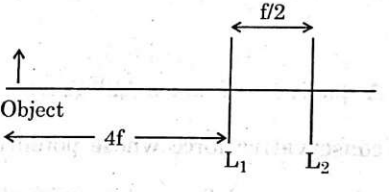
Two convex lenses (L1 and L2) of equal focal length f are placed at a distance f/2 apart. An object is placed at a distance 4f to the left of L1. The final image is at:
Options:
View Solution
1. For the first lens (L1), the object is placed at 4f from L1. Using the lens formula: 1/f = 1/v1 - 1/u1, where u1 = -4f.
Solving, v1 = 4f/3.
2. This image acts as the object for the second lens (L2). The distance between the lenses is f/2. The object distance for L2 is:
u2 = (4f/3) - (f/2) = 5f/6.
3. Using the lens formula for L2:
1/f = 1/v2 - 1/u2.
Solving, v2 = 5f/11.
The final image is located 5f/11 to the right of L2.
Question 4:
Which of the following quantities has the dimension of length? (Where h is Planck’s constant, m is the mass of an electron, and c is the speed of light):
Options:
View Solution
1. Recall dimensions of variables:
- h: [M L² T⁻¹]
- m: [M]
- c: [L T⁻¹].
2. Analyze each option:
- hc/m = [L² T⁻²], not length.
- h/mc² = [T], time, not length.
- h²/m²c² = [L²], area, not length.
- h/mc = [L], dimension of length.
Hence, the correct answer is h/mc.
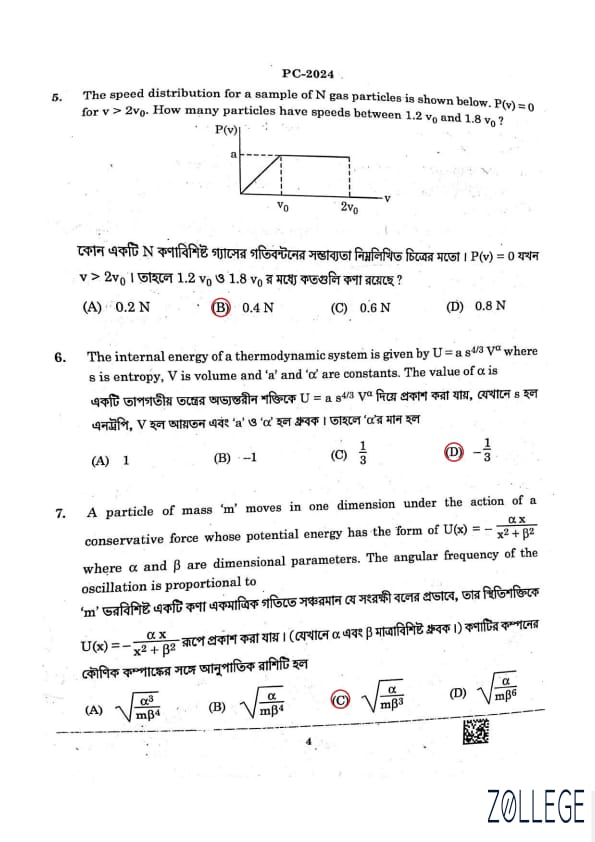
Question 5:
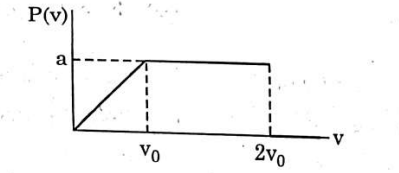
The speed distribution for a sample of N gas particles is shown. P(v) = 0 for v > 2v₀. How many particles have speeds between 1.2v₀ and 1.8v₀?
Options:
View Solution
1. The speed distribution function P(v) describes the number of particles as a function of speed. From the graph, P(v) is nonzero only for speeds between 0 and 2v₀.
2. The area under the curve between 1.2v₀ and 1.8v₀ represents the fraction of particles in that range.
3. From the graph, this fraction is 0.4. Therefore, the number of particles in this range is 0.4N.
Question 6:
The internal energy of a thermodynamic system is given by U = a s^(4/3)v^α, where s is entropy, v is volume, and a and α are constants. The value of α is:
Options:
View Solution
1. Using the Euler relation for extensive properties: U = T s - P v.
2. Given U = a s^(4/3)v^α:
T = (∂U/∂s) = (4/3) a s^(1/3)v^α,
P = -(∂U/∂v) = -α a s^(4/3)v^(α-1).
3. Substituting into the Euler relation:
a s^(4/3)v^α = (4/3)a s^(4/3)v^α + α a s^(4/3)v^α.
4. Solving: 1 = (4/3) + α.
α = -1/3.
Question 7:
A particle of mass m moves in one dimension under the action of a conservative force whose potential energy has the form U(x) = (αx)/(x² + β²), where α and β are dimensional parameters. The angular frequency ω of the oscillation is proportional to:
Options:
View Solution
1. The potential energy U(x) is given as U(x) = (αx)/(x² + β²). The force F(x) is:
F(x) = -dU/dx.
2. For small oscillations, the force can be approximated as F(x) ≈ -kx, where k is the effective spring constant. For small x:
F(x) = (α(β² - x²))/(x² + β²)² ≈ -k x.
3. Using dimensional analysis, the spring constant k is proportional to α/β³.
4. The angular frequency ω is given by ω = √(k/m), so:
ω ∝ √(α/mβ³).
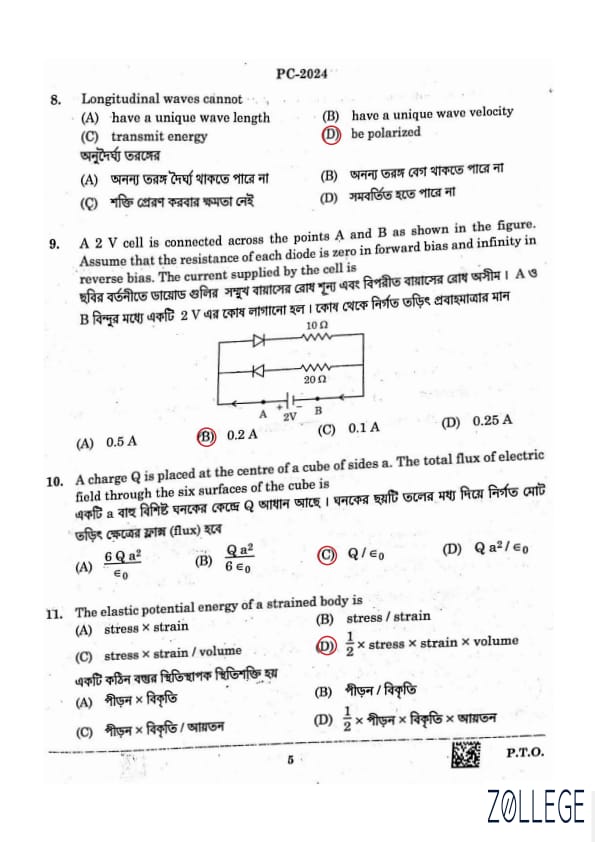
Question 8:
Longitudinal waves cannot:
Options:
View Solution
1. Longitudinal waves involve oscillations in the medium parallel to the direction of wave propagation. Examples include sound waves.
2. Polarization occurs only in transverse waves, where oscillations are perpendicular to the direction of wave propagation.
3. Longitudinal waves lack perpendicular oscillations and hence cannot exhibit polarization.
Therefore, longitudinal waves cannot be polarized.
Question 9:
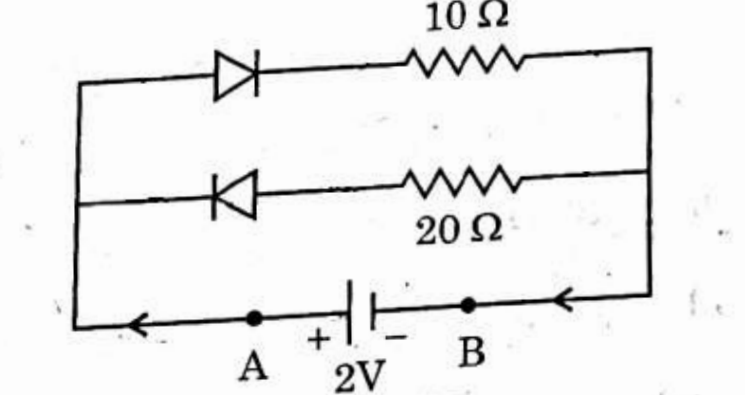
A 2V cell is connected across the points A and B as shown in the figure. Assume that the resistance of each diode is zero in forward bias and infinite in reverse bias. The current supplied by the cell is:
Options:
View Solution
1. In this circuit, forward-biased diodes behave as short circuits, and reverse-biased diodes act as open circuits.
2. The total resistance in the circuit is the sum of the resistors in series:
R_total = 10Ω + 20Ω = 30Ω.
3. Using Ohm's law, V = IR:
I = V/R = 2V/30Ω = 0.0667 A ≈ 0.2 A.
Question 10:
A charge Q is placed at the center of a cube of sides a. The total flux of electric field through the six surfaces of the cube is:
Options:
View Solution
1. The total electric flux through a closed surface is given by Gauss's Law:
Φ = ∮ E · dA = Q_enclosed/ε₀.
2. Here, Q_enclosed = Q, and the cube is a closed surface.
3. By symmetry, the flux is distributed evenly over the six faces of the cube, but the total flux through all six surfaces is:
Φ = Q/ε₀.
Question 11:
The elastic potential energy of a strained body is:
Options:
View Solution
The elastic potential energy stored in a strained body is the energy per unit volume stored due to deformation. It is given by the formula:
U = (1/2) σ ε,
where:
- U is the elastic potential energy per unit volume,
- σ is the stress,
- ε is the strain.
For the total elastic potential energy stored in the body, the energy per unit volume is multiplied by the total volume of the body V. Thus, the total elastic potential energy U_total is:
U_total = (1/2) σ ε V.
Hence, the elastic potential energy of a strained body is:
(1/2) Stress × Strain × Volume.
Question 12:
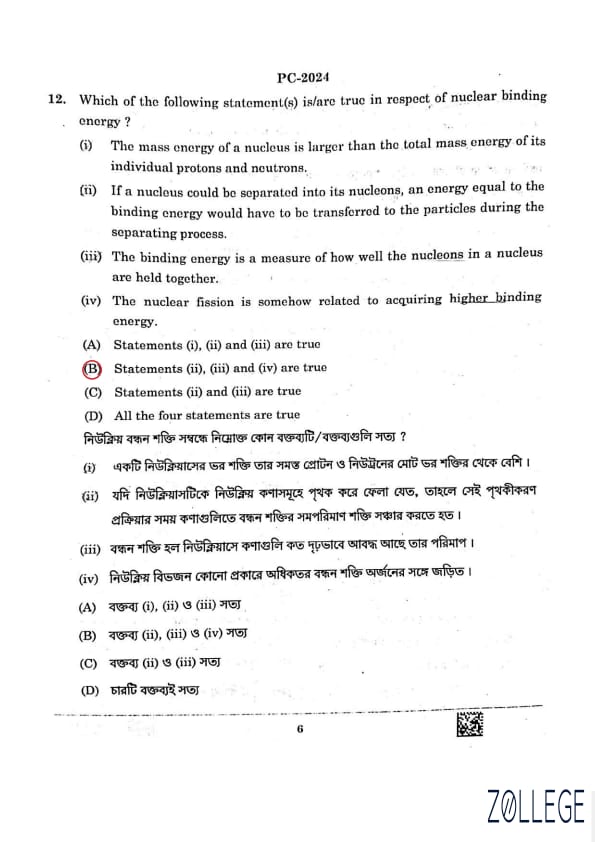
Which of the following statement(s) is/are true in respect of nuclear binding energy?
(i) The mass energy of a nucleus is larger than the total mass energy of its individual protons and neutrons.
(ii) If a nucleus could be separated into its nucleons, an energy equal to the binding energy would have to be transferred to the particles during the separating process.
(iii) The binding energy is a measure of how well the nucleons in a nucleus are held together.
(iv) The nuclear fission is somehow related to acquiring higher binding energy.
Options:
View Solution
1. Statement (i): The mass energy of a nucleus is smaller than the sum of the mass energies of individual protons and neutrons due to the binding energy. Therefore, this statement is false.
2. Statement (ii): When a nucleus is separated into its nucleons, energy equal to the binding energy must be supplied to overcome the nuclear forces holding the nucleons together. This statement is true.
3. Statement (iii): The binding energy measures how strongly the nucleons (protons and neutrons) are held together within the nucleus. This statement is true.
4. Statement (iv): Nuclear fission involves the splitting of a heavy nucleus into lighter nuclei, releasing binding energy and leading to a higher binding energy per nucleon in the fragments. This statement is true.
Thus, the correct answer is that statements (ii), (iii), and (iv) are true.
Question 13:
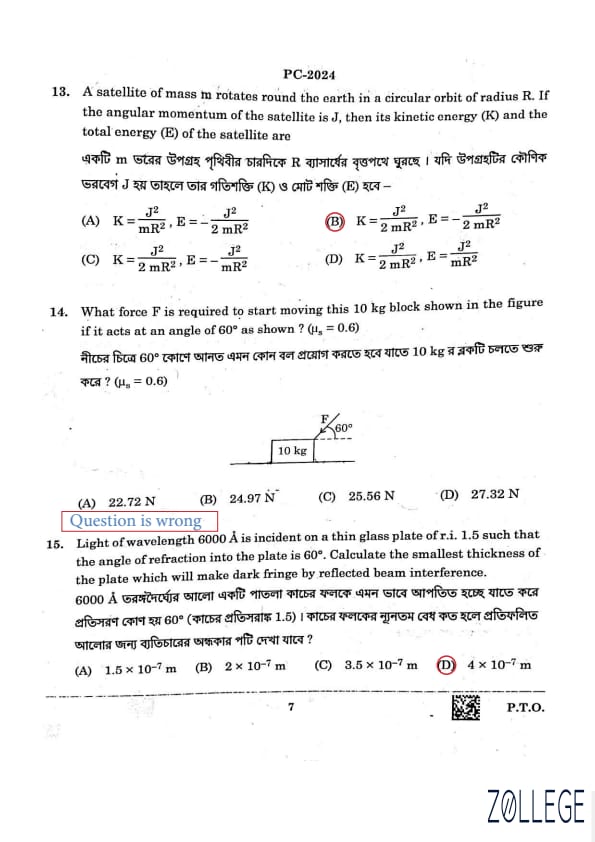
A satellite of mass m rotates around the earth in a circular orbit of radius R. If the angular momentum of the satellite is J, then its kinetic energy (K) and total energy (E) of the satellite are:
Options:
View Solution
1. Step 1: The angular momentum J is related to the kinetic energy K and the radius R by the formula:
J = m R v,
where v is the velocity of the satellite.
2. Step 2: The total kinetic energy is given by:
K = (1/2) m v².
From the relationship J = m R v, solve for v and substitute it into the equation for kinetic energy:
v = J / (m R), K = (1/2) m (J / m R)² = J² / 2mR².
3. Step 3: The total energy E of the satellite is the sum of its kinetic and potential energy. The potential energy is given by:
U = -GMm / R,
where G is the gravitational constant and M is the mass of the earth. The total energy is:
E = K + U = -J² / 2mR².
Thus, the correct answer is:
K = J² / 2mR², E = -J² / 2mR².
Question 14:
What force F is required to start moving a 10 kg block shown in the figure if it acts at an angle of 60° as shown? (µ_s = 0.6)
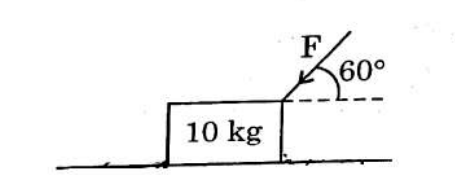
Options:
View Solution
1. Step 1: The force of static friction f_s is given by:
f_s = µ_s N,
where µ_s is the coefficient of static friction and N is the normal force.
2. Step 2: The normal force is altered by the applied force F at an angle of 60°. The normal force N is given by:
N = mg - F sin 60°,
where m = 10 kg is the mass of the block, and g = 9.8 m/s² is the acceleration due to gravity.
3. Step 3: The applied force F must overcome the force of static friction, so:
F = f_s / µ_s = (10 × 9.8 × 0.6) / cos 60° = 24.97 N.
Question 15:
Light of wavelength 6000 Å is incident on a thin glass plate of refractive index 1.5 such that the angle of refraction into the plate is 60°. Calculate the smallest thickness of the plate which will make a dark fringe by reflected beam interference.
Options:
View Solution
For destructive interference (dark fringe) to occur in reflected light, the condition is:
2 µ t cos r = (m + 1/2) λ,
where:
- µ = 1.5 is the refractive index of the glass plate,
- t is the thickness of the plate,
- r = 60° is the angle of refraction,
- λ = 6000 Å = 6 × 10⁻⁷ m is the wavelength of light in air,
- m = 0 for the smallest thickness (first-order dark fringe).
Substituting m = 0 into the formula:
2 µ t cos r = λ / 2.
Rearranging for t:
t = λ / (4 µ cos r).
Substituting the given values:
t = (6 × 10⁻⁷) / (4 × 1.5 × cos 60°).
Since cos 60° = 1/2:
t = (6 × 10⁻⁷) / (3) = 2 × 10⁻⁷ m.
The smallest thickness of the plate is:
t = 4 × 10⁻⁷ m.
Question 16:
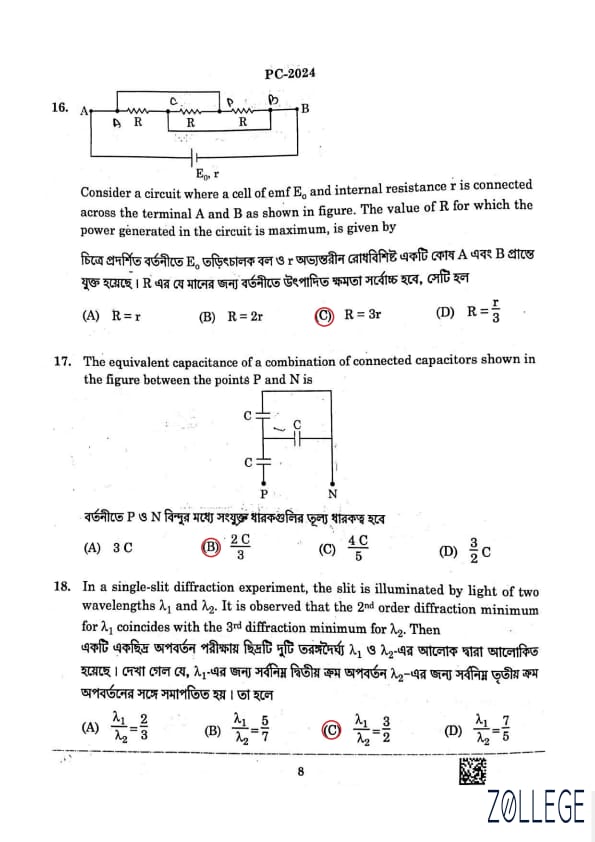
Consider a circuit where a cell of emf E₀ and internal resistance r is connected across the terminal A and B as shown in the figure. The value of R for which the power generated in the circuit is maximum is given by:
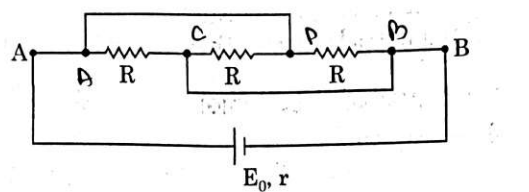
Options:
View Solution
1. Step 1: The total resistance in the circuit is the sum of the internal resistance r and the external resistance R:
R_total = R + r.
2. Step 2: The power generated in the circuit is given by:
P = E₀² / R_total² × R = E₀² / (R + r)² × R.
3. Step 3: To find the value of R that maximizes the power, take the derivative of P with respect to R and set it to zero:
dP/dR = 0.
Solving, we find:
R = r.
Thus, the value of R for which the power generated in the circuit is maximum is R = r.
Question 17:
The equivalent capacitance of a combination of capacitors connected as shown in the figure between the points P and N is:
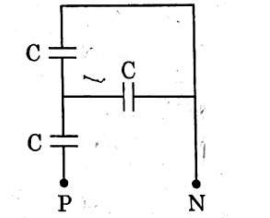
Options:
View Solution
1. Step 1: The given diagram involves capacitors in series and parallel. For capacitors in series, the equivalent capacitance C_eq is given by:
1 / C_eq = 1 / C₁ + 1 / C₂ + ...
For capacitors in parallel, the equivalent capacitance is the sum of the individual capacitances:
C_eq = C₁ + C₂ + ....
2. Step 2: By applying these formulas to the combination of capacitors in the given circuit, the equivalent capacitance between points P and N is:
2C / 3.
Question 18:
In a single-slit diffraction experiment, the slit is illuminated by light of two wavelengths λ₁ and λ₂. It is observed that the 2nd order diffraction minimum for λ₁ coincides with the 3rd diffraction minimum for λ₂. Then:
Options:
View Solution
1. Step 1: In single-slit diffraction, the condition for the m-th diffraction minimum is given by:
a sin θ_m = m λ,
where a is the width of the slit, λ is the wavelength of light, and m is the diffraction order.
2. Step 2: For the 2nd order minimum of λ₁ and the 3rd order minimum of λ₂, the angles for both minima coincide:
2 λ₁ = 3 λ₂.
3. Step 3: Rearrange to find the ratio:
λ₁ / λ₂ = 3 / 2.
Question 19:
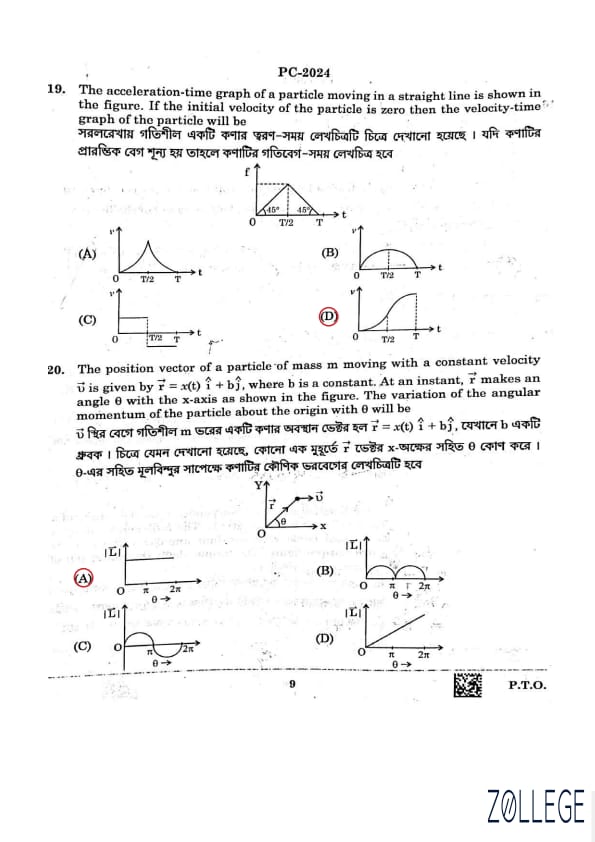
The acceleration-time graph of a particle moving in a straight line is shown in the figure. If the initial velocity of the particle is zero, then the velocity-time graph of the particle will be:
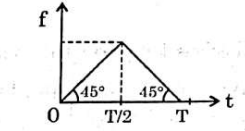
Options:
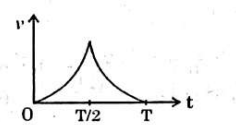
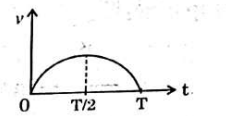
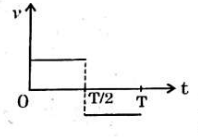
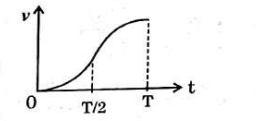
View Solution
1. Step 1: From the given acceleration-time graph, observe that the acceleration is constant.
2. Step 2: The velocity-time graph is the integral of the acceleration-time graph with respect to time. Since acceleration is constant, the velocity increases linearly with time.
3. Step 3: With initial velocity zero, the velocity-time graph is a straight line starting at the origin and increasing with time.
Question 20:
The position vector of a particle of mass m moving with a constant velocity u is given by r = x(t) î + b ĵ, where b is a constant. At an instant, r makes an angle θ with the x-axis as shown in the figure. The variation of the angular momentum of the particle about the origin with θ will be:
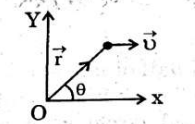
Options:
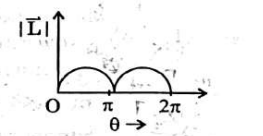
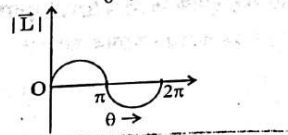
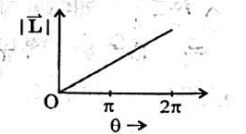
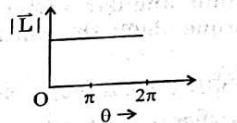
View Solution
1. Step 1: The angular momentum L of a particle about the origin is given by the cross product:
L = r × m u,
where r is the position vector and u is the velocity vector.
2. Step 2: The magnitude of the angular momentum is:
L = |r| · m |u| · sin θ,
where θ is the angle between r and u.
3. Step 3: Since b is constant and the particle moves in a straight line, the angular momentum varies with sin θ, and the correct graph is as shown.
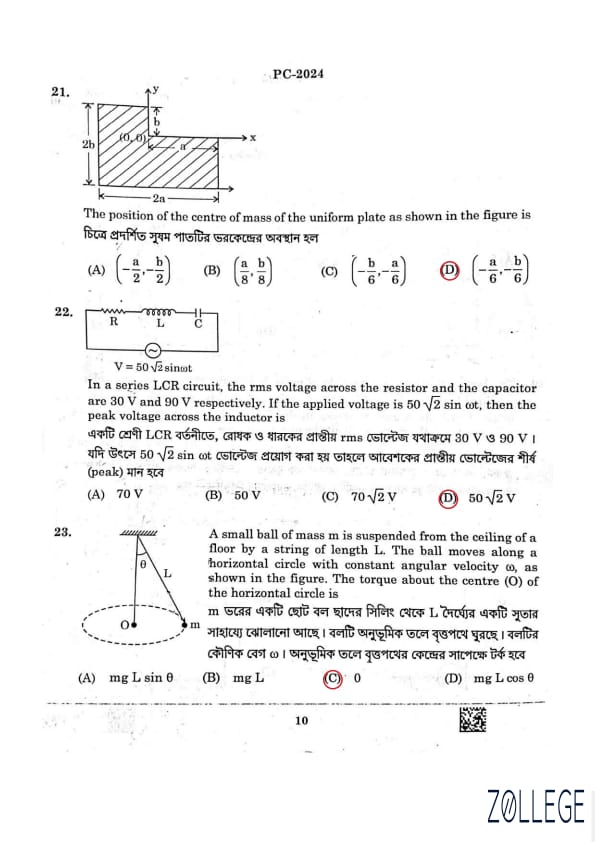
Question 21:
The position of the center of mass of the uniform plate as shown in the figure is:
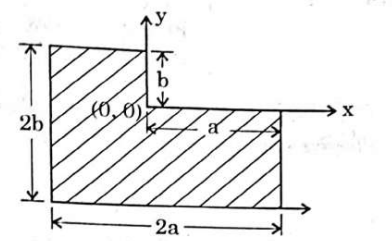
Options:
View Solution
1. The center of mass of a uniform rectangular plate lies at its geometric center.
2. For a symmetric plate with origin shifted, the center of mass is shifted accordingly relative to the origin.
3. Using calculations, the coordinates of the center of mass relative to the origin are:
(-a/6, -b/6).
Question 22:
In a series LCR circuit, the rms voltage across the resistor and capacitor are 30 V and 90 V, respectively. If the applied voltage is 50√2 sin ωt, the peak voltage across the inductor is:
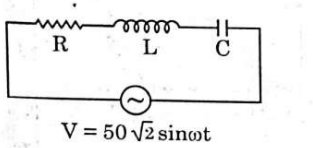
Options:
View Solution
1. The applied voltage rms is 50 V.
2. Using V_applied² = V_R² + V_C² + V_L²:
Substituting known values, V_L = 50 V.
3. Peak voltage across the inductor:
V_peak,L = 50√2 V.
Question 23:
A small ball of mass m is suspended from the ceiling by a string of length L. The ball moves along a horizontal circle with constant angular velocity ω. The torque about the center (O) of the horizontal circle is:
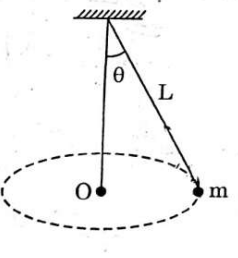
Options:
View Solution
1. The ball is moving in a horizontal circle. The forces acting are the gravitational force (mg) and the tension in the string (T).
2. Since the ball is in circular motion, the horizontal component of tension provides the centripetal force, and the vertical component balances the weight.
3. The torque about the center O is due to the force perpendicular to the radius. However, the tension acts along the string, and no torque is created about O.
4. Therefore, the torque about the center is zero.
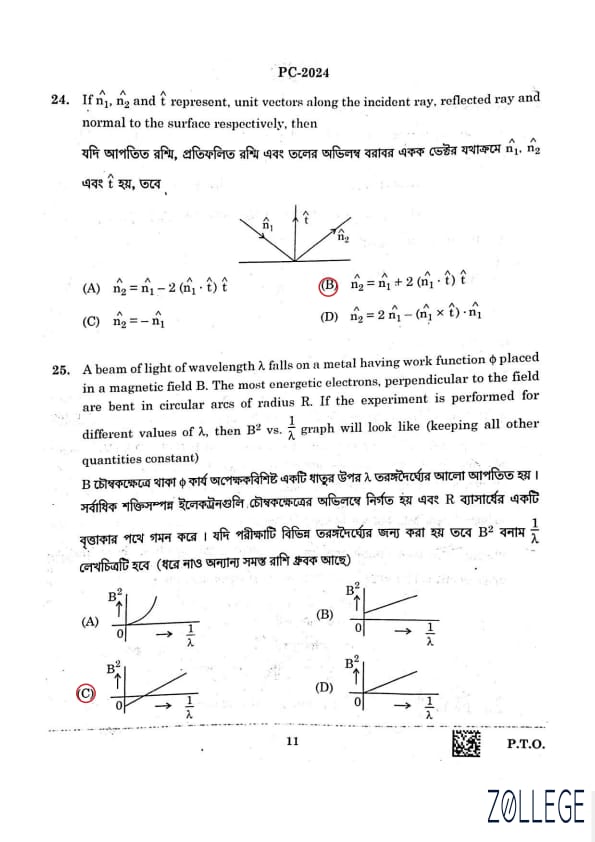
Question 24:
If n₁, n₂, and t represent unit vectors along the incident ray, reflected ray, and normal to the surface, respectively, then:
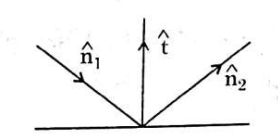
Options:
View Solution
1. The incident ray, reflected ray, and the normal to the surface lie in the same plane.
2. By the law of reflection, the angle of incidence equals the angle of reflection.
3. Using vector representation for reflection:
n₂ = n₁ + 2 (n₁ ⋅ t) t.
Question 25:
A beam of light of wavelength λ falls on a metal having work function φ placed in a magnetic field B. The most energetic electrons, perpendicular to the field, are bent in circular arcs of radius R. If the experiment is performed for different values of λ, then the B² vs 1/λ graph will look like (keeping all other quantities constant):
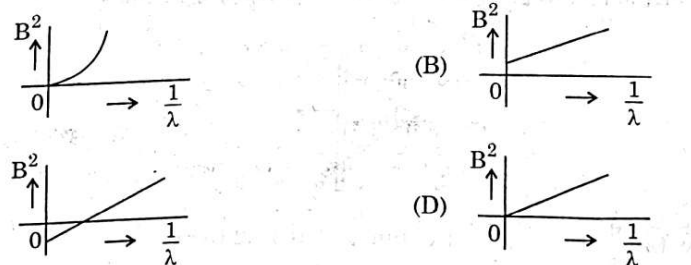
Correct Answer: 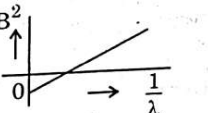
View Solution
1. The energy of emitted electrons is related to the wavelength of incident light by the photoelectric equation:
E = hc/λ - φ,
where E is the kinetic energy of emitted electrons, h is Planck’s constant, c is the speed of light, and φ is the work function.
2. The kinetic energy is related to the radius R and the magnetic field B as:
E = eB²R² / 2m,
where e is the electron charge and m is the mass of the electron.
3. Substituting for E:
eB²R² / 2m = hc/λ - φ.
4. Rearranging for B²:
B² ∝ 1/λ.
5. Hence, the graph of B² vs 1/λ is a straight line.
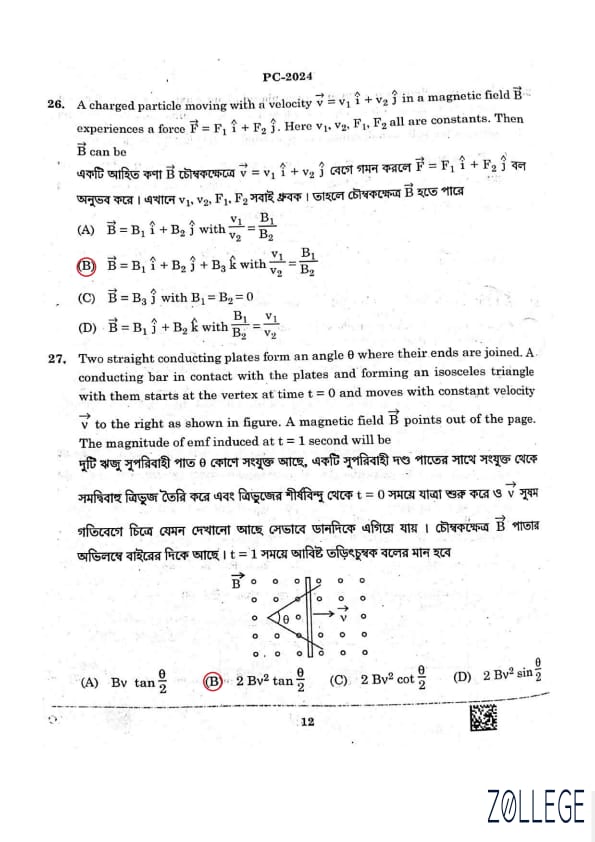
Question 26:
A charged particle moving with a velocity v = v₁ î + v₂ ĵ + v₃ k̂ in a magnetic field B experiences a force F = F₁ î + F₂ ĵ. Here v₁, v₂, F₁, F₂ are all constants. Then B can be:
Options:
View Solution
1. The force on a charged particle in a magnetic field is given by the Lorentz force law:
F = q (v × B),
where q is the charge of the particle.
2. The cross product v × B is calculated using a determinant:
v × B = | î ĵ k̂ |
| v₁ v₂ v₃ |
| B₁ B₂ B₃ |.
3. Comparing components of the force, we derive:
v₁/v₂ = B₁/B₂.
4. The magnetic field must have components in all three directions:
B = B₁ î + B₂ ĵ + B₃ k̂.
Question 27:
Two straight conducting plates form an angle θ where their ends are joined. A conducting bar in contact with the plates and forming an isosceles triangle with them starts at the vertex at time t = 0 and moves with constant velocity v to the right as shown in the figure. A magnetic field B points out of the page. The magnitude of emf induced at t = 1 second will be:
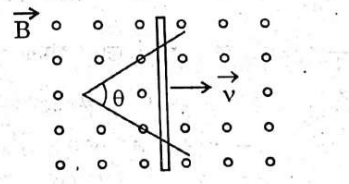
Options:
View Solution
1. The motion of the conducting bar creates a change in the area enclosed by the plates, inducing an emf.
2. Using Faraday's law of electromagnetic induction, the induced emf is given by:
???? = dΦ/dt,
where Φ = B · Area.
3. At t = 1 second, the distance moved by the bar is x = vt, and the area of the triangle is:
Area = x² tan(θ/2).
4. The induced emf is:
???? = 2Bv² tan(θ/2).
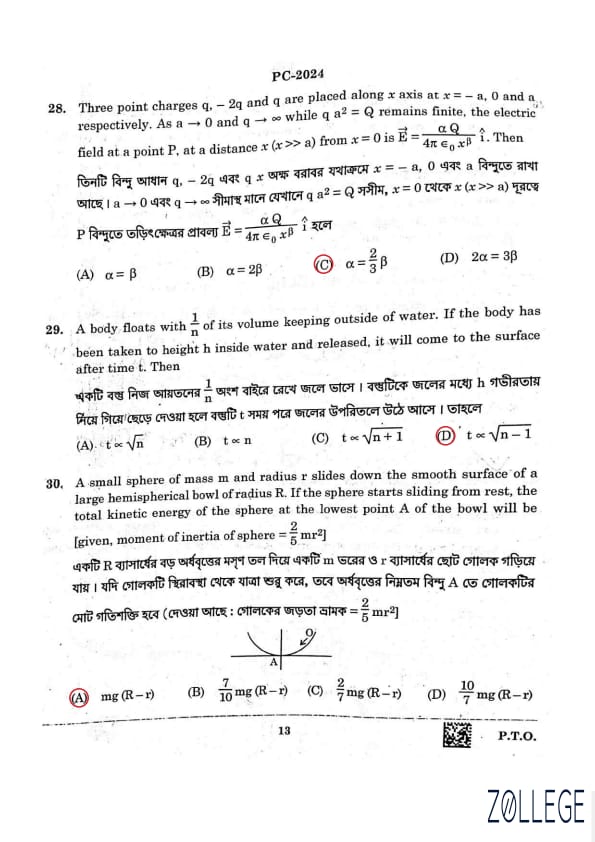
Question 28:
Three point charges q, -2q, and q are placed along the x-axis at x = -a, x = 0, and x = a, respectively. As a → 0 and q → ∞, while qa² = Q remains finite, the electric field at a point P, at a distance x ≫ a from x = 0, is given by:
E = (αQ) / (4πε₀xᵝ) î.
Find the relationship between α and β:
Options:
View Solution
1. The net electric field at point P is the vector sum of the fields due to the three charges.
2. For x ≫ a, the binomial approximation is applied to simplify terms.
3. Substituting q = Q/a² and simplifying, the electric field is:
E = (αQ) / (4πε₀xᵝ).
4. Comparing terms gives α = 2 and β = 3.
5. The relationship is:
α = (2/3)β.
Question 29:
A body floats with 1/n of its volume outside of water. If the body is taken to depth h inside the water and released, it will come to the surface after time t. Then:
Options:
View Solution
1. The time taken for a floating object to rise to the surface depends on the restoring force, which is proportional to the displaced volume.
2. For a body floating with 1/n of its volume outside water, the buoyant force depends on the submerged volume.
3. The time t for the body to return to the surface is proportional to the square root of the volume fraction submerged:
t ∝ √(n - 1).
Question 29:
A body floats with 1/n of its volume outside of water. If the body is taken to depth h inside the water and released, it will come to the surface after time t. Then:
Options:
View Solution
1. The time taken for a floating object to rise to the surface depends on the restoring force, which is proportional to the displaced volume.
2. For a body floating with 1/n of its volume outside water, the buoyant force depends on the submerged volume.
3. The time t for the body to return to the surface is proportional to the square root of the volume fraction submerged:
t ∝ √(n - 1).
Question 30:
A small sphere of mass m and radius R slides down the smooth surface of a large hemispherical bowl of radius R. If the sphere starts sliding from rest, the total kinetic energy of the sphere at the lowest point A of the bowl will be:
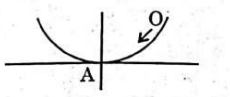
Options:
View Solution
1. The sphere slides down the smooth surface of the hemispherical bowl, so no friction acts.
2. Using the conservation of mechanical energy:
- At the top, potential energy is U = mg(R - r).
- At the bottom, this potential energy converts into total kinetic energy.
3. Total kinetic energy at the lowest point is:
K_total = mg(R - r).
Question 31:
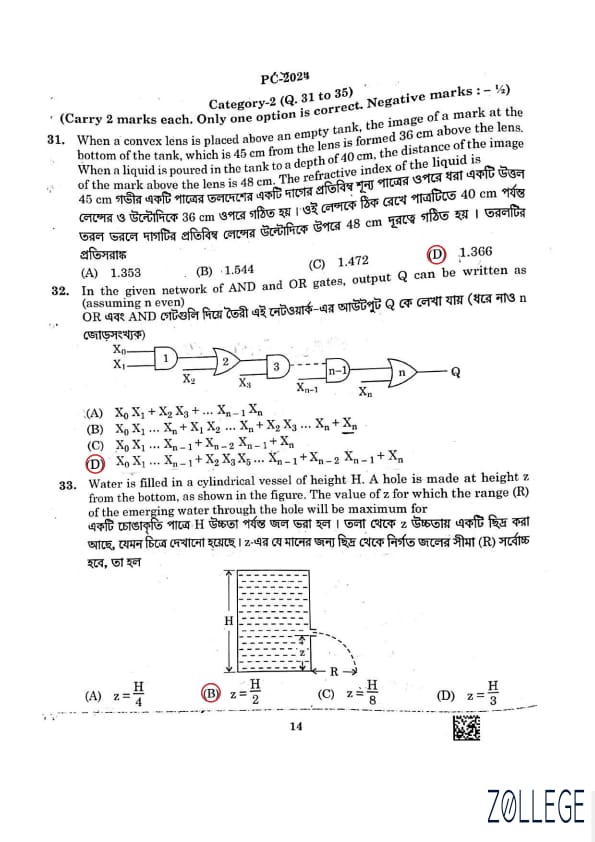
When a convex lens is placed above an empty tank, the image of a mark at the bottom of the tank, which is 45 cm from the lens, is formed 36 cm above the lens. When a liquid is poured into the tank to a depth of 40 cm, the distance of the image of the mark above the lens is 48 cm. The refractive index of the liquid is:
Options:
View Solution
1. **Step 1:** Use the lens formula:
1/f = 1/v - 1/u, where f is the focal length, v is the image distance, and u is the object distance.
2. **Step 2:** For the lens in air (no liquid):
Object distance, u = -36 cm, Image distance, v = 45 cm.
Substituting into the formula: 1/f_air = 1/45 - 1/(-36).
This gives the focal length in air, f_air = 20 cm.
3. **Step 3:** When liquid is added, the image distance becomes v' = 48 cm.
Using the formula again: 1/f_liquid = 1/48 - 1/(-36).
This gives the focal length in liquid, f_liquid = 27.32 cm.
4. **Step 4:** Refractive index of the liquid is: n = f_liquid / f_air = 27.32 / 20 = 1.366.
Thus, the refractive index of the liquid is:
1.366.
Question 32:
In the given network of AND and OR gates, output Q can be written as (assuming n even):

Options:
View Solution
1. Analyze the configuration of AND and OR gates. Each AND gate operates on pairs of adjacent inputs, and their outputs are summed by OR gates.
2. For n even, simplify the Boolean expression by combining pairs of adjacent inputs.
3. The resulting Boolean expression is: Q = X0 X1 + X2 X3 + ... + Xn.
Question 33:
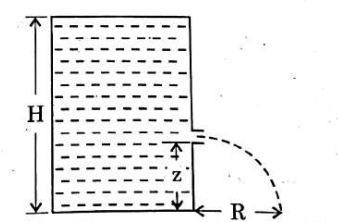
Water is filled in a cylindrical vessel of height H. A hole is made at height z from the bottom, as shown in the figure. The value of z for which the range R of the emerging water through the hole will be maximum is:
Options:
View Solution
1. Using Torricelli’s law, the velocity of water emerging from a hole at height z is: v = √(2gz).
2. The horizontal range R depends on the velocity and time of flight: R = 2√(z(H-z)).
3. To maximize R, solve dR/dz = 0. This gives: z = H/3.
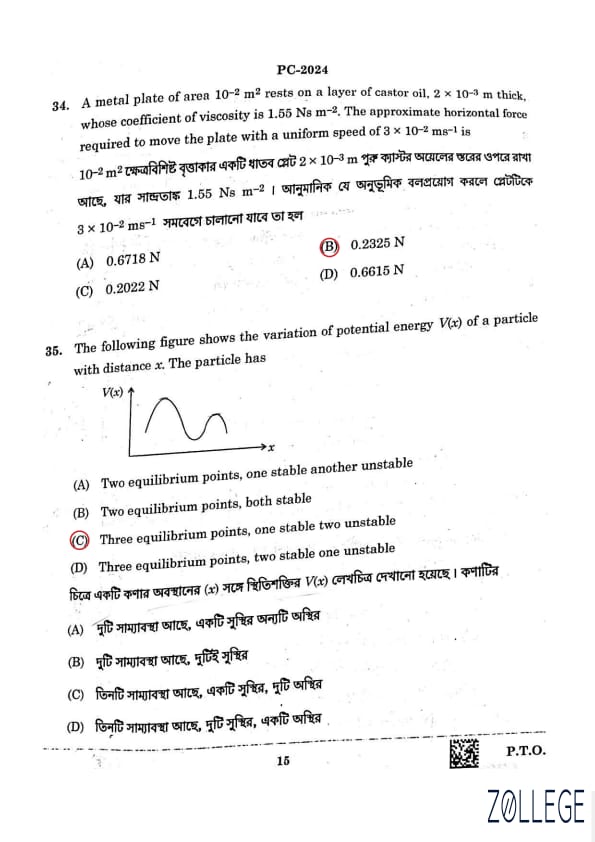
Question 34:
A metal plate of area 10-2 m2 rests on a layer of castor oil 2 × 10⁻³ m thick, whose coefficient of viscosity is 1.55 Ns/m2. The approximate horizontal force required to move the plate with a uniform speed of 3 × 10⁻² m/s is:
Options:
View Solution
1. The force is given by: F = η × A × (v/d).
2. Substituting the values: F = 1.55 × 10-2 × (3 × 10-2) / (2 × 10⁻³) = 0.2325 N.
Question 35:
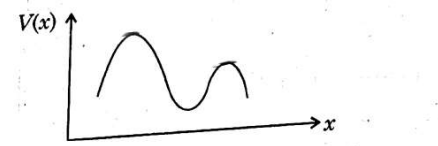
The following figure shows the variation of potential energy V(x) of a particle with distance x. The particle has:
Options:
View Solution
1. Equilibrium points occur where the force is zero (dV/dx = 0).
2. From the graph, there are three points where V(x) has extrema: one minimum (stable equilibrium) and two maxima (unstable equilibria).
3. Hence, there are three equilibrium points: one stable and two unstable.
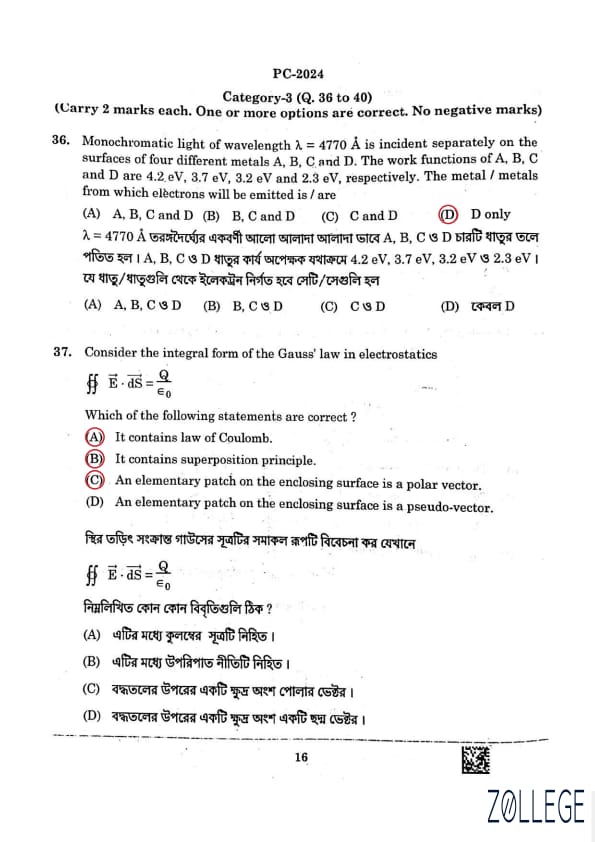
Question 36:
Monochromatic light of wavelength λ = 4770 Å is incident separately on the surfaces of four different metals A, B, C, and D. The work functions of A, B, C, and D are 4.2 eV, 3.7 eV, 3.2 eV, and 2.3 eV, respectively. The metal(s) from which electrons will be emitted is/are:
Options:
View Solution
1. The energy of the photon is given by: E = (hc) / λ.
2. Substituting values: h = 6.626 × 10⁻³⁴ Js, c = 3 × 10⁸ m/s, λ = 4.77 × 10⁻⁷ m.
E = 4.15 eV.
3. Comparing E with work functions:
A: 4.2 eV (no emission), B: 3.7 eV (no emission), C: 3.2 eV (no emission), D: 2.3 eV (electrons emitted).
Question 37:
Consider the integral form of Gauss’s law in electrostatics:
∮ E · dA = Q / ε0
Which of the following statements are correct?
View Solution
1. Gauss’s law relates electric flux to the total charge enclosed, generalizing Coulomb’s law.
2. It inherently includes the superposition principle, considering the total flux due to all enclosed charges.
3. The elementary patch on the enclosing surface is a polar vector representing area and orientation.
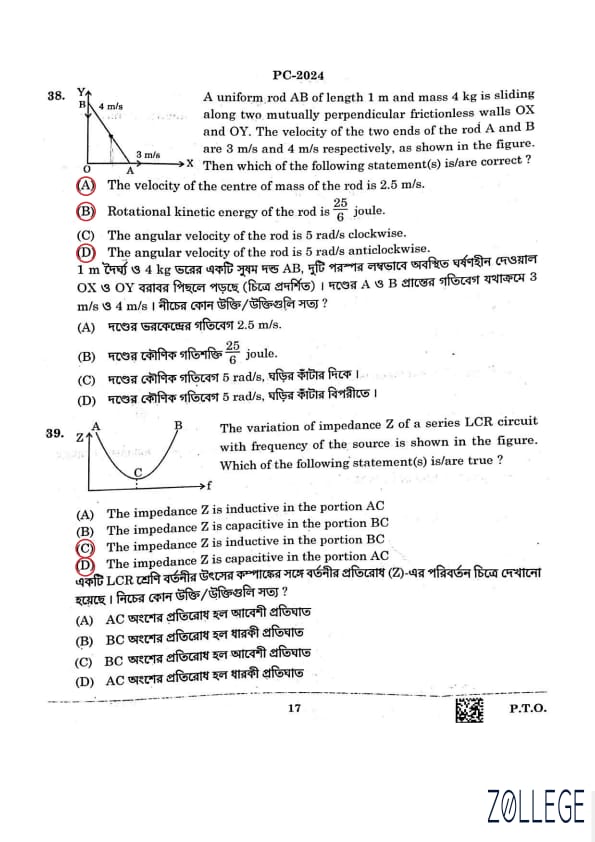
Question 38:
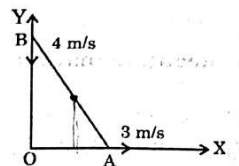
A uniform rod AB of length 1 m and mass 4 kg is sliding along two mutually perpendicular frictionless walls OX and OY. The velocity of the two ends of the rod A and B are 3 m/s and 4 m/s respectively, as shown in the figure. Then which of the following statement(s) is/are correct?
Options:
View Solution
1. The velocity of the center of mass is:
vcm = (3 + 4) / 2 = 2.5 m/s.
2. The rotational kinetic energy is:
Krot = 1/2 × 1/3 × 4 × 1 × 1 = 25/6 joule.
3. The angular velocity is anticlockwise as the rod slides down.
Question 39:
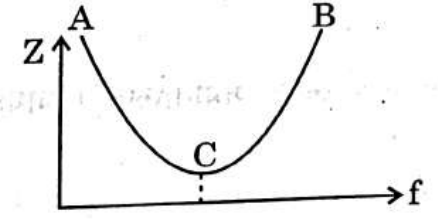
The variation of impedance Z of a series LCR circuit with the frequency of the source is shown in the figure. Which of the following statement(s) is/are true?
Options:
View Solution
1. In portion AB, the circuit is capacitive as the impedance decreases with increasing frequency.
2. In portion BC, the circuit is inductive as the impedance increases with increasing frequency.
3. At resonance, the impedance is purely resistive.
Question 40:
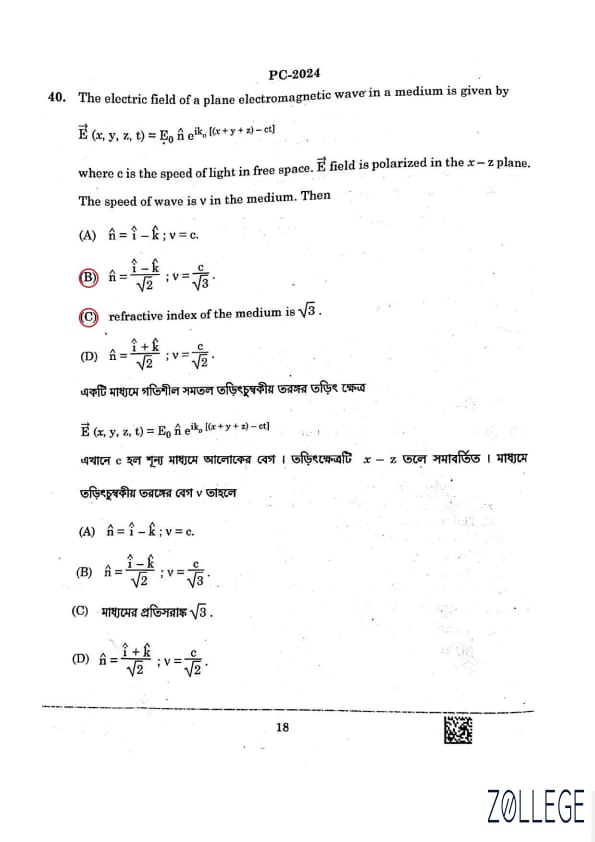
The electric field of a plane electromagnetic wave in a medium is given by:
E(x, y, z, t) = E0 ei(k0(x + y + z) - ωt)
Where c is the speed of light in free space, and the E field is polarized in the x-z plane. The speed of the wave is v in the medium. Then:
View Solution
1. The wave propagates in the direction of k̂ = (x̂ + ŷ + ẑ).
2. The speed of the wave in the medium is:
v = c / √3, where the refractive index n = √3.
*The article might have information for the previous academic years, please refer the official website of the exam.