
WBJEE 2026 Physics and Chemistry Question Paper with Solutions PDF


| Updated On - May 28, 2026
The WBJEE 2026 exam for Physics and Chemistry Conducted by the WBJEEB in the first shift in CBT Mode.
The WBJEE 2026 Physics and Chemistry question paper consists of a total of 80 questions divided into three categories. Category 1 includes 30 questions carrying 1 mark each, with a negative marking of 0.25 marks for every incorrect answer. Category 2 consists of 5 questions carrying 2 marks each, with a negative marking of 0.5 marks for wrong answers. Category 3 contains 5 questions carrying 2 marks each, and there is no negative marking in this section.
The WBJEE 2026 Physics and Chemistry Question Paper with Solution PDF is available here for download.
WBJEE 2026 Physics and Chemistry Question Paper with Solutions PDF
| WBJEE 2026 Physics and Chemistry Question Paper | Download PDF | Check Solutions |
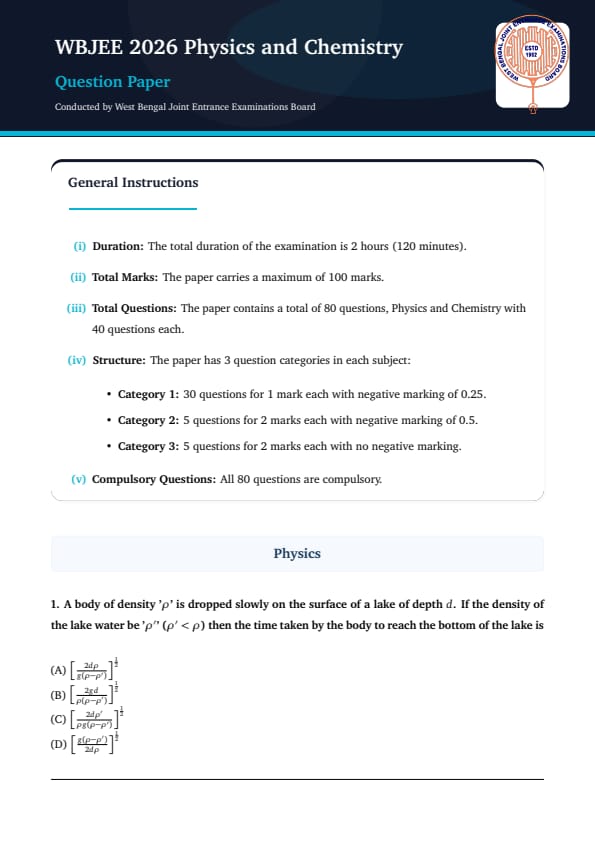
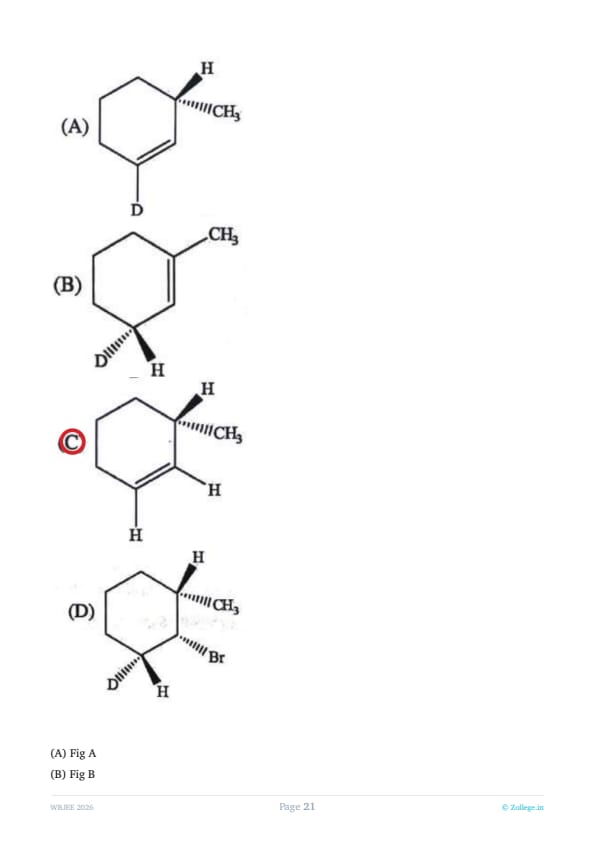
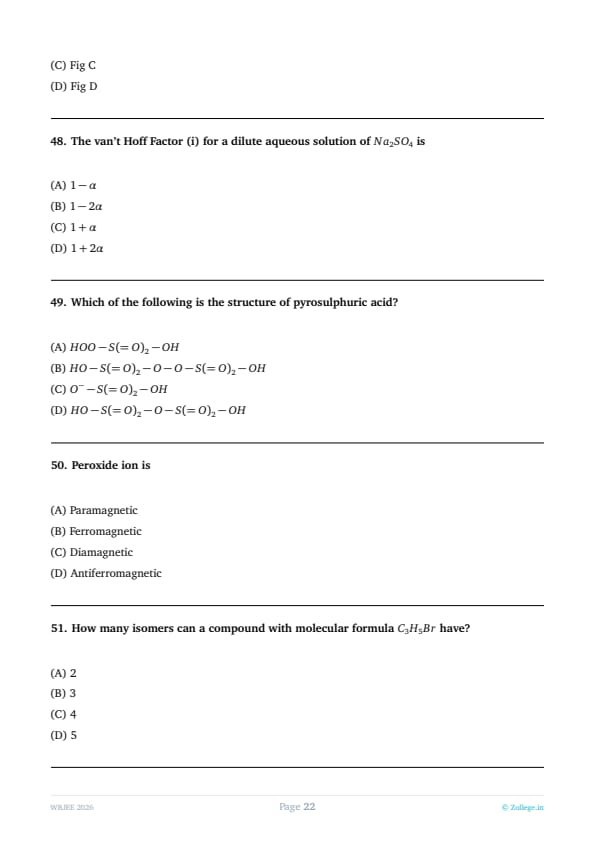
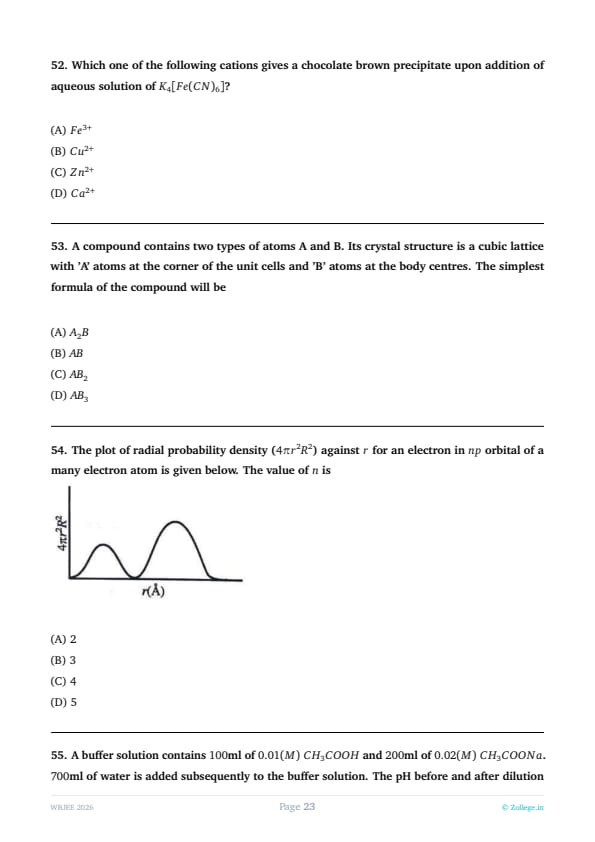
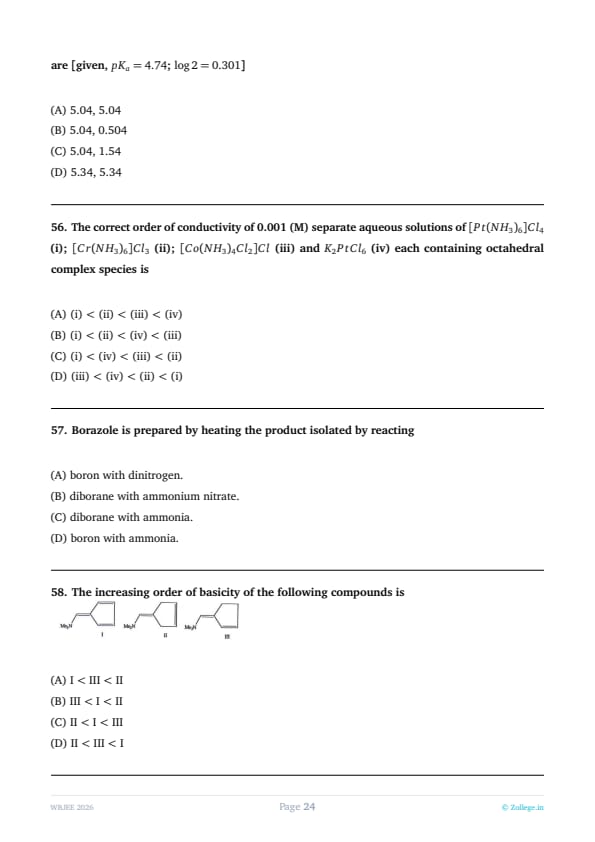

A body of density '\(\rho\)' is dropped slowly on the surface of a lake of depth \(d\). If the density of the lake water be '\(\rho'\)' (\(\rho' < \rho\)) then the time taken by the body to reach the bottom of the lake is
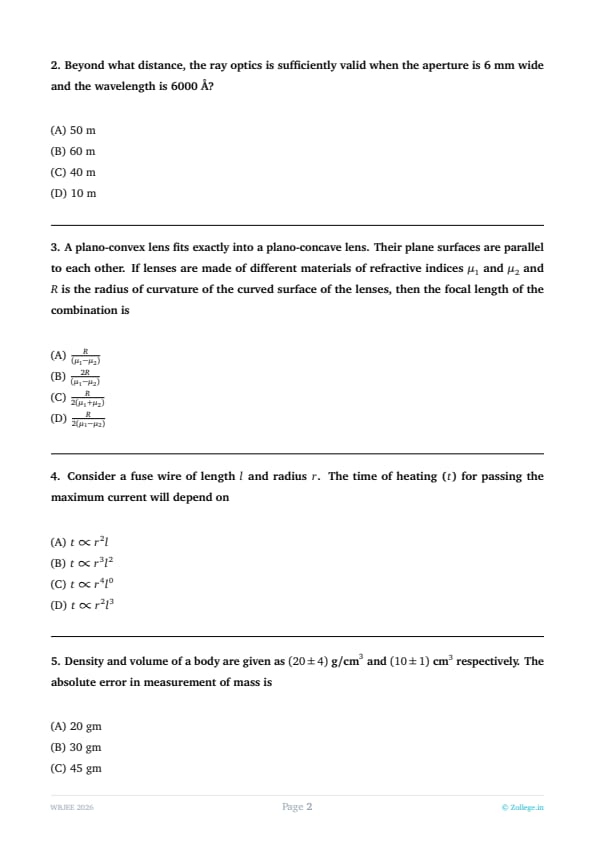
Beyond what distance, the ray optics is sufficiently valid when the aperture is 6 mm wide and the wavelength is 6000 \(AA\)?
A plano-convex lens fits exactly into a plano-concave lens. Their plane surfaces are parallel to each other. If lenses are made of different materials of refractive indices \(\mu_1\) and \(\mu_2\) and \(R\) is the radius of curvature of the curved surface of the lenses, then the focal length of the combination is
Consider a fuse wire of length \(l\) and radius \(r\). The time of heating (\(t\)) for passing the maximum current will depend on
Density and volume of a body are given as \((20 \pm 4) g/cm^3\) and \((10 \pm 1) cm^3\) respectively. The absolute error in measurement of mass is
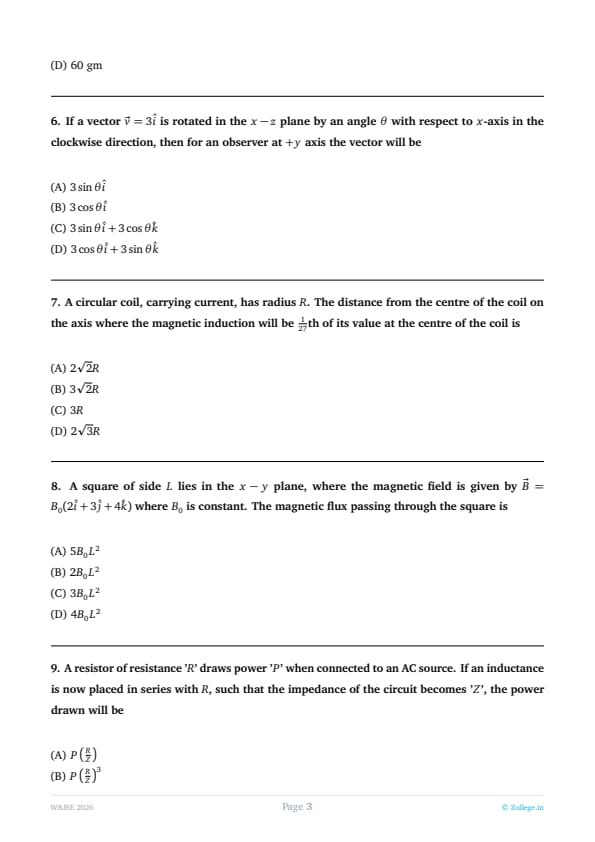
If a vector \(\vec{v} = 3\hat{i}\) is rotated in the \(x-z\) plane by an angle \(\theta\) with respect to \(x\)-axis in the clockwise direction, then for an observer at \(+y\) axis the vector will be
A circular coil, carrying current, has radius \(R\). The distance from the centre of the coil on the axis where the magnetic induction will be \(\frac{1}{27}\)th of its value at the centre of the coil is
A square of side \(L\) lies in the \(x-y\) plane, where the magnetic field is given by \(\vec{B} = B_0 (2\hat{i} + 3\hat{j} + 4\hat{k})\) where \(B_0\) is constant. The magnetic flux passing through the square is
A resistor of resistance '\(R\)' draws power '\(P\)' when connected to an AC source. If an inductance is now placed in series with \(R\), such that the impedance of the circuit becomes '\(Z\)', the power drawn will be
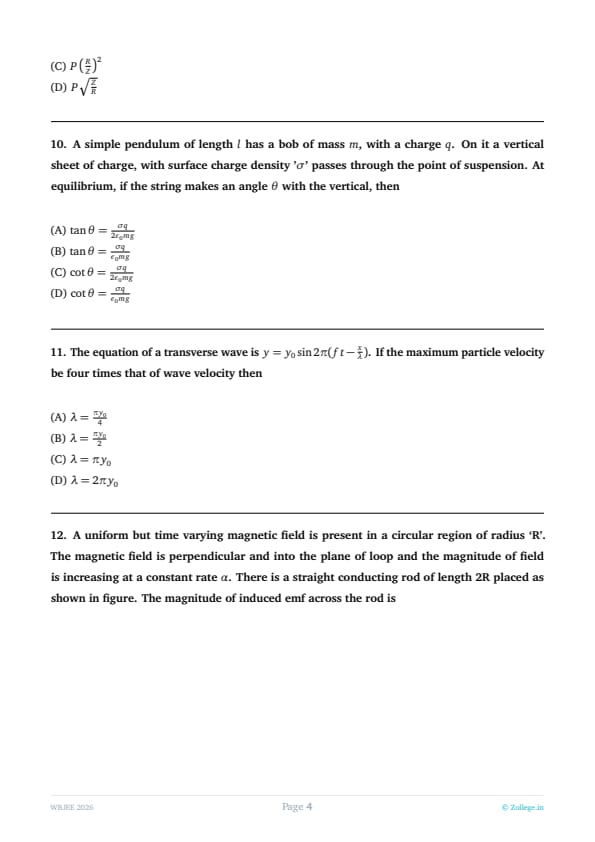
A simple pendulum of length \(l\) has a bob of mass \(m\), with a charge \(q\). On it a vertical sheet of charge, with surface charge density '\(\sigma\)' passes through the point of suspension. At equilibrium, if the string makes an angle \(\theta\) with the vertical, then
The equation of a transverse wave is \(y = y_0 \sin 2\pi(ft - \frac{x}{\lambda})\). If the maximum particle velocity be four times that of wave velocity then
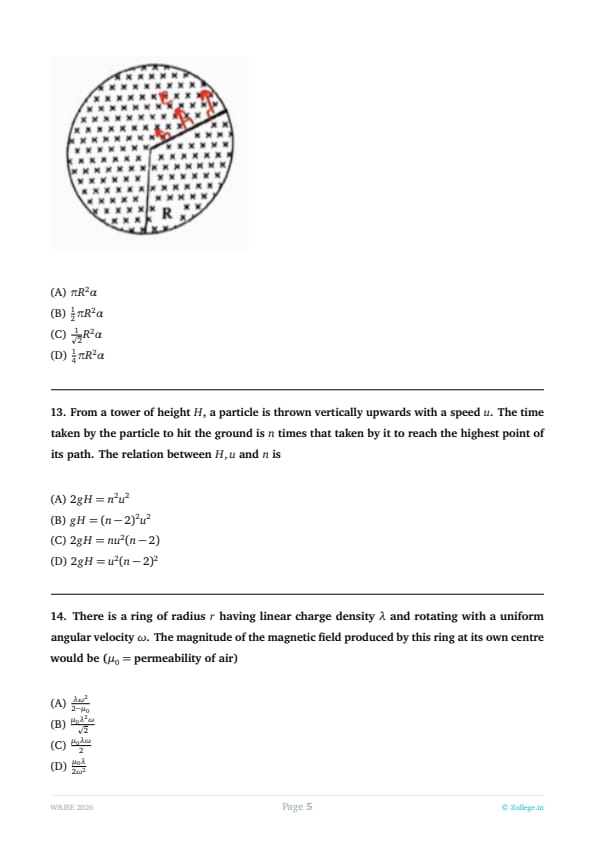
A uniform but time varying magnetic field is present in a circular region of radius ‘R’. The magnetic field is perpendicular and into the plane of loop and the magnitude of field is increasing at a constant rate \(\alpha\). There is a straight conducting rod of length 2R placed as shown in figure. The magnitude of induced emf across the rod is

From a tower of height \(H\), a particle is thrown vertically upwards with a speed \(u\). The time taken by the particle to hit the ground is \(n\) times that taken by it to reach the highest point of its path. The relation between \(H, u\) and \(n\) is
There is a ring of radius \(r\) having linear charge density \(\lambda\) and rotating with a uniform angular velocity \(\omega\). The magnitude of the magnetic field produced by this ring at its own centre would be (\(\mu_0 = permeability of air\))
Three vectors \(\vec{a}, \vec{b}\) and \(\vec{c}\) are such that \(|\vec{a}|=1, |\vec{b}|=2\) and \(|\vec{c}|=4\) along with \(\vec{a}+\vec{b}+\vec{c}=0\). Then, the value of \(4\vec{a}\cdot\vec{b} + 3\vec{b}\cdot\vec{c} + 3\vec{c}\cdot\vec{a}\) will be
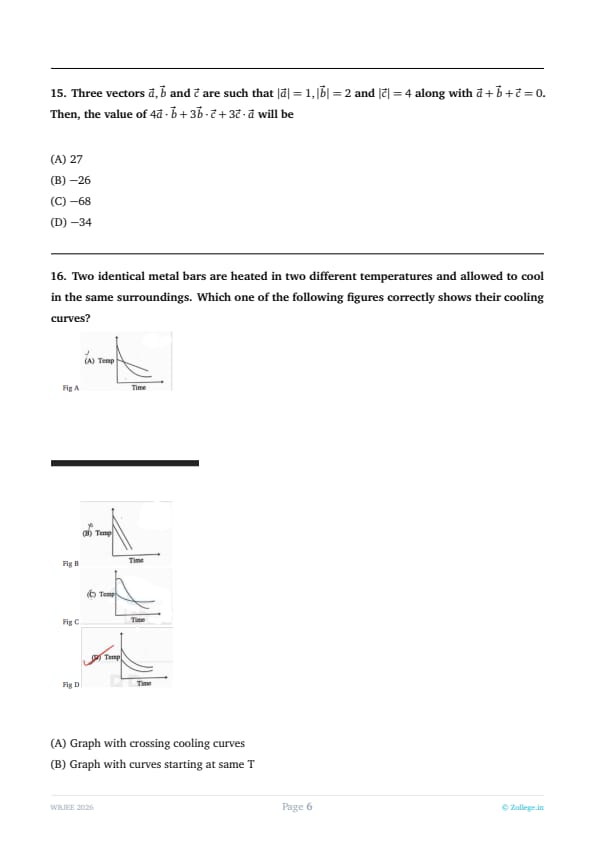
Two identical metal bars are heated in two different temperatures and allowed to cool in the same surroundings. Which one of the following figures correctly shows their cooling curves?

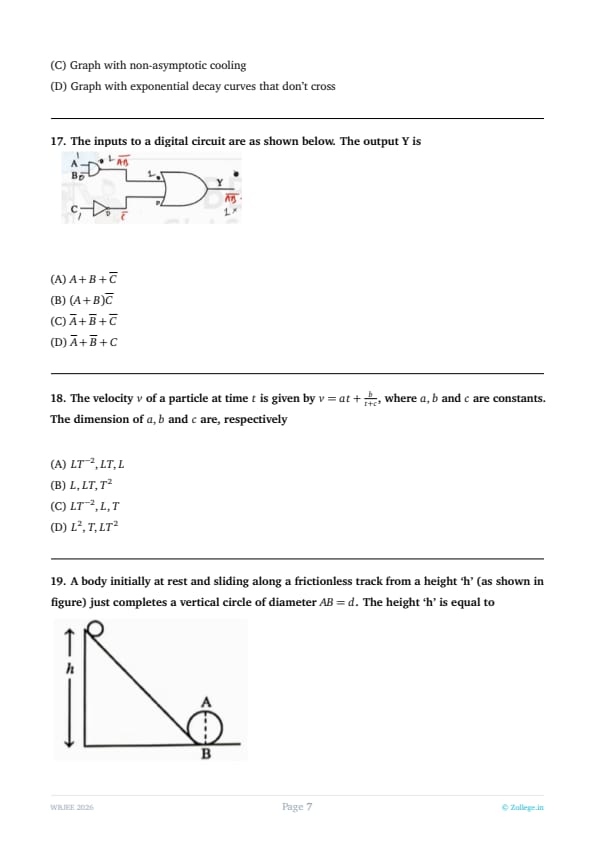
The inputs to a digital circuit are as shown below. The output Y is

The velocity \(v\) of a particle at time \(t\) is given by \(v = at + \frac{b}{t+c}\), where \(a, b\) and \(c\) are constants. The dimension of \(a, b\) and \(c\) are, respectively
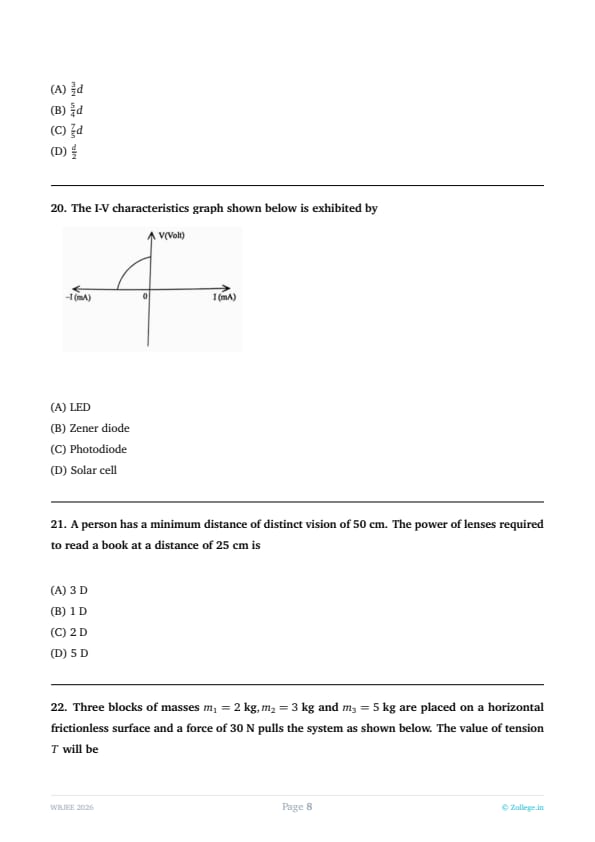
A body initially at rest and sliding along a frictionless track from a height ‘h’ (as shown in figure) just completes a vertical circle of diameter \(AB = d\). The height ‘h’ is equal to

The I-V characteristics graph shown below is exhibited by

A person has a minimum distance of distinct vision of 50 cm. The power of lenses required to read a book at a distance of 25 cm is
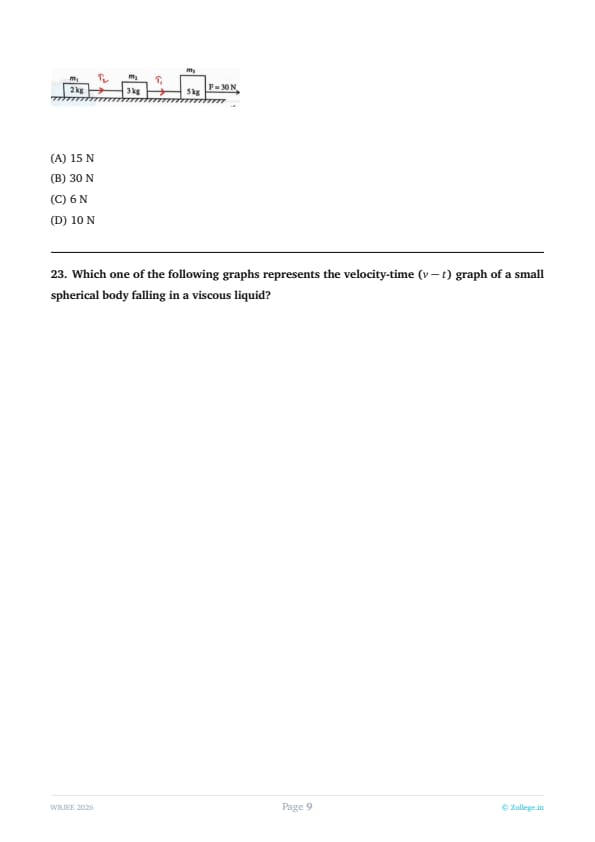
Three blocks of masses \(m_1 = 2 kg, m_2 = 3 kg\) and \(m_3 = 5 kg\) are placed on a horizontal frictionless surface and a force of 30 N pulls the system as shown below. The value of tension \(T\) will be

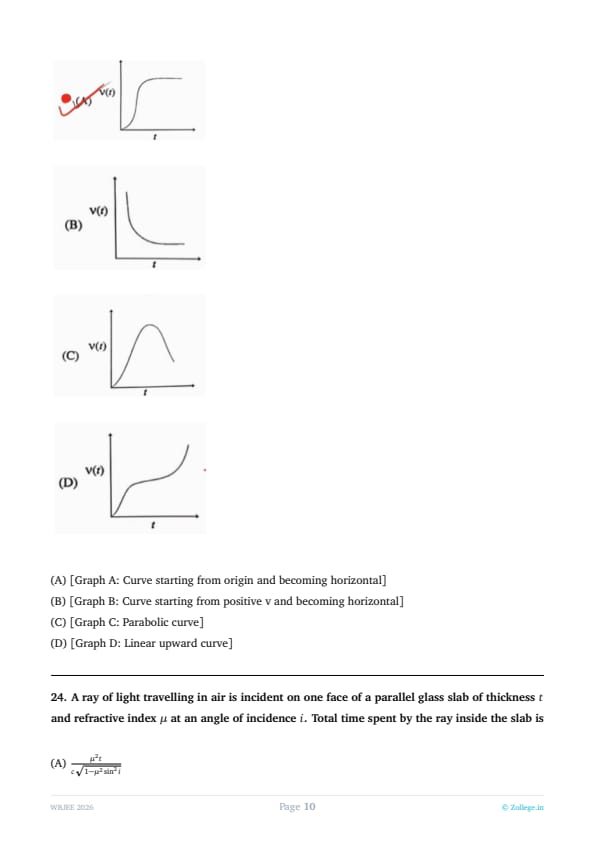
Which one of the following graphs represents the velocity-time (\(v-t\)) graph of a small spherical body falling in a viscous liquid?

A ray of light travelling in air is incident on one face of a parallel glass slab of thickness \(t\) and refractive index \(\mu\) at an angle of incidence \(i\). Total time spent by the ray inside the slab is
Radiation of wavelength \(\lambda\) is incident on a photocell. The fastest emitted electron has speed \(v\). If the wavelength is changed to \(\frac{3\lambda}{4}\), then the speed of the fastest emitted electron will be
Two spherical soap bubbles of radii \(r_1\) and \(r_2\) in vacuum coalesce under isothermal condition. The newly formed bubble has a radius (\(r\)) given by
A radioactive element \(^{242}_{92}X\) emits two \(\alpha\)-particles, one electron and two positrons. The transformed nucleus is represented by \(^{234}_P Y\). The value of P is
The magnetic moment of an iron bar is \(M\). It is now bent in such a way that it forms an arc section of a circle subtending an angle of \(60^\circ\) at the centre. The magnetic moment of the arc section is
A uniform rod AB is suspended from a point P, at a variable distance \(x\) from A, as shown in figure. To make the rod horizontal, a mass ‘m’ is suspended from its end A. Which set of variables will give a straight line when they are plotted?

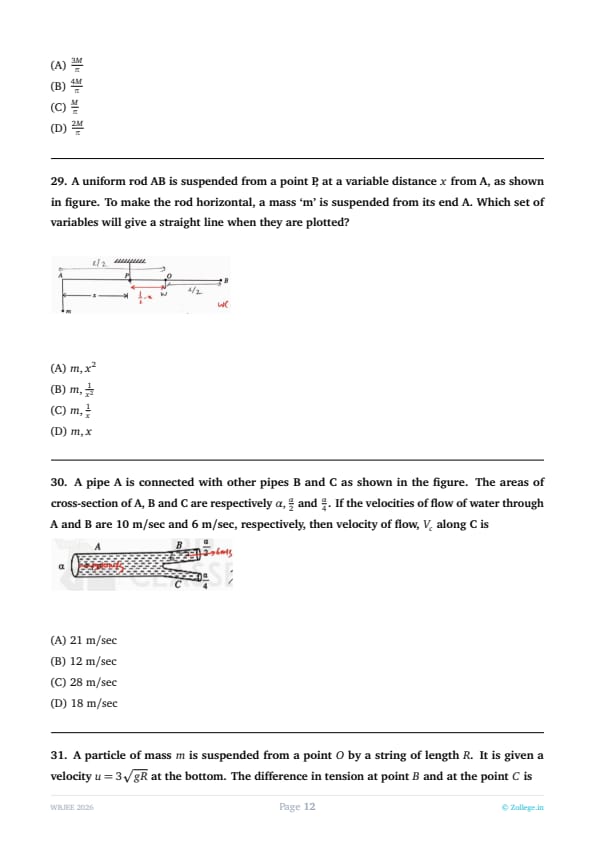
A pipe A is connected with other pipes B and C as shown in the figure. The areas of cross-section of A, B and C are respectively \(\alpha, \frac{\alpha}{2}\) and \(\frac{\alpha}{4}\). If the velocities of flow of water through A and B are 10 m/sec and 6 m/sec, respectively, then velocity of flow, \(V_c\) along C is

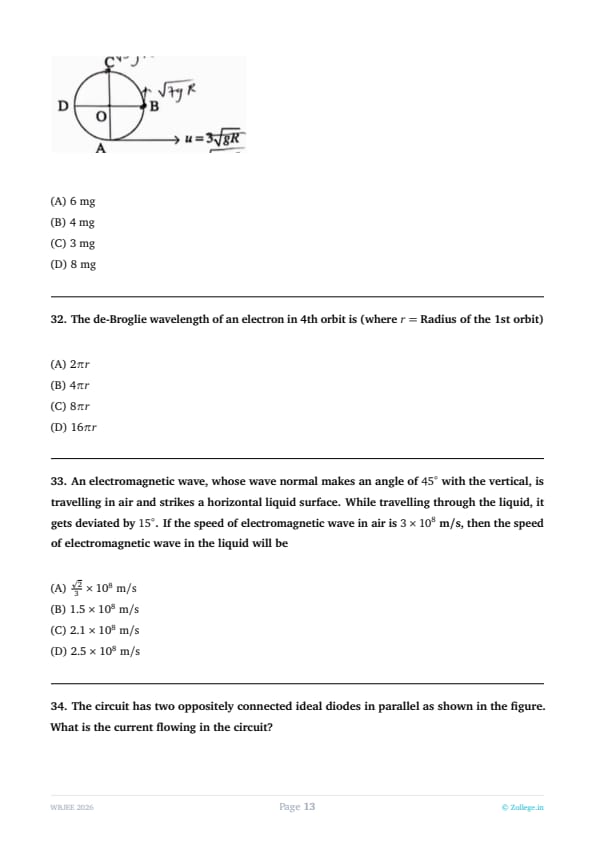
A particle of mass \(m\) is suspended from a point \(O\) by a string of length \(R\). It is given a velocity \(u = 3\sqrt{gR}\) at the bottom. The difference in tension at point \(B\) and at the point \(C\) is

The de-Broglie wavelength of an electron in 4th orbit is (where \(r = Radius of the 1st orbit\))
An electromagnetic wave, whose wave normal makes an angle of \(45^\circ\) with the vertical, is travelling in air and strikes a horizontal liquid surface. While travelling through the liquid, it gets deviated by \(15^\circ\). If the speed of electromagnetic wave in air is \(3 \times 10^8 m/s\), then the speed of electromagnetic wave in the liquid will be
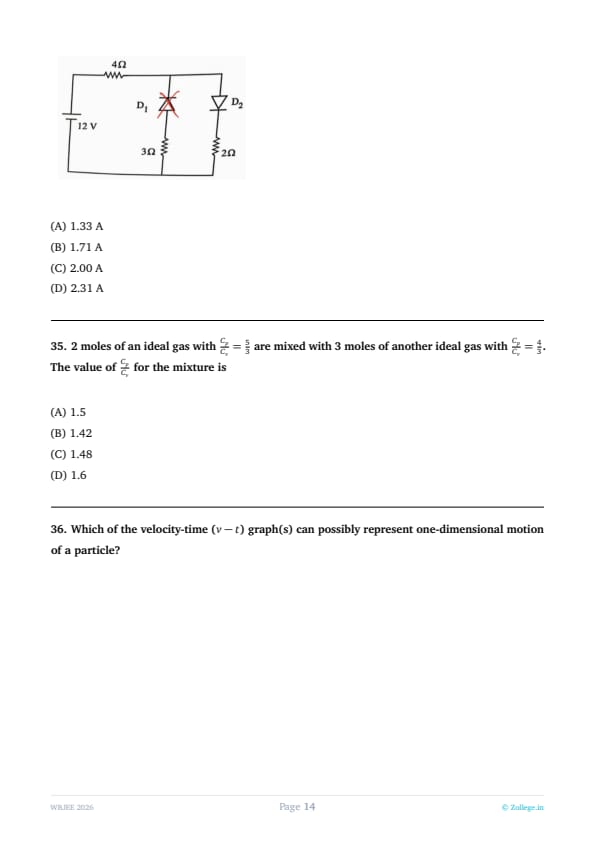
The circuit has two oppositely connected ideal diodes in parallel as shown in the figure. What is the current flowing in the circuit?

2 moles of an ideal gas with \(\frac{C_p}{C_v} = \frac{5}{3}\) are mixed with 3 moles of another ideal gas with \(\frac{C_p}{C_v} = \frac{4}{3}\). The value of \(\frac{C_p}{C_v}\) for the mixture is
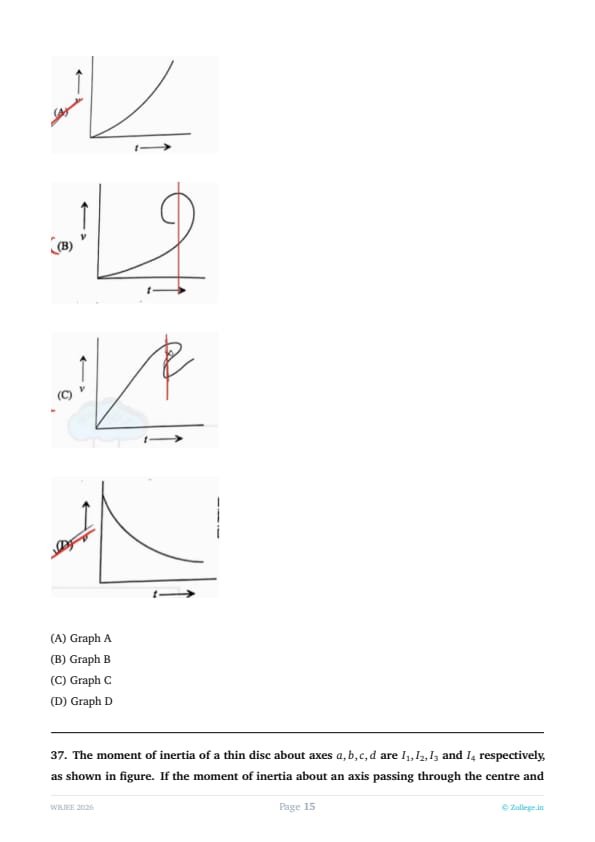
Which of the velocity-time (\(v-t\)) graph(s) can possibly represent one-dimensional motion of a particle?

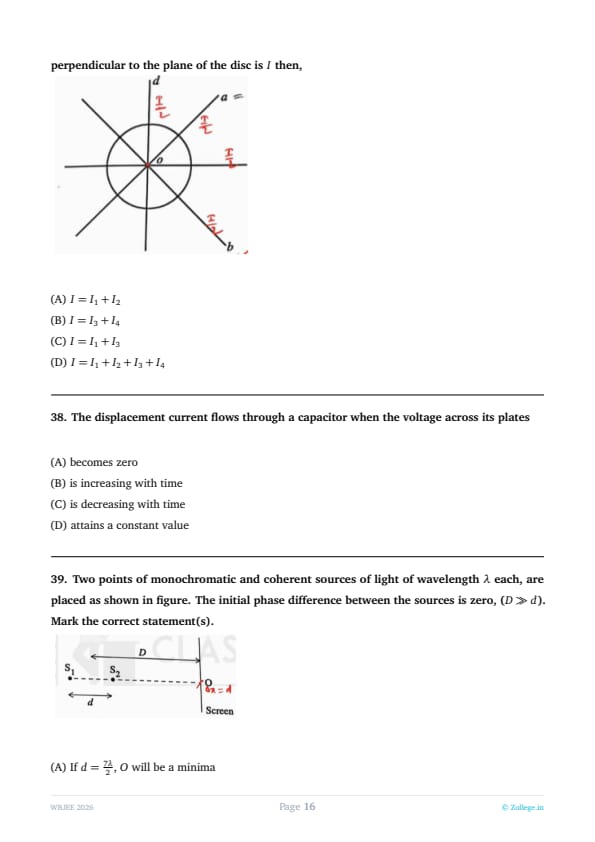
The moment of inertia of a thin disc about axes \(a, b, c, d\) are \(I_1, I_2, I_3\) and \(I_4\) respectively, as shown in figure. If the moment of inertia about an axis passing through the centre and perpendicular to the plane of the disc is \(I\) then,

The displacement current flows through a capacitor when the voltage across its plates
Two points of monochromatic and coherent sources of light of wavelength \(\lambda\) each, are placed as shown in figure. The initial phase difference between the sources is zero, (\(D \gg d\)). Mark the correct statement(s).

For Boolean variables \(A\) and \(B\), \(A \oplus B = A\overline{B} + \overline{A}B\). Then, which of the following statements is/are correct?
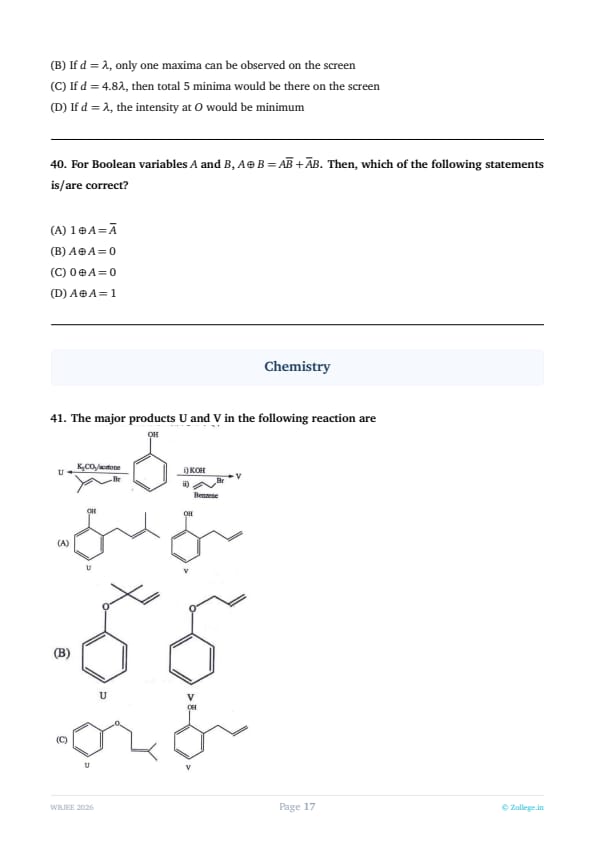
The major products U and V in the following reaction are


Among \(N_2O\), \(ClF_2^-\), \(SO_2\) and \(I_3^+\), the species having the linear structures are
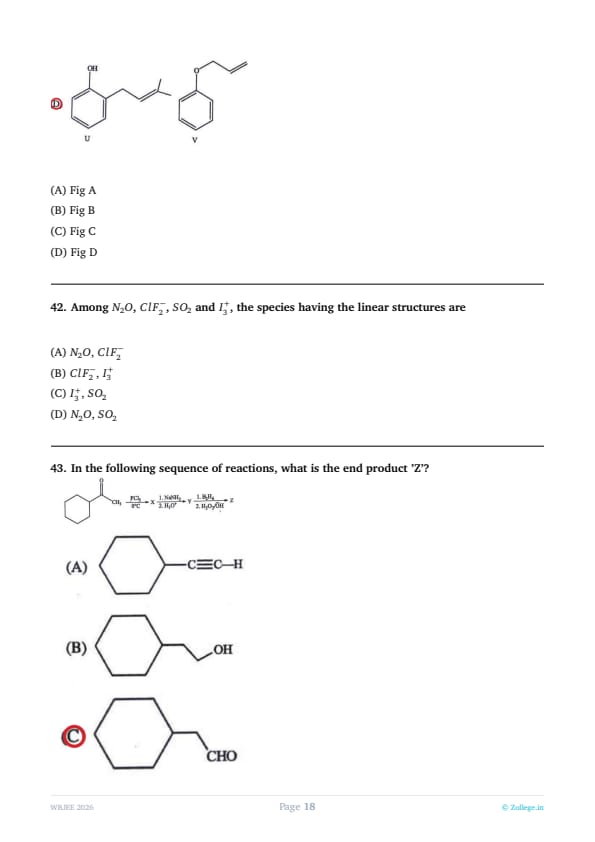
In the following sequence of reactions, what is the end product 'Z'?


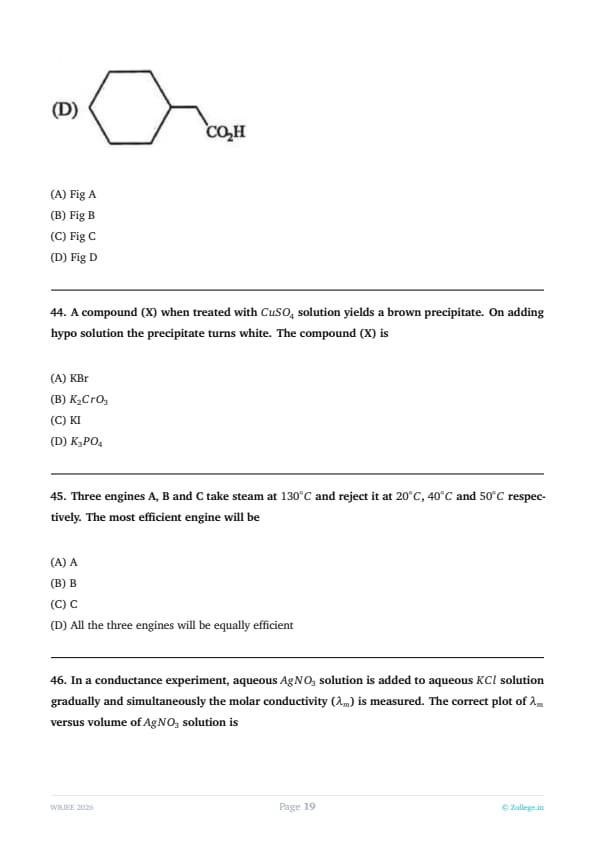
A compound (X) when treated with \(CuSO_4\) solution yields a brown precipitate. On adding hypo solution the precipitate turns white. The compound (X) is
Three engines A, B and C take steam at \(130^\circ C\) and reject it at \(20^\circ C\), \(40^\circ C\) and \(50^\circ C\) respectively. The most efficient engine will be
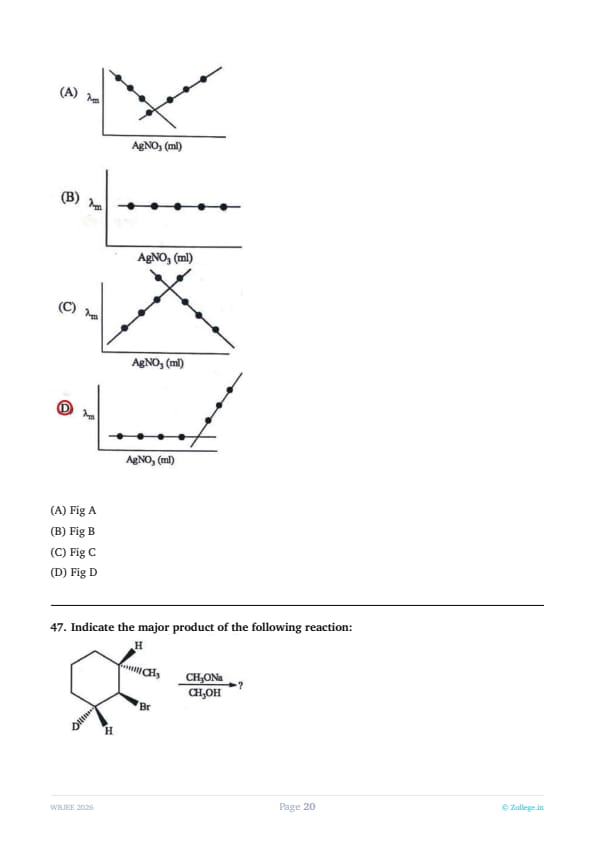
In a conductance experiment, aqueous \(AgNO_3\) solution is added to aqueous \(KCl\) solution gradually and simultaneously the molar conductivity (\(\lambda_m\)) is measured. The correct plot of \(\lambda_m\) versus volume of \(AgNO_3\) solution is


Indicate the major product of the following reaction:


The van’t Hoff Factor (i) for a dilute aqueous solution of \(Na_2SO_4\) is
Which of the following is the structure of pyrosulphuric acid?
Peroxide ion is
How many isomers can a compound with molecular formula \(C_3H_5Br\) have?
Which one of the following cations gives a chocolate brown precipitate upon addition of aqueous solution of \(K_4[Fe(CN)_6]\)?
A compound contains two types of atoms A and B. Its crystal structure is a cubic lattice with 'A' atoms at the corner of the unit cells and 'B' atoms at the body centres. The simplest formula of the compound will be
The plot of radial probability density (\(4\pi r^2 R^2\)) against \(r\) for an electron in \(np\) orbital of a many electron atom is given below. The value of \(n\) is

A buffer solution contains \(100ml\) of \(0.01(M)\) \(CH_3COOH\) and \(200ml\) of \(0.02(M)\) \(CH_3COONa\). \(700ml\) of water is added subsequently to the buffer solution. The pH before and after dilution are [given, \(pK_a = 4.74\); \(\log 2 = 0.301\)]
The correct order of conductivity of 0.001 (M) separate aqueous solutions of \([Pt(NH_3)_6]Cl_4\) (i); \([Cr(NH_3)_6]Cl_3\) (ii); \([Co(NH_3)_4Cl_2]Cl\) (iii) and \(K_2PtCl_6\) (iv) each containing octahedral complex species is
Borazole is prepared by heating the product isolated by reacting
The increasing order of basicity of the following compounds is

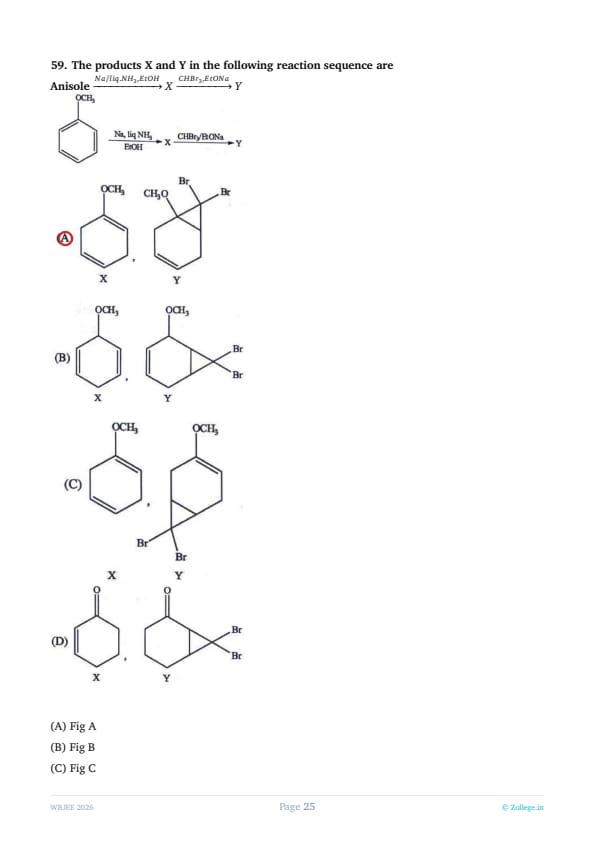
The products X and Y in the following reaction sequence are
Anisole \(\xrightarrow{Na/liq. NH_3, EtOH} X \xrightarrow{CHBr_3, EtONa} Y\)


View Solution
Step 1: Understanding the Concept:
This problem involves two distinct organic reactions:
1. Birch Reduction: The reduction of aromatic rings using alkali metals in liquid ammonia. The regioselectivity depends on whether the substituent is electron-donating or withdrawing.
2. Carbene Addition: The reaction of a carbene (\(:CBr_2\)) with an alkene to form a cyclopropane ring.
Step 2: Detailed Explanation:
Step 1: Formation of X (Birch Reduction):
Anisole (methoxybenzene) has a methoxy group (\(-OCH_3\)), which is electron-donating via resonance (\(+M\) effect).
In Birch reduction, electron-donating groups direct the reduction to the 2,5-positions. The carbon attached to the methoxy group remains unreduced.
Product X is 1-methoxycyclohexa-1,4-diene.
Step 2: Formation of Y (Carbene Addition):
The reagents \(CHBr_3\) and \(EtONa\) generate dibromocarbene (\(:CBr_2\)) via \(\alpha\)-elimination.
Dibromocarbene is an electrophilic carbene. It will selectively add to the more electron-rich double bond of the diene X.
In 1-methoxycyclohexa-1,4-diene, the double bond bearing the methoxy group (\(C_1=C_2\)) is significantly more electron-rich than the isolated double bond due to the \(+M\) effect of the oxygen.
Therefore, the carbene adds exclusively to the substituted double bond to form a fused dibromocyclopropane ring.
Product Y is 1,1-dibromo-2-methoxybicyclo[4.1.0]hept-3-ene.
These structures correspond to Figure A.
Step 3: Final Answer:
The major products X and Y are shown in Figure A. The correct option is (A).
Quick Tip: Birch Reduction Rule:
- EDG (\(-OCH_3, -CH_3\)): Carbon with substituent is NOT reduced (product is 1-substituted-1,4-diene).
- EWG (\(-COOH, -CN\)): Carbon with substituent IS reduced.
Carbenes always attack the most electron-rich (more substituted or donor-attached) double bond!
The van der Waal’s equation : \([P + a/(4V^2)][V - b/2] = RT/2\) is valid for
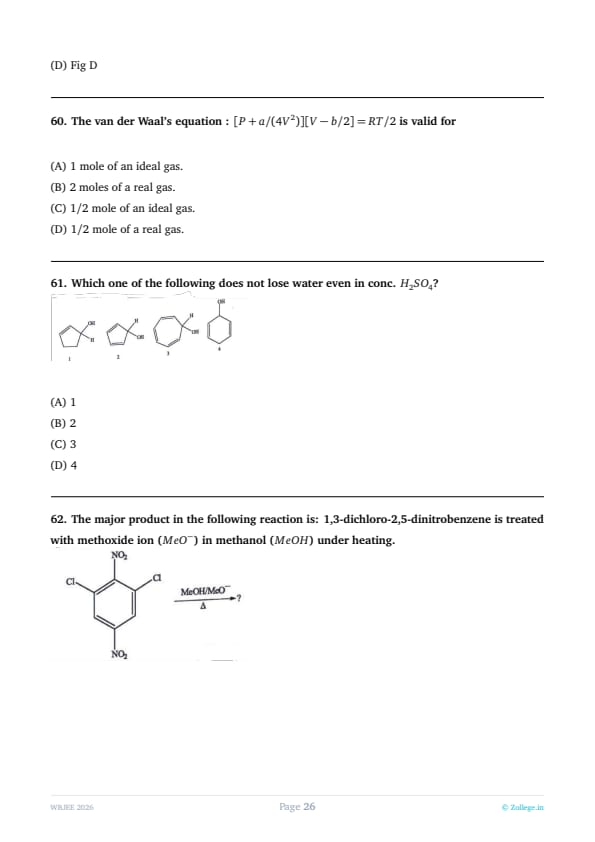
Which one of the following does not lose water even in conc. \(H_2SO_4\)?

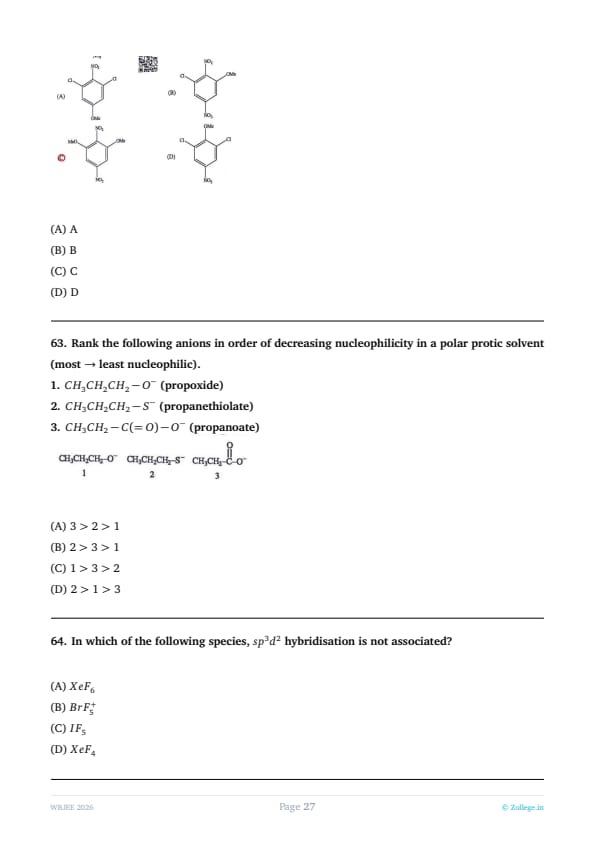
The major product in the following reaction is: 1,3-dichloro-2,5-dinitrobenzene is treated with methoxide ion (\(MeO^-\)) in methanol (\(MeOH\)) under heating.


View Solution
Step 1: Understanding the Concept:
This reaction is a classic example of Nucleophilic Aromatic Substitution (\(S_NAr\)).
Aromatic rings are generally resistant to nucleophilic attack due to electron-rich \(\pi\)-clouds, but substitution becomes possible if the ring is substituted with strong electron-withdrawing groups (EWGs) like nitro groups (\(-NO_2\)).
The \(S_NAr\) mechanism is most effective when the EWGs are located at ortho or para positions relative to the leaving group (the halogen).
These groups stabilize the negatively charged transition state (Meisenheimer complex) by delocalizing the charge onto the oxygen atoms.
Step 2: Key Formula or Approach:
1. Examine the positions of the Chlorine atoms (leaving groups) relative to the Nitro groups (activating groups).
2. Chlorine at C1 is ortho to \(-NO_2\) at C2 and para to \(-NO_2\) at C5.
3. Chlorine at C3 is ortho to \(-NO_2\) at C2 and para to \(-NO_2\) at C5.
4. Both Cl atoms are highly activated for substitution.
Step 3: Detailed Explanation:
The starting material is 1,3-dichloro-2,5-dinitrobenzene.
The methoxide ion (\(MeO^-\)) is a strong nucleophile. In the presence of methanol and heat, it attacks the ring carbons bearing the chlorine atoms.
Since the nitro groups are positioned perfectly to activate both chlorine atoms, the reaction does not stop at a single substitution if heat and excess nucleophile are provided.
First, one methoxide ion attacks at C1, forming a Meisenheimer intermediate where the negative charge is delocalized into the nitro groups at C2 and C5. The subsequent loss of the chloride ion (\(Cl^-\)) restores aromaticity, yielding 1-chloro-3-methoxy-2,5-dinitrobenzene.
Because the second chlorine at C3 is also equally activated by the same nitro groups, another methoxide ion attacks C3 in a similar manner.
Under heating conditions, both activated chlorine atoms are replaced by methoxy groups.
The final major product is 1,3-dimethoxy-2,5-dinitrobenzene. This product matches the structure provided in Figure C.
Step 4: Final Answer:
The reaction leads to the replacement of both chlorine atoms by methoxy groups because both positions are ortho/para activated by nitro groups. The correct option is (C).
Quick Tip: In \(S_NAr\) reactions: Halogens are the leaving groups, and Nitro groups are the activators. If you see multiple halogens and multiple nitro groups with "heat", assume all activated halogens will be replaced by the nucleophile!
Rank the following anions in order of decreasing nucleophilicity in a polar protic solvent (most \(\rightarrow\) least nucleophilic).
1. \(CH_3CH_2CH_2 - O^-\) (propoxide)
2. \(CH_3CH_2CH_2 - S^-\) (propanethiolate)
3. \(CH_3CH_2 - C(= O) - O^-\) (propanoate)

In which of the following species, \(sp^3d^2\) hybridisation is not associated?
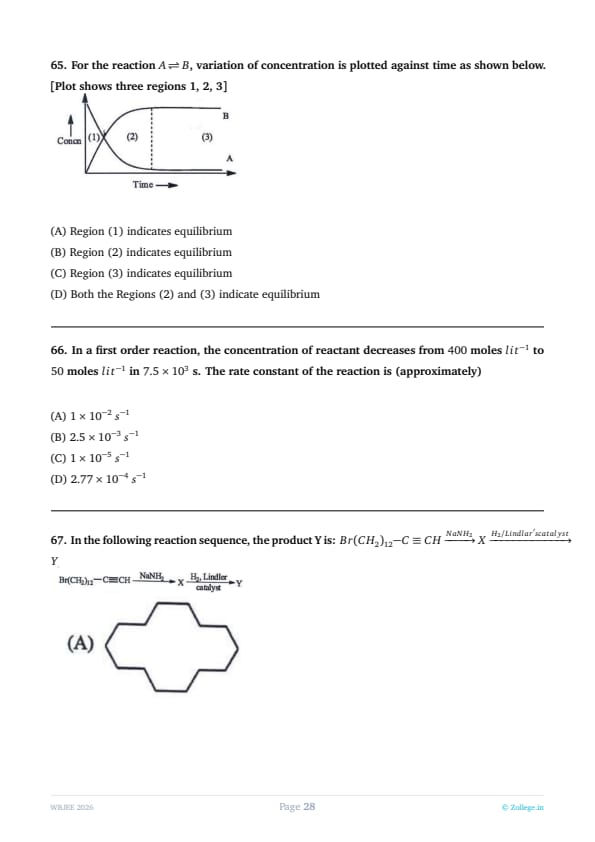
For the reaction \(A \rightleftharpoons B\), variation of concentration is plotted against time as shown below. [Plot shows three regions 1, 2, 3]

In a first order reaction, the concentration of reactant decreases from \(400\) moles \(lit^{-1}\) to \(50\) moles \(lit^{-1}\) in \(7.5 \times 10^3\) s. The rate constant of the reaction is (approximately)
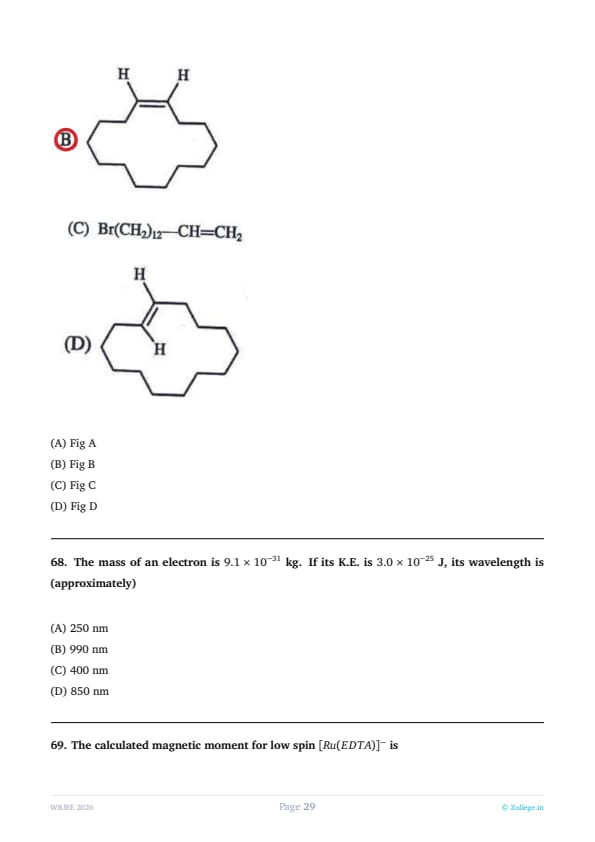
In the following reaction sequence, the product Y is: \(Br(CH_2)_{12} - C \equiv CH \xrightarrow{NaNH_2} X \xrightarrow{H_2/Lindlar's catalyst} Y\)


View Solution
Step 1: Understanding the Concept:
The reaction involves two distinct steps:
1. Intramolecular Alkylation: Sodium amide (\(NaNH_2\)) is an extremely strong base. It deprotonates the terminal alkyne to form a nucleophilic acetylide ion, which can then attack an electrophilic site (like an alkyl halide) within the same molecule to form a ring.
2. Partial Hydrogenation: Lindlar's catalyst is a poisoned palladium catalyst that reduces alkynes selectively to alkenes. Because the reduction occurs via syn-addition, the product is always the cis-alkene (Z-isomer).
Step 2: Detailed Explanation:
Step 1: Formation of X
The starting material has a 14-carbon chain: 12 methylene groups (\(-CH_2-\)) and 2 alkyne carbons. It has a bromine atom at one end and a terminal alkyne at the other.
\(NaNH_2\) deprotonates the terminal hydrogen to form an acetylide carbanion: \(Br-(CH_2)_{12}-C \equiv C^-\).
This carbanion then performs an intramolecular nucleophilic substitution (\(S_N2\)) on the carbon bearing the bromine atom.
The chain closes to form a ring. Total carbons in ring = \(12 + 2 = 14\).
Product X is cyclotetradecyne (a 14-membered cyclic alkyne).
Step 2: Formation of Y
The cyclic alkyne X is treated with \(H_2\) over Lindlar's catalyst (\(Pd/CaCO_3/Quinoline\)).
This reagent reduces the triple bond to a double bond. Since the hydrogen atoms are added to the same face of the triple bond (syn-addition), the resulting alkene is the cis-isomer.
Product Y is cis-cyclotetradecene.
In Figure B, the double bond is shown in the cis-configuration (Z), where the hydrogen atoms are on the same side.
Step 3: Final Answer:
The cyclization and subsequent syn-reduction result in a 14-membered cyclic cis-alkene. The correct option is (B).
Step 4: Final Verification:
Check the number of carbons (14) and the cis-double bond. Both match Figure B.
Quick Tip: To remember alkyne reductions:
1. {Lindlar's Catalyst} \(\rightarrow\) {cis-alkene} (Syn addition).
2. {Sodium in Liquid Ammonia} (\(Na/NH_3\)) \(\rightarrow\) {trans-alkene} (Anti addition).
Since the question specifies Lindlar's, we must choose the cis-product.
The mass of an electron is \(9.1 \times 10^{-31}\) kg. If its K.E. is \(3.0 \times 10^{-25}\) J, its wavelength is (approximately)
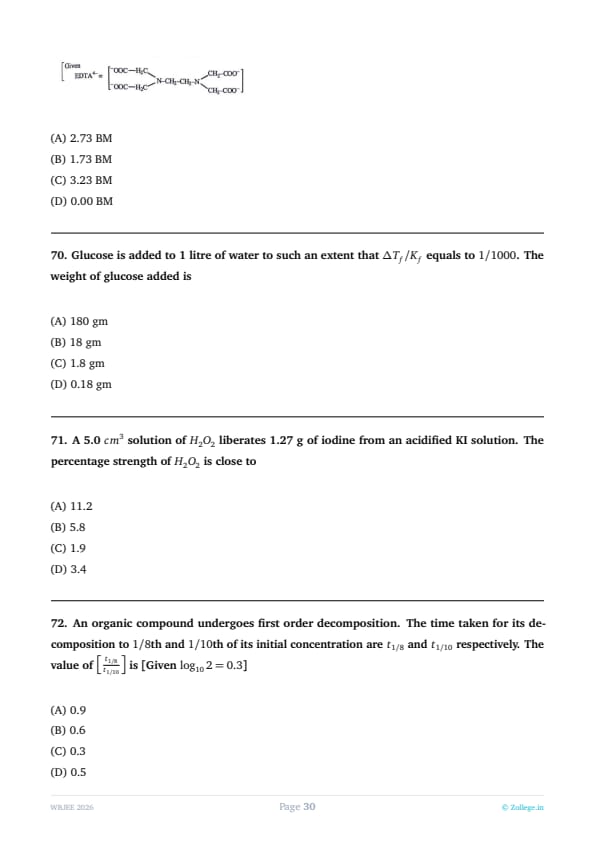
The calculated magnetic moment for low spin \([Ru(EDTA)]^-\) is

Glucose is added to 1 litre of water to such an extent that \(\Delta T_f / K_f\) equals to \(1/1000\). The weight of glucose added is
A 5.0 \(cm^3\) solution of \(H_2O_2\) liberates 1.27 g of iodine from an acidified KI solution. The percentage strength of \(H_2O_2\) is close to
An organic compound undergoes first order decomposition. The time taken for its decomposition to \(1/8\)th and \(1/10\)th of its initial concentration are \(t_{1/8}\) and \(t_{1/10}\) respectively. The value of \(\left[ \frac{t_{1/8}}{t_{1/10}} \right]\) is [Given \(\log_{10} 2 = 0.3\)]
For the metal complex \([Co(NH_3)_5SO_4]Br\), coordination number, oxidation number, number of d-electrons and number of unpaired d-electrons are respectively
\(RO-CH_2-C\equiv CH \xrightarrow{X} \xrightarrow{Y} RO-CH_2-C\equiv C-CH_2CH_2-Br\). To carry out the above conversion X and Y are respectively
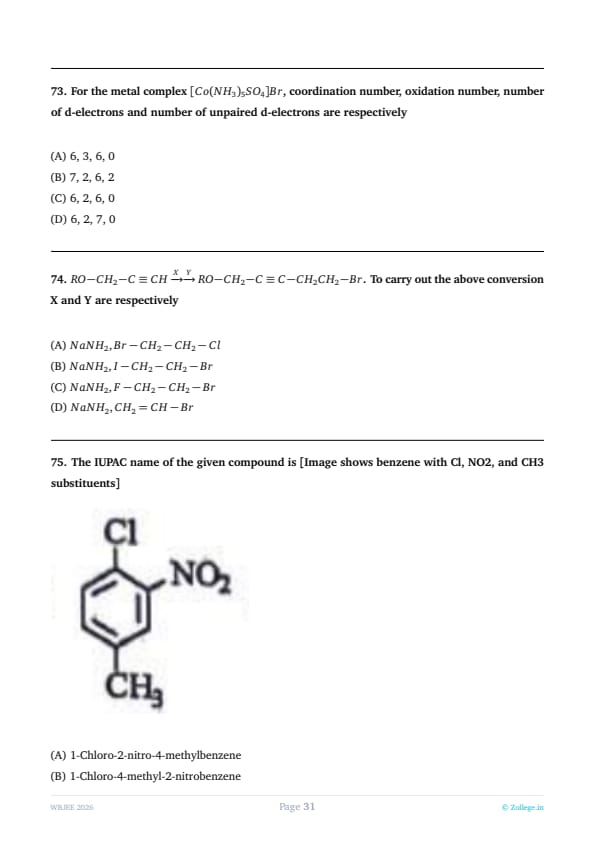
The IUPAC name of the given compound is [Image shows benzene with Cl, NO2, and CH3 substituents]

View Solution
Step 1: Understanding the Concept:
For trisubstituted benzenes where none of the substituents impart a special name (like phenol or aniline), the ring is numbered such that the set of locants (the position numbers) is the lowest. If multiple numbering schemes give the same set of lowest locants, we number based on alphabetical priority. The substituents are then listed in alphabetical order in the final name.
Step 2: Detailed Explanation:
The substituents on the ring are:
- Chloro (C)
- Methyl (M)
- Nitro (N)
Let's evaluate numbering schemes:
1. Starting at Cl (1) and going towards Nitro: Locants are (1, 2, 4). Set = \(\{1, 2, 4\}\).
2. Starting at Nitro (1) and going towards Cl: Locants are (1, 2, 5). Set = \(\{1, 2, 5\}\).
3. Starting at Methyl (1) and going towards Nitro: Locants are (1, 3, 4). Set = \(\{1, 3, 4\}\).
Comparing \(\{1, 2, 4\}\), \(\{1, 2, 5\}\), and \(\{1, 3, 4\}\), the lowest set is \(\{1, 2, 4\}\).
Using this numbering:
- Chlorine is at position 1.
- Nitro is at position 2.
- Methyl is at position 4.
Now, arrange alphabetically for the final name: Chloro (C) \(<\) Methyl (M) \(<\) Nitro (N).
Name: 1-Chloro-4-methyl-2-nitrobenzene.
Step 3: Final Answer:
The correct IUPAC name is 1-Chloro-4-methyl-2-nitrobenzene. The correct option is (B).
Quick Tip: Alphabetical order is used for {listing} substituents in the name, but {numbering} is primarily determined by the "lowest locant rule". Always determine the numerical set first!
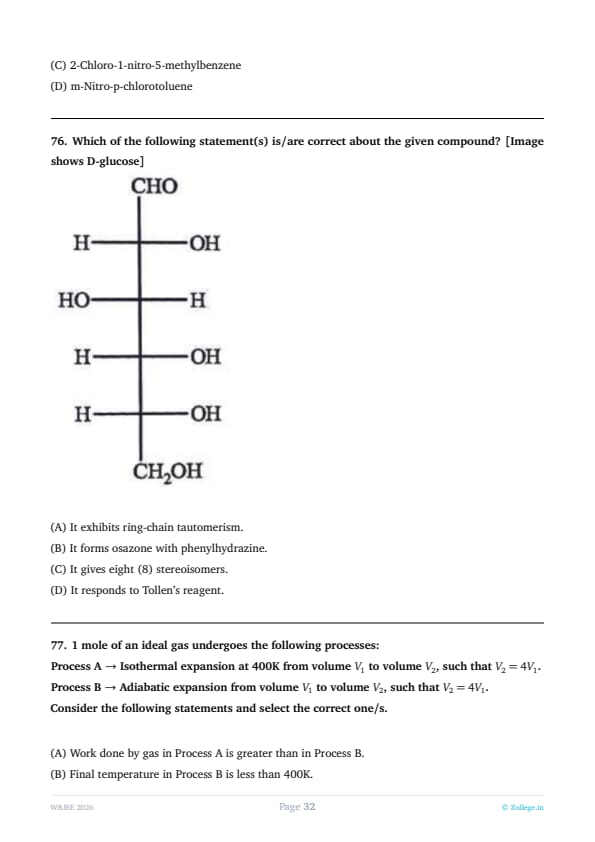
Which of the following statement(s) is/are correct about the given compound? [Image shows D-glucose]

1 mole of an ideal gas undergoes the following processes:
Process A \(\rightarrow\) Isothermal expansion at 400K from volume \(V_1\) to volume \(V_2\), such that \(V_2 = 4V_1\).
Process B \(\rightarrow\) Adiabatic expansion from volume \(V_1\) to volume \(V_2\), such that \(V_2 = 4V_1\).
Consider the following statements and select the correct one/s.
Which of the following statement(s) is/are correct?
Which of the following have tetrahedral structures?
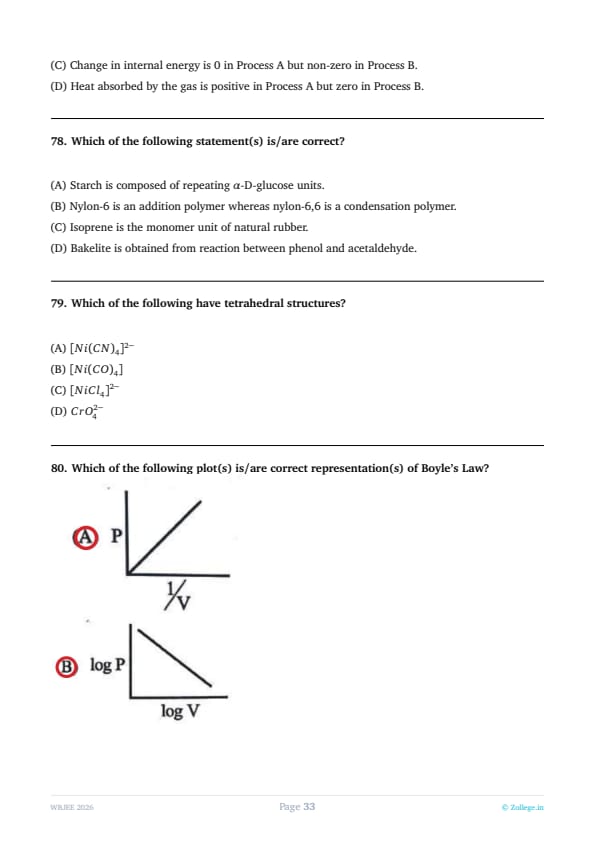
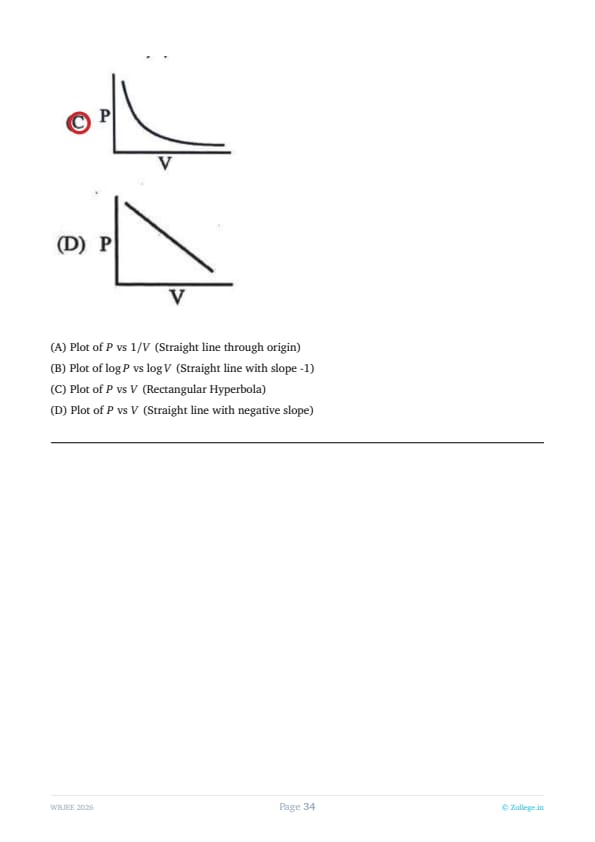
Which of the following plot(s) is/are correct representation(s) of Boyle’s Law?


WBJEE 2026 Physics and Chemistry Paper Analysis and Solutions
*The article might have information for the previous academic years, please refer the official website of the exam.