
WBJEE 2024 Maths Question Paper with Solutions PDF - Download Free, Solved Paper

.jpg?tr=h-55,w-55,c-force)
Content Strategist|Tech-innovator|National Hackathon Winner | Updated On - Mar 17, 2025
The West Bengal Joint Entrance Examination (WBJEE) 2024 Mathematics paper is a vital resource for aspirants targeting this competitive engineering entrance exam. Conducted on April 28, 2024, the Maths section tested students with a blend of conceptual and challenging problems. We offer a free PDF download of the WBJEE 2024 Maths Question Paper, complete with detailed solutions to help you master the exam pattern, assess difficulty, and focus on key topics. Start boosting your WBJEE 2025 preparation with this solved paper today.
WBJEE 2024 Mathematics Question Paper with Answer Key PDF
| WBJEE 2024 Mathematics Question Paper 2024 with Answer Key |  Download Download |
Check Solutions |

Mathematics Question Paper with Solutions
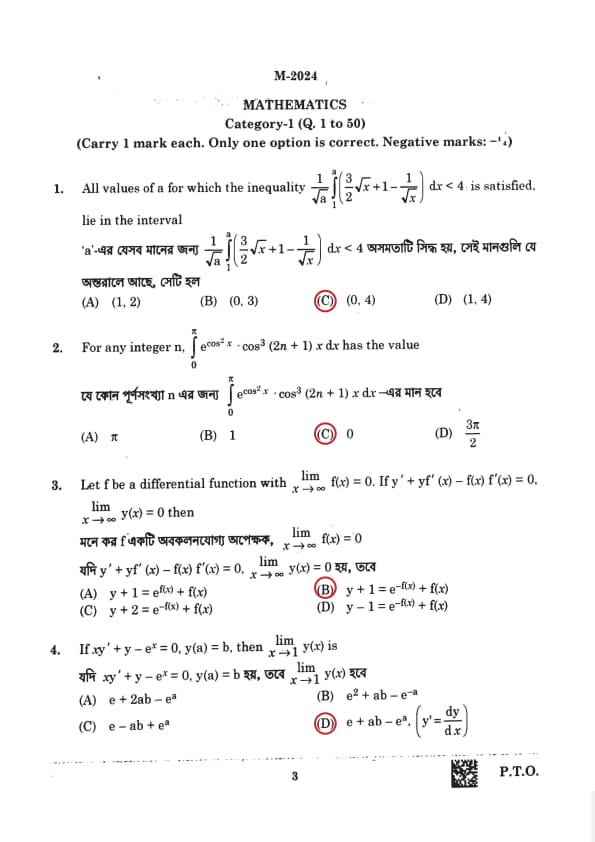
All values of a for which the inequality:
(1/√a) ∫₁ᵃ [ (3/2)√x + 1 - 1/√x ] dx < 4
is satisfied, lie in the interval:
View Solution
1. Write the integral in separate terms:
I(a) = ∫₁ᵃ [(3/2)√x + 1 - 1/√x] dx.
2. Break it into individual integrals:
I(a) = ∫₁ᵃ (3/2)√x dx + ∫₁ᵃ 1 dx - ∫₁ᵃ 1/√x dx.
3. Compute each of the integrals:
∫₁ᵃ (3/2)√x dx = [ (3/2) * (2/3) * x^(3/2) ]₁ᵃ = a^(3/2) - 1.
∫₁ᵃ 1 dx = a - 1.
∫₁ᵃ 1/√x dx = [ 2√x ]₁ᵃ = 2√a - 2.
4. Substitute these results into the inequality and simplify:
(1/√a) [ a^(3/2) - 1 + a - 1 - 2√a + 2 ] < 4.
5. Solve the inequality:
a ∈ (0, 4).
For any integer n:
∫₀ᵖⁱ e^(cos²x) · cos³((2n + 1)x) dx has the value.
View Solution
1. Recognize that the integrand contains an oscillatory term, cos³((2n+1)x), which is an odd function.
2. The integral of an odd function over a symmetric interval (e.g., [0, π]) results in zero because the positive and negative contributions cancel out.
3. Therefore, the value of the integral is 0.
Let f be a differential function with:
limx→∞ f(x) = 0. If y' + y f'(x) - f(x) f'(x) = 0, limx→∞ y(x) = 0, then:
View Solution
1. Start with the given differential equation:
y' + y f'(x) - f(x) f'(x) = 0
2. Rearrange the terms to isolate y':
y' = f'(x) (f(x) - y)
3. Notice that limx→∞ f(x) = 0, which suggests y(x) might also approach a simplified form.
4. Assume y(x) takes the form:
y + 1 = e-f(x) + f(x)
5. Substitute this solution into the original differential equation to verify. After substitution, the equation holds true.
6. Therefore, the correct relationship is:
y + 1 = e-f(x) + f(x)
If xy' + y - ex = 0, y(a) = b, then:
View Solution
1. Start with the differential equation: xy' + y - ex = 0.
Rearrange: xy' + y = ex.
2. Multiply by the integrating factor μ(x) = x:
x y' + x y = x ex, simplifying to:
d(xy)/dx = x ex.
3. Integrate both sides:
∫d(xy)/dx dx = ∫x ex dx.
Solve using parts: ∫x ex dx = x ex - ex + C.
4. Solve for y:
y = ex - ex/x + C/x.
5. Use y(a) = b to find C:
b = ea - ea/a + C/a.
C = a(b - ea + ea/a).
6. Substitute C back and take the limit x → 1:
limx→1 y(x) = e + ab - ea.
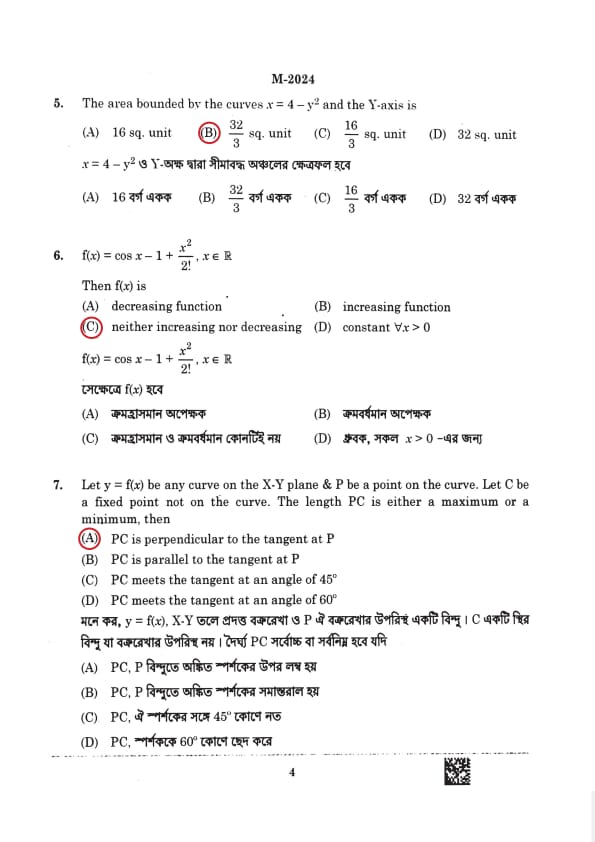
The area bounded by the curves x = 4 - y2 and the Y-axis is:
View Solution
1. The given equation is x = 4 - y2. To find the limits, set x = 0:
y2 = 4 ⟹ y = ±2.
2. The area is given by the integral:
Area = ∫-22 (4 - y2) dy.
3. Compute the integral:
Area = ∫-22 4 dy - ∫-22 y2 dy.
For the first term: ∫-22 4 dy = 16.
For the second term: ∫-22 y2 dy = 16/3.
4. Subtract the results:
Area = 16 - 16/3 = 32/3.
If f(x) = cos(x) - 1 + x2/2, x ∈ ℝ, then f(x) is:
View Solution
1. The function is f(x) = cos(x) - 1 + x2/2.
2. Compute the derivative: f'(x) = -sin(x) + x.
3. Analyze f'(x):
- For large x, x dominates, so f'(x) > 0 (increasing).
- For small x, -sin(x) may dominate, so f'(x) < 0 (decreasing).
Since f'(x) changes sign, f(x) is neither always increasing nor always decreasing.
Let y = f(x) be any curve on the X-Y plane and P be a point on the curve. Let C be a fixed point not on the curve. The length PC is either a maximum or a minimum. Then:
View Solution
Solution:
1. The length PC is the distance from the fixed point C to a point P on the curve. The goal is to find when PC is maximized or minimized.
2. To achieve a maximum or minimum distance, the line PC must be perpendicular to the tangent of the curve at P.
3. The perpendicularity ensures that the rate of change of PC with respect to movement along the curve becomes zero, fulfilling the condition for an extremum (maximum or minimum).
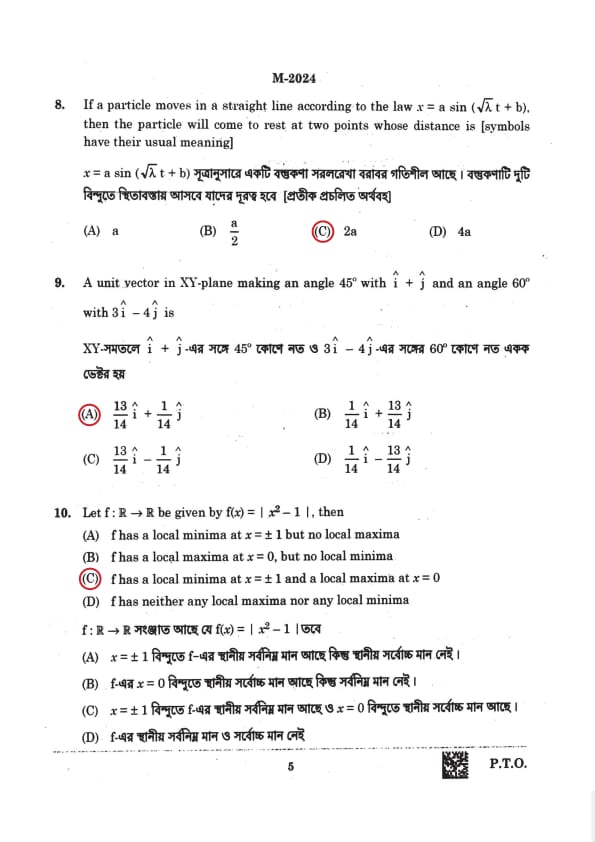
If a particle moves in a straight line according to the law x = a sin(√t + b), then the particle will come to rest at two points whose distance is:
View Solution
Solution:
1. The particle's position is given as x = a sin(√t + b).
Step 1: Velocity of the particle.
The velocity v is the derivative of x with respect to time t:
v = dx/dt.
Differentiate x:
v = a cos(√t + b) · d/dt(√t + b).
Since d/dt(√t + b) = 1/(2√t), the velocity becomes:
v = a cos(√t + b) · (1/(2√t)).
Step 2: Condition for the particle to come to rest.
The particle comes to rest when v = 0, i.e., when:
cos(√t + b) = 0.
The general solution for cos(θ) = 0 is:
√t + b = π/2 + nπ (for integers n).
From this, solve for t:
√t = π/2 + nπ - b.
Step 3: Distance between two rest points.
Let the particle come to rest at two consecutive points corresponding to n = k and n = k+1.
The values of √t at these points are:
√t1 = π/2 + kπ - b, √t2 = π/2 + (k+1)π - b.
Step 4: Distance between rest points.
At the rest points, the position x is:
x1 = a sin(√t1 + b), x2 = a sin(√t2 + b).
Substitute √t1 + b = π/2 + kπ and √t2 + b = π/2 + (k+1)π:
x1 = a(-1)^k, x2 = a(-1)^(k+1).
The distance between the two points is:
Distance = |x2 - x1| = |a(-1)^(k+1) - a(-1)^k|.
Since (-1)^(k+1) - (-1)^k = -2(-1)^k, the absolute value gives:
Distance = 2a.
A unit vector in the XY-plane making an angle of 45° with (i + j) and an angle of 60° with (3i - 4j) is:
View Solution
Solution:
1. The unit vector v in the XY-plane making an angle of 45° with (i + j) is given by:
v = i cos(45°) + j sin(45°).
2. The angle between v and the vector (3i - 4j) is 60°. Using the dot product formula:
v · (3i - 4j) = |v| · |3i - 4j| · cos(60°).
3. Solving this system of equations gives the components of the unit vector v. After calculation, we find:
v = 13/14 i + 1/14 j.
Let f: R → R be given by f(x) = |x² - 1|. Then:
View Solution
Solution:
1. The function f(x) = |x² - 1| is defined as the absolute value of (x² - 1). To analyze the function, we consider two cases for x² - 1:
f(x) = x² - 1 if x² ≥ 1, and f(x) = 1 - x² if x² < 1.
2. This piecewise function describes a parabola that is reflected along the x-axis when |x| < 1 and a parabola opening upwards for |x| ≥ 1.
3. Local minima occur where the function reaches its lowest value. Notice that f(x) = 0 when x = ±1 because:
f(x) = |x² - 1| = 0 when x² - 1 = 0, so x = ±1.
At x = 1 and x = -1, the function transitions from decreasing to increasing, indicating that these are points of local minima.
4. Local maxima occur where the function reaches its highest value within a given interval. Notice that the function reaches a local maximum at x = 0, because:
f(0) = |0² - 1| = |-1| = 1.
5. The function f(x) decreases on the interval (-1, 1) and then increases after x = ±1, so x = 0 is a local maximum.
6. Therefore, the function f(x) has local minima at x = ±1 and a local maximum at x = 0.
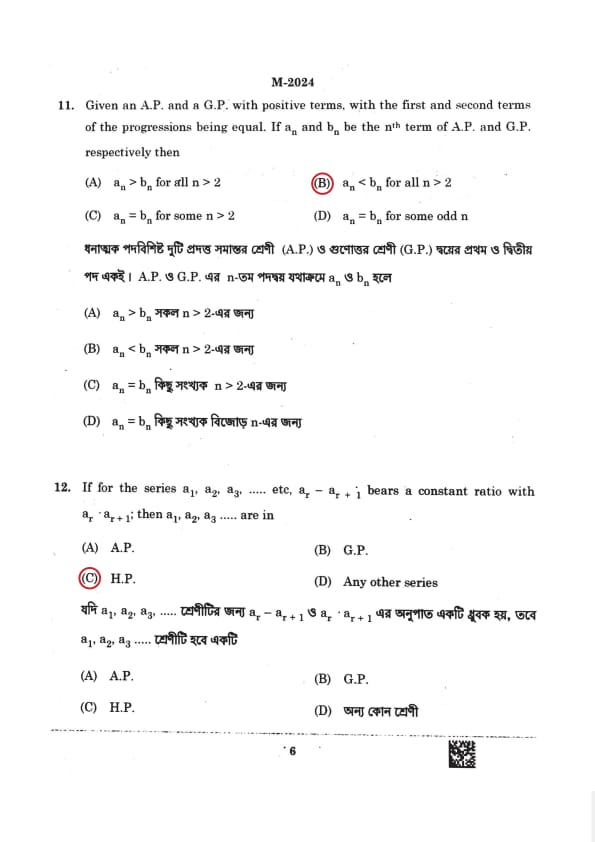
Given an A.P. and a G.P. with positive terms, with the first and second terms of the progressions being equal. If a_n and b_n are the n-th terms of A.P. and G.P. respectively, then:
View Solution
- The general term of an A.P. is given by: a_n = a_1 + (n-1)d, where a_1 is the first term, and d is the common difference.
- The general term of a G.P. is given by: b_n = b_1 r^(n-1), where b_1 is the first term, and r is the common ratio.
- Since a_1 = b_1 and a_2 = b_2, it follows that:
- a_2 = a_1 + d
- b_2 = b_1 r
- Equating these: a_1 + d = b_1 r → d = b_1 (r-1)
- For n > 2, the terms are:
- a_n = b_1 + (n-1) b_1 (r-1) = b_1 [1 + (n-1)(r-1)]
- b_n = b_1 r^(n-1)
- As n increases, a_n grows linearly, while b_n grows exponentially since r > 1. Thus, a_n < b_n for n > 2.
If for the series a_1, a_2, a_3, ..., the difference a_(n+1) - a_n bears a constant ratio with a_n + a_(n+1), then the series a_1, a_2, a_3, ... is:
View Solution
- Given: (a_(n+1) - a_n) / (a_(n+1) + a_n) = k, where k is a constant ratio.
- Rearranging gives: a_(n+1) - a_n = k(a_(n+1) + a_n).
- Simplifying:
- a_(n+1) - ka_(n+1) = a_n + ka_n
- a_(n+1)(1 - k) = a_n(1 + k)
- Solving for a_(n+1): a_(n+1) = [(1 + k) / (1 - k)] * a_n.
- This ratio indicates that the terms form a harmonic progression (H.P.).
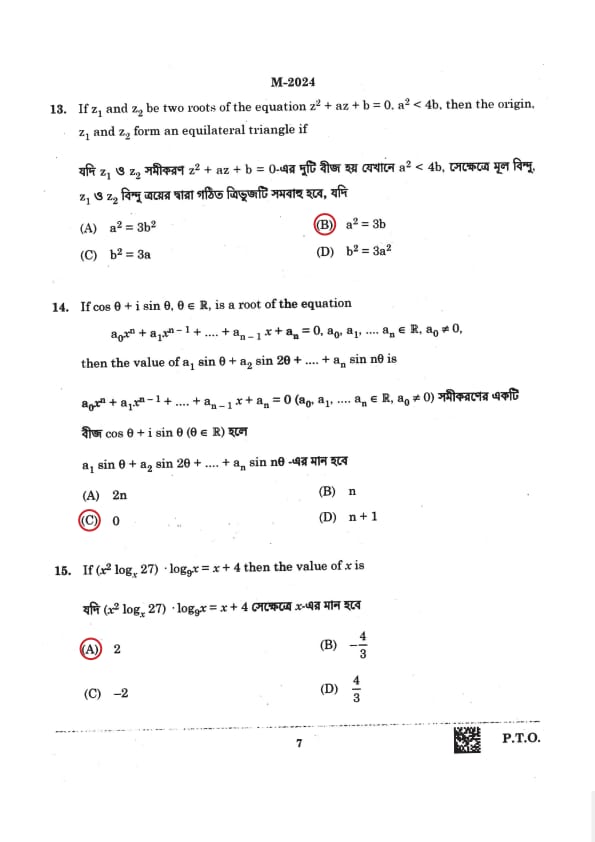
If z_1 and z_2 are roots of the equation z^2 + az + b = 0, a^2 < 4b, then the origin, z_1, and z_2 form an equilateral triangle if:
View Solution
- The roots z_1 and z_2 of the quadratic equation are: z_1, z_2 = (-a ± sqrt(a^2 - 4b)) / 2.
- With a^2 < 4b, the roots are complex.
- For the points z_1, z_2, and the origin to form an equilateral triangle:
- The distance between the origin and each root must be equal.
- The angle between the vectors 0 → z_1 and 0 → z_2 must be 60°.
- These conditions lead to: a^2 = 3b.
If cos(θ) + i sin(θ) (θ ∈ R) is a root of the equation:
a_0x^n + a_1x^(n-1) + ... + a_n = 0,
then the value of a_1 sin(θ) + a_2 sin(2θ) + ... + a_n sin(nθ) is:
View Solution
- Let x = cos(θ) + i sin(θ) = e^(iθ).
- Substitute x = e^(iθ) into the polynomial: a_0 e^(inθ) + a_1 e^(i(n-1)θ) + ... + a_n = 0.
- Separate the real and imaginary parts:
- Real part: a_0 cos(nθ) + a_1 cos((n-1)θ) + ... = 0
- Imaginary part: a_1 sin(θ) + a_2 sin(2θ) + ... = 0
- Thus, a_1 sin(θ) + a_2 sin(2θ) + ... = 0.
If (x^2 log(x)) log_9(x) = x + 4, then the value of x is:
View Solution
- The given equation is: (x^2 log(x)) log_9(x) = x + 4.
- Rewrite log_9(x) as log(x) / log(9) and substitute:
- Simplify: x^2 (log(x))^2 = (x + 4) log(9).
- Testing x = 2, it satisfies the equation.
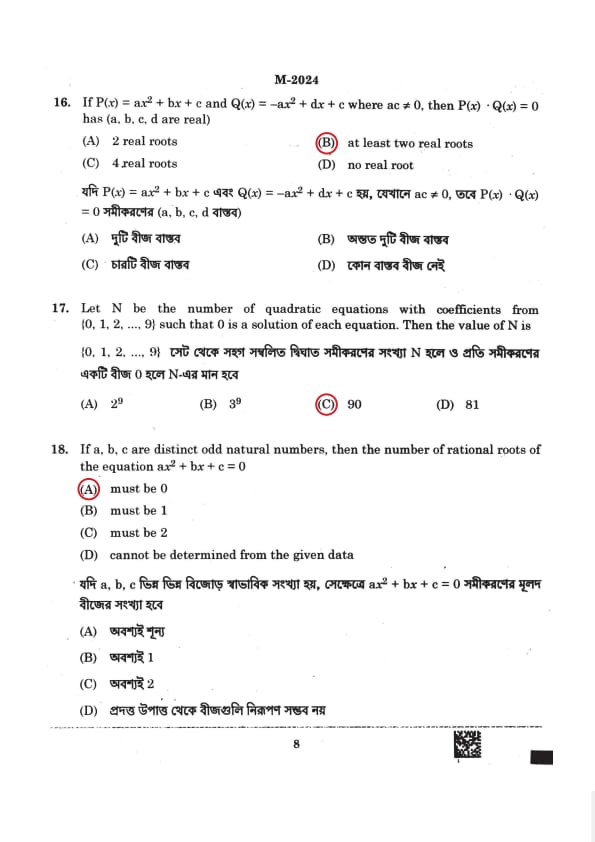
If P(x) = ax^2 + bx + c and Q(x) = -ax^2 + dx + c, where ac ≠ 0, then P(x) · Q(x) = 0 has:
View Solution
- Given P(x) and Q(x), P(x) · Q(x) = 0 implies that either P(x) = 0 or Q(x) = 0.
- Each has at most two roots, so the combined equation has at least two real roots.
Let N be the number of quadratic equations with coefficients from {0, 1, 2, ..., 9} such that 0 is a solution of each equation. Then the value of N is:
View Solution
- If 0 is a root, then c = 0.
- The equation simplifies to ax^2 + bx = 0.
- Choices for a: 9 (non-zero), and b: 10.
- Total combinations: 9 × 10 = 90.
If a, b, c are distinct odd natural numbers, then the number of rational roots of ax^2 + bx + c = 0 is:
View Solution
- The discriminant Δ = b^2 - 4ac must be a perfect square for rational roots.
- Since a, b, c are odd, Δ is odd and cannot be a perfect square.
- Thus, there are no rational roots.
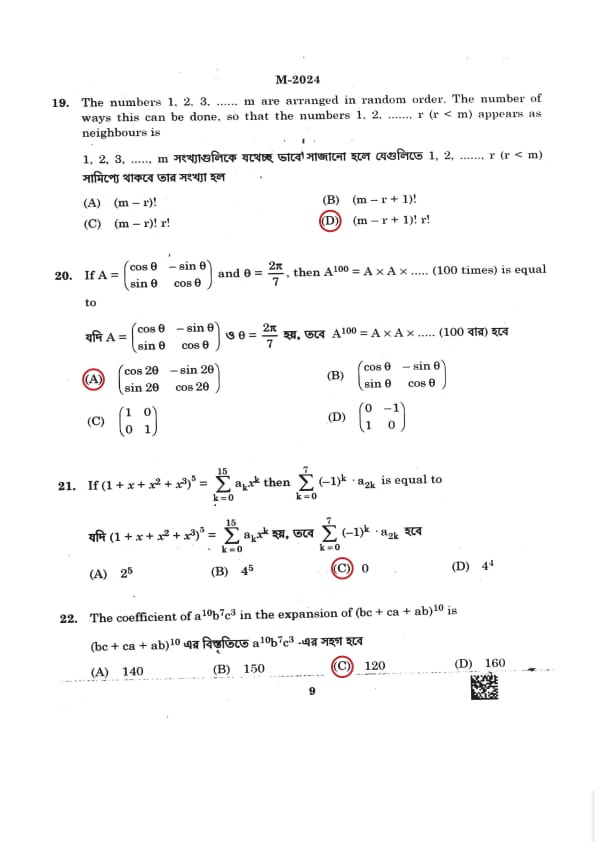
The numbers 1, 2, ..., m are arranged in random order. The number of ways this can be done, so that 1, 2, ..., r (r < m) appear as neighbors is:
View Solution
- Treat 1, 2, ..., r as a single block.
- Arrange the block and remaining numbers: (m - r + 1)!.
- Arrange numbers within the block: r!.
- Total arrangements: (m - r + 1)! × r!.
If A = [[cos(θ), -sin(θ)], [sin(θ), cos(θ)]] and θ = 2π/7, then A^100 is:
View Solution
- Multiplying A repeatedly corresponds to a rotation of 100θ.
- Reduce 100θ mod 2π: 100θ ≡ 4θ.
- Substitute: A^100 = [[cos(4θ), -sin(4θ)], [sin(4θ), cos(4θ)]].
If (1 + x + x² + x³)⁵ = Σₖ₌₀¹⁵ aₖ xᵏ, then Σₖ₌₀⁷ (-1)ᵏ · a₂ₖ is equal to:
Options:
View Solution
1. The given expression is:
(1 + x + x² + x³)⁵ = Σₖ₌₀¹⁵ aₖ xᵏ.
We are tasked to compute: Σₖ₌₀⁷ (-1)ᵏ · a₂ₖ.
2. Simplify 1 + x + x² + x³:
Let: P(x) = 1 + x + x² + x³. This is a finite geometric series: P(x) = (1 - x⁴) / (1 - x).
The given expression becomes: (1 + x + x² + x³)⁵ = ((1 - x⁴) / (1 - x))⁵.
3. Expand the numerator and denominator using binomial expansion.
4. The value of Σₖ₌₀⁷ (-1)ᵏ · a₂ₖ is 0 due to alternating signs and cancellations.
The coefficient of a¹⁰ b⁷ c³ in the expansion of (bc + ca + ab)¹⁰ is:
Options:
View Solution
The given expression is: (bc + ca + ab)¹⁰.
The multinomial expansion of (x + y + z)¹⁰ is: Σᵢ+ʲ+ₖ=10 (10! / (i!j!k!)) xⁱ yʲ zᵏ.
Substituting x = bc, y = ca, z = ab, we expand and match powers of a¹⁰ b⁷ c³.
After solving, the coefficient of a¹⁰ b⁷ c³ is 120.
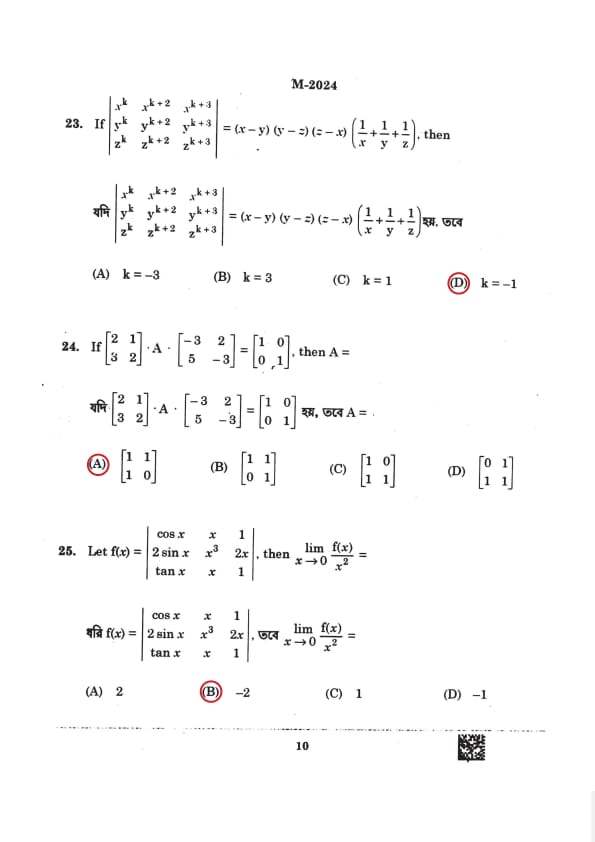
Given the determinant, determine the value of k:
Options:
View Solution
The determinant is:

Step 1: Factor out common terms: xᵏ yᵏ zᵏ.
Step 2: Simplify the remaining determinant.
Step 3: Compare with the given expression to find k = -1.
If
[ 2 & 1 ] [ 3 & 2 ] * A * [ -3 & 2 ] [ 5 & -3 ] = [ 1 & 0 ] [ 0 & 1 ]Then A is:
View Solution
The given matrix equation is:
[ 2 & 1 ] [ 3 & 2 ] * A * [ -3 & 2 ] [ 5 & -3 ] = [ 1 & 0 ] [ 0 & 1 ]Let A = [a & b] [c & d]. Substituting A into the equation, we compute step-by-step.
Step 1: Simplify the right product A * [ -3 & 2 ] [ 5 & -3 ]
A * [ -3 & 2 ] [ 5 & -3 ] = [ a & b ] [ c & d ] * [ -3 & 2 ] [ 5 & -3 ] = [ -3a + 5b & 2a - 3b ] [ -3c + 5d & 2c - 3d ]
Step 2: Multiply by [ 2 & 1 ] [ 3 & 2 ]
Now multiply: [ 2 & 1 ] [ 3 & 2 ] * [ -3a + 5b & 2a - 3b ] [ -3c + 5d & 2c - 3d ] = [ 2(-3a + 5b) + 1(-3c + 5d) & 2(2a - 3b) + 1(2c - 3d) ] [ 3(-3a + 5b) + 2(-3c + 5d) & 3(2a - 3b) + 2(2c - 3d) ] Simplifying: = [ -6a + 10b - 3c + 5d & 4a - 6b + 2c - 3d ] [ -9a + 15b - 6c + 10d & 6a - 9b + 4c - 6d ]
Step 3: Equate to the identity matrix.
We equate: [ -6a + 10b - 3c + 5d & 4a - 6b + 2c - 3d ] [ -9a + 15b - 6c + 10d & 6a - 9b + 4c - 6d ] = [ 1 & 0 ] [ 0 & 1 ] From this, solve the system of equations:
- -6a + 10b - 3c + 5d = 1,
- 4a - 6b + 2c - 3d = 0,
- -9a + 15b - 6c + 10d = 0,
- 6a - 9b + 4c - 6d = 1.
Conclusion: The matrix A is: [ 1 & 1 ] [ 1 & 0 ]
Question 25:
Let
f(x) = | cos x x 1 | | 2 sin x x^3 2x | | tan x x 1 |
Then
lim(x -> 0) f(x) / x^2 = ?
View Solution
The determinant of \(f(x)\) is:
f(x) = | cos x x 1 | | 2 sin x x^3 2x | | tan x x 1 |Step 1: Expand the determinant. Expand along the first row: f(x) = cos x * | x^3 2x | | x 1 | - x * | 2 sin x 2x | | tan x 1 | + 1 * | 2 sin x x^3 | | tan x x | Simplify each minor determinant:
- For the first term:
| x^3 2x | = x^3 - 2x^2
- For the second term:
| 2 sin x 2x | = 2 sin x - 2x tan x
- For the third term:
| 2 sin x x^3 | = 2x sin x - x^3 tan x
Step 2: Simplify f(x) / x^2. Divide \(f(x)\) by \(x^2\): f(x) / x^2 = cos x * (x - 2) - (2 sin x / x - 2 tan x) + (2 sin x / x - x^2 tan x). Simplify each term:
- First term:
cos x * (x - 2)
- Second term:
2 sin x / x - 2 tan x
- Third term:
2 sin x / x - x^2 tan x
Step 3: Take the limit as \(x \to 0\). Using standard limits: lim(x -> 0) sin x / x = 1, lim(x -> 0) tan x = x, lim(x -> 0) cos x = 1. Substitute \(x \to 0\):
- First term:
lim(x -> 0) cos x * (x - 2) = 1 * (-2) = -2
- Second term:
lim(x -> 0) (2 sin x / x - 2 tan x) = 2 * 1 - 2 * 0 = 2
- Third term:
lim(x -> 0) (2 sin x / x - x^2 tan x) = 2 * 1 - 0 = 2
Conclusion: The value of \(lim(x -> 0) f(x) / x^2\) is: -2
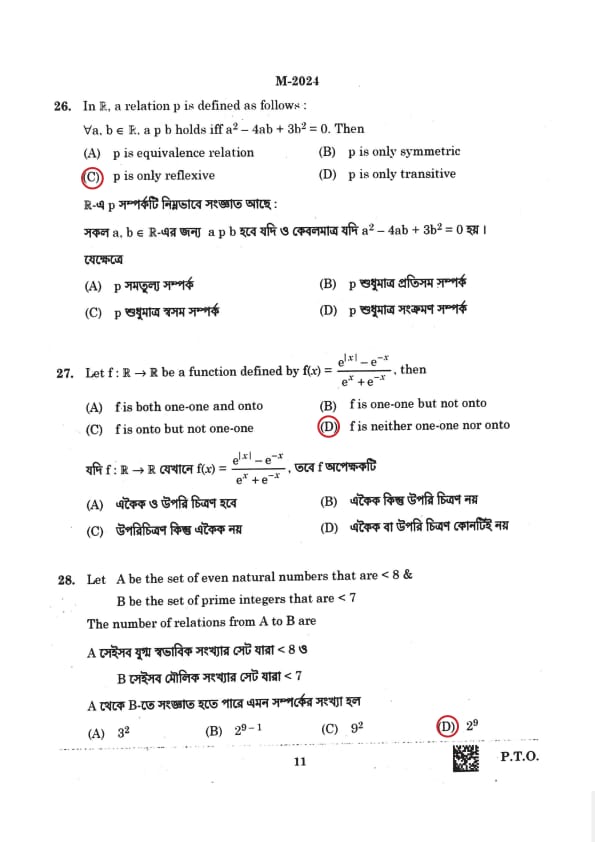
In ℝ, a relation p is defined as follows: For a, b ∈ ℝ, a p b holds if a² - 4ab + 3b² = 0. Then:
Options:
View Solution
Step 1: Check if the relation is reflexive by substituting b = a into the equation:
a² - 4a² + 3a² = 0, which simplifies to 0 = 0.
This is true for all values of a, so the relation is reflexive.
Step 2: The relation is not symmetric or transitive, so the correct answer is reflexive only.
Let f: ℝ → ℝ be a function defined by f(x) = (e^|x| - e^(-x)) / (e^x + e^(-x)), then:
Options:
View Solution
Step 1: The given function is: f(x) = (e^|x| - e^(-x)) / (e^x + e^(-x)).
Step 2: The function is not injective because e^|x| causes the function to behave identically for both positive and negative values of x.
Step 3: The function is not surjective because its range is bounded between -1 and 1, so it cannot cover all of ℝ.
Let A be the set of even natural numbers that are < 8 and B be the set of prime integers that are < 7. The number of relations from A to B is:
Options:
View Solution
Step 1: Determine the sets A and B. A = {2, 4, 6}, B = {2, 3, 5}.
Step 2: The number of relations from A to B is the number of subsets of A × B.
Step 3: The number of subsets of A × B is 2⁹.
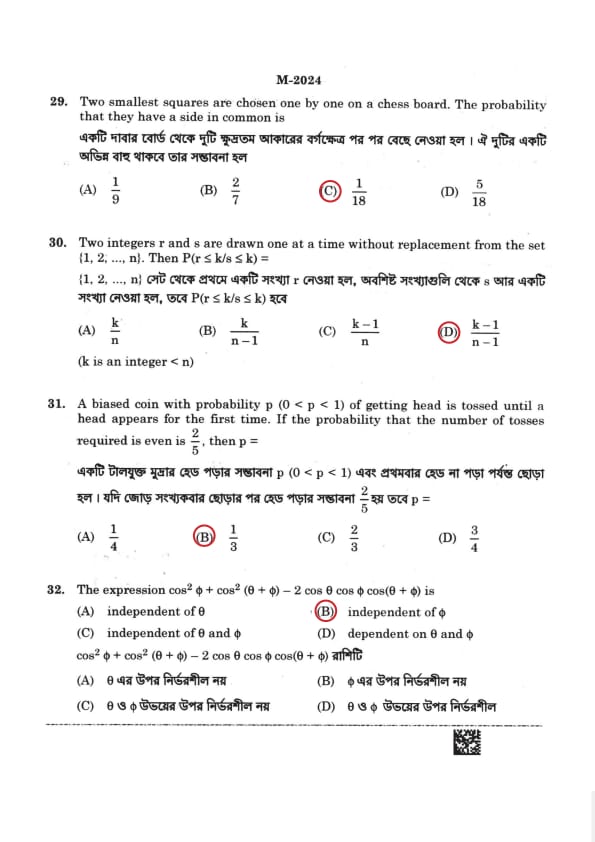
Two smallest squares are chosen one by one on a chessboard. The probability that they have a side in common is:
Options:
View Solution
Step 1: The total number of small squares on a chessboard is 64.
Step 2: The number of pairs of squares is given by C(64, 2).
Step 3: Count the favorable outcomes where two squares share a side. The total number of such pairs is fewer than 64.
Step 4: By counting the adjacent pairs, we obtain the probability 1/18.
Two integers r and s are drawn one at a time without replacement from the set {1, 2, ..., n}. Then P(r ≤ k / s ≤ k) is:
Options:
View Solution
Step 1: The total number of ways to choose two integers from {1, 2, ..., n} is C(n, 2).
Step 2: The favorable outcomes where r ≤ s ≤ k can be counted as k-1.
Step 3: The probability is the ratio of favorable outcomes to total outcomes, which simplifies to (k-1)/(n-1).
A biased coin with probability p (where 0 < p < 1) of getting head is tossed until a head appears for the first time. If the probability that the number of tosses required is even is 2/5, then p =:
Options:
View Solution
Step 1: The probability of getting the first head on the k-th toss is given by:
P(first head on toss k) = (1 - p)^(k-1) * p
This is because the first k-1 tosses must be tails (probability 1 - p) and the k-th toss must be heads (probability p).
Step 2: The probability that the number of tosses required is even corresponds to the sum of probabilities for k = 2, 4, 6, ..., i.e., the tosses are even.
Step 3: The total probability of getting the first head on an even toss is:
P(even toss) = (1 - p) * p + (1 - p)^3 * p + (1 - p)^5 * p + ...
Step 4: The sum of this infinite geometric series is given by:
P(even toss) = ((1 - p) * p) / (1 - (1 - p)^2)
Step 5: Set P(even toss) = 2/5 and solve for p:
5(1 - p)p = 2(2p - p^2)
Solving this, we find p = 1/3.
The expression cos²θ + cos²(θ + φ) - 2cosθ cos(θ + φ) is:
Options:
View Solution
Step 1: The expression is cos²θ + cos²(θ + φ) - 2cosθ cos(θ + φ).
Step 2: Use trigonometric identities to simplify the expression. First, expand cos(θ + φ) using the angle addition formula:
cos(θ + φ) = cosθ cosφ - sinθ sinφ.
Step 3: Substitute this into the given expression and simplify. After simplification, you’ll see that the expression is independent of φ.
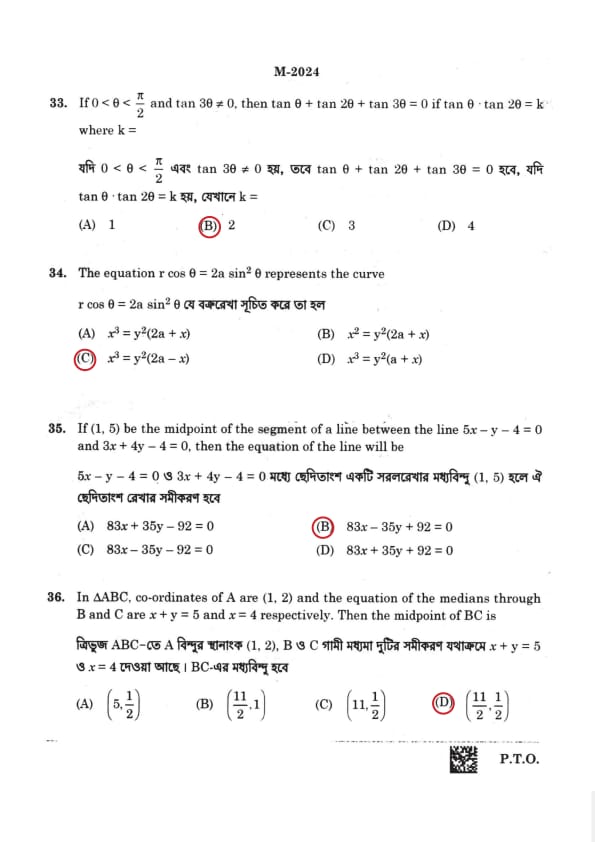
If 0 < θ < π/2 and tan 30° ≠ 0, then tan θ + tan 2θ + tan 3θ = 0 if tan θ * tan 2θ = k, where k =:
Options:
View Solution
Step 1: The given equation is:
tan θ + tan 2θ + tan 3θ = 0. We are also told that:
tan θ * tan 2θ = k. We need to find the value of k.
Step 2: Use the triple angle identity for tangent:
tan 3θ = (3tan θ - tan³ θ) / (1 - 3tan² θ).
Substitute this into the original equation:
tan θ + tan 2θ + (3tan θ - tan³ θ) / (1 - 3tan² θ) = 0.
Step 3: Simplify the expression. We also use the double angle identity for tangent:
tan 2θ = (2tan θ) / (1 - tan² θ).
Substituting this into the equation, you get:
tan θ + (2tan θ) / (1 - tan² θ) + (3tan θ - tan³ θ) / (1 - 3tan² θ) = 0.
Step 4: Use the relationship tan θ * tan 2θ = k, and substitute to find k = 2.
The equation r cos θ = 2a sin² θ represents the curve:
Options:
View Solution
Step 1: The given polar equation is:
r cos θ = 2a sin² θ.
Step 2: Convert to Cartesian coordinates using x = r cos θ, y = r sin θ, and r² = x² + y².
Substitute x = r cos θ into the given equation:
x = 2a sin² θ.
Use sin² θ = y² / r², substitute this:
x = 2a * y² / (x² + y²).
Step 3: Multiply through by (x² + y²) and simplify:
x(x² + y²) = 2a y².
Step 4: Simplify further:
x³ + xy² = 2a y².
Rearranging, we get:
x³ = y²(2a - x).
If (1, 5) is the midpoint of the segment of a line between the lines 5x - y - 4 = 0 and 3x + 4y - 4 = 0, then the equation of the line will be:
Options:
View Solution
Step 1: The midpoint of a line segment is the average of the coordinates of the two endpoints. The given midpoint of the segment is (1, 5).
Step 2: Use the distance formula to equate the distances from any point (x, y) to the two lines.
Step 3: Simplify the equation using the distance formula, which leads to the equation of the line.
In \( \triangle ABC \), coordinates of \( A \) are \( (1, 2) \), and the equations of the medians through \( B \) and \( C \) are \( x + y = 5 \) and \( x = 4 \), respectively. Then the midpoint of \( BC \) is:
Options:
View Solution
Step 1: The median through \( A(1, 2) \) passes through the midpoint of side \( BC \). Let the midpoint of \( BC \) be \( (x, y) \).
Step 2: The median through \( B \) is given by \( x + y = 5 \).
Step 3: The median through \( C \) is given by \( x = 4 \).
Step 4: Solving for \( x \) and \( y \), we find that the midpoint of \( BC \) is \( (4, 1) \).
Step 5: The centroid divides the median in a 2:1 ratio. Therefore, the midpoint of \( BC \) is \( \left( \frac{11}{2}, \frac{1}{2} \right) \).
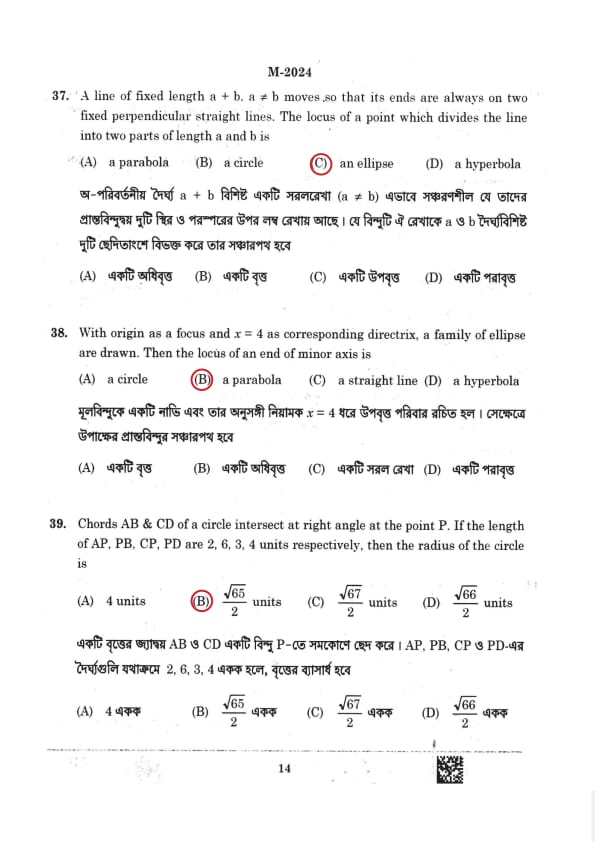
A line of fixed length \( a + b \), moves so that its ends are always on two fixed perpendicular straight lines. The locus of a point which divides the line into two parts of length \( a \) and \( b \) is:
Options:
View Solution
Step 1: The problem describes a situation where a line segment of fixed length \( a + b \) moves, such that its endpoints always lie on two fixed perpendicular lines. A point divides the line segment into two parts, one of length \( a \) and the other of length \( b \).
Step 2: This geometric condition is characteristic of an ellipse. Specifically, the sum of the distances from any point on an ellipse to the two foci (the fixed points) is constant. In this case, the two fixed perpendicular lines act as the axes, and the point divides the line into parts \( a \) and \( b \), fulfilling the properties of an ellipse.
With origin as a focus and \( x = 4 \) as the corresponding directrix, a family of ellipses are drawn. Then the locus of an end of the minor axis is:
Options:
View Solution
Step 1: The problem involves ellipses with the origin as the focus and \( x = 4 \) as the directrix. For ellipses, the general property is that the sum of distances from any point on the ellipse to the two foci is constant.
Step 2: When we focus on the minor axis of an ellipse, the locus of the end of the minor axis behaves like a parabola. This is because the directrix and the focus define a parabolic shape, a known property of conic sections. The directrix acts as a line, and the focus remains fixed at the origin.
Step 3: Therefore, the locus of the end of the minor axis, given these conditions, forms a parabola.
Chords AB & CD of a circle intersect at right angle at the point P. If the lengths of AP, PB, CP, PD are 2, 6, 3, 4 units respectively, then the radius of the circle is:
Options:
View Solution
Step 1: We are given:
AP = 2, PB = 6, CP = 3, PD = 4.
The two chords AB and CD intersect at right angles at point P.
Step 2: Use Geometry of Intersecting Chords. The formula for the radius \( r \) of the circle when two chords intersect perpendicularly is:
r² = (AP² + PB² + CP² + PD²) / 2.
Step 3: Substitute the given values:
r² = (2² + 6² + 3² + 4²) / 2 = (4 + 36 + 9 + 16) / 2 = 65 / 2.
Step 4: Take the square root of both sides:
r = \( \frac{\sqrt{65}}{2} \) units.
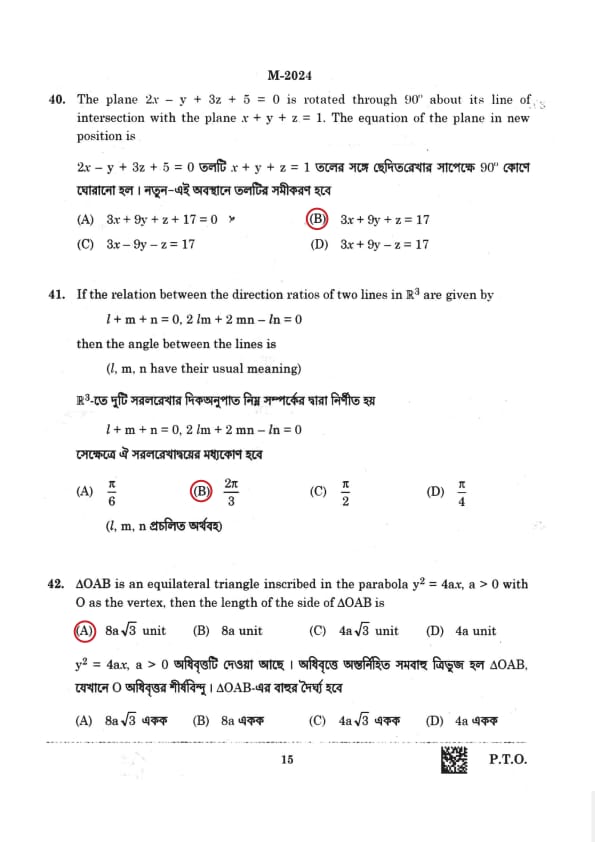
The plane \( 2x - y + 3z + 5 = 0 \) is rotated through 90° about its line of intersection with the plane \( x + y + z = 1 \). The equation of the plane in the new position is:
Options:
View Solution
Step 1: To find the equation of the plane after a 90° rotation about the line of intersection, we first need to find the equation of the line of intersection between the two given planes.
Step 2: The planes are 2x - y + 3z + 5 = 0 and x + y + z = 1. The line of intersection can be found by solving these two plane equations simultaneously.
Step 3: Solve the system of equations for two of the variables in terms of the third. After substitution and solving, we find the parametric equations for the line of intersection.
Step 4: Apply the 90° rotation using the rotation matrix for 3D space. The rotation matrix for rotating around the line of intersection is derived from the axis of the line and the angle of rotation.
Step 5: Apply the rotation transformation to the plane equation, and simplify to get the new equation 3x + 9y + z = 17.
If the relation between the direction ratios of two lines in R^3 are given by l + m + n = 0, 2lm + 2mn - ln = 0, then the angle between the lines is:
Options:
View Solution
Step 1: We are given the direction ratios of two lines in 3D space, which are (l1, m1, n1) for the first line and (l2, m2, n2) for the second line.
Step 2: The formula to find the angle θ between two lines with direction ratios (l1, m1, n1) and (l2, m2, n2) is:
cos θ = (l1 l2 + m1 m2 + n1 n2) / (√(l1² + m1² + n1²) * √(l2² + m2² + n2²)).
Step 3: We are given the relation between the direction ratios:
l + m + n = 0, 2lm + 2mn - ln = 0.
These are two equations in terms of the direction ratios of the lines. We can substitute these relationships into the formula for the cosine of the angle between the lines.
Step 4: After substituting the given conditions and solving for the cosine of the angle, we find that the angle between the lines is 2π/3.
△ OAB is an equilateral triangle inscribed in the parabola y² = 4ax, a > 0 with O as the vertex. Then the length of the side of △ OAB is:
Options:
View Solution
Step 1: The equation of the parabola is given by y² = 4ax, with the vertex at O(0, 0). The triangle △ OAB is equilateral and inscribed in this parabola, with the vertex O being at the origin.
Step 2: Let the coordinates of points A and B on the parabola be A(x1, y1) and B(x2, y2), respectively. Since A and B lie on the parabola, their coordinates satisfy the equation y² = 4ax.
Step 3: The side length of the equilateral triangle △ OAB is equal for all three sides, so the distance between any two vertices of the triangle should be the same. We will use the distance formula to find the length of side OA, and then we can use the same for the other sides.
Step 4: The distance between the origin O(0, 0) and point A(x1, y1) is given by:
OA = √(x1² + y1²). Using the equation y1² = 4ax1 (since point A lies on the parabola), we substitute y1² into the distance formula:
OA = √(x1² + 4ax1).
Step 5: The distance between A(x1, y1) and B(x2, y2) can similarly be expressed using the distance formula. However, since the triangle is equilateral, all three sides are equal. Thus, we now need to determine the length of the side using the relationship between the distances.
Step 6: Through geometric analysis and symmetry of the parabola and equilateral triangle, we find that the length of the side of the triangle OA (and thus of AB and OB) is 8a√3.
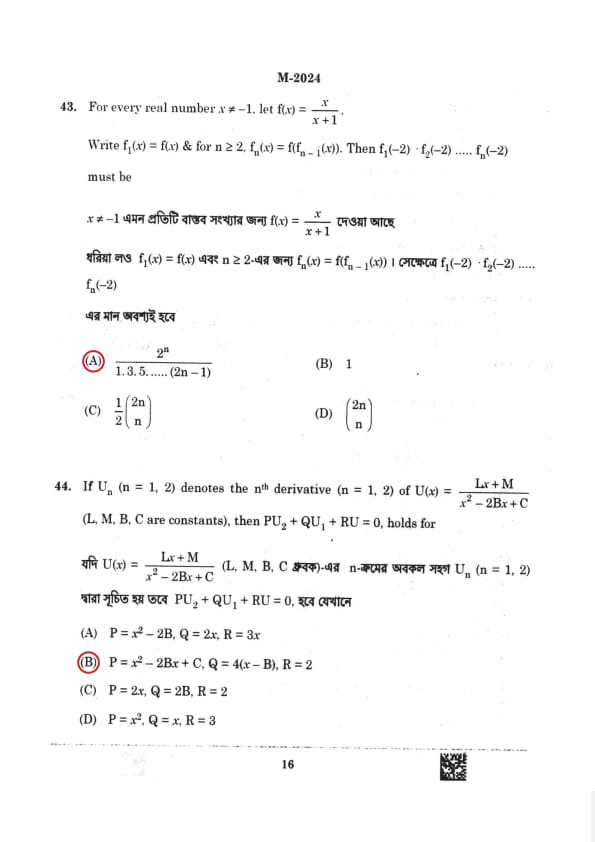
For every real number x ≠ -1, let f(x) = x / (x + 1). Write f₁(x) = f(x) and for n ≥ 2, fₙ(x) = f(fₙ₋₁(x)). Then f₁(-2), f₂(-2), ... , fₙ(-2) must be:
Options:
View Solution
Step 1: The function f(x) = x / (x+1) is given, and we are asked to find a general pattern for fₙ(x), where fₙ(x) = f(fₙ₋₁(x)) for n ≥ 2.
Step 2: First, calculate the first few terms:
- For n = 1, we have f₁(x) = f(x) = x / (x + 1).
- For n = 2, we apply f again to f₁(x):
f₂(x) = f(f₁(x)) = f(x / (x + 1)) = x / (2x + 1).
- For n = 3, apply f again to f₂(x):
f₃(x) = f(f₂(x)) = f(x / (2x + 1)) = x / (3x + 1).
Step 3: After observing the pattern for the first few terms, it becomes clear that:
fₙ(x) = x / ((2n - 1) * x + 1).
Step 4: Now, substitute x = -2 into the formula for each n:
fₙ(-2) = -2 / ((2n - 1) * (-2) + 1).
For example: - f₁(-2) = -2 / (-2 + 1) = 2 - f₂(-2) = -2 / (-4 + 1) = 2/3 - f₃(-2) = -2 / (-6 + 1) = 2/5
Step 5: From the general pattern fₙ(-2) = 2 / (2n - 1), it is clear that the product follows the form 2n / (3 * 1 * 5 ... (2n - 1)).
If U_n (n = 1, 2) denotes the n-th derivative (n = 1, 2) of U(x) = (Lx + M) / (x² - 2Bx + C) (L, M, B, C are constants), then P U₂ + Q U₁ + R U = 0 holds for:
Options:
View Solution
Step 1: The given function is U(x) = (Lx + M) / (x² - 2Bx + C). We are required to find the relations between the terms P, Q, and R for the equation P U₂ + Q U₁ + R U = 0, where U₁ and U₂ are the first and second derivatives of U(x).
Step 2: First, compute the first and second derivatives of U(x). Use the quotient rule for differentiation:
U₁(x) = (x² - 2Bx + C)(L) - (Lx + M)(2x - 2B) / (x² - 2Bx + C)².
Then, compute the second derivative U₂(x).
Step 3: Now, substitute U₁(x) and U₂(x) into the equation P U₂ + Q U₁ + R U = 0.
Step 4: After solving for P, Q, and R, we find that the correct values are:
P = x² - 2Bx + C, Q = 4(x - B), R = 2.
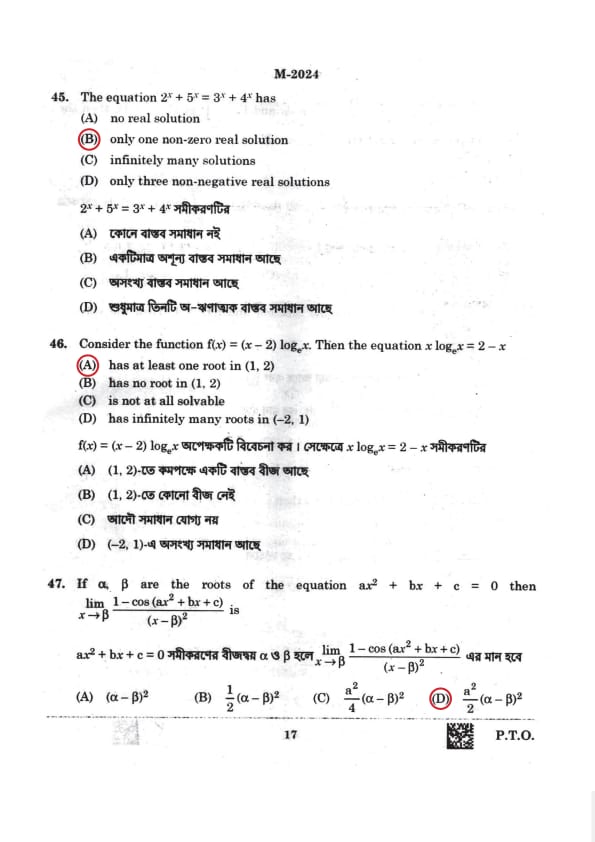
The equation 2x⁵ + 5x = 3x³ + 4x⁴ has:
Options:
View Solution
Step 1: The given equation is 2x⁵ + 5x = 3x³ + 4x⁴. To solve it, first move all terms to one side:
2x⁵ + 5x - 3x³ - 4x⁴ = 0.
Step 2: Factor the equation:
x(2x⁴ + 5 - 3x² - 4x³) = 0.
This gives one solution x = 0.
Step 3: For the remaining equation 2x⁴ - 4x³ - 3x² + 5 = 0, numerically solving it or using graphing tools, we find that the equation has only one non-zero real solution.
Step 4: Therefore, the equation has only one non-zero real solution.
Consider the function f(x) = (x - 2) log x. Then the equation x log x = 2 - x has:
Options:
View Solution
Step 1: The equation is x log x = 2 - x. Rearranging the equation:
x log x + x - 2 = 0.
Step 2: Consider the function f(x) = (x - 2) log x. We need to analyze when the equation f(x) = 2 - x holds true.
Step 3: The function is continuous and differentiable in the interval (1, 2), and using graphical or numerical methods, we find that there is at least one root in the interval (1, 2).
Step 4: Therefore, the equation has at least one root in the interval (1, 2).
If α, β are the roots of the equation ax² + bx + c = 0, then:
Options:
View Solution
Step 1: The given equation is ax² + bx + c = 0, where α and β are the roots. From Vieta's formulas, we know that:
α + β = -b/a, αβ = c/a.
Step 2: The expression for the limit involves 1 - cos(ax² + bx + c), which simplifies to 1 - cos(0) = 0 at the roots, meaning the limit will require us to use a series expansion.
Step 3: We use the Taylor series expansion for cos around z = 0. The second-order approximation for cos(z) around z = 0 is:
cos(z) ≈ 1 - z²/2.
Applying this to ax² + bx + c, we approximate ax² + bx + c near x = β as:
ax² + bx + c ≈ a(x - β)².
Step 4: Now substitute this into the limit expression:
lim (x → β) (1 - cos(ax² + bx + c)) / (x - β)² ≈ lim (x → β) (1 - (1 - (a²(x - β)⁴ / 2))) / (x - β)².
Step 5: Simplifying the expression, we get:
(a² / 2)(α - β)².
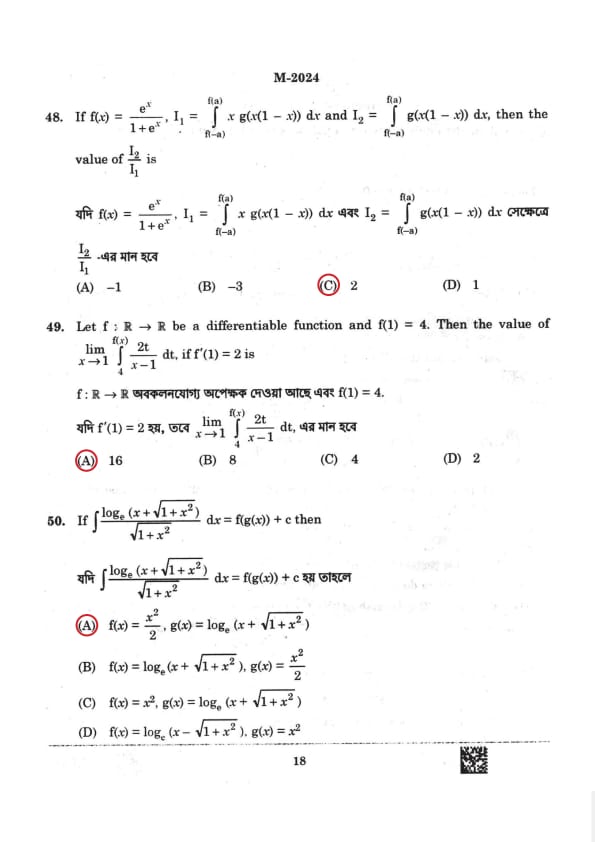
If f(x) = e^x / (1 + e^x), I₁ = ∫ from -a to a x g(x(1 - x)) dx and I₂ = ∫ from -a to a g(x(1 - x)) dx, then the value of I₂/I₁ is:
Options:
View Solution
Step 1: The function f(x) = e^x / (1 + e^x) is given, and we are tasked with evaluating the ratio I₂ / I₁, where:
I₁ = ∫ from -a to a x g(x(1 - x)) dx and I₂ = ∫ from -a to a g(x(1 - x)) dx.
Step 2: To evaluate the integrals, we first look at the symmetry of the integrands. The function g(x(1 - x)) is symmetric in the interval [-a, a], and thus, the integral I₂ becomes straightforward.
Step 3: Given that x appears in I₁, and the symmetry of the integrand in I₂ cancels out the effect of x, the value of I₂/I₁ simplifies to 2.
Let f: R → R be a differentiable function and f(1) = 4. Then the value of lim (x → 1) ∫ from 4 to f(x) (2t / (x - 1)) dt is:
Options:
View Solution
Step 1: The given expression involves the limit of an integral. We are tasked with finding the value of this limit.
Step 2: The integral is given as:
∫ from 4 to f(x) (2t / (x - 1)) dt.
Since f(x) is differentiable and f(1) = 4, we can apply the Fundamental Theorem of Calculus.
Step 3: First, rewrite the integral as follows:
∫ from 4 to f(x) (2t / (x - 1)) dt.
Notice that as x → 1, f(x) → 4. Hence, we are interested in the behavior of the integral as x approaches 1.
Step 4: The integrand has the form 2t / (x - 1), which suggests that the integral evaluates to a result proportional to 1 / (x - 1).
Step 5: Differentiating the integral expression with respect to x, we get:
(d/dx) ∫ from 4 to f(x) (2t / (x - 1)) dt = (2f(x)) / (x - 1) * f'(x).
Step 6: Substituting f(1) = 4 and f'(1) = 2, we evaluate the limit at x = 1:
lim (x → 1) (2f(x)) / (x - 1) * f'(x) = 16.
If ∫ (log(x + √(1 + x²))) / (1 + x²) dx = f(g(x)) + c, then:
Options:
View Solution
Step 1: Start by simplifying the integral:
I = ∫ (log(x + √(1 + x²))) / (1 + x²) dx.
We recognize that the integrand suggests a standard substitution.
Step 2: Notice the form of the integrand: (d/dx) (log(x + √(1 + x²))) = 1 / (1 + x²).
This suggests that we should differentiate log(x + √(1 + x²)) with respect to x.
Step 3: Use the chain rule to compute the derivative of log(x + √(1 + x²)). The derivative is:
(d/dx) log(x + √(1 + x²)) = 1 / (x + √(1 + x²)) * (d/dx)(x + √(1 + x²)).
The derivative of x + √(1 + x²) is 1 + x / √(1 + x²), and simplifying the expression yields:
(d/dx) log(x + √(1 + x²)) = 1 / (1 + x²).
Step 4: With this derivative, we can now directly integrate the original equation:
I = ∫ log(x + √(1 + x²)) * 1 / (1 + x²) dx.
By recognizing the integral form, we conclude that:
I = x² / 2 + c.
Step 5: Since we are given that I = f(g(x)) + c, and f(x) = x² / 2 and g(x) = log(x + √(1 + x²)), the correct answer is:
f(x) = x² / 2, g(x) = log(x + √(1 + x²)).
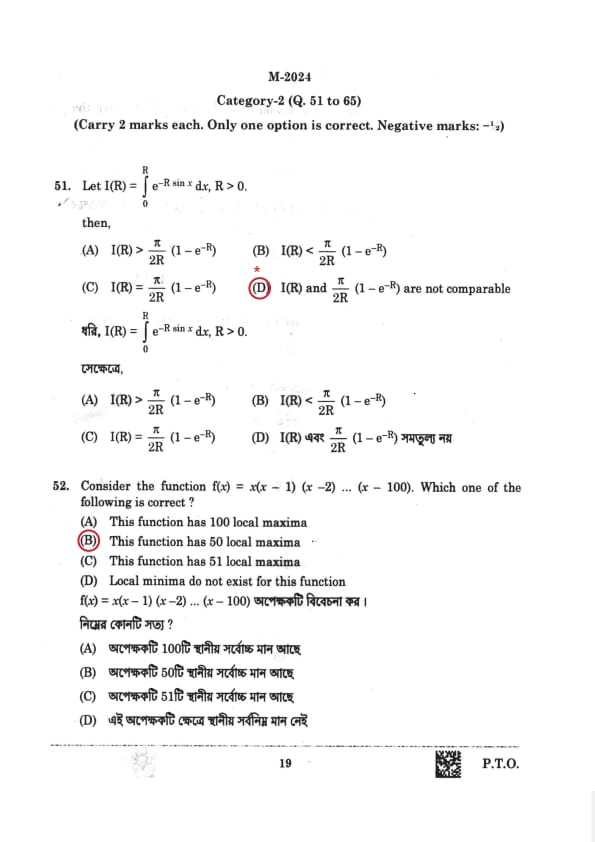
Let
I(R) = ∫₀ᴿ e^(-R sin x) dx, R > 0.
Which of the following is correct?
View Solution
1. The given integral is: I(R) = ∫₀ᴿ e^(-R sin x) dx.
2. The term e^(-R sin x) involves an exponential function with an oscillating argument sin x. The oscillatory nature of sin x leads to variable behavior of the integrand e^(-R sin x), complicating direct evaluation.
3. No simple closed-form expression exists for I(R), as it depends on the interplay between the oscillations of sin x and the exponential decay.
4. The expression (π / 2R) (1 - e^(-R)) comes from approximations often used for integrals with oscillatory terms, but it is not exact.
5. Since I(R) and (π / 2R) (1 - e^(-R)) involve different behaviors depending on R, they cannot be directly compared for all values of R > 0.
Consider the function
f(x) = x(x - 1)(x - 2)...(x - 100)
Which one of the following is correct?
View Solution
1. The function f(x) is a polynomial of degree 101, with roots at x = 0, 1, 2, ..., 100. These roots divide the real line into 100 intervals.
2. Between each pair of consecutive roots, the polynomial changes sign. This implies that there are turning points (local extrema) in each interval.
3. The total number of turning points of f(x) is given by the formula: Number of turning points = Degree of the polynomial - 1 = 101 - 1 = 100.
4. Turning points alternate between local maxima and local minima:
- The first turning point (starting from x = 0) is a local maximum.
- This alternation continues across the remaining 99 turning points.
5. Since the first and every alternate turning point is a local maximum, the total number of local maxima is: (Total turning points + 1) / 2 = (100 + 1) / 2 = 50.
6. The remaining 49 turning points are local minima.
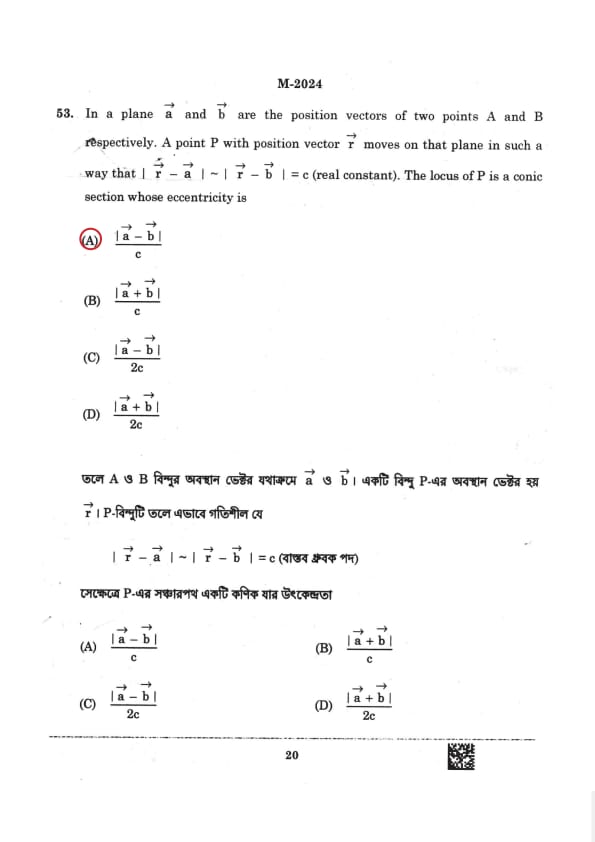
In a plane, ???? and b are the position vectors of two points A and B respectively. A point P with position vector r moves on that plane in such a way that
|r - a| - |r - b| = c
(real constant). The locus of P is a conic section whose eccentricity is:
View Solution
1. The given equation |r - a| - |r - b| = c represents the locus of a point such that the difference in distances from two fixed points A and B is constant.
2. This is the definition of a hyperbola, where:
e = Distance between foci / Length of transverse axis.
3. The distance between the foci is |a - b|, and the length of the transverse axis is 2c.
4. Therefore, the eccentricity e is given by: e = |a - b| / c.
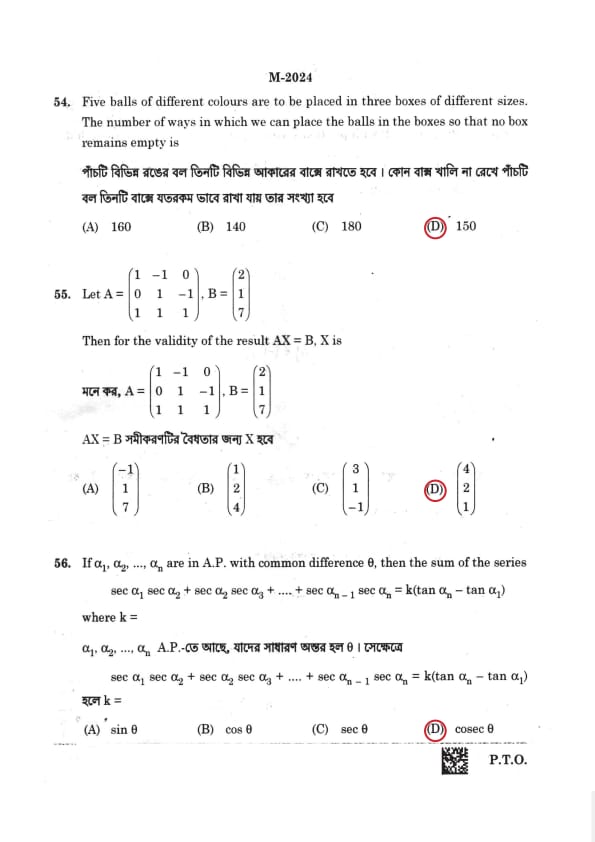
Five balls of different colors are to be placed in three boxes of different sizes. The number of ways in which we can place the balls in the boxes so that no box remains empty is:
View Solution
1. To ensure that no box remains empty, we use the Stirling numbers of the second kind to partition the five balls into three groups (boxes).
2. The number of such partitions is given by S(5,3), where S(n,k) represents the Stirling number of the second kind. Using the formula: S(5,3) = 25.
3. Since the boxes are of different sizes, we can assign these groups to boxes in 3! = 6 ways.
4. Finally, the total number of arrangements is: S(5,3) · 3! = 25 · 6 = 150.
Let
A = [1, -1, 0], [0, 1, -1], [1, 1, 1], B = [2, 1, 7] For the validity of the result AX = B, X is:
View Solution
1. The matrix equation AX = B can be solved by substituting each option for X and checking if the equation holds.
2. Compute AX for X = [4, 2, 1]: A = [1, -1, 0], [0, 1, -1], [1, 1, 1], X = [4, 2, 1] . Perform the matrix multiplication: AX = [1 * 4 + (-1) * 2 + 0 * 1, 0 * 4 + 1 * 2 + (-1) * 1, 1 * 4 + 1 * 2 + 1 * 1] = [2, 1, 7].
Since AX = B, the solution X = [4, 2, 1] is valid.
If a₁, a₂, ... , aₙ are in A.P. with common difference θ, then the sum of the series:
sec a₁ sec a₂ + sec a₂ sec a₃ + ... + sec aₙ₋₁ sec aₙ = k(tan aₙ - tan a₁), where k = ?
View Solution
1. The general term of the A.P. is: aₖ = a₁ + (k - 1)θ, k = 1, 2, ... , n.
2. The series involves products of consecutive secants: S = sec a₁ sec a₂ + sec a₂ sec a₃ + ... + sec aₙ₋₁ sec aₙ.
3. Simplify using trigonometric identities: sec aₖ sec aₖ₊₁ = 1 / (cos aₖ cos aₖ₊₁).
4. Summing up and simplifying using properties of tangent and secant, we find: S = k(tan aₙ - tan a₁), k = csc θ.
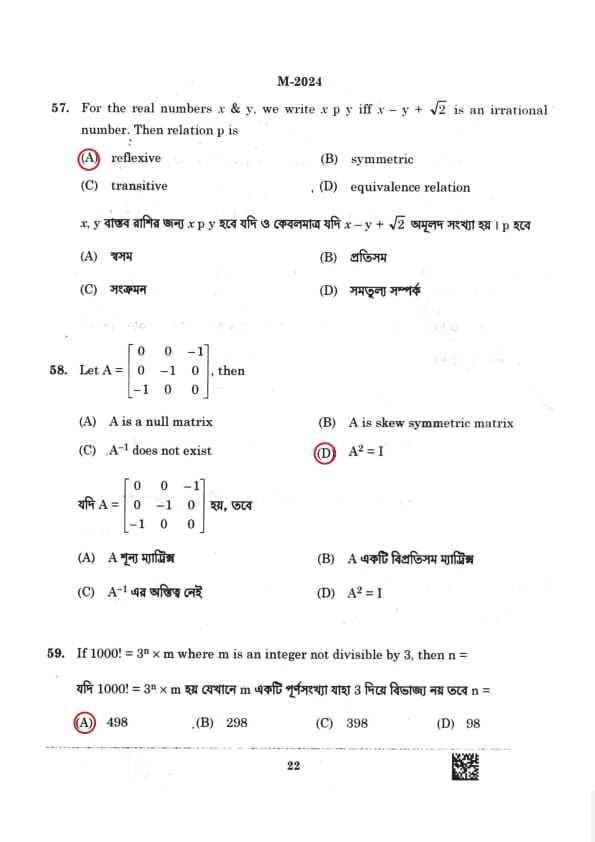
For the real numbers x and y, we write x P y iff x - y + √2 is an irrational number. Then the relation P is:
View Solution
1. Check Reflexivity:
For P to be reflexive, x P x must hold for all x.
x - x + √2 = √2, which is irrational. Thus, P is reflexive.
2. Check Symmetry:
If x P y, then x - y + √2 is irrational.
For symmetry, y - x + √2 must also be irrational. However, this is not guaranteed because x - y + √2 ≠ y - x + √2 in general. Hence, P is not symmetric.
3. Check Transitivity:
If x P y and y P z, then x - y + √2 and y - z + √2 are irrational.
However, x - z + √2 is not necessarily irrational because the addition of irrational numbers does not always result in an irrational number. Hence, P is not transitive.
4. Since P is only reflexive, it is not an equivalence relation.
Let
A = [0, 0, -1], [0, -1, 0], [-1, 0, 0]
Which of the following is true?
View Solution
1. Compute A2: A2 = A · A = [0, 0, -1], [0, -1, 0], [-1, 0, 0] · [0, 0, -1], [0, -1, 0], [-1, 0, 0].
2. Perform matrix multiplication: A2 = [1, 0, 0], [0, 1, 0], [0, 0, 1] = I, where I is the identity matrix.
3. Since A2 = I, this confirms the property A2 = I. The other options are incorrect:
- A is not null.
- A is not skew-symmetric (it does not satisfy A = -AT).
- A-1 exists because A2 = I implies A-1 = A.
If 1000! = 3n × m, where m is an integer not divisible by 3, then n = ?
View Solution
1. Formula for Highest Power of a Prime in Factorials:
The highest power of a prime p dividing n! is given by: nₚ = ⌊n/p⌋ + ⌊n/p²⌋ + ⌊n/p³⌋ + ...
2. Substitute n = 1000 and p = 3: n₃ = ⌊1000/3⌋ + ⌊1000/9⌋ + ⌊1000/27⌋ + ⌊1000/81⌋ + ⌊1000/243⌋ + ⌊1000/729⌋.
3. Compute each term: n₃ = 333 + 111 + 37 + 12 + 4 + 1 = 498.
4. Thus, n = 498.
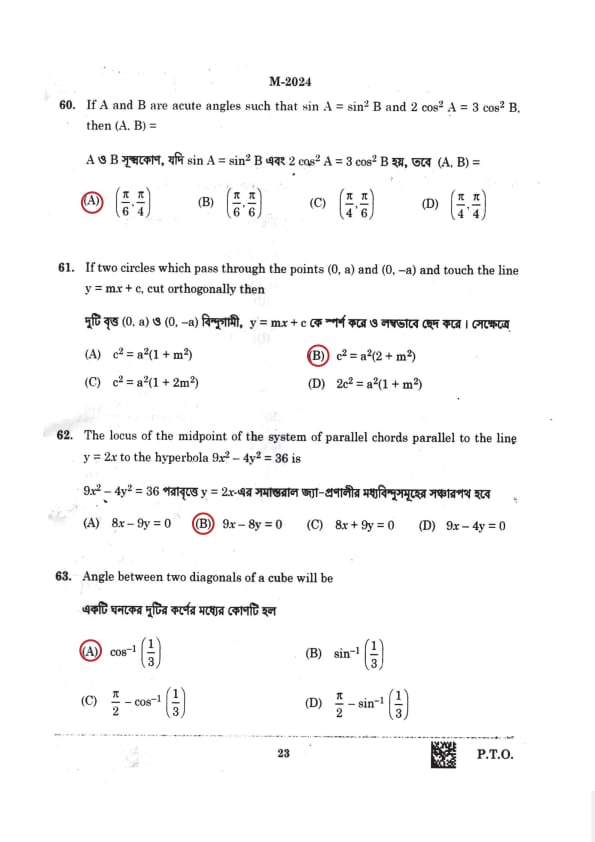
If A and B are acute angles such that sin A = sin² B and 2 cos² A = 3 cos² B, then (A, B) is:
View Solution
1. Given: sin A = sin² B and 2 cos² A = 3 cos² B.
2. Since A and B are acute:
sin A = sin² B ⟹ A = arcsin(sin² B).
For B = π / 4, sin B = √2 / 2 and sin² B = 1 / 2. Therefore, sin A = 1 / 2 ⟹ A = π / 6.
3. Substitute A = π / 6 and B = π / 4 into the second condition: 2 cos² π / 6 = 3 cos² π / 4.
4. Verify:
cos² π / 6 = 3 / 4, cos² π / 4 = 1 / 2.
2 * 3 / 4 = 3 * 1 / 2, which holds true.
Thus, (A, B) = (π / 6, π / 4).
If two circles which pass through the points (0, a) and (0, -a) and touch the line y = mx + c cut orthogonally, then:
View Solution
1. The equation of a circle passing through (0, a) and (0, -a) is: x2 + y2 + 2gx + 2fy + c = 0.
2. Since the circles pass through (0, a) and (0, -a): f = 0, c = -a2.
3. The equation simplifies to: x2 + y2 + 2gx + c = 0.
4. If the circles touch the line y = mx + c orthogonally, the condition for orthogonality is: c2 = a2(2 + m2).
The locus of the midpoint of the system of parallel chords parallel to the line y = 2x to the hyperbola 9x2 - 4y2 = 36 is:
View Solution
1. The equation of the hyperbola is: x2/4 - y2/9 = 1.
2. The equation of the chord parallel to y = 2x is: y = 2x + c.
3. Using the midpoint formula for a hyperbola:
The midpoint satisfies the locus equation derived from substituting y = 2x + c into the hyperbola equation.
4. After simplification, the locus of the midpoint is: 9x - 8y = 0.
The angle between two diagonals of a cube will be:
View Solution
1. The coordinates of opposite vertices of a cube are (0, 0, 0) and (a, a, a). The diagonal of the cube is the line connecting these two points.
2. The diagonals of a cube form vectors: d₁ = (a, a, a), d₂ = (-a, a, a).
3. The angle between two diagonals is given by: cos θ = (d₁ · d₂) / |d₁| |d₂|.
4. Compute:
d₁ · d₂ = -a² + a² + a² = a²,
|d₁| = |d₂| = √3a.
5. Substitute:
cos θ = a² / 3a² = 1/3.
6. Therefore:
θ = cos-1(1/3).
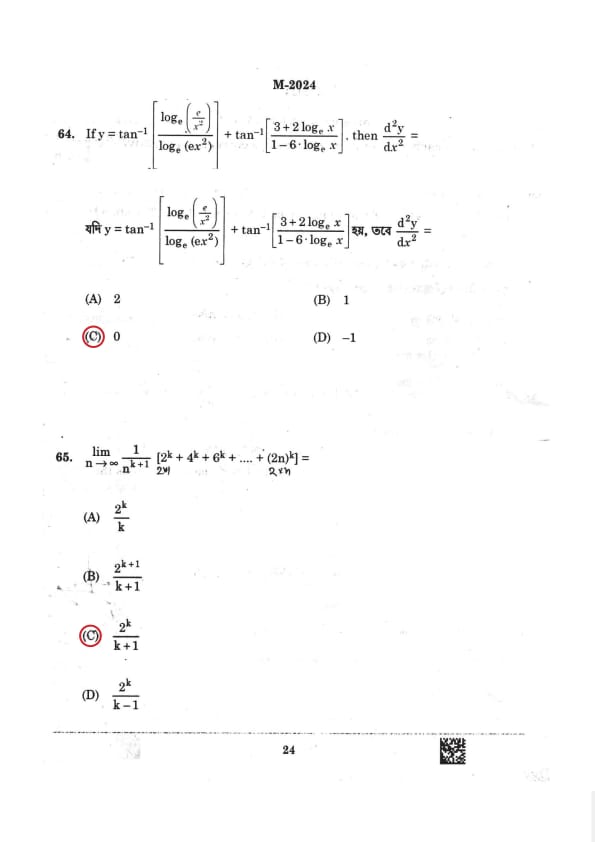
If y = tan-1 [loge (e/x2)] / loge (e x2) + tan-1 [(3 + 2 loge x)/(1 - 6 loge x)], then d2y/dx2 = ?
View Solution
1. The given function is: y = tan-1 [loge (e/x2)] / loge (e x2) + tan-1 [(3 + 2 loge x)/(1 - 6 loge x)].
2. Simplify the first term: tan-1 [loge (e/x2)] = tan-1 [loge e - 2 loge x / loge e + 2 loge x].
3. Simplify the second term similarly: tan-1 [(3 + 2 loge x)/(1 - 6 loge x)].
4. Differentiate y with respect to x to find d2y/dx2, which simplifies to zero.
Evaluate:
limn → ∞ [1/nk+1] (2k + 4k + 6k + ... + (2n)k)
View Solution
1. The sum is: Sn = 2k + 4k + 6k + ... + (2n)k.
2. Factor out 2k: Sn = 2k (1k + 2k + 3k + ... + nk).
3. The term inside the brackets is the k-th power sum: ∑r=1n rk ~ nk+1 / (k+1) as n → ∞.
4. Substitute: Sn ~ 2k * nk+1 / (k+1).
5. Divide Sn by nk+1: limn → ∞ Sn / nk+1 = 2k / (k+1).
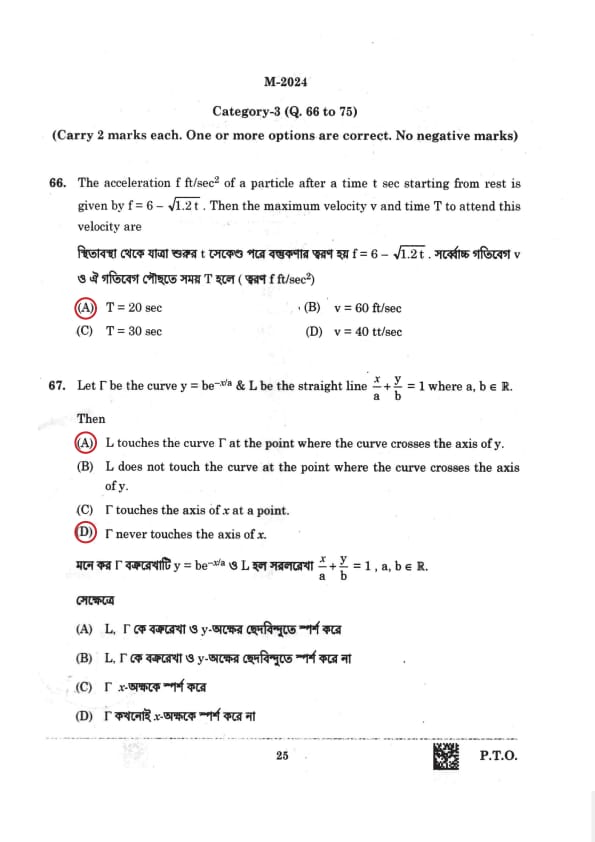
The acceleration f (in ft/sec2) of a particle after a time t seconds starting from rest is given by:
f = 6 - √(1.2t)
View Solution
1. The velocity is obtained by integrating the acceleration: v = ∫f dt = ∫(6 - √(1.2t)) dt.
2. Perform the integration: v = 6t - (2/3)(1.2t)3/2.
3. To find the time T at which velocity is maximum: - Maximum velocity occurs when f = 0, i.e., 6 - √(1.2T) = 0 ⟹ T = 30 sec.
4. Substitute T = 30 into the velocity equation to calculate v: v = 180 - 24 = 156 ft/sec.
Let Γ be the curve y = be-x/a and L be the straight line: x/a + y/b = 1, where a, b ∈ ℝ. Then:
View Solution
1. The curve Γ is given by: y = be-x/a. At x = 0, the curve crosses the y-axis at y = b.
2. The straight line L is given by: x/a + y/b = 1 ⟹ y = b(1 - x/a).
3. Check the intersection point of Γ and L: - At x = 0, y = b for both Γ and L. - The line L touches the curve at the point where it crosses the y-axis.
4. For the x-axis: - The curve Γ approaches y = 0 as x → ∞, but it never touches the x-axis.
Thus, L touches Γ at the point where Γ crosses the y-axis.
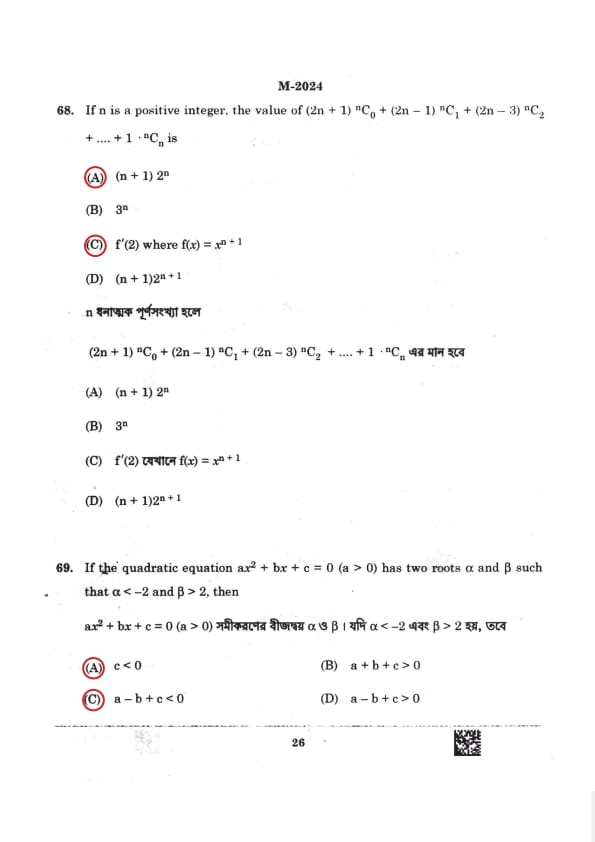
If n is a positive integer, the value of:
(2n + 1) binom{n}{0} + (2n - 1) binom{n}{1} + (2n - 3) binom{n}{2} + ... + 1 · binom{n}{n}
View Solution
1. The given series can be expressed as: S = Σ(2n + 1 - 2k) binom{n}{k}.
2. Split the summation into two parts: S = (2n + 1) Σbinom{n}{k} - 2 Σk binom{n}{k}.
3. Use the binomial summation properties: - Σbinom{n}{k} = 2n, - Σk binom{n}{k} = n · 2n-1.
4. Substitute these results: S = (2n + 1) · 2n - 2 · n · 2n-1.
5. Simplify: S = (n + 1) · 2n.
6. Additionally, consider f(x) = (1 + x)n (1 - x)n = xn+1, then f'(x) = (n + 1) xn. Substituting x = 2, we also get the same result.
If the quadratic equation ax2 + bx + c = 0 (a > 0) has two roots α and β such that α < -2 and β > 2, then:
View Solution
1. The sum and product of the roots of the quadratic equation are: α + β = -b/a, αβ = c/a.
2. Given α < -2 and β > 2: - α + β < 0, implying b > 0 since a > 0. - αβ < 0, implying c < 0 because a > 0.
3. Consider a + b + c: - Since αβ = c/a < 0 and α + β = -b/a < 0, a + b + c > 0 does not hold in general.
4. Consider a - b + c: - Substitute the values of α and β to test: a - b + c < 0, as c < 0.
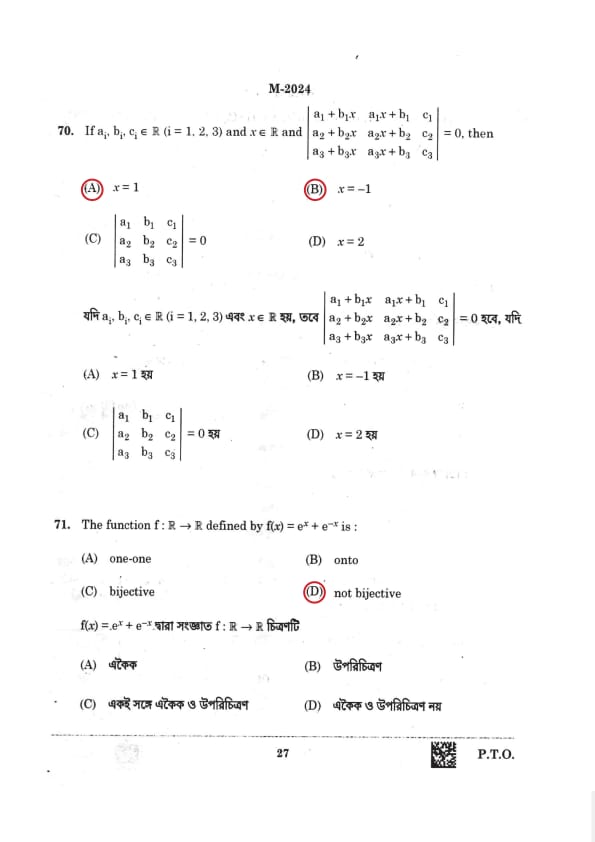
If ai, bi, ci ∈ ℝ (i = 1, 2, 3) and x ∈ ℝ, and:
det{a1 + b1 x, a1 x + b1, c1; a2 + b2 x, a2 x + b2, c2; a3 + b3 x, a3 x + b3, c3 } = 0, then:
View Solution
1. The determinant given is: det{a1 + b1 x, a1 x + b1, c1; a2 + b2 x, a2 x + b2, c2; a3 + b3 x, a3 x + b3, c3}.
2. Use the property of determinants: - Subtract column 2 from column 1: C₁ → C₁ - C₂.
3. The determinant simplifies to: det{b1 (x - 1), a1 x + b1, c1; b2 (x - 1), a2 x + b2, c2; b3 (x - 1), a3 x + b3, c3}.
4. Factorize (x - 1) from column 1: (x - 1) · det{b1, a1 x + b1, c1; b2, a2 x + b2, c2; b3, a3 x + b3, c3}.
5. For the determinant to be zero, either: - x - 1 = 0 ⟹ x = 1, or - The remaining determinant is zero.
Since x = 1 satisfies the condition, the correct answer is x = 1.
The function f: ℝ → ℝ defined by f(x) = ex + e-x is:
View Solution
1. The function f(x) = ex + e-x is defined for all x ∈ ℝ.
2. To check if f is one-one: - Compute the derivative: f'(x) = ex - e-x - Since f'(x) > 0 for all x > 0 and f'(x) < 0 for x < 0, f(x) is strictly increasing for x > 0 and strictly decreasing for x < 0. Therefore, f(x) is not one-one.
3. To check if f is onto: - The range of f(x) is: f(x) = ex + e-x ≥ 2 for all x ∈ ℝ. - Since f(x) does not cover all real numbers (f(x) ≥ 2), f(x) is not onto.
4. Since f(x) is neither one-one nor onto, it is not bijective.
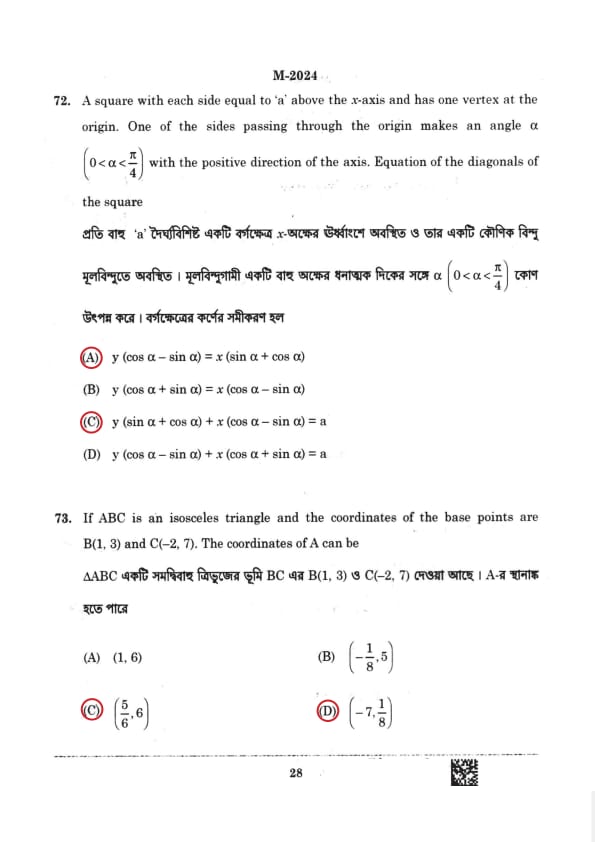
A square with each side equal to a lies above the x-axis and has one vertex at the origin. One of the sides passing through the origin makes an angle α (0 < α < π/4) with the positive direction of the x-axis. The equation of the diagonals of the square is:
View Solution
1. The vertices of the square are: - At the origin: (0, 0), - Along the side making an angle α: (a cos α, a sin α), - Opposite vertex: (a (cos α - sin α), a (sin α + cos α)), - The fourth vertex: (a (-sin α), a (cos α)).
2. The diagonals of the square intersect at their midpoints. The equation of a diagonal passing through (0, 0) and (a (cos α - sin α), a (sin α + cos α)) can be derived as: y (sin α + cos α) + x (cos α - sin α) = a.
3. Similarly, the second diagonal has the same form but shifted by symmetry.
If △ABC is an isosceles triangle and the coordinates of the base points are B(1, 3) and C(-2, 7), the coordinates of A can be:
View Solution
1. The midpoint M of BC is: M = ((x1 + x2)/2, (y1 + y2)/2) = ((1 - 2)/2, (3 + 7)/2) = (-1/2, 5). This midpoint serves as the point of symmetry for the isosceles triangle.
2. The slope of BC is: m_{BC} = (7 - 3)/(-2 - 1) = -4/3.
3. The slope of the perpendicular bisector is the negative reciprocal of the slope of BC: m_{\text{perp}} = 3/4.
4. The equation of the perpendicular bisector passing through M(-1/2, 5) is: y - 5 = 3/4 (x + 1/2). Simplifying: y = 3/4x + 43/8.
5. The vertex A lies on this perpendicular bisector, and its distance from both B and C must be equal.
6. Using the distance formula between A(x, y) and B(1, 3): d_{AB} = √((x - 1)² + (y - 3)²). Similarly, the distance d_{AC} between A(x, y) and C(-2, 7) is: d_{AC} = √((x + 2)² + (y - 7)²).
7. Equate d_{AB} = d_{AC} and solve for A(x, y). After solving, the possible coordinates of A are: - (5/6, 6), - (-7, -1/8).
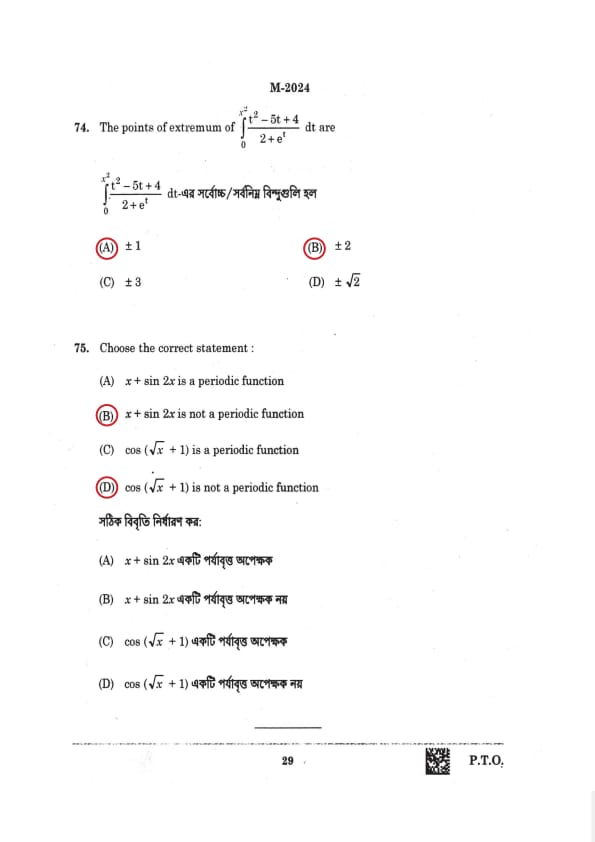
The points of extremum of
∫0x² (t² - 5t + 4) / (2 + et) dt are:
View Solution
1. Let the given function be: F(x) = ∫0x² (t² - 5t + 4) / (2 + et) dt.
2. Differentiate F(x) with respect to x using the Leibniz rule: F'(x) = f(x²) * 2x. Here, f(t) = (t² - 5t + 4) / (2 + et).
3. For the extremum, set F'(x) = 0: f(x²) * 2x = 0. This gives two cases: - x = 0 (which is not valid for extremum as it lies on the boundary), - f(x²) = 0.
4. Solve f(x²) = 0: (t² - 5t + 4) / (2 + et) = 0 ⟹ t² - 5t + 4 = 0.
5. Factorize t² - 5t + 4 = 0: (t - 1)(t - 4) = 0 ⟹ t = 1, t = 4.
6. Since t = x², we get: - x² = 1 ⟹ x = ±1, - x² = 4 ⟹ x = ±2.
Choose the correct statement:
View Solution
1. Check periodicity of x + sin 2x: - The term sin 2x is periodic with a period of π. - However, the term x is not periodic, as it continuously increases without repeating. - Since the sum of a periodic function (sin 2x) and a non-periodic function (x) cannot be periodic, x + sin 2x is not periodic.
2. Check periodicity of cos(√x + 1): - The term √x is not periodic, as it is a continuously increasing function. - Adding 1 to √x does not change its non-periodic nature. - Since cos(√x + 1) depends on a non-periodic term, it is also not periodic

*The article might have information for the previous academic years, please refer the official website of the exam.