
GPAT 2025 Question Paper with Solutions – Download Previous Year Papers & Answer Key PDF


| Updated On - Sep 15, 2025
The GPAT 2025 Exam took place in more than 100 exam centres around India on May 25, 2025, with shift 1 running from 9:00 a.m. to 12:00 p.m. in a CBT format.
Candidates had three hours to complete the 125 multiple-choice questions on the GPAT 2025 question paper in order to receive 500 marks. A candidate receives four marks for each right response, and one mark is subtracted for each incorrect response.
GPAT Question Paper 2025 with Answer Key PDF
| GATE 2025 Question Paper with Solution PDF (May 25) | Download PDF | Check Solutions |

Match the following:
(P) Schedule H
(Q) Schedule G
(R) Schedule P
(S) Schedule F2
Descriptions:
(I) Life period of drugs
(II) Drugs used under RMP
(III) List of Prescription Drugs
(IV) Standards for surgical dressing
View Solution
- Schedule H: Contains drugs that must be sold only on prescription of a Registered Medical Practitioner (RMP).
\(\Rightarrow\) (III) List of Prescription Drugs
- Schedule G: Drugs that must be used under medical supervision. Label must display caution.
\(\Rightarrow\) (II) Drugs used under RMP
- Schedule P: Specifies the life period (shelf-life) and storage conditions of drugs.
\(\Rightarrow\) (I) Life period of drugs
- Schedule F2: Contains standards for surgical dressings like sterile gauze and bandages.
\(\Rightarrow\) (IV) Standards for surgical dressing Quick Tip: Schedules under the Drugs and Cosmetics Rules categorize drugs by usage, control, and manufacturing standards. Knowing these is crucial for GPAT.
Match the following:
(1) Schedule FF
(2) Schedule F3
(3) Schedule V
(4) Schedule Y
Descriptions:
(P) Standards of patent and proprietary medicines
(Q) Requirements and guidelines for clinical trials
(R) Standards for sterilized umbilical tapes
(S) Standards for Ophthalmic preparations
View Solution
- Schedule FF: Lays down standards for ophthalmic preparations.
\(\Rightarrow\) [S]
- Schedule F3: Contains standards for sterilized umbilical tapes.
\(\Rightarrow\) [R]
- Schedule V: Deals with the standards for patent and proprietary medicines.
\(\Rightarrow\) [P]
- Schedule Y: Provides requirements and guidelines for conducting clinical trials in India.
\(\Rightarrow\) [Q] Quick Tip: Schedules F, FF, F3, and Y are focused on manufacturing and testing standards. Schedule Y is especially important for regulatory aspects of clinical trials.
If the label or the container bears the name of an individual or company purporting to be the manufacturer of the drug, which individual or company is fictitious or does not exist, it is:
View Solution
- According to the Drugs and Cosmetics Act, a Spurious Drug includes any drug whose labeling falsely claims it to be manufactured by a non-existent or fictitious person or company.
- This ensures protection against counterfeit or fraudulent manufacturers.
Quick Tip: Spurious drugs misrepresent origin or identity — often involving fake or non-existent manufacturers.
ISO for quality assurance of Design, Development, Processing, Installation, and Servicing is:
View Solution
- ISO 9001 outlines requirements for a quality management system (QMS) where an organization needs to demonstrate its ability in design, development, installation, and servicing.
- It is the most comprehensive and widely adopted ISO standard.
Quick Tip: ISO 9001 is key for end-to-end quality assurance in pharmaceutical manufacturing systems.
According to the ICH guidelines for stability studies, Climatic Zone II temperature and relative humidity are respectively:
View Solution
- As per ICH (International Council for Harmonisation) guidelines:
- Climatic Zone II (Subtropical and Mediterranean) conditions:
\(\)
25^\circ C \pm 2^\circ C \text{ and 60% \pm 5% \text{ RH
\(\)
- These are standard long-term storage conditions for pharmaceutical stability studies. Quick Tip: Zone II is applicable to Europe, Japan, and parts of India — important for multinational drug stability protocols.
How much volume of Raw spirit can an excise officer withdraw as sample?
View Solution
- As per Excise Rules and Drugs and Cosmetics Act, for raw spirit used in pharmaceuticals,
an excise officer is authorized to collect 3 samples, with each sample not exceeding 100 ml.
- This ensures adequate quantity for testing, retesting, and legal proceedings.
Quick Tip: Always remember: excise officers collect 3 samples × 100 ml for record, analysis, and counter-verification.
Minimum manufacturing space for 'Habb-Unani medicine' as per Schedule of D and C Act?
View Solution
- According to Schedule T of the Drugs and Cosmetics Act, the minimum area required for manufacturing of Habb (Unani medicine) is:
\(\)
\text{100 Sq. Ft.
\(\)
- This is applicable under traditional systems of medicine for GMP compliance. Quick Tip: Memorize minimum area requirements under Schedule T for various Ayurvedic, Siddha, and Unani dosage forms.
Manufacturing Specification for tooling has been standardized by?
View Solution
- The Indian Pharmacopoeial Commission (IPC) is the official body responsible for setting standards of drugs in India under the Ministry of Health and Family Welfare.
- It also standardizes manufacturing specifications for tooling — particularly the punches and dies used in tablet compression.
- This ensures interchangeability, efficiency, and quality control across different tablet manufacturing lines.
Quick Tip: IPC not only sets monographs but also standardizes equipment specs like punches, dies, and tooling in tablet manufacturing.
Match the pair of drugs and their family:
Column A (Drugs):
1. Snake root
2. Artemisia
3. Bitter almond
4. Myrrh
Column B (Family):
(P) Compositae
(Q) Rosaceae
(R) Apocynaceae
(S) Burseraceae
View Solution
- 1. Snake root \(\rightarrow\) Rauwolfia serpentina, belongs to Apocynaceae family.
\( \Rightarrow \) [R]
- 2. Artemisia \(\rightarrow\) Source of drugs like artemisinin, belongs to Compositae (Asteraceae) family.
\( \Rightarrow \) [P]
- 3. Bitter almond \(\rightarrow\) From Prunus amygdalus, belongs to Rosaceae family.
\( \Rightarrow \) [Q]
- 4. Myrrh \(\rightarrow\) Oleo-gum resin from Commiphora species, belongs to Burseraceae family.
\( \Rightarrow \) [S] Quick Tip: Learn botanical sources and families for crude drugs — frequently tested in Pharmacognosy GPAT questions.
Which of the following alkaloids are found as salts of meconic acid?
View Solution
- Opium alkaloids, such as morphine, codeine, and thebaine, are typically found in nature as salts of meconic acid.
- Meconic acid is a non-nitrogenous organic acid unique to opium (Papaver somniferum).
- The presence of meconic acid is used to identify opium alkaloids using Ferric chloride test, which gives a deep red color.
Quick Tip: Meconic acid is a key marker of natural opium — forming stable salts with its alkaloids.
Choose the correct statement from the following:
(P) Anthraquinone derivatives are generally detected by Borntrager’s test
(Q) Anthrone is yellow colored and soluble in alkali
(R) Anthranol is insoluble in alkali and shows strong red fluorescence
(S) Borntrager’s test gives negative result with Anthranol (Reduced form)
View Solution
- [P]: True. Borntrager’s test is a qualitative test to detect free anthraquinone glycosides, giving a pink to red color in the ammoniacal layer.
- [Q]: False. Anthrone is typically greenish in color and used as a reagent, not a yellow compound.
- [R]: False. Anthranol, being a reduced form, is soluble in alkali and generally does not show red fluorescence.
- [S]: True. The reduced form (like anthranol or anthranone) gives a negative Borntrager’s test, since oxidation is needed to yield the colored anthraquinone compound.
Quick Tip: Borntrager’s test is positive for free anthraquinone glycosides, not their reduced forms like anthranol.
Choose the correct statement from the following:
(A) Tannin solution precipitate alkaloid
(B) Hydrolysable tannin produce gallic and ellagic acid by enzymatic and acid hydrolysis
(C) Condensed tannin converted into red color substance known as phlobaphene on acid and enzymatic hydrolysis
(D) Tannin are insoluble in water
View Solution
- [A]: True. Tannins precipitate alkaloids, gelatin, and heavy metals due to their astringent and protein-binding properties.
- [B]: True. Hydrolysable tannins are broken down by enzymatic or acidic hydrolysis to yield gallic acid and ellagic acid.
- [C]: True. Condensed tannins (catechol-type) are polymerized to form phlobaphenes, which are red-brown insoluble substances.
- [D]: False. Tannins are highly water-soluble, and aqueous extracts are commonly used in phytochemical tests.
Quick Tip: Tannins are classified into hydrolysable and condensed types—both have characteristic reactions important in crude drug analysis.
Trikatu in Ayurveda is a combination of:
View Solution
- Trikatu is a classical Ayurvedic formulation composed of:
- Black pepper (Piper nigrum)
- Long pepper (Piper longum)
- Ginger (Zingiber officinale)
- It is used to enhance bioavailability and aid in digestion and metabolism.
- Known as "three pungents", Trikatu balances Kapha and Vata doshas in Ayurvedic medicine.
Quick Tip: Trikatu is commonly used as a bioenhancer in Ayurveda and is made from three pungent ingredients.
Glycogenic amino acids enter TCA cycle except:
View Solution
- Glycogenic amino acids are converted into intermediates of the TCA cycle, which ultimately lead to glucose formation via gluconeogenesis.
- Glycine is considered conditionally glucogenic, but it doesn't directly feed into a TCA intermediate without further conversion, making it an exception in this context.
Quick Tip: Memorize amino acid catabolic fates — important for Biochemistry questions in GPAT.
Match the following:
(P) Tuberculosis
(Q) Diphtheria
(R) Yellow fever
(S) Malaria
Descriptions:
(1) Bacterial
(2) Viral
(3) Toxoids
(4) Protozoal
View Solution
- (P) Tuberculosis — (1) Bacterial:
Caused by \textit{Mycobacterium tuberculosis, it is a chronic bacterial infection affecting lungs and other organs.
- (Q) Diphtheria — (3) Toxoids:
Caused by \textit{Corynebacterium diphtheriae. Vaccination involves toxoid (inactivated toxin) used in DPT vaccine.
- (R) Yellow fever — (2) Viral:
Caused by Flavivirus, transmitted by mosquitoes (Aedes aegypti). It is a viral hemorrhagic disease.
- (S) Malaria — (4) Protozoal:
Caused by Plasmodium spp. (like P. falciparum), transmitted by Anopheles mosquitoes. It is a protozoal infection. Quick Tip: Memorize disease classifications by pathogen type (bacterial, viral, protozoal, etc.)—commonly asked in GPAT exams.
Which of the following is used to evaluate disinfectant?
View Solution
- The Chick Martin test is a classical method used to evaluate the efficacy of disinfectants in the presence of organic matter (e.g., yeast, proteins).
- It improves upon the Rideal–Walker test by simulating more realistic conditions found in clinical and environmental settings.
- This test involves the comparison of phenol coefficient of a disinfectant in the presence of organic load.
- Widal test — Used for serological diagnosis of typhoid fever, not for disinfectants.
- VRDL test — Refers to Viral Research and Diagnostic Laboratory tests for viral infections like HIV, hepatitis, etc.
- Hence, both (A) and (B) are unrelated to disinfectant evaluation. Quick Tip: Remember: Chick Martin test evaluates disinfectants under real-use conditions; Widal test is for typhoid.
Oral vaccine such as Dukoral® and Shanchol™ is used for prevention of:
View Solution
- Dukoral® and Shanchol™ are oral cholera vaccines designed to prevent cholera infection caused by Vibrio cholerae.
- These vaccines stimulate mucosal immunity by inducing secretory IgA antibodies in the intestine, providing protection against cholera toxin.
- Dukoral® contains inactivated whole-cell Vibrio cholerae and recombinant cholera toxin B subunit.
- Shanchol™ is a bivalent whole-cell oral vaccine without the toxin component.
- These vaccines are effective in controlling cholera outbreaks, especially in endemic areas.
- Other options:
- Pneumonia vaccines target bacterial or viral causes like Streptococcus pneumoniae.
- Ebola virus vaccine is different and not oral.
- Polio vaccines (OPV) are oral but distinct from Dukoral/Shanchol. Quick Tip: Remember that Dukoral® and Shanchol™ are the primary oral vaccines against cholera, critical for public health in endemic regions.
Which parasitic worm is responsible for causing lymphatic filariasis?
View Solution
- Wuchereria bancrofti is a parasitic filarial nematode that causes lymphatic filariasis, commonly known as elephantiasis.
- It is transmitted to humans through the bite of infected mosquitoes (e.g., Culex, Anopheles, Aedes).
- The adult worms live in the lymphatic system and block lymphatic vessels, causing severe swelling, especially in the legs, genitals, and breasts.
- The disease is characterized by lymphedema, chronic inflammation, and gross enlargement of affected body parts.
- Other options:
- (B) Brugia malayi — Also causes lymphatic filariasis but is less prevalent than W. bancrofti.
- (C) Onchocerca volvulus — Causes onchocerciasis or “river blindness”.
- (D) Ancylostoma duodenale — A hookworm causing iron-deficiency anemia, not filariasis.
Quick Tip: Wuchereria bancrofti is the primary causative organism for lymphatic filariasis — focus on mosquito-borne helminths for GPAT.
Which statistical test is used to compare mean of two identical group?
View Solution
The paired t-test is a statistical method used to compare the means of two related (i.e., identical or matched) groups.It is used when the same subjects are measured twice.for example, before and after a treatment, or under two different conditions.The test determines whether the average difference between paired observations is significantly different from zero.
In the context of GPAT, it is essential for comparing pre- and post-treatment effects or evaluating crossover study designs in biostatistics and clinical trials.
Other options:
- (A) ANOVA (Analysis of Variance) — Used when comparing means of more than two groups.
- (B) Sample t test (Unpaired/Independent t test) — Used to compare the means of two independent groups.
- (D) Pooled t test — A form of unpaired t-test that assumes equal variances in two independent samples.
Quick Tip: Use the paired t-test when comparing two related measurements (same group, different times or conditions) — crucial for bioequivalence and clinical trial designs in GPAT.
Which enzyme is responsible for albinism?
View Solution
- Albinism is a congenital disorder characterized by the partial or complete absence of melanin pigment in the skin, hair, and eyes.
- The biosynthesis of melanin occurs via the tyrosine metabolic pathway, in which the enzyme tyrosinase plays a central role.
- Tyrosinase catalyzes the conversion of tyrosine to DOPA (dihydroxyphenylalanine) and then to dopaquinone, which are key steps in melanin production.
- Mutations in the tyrosinase gene (TYR) result in defective or absent enzyme activity, leading to oculocutaneous albinism type 1 (OCA1).
- This enzyme is copper-dependent and is found in melanocytes.
- Other options:
- (a) Beta-hydroxylase — Involved in catecholamine biosynthesis (e.g., norepinephrine production).
- (b) Pyruvate dehydrogenase — Part of carbohydrate metabolism; links glycolysis to the Krebs cycle.
- (c) Hydroxylase — General term for enzymes adding hydroxyl groups, but not specific to melanin synthesis.
Quick Tip: Remember: Albinism is due to a tyrosinase deficiency — an enzyme vital for melanin biosynthesis. It’s a classic GPAT question from the Biochemistry section.
Which anemia is caused due to Microcytic, hypochromic red blood cells?
View Solution
- Microcytic, hypochromic anemia refers to red blood cells (RBCs) that are smaller than normal (microcytic) and have reduced hemoglobin content (hypochromic), which appears pale under a microscope.
- The most common cause of this type of anemia is Iron deficiency anemia, which results from insufficient iron for hemoglobin synthesis.
- Iron is essential for the formation of hemoglobin, and its deficiency leads to impaired hemoglobin production, producing smaller, less pigmented RBCs.
Analysis of other options:
- (a) Pernicious anemia: A type of macrocytic anemia caused by vitamin B\textsubscript{12 deficiency due to intrinsic factor absence.
- (b) Aplastic anemia: A normocytic normochromic anemia caused by bone marrow failure, not related to cell size or color.
- (d) Hemolytic anemia: Characterized by increased RBC destruction, often with normocytic cells; not microcytic-hypochromic.
Quick Tip: Always associate microcytic, hypochromic RBCs with iron deficiency. It’s a classic feature asked frequently in GPAT’s Pharmacology and Pathophysiology sections.
Which of the following is the differential test i.e. it does not require the need to make assumption of population following normal or differential distributed?
View Solution
The Kruskal-Wallis test is a non-parametric statistical test used to compare three or more independent groups. Unlike parametric tests like ANOVA or t-tests, it does not assume normal distribution of the data. Instead, it ranks the data and compares the mean ranks between the groups.
Key Characteristics:
- It is an extension of the Mann–Whitney U test to more than two groups.
- Useful when data is ordinal or not normally distributed.
- It compares medians rather than means.
Analysis of Other Options:
- (a) ANOVA: Assumes data is normally distributed and groups have equal variances.
- (b) Student T test: A parametric test that compares means and assumes normality.
- (c) Fisher LSD test: A post-hoc test following ANOVA, also assumes normal distribution.
Quick Tip: In GPAT, remember: Parametric = Normality assumed, Non-parametric = No normality assumption. Kruskal-Wallis is a non-parametric alternative to one-way ANOVA.
Which of the following is correct stability order of alkenes?
View Solution
The stability of alkenes is influenced primarily by:
Hyperconjugation
Alkyl substitution (more substituted alkenes are more stable)
Steric hindrance (cis isomers are usually less stable than trans)
Let’s analyze each alkene:
1. Isobutene (2-methylpropene):
A highly substituted (trisubstituted) alkene. It benefits from both +I effect and extensive hyperconjugation.
⇒ Highest stability
2. Trans-2-butene:
Disubstituted alkene with groups on opposite sides — less steric hindrance than cis. More stable than cis-2-butene.
3. Cis-2-butene:
Also disubstituted but with steric repulsion due to same-side substituents. Less stable than trans.
4. But-1-ene:
Monosubstituted alkene, minimal hyperconjugation and substitution.
⇒ Least stable among the given
Correct Stability Order: \[ Isobutene > Trans-2-butene > Cis-2-butene > But-1-ene \] Quick Tip: In alkene stability questions, always rank based on: (1) degree of substitution, (2) trans \(>\) cis (due to less steric hindrance), and (3) hyperconjugation effects.
Cis-trans (E/Z) Isomers, EXCEPT
View Solution
Cis-trans (E/Z) isomerism is a type of geometrical isomerism seen in alkenes. It occurs only when:
1. There is a C=C double bond, and
2. Each of the double bonded carbon atoms is attached to two different groups (i.e., different priority substituents).
Let’s evaluate the options one by one based on this rule:
(a) 1-butene:
Structure: CH\textsubscript{2=CH–CH\textsubscript{2–CH\textsubscript{3
Here, one of the double-bonded carbon atoms (CH\textsubscript{2) is attached to two identical hydrogen atoms.
Hence, cis-trans isomerism is not possible in 1-butene.
(b) 2-butene-1-ol:
Structure: HO–CH\textsubscript{2–CH=CH–CH\textsubscript{3
The double bond is between C2 and C3. C2 is attached to H and CH\textsubscript{2OH; C3 is attached to H and CH\textsubscript{3.
Since both double bonded carbons have two different groups, cis-trans (E/Z) isomerism is possible.
(c) 2-chloro-3-hexene:
Structure: CH\textsubscript{3–CH(Cl)–CH=CH–CH\textsubscript{2–CH\textsubscript{3
C3 (CH=) is bonded to C2 (which bears a Cl) and to C4; C4 is attached to two different groups (CH\textsubscript{2CH\textsubscript{3 and H), and similarly for C3.
Hence, E/Z isomerism is possible.
(d) 4-chloro-2-pentene:
Structure: CH\textsubscript{3–CH=CH–CH(Cl)–CH\textsubscript{3
The double bond is between C2 and C3. Check the groups attached:
– C2 is attached to CH\textsubscript{3 and H (fine), but
– C3 is attached to CH(Cl) and H. Here, CH(Cl) and CH\textsubscript{3 may seem different, but the priority order fails due to symmetry on further expansion, making it ambiguous.
However, due to the similar environment and branching, geometrical isomerism is restricted or not well-defined.
Hence, E/Z isomerism is not reliably possible here.
\begin{quicktipbox
For a compound to show cis-trans (E/Z) isomerism, both double bonded carbon atoms must have two different groups attached. If either carbon has two identical groups, cis-trans isomerism is not possible.
\end{quicktipbox Quick Tip: For a compound to show cis-trans (E/Z) isomerism, both double bonded carbon atoms must have two different groups attached. If either carbon has two identical groups, cis-trans isomerism is not possible.
Number of stereoisomers of 3-bromo-2-butanol:
View Solution
- The structure of 3-bromo-2-butanol is:
\(\)
CH_3\text{-CH(OH)-CH(Br)-CH_3
\(\)
- In this molecule:
- The carbon at position 2 (attached to OH) is a chiral center.
- The carbon at position 3 (attached to Br) is also a chiral center.
- Since there are two chiral centers, the maximum number of stereoisomers is:
\(\)
2^n = 2^2 = 4
\(\)
where \( n = \text{number of chiral centers \).
- These 4 stereoisomers include:
- A pair of enantiomers (non-superimposable mirror images).
- Another pair of enantiomers.
- No meso compound exists in this case, as there is no internal plane of symmetry due to the different substituents (OH and Br).
Quick Tip: Use the formula \(2^n\) for maximum number of stereoisomers, where \(n\) is the number of chiral centers. Check for meso forms if symmetry is possible.
In Friedel-Crafts reaction, benzene reacts with isopropyl bromide in the presence of aluminium trichloride to give:
View Solution
- The Friedel–Crafts alkylation reaction involves the alkylation of an aromatic ring with an alkyl halide in the presence of a Lewis acid such as {AlCl_3.
- In this case, isopropyl bromide is the alkyl halide and benzene is the aromatic compound.
- The AlCl(_3) catalyst helps generate a carbocation (or a carbocation-like species) from isopropyl bromide:
\(\)
(\text{CH_3)_2\text{CH–Br + \text{AlCl_3 \rightarrow (\text{CH_3)_2\text{C^+ + \text{AlCl_3\text{Br^-
\(\)
- This isopropyl carbocation then reacts with benzene to form isopropyl benzene (cumene) via electrophilic aromatic substitution.
- Other options:
- (A) Benzophenone and (B) Acetophenone are products of Friedel–Crafts acylation, not alkylation.
- (D) n-Propyl benzene is not formed here because n-propyl carbocation is unstable and rearranges to isopropyl carbocation.
bigskip Quick Tip: In Friedel–Crafts alkylation, secondary carbocations like isopropyl are stable and commonly formed. Always consider carbocation stability and rearrangement.
Number of conformational isomers of \emph{n}-butane:
View Solution
- \emph{n}-Butane has the structural formula:
\(\)
CH_3-\text{CH_2-\text{CH_2-\text{CH_3
\(\)
- When viewed along the central C–C bond (C2–C3), different conformations arise due to rotation about this bond.
- The key conformers are:
- Anti: The two methyl groups are \(180^\circ\) apart (most stable).
- Gauche: The methyl groups are \(60^\circ\) apart (less stable).
- Eclipsed: The methyls and/or hydrogens are aligned (least stable — not counted here as stable conformers).
- In \emph{n-butane, due to symmetry:
- There is 1 anti conformer.
- There are 2 equivalent gauche conformers (mirror images of each other).
- Hence, the molecule has 3 significant conformational isomers:
- 1 anti + 2 gauche Quick Tip: Conformational isomers differ by rotation around single bonds. For alkanes like \emph{n-butane, analyze using Newman projections for anti and gauche forms.
Debye is a unit of:
View Solution
- The Debye (D) is a unit used to express the dipole moment of a molecule. Dipole moment is a measure of the separation of positive and negative charges in a molecule.
It is a vector quantity given by:
\(\)
\mu = q \times d
\(\)
where \( \mu \) is the dipole moment, \( q \) is the magnitude of the charge, and \( d \) is the distance between the charges.
- 1 Debye (D) is equal to:
\(\)
1\ D = 3.336 \times 10^{-30\ \text{Coulomb-meter
\(\)
- Dipole moments are important for understanding molecular polarity, solubility, and intermolecular interactions.
- Other options explained:
- (B) Field effect relates to electron withdrawal through space, not measured in Debye.
- (C) Dissociation constant is expressed in terms of concentration (mol/L).
- (D) Bond energy is measured in kcal/mol or kJ/mol.
Quick Tip: Dipole moment reflects the polarity of a molecule and is commonly expressed in Debye. Polar molecules like H\textsubscript{2O have a higher dipole moment than nonpolar molecules like CO\textsubscript{2}.
Which is considered an exception to Markovnikov's rule \emph{EXCEPT}:
View Solution
- Markovnikov’s Rule states that in the addition of HX to an unsymmetrical alkene, the hydrogen (H) attaches to the carbon with more hydrogen atoms, and the halide (X) attaches to the carbon with fewer hydrogen atoms.
- This rule applies to:
- (A) Addition of HI
- (B) Addition of HCl
- (D) Addition of H\(_2\)O in acid (hydration follows Markovnikov's rule)
- Exception:
- (C) \underline{Addition of HBr in the presence of peroxide is an exception due to the peroxide effect or Kharasch effect.
- This reaction proceeds via a free radical mechanism, leading to anti-Markovnikov addition where Br adds to the carbon with more hydrogen atoms.
- Hence, all options follow Markovnikov's rule \emph{except option (C), which is the correct answer in this case since the question asks for the one that is NOT an exception.
Quick Tip: Remember: In the presence of peroxides, HBr follows anti-Markovnikov's addition via a free radical mechanism — a common GPAT favorite question!
In Baeyer strain theory, which cycloalkane is more stable?
View Solution
- Baeyer Strain Theory (proposed by Adolf von Baeyer) explains the relative stability of cycloalkanes based on angle strain. According to this theory, the most stable ring systems are those in which the bond angles are closest to the tetrahedral angle of \( 109.5^\circ \).
- The ideal bond angle in a tetrahedral molecule is \( 109.5^\circ \), and any deviation from this causes angle strain.
Let’s analyze the ring strain in each option:
- (A) Cyclopropane: Bond angle = \( 60^\circ \) → High strain
- (B) Cyclobutane: Bond angle = \( 90^\circ \) → Considerable strain
- (C) Cyclopentane: Bond angle = \( 108^\circ \) → Closest to 109.5° → Least strain and most stable
- (D) Cyclooctane: Angle strain is reduced, but suffers from torsional strain due to its flexible ring, making it less stable than cyclopentane
- Hence, Cyclopentane is considered the most stable cycloalkane as per Baeyer strain theory.
Quick Tip: Remember: Cyclopentane has minimal angle strain and is considered most stable according to Baeyer's angle strain theory — important for understanding ring stability in GPAT.
Walden inversion includes:
View Solution
- Walden inversion refers to the inversion of configuration (chirality) that occurs during a nucleophilic substitution reaction.
- This phenomenon is characteristic of SN2 bimolecular nucleophilic substitution reactions, where the nucleophile attacks the carbon from the side opposite to the leaving group.
- As a result, the spatial arrangement of atoms around the chiral center gets inverted — this is what we call a Walden inversion.
- SN1 reactions proceed through a planar carbocation intermediate and often lead to racemization rather than inversion.
- Elimination reactions (E1 or E2) do not involve inversion of configuration, as they lead to the formation of alkenes.
- Therefore, only SN2 reactions exhibit Walden inversion.
Quick Tip: In SN2 reactions, the backside attack by the nucleophile causes Walden inversion — key for chirality-based GPAT questions!
Diels-Alder reaction is:
View Solution
- The Diels-Alder reaction is a [4+2] cycloaddition reaction between a conjugated diene and a dienophile.
- It is a pericyclic reaction that results in the formation of a six-membered ring.
- The reaction occurs via a concerted mechanism without intermediates, making it stereospecific.
- This reaction does not involve elimination, nucleophilic addition, or electrophilic substitution mechanisms.
- It is widely used in organic synthesis for constructing complex cyclic structures with high stereoselectivity.
- Therefore, Diels-Alder is classified as a cycloaddition reaction.
Quick Tip: Diels-Alder is a classic example of a [4+2] cycloaddition — remember this for quick identification in reaction mechanism questions!
Alkyl halide is converted to alkane:
View Solution
- The Wurtz reaction involves the coupling of two alkyl halides using sodium metal in dry ether, producing a higher alkane.
- General reaction:
\[ 2R-X + 2Na \xrightarrow{dry ether} R-R + 2NaX \]
where \( R \) is an alkyl group and \( X \) is a halide.
- It is mainly used for the synthesis of symmetric alkane from primary alkyl halides.
- The Birch reaction is a type of reduction reaction of aromatic rings using sodium and alcohol in liquid ammonia.
- The Sabatier-Senderens reaction is a hydrogenation of alkenes/alkynes using nickel catalysts.
- The Grignard reaction involves formation of C–C bonds using Grignard reagents, not direct conversion of alkyl halides to alkanes.
- Therefore, the correct reaction for converting alkyl halides to alkanes is the Wurtz Reaction.
Quick Tip: Wurtz Reaction = Alkyl halide + Na (dry ether) → Alkane. Useful for synthesizing symmetrical alkanes in organic chemistry.
Aryl diazonium reacts with fluoroborate to give aryl fluoride:
View Solution
- The Balz-Schiemann reaction involves the conversion of an aryl diazonium salt into an aryl fluoride by thermal decomposition of the corresponding aryl diazonium tetrafluoroborate salt.
- General reaction:
\[ Ar-N_2^+ BF_4^- \xrightarrow{\Delta} Ar-F + N_2 + BF_3 \]
where Ar = aryl group.
- This reaction is widely used to introduce fluorine atoms into aromatic rings, which is important in the synthesis of fluorinated aromatic compounds.
- Other options:
- Stephen reaction reduces nitriles to aldehydes.
- Gattermann reaction introduces formyl groups into aromatic rings.
- Gomberg reaction is related to the formation of triphenylmethyl radicals.
- Therefore, the correct reaction that produces aryl fluoride from aryldiazonium salts using fluoroborate is the Balz-Schiemann reaction.
Quick Tip: Remember: Balz-Schiemann reaction is the key method to prepare aryl fluorides from aryl diazonium salts — an important named reaction for GPAT organic chemistry.
Pyridine is a base with \(K_b\) value:
View Solution
- Pyridine is a heterocyclic aromatic organic compound with the molecular formula \ce{C5H5N. It consists of a six-membered ring with five carbon atoms and one nitrogen atom.
- The nitrogen in pyridine is sp\(^2\)-hybridized and its lone pair of electrons is not involved in the aromatic \(\pi\)-system. This makes the lone pair available for protonation, hence making pyridine act as a Lewis base.
- The basicity of a compound is often expressed using the base dissociation constant (\(K_b\)), which measures the extent to which a base can accept a proton.
- Pyridine has a \(K_b\) value of \(1.7 \times 10^{-9}\), indicating it is a weak base. This low \(K_b\) corresponds to a p\(K_b\) of approximately 8.77.
- The low basicity compared to aliphatic amines is due to the electron-withdrawing effect of the aromatic ring, which reduces electron density on the nitrogen atom.
- Among the options, the correct \(K_b\) value of pyridine is \(1.7 \times 10^{-9}\).
Quick Tip: Remember: Pyridine is a weak base with a \(K_b\) around \(10^{-9}\) — significantly less basic than aliphatic amines due to aromatic delocalization effects.
Naturally occurring pilocarpine is:
View Solution
- Pilocarpine is a naturally occurring alkaloid obtained from the leaves of the plant Pilocarpus jaborandi.
- It is a parasympathomimetic alkaloid that acts as a muscarinic receptor agonist, primarily used in the treatment of glaucoma and xerostomia (dry mouth).
- The natural configuration of pilocarpine is stereospecific and biologically active in the form of 3R,4S enantiomer. This is the (+) isomer of pilocarpine, which exhibits the desired pharmacological activity.
- Stereochemistry is important in alkaloids, especially those that interact with chiral biological targets like receptors or enzymes. The 3R,4S configuration ensures proper binding affinity and efficacy.
- Thus, the naturally occurring pilocarpine is the 3R,4S (+) form.
Quick Tip: Remember: Natural pilocarpine is the 3R,4S (+) enantiomer, derived from Pilocarpus species and used for glaucoma management.
In a drug discovery process:
1. Lead optimization
2. Target selection
3. Lead findings
View Solution
- Drug discovery is a step-wise process that begins with identifying the biological origin of the disease, followed by screening and optimizing chemical candidates.
- The first step is Target Selection, where a biological molecule (usually a protein) involved in a disease is chosen as a potential site for drug action. This target should be validated to confirm its role in the disease.
- The next step is Lead Finding, which involves screening of chemical libraries or natural sources to identify compounds (leads) that show biological activity against the selected target.
- The final step in this sequence is Lead Optimization, where the chemical structure of lead compounds is modified to enhance potency, selectivity, pharmacokinetics, and reduce toxicity.
- Hence, the correct order in the drug discovery process is:
Target Selection → Lead Finding → Lead Optimization = 2-3-1
Quick Tip: In drug discovery: Identify the target (2), find a lead compound (3), and optimize it (1) for better activity and safety.
Methotrexate, used as an antimetabolite, is a product of N-methylation of para-aminobenzoic acid and pyridine hydroxyl. The isosteric group is
View Solution
- Methotrexate is a folic acid analog and acts as a competitive inhibitor of the enzyme dihydrofolate reductase (DHFR), which is essential for DNA synthesis.
- In structure-activity relationships (SAR), bioisosteric replacement is a concept where functional groups with similar physical or chemical properties are substituted without significantly altering the biological activity.
- The N-methyl group (CH\textsubscript{3) acts as a classical isosteric group in methotrexate, mimicking structural features of naturally occurring folates to retain binding affinity and metabolic stability.
- Among the given options, CH\textsubscript{3 serves as a non-polar, small group that can mimic hydrogen or methyl moieties in bioisosterism.
- Therefore, the correct isosteric group relevant to methotrexate’s activity is CH\textsubscript{3.
Quick Tip: Isosteres are useful in drug design for improving activity or metabolic stability by structural mimicry.
A/B Trans steroidal hydrogen in the 5th position
View Solution
- Steroids consist of four fused rings labeled A, B, C, and D. The configuration of hydrogen at the 5th carbon (C-5) determines the stereochemistry of the junction between rings A and B.
- If the hydrogen at the 5th position is in the alpha configuration (below the plane), it means the A/B ring junction is in trans configuration. This is typical for many biologically active steroids.
- In contrast, if the hydrogen is in the beta configuration (above the plane), the A/B junction is cis.
- Trans junctions generally offer more thermodynamic stability due to less steric strain compared to cis junctions.
- Hence, A/B trans steroidal configuration involves hydrogen at C-5 in the alpha position.
Quick Tip: Remember: Trans A/B junction = H at C-5 in alpha position; Cis A/B junction = H at C-5 in beta position.
Total Number of Carbon atoms in pregnane is
View Solution
- Pregnane is a C-21 steroid nucleus. It consists of the basic steroid four-ring structure (cyclopentanoperhydrophenanthrene nucleus) with two additional carbon atoms in the side chain.
- The core steroid structure has 17 carbon atoms: 3 six-membered rings (A, B, and C) and 1 five-membered ring (D).
- In pregnane, a two-carbon side chain is attached at C-17, making the total carbon count: 17 (rings) + 2 (side chain) + 2 (additional substituents) = 21 carbon atoms.
- Pregnane serves as the parent structure for important hormones like progesterone and corticosteroids.
Quick Tip: Remember: Pregnane = 21-carbon steroid backbone; Androstane = 19-carbon; Estrane = 18-carbon.
Hypnotics and sedative barbiturate pK\(_a\) value
View Solution
- Barbiturates are derivatives of barbituric acid and act as central nervous system depressants.
- They are weak acids due to the presence of acidic hydrogen at the 5-position of the barbituric acid ring.
- The pK\(_a\) value of hypnotic and sedative barbiturates generally lies in the range of 7–9, making them weak acids that are mostly unionized at acidic pH and ionized at basic pH.
- This property affects their solubility and ability to cross the blood-brain barrier, thus influencing onset and duration of action.
- Examples include phenobarbital (pK\(_a\) ~7.3) and pentobarbital (pK\(_a\) ~8.1).
Quick Tip: Barbiturate activity is influenced by lipid solubility and ionization, which are pH-dependent due to their pK\(_a\).
Structure of hybrid in methadone and meperidine
View Solution
- Tramadol is a centrally acting analgesic with a dual mechanism of action: weak \(\mu\)-opioid receptor agonist and inhibition of serotonin and norepinephrine reuptake.
- Structurally, it is considered a hybrid of methadone and meperidine.
- Methadone is a synthetic opioid with a phenylpropylamine backbone, while meperidine contains a piperidine ring structure.
- Tramadol contains a methadone-like side chain with a meperidine-like structure in its basic amine and ether functionality.
- This hybrid structure contributes to its analgesic efficacy and unique pharmacological profile.
Quick Tip: Tramadol's structure combines features of both methadone and meperidine, giving it opioid and non-opioid analgesic properties.
Steroidal cholestane ring fused with
View Solution
- Cholestane is a saturated derivative of cholesterol and serves as the parent compound for many steroids.
- It consists of a perhydrocyclopentanophenanthrene nucleus, which includes three six-membered rings (A, B, and C) and one five-membered ring (D).
- These four rings are fused together at the carbon positions 5, 6, 8, 9, 10, and 13, forming a tetracyclic skeleton.
- This numbering follows IUPAC nomenclature, and these positions are critical for defining stereochemistry and biological activity of steroid molecules.
Quick Tip: Remember the tetracyclic steroid nucleus involves key fusion points at carbons 5, 6, 8, 9, 10, and 13 — important for structural identification in medicinal chemistry.
UV absorbance value of Morphine
View Solution
- Morphine is an opiate alkaloid with a characteristic UV absorption spectrum.
- The maximum UV absorbance (\λ max) for morphine is approximately 286 nm due to the conjugated aromatic ring system in its structure.
- This absorbance is used in qualitative and quantitative analysis of morphine in pharmaceutical preparations using UV-visible spectrophotometry.
- Understanding the UV absorbance helps in drug identification and purity analysis in pharmaceutical quality control.
Quick Tip: UV absorbance maxima provide valuable information for drug analysis; morphine's peak at 286 nm is a key identifier.
Complexometric titration indicators Except
View Solution
- Complexometric titrations involve the use of indicators that form colored complexes with metal ions, helping to visually detect the endpoint.
- Common complexometric indicators include Mordant Black II, Catechol Violet, and Xylene Orange, all of which change color upon binding with metal ions such as Ca\(^{2+}\) or Mg\(^{2+}\).
- Ferroin, however, is primarily a redox indicator used in redox titrations, especially with iron(II) and iron(III) ions, and does not act as a complexometric indicator.
- Therefore, Ferroin is an exception and is not used as an indicator in complexometric titrations.
Quick Tip: Remember, indicators for complexometric titrations form metal complexes; Ferroin is a redox indicator, not suitable for this purpose.
In complexometric titration, the masking agent used to mask Iron (II) ion
View Solution
- In complexometric titrations, masking agents are substances that selectively bind to certain metal ions to prevent them from interfering with the titration of other metal ions.
- Potassium cyanide (KCN) is commonly used as a masking agent for Iron (II) ions because it forms a very stable complex with Fe\(^{2+}\), effectively "masking" it.
- This prevents Fe\(^{2+}\) from reacting with the titrant, allowing accurate determination of other metal ions in the solution.
- Other options like thioglycerol, triethanolamine, and ammonium fluoride have masking properties for different ions but are not typically used for Fe\(^{2+}\).
Quick Tip: KCN is an effective masking agent for Iron (II) ions in complexometric titrations due to stable complex formation.
Which is used as Fajan's method indicator
View Solution
- Fajan's method is a type of adsorption indicator method used in precipitation titrations, particularly for determining halides by titration with silver nitrate.
- Dichlorofluorescein is commonly used as the indicator in Fajan's method because it adsorbs onto the surface of the precipitate, changing color at the endpoint.
- This color change indicates the completion of the reaction, enabling accurate determination of the endpoint.
- Other indicators like methyl red, phenolphthalein, and xylene orange are used in different types of titrations and are not suitable for Fajan's method.
Quick Tip: Dichlorofluorescein acts as an adsorption indicator in Fajan’s method by color change at the precipitate surface.
Cyanide used in nepheloturbidometry as a salt of
View Solution
- Nepheloturbidometry is an analytical technique used to measure the turbidity or cloudiness of a solution, often due to suspended particles.
- In nepheloturbidometry, cyanide ions are commonly used as silver cyanide (AgCN) salt.
- Silver cyanide forms a precipitate that scatters light, which is measured to determine the concentration of analytes.
- The salt of silver (Ag) is preferred because of its stable complex formation with cyanide and well-defined turbidity properties.
- Salts of gold (Au), sodium (Na), or potassium (K) cyanide are not typically used for this purpose in nepheloturbidometry.
Quick Tip: In nepheloturbidometry, silver cyanide (AgCN) is the common cyanide salt due to its precipitate formation causing turbidity.
How to prepare 200 mL of a 0.15 M sodium hydroxide solution?
View Solution
- Given: Volume \( V = 200 \, mL = 0.2 \, L \), Molarity \( M = 0.15 \, mol/L \)
- Molar mass of sodium hydroxide (NaOH) \( = 23 + 16 + 1 = 40 \, g/mol \)
- Number of moles required:
\[ n = M \times V = 0.15 \times 0.2 = 0.03 \, mol \]
- Mass of NaOH needed:
\[ m = n \times Molar mass = 0.03 \times 40 = 1.2 \, g \]
- Therefore, to prepare 200 mL of 0.15 M NaOH solution, dissolve 1.2 g of sodium hydroxide in water and make up the volume to 200 mL.
Quick Tip: Use the formula \( mass = M \times V \times molar mass \) to prepare molar solutions accurately.
Stationary phase for steroidal chromatography is:
View Solution
- In chromatography, the stationary phase is the phase that does not move and with which the compounds interact.
- Steroidal compounds are generally non-polar and require a stationary phase that can interact effectively to allow separation.
- Acylated paper is paper chemically modified with acyl groups, making it more hydrophobic and suitable for separating steroidal compounds due to better interaction with the non-polar steroids.
- Other options like carboxy paper, kieselguhr paper, and silica paper are typically used for different types of chromatography, such as polar compounds or different analytical purposes.
- Hence, acylated paper is the preferred stationary phase in steroidal chromatography to achieve efficient separation.
Quick Tip: Selecting the correct stationary phase depends on the polarity and nature of the analyte to ensure optimal separation.
Choose the correct statement in a potentiometric titration: Salt bridge is used as
(i) Prevent contamination of reference electrode to test solution
(ii) No use of design reference electrode of salt bridge
(iii) No effect in test solution
(iv) Solidified with 3% agar
View Solution
- In potentiometric titration, the salt bridge plays a crucial role in maintaining the electrical neutrality between the reference and the indicator electrodes without allowing mixing of their respective solutions.
- Statement (i) is correct: The salt bridge prevents contamination between the reference electrode (such as calomel or silver-silver chloride) and the test (analyte) solution by providing an ionic connection.
- Statement (iv) is also correct: Salt bridges are often prepared using electrolytes such as KCl or KNO\(_3\) , and are solidified with 3% agar or gelatin to prevent flow and mixing of liquids while maintaining conductivity.
- Statement (ii) is incorrect: Reference electrodes require a salt bridge for proper functioning in many setups.
- Statement (iii) is incorrect: Although the salt bridge minimizes the effect on test solution composition, it still contributes ions and hence has some effect.
Quick Tip: Salt bridges ensure ionic continuity and prevent liquid junction potential while protecting the test solution from contamination.
Which of the following is not a Karl Fischer reagent
View Solution
Karl Fischer titration is a widely used analytical technique for the determination of water content in pharmaceutical substances. The classical Karl Fischer reagent consists of:
- Iodine (I\(_2\)): Acts as an oxidizing agent.
- Sulphur dioxide (SO\(_2\)): Serves as a reducing agent.
- Pyridine: Functions as a base to neutralize the acid formed during the reaction and to stabilize the intermediate complex.
- Methanol or other alcohols are used as solvents.
Pyrimidine, on the other hand, is a heterocyclic compound and is not a component of the Karl Fischer reagent. It is not involved in the reaction mechanism or stabilization of the intermediates in water determination, and hence, is not part of the reagent composition.
Quick Tip: Remember: Karl Fischer reagent = Iodine + SO\(_2\) + Base (e.g., Pyridine) + Alcohol (e.g., Methanol)
In Ilkovic equation, m\textprime{} determines
View Solution
The Ilkovic equation is used in polarography to relate the diffusion current (\(i_d\)) to the concentration of electroactive species in solution. The equation is given as: \[ i_d = 607 \, n D^{1/2} m^{2/3} t^{1/6} C \]
Where:
- \( i_d \) = diffusion current (in microamperes)
- \( n \) = number of electrons transferred
- \( D \) = diffusion coefficient of the analyte
- \( m \) = rate of mercury flow (mass flow rate)
- \( t \) = drop time of mercury from DME (dropping mercury electrode)
- \( C \) = concentration of the analyte
Here, \( m \) (sometimes represented as \( m' \)) specifically denotes the mass flow rate of mercury, which determines how much mercury is flowing out of the capillary per unit time during the polarographic analysis. This parameter affects the size and frequency of mercury drops and influences the current measured.
Quick Tip: Ilkovic equation is central to classical polarography and is applied when using DME for quantitative electrochemical analysis.
Enzyme activation energy (E\textsubscript{a}) for thermal decomposition of glucose in a first-order reaction is calculated by
View Solution
The activation energy \( E_a \) of a reaction is a fundamental parameter in chemical kinetics that indicates the minimum energy required for reactants to undergo a successful transformation into products. It can be calculated using the Arrhenius equation: \[ k = A e^{-E_a / RT \]
Taking the natural logarithm of both sides: \[ \ln k = \ln A - \frac{E_a}{R} \cdot \frac{1}{T} \]
This is the equation of a straight line: \[ y = mx + c \]
Where:
- \( y = \ln k \)
- \( x = \frac{1}{T} \)
- Slope \( m = -\frac{E_a}{R} \)
- \( R \) = gas constant (8.314 \, J/mol·K)
Hence, the activation energy is calculated from the \textit{slope of the Arrhenius plot (which is a plot of \( \ln k \) versus \( \frac{1{T \)). The slope gives \( -\frac{E_a}{R} \), and multiplying this by \( -R \) yields the value of \( E_a \).
Quick Tip: Arrhenius plot is a valuable tool to determine kinetic parameters such as activation energy and frequency factor from temperature-dependent rate constant data.
In conductometric titration of acetic acid with 0.1 N sodium hydroxide, complete neutralization occurs. Further addition of titrant results in
View Solution
Conductometric titration involves the measurement of electrical conductance during a chemical reaction. When titrating a weak acid like acetic acid (CH\textsubscript{3COOH) with a strong base like sodium hydroxide (NaOH), the neutralization reaction is: \[ CH_3COOH + NaOH \rightarrow CH_3COONa + H_2O \]
Initially, conductance is low due to partial ionization of acetic acid. As NaOH is added, H\textsuperscript{+ ions are replaced by highly mobile Na\textsuperscript{+ ions, slightly increasing conductance. At the equivalence point, the solution contains sodium acetate, which is a salt of a weak acid and contributes moderately to conductance.
Beyond the equivalence point, excess NaOH adds OH\textsuperscript{− ions, which are very mobile and significantly increase the conductance. Thus, further addition of titrant (NaOH) after neutralization leads to a noticeable increase in conductance.
Quick Tip: In weak acid–strong base conductometric titrations, conductance increases sharply after the equivalence point due to the presence of excess hydroxide ions.
Vincristine in ultraviolet spectrophotometry \(\lambda_{max}\) value
View Solution
Vincristine is a vinca alkaloid used in cancer chemotherapy and exhibits characteristic absorbance in the ultraviolet region due to its conjugated double bond system and aromatic rings. In UV-Visible spectrophotometry, the compound shows a maximum absorbance (\(\lambda_{max}\)) at around 290 nm, which corresponds to the \(\pi \rightarrow \pi^*\) electronic transition.
This wavelength is significant for qualitative and quantitative analysis of vincristine in pharmaceutical preparations, as it allows sensitive and specific detection using UV spectroscopy.
Vincristine’s \(\lambda_{max}\) value is a result of its molecular structure, including indole and catharanthine-like moieties that absorb in the UV range. UV absorbance at 290 nm ensures accurate monitoring during analytical and quality control procedures.
Quick Tip: Always use the compound's known \(\lambda_{max}\) for most accurate quantitative UV analysis, as this gives the highest molar absorptivity.
Which of the following liquids has the highest surface tension at 20°C?
View Solution
Surface tension is the force that causes the molecules on the surface of a liquid to be pushed together and form a layer. It is measured in dynes/cm or mN/m. The value of surface tension depends on the nature of the liquid, temperature, and intermolecular forces.
At 20°C:
- Carbon tetrachloride has surface tension around 26 dynes/cm.
- Mercury, despite being a metal in liquid form, exhibits extremely high surface tension of approximately 475 dynes/cm, which is technically the highest, but its metal nature sets it apart from organic liquids.
- Oleic acid, a long-chain fatty acid, has strong cohesive forces due to hydrogen bonding and molecular interactions, leading to very high surface tension among organic compounds, typically higher than octane or carbon tetrachloride.
- Octane has a surface tension around 21.8 dynes/cm.
Given that the question pertains to organic or general liquid compounds, and based on GPAT-relevant references that often exclude mercury in this context due to its metallic nature, oleic acid is considered to have the highest surface tension among the given organic options.
Quick Tip: Surface tension affects droplet formation, spreading behavior, and emulsification, and is key in formulation and drug delivery systems.
Which diluent is incompatible with primary amines?
View Solution
Lactose is a reducing sugar commonly used as a diluent in pharmaceutical formulations. It contains a free aldehyde group capable of reacting with primary amines through the Maillard reaction, leading to the formation of brown-colored products and potentially affecting the stability and efficacy of the drug. This incompatibility is particularly significant when the active pharmaceutical ingredient contains primary amine groups.
Other diluents such as mannitol, microcrystalline cellulose, and dextrose do not have the same reducing properties or reactivity with primary amines, making them generally compatible with such drugs.
Therefore, lactose is considered incompatible with primary amines due to its reducing nature and potential to cause chemical interaction.
Quick Tip: When formulating drugs with primary amines, avoid using reducing sugars like lactose as diluents to prevent instability caused by Maillard reactions.
Maximum limit of iron used in gelatin for manufacturing Soft Gelatin capsule shell should not exceed
View Solution
Gelatin is a key raw material used in the manufacture of soft gelatin capsules, acting as the primary film-forming agent. The quality and purity of gelatin are critical to ensure the safety and stability of the final pharmaceutical product. One important parameter is the maximum allowable limit of heavy metals such as iron in gelatin.
Iron content in gelatin should be kept minimal to avoid oxidative degradation and discoloration of the capsule shells, which can affect both the appearance and shelf life of the product. According to pharmacopeial standards and pharmaceutical guidelines, the maximum permissible limit of iron in gelatin used for soft gelatin capsules is typically set at 15 parts per million (PPM).
Exceeding this limit can lead to catalytic oxidation of capsule contents and impact the mechanical properties of the shell. Therefore, manufacturers strictly monitor and control iron content during gelatin processing and quality testing.
Quick Tip: Maintaining low heavy metal content, including iron, in gelatin ensures the physical integrity and chemical stability of soft gelatin capsules.
If the log of microorganisms is plotted against time, an initially straight line results. The inverse slope of this line is called
View Solution
In microbiology and sterilization kinetics, when the logarithm of the number of surviving microorganisms is plotted against time during a thermal death process, the plot often yields a straight line initially. This linear portion represents a first-order kinetics death rate.
The slope of this line represents the rate of microbial death, and the inverse of the slope is termed the D value (decimal reduction time). The D value is defined as the time required at a specific temperature to reduce the microbial population by 90%, or one logarithmic cycle (i.e., reduce the number of viable organisms to 10% of the original count).
Other terms:
- Thermal death line represents the graphical representation of thermal death times at various temperatures.
- Z value is the temperature change needed to change the D value by a factor of 10.
- Half-life is the time needed for half the microbial population to be killed, different from the decimal reduction time.
Thus, the D value is crucial in designing sterilization processes to ensure effective microbial kill in pharmaceutical and food industries.
Quick Tip: D value helps in assessing the heat resistance of microorganisms and in establishing sterilization parameters.
Sedimentation volume is measured by
View Solution
Sedimentation volume (F) is an important parameter in evaluating the stability of suspensions. It is defined as the ratio of the ultimate volume of sediment (Vu) to the original volume of the total suspension (V0). Mathematically, \[ F = \frac{V_u}{V_0} \]
Where:
- \(V_u\) = Ultimate volume of sediment after complete settling
- \(V_0\) = Initial volume of the total suspension before sedimentation
This ratio gives an indication of the extent of sedimentation and the nature of sediment formed. A higher sedimentation volume (close to 1) indicates a well-dispersed suspension with loosely packed sediment, while a lower value indicates dense sediment with poor redispersibility.
Other terms in the options:
- Flocculation of sedimentation refers to the aggregation of particles forming loose sediment but is not a measurement.
- Volume of flocculated suspension refers to volume after flocculation, not the sedimentation volume itself.
Sedimentation volume is a crucial parameter for formulating stable suspensions in pharmaceutical dosage forms.
Quick Tip: Sedimentation volume helps in assessing the physical stability of suspensions and their redispersibility.
According to USP, the range of sparingly solubility required to dissolve 1 part of solute should be
View Solution
Solubility is classified based on the amount of solvent required to dissolve one part of solute, often expressed as parts of solvent per part of solute. According to the United States Pharmacopeia (USP), the solubility ranges are categorized as follows:
- Very soluble: less than 1 part solvent required
- Freely soluble: 1 - 10 parts solvent
- Sparingly soluble: 30 - 100 parts solvent
- Slightly soluble: 100 - 1000 parts solvent
- Very slightly soluble: 1000 - 10,000 parts solvent
- Practically insoluble or insoluble: more than 10,000 parts solvent
Thus, the range for sparingly soluble substances corresponds to dissolving 1 part of solute in 30 to 100 parts of solvent. This classification is crucial for pharmaceutical formulation and drug delivery as it influences dissolution rate and bioavailability.
Quick Tip: Understanding solubility classification aids in selecting proper solvents and designing appropriate dosage forms.
Rheogram of which type of flow does not start from the origin
View Solution
A rheogram is a graph of shear stress versus shear rate used to describe the flow behavior of fluids.
- Plastic flow is characterized by the presence of a yield stress that must be overcome before flow begins. This means the rheogram does not start from the origin; instead, it has a positive intercept on the shear stress axis. The fluid behaves like a solid until this yield stress is exceeded. Examples include toothpaste and ketchup.
- Dilatant flow (shear-thickening) fluids show an increase in viscosity with increasing shear rate, but their rheograms start from the origin.
- Pseudoplastic flow (shear-thinning) fluids have decreasing viscosity with increasing shear rate and also start from the origin on the rheogram.
- Newtonian fluids exhibit a linear relationship between shear stress and shear rate with zero intercept, thus their rheogram always starts from the origin.
Therefore, only plastic flow shows a rheogram that does not start from the origin due to the yield value that must be exceeded for flow to commence.
Quick Tip: Understanding flow behavior is critical in pharmaceutical formulation, especially for suspensions, emulsions, and ointments to ensure proper processing and patient compliance.
A powder has a Carr's compressibility index in the range of 12-16. The flowability of the powder will be
View Solution
Carr's Compressibility Index (CCI) is an indirect measure of powder flowability and packing ability. It is calculated using bulk density and tapped density of the powder as:
\[ CCI = \frac{Tapped density - Bulk density}{Tapped density} \times 100 \]
The flowability categories based on CCI values are:
- 5-10: Excellent flow
- 11-15: Good flow
- 16-20: Fair flow
- 21-25: Poor flow
- >25: Very poor flow
Since the given Carr's index is in the range 12-16, it falls in the "Good" flowability range, indicating the powder will flow well enough for typical pharmaceutical processing but is not excellent. This parameter is critical in tablet formulation and capsule filling to ensure uniformity and ease of processing.
Quick Tip: Lower Carr's index indicates better flowability, which reduces problems like segregation and inconsistent dosing during manufacturing.
As per USP, the maximum concentration of benzalkonium chloride used as a preservative in parenteral formulations is
View Solution
Benzalkonium chloride is a quaternary ammonium compound widely used as a preservative due to its antimicrobial properties. In parenteral formulations, preservatives are required to prevent microbial contamination during storage and use.
According to the United States Pharmacopeia (USP) guidelines, the maximum permissible concentration of benzalkonium chloride in parenteral (injectable) formulations is 0.01%. Higher concentrations may pose toxicity risks such as irritation or sensitization. Therefore, strict limits ensure safety while maintaining effective antimicrobial activity.
Using benzalkonium chloride within this concentration helps maintain sterility without compromising patient safety, which is crucial for injectable drug products. Quick Tip: Always adhere to USP limits for preservatives in parenteral formulations to balance antimicrobial efficacy and patient safety.
Which of the following is commonly used as a broad-spectrum preservative in pharmaceutical formulations?
View Solution
Benzalkonium chloride is a quaternary ammonium compound widely used as a broad-spectrum antimicrobial preservative in various pharmaceutical formulations, including ophthalmic solutions, nasal sprays, and topical preparations.
It is effective against bacteria, fungi, and some viruses, making it a preferred preservative for multi-dose formulations. Its mechanism of action involves disruption of microbial cell membranes, leading to leakage of cellular contents and cell death.
In contrast:
- Benzoic acid is used primarily as a preservative in acidic preparations such as syrups and beverages but has a narrower spectrum of activity.
- Ascorbic acid and Vitamin C are antioxidants, not primarily used as antimicrobial preservatives.
Due to its broad efficacy and relatively low toxicity at recommended concentrations, benzalkonium chloride remains a common choice for preservation in pharmaceutical products.
Quick Tip: Benzalkonium chloride provides broad antimicrobial protection, especially useful in aqueous multi-dose formulations.
Statement of deflocculated suspension
View Solution
A deflocculated suspension is one in which the particles remain as individual entities rather than forming loose aggregates or flocs. As a result, the particles settle slowly due to their small size and high surface area, causing sedimentation to occur slowly.
Characteristics of deflocculated suspensions include:
- Sedimentation occurs slowly because individual particles settle independently, often forming a compact, hard cake that is difficult to redisperse.
- They tend to have poor physical stability as sedimented particles pack tightly, leading to difficult redispersion.
- Appearance may be clear initially but becomes problematic upon settling.
In contrast, flocculated suspensions form loose aggregates (flocs) that settle rapidly but are easier to redisperse, preventing hard caking.
Quick Tip: Deflocculated suspensions have slow sedimentation but may cause caking, affecting formulation stability and patient acceptability.
Common name of convective transport
View Solution
Convective transport refers to the movement of solutes or particles through a fluid driven by a bulk flow, such as pressure or solvent movement. This process is typically characterized by the flow of solutes through channels or pores in a membrane along with the solvent.
- In pharmaceutical and biological contexts, convective transport is commonly known as "pore transport" because solutes are carried through pores or channels by the movement of the solvent (bulk flow).
- Unlike passive diffusion (movement down a concentration gradient) or active transport (energy-dependent transport), convective transport depends on fluid flow, often influenced by pressure gradients.
- It is important in drug absorption and distribution, especially for large molecules or particulate matter that cannot easily diffuse through membranes.
Hence, convective transport is synonymously called pore transport.
Quick Tip: Understanding different transport mechanisms is essential in drug delivery system design to optimize drug absorption and bioavailability.
Particle size range of optical microscopy
View Solution
Optical microscopy (light microscopy) uses visible light and lenses to magnify particles. Its resolution limit is governed by the wavelength of visible light, typically around 0.2 micrometers (\mu).
- The smallest particle size that can be effectively visualized and measured using optical microscopy generally ranges from about 0.5 μm to 1.5 \mu
- Particles larger than this range can be easily seen, but optical microscopy is most accurate and commonly used for particles within this micrometer range.
- Particles smaller than 0.2 \mu cannot be resolved clearly by optical microscopes and require electron microscopy techniques such as SEM or TEM for characterization.
- The options with very large sizes like 500–1000 μm correspond to sizes easily visible to the naked eye or low magnification and are not the typical particle size range used for optical microscopy particle size analysis.
Hence, the correct particle size range for optical microscopy is 0.5–1.50 \mu.
Quick Tip: The resolving power of optical microscopes limits particle size measurement to about 0.2 μm and above, making it suitable for microparticles but not nanoparticles.
Select the statement of Smectic liquid crystal
View Solution
Liquid crystals are a state of matter that possess properties between those of conventional liquids and solid crystals. The smectic phase is one of the most ordered liquid crystalline phases.
- Smectic liquid crystals are characterized by their molecules being arranged in distinct layers. Within each layer, the molecules are free to move (flow) in two directions (within the layer), and they exhibit rotational motion around their long axis.
- This contrasts with nematic liquid crystals, where molecules are oriented in the same direction but do not form layers.
- In smectic phases, molecular mobility is restricted compared to nematic phases but still allows some fluidity. The molecular arrangement leads to anisotropic properties, which are crucial for their applications in display technologies and drug delivery systems.
Thus, smectic liquid crystals show mobility in two directions and rotation around one axis, which corresponds to option (c).
Quick Tip: Liquid crystals are crucial in pharmaceutical applications, especially in transdermal and controlled drug delivery systems, due to their unique alignment and mobility characteristics.
The flow of viscosity increases when the substance is sheared. This is known as
View Solution
Plastic flow behavior is a type of non-Newtonian flow where the material behaves as a solid under low shear stress but begins to flow like a viscous liquid once a certain yield stress is exceeded.
- Plastic substances resist flow until a critical stress (yield value) is applied. Once this stress is exceeded, the substance flows, and its viscosity may appear to increase under further shear due to internal structural resistance.
- A typical example is Bingham plastic flow, where the flow does not start until the yield value is reached. Examples include toothpaste, ointments, and some suspensions.
- In contrast:
- Dilatant systems (option a) show an increase in viscosity with increasing shear rate (opposite of shear-thinning).
- Pseudoplastic systems (option c) show a decrease in viscosity with increasing shear rate (shear-thinning behavior).
- Newtonian fluids (option d) have constant viscosity regardless of the shear rate.
Therefore, an increase in viscosity upon shearing after surpassing a threshold is best described by plastic flow behavior.
Quick Tip: Plastic flow behavior is important in semisolid dosage forms like creams and pastes, where controlled application and spreadability are desired after a certain pressure is applied.
Equipment used in structured breakdown of thixotropy
View Solution
Thixotropy is a time-dependent shear-thinning property. A thixotropic material becomes less viscous over time when shear is applied and recovers its viscosity when the shear is removed.
- This behavior is common in colloidal systems, gels, and suspensions, where structural breakdown occurs under stress and rebuilds when at rest.
- A viscometer is an instrument used to measure the viscosity of a fluid. In the study of thixotropy, viscometers help observe how viscosity decreases over time under constant shear—indicating structural breakdown.
- Brookfield viscometer and rotational viscometers are widely used for studying thixotropic flow behavior in pharmaceuticals.
Other options:
- Planimeters (option b) are used to measure the area on a two-dimensional plane and are not relevant to rheology.
- Rotameters (option c) measure fluid flow rate, not viscosity.
- Orifice meters (option d) are also flow-measuring devices used in process industries.
Hence, the correct equipment for measuring the structural breakdown in thixotropy is the viscometer.
Quick Tip: Thixotropy is essential in pharmaceutical formulations like suspensions and gels, ensuring ease of application during use and stability at rest.
Thixotropic behavior is associated with
View Solution
Thixotropy is a type of time-dependent non-Newtonian flow behavior in which a material’s viscosity decreases under applied shear stress and gradually recovers when the stress is removed.
- In a thixotropic system, such as suspensions, gels, or colloidal dispersions, the internal structure is disrupted by shearing, resulting in a temporary reduction in viscosity.
- When the shear force is stopped, the structure rebuilds over time, and viscosity is restored.
- This behavior is useful in pharmaceutical and cosmetic formulations where ease of application (low viscosity during application) and retention at the site of action (high viscosity at rest) are required.
Incorrect options:
- (a) Increase in viscosity is not typical of thixotropy; that is more characteristic of negative thixotropy (a rare phenomenon).
- (c) Solid \& Liquid behavior describes viscoelasticity, not specifically thixotropy.
- (d) Sol-gel transformation refers to a phase transition but not the time-dependent shear-thinning of thixotropy.
Hence, thixotropic behavior is best associated with a decrease in viscosity upon shearing.
Quick Tip: Thixotropic gels are ideal for topical and ophthalmic formulations, ensuring ease of application and prolonged residence time.
Match the following:
I. True density \hfill (P) Reciprocal of bulk density
II. Granule density \hfill (Q) Graduated cylinder method
III. Bulk density \hfill (R) Helium Pycnometer
IV. Bulkiness \hfill (S) Mercury displacement method
View Solution
Each type of density in pharmaceutical powders is determined using specific techniques:
- I. True density refers to the density of the solid material excluding pores and voids. It is accurately measured using a Helium Pycnometer because helium gas can penetrate even the smallest voids in the sample. \hfill \(\Rightarrow\) (R)
- II. Granule density (also called apparent or particle density) includes intra-particle pores and is often measured using the mercury displacement method, as mercury does not enter small pores. \hfill \(\Rightarrow\) (S)
- III. Bulk density is the mass of a powder divided by its bulk volume (including voids). It is typically measured using the graduated cylinder method, where the powder is poured into a cylinder without tapping. \hfill \(\Rightarrow\) (Q)
- IV. Bulkiness is the inverse of bulk density, i.e., volume occupied per unit mass of the powder. \hfill \(\Rightarrow\) (P)
Thus, the correct matching is:
I-(R), II-(S), III-(Q), IV-(P) Quick Tip: Bulk density and true density are crucial parameters in powder flow, compression behavior, and dosage form uniformity.
Kozeny-Carman equation is related to
View Solution
The Kozeny-Carman equation is a mathematical expression used to describe the flow of fluids through porous media, particularly in packed beds. It relates the permeability (k) of a porous material to its particle size, porosity, and specific surface area.
The general form of the Kozeny-Carman equation is:
\[ k = \frac{\varepsilon^3}{S^2 (1 - \varepsilon)^2} \cdot \frac{1}{K} \]
Where:
- \( k \) = permeability of the bed
- \( \varepsilon \) = porosity of the bed
- \( S \) = specific surface area of particles
- \( K \) = Kozeny constant (typically ~5)
This equation is crucial in pharmaceutical processes like filtration, tablet compaction, and granulation, where understanding the flow of fluids through a bed of particles is necessary.
- Option (a) relates to fluid mechanics but applies to turbulent systems, not porous beds.
- Option (b) refers to Stokes’ law.
- Option (c) is unrelated to porous media.
- Option (d) correctly identifies the application of the Kozeny-Carman equation.
Quick Tip: The Kozeny-Carman equation helps in designing filtration systems, predicting flow rates, and understanding the impact of particle size and porosity in pharmaceutical formulations.
Theory of filtration is related to
View Solution
Filtration is a unit operation widely used in pharmaceutical and chemical industries to separate solids from liquids. The theory of filtration is fundamentally described by Darcy's Law, which explains the relationship between the rate of fluid flow through a porous medium and the applied pressure.
Darcy's Law equation:
\[ Q = \frac{k \cdot A \cdot \Delta P}{\mu \cdot L} \]
Where:
- \( Q \) = volumetric flow rate (m³/s)
- \( k \) = permeability of the medium (m²)
- \( A \) = cross-sectional area (m²)
- \( \Delta P \) = pressure difference (Pa)
- \( \mu \) = viscosity of the fluid (Pa·s)
- \( L \) = thickness of the filter medium (m)
Explanation of options:
- (a) Dalton's method deals with partial pressures of gases. Not relevant to filtration.
- (b) Darcy equation is directly related to filtration theory, especially constant pressure filtration.
- (c) BET equation relates to surface area determination through gas adsorption, not filtration.
- (d) Stokes' equation is used for sedimentation and particle settling, not for filtration mechanisms.
Quick Tip: Darcy’s Law is essential in filter design and predicting flow rates during filtration. It helps optimize filtration efficiency and filter media selection.
The equation \[ \log \left( \frac{P_1}{P_2} \right) = \frac{2.303 \cdot \Delta H_v \cdot (T_2 - T_1)}{R \cdot T_1 \cdot T_2} \]
is related to:
View Solution
The given equation is a form of the Clausius-Clapeyron equation, which describes the relationship between vapor pressure and temperature for a pure substance undergoing phase change (typically liquid to vapor). This equation is widely used in physical pharmacy to determine the heat of vaporization (\ΔH_v) of a substance.
The logarithmic form of the Clausius-Clapeyron equation is:
\[ \log \left( \frac{P_1}{P_2} \right) = \frac{2.303 \cdot \Delta H_v \cdot (T_2 - T_1)}{R \cdot T_1 \cdot T_2} \]
Where:
- \( P_1, P_2 \) = vapor pressures at temperatures \( T_1 \) and \( T_2 \) respectively
- \( \Delta H_v \) = enthalpy (heat) of vaporization
- \( R \) = gas constant
- \( T_1, T_2 \) = temperatures in Kelvin
Explanation of options:
- (a) Clausius-Mossotti equation relates to dielectric constants and polarizability.
- (b) BET equation deals with multilayer adsorption on solid surfaces.
- (c) Boltzmann-Planck equation relates to statistical mechanics and entropy.
- (d) Clausius-Clapeyron equation is correct as it explains the change in vapor pressure with temperature.
Quick Tip: The Clausius-Clapeyron equation is crucial for determining enthalpy of vaporization and is used in evaluating drug stability and storage conditions.
Nitrodisc is an example of which type of Drug Delivery System?
View Solution
Nitrodisc is a type of transdermal drug delivery system (TDDS) designed to deliver nitroglycerin through the skin for the management of angina pectoris (chest pain due to reduced blood flow to the heart).
Transdermal systems like Nitrodisc use a patch that is applied to the skin, from which the drug diffuses across the skin layers and enters systemic circulation. This approach offers several advantages:
- Bypasses first-pass hepatic metabolism
- Provides controlled and sustained drug release
- Improves patient compliance due to ease of use
Nitrodisc contains a reservoir of nitroglycerin and often utilizes a rate-controlling membrane to regulate drug release over a specific duration, usually 24 hours.
Explanation of options:
- (a) Ocular: Intended for eye delivery (e.g., eye drops or inserts).
- (b) Transdermal: Correct. Nitrodisc is applied to the skin for systemic action.
- (c) Mucosal: Refers to buccal, rectal, or vaginal drug delivery.
- (d) Nasal: Involves drug delivery via nasal sprays or drops.
Quick Tip: Transdermal patches like Nitrodisc ensure steady plasma drug levels and are useful in chronic conditions like angina, hypertension, and hormone replacement therapy.
CLASS-II method for tonicity adjustment is:
View Solution
Tonicity adjustment is a critical step in pharmaceutical formulations, especially for parenteral, ophthalmic, and nasal preparations. The White Vincent method is categorized under Class II methods of tonicity adjustment.
Class II methods are used when the volume of the solution needs to be adjusted after the addition of the drug. The White Vincent method calculates the volume of isotonic solution to be prepared by using the sodium chloride equivalent (E-value) of the drug.
White Vincent Formula: \[ V = \frac{w \times E \times 111.1}{0.9} \]
Where:
- \( V \) = volume of isotonic solution (in mL)
- \( w \) = weight of drug (in grams)
- \( E \) = NaCl equivalent value of the drug
- 0.9 = concentration of normal saline (in %)
- 111.1 = volume (in mL) that 0.9 g NaCl will make isotonic
Explanation of options:
- (a) Cryoscopic: Class I method based on freezing point depression.
- (b) NaCl Equivalent: Concept used in several methods but not a method itself.
- (c) White Vincent: Correct. It is a Class II method.
- (d) Mole fraction: Not commonly used for tonicity adjustments in practical pharmaceutics.
Quick Tip: White Vincent method is especially useful in hospital and extemporaneous formulations to make isotonic solutions accurately without prior measurement of final volume.
If the granule density of potassium bicarbonate is 2.350 g/cc and the true density is 3.560 g/cc, determine the interparticle porosity of the powder.
View Solution
Interparticle porosity (\(\varepsilon\)) refers to the void spaces between particles in a powder or granule bed. It can be calculated using the relationship between true density and granule (or apparent) density as follows:
\[ \varepsilon = 1 - \frac{\rho_{granule}}{\rho_{true}} \]
Where, \(\rho_{granule} = 2.350 \, g/cc\) (given)
\(\rho_{true} = 3.560 \, g/cc\) (given)
Substitute values:
\[ \varepsilon = 1 - \frac{2.350}{3.560} = 1 - 0.659 = 0.341 \]
Therefore, the interparticle porosity is approximately 0.34. Quick Tip: Interparticle porosity is important for understanding powder flow, compressibility, and packing behavior in pharmaceutical formulations.
Triple point of water occurs at which temperature and pressure?
View Solution
The triple point of a substance is the unique condition of temperature and pressure at which the three phases (solid, liquid, and gas) coexist in thermodynamic equilibrium.
For water, the triple point is a fundamental fixed point used in thermometry and metrology. It occurs at:
- Temperature: 0.01°C, which is equivalent to 0.018°F. However, more precise values are sometimes represented, and the value 0.0098°F is also cited in some detailed physical chemistry references.
- Pressure: 4.58 mmHg (also expressed as 611.657 Pa or about 0.00604 atm).
The given options approximate this value, and among them, the closest is (b) with 0.0098°F and 4.58 mmHg.
Understanding the triple point of water is crucial because:
- It serves as a fundamental reference point for temperature scales.
- It is used for calibration of thermometers and in defining the Kelvin temperature scale.
- It illustrates the coexistence of phases in equilibrium, a key concept in physical pharmacy. Quick Tip: The triple point is distinct from the melting or boiling points and is a unique set of conditions specific to each substance.
In supercritical fluid extraction, what will be the critical temperature (CT) and critical pressure (CP)?
View Solution
Supercritical fluid extraction (SFE) uses a fluid above its critical temperature and pressure, where it exhibits unique solvent properties between those of liquids and gases. The most commonly used supercritical fluid in pharmaceutical and food industries is carbon dioxide (CO\(_2\)) because of its relatively low critical temperature and pressure, non-toxicity, and inertness.
- The critical temperature (CT) of CO\(_2\) is 31.1°C.
- The critical pressure (CP) of CO\(_2\) is 73.8 atm (approximately 7.38 MPa).
Above these conditions, CO\(_2\) becomes a supercritical fluid, which can diffuse through solids like a gas and dissolve substances like a liquid, making it an excellent extraction solvent for sensitive compounds without thermal degradation.
This critical point is important because:
- It allows extraction at relatively mild conditions preserving thermolabile substances.
- It eliminates the use of organic solvents, making the process environmentally friendly.
- Adjusting temperature and pressure near the critical point allows selective extraction by changing solvent power. Quick Tip: CO\(_2\) is the preferred supercritical fluid due to its moderate critical point and safety profile in pharmaceutical processes.
Examples of continuous shelf moving dryer are
View Solution
Drying is an essential unit operation in pharmaceutical manufacturing to remove moisture from solid and semi-solid dosage forms. Dryers can be classified as batch or continuous based on operation.
- Continuous shelf moving dryers involve a continuous movement of trays or shelves through the drying chamber, allowing for uninterrupted drying of materials.
- Turbo tray dryer is an example of a continuous shelf moving dryer where trays holding the product move continuously or intermittently through heated air streams. This design improves drying efficiency by combining convection drying with movement.
- Other dryers like vacuum dryer and tray dryer generally operate in batch mode, while spray dryers are used for drying liquids into powders through atomization.
Thus, turbo tray dryer is the correct example of a continuous shelf moving dryer commonly used in pharmaceutical drying processes. Quick Tip: Continuous dryers enhance productivity by allowing non-stop operation and uniform drying with reduced processing time.
An antibiotic dissolves completely in 250 mL of aqueous solution at pH range 1–6.8 and 37°C, and after dissolution, it shows 85% absorption in the body. Based on the Biopharmaceutics Classification System (BCS), in which class does this drug belong?
View Solution
The Biopharmaceutics Classification System (BCS) categorizes drugs based on their solubility and intestinal permeability:
- Class I: High solubility, high permeability
- Class II: Low solubility, high permeability
- Class III: High solubility, low permeability
- Class IV: Low solubility, low permeability
Key points from the question:
- The drug dissolves completely in 250 mL aqueous solution over a pH range 1–6.8 at 37°C, indicating high solubility.
- The drug shows only 85% absorption, which suggests low permeability (high permeability is generally \(>\)85% absorbed, but borderline values and context suggest moderate to low permeability).
Thus, the drug fits the profile of Class III, which is characterized by high solubility but low permeability. Quick Tip: BCS classification aids in predicting drug absorption and guiding formulation strategies. Class III drugs often require permeability enhancement techniques.
Manucol is also known as
View Solution
Manucol is a brand name commonly used for sodium alginate, which is a salt of alginic acid derived from brown seaweed. Sodium alginate is widely used in pharmaceutical formulations as a gelling agent, thickener, stabilizer, and viscosity enhancer. It is especially important in antacid and wound dressing products due to its gel-forming properties upon contact with water or gastric acid.
Key points about sodium alginate (Manucol):
- It forms a viscous gum or gel in aqueous solutions.
- Used in controlled release formulations, topical gels, and as an excipient in tablets and suspensions.
- Differs from alginic acid, which is the acidic precursor and less soluble.
Other options:
- Alginic acid is the acid form, not the sodium salt.
- Carbopol is a synthetic polymer used as a thickening agent, not related to alginates.
- Guar gum is a different natural polysaccharide from guar beans, used as a thickener. Quick Tip: Sodium alginate (Manucol) is widely used in formulations requiring gel formation and sustained release due to its biocompatibility and non-toxicity.
Which of the following anticancer drugs produces hand-foot syndrome?
View Solution
Hand-foot syndrome, also known as palmar-plantar erythrodysesthesia, is a common adverse effect associated with certain chemotherapeutic agents. It is characterized by redness, swelling, pain, and peeling of the skin on the palms of the hands and soles of the feet.
- Capecitabine is an oral prodrug of 5-fluorouracil (5-FU) widely used in cancer chemotherapy. It is well known to cause hand-foot syndrome as a dose-limiting toxicity. The syndrome results from the drug’s effect on rapidly dividing skin cells and capillary damage in the extremities.
- Other drugs listed, such as Methotrexate, Vincristine, and Doxorubicin, have different toxicity profiles but are not commonly associated with hand-foot syndrome.
Management of hand-foot syndrome includes dose adjustment, symptomatic treatment with emollients, and sometimes corticosteroids. Quick Tip: Hand-foot syndrome is a distinctive dermatological toxicity of capecitabine and some other fluoropyrimidines; early recognition helps in effective management and dose modification.
Which of the following is a P2Y₁₂ enzyme inhibitor?
View Solution
P2Y\(_12\) is a subtype of ADP receptor found on platelet surfaces that plays a crucial role in platelet aggregation and thrombus formation. Inhibiting this receptor prevents ADP-mediated platelet activation and aggregation, thus acting as an antiplatelet agent.
- Clopidogrel is a thienopyridine class antiplatelet drug that irreversibly inhibits the P2Y\(_12\) ADP receptor on platelets, preventing platelet aggregation. It is commonly used in the prevention of stroke, myocardial infarction, and other thrombotic events.
- Aspirin acts by irreversibly inhibiting cyclooxygenase-1 (COX-1) enzyme, thereby blocking thromboxane A\(_2\) synthesis and platelet aggregation, but does not inhibit P2Y\(_12\).
- Dipyridamole inhibits phosphodiesterase and increases cAMP levels in platelets, leading to inhibition of aggregation, but is not a P2Y\(_12\) inhibitor.
- Tirofiban is a glycoprotein IIb/IIIa receptor antagonist that prevents fibrinogen binding to platelets, also not a P2Y\(_12\) inhibitor.
Hence, clopidogrel is the correct choice as a P2Y\(_12\) enzyme inhibitor.
Quick Tip: P2Y\(_12\) inhibitors like clopidogrel are crucial in dual antiplatelet therapy, often combined with aspirin, for preventing cardiovascular events.
Vigabatrin is an inhibitor of
View Solution
Vigabatrin is an antiepileptic drug that works by increasing the levels of gamma-aminobutyric acid (GABA), an inhibitory neurotransmitter in the brain. It does so by irreversibly inhibiting the enzyme GABA transaminase, which is responsible for the degradation of GABA.
- GABA transaminase (GABA-T) catalyzes the breakdown of GABA into succinic semialdehyde, reducing GABA availability in the central nervous system.
- By inhibiting GABA-T, vigabatrin leads to increased GABA concentrations, enhancing inhibitory neurotransmission and reducing seizure activity.
- It does not inhibit GABA synthase (which is responsible for GABA synthesis), nor does it block voltage-gated sodium channels or chloride channels directly.
Thus, the correct answer is that vigabatrin inhibits GABA transaminase.
Quick Tip: Vigabatrin is used primarily for refractory epilepsy and infantile spasms due to its unique mechanism of increasing brain GABA by inhibiting its breakdown.
PDE 4 inhibitor used in COPD
View Solution
Phosphodiesterase-4 (PDE4) inhibitors are a class of drugs that reduce inflammation by preventing the breakdown of cyclic AMP (cAMP) in inflammatory cells.
- Roflumilast is a selective PDE4 inhibitor approved for use in chronic obstructive pulmonary disease (COPD). By inhibiting PDE4, it increases intracellular cAMP levels, leading to reduced release of pro-inflammatory mediators.
- This results in decreased inflammation in the lungs, improved airflow, and reduced exacerbations in COPD patients.
- Other options:
- Montelukast is a leukotriene receptor antagonist used in asthma, not a PDE4 inhibitor.
- Cromoglicate (cromolyn sodium) is a mast cell stabilizer used in asthma prophylaxis.
- Omalizumab is an anti-IgE monoclonal antibody used for allergic asthma.
Hence, roflumilast is the correct PDE4 inhibitor used in COPD management.
Quick Tip: PDE4 inhibitors like roflumilast help control inflammation in COPD by modulating intracellular signaling pathways, improving symptoms and reducing exacerbations.
Which of the following is an antidote for organophosphorus poisoning?
View Solution
Organophosphorus compounds inhibit acetylcholinesterase, causing accumulation of acetylcholine at nerve synapses, leading to overstimulation of cholinergic receptors and symptoms of poisoning such as salivation, lacrimation, muscle twitching, and respiratory distress.
- Pralidoxime (2-PAM) is a specific antidote that reactivates acetylcholinesterase by cleaving the phosphate-enzyme bond formed by organophosphates, thus restoring enzyme activity.
- It is most effective if given early before the "aging" of the enzyme-inhibitor complex occurs.
- Naloxone is an opioid antagonist used in opioid overdose, not in organophosphorus poisoning.
- Physostigmine is an acetylcholinesterase inhibitor and is contraindicated here as it would worsen cholinergic crisis.
- Sodium thiosulfate is used in cyanide poisoning, not organophosphorus poisoning.
Thus, pralidoxime is the correct antidote for organophosphorus poisoning.
Quick Tip: In organophosphorus poisoning, pralidoxime combined with atropine is used to reverse both muscarinic and nicotinic effects by reactivating acetylcholinesterase and blocking acetylcholine receptors.
Which of the following is a Proliferator-Activated Receptor-Alpha (PPAR-α) agonist?
View Solution
Proliferator-Activated Receptors (PPARs) are nuclear receptor proteins that function as transcription factors regulating the expression of genes. There are three subtypes: PPAR-\(α\), PPAR-\(γ\), and PPAR-\(β/δ\), each with distinct roles in metabolism.
- PPAR\(α\) agonists mainly regulate lipid metabolism, increasing fatty acid oxidation, and are primarily targeted by fibrates (e.g., fenofibrate).
- PPAR-\(γ\) agonists regulate glucose metabolism and insulin sensitivity and are the targets of thiazolidinediones (TZDs) such as pioglitazone and rosiglitazone.
- Although the question mentions PPAR-\(α\), pioglitazone primarily acts as a PPAR-\(γ\) agonist; however, pioglitazone also exhibits some affinity for PPAR-\(α\), contributing to its beneficial effects on lipid metabolism besides glucose control.
- Sulfonylureas stimulate insulin release from pancreatic \(β\)-cells.
- Metformin acts by reducing hepatic glucose production and increasing insulin sensitivity but does not act via PPARs.
- Acarbose is an alpha-glucosidase inhibitor delaying carbohydrate absorption in the intestine.
Thus, among the given options, pioglitazone is the closest PPAR agonist, specifically PPAR-\(γ\), but also with some PPAR \(α\) activity, making it the correct answer. Quick Tip: PPAR-α agonists mainly affect lipid metabolism (fibrates), PPAR-γ agonists improve insulin sensitivity (thiazolidinediones like pioglitazone).
Bambuterol is a prodrug of
View Solution
Bambuterol is a long-acting β₂-adrenergic receptor agonist that functions as a prodrug. After oral administration, it is metabolized in the liver and plasma to form the active compound terbutaline.
Terbutaline is a short-acting selective β₂-agonist, commonly used as a bronchodilator in the treatment of asthma, chronic bronchitis, and COPD. Bambuterol provides prolonged bronchodilation due to its gradual conversion into terbutaline, making it suitable for once-daily administration.
- Salmeterol is a long-acting β₂-agonist but is not a metabolite of bambuterol.
- Albuterol (salbutamol) is a short-acting β₂-agonist, but again, it is not related to bambuterol metabolism.
- Theophylline is a methylxanthine bronchodilator with a different mechanism of action.
Hence, bambuterol is a prodrug of terbutaline. Quick Tip: Prodrugs are pharmacologically inactive compounds that are metabolized in the body to release the active drug; bambuterol is a classic example used for sustained β₂-agonist activity.
Anticonvulsant drug used as a selective molecular target
View Solution
Lamotrigine is an anticonvulsant and mood-stabilizing drug primarily used in the treatment of epilepsy and bipolar disorder. Its mechanism of action involves selective molecular targeting of voltage-gated sodium channels (VGSCs), thereby stabilizing neuronal membranes and inhibiting the release of excitatory neurotransmitters like glutamate and aspartate.
This selective inhibition reduces the high-frequency neuronal firing associated with seizures, making lamotrigine effective in treating partial seizures, generalized seizures, and Lennox-Gastaut syndrome.
- Vigabatrin inhibits GABA transaminase, increasing GABA levels—broad-acting, not highly selective.
- Gabapentin binds to the α₂δ subunit of voltage-gated calcium channels, but it’s not a classic selective target inhibitor.
- Tiagabine inhibits GABA reuptake via GAT-1, increasing GABA in the synaptic cleft—not a selective molecular blocker.
Thus, among the listed drugs, lamotrigine exhibits selective molecular targeting by acting on sodium channels, making it a key GPAT-relevant example of such a mechanism. Quick Tip: Drugs targeting voltage-gated ion channels are commonly used in epilepsy. Lamotrigine is especially important due to its dual action in seizure control and bipolar disorder.
Common name of convective transport
View Solution
Convective transport refers to the movement of solute molecules along with the flow of solvent (usually water) through aqueous pores or channels present in biological membranes. This mechanism is also known as pore transport or bulk flow.
Key features of convective (pore) transport:
- Occurs through aqueous pores or channels in the membrane.
- Involves small, water-soluble, and low molecular weight molecules (e.g., urea, electrolytes).
- No energy requirement—it is a type of passive transport driven by pressure gradients or bulk fluid movement.
- Common in capillaries and renal glomerular filtration processes.
Let’s assess the options:
- Endocytosis involves vesicle formation and is an active, energy-dependent process.
- Active transport uses energy (ATP) to move substances against a concentration gradient.
- Passive transport includes diffusion but not necessarily pore-mediated transport.
- Pore transport is the correct equivalent term for convective transport.
Hence, the common name for convective transport is pore transport. Quick Tip: Convective or pore transport is important in drug absorption of small hydrophilic molecules, especially across leaky membranes like those in the renal glomerulus or small intestine.
After which phase of clinical trials do pharmaceutical companies submit a New Drug Application (NDA) to the regulatory authority?
View Solution
A New Drug Application (NDA) is submitted to the regulatory authority (such as the US FDA or CDSCO in India) after the successful completion of Phase III clinical trials. The NDA is a formal request to approve a new pharmaceutical for marketing and includes comprehensive data on:
- Preclinical (animal) studies
- Chemistry, Manufacturing, and Controls (CMC)
- Pharmacokinetics and pharmacodynamics
- Safety and efficacy data from Phase I to Phase III trials
Let’s review the phases briefly:
- Phase I: Assesses safety, dosage, and pharmacokinetics in a small group of healthy volunteers.
- Phase II: Evaluates efficacy and side effects in patients with the disease/condition.
- Phase III: Confirms therapeutic effect in a larger patient population and compares with standard treatments.
- Phase IV: Conducted after NDA approval for post-marketing surveillance and long-term side effects.
Thus, the NDA is submitted after Phase III but before Phase IV begins. Quick Tip: Remember: NDA submission follows successful Phase III trials, while Phase IV studies are post-marketing studies conducted after drug approval.
Match the following:
I. Alpha (α) cells \hfill [P] Glucagon
II. Beta (β) cells \hfill [Q] Somatostatin
III. Delta (δ) cells \hfill [R] Gastrin
IV. G cells \hfill [S] Proinsulin
View Solution
The pancreas and gastrointestinal tract contain various types of endocrine cells that secrete different hormones involved in glucose metabolism and digestion.
- Alpha (α) cells: Located in the islets of Langerhans in the pancreas, these cells secrete glucagon, a hormone that raises blood glucose levels by promoting glycogenolysis and gluconeogenesis.
- Beta (β) cells: Also located in the pancreatic islets, they secrete insulin and its precursor proinsulin, which help lower blood glucose.
- Delta (δ) cells: Present in the pancreas and GI tract, they secrete somatostatin, a hormone that inhibits the release of many other hormones including insulin, glucagon, and gastrin.
- G cells: Found primarily in the antrum of the stomach, these cells secrete gastrin, which stimulates gastric acid secretion by parietal cells.
Thus, the correct matching is:
- I → P (Glucagon)
- II → S (Proinsulin)
- III → Q (Somatostatin)
- IV → R (Gastrin)
Quick Tip: Remember: α-cells → Glucagon, β-cells → Insulin/Proinsulin, δ-cells → Somatostatin, G-cells → Gastrin. These are common GPAT questions on pancreatic and gastric hormones.
Which of the following drugs, when given with warfarin, induces hepatic CYP450 enzyme?
View Solution
Cytochrome P450 (CYP450) enzymes are a family of enzymes involved in the metabolism of many drugs. Warfarin, an oral anticoagulant, is metabolized mainly by CYP2C9, CYP1A2, and CYP3A4 isoenzymes in the liver.
Some drugs can either inhibit or induce CYP450 enzymes, thereby altering the metabolism of co-administered drugs like warfarin:
- Ciprofloxacin and Metronidazole are CYP450 inhibitors. They reduce the metabolism of warfarin, increasing its plasma concentration and thus enhancing its anticoagulant effect, which can lead to bleeding.
- Diltiazem is a calcium channel blocker that also acts as a CYP3A4 inhibitor. It similarly raises warfarin levels by decreasing its metabolism.
- Carbamazepine, an anticonvulsant, is a CYP450 enzyme inducer, especially of CYP3A4. It increases the metabolic rate of warfarin, leading to reduced plasma levels and a decreased anticoagulant effect, which may cause therapeutic failure.
Thus, among the given options, carbamazepine is the correct choice as it induces hepatic CYP450 enzymes, lowering the effectiveness of warfarin. Quick Tip: CYP450 inducers like carbamazepine, rifampin, and phenytoin reduce warfarin levels. In contrast, inhibitors like ciprofloxacin and metronidazole increase warfarin’s effects.
Blood concentration ratio of the combination of trimethoprim and sulfamethoxazole after being given in a 1:5 ratio is
View Solution
Trimethoprim and sulfamethoxazole are combined in a fixed-dose formulation due to their synergistic antibacterial activity, often referred to as co-trimoxazole. The combination is typically administered in a 1:5 ratio by weight (trimethoprim:sulfamethoxazole) to achieve an optimal blood concentration ratio of 1:20.
This adjustment is required because of pharmacokinetic differences between the two drugs:
- Sulfamethoxazole has a much higher volume of distribution and faster clearance than trimethoprim.
- To ensure both drugs achieve their desired therapeutic concentration at the site of action, the ratio of 1:5 in the dosage form compensates for these differences.
- Once administered, trimethoprim accumulates more in tissues, while sulfamethoxazole maintains higher plasma levels, resulting in a plasma (blood) concentration ratio of approximately 1:20 (trimethoprim:sulfamethoxazole).
This blood concentration ratio is ideal for their combined bacteriostatic effect, targeting sequential steps in folic acid synthesis in bacteria. Quick Tip: Trimethoprim inhibits dihydrofolate reductase, while sulfamethoxazole inhibits dihydropteroate synthase—together they block folate synthesis, leading to synergistic action.
Furosemide mechanism of action
View Solution
Furosemide is a loop diuretic that acts primarily on the thick ascending limb of the loop of Henle in the nephron.
- It inhibits the Na⁺-K⁺-2Cl⁻ symporter, which is responsible for the reabsorption of sodium, potassium, and chloride ions from the tubular fluid back into the bloodstream.
- By blocking this transporter, furosemide increases the excretion of Na⁺, Cl⁻, and K⁺, along with water, leading to a potent diuretic effect.
- This inhibition also reduces the reabsorption of calcium and magnesium, contributing to additional electrolyte loss.
- Furosemide is useful in the management of edema, congestive heart failure, hypertension, and renal impairment.
- Unlike thiazide diuretics, which act on the distal convoluted tubule, furosemide works earlier in the nephron and has a more profound diuretic effect.
Quick Tip: Furosemide is called a "high-ceiling" diuretic due to its powerful action. It may cause hypokalemia and ototoxicity with prolonged use.
Match the following drugs and their Mechanism of Action (MOA):
\
View Solution
This matching involves understanding the mechanisms of action (MOA) of key anti-tubercular drugs used in the treatment of tuberculosis:
Ethambutol — Inhibits arabinosyl transferase, an enzyme essential for the polymerization of arabinogalactan, a crucial component of the mycobacterial cell wall. (1)-(R)
Para-aminosalicylic acid (PAS) — Acts as a structural analog of PABA and inhibits folate synthase, thereby interfering with folate metabolism. (2)-(S)
Rifampicin — Inhibits DNA-dependent RNA polymerase in mycobacteria, preventing transcription and RNA synthesis. (3)-(P)
Bedaquiline — Specifically targets and inhibits the mycobacterial ATP synthase enzyme, leading to depletion of cellular energy (ATP) in Mycobacterium tuberculosis. (4)-(Q)
Matching accordingly:
- (1)-(R) Ethambutol
- (2)-(S) Para-aminosalicylic acid
- (3)-(P) Rifampicin
- (4)-(Q) Bedaquiline
Quick Tip: Understanding drug mechanisms is vital for rational therapy and predicting adverse effects or resistance mechanisms in tuberculosis treatment.
Match the following Class and their Antiarrhythmic Drug:

View Solution
Antiarrhythmic drugs are classified based on the Vaughan Williams classification system into four main classes according to their primary mechanism of action:
Class I – Sodium channel blockers. These drugs reduce the rate of rise of phase 0 of the action potential. Disopyramide, a Class Ia agent, falls under this category. (1)-(P)
Class II – Beta-adrenergic blockers. These reduce sympathetic activity, decrease heart rate, and conduction velocity. Metoprolol is a selective beta-1 blocker. (2)-(Q)
Class III – Potassium channel blockers. These prolong repolarization and the action potential duration. Amiodarone is a prototype agent. (3)-(R)
Class IV – Calcium channel blockers. These affect the SA and AV nodes, reducing conduction velocity. Verapamil is a non-dihydropyridine calcium channel blocker. (4)-(S)
Matching accordingly:
- (1)-(P) Disopyramide
- (2)-(Q) Metoprolol
- (3)-(R) Amiodarone
- (4)-(S) Verapamil
Quick Tip: The Vaughan Williams classification helps in identifying antiarrhythmic agents by their primary mechanism and is essential in managing arrhythmias effectively.
Which effect is associated with amphotericin B?
View Solution
Amphotericin B is a polyene antifungal agent used primarily to treat systemic fungal infections. One of its notable adverse effects is renal toxicity, which leads to electrolyte disturbances.
- Amphotericin B binds to ergosterol in fungal cell membranes, creating pores that cause leakage of intracellular components. Unfortunately, it can also affect mammalian kidney cells.
- This nephrotoxicity results in increased renal tubular permeability leading to loss of potassium and magnesium in the urine.
- Consequently, patients often develop hypokalemia (low serum potassium levels), which can cause muscle weakness, cardiac arrhythmias, and other clinical manifestations.
- Other electrolyte abnormalities may occur but hypokalemia is the hallmark electrolyte disturbance linked with amphotericin B therapy. Quick Tip: Monitor serum electrolytes, especially potassium and magnesium, during amphotericin B therapy to prevent serious complications.
Which of the following drugs used to treat influenza targets an enzyme?
View Solution
Influenza antiviral drugs target specific viral enzymes to inhibit replication and spread of the virus. Among the options:
- DNA polymerase and reverse transcriptase are enzymes associated with DNA and retroviruses, respectively, not influenza viruses.
- Protease inhibitors are mainly used in treatment of HIV infections.
- Neuraminidase is a crucial enzyme on the surface of influenza viruses that facilitates the release of new viral particles from infected cells by cleaving sialic acid residues.
Neuraminidase inhibitors like oseltamivir and zanamivir block this enzyme, preventing viral spread and are thus effective anti-influenza agents.
Quick Tip: Neuraminidase inhibitors are most effective when given within 48 hours of influenza symptom onset.
Choose the correct match of laxative and its Mechanism of Action (MOA):

View Solution
- Senna is a stimulant laxative (Q). It acts by stimulating the enteric nerves to increase peristalsis, promoting bowel movements.
- Lactulose is an osmotic purgative (P). It draws water into the colon, softening stools and increasing bowel movement frequency.
- Lubiprostone causes fecal softening (R) by activating chloride channels in the intestinal epithelium, increasing fluid secretion into the bowel.
- Prucalopride is a selective 5-HT₄ receptor agonist (S) that enhances colonic motility by stimulating serotonin receptors.
This classification aligns with the pharmacological mechanisms of these laxatives used in clinical practice.
Quick Tip: Understanding laxative mechanisms helps in selecting appropriate therapy based on constipation etiology and patient condition.
BPALM combination drug names include moxifloxacin
View Solution
The BPALM regimen is a combination therapy used primarily for treating multidrug-resistant tuberculosis (MDR-TB). It includes the following drugs:
- Bedaquiline – a diarylquinoline that inhibits mycobacterial ATP synthase, killing Mycobacterium tuberculosis.
- Pretomanid – a nitroimidazole that inhibits mycolic acid synthesis and generates reactive nitrogen species.
- Linezolid – an oxazolidinone antibiotic inhibiting bacterial protein synthesis by binding to the 50S ribosomal subunit.
- Moxifloxacin – a fluoroquinolone antibiotic that inhibits DNA gyrase and topoisomerase IV, interfering with bacterial DNA replication.
This combination is preferred due to its efficacy and synergy against resistant strains. The inclusion of moxifloxacin is specific to option (c), making it the correct answer.
Quick Tip: BPALM is an important regimen for MDR-TB, and understanding its components is crucial for TB pharmacotherapy.
Mirabegron is used in the management of overactive bladder
View Solution
Mirabegron is a selective Beta-3 adrenergic receptor agonist primarily used in the treatment of overactive bladder (OAB). Activation of Beta-3 receptors in the detrusor muscle of the bladder leads to relaxation during the storage phase of the urinary bladder cycle, thereby increasing bladder capacity and reducing symptoms of urgency and frequency.
Unlike antimuscarinic agents (such as M3 antagonists), which inhibit bladder contractions by blocking muscarinic receptors, mirabegron works by a different mechanism and generally has a more favorable side effect profile, especially regarding dry mouth and constipation.
Quick Tip: Beta-3 agonists like mirabegron are preferred in patients who cannot tolerate antimuscarinic side effects for overactive bladder.
Which PDE 4 inhibitor is used in COPD?
View Solution
Theophylline is a methylxanthine drug commonly used in the management of chronic obstructive pulmonary disease (COPD) and asthma. It acts primarily as a phosphodiesterase (PDE) inhibitor, particularly inhibiting PDE-4, leading to an increase in intracellular cyclic AMP (cAMP). This results in relaxation of bronchial smooth muscle and anti-inflammatory effects.
Though primarily classified as a nonspecific PDE inhibitor, its PDE-4 inhibitory activity contributes significantly to its bronchodilator and anti-inflammatory effects in COPD. This leads to improved airflow and reduced symptoms in COPD patients.
Other options:
- Montelukast is a leukotriene receptor antagonist, not a PDE inhibitor.
- Cromoglicate is a mast cell stabilizer.
- Omalizumab is an anti-IgE monoclonal antibody used mainly in allergic asthma.
\begin{quicktipbox
Theophylline requires monitoring due to a narrow therapeutic index and potential side effects like tachycardia and nausea.
\end{quicktipbox Quick Tip: Theophylline requires monitoring due to a narrow therapeutic index and potential side effects like tachycardia and nausea.
5-HT\textsubscript{2A}/2C antagonist used in migraine
View Solution
Methysergide is a serotonin receptor antagonist primarily targeting the 5-HT\textsubscript{2A and 5-HT\textsubscript{2C receptors. It has been used as a prophylactic treatment for migraine by preventing vasoconstriction and platelet aggregation associated with migraine attacks.
- Methysergide blocks serotonin-induced vasoconstriction, thereby reducing migraine frequency.
- Ketanserin is also a 5-HT\textsubscript{2 antagonist but primarily used as an antihypertensive agent.
- Sumatriptan and Rizatriptan are 5-HT\textsubscript{1B/1D receptor agonists (triptans) used for acute migraine treatment, not antagonists.
Hence, Methysergide is the correct drug categorized as a 5-HT\textsubscript{2A/2C antagonist used in migraine prophylaxis.
\begin{quicktipbox
Triptans (5-HT\textsubscript{1B/1D agonists) are used for acute migraine attacks, whereas Methysergide is used for prevention.
\end{quicktipbox Quick Tip: Triptans (5-HT\textsubscript{1B/1D} agonists) are used for acute migraine attacks, whereas Methysergide is used for prevention.
If 50% of women who are diagnosed with venous thrombosis are found to be taking oral contraceptives compared to those without thrombosis, which type of study is this?
View Solution
A case study (more specifically a case-control study in epidemiology) compares subjects with a particular condition (cases) to those without the condition (controls) to identify factors that may be associated with the condition.
- Here, women diagnosed with venous thrombosis (cases) are compared to women without thrombosis (controls) based on oral contraceptive use.
- A cohort study follows a group over time to see who develops the outcome; not applicable here since the data is retrospective.
- Cross-sectional studies measure exposure and outcome simultaneously at a single point in time, not comparing based on disease presence retrospectively.
- ANOVA is a statistical test used to compare means across groups, not a study design.
Therefore, this study is a case study (case-control) design.
\begin{quicktipbox
Case-control studies are retrospective and useful for studying rare diseases and their risk factors.
\end{quicktipbox Quick Tip: Case-control studies are retrospective and useful for studying rare diseases and their risk factors.
pH of Jejunum
View Solution
The jejunum is part of the small intestine where the pH is slightly alkaline to neutral, generally around 6.8 to 7.4. This mildly alkaline environment aids in the function of intestinal enzymes and nutrient absorption. The options given show various pH values, but the value closest to the physiological pH of the jejunum is (a) 6.8±4, representing the expected pH range.
Quick Tip: Remember, the pH gradually increases from acidic in the stomach (around 1–3) to neutral or slightly alkaline in the small intestine (around 6–7.5), which helps enzymatic digestion and absorption.
GnRH agonist EXCEPT
View Solution
Goserelin, triptorelin, and buserlin are well-known GnRH (Gonadotropin-releasing hormone) agonists used clinically to regulate hormone-dependent conditions. "Gani" is not a recognized GnRH agonist, making option (b) the correct exception here.
Quick Tip: GnRH agonists are synthetic peptides that initially stimulate, then suppress gonadotropin secretion; know common drugs like goserelin, triptorelin, and buserlin.
Which of the following are responsible for a rightward shift in the oxygen-hemoglobin dissociation curve?
View Solution
A rightward shift in the oxygen-hemoglobin dissociation curve indicates decreased hemoglobin affinity for oxygen, facilitating oxygen release to tissues. This shift is caused by factors such as increased hydrogen ion concentration (higher H\textsuperscript{+, causing lower pH) and increased partial pressure of carbon dioxide (higher pCO\textsubscript{2), both of which occur during increased metabolic activity. Lower PO\textsubscript{2 does not cause this shift but reflects oxygen availability. Therefore, both (b) higher H\textsuperscript{+ and (c) higher pCO\textsubscript{2 cause a rightward shift.
Quick Tip: Remember the Bohr effect: increased H\textsuperscript{+} and CO\textsubscript{2} reduce hemoglobin's oxygen affinity, shifting the curve right and enhancing oxygen delivery to tissues.
Match the following Class and their Drug:
(1) Alkylating
(2) Platinum analog
(3) Antimetabolite
(4) EGF receptor inhibitor
(P) 5-fluorouracil
(Q) Cisplatin
(R) Cetuximab
(S) Chlorambucil
View Solution
Alkylating agents such as Chlorambucil (S) work by adding alkyl groups to DNA, interfering with replication. Platinum analogs like Cisplatin (Q) form DNA crosslinks inhibiting DNA synthesis. Antimetabolites, such as 5-fluorouracil (P), inhibit nucleotide synthesis by mimicking natural metabolites. EGF receptor inhibitors, like Cetuximab (R), block epidermal growth factor receptor signaling to prevent cancer cell growth. Hence, the correct matching is (1)-(S), (2)-(Q), (3)-(P), (4)-(R).
Quick Tip: When matching drug classes, focus on their mechanism of action: alkylating agents modify DNA, platinum compounds crosslink DNA, antimetabolites interfere with nucleotide synthesis, and EGF inhibitors block receptor signaling.
Which of the following nasal decongestants is an \(\alpha_2\) agonist?
View Solution
Oxymetazoline is a nasal decongestant that acts primarily as an \(\alpha_2\)-adrenergic receptor agonist causing vasoconstriction of nasal blood vessels, which reduces nasal congestion. Terbutaline and Salbutamol are \(\beta_2\)-agonists primarily used as bronchodilators. Methotrexate is an antimetabolite and not related to adrenergic receptors.
Quick Tip: Nasal decongestants like oxymetazoline work via \(\alpha_2\) receptor-mediated vasoconstriction to reduce swelling and congestion.
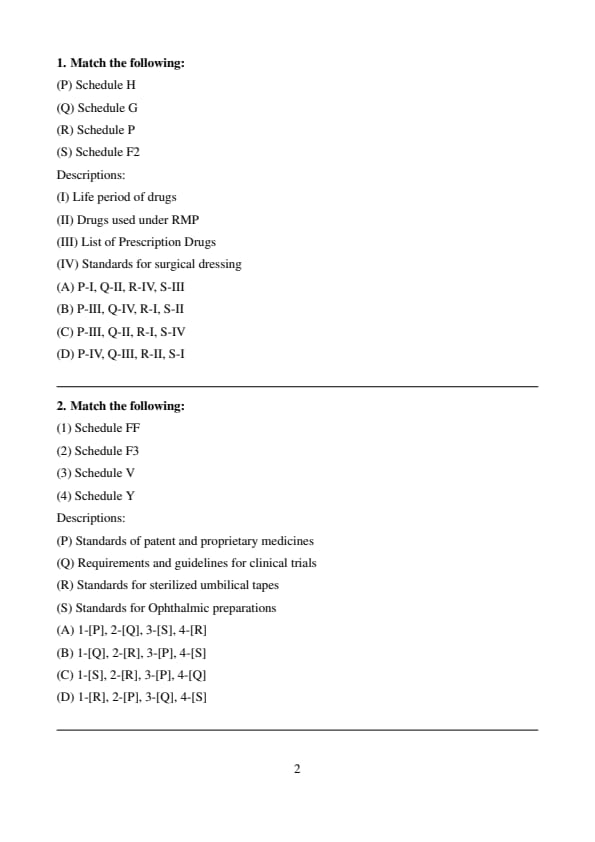
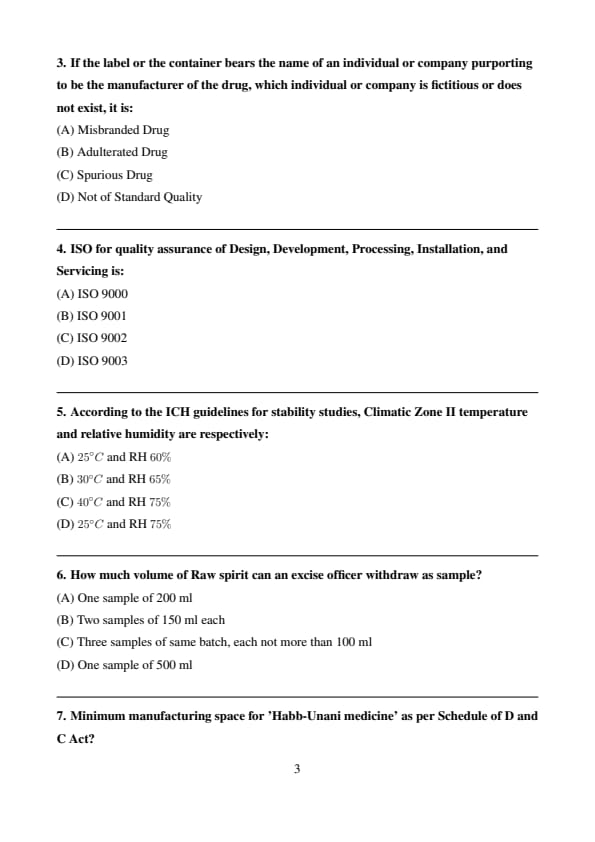
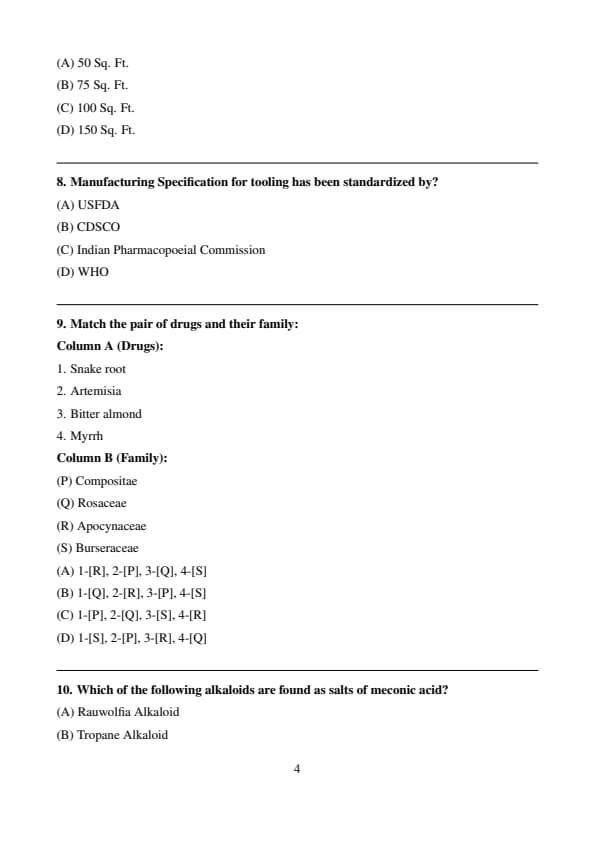
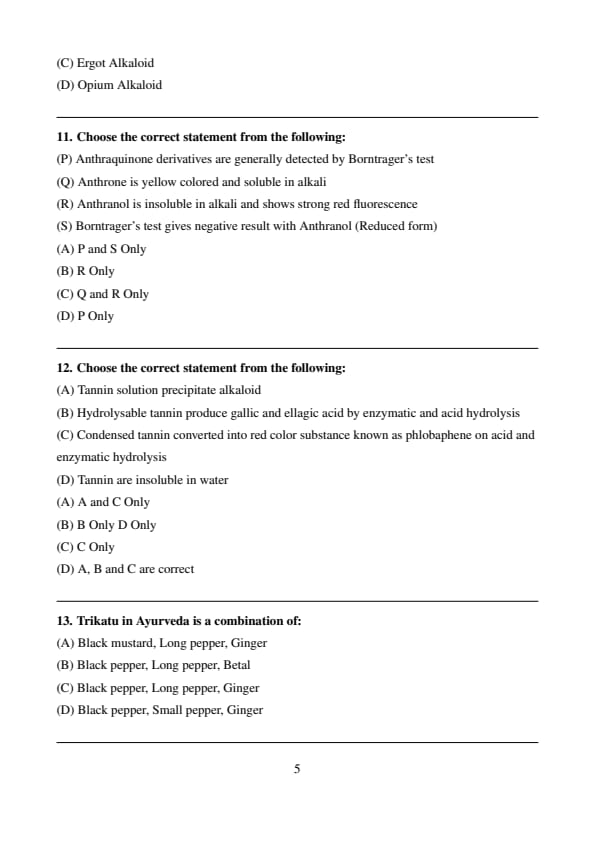
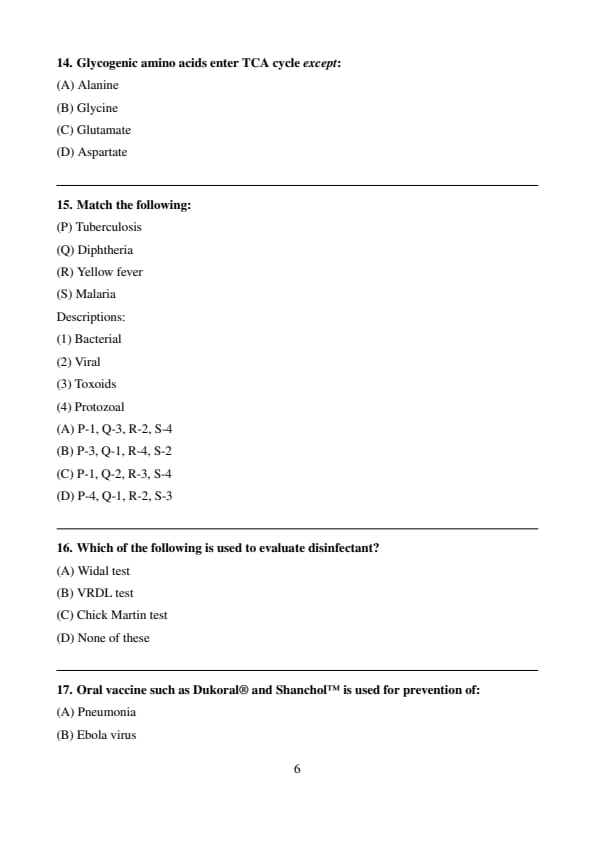
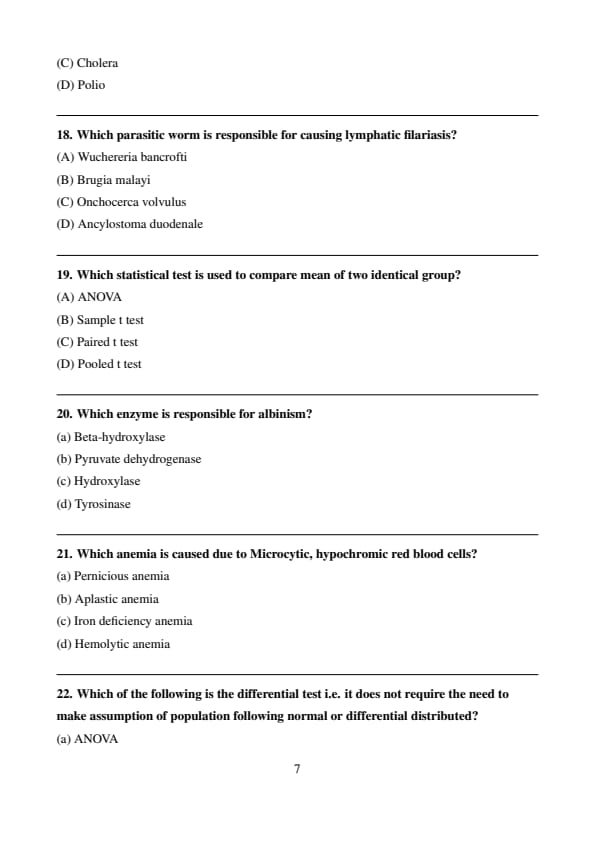

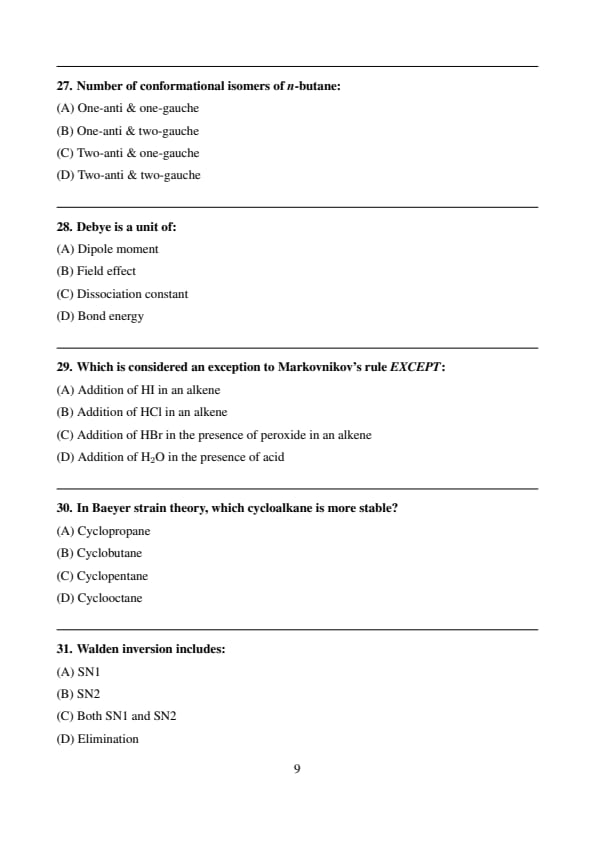
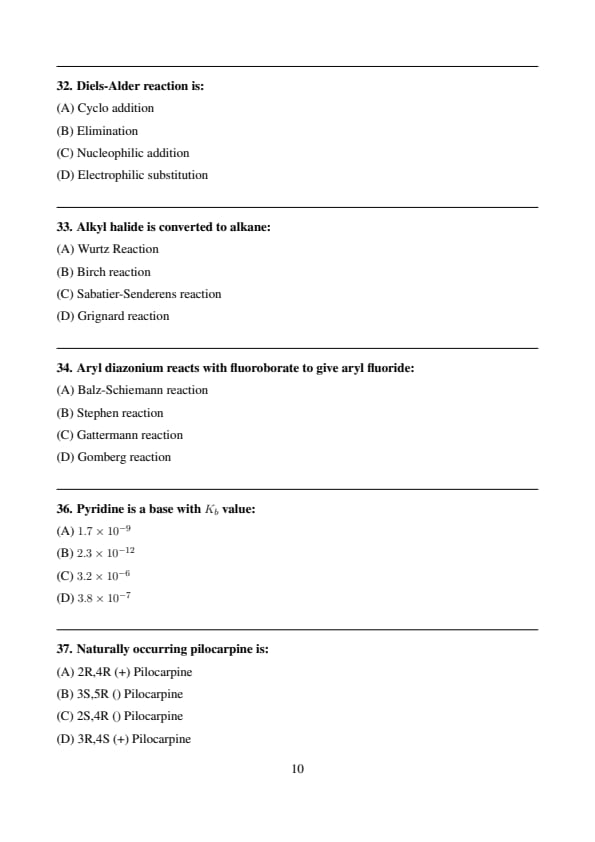
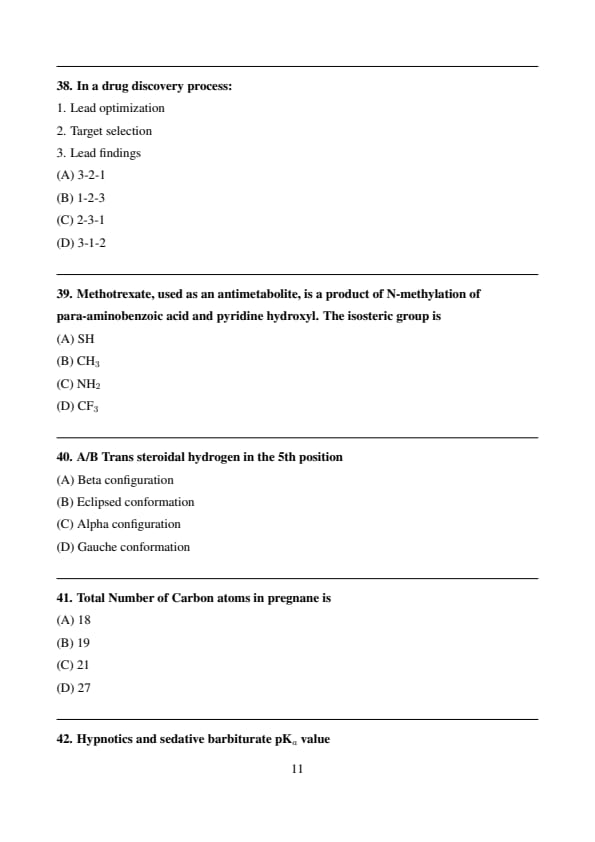
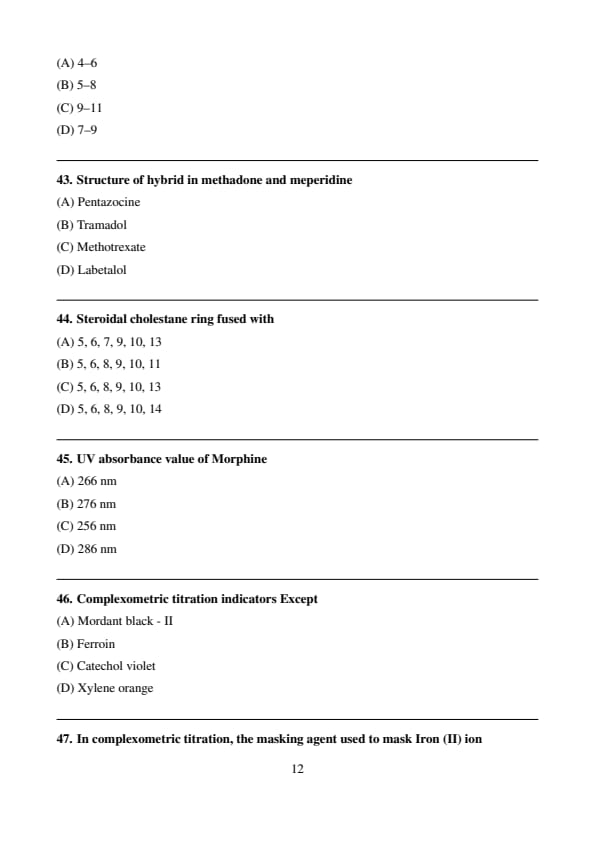
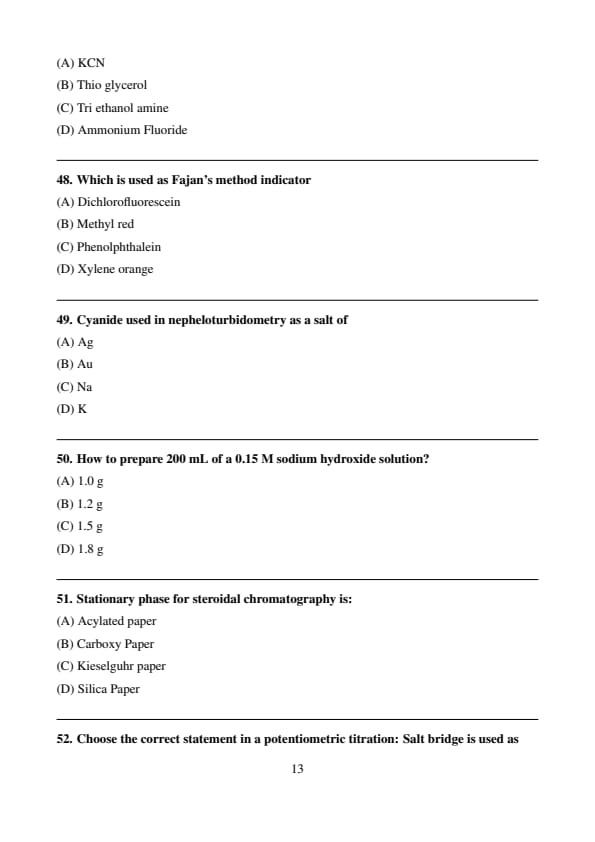
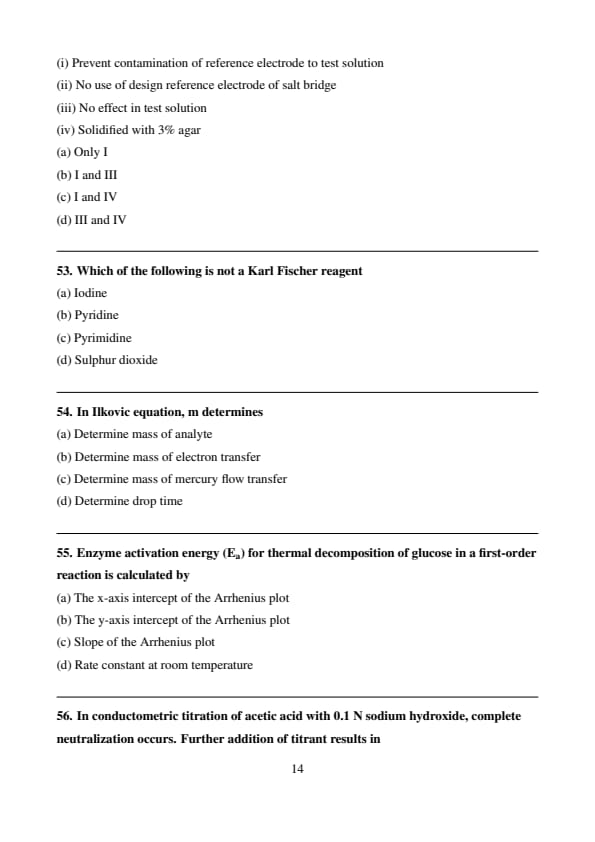
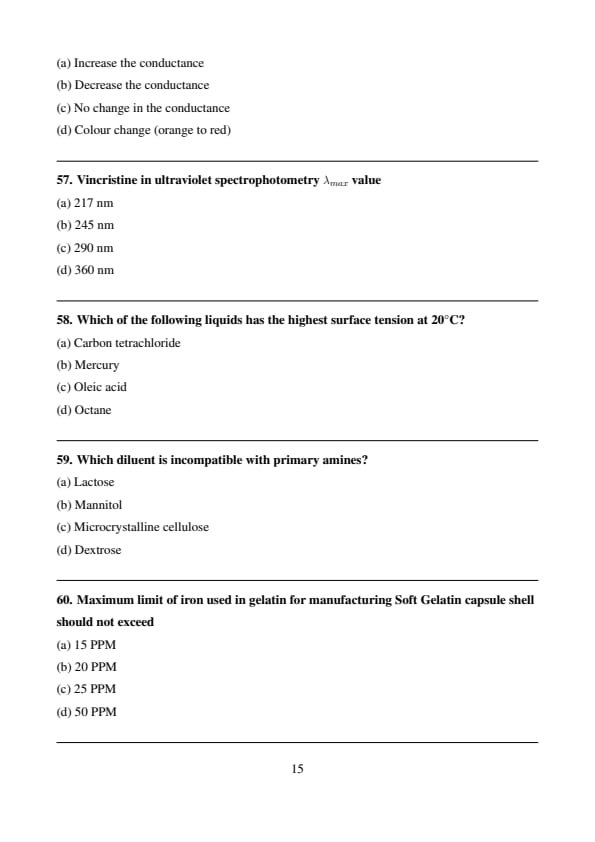
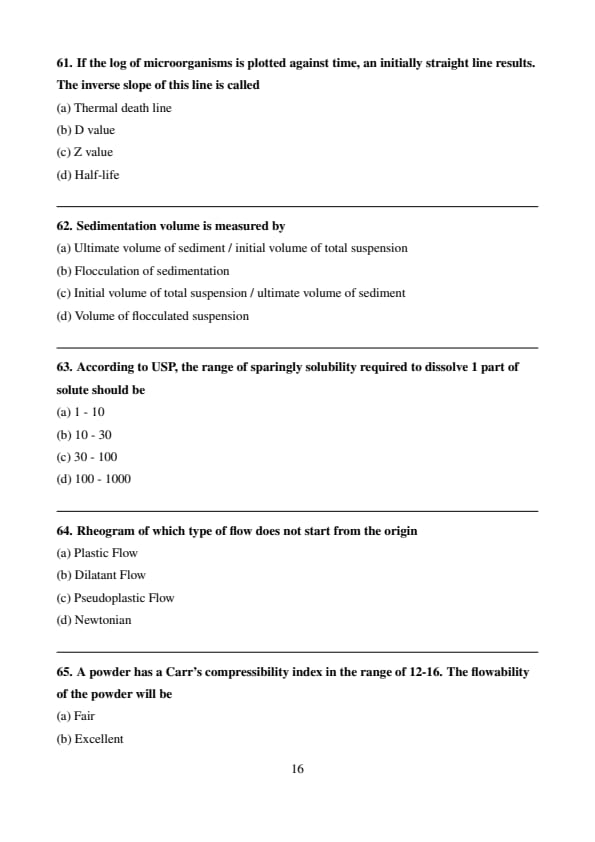
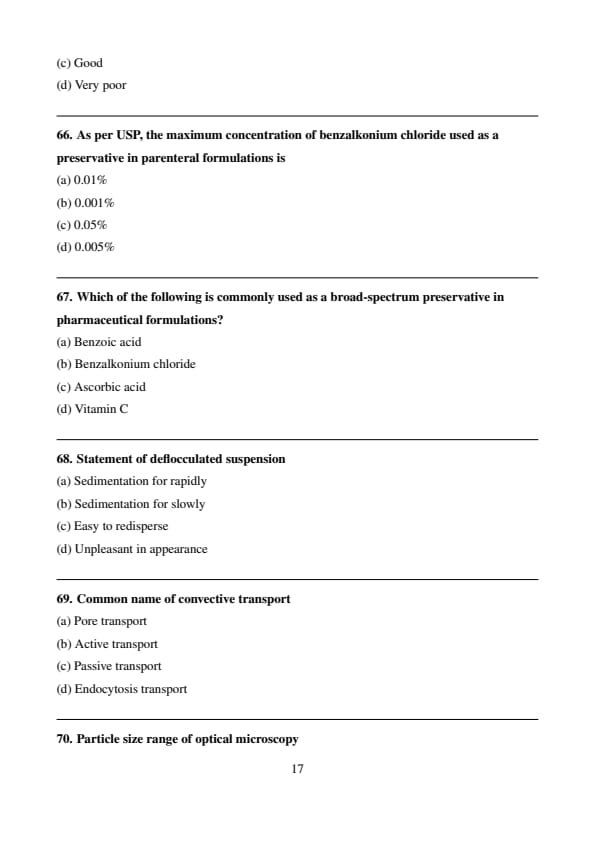
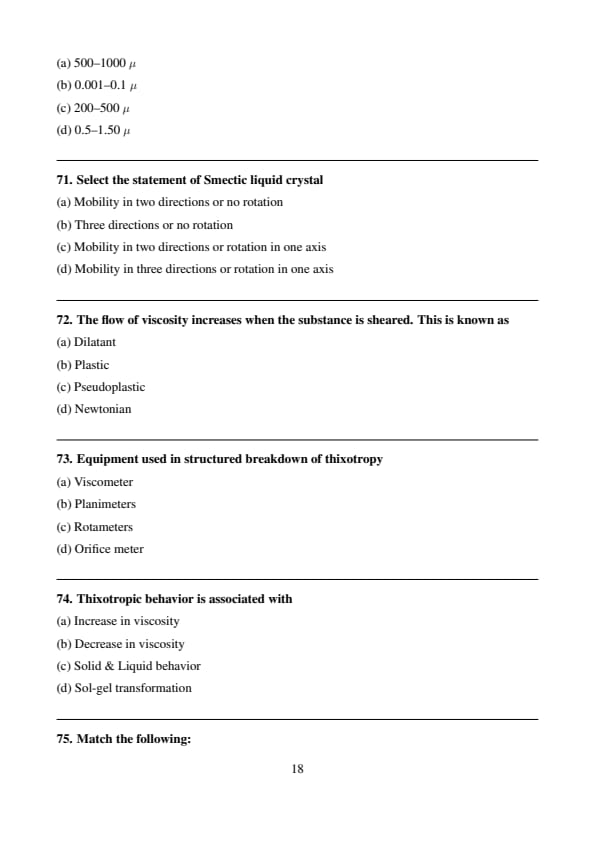
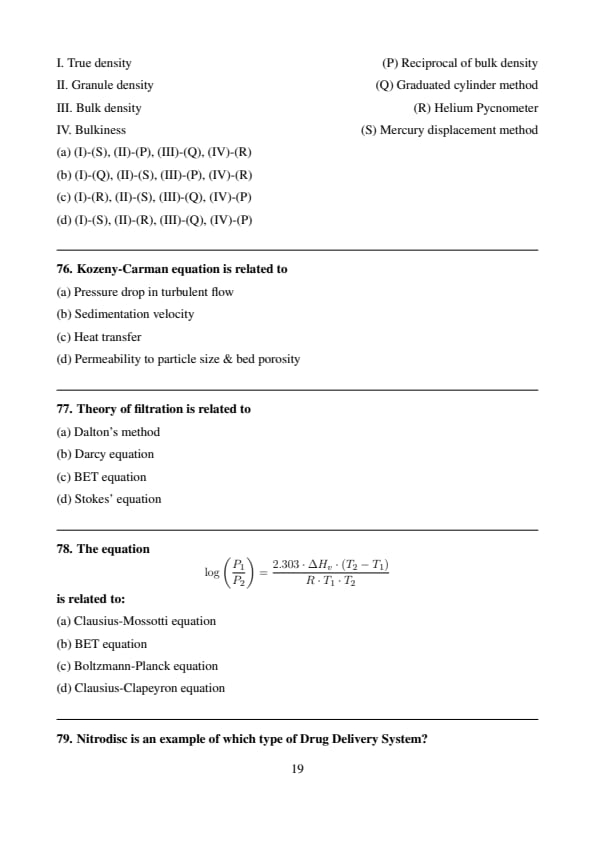
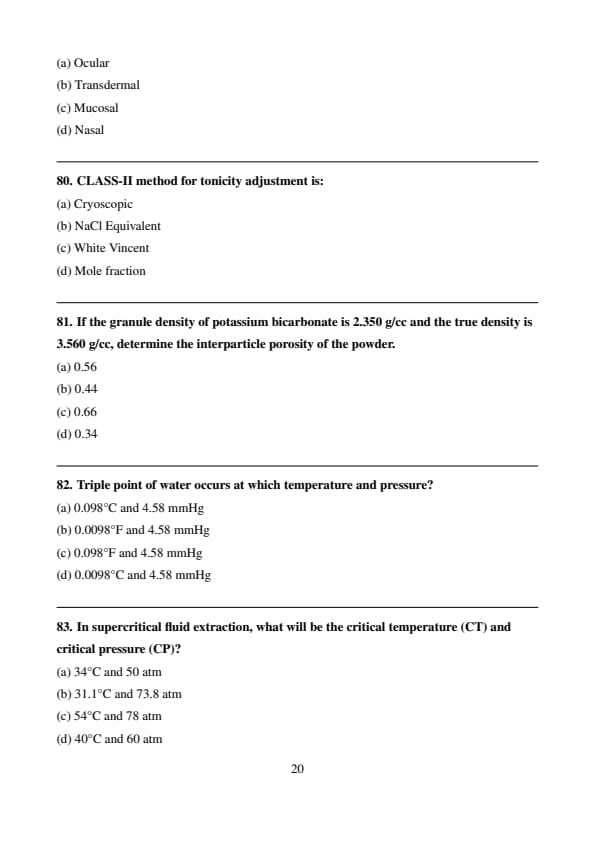
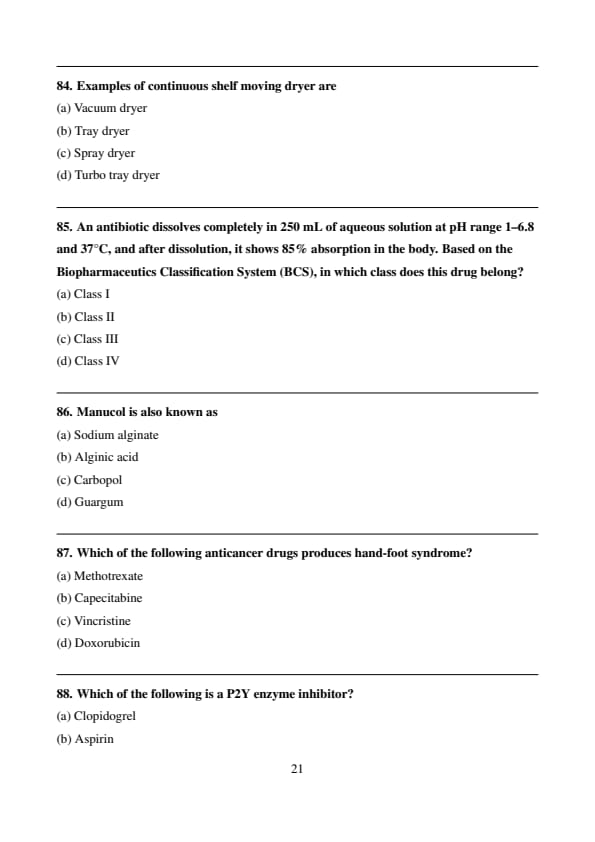
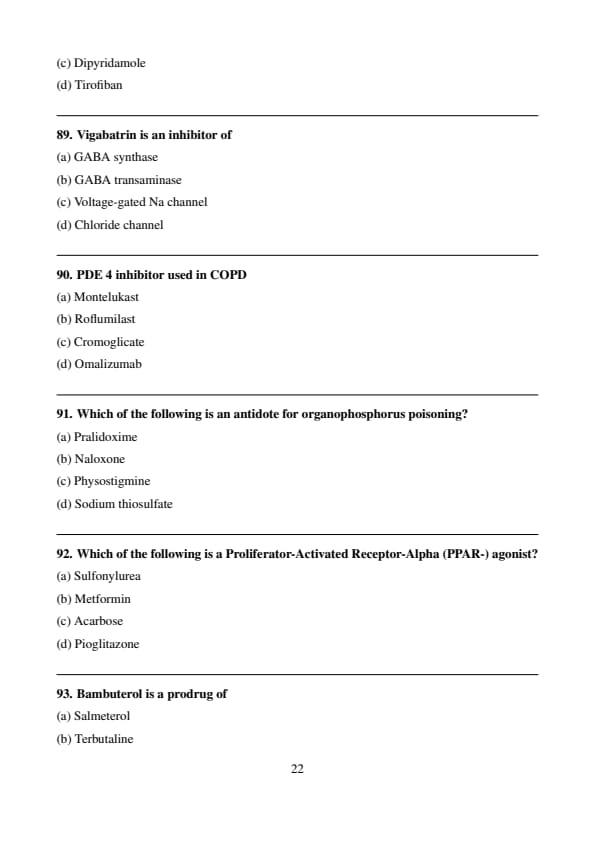
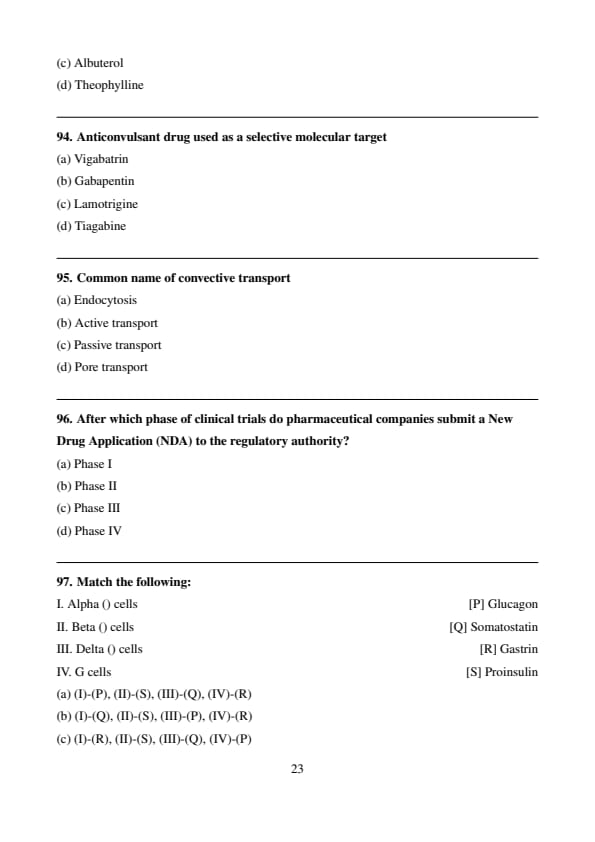
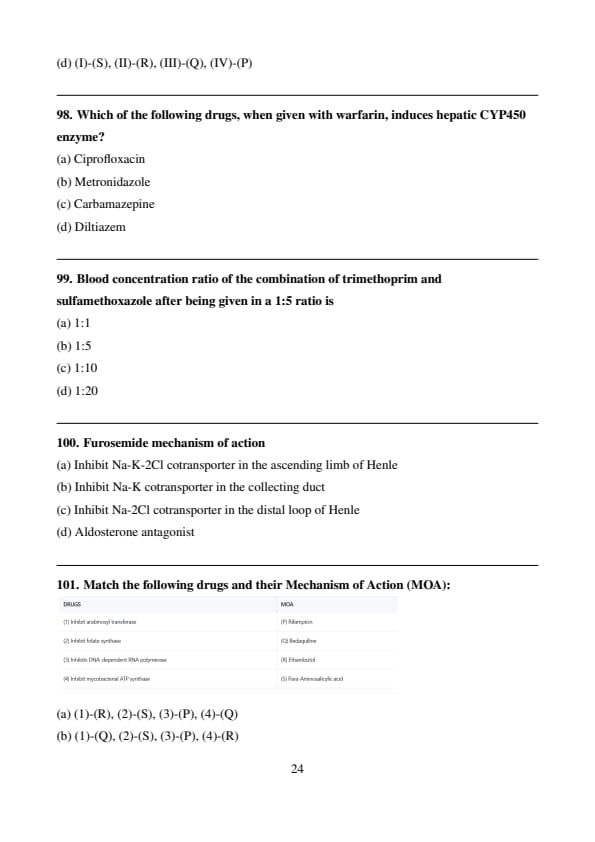
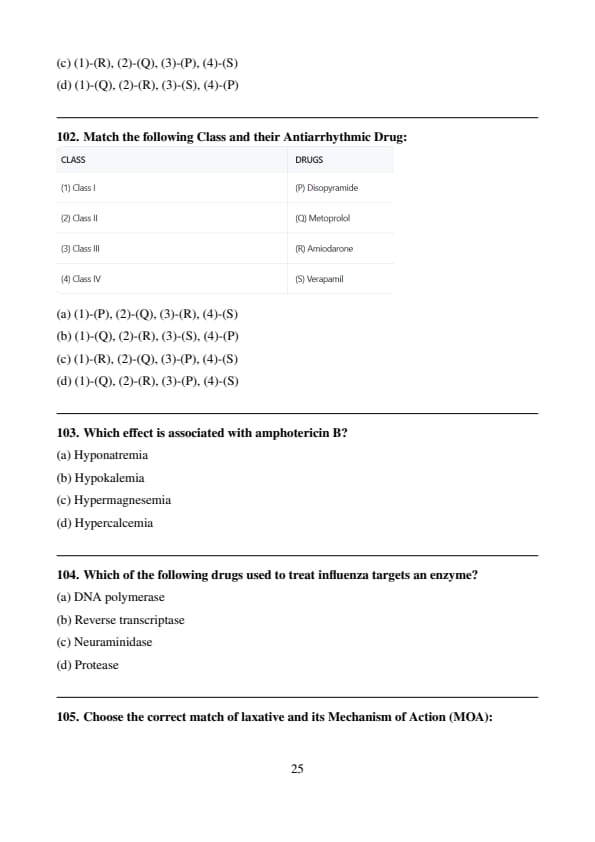
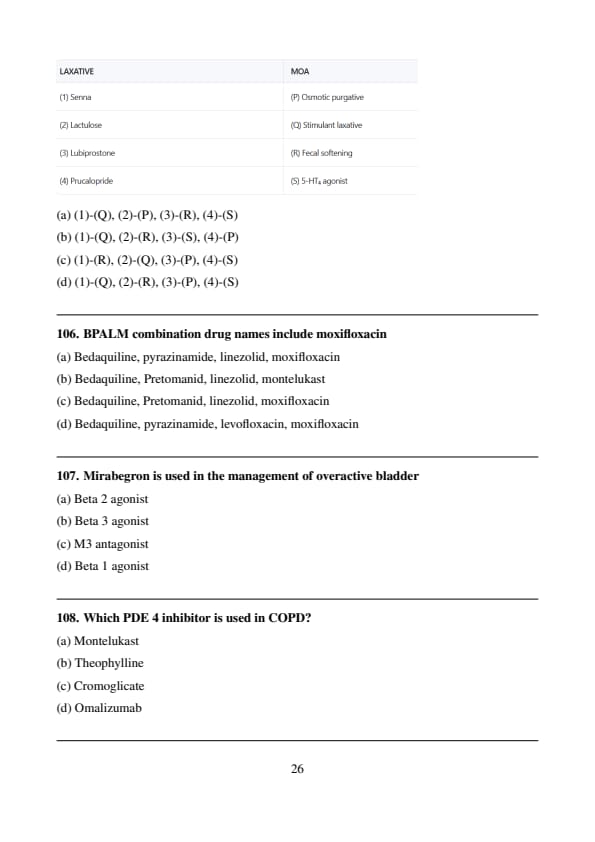
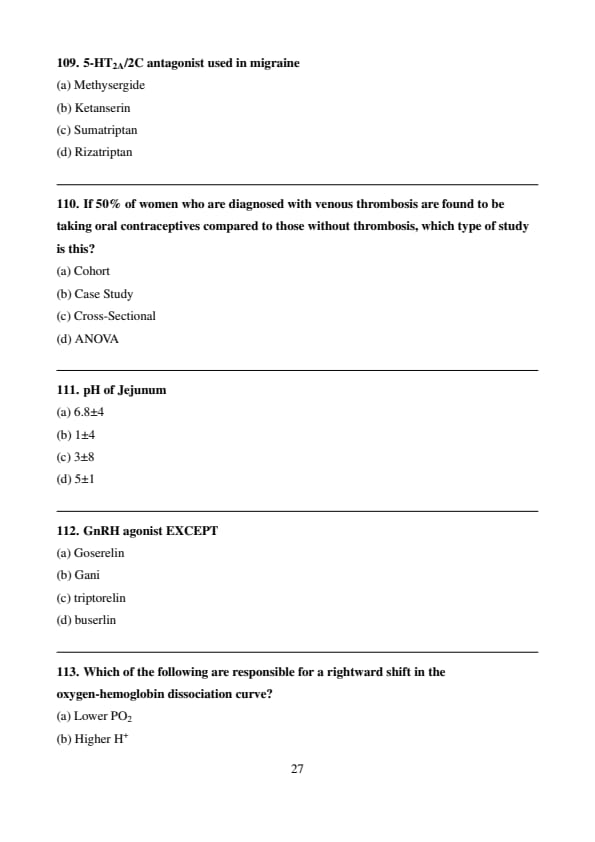
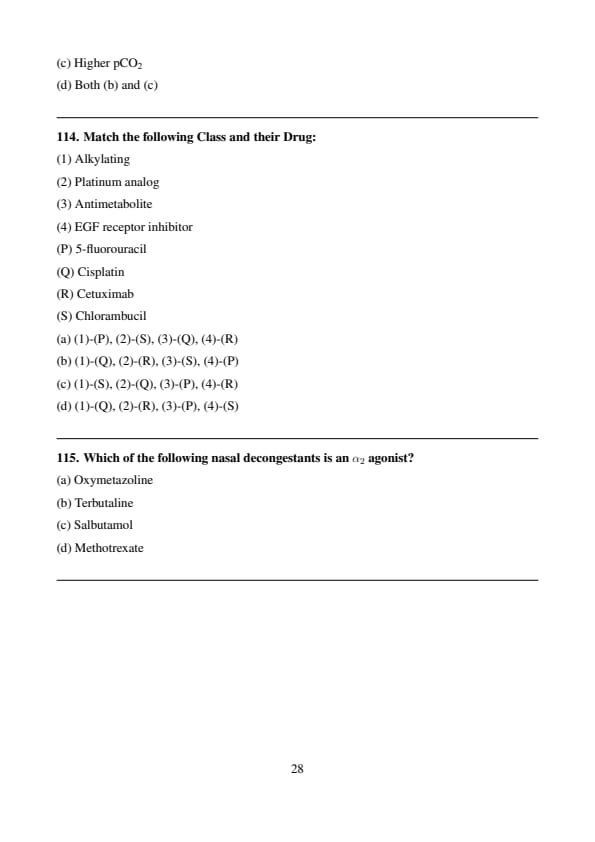
*The article might have information for the previous academic years, please refer the official website of the exam.