
UP Board Class 10 English(Code 817 HM) Question Paper 2024 with Solutions


Content Writer | Updated On - Mar 5, 2025
UP Board Class 10 English Question Paper 2024 PDF (Code 817 HM) is available for download here. The English exam was conducted on March 4, 2024 in the Morning Shift from 8:30 AM to 11:45 AM. The total marks for the theory paper are 70. Students reported the paper to be easy to moderate.
UP Board Class 10 English Question Paper 2024 (Code 817 HM) with Solutions
| UP Board Class 10 English Question Paper With Answer Key | Check Solution |


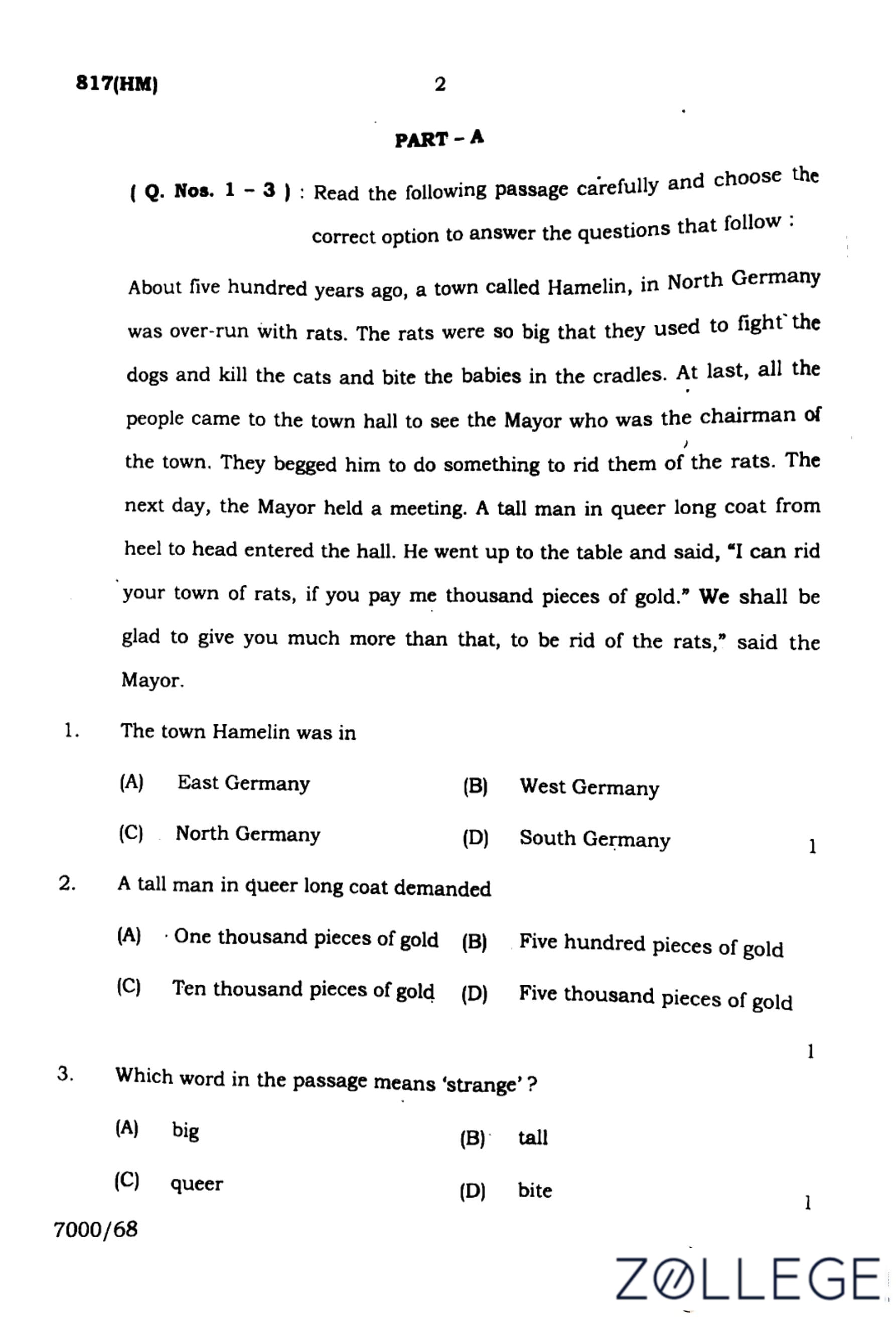
1. The town Hamelin was in
View Solution
The passage mentions that the town of Hamelin is located in North Germany. This is the correct answer.
Quick Tip: Make sure to pay attention to specific details in the passage, such as locations, names, and key events.
A tall man in queer long coat demanded
View Solution
The passage clearly states that the tall man demanded five thousand pieces of gold in exchange for his help in ridding the town of rats. Therefore, the correct answer is (D).
Quick Tip: Pay close attention to numbers and quantities mentioned in the passage to answer such questions.
Which word in the passage means ‘strange’?
View Solution
In the passage, the word "queer" is used to describe the man’s long coat. In this context, "queer" means "strange" or "unusual." Therefore, the correct answer is (C).
Quick Tip: Context clues in the passage can help you figure out the meanings of certain words.
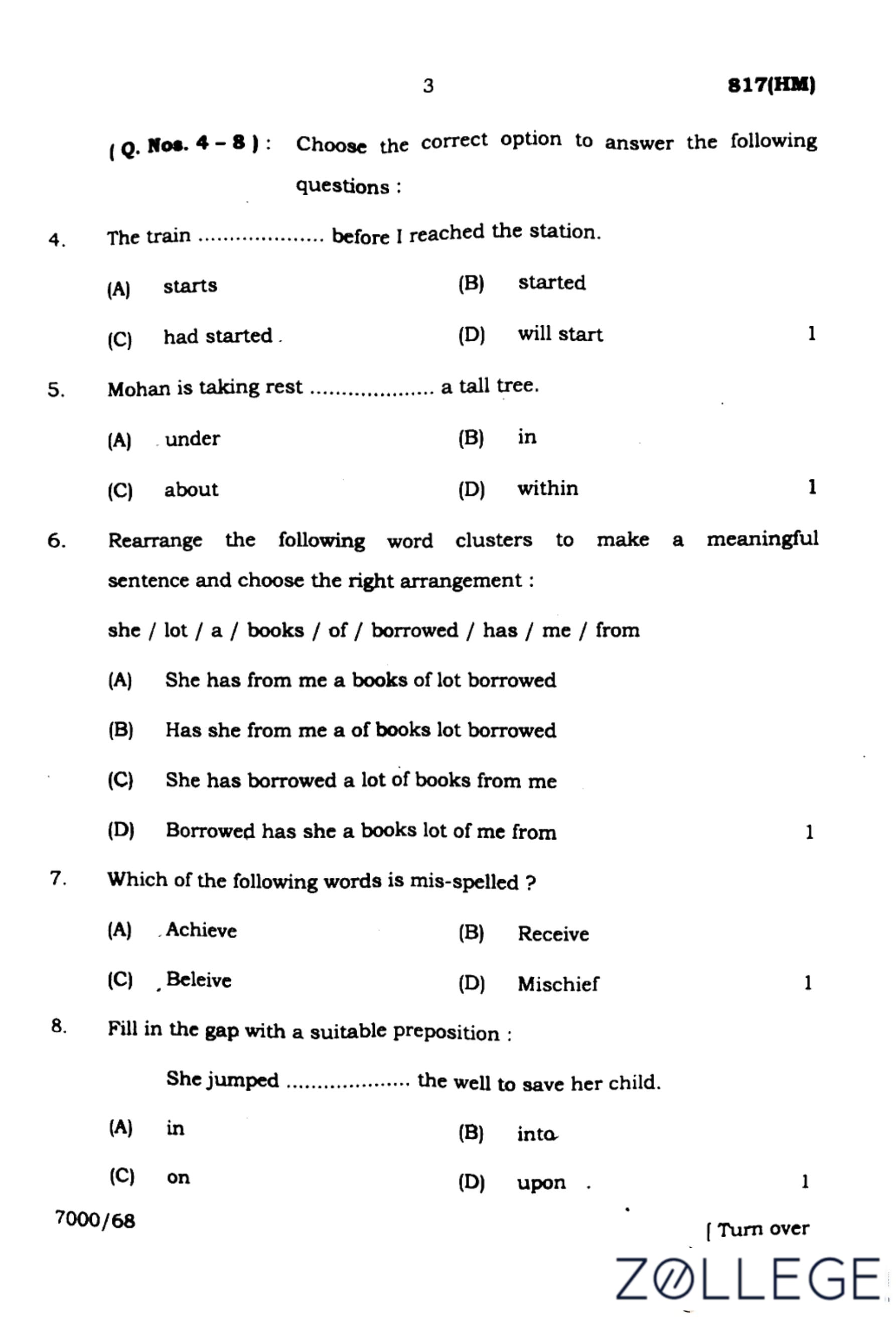
The train ________ before I reached the station.
View Solution
The correct tense here is the past perfect tense, "had started", because the action of the train starting happened before the speaker reached the station. Thus, the correct answer is (C).
Quick Tip: When talking about two actions in the past where one happened before the other, use the past perfect tense for the earlier action.
Mohan is taking rest ________ a tall tree.
View Solution
The correct preposition here is "under," because it refers to being beneath or below the tree. "In" would refer to being inside something, which does not apply to a tree. Hence, (A) is the correct answer.
Quick Tip: When referring to being beneath something, "under" is the most appropriate preposition.
Rearrange the following word clusters to make a meaningful sentence and choose the right arrangement:
View Solution
The correct sentence after rearranging the words is: "She has borrowed a lot of books from me." The other options have incorrect word order or grammar.
Quick Tip: When rearranging words, always check for correct word order and subject-verb agreement.
Which of the following words is mis-spelled?
View Solution
The correct spelling is "Believe" (option C has the incorrect spelling). The other words are correctly spelled.
Quick Tip: Be careful with common misspellings like "beleive" (it should be "believe").
Fill in the gap with a suitable preposition:
She jumped _______ the well to save her child.
View Solution
The correct preposition here is "into" because it suggests movement into the well. "In" would imply being inside already, not jumping into it.
Quick Tip: Use "into" for indicating movement towards something, like jumping into a well.
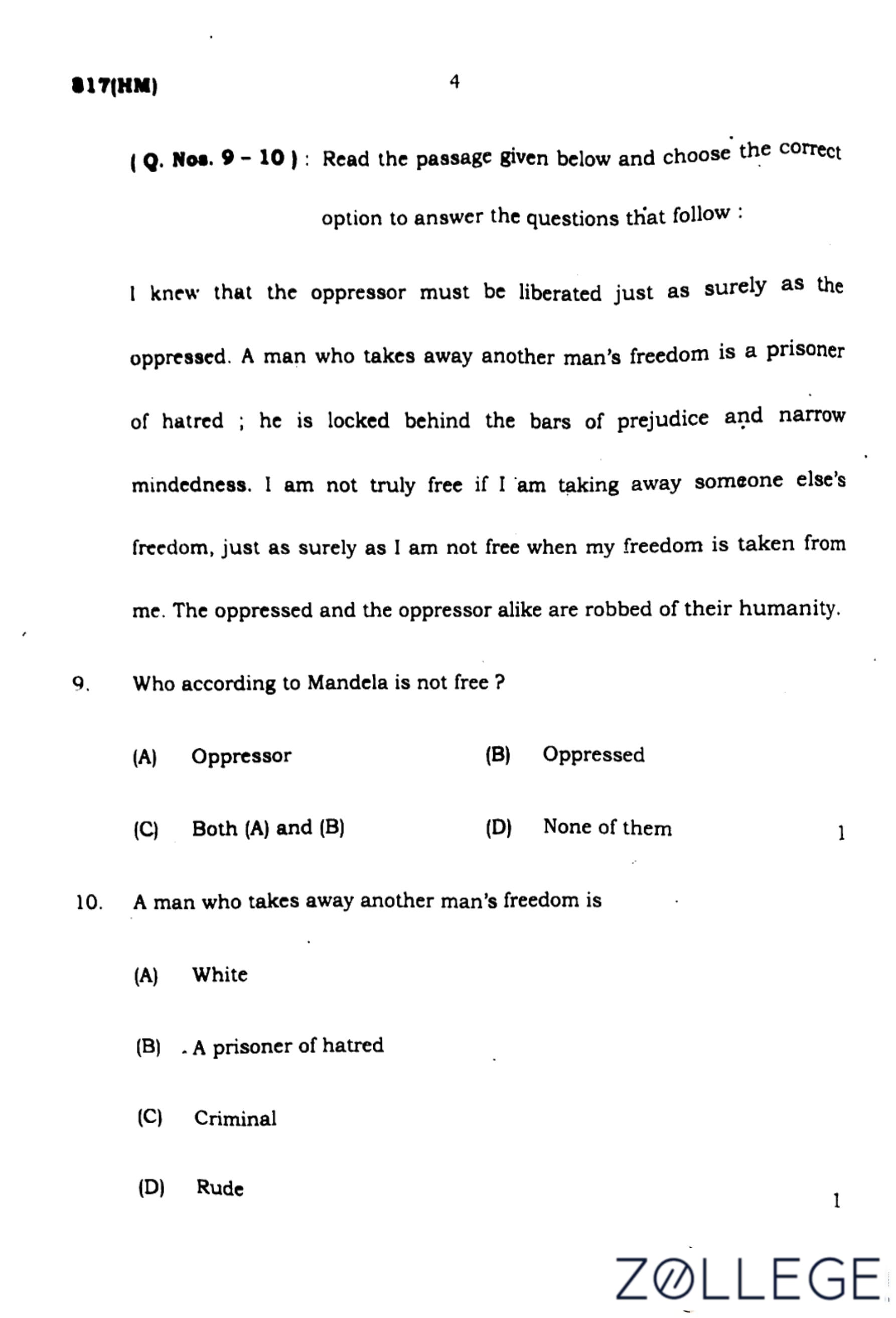
Who according to Mandela is not free?
View Solution
According to Mandela, both the oppressor and the oppressed are not truly free. The oppressor is locked behind the bars of prejudice and hatred, while the oppressed is deprived of their freedom. Therefore, both groups are robbed of their humanity and cannot be considered free.
Quick Tip: Understand the broader implications of freedom in the context of both the oppressed and the oppressor. Freedom involves not just individual liberty but also the responsibility to respect others' freedoms.
A man who takes away another man's freedom is
View Solution
According to Mandela, a man who takes away another man's freedom is not just someone who commits a crime but is also a prisoner of hatred. He is locked behind the bars of prejudice and narrow-mindedness, unable to experience true freedom, just as the oppressed are deprived of their freedom.
Quick Tip: This question reflects the philosophical view that true freedom is not just a matter of personal liberty but also involves respecting others' freedoms.
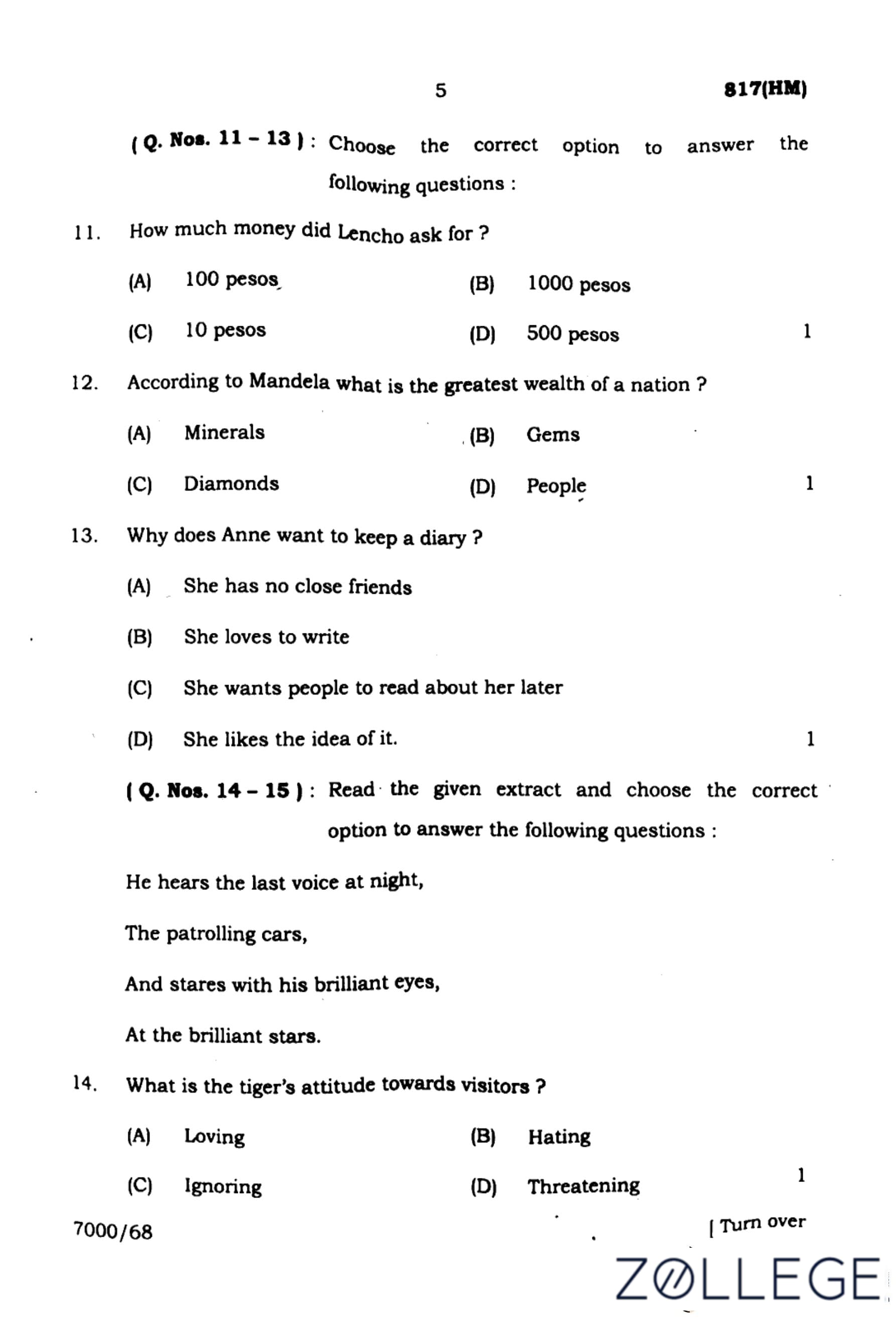
How much money did Lencho ask for?
View Solution
In the story "A Letter to God," Lencho asked for 100 pesos from God to help him recover from the damages caused by the hailstorm. He believed that the money would help him replant his crops and provide for his family during the hardship.
Quick Tip: Lencho asked for 100 pesos, showing his faith in God and his belief in divine intervention to help him in times of trouble.
According to Mandela, what is the greatest wealth of a nation?
View Solution
According to Nelson Mandela, the greatest wealth of a nation is its people. He emphasizes that the strength and unity of a nation come from the people who form the backbone of society, not material wealth like minerals or gems.
Quick Tip: Mandela's view emphasizes the power of unity and social harmony as a source of national strength.
Why does Anne want to keep a diary?
View Solution
Anne Frank wanted to keep a diary because she had no close friends to confide in. The diary became her confidant, allowing her to express her feelings, thoughts, and experiences during her time in hiding.
Quick Tip: Anne Frank's diary provides a personal and emotional account of her life during the Holocaust. Focus on her introspection and how her writing helped her cope with her circumstances.
14. What is the tiger’s attitude towards visitors?
View Solution
The tiger in the poem remains indifferent to the world around it. It observes the stars with its brilliant eyes and listens to the sounds of the night, but it shows no reaction to visitors. This indicates that the tiger’s attitude is one of indifference, making option (C) Ignoring the correct answer.
Quick Tip: The poem reflects the tiger's freedom and detachment from the human world, symbolizing peace and solitude.
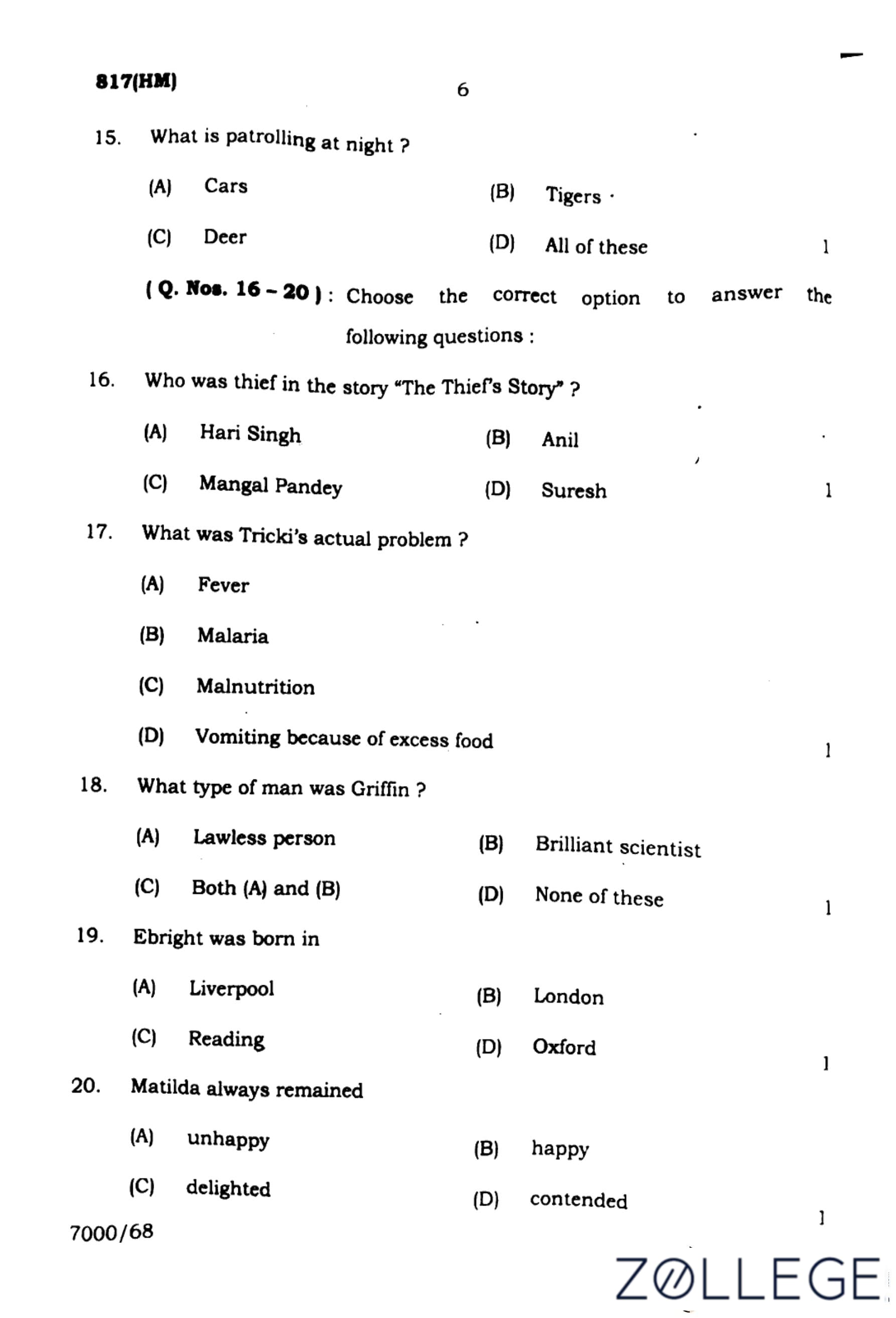
What is patrolling at night?
View Solution
The poem describes a tiger that hears the sounds of the night, including the patrolling cars. It implies that the night is alive with movement, both from cars and animals like tigers, making all these options correct. Therefore, the answer is (D) All of these.
Quick Tip: Look out for descriptive elements in poems that describe both natural and man-made sounds in harmony.
Who was the thief in the story "The Thief's Story"?
View Solution
In the story "The Thief's Story," the character Hari Singh is introduced as the thief who steals from Anil. The plot revolves around his change of heart after receiving Anil's kindness.
Quick Tip: Understanding character development in stories helps in determining motivations, which is key to understanding their actions.
What was Tricki’s actual problem?
View Solution
Tricki's actual problem was vomiting due to overfeeding. Despite being well-fed by his mistress, Tricki's health problems were caused by the excessive food he was given, which led to him vomiting.
Quick Tip: In stories, sometimes the problem may seem more complex, but the solution or issue can be simpler, such as overfeeding leading to vomiting.
What type of man was Griffin?
View Solution
Griffin was a brilliant scientist but he also had lawless tendencies. His desire to experiment led him to do unethical things, and his behavior was characterized by a disregard for the law. Hence, both options (A) and (B) apply to him.
Quick Tip: Griffin’s character shows that intelligence without ethics can lead to destructive actions.
Ebright was born in
View Solution
Ebright was born in Reading. His early life and environment played a crucial role in shaping his interest in science. Reading is also where he developed his passion for biology, which led to his later groundbreaking work.
Quick Tip: Understanding the early influences on a scientist's life can help you understand their motivation and passion for their field.
Matilda always remained
View Solution
Matilda, a character in the story, always remained unhappy because of her treatment at home. Her circumstances made her feel discontent, and despite her beauty and intelligence, she was often overshadowed by her family's lack of appreciation for her.
Quick Tip: Look for the emotional traits of characters in stories, which often help us understand the core conflict or themes.
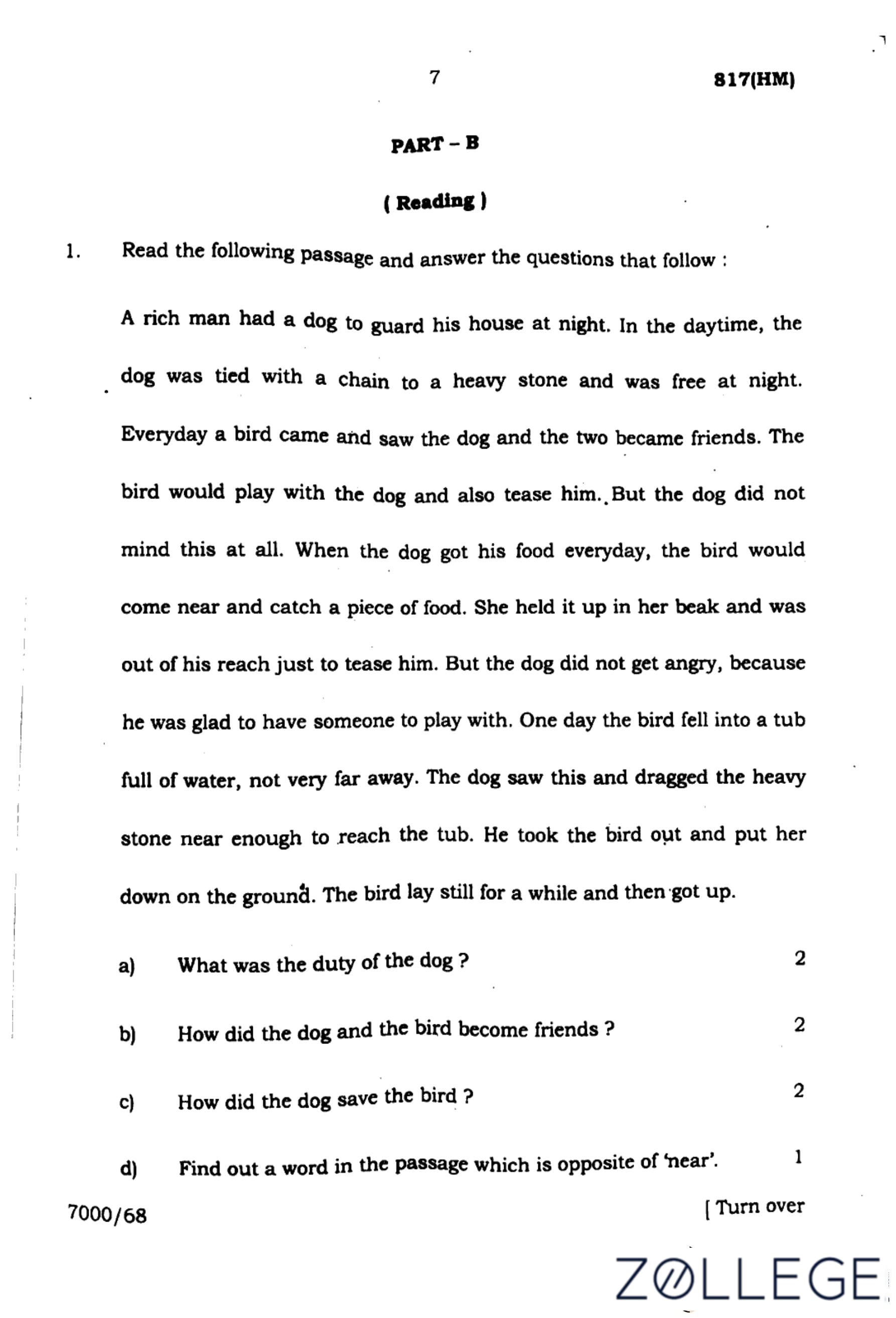
What was the duty of the dog ?
View Solution
The duty of the dog was to guard the house of the rich man at night. The dog was tied to a heavy stone during the day but was free at night to perform this duty of guarding the house.
Quick Tip: A dog’s primary role as a guardian is to stay alert, even if it does not act immediately.
How did the dog and the bird become friends ?
View Solution
The dog and the bird became friends when the bird came every day to see the dog. The bird would play with the dog and also tease him. The dog did not mind and was happy to have someone to play with.
Quick Tip: Friendship between animals is often depicted in literature as a symbol of companionship beyond species.
How did the dog save the bird ?
View Solution
The dog saved the bird when it fell into a tub full of water. The dog saw this and dragged the heavy stone near enough to the tub to reach it. The dog then took the bird out and put her down on the ground.
Quick Tip: A loyal pet will often show incredible resourcefulness in times of need, proving their strong bond with their owners or friends.
Find out a word in the passage which is opposite of ‘near’.
View Solution
The word opposite to 'near' in the passage is 'far'.
Quick Tip: Understanding opposites is essential for improving vocabulary and comprehension skills.
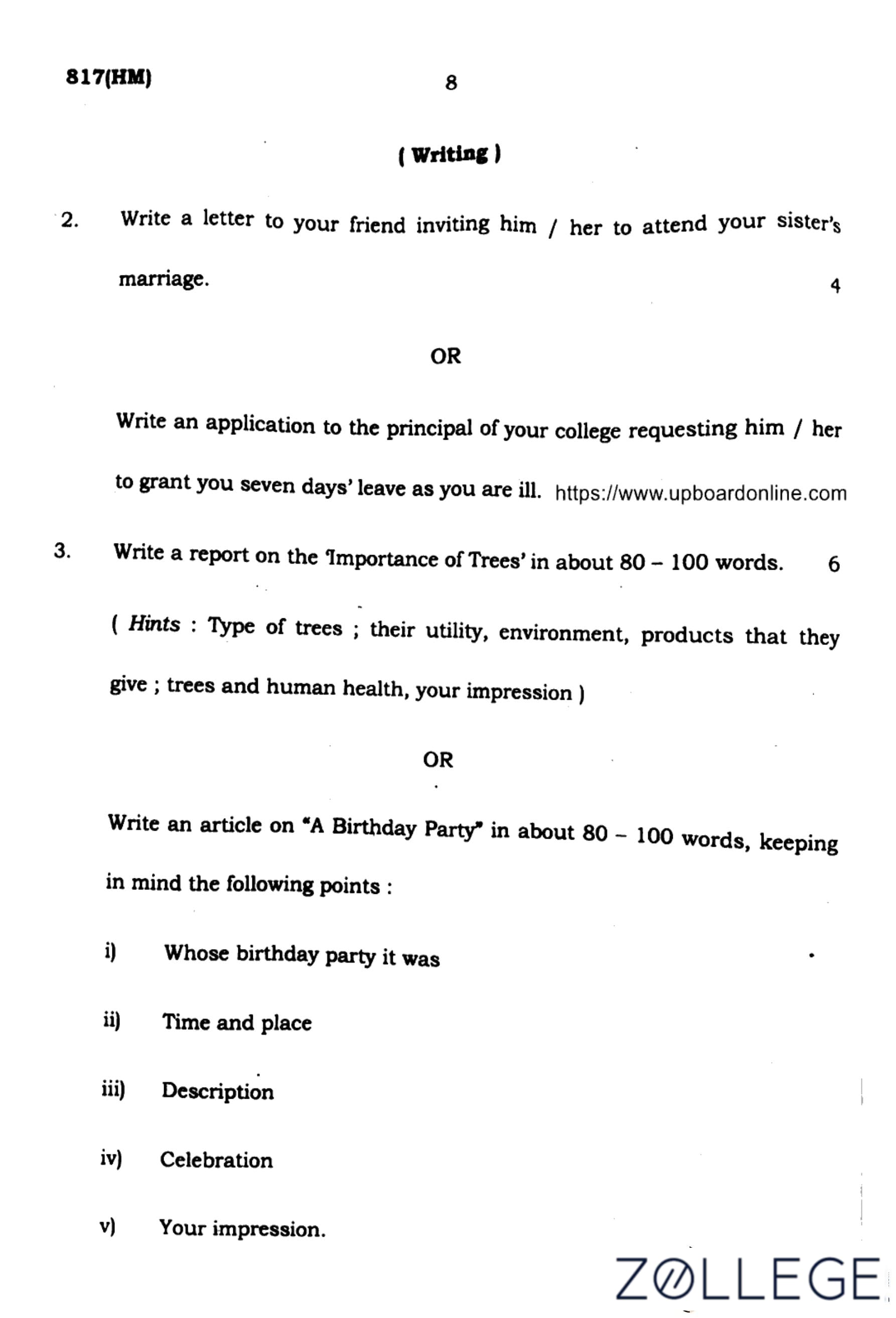
Write a letter to your friend inviting him/her to attend your sister's marriage.
View Solution
[Your Name]
[Your Address]
[City, Zip Code]
[Date]
Dear [Friend's Name],
I hope this letter finds you in the best of health and spirits. I am writing to invite you to a very special occasion in our family. My sister's marriage has been fixed, and the ceremony will take place on [Date] at [Venue]. I would be honored if you could attend and bless the couple. Your presence will make the occasion even more memorable.
Looking forward to seeing you at the wedding.
Yours lovingly,
[Your Name]
Quick Tip: When writing formal invitations, ensure to include all the relevant details such as the date, venue, and time of the event.
Write an application to the principal of your college requesting him/her to grant you seven days’ leave as you are ill.
View Solution
[Your Name]
[Your Roll Number]
[Class, Section]
[College Name]
[Date]
The Principal,
[College Name],
[City Name]
Subject: Application for Sick Leave
Respected Sir/Madam,
I am writing to inform you that I am suffering from [mention illness, e.g., fever, cold] and I am unable to attend college for the next few days. I kindly request you to grant me seven days of sick leave starting from [start date]. I assure you that I will complete any missed assignments or lectures as soon as I am well.
I hope for your understanding and approval.
Yours sincerely,
[Your Name]
Quick Tip: Always provide a valid reason and be polite when requesting leave. Attach a medical certificate if required.
Write a report on the 'Importance of Trees' in about 80-100 words.
View Solution
Importance of Trees
Trees are essential for the health of the environment and life on Earth. They absorb carbon dioxide and provide oxygen, helping to combat climate change. Trees support biodiversity by offering habitat to various animals and insects. They also help in conserving water, preventing soil erosion, and reducing noise pollution. Moreover, trees provide humans with food, medicinal products, and materials like wood. They enhance the beauty of the environment and improve mental well-being. Thus, it is crucial to protect and plant more trees to ensure a sustainable future.
Quick Tip: Make sure to include the environmental, ecological, and human benefits of trees in your report.
Write an article on "A Birthday Party" in about 80-100 words, keeping in mind the following points:
View Solution
A Birthday Party
Last week, I attended my friend’s birthday party at her house. The event was held at 5:00 PM, and it was filled with joy and laughter. The house was beautifully decorated with balloons, streamers, and colorful lights. There were games such as musical chairs and a treasure hunt. The highlight of the evening was the cutting of the birthday cake, followed by everyone singing "Happy Birthday." The party had delicious snacks and drinks. It was a fun-filled evening where all the guests had a wonderful time celebrating with the birthday girl.
Quick Tip: In describing a party, make sure to cover the key elements such as time, place, activities, and your overall impressions.
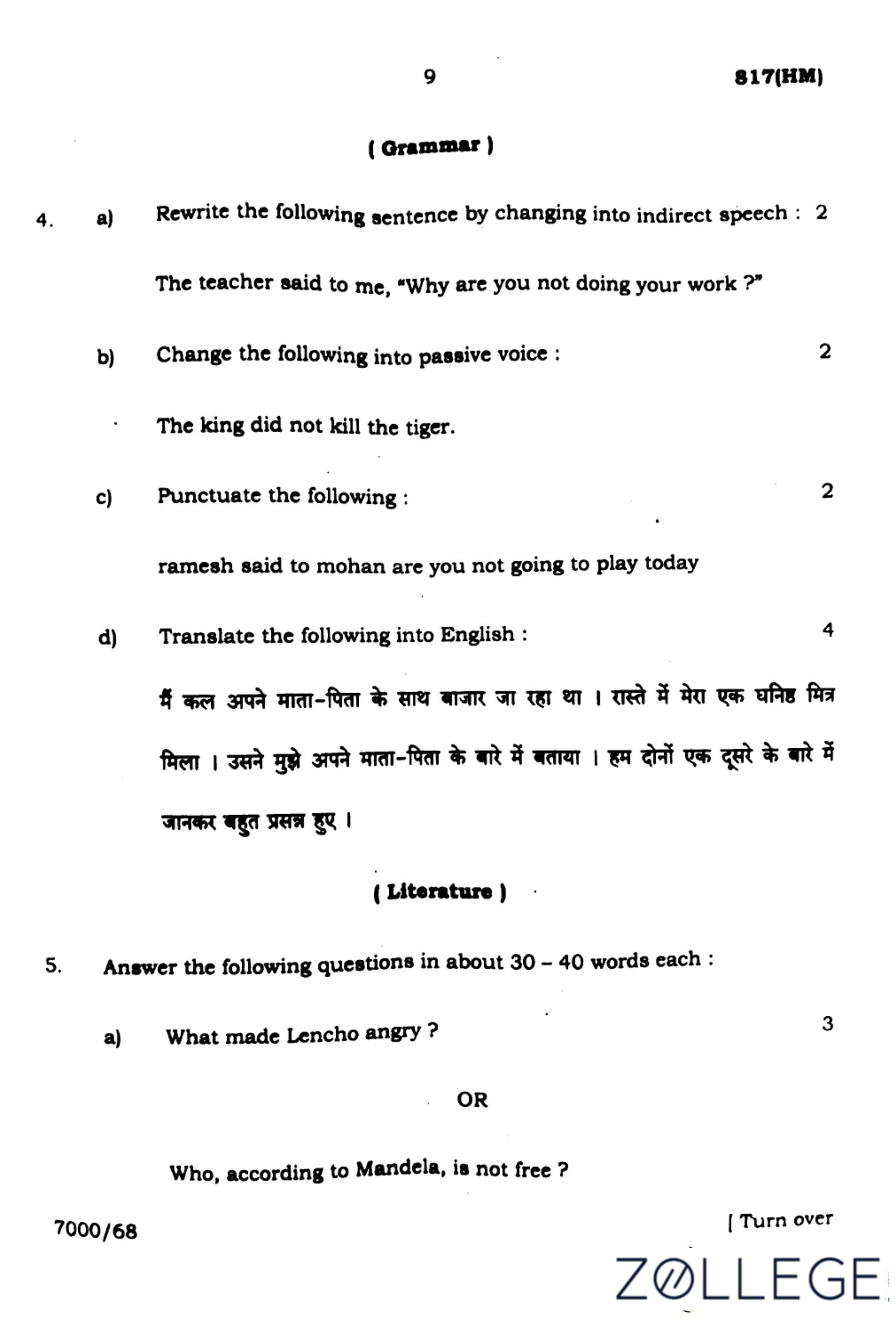
The teacher said to me, "Why are you not doing your work?"
View Solution
The teacher asked me why I was not doing my work.
Quick Tip: When converting direct speech to indirect speech, make sure to change the pronouns and verb tenses accordingly.
Change the following into passive voice:
The king did not kill the tiger.
View Solution
The tiger was not killed by the king.
Quick Tip: In passive voice, the object becomes the subject of the sentence, and the verb is changed accordingly.
Punctuate the following:
ramesh said to mohan are you not going to play today
View Solution
Ramesh said to Mohan, "Are you not going to play today?"
Quick Tip: Punctuating speech involves adding commas, quotation marks, and capital letters where appropriate.
Translate the following into English:
View Solution
Yesterday, I was going to the market with my parents. On the way, I met a close friend of mine. He told me about his parents. We both knew about each other.
Quick Tip: When translating, make sure to maintain the meaning of the sentence while adapting it to the structure and flow of the target language.
Answer the following questions in about 30 - 40 words each:
a) What made Lencho angry ?
View Solution
Lencho was angry because the rain that he had hoped for was destroyed by a hailstorm. He blamed God for not helping him and felt that the money he had requested would be his only hope.
Quick Tip: Lencho's reaction highlights the theme of faith and frustration in difficult situations.
Who, according to Mandela, is not free?
View Solution
According to Mandela, both the oppressor and the oppressed are not free. The oppressor is a prisoner of hatred, while the oppressed are robbed of their humanity and freedom.
Quick Tip: Nelson Mandela emphasizes that true freedom involves the liberation of both the oppressed and the oppressor.
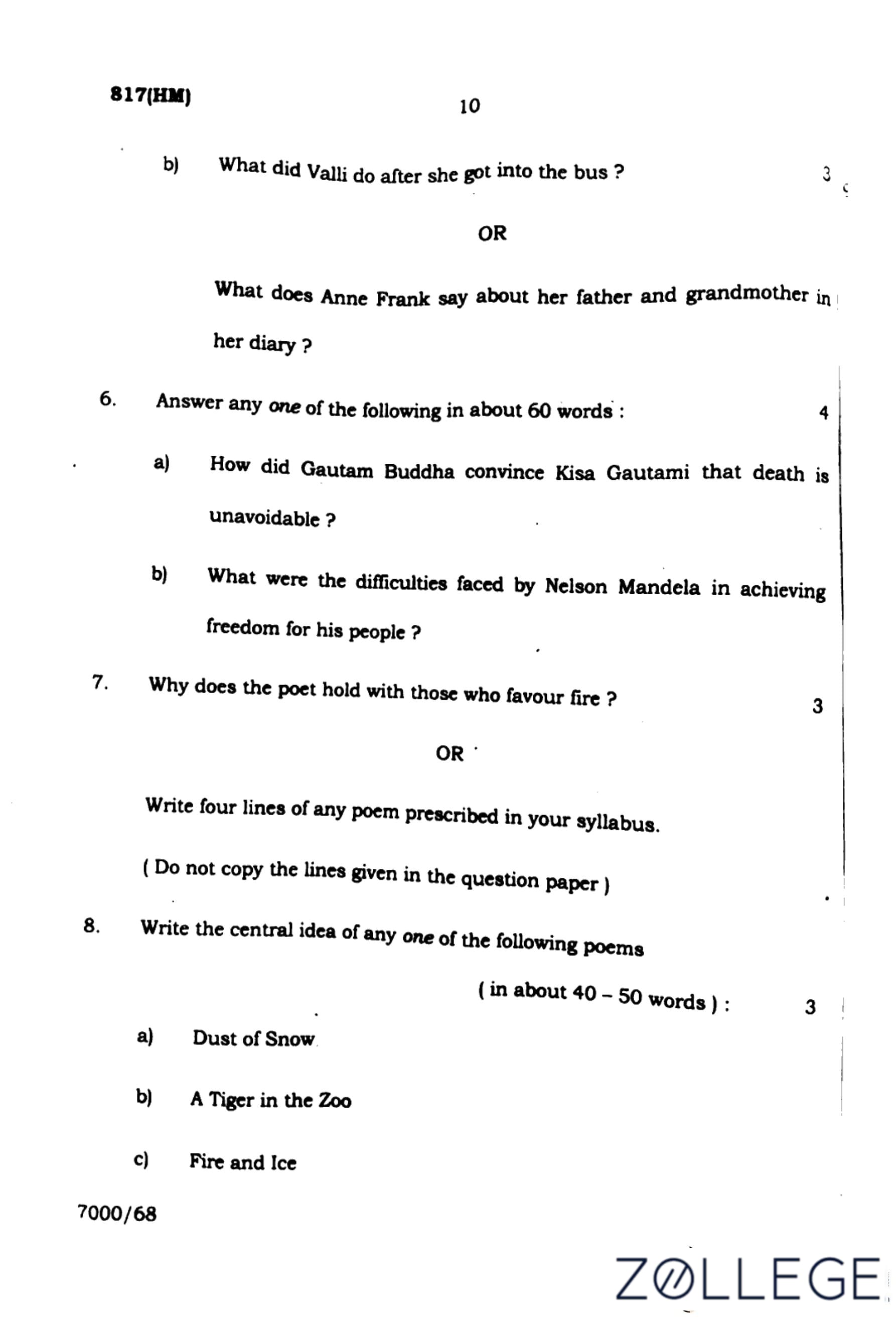
b) What did Valli do after she got into the bus?
View Solution
After getting into the bus, Valli took a seat on the window side and stared out of the window. She was full of excitement, enjoying the views of the unfamiliar sights. She felt like she was on an adventure.
Quick Tip: Valli's excitement represents the joy of exploring the unknown and overcoming personal fears.
a) How did Gautam Buddha convince Kisa Gautami that death is unavoidable?
View Solution
Gautam Buddha convinced Kisa Gautami that death is unavoidable by asking her to find a mustard seed from a house where no one had died. She went to many houses but failed to find any. Finally, she understood that death is a part of life and everyone faces it.
Quick Tip: The story highlights the universality of death and the inevitable truth that no one can escape it.
b) What were the difficulties faced by Nelson Mandela in achieving freedom for his people?
View Solution
Nelson Mandela faced numerous challenges including the apartheid system that legalized racial segregation, discrimination, and the oppression of non-white South Africans. He was imprisoned for 27 years, during which he endured harsh conditions. He also struggled against global political pressures and economic sanctions to gain support for his cause, but his resilience led to the eventual freedom of South Africa.
Quick Tip: Mandela's perseverance and dedication to justice and equality made him a global symbol of resistance and change.
Why does the poet hold with those who favour fire?
View Solution
The poet holds with those who favour fire because fire represents passion, energy, and change. In contrast to water, which symbolizes calmness and stagnation, fire embodies transformation and power. The poet believes that fire’s ability to burn away the old to make space for the new is a necessary force for progress and growth.
Quick Tip: Fire is a powerful symbol of change and destruction, often associated with renewal and energy.
Write four lines of any poem prescribed in your syllabus.
View Solution
Here are four lines from the poem "The Road Not Taken" by Robert Frost:
Two roads diverged in a yellow wood,
And sorry I could not travel both
And be one traveler, long I stood
And looked down one as far as I could
Quick Tip: When answering questions on poetry, make sure to mention the title and poet if needed. The focus should be on the content and meaning of the lines.
a) Dust of Snow:
View Solution
The central idea of "Dust of Snow" is the healing power of nature. A small act, like a snowflake falling on the poet, brings a moment of joy that changes his mood for the better. It emphasizes how nature can uplift and refresh the human spirit.
Quick Tip: Look for the poem's emotional transformation or shift to identify its central idea.
b) A Tiger in the Zoo:
View Solution
"A Tiger in the Zoo" reflects the contrast between the tiger's majestic, wild nature and its confined existence in the zoo. The poem illustrates the sadness and frustration of the tiger, which is meant to roam freely but is trapped in a cage, far from its natural habitat.
Quick Tip: Pay attention to the mood and contrast in poems, as it often reveals the central idea.
c) Fire and Ice:
View Solution
"Fire and Ice" by Robert Frost reflects on the destructive nature of human emotions. The poet compares fire (representing desire and passion) and ice (representing hate and indifference), discussing how both have the potential to destroy the world. It explores the duality of emotions leading to destruction.
Quick Tip: Look for symbolism in the elements described in the poem. Fire and ice are used metaphorically to represent intense emotions.
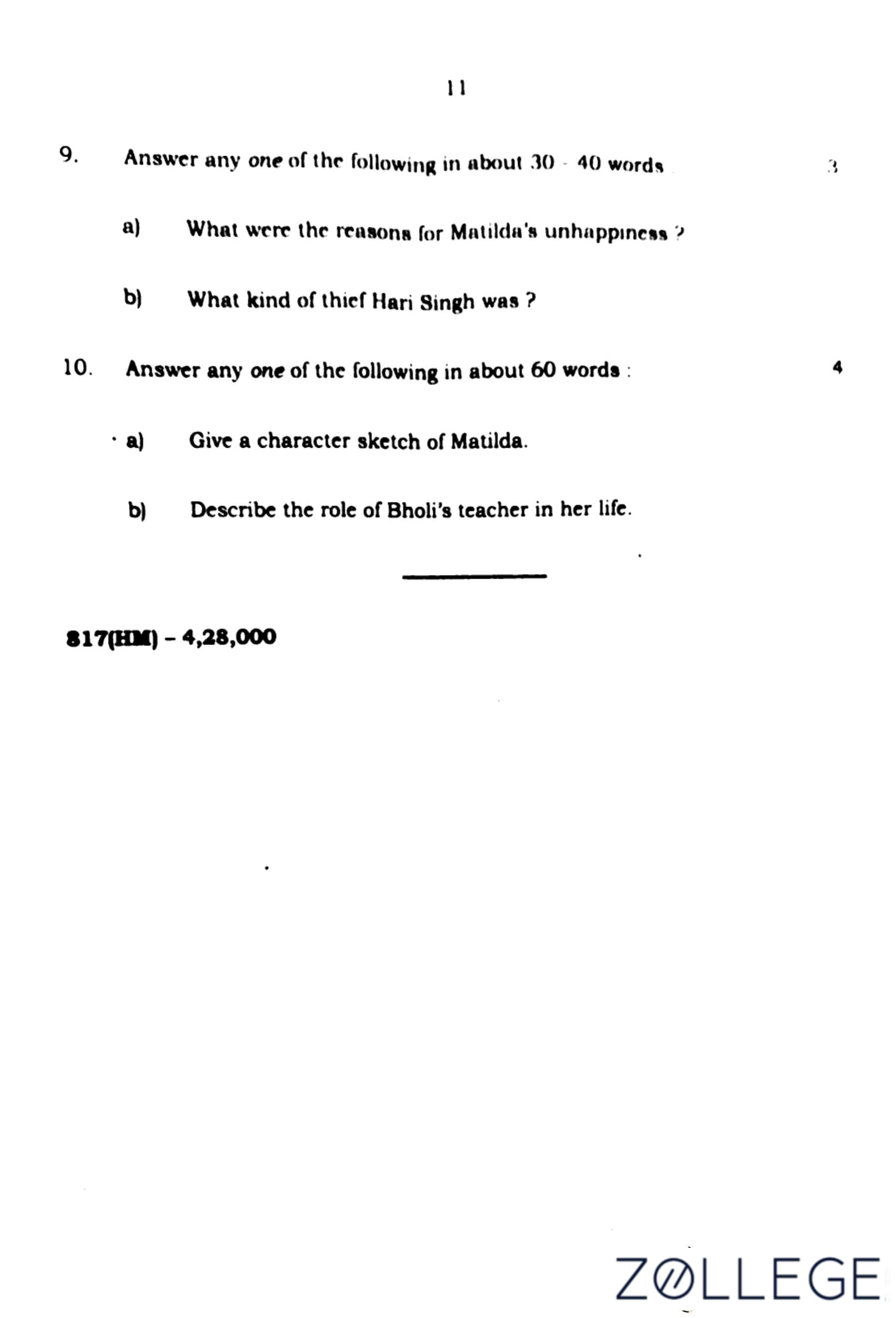
Answer any one of the following in about 30 - 40 words:
a) What were the reasons for Matilda’s unhappiness?
View Solution
Matilda was unhappy because she was born into a poor family and desired a lavish lifestyle. She felt dissatisfied with her modest life and believed she deserved wealth and luxury, leading to her constant dissatisfaction.
Quick Tip: Matilda's dissatisfaction stems from her desire for a life of luxury, which blinds her to the happiness in her current life.
b) What kind of thief Hari Singh was?
View Solution
Hari Singh was a skilled and clever thief who stole from those who trusted him. He was able to gain the trust of his victims, including Anil, and was able to steal money without being caught, showing his cunning nature.
Quick Tip: Hari Singh’s ability to deceive and manipulate people illustrates his cleverness, but his actions reveal his moral downfall.
Answer any one of the following in about 60 words:
a) Give a character sketch of Matilda.
View Solution
Matilda was a beautiful but unhappy woman, dissatisfied with her life. She craved luxury and wealth, and her vanity led her to borrow an expensive necklace. Her desire for materialism caused her to lose everything, reflecting her lack of appreciation for the simple joys in life and her poor judgment.
Quick Tip: Matilda's character highlights the consequences of vanity and materialism, teaching us the importance of contentment and gratitude.
b) Describe the role of Bholi’s teacher in her life.
View Solution
Bholi’s teacher played a vital role in transforming her life. He encouraged her to speak and taught her to be confident. Through his support, Bholi was able to overcome her fear and low self-esteem. His efforts helped her to express herself and lead a better life, proving the power of education.
Quick Tip: Bholi’s teacher’s role exemplifies how the right guidance and encouragement can help overcome fears and unlock potential.
*The article might have information for the previous academic years, please refer the official website of the exam.