
UP Board Class 10 Mathematics(Code 822 HV) Question Paper 2024 with Solutions


Content Writer | Updated On - Feb 27, 2025
UP Board Class 10 Mathematics Question Paper 2024 PDF (Code 822 HV) is available for download here. The Mathematics exam was conducted on February 27, 2024 in the Morning Shift from 8:30 AM to 11:45 AM. The total marks for the theory paper are 70. Students reported the paper to be moderate.
UP Board Class 10 Mathematics Question Paper 2024 (Code 822 HV) with Solutions
| UP Board Class 10 Mathematics Question Paper With Answer Key | Check Solution |


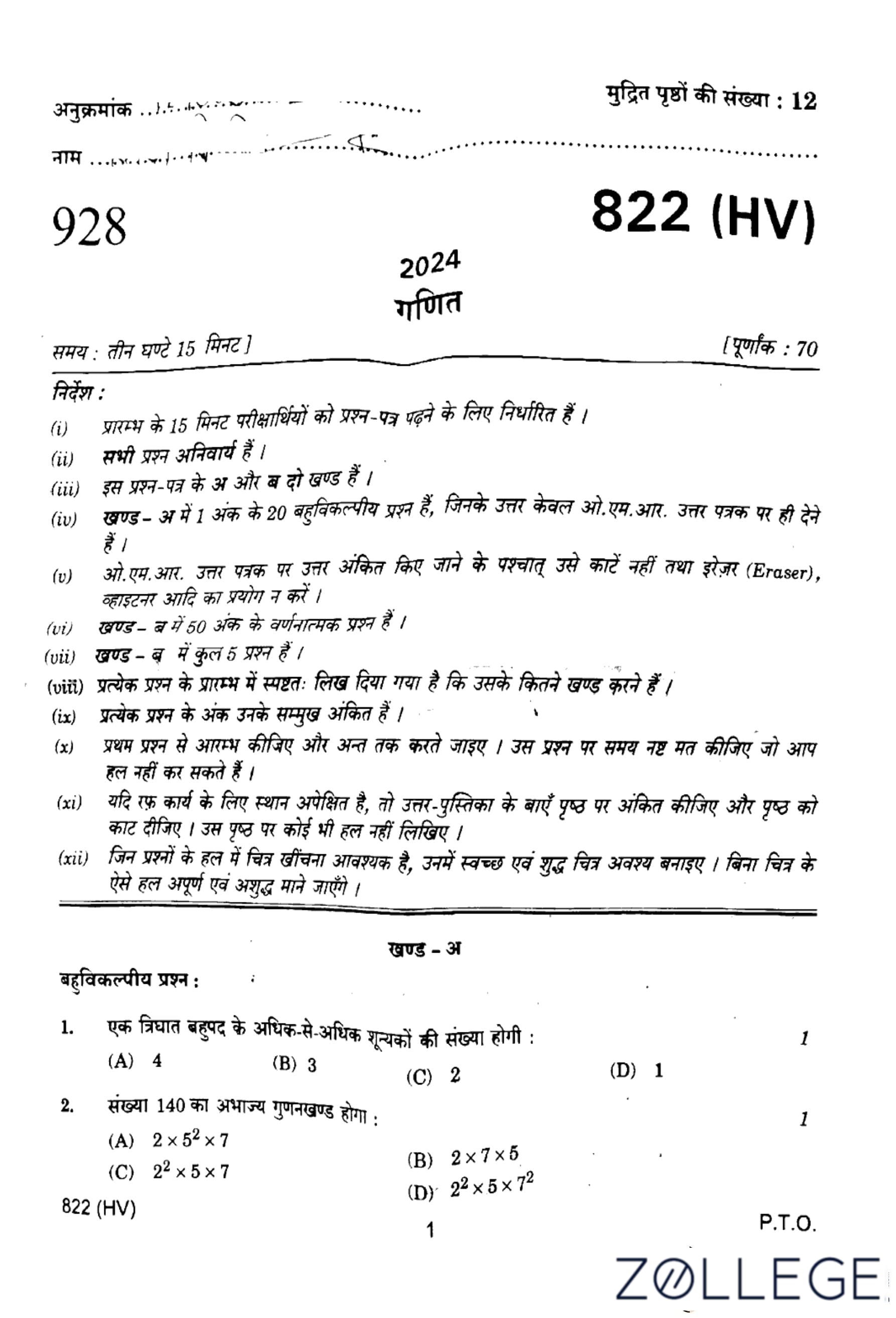
Maximum number of zeroes of a cubic polynomial will be:
View Solution
Step 1: Consider the degree of a cubic polynomial, which is 3.
Step 2: Apply the Fundamental Theorem of Algebra, which states that a polynomial of degree \(n\) has exactly \(n\) roots.
Step 3: Conclude that a cubic polynomial has three roots, which are the zeroes of the polynomial. Quick Tip: The roots of a polynomial can be real or complex, and some roots may repeat. Always consider the possibility of complex roots when dealing with polynomials.
Prime factors of number 140 will be:
View Solution
Step 1: Start with the given number 140.
Step 2: Divide 140 by the smallest prime number, which is 2. \[ 140 \div 2 = 70. \]
Step 3: Divide the quotient by 2 again. \[ 70 \div 2 = 35. \]
Step 4: Now divide 35 by the next smallest prime, which is 5. \[ 35 \div 5 = 7. \]
Step 5: The remaining quotient is 7, which is a prime number.
Step 6: Compile the results to express the prime factors of 140. \[ 140 = 2^2 \times 5 \times 7. \] Quick Tip: For efficient prime factorization, continuously divide by the smallest prime until reaching a prime number or 1.
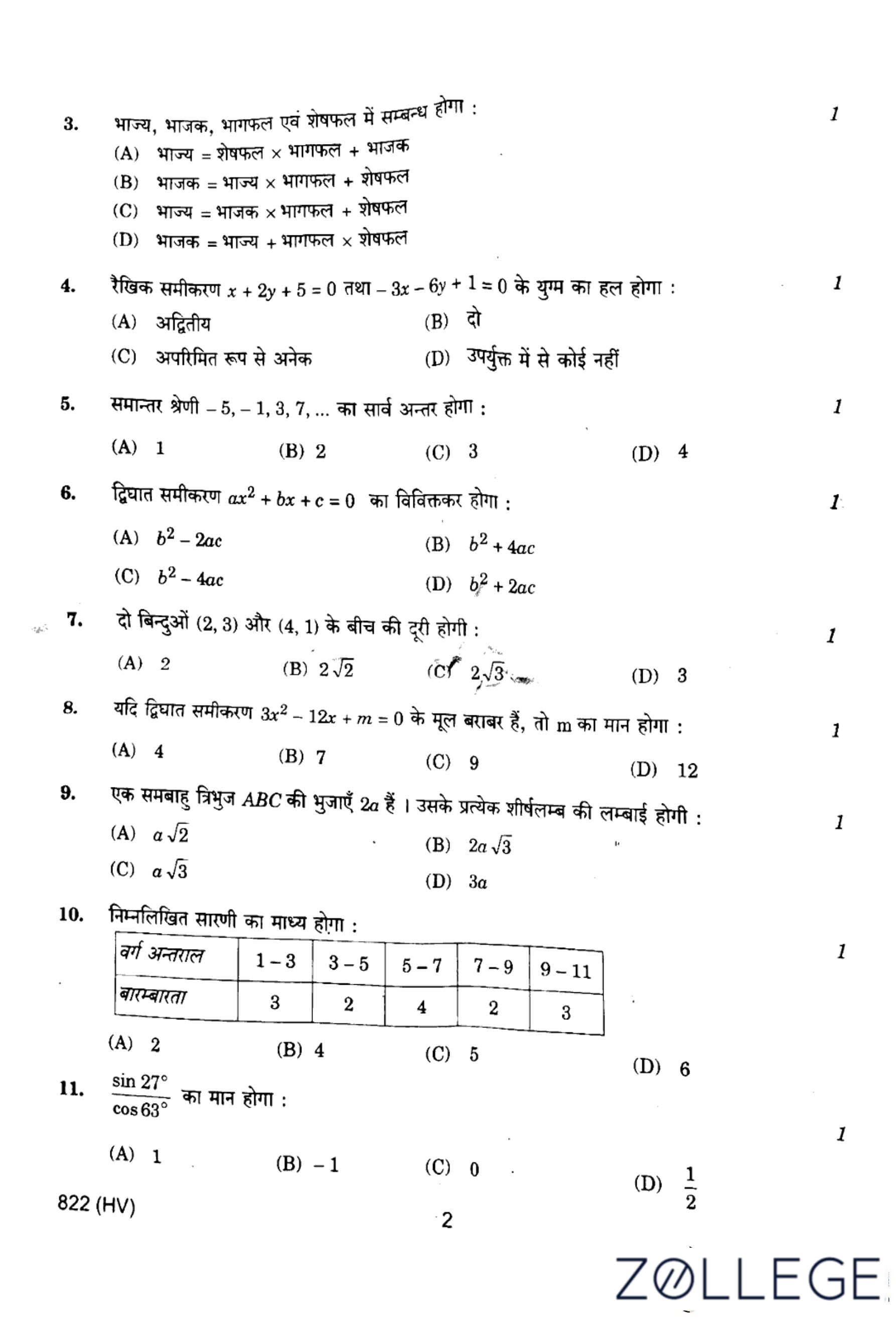
The relation between dividend, divisor, quotient and remainder is:
View Solution
Step 1: Recall the division algorithm, which states that any integer dividend can be expressed as the divisor times the quotient plus the remainder. Quick Tip: The division algorithm provides the fundamental basis for operations in modular arithmetic and number theory.
The solution of a pair of linear equations \( x + 2y + 5 = 0 \) and \( -3x - 6y + 1 = 0 \) will be:
View Solution
Step 1: Rewrite the equations in standard form:
First equation: \( x + 2y = -5 \)
Second equation: \( -3x - 6y = -1 \)
Step 2: Multiply the first equation by 3 to see if the second equation is proportional to the first: \[ 3(x + 2y) = 3(-5) \quad \Rightarrow \quad 3x + 6y = -15 \]
Step 3: Compare the two equations:
The modified first equation is \( 3x + 6y = -15 \).
The second equation is \( -3x - 6y = -1 \).
The second equation is not proportional to the first equation, meaning the system is inconsistent and does not represent the same line.
Conclusion: Since the system is inconsistent, there are no solutions. Therefore, the correct answer is (D) None of the above. Quick Tip: When two linear equations are inconsistent, they represent parallel lines and thus have no solution.
Common difference for the Arithmetic Progression (AP) \(-5, -1, 3, 7, \ldots\) will be:
View Solution
Step 1: Calculate the difference between consecutive terms in the sequence.
Step 2: The first term is \( -5 \) and the second term is \( -1 \). The difference is: \[ Difference = -1 - (-5) = -1 + 5 = 4 \]
Step 3: The second term is \( -1 \) and the third term is \( 3 \). The difference is: \[ Difference = 3 - (-1) = 3 + 1 = 4 \]
Step 4: The third term is \( 3 \) and the fourth term is \( 7 \). The difference is: \[ Difference = 7 - 3 = 4 \]
Step 5: Confirm the difference is consistent across all listed terms.
Conclusion: The common difference for the given Arithmetic Progression is \( 4 \). Therefore, the correct answer is (D) \(4\). Quick Tip: Always check multiple consecutive differences in an AP to ensure the common difference is consistent.
The discriminant of the quadratic equation \(ax^2 + bx + c = 0\) will be:
View Solution
Step 1: Recall the formula for the discriminant of a quadratic equation, which is used to determine the nature of its roots. Quick Tip: The discriminant tells us the number and type of solutions: positive for two real solutions, zero for one real solution, negative for two complex solutions.
Distance between two points \((2, 3)\) and \((4, 1)\) will be:
View Solution
Step 1: Apply the distance formula, \(d = \sqrt{(x_2 - x_1)^2 + (y_2 - y_1)^2}\), where \((x_1, y_1)\) and \((x_2, y_2)\) are the coordinates of the two points. Quick Tip: Always double-check calculations when applying the distance formula to avoid common errors like miscalculating squares or square roots.
If the roots of the quadratic equation \(3x^2 - 12x + m = 0\) are equal, then the value of \(m\) will be:
View Solution
Step 1: For a quadratic equation \( ax^2 + bx + c = 0 \) to have equal roots, the discriminant (\( \Delta \)) must be zero. The discriminant is given by: \[ \Delta = b^2 - 4ac \]
So, for the equation \( 3x^2 - 12x + m = 0 \), we have: \[ a = 3, \quad b = -12, \quad c = m \]
Step 2: Set the discriminant to zero: \[ \Delta = b^2 - 4ac = 0 \]
Substitute the values of \(a\), \(b\), and \(c\) into the equation: \[ (-12)^2 - 4(3)(m) = 0 \] \[ 144 - 12m = 0 \]
Step 3: Solve for \(m\): \[ 12m = 144 \] \[ m = \frac{144}{12} = 12 \]
Conclusion: The value of \(m\) that ensures the quadratic equation has equal roots is \(m = 12\). Therefore, the correct answer is (D) \(12\). Quick Tip: Remember, equal roots in a quadratic equation imply the discriminant is exactly zero.
An \( \triangle ABC \) is an equilateral triangle of side \( 2a \). The length of each of its altitudes will be:
View Solution
Step 1: Note the formula for the altitude \( h \) of an equilateral triangle with side length \( s \) is given by: \[ h = \frac{\sqrt{3}}{2} \times s \]
Step 2: Substitute \( s = 2a \) into the formula: \[ h = \frac{\sqrt{3}}{2} \times 2a = a\sqrt{3} \]
Step 3: Thus, the length of each altitude in \( \triangle ABC \) is \( a\sqrt{3} \). Quick Tip: Remember, the altitude of an equilateral triangle splits it into two 30-60-90 right triangles, where the ratios of sides are consistent.
Mean of the following table will be:
% Table setup
\begin{tabular{|c|c|
\hline
Class Interval & Frequency (f)
\hline
1 -- 3 & 3
3 -- 5 & 2
5 -- 7 & 4
7 -- 9 & 2
9 -- 11 & 3
\hline
\end{tabular
View Solution
Step 1: Compute the midpoints (\( x_i \)) of each class interval using the formula: \[ x_i = \frac{Lower Bound + Upper Bound}{2} \]
% Table for Calculation
\begin{tabular{|c|c|c|c|
\hline
Class Interval & Frequency (f) & Midpoint (x) & f \(\times\) x
\hline
1 -- 3 & 3 & \( \frac{1+3}{2} = 2 \) & \(3 \times 2 = 6\)
3 -- 5 & 2 & \( \frac{3+5}{2} = 4 \) & \(2 \times 4 = 8\)
5 -- 7 & 4 & \( \frac{5+7}{2} = 6 \) & \(4 \times 6 = 24\)
7 -- 9 & 2 & \( \frac{7+9}{2} = 8 \) & \(2 \times 8 = 16\)
9 -- 11 & 3 & \( \frac{9+11}{2} = 10 \) & \(3 \times 10 = 30\)
\hline
Total & \( \sum f = 14 \) & & \( \sum f x = 84 \)
\hline
\end{tabular
Step 2: Compute the mean using the formula: \[ Mean = \frac{\sum f x}{\sum f} \]
Substituting the values: \[ Mean = \frac{84}{14} = 6 \]
Thus, the mean of the given data is 6. Quick Tip: To find the mean of grouped data, use \( \frac{\sum f x}{\sum f} \), where \( x \) is the class midpoint and \( f \) is the frequency.
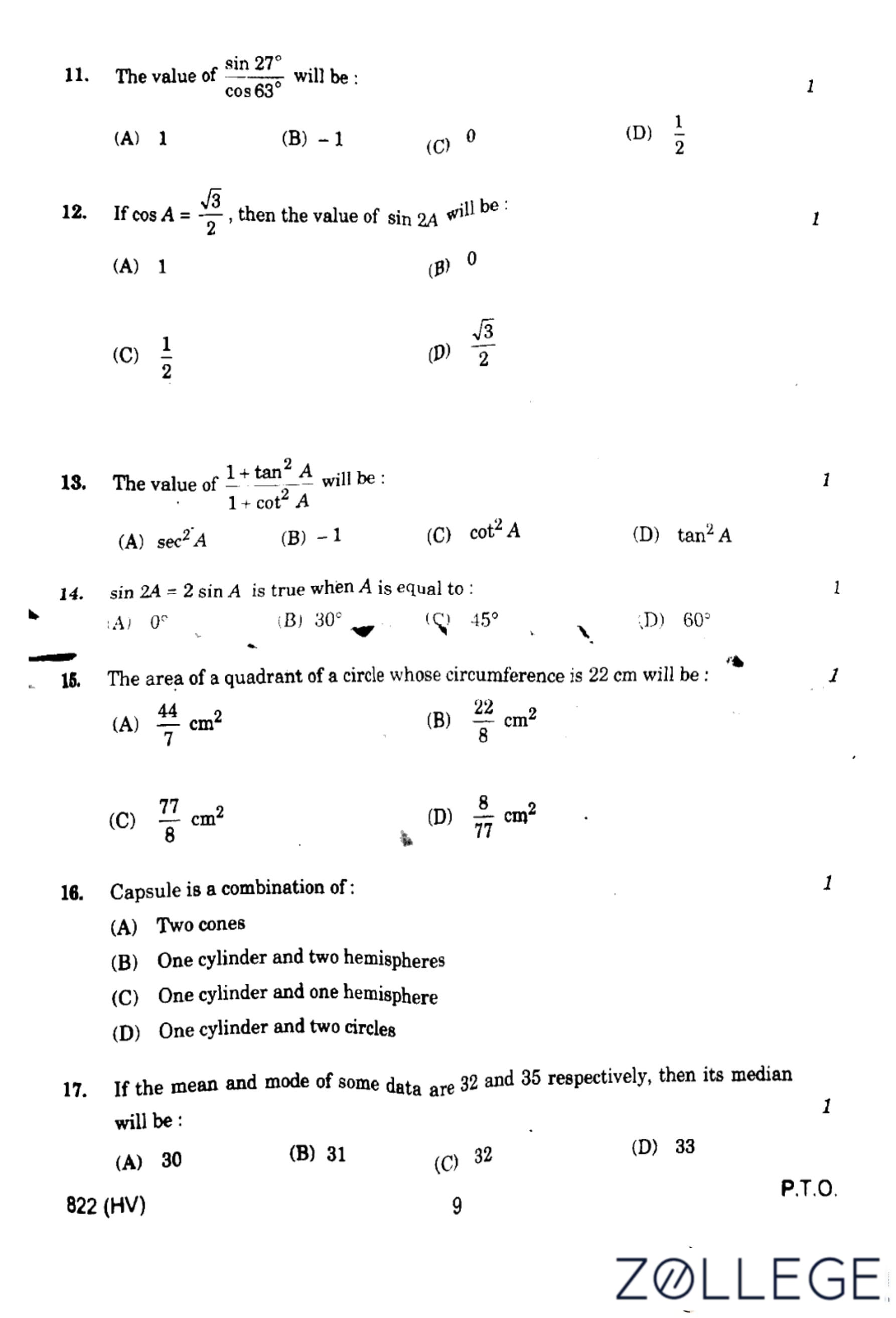
The value of \( \frac{\sin 27^\circ}{\cos 63^\circ} \) will be:
View Solution
Step 1: Using the trigonometric identity: \[ \sin x = \cos (90^\circ - x) \]
we substitute \( \sin 27^\circ \) as follows: \[ \sin 27^\circ = \cos (90^\circ - 27^\circ) = \cos 63^\circ \]
Step 2: Substituting in the given expression: \[ \frac{\sin 27^\circ}{\cos 63^\circ} = \frac{\cos 63^\circ}{\cos 63^\circ} = 1 \] Quick Tip: Use the co-function identity \( \sin x = \cos (90^\circ - x) \) for simplifications.
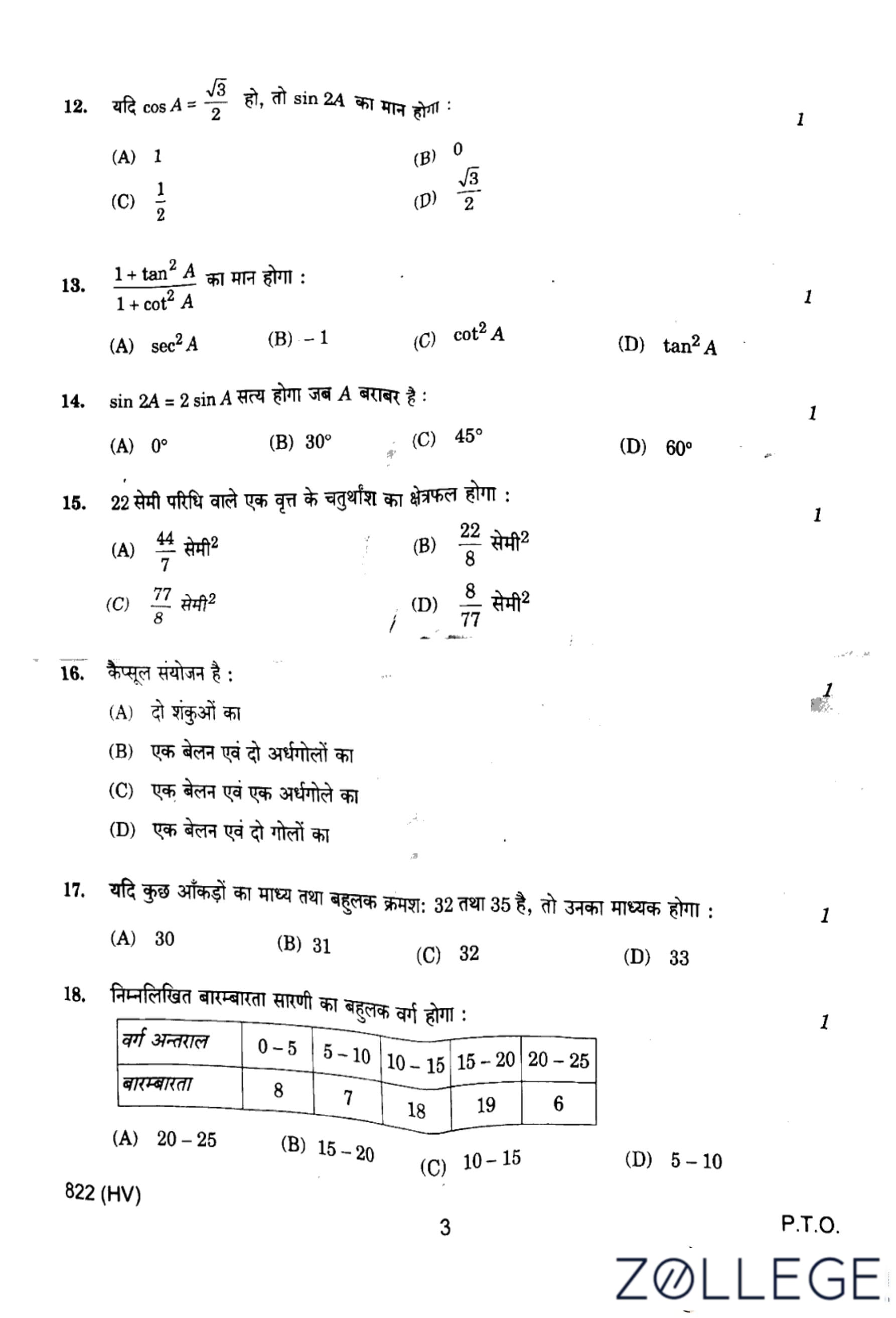
If \( \cos A = \frac{\sqrt{3}}{2} \), then the value of \( \sin 2A \) will be:
View Solution
Step 1: Using the Pythagorean identity: \[ \sin^2 A + \cos^2 A = 1 \]
Substitute \( \cos A = \frac{\sqrt{3}}{2} \): \[ \sin^2 A = 1 - \left(\frac{\sqrt{3}}{2}\right)^2 = 1 - \frac{3}{4} = \frac{1}{4} \] \[ \sin A = \frac{1}{2} \]
Step 2: Use the double angle identity for sine: \[ \sin 2A = 2 \sin A \cos A \]
Substitute the values for \( \sin A \) and \( \cos A \): \[ \sin 2A = 2 \times \frac{1}{2} \times \frac{\sqrt{3}}{2} = \frac{\sqrt{3}}{2} \] Quick Tip: Use the identity \( \sin 2A = 2 \sin A \cos A \) for double-angle simplifications.
The value of \( \frac{1 + \tan^2 A}{1 + \cot^2 A} \) will be:
View Solution
Step 1: Using the Pythagorean identities: \[ 1 + \tan^2 A = \sec^2 A, \quad 1 + \cot^2 A = \csc^2 A \]
Step 2: Substituting in the given expression: \[ \frac{1 + \tan^2 A}{1 + \cot^2 A} = \frac{\sec^2 A}{\csc^2 A} \]
Step 3: Expressing in terms of sine and cosine: \[ \sec^2 A = \frac{1}{\cos^2 A}, \quad \csc^2 A = \frac{1}{\sin^2 A} \] \[ \frac{\sec^2 A}{\csc^2 A} = \frac{\frac{1}{\cos^2 A}}{\frac{1}{\sin^2 A}} = \frac{\sin^2 A}{\cos^2 A} = \tan^2 A \] Quick Tip: Use the identities \( \sec^2 A = 1 + \tan^2 A \) and \( \csc^2 A = 1 + \cot^2 A \) for solving such problems.
\( \sin 2A = 2 \sin A \) is true when \( A \) is equal to:
View Solution
Step 1: Given equation: \[ \sin 2A = 2 \sin A \]
Step 2: Using the double angle formula: \[ \sin 2A = 2 \sin A \cos A \]
Step 3: Equating both sides: \[ 2 \sin A \cos A = 2 \sin A \]
Step 4: Dividing by \( 2 \sin A \) (provided \( \sin A \neq 0 \)): \[ \cos A = 1 \]
Step 5: The value of \( A \) that satisfies \( \cos A = 1 \) is: \[ A = 0^\circ \] Quick Tip: The identity \( \sin 2A = 2 \sin A \cos A \) helps in solving trigonometric equations.
The area of a quadrant of a circle whose circumference is 22 cm will be:
View Solution
Step 1: Circumference of a circle is given by the formula: \[ 2 \pi r = 22 \]
Step 2: Solve for the radius \( r \): \[ r = \frac{22}{2\pi} = \frac{22}{2 \times \frac{22}{7}} = \frac{7}{2} \]
Step 3: Area of a full circle is given by: \[ \pi r^2 \]
Substitute \( r = \frac{7}{2} \): \[ \pi r^2 = \pi \times \left(\frac{7}{2}\right)^2 = \pi \times \frac{49}{4} = \frac{49\pi}{4} \]
Now substitute \( \pi = \frac{22}{7} \) into the equation: \[ \frac{49\pi}{4} = \frac{49}{4} \times \frac{22}{7} = \frac{49 \times 22}{4 \times 7} = \frac{1078}{28} = \frac{77}{4} \]
Step 4: Area of a quadrant of the circle is: \[ \frac{1}{4} \times \frac{77}{4} = \frac{77}{8} \]
Thus, the area of the quadrant is \( \frac{77}{8} \, cm^2 \). Quick Tip: For quadrant area, use \( \frac{1}{4} \pi r^2 \) after determining the radius from the circumference formula.
Capsule is a combination of:
View Solution
A capsule consists of a cylindrical middle section and two hemispherical ends.
Step 1: The middle section is a cylinder, which has a curved surface area and volume formula: \[ Curved Surface Area = 2\pi r h \]
Step 2: The two ends are hemispheres, which contribute to the total surface area and volume. The volume formula for one hemisphere is: \[ V = \frac{2}{3} \pi r^3 \]
Thus, a capsule is best represented by one cylinder and two hemispheres. Quick Tip: The combination of shapes helps in finding the total surface area and volume of real-life objects.
If the mean and mode of some data are 32 and 35 respectively, then its median will be:
View Solution
Step 1: Using the empirical formula: \[ Mode = 3 \times Median - 2 \times Mean \]
Step 2: Substituting the given values: \[ 35 = 3 \times Median - 2 \times 32 \]
Step 3: Solving for Median: \[ 35 = 3 \times Median - 64 \] \[ 3 \times Median = 99 \] \[ Median = \frac{99}{3} = 33 \] Quick Tip: The relation \( Mode = 3 \times Median - 2 \times Mean \) is useful in finding the missing measure of central tendency.
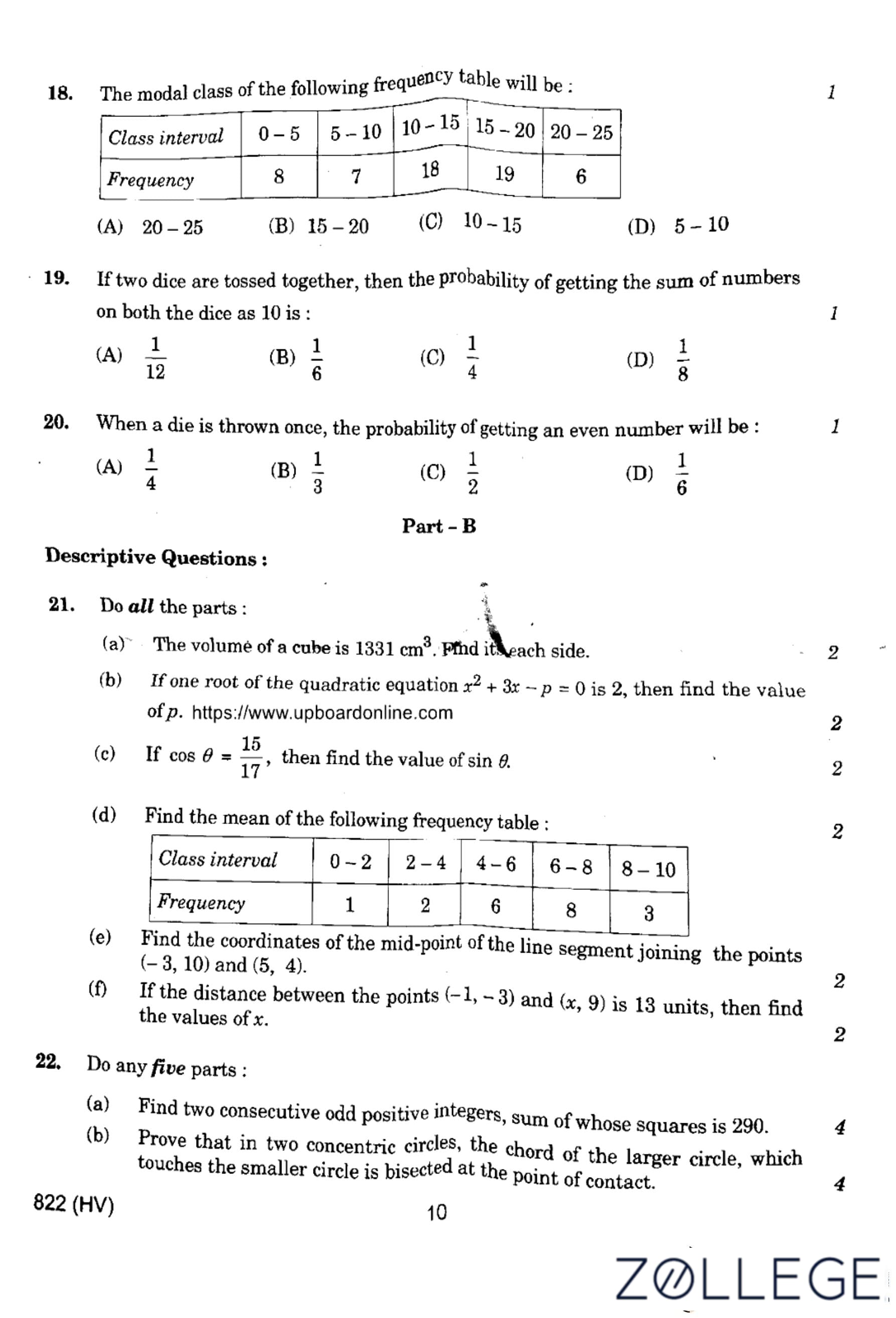
The modal class of the following frequency table will be:
\[ \begin{array}{|c|c|c|c|c|c|} \hline \textbf{Class Interval} & 0-5 & 5-10 & 10-15 & 15-20 & 20-25
\hline \textbf{Frequency} & 8 & 7 & 18 & 19 & 6
\hline \end{array} \]
View Solution
Step 1: The modal class is the class interval with the highest frequency.
From the frequency table, the maximum frequency is 19 (corresponding to the class interval 15-20).
Step 2: Since 19 is the highest frequency, the modal class is 15-20. Quick Tip: The modal class is the class interval with the highest frequency in a frequency distribution table.
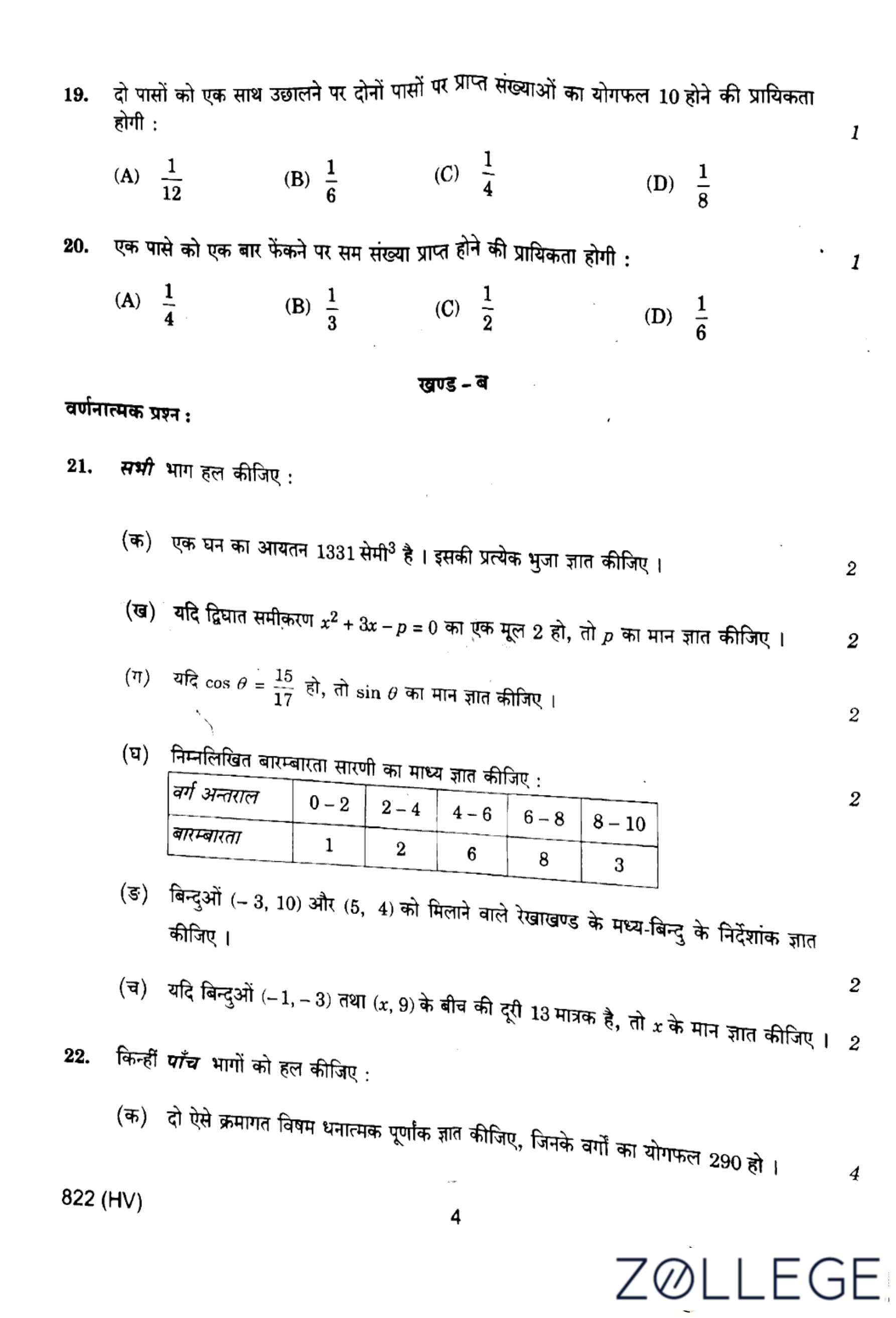
If two dice are tossed together, then the probability of getting the sum of numbers on both the dice as 10 is:
View Solution
Step 1: The total number of outcomes when rolling two dice is: \[ 6 \times 6 = 36 \]
Step 2: The possible dice pairs that give a sum of 10 are: \[ (4,6), (5,5), (6,4) \]
Step 3: There are 3 favorable outcomes, so the probability is: \[ \frac{Favorable Outcomes}{Total Outcomes} = \frac{3}{36} = \frac{1}{12} \] Quick Tip: To find the probability of a sum with two dice, list all possible pairs and count the favorable ones.
When a die is thrown once, the probability of getting an even number will be:
View Solution
Step 1: The sample space for rolling a single die is: \[ \{1,2,3,4,5,6\} \]
Step 2: The even numbers are: \[ \{2,4,6\} \]
Step 3: The probability of rolling an even number is: \[ \frac{Number of favorable outcomes}{Total outcomes} = \frac{3}{6} = \frac{1}{2} \] Quick Tip: A fair six-sided die has equal chances of landing on any number; half of them are even.
The volume of a cube is 1331 cm\(^3\). Find its each side.
View Solution
Step 1: The volume of a cube is given by the formula: \[ V = s^3 \]
where \( s \) is the length of a side.
Step 2: Substituting the given volume: \[ 1331 = s^3 \]
Step 3: Taking the cube root on both sides: \[ s = \sqrt[3]{1331} = 11 \]
Thus, the side of the cube is 11 cm. Quick Tip: To find the side of a cube from its volume, take the cube root of the given volume.
If one root of the quadratic equation \( x^2 + 3x - p = 0 \) is 2, then find the value of \( p \).
View Solution
Step 1: Given the quadratic equation: \[ x^2 + 3x - p = 0 \]
One root is given as \( x = 2 \).
Step 2: Using the property of quadratic equations, if \( x = 2 \) is a root, it satisfies the equation: \[ (2)^2 + 3(2) - p = 0 \]
Step 3: Solving for \( p \): \[ 4 + 6 - p = 0 \] \[ p = 10 \]
Thus, the value of \( p \) is 10. Quick Tip: To find an unknown coefficient in a quadratic equation, substitute the given root and solve for the unknown.
If \( \cos \theta = \frac{15}{17} \), then find the value of \( \sin \theta \).
View Solution
Step 1: Using the Pythagorean identity: \[ \sin^2 \theta + \cos^2 \theta = 1 \]
Step 2: Substituting \( \cos \theta = \frac{15}{17} \): \[ \sin^2 \theta + \left(\frac{15}{17}\right)^2 = 1 \]
Step 3: Solving for \( \sin \theta \): \[ \sin^2 \theta + \frac{225}{289} = 1 \] \[ \sin^2 \theta = 1 - \frac{225}{289} = \frac{289}{289} - \frac{225}{289} = \frac{64}{289} \]
Step 4: Taking the square root: \[ \sin \theta = \pm \frac{8}{17} \]
Thus, \( \sin \theta \) can be \( \frac{8}{17} \) or \( -\frac{8}{17} \), depending on the quadrant of \( \theta \). Quick Tip: Use the identity \( \sin^2 \theta + \cos^2 \theta = 1 \) to find one trigonometric ratio from another.
Find the mean of the following frequency table:
\[ \begin{array}{|c|c|c|c|c|c|} \hline \textbf{Class Interval} & 0-2 & 2-4 & 4-6 & 6-8 & 8-10
\hline \textbf{Frequency (f)} & 1 & 2 & 6 & 8 & 3
\hline \end{array} \]
View Solution
Step 1: Find the class midpoints (\( x_i \)): \[ x_i = \frac{Lower Bound + Upper Bound}{2} \]
\[ x_i = \{1, 3, 5, 7, 9\} \]
Step 2: Compute the sum of \( f_i x_i \): \[ \sum f_i x_i = (1 \times 1) + (2 \times 3) + (6 \times 5) + (8 \times 7) + (3 \times 9) \]
\[ = 1 + 6 + 30 + 56 + 27 = 120 \]
Step 3: Compute the total frequency: \[ \sum f_i = 1 + 2 + 6 + 8 + 3 = 20 \]
Step 4: Find the mean using the formula: \[ Mean = \frac{\sum f_i x_i}{\sum f_i} = \frac{120}{20} = 6 \]
Thus, the mean is 6. Quick Tip: For grouped frequency data, the mean is found using \( \frac{\sum f_i x_i}{\sum f_i} \).
Find the coordinates of the midpoint of the line segment joining the points (-3,10) and (5,4).
View Solution
Step 1: The midpoint formula is: \[ M(x, y) = \left( \frac{x_1 + x_2}{2}, \frac{y_1 + y_2}{2} \right) \]
Step 2: Substituting given points \( (-3,10) \) and \( (5,4) \): \[ M = \left( \frac{-3 + 5}{2}, \frac{10 + 4}{2} \right) \]
Step 3: Solving: \[ M = \left( \frac{2}{2}, \frac{14}{2} \right) = (1,7) \]
Thus, the midpoint is (1,7). Quick Tip: The midpoint of a segment joining two points is the average of their coordinates.
If the distance between the points (-1,-3) and (x,9) is 13 units, then find the values of \( x \).
View Solution
Step 1: Using the distance formula: \[ d = \sqrt{(x_2 - x_1)^2 + (y_2 - y_1)^2} \]
Step 2: Substituting given values \( (-1,-3) \) and \( (x,9) \): \[ 13 = \sqrt{(x + 1)^2 + (9 + 3)^2} \]
Step 3: Squaring both sides: \[ 169 = (x+1)^2 + 144 \]
Step 4: Solving for \( x \): \[ (x+1)^2 = 169 - 144 \] \[ (x+1)^2 = 25 \]
\[ x+1 = \pm 5 \]
Step 5: Finding \( x \): \[ x = -1 + 5 = 4 \quad or \quad x = -1 - 5 = -6 \]
Thus, \( x \) can be 4 or -6. Quick Tip: Use the distance formula \( d = \sqrt{(x_2 - x_1)^2 + (y_2 - y_1)^2} \) to find unknown coordinates.
Find two consecutive odd positive integers, sum of whose squares is 290.
View Solution
Step 1: Let the two consecutive odd integers be \( x \) and \( x+2 \).
Step 2: Given condition: \[ x^2 + (x+2)^2 = 290 \]
Step 3: Expanding the equation: \[ x^2 + x^2 + 4x + 4 = 290 \]
Step 4: Simplifying: \[ 2x^2 + 4x + 4 = 290 \] \[ 2x^2 + 4x - 286 = 0 \]
Step 5: Dividing by 2: \[ x^2 + 2x - 143 = 0 \]
Step 6: Solving using the quadratic formula: \[ x = \frac{-2 \pm \sqrt{(2)^2 - 4(1)(-143)}}{2(1)} \]
\[ x = \frac{-2 \pm \sqrt{4 + 572}}{2} \]
\[ x = \frac{-2 \pm \sqrt{576}}{2} \]
\[ x = \frac{-2 \pm 24}{2} \]
Step 7: Finding possible values of \( x \): \[ x = \frac{-2 + 24}{2} = \frac{22}{2} = 11 \]
or \[ x = \frac{-2 - 24}{2} = \frac{-26}{2} = -13 \quad (not positive) \]
Step 8: The two consecutive odd positive integers are 11 and 13. Quick Tip: For problems involving consecutive numbers, define them in terms of a variable and use algebraic equations to solve.
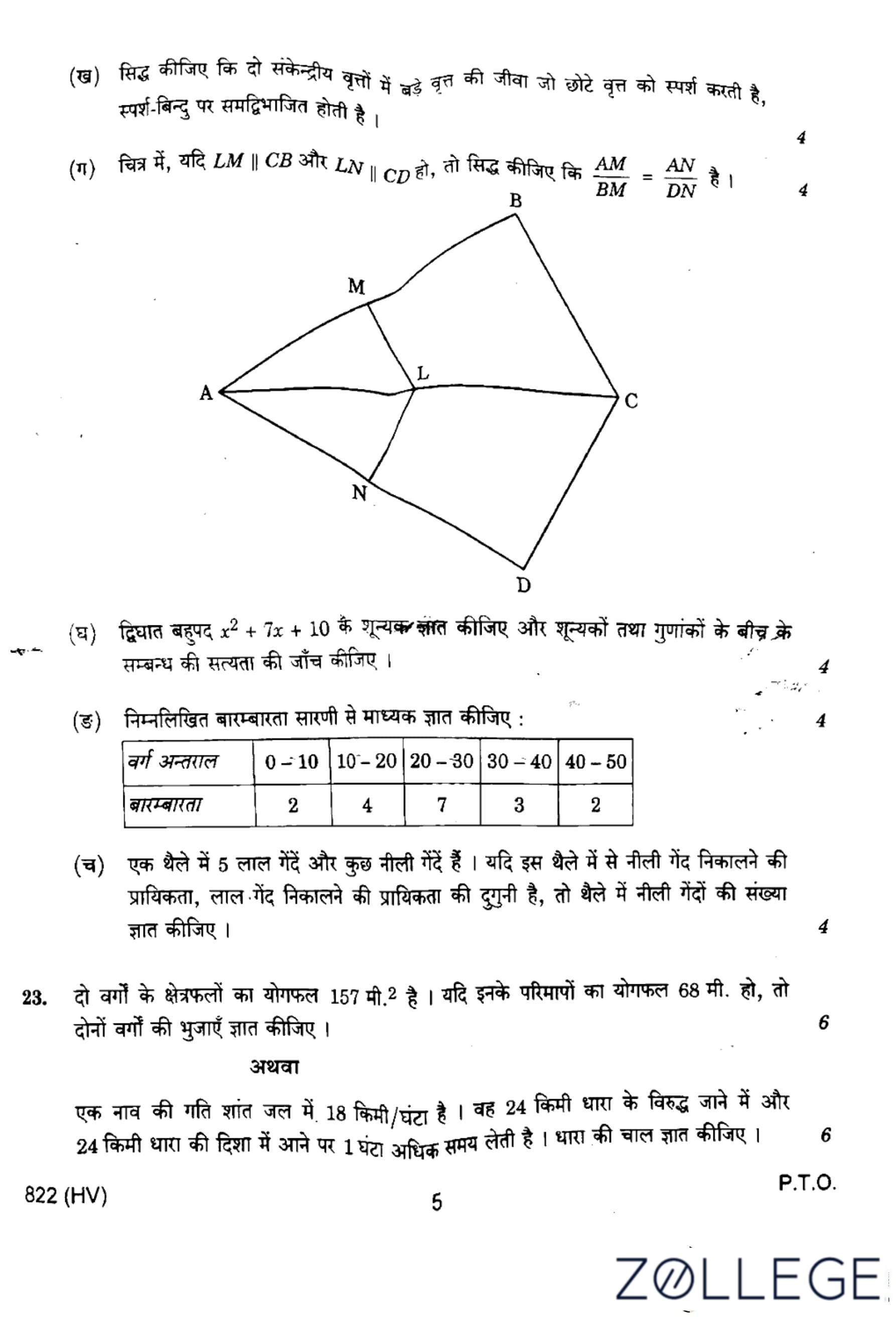
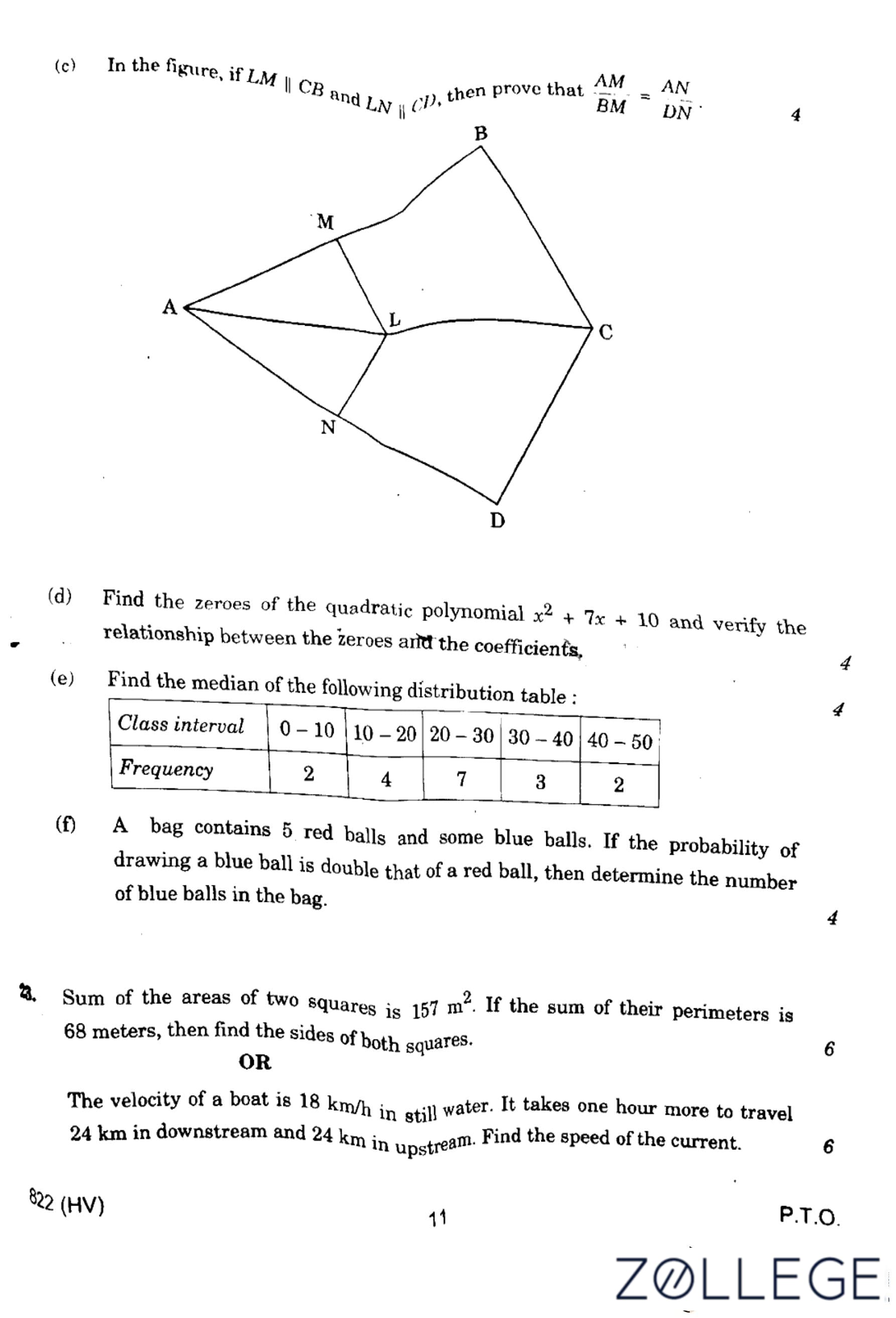
In the figure, if \( LM \parallel CB \) and \( LN \parallel CD \), then prove that \( \frac{AM}{BM} = \frac{AN}{DN} \).
\end{figure
View Solution
Step 1: Given that \( LM \parallel CB \) and \( LN \parallel CD \), we will use the Basic Proportionality Theorem (Thales' Theorem).
Step 2: According to Thales' Theorem, if a line is drawn parallel to one side of a triangle, it divides the other two sides in the same ratio.
Since \( LM \parallel CB \), in \( \triangle ABM \), we get: \[ \frac{AM}{BM} = \frac{AL}{LC} \]
Similarly, since \( LN \parallel CD \), in \( \triangle AND \), we get: \[ \frac{AN}{DN} = \frac{AL}{LC} \]
Step 3: Equating both ratios, we obtain: \[ \frac{AM}{BM} = \frac{AN}{DN} \]
Thus, the given statement is proved. Quick Tip: Thales' theorem states that a line parallel to one side of a triangle divides the other two sides in the same ratio.
Find the zeroes of the quadratic polynomial \( x^2 + 7x + 10 \) and verify the relationship between the zeroes and the coefficients.
View Solution
Step 1: The given quadratic polynomial is: \[ x^2 + 7x + 10 = 0 \]
Step 2: Factorizing the quadratic equation: \[ x^2 + 5x + 2x + 10 = 0 \] \[ x(x+5) + 2(x+5) = 0 \]
\[ (x+5)(x+2) = 0 \]
Step 3: Setting each factor to zero: \[ x+5 = 0 \quad \Rightarrow \quad x = -5 \] \[ x+2 = 0 \quad \Rightarrow \quad x = -2 \]
Thus, the zeroes are \( -5 \) and \( -2 \).
Step 4: Verifying the relationship between zeroes and coefficients:
From the general quadratic equation \( ax^2 + bx + c = 0 \), we have:
- Sum of zeroes:
\[ \alpha + \beta = -\frac{b}{a} = -\frac{7}{1} = -7 \]
\[ (-5) + (-2) = -7 \quad (Verified) \]
- Product of zeroes:
\[ \alpha \beta = \frac{c}{a} = \frac{10}{1} = 10 \]
\[ (-5) \times (-2) = 10 \quad (Verified) \]
Thus, the relationships are verified. Quick Tip: For a quadratic equation \( ax^2 + bx + c = 0 \), the sum of the roots is \( -\frac{b}{a} \), and the product of the roots is \( \frac{c}{a} \).
Find the median of the following distribution table:
\[ \begin{array}{|c|c|c|c|c|c|} \hline \textbf{Class Interval} & 0-10 & 10-20 & 20-30 & 30-40 & 40-50
\hline \textbf{Frequency (f)} & 2 & 4 & 7 & 3 & 2
\hline \end{array} \]
View Solution
Step 1: Compute the cumulative frequency:
\[ \begin{array}{|c|c|c|} \hline \textbf{Class Interval} & \textbf{Frequency (f)} & \textbf{Cumulative Frequency (CF)}
\hline 0 - 10 & 2 & 2
10 - 20 & 4 & 6
20 - 30 & 7 & 13
30 - 40 & 3 & 16
40 - 50 & 2 & 18
\hline \end{array} \]
Step 2: Find the median class.
The total frequency \( n = 18 \), so \[ \frac{n}{2} = \frac{18}{2} = 9 \]
The cumulative frequency just greater than 9 is 13, corresponding to the class interval 20-30.
Thus, the median class is 20-30.
Step 3: Apply the median formula: \[ Median = L + \left( \frac{\frac{n}{2} - CF}{f} \right) \times h \]
where:
- \( L = 20 \) (lower boundary of median class)
- \( n = 18 \) (total frequency)
- \( CF = 6 \) (cumulative frequency before median class)
- \( f = 7 \) (frequency of median class)
- \( h = 10 \) (class width)
Step 4: Substituting values: \[ Median = 20 + \left( \frac{9 - 6}{7} \right) \times 10 \]
\[ = 20 + \left( \frac{3}{7} \times 10 \right) \]
\[ = 20 + 4.29 \]
\[ = 24.29 \]
Thus, the median is approximately 24.3. Quick Tip: The median class is the first class interval where the cumulative frequency exceeds \( n/2 \).
A bag contains 5 red balls and some blue balls. If the probability of drawing a blue ball is double that of a red ball, then determine the number of blue balls in the bag.
View Solution
Step 1: Let the number of blue balls be \( x \).
Total number of balls = \( 5 + x \).
Step 2: Probability of drawing a red ball: \[ P(Red) = \frac{5}{5 + x} \]
Step 3: Probability of drawing a blue ball: \[ P(Blue) = \frac{x}{5 + x} \]
Step 4: Given that \( P(Blue) = 2 \times P(Red) \), \[ \frac{x}{5 + x} = 2 \times \frac{5}{5 + x} \]
Step 5: Solving for \( x \): \[ x = 2 \times 5 \]
\[ x = 10 \]
Thus, the number of blue balls is 10. Quick Tip: If one probability is given as a multiple of another, use proportion equations to solve for the unknown.
Sum of the areas of two squares is 157 m\(^2\). If the sum of their perimeters is 68 meters, then find the sides of both squares.
View Solution
Step 1: Let the side lengths of the two squares be \( x \) and \( y \).
Step 2: Using the given sum of areas: \[ x^2 + y^2 = 157 \]
Step 3: Using the given sum of perimeters: \[ 4x + 4y = 68 \]
Step 4: Simplifying the perimeter equation: \[ x + y = 17 \]
Step 5: Express \( y \) in terms of \( x \): \[ y = 17 - x \]
Step 6: Substituting in the area equation: \[ x^2 + (17-x)^2 = 157 \]
Step 7: Expanding: \[ x^2 + 289 - 34x + x^2 = 157 \]
\[ 2x^2 - 34x + 289 = 157 \]
Step 8: Simplifying: \[ 2x^2 - 34x + 132 = 0 \]
Step 9: Dividing by 2: \[ x^2 - 17x + 66 = 0 \]
Step 10: Solving using factorization: \[ (x - 11)(x - 6) = 0 \]
Step 11: Finding values of \( x \): \[ x = 11 \quad or \quad x = 6 \]
Step 12: Finding corresponding values of \( y \):
- If \( x = 11 \), then \( y = 6 \).
- If \( x = 6 \), then \( y = 11 \).
Thus, the sides of the squares are 11 m and 6 m. Quick Tip: For problems involving squares, use the formulas: - Area of a square = \( side^2 \), - Perimeter of a square = \( 4 \times side \).
The velocity of a boat is 18 km/h in still water. It takes one hour more to travel 24 km in downstream and 24 km in upstream. Find the speed of the current.
View Solution
Step 1: Let the speed of the current be \( x \) km/h.
Step 2: The effective speed of the boat:
- Downstream speed = \( (18 + x) \) km/h
- Upstream speed = \( (18 - x) \) km/h
Step 3: Using the time formula \( Time = \frac{Distance}{Speed} \), \[ Time taken downstream = \frac{24}{18 + x} \] \[ Time taken upstream = \frac{24}{18 - x} \]
Step 4: Given that the upstream journey takes one hour more than the downstream journey: \[ \frac{24}{18 - x} - \frac{24}{18 + x} = 1 \]
Step 5: Taking LCM and solving for \( x \): \[ \frac{24(18 + x) - 24(18 - x)}{(18 - x)(18 + x)} = 1 \]
\[ \frac{432 + 24x - 432 + 24x}{324 - x^2} = 1 \]
\[ \frac{48x}{324 - x^2} = 1 \]
\[ 48x = 324 - x^2 \]
Step 6: Rearranging the quadratic equation: \[ x^2 + 48x - 324 = 0 \]
Step 7: Solving using the quadratic formula: \[ x = \frac{-48 \pm \sqrt{(48)^2 - 4(1)(-324)}}{2(1)} \]
\[ x = \frac{-48 \pm \sqrt{2304 + 1296}}{2} \]
\[ x = \frac{-48 \pm \sqrt{3600}}{2} \]
\[ x = \frac{-48 \pm 60}{2} \]
Step 8: Finding values of \( x \): \[ x = \frac{-48 + 60}{2} = \frac{12}{2} = 6 \]
\[ x = \frac{-48 - 60}{2} = \frac{-108}{2} = -54 \quad (Not valid as speed cannot be negative) \]
Thus, the speed of the current is 6 km/h. Quick Tip: For boat and stream problems, use the formula: - Downstream speed = \( Boat speed + Current speed \), - Upstream speed = \( Boat speed - Current speed \).
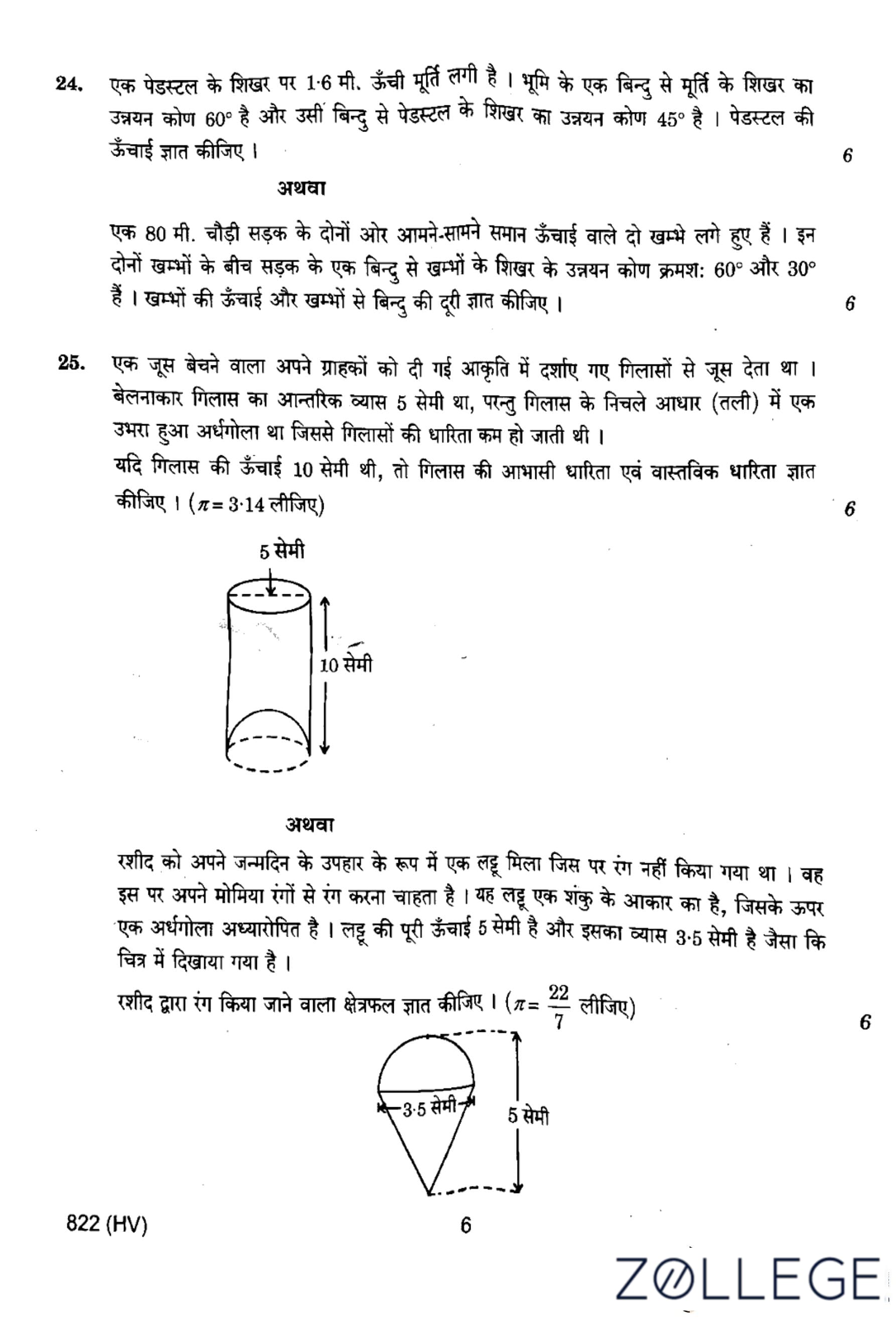
A statue 1.6 m tall, stands on top of a pedestal. From a point on the ground, the angle of elevation of the top of the statue is \( 60^\circ \) and from the same point, the angle of elevation of the top of the pedestal is \( 45^\circ \). Find the length of the pedestal.
View Solution
Step 1: Let the height of the pedestal be \( h \) meters, and let the distance from the observation point to the base of the pedestal be \( d \) meters.
Step 2: Using the tangent formula in right-angled triangles: \[ \tan \theta = \frac{opposite side}{adjacent side} \]
For the pedestal (\( \angle 45^\circ \)): \[ \tan 45^\circ = \frac{h}{d} \] \[ 1 = \frac{h}{d} \] \[ h = d \]
For the statue + pedestal (\( \angle 60^\circ \)): \[ \tan 60^\circ = \frac{h + 1.6}{d} \] \[ \sqrt{3} = \frac{h + 1.6}{d} \] \[ h + 1.6 = \sqrt{3} d \]
Step 3: Substituting \( h = d \): \[ d + 1.6 = \sqrt{3} d \]
Step 4: Solving for \( d \): \[ 1.6 = (\sqrt{3} - 1) d \] \[ d = \frac{1.6}{\sqrt{3} - 1} \]
Rationalizing: \[ d = \frac{1.6 (\sqrt{3} + 1)}{(3 - 1)} = 0.8 (\sqrt{3} + 1) \]
Approximating \( \sqrt{3} \approx 1.732 \): \[ d = 0.8 (1.732 + 1) = 0.8 \times 2.732 = 2.19 m \]
Step 5: Since \( h = d \), the height of the pedestal is 2.19 m. Quick Tip: In height and distance problems, use \( \tan \theta = \frac{height}{base} \) to find unknown distances.
Two poles of equal heights are standing opposite to each other on either side of the road, which is 80 m wide. From a point between them on the road, the angles of elevation of the top of the poles are \( 60^\circ \) and \( 30^\circ \) respectively. Find the height of the poles and the distance of the point from the pole.
View Solution
Step 1: Let the height of each pole be \( h \) meters.
Let the distances of the point from one pole be \( x \) meters, so the distance from the other pole is \( 80 - x \) meters.
Step 2: Using the tangent formula:
For the pole observed at \( 60^\circ \): \[ \tan 60^\circ = \frac{h}{x} \] \[ \sqrt{3} = \frac{h}{x} \] \[ h = \sqrt{3} x \]
For the pole observed at \( 30^\circ \): \[ \tan 30^\circ = \frac{h}{80 - x} \] \[ \frac{1}{\sqrt{3}} = \frac{h}{80 - x} \] \[ h = \frac{(80 - x)}{\sqrt{3}} \]
Step 3: Equating both equations for \( h \): \[ \sqrt{3} x = \frac{(80 - x)}{\sqrt{3}} \]
Step 4: Cross-multiplying: \[ 3x = 80 - x \]
Step 5: Solving for \( x \): \[ 4x = 80 \] \[ x = 20 \]
Step 6: Substituting \( x = 20 \) into \( h = \sqrt{3} x \): \[ h = \sqrt{3} \times 20 \] \[ h = 20\sqrt{3} \]
Approximating \( \sqrt{3} \approx 1.732 \): \[ h \approx 20 \times 1.732 = 34.64 m \]
Thus, the height of the poles is 34.64 m and the distance of the point from one pole is 20 m. Quick Tip: When a point is between two objects, set up separate tangent equations and solve using substitution.
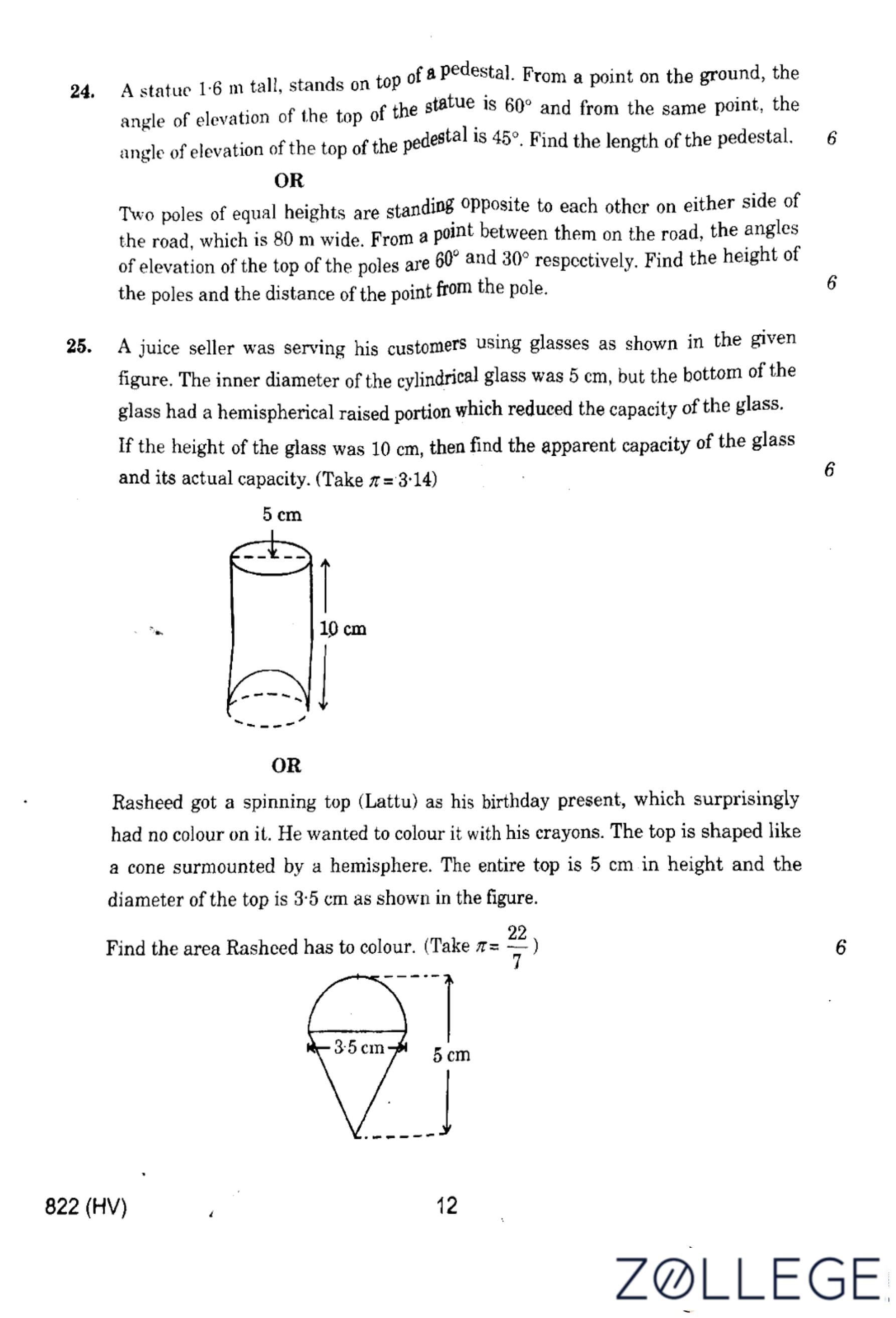
A juice seller was serving his customers using glasses as shown in the given figure. The inner diameter of the cylindrical glass was 5 cm, but the bottom of the glass had a hemispherical raised portion which reduced the capacity of the glass. If the height of the glass was 10 cm, then find the apparent capacity of the glass and its actual capacity. (Take \( \pi = 3.14 \))
\end{figure
View Solution
Step 1: Given data:
- Diameter of the glass = 5 cm, so radius \( r = \frac{5}{2} = 2.5 \) cm
- Height of the cylindrical part = 10 cm
Step 2: Volume of the cylindrical part: \[ V_{cylinder} = \pi r^2 h \]
\[ = 3.14 \times (2.5)^2 \times 10 \]
\[ = 3.14 \times 6.25 \times 10 \]
\[ = 196.25 cm^3 \]
Step 3: Volume of the hemispherical portion: \[ V_{hemisphere} = \frac{1}{2} \times \frac{4}{3} \pi r^3 \]
\[ = \frac{2}{3} \times 3.14 \times (2.5)^3 \]
\[ = \frac{2}{3} \times 3.14 \times 15.625 \]
\[ = \frac{98.12}{3} = 32.71 cm^3 \]
Step 4: Actual capacity of the glass: \[ V_{actual} = V_{cylinder} - V_{hemisphere} \]
\[ = 196.25 - 32.71 \]
\[ = 163.54 cm^3 \]
Thus,
- The apparent capacity of the glass = 196.25 cm\(^3\)
- The actual capacity of the glass = 163.54 cm\(^3\) Quick Tip: To find the effective volume of a container with a raised portion, subtract the displaced volume from the total volume.
Rasheed got a spinning top (Lattu) as his birthday present, which surprisingly had no colour on it. He wanted to colour it with his crayons. The top is shaped like a cone surmounted by a hemisphere. The entire top is 5 cm in height and the diameter of the top is 3.5 cm as shown in the figure. Find the area Rasheed has to colour. (Take \( \pi = \frac{22}{7} \))
\end{figure
View Solution
Step 1: Given data:
- Diameter of the top = 3.5 cm, so radius \( r = \frac{3.5}{2} = 1.75 \) cm
- Total height of the top = 5 cm
- Radius of the hemisphere = 1.75 cm
Step 2: Find the height of the conical portion: \[ h_{cone} = 5 - 1.75 = 3.25 cm \]
Step 3: Slant height (\( l \)) of the cone using Pythagoras theorem: \[ l = \sqrt{h^2 + r^2} \]
\[ = \sqrt{(3.25)^2 + (1.75)^2} \]
\[ = \sqrt{10.56 + 3.06} \]
\[ = \sqrt{13.62} \approx 3.69 cm \]
Step 4: Curved surface area of the cone: \[ CSA_{cone} = \pi r l \]
\[ = \frac{22}{7} \times 1.75 \times 3.69 \]
\[ = \frac{22 \times 6.46}{7} \]
\[ = \frac{142.12}{7} \approx 20.3 cm^2 \]
Step 5: Curved surface area of the hemisphere: \[ CSA_{hemisphere} = 2 \pi r^2 \]
\[ = 2 \times \frac{22}{7} \times (1.75)^2 \]
\[ = 2 \times \frac{22}{7} \times 3.06 \]
\[ = \frac{134.64}{7} \approx 19.2 cm^2 \]
Step 6: Total surface area to be coloured: \[ Total area = CSA_{cone} + CSA_{hemisphere} \]
\[ = 20.3 + 19.2 \]
\[ = 39.5 cm^2 \]
Thus, the area Rasheed has to colour is 39.5 cm\(^2\). Quick Tip: The total surface area of a composite shape is found by adding the individual curved surface areas.
*The article might have information for the previous academic years, please refer the official website of the exam.