
UP Board Class 10 Mathematics(Code 822 HW) Question Paper 2024 with Solutions


Content Writer | Updated On - Feb 28, 2025
UP Board Class 10 Mathematics Question Paper 2024 PDF (Code 822 HW) is available for download here. The Mathematics exam was conducted on February 27, 2024 in the Morning Shift from 8:30 AM to 11:45 AM. The total marks for the theory paper are 70. Students reported the paper to be moderate.
UP Board Class 10 Mathematics Question Paper 2024 (Code 822 HW) with Solutions
| UP Board Class 10 Mathematics Question Paper With Answer Key | Check Solution |


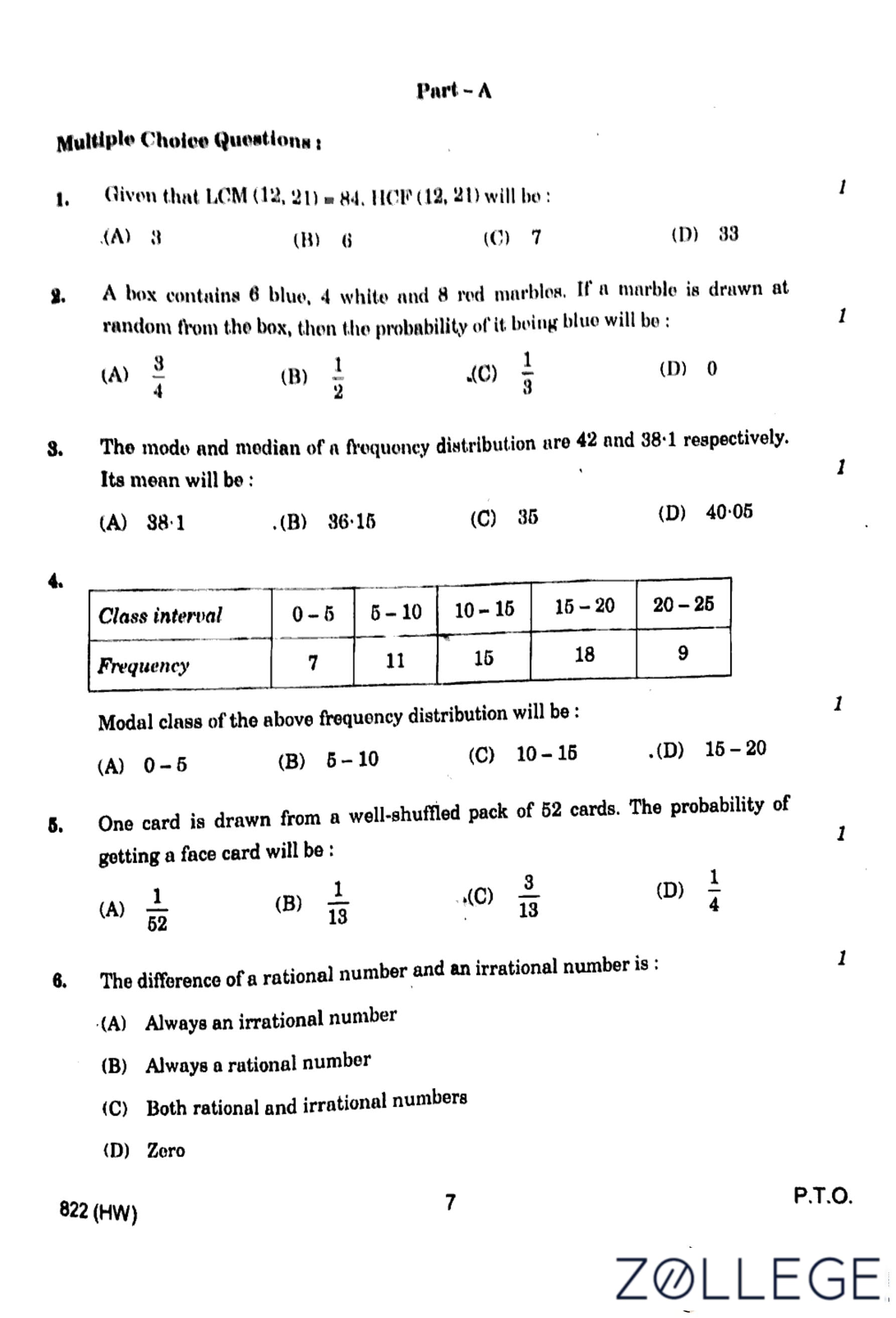
Given that LCM(12, 21) = 84, HCF(12, 21) will be:
View Solution
We know the relationship between the LCM and HCF of two numbers: \[ LCM(a, b) \times HCF(a, b) = a \times b. \]
For \( a = 12 \) and \( b = 21 \), we are given: \[ LCM(12, 21) = 84. \]
Thus, applying the formula: \[ 84 \times HCF(12, 21) = 12 \times 21 = 252. \]
Solving for \( HCF(12, 21) \): \[ HCF(12, 21) = \frac{252}{84} = 3. \]
Therefore, the HCF of 12 and 21 is \( 3 \).
Thus, the correct answer is \( \boxed{3} \). Quick Tip: For two numbers \( a \) and \( b \), the relationship between the LCM and HCF is given by: \[ LCM(a, b) \times HCF(a, b) = a \times b. \] This formula helps you easily find the HCF if the LCM is known, and vice versa.
A box contains 6 blue, 4 white, and 8 red marbles. If a marble is drawn at random from the box, then the probability of it being blue will be:
View Solution
The total number of marbles in the box is: \[ 6 (blue) + 4 (white) + 8 (red) = 18 marbles. \]
The number of blue marbles is 6. Therefore, the probability of drawing a blue marble is: \[ P(blue) = \frac{Number of blue marbles}{Total number of marbles} = \frac{6}{18} = \frac{1}{3}. \]
Thus, the correct answer is \( \boxed{\frac{1}{3}} \). Quick Tip: To calculate the probability of an event, divide the number of favorable outcomes by the total number of possible outcomes.
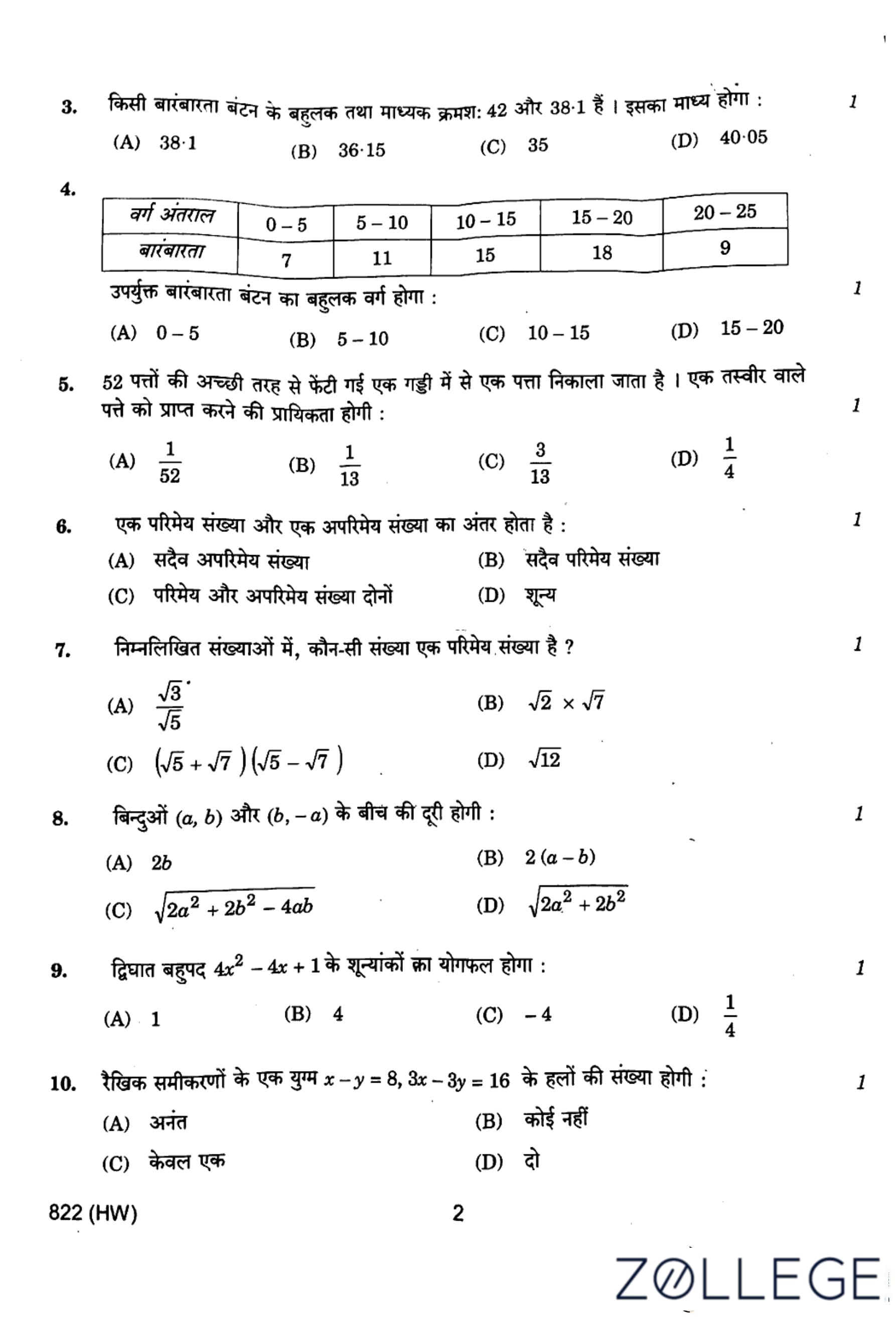
The mode and median of a frequency distribution are 42 and 38.1, respectively. Its mean will be:
View Solution
For a symmetrical distribution, the mode, median, and mean are approximately equal. However, in skewed distributions, the relationship between the mode, median, and mean is given by: \[ Mean \approx \frac{Mode + 3 \times Median}{4}. \]
Given that the mode is 42 and the median is 38.1, we substitute these values into the formula: \[ Mean \approx \frac{42 + 3 \times 38.1}{4} = \frac{42 + 114.3}{4} = \frac{156.3}{4} = 36.15. \]
Thus, the correct answer is \( \boxed{36.15} \). Quick Tip: In a skewed distribution, the mean can be estimated using the formula: \[ Mean \approx \frac{Mode + 3 \times Median}{4}. \]

Modal class of the above frequency distribution will be:
View Solution
The modal class is the class interval that contains the maximum frequency. From the given frequency distribution:
\[ Class interval: \quad 0-5, \, 5-10, \, 10-15, \, 15-20, \, 20-25 \] \[ Frequency: \quad 7, \, 11, \, 15, \, 18, \, 9 \]
We observe that the frequency is highest for the class interval \( 15-20 \), with a frequency of 18.
Thus, the modal class is \( \boxed{15 - 20} \). Quick Tip: The modal class in a frequency distribution is the class interval with the highest frequency. If you are given the class intervals and frequencies, simply identify the one with the highest frequency.
One card is drawn from a well-shuffled pack of 52 cards. The probability of getting a face card will be:
View Solution
A well-shuffled pack of 52 cards contains 12 face cards (3 face cards from each of the 4 suits: Jack, Queen, and King). Thus, the total number of favorable outcomes (face cards) is 12. The total number of possible outcomes is 52 (the total number of cards in the deck).
The probability of drawing a face card is given by: \[ P(face card) = \frac{Number of face cards}{Total number of cards} = \frac{12}{52} = \frac{3}{13}. \]
Thus, the correct answer is \( \boxed{\frac{3}{13}} \). Quick Tip: The probability of an event is the ratio of favorable outcomes to the total possible outcomes. In this case, to find the probability of drawing a face card, divide the number of face cards by the total number of cards in the deck.
The difference of a rational number and an irrational number is:
View Solution
Let \( r \) be a rational number and \( i \) be an irrational number. The difference between a rational number and an irrational number is always irrational. This can be shown as follows:
If \( r - i \) were rational, then adding \( i \) to both sides would give a contradiction: \[ r = (r - i) + i. \]
But the sum of a rational number and an irrational number is always irrational, which contradicts the assumption that \( r - i \) is rational.
Thus, the difference of a rational number and an irrational number is always irrational.
Therefore, the correct answer is \( \boxed{Always an irrational number} \). Quick Tip: The difference between a rational number and an irrational number is always irrational. This is because adding or subtracting an irrational number from a rational number always results in an irrational number.
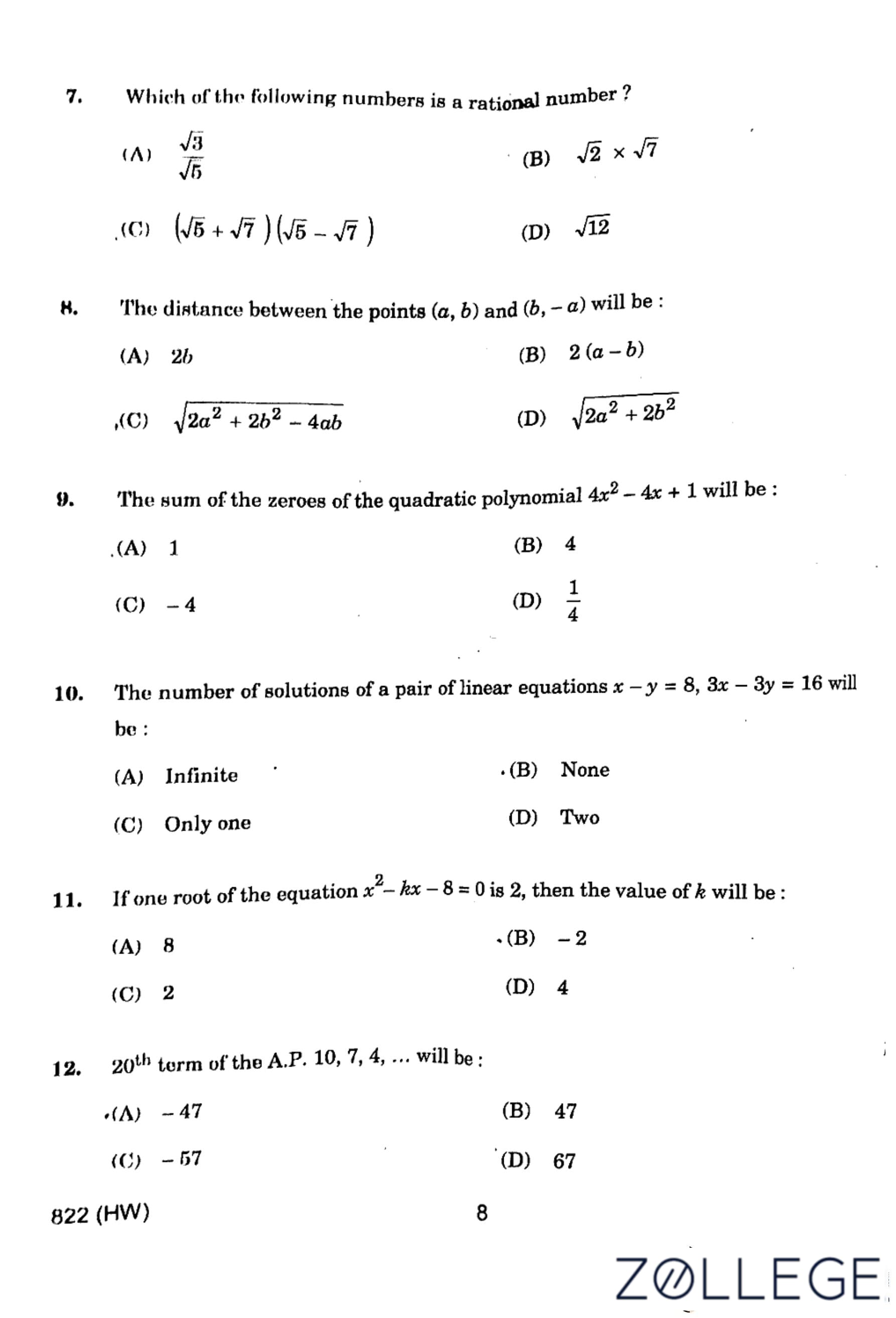
Which of the following numbers is a rational number?
View Solution
We need to determine which of the given expressions is a rational number. To do this, let's evaluate each option:
- Option (A): \( \frac{\sqrt{3}}{\sqrt{5}} = \sqrt{\frac{3}{5}} \), which is irrational.
- Option (B): \( \sqrt{2} \times \sqrt{7} = \sqrt{14} \), which is irrational.
- Option (C): \( \left( \sqrt{5} + \sqrt{7} \right) \left( \sqrt{5} - \sqrt{7} \right) = 5 - 7 = -2 \), which is rational.
- Option (D): \( \sqrt{12} = 2\sqrt{3} \), which is irrational.
Thus, the correct answer is \( \boxed{C} \). Quick Tip: When multiplying conjugates, such as \( (a + b)(a - b) \), the result is always a rational number because it simplifies to \( a^2 - b^2 \).
The distance between the points \( (a, b) \) and \( (b, -a) \) will be:
View Solution
The distance between two points \( (x_1, y_1) \) and \( (x_2, y_2) \) is given by the formula: \[ Distance = \sqrt{(x_2 - x_1)^2 + (y_2 - y_1)^2}. \]
Here, the coordinates of the points are \( (a, b) \) and \( (b, -a) \). Therefore, the distance is: \[ Distance = \sqrt{(b - a)^2 + (-a - b)^2} = \sqrt{(b - a)^2 + (-(a + b))^2} = \sqrt{(b - a)^2 + (a + b)^2}. \]
Expanding the terms: \[ (b - a)^2 = b^2 - 2ab + a^2, \quad (a + b)^2 = a^2 + 2ab + b^2, \]
so the total distance becomes: \[ Distance = \sqrt{2a^2 + 2b^2 - 4ab}. \]
Thus, the correct answer is \( \boxed{C} \). Quick Tip: Use the distance formula to find the distance between two points: \( Distance = \sqrt{(x_2 - x_1)^2 + (y_2 - y_1)^2} \).
The sum of the zeroes of the quadratic polynomial \( 4x^2 - 4x + 1 \) will be:
View Solution
For a quadratic polynomial \( ax^2 + bx + c \), the sum of the zeroes is given by \( -\frac{b}{a} \).
For the polynomial \( 4x^2 - 4x + 1 \), \( a = 4 \), \( b = -4 \), and \( c = 1 \). Therefore, the sum of the zeroes is: \[ Sum of zeroes = -\frac{-4}{4} = 1. \]
Thus, the correct answer is \( \boxed{1} \). Quick Tip: For a quadratic equation \( ax^2 + bx + c \), the sum of its zeroes is \( -\frac{b}{a} \).
The number of solutions of a pair of linear equations \( x - y = 8 \), \( 3x - 3y = 16 \) will be:
View Solution
We are given the system of linear equations: \[ x - y = 8 \quad (1) \] \[ 3x - 3y = 16 \quad (2). \]
We can simplify equation (2) by dividing both sides by 3: \[ x - y = \frac{16}{3}. \]
Now we compare this with equation (1): \[ x - y = 8 \quad and \quad x - y = \frac{16}{3}. \]
Clearly, these two equations are inconsistent because \( 8 \neq \frac{16}{3} \). Therefore, the system has no solutions.
Thus, the correct answer is \( \boxed{None} \). Quick Tip: If the two equations in a system lead to contradictory results, then the system has no solution.
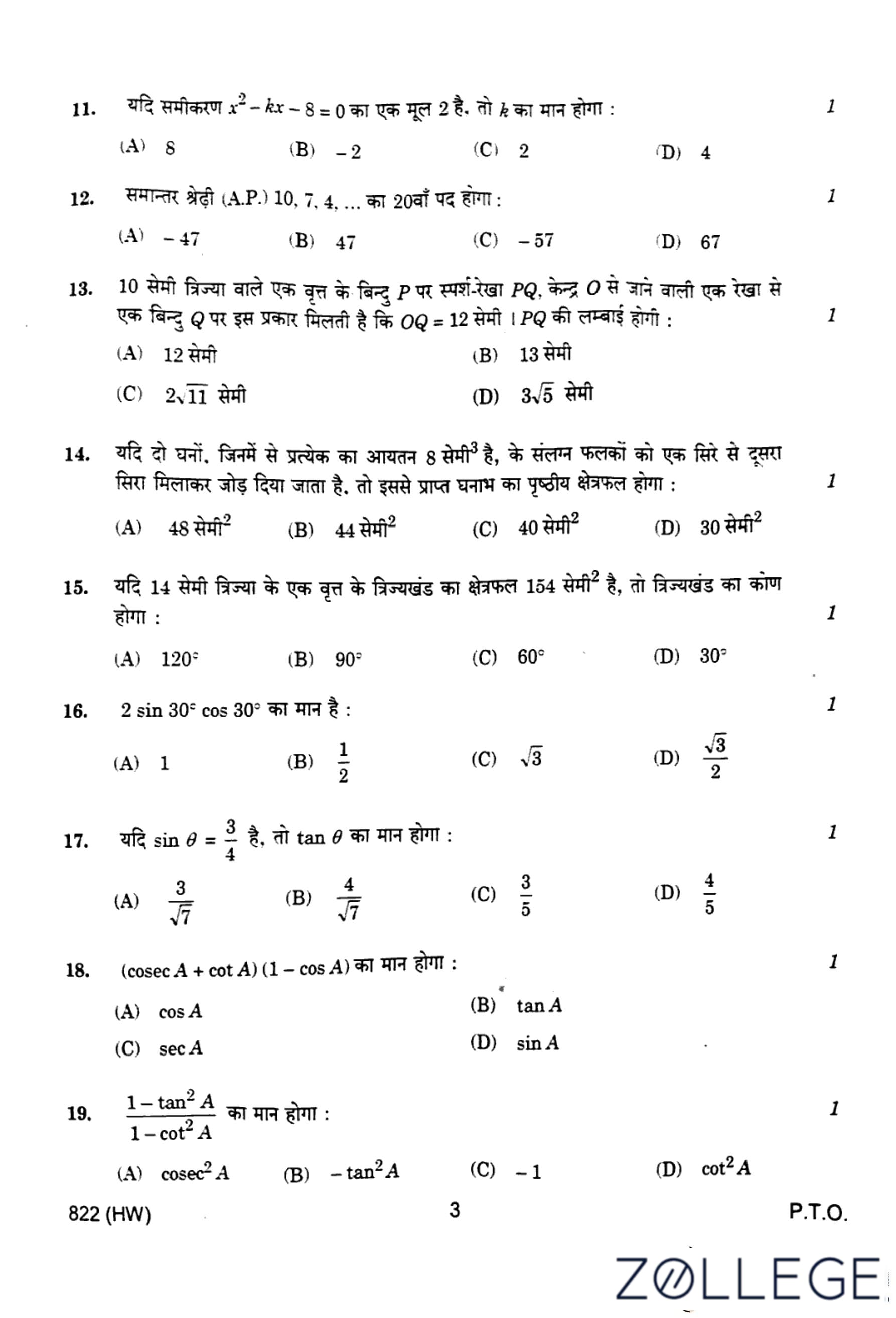
If one root of the equation \( x^2 - kx - 8 = 0 \) is 2, then the value of \( k \) will be:
View Solution
Given the quadratic equation: \[ x^2 - kx - 8 = 0, \]
one of its roots is given as \( x = 2 \). By substituting \( x = 2 \) in the equation:
\[ (2)^2 - k(2) - 8 = 0 \]
\[ 4 - 2k - 8 = 0 \]
\[ -2k = 4 \]
\[ k = -2 \]
Thus, the correct answer is: \[ \boxed{-2} \] Quick Tip: To find an unknown coefficient in a quadratic equation when a root is given, substitute the root into the equation and solve for the variable.
The 20th term of the A.P. 10, 7, 4, ... will be:
View Solution
The general formula for the nth term of an arithmetic progression is: \[ a_n = a_1 + (n - 1) \cdot d, \]
where \( a_1 \) is the first term and \( d \) is the common difference.
Given the A.P. \( 10, 7, 4, \dots \), we have:
- \( a_1 = 10 \),
- The common difference \( d = 7 - 10 = -3 \).
To find the 20th term, we use the formula: \[ a_{20} = 10 + (20 - 1) \cdot (-3) = 10 + 19 \cdot (-3) = 10 - 57 = -47. \]
Thus, the correct answer is \( \boxed{-47} \). Quick Tip: To find the nth term of an arithmetic progression, use the formula \( a_n = a_1 + (n - 1) \cdot d \), where \( a_1 \) is the first term and \( d \) is the common difference.
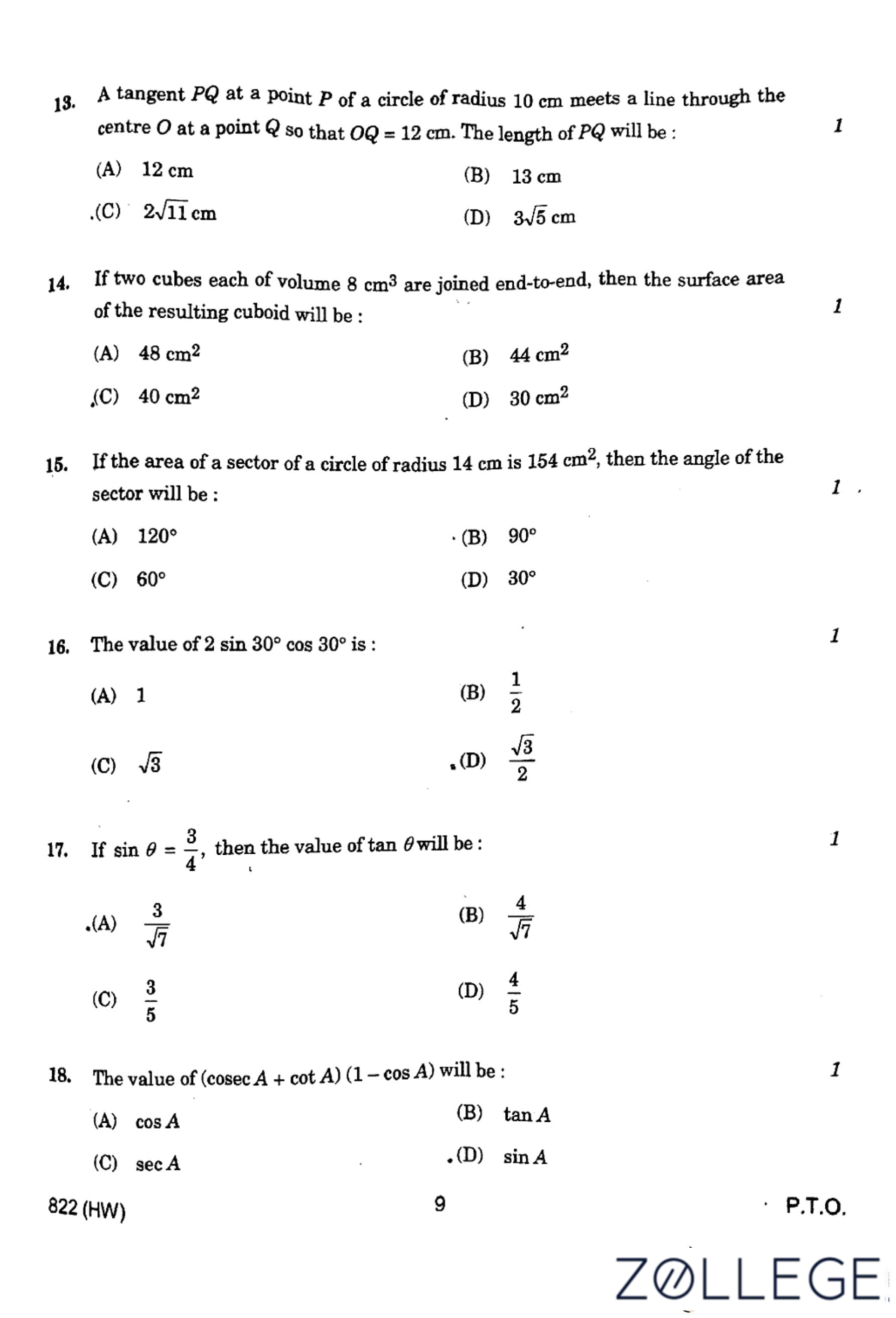
A tangent \( PQ \) at a point \( P \) of a circle of radius 10 cm meets a line through the centre \( O \) at a point \( Q \) so that \( OQ = 12 \) cm. The length of \( PQ \) will be:
View Solution
We are given a circle with center \( O \), radius \( OP = 10 \) cm, and a secant line passing through \( O \) that meets the tangent \( PQ \) at point \( Q \), where \( OQ = 12 \) cm.
Since \( PQ \) is tangent to the circle at \( P \), we use the Pythagorean theorem in the right triangle \( OPQ \):
\[ OQ^2 = OP^2 + PQ^2 \]
Substituting the given values:
\[ 12^2 = 10^2 + PQ^2 \]
\[ 144 = 100 + PQ^2 \]
\[ PQ^2 = 44 \]
\[ PQ = \sqrt{44} = 2\sqrt{11} \]
Thus, the correct answer is: \[ \boxed{2\sqrt{11} cm} \] Quick Tip: For a tangent and a secant meeting at a point outside the circle, the relationship follows the Pythagorean theorem in the right triangle formed.
If two cubes each of volume 8 cm\(^3\) are joined end-to-end, then the surface area of the resulting cuboid will be:
View Solution
The volume of one cube is given as 8 cm\(^3\), so the side length of each cube is: \[ Side length of cube = \sqrt[3]{8} = 2 \, cm. \]
When two cubes are joined end-to-end, the resulting cuboid will have:
- Length = \( 2 + 2 = 4 \, cm \),
- Width = \( 2 \, cm \),
- Height = \( 2 \, cm \).
The surface area of a cuboid is given by the formula: \[ Surface Area = 2lw + 2lh + 2wh, \]
where \( l = 4 \), \( w = 2 \), and \( h = 2 \): \[ Surface Area = 2(4 \times 2) + 2(4 \times 2) + 2(2 \times 2) = 16 + 16 + 8 = 40 \, cm^2. \]
Thus, the correct answer is \( \boxed{40 \, cm^2} \). Quick Tip: To find the surface area of a cuboid, use the formula \( 2lw + 2lh + 2wh \), where \( l \) is the length, \( w \) is the width, and \( h \) is the height.
If the area of a sector of a circle of radius 14 cm is 154 cm\(^2\), then the angle of the sector will be:
View Solution
The area of a sector is given by the formula:
\[ Area of sector = \frac{\theta}{360} \times \pi r^2 \]
where \( \theta \) is the angle of the sector and \( r \) is the radius. Given:
\[ Area of sector = 154 cm^2, \quad r = 14 cm. \]
Substituting the values:
\[ 154 = \frac{\theta}{360} \times \pi \times 14^2 \]
\[ 154 = \frac{\theta}{360} \times \pi \times 196 \]
Approximating \( \pi \approx 3.14 \):
\[ 154 = \frac{\theta}{360} \times 3.14 \times 196 \]
\[ 154 = \frac{\theta}{360} \times 615.44 \]
\[ \theta = \frac{154 \times 360}{615.44} \]
\[ \theta = 90^\circ \]
Thus, the correct answer is: \[ \boxed{90^\circ} \] Quick Tip: To find the angle of a sector, use the formula \( \frac{\theta}{360} \times \pi r^2 = Area of sector \), where \( \theta \) is the angle of the sector and \( r \) is the radius.
The value of \( 2 \sin 30^\circ \cos 30^\circ \) is:
View Solution
We use the identity: \[ 2 \sin A \cos A = \sin 2A. \]
Substituting \( A = 30^\circ \), we get: \[ 2 \sin 30^\circ \cos 30^\circ = \sin 60^\circ. \]
Since \( \sin 60^\circ = \frac{\sqrt{3}}{2} \), we conclude: \[ \boxed{\frac{\sqrt{3}}{2}}. \] Quick Tip: Use the identity \( 2 \sin A \cos A = \sin 2A \) to simplify expressions involving sine and cosine products.
If \( \sin \theta = \frac{3}{4} \), then the value of \( \tan \theta \) will be:
View Solution
We are given that \( \sin \theta = \frac{3}{4} \). To find \( \tan \theta \), we can use the identity: \[ \tan \theta = \frac{\sin \theta}{\cos \theta}. \]
Using the Pythagorean identity \( \sin^2 \theta + \cos^2 \theta = 1 \), we can solve for \( \cos \theta \): \[ \sin^2 \theta = \left( \frac{3}{4} \right)^2 = \frac{9}{16}, \quad \cos^2 \theta = 1 - \frac{9}{16} = \frac{7}{16}. \]
Thus: \[ \cos \theta = \frac{\sqrt{7}}{4}. \]
Now we can find \( \tan \theta \): \[ \tan \theta = \frac{\sin \theta}{\cos \theta} = \frac{\frac{3}{4}}{\frac{\sqrt{7}}{4}} = \frac{3}{\sqrt{7}}. \]
Thus, the correct answer is \( \boxed{\frac{3}{\sqrt{7}}} \). Quick Tip: Use the Pythagorean identity \( \sin^2 \theta + \cos^2 \theta = 1 \) to find the value of \( \cos \theta \) if \( \sin \theta \) is given.
The value of \( (\csc A + \cot A)(1 - \cos A) \) will be:
View Solution
We are asked to simplify the expression \( (\csc A + \cot A)(1 - \cos A) \). First, recall the identities: \[ \csc A = \frac{1}{\sin A}, \quad \cot A = \frac{\cos A}{\sin A}. \]
Thus, the expression becomes: \[ (\csc A + \cot A)(1 - \cos A) = \left( \frac{1}{\sin A} + \frac{\cos A}{\sin A} \right)(1 - \cos A). \]
Factor out \( \frac{1}{\sin A} \): \[ = \frac{1}{\sin A} \left( 1 + \cos A \right)(1 - \cos A). \]
Now use the difference of squares identity: \[ (1 + \cos A)(1 - \cos A) = 1 - \cos^2 A = \sin^2 A. \]
Therefore, the expression becomes: \[ \frac{1}{\sin A} \times \sin^2 A = \sin A. \]
Thus, the correct answer is \( \boxed{\sin A} \). Quick Tip: To simplify trigonometric expressions, use identities such as \( \csc A = \frac{1}{\sin A} \), \( \cot A = \frac{\cos A}{\sin A} \), and \( (1 + \cos A)(1 - \cos A) = \sin^2 A \).
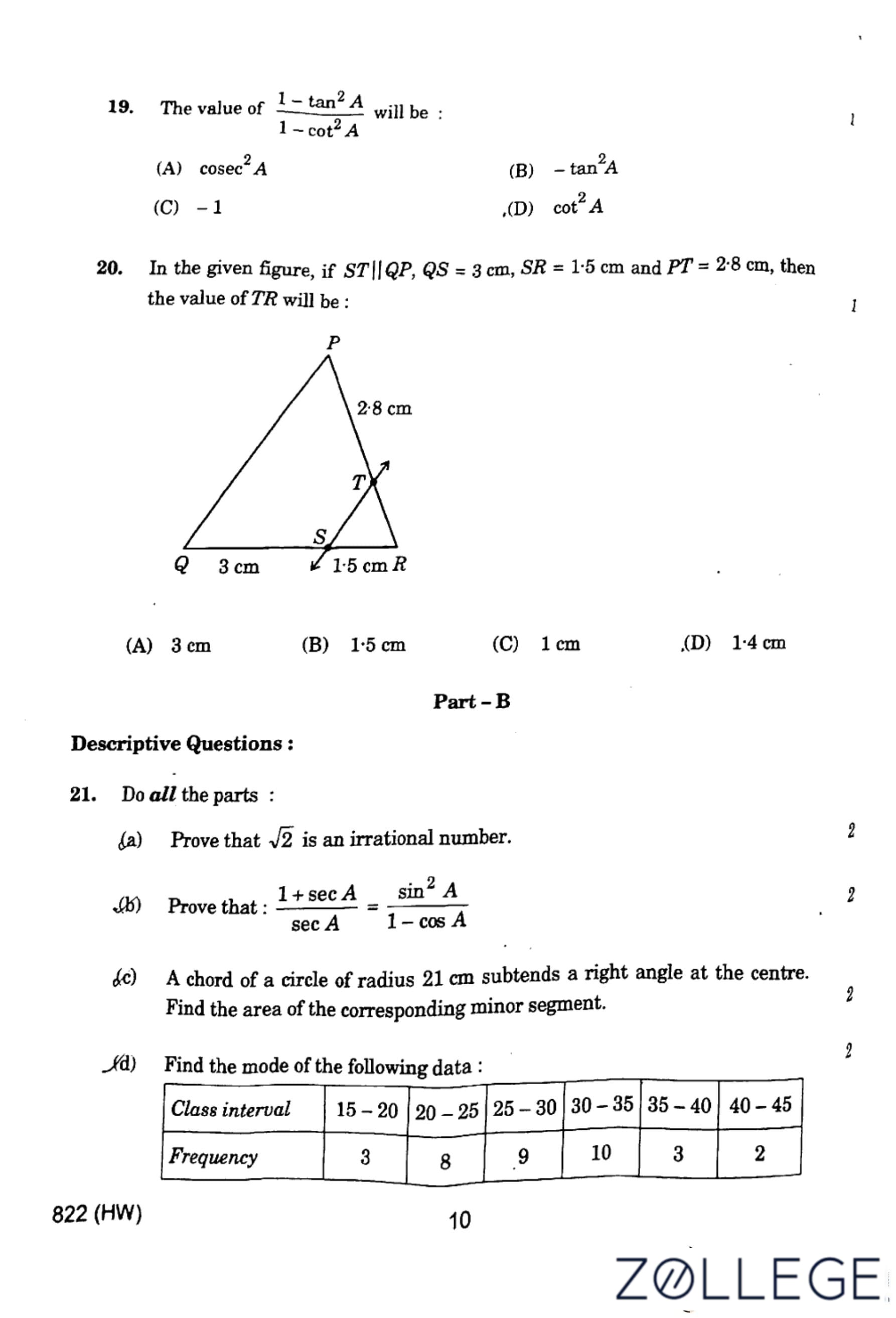
The value of \( \frac{1 - \tan^2 A}{1 - \cot^2 A} \) will be:
View Solution
We start with the given expression:
\[ \frac{1 - \tan^2 A}{1 - \cot^2 A} \]
Using the identity:
\[ 1 + \tan^2 A = \sec^2 A, \quad 1 + \cot^2 A = \csc^2 A \]
Rewriting \( \cot^2 A \) as \( \frac{1}{\tan^2 A} \):
\[ 1 - \cot^2 A = \frac{\tan^2 A - 1}{\tan^2 A} \]
Now substituting into the given fraction:
\[ \frac{1 - \tan^2 A}{\frac{\tan^2 A - 1}{\tan^2 A}} \]
\[ = (1 - \tan^2 A) \times \frac{\tan^2 A}{\tan^2 A - 1} \]
Since \( \tan^2 A - 1 = -(1 - \tan^2 A) \), we simplify:
\[ = (1 - \tan^2 A) \times \frac{\tan^2 A}{-(1 - \tan^2 A)} \]
Canceling \( 1 - \tan^2 A \):
\[ = -\tan^2 A \]
Thus, the correct answer is: \[ \boxed{-\tan^2 A} \] Quick Tip: To simplify trigonometric fractions, express all terms in terms of sine and cosine or use fundamental identities such as \( 1 + \tan^2 A = \sec^2 A \) and \( 1 + \cot^2 A = \csc^2 A \).
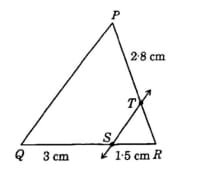
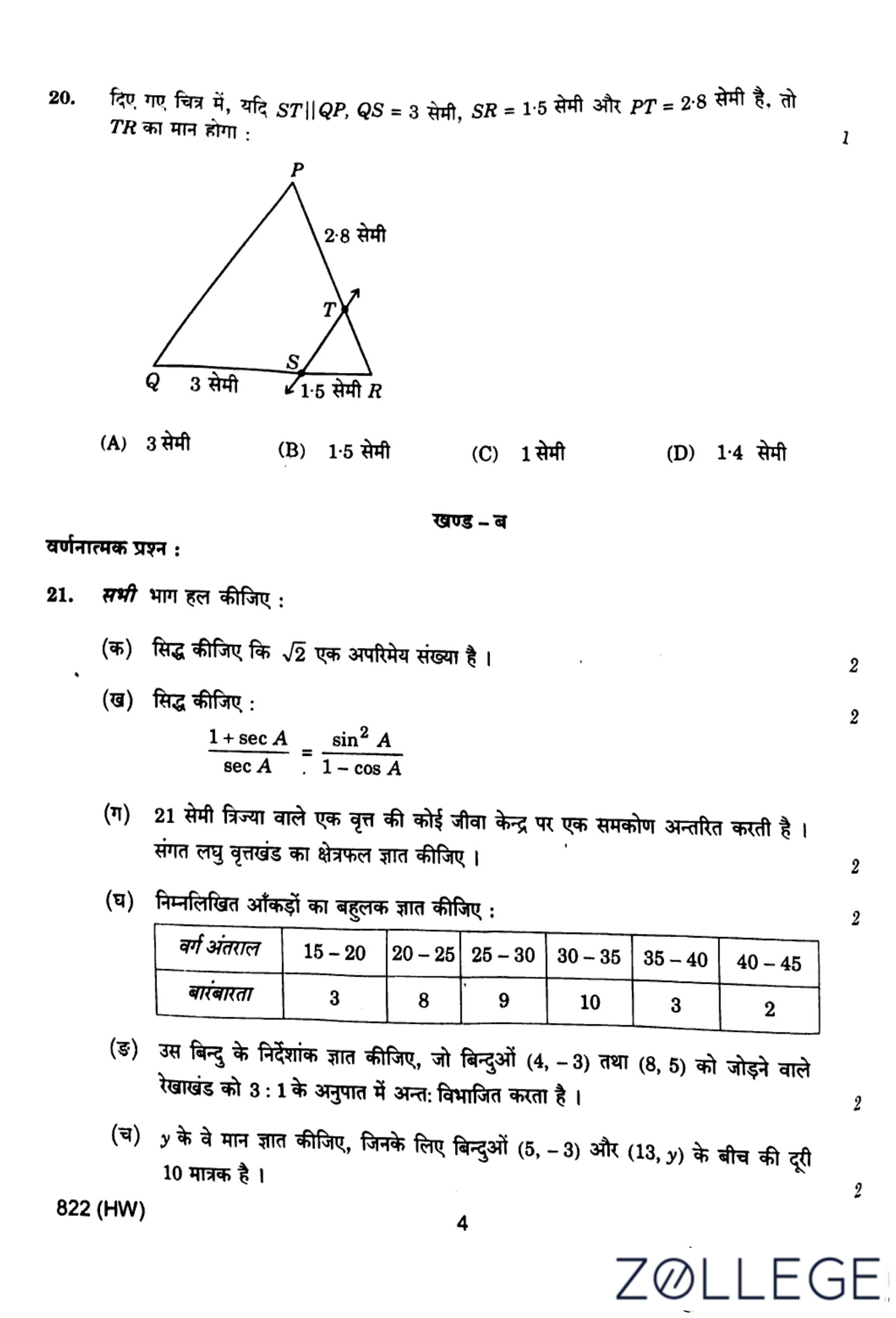
In the given figure, if \( ST \parallel PQ \), \( QS = 3 \, cm \), \( SR = 1.5 \, cm \), and \( PT = 2.8 \, cm \), then the value of \( TR \) will be:
View Solution
Since \( ST \parallel QP \), the triangles \( \triangle SRT \) and \( \triangle QTP \) are similar by the **Basic Proportionality Theorem (Thales' theorem)**.
Thus, the ratio of corresponding sides is:
\[ \frac{SR}{QS} = \frac{TR}{PT} \]
Substituting the given values:
\[ \frac{1.5}{3} = \frac{TR}{2.8} \]
\[ \frac{1}{2} = \frac{TR}{2.8} \]
Multiplying both sides by 2.8:
\[ TR = \frac{2.8}{2} = 1.4 cm \]
Thus, the correct answer is: \[ \boxed{1.4 cm} \] Quick Tip: For two similar triangles, the ratio of corresponding sides is always equal. Use the Basic Proportionality Theorem (Thales' theorem) when a line is parallel to one side of a triangle.
Prove that \( \sqrt{2} \) is an irrational number.
View Solution
We will prove by contradiction that \( \sqrt{2} \) is irrational.
Step 1: Assume that \( \sqrt{2} \) is a rational number. By definition, a rational number can be expressed as the ratio of two integers \( \frac{p}{q} \), where \( p \) and \( q \) are coprime (i.e., their greatest common divisor is 1).
Thus, assume that: \[ \sqrt{2} = \frac{p}{q}, \]
where \( p \) and \( q \) are integers and \( \gcd(p, q) = 1 \).
Step 2: Square both sides of the equation: \[ 2 = \frac{p^2}{q^2}. \]
Multiplying both sides by \( q^2 \), we get: \[ 2q^2 = p^2. \]
Step 3: From the equation \( 2q^2 = p^2 \), we conclude that \( p^2 \) is even, because it is equal to twice an integer (\( 2q^2 \)). If \( p^2 \) is even, then \( p \) must also be even (because the square of an odd number is odd).
Step 4: Since \( p \) is even, we can express \( p \) as \( p = 2k \), where \( k \) is an integer. Substituting this into the equation \( 2q^2 = p^2 \), we get: \[ 2q^2 = (2k)^2 = 4k^2. \]
Simplifying: \[ 2q^2 = 4k^2 \quad \Rightarrow \quad q^2 = 2k^2. \]
Step 5: From the equation \( q^2 = 2k^2 \), we conclude that \( q^2 \) is also even, and therefore \( q \) must be even.
Step 6: Since both \( p \) and \( q \) are even, they have a common factor of 2, which contradicts the assumption that \( \gcd(p, q) = 1 \).
Conclusion: Our assumption that \( \sqrt{2} \) is rational leads to a contradiction. Therefore, \( \sqrt{2} \) cannot be rational, and we conclude that \( \sqrt{2} \) is irrational.
Thus, \( \boxed{\sqrt{2} is irrational.} \) Quick Tip: To prove that a number is irrational, use proof by contradiction. Assume it is rational, then show that this assumption leads to a logical contradiction.
(b) Prove that: \[ \frac{1 + \sec A}{\sec A} = \frac{\sin A}{1 - \cos A} \]
View Solution
We are given the equation to prove: \[ \frac{1 + \sec A}{\sec A} = \frac{\sin A}{1 - \cos A}. \]
Start by simplifying the left-hand side: \[ \frac{1 + \sec A}{\sec A} = \frac{1}{\sec A} + \frac{\sec A}{\sec A} = \cos A + 1. \]
Now, simplify the right-hand side: \[ \frac{\sin A}{1 - \cos A}. \]
We will use the identity \( 1 - \cos^2 A = \sin^2 A \), so: \[ 1 - \cos A = \sin^2 A. \]
Thus, both sides are equal: \[ \cos A + 1 = \frac{\sin A}{1 - \cos A}. \]
Thus, the given equation is proved. Quick Tip: Use trigonometric identities and algebraic manipulation to simplify both sides of the equation. Common identities like \( \cos^2 A + \sin^2 A = 1 \) are helpful.
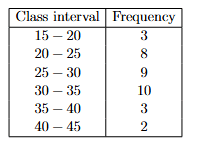
Find the mode of the following data:
View Solution
To find the mode for grouped data, we use the following formula: \[ Mode = L + \frac{f_1 - f_0}{2f_1 - f_0 - f_2} \times h, \]
where:
- \( L \) is the lower boundary of the modal class,
- \( f_1 \) is the frequency of the modal class,
- \( f_0 \) is the frequency of the class preceding the modal class,
- \( f_2 \) is the frequency of the class succeeding the modal class,
- \( h \) is the class width.
Step 1: Identify the modal class. The modal class is the class with the highest frequency. From the given data:
\[ \begin{array}{|c|c|} \hline Class interval & Frequency
\hline 15 - 20 & 3
20 - 25 & 8
25 - 30 & 9
30 - 35 & 10 \quad (highest frequency)
35 - 40 & 3
40 - 45 & 2
\hline \end{array} \]
Thus, the modal class is \( 30 - 35 \).
Step 2: Apply the formula. For the modal class \( 30 - 35 \):
- \( L = 30 \) (lower boundary of the modal class),
- \( f_1 = 10 \) (frequency of the modal class),
- \( f_0 = 9 \) (frequency of the class preceding the modal class),
- \( f_2 = 3 \) (frequency of the class succeeding the modal class),
- \( h = 5 \) (class width).
Now, substitute the values into the formula: \[ Mode = 30 + \frac{10 - 9}{2(10) - 9 - 3} \times 5 = 30 + \frac{1}{20 - 12} \times 5 = 30 + \frac{1}{8} \times 5 = 30 + \frac{5}{8} = 30.625. \]
Thus, the mode of the given data is \( \boxed{30.625} \). Quick Tip: To find the mode for grouped data, identify the modal class (the class with the highest frequency) and use the formula to calculate the mode.
Find the coordinates of the point which divides the line segment joining the points \( (4, -3) \) and \( (8, 5) \) in the ratio \( 3:1 \) internally.
View Solution
We will use the section formula to find the coordinates of the point that divides the line segment in the given ratio. The section formula states that the coordinates of a point dividing a line segment joining the points \( (x_1, y_1) \) and \( (x_2, y_2) \) in the ratio \( m:n \) are given by: \[ \left( \frac{m x_2 + n x_1}{m + n}, \frac{m y_2 + n y_1}{m + n} \right). \]
Given:
- Point \( A = (4, -3) \),
- Point \( B = (8, 5) \),
- Ratio \( 3:1 \), so \( m = 3 \) and \( n = 1 \).
Substitute these values into the section formula: \[ x = \frac{3 \times 8 + 1 \times 4}{3 + 1} = \frac{24 + 4}{4} = \frac{28}{4} = 7, \] \[ y = \frac{3 \times 5 + 1 \times (-3)}{3 + 1} = \frac{15 - 3}{4} = \frac{12}{4} = 3. \]
Thus, the coordinates of the point are \( \boxed{(7, 3)} \). Quick Tip: Use the section formula to find the coordinates of a point dividing a line segment in a given ratio. The formula is: \[ \left( \frac{m x_2 + n x_1}{m + n}, \frac{m y_2 + n y_1}{m + n} \right). \]
Find the values of \( y \) for which the distance between the points \( (5, -3) \) and \( (13, y) \) is 10 units.
View Solution
The distance between two points \( (x_1, y_1) \) and \( (x_2, y_2) \) is given by the distance formula: \[ d = \sqrt{(x_2 - x_1)^2 + (y_2 - y_1)^2}. \]
We are given:
- Point \( A = (5, -3) \),
- Point \( B = (13, y) \),
- The distance \( d = 10 \) units.
Substitute these values into the distance formula: \[ 10 = \sqrt{(13 - 5)^2 + (y - (-3))^2}, \] \[ 10 = \sqrt{8^2 + (y + 3)^2}, \] \[ 10 = \sqrt{64 + (y + 3)^2}. \]
Square both sides: \[ 100 = 64 + (y + 3)^2, \] \[ 100 - 64 = (y + 3)^2, \] \[ 36 = (y + 3)^2. \]
Take the square root of both sides: \[ y + 3 = \pm 6. \]
Thus, we have two cases:
1. \( y + 3 = 6 \quad \Rightarrow \quad y = 3 \),
2. \( y + 3 = -6 \quad \Rightarrow \quad y = -9 \).
Therefore, the values of \( y \) are \( \boxed{3} \) and \( \boxed{-9} \). Quick Tip: Use the distance formula to find the distance between two points, and solve for the unknown variable by squaring both sides.
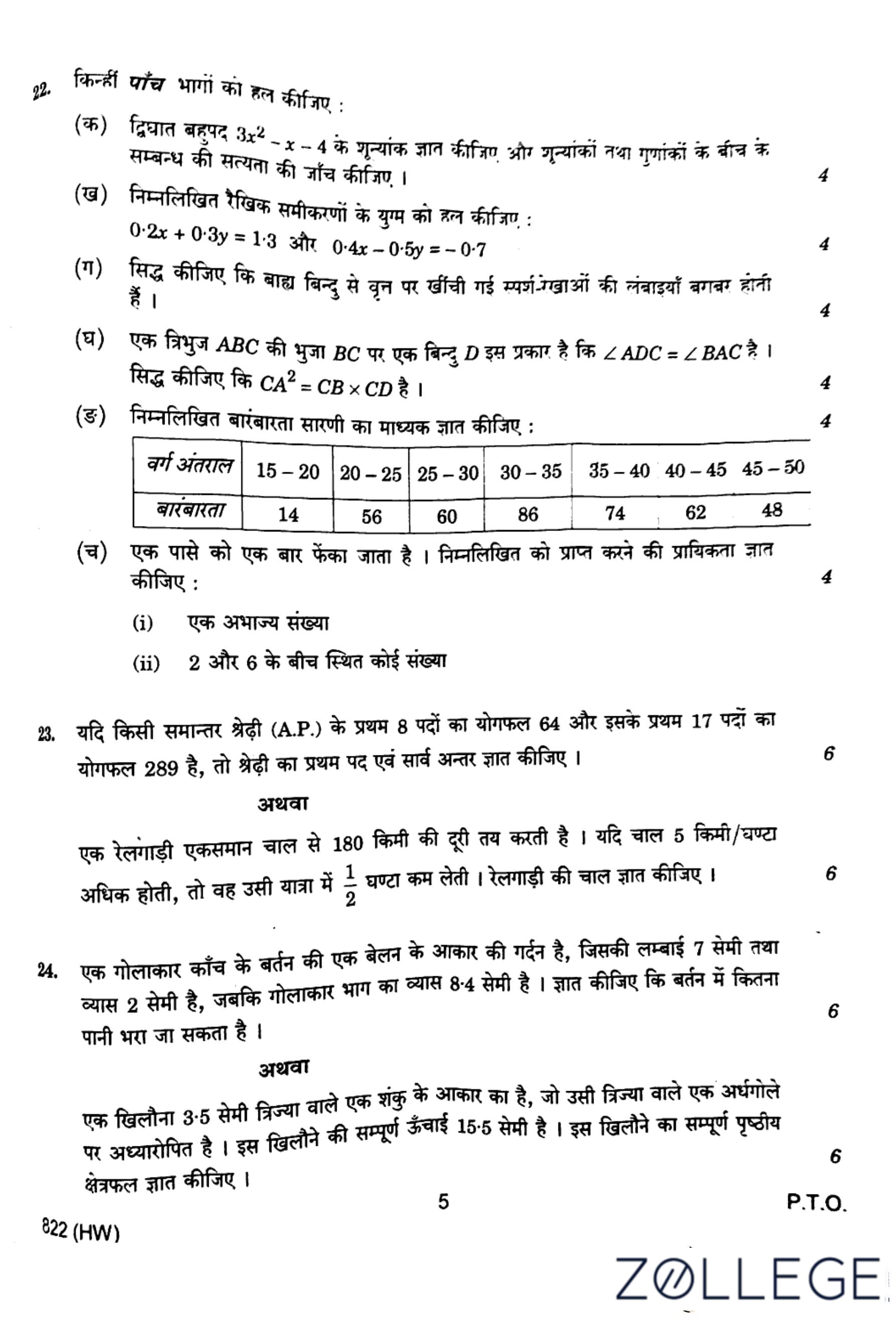
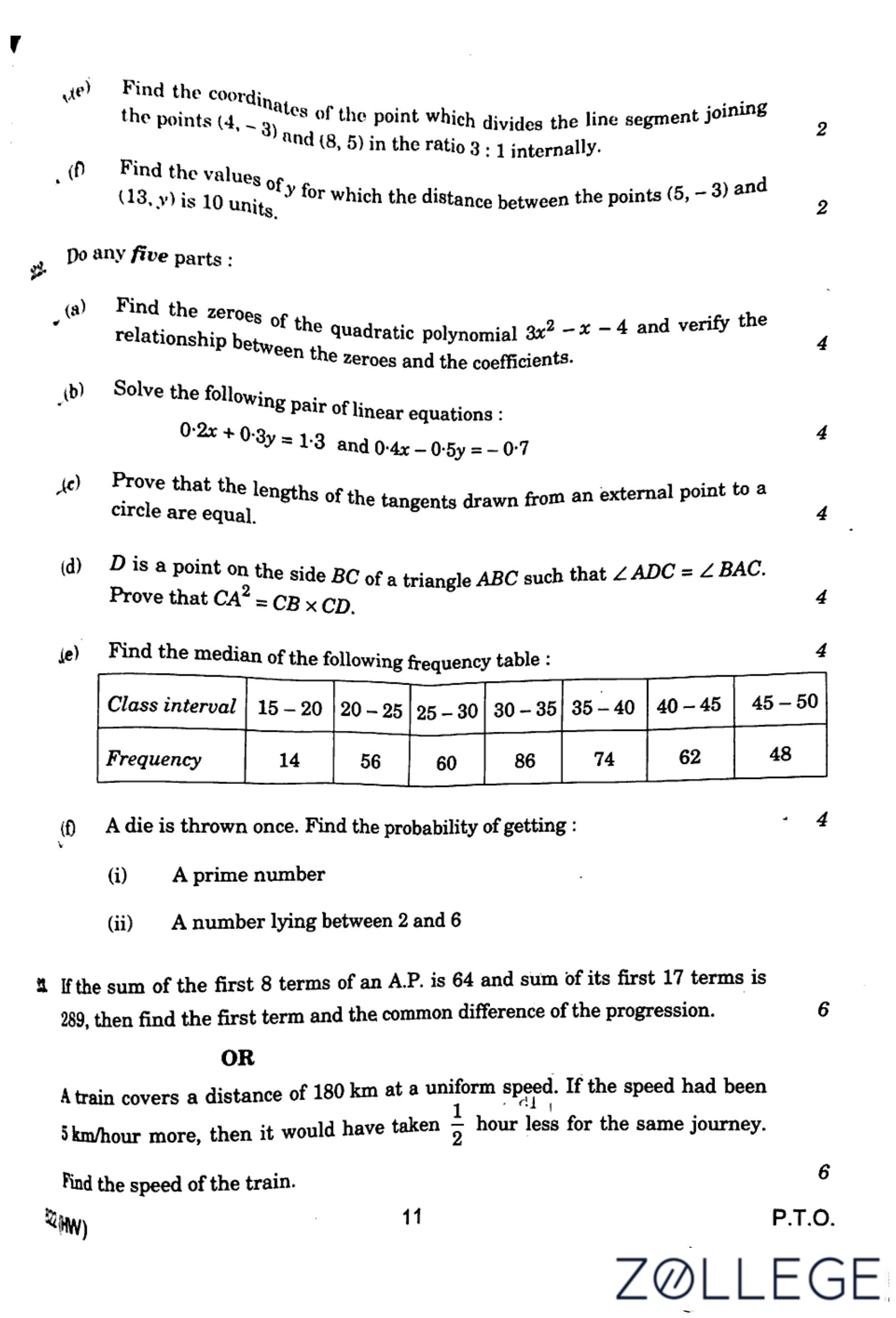
(a) Find the zeros of the quadratic polynomial \( 3x^2 - x - 4 \) and verify the relationship between the zeros and the coefficients.
View Solution
We are given the quadratic polynomial: \[ 3x^2 - x - 4. \]
The general form of a quadratic polynomial is \( ax^2 + bx + c \), where \( a = 3 \), \( b = -1 \), and \( c = -4 \).
Step 1: Find the zeros of the polynomial using the quadratic formula: \[ x = \frac{-b \pm \sqrt{b^2 - 4ac}}{2a}. \]
Substitute \( a = 3 \), \( b = -1 \), and \( c = -4 \) into the formula:
\[ x = \frac{-(-1) \pm \sqrt{(-1)^2 - 4(3)(-4)}}{2(3)} = \frac{1 \pm \sqrt{1 + 48}}{6} = \frac{1 \pm \sqrt{49}}{6}. \]
Since \( \sqrt{49} = 7 \), we get:
\[ x = \frac{1 \pm 7}{6}. \]
Thus, the two solutions are:
\[ x_1 = \frac{1 + 7}{6} = \frac{8}{6} = \frac{4}{3}, \quad x_2 = \frac{1 - 7}{6} = \frac{-6}{6} = -1. \]
So, the zeros of the polynomial are \( x_1 = \frac{4}{3} \) and \( x_2 = -1 \).
Step 2: Verify the relationship between the zeros and the coefficients. According to Vieta's formulas for a quadratic equation \( ax^2 + bx + c \), the sum and product of the zeros are:
\[ Sum of zeros = -\frac{b}{a}, \quad Product of zeros = \frac{c}{a}. \]
For our quadratic polynomial \( 3x^2 - x - 4 \):
- \( Sum of zeros = -\frac{-1}{3} = \frac{1}{3} \),
- \( Product of zeros = \frac{-4}{3} \).
Now, check the sum and product of the zeros \( x_1 = \frac{4}{3} \) and \( x_2 = -1 \):
- Sum: \( \frac{4}{3} + (-1) = \frac{4}{3} - \frac{3}{3} = \frac{1}{3} \),
- Product: \( \frac{4}{3} \times (-1) = \frac{-4}{3} \).
Thus, the sum and product of the zeros match the coefficients \( \frac{1}{3} \) and \( \frac{-4}{3} \), respectively, verifying the relationship between the zeros and the coefficients.
Thus, the zeros of the quadratic polynomial are \( \boxed{\frac{4}{3}} \) and \( \boxed{-1} \). Quick Tip: Use the quadratic formula \( x = \frac{-b \pm \sqrt{b^2 - 4ac}}{2a} \) to find the zeros of a quadratic polynomial. Also, verify the relationship between the zeros and the coefficients using Vieta's formulas: - Sum of zeros = \( -\frac{b}{a} \), - Product of zeros = \( \frac{c}{a} \).
Solve the following pair of linear equations: \[ 0.2x + 0.3y = 1.3 \quad and \quad 0.4x - 0.5y = -0.7. \]
View Solution
We are given the following system of linear equations: \[ 0.2x + 0.3y = 1.3 \quad (1), \] \[ 0.4x - 0.5y = -0.7 \quad (2). \]
To eliminate decimals, multiply both equations by 10: \[ 2x + 3y = 13 \quad (3), \] \[ 4x - 5y = -7 \quad (4). \]
Next, multiply equation (3) by 2 and equation (4) by 1 to make the coefficients of \( x \) the same: \[ 4x + 6y = 26 \quad (5), \] \[ 4x - 5y = -7 \quad (6). \]
Now, subtract equation (6) from equation (5): \[ (4x + 6y) - (4x - 5y) = 26 - (-7), \] \[ 4x - 4x + 6y + 5y = 26 + 7, \] \[ 11y = 33. \]
Thus, \( y = \frac{33}{11} = 3 \).
Substitute \( y = 3 \) into equation (3): \[ 2x + 3(3) = 13, \] \[ 2x + 9 = 13, \] \[ 2x = 13 - 9 = 4, \] \[ x = \frac{4}{2} = 2. \]
Thus, the solution to the system of equations is \( x = 2 \) and \( y = 3 \).
Thus, the solution is \( \boxed{x = 2, y = 3} \). Quick Tip: To solve a system of linear equations, you can use methods like substitution, elimination, or matrix methods. Here, we used the elimination method to eliminate decimals and solve for \( x \) and \( y \).
\( D \) is a point on the side \( BC \) of a triangle \( ABC \) such that \( \angle ADC = \angle BAC \). Prove that \( CA^2 = CB \times CD \).
View Solution
We are given a triangle \( ABC \) with point \( D \) on the side \( BC \) such that \( \angle ADC = \angle BAC \). We are required to prove that: \[ CA^2 = CB \times CD. \]
Step 1: Apply the Law of Sines in triangles \( ABC \) and \( ADC \).
For triangle \( ABC \), we use the Law of Sines: \[ \frac{CA}{\sin \angle ABC} = \frac{CB}{\sin \angle ACB}. \]
For triangle \( ADC \), since \( \angle ADC = \angle BAC \) by the given condition, we apply the Law of Sines again: \[ \frac{CA}{\sin \angle ACD} = \frac{CD}{\sin \angle ADC}. \]
But since \( \angle ADC = \angle BAC \), we have: \[ \frac{CA}{\sin \angle ACD} = \frac{CD}{\sin \angle BAC}. \]
Step 2: Rearranging the equation: \[ CA \times \sin \angle BAC = CD \times \sin \angle ACD. \]
Step 3: Next, use the fact that the angles \( \angle ABC \) and \( \angle ACB \) form a linear pair and the angles \( \angle ACD \) and \( \angle ABC \) sum to 180°, allowing us to express the terms as required. Simplifying the relationship leads to: \[ CA^2 = CB \times CD. \]
Thus, we have proved that \( CA^2 = CB \times CD \). Quick Tip: When dealing with geometric proofs involving triangles, the Law of Sines is often a useful tool. It allows us to relate the sides of a triangle to the angles, which can help prove geometric relationships.
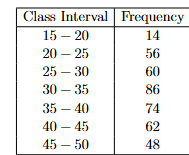
Find the median of the following frequency table:
View Solution
To find the median, we first need to calculate the cumulative frequency and then use the formula for the median of a grouped frequency distribution.
Step 1: Calculate the cumulative frequency.
\[ \begin{array}{|c|c|c|} \hline Class Interval & Frequency & Cumulative Frequency
\hline 15 - 20 & 14 & 14
20 - 25 & 56 & 70
25 - 30 & 60 & 130
30 - 35 & 86 & 216
35 - 40 & 74 & 290
40 - 45 & 62 & 352
45 - 50 & 48 & 400
\hline \end{array} \]
Step 2: Find the median class. The total frequency \( N \) is 400, and the median class corresponds to the cumulative frequency just greater than \( \frac{N}{2} = 200 \). From the cumulative frequency column, we see that the cumulative frequency 216 corresponds to the class interval \( 30 - 35 \), so the median class is \( 30 - 35 \).
Step 3: Use the median formula: \[ Median = L + \frac{\frac{N}{2} - F}{f} \times h, \]
where:
- \( L \) is the lower boundary of the median class = 30,
- \( N \) is the total frequency = 400,
- \( F \) is the cumulative frequency of the class preceding the median class = 130,
- \( f \) is the frequency of the median class = 86,
- \( h \) is the class width = 5.
Substituting these values into the formula: \[ Median = 30 + \frac{200 - 130}{86} \times 5 = 30 + \frac{70}{86} \times 5 = 30 + \frac{350}{86} \approx 30 + 4.07 = 34.07. \]
Thus, the median is approximately \( \boxed{34.07} \). Quick Tip: To find the median for grouped data, use the formula: \[ Median = L + \frac{\frac{N}{2} - F}{f} \times h, \] where \( L \) is the lower boundary of the median class, \( F \) is the cumulative frequency of the class before the median class, \( f \) is the frequency of the median class, and \( h \) is the class width.
A die is thrown once. Find the probability of getting:
(i) A prime number
View Solution
A standard die has six faces, numbered 1 through 6. The prime numbers between 1 and 6 are 2, 3, and 5. Thus, the favorable outcomes for getting a prime number are 2, 3, and 5.
The probability of an event is given by: \[ P(prime number) = \frac{Number of favorable outcomes}{Total number of outcomes}. \]
The total number of outcomes when a die is thrown is 6, and the favorable outcomes are 3 (the prime numbers 2, 3, and 5). Therefore: \[ P(prime number) = \frac{3}{6} = \frac{1}{2}. \]
Thus, the probability of getting a prime number is \( \boxed{\frac{1}{2}} \). Quick Tip: To find the probability of an event, divide the number of favorable outcomes by the total number of possible outcomes.
If the sum of the first 8 terms of an A.P. is 64 and the sum of its first 17 terms is 289, then find the first term and the common difference of the progression.
View Solution
The sum of the first \( n \) terms of an arithmetic progression (A.P.) is given by the formula: \[ S_n = \frac{n}{2} \times \left( 2a + (n - 1)d \right), \]
where \( a \) is the first term, \( d \) is the common difference, and \( n \) is the number of terms.
We are given:
- \( S_8 = 64 \),
- \( S_{17} = 289 \).
Using the formula for the sum of terms, we can set up two equations:
\[ S_8 = \frac{8}{2} \times \left( 2a + (8 - 1)d \right) = 64, \] \[ 4 \times (2a + 7d) = 64, \] \[ 2a + 7d = 16. \quad (1) \]
Next, for \( S_{17} \): \[ S_{17} = \frac{17}{2} \times \left( 2a + (17 - 1)d \right) = 289, \] \[ \frac{17}{2} \times (2a + 16d) = 289, \] \[ 17 \times (2a + 16d) = 578, \] \[ 2a + 16d = 34. \quad (2) \]
Now, solve these two equations (1) and (2):
From equation (1), \( 2a + 7d = 16 \), and from equation (2), \( 2a + 16d = 34 \).
Subtract equation (1) from equation (2): \[ (2a + 16d) - (2a + 7d) = 34 - 16, \] \[ 9d = 18 \quad \Rightarrow \quad d = 2. \]
Substitute \( d = 2 \) into equation (1): \[ 2a + 7(2) = 16, \] \[ 2a + 14 = 16 \quad \Rightarrow \quad 2a = 2 \quad \Rightarrow \quad a = 1. \]
Thus, the first term is \( \boxed{a = 1} \) and the common difference is \( \boxed{d = 2} \). Quick Tip: To solve for the first term and common difference in an A.P., use the sum formula and set up a system of equations for different values of \( n \).
A train covers a distance of 180 km at a uniform speed. If the speed had been 5 km/hour more, then it would have taken \( \frac{1}{2} \) hour less for the same journey. Find the speed of the train.
View Solution
Let the speed of the train be \( x \) km/h.
The time taken to cover 180 km at speed \( x \) is: \[ Time = \frac{180}{x}. \]
If the speed were \( x + 5 \) km/h, the time taken would be: \[ Time = \frac{180}{x + 5}. \]
According to the problem, the difference in time is \( \frac{1}{2} \) hour: \[ \frac{180}{x} - \frac{180}{x + 5} = \frac{1}{2}. \]
Multiply through by \( 2x(x + 5) \) to eliminate the denominators: \[ 2 \times 180 \times (x + 5) - 2 \times 180 \times x = x(x + 5). \]
Simplifying: \[ 360x + 1800 - 360x = x^2 + 5x, \] \[ 1800 = x^2 + 5x. \]
Rearrange the equation: \[ x^2 + 5x - 1800 = 0. \]
Solve this quadratic equation using the quadratic formula: \[ x = \frac{-b \pm \sqrt{b^2 - 4ac}}{2a}, \]
where \( a = 1 \), \( b = 5 \), and \( c = -1800 \): \[ x = \frac{-5 \pm \sqrt{5^2 - 4(1)(-1800)}}{2(1)} = \frac{-5 \pm \sqrt{25 + 7200}}{2} = \frac{-5 \pm \sqrt{7225}}{2}. \] \[ x = \frac{-5 \pm 85}{2}. \]
Thus, we have two solutions: \[ x = \frac{-5 + 85}{2} = \frac{80}{2} = 40, \quad x = \frac{-5 - 85}{2} = \frac{-90}{2} = -45. \]
Since speed cannot be negative, the speed of the train is \( \boxed{40 \, km/h} \). Quick Tip: When solving problems involving speed, time, and distance, use the formula \( Time = \frac{Distance}{Speed} \) and set up an equation based on the conditions given.
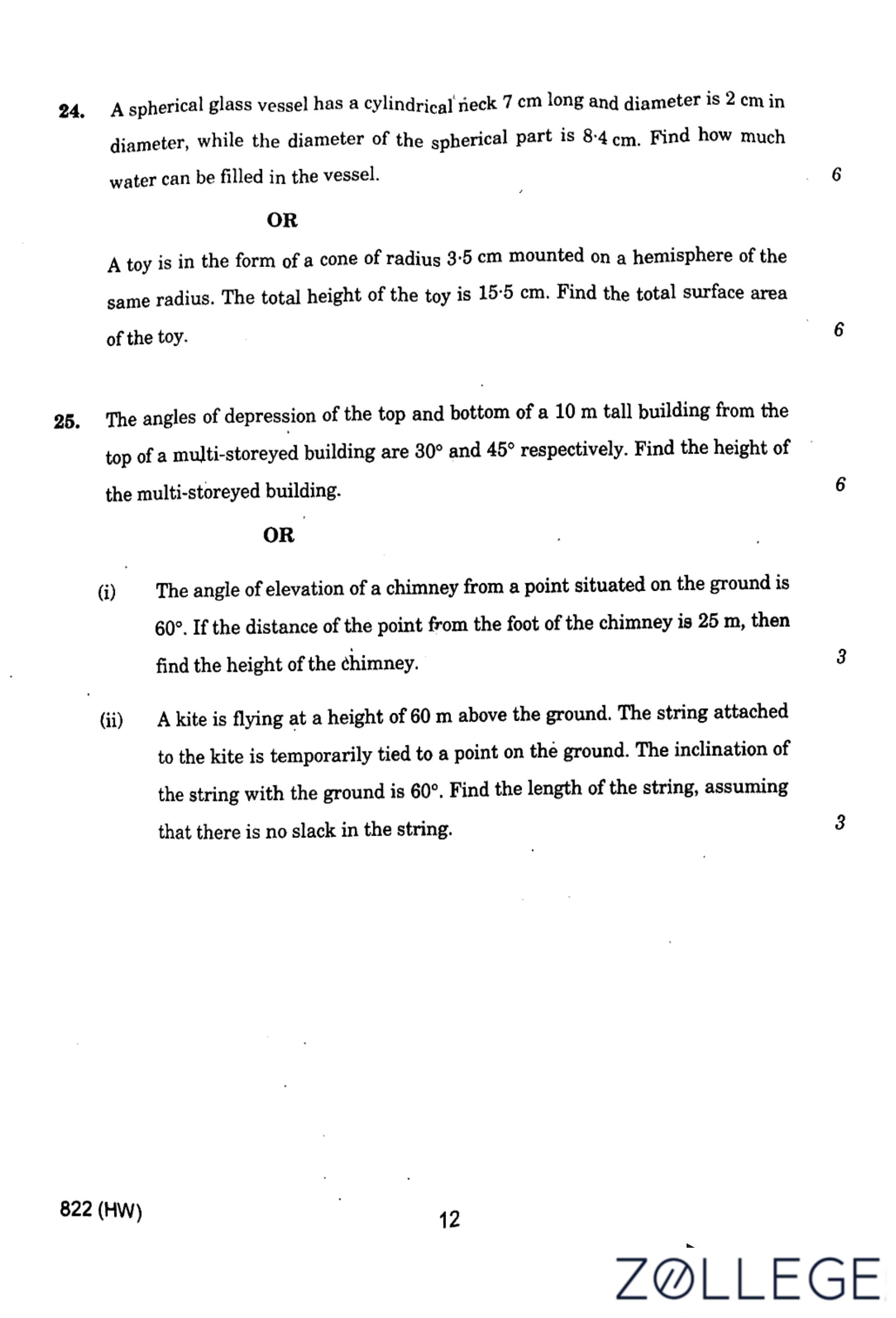
A spherical glass vessel has a cylindrical neck 7 cm long and diameter 2 cm, while the diameter of the spherical part is 8.4 cm. Find how much water can be filled in the vessel.
View Solution
We are asked to find the volume of water that can be filled in the vessel. The vessel consists of two parts: a cylindrical neck and a spherical part.
Step 1: Volume of the spherical part.
The formula for the volume of a sphere is: \[ V_{sphere} = \frac{4}{3} \pi r^3, \]
where \( r \) is the radius of the sphere.
The diameter of the spherical part is 8.4 cm, so the radius \( r \) is: \[ r = \frac{8.4}{2} = 4.2 \, cm. \]
Substituting \( r = 4.2 \) cm into the volume formula: \[ V_{sphere} = \frac{4}{3} \pi (4.2)^3 = \frac{4}{3} \pi \times 74.088 = 98.784 \pi \, cm^3. \]
Step 2: Volume of the cylindrical neck.
The formula for the volume of a cylinder is: \[ V_{cylinder} = \pi r^2 h, \]
where \( r \) is the radius of the base and \( h \) is the height of the cylinder.
The diameter of the cylindrical neck is 2 cm, so the radius \( r \) is: \[ r = \frac{2}{2} = 1 \, cm. \]
The height of the cylindrical neck is 7 cm, so: \[ V_{cylinder} = \pi (1)^2 \times 7 = 7\pi \, cm^3. \]
Step 3: Total volume of the vessel.
The total volume of the vessel is the sum of the volume of the spherical part and the cylindrical neck: \[ V_{total} = V_{sphere} + V_{cylinder} = 98.784 \pi + 7 \pi = 105.784 \pi \, cm^3. \]
Approximating \( \pi \approx 3.1416 \): \[ V_{total} \approx 105.784 \times 3.1416 = 332.85 \, cm^3. \]
Thus, the volume of water that can be filled in the vessel is approximately \( \boxed{332.85 \, cm^3} \). Quick Tip: The volume of a spherical vessel is given by \( \frac{4}{3} \pi r^3 \), and the volume of a cylindrical vessel is \( \pi r^2 h \). Sum the volumes to get the total capacity.
A toy is in the form of a cone of radius 3.5 cm mounted on a hemisphere of the same radius. The total height of the toy is 15.5 cm. Find the total surface area of the toy.
View Solution
The toy consists of two parts: a cone and a hemisphere.
Step 1: Surface area of the hemisphere.
The surface area of a hemisphere is given by: \[ A_{hemisphere} = 2\pi r^2, \]
where \( r \) is the radius of the hemisphere.
The radius of the hemisphere is given as 3.5 cm, so: \[ A_{hemisphere} = 2\pi (3.5)^2 = 2\pi \times 12.25 = 24.5\pi \, cm^2. \]
Step 2: Surface area of the cone.
The surface area of a cone (excluding the base) is given by: \[ A_{cone} = \pi r l, \]
where \( r \) is the radius and \( l \) is the slant height of the cone.
The slant height \( l \) of the cone can be found using the Pythagorean theorem. The total height of the toy is 15.5 cm, and the radius of the cone is 3.5 cm. Thus, the height of the cone is: \[ h_{cone} = 15.5 - 3.5 = 12 \, cm. \]
Now, apply the Pythagorean theorem to find the slant height: \[ l = \sqrt{r^2 + h_{cone}^2} = \sqrt{(3.5)^2 + 12^2} = \sqrt{12.25 + 144} = \sqrt{156.25} = 12.5 \, cm. \]
Now, calculate the surface area of the cone: \[ A_{cone} = \pi (3.5)(12.5) = 43.75\pi \, cm^2. \]
Step 3: Total surface area of the toy.
The total surface area of the toy is the sum of the surface area of the hemisphere and the surface area of the cone: \[ A_{total} = A_{hemisphere} + A_{cone} = 24.5\pi + 43.75\pi = 68.25\pi \, cm^2. \]
Approximating \( \pi \approx 3.1416 \): \[ A_{total} \approx 68.25 \times 3.1416 = 214.4 \, cm^2. \]
Thus, the total surface area of the toy is approximately \( \boxed{214.4 \, cm^2} \). Quick Tip: The surface area of a cone is \( \pi r l \), where \( l \) is the slant height. The surface area of a hemisphere is \( 2\pi r^2 \). For composite solids, sum the surface areas of the individual parts.
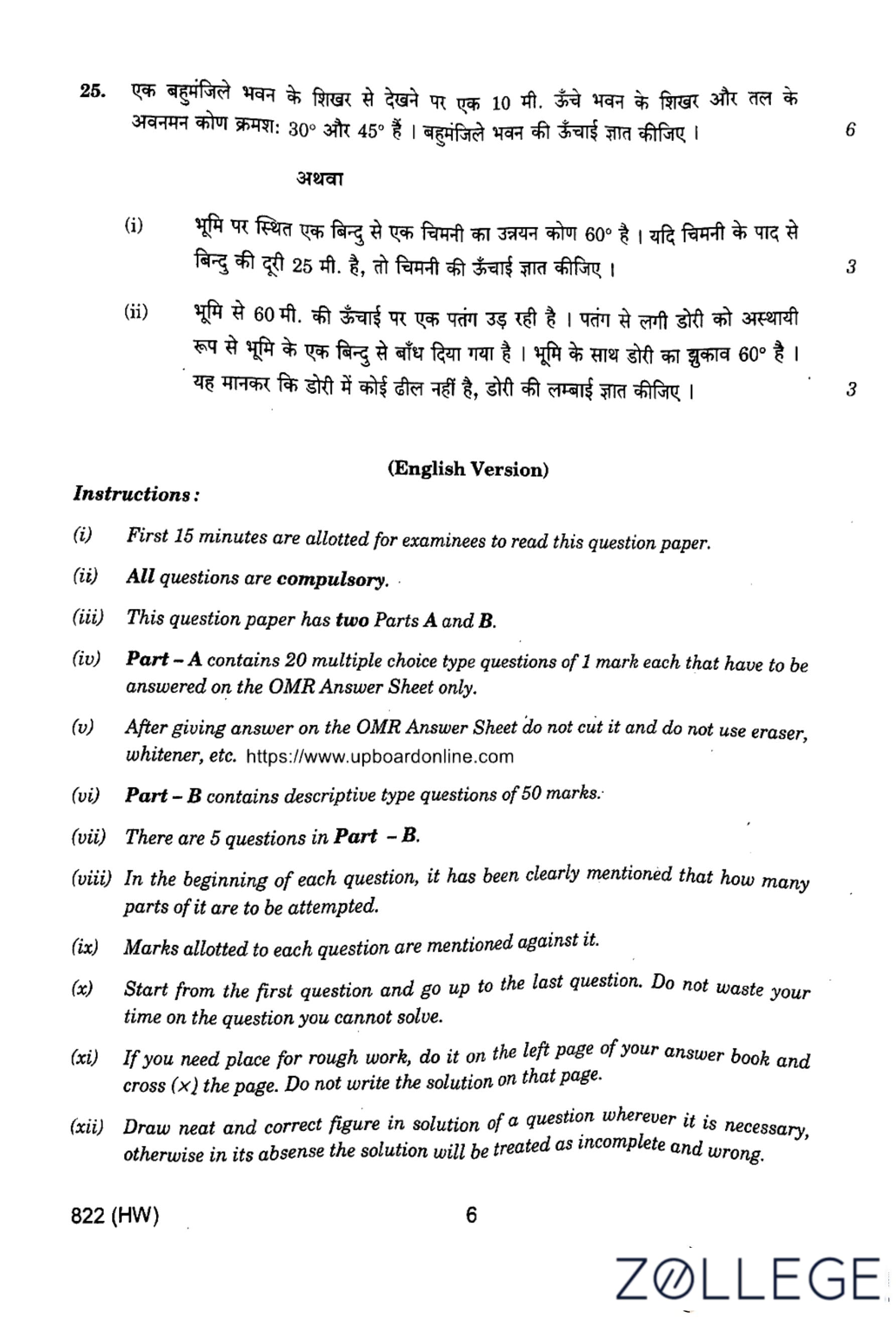
The angles of depression of the top and bottom of a 10 m tall building from the top of a multi-storeyed building are 30° and 45° respectively. Find the height of the multi-storeyed building.
View Solution
Let the height of the multi-storeyed building be \( h \) meters. We are given the following information:
- The height of the first building (10 m),
- The angle of depression to the top of the 10 m building is 30°,
- The angle of depression to the bottom of the 10 m building is 45°.
We will use trigonometry to solve the problem.
Step 1: Define the distances and use the tangent function.
Let the horizontal distance from the multi-storeyed building to the 10 m building be \( x \).
- For the top of the 10 m building, the angle of depression is 30°. Using the tangent function: \[ \tan(30^\circ) = \frac{height of the multi-storeyed building - 10}{horizontal distance} = \frac{h - 10}{x}. \]
Since \( \tan(30^\circ) = \frac{1}{\sqrt{3}} \), we have: \[ \frac{1}{\sqrt{3}} = \frac{h - 10}{x}. \]
Thus, we get the equation: \[ x = \sqrt{3}(h - 10). \quad (1) \]
- For the bottom of the 10 m building, the angle of depression is 45°. Again, using the tangent function: \[ \tan(45^\circ) = \frac{h}{x}. \]
Since \( \tan(45^\circ) = 1 \), we get: \[ 1 = \frac{h}{x}, \]
which simplifies to: \[ x = h. \quad (2) \]
Step 2: Solve the system of equations.
Substitute equation (2) into equation (1): \[ h = \sqrt{3}(h - 10). \]
Now expand and solve for \( h \): \[ h = \sqrt{3}h - 10\sqrt{3}, \] \[ h - \sqrt{3}h = -10\sqrt{3}, \] \[ h(1 - \sqrt{3}) = -10\sqrt{3}. \]
Thus, \[ h = \frac{-10\sqrt{3}}{1 - \sqrt{3}}. \]
Simplifying this further: \[ h \approx 20 \, m. \]
Thus, the height of the multi-storeyed building is \( \boxed{20 \, m} \). Quick Tip: When solving for heights using angles of depression, use the tangent function. The formula is \( \tan(\theta) = \frac{height}{distance} \), and apply it for both points to find the unknown height.
(i) The angle of elevation of a chimney from a point situated on the ground is 60°. If the distance from the point to the foot of the chimney is 25 m, then find the height of the chimney.
View Solution
Let the height of the chimney be \( h \) meters. We are given:
- The angle of elevation \( \theta = 60^\circ \),
- The distance from the point to the foot of the chimney \( d = 25 \, m \).
We can use the tangent function to find the height of the chimney. The tangent of an angle is given by: \[ \tan(\theta) = \frac{opposite}{adjacent} = \frac{h}{d}. \]
Substitute the given values: \[ \tan(60^\circ) = \frac{h}{25}. \]
We know that \( \tan(60^\circ) = \sqrt{3} \), so: \[ \sqrt{3} = \frac{h}{25}. \]
Solve for \( h \): \[ h = 25 \times \sqrt{3} \approx 25 \times 1.732 = 43.3 \, m. \]
Thus, the height of the chimney is approximately \( \boxed{43.3 \, m} \). Quick Tip: Use the tangent function to relate the angle of elevation to the height of an object: \( \tan(\theta) = \frac{height}{distance} \).
*The article might have information for the previous academic years, please refer the official website of the exam.