
UP Board Class 10 Mathematics(Code 822 HX) Question Paper 2024 with Solutions


Content Writer | Updated On - Mar 4, 2025
UP Board Class 10 Mathematics Question Paper 2024 PDF (Code 822 HX) is available for download here. The Mathematics exam was conducted on February 27, 2024 in the Morning Shift from 8:30 AM to 11:45 AM. The total marks for the theory paper are 70. Students reported the paper to be moderate.
UP Board Class 10 Mathematics Question Paper 2024 (Code 822 HX) with Solutions
| UP Board Class 10 Mathematics Question Paper With Answer Key | Check Solution |


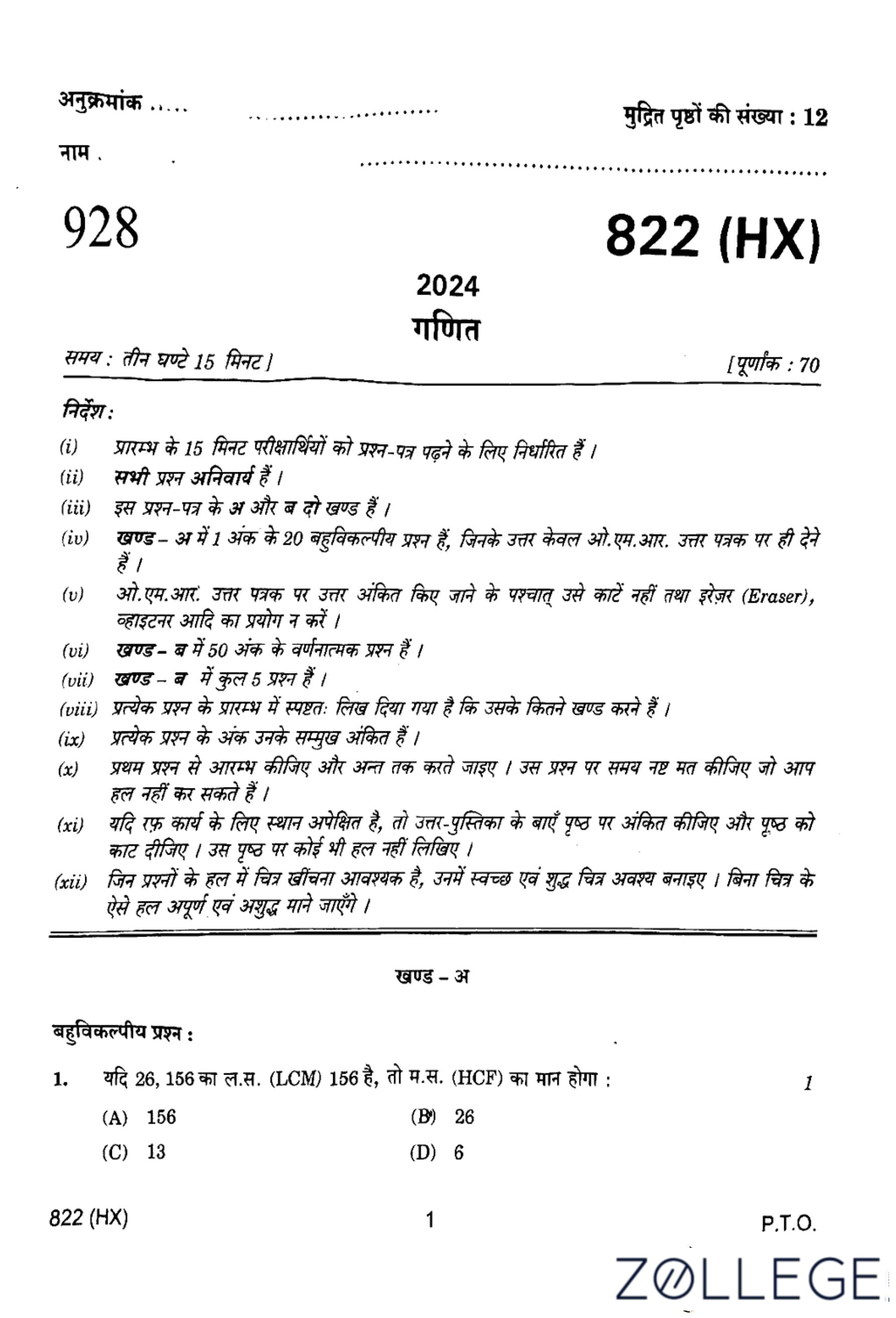
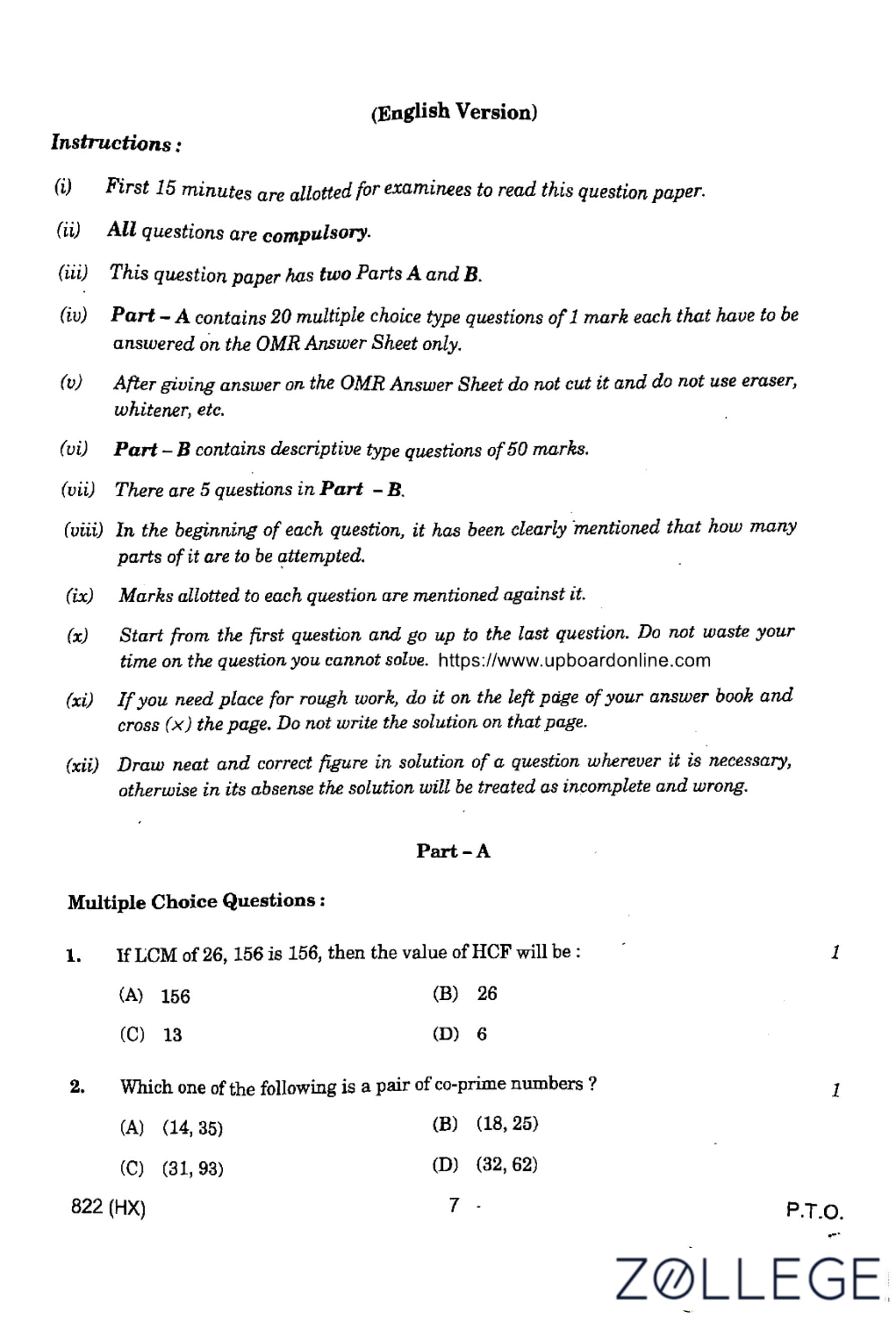
If LCM of 26, 156 is 156, then the value of HCF will be:
View Solution
We are given the LCM of 26 and 156, and we need to find their HCF. We use the relationship between LCM, HCF, and the product of two numbers: \[ LCM \times HCF = Product of the two numbers. \]
Let \( HCF = h \). Then: \[ LCM(26, 156) \times h = 26 \times 156. \]
We are given that \( LCM(26, 156) = 156 \), so: \[ 156 \times h = 26 \times 156. \]
Canceling out 156 from both sides: \[ h = 26. \]
Thus, the value of HCF is \( \boxed{26} \). Quick Tip: To find the HCF when the LCM is known, use the formula: \[ LCM \times HCF = Product of the numbers. \]
Which one of the following is a pair of co-prime numbers?
View Solution
Co-prime numbers are numbers whose HCF is 1. Let's check the HCF for each pair of numbers.
- For (14, 35), the factors of 14 are \( 1, 2, 7, 14 \) and the factors of 35 are \( 1, 5, 7, 35 \). The common factor is 7, so they are not co-prime.
- For (18, 25), the factors of 18 are \( 1, 2, 3, 6, 9, 18 \) and the factors of 25 are \( 1, 5, 25 \). The common factor is 1, so they are co-prime.
- For (31, 93), the factors of 31 are \( 1, 31 \) and the factors of 93 are \( 1, 3, 31, 93 \). The common factor is 31, so they are not co-prime.
- For (32, 62), the factors of 32 are \( 1, 2, 4, 8, 16, 32 \) and the factors of 62 are \( 1, 2, 31, 62 \). The common factor is 2, so they are not co-prime.
Thus, the correct pair of co-prime numbers is \( \boxed{(18, 25)} \). Quick Tip: To check if two numbers are co-prime, find their HCF. If the HCF is 1, the numbers are co-prime.
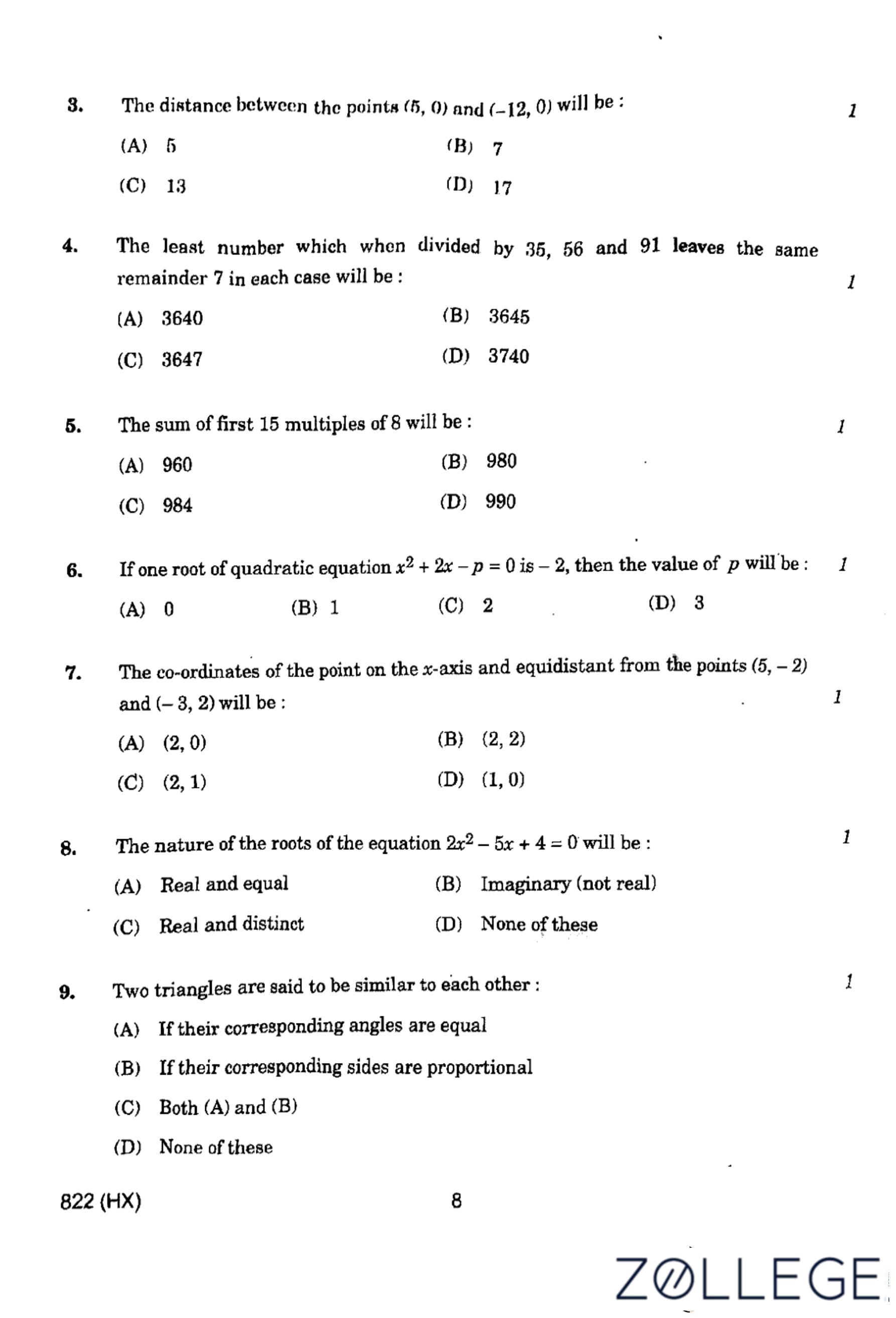
The distance between the points \( (5, 0) \) and \( (-12, 0) \) will be:
View Solution
The distance between two points \( (x_1, y_1) \) and \( (x_2, y_2) \) is given by the distance formula:
\[ d = \sqrt{(x_2 - x_1)^2 + (y_2 - y_1)^2} \]
Given points: \( (5, 0) \) and \( (-12, 0) \),
Since both points lie on the x-axis (\( y = 0 \)), the distance simplifies to:
\[ d = |x_2 - x_1| \]
\[ d = |-12 - 5| \]
\[ d = |-17| \]
\[ d = 17 \]
Thus, the correct answer is \( \boxed{17} \). Quick Tip: For points on the x-axis or y-axis, the distance can be found by taking the absolute difference of their coordinates.
The least number which when divided by 35, 56, and 91 leaves the same remainder 7 in each case will be:
View Solution
We are asked to find the least number \( x \) that, when divided by 35, 56, and 91, leaves a remainder of 7 in each case. This means that: \[ x - 7 is divisible by 35, 56, and 91. \]
Thus, we need to find the least common multiple (LCM) of 35, 56, and 91, and then add 7 to the result.
- The prime factorization of 35 is \( 35 = 5 \times 7 \),
- The prime factorization of 56 is \( 56 = 2^3 \times 7 \),
- The prime factorization of 91 is \( 91 = 7 \times 13 \).
The LCM is obtained by taking the highest powers of all primes appearing in the factorizations: \[ LCM(35, 56, 91) = 2^3 \times 5 \times 7 \times 13 = 3640. \]
Thus, the least number is: \[ x = 3640 + 7 = 3647. \]
Therefore, the correct answer is \( \boxed{3647} \). Quick Tip: To find a number that leaves the same remainder when divided by multiple divisors, find the LCM of those divisors and add the remainder to it.
The sum of the first 15 multiples of 8 will be:
View Solution
The first 15 multiples of 8 are: \[ 8, 16, 24, \dots, 8 \times 15 = 120. \]
The sum of the first \( n \) multiples of 8 is: \[ Sum = 8 \times (1 + 2 + 3 + \dots + 15). \]
The sum of the first 15 natural numbers is given by the formula: \[ Sum of first n numbers = \frac{n(n + 1)}{2}. \]
For \( n = 15 \): \[ Sum of first 15 numbers = \frac{15 \times 16}{2} = 120. \]
Thus, the sum of the first 15 multiples of 8 is: \[ Sum = 8 \times 120 = 960. \]
Thus, the correct answer is \( \boxed{960} \). Quick Tip: To find the sum of the first \( n \) multiples of a number, first find the sum of the first \( n \) natural numbers and multiply by the number.
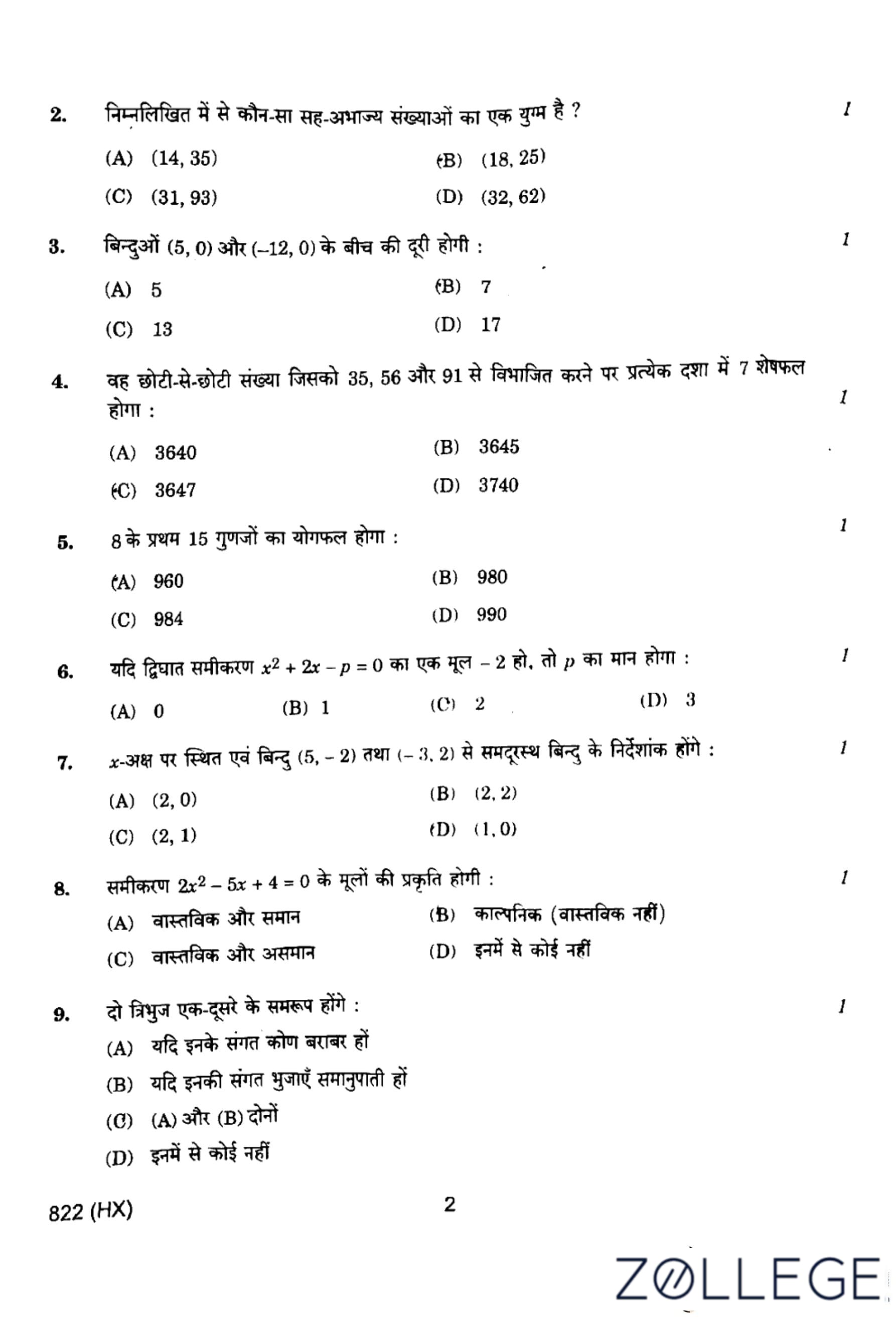
If one root of the quadratic equation \( x^2 + 2x - p = 0 \) is -2, then the value of \( p \) will be:
View Solution
Since \( -2 \) is a root of the quadratic equation,
\[ x^2 + 2x - p = 0 \]
It must satisfy the equation. Substituting \( x = -2 \):
\[ (-2)^2 + 2(-2) - p = 0 \]
\[ 4 - 4 - p = 0 \]
\[ 0 - p = 0 \]
\[ p = 0 \]
Thus, the correct answer is \( \boxed{0} \). Quick Tip: To find an unknown coefficient in a quadratic equation when a root is given, substitute the root into the equation and solve for the unknown.
The coordinates of the point on the x-axis and equidistant from the points \( (5, -2) \) and \( (-3, 2) \) will be:
View Solution
Let the required point on the x-axis be \( (x, 0) \). Since it is equidistant from \( (5, -2) \) and \( (-3, 2) \), we use the distance formula:
\[ \sqrt{(x - 5)^2 + (0 + 2)^2} = \sqrt{(x + 3)^2 + (0 - 2)^2} \]
Squaring both sides:
\[ (x - 5)^2 + 4 = (x + 3)^2 + 4 \]
Canceling 4 on both sides:
\[ (x - 5)^2 = (x + 3)^2 \]
Expanding:
\[ x^2 - 10x + 25 = x^2 + 6x + 9 \]
Canceling \( x^2 \) on both sides:
\[ -10x + 25 = 6x + 9 \]
Solving for \( x \):
\[ 25 - 9 = 6x + 10x \]
\[ 16 = 16x \]
\[ x = 1 \]
Thus, the required point is \( (1,0) \).
\[ \boxed{(1,0)} \] Quick Tip: To find a point equidistant from two given points, use the distance formula and equate the distances.
The nature of the roots of the equation \( 2x^2 - 5x + 4 = 0 \) will be:
View Solution
To determine the nature of the roots of a quadratic equation, we calculate the discriminant: \[ \Delta = b^2 - 4ac, \]
where \( a = 2 \), \( b = -5 \), and \( c = 4 \).
Substituting the values: \[ \Delta = (-5)^2 - 4(2)(4) = 25 - 32 = -7. \]
Since the discriminant is negative, the roots are real and distinct.
Thus, the nature of the roots is \( \boxed{Real and distinct} \). Quick Tip: The discriminant \( \Delta = b^2 - 4ac \) helps determine the nature of the roots. If \( \Delta > 0 \), the roots are real and distinct; if \( \Delta = 0 \), the roots are real and equal; if \( \Delta < 0 \), the roots are imaginary.
Two triangles are said to be similar to each other:
View Solution
Two triangles are said to be similar if:
1. Their corresponding angles are equal.
2. Their corresponding sides are proportional.
Thus, the correct answer is \( \boxed{Both (A) and (B)} \). Quick Tip: For two triangles to be similar, their corresponding angles must be equal, and their corresponding sides must be proportional.
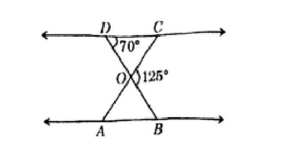
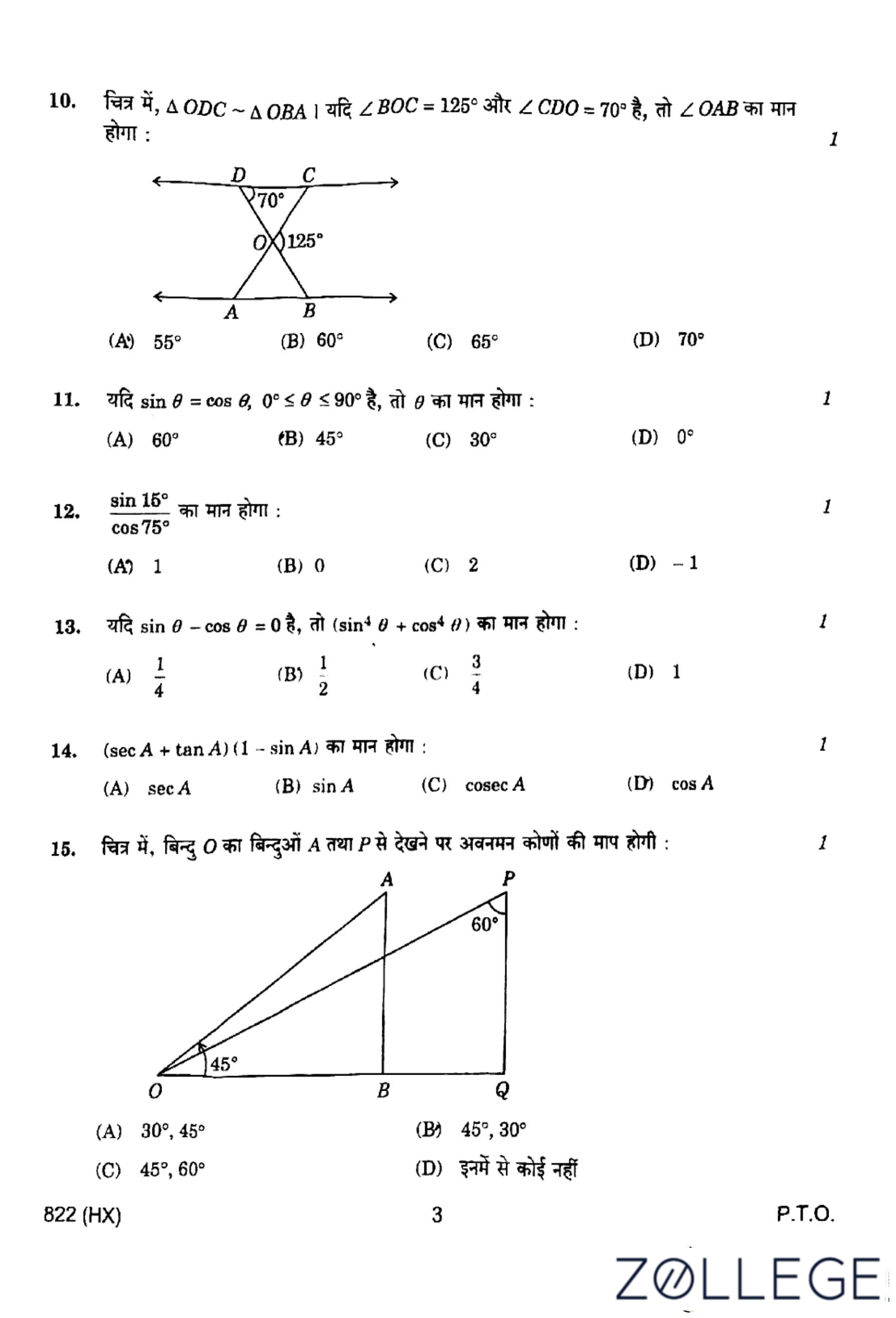
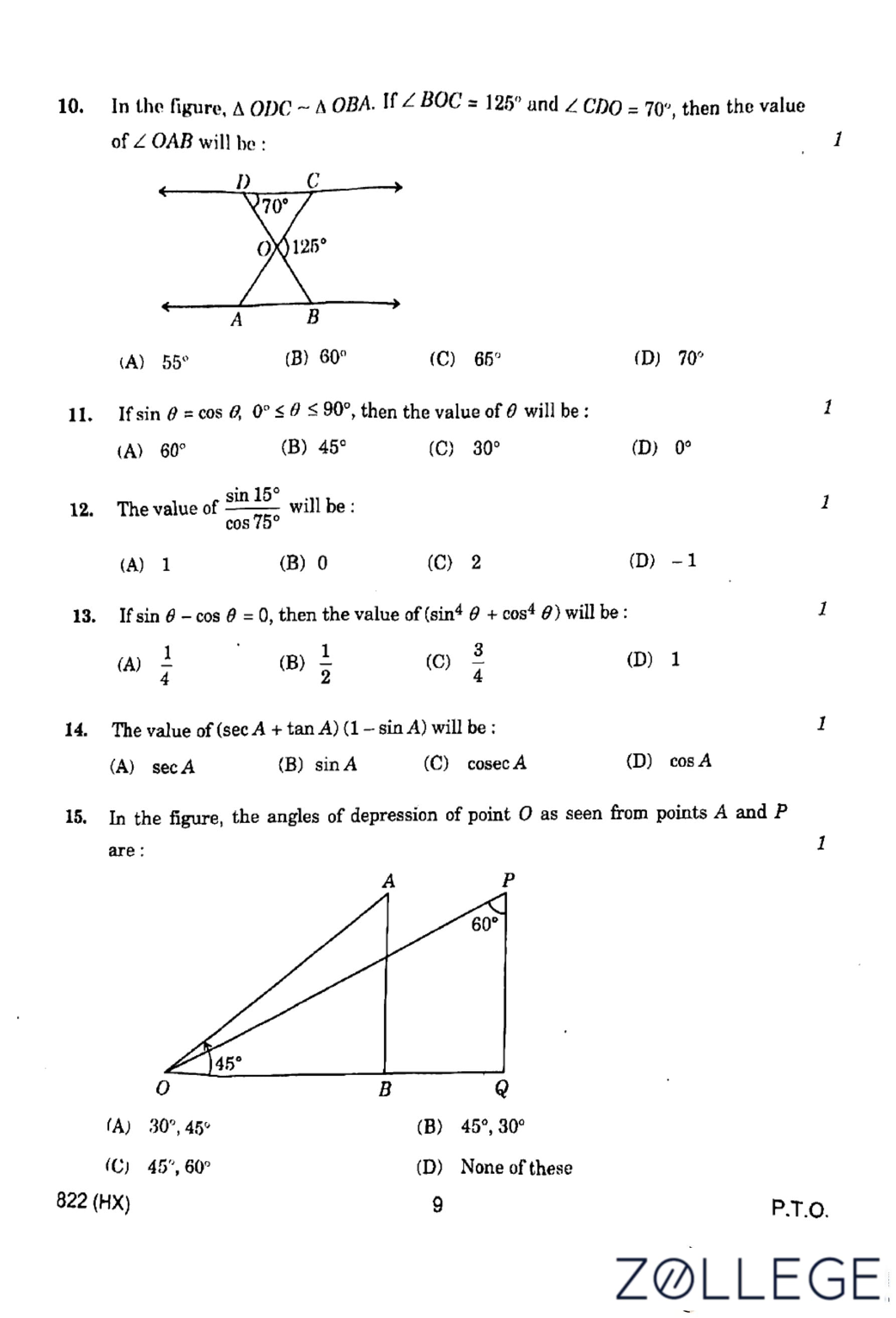
In the figure, \( \triangle ODC \sim \triangle OBA \). If \( \angle BOC = 125^\circ \) and \( \angle CDO = 70^\circ \), then the value of \( \angle OAB \) will be:
View Solution
Given:
\[ \angle BOC = 125^\circ, \quad \angle CDO = 70^\circ \]
Since \( \triangle ODC \sim \triangle OBA \), their corresponding angles are equal.
From the straight line property:
\[ \angle BOC + \angle BOA = 180^\circ \]
\[ 125^\circ + \angle BOA = 180^\circ \]
\[ \angle BOA = 180^\circ - 125^\circ = 55^\circ \]
Since \( \triangle ODC \sim \triangle OBA \), corresponding angles are equal:
\[ \angle OAB = \angle BOA = 55^\circ \]
Thus, the required angle is:
\[ \boxed{55^\circ} \] Quick Tip: For two similar triangles, corresponding angles are equal, and corresponding sides are proportional.
If \( \sin \theta = \cos \theta \), \( 0^\circ \leq \theta \leq 90^\circ \), then the value of \( \theta \) will be:
View Solution
We are given that \( \sin \theta = \cos \theta \), and we need to find the value of \( \theta \). We know that: \[ \sin \theta = \cos \theta \quad \Rightarrow \quad \tan \theta = 1. \]
The value of \( \theta \) that satisfies \( \tan \theta = 1 \) within the range \( 0^\circ \leq \theta \leq 90^\circ \) is \( \theta = 45^\circ \).
Thus, the value of \( \theta \) is \( \boxed{45^\circ} \). Quick Tip: When \( \sin \theta = \cos \theta \), the value of \( \theta \) is \( 45^\circ \), since \( \tan 45^\circ = 1 \).
The value of \( \frac{\sin 15^\circ}{\cos 75^\circ} \) will be:
View Solution
We know the trigonometric identity:
\[ \cos (90^\circ - \theta) = \sin \theta \]
Using this identity,
\[ \cos 75^\circ = \sin (90^\circ - 75^\circ) = \sin 15^\circ \]
Thus,
\[ \frac{\sin 15^\circ}{\cos 75^\circ} = \frac{\sin 15^\circ}{\sin 15^\circ} = 1 \]
Therefore, the correct answer is:
\[ \boxed{1} \] Quick Tip: Use the identity \( \cos (90^\circ - \theta) = \sin \theta \) to simplify expressions involving complementary angles.
If \( \sin \theta - \cos \theta = 0 \), then the value of \( \sin^4 \theta + \cos^4 \theta \) will be:
View Solution
Given:
\[ \sin \theta - \cos \theta = 0 \]
This implies:
\[ \sin \theta = \cos \theta \]
Dividing both sides by \( \cos \theta \):
\[ \tan \theta = 1 \]
Thus,
\[ \theta = 45^\circ \]
Now, we need to evaluate:
\[ \sin^4 \theta + \cos^4 \theta \]
Using the identity:
\[ \sin^4 \theta + \cos^4 \theta = (\sin^2 \theta + \cos^2 \theta)^2 - 2\sin^2 \theta \cos^2 \theta \]
Since:
\[ \sin^2 \theta + \cos^2 \theta = 1 \]
And:
\[ \sin^2 \theta = \cos^2 \theta = \frac{1}{2} \]
\[ \sin^2 \theta \cos^2 \theta = \left(\frac{1}{2}\right) \left(\frac{1}{2}\right) = \frac{1}{4} \]
Substituting these values:
\[ \sin^4 \theta + \cos^4 \theta = 1 - 2 \times \frac{1}{4} \]
\[ = 1 - \frac{1}{2} = \frac{1}{2} \]
Thus, the required value is:
\[ \boxed{\frac{1}{2}} \] Quick Tip: Use the identity \( \sin^4 \theta + \cos^4 \theta = 1 - 2\sin^2 \theta \cos^2 \theta \) to simplify expressions.
The value of \( \sec A + \tan A (1 - \sin A) \) will be:
View Solution
We start with the given expression:
\[ (\sec A + \tan A)(1 - \sin A) \]
Expanding using trigonometric identities:
\[ \sec A = \frac{1}{\cos A}, \quad \tan A = \frac{\sin A}{\cos A} \]
\[ \sec A + \tan A = \frac{1 + \sin A}{\cos A} \]
Thus, multiplying by \( (1 - \sin A) \):
\[ (\sec A + \tan A)(1 - \sin A) = \left( \frac{1 + \sin A}{\cos A} \right)(1 - \sin A) \]
Expanding:
\[ = \frac{(1 + \sin A)(1 - \sin A)}{\cos A} \]
Using the identity:
\[ (1 + \sin A)(1 - \sin A) = 1 - \sin^2 A = \cos^2 A \]
\[ = \frac{\cos^2 A}{\cos A} \]
\[ = \cos A \]
Thus, the required value is:
\[ \boxed{\cos A} \] Quick Tip: Use the identity \( (1 + \sin A)(1 - \sin A) = \cos^2 A \) to simplify expressions involving sine and cosine.
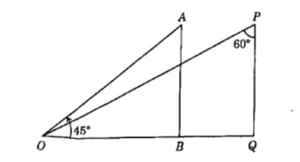
In the figure, the angles of depression of point \( O \) as seen from points \( A \) and \( P \) are:
View Solution
From the diagram, we can see that point \( O \) is at the base of the figure, and points \( A \) and \( P \) are positioned higher. The angles of depression are given from these points to point \( O \).
Step 1: Understand the angles of depression.
The angle of depression from point \( A \) to point \( O \) is the angle formed between the line of sight from \( A \) to \( O \) and the horizontal line through \( A \). The same applies for point \( P \). Since these are angles of depression, they are measured downward from the horizontal line at points \( A \) and \( P \).
Step 2: Use the concept of alternate interior angles.
The angles of depression from points \( A \) and \( P \) will be congruent to the angles of elevation from point \( O \) to these points, because the lines \( OA \) and \( OP \) are parallel to the horizontal lines. This means that: \[ Angle of depression from point A = Angle of elevation at point O, \]
and \[ Angle of depression from point P = Angle of elevation at point O. \]
Step 3: Apply the given information.
In the diagram, the angle of elevation at point \( O \) is \( 45^\circ \) for point \( A \) and \( 60^\circ \) for point \( P \).
Thus, the angles of depression from points \( A \) and \( P \) are:
- \( 45^\circ \) from \( A \),
- \( 60^\circ \) from \( P \).
Thus, the correct answer is \( \boxed{(C) 45^\circ, 60^\circ} \). Quick Tip: Angles of depression and elevation are often congruent because they are alternate interior angles formed by a horizontal line and a line of sight to a point.
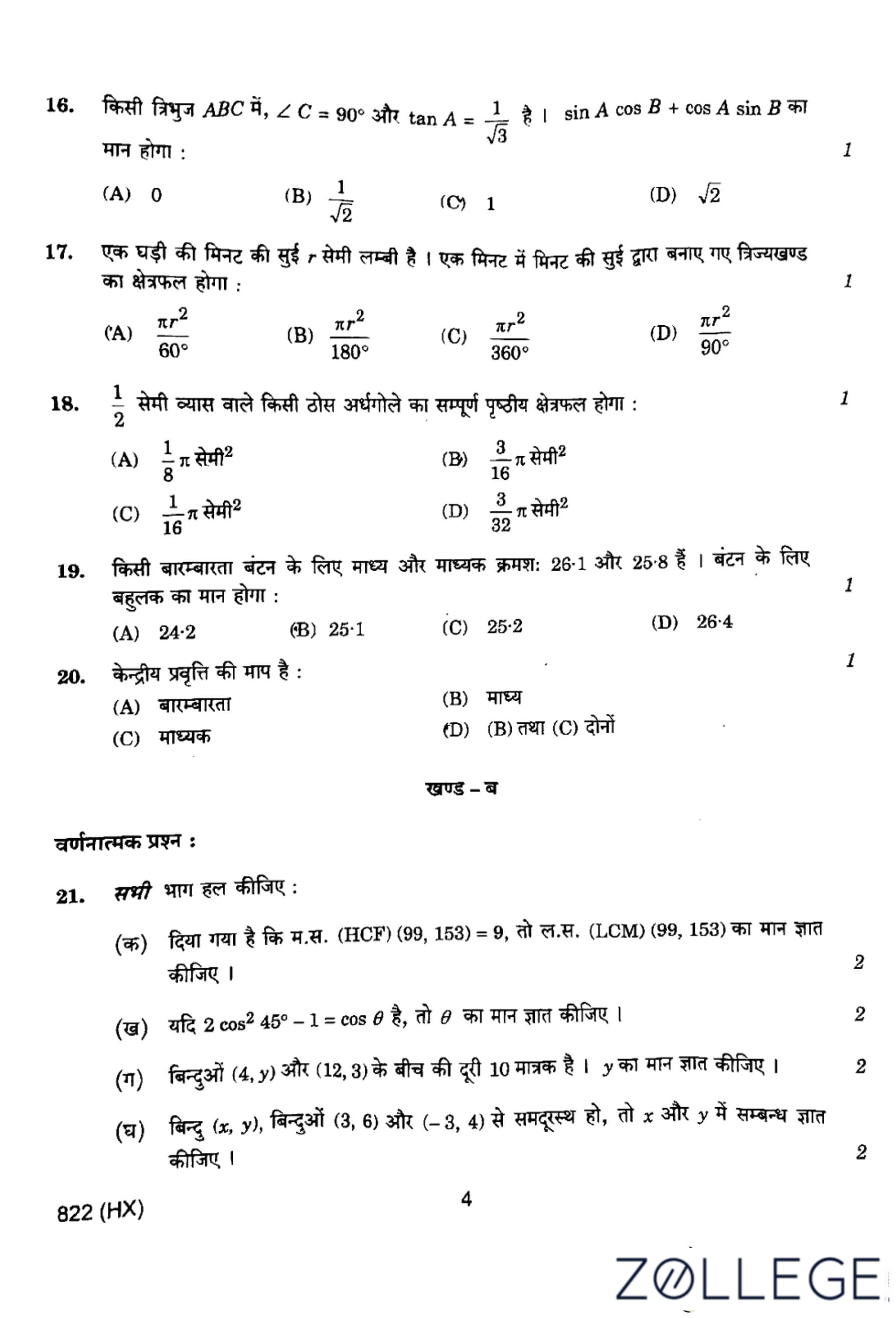
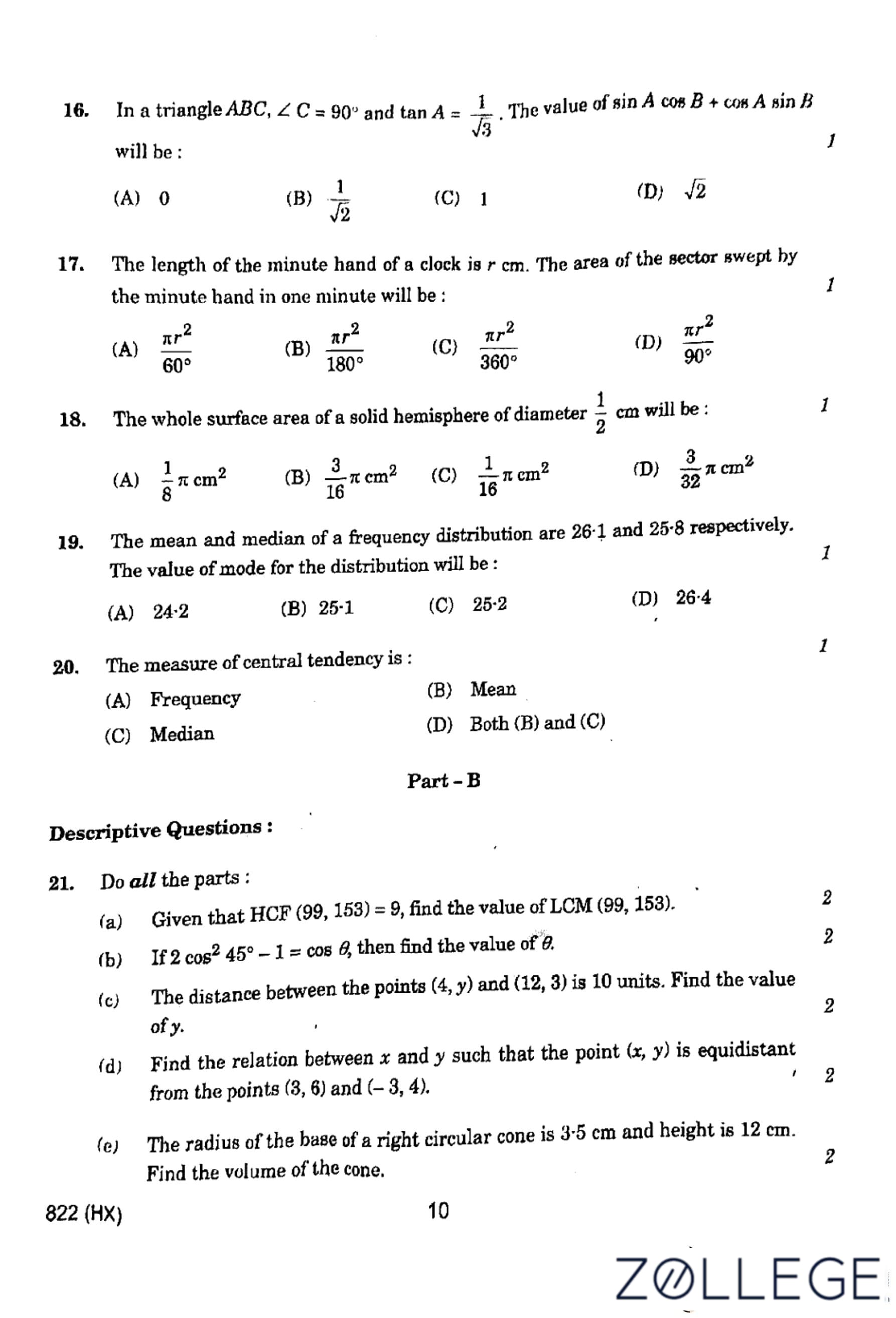
In a triangle \( ABC \), \( \angle C = 90^\circ \) and \( \tan A = \frac{1}{\sqrt{3}} \). The value of \( \sin A \cos B + \cos A \sin B \) will be:
View Solution
We are given that:
\[ \tan A = \frac{1}{\sqrt{3}} \]
From the definition of tangent:
\[ \tan A = \frac{opposite}{adjacent} \]
Let the opposite side of \( A \) be \( 1 \) and the adjacent side be \( \sqrt{3} \). Using the Pythagorean theorem:
\[ hypotenuse = \sqrt{(1)^2 + (\sqrt{3})^2} = \sqrt{1 + 3} = \sqrt{4} = 2 \]
Now, we calculate the trigonometric values:
\[ \sin A = \frac{opposite}{hypotenuse} = \frac{1}{2}, \quad \cos A = \frac{adjacent}{hypotenuse} = \frac{\sqrt{3}}{2} \]
Since \( \angle B = 90^\circ - A \), we have:
\[ \sin B = \cos A = \frac{\sqrt{3}}{2}, \quad \cos B = \sin A = \frac{1}{2} \]
Now, calculating the given expression:
\[ \sin A \cos B + \cos A \sin B \]
\[ = \left(\frac{1}{2} \times \frac{1}{2}\right) + \left(\frac{\sqrt{3}}{2} \times \frac{\sqrt{3}}{2}\right) \]
\[ = \frac{1}{4} + \frac{3}{4} = \frac{4}{4} = 1 \]
Thus, the required value is:
\[ \boxed{1} \] Quick Tip: The identity \( \sin A \cos B + \cos A \sin B = \sin(A + B) \) simplifies to \( \sin 90^\circ = 1 \).
The length of the minute hand of a clock is \( r \) cm. The area of the sector swept by the minute hand in one minute will be:
View Solution
The area of a sector of a circle is given by:
\[ A = \frac{\theta}{360^\circ} \times \pi r^2 \]
where \( \theta \) is the angle swept by the sector.
Since the minute hand of a clock moves \( 360^\circ \) in 60 minutes, the angle swept in one minute is:
\[ \theta = \frac{360^\circ}{60} = 6^\circ \]
Thus, the area swept in one minute is:
\[ A = \frac{6^\circ}{360^\circ} \times \pi r^2 \]
\[ = \frac{1}{60} \times \pi r^2 \]
\[ = \frac{\pi r^2}{60} \]
Thus, the required area is:
\[ \boxed{\frac{\pi r^2}{60}} \] Quick Tip: To find the area of a sector, use the formula \( \frac{\theta}{360^\circ} \times \pi r^2 \), where \( \theta \) is the angle in degrees.
The whole surface area of a solid hemisphere of diameter \( \frac{1}{2} \) cm will be:
View Solution
The total surface area of a solid hemisphere is the sum of the curved surface area and the area of the circular base.
The surface area of the curved part of the hemisphere is given by: \[ Curved surface area = 2\pi r^2. \]
The area of the base is: \[ Base area = \pi r^2. \]
Thus, the total surface area is: \[ Total surface area = 2\pi r^2 + \pi r^2 = 3\pi r^2. \]
The diameter is given as \( \frac{1}{2} \) cm, so the radius \( r = \frac{1}{4} \) cm. Substituting into the formula: \[ Total surface area = 3\pi \times \left( \frac{1}{4} \right)^2 = 3\pi \times \frac{1}{16} = \frac{3}{16} \pi \, cm^2. \]
Thus, the correct answer is \( \boxed{\frac{3}{16} \pi \, cm^2} \). Quick Tip: For a solid hemisphere, the total surface area is the sum of the curved surface area and the area of the circular base, given by \( 3\pi r^2 \).
The mean and median of a frequency distribution are 26.1 and 25.8 respectively. The value of mode for the distribution will be:
View Solution
Using the empirical relation between mean, median, and mode:
\[ Mode = 3 \times Median - 2 \times Mean \]
Substituting the given values:
\[ Mode = 3 \times 25.8 - 2 \times 26.1 \]
\[ = 77.4 - 52.2 \]
\[ = 25.2 \]
Thus, the required mode is:
\[ \boxed{25.2} \] Quick Tip: The empirical formula \( Mode = 3 \times Median - 2 \times Mean \) is useful when the mode is not directly available from the data.
The measure of central tendency is:
View Solution
The measure of central tendency is a statistical term that refers to the central or typical value for a set of data. Common measures of central tendency include:
1. Mean – the arithmetic average of the data.
2. Median – the middle value of the data when it is ordered.
3. Mode – the value that appears most frequently in the data.
Given the options, both the mean and the median are measures of central tendency. Therefore, the correct answer is: \[ \boxed{(D) Both (B) and (C). \] Quick Tip: In statistics, the mean and median are the most commonly used measures of central tendency. The mean is used when data is symmetrically distributed, while the median is preferred when data has outliers or is skewed.
Given that \( HCF(99, 153) = 9 \), find the value of \( LCM(99, 153) \).
View Solution
We can use the relationship between the HCF and \textit{LCM of two numbers, which is given by the formula: \[ HCF(a, b) \times LCM(a, b) = a \times b. \]
Here, we are given:
- \( HCF(99, 153) = 9 \),
- \( a = 99 \),
- \( b = 153 \).
We need to find \( LCM(99, 153) \). Using the formula, we have: \[ 9 \times LCM(99, 153) = 99 \times 153. \]
Now, calculate \( 99 \times 153 \): \[ 99 \times 153 = 15147. \]
Thus: \[ 9 \times LCM(99, 153) = 15147, \] \[ LCM(99, 153) = \frac{15147{9} = 1683. \]
Thus, the value of \( LCM(99, 153) \) is \( \boxed{1683} \). Quick Tip: Use the formula \( HCF(a, b) \times LCM(a, b) = a \times b \) to relate the HCF and LCM of two numbers.
If \( 2 \cos^2 45^\circ - 1 = \cos \theta \), then find the value of \( \theta \).
View Solution
We are given the equation: \[ 2 \cos^2 45^\circ - 1 = \cos \theta. \]
We know that \( \cos 45^\circ = \frac{1}{\sqrt{2}} \), so: \[ \cos^2 45^\circ = \left( \frac{1}{\sqrt{2}} \right)^2 = \frac{1}{2}. \]
Substituting this into the equation: \[ 2 \times \frac{1}{2} - 1 = \cos \theta, \] \[ 1 - 1 = \cos \theta, \] \[ \cos \theta = 0. \]
The value of \( \theta \) for which \( \cos \theta = 0 \) is: \[ \theta = 90^\circ or 270^\circ. \]
Since \( \theta \) is between \( 0^\circ \leq \theta \leq 90^\circ \), the value of \( \theta \) is \( \boxed{90^\circ} \). Quick Tip: When solving trigonometric equations, remember to use known values for standard angles and identities.
Find the relation between \( x \) and \( y \) such that the point \( (x, y) \) is equidistant from the points \( (3, 6) \) and \( (-3, 4) \).
View Solution
The distance between two points \( (x_1, y_1) \) and \( (x_2, y_2) \) is given by the distance formula:
\[ d = \sqrt{(x_2 - x_1)^2 + (y_2 - y_1)^2} \]
Since the point \( (x, y) \) is equidistant from \( (3,6) \) and \( (-3,4) \), we equate the distances:
\[ \sqrt{(x - 3)^2 + (y - 6)^2} = \sqrt{(x + 3)^2 + (y - 4)^2} \]
Squaring both sides:
\[ (x - 3)^2 + (y - 6)^2 = (x + 3)^2 + (y - 4)^2 \]
Expanding:
\[ x^2 - 6x + 9 + y^2 - 12y + 36 = x^2 + 6x + 9 + y^2 - 8y + 16 \]
Cancel \( x^2 \) and \( y^2 \) on both sides:
\[ -6x + 9 - 12y + 36 = 6x + 9 - 8y + 16 \]
\[ -6x - 12y + 45 = 6x - 8y + 25 \]
Rearranging:
\[ -6x - 12y - 6x + 8y = 25 - 45 \]
\[ -12x - 4y = -20 \]
Dividing by \(-4\):
\[ 3x + y - 5 = 0 \]
Thus, the required relation is:
\[ \boxed{3x + y - 5 = 0} \] Quick Tip: To find the locus of points equidistant from two given points, use the distance formula and equate the two distances.
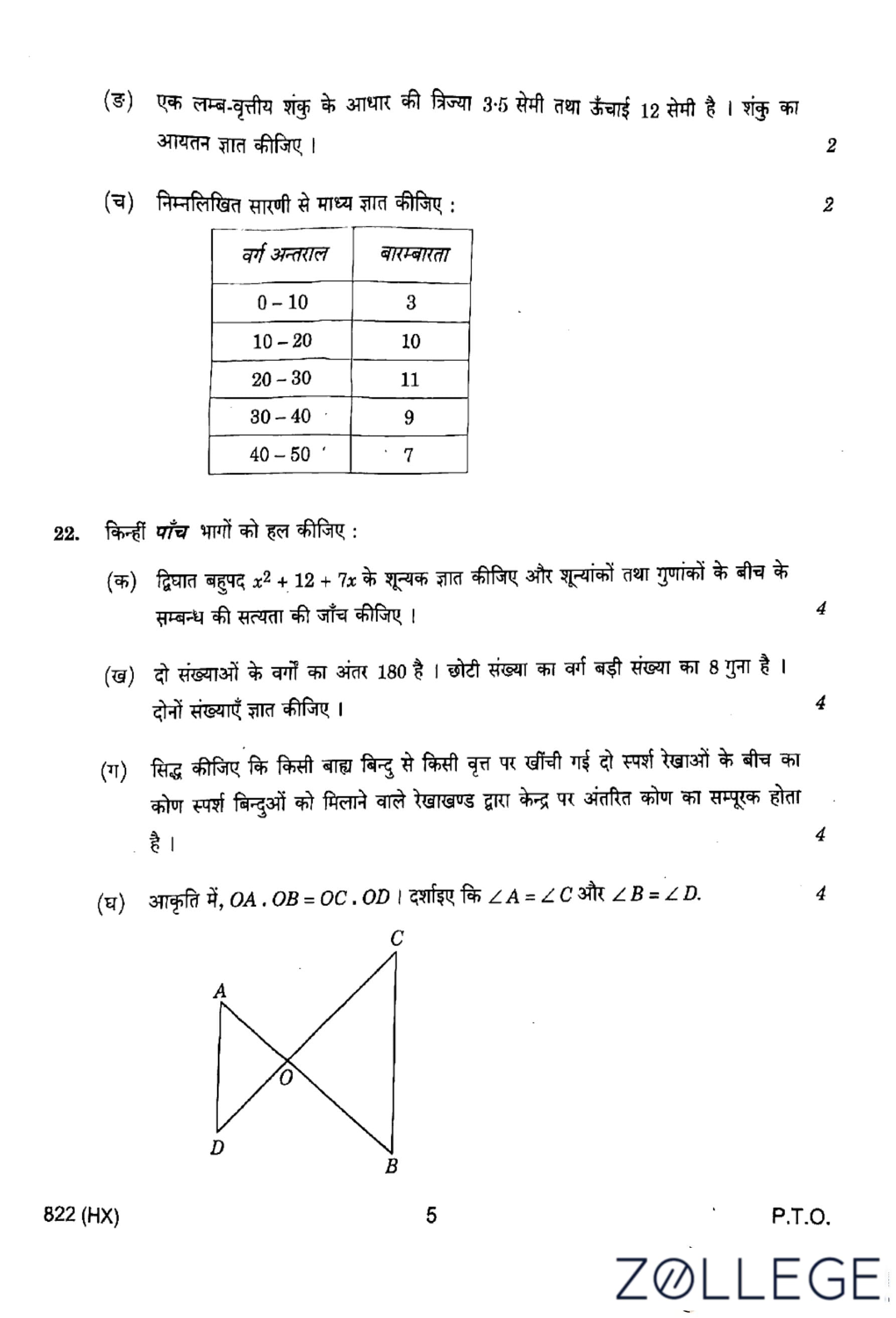
The radius of the base of a right circular cone is 3.5 cm and height is 12 cm. Find the volume of the cone.
View Solution
The volume \( V \) of a cone is given by the formula: \[ V = \frac{1}{3} \pi r^2 h, \]
where \( r \) is the radius and \( h \) is the height.
We are given:
- \( r = 3.5 \) cm,
- \( h = 12 \) cm.
Substitute the values into the formula: \[ V = \frac{1}{3} \pi (3.5)^2 \times 12 = \frac{1}{3} \pi \times 12.25 \times 12. \]
Simplifying: \[ V = \frac{1}{3} \pi \times 147 = 49\pi \, cm^3. \]
Thus, the volume of the cone is \( \boxed{49\pi \, cm^3} \), or approximately \( 153.94 \, cm^3 \). Quick Tip: The volume of a cone is calculated using the formula \( V = \frac{1}{3} \pi r^2 h \), where \( r \) is the radius and \( h \) is the height.
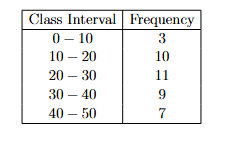
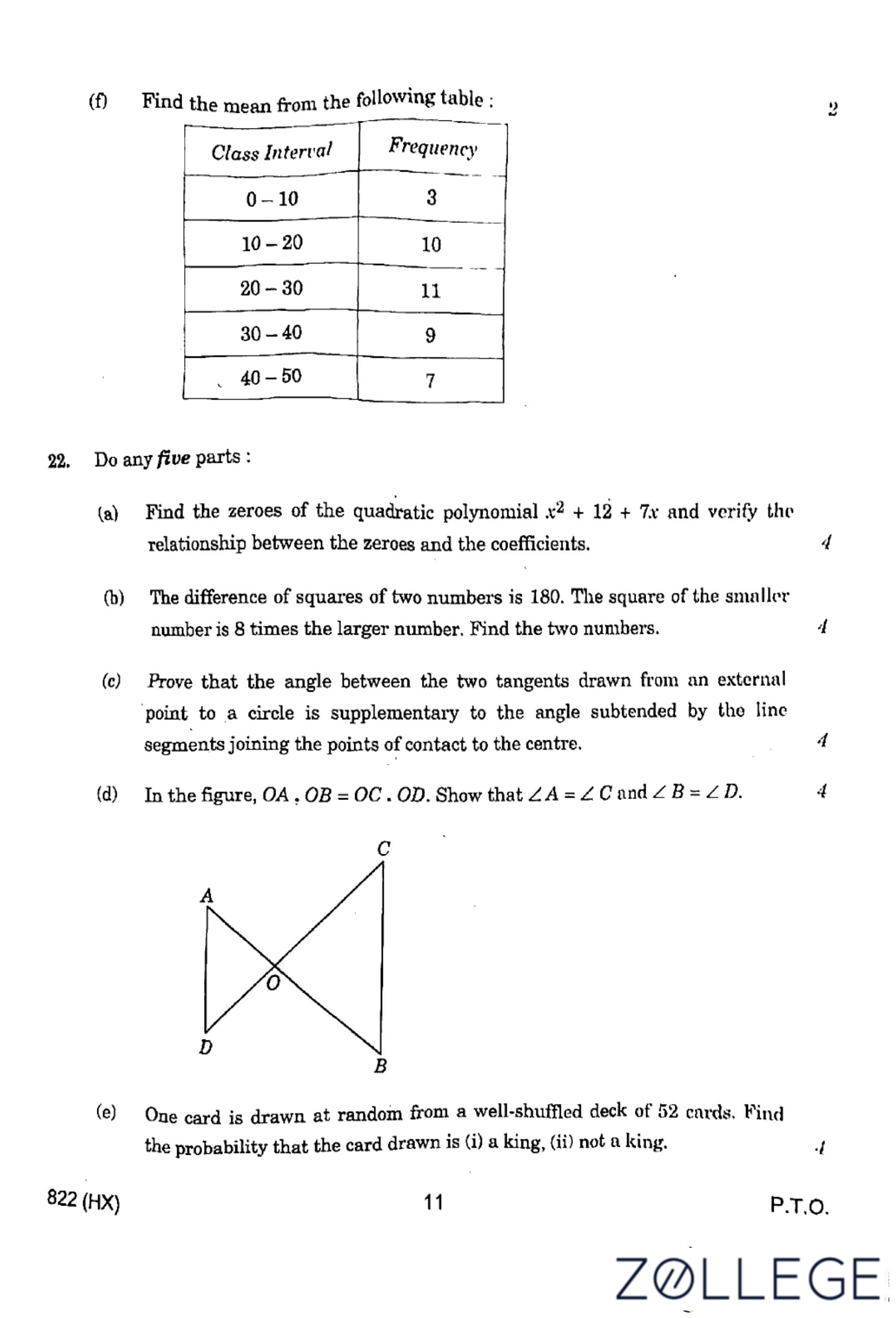
Find the mean from the following table:
View Solution
The formula for the mean of a grouped frequency distribution is given by:
\[ Mean = \frac{\sum (f \cdot x)}{\sum f} \]
where:
- \( f \) is the frequency of each class,
- \( x \) is the midpoint of each class interval,
- \( \sum f \) is the sum of the frequencies.
Step 1: Calculate the midpoints of each class interval.
For each class interval, the midpoint \( x \) is calculated as:
\[ x = \frac{lower limit + upper limit}{2}. \]
Thus, the midpoints are:
- For \( 0 - 10 \), the midpoint \( x = \frac{0 + 10}{2} = 5 \),
- For \( 10 - 20 \), the midpoint \( x = \frac{10 + 20}{2} = 15 \),
- For \( 20 - 30 \), the midpoint \( x = \frac{20 + 30}{2} = 25 \),
- For \( 30 - 40 \), the midpoint \( x = \frac{30 + 40}{2} = 35 \),
- For \( 40 - 50 \), the midpoint \( x = \frac{40 + 50}{2} = 45 \).
Step 2: Multiply each frequency by the corresponding midpoint.
Now, we compute \( f \cdot x \) for each class interval:
- For \( 0-10 \), \( f \cdot x = 3 \times 5 = 15 \),
- For \( 10-20 \), \( f \cdot x = 10 \times 15 = 150 \),
- For \( 20-30 \), \( f \cdot x = 11 \times 25 = 275 \),
- For \( 30-40 \), \( f \cdot x = 9 \times 35 = 315 \),
- For \( 40-50 \), \( f \cdot x = 7 \times 45 = 315 \).
Step 3: Calculate the sum of \( f \cdot x \) and the sum of the frequencies.
Sum of \( f \cdot x \):
\[ \sum (f \cdot x) = 15 + 150 + 275 + 315 + 315 = 1070. \]
Sum of the frequencies: \[ \sum f = 3 + 10 + 11 + 9 + 7 = 40. \]
Step 4: Compute the mean.
Now, use the formula to compute the mean: \[ Mean = \frac{1070}{40} = 26.75. \]
Thus, the mean is \( \boxed{26.75} \). Quick Tip: To find the mean for a grouped data set, always calculate the midpoints of the class intervals, multiply each midpoint by the corresponding frequency, sum those products, and then divide by the total frequency.
Find the zeros of the quadratic polynomial \( x^2 + 12x + 7 \) and verify the relationship between the zeros and the coefficients.
View Solution
Step 1.We are given the quadratic polynomial: \[ p(x) = x^2 + 12x + 7. \]
To find the zeros of this polynomial, we solve the equation: \[ x^2 + 12x + 7 = 0. \]
This is a quadratic equation in standard form \( ax^2 + bx + c = 0 \), where:
- \( a = 1 \),
- \( b = 12 \),
- \( c = 7 \).
Step 2.We will use the quadratic formula to find the zeros. The quadratic formula is given by: \[ x = \frac{-b \pm \sqrt{b^2 - 4ac}}{2a}. \]
Substitute the values of \( a \), \( b \), and \( c \) into the formula: \[ x = \frac{-12 \pm \sqrt{12^2 - 4(1)(7)}}{2(1)} = \frac{-12 \pm \sqrt{144 - 28}}{2} = \frac{-12 \pm \sqrt{116}}{2}. \]
Step 3.We can simplify \( \sqrt{116} \) as: \[ \sqrt{116} = \sqrt{4 \times 29} = 2\sqrt{29}. \]
Thus, the zeros are: \[ x = \frac{-12 \pm 2\sqrt{29}}{2}. \]
Simplifying further: \[ x = -6 \pm \sqrt{29}. \]
Therefore, the zeros of the polynomial are: \[ x_1 = -6 + \sqrt{29}, \quad x_2 = -6 - \sqrt{29}. \]
Verification of the Relationship Between the Zeros and Coefficients:
For a quadratic equation \( ax^2 + bx + c = 0 \), the relationship between the zeros \( \alpha \) and \( \beta \) and the coefficients is given by Vieta’s formulas:
- The sum of the zeros \( \alpha + \beta = -\frac{b}{a} \),
- The product of the zeros \( \alpha \times \beta = \frac{c}{a} \).
For the equation \( x^2 + 12x + 7 = 0 \), we have:
- The sum of the zeros: \[ \alpha + \beta = (-6 + \sqrt{29}) + (-6 - \sqrt{29}) = -12, \]
which matches \( -\frac{b}{a} = -\frac{12}{1} = -12 \).
- The product of the zeros: \[ \alpha \times \beta = (-6 + \sqrt{29})(-6 - \sqrt{29}) = (-6)^2 - (\sqrt{29})^2 = 36 - 29 = 7, \]
which matches \( \frac{c}{a} = \frac{7}{1} = 7 \).
Thus, the relationship between the zeros and the coefficients is verified. Quick Tip: Vieta's formulas provide a way to find the sum and product of the roots of a quadratic equation without explicitly solving for the roots.
Prove that the angle between the two tangents drawn from an external point to a circle is supplementary to the angle subtended by the line segments joining the points of contact to the centre.
View Solution
### Step 1: Understanding the Problem
Let \( O \) be the center of the circle, and let \( P \) be an external point from which two tangents \( PA \) and \( PB \) are drawn to the circle, touching it at points \( A \) and \( B \), respectively.
We need to prove that:
\[ \angle APB + \angle AOB = 180^\circ \]
where \( \angle APB \) is the angle between the two tangents, and \( \angle AOB \) is the angle subtended at the center by the line segments joining the points of contact.
### Step 2: Recognizing Key Properties
1. The tangents from an external point to a circle are equal in length:
\[ PA = PB \]
2. The radius is perpendicular to the tangent at the point of contact:
\[ OA \perp PA, \quad OB \perp PB \]
3. \( \triangle OAP \) and \( \triangle OBP \) are congruent by the RHS (Right-Angle Hypotenuse Side) rule.
4. The quadrilateral \( OAPB \) is a cyclic quadrilateral because all its vertices lie on the same circle.
### Step 3: Using the Exterior Angle Theorem
Since \( OAPB \) is a cyclic quadrilateral, the exterior angle at \( P \) (i.e., \( \angle APB \)) is equal to the supplementary angle of the interior opposite angle at \( O \) (i.e., \( \angle AOB \)):
\[ \angle APB + \angle AOB = 180^\circ \]
### Step 4: Conclusion
Thus, we have proved that the angle between the two tangents drawn from an external point to a circle is supplementary to the angle subtended by the line segments joining the points of contact to the center.
\[ \boxed{\angle APB + \angle AOB = 180^\circ} \] Quick Tip: The sum of opposite angles in a cyclic quadrilateral is always \( 180^\circ \), which is key to proving this theorem.
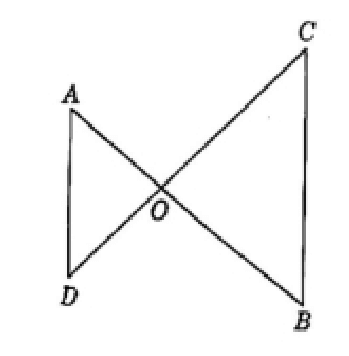
In the figure, \( OA = OB = OC = OD \). Show that \( \angle A = \angle C \) and \( \angle B = \angle D \).
View Solution
We are given that \( OA = OB = OC = OD \), meaning that all four segments from the point \( O \) to points \( A \), \( B \), \( C \), and \( D \) are equal. This suggests that triangles \( OAB \), \( OBC \), and \( ODC \) are isosceles triangles, as they have two equal sides.
Step 1: \textit{Prove that \( \triangle OAB \) and \( \triangle ODC \) are isosceles.
- In \( \triangle OAB \), since \( OA = OB \), by the properties of isosceles triangles, we know that the angles opposite these equal sides are also equal. Hence: \[ \angle OAB = \angle OBA. \]
- Similarly, in \( \triangle ODC \), since \( OC = OD \), we can conclude: \[ \angle ODC = \angle OCD. \]
Step 2: \textit{Prove that \( \angle A = \angle C \) and \( \angle B = \angle D \).
- Since \( \angle OAB = \angle OBA \) and \( \angle ODC = \angle OCD \), and given that the angle between the two triangles at \( O \) is the same (i.e., the angles at \( O \) in \( \triangle OAB \) and \( \triangle ODC \) are the same), it follows that the corresponding angles at points \( A \) and \( C \) are equal.
- Therefore: \[ \angle A = \angle C. \]
- Similarly, the angles at points \( B \) and \( D \) are also equal: \[ \angle B = \angle D. \]
Thus, we have shown that \( \angle A = \angle C \) and \( \angle B = \angle D \). Quick Tip: When solving problems involving isosceles triangles, always look for equal sides and use the fact that angles opposite equal sides are also equal. This can help prove other relationships between the angles.
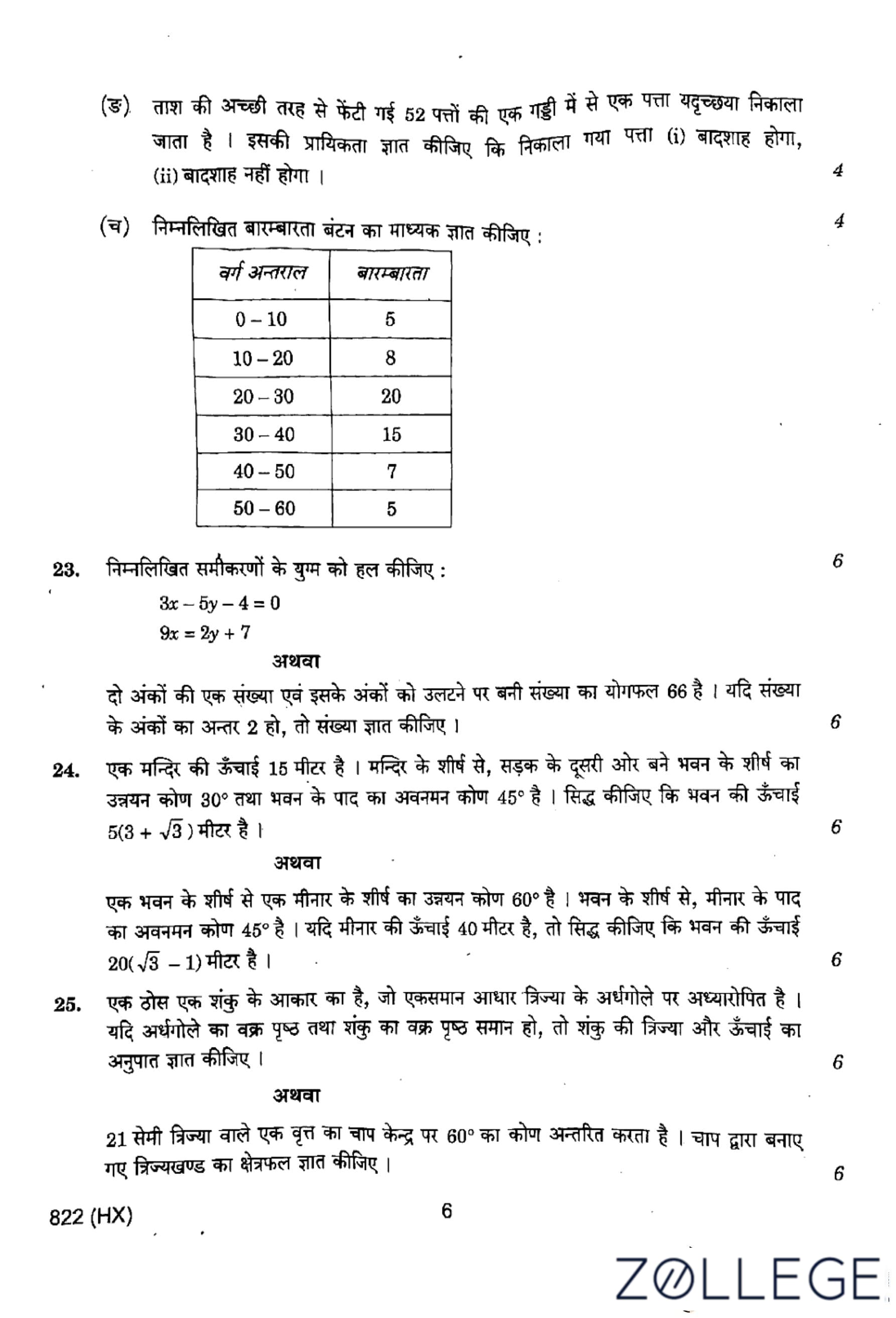
(e) One card is drawn at random from a well-shuffled deck of 52 cards. Find the probability that the card drawn is:
(i) a king, \quad (ii) not a king.
View Solution
A standard deck of 52 playing cards consists of 4 suits: hearts, diamonds, clubs, and spades. Each suit contains 13 cards, including one king. Therefore, there are 4 kings in a deck.
(i) Probability of drawing a king:
The total number of outcomes (total cards in the deck) is 52, and the favorable outcomes (kings) are 4. The probability \( P(King) \) is given by: \[ P(King) = \frac{Number of kings}{Total number of cards} = \frac{4}{52} = \frac{1}{13}. \]
(ii) Probability of drawing a card that is not a king:
The probability of drawing a card that is not a king is the complement of the probability of drawing a king. Therefore, the probability \( P(Not a King) \) is: \[ P(Not a King) = 1 - P(King) = 1 - \frac{1}{13} = \frac{12}{13}. \]
Thus, the probabilities are:
- (i) \( P(King) = \frac{1}{13} \),
- (ii) \( P(Not a King) = \frac{12}{13} \). Quick Tip: To calculate the probability of an event, divide the number of favorable outcomes by the total number of possible outcomes. For complementary events, subtract the probability from 1.
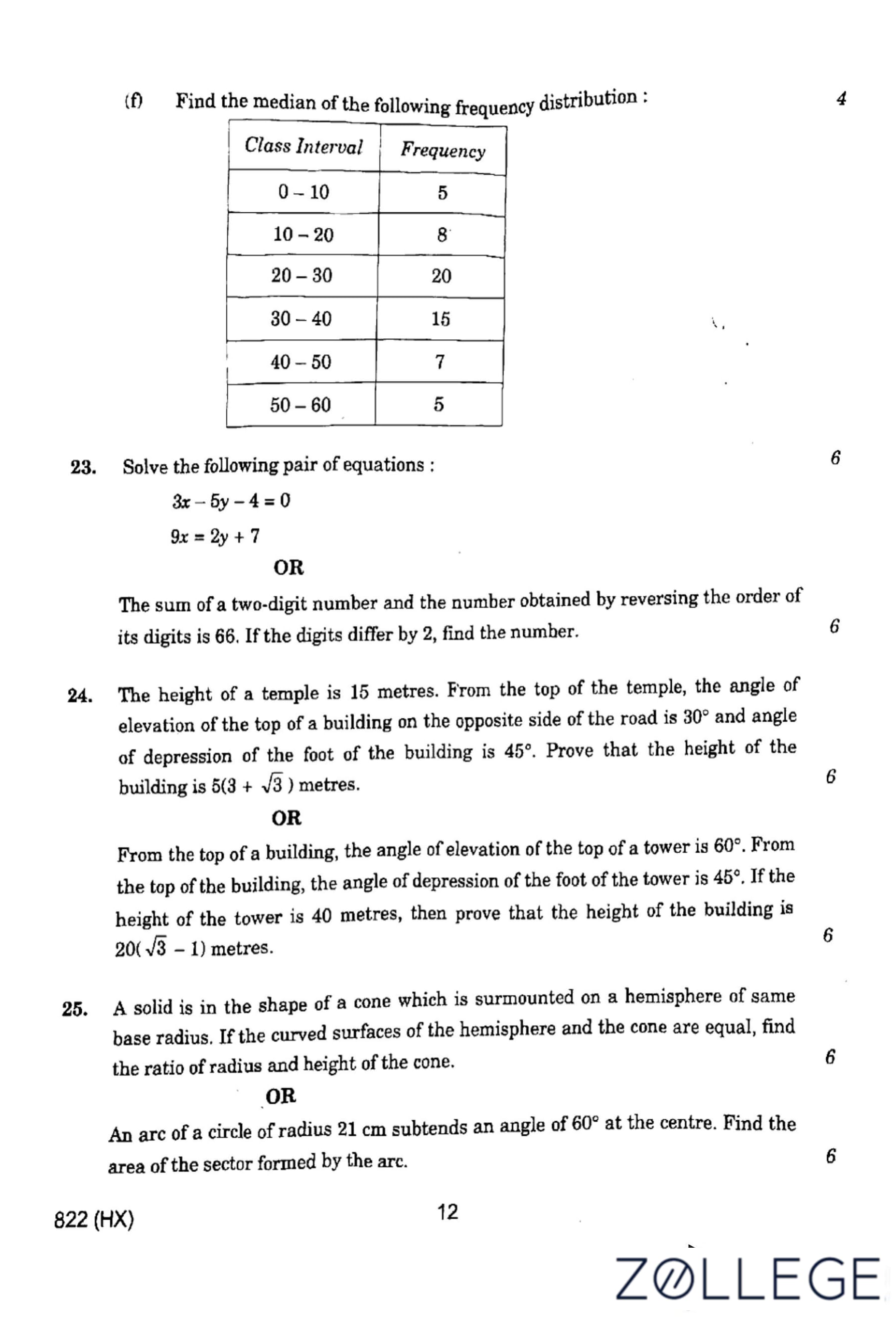
Find the median of the following frequency distribution:
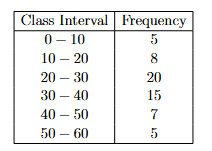
View Solution
To find the median, we first calculate the cumulative frequency and use the formula for the median:
\[ Median = L + \frac{\frac{N}{2} - F}{f} \times h, \]
where:
- \( L \) is the lower boundary of the median class,
- \( N \) is the total frequency,
- \( F \) is the cumulative frequency before the median class,
- \( f \) is the frequency of the median class,
- \( h \) is the class width.
Step 1: Calculate the cumulative frequency.
\[ \begin{array}{|c|c|c|} \hline Class Interval & Frequency & Cumulative Frequency
\hline 0 - 10 & 5 & 5
10 - 20 & 8 & 13
20 - 30 & 20 & 33
30 - 40 & 15 & 48
40 - 50 & 7 & 55
50 - 60 & 5 & 60
\hline \end{array} \]
Step 2: Find the median class.
The total frequency \( N = 60 \), so \( \frac{N}{2} = 30 \).
The cumulative frequency just greater than 30 is 33, which corresponds to the class interval \( 20 - 30 \). Therefore, the median class is \( 20 - 30 \).
Step 3: Apply the formula for the median.
From the table:
- \( L = 20 \) (lower boundary of the median class),
- \( F = 13 \) (cumulative frequency before the median class),
- \( f = 20 \) (frequency of the median class),
- \( h = 10 \) (class width, since \( 30 - 20 = 10 \)).
Now, substitute these values into the median formula: \[ Median = 20 + \frac{\frac{60}{2} - 13}{20} \times 10 = 20 + \frac{30 - 13}{20} \times 10 = 20 + \frac{17}{20} \times 10 = 20 + 8.5 = 28.5. \]
Thus, the median is \( \boxed{28.5} \). Quick Tip: To calculate the median from a frequency distribution, find the cumulative frequency, locate the median class, and then apply the median formula using the appropriate values.
Solve the following pair of equations: \[ 3x - 5y - 4 = 0 \quad and \quad 9x = 2y + 7. \]
View Solution
Step1.We are given the system of linear equations:
1. \( 3x - 5y - 4 = 0 \) \quad (Equation 1)
2. \( 9x = 2y + 7 \) \quad (Equation 2)
Step 2.First, solve Equation 1 for \( x \): \[ 3x = 5y + 4 \quad \Rightarrow \quad x = \frac{5y + 4}{3}. \]
Step 3.Substitute this value of \( x \) into Equation 2: \[ 9\left( \frac{5y + 4}{3} \right) = 2y + 7. \]
Simplifying: \[ 3(5y + 4) = 2y + 7 \quad \Rightarrow \quad 15y + 12 = 2y + 7. \]
Solve for \( y \): \[ 15y - 2y = 7 - 12 \quad \Rightarrow \quad 13y = -5 \quad \Rightarrow \quad y = \frac{-5}{13}. \]
Substitute \( y = \frac{-5}{13} \) into \( x = \frac{5y + 4}{3} \): \[ x = \frac{5 \times \frac{-5}{13} + 4}{3} = \frac{-\frac{25}{13} + 4}{3} = \frac{-\frac{25}{13} + \frac{52}{13}}{3} = \frac{\frac{27}{13}}{3} = \frac{27}{39} = \frac{9}{13}. \]
Thus, the solution to the system of equations is: \[ x = \frac{9}{13}, \quad y = \frac{-5}{13}. \] Quick Tip: When solving a system of equations, first isolate one variable and substitute into the other equation to simplify the system.
The sum of a two-digit number and the number obtained by reversing the order of its digits is 66. If the digits differ by 2, find the number.
View Solution
Let the two-digit number be \( 10a + b \), where:
- \( a \) is the tens digit,
- \( b \) is the ones digit.
The number obtained by reversing the digits is \( 10b + a \).
We are given two conditions:
Step 1. The sum of the number and the reversed number is 66: \[ (10a + b) + (10b + a) = 66. \]
Simplifying: \[ 11a + 11b = 66 \quad \Rightarrow \quad a + b = 6 \quad (Equation 1). \]
Step 2. The digits differ by 2: \[ a - b = 2 \quad (Equation 2). \]
Now, solve the system of equations:
- From Equation 1: \( a + b = 6 \),
- From Equation 2: \( a - b = 2 \).
Add the two equations: \[ (a + b) + (a - b) = 6 + 2, \] \[ 2a = 8 \quad \Rightarrow \quad a = 4. \]
Substitute \( a = 4 \) into Equation 1: \[ 4 + b = 6 \quad \Rightarrow \quad b = 2. \]
Thus, the number is: \[ 10a + b = 10(4) + 2 = 42. \]
Therefore, the number is \( \boxed{42} \). Quick Tip: When solving problems involving two-digit numbers, express the number in terms of its digits and use the given conditions to form a system of equations.
The height of a temple is 15 metres. From the top of the temple, the angle of elevation of the top of a building on the opposite side of the road is 30° and the angle of depression of the foot of the building is 45°. Prove that the height of the building is \( 15\sqrt{3} + 15\sqrt{3} \) metres.
View Solution
Let the height of the temple be \( AB = 15 \) m, and let the height of the building be \( CD = h \). Let the distance from the base of the temple to the base of the building be \( x \).
Step 1. Using the angle of elevation:
From the top of the temple \( A \), the angle of elevation of the top of the building \( C \) is 30°. Thus, in the triangle \( ABC \), we have:
\[ \tan 30^\circ = \frac{opposite}{adjacent} = \frac{h - 15}{x}. \]
Since \( \tan 30^\circ = \frac{1}{\sqrt{3}} \), we get:
\[ \frac{1}{\sqrt{3}} = \frac{h - 15}{x}. \]
Hence:
\[ x = \sqrt{3}(h - 15). \quad (Equation 1) \]
Step 2. Using the angle of depression:
From the top of the temple \( A \), the angle of depression of the foot of the building \( D \) is 45°. Thus, in the triangle \( ABD \), we have:
\[ \tan 45^\circ = \frac{opposite}{adjacent} = \frac{15}{x}. \]
Since \( \tan 45^\circ = 1 \), we get:
\[ 1 = \frac{15}{x}. \]
Hence:
\[ x = 15. \quad (Equation 2) \]
Step 3. Substitute Equation 2 into Equation 1:
From Equation 2, we have \( x = 15 \). Substituting this into Equation 1:
\[ 15 = \sqrt{3}(h - 15). \]
Solving for \( h \):
\[ \frac{15}{\sqrt{3}} = h - 15 \quad \Rightarrow \quad 5\sqrt{3} = h - 15 \quad \Rightarrow \quad h = 15 + 5\sqrt{3}. \]
Thus, the height of the building is \( h = 15 + 5\sqrt{3} \) metres. Quick Tip: When dealing with angles of elevation and depression, use the tangent function to relate the height and distance, and then solve the resulting equations.
From the top of a building, the angle of elevation of the top of a tower is 60°. From the top of the building, the angle of depression of the foot of the tower is 45°. If the height of the tower is 40 metres, then prove that the height of the building is \( 20\left(\sqrt{3} - 1\right) \) metres.
View Solution
Let the height of the building be \( h \) and the height of the tower be \( 40 \) metres. Let the distance between the foot of the building and the foot of the tower be \( x \).
Step 1. Using the angle of elevation:
From the top of the building, the angle of elevation of the top of the tower is 60°. In the triangle formed by the building, the tower, and the ground, we have:
\[ \tan 60^\circ = \frac{opposite}{adjacent} = \frac{40 - h}{x}. \]
Since \( \tan 60^\circ = \sqrt{3} \), we get:
\[ \sqrt{3} = \frac{40 - h}{x}. \]
Hence:
\[ x = \frac{40 - h}{\sqrt{3}}. \quad (Equation 1) \]
Step 2. Using the angle of depression:
From the top of the building, the angle of depression of the foot of the tower is 45°. In the triangle formed by the building and the foot of the tower, we have:
\[ \tan 45^\circ = \frac{opposite}{adjacent} = \frac{h}{x}. \]
Since \( \tan 45^\circ = 1 \), we get:
\[ 1 = \frac{h}{x}. \]
Hence:
\[ x = h. \quad (Equation 2) \]
Step 3. Substitute Equation 2 into Equation 1:
From Equation 2, \( x = h \). Substituting this into Equation 1:
\[ h = \frac{40 - h}{\sqrt{3}}. \]
Multiply both sides by \( \sqrt{3} \):
\[ h\sqrt{3} = 40 - h. \]
Solve for \( h \):
\[ h\sqrt{3} + h = 40 \quad \Rightarrow \quad h(\sqrt{3} + 1) = 40. \]
Hence:
\[ h = \frac{40}{\sqrt{3} + 1}. \]
Multiply numerator and denominator by \( \sqrt{3} - 1 \) to rationalize the denominator:
\[ h = \frac{40(\sqrt{3} - 1)}{(\sqrt{3} + 1)(\sqrt{3} - 1)} = \frac{40(\sqrt{3} - 1)}{3 - 1} = \frac{40(\sqrt{3} - 1)}{2}. \]
Thus:
\[ h = 20(\sqrt{3} - 1). \]
Therefore, the height of the building is \( \boxed{20(\sqrt{3} - 1)} \) metres. Quick Tip: To solve problems involving angles of elevation and depression, use the tangent function and employ algebraic manipulation to isolate the unknown.
A solid is in the shape of a cone which is surmounted on a hemisphere of the same base radius. If the curved surfaces of the hemisphere and the cone are equal, find the ratio of radius and height of the cone.
View Solution
Let the radius of the base of the cone and the hemisphere be \( r \) and the height of the cone be \( h \).
Step 1. The curved surface area of the hemisphere is: \[ A_{hemisphere} = 2\pi r^2. \]
Step 2. The curved surface area of the cone is: \[ A_{cone} = \pi r l, \]
where \( l \) is the slant height of the cone. Using the Pythagorean theorem, the slant height \( l \) is given by: \[ l = \sqrt{r^2 + h^2}. \]
Step 3.Since the curved surfaces of the hemisphere and the cone are equal, we have: \[ A_{hemisphere} = A_{cone}. \]
Thus: \[ 2\pi r^2 = \pi r \sqrt{r^2 + h^2}. \]
Divide both sides by \( \pi r \): \[ 2r = \sqrt{r^2 + h^2}. \]
Square both sides: \[ 4r^2 = r^2 + h^2. \]
Simplify: \[ 3r^2 = h^2. \]
Taking the square root of both sides: \[ h = \sqrt{3}r. \]
Thus, the ratio of the radius to the height of the cone is: \[ \frac{r}{h} = \frac{r}{\sqrt{3}r} = \frac{1}{\sqrt{3}}. \]
Thus, the ratio of the radius to the height of the cone is \( \boxed{\frac{1}{\sqrt{3}}} \). Quick Tip: When dealing with problems involving surface areas, make sure to set the areas equal and use the properties of geometric shapes to solve for the unknowns.
An arc of a circle of radius 21 cm subtends an angle of 60° at the centre. Find the area of the sector formed by the arc.
View Solution
Step 1.The formula for the area of a sector of a circle is given by: \[ A_{sector} = \frac{\theta}{360^\circ} \times \pi r^2, \]
where:
- \( \theta \) is the angle subtended by the arc at the center,
- \( r \) is the radius of the circle.
We are given:
- \( r = 21 \) cm,
- \( \theta = 60^\circ \).
Step 2.Substituting these values into the formula: \[ A_{sector} = \frac{60^\circ}{360^\circ} \times \pi (21)^2 = \frac{1}{6} \times \pi \times 441 = \frac{441\pi}{6} = 73.5\pi. \]
Thus, the area of the sector is \( \boxed{73.5\pi} \, cm^2 \), or approximately \( 230.91 \, cm^2 \) when using \( \pi \approx 3.1416 \). Quick Tip: When calculating the area of a sector, use the angle in degrees and apply the formula \( A_{sector} = \frac{\theta}{360^\circ} \times \pi r^2 \).
*The article might have information for the previous academic years, please refer the official website of the exam.