
UP Board Class 10 Mathematics(Code 822 HY) Question Paper 2024 with Solutions


Content Writer | Updated On - Mar 4, 2025
UP Board Class 10 Mathematics Question Paper 2024 PDF (Code 822 HY) is available for download here. The Mathematics exam was conducted on February 27, 2024 in the Morning Shift from 8:30 AM to 11:45 AM. The total marks for the theory paper are 70. Students reported the paper to be moderate.
UP Board Class 10 Mathematics Question Paper 2024 (Code 822 HY) with Solutions
| UP Board Class 10 Mathematics Question Paper With Answer Key | Check Solution |


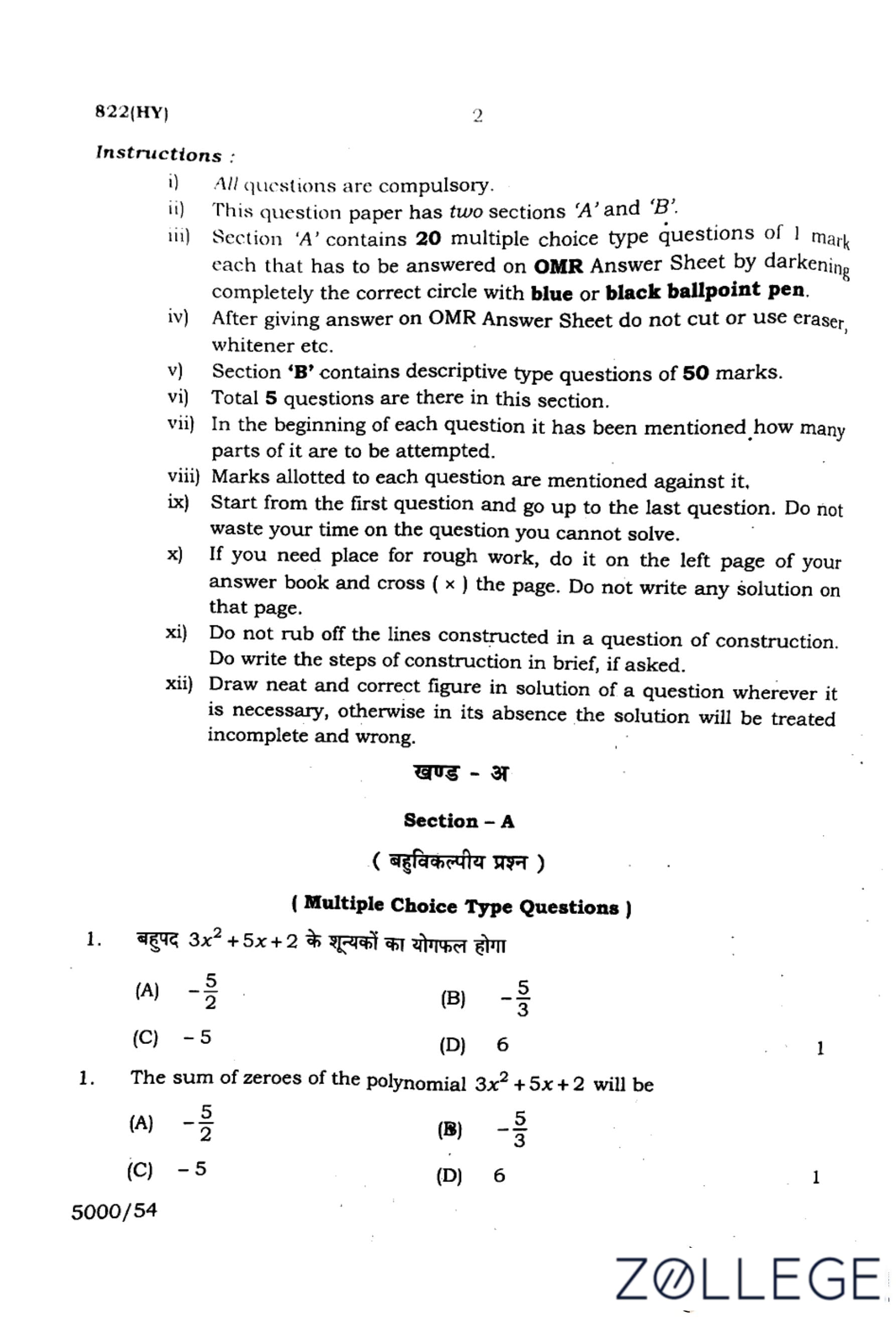
The sum of the zeros of the polynomial \( 3x^2 + 5x + 2 \) will be:
View Solution
For a quadratic polynomial of the form:
\[ ax^2 + bx + c \]
The sum of its zeroes is given by the formula:
\[ \alpha + \beta = -\frac{b}{a} \]
For the given polynomial:
\[ 3x^2 + 5x + 2 \]
Comparing with \( ax^2 + bx + c \), we have:
\[ a = 3, \quad b = 5, \quad c = 2 \]
Applying the formula:
\[ \alpha + \beta = -\frac{5}{3} \]
Thus, the required sum of the zeroes is:
\[ \boxed{-\frac{5}{3}} \] Quick Tip: For a quadratic equation \( ax^2 + bx + c \), the sum of zeroes is given by \( -\frac{b}{a} \), and the product of zeroes is given by \( \frac{c}{a} \).
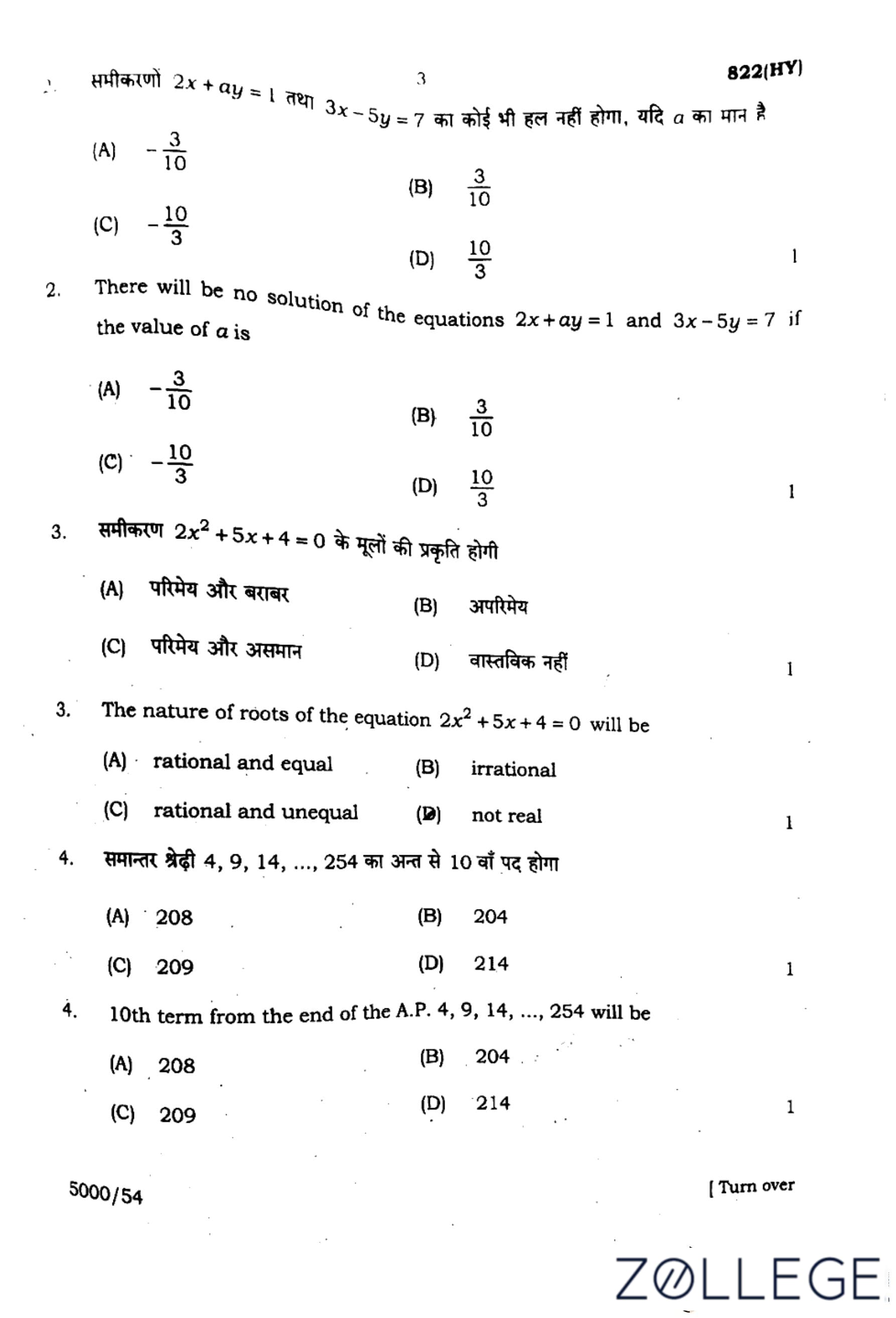
There will be no solution of the equations \( 2x + ay = 1 \) and \( 3x - 5y = 7 \) if the value of \( a \) is:
View Solution
A system of linear equations has no solution if the two lines represented by the equations are parallel. This happens when the ratios of coefficients of \( x \) and \( y \) are equal, but the ratio of the constants is different:
\[ \frac{a_1}{a_2} = \frac{b_1}{b_2} \neq \frac{c_1}{c_2} \]
For the given equations:
\[ 2x + ay = 1 \]
\[ 3x - 5y = 7 \]
Comparing with \( a_1x + b_1y = c_1 \) and \( a_2x + b_2y = c_2 \):
\[ a_1 = 2, \quad b_1 = a, \quad c_1 = 1 \]
\[ a_2 = 3, \quad b_2 = -5, \quad c_2 = 7 \]
For no solution:
\[ \frac{2}{3} = \frac{a}{-5} \neq \frac{1}{7} \]
Solving \( \frac{2}{3} = \frac{a}{-5} \):
\[ 2 \times (-5) = 3 \times a \]
\[ -10 = 3a \]
\[ a = -\frac{10}{3} \]
Thus, the required value of \( a \) is:
\[ \boxed{-\frac{10}{3}} \] Quick Tip: For a system of linear equations to have no solution, the ratio of coefficients of \( x \) and \( y \) must be equal, but the ratio of the constants must be different.
The nature of roots of the equation \( 2x^2 + 5x + 4 = 0 \) will be:
View Solution
To determine the nature of the roots of the quadratic equation:
\[ 2x^2 + 5x + 4 = 0 \]
we calculate the discriminant (\(\Delta\)):
\[ \Delta = b^2 - 4ac \]
where \( a = 2 \), \( b = 5 \), and \( c = 4 \).
\[ \Delta = (5)^2 - 4(2)(4) \]
\[ = 25 - 32 \]
\[ = -7 \]
Since the discriminant (\(\Delta\)) is negative (\(\Delta < 0\)), the roots of the quadratic equation are not real (they are complex or imaginary).
Thus, the correct answer is:
\[ \boxed{Not real} \] Quick Tip: The nature of roots of a quadratic equation \( ax^2 + bx + c = 0 \) depends on the discriminant (\(\Delta\)): - If \( \Delta > 0 \) and is a perfect square, the roots are rational and unequal. - If \( \Delta > 0 \) and is not a perfect square, the roots are irrational. - If \( \Delta = 0 \), the roots are real and equal. - If \( \Delta < 0 \), the roots are not real (complex or imaginary).
The 10th term from the end of the A.P. \( 4, 9, 14, \dots, 254 \) will be:
View Solution
Given the arithmetic progression (A.P.):
\[ 4, 9, 14, \dots, 254 \]
### Step 1: Identify Key Values
The first term (\( a \)) and common difference (\( d \)):
\[ a = 4, \quad d = 9 - 4 = 5 \]
The last term (\( l \)):
\[ l = 254 \]
### Step 2: Find the Total Number of Terms
The general formula for the \( n \)th term of an A.P. is:
\[ a_n = a + (n-1) d \]
Substituting values:
\[ 254 = 4 + (n-1) \times 5 \]
\[ 254 - 4 = (n-1) \times 5 \]
\[ 250 = (n-1) \times 5 \]
\[ n-1 = 50 \]
\[ n = 51 \]
So, there are \( 51 \) terms in the sequence.
### Step 3: Finding the 10th Term from the End
The formula for the \( k \)th term from the end is:
\[ T_k = l - (k-1) d \]
For \( k = 10 \):
\[ T_{10} = 254 - (10-1) \times 5 \]
\[ = 254 - 9 \times 5 \]
\[ = 254 - 45 \]
\[ = 209 \]
Thus, the required 10th term from the end is:
\[ \boxed{209} \] Quick Tip: To find the \( k \)th term from the end in an A.P., use the formula: \[ T_k = l - (k-1) d \] where \( l \) is the last term, \( d \) is the common difference, and \( k \) is the required position from the end.
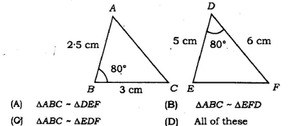
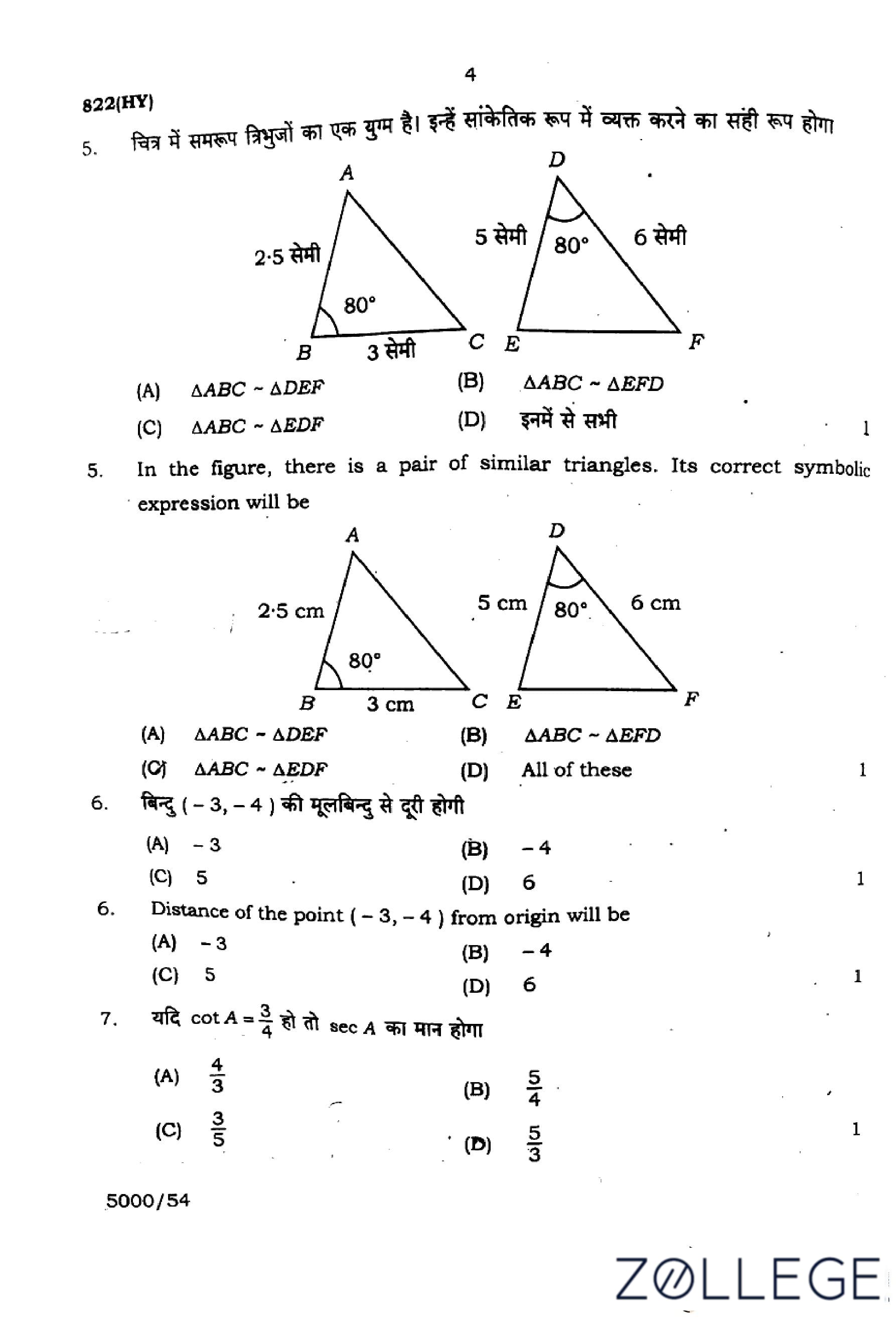
In the figure, there is a pair of similar triangles. Its correct symbolic expression will be:
View Solution
From the figure, we observe the following:
- Both triangles have a common angle of \( 80^\circ \).
- The sides of the triangles are proportional. Specifically:
- \( AB = 2.5 \, cm \), \( BC = 3 \, cm \),
- \( DE = 5 \, cm \), \( EF = 6 \, cm \).
The triangles are similar by the Angle-Side-Angle (ASA) criterion for similarity, since they have:
- \( \angle ABC = \angle DEF = 80^\circ \),
- The corresponding sides \( AB \) and \( DE \), \( BC \) and \( EF \), are proportional.
Therefore, the correct symbolic expression for the similarity of the triangles is: \[ \triangle ABC \sim \triangle DEF. \]
Thus, the answer is \( \boxed{\triangle ABC \sim \triangle DEF} \). Quick Tip: When two triangles have corresponding angles equal and corresponding sides proportional, they are similar. The symbolic expression for their similarity is \( \triangle ABC \sim \triangle DEF \).
Distance of the point \((-3, -4)\) from the origin will be:
View Solution
The distance \( d \) of a point \((x, y)\) from the origin is given by the formula: \[ d = \sqrt{x^2 + y^2}. \]
Substitute \( x = -3 \) and \( y = -4 \): \[ d = \sqrt{(-3)^2 + (-4)^2} = \sqrt{9 + 16} = \sqrt{25} = 5. \]
Thus, the distance is \( \boxed{5} \). Quick Tip: The distance of any point \((x, y)\) from the origin is calculated using \( d = \sqrt{x^2 + y^2} \).
If \( \cot A = \frac{3}{4} \), then the value of \( \sec A \) will be:
View Solution
We are given:
\[ \cot A = \frac{3}{4} \]
### Step 1: Express in Terms of Triangle Sides
Since:
\[ \cot A = \frac{Adjacent}{Opposite} \]
Let the adjacent side be \( 3k \) and the opposite side be \( 4k \).
Using the Pythagorean theorem:
\[ Hypotenuse^2 = Adjacent^2 + Opposite^2 \]
\[ h^2 = (3k)^2 + (4k)^2 \]
\[ h^2 = 9k^2 + 16k^2 = 25k^2 \]
\[ h = 5k \]
### Step 2: Find \( \sec A \)
\[ \sec A = \frac{Hypotenuse}{Adjacent} \]
\[ \sec A = \frac{5k}{3k} = \frac{5}{3} \]
Thus, the required value is:
\[ \boxed{\frac{5}{3}} \] Quick Tip: To find trigonometric ratios, use the Pythagorean theorem: \[ Hypotenuse^2 = Adjacent^2 + Opposite^2 \] and express the given ratio in terms of a right-angled triangle.
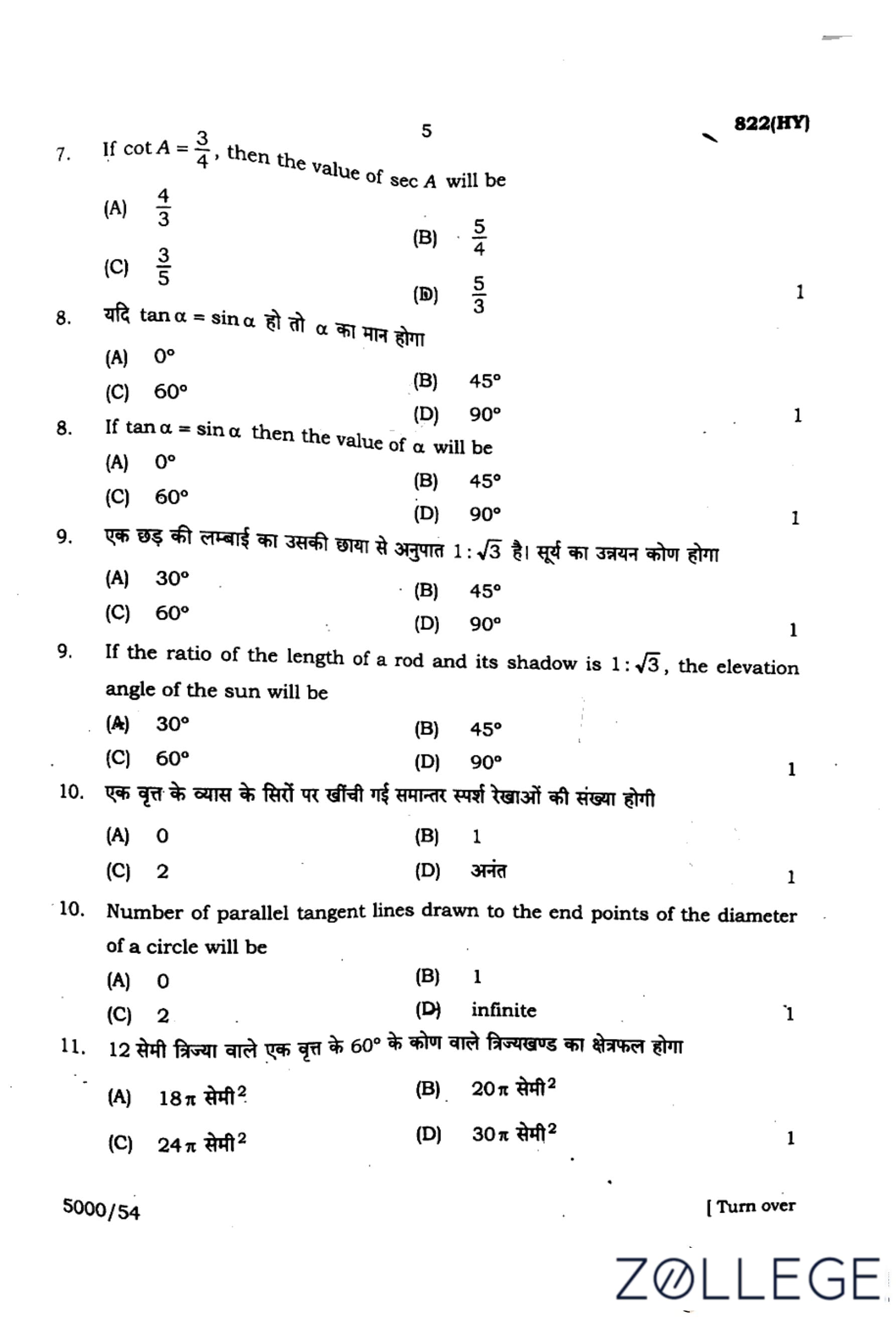
If \( \tan \alpha = \sin \alpha \), then the value of \( \alpha \) will be:
View Solution
We are given the equation:
\[ \tan \alpha = \sin \alpha \]
### Step 1: Express in Terms of Sine and Cosine
Using trigonometric identities:
\[ \tan \alpha = \frac{\sin \alpha}{\cos \alpha} \]
Thus, the given equation becomes:
\[ \frac{\sin \alpha}{\cos \alpha} = \sin \alpha \]
### Step 2: Solve for \( \alpha \)
Rearrange:
\[ \frac{\sin \alpha}{\cos \alpha} - \sin \alpha = 0 \]
Factor out \( \sin \alpha \):
\[ \sin \alpha \left( \frac{1}{\cos \alpha} - 1 \right) = 0 \]
For this equation to hold, either:
1. \( \sin \alpha = 0 \), which gives \( \alpha = 0^\circ \), or
2. \( \frac{1}{\cos \alpha} - 1 = 0 \Rightarrow \cos \alpha = 1 \), which also gives \( \alpha = 0^\circ \).
Thus, the required value of \( \alpha \) is:
\[ \boxed{0^\circ} \] Quick Tip: Use trigonometric identities to express equations in terms of sine and cosine, then solve for the unknown angle.
If the ratio of the length of a rod and its shadow is \( 1 : \sqrt{3} \), the elevation angle of the sun will be:
View Solution
Let the length of the rod be \( h \) and the length of its shadow be \( s \). Given:
\[ \frac{h}{s} = \frac{1}{\sqrt{3}} \]
The elevation angle \( \theta \) of the sun is given by:
\[ \tan \theta = \frac{Height of the rod}{Length of the shadow} \]
Substituting the given ratio:
\[ \tan \theta = \frac{1}{\sqrt{3}} \]
We know that:
\[ \tan 30^\circ = \frac{1}{\sqrt{3}} \]
Thus,
\[ \theta = 30^\circ \]
Therefore, the elevation angle of the sun is:
\[ \boxed{30^\circ} \] Quick Tip: The elevation angle of the sun is found using \( \tan \theta = \frac{Height of Object}{Shadow Length} \). Memorizing standard tangent values helps in quick calculations.
Number of parallel tangent lines drawn to the end points of the diameter of a circle will be:
View Solution
At the end points of the diameter of a circle, two parallel tangent lines can be drawn. One tangent line can be drawn from each endpoint of the diameter. Hence, the number of parallel tangent lines drawn will be \( \boxed{2} \). Quick Tip: When a tangent is drawn at the endpoints of the diameter, there are exactly two parallel tangent lines.
The area of the sector of a circle whose angle is 60° and radius 12 cm will be:

View Solution
The area \( A \) of a sector of a circle is given by the formula: \[ A = \frac{\theta}{360^\circ} \times \pi r^2, \]
where \( \theta \) is the central angle and \( r \) is the radius.
Given:
- \( \theta = 60^\circ \),
- \( r = 12 \, cm \),
Substitute the values: \[ A = \frac{60}{360} \times \pi (12)^2 = \frac{1}{6} \times \pi \times 144 = 24\pi \, cm^2. \]
Thus, the area of the sector is \( \boxed{24\pi \, cm^2} \). Quick Tip: The area of a sector is given by \( A = \frac{\theta}{360^\circ} \times \pi r^2 \), where \( \theta \) is the angle and \( r \) is the radius.
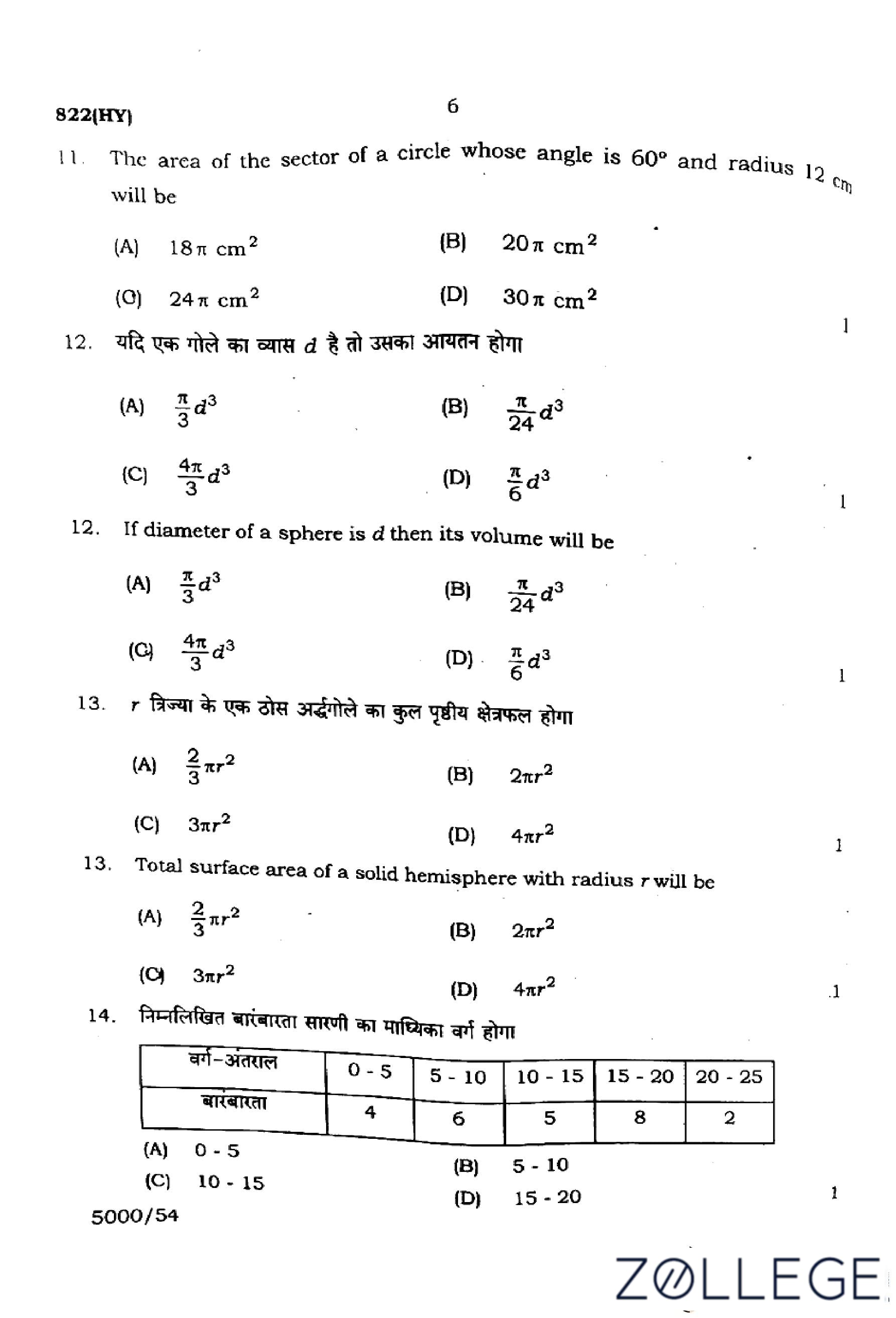
If the diameter of a sphere is \( d \), then its volume will be:
View Solution
The volume of a sphere is given by the formula:
\[ V = \frac{4}{3} \pi r^3 \]
where \( r \) is the radius of the sphere. Given that the diameter of the sphere is \( d \), we have:
\[ r = \frac{d}{2} \]
Substituting \( r \) into the volume formula:
\[ V = \frac{4}{3} \pi \left(\frac{d}{2}\right)^3 \]
\[ = \frac{4}{3} \pi \times \frac{d^3}{8} \]
\[ = \frac{4\pi d^3}{24} \]
\[ = \frac{\pi d^3}{6} \]
Thus, the required volume of the sphere is:
\[ \boxed{\frac{\pi}{6} d^3} \] Quick Tip: To find the volume of a sphere when given the diameter, use \( r = \frac{d}{2} \) and substitute into \( V = \frac{4}{3} \pi r^3 \).
Total surface area of a solid hemisphere with radius \( r \) will be:
View Solution
The total surface area of a solid hemisphere consists of:
1. The curved surface area (CSA) of the hemisphere:
\[ CSA = 2\pi r^2 \]
2. The circular base area:
\[ Base Area = \pi r^2 \]
Thus, the total surface area (TSA) is:
\[ TSA = CSA + Base Area \]
\[ = 2\pi r^2 + \pi r^2 \]
\[ = 3\pi r^2 \]
Thus, the required total surface area is:
\[ \boxed{3\pi r^2} \] Quick Tip: The total surface area of a solid hemisphere is given by: \[ TSA = 2\pi r^2 + \pi r^2 = 3\pi r^2 \] where \( 2\pi r^2 \) is the curved surface area, and \( \pi r^2 \) is the base area.
The median class of the following frequency table will be:

View Solution
To find the median class, we first calculate the cumulative frequency for the given frequency table:
\begin{table[h]
\centering
\begin{tabular{|c|c|c|
\hline
Class Interval & Frequency & Cumulative Frequency
\hline
0 - 5 & 4 & 4
5 - 10 & 6 & 4 + 6 = 10
10 - 15 & 5 & 10 + 5 = 15
15 - 20 & 8 & 15 + 8 = 23
20 - 25 & 2 & 23 + 2 = 25
\hline
\end{tabular
\label{tab:freq_dist
\end{table
Now, we calculate the median class using the following steps:
1. Find the total number of observations, \( N = 25 \) (sum of frequencies).
2. The median class corresponds to the class interval where the cumulative frequency is greater than or equal to \( \frac{N}{2} \), which is \( \frac{25}{2} = 12.5 \).
3. The cumulative frequency just greater than 12.5 is 15, which corresponds to the class interval \( 10 - 15 \).
Thus, the median class is \( \boxed{5 - 10} \).
Quick Tip: The median class is the class where the cumulative frequency first exceeds \( \frac{N}{2} \), where \( N \) is the total frequency.
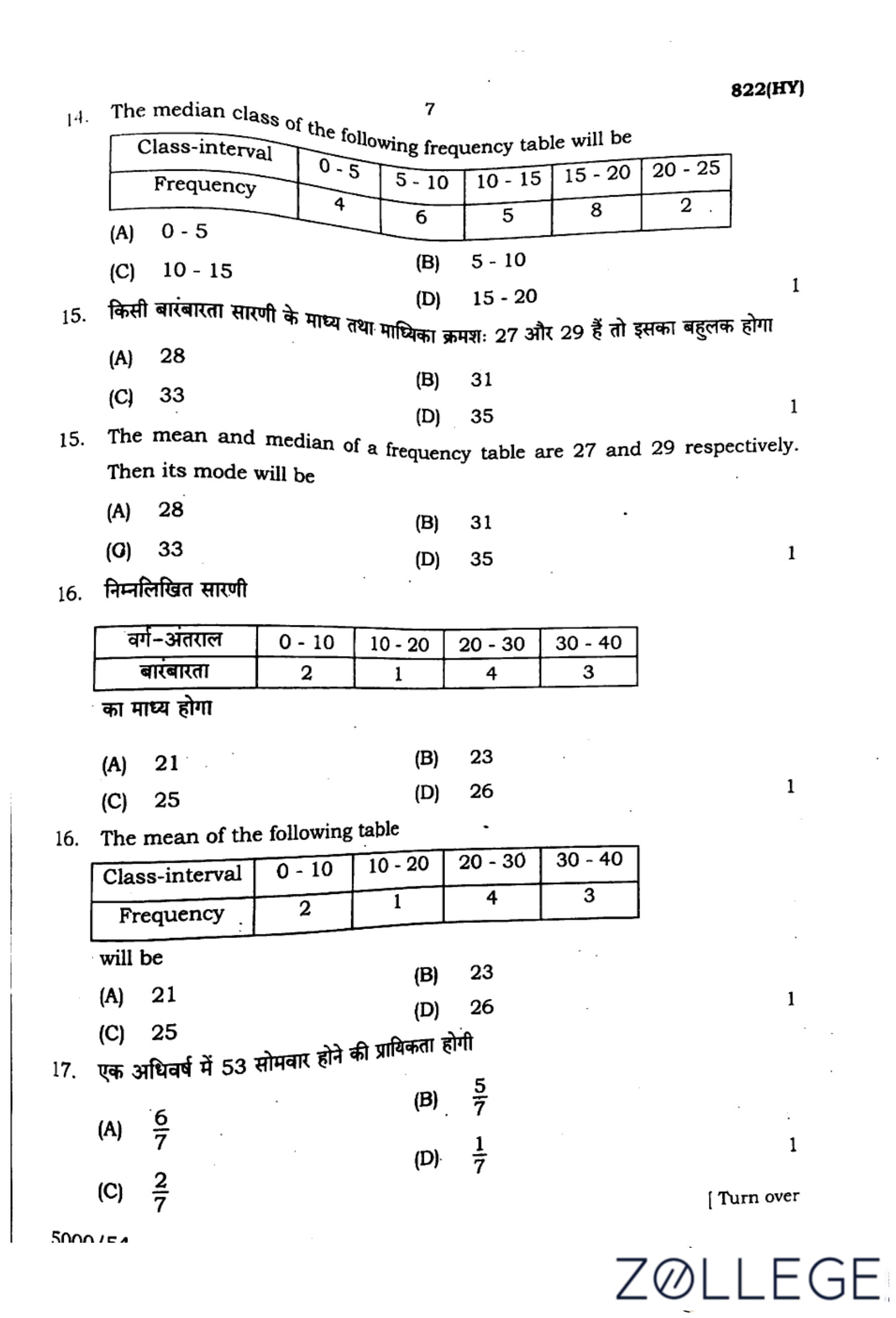
The mean and median of a frequency table are 27 and 29 respectively. Then its mode will be:
View Solution
Using the empirical formula relating mean, median, and mode:
\[ Mode = 3 \times Median - 2 \times Mean \]
Substituting the given values:
\[ Mode = 3 \times 29 - 2 \times 27 \]
\[ = 87 - 54 \]
\[ = 33 \]
Thus, the required mode is:
\[ \boxed{33} \] Quick Tip: The empirical formula: \[ Mode = 3 \times Median - 2 \times Mean \] is useful for estimating the mode when it is not directly available from the data.
The mean of the following table will be:

View Solution
To calculate the mean for the grouped frequency table, we use the formula: \[ Mean = \frac{\sum f_i x_i}{\sum f_i}, \]
where \( f_i \) is the frequency and \( x_i \) is the midpoint of each class interval.
The midpoints for each class interval are:
- \( x_1 = \frac{0 + 10}{2} = 5 \),
- \( x_2 = \frac{10 + 20}{2} = 15 \),
- \( x_3 = \frac{20 + 30}{2} = 25 \),
- \( x_4 = \frac{30 + 40}{2} = 35 \).
Now, we compute \( f_i x_i \):
- \( f_1 x_1 = 2 \times 5 = 10 \),
- \( f_2 x_2 = 1 \times 15 = 15 \),
- \( f_3 x_3 = 4 \times 25 = 100 \),
- \( f_4 x_4 = 3 \times 35 = 105 \).
Now, sum these values: \[ \sum f_i x_i = 10 + 15 + 100 + 105 = 230, \]
and the total sum of frequencies is: \[ \sum f_i = 2 + 1 + 4 + 3 = 10. \]
Thus, the mean is: \[ Mean = \frac{230}{10} = 23. \]
Thus, the mean of the given frequency table is \( \boxed{23} \). Quick Tip: To calculate the mean for a grouped frequency distribution, multiply the class midpoints by their corresponding frequencies, then divide the sum by the total frequency.
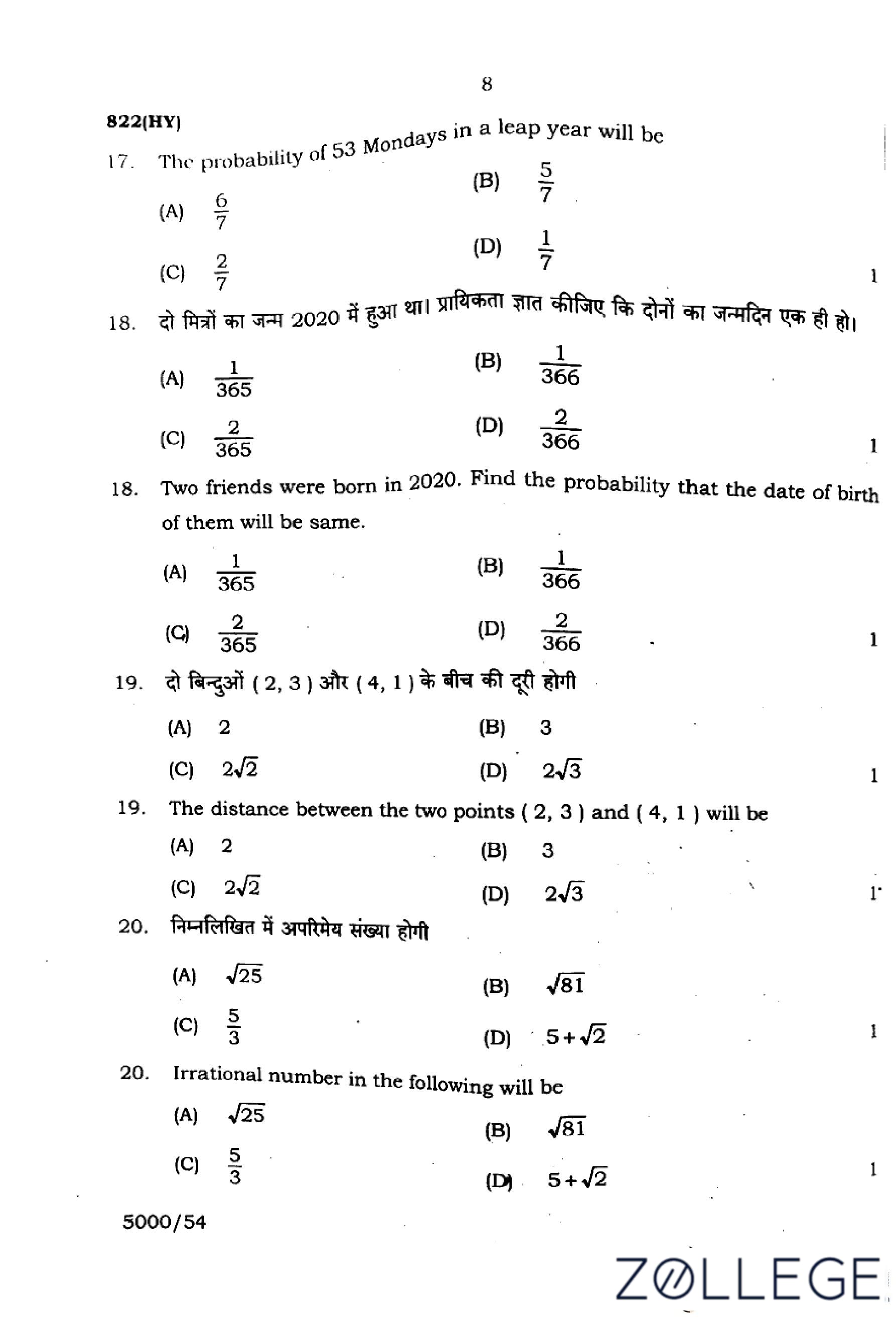
The probability of 53 Mondays in a leap year will be:
View Solution
### Step 1: Understanding Leap Year Distribution
A leap year has 366 days, which means:
\[ 366 \div 7 = 52 weeks and 2 extra days \]
So, every leap year has 52 full weeks (i.e., 52 Mondays, Tuesdays, ..., Sundays) and2 extra days.
### Step 2: Finding Favorable Cases
The extra 2 days can be any of the following pairs:
1. Sunday & Monday
2. Monday & Tuesday
3. Tuesday & Wednesday
4. Wednesday & Thursday
5. Thursday & Friday
6. Friday & Saturday
7. Saturday & Sunday
For there to be 53 Mondays, Monday must be one of these extra days. This happens in 2 out of 7 cases:
- (Sunday, Monday)
- (Monday, Tuesday)
### Step 3: Calculating Probability
Since there are 7 possible cases and 2 favorable cases, the probability is:
\[ \frac{2}{7} \]
Thus, the required probability is:
\[ \boxed{\frac{2}{7}} \] Quick Tip: In a leap year, there are 52 full weeks and 2 extra days. The probability of 53 occurrences of a specific day is determined by how often that day appears among the extra 2 days.
Two friends were born in 2020. Find the probability that the date of birth of both of them will be the same.
View Solution
### Step 1: Understanding the Problem
Since the friends were born in 2020, which is a leap year, it contains 366 days.
Each person can be born on any of these 366 days, and the second person must be born on the same day as the first.
### Step 2: Probability Calculation
\
- The first friend can be born on any of the 366 days.
- The second friend must be born on the same day.
- The probability of this happening is:
\[ \frac{1}{366} \]
Thus, the required probability is:
\[ \boxed{\frac{1}{366}} \] Quick Tip: For two people to have the same birthday in a leap year, the probability is \( \frac{1}{366} \). In a non-leap year, the probability would be \( \frac{1}{365} \).
The distance between the two points \( (2, 3) \) and \( (4, 1) \) will be:
View Solution
The distance \( d \) between two points \( (x_1, y_1) \) and \( (x_2, y_2) \) in the coordinate plane is given by the distance formula: \[ d = \sqrt{(x_2 - x_1)^2 + (y_2 - y_1)^2}. \]
Substitute \( (x_1, y_1) = (2, 3) \) and \( (x_2, y_2) = (4, 1) \): \[ d = \sqrt{(4 - 2)^2 + (1 - 3)^2} = \sqrt{2^2 + (-2)^2} = \sqrt{4 + 4} = \sqrt{8} = 2\sqrt{2}. \]
Thus, the distance between the two points is \( \boxed{2\sqrt{2}} \). Quick Tip: To find the distance between two points in a plane, use the distance formula \( d = \sqrt{(x_2 - x_1)^2 + (y_2 - y_1)^2} \).
Irrational number in the following will be:
View Solution
- \( \sqrt{25} = 5 \), which is a rational number.
- \( \sqrt{81} = 9 \), which is a rational number.
- \( \frac{5}{3} \) is a rational number.
- \( 5 + \sqrt{2} \) is an irrational number because \( \sqrt{2} \) is irrational and adding a rational number (5) to an irrational number results in an irrational number.
Thus, the irrational number is \( \boxed{5 + \sqrt{2}} \).
Quick Tip: The sum of a rational and an irrational number is always irrational.
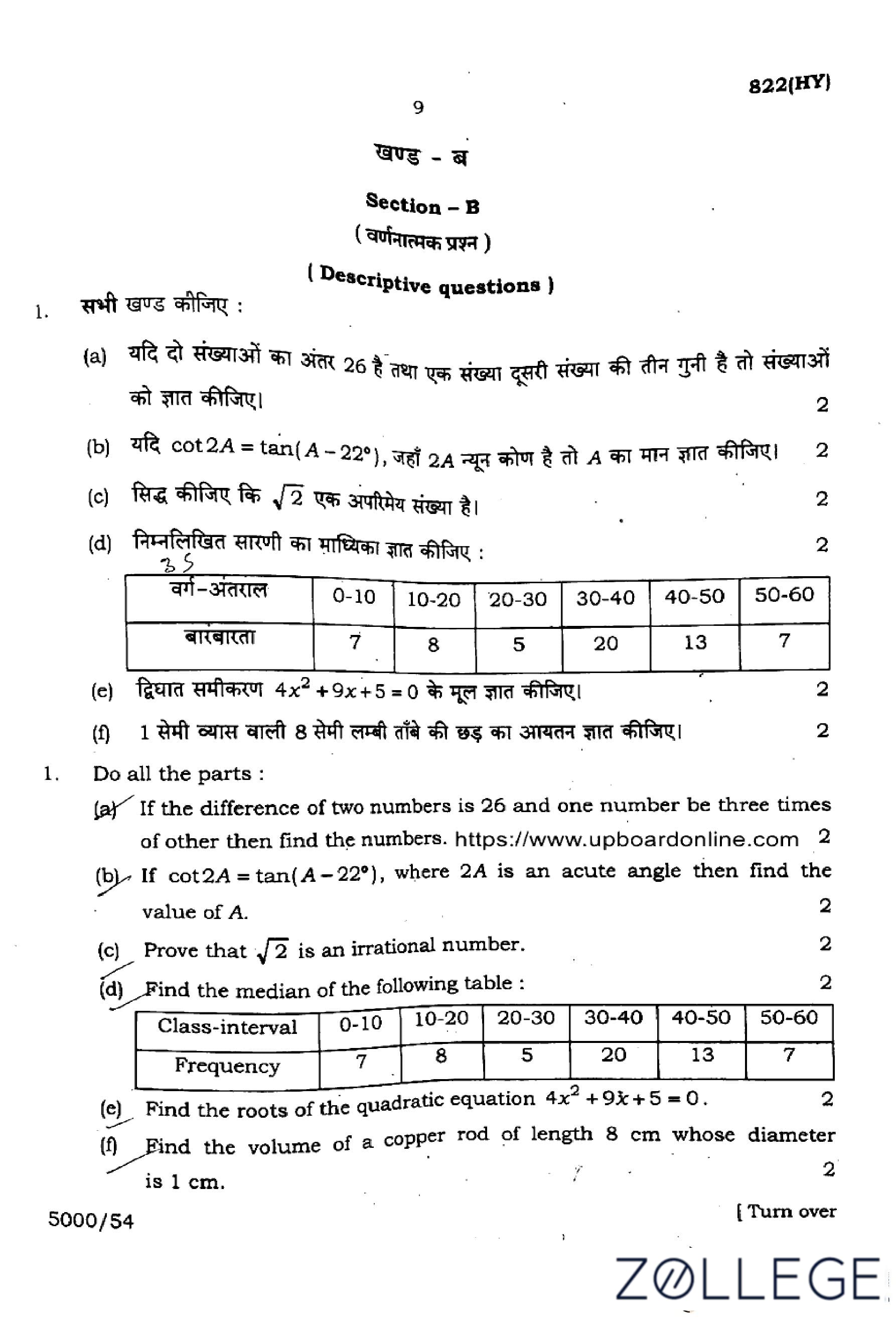
(a.)If the difference of two numbers is 26 and one number is three times the other, then find the numbers.
View Solution
Let the two numbers be \( x \) and \( y \), where \( x \) is the larger number. According to the problem: \[ x - y = 26 \quad (Equation 1). \]
We are also told that one number is three times the other: \[ x = 3y \quad (Equation 2). \]
Substitute \( x = 3y \) from Equation 2 into Equation 1: \[ 3y - y = 26 \quad \Rightarrow \quad 2y = 26 \quad \Rightarrow \quad y = 13. \]
Now, substitute \( y = 13 \) into Equation 2: \[ x = 3 \times 13 = 39. \]
Thus, the two numbers are \( x = 39 \) and \( y = 13 \). Quick Tip: When solving problems involving relationships between two variables, set up two equations and solve them simultaneously.
If \( \cot 2A = \tan(A - 22^\circ) \), where \( 2A \) is an acute angle, then find the value of \( A \).
View Solution
We are given the equation \( \cot 2A = \tan(A - 22^\circ) \).
We know that \( \cot x = \frac{1}{\tan x} \), so the equation becomes: \[ \frac{1}{\tan 2A} = \tan(A - 22^\circ). \]
Now, use the identity \( \tan(90^\circ - x) = \cot x \) and manipulate the equation: \[ \tan 2A = \tan(90^\circ - (A - 22^\circ)) = \tan(90^\circ - A + 22^\circ) = \tan(68^\circ - A). \]
Thus, we have the equation: \[ 2A = 68^\circ - A. \]
Solving for \( A \): \[ 2A + A = 68^\circ \quad \Rightarrow \quad 3A = 68^\circ \quad \Rightarrow \quad A = \frac{68^\circ}{3} = 22.67^\circ. \]
Thus, the value of \( A \) is approximately \( 22.67^\circ \). Quick Tip: Use trigonometric identities to manipulate the given equation, and then solve for the unknown variable.
Prove that \( \sqrt{2} \) is an irrational number.
View Solution
To prove that \( \sqrt{2} \) is an irrational number, we will use proof by contradiction.
Assume that \( \sqrt{2} \) is a rational number. This means that \( \sqrt{2} \) can be expressed as a fraction \( \frac{p}{q} \), where \( p \) and \( q \) are integers with no common factors (i.e., \( \frac{p}{q} \) is in the simplest form).
Thus, we assume: \[ \sqrt{2} = \frac{p}{q}. \]
Squaring both sides: \[ 2 = \frac{p^2}{q^2}. \]
This leads to: \[ 2q^2 = p^2. \]
Now, observe that \( p^2 \) is even because it is equal to \( 2q^2 \), which is obviously even. Since \( p^2 \) is even, \( p \) must also be even (because the square of an odd number is odd). Therefore, let \( p = 2k \), where \( k \) is an integer.
Substitute \( p = 2k \) into the equation \( 2q^2 = p^2 \): \[ 2q^2 = (2k)^2 \quad \Rightarrow \quad 2q^2 = 4k^2 \quad \Rightarrow \quad q^2 = 2k^2. \]
This shows that \( q^2 \) is even, and therefore \( q \) must also be even.
Thus, both \( p \) and \( q \) are even, which contradicts our assumption that \( \frac{p}{q} \) is in the simplest form.
Since this leads to a contradiction, our assumption that \( \sqrt{2} \) is rational must be false. Therefore, \( \sqrt{2} \) is an irrational number.
Thus, \( \boxed{\sqrt{2} is irrational} \). Quick Tip: To prove that a number is irrational, assume it is rational, and then show that this leads to a contradiction.
Find the median of the following table:

View Solution
To find the median from a frequency table, we use the following steps:
Step 1. Calculate the total frequency: The total frequency is the sum of the frequencies:
\[ N = 7 + 8 + 5 + 20 + 13 + 7 = 60. \]
Step 2.Calculate the cumulative frequency:
\[ \begin{array}{|c|c|} \hline Class Interval & Cumulative Frequency
\hline 0-10 & 7
10-20 & 7 + 8 = 15
20-30 & 15 + 5 = 20
30-40 & 20 + 20 = 40
40-50 & 40 + 13 = 53
50-60 & 53 + 7 = 60
\hline \end{array} \]
Step 3.Find the median class: The median class corresponds to the class interval where the cumulative frequency is greater than or equal to \( \frac{N}{2} = \frac{60}{2} = 30 \).
Looking at the cumulative frequencies, we find that the median class is \( 30-40 \), because the cumulative frequency just greater than or equal to 30 is 40.
Step 4. Apply the median formula:
The formula for the median is:
\[ Median = L + \frac{\frac{N}{2} - CF}{f} \times h, \]
where:
- \( L \) is the lower limit of the median class,
- \( N \) is the total frequency,
- \( CF \) is the cumulative frequency of the class before the median class,
- \( f \) is the frequency of the median class,
- \( h \) is the class width.
For the median class \( 30-40 \), we have:
- \( L = 30 \),
- \( CF = 20 \),
- \( f = 20 \),
- \( h = 10 \).
Substitute these values into the formula: \[ Median = 30 + \frac{30 - 20}{20} \times 10 = 30 + \frac{10}{20} \times 10 = 30 + 5 = 35. \]
Thus, the median is \( \boxed{35} \). Quick Tip: To find the median from a frequency table, use the formula for the median, which involves the cumulative frequency and the frequency of the median class.
Find the roots of the quadratic equation \( 4x^2 + 9x + 5 = 0 \).
View Solution
Step 1.The quadratic equation is given by: \[ 4x^2 + 9x + 5 = 0. \]
Step 2.We will solve this equation using the quadratic formula: \[ x = \frac{-b \pm \sqrt{b^2 - 4ac}}{2a}, \]
where \( a = 4 \), \( b = 9 \), and \( c = 5 \).
Step 3.Substitute these values into the quadratic formula: \[ x = \frac{-9 \pm \sqrt{9^2 - 4 \times 4 \times 5}}{2 \times 4} = \frac{-9 \pm \sqrt{81 - 80}}{8} = \frac{-9 \pm \sqrt{1}}{8}. \]
Thus, the roots are: \[ x = \frac{-9 + 1}{8} = \frac{-8}{8} = -1 \quad or \quad x = \frac{-9 - 1}{8} = \frac{-10}{8} = -\frac{5}{4}. \]
The roots of the quadratic equation are \( x = -1 \) and \( x = -\frac{5}{4} \). Quick Tip: The quadratic formula is used to find the roots of any quadratic equation. Make sure to correctly substitute the values of \( a \), \( b \), and \( c \).
Find the volume of a copper rod of length 8 cm whose diameter is 1 cm.
View Solution
The volume \( V \) of a cylindrical object like a rod is given by the formula: \[ V = \pi r^2 h, \]
where \( r \) is the radius of the base, and \( h \) is the height (or length in this case).
The diameter of the rod is 1 cm, so the radius is: \[ r = \frac{1}{2} \, cm. \]
The length of the rod is given as \( h = 8 \, cm \).
Now, substitute these values into the volume formula: \[ V = \pi \left(\frac{1}{2}\right)^2 \times 8 = \pi \times \frac{1}{4} \times 8 = 2\pi \, cm^3. \]
Thus, the volume of the rod is \( \boxed{2\pi \, cm^3} \). Quick Tip: The volume of a cylinder is calculated using \( V = \pi r^2 h \), where \( r \) is the radius of the base and \( h \) is the height.
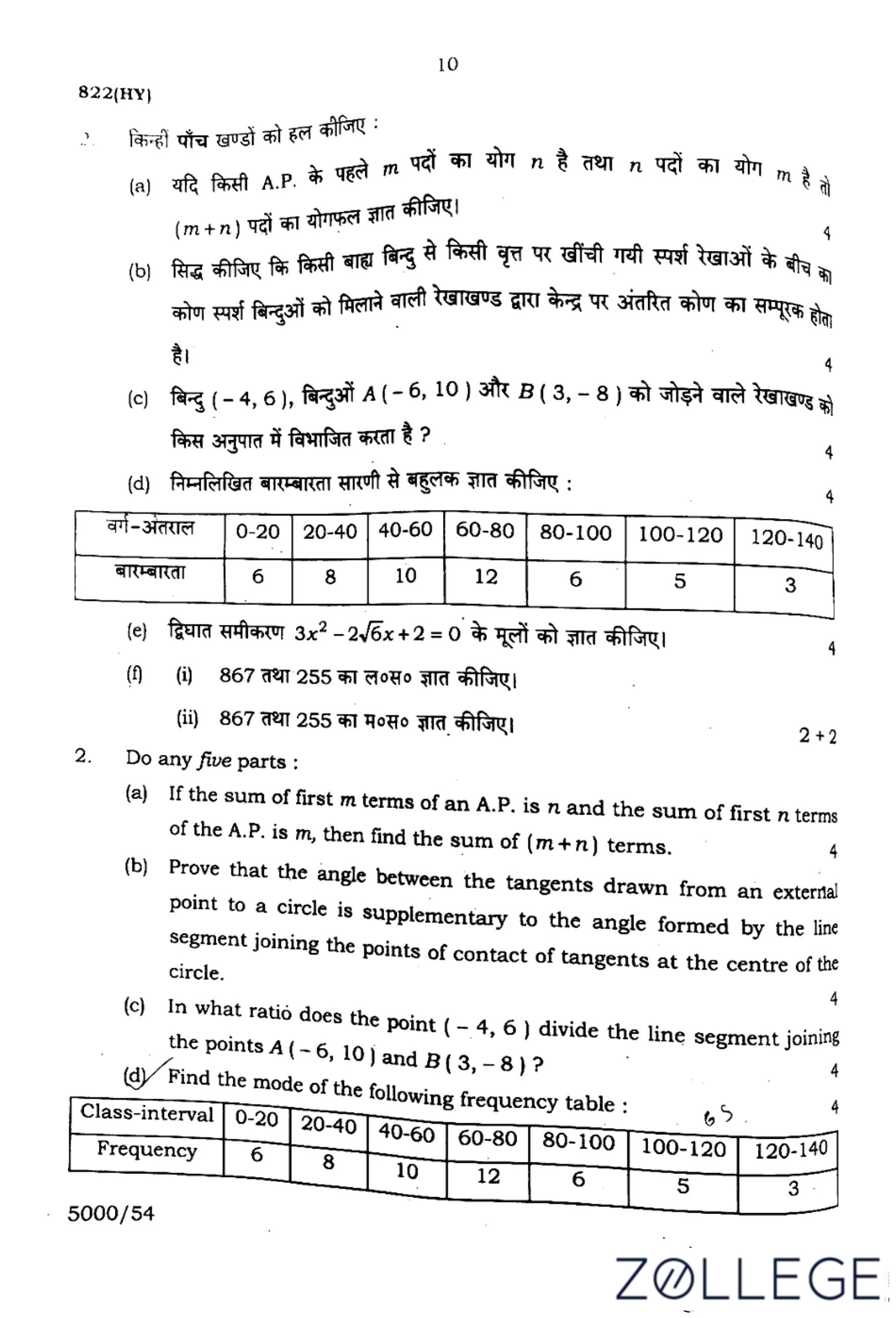
(a.)If the sum of the first \( m \) terms of an A.P. is \( n \) and the sum of the first \( n \) terms of the A.P. is \( m \), then find the sum of \( (m + n) \) terms.
View Solution
The sum of the first \( m \) terms of an arithmetic progression (A.P.) is given by the formula: \[ S_m = \frac{m}{2} \left( 2a + (m-1)d \right), \]
where \( a \) is the first term and \( d \) is the common difference of the A.P.
We are given that the sum of the first \( m \) terms is \( n \), so: \[ S_m = n \quad \Rightarrow \quad \frac{m}{2} \left( 2a + (m-1)d \right) = n. \quad \cdots (1) \]
Similarly, the sum of the first \( n \) terms is given by: \[ S_n = \frac{n}{2} \left( 2a + (n-1)d \right), \]
and we are given that \( S_n = m \), so: \[ S_n = m \quad \Rightarrow \quad \frac{n}{2} \left( 2a + (n-1)d \right) = m. \quad \cdots (2) \]
We now have two equations to solve for \( a \) and \( d \). Once we have \( a \) and \( d \), we can find the sum of the first \( (m+n) \) terms using the sum formula: \[ S_{m+n} = \frac{m+n}{2} \left( 2a + (m+n-1)d \right). \]
This approach will give us the sum of \( (m+n) \) terms. Quick Tip: The sum of the first \( m \) terms of an A.P. can be found using the formula \( S_m = \frac{m}{2} (2a + (m-1)d) \), where \( a \) is the first term and \( d \) is the common difference.
Prove that the angle between the tangents drawn from an external point to a circle is supplementary to the angle formed by the line joining the points of contact of tangents at the center of the circle.
View Solution
### Step 1: Understanding the Problem
Let \( O \) be the center of the circle, and let \( P \) be an external point from which two tangents \( PA \) and \( PB \) are drawn to the circle, touching it at points \( A \) and \( B \), respectively.
We need to prove that:
\[ \angle APB + \angle AOB = 180^\circ \]
where:
- \( \angle APB \) is the angle between the two tangents, and
- \( \angle AOB \) is the angle subtended at the center by the points of contact.
### Step 2: Recognizing Key Properties
1. The two tangents drawn from an external point to a circle are equal in length:
\[ PA = PB \]
2. The radius is perpendicular to the tangent at the point of contact:
\[ OA \perp PA, \quad OB \perp PB \]
3. The quadrilateral \( OAPB \) is a cyclic quadrilateral because all four points lie on a circle.
### Step 3: Using Angle Properties
In the cyclic quadrilateral \( OAPB \):
- The exterior angle \( \angle APB \) is equal to the supplementary angle of the interior opposite angle \( \angle AOB \), as per the cyclic quadrilateral theorem.
\[ \angle APB + \angle AOB = 180^\circ \]
### Step 4: Conclusion
Thus, we have proved that the angle between the two tangents drawn from an external point to a circle is supplementary to the angle subtended by the line segment joining the points of contact to the center.
\[ \boxed{\angle APB + \angle AOB = 180^\circ} \] Quick Tip: In a cyclic quadrilateral, the sum of opposite angles is always \( 180^\circ \), which is key to proving this theorem.
In what ratio does the point \( (-4, 6) \) divide the line segment joining the points \( A(-6, 10) \) and \( B(3, -8) \)?
View Solution
Let the point \( P(-4, 6) \) divide the line segment joining points \( A(-6, 10) \) and \( B(3, -8) \) in the ratio \( k : 1 \).
Using the section formula, the coordinates of the point \( P \) dividing the line segment in the ratio \( k : 1 \) are given by: \[ x = \frac{k \cdot x_2 + 1 \cdot x_1}{k + 1}, \quad y = \frac{k \cdot y_2 + 1 \cdot y_1}{k + 1}. \]
Substitute the coordinates of \( A(-6, 10) \) and \( B(3, -8) \) into the formula:
For the x-coordinate: \[ -4 = \frac{k \cdot 3 + (-6)}{k + 1}. \]
Simplify: \[ -4 = \frac{3k - 6}{k + 1}. \]
Multiply both sides by \( (k + 1) \): \[ -4(k + 1) = 3k - 6 \quad \Rightarrow \quad -4k - 4 = 3k - 6. \]
Solve for \( k \): \[ -4k - 3k = -6 + 4 \quad \Rightarrow \quad -7k = -2 \quad \Rightarrow \quad k = \frac{2}{7}. \]
Thus, the point \( (-4, 6) \) divides the line segment joining \( A(-6, 10) \) and \( B(3, -8) \) in the ratio \( 2:7 \). Quick Tip: To find the ratio in which a point divides a line segment, use the section formula and solve for the ratio.
Find the mode of the following frequency table:

View Solution
To find the mode for the grouped frequency table, we use the formula for the mode of a frequency distribution: \[ Mode = L + \frac{(f_1 - f_0)}{(2f_1 - f_0 - f_2)} \times h, \]
where:
- \( L \) is the lower boundary of the modal class,
- \( f_1 \) is the frequency of the modal class,
- \( f_0 \) is the frequency of the class preceding the modal class,
- \( f_2 \) is the frequency of the class succeeding the modal class,
- \( h \) is the class width.
### Step 1: Identify the modal class
From the frequency table, we see that the maximum frequency is 12, which corresponds to the class interval \( 60 - 80 \). Therefore, the modal class is \( 60 - 80 \).
### Step 2: Apply the formula
For the modal class \( 60 - 80 \):
- \( L = 60 \) (lower boundary of the modal class),
- \( f_1 = 12 \) (frequency of the modal class),
- \( f_0 = 10 \) (frequency of the class preceding the modal class, \( 40 - 60 \)),
- \( f_2 = 6 \) (frequency of the class succeeding the modal class, \( 80 - 100 \)),
- \( h = 20 \) (class width).
Substitute these values into the formula: \[ Mode = 60 + \frac{(12 - 10)}{(2 \times 12 - 10 - 6)} \times 20 = 60 + \frac{2}{(24 - 10 - 6)} \times 20 = 60 + \frac{2}{8} \times 20 = 60 + 5 = 65. \]
Thus, the mode of the given frequency distribution is \( \boxed{65} \). Quick Tip: The mode is the value that appears most frequently. For grouped data, we use the formula to calculate the mode of the distribution based on the frequency of the modal class.
Find the roots of the quadratic equation \( 3x^2 - 2\sqrt{6}x + 2 = 0 \).
View Solution
The quadratic equation is given by: \[ 3x^2 - 2\sqrt{6}x + 2 = 0. \]
We will solve this using the quadratic formula: \[ x = \frac{-b \pm \sqrt{b^2 - 4ac}}{2a}, \]
where \( a = 3 \), \( b = -2\sqrt{6} \), and \( c = 2 \).
Substitute these values into the quadratic formula: \[ x = \frac{-(-2\sqrt{6}) \pm \sqrt{(-2\sqrt{6})^2 - 4 \times 3 \times 2}}{2 \times 3} \] \[ x = \frac{2\sqrt{6} \pm \sqrt{(2\sqrt{6})^2 - 24}}{6} \] \[ x = \frac{2\sqrt{6} \pm \sqrt{24 - 24}}{6} \] \[ x = \frac{2\sqrt{6} \pm \sqrt{0}}{6} \] \[ x = \frac{2\sqrt{6}}{6} \] \[ x = \frac{\sqrt{6}}{3}. \]
Thus, the roots of the quadratic equation are \( x = \frac{\sqrt{6}}{3} \). Quick Tip: To solve a quadratic equation, use the quadratic formula. For equations with irrational coefficients, make sure to carefully simplify the terms.
Find the LCM of 867 and 255.
View Solution
To find the Least Common Multiple (LCM) of two numbers, we use the formula: \[ LCM(a, b) = \frac{a \times b}{HCF(a, b)}. \]
We first need to find the Highest Common Factor (HCF) of 867 and 255. Using the Euclidean algorithm:
1. \( 867 \div 255 = 3 \) remainder \( 102 \),
2. \( 255 \div 102 = 2 \) remainder \( 51 \),
3. \( 102 \div 51 = 2 \) remainder \( 0 \).
Since the remainder is 0, the HCF of 867 and 255 is \( 51 \).
Now, use the formula for the LCM: \[ LCM(867, 255) = \frac{867 \times 255}{51} = \frac{221985}{51} = 4350. \]
Thus, the LCM of 867 and 255 is \( \boxed{4350} \). Quick Tip: To find the LCM, first calculate the HCF using the Euclidean algorithm, then apply the formula \( LCM(a, b) = \frac{a \times b}{HCF(a, b)} \).
Find the HCF of 867 and 255.
View Solution
We will use the Euclidean algorithm to find the Highest Common Factor (HCF) of 867 and 255:
1. \( 867 \div 255 = 3 \) remainder \( 102 \),
2. \( 255 \div 102 = 2 \) remainder \( 51 \),
3. \( 102 \div 51 = 2 \) remainder \( 0 \).
Since the remainder is 0, the HCF of 867 and 255 is \( \boxed{51} \). Quick Tip: The Euclidean algorithm is a simple method to find the HCF of two numbers by repeatedly dividing and finding the remainder.
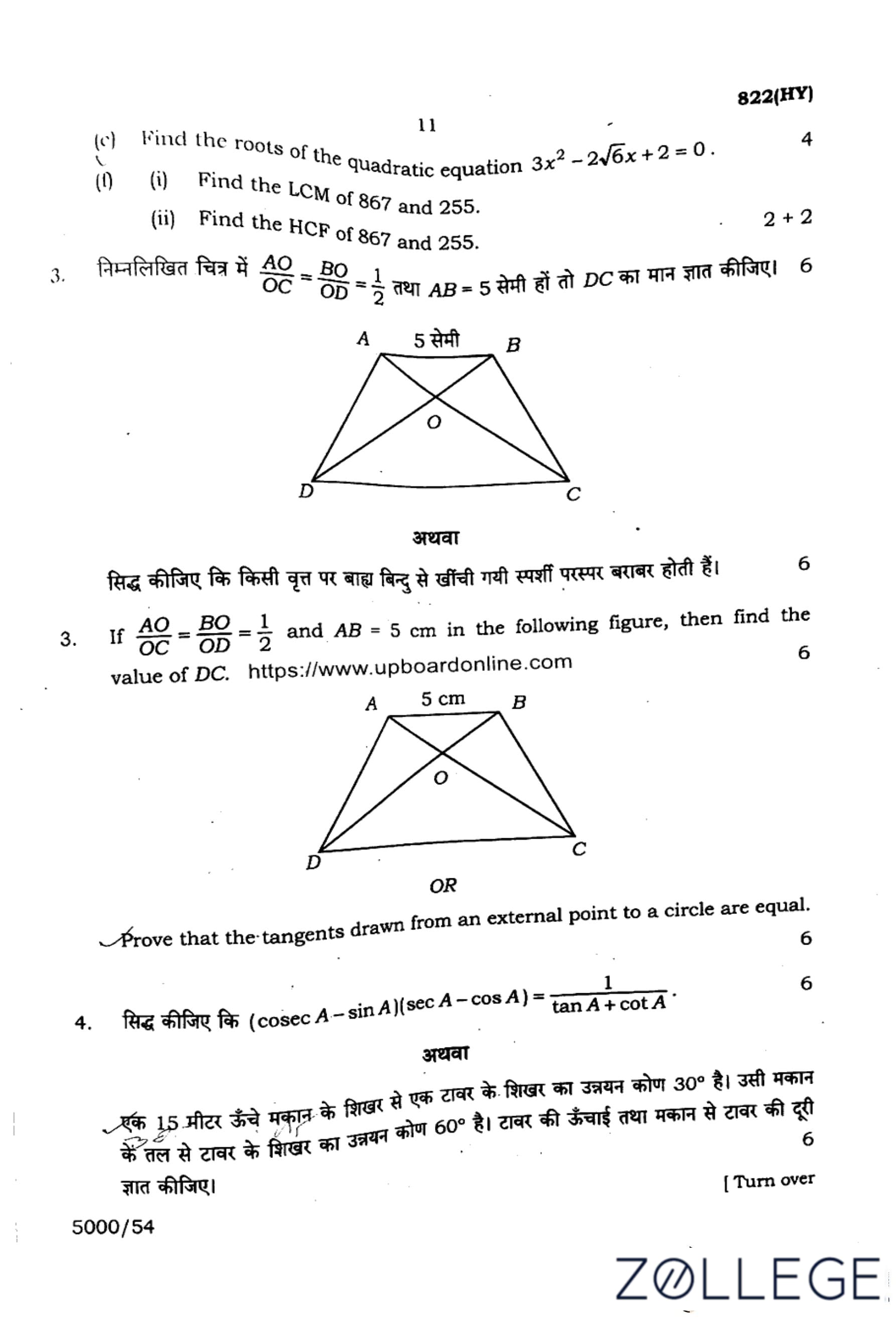
If \( \frac{AO}{OC} = \frac{BO}{OD} = \frac{1}{2} \) and \( AB = 5 \, cm \), then find the value of \( DC \).
View Solution
Given:
\[ \frac{AO}{OC} = \frac{BO}{OD} = \frac{1}{2} \]
and
\[ AB = 5 cm \]
We need to determine the value of \( DC \).
### Step 1: Understanding the Ratio
From the given ratios:
\[ \frac{AO}{OC} = \frac{1}{2} \Rightarrow AO = x, \quad OC = 2x \]
\[ \frac{BO}{OD} = \frac{1}{2} \Rightarrow BO = y, \quad OD = 2y \]
Since \( AB = AO + BO = 5 \), we substitute:
\[ x + y = 5 \]
Using the given ratio, we express \( DC \) as:
\[ DC = OC + OD = 2x + 2y \]
### Step 2: Expressing \( DC \) in Terms of \( AB \)
From \( x + y = 5 \):
\[ DC = 2(x + y) = 2 \times 5 = 10 cm \]
Thus, the required value of \( DC \) is:
\[ \boxed{10 cm} \] Quick Tip: For intersecting chords in a circle, use the property that the ratios of the segments formed by the intersection can be used to find unknown lengths.
Prove that the tangents drawn from an external point to a circle are equal.
View Solution
Let \( P \) be an external point from which two tangents \( PA \) and \( PB \) are drawn to the circle with center \( O \). Let the points of contact be \( A \) and \( B \), respectively.
We need to prove that \( PA = PB \).
1. By the property of tangents to a circle, the radius at the point of contact is perpendicular to the tangent. Therefore: \[ OA \perp PA \quad and \quad OB \perp PB. \]
2. Since \( OA = OB \) (radii of the same circle), and the angles \( \angle OAP \) and \( \angle OBP \) are right angles, we have two right-angled triangles: \( \triangle OAP \) and \( \triangle OBP \).
3. In \( \triangle OAP \) and \( \triangle OBP \), we have:
- \( OA = OB \) (radii of the same circle),
- \( \angle OAP = \angle OBP = 90^\circ \) (right angles),
- \( OP = OP \) (common side).
4. By the RHS (Right Angle-Hypotenuse-Side) criterion for congruency, we conclude that: \[ \triangle OAP \cong \triangle OBP. \]
Thus, by the congruence of these triangles, we conclude that: \[ PA = PB. \]
Hence, the tangents drawn from an external point to a circle are equal. Quick Tip: When tangents are drawn from an external point to a circle, they are always equal in length. This result can be proved using the congruency of triangles formed by the radius and the tangent.
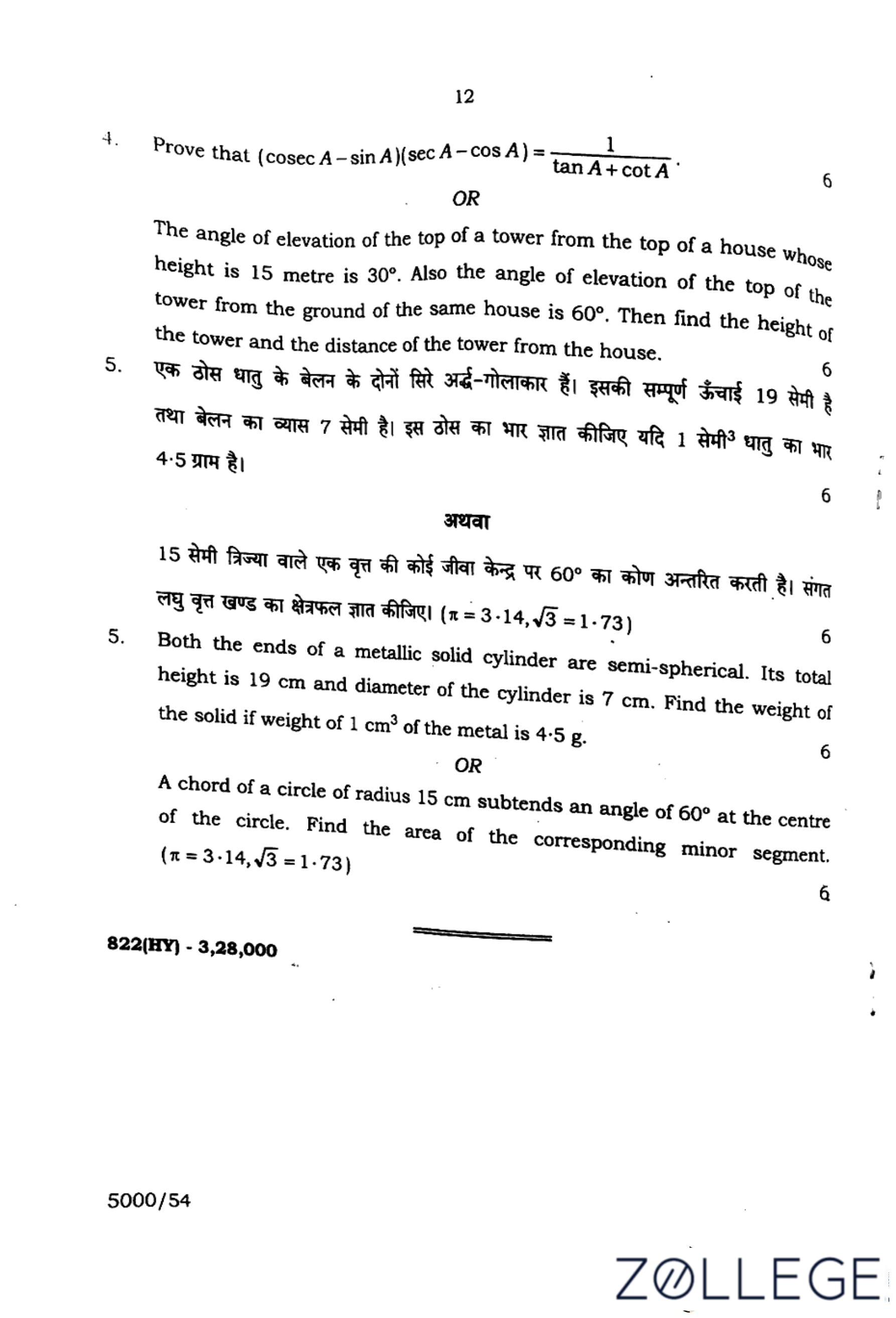
Prove that \( (\csc A - \sin A)(\sec A - \cos A) = \frac{1}{\tan A + \cot A} \).
View Solution
We are given the expression \( (\csc A - \sin A)(\sec A - \cos A) \), and we need to prove that it is equal to \( \frac{1}{\tan A + \cot A} \).
### Step 1: Simplify \( (\csc A - \sin A)(\sec A - \cos A) \)
We start by expanding the left-hand side: \[ (\csc A - \sin A)(\sec A - \cos A) = \csc A \cdot \sec A - \csc A \cdot \cos A - \sin A \cdot \sec A + \sin A \cdot \cos A. \]
Using the identities \( \csc A = \frac{1}{\sin A} \) and \( \sec A = \frac{1}{\cos A} \), substitute them into the expression: \[ = \frac{1}{\sin A \cos A} - 1 - \frac{\sin A}{\cos A} + \sin A \cos A. \]
### Step 2: Simplify further
Now we can combine terms: \[ = \frac{1}{\sin A \cos A} - \frac{\sin A}{\cos A} - 1 + \sin A \cos A. \]
### Step 3: Work with the right-hand side
We now look at the right-hand side: \[ \frac{1}{\tan A + \cot A} = \frac{1}{\frac{\sin A}{\cos A} + \frac{\cos A}{\sin A}}. \]
Combine the terms in the denominator: \[ \frac{1}{\frac{\sin^2 A + \cos^2 A}{\sin A \cos A}} = \frac{\sin A \cos A}{1} = \sin A \cos A. \]
### Step 4: Equating both sides
Now we compare both sides: \[ (\csc A - \sin A)(\sec A - \cos A) = \sin A \cos A, \]
and \[ \frac{1}{\tan A + \cot A} = \sin A \cos A. \]
Thus, we have proved that: \[ (\csc A - \sin A)(\sec A - \cos A) = \frac{1}{\tan A + \cot A}. \] Quick Tip: Simplifying trigonometric identities often requires converting functions to their sine and cosine forms. This makes it easier to manipulate and combine terms.
The angle of elevation of the top of a tower from the top of a house whose height is 15 meters is 30°. Also, the angle of elevation of the top of the tower from the ground of the same house is 60°. Then, find the height of the tower and the distance of the tower from the house.
View Solution
### Step 1: Understanding the Problem
Let:
- \( h \) be the height of the tower above the ground.
- \( x \) be the horizontal distance between the tower and the house.
- The height of the house is given as **15 meters**.
We form a **right-angled triangle** by considering two points:
1. **Top of the house as a reference** (angle of elevation \( 30^\circ \)).
2. **Ground as a reference** (angle of elevation \( 60^\circ \)).
---
### Step 2: Using Trigonometry to Find Distance \( x \)
#### Applying the tangent function in the **larger triangle** (from the ground):
\[ \tan 60^\circ = \frac{Total height of the tower}{Distance from house to tower} \]
\[ \sqrt{3} = \frac{h}{x} \]
\[ h = \sqrt{3} x \]
---
### Step 3: Using Trigonometry to Find Additional Height
The additional height of the tower above the house is given by the **smaller right-angled triangle**:
\[ \tan 30^\circ = \frac{Height of the tower above the house}{Distance from house to tower} \]
\[ \frac{1}{\sqrt{3}} = \frac{h - 15}{x} \]
\[ h - 15 = \frac{x}{\sqrt{3}} \]
\[ h = \frac{x}{\sqrt{3}} + 15 \]
---
### Step 4: Solving for \( h \)
Since both equations equal \( h \):
\[ \sqrt{3} x = \frac{x}{\sqrt{3}} + 15 \]
Multiply everything by \( \sqrt{3} \) to eliminate the fraction:
\[ 3x = x + 15\sqrt{3} \]
\[ 3x - x = 15\sqrt{3} \]
\[ 2x = 15\sqrt{3} \]
\[ x = \frac{15\sqrt{3}}{2} \]
Approximating \( \sqrt{3} \approx 1.732 \):
\[ x = \frac{15 \times 1.732}{2} = \frac{25.98}{2} = 12.99 \approx 13 m \]
Thus, the required distance between the house and the tower is:
\[ \boxed{13 m} \]
---
### Step 5: Solving for \( h \)
Using \( h = \sqrt{3} x \):
\[ h = \sqrt{3} \times 13 \]
\[ h = 1.732 \times 13 = 22.52 \approx 23 m \]
Thus, the total height of the tower is:
\[ \boxed{23 m} \]
Final Answers:
- Height of the tower = \( 23 \) m
- Distance from the house to the tower= \( 13 \) m Quick Tip: When dealing with angles of elevation and distances, the tangent function is useful for setting up relationships between the height and the distance.
Both the ends of a metallic solid cylinder are semi-spherical. Its total height is 19 cm and the diameter of the cylinder is 7 cm. Find the weight of the solid if the weight of 1 cm³ of the metal is 4.5 g.
View Solution
The given solid consists of a cylindrical portion and two semi-spherical ends. Let's break the problem into parts.
Step 1. Radius of the cylinder and the spheres:
The diameter of the cylinder is given as 7 cm, so the radius of the cylinder and the hemispherical ends is:
\[ r = \frac{7}{2} = 3.5 \, cm. \]
Step 2. Height of the cylinder:
The total height of the solid is 19 cm, which includes the height of the cylindrical portion and the two hemispherical ends. The height of the two hemispheres is:
\[ 2 \times \frac{r}{2} = 2 \times \frac{3.5}{2} = 3.5 \, cm. \]
Therefore, the height of the cylindrical portion is:
\[ Height of cylinder = 19 - 3.5 = 15.5 \, cm. \]
Step 3. Volume of the cylinder:
The volume \( V_{cylinder} \) of a cylinder is given by:
\[ V_{cylinder} = \pi r^2 h = 3.14 \times (3.5)^2 \times 15.5. \]
Simplifying:
\[ V_{cylinder} = 3.14 \times 12.25 \times 15.5 = 3.14 \times 189.875 = 595.7 \, cm^3. \]
Step 4. Volume of the hemispheres:
The volume \( V_{sphere} \) of a sphere is given by:
\[ V_{sphere} = \frac{4}{3} \pi r^3. \]
Therefore, the volume of one hemisphere is:
\[ V_{hemisphere} = \frac{1}{2} \times \frac{4}{3} \pi r^3 = \frac{2}{3} \pi r^3. \]
For the given radius:
\[ V_{hemisphere} = \frac{2}{3} \times 3.14 \times (3.5)^3 = \frac{2}{3} \times 3.14 \times 42.875 = 89.8 \, cm^3. \]
Since there are two hemispheres, the total volume of the hemispheres is:
\[ V_{hemispheres} = 2 \times 89.8 = 179.6 \, cm^3. \]
Step 5. Total volume of the solid:
The total volume \( V_{total} \) is the sum of the volumes of the cylinder and the hemispheres:
\[ V_{total} = V_{cylinder} + V_{hemispheres} = 595.7 + 179.6 = 775.3 \, cm^3. \]
Step 6. Weight of the solid:
The weight \( W \) of the solid is given by:
\[ W = Volume \times Weight of 1 cm^3 \, of metal = 775.3 \times 4.5 = 3498.35 \, g. \]
Thus, the weight of the solid is \( \boxed{3498.35} \, g. \) Quick Tip: To solve this type of problem, divide the solid into simpler shapes (like cylinders and spheres), find the volume of each part, and then use the given information to calculate the weight.
A chord of a circle of radius 15 cm subtends an angle of 60° at the center of the circle. Find the area of the corresponding minor segment.
(Given: \( \pi = 3.14 \), \( \sqrt{3 = 1.73 \))
View Solution
Let the radius of the circle be \( r = 15 \, cm \), and the angle subtended by the chord at the center be \( \theta = 60^\circ \).
The area of the minor segment can be calculated using the formula: \[ Area of segment = \frac{\theta}{360^\circ} \times \pi r^2 - Area of triangle. \]
### Step 1: Calculate the area of the sector
The area of the sector is given by: \[ Area of sector = \frac{\theta}{360^\circ} \times \pi r^2 = \frac{60^\circ}{360^\circ} \times 3.14 \times (15)^2 = \frac{1}{6} \times 3.14 \times 225 = 117.5 \, cm^2. \]
### Step 2: Calculate the area of the triangle
The area of the triangle formed by the two radii and the chord can be calculated using the formula: \[ Area of triangle = \frac{1}{2} r^2 \sin \theta. \]
For \( r = 15 \, cm \) and \( \theta = 60^\circ \): \[ Area of triangle = \frac{1}{2} \times (15)^2 \times \sin 60^\circ = \frac{1}{2} \times 225 \times \frac{\sqrt{3}}{2} = \frac{1}{2} \times 225 \times 0.866 = 97.5 \, cm^2. \]
### Step 3: Calculate the area of the minor segment
Now, subtract the area of the triangle from the area of the sector: \[ Area of segment = 117.5 - 97.5 = 20 \, cm^2. \]
Thus, the area of the minor segment is \( \boxed{20 \, cm^2} \). Quick Tip: To find the area of a segment, subtract the area of the corresponding triangle from the area of the sector.
*The article might have information for the previous academic years, please refer the official website of the exam.