
UP Board Class 10 Mathematics(Code 822 HZ) Question Paper 2024 with Solutions


Content Writer | Updated On - Feb 28, 2025
UP Board Class 10 Mathematics Question Paper 2024 PDF (Code 822 HZ) is available for download here. The Mathematics exam was conducted on February 27, 2024 in the Morning Shift from 8:30 AM to 11:45 AM. The total marks for the theory paper are 70. Students reported the paper to be moderate.
UP Board Class 10 Mathematics Question Paper 2024 (Code 822 HZ) with Solutions
| UP Board Class 10 Mathematics Question Paper With Answer Key | Check Solution |


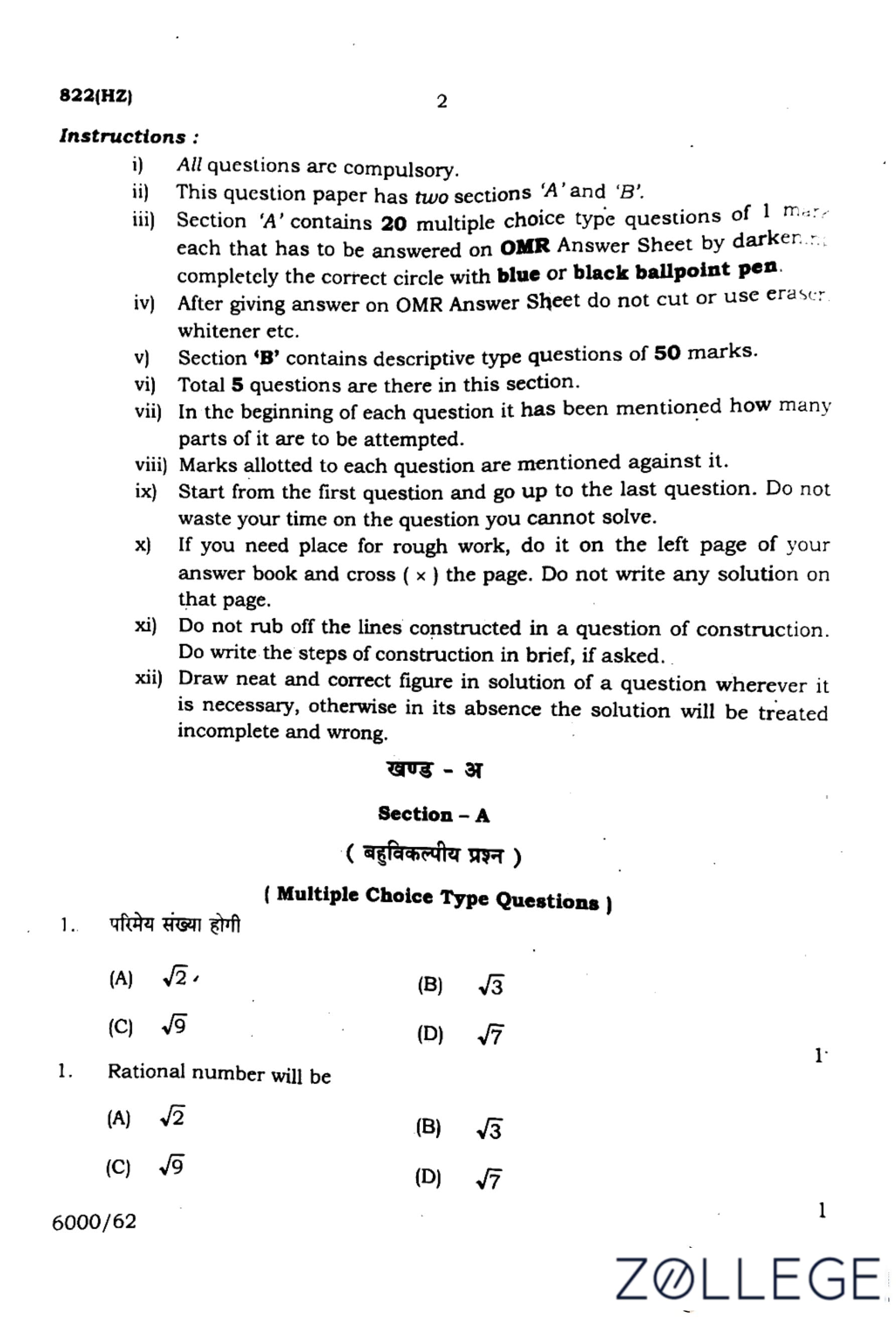
Which of the following is a rational number?
View Solution
To determine which of the following is a rational number, we need to recall that a rational number is a number that can be expressed as the quotient of two integers.
- \( \sqrt{2} \) is an irrational number because 2 is not a perfect square.
- \( \sqrt{3} \) is also an irrational number because 3 is not a perfect square.
- \( \sqrt{9} = 3 \), which is a rational number because 3 is an integer.
- \( \sqrt{7} \) is an irrational number because 7 is not a perfect square.
Therefore, the rational number in the list is \( \boxed{C) \sqrt{9} = 3} \). Quick Tip: To check if a square root is rational, verify if the number under the square root is a perfect square. If it is, the square root is a rational number.
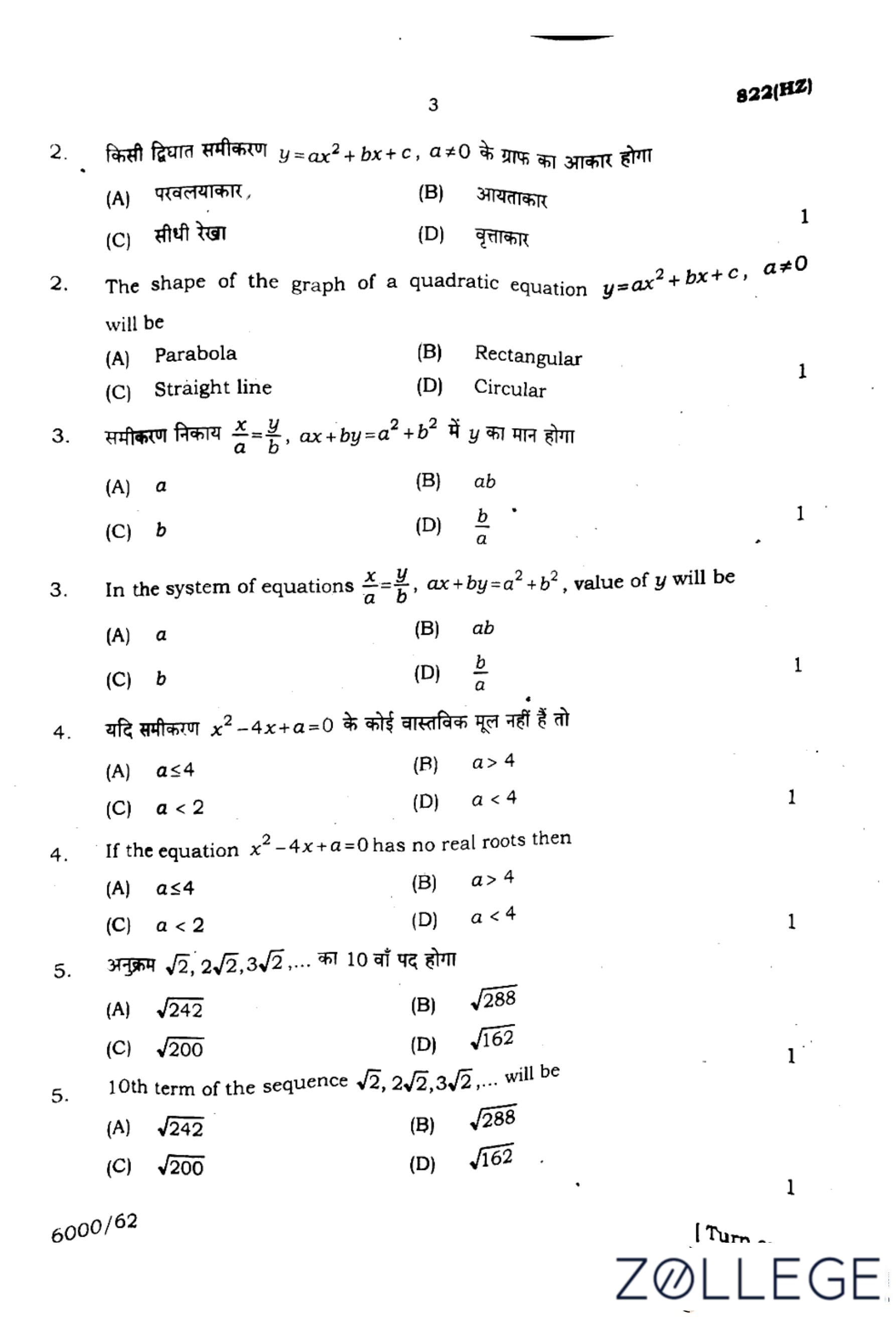
The shape of the graph of a quadratic equation \( y = ax^2 + bx + c, a \neq 0 \) will be:
View Solution
The graph of a quadratic equation \( y = ax^2 + bx + c \) (where \( a \neq 0 \)) is always a parabola. The coefficient \( a \) determines the direction of the parabola (upward or downward), but the shape remains the same.
Thus, the correct answer is \( \boxed{A) Parabola} \). Quick Tip: The graph of any quadratic equation is a parabola. The direction depends on the sign of \( a \).
In the system of equations \( \{x}{a} = \frac{y}{b} \), \( ax + by = a^2 + b^2 \), the value of \( y \) will be:
View Solution
From the first equation \( \frac{x}{a} = \frac{y}{b} \), we can write: \[ x = \frac{a}{b}y. \]
Substitute this into the second equation \( ax + by = a^2 + b^2 \): \[ a \left( \frac{a}{b} y \right) + by = a^2 + b^2. \]
Simplifying: \[ \frac{a^2}{b}y + by = a^2 + b^2. \]
Factor out \( y \): \[ y \left( \frac{a^2}{b} + b \right) = a^2 + b^2. \]
Solve for \( y \): \[ y = \frac{a^2 + b^2}{\frac{a^2}{b} + b} = \frac{b(a^2 + b^2)}{a^2 + b^2} = \frac{b}{a}. \]
Thus, the value of \( y \) is \( \boxed{\frac{b}{a}} \). Quick Tip: When solving for variables in a system of equations, always substitute one equation into another to eliminate one variable and solve for the remaining one.
If the equation \( x^2 - 4x + a = 0 \) has no real roots, then:
View Solution
The given equation is a quadratic equation. The discriminant (\( \Delta \)) of a quadratic equation \( ax^2 + bx + c = 0 \) is given by: \[ \Delta = b^2 - 4ac. \]
For the equation \( x^2 - 4x + a = 0 \), we have \( a = 1 \), \( b = -4 \), and \( c = a \). The discriminant is: \[ \Delta = (-4)^2 - 4(1)(a) = 16 - 4a. \]
For the equation to have no real roots, the discriminant must be negative: \[ 16 - 4a < 0 \quad \Rightarrow \quad a > 4. \]
Thus, the value of \( a \) must be \( \boxed{a > 4} \). Quick Tip: To determine whether a quadratic equation has real roots, check the discriminant. If the discriminant is negative, there are no real roots.
The 10th term of the sequence \( \sqrt{2}, 2, \sqrt{3}, \sqrt{2}, 3, \sqrt{3}, \ldots \) will be:
View Solution
### Step 1: Identifying the Pattern
The given sequence is:
\[ \sqrt{2}, 2\sqrt{2}, 3\sqrt{2}, 4\sqrt{2}, \dots \]
Observing the terms, we notice that each term can be written as:
\[ T_n = n\sqrt{2} \]
where \( n \) represents the term number.
---
### Step 2: Finding the 10th Term
To find the 10th term (\( T_{10} \)):
\[ T_{10} = 10\sqrt{2} \]
Squaring both sides:
\[ (T_{10})^2 = (10\sqrt{2})^2 = 10^2 \times 2 = 100 \times 2 = 200 \]
Thus, the required answer is:
\[ \sqrt{200} \]
---
Final Answer: \[ \boxed{\sqrt{200}} \] Quick Tip: When dealing with repeating sequences, find the position of the term in the repeating cycle and identify the term.
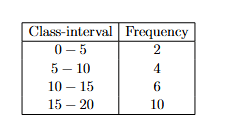
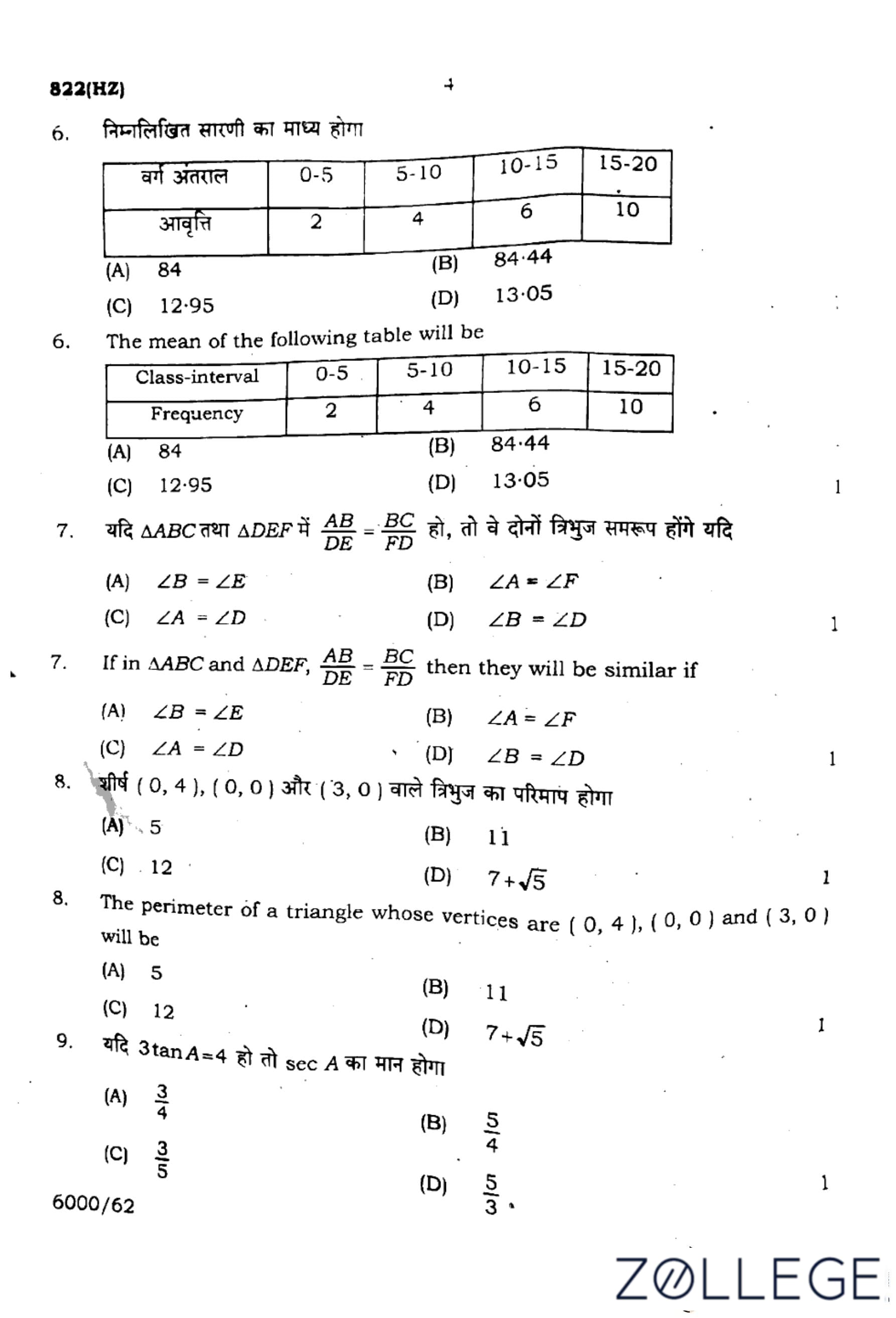
The mean of the following table will be:
View Solution
N/A Quick Tip: To calculate the mean of grouped data, use the formula \( Mean = \frac{\sum (f \cdot x)}{\sum f} \), where \( x \) is the midpoint of each class interval.
If in \( \triangle ABC \) and \( \triangle DEF \), \( \frac{AB}{DE} = \frac{BC}{FD} \), then they will be similar if:
View Solution
### Step 1: Understanding Similarity Criteria
Two triangles are similar if they satisfy any of the following conditions:
1. Angle-Angle (AA) Similarity: If two angles of one triangle are equal to two angles of another triangle, then the triangles are similar.
2. Side-Angle-Side (SAS) Similarity: If two sides of a triangle are proportional to two sides of another triangle, and the included angles are equal, then the triangles are similar.
3. Side-Side-Side (SSS) Similarity: If all three sides of one triangle are proportional to the corresponding three sides of another triangle, then the triangles are similar.
### Step 2: Applying the Given Condition
The given condition:
\[ \frac{AB}{DE} = \frac{BC}{FD} \]
represents two pairs of proportional sides.
To apply SAS similarity, we need to ensure that the included angle between these two pairs of sides is equal, meaning:
\[ \angle B = \angle D \]
Thus, by the SAS Similarity Criterion, the triangles will be similar if:
\[ \boxed{\angle B = \angle D} \] Quick Tip: For two triangles to be similar, the corresponding sides must be proportional and the corresponding angles must be equal.
The perimeter of a triangle whose vertices are \( (0, 4) \), \( (0, 0) \), and \( (3, 0) \) will be:
View Solution
### Step 1: Using the Distance Formula
The formula for the distance between two points \( (x_1, y_1) \) and \( (x_2, y_2) \) is:
\[ d = \sqrt{(x_2 - x_1)^2 + (y_2 - y_1)^2} \]
Given vertices:
- \( A(0,4) \)
- \( B(0,0) \)
- \( C(3,0) \)
---
### Step 2: Finding the Side Lengths
#### Distance \( AB \) \[ AB = \sqrt{(0 - 0)^2 + (4 - 0)^2} = \sqrt{0 + 16} = \sqrt{16} = 4 \]
#### Distance \( BC \) \[ BC = \sqrt{(3 - 0)^2 + (0 - 0)^2} = \sqrt{9 + 0} = \sqrt{9} = 3 \]
#### Distance \( CA \) \[ CA = \sqrt{(3 - 0)^2 + (0 - 4)^2} = \sqrt{9 + 16} = \sqrt{25} = 5 \]
---
### Step 3: Calculating the Perimeter
The perimeter of the triangle is:
\[ P = AB + BC + CA \]
\[ P = 4 + 3 + 5 = 12 \]
Thus, the required perimeter is:
\[ \boxed{12} \] Quick Tip: To find the perimeter of a triangle, calculate the length of each side using the distance formula and then add them together.
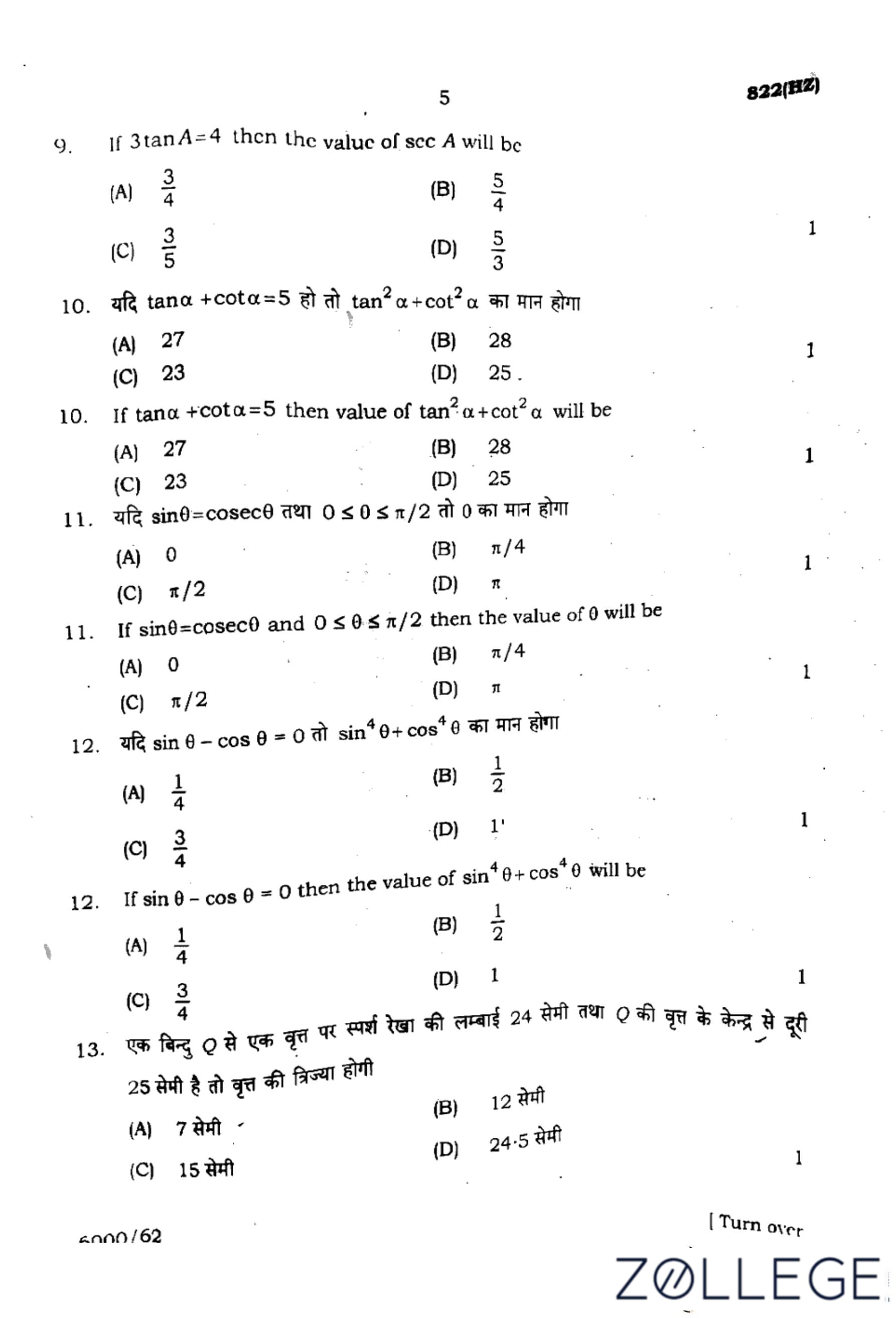
If \( 3 \tan A = 4 \), then the value of \( \sec A \) will be:
View Solution
### Step 1: Expressing \( \tan A \)
Given:
\[ 3 \tan A = 4 \]
Dividing both sides by 3:
\[ \tan A = \frac{4}{3} \]
Since:
\[ \tan A = \frac{Opposite}{Adjacent} \]
Let the opposite side be \( 4k \) and the adjacent side be \( 3k \).
---
### Step 2: Finding the Hypotenuse
Using the Pythagorean theorem:
\[ Hypotenuse^2 = Opposite^2 + Adjacent^2 \]
\[ h^2 = (4k)^2 + (3k)^2 \]
\[ h^2 = 16k^2 + 9k^2 = 25k^2 \]
\[ h = 5k \]
---
### Step 3: Finding \( \sec A \)
We know:
\[ \sec A = \frac{Hypotenuse}{Adjacent} \]
\[ \sec A = \frac{5k}{3k} = \frac{5}{3} \]
Thus, the required value is:
\[ \boxed{\frac{5}{3}} \] Quick Tip: To find \( \sec A \), use the identity \( \sec^2 A = 1 + \tan^2 A \), then solve for \( \sec A \).
If \( \tan \alpha + \cot \alpha = 5 \), then the value of \( \tan^2 \alpha + \cot^2 \alpha \) will be:
View Solution
### Step 1: Expressing the Given Equation
We are given:
\[ \tan \alpha + \cot \alpha = 5 \]
Using the identity:
\[ \cot \alpha = \frac{1}{\tan \alpha} \]
Rewriting the equation:
\[ \tan \alpha + \frac{1}{\tan \alpha} = 5 \]
Let \( x = \tan \alpha \), then:
\[ x + \frac{1}{x} = 5 \]
---
### Step 2: Squaring Both Sides
Squaring both sides:
\[ \left( x + \frac{1}{x} \right)^2 = 5^2 \]
\[ x^2 + 2 + \frac{1}{x^2} = 25 \]
\[ x^2 + \frac{1}{x^2} = 25 - 2 \]
\[ x^2 + \frac{1}{x^2} = 23 \]
Thus, the required value of \( \tan^2 \alpha + \cot^2 \alpha \) is:
\[ \boxed{23} \] Quick Tip: To find \( \tan^2 \alpha + \cot^2 \alpha \) from \( \tan \alpha + \cot \alpha \), square both sides and apply the identity \( \tan \alpha \cot \alpha = 1 \).
If \( \sin \theta = \csc \theta \) and \( 0 \leq \theta \leq \frac{\pi}{2} \), then the value of \( \theta \) will be:
View Solution
### Step 1: Using the Identity of Cosecant
We are given:
\[ \sin \theta = \csc \theta \]
Using the identity:
\[ \csc \theta = \frac{1}{\sin \theta} \]
we rewrite the equation as:
\[ \sin \theta = \frac{1}{\sin \theta} \]
---
### Step 2: Squaring Both Sides
Multiplying both sides by \( \sin \theta \):
\[ \sin^2 \theta = 1 \]
Taking the square root:
\[ \sin \theta = \pm 1 \]
---
### Step 3: Finding \( \theta \) in the Given Range
From the given condition:
\[ 0 \leq \theta \leq \frac{\pi}{2} \]
we check when \( \sin \theta = 1 \):
\[ \sin \frac{\pi}{2} = 1 \]
Thus, the required value of \( \theta \) is:
\[ \boxed{\frac{\pi}{2}} \]
---
%Quick Tip Quick Tip: For trigonometric equations, always express functions in terms of their fundamental identities and solve within the given range.
If \( \sin \theta - \cos \theta = 0 \), then the value of \( \sin^4 \theta + \cos^4 \theta \) will be:
View Solution
We are given that \( \sin \theta = \cos \theta \). Squaring both sides, we get:
\[ \sin^2 \theta = \cos^2 \theta. \]
Now, we can use the identity:
\[ \sin^4 \theta + \cos^4 \theta = (\sin^2 \theta + \cos^2 \theta)^2 - 2 \sin^2 \theta \cos^2 \theta. \]
Since \( \sin^2 \theta + \cos^2 \theta = 1 \), we have:
\[ \sin^4 \theta + \cos^4 \theta = 1^2 - 2 \sin^2 \theta \cos^2 \theta. \]
Using \( \sin^2 \theta = \cos^2 \theta \), we get:
\[ \sin^4 \theta + \cos^4 \theta = 1 - 2 \left( \frac{1}{2} \right) = \frac{1}{2}. \]
Thus, the value of \( \sin^4 \theta + \cos^4 \theta \) is \( \boxed{\frac{1}{2}} \). Quick Tip: Use the identity \( \sin^4 \theta + \cos^4 \theta = (\sin^2 \theta + \cos^2 \theta)^2 - 2 \sin^2 \theta \cos^2 \theta \) to simplify such expressions.
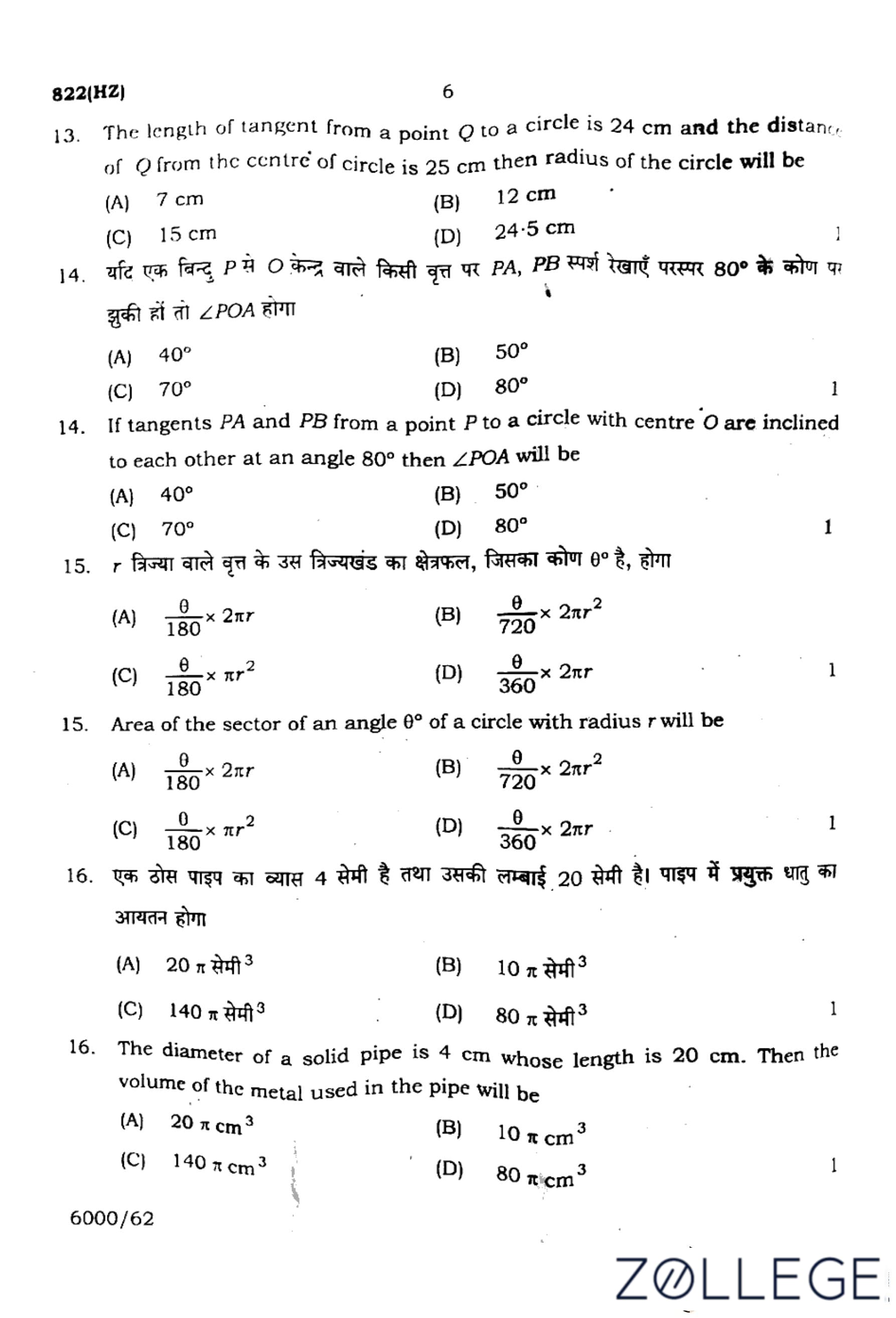
The length of tangent from a point \( Q \) to a circle is 24 cm and the distance of \( Q \) from the centre of the circle is 25 cm, then the radius of the circle will be:
View Solution
### Step 1: Understanding the Given Information
We are given:
- Length of the tangent \( PQ = 24 \) cm.
- Distance from the external point \( Q \) to the center of the circle \( OQ = 25 \) cm.
- We need to find the radius of the circle \( r = OP \).
Since a tangent to a circle is always perpendicular to the radius at the point of contact, we form a right-angled triangle \( \triangle OPQ \) where:
- \( OP \) is the radius (\( r \)).
- \( PQ \) is the tangent.
- \( OQ \) is the hypotenuse.
---
### Step 2: Using the Pythagorean Theorem
Since \( \triangle OPQ \) is a right-angled triangle:
\[ OQ^2 = OP^2 + PQ^2 \]
Substituting the given values:
\[ 25^2 = r^2 + 24^2 \]
\[ 625 = r^2 + 576 \]
\[ r^2 = 625 - 576 \]
\[ r^2 = 49 \]
\[ r = \sqrt{49} = 7 \]
Thus, the required radius of the circle is:
\[ \boxed{7 cm} \] Quick Tip: For problems involving tangents and distances from external points to the center of the circle, use the Pythagorean theorem to solve for the unknown radius.
If tangents \( PA \) and \( PB \) from a point \( P \) to a circle with centre \( O \) are inclined to each other at an angle \( 80^\circ \), then \( \angle POA \) will be:
View Solution
Step 1: Recall that the angle between two tangents drawn from an external point to a circle is always equal to the angle subtended by the line joining the points of contact at the center. In this case, the tangents \( PA \) and \( PB \) are inclined at an angle of \( 80^\circ \).
\[ \angle POB = 180^\circ - 80^\circ = 100^\circ \]
Step 2: Since the angle \( \angle POA \) is half of \( \angle POB \) (because \( \angle POA \) and \( \angle POB \) are central angles subtended by the same arc), we calculate:
\[ \angle POA = \frac{100^\circ}{2} = 50^\circ \]
Thus, the correct answer is \( 50^\circ \). Quick Tip: For tangents from an external point to a circle: - The angle between the two tangents is equal to the angle subtended at the center by the line joining the points of contact. - This principle helps solve problems involving tangents and circles quickly.
Area of the sector of an angle \( \theta^\circ \) of a circle with radius \( r \) will be:
View Solution
### Step 1: Understanding the Formula
The area of a sector of a circle with radius \( r \) and central angle \( \theta^\circ \) is given by:
\[ Sector Area = \frac{\theta}{360} \times \pi r^2 \]
---
### Step 2: Verifying the Given Options
Looking at the given options, option (B) \( \frac{\theta}{720} \times 2\pi r^2 \) can be rewritten as:
\[ \frac{\theta}{720} \times 2\pi r^2 = \frac{\theta}{360} \times \pi r^2 \]
which is indeed the correct formula for the area of a sector.
Thus, the required area of the sector is:
\[ \boxed{\frac{\theta}{720} \times 2\pi r^2} \] Quick Tip: Remember that the area of a sector is proportional to the central angle of the sector. The formula is derived from the fraction of the full circle represented by the angle \( \theta \). - If \( \theta = 360^\circ \), the area becomes the area of the entire circle.
The diameter of a solid pipe is 4 cm whose length is 20 cm. Then the volume of the metal used in the pipe will be:
View Solution
### Step 1: Understanding the Given Information
- Outer Diameter of the pipe \( D = 4 \) cm
- Outer Radius \( R = \frac{D}{2} = \frac{4}{2} = 2 \) cm
- Inner Radius \( r \) (since the pipe is hollow, but no inner radius is given, we assume the inner radius is 0, making it a solid cylinder)
- Length (Height) of the pipe \( h = 20 \) cm
---
### Step 2: Volume of a Cylinder
The volume of a cylinder is given by:
\[ V = \pi R^2 h \]
Substituting the given values:
\[ V = \pi (2)^2 (20) \]
\[ V = \pi \times 4 \times 20 \]
\[ V = 80\pi \]
Thus, the required volume of the metal used in the pipe is:
\[ \boxed{80\pi} cm^3 \] Quick Tip: When calculating the volume of a hollow pipe, ensure you use the formula for the outer and inner radii, and subtract the volume of the inner cylinder from the outer one if it's hollow.
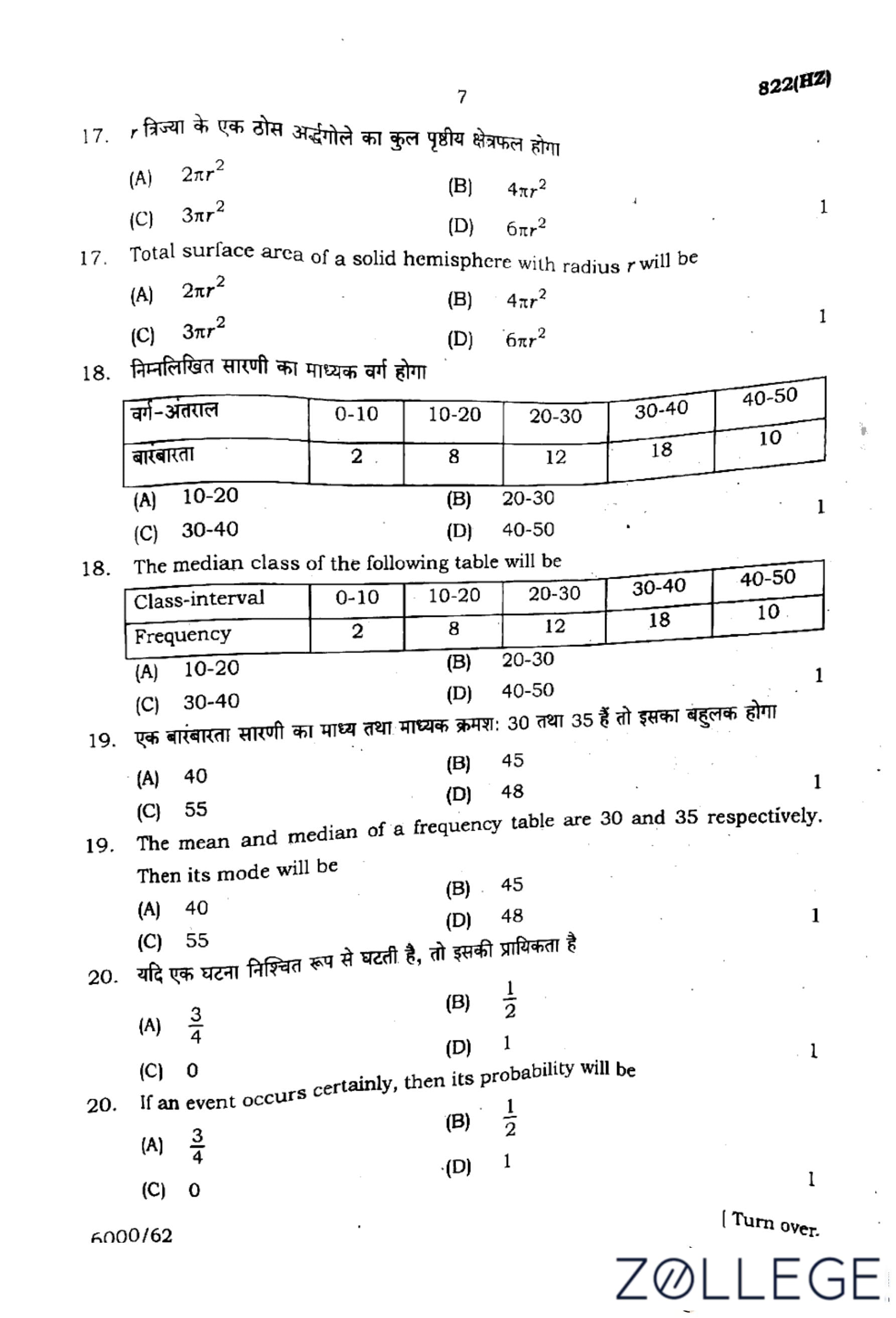
Total surface area of a solid hemisphere with radius \( r \) will be:
View Solution
Step 1: The total surface area of a solid hemisphere is the sum of the curved surface area and the area of the base.
For a hemisphere, the formula for the curved surface area is:
\[ Curved Surface Area = 2\pi r^2 \]
Step 2: The area of the base of the hemisphere, which is a circle, is:
\[ Base Area = \pi r^2 \]
Step 3: Therefore, the total surface area of the hemisphere is:
\[ Total Surface Area = Curved Surface Area + Base Area = 2\pi r^2 + \pi r^2 = 3\pi r^2 \]
Step 4: Thus, the correct answer is \( 3\pi r^2 \). Quick Tip: For a solid hemisphere, remember to add both the curved surface area and the area of the circular base when calculating the total surface area.
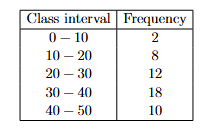
The median class of the following table will be:
View Solution
Step 1: To determine the median class, we first need to find the cumulative frequency.
Step 2: Find the cumulative frequency:
- Cumulative frequency for \( 0-10 \) = 2
- Cumulative frequency for \( 10-20 \) = 2 + 8 = 10
- Cumulative frequency for \( 20-30 \) = 10 + 12 = 22
- Cumulative frequency for \( 30-40 \) = 22 + 18 = 40
- Cumulative frequency for \( 40-50 \) = 40 + 10 = 50
Step 3: The total frequency is 50. The median class is the one where the cumulative frequency exceeds \( \frac{50}{2} = 25 \).
Step 4: From the cumulative frequencies, we can see that the cumulative frequency for the class \( 20-30 \) is 22, and for the class \( 30-40 \) is 40. Since 25 falls between 22 and 40, the median class is \( 30-40 \). Quick Tip: To find the median class, first calculate the cumulative frequency, then look for the class where the cumulative frequency exceeds half of the total frequency.
The mean and median of a frequency table are 30 and 35 respectively. Then its mode will be:
View Solution
We know the relation between mean, median, and mode in a frequency distribution is given by: \[ Mode = 3 \times Median - 2 \times Mean. \]
Substitute the given values for mean and median: \[ Mode = 3 \times 35 - 2 \times 30 = 105 - 60 = 45. \] Quick Tip: For frequency distributions, you can use the relation between mean, median, and mode to quickly calculate the mode: \[ Mode = 3 \times Median - 2 \times Mean. \]
If an event occurs certainly, then its probability will be:
View Solution
The probability of an event that occurs certainly is always 1, as probability is a measure of the likelihood of an event happening, and an event that occurs with certainty has a probability of 1. \[ P(certain event) = 1. \] Quick Tip: For an event that occurs certainly, the probability is always 1. The probability of an impossible event is 0, while any event that can occur has a probability between 0 and 1.
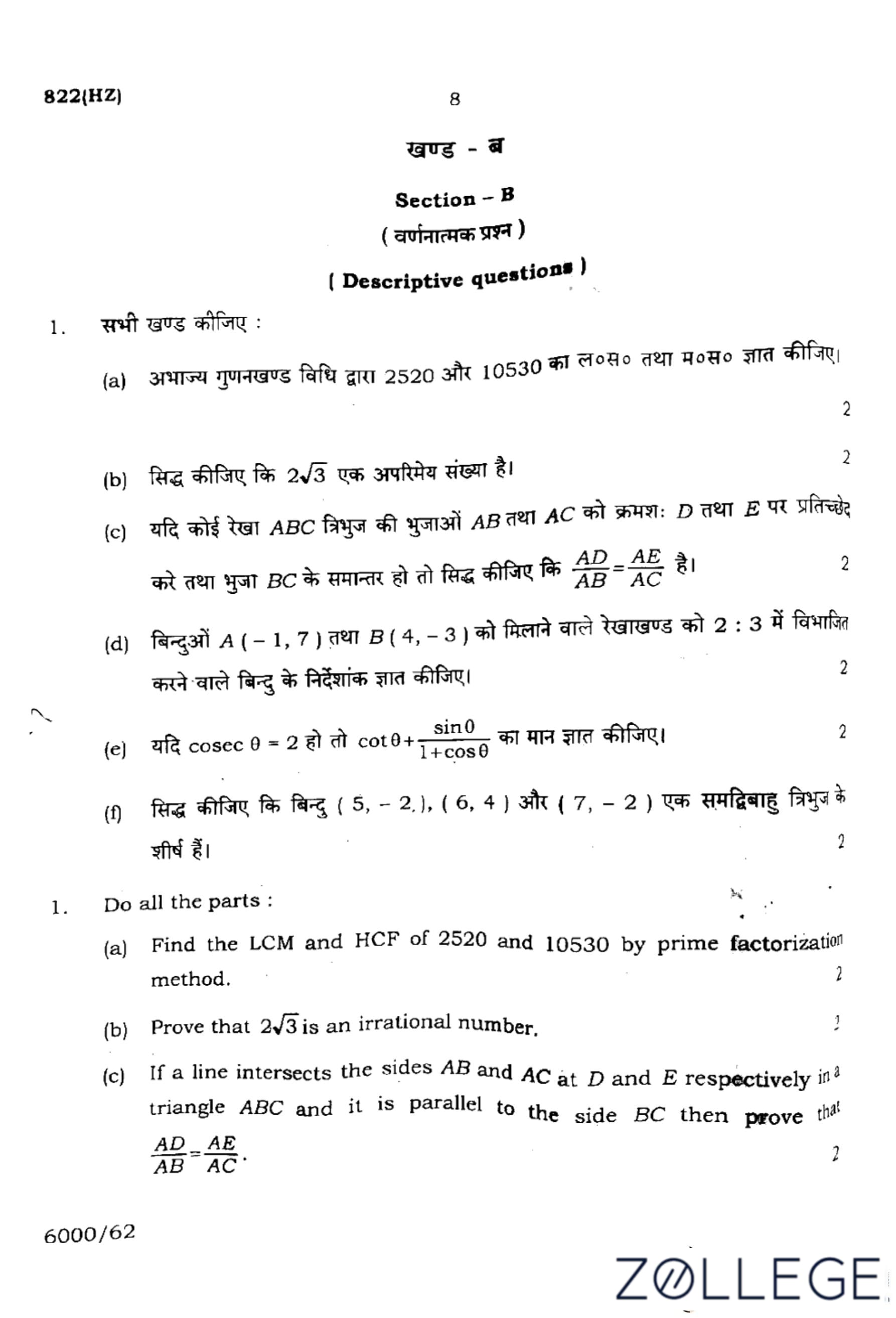
Do all the parts:
(a) Find the LCM and HCF of 2520 and 10530 by prime factorization method.}
(b) Prove that \( 2\sqrt{3} \) is an irrational number.}
View Solution
### Step 1: Prime Factorization
We first perform the prime factorization of both numbers.
#### Prime Factorization of \( 2520 \) \[ 2520 = 2^3 \times 3^2 \times 5 \times 7 \]
#### Prime Factorization of \( 10530 \) \[ 10530 = 2 \times 3 \times 5 \times 7 \times 11 \]
---
### Step 2: Finding the HCF (Highest Common Factor)
The HCF is the product of the smallest powers of the common prime factors.
Common prime factors: **\( 2, 3, 5, 7 \)**
Taking the lowest powers:
\[ HCF = 2^1 \times 3^1 \times 5^1 \times 7^1 \]
\[ HCF = 2 \times 3 \times 5 \times 7 = 210 \]
---
### Step 3: Finding the LCM (Least Common Multiple)
The LCM is the product of the highest powers of all prime factors.
All prime factors involved: \( 2, 3, 5, 7, 11 \)
Taking the highest powers:
\[ LCM = 2^3 \times 3^2 \times 5^1 \times 7^1 \times 11^1 \]
\[ LCM = 8 \times 9 \times 5 \times 7 \times 11 \]
\[ LCM = 126630 \]
---
### Step 4: Final Answers \[ \boxed{HCF = 210} \] \[ \boxed{LCM = 126630} \] Quick Tip: To find the HCF and LCM of two numbers, factor each number into primes: - The HCF is the product of the lowest powers of the common prime factors. - The LCM is the product of the highest powers of all prime factors.
Do any five parts:
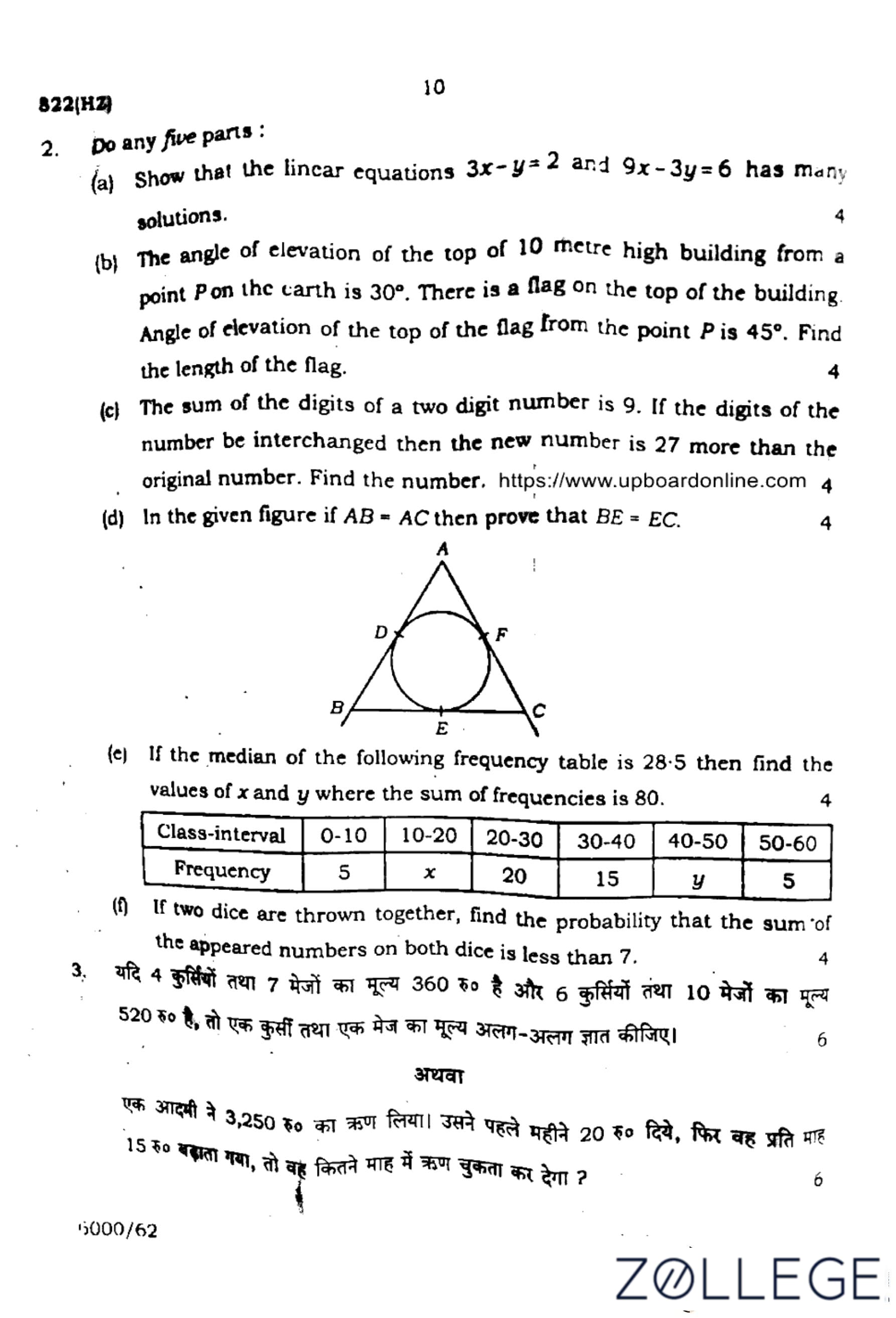
(a) Show that the linear equations \( 3x - y = 2 \) and \( 9x - 3y = 6 \) have many solutions.}
View Solution
Step 1: Consider the given equations: \[ 3x - y = 2 \quad (1) \] \[ 9x - 3y = 6 \quad (2) \]
Step 2: Multiply equation (1) by 3 to make the coefficients of \( y \) the same in both equations: \[ 3(3x - y) = 3 \times 2 \quad \Rightarrow \quad 9x - 3y = 6 \quad (3) \]
Step 3: Compare equation (2) and equation (3). We can see that both equations are identical: \[ 9x - 3y = 6 \]
Since the equations are the same, there are infinitely many solutions for \( x \) and \( y \).
Answer: The system of equations has infinitely many solutions. Quick Tip: If two linear equations are proportional, that is, they represent the same line, the system will have infinite solutions.
(b) The angle of elevation of the top of a 10 metre high building from a point \( P \) on the earth is \( 30^\circ \). There is a flag on the top of the building. Angle of elevation of the top of the flag from the point \( P \) is \( 45^\circ \). Find the length of the flag.
View Solution
Step 1: Let the height of the building be \( h = 10 \, m \) and the height of the flag be \( x \, m \). The total height is then \( h + x \).
Let the distance from the point \( P \) to the base of the building be \( d \).
From the given data:
1. \( \tan(30^\circ) = \frac{h}{d} = \frac{10}{d} \).
2. \( \tan(45^\circ) = \frac{h + x}{d} = \frac{10 + x}{d} \).
Step 2: Using the first equation: \[ \tan(30^\circ) = \frac{10}{d} \quad \Rightarrow \quad d = \frac{10}{\tan(30^\circ)} = \frac{10}{\frac{1}{\sqrt{3}}} = 10\sqrt{3}. \]
Step 3: Using the second equation: \[ \tan(45^\circ) = \frac{10 + x}{d} \quad \Rightarrow \quad 1 = \frac{10 + x}{10\sqrt{3}} \quad \Rightarrow \quad 10 + x = 10\sqrt{3}. \] \[ x = 10\sqrt{3} - 10 = 10(\sqrt{3} - 1). \]
Thus, the length of the flag is \( 10(\sqrt{3} - 1) \, m \).
Answer: The length of the flag is \( 10(\sqrt{3} - 1) \, m \). Quick Tip: For problems involving elevation and depression angles, break the problem into two parts: one for the building and one for the flag. Use trigonometric ratios like \( \tan(\theta) = \frac{opposite}{adjacent} \) to solve for unknowns.
(c) The sum of the digits of a two-digit number is 9. If the digits of the number be interchanged then the new number is 27 more than the original number. Find the number.
View Solution
Step 1: Let the original two-digit number be represented as \( 10x + y \), where \( x \) is the tens digit and \( y \) is the ones digit.
Step 2: From the given, we know: \[ x + y = 9 \quad (sum of the digits). \]
Also, when the digits are interchanged, the new number becomes \( 10y + x \). It is given that the new number is 27 more than the original number: \[ 10y + x = 10x + y + 27. \]
Step 3: Simplifying the equation: \[ 10y + x = 10x + y + 27 \quad \Rightarrow \quad 9y - 9x = 27 \quad \Rightarrow \quad y - x = 3. \]
Step 4: Now we have the system of equations:
1. \( x + y = 9 \)
2. \( y - x = 3 \)
Solving the system: \[ x + y = 9 \quad and \quad y - x = 3. \]
Adding both equations: \[ (x + y) + (y - x) = 9 + 3 \quad \Rightarrow \quad 2y = 12 \quad \Rightarrow \quad y = 6. \]
Substitute \( y = 6 \) in \( x + y = 9 \): \[ x + 6 = 9 \quad \Rightarrow \quad x = 3. \]
Step 5: Therefore, the original number is \( 10x + y = 10(3) + 6 = 36 \).
Answer: The number is \( 36 \). Quick Tip: To solve problems involving the sum or difference of digits of a number, use variables to represent the digits and set up a system of equations based on the conditions given.
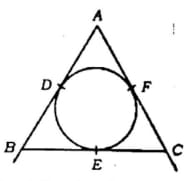
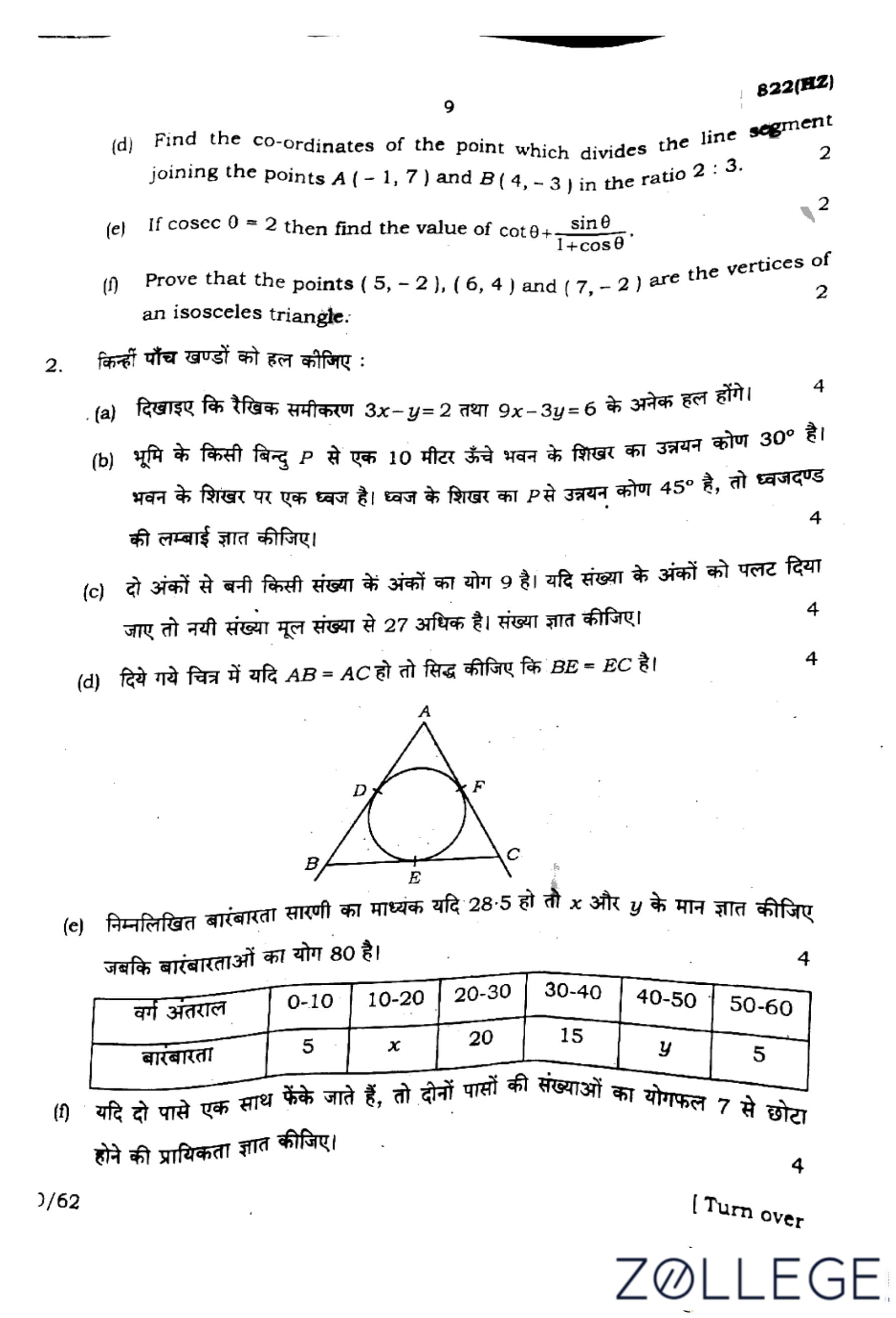
In the given figure, if \( AB = AC \), then prove that \( BE = EC \).
View Solution
### Step 1: Understanding the Given Information
We are given:
- \( \triangle ABC \) is an isosceles triangle, where \( AB = AC \).
- An incircle of \( \triangle ABC \) touches \( AB \) at \( D \), \( AC \) at \( F \), and \( BC \) at \( E \).
We need to prove:
\[ BE = EC \]
---
### Step 2: Using Tangent Properties
The key property we use is:
Tangents drawn from an external point to a circle are equal in length.
Applying this to different points:
1. From \( B \), the tangents to the incircle are:
\[ BD = BE \]
2. From \( C \), the tangents to the incircle are:
\[ CF = CE \]
3. From \( A \), the tangents to the incircle are:
\[ AD = AF \]
Since \( AB = AC \), we also know:
\[ AD = AF \]
---
### Step 3: Proving \( BE = EC \)
From the perimeter property of a triangle’s incircle:
\[ BD + BE = CF + CE \]
Since \( BD = CF \), we substitute:
\[ BE = CE \]
Thus, we have proved:
\[ \boxed{BE = EC} \] Quick Tip: In problems involving an incircle and tangents to a circle, remember that the lengths of the tangents drawn from the same external point to the circle are always equal.
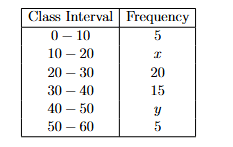
If the median of the following frequency table is 28.5, then find the values of \(x\) and \(y\) where the sum of frequencies is 80.
View Solution
### Step 1: Given Information
- Total sum of frequencies:
\[ 5 + x + 20 + 15 + y + 5 = 80 \]
Simplifying:
\[ x + y + 45 = 80 \]
\[ x + y = 35 \]
- Median class is given at \( 28.5 \).
Looking at the class intervals, the class 20-30 contains 28.5, so:
\[ Median class = 20 - 30 \]
---
### Step 2: Finding Cumulative Frequency
\begin{tabular{|c|c|c|
\hline
Class Interval & Frequency (f) & Cumulative Frequency (CF)
\hline
0-10 & 5 & 5
10-20 & \( x \) & \( 5 + x \)
20-30 (Median Class) & 20 & \( 5 + x + 20 = 25 + x \)
30-40 & 15 & \( 25 + x + 15 = 40 + x \)
40-50 & \( y \) & \( 40 + x + y \)
50-60 & 5 & \( 45 + x + y \)
\hline
\end{tabular
Since the median class is 20-30, we use the median formula:
\[ Median = L + \left( \frac{\frac{N}{2} - CF}{f} \right) \times h \]
where:
- \( L = 20 \) (lower boundary of median class),
- \( N = 80 \) (total frequency),
- \( CF = 5 + x \) (cumulative frequency before median class),
- \( f = 20 \) (frequency of median class),
- \( h = 10 \) (class width),
- Median \( = 28.5 \).
---
### Step 3: Substituting the Values \[ 28.5 = 20 + \left( \frac{40 - (5 + x)}{20} \right) \times 10 \]
\[ 28.5 = 20 + \left( \frac{35 - x}{20} \right) \times 10 \]
\[ 28.5 - 20 = \left( \frac{35 - x}{20} \right) \times 10 \]
\[ 8.5 = \frac{35 - x}{2} \]
\[ 17 = 35 - x \]
\[ x = 8 \]
---
### Step 4: Finding \( y \)
From Step 1, we derived:
\[ x + y = 35 \]
Substituting \( x = 8 \):
\[ 8 + y = 35 \]
\[ y = 7 \]
Thus, the required values are:
\[ \boxed{x = 8, \quad y = 7} \] Quick Tip: For frequency tables and probability, always double-check the sum and median conditions. When calculating the median, ensure that cumulative frequencies are correct and that you consider any rounding if necessary.
(f) If two dice are thrown together, find the probability that the sum of the appeared numbers on both dice is less than 7.
View Solution
Step 1: The total number of possible outcomes when two dice are thrown is: \[ 6 \times 6 = 36. \]
Step 2: We now find the number of favorable outcomes where the sum of the numbers on the two dice is less than 7. The possible sums less than 7 are 2, 3, 4, 5, and 6. The corresponding favorable outcomes are:
- Sum = 2: \( (1,1) \) — 1 outcome
- Sum = 3: \( (1,2), (2,1) \) — 2 outcomes
- Sum = 4: \( (1,3), (2,2), (3,1) \) — 3 outcomes
- Sum = 5: \( (1,4), (2,3), (3,2), (4,1) \) — 4 outcomes
- Sum = 6: \( (1,5), (2,4), (3,3), (4,2), (5,1) \) — 5 outcomes
The total number of favorable outcomes is: \[ 1 + 2 + 3 + 4 + 5 = 15. \]
Step 3: The probability is the ratio of favorable outcomes to total outcomes: \[ Probability = \frac{15}{36} = \frac{5}{12}. \] Quick Tip: When calculating probabilities with dice, list all possible sums and count the favorable outcomes carefully. The probability is simply the ratio of favorable outcomes to the total number of outcomes.
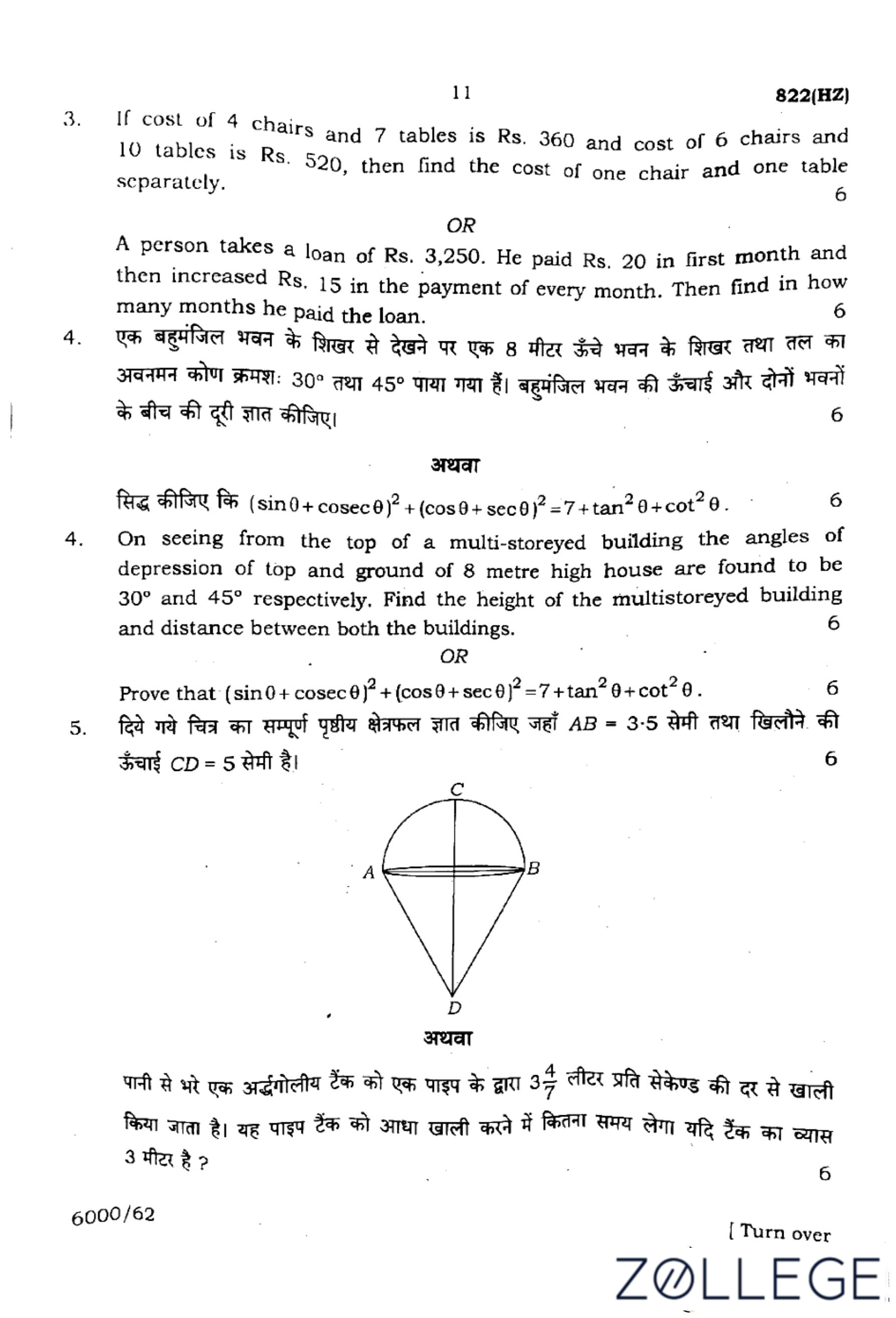
If the cost of 4 chairs and 7 tables is Rs. 360 and the cost of 6 chairs and 10 tables is Rs. 520, then find the cost of one chair and one table separately.
View Solution
Step 1: Let the cost of one chair be \( x \) and the cost of one table be \( y \).
From the given information, we can form the following system of equations:
\[ 4x + 7y = 360 \tag{1} \] \[ 6x + 10y = 520 \tag{2} \]
Step 2: Multiply equation (1) by 3 and equation (2) by 2 to eliminate \( x \):
\[ 12x + 21y = 1080 \tag{3} \] \[ 12x + 20y = 1040 \tag{4} \]
Step 3: Subtract equation (4) from equation (3):
\[ (12x + 21y) - (12x + 20y) = 1080 - 1040 \] \[ y = 40 \]
Step 4: Substitute \( y = 40 \) into equation (1):
\[ 4x + 7(40) = 360 \] \[ 4x + 280 = 360 \] \[ 4x = 360 - 280 = 80 \] \[ x = \frac{80}{4} = 20 \]
Step 5: The cost of one chair is Rs. 20 and the cost of one table is Rs. 40.
% Correct Answer
Correct Answer: Cost of one chair = Rs. 20, Cost of one table = Rs. 40 Quick Tip: For solving such problems, use simultaneous equations to model the given data. Eliminate one variable by multiplying equations and subtracting them, then solve for the remaining variable.
On seeing from the top of a multi-storeyed building the angles of depression of top and ground of 8 metre high house are found to be 30\degree and 45\degree respectively. Find the height of the multi-storeyed building and the distance between both buildings.
View Solution
### Step 1: Understanding the Given Information
- Let the height of the multi-storeyed building be \( H \) meters.
- The height of the smaller house is 8 meters.
- The angles of depression from the top of the multi-storeyed building:
- To the top of the house: \( 30^\circ \).
- To the ground of the house: \( 45^\circ \).
- Let the distance between both buildings be \( d \) meters.
Using a right-angled triangle approach, we will apply trigonometric ratios.
---
### Step 2: Applying Trigonometry in Right Triangles
#### Triangle for Ground Point (Using \( 45^\circ \))
In the right triangle formed by the top of the multi-storeyed building and the ground of the smaller house:
\[ \tan 45^\circ = \frac{Height of Building}{Distance between buildings} \]
Since \( \tan 45^\circ = 1 \), we get:
\[ 1 = \frac{H}{d} \]
\[ H = d \]
---
#### Triangle for Top of Smaller House (Using \( 30^\circ \))
For the right triangle formed by the top of the multi-storeyed building and the top of the smaller house, the remaining height is:
\[ (H - 8) \]
Applying \( \tan 30^\circ \):
\[ \tan 30^\circ = \frac{H - 8}{d} \]
Since \( \tan 30^\circ = \frac{1}{\sqrt{3}} \), we get:
\[ \frac{1}{\sqrt{3}} = \frac{H - 8}{d} \]
\[ (H - 8) = \frac{d}{\sqrt{3}} \]
---
### Step 3: Solving for \( H \)
We already found that:
\[ H = d \]
Substituting \( H = d \) into \( H - 8 = \frac{d}{\sqrt{3}} \):
\[ d - 8 = \frac{d}{\sqrt{3}} \]
Multiplying both sides by \( \sqrt{3} \) to eliminate the fraction:
\[ \sqrt{3} d - 8\sqrt{3} = d \]
Rearranging:
\[ \sqrt{3} d - d = 8\sqrt{3} \]
Factoring \( d \):
\[ d(\sqrt{3} - 1) = 8\sqrt{3} \]
Solving for \( d \):
\[ d = \frac{8\sqrt{3}}{\sqrt{3} - 1} \]
Rationalizing the denominator:
\[ d = \frac{8\sqrt{3} (\sqrt{3} + 1)}{(\sqrt{3} - 1)(\sqrt{3} + 1)} \]
\[ d = \frac{8\sqrt{3} (\sqrt{3} + 1)}{3 - 1} \]
\[ d = \frac{8\sqrt{3} (\sqrt{3} + 1)}{2} \]
\[ d = 4\sqrt{3} (\sqrt{3} + 1) \]
\[ d = 12 + 4\sqrt{3} \]
Since \( H = d \), we conclude:
\[ H = 12 + 4\sqrt{3} \]
---
### Step 4: Final Answer
Thus, the height of the multi-storeyed building is:
\[ \boxed{12 + 4\sqrt{3} meters} \]
The distance between the two buildings is:
\[ \boxed{12 + 4\sqrt{3} meters} \] Quick Tip: When solving problems involving angles of depression or elevation, remember that the horizontal distance is the adjacent side to the angle, and the height difference is the opposite side.
Prove that \( (\sin \theta + \csc \theta)^2 + (\cos \theta + \sec \theta)^2 = 7 + \tan^2 \theta + \cot^2 \theta \).
View Solution
Step 1: Expanding both terms on the left-hand side: \[ (\sin \theta + \csc \theta)^2 = \sin^2 \theta + 2 \sin \theta \csc \theta + \csc^2 \theta \]
Since \( \sin \theta \csc \theta = 1 \), we get: \[ (\sin \theta + \csc \theta)^2 = \sin^2 \theta + 2 + \csc^2 \theta. \]
Similarly, for the second term: \[ (\cos \theta + \sec \theta)^2 = \cos^2 \theta + 2 \cos \theta \sec \theta + \sec^2 \theta. \]
Since \( \cos \theta \sec \theta = 1 \), we get: \[ (\cos \theta + \sec \theta)^2 = \cos^2 \theta + 2 + \sec^2 \theta. \]
Step 2: Now, adding both sides: \[ (\sin \theta + \csc \theta)^2 + (\cos \theta + \sec \theta)^2 = \left( \sin^2 \theta + 2 + \csc^2 \theta \right) + \left( \cos^2 \theta + 2 + \sec^2 \theta \right). \]
Simplifying: \[ \sin^2 \theta + \cos^2 \theta + 4 + \csc^2 \theta + \sec^2 \theta. \]
Since \( \sin^2 \theta + \cos^2 \theta = 1 \), this becomes: \[ 1 + 4 + \csc^2 \theta + \sec^2 \theta = 5 + \csc^2 \theta + \sec^2 \theta. \]
Step 3: Now, let's express \( \csc^2 \theta \) and \( \sec^2 \theta \) in terms of \( \tan^2 \theta \) and \( \cot^2 \theta \): \[ \csc^2 \theta = 1 + \cot^2 \theta \quad and \quad \sec^2 \theta = 1 + \tan^2 \theta. \]
Substituting these into the expression: \[ 5 + \left( 1 + \cot^2 \theta \right) + \left( 1 + \tan^2 \theta \right) = 7 + \tan^2 \theta + \cot^2 \theta. \]
Conclusion: Therefore, we have proved that: \[ (\sin \theta + \csc \theta)^2 + (\cos \theta + \sec \theta)^2 = 7 + \tan^2 \theta + \cot^2 \theta. \] Quick Tip: Use trigonometric identities like \( \sin^2 \theta + \cos^2 \theta = 1 \), \( \csc^2 \theta = 1 + \cot^2 \theta \), and \( \sec^2 \theta = 1 + \tan^2 \theta \) to simplify and prove trigonometric expressions.
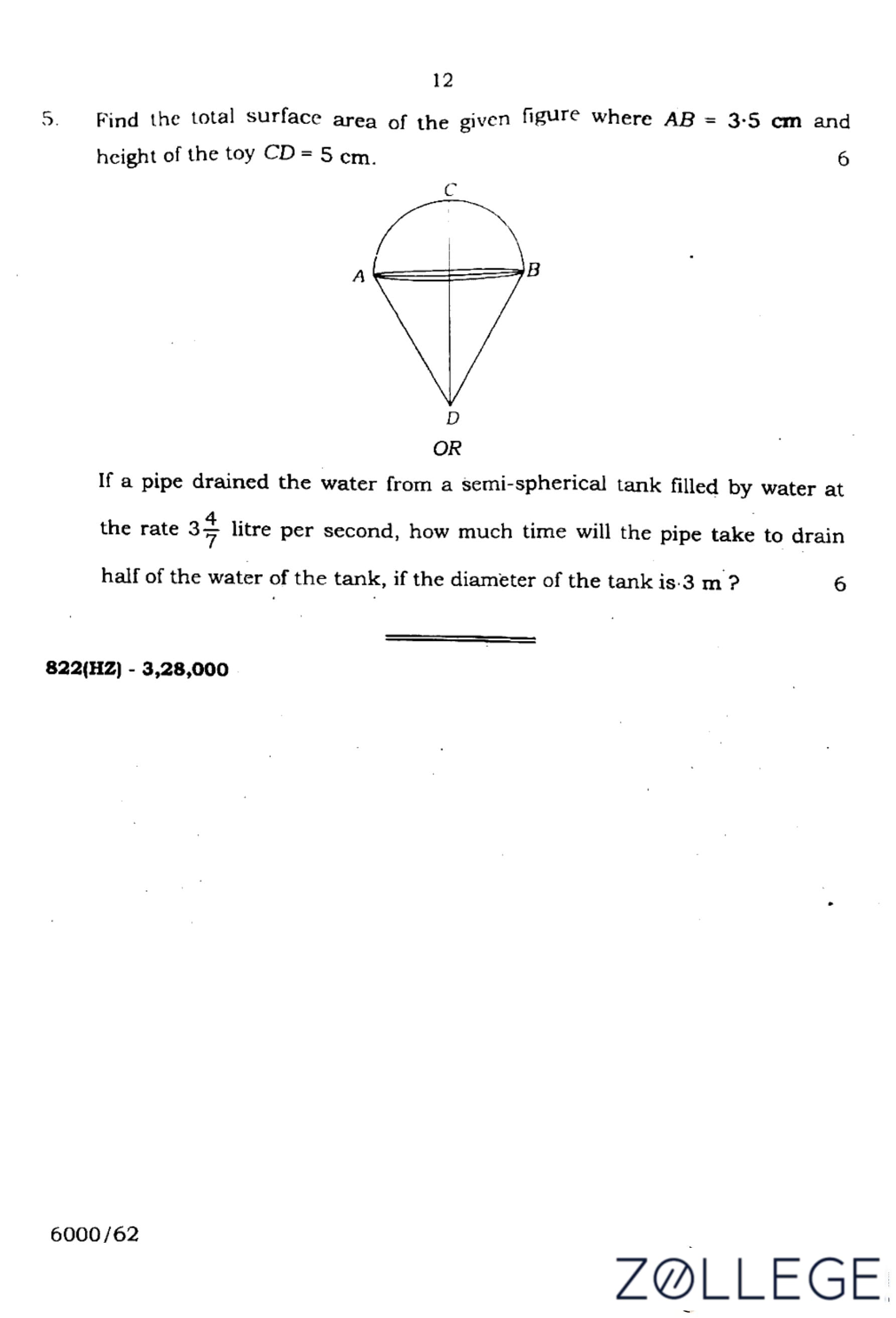
Find the total surface area of the given figure where \( AB = 3.5 \, cm \) and the height of the toy \( CD = 5 \, cm. \)
View Solution
Step 1: The figure consists of a cone with a hemisphere on top. The total surface area will be the sum of the curved surface area of the cone and the surface area of the hemisphere.
Step 2: We are given that the radius of the base of the cone, \( r = AB = 3.5 \, cm \), and the height of the cone, \( h = CD = 5 \, cm \).
To find the slant height \( l \) of the cone, we use the Pythagorean theorem: \[ l = \sqrt{r^2 + h^2} = \sqrt{(3.5)^2 + (5)^2} = \sqrt{12.25 + 25} = \sqrt{37.25} \approx 6.1 \, cm. \]
Step 3: The surface area of the cone is given by: \[ Curved Surface Area of Cone = \pi r l = \pi \times 3.5 \times 6.1 \approx 67.3 \, cm^2. \]
Step 4: The surface area of the hemisphere is given by: \[ Surface Area of Hemisphere = 2\pi r^2 = 2 \pi \times (3.5)^2 = 2 \pi \times 12.25 \approx 76.96 \, cm^2. \]
Step 5: The total surface area is the sum of the curved surface area of the cone and the surface area of the hemisphere: \[ Total Surface Area = 67.3 + 76.96 \approx 144.26 \, cm^2. \]
Conclusion: Therefore, the total surface area of the figure is approximately \( \boxed{144.26 \, cm^2} \). Quick Tip: For total surface area of a cone with a hemisphere on top, remember to calculate the surface area of both the cone's curved surface and the hemisphere, and add them together. Use the Pythagorean theorem to find the slant height of the cone.
If a pipe drained the water from a semi-spherical tank filled with water at the rate \( \frac{3}{4} \) litre per second, how much time will the pipe take to drain half of the water of the tank, if the diameter of the tank is 3 m?
View Solution
### Step 1: Given Information
- Rate of drainage = \( 3 \frac{4}{7} \) litres/second
Converting to improper fraction:
\[ 3 \frac{4}{7} = \frac{25}{7} litres/second \]
- Diameter of tank = \( 3 \) meters, so radius:
\[ r = \frac{3}{2} = 1.5 meters \]
- The tank is semi-spherical, so its volume is:
\[ V = \frac{1}{2} \times \frac{4}{3} \pi r^3 \]
---
### Step 2: Calculating Volume of Water in the Tank \[ V = \frac{1}{2} \times \frac{4}{3} \pi (1.5)^3 \]
\[ V = \frac{1}{2} \times \frac{4}{3} \pi \times 3.375 \]
\[ V = \frac{4}{6} \times \pi \times 3.375 \]
\[ V = \frac{2}{3} \times \pi \times 3.375 \]
\[ V = \frac{6.75}{3} \pi \]
\[ V = 2.25 \pi cubic meters \]
Since 1 cubic meter = 1000 litres, the total volume in litres is:
\[ V = 2.25 \times \pi \times 1000 \]
\[ V \approx 2.25 \times 3.1416 \times 1000 \]
\[ V \approx 7068.58 litres \]
---
### Step 3: Calculating Half the Volume \[ Half of the water = \frac{7068.58}{2} \approx 3534.29 litres \]
---
### Step 4: Finding Time Required
Using the drainage rate:
\[ Time = \frac{Volume to be drained}{Rate of drainage} \]
\[ Time = \frac{3534.29}{\frac{25}{7}} \]
\[ = 3534.29 \times \frac{7}{25} \]
\[ = \frac{24740.03}{25} \]
\[ \approx 989.6 seconds \]
\[ \approx \frac{989.6}{60} minutes \]
\[ \approx 16.5 minutes \]
---
### Step 5: Final Answer
Thus, the required time to drain **half of the water** is:
\[ \boxed{16.5 minutes} \] Quick Tip: For problems involving draining or filling a tank, always begin by calculating the volume of the tank and then use the rate of drainage to find the time taken. Remember to convert units appropriately (e.g., from cubic meters to litres).
*The article might have information for the previous academic years, please refer the official website of the exam.