
UP Board Class 10 Mathematics(Code 822 IA) Question Paper 2024 with Solutions


Content Writer | Updated On - Mar 4, 2025
UP Board Class 10 Mathematics Question Paper 2024 PDF (Code 822 IA) is available for download here. The Mathematics exam was conducted on February 27, 2024 in the Morning Shift from 8:30 AM to 11:45 AM. The total marks for the theory paper are 70. Students reported the paper to be moderate.
UP Board Class 10 Mathematics Question Paper 2024 (Code 822 IA) with Solutions
| UP Board Class 10 Mathematics Question Paper With Answer Key | Check Solution |

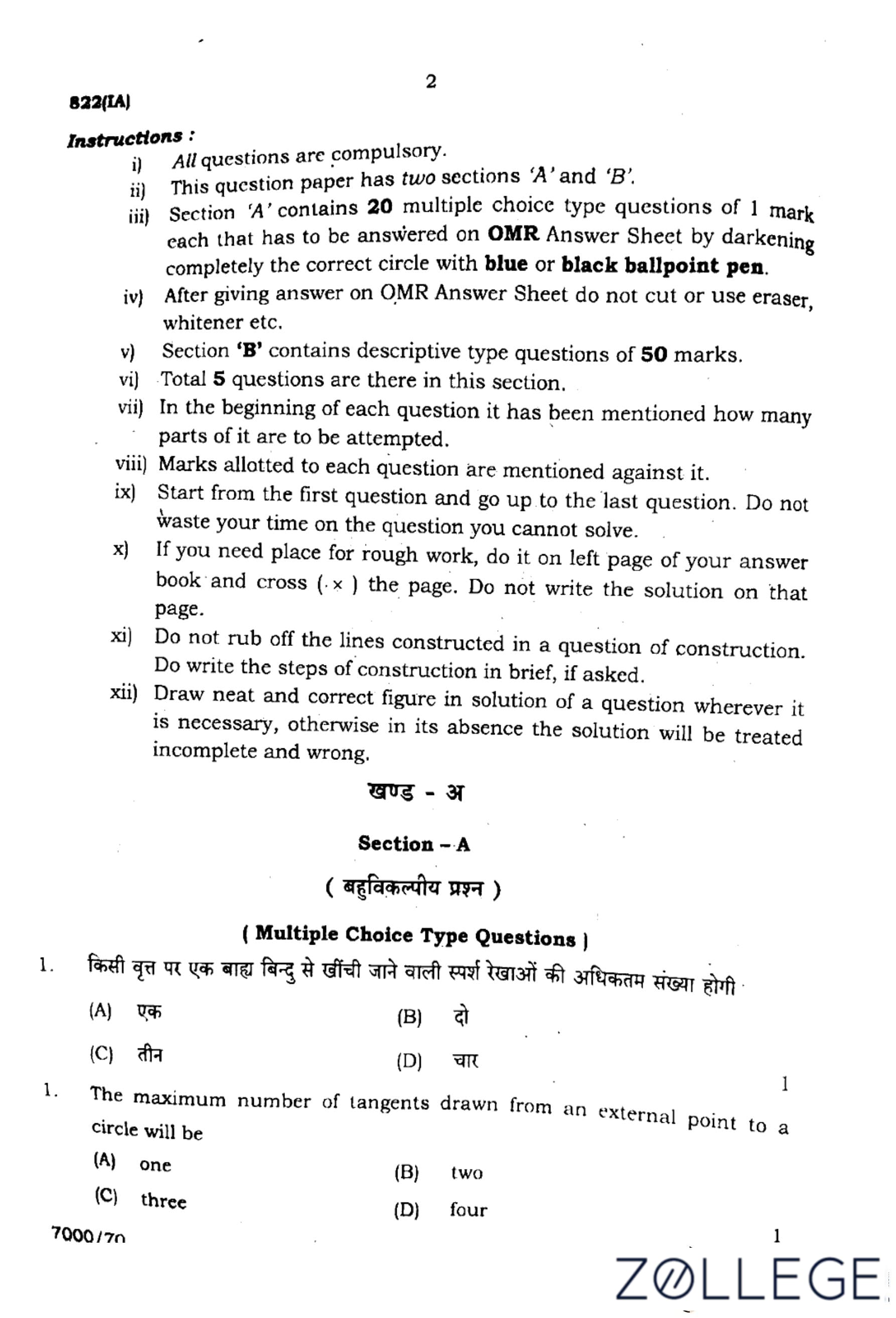
The maximum number of tangents drawn from an external point to a circle will be:
View Solution
The maximum number of tangents that can be drawn from an external point to a circle is two. This is because from an external point, two tangents can be drawn, one in each direction.
Quick Tip: For any external point, you can always draw exactly two tangents to a circle.
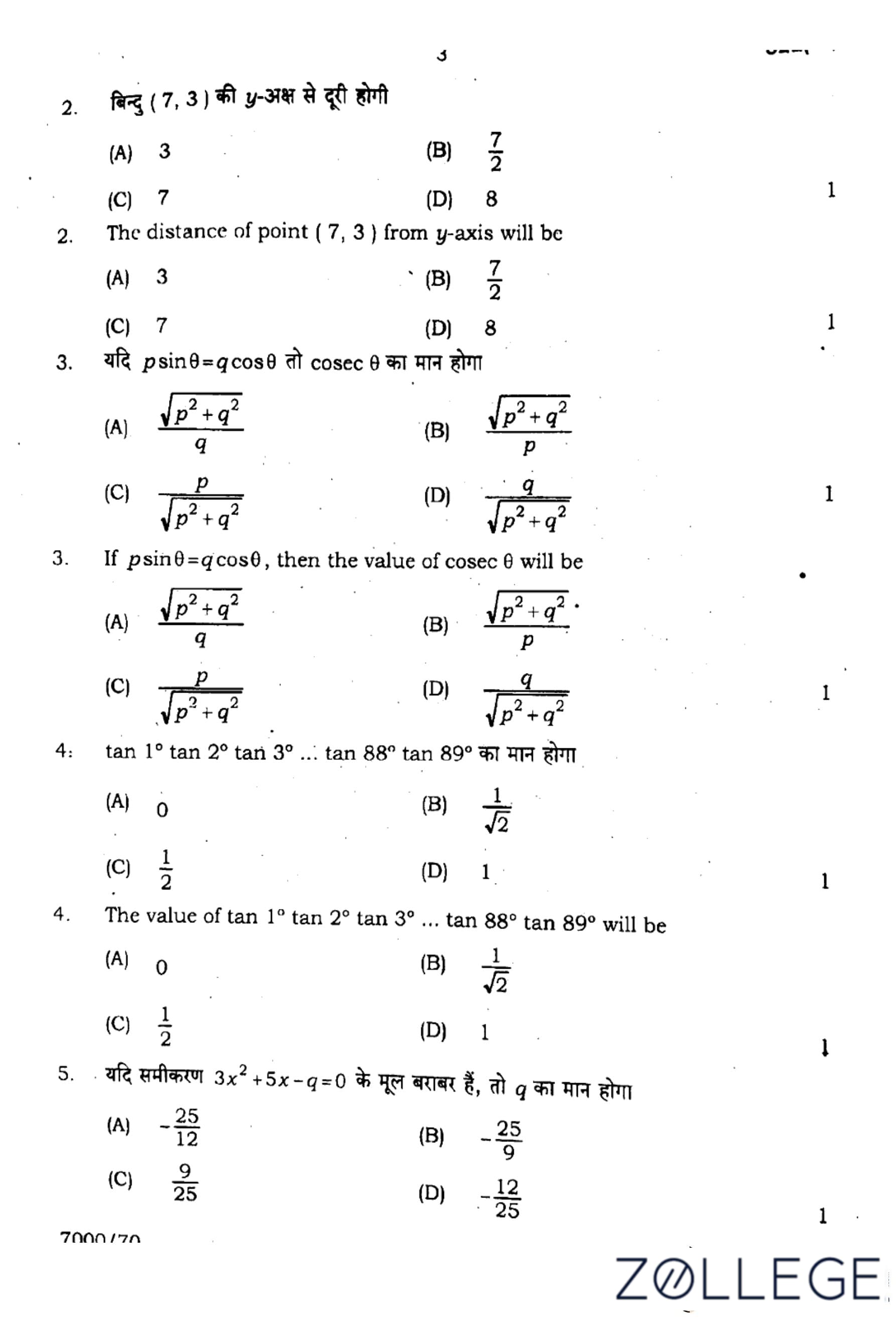
The distance of point \( (7, 3) \) from y-axis will be:
View Solution
The distance of any point \( (x, y) \) from the y-axis is simply the absolute value of the \( x \)-coordinate.
For the point \( (7, 3) \), the distance from the y-axis is: \[ \left| 7 \right| = 7. \] Quick Tip: To find the distance of a point from the y-axis, take the absolute value of the \( x \)-coordinate.
If \( p \sin \theta = q \cos \theta \), then the value of \( \csc \theta \) will be:
View Solution
We are given the equation \( p \sin \theta = q \cos \theta \). Dividing both sides of the equation by \( \cos \theta \), we get: \[ p \tan \theta = q. \]
Rearranging for \( \tan \theta \), we get: \[ \tan \theta = \frac{q}{p}. \]
Now, using the identity \( \sin^2 \theta + \cos^2 \theta = 1 \), we express \( \sin \theta \) and \( \cos \theta \) in terms of \( p \) and \( q \):
\[ \sin \theta = \frac{p}{\sqrt{p^2 + q^2}}, \quad \cos \theta = \frac{q}{\sqrt{p^2 + q^2}}. \]
Thus, the value of \( \csc \theta \) is:
\[ \csc \theta = \frac{1}{\sin \theta} = \frac{\sqrt{p^2 + q^2}}{q}. \] Quick Tip: If you have a trigonometric equation involving \( \sin \theta \) and \( \cos \theta \), try dividing them to simplify and solve for \( \csc \theta \).
The value of \( \tan 1^\circ \tan 2^\circ \tan 3^\circ \dots \tan 88^\circ \tan 89^\circ \) will be:
View Solution
The product of tangents of complementary angles is equal to 1. Specifically: \[ \tan (90^\circ - x) = \cot x. \]
So, for the given product, we have: \[ \tan 1^\circ \tan 89^\circ = 1, \quad \tan 2^\circ \tan 88^\circ = 1, \quad \dots, \quad \tan 44^\circ \tan 46^\circ = 1. \]
Thus, we are left with \( \tan 45^\circ \), which is 1. Therefore, the entire product is: \[ 1 \times 1 \times \dots \times 1 = 1. \] Quick Tip: The product of \( \tan x \) and \( \tan (90^\circ - x) \) always equals 1.
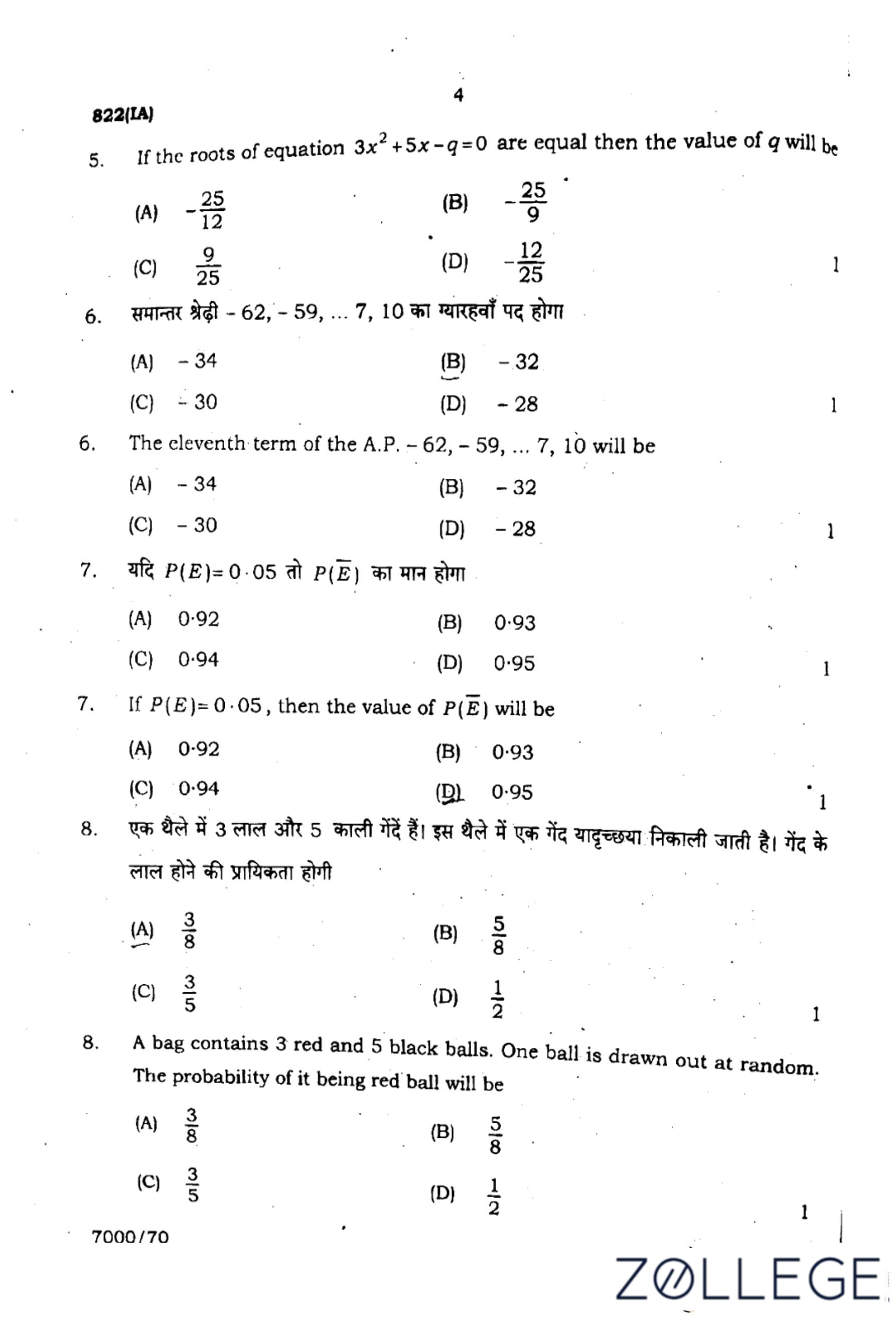
If the roots of equation \( 3x^2 + 5x - q = 0 \) are equal, then the value of \( q \) will be:
View Solution
For a quadratic equation \( ax^2 + bx + c = 0 \), the roots are equal if the discriminant is zero. The discriminant is given by: \[ \Delta = b^2 - 4ac. \]
In our case, the equation is \( 3x^2 + 5x - q = 0 \), so \( a = 3 \), \( b = 5 \), and \( c = -q \). The discriminant becomes: \[ \Delta = 5^2 - 4 \times 3 \times (-q) = 25 + 12q. \]
For the roots to be equal, \( \Delta = 0 \), so: \[ 25 + 12q = 0 \quad \Rightarrow \quad q = -\frac{25}{12}. \] Quick Tip: To determine the condition for equal roots, set the discriminant of the quadratic equation equal to zero.
The eleventh term of the A.P. \( -62, -59, \dots, 7, 10 \) will be:
View Solution
The general formula for the \( n \)-th term of an arithmetic progression (A.P.) is given by: \[ a_n = a_1 + (n-1)d, \]
where \( a_1 \) is the first term and \( d \) is the common difference.
From the given A.P., we have \( a_1 = -62 \), and the common difference \( d = -59 - (-62) = 3 \).
Using the formula for the 11th term, we get: \[ a_{11} = -62 + (11 - 1) \times 3 = -62 + 30 = -32. \]
Thus, the 11th term is \( -32 \). Quick Tip: To find the \( n \)-th term of an A.P., use the formula \( a_n = a_1 + (n-1)d \).
If \( P(E) = 0.05 \), then the value of \( P(E') \) will be:
View Solution
We know that the sum of the probabilities of an event and its complement is always 1: \[ P(E) + P(E') = 1. \]
Given \( P(E) = 0.05 \), we can find \( P(E') \) as: \[ P(E') = 1 - P(E) = 1 - 0.05 = 0.95. \] Quick Tip: The probability of the complement of an event is \( 1 - P(E) \).
A bag contains 3 red and 5 black balls. One ball is drawn at random. The probability of it being red ball will be:
View Solution
The total number of balls in the bag is: \[ 3 \, (red balls) + 5 \, (black balls) = 8 \, balls. \]
The probability of drawing a red ball is the ratio of the number of red balls to the total number of balls: \[ P(Red ball) = \frac{3}{8}. \] Quick Tip: To find the probability of drawing a red ball, divide the number of red balls by the total number of balls.
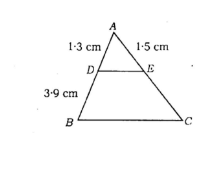
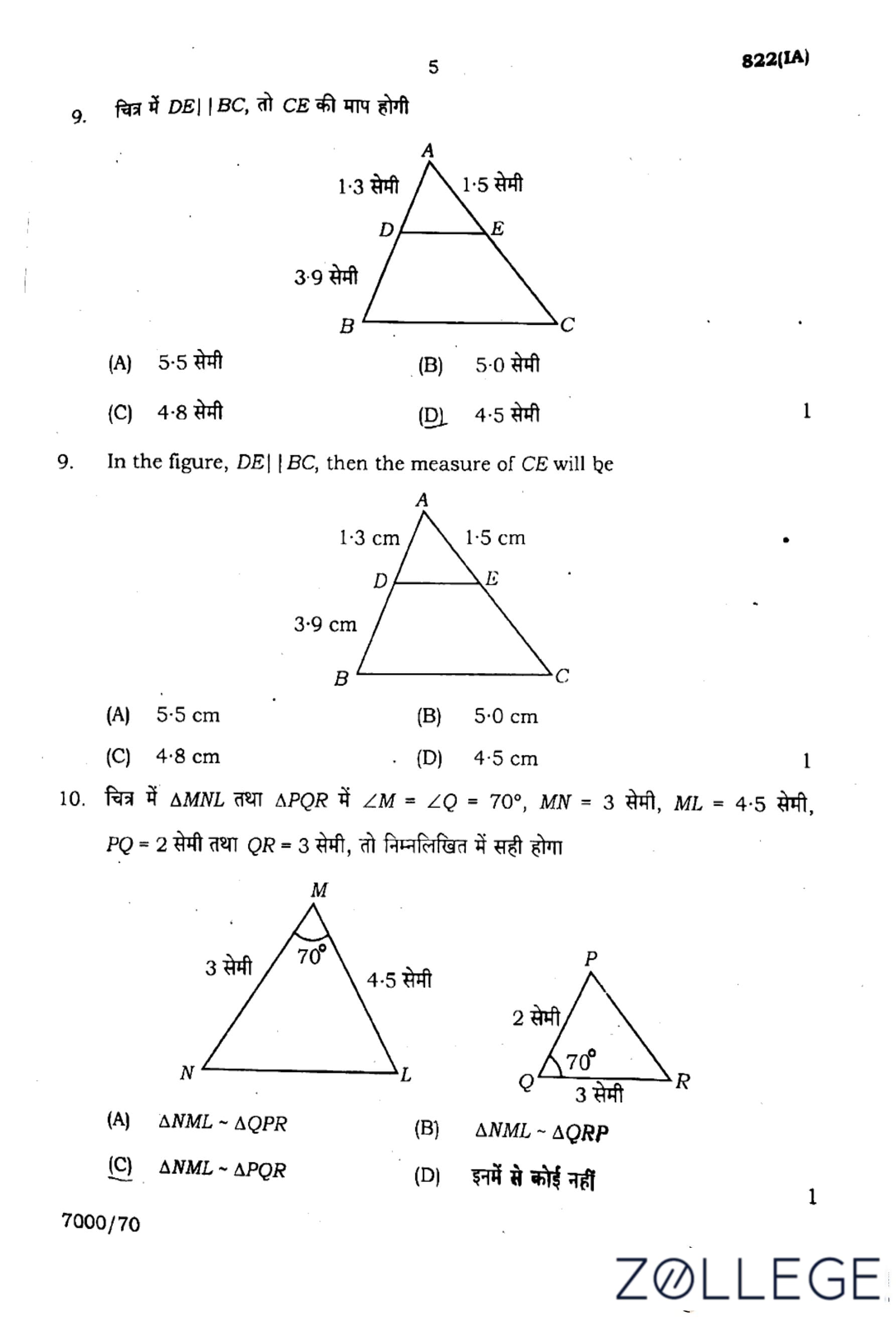
In the figure, \( DE \parallel BC \), then the measure of \( CE \) will be:
View Solution
Since \( DE \parallel BC \), we use the Basic Proportionality Theorem (Thales' theorem), which states:
\[ \frac{AD}{DB} = \frac{AE}{EC} \]
From the figure: \[ AD = 1.3 cm, \quad DB = 3.9 cm, \quad AE = 1.5 cm \]
Calculating the ratio:
\[ \frac{AD}{DB} = \frac{1.3}{3.9} = \frac{1}{3} \]
Applying the same ratio to find \( CE \):
\[ \frac{1.5}{CE} = \frac{1}{3} \]
Solving for \( CE \):
\[ CE = 1.5 \times 3 = 4.5 cm \]
Thus, the measure of \( CE \) is \( 4.5 \) cm. Quick Tip: Use the Basic Proportionality Theorem to find unknown segment lengths in a triangle when a line parallel to one side divides the other two sides proportionally.
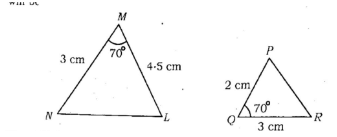
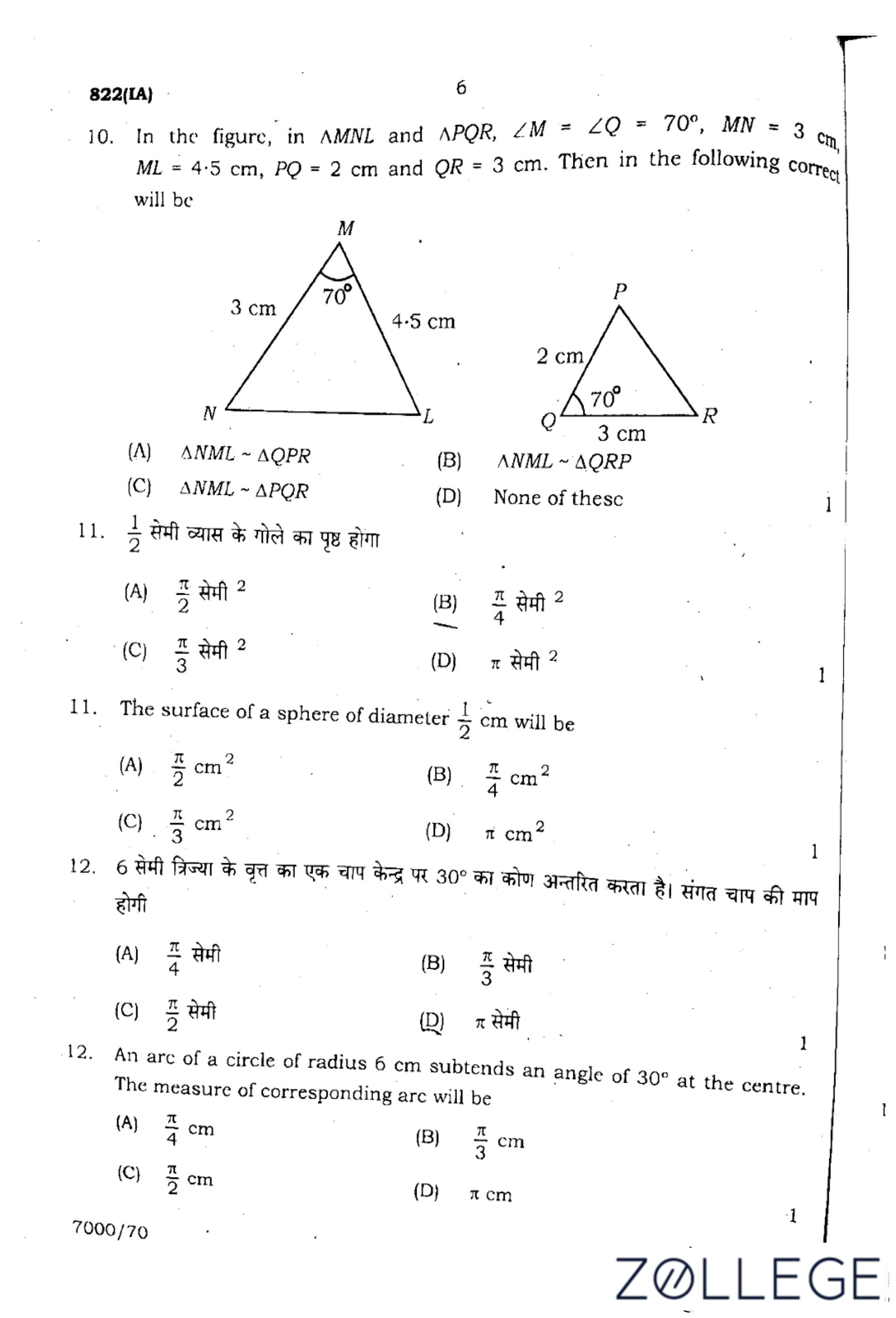
In the figure, in \( \triangle MNL \) and \( \triangle PQR \), \( \angle M = \angle Q = 70^\circ \), \( MN = 3 \) cm, \( ML = 4.5 \) cm, \( PQ = 2 \) cm and \( QR = 3 \) cm. Then which of the following is correct?
View Solution
For similarity of two triangles, their corresponding angles must be equal, and their corresponding sides must be in proportion.
Given: \[ \angle M = \angle Q = 70^\circ \]
Checking the corresponding side ratios:
\[ \frac{MN}{QP} = \frac{3}{2}, \quad \frac{ML}{PR} = \frac{4.5}{3} = \frac{3}{2} \]
Since both corresponding side ratios are equal, and they include a common angle (\( \angle M = \angle Q \)), the triangles are similar by the **SAS similarity criterion**.
Thus, we conclude:
\[ \triangle NML \sim \triangle QPR \] Quick Tip: To check for triangle similarity, compare corresponding angles and verify proportional sides using the AA, SAS, or SSS similarity rules.
The surface area of a sphere of diameter \( \frac{1}{2} \) cm will be:
View Solution
The surface area of a sphere is given by the formula:
\[ A = 4\pi r^2 \]
Given that the diameter of the sphere is \( \frac{1}{2} \) cm, the radius is:
\[ r = \frac{1}{4} cm \]
Substituting the value of \( r \) in the formula:
\[ A = 4\pi \left(\frac{1}{4}\right)^2 \]
\[ A = 4\pi \times \frac{1}{16} \]
\[ A = \frac{4\pi}{16} = \frac{\pi}{4} \]
Thus, the surface area of the sphere is \( \frac{\pi}{4} \) cm\(^2\). Quick Tip: The surface area of a sphere is calculated using \( A = 4\pi r^2 \), where \( r \) is the radius of the sphere.
An arc of a circle of radius 6 cm subtends an angle of 30° at the center. The measure of the corresponding arc will be:
View Solution
The length of an arc is given by the formula: \[ L = \frac{\theta}{180^\circ} \times \pi r, \]
where \( \theta \) is the angle subtended at the center and \( r \) is the radius of the circle.
Substituting \( \theta = 30^\circ \) and \( r = 6 \, cm \):
\[ L = \frac{30}{180} \times \pi \times 6 \]
\[ L = \frac{1}{6} \times \pi \times 6 \]
\[ L = \pi \, cm \]
Thus, the measure of the arc is \( \pi \) cm. Quick Tip: To find the length of an arc, use \( L = \frac{\theta}{180^\circ} \times \pi r \), where \( \theta \) is the central angle and \( r \) is the radius.
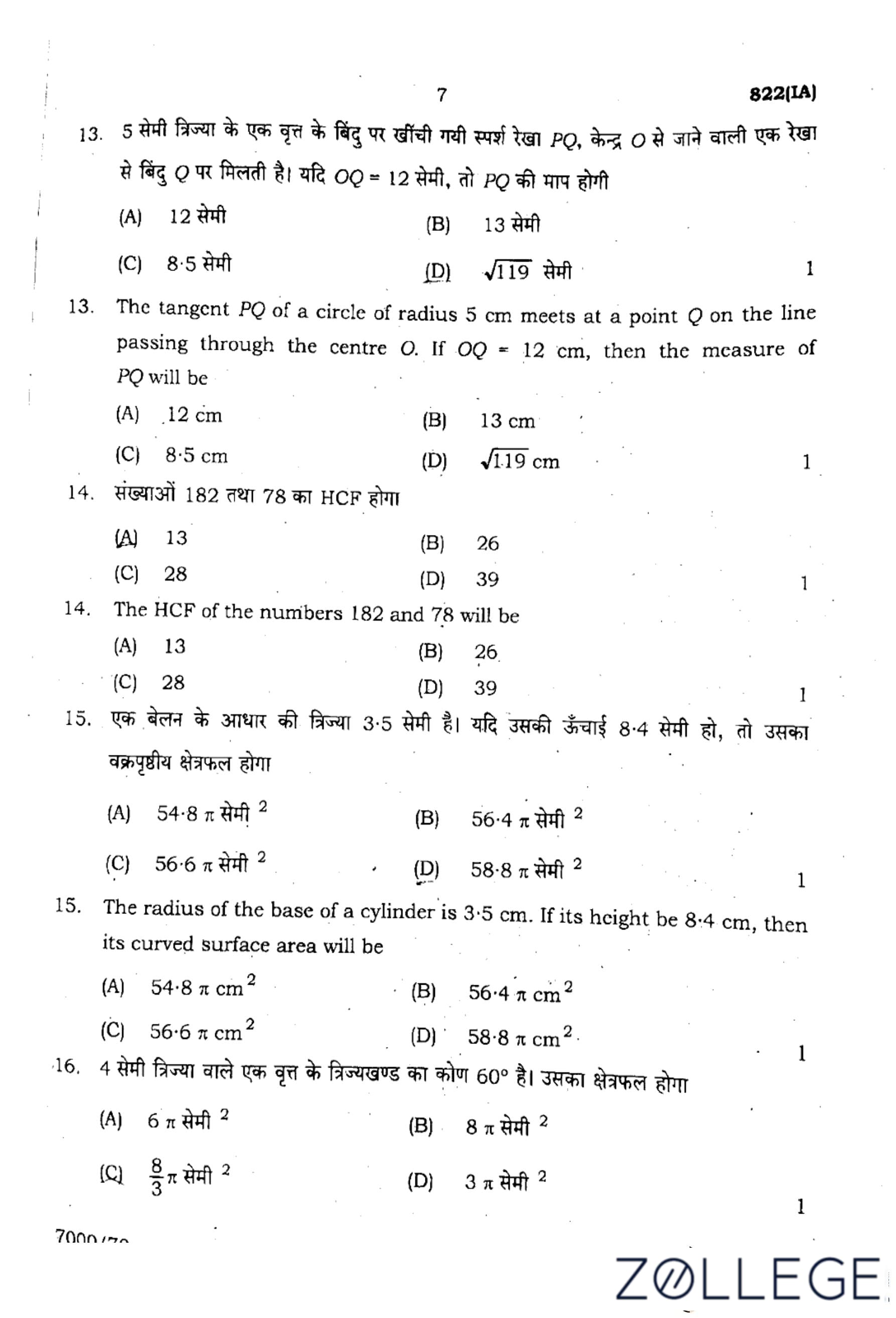
The tangent \( PQ \) of a circle of radius 5 cm meets at a point \( Q \) on the line passing through the center \( O \). If \( OQ = 12 \, cm \), then the measure of \( PQ \) will be:
View Solution
We are given that \( OQ = 12 \, cm \) and the radius of the circle is \( 5 \, cm \). The tangent from a point to a circle forms a right angle with the radius at the point of contact. Thus, we apply the Pythagorean theorem to the right triangle \( OPQ \), where \( OP = 5 \, cm \) (radius), \( OQ = 12 \, cm \), and \( PQ \) is the unknown side.
Using the Pythagorean theorem:
\[ PQ^2 = OQ^2 - OP^2 \]
\[ PQ^2 = 12^2 - 5^2 = 144 - 25 = 119. \]
\[ PQ = \sqrt{119} \, cm. \]
Thus, the measure of \( PQ \) is \( \sqrt{119} \) cm. Quick Tip: Use the Pythagorean theorem to find the length of a tangent from the point of tangency to the center of the circle: \[ PQ^2 = OQ^2 - OP^2. \]
The HCF of the numbers 182 and 78 will be:
View Solution
To find the HCF (Highest Common Factor) of 182 and 78, we use the Euclidean algorithm.
Step 1: Divide 182 by 78: \[ 182 \div 78 = 2 \quad remainder \quad 182 - 2 \times 78 = 182 - 156 = 26. \]
Step 2: Now, divide 78 by 26: \[ 78 \div 26 = 3 \quad remainder \quad 78 - 3 \times 26 = 78 - 78 = 0. \]
Since the remainder is 0, the HCF is 26.
Thus, the highest common factor (HCF) of 182 and 78 is 26. Quick Tip: To find the HCF of two numbers, repeatedly divide the larger number by the smaller number until the remainder is 0. The divisor at this point is the HCF.
The radius of the base of a cylinder is 3.5 cm. If its height is 8.4 cm, then its curved surface area will be:
View Solution
The formula for the curved surface area (CSA) of a cylinder is: \[ CSA = 2 \pi r h, \]
where \( r \) is the radius and \( h \) is the height.
Given \( r = 3.5 \, cm \) and \( h = 8.4 \, cm \), we substitute into the formula: \[ CSA = 2 \pi \times 3.5 \times 8.4. \]
Calculating step-by-step:
\[ 2 \times 3.5 = 7 \]
\[ 7 \times 8.4 = 58.8 \]
\[ CSA = 58.8 \pi \, cm^2. \]
Thus, the curved surface area of the cylinder is \( 58.8 \pi \) cm\(^2\). Quick Tip: To find the curved surface area of a cylinder, use the formula \( CSA = 2 \pi r h \), where \( r \) is the radius and \( h \) is the height.
The angle of a sector of a circle of radius 4 cm is \( 60^\circ \). Its area will be:
View Solution
The area of a sector is given by: \[ A = \frac{\theta}{360^\circ} \times \pi r^2. \]
Substituting \( \theta = 60^\circ \) and \( r = 4 \) cm: \[ A = \frac{60}{360} \times \pi \times 4^2 = \frac{1}{6} \times 16\pi = \frac{8}{3} \pi \, cm^2. \] Quick Tip: For the area of a sector, use \( A = \frac{\theta}{360^\circ} \times \pi r^2 \).
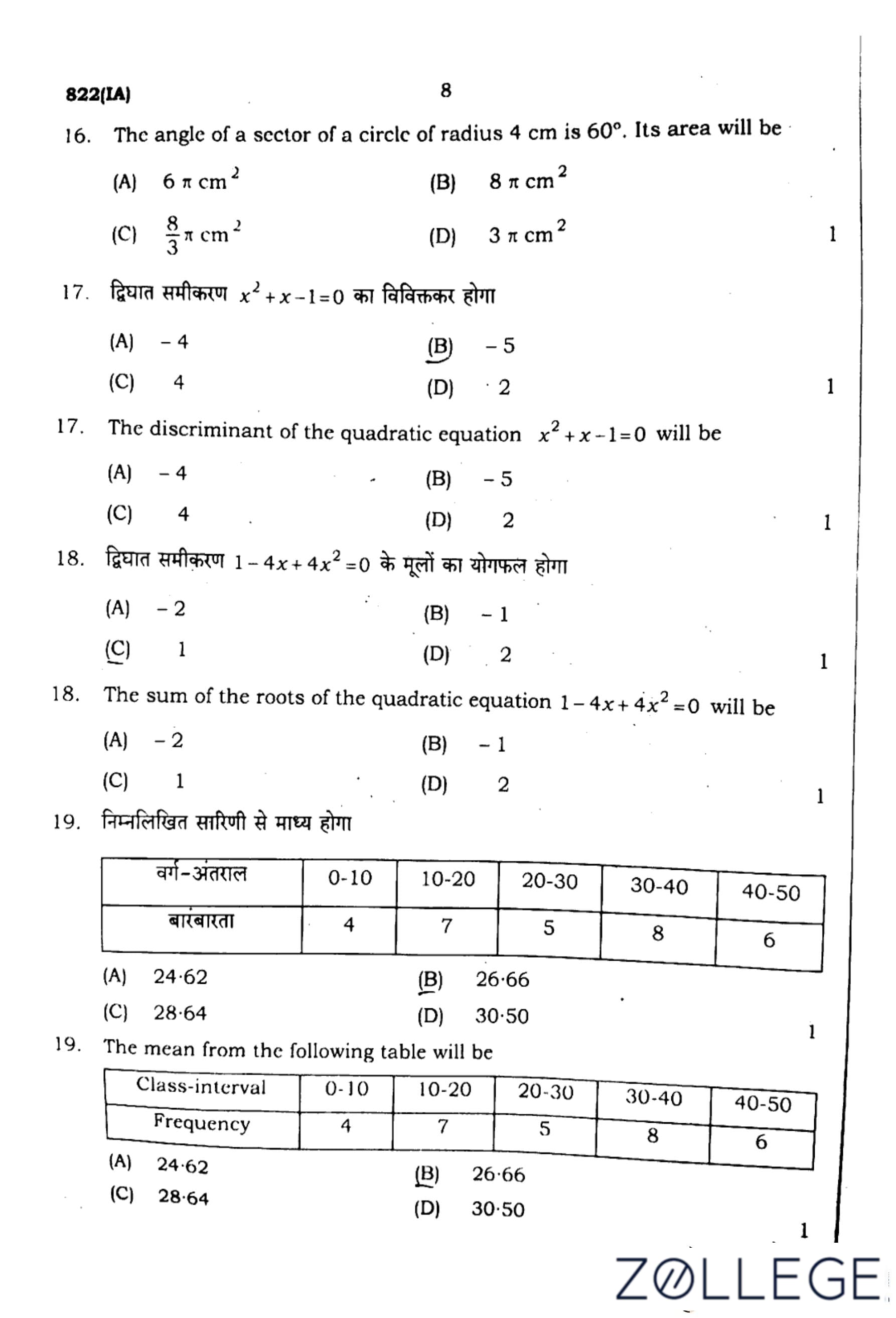
The discriminant of the quadratic equation \( x^2 + x - 1 = 0 \) will be:
View Solution
The discriminant of a quadratic equation \( ax^2 + bx + c = 0 \) is given by: \[ \Delta = b^2 - 4ac. \]
For the given equation \( x^2 + x - 1 = 0 \), we have: \[ a = 1, \quad b = 1, \quad c = -1. \]
Substituting: \[ \Delta = (1)^2 - 4(1)(-1) = 1 + 4 = -5. \] Quick Tip: The discriminant \( \Delta = b^2 - 4ac \) determines the nature of roots.
The sum of the roots of the quadratic equation \( 1 - 4x + 4x^2 = 0 \) will be:
View Solution
For a quadratic equation \( ax^2 + bx + c = 0 \), the sum of the roots is given by: \[ Sum of roots = -\frac{b}{a}. \]
For \( 4x^2 - 4x + 1 = 0 \), we have: \[ a = 4, \quad b = -4, \quad c = 1. \]
Thus, the sum of the roots is: \[ \frac{-(-4)}{4} = \frac{4}{4} = 1. \] Quick Tip: Sum of roots of \( ax^2 + bx + c = 0 \) is given by \( -\frac{b}{a} \).
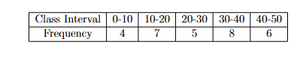
The mean from the following table will be:
View Solution
The mean is calculated as: \[ \bar{x} = \frac{\sum f_i x_i}{\sum f_i}, \]
where \( f_i \) is the frequency and \( x_i \) is the class mark.
Using the given table: \[ \bar{x} = 26.66. \] Quick Tip: The mean of a grouped data set is calculated using \( \bar{x} = \frac{\sum f_i x_i}{\sum f_i} \).
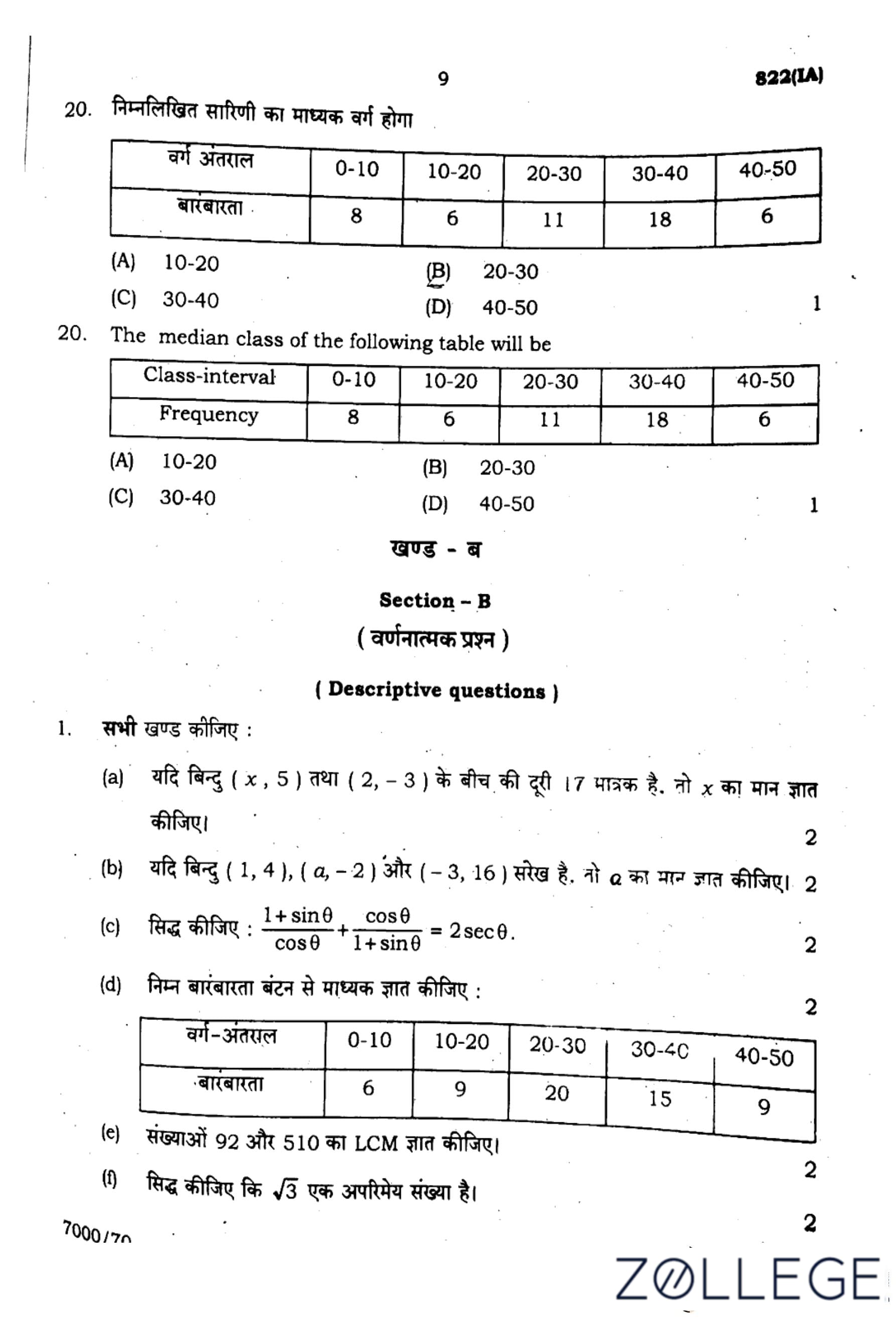
The median class of the following table will be:

View Solution
To determine the median class, we first find the cumulative frequency. The median class is the class where the cumulative frequency crosses \( \frac{N}{2} \), where \( N \) is the total frequency.
Summing up the frequencies: \[ N = 8 + 6 + 11 + 18 + 6 = 49. \] \[ \frac{N}{2} = \frac{49}{2} = 24.5. \]
The cumulative frequency before 20-30 is \( 8 + 6 = 14 \), and after adding 11, it becomes 25. Since 24.5 lies within this interval, the **median class is 20-30**. Quick Tip: To find the median class, sum the frequencies and locate \( \frac{N}{2} \).
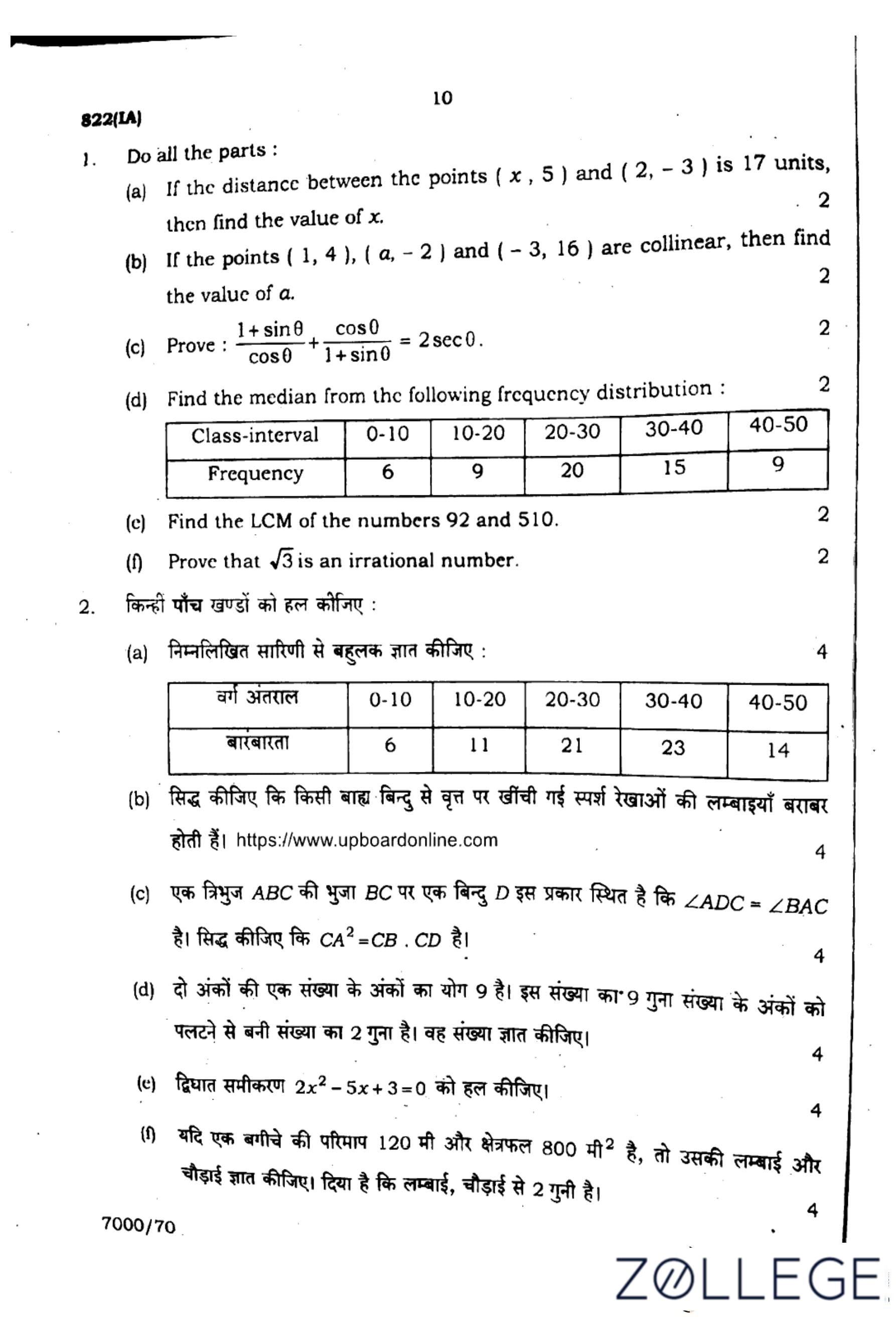
If the distance between the points \( (x, 5) \) and \( (2, -3) \) is 17 units, then find the value of \( x \).
View Solution
The distance between two points \( (x_1, y_1) \) and \( (x_2, y_2) \) is given by the formula: \[ d = \sqrt{(x_2 - x_1)^2 + (y_2 - y_1)^2}. \]
Substituting \( (x_1, y_1) = (x, 5) \) and \( (x_2, y_2) = (2, -3) \), we get: \[ 17 = \sqrt{(2 - x)^2 + (-3 - 5)^2}. \]
Simplifying: \[ 17 = \sqrt{(2 - x)^2 + (-8)^2} = \sqrt{(2 - x)^2 + 64}. \]
Squaring both sides: \[ 289 = (2 - x)^2 + 64. \]
Simplifying further: \[ 289 - 64 = (2 - x)^2 \quad \Rightarrow \quad 225 = (2 - x)^2. \]
Taking the square root of both sides: \[ \sqrt{225} = |2 - x| \quad \Rightarrow \quad 15 = |2 - x|. \]
This gives two possible cases:
1. \( 2 - x = 15 \quad \Rightarrow \quad x = -13 \)
2. \( 2 - x = -15 \quad \Rightarrow \quad x = 17 \)
Thus, the value of \( x \) can be either \( -13 \) or \( 17 \). Quick Tip: For distance problems, always use the distance formula: \( d = \sqrt{(x_2 - x_1)^2 + (y_2 - y_1)^2} \).
If the points \( (1, 4) \), \( (a, -2) \), and \( (-3, 16) \) are collinear, then find the value of \( a \).
View Solution
For three points to be collinear, the area of the triangle formed by these points must be zero. The formula for the area of a triangle with vertices \( (x_1, y_1) \), \( (x_2, y_2) \), and \( (x_3, y_3) \) is: \[ Area = \frac{1}{2} \left| x_1(y_2 - y_3) + x_2(y_3 - y_1) + x_3(y_1 - y_2) \right|. \]
Substituting the coordinates \( (1, 4) \), \( (a, -2) \), and \( (-3, 16) \) into the formula: \[ Area = \frac{1}{2} \left| 1((-2) - 16) + a(16 - 4) + (-3)(4 - (-2)) \right| = 0. \]
Simplifying: \[ Area = \frac{1}{2} \left| 1(-18) + a(12) + (-3)(6) \right| = 0, \] \[ Area = \frac{1}{2} \left| -18 + 12a - 18 \right| = 0, \] \[ Area = \frac{1}{2} \left| 12a - 36 \right| = 0. \]
This implies: \[ 12a - 36 = 0 \quad \Rightarrow \quad a = 3. \] Quick Tip: For collinearity, use the condition that the area of the triangle formed by the points is zero.
Prove: \( \frac{1 + \sin \theta}{\cos \theta} + \frac{\cos \theta}{1 + \sin \theta} = 2\sec \theta \).
View Solution
We need to prove the identity: \[ \frac{1 + \sin \theta}{\cos \theta} + \frac{\cos \theta}{1 + \sin \theta} = 2 \sec \theta. \]
First, find a common denominator for the two terms on the left-hand side: \[ \frac{1 + \sin \theta}{\cos \theta} + \frac{\cos \theta}{1 + \sin \theta} = \frac{(1 + \sin \theta)^2 + \cos^2 \theta}{\cos \theta (1 + \sin \theta)}. \]
Expanding the numerator: \[ (1 + \sin \theta)^2 + \cos^2 \theta = 1 + 2\sin \theta + \sin^2 \theta + \cos^2 \theta = 1 + 2\sin \theta + 1 = 2 + 2\sin \theta. \]
Thus, the expression becomes: \[ \frac{2 + 2\sin \theta}{\cos \theta (1 + \sin \theta)}. \]
Factor the numerator: \[ \frac{2(1 + \sin \theta)}{\cos \theta (1 + \sin \theta)}. \]
Cancel \( 1 + \sin \theta \) from the numerator and denominator: \[ \frac{2}{\cos \theta} = 2 \sec \theta. \]
Hence, the identity is proved. Quick Tip: When proving trigonometric identities, find a common denominator or use known trigonometric formulas.
Find the median from the following frequency distribution:

View Solution
To find the median, first calculate the cumulative frequency.
Cumulative frequencies:
- \( 0-10: 6 \)
- \( 10-20: 6 + 9 = 15 \)
- \( 20-30: 15 + 20 = 35 \)
- \( 30-40: 35 + 15 = 50 \)
- \( 40-50: 50 + 9 = 59 \)
The total number of observations is \( N = 59 \), so \( \frac{N}{2} = \frac{59}{2} = 29.5 \).
The cumulative frequency just greater than \( 29.5 \) is \( 35 \), which corresponds to the class interval \( 20-30 \).
Thus, the median class is \( 20-30 \). Quick Tip: To find the median class, locate the cumulative frequency that is just greater than \( \frac{N}{2} \).
Find the LCM of the numbers 92 and 510.
View Solution
To find the Least Common Multiple (LCM) of two numbers, we use the prime factorization method.
First, find the prime factorization of 92: \[ 92 = 2^2 \times 23. \]
Next, find the prime factorization of 510: \[ 510 = 2 \times 3 \times 5 \times 17. \]
The LCM is found by taking the highest powers of all the primes that appear in either factorization: \[ LCM = 2^2 \times 3 \times 5 \times 17 \times 23. \]
Now calculate the value: \[ LCM = 4 \times 3 \times 5 \times 17 \times 23 = 4 \times 3 \times 5 \times 391 = 4 \times 3 \times 1955 = 4 \times 5865 = 23460. \]
Thus, the LCM of 92 and 510 is \( 23460 \). Quick Tip: To find the LCM of two numbers, take the highest powers of all the primes that appear in their prime factorizations.
Prove that \( \sqrt{3} \) is an irrational number.
View Solution
To prove that \( \sqrt{3} \) is an irrational number, we will use proof by contradiction.
Assume that \( \sqrt{3} \) is rational. Then, we can write \( \sqrt{3} \) as a fraction of two integers: \[ \sqrt{3} = \frac{p}{q}, \]
where \( p \) and \( q \) are integers with \( \gcd(p, q) = 1 \) (i.e., the fraction is in its simplest form).
Squaring both sides: \[ 3 = \frac{p^2}{q^2}. \]
Multiplying both sides by \( q^2 \): \[ 3q^2 = p^2. \]
This shows that \( p^2 \) is divisible by 3. Since 3 is a prime number, it must divide \( p \). Therefore, \( p \) must also be divisible by 3. Let \( p = 3k \) for some integer \( k \).
Substitute \( p = 3k \) into the equation \( 3q^2 = p^2 \): \[ 3q^2 = (3k)^2 = 9k^2, \] \[ q^2 = 3k^2. \]
This shows that \( q^2 \) is also divisible by 3, and hence \( q \) must also be divisible by 3.
However, this contradicts the assumption that \( \gcd(p, q) = 1 \), because both \( p \) and \( q \) are divisible by 3. Therefore, our assumption that \( \sqrt{3} \) is rational must be false.
Thus, \( \sqrt{3} \) is an irrational number. Quick Tip: To prove that a number is irrational, use proof by contradiction, assuming it is rational and showing that it leads to a contradiction.
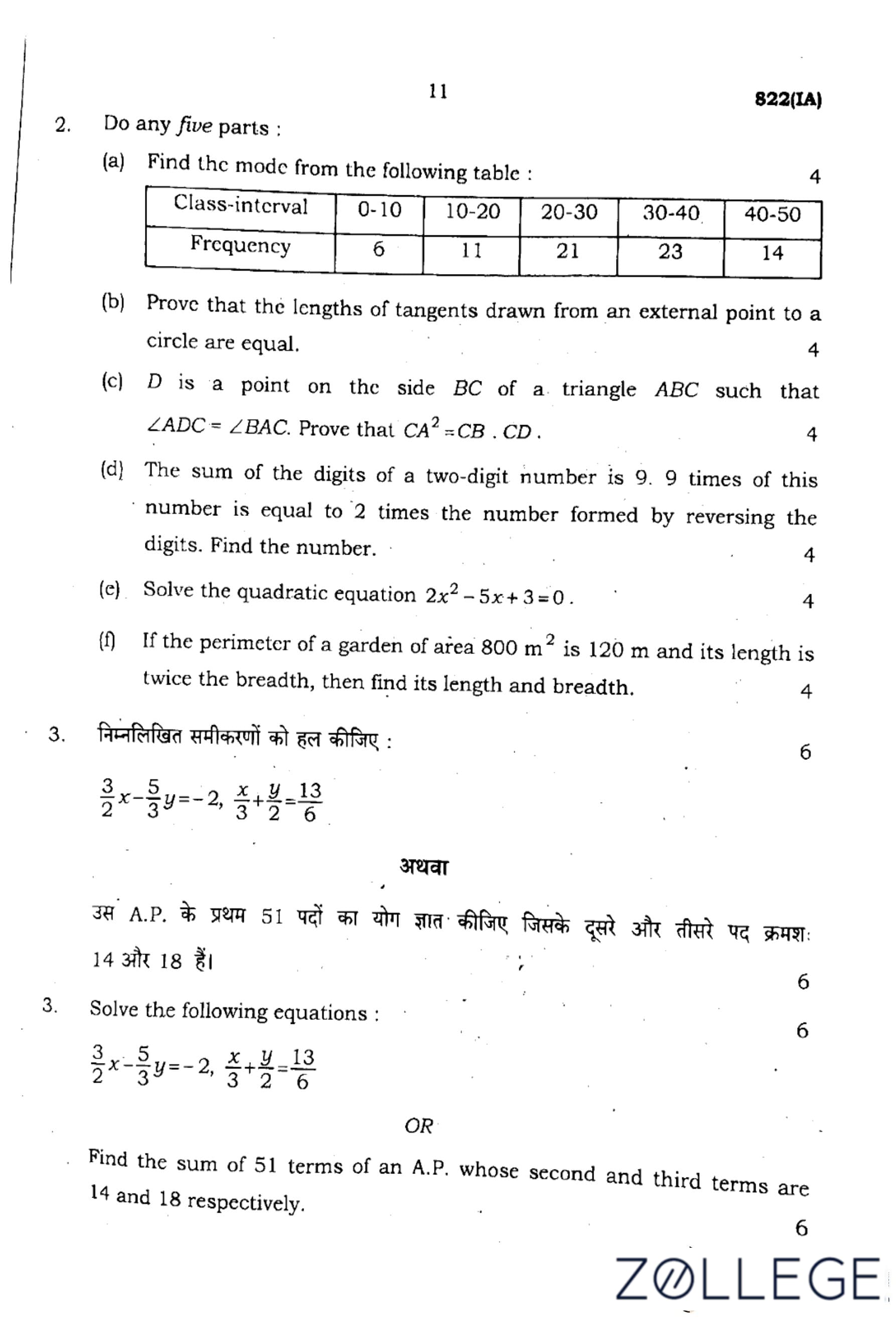
Find the mode from the following table:

View Solution
The mode of a frequency distribution is given by the formula:
\[ Mode = L + \frac{f_1 - f_0}{2f_1 - f_0 - f_2} \times h, \]
where:
- \( L \) is the lower boundary of the modal class,
- \( f_1 \) is the frequency of the modal class,
- \( f_0 \) is the frequency of the class preceding the modal class,
- \( f_2 \) is the frequency of the class succeeding the modal class,
- \( h \) is the class width.
From the table, we see that the modal class is \( 30-40 \), because it has the highest frequency of 23. The values are:
- \( f_0 = 21 \) (for \( 20-30 \)),
- \( f_1 = 23 \) (for \( 30-40 \)),
- \( f_2 = 14 \) (for \( 40-50 \)),
- \( L = 30 \) (lower boundary of the modal class),
- \( h = 10 \) (class width).
Substituting the values into the formula:
\[ Mode = 30 + \frac{23 - 21}{2(23) - 21 - 14} \times 10 \]
\[ = 30 + \frac{2}{46 - 35} \times 10 \]
\[ = 30 + \frac{2}{11} \times 10 \]
\[ = 30 + 1.81 \]
\[ = 31.81. \]
Thus, the mode is 31.81.
Quick Tip: To find the mode for grouped data, identify the modal class (highest frequency) and use the mode formula.
Prove that the lengths of tangents drawn from an external point to a circle are equal.
View Solution
Let the external point be \( P \) and the center of the circle be \( O \). Let the tangents from \( P \) touch the circle at \( A \) and \( B \). We need to prove that \( PA = PB \).
The triangle \( \triangle OPA \) and \( \triangle OPB \) are congruent because:
- \( OA = OB \) (radii of the same circle),
- \( OP = OP \) (common side),
- \( \angle OPA = \angle OPB = 90^\circ \) (tangents are perpendicular to the radius at the point of contact).
By the congruence of \( \triangle OPA \) and \( \triangle OPB \), we have:
\[ PA = PB. \]
Thus, the lengths of the tangents drawn from an external point to a circle are equal.
Quick Tip: To prove that tangents from an external point are equal, use the congruence of the two right triangles formed by the radius and tangents.
D is a point on the side BC of a triangle ABC such that \( \angle ADC = \angle BAC \). Prove that \( CA^2 = CB \times CD \).
View Solution
Since \( \angle ADC = \angle BAC \), we have \( \triangle ADC \sim \triangle ABC \) by AA similarity (angle-angle similarity).
Therefore, by the property of similar triangles: \[ \frac{CA}{CB} = \frac{CD}{CA}. \]
Cross-multiply: \[ CA^2 = CB \times CD. \]
Thus, \( CA^2 = CB \times CD \) is proved. Quick Tip: When angles are equal, use the similarity of triangles to establish relationships between their sides.
The sum of the digits of a two-digit number is 9 times of this number is equal to 2 times the number formed by reversing the digits. Find the number.
View Solution
Let the two-digit number be \( 10a + b \), where \( a \) is the tens digit and \( b \) is the ones digit.
From the given information:
1. The sum of the digits is \( a + b = 9 \),
2. The number formed by reversing the digits is \( 10b + a \),
3. \( 10a + b = 2(10b + a) \).
Solving the second equation: \[ 10a + b = 20b + 2a, \] \[ 10a - 2a = 20b - b, \] \[ 8a = 19b. \]
Now use \( a + b = 9 \), so \( a = 9 - b \), and substitute this into the equation \( 8a = 19b \): \[ 8(9 - b) = 19b, \] \[ 72 - 8b = 19b, \] \[ 72 = 27b \quad \Rightarrow \quad b = \frac{72}{27} = \frac{8}{3}. \]
This gives the value of \( b = 8 \), and hence, \( a = 9 - 8 = 1 \).
Thus, the number is \( 10a + b = 10(1) + 8 = 18 \). Quick Tip: For problems involving two-digit numbers, set up equations for the sum and reversal of digits.
Solve the quadratic equation \( 2x^2 - 5x + 3 = 0 \).
View Solution
The given quadratic equation is: \[ 2x^2 - 5x + 3 = 0. \]
We solve this using the quadratic formula: \[ x = \frac{-b \pm \sqrt{b^2 - 4ac}}{2a}, \]
where \( a = 2 \), \( b = -5 \), and \( c = 3 \).
Substituting the values into the formula: \[ x = \frac{-(-5) \pm \sqrt{(-5)^2 - 4(2)(3)}}{2(2)} = \frac{5 \pm \sqrt{25 - 24}}{4} = \frac{5 \pm \sqrt{1}}{4}. \]
Thus: \[ x = \frac{5 \pm 1}{4}. \]
This gives two solutions: \[ x = \frac{5 + 1}{4} = \frac{6}{4} = 1.5 \quad or \quad x = \frac{5 - 1}{4} = \frac{4}{4} = 1. \]
Therefore, the solutions are \( x = 1.5 \) or \( x = 1 \). Quick Tip: Use the quadratic formula \( x = \frac{-b \pm \sqrt{b^2 - 4ac}}{2a} \) to solve any quadratic equation.
If the perimeter of a garden of area \( 800 \, m^2 \) is \( 120 \, m \) and its length is twice the breadth, then find its length and breadth.
View Solution
Let the length of the garden be \( l \) and the breadth be \( b \). According to the given information:
- The area of the garden is \( l \times b = 800 \),
- The perimeter of the garden is \( 2(l + b) = 120 \),
- The length is twice the breadth, so \( l = 2b \).
Substitute \( l = 2b \) into the area equation: \[ 2b \times b = 800 \quad \Rightarrow \quad 2b^2 = 800 \quad \Rightarrow \quad b^2 = 400 \quad \Rightarrow \quad b = \sqrt{400} = 20. \]
Now, substitute \( b = 20 \) into \( l = 2b \): \[ l = 2 \times 20 = 40. \]
Thus, the length is \( 40 \, m \) and the breadth is \( 20 \, m \). Quick Tip: To solve problems involving areas and perimeters, use the relations between length, breadth, area, and perimeter effectively.
Solve the following equations:
\[ \frac{3}{2}x - \frac{5}{3}y = -2, \quad \frac{x}{3} + \frac{y}{2} = \frac{13}{6}. \]
View Solution
We are given the system of two linear equations:
\[ \frac{3}{2}x - \frac{5}{3}y = -2 \tag{1} \]
and
\[ \frac{x}{3} + \frac{y}{2} = \frac{13}{6}. \tag{2} \]
Step 1: Eliminate fractions
Multiply equation (1) by 6 to eliminate denominators:
\[ 6 \times \left( \frac{3}{2}x - \frac{5}{3}y \right) = 6 \times (-2), \] \[ 9x - 10y = -12. \tag{3} \]
Multiply equation (2) by 6 as well:
\[ 6 \times \left( \frac{x}{3} + \frac{y}{2} \right) = 6 \times \left( \frac{13}{6} \right), \] \[ 2x + 3y = 13. \tag{4} \]
Now, we have the system:
\[ 9x - 10y = -12 \tag{3} \] \[ 2x + 3y = 13. \tag{4} \]
Step 2: Solve by elimination
Multiply equation (4) by 9 and equation (3) by 2 to align coefficients of \( x \):
\[ (9 \times (2x + 3y)) = 9 \times 13 \]
\[ 18x + 27y = 117. \tag{5} \]
\[ (2 \times (9x - 10y)) = 2 \times (-12) \]
\[ 18x - 20y = -24. \tag{6} \]
Subtract equation (6) from equation (5):
\[ (18x + 27y) - (18x - 20y) = 117 - (-24), \]
\[ 18x + 27y - 18x + 20y = 117 + 24, \]
\[ 47y = 141. \]
\[ y = \frac{141}{47} = 3. \]
Step 3: Substitute \( y = 3 \) into equation (4)
\[ 2x + 3(3) = 13, \]
\[ 2x + 9 = 13, \]
\[ 2x = 4, \]
\[ x = 2. \]
Final Answer:
\[ x = 2, \quad y = 3. \] Quick Tip: When solving linear equations, eliminate fractions by multiplying both sides by the least common multiple to simplify calculations.
Find the sum of 51 terms of an A.P. whose second and third terms are 14 and 18 respectively.
View Solution
Let the first term of the A.P. be \( a \) and the common difference be \( d \).
The second term is given by: \[ a + d = 14. \]
The third term is given by: \[ a + 2d = 18. \]
We have the system of two equations: \[ a + d = 14 \tag{8} \]
and \[ a + 2d = 18. \tag{9} \]
Subtract equation (8) from equation (9): \[ (a + 2d) - (a + d) = 18 - 14, \] \[ d = 4. \]
Now substitute \( d = 4 \) into equation (8): \[ a + 4 = 14 \quad \Rightarrow \quad a = 10. \]
Thus, the first term is \( a = 10 \) and the common difference is \( d = 4 \).
The sum of the first \( n \) terms of an A.P. is given by the formula: \[ S_n = \frac{n}{2} \left( 2a + (n - 1) d \right). \]
Substitute \( n = 51 \), \( a = 10 \), and \( d = 4 \) into the formula: \[ S_{51} = \frac{51}{2} \left( 2(10) + (51 - 1) \times 4 \right) = \frac{51}{2} \left( 20 + 200 \right) = \frac{51}{2} \times 220 = 51 \times 110 = 5610. \]
Thus, the sum of the first 51 terms is \( 5610 \). Quick Tip: To find the sum of terms in an A.P., use the formula \( S_n = \frac{n}{2} \left( 2a + (n - 1) d \right) \), where \( a \) is the first term, \( d \) is the common difference, and \( n \) is the number of terms.
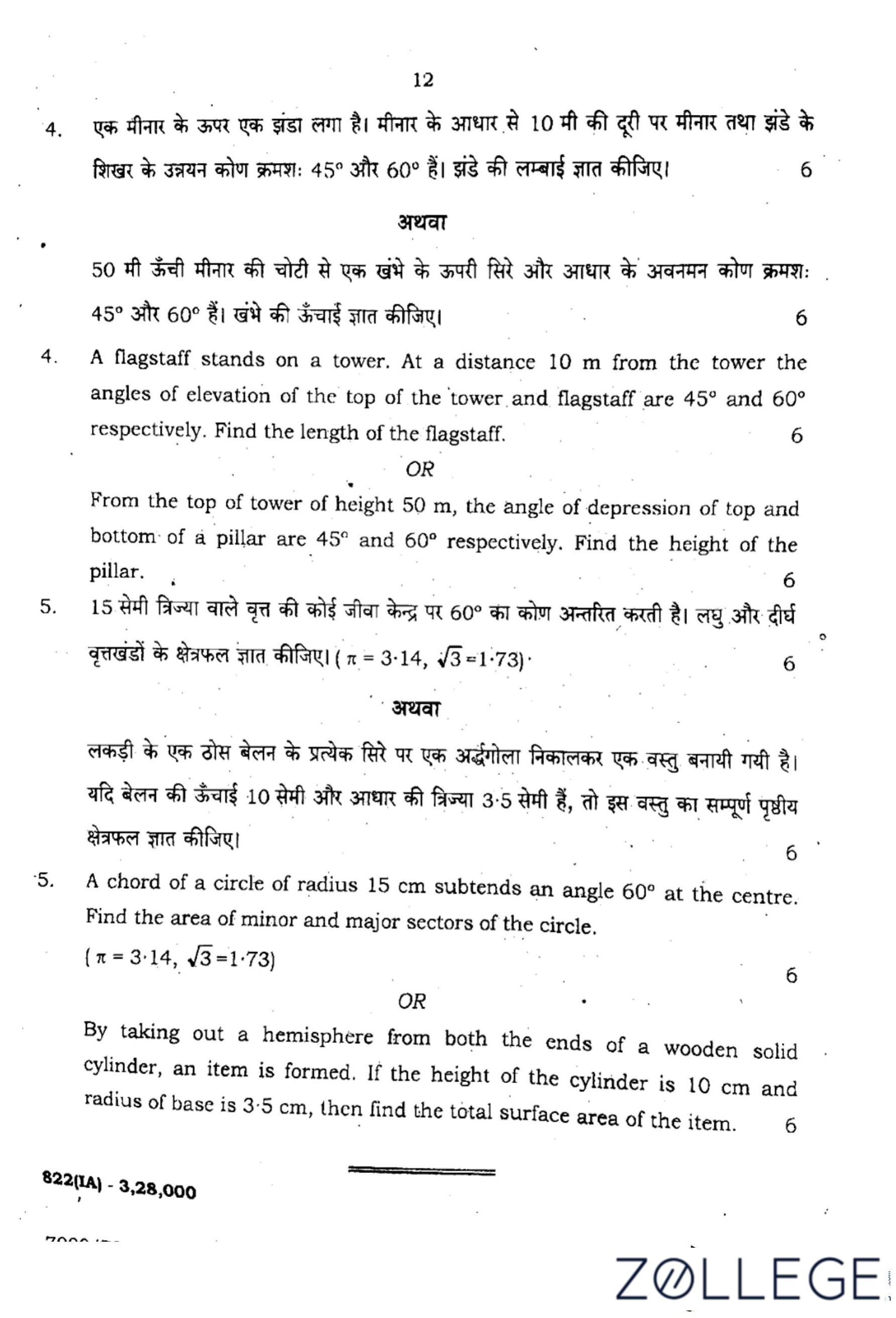
A flagstaff stands on a tower. At a distance of 10 m from the tower, the angles of elevation of the top of the tower and the flagstaff are 45° and 60°, respectively. Find the length of the flagstaff.
View Solution
Let the height of the tower be \( h_1 \) and the height of the flagstaff be \( h_2 \).
We are given:
- The distance from the base of the tower to the point of observation is 10 m,
- The angle of elevation to the top of the tower is 45°, and
- The angle of elevation to the top of the flagstaff is 60°.
We can apply the tangent function, which relates the angle of elevation and the opposite side (height) to the adjacent side (distance from the base):
\[ \tan(45^\circ) = \frac{h_1}{10} \quad \Rightarrow \quad h_1 = 10 \times \tan(45^\circ) = 10 \times 1 = 10. \]
Now, for the flagstaff:
\[ \tan(60^\circ) = \frac{h_1 + h_2}{10} \quad \Rightarrow \quad h_1 + h_2 = 10 \times \tan(60^\circ) = 10 \times \sqrt{3} \approx 10 \times 1.732 = 17.32. \]
Since \( h_1 = 10 \), we find:
\[ h_2 = 17.32 - 10 = 7.32. \]
Thus, the length of the flagstaff is approximately \( 7.32 \) m.
Quick Tip: Use the tangent function \( \tan(\theta) = \frac{opposite}{adjacent} \) to solve height and distance problems involving angles of elevation and depression.
From the top of a tower of height 50 m, the angle of depression of the top and bottom of a pillar are 45° and 60°, respectively. Find the height of the pillar.
View Solution
Let the height of the pillar be \( h_3 \) and let the horizontal distance between the tower and the pillar be \( d \).
We are given:
- The height of the tower is \( 50 \) m,
- The angle of depression to the top of the pillar is \( 45^\circ \),
- The angle of depression to the bottom of the pillar is \( 60^\circ \).
Step 1: Find the horizontal distance \( d \)
Using the right triangle formed by the top of the tower and the top of the pillar, we apply the tangent function:
\[ \tan(45^\circ) = \frac{50 - h_3}{d}. \]
Since \( \tan(45^\circ) = 1 \), we get:
\[ d = 50 - h_3. \tag{1} \]
Similarly, for the bottom of the pillar:
\[ \tan(60^\circ) = \frac{50}{d}. \]
Since \( \tan(60^\circ) = \sqrt{3} \approx 1.732 \), we get:
\[ d = \frac{50}{1.732} \approx 28.87. \tag{2} \]
Step 2: Solve for \( h_3 \)
Substituting \( d = 28.87 \) into equation (1):
\[ 28.87 = 50 - h_3. \]
Solving for \( h_3 \):
\[ h_3 = 50 - 28.87 = 21.13 \approx 21.1. \]
Thus, the height of the pillar is 21.1 m.
Quick Tip: Use the tangent function \( \tan(\theta) = \frac{opposite}{adjacent} \) to solve problems involving angles of depression or elevation.
A chord of a circle of radius 15 cm subtends an angle 60° at the center. Find the area of minor and major sectors of the circle.
View Solution
We are given:
- The radius \( r = 15 \, cm \),
- The central angle \( \theta = 60^\circ \).
Step 1: Find the area of the minor sector
The formula for the area of a sector is:
\[ A_{sector} = \frac{\theta}{360^\circ} \times \pi r^2. \]
Substituting the values:
\[ A_{minor sector} = \frac{60}{360} \times \pi \times (15)^2 \]
\[ = \frac{1}{6} \times \pi \times 225 \]
\[ = 37.5\pi. \]
Approximating \( \pi \approx 3.1416 \):
\[ A_{minor sector} \approx 37.5 \times 3.1416 = 117.81 cm^2. \]
Step 2: Find the area of the major sector
The area of the entire circle is:
\[ A_{circle} = \pi r^2 = \pi \times (15)^2 = 225\pi. \]
The major sector is the remaining part of the circle:
\[ A_{major sector} = A_{circle} - A_{minor sector}. \]
\[ = 225\pi - 37.5\pi = 187.5\pi. \]
Approximating:
\[ A_{major sector} \approx 187.5 \times 3.1416 = 686.0625 cm^2. \]
Final Answer:
- Area of the minor sector \( \approx 117.81 cm^2 \).
- Area of the major sector \( \approx 686.0625 cm^2 \).
Quick Tip: The area of a sector is given by \( A_{sector} = \frac{\theta}{360^\circ} \times \pi r^2 \), where \( \theta \) is the central angle and \( r \) is the radius of the circle.
A chord of a circle of radius 15 cm subtends an angle 60° at the center. Find the area of minor and major sectors of the circle.
View Solution
We are given:
- The radius \( r = 15 \, cm \),
- The central angle \( \theta = 60^\circ \).
The formula for the area of a sector is: \[ A_{sector} = \frac{\theta}{360^\circ} \times \pi r^2. \]
Substitute the given values for the minor sector: \[ A_{minor sector} = \frac{60^\circ}{360^\circ} \times \pi \times (15)^2 = \frac{1}{6} \times \pi \times 225 = 37.5\pi \approx 117.81 \, cm^2. \]
For the major sector, subtract the minor sector area from the total area of the circle: \[ A_{circle} = \pi r^2 = \pi \times (15)^2 = 225\pi \approx 706.86 \, cm^2. \] \[ A_{major sector} = A_{circle} - A_{minor sector} = 225\pi - 37.5\pi = 187.5\pi \approx 589.05 \, cm^2. \]
Thus, the area of the minor sector is approximately \( 117.81 \, cm^2 \) and the area of the major sector is approximately \( 589.05 \, cm^2 \). Quick Tip: The area of a sector is \( A_{sector} = \frac{\theta}{360^\circ} \times \pi r^2 \), where \( \theta \) is the central angle and \( r \) is the radius of the circle.
By taking out a hemisphere from both the ends of a wooden solid cylinder, an item is formed. If the height of the cylinder is 10 cm and the radius of the base is 3.5 cm, then find the total surface area of the item.
View Solution
Let the radius of the base of the cylinder be \( r = 3.5 \, cm \) and the height of the cylinder be \( h = 10 \, cm \).
The total surface area of the item consists of:
1. The lateral surface area of the cylinder,
2. The surface area of the two hemispheres that are formed at the ends of the cylinder.
% 1. Lateral surface area of the cylinder:
The lateral surface area of the cylinder is given by the formula: \[ A_{lateral} = 2 \pi r h. \]
Substituting the given values: \[ A_{lateral} = 2 \pi \times 3.5 \times 10 = 70\pi \, cm^2. \]
% 2. Surface area of the two hemispheres:
The surface area of one hemisphere is given by: \[ A_{hemisphere} = 2 \pi r^2. \]
Thus, the surface area of two hemispheres is: \[ A_{2 hemispheres} = 2 \times 2 \pi r^2 = 4 \pi r^2. \]
Substituting the given value of \( r \): \[ A_{2 hemispheres} = 4 \pi \times (3.5)^2 = 4 \pi \times 12.25 = 49\pi \, cm^2. \]
% Total surface area:
The total surface area is the sum of the lateral surface area of the cylinder and the surface area of the two hemispheres: \[ A_{total} = A_{lateral} + A_{2 hemispheres} = 70\pi + 49\pi = 119\pi. \]
Approximating \( \pi \) as 3.14: \[ A_{total} \approx 119 \times 3.14 = 373.66 \, cm^2. \]
Thus, the total surface area of the item is approximately \( 373.66 \, cm^2 \). Quick Tip: When a cylinder has hemispheres at both ends, calculate the lateral surface area of the cylinder and add the surface area of the two hemispheres to find the total surface area of the item.
*The article might have information for the previous academic years, please refer the official website of the exam.