
UP Board Class 10 Mathematics(Code 822 IB) Question Paper 2024 with Solutions


Content Writer | Updated On - Mar 4, 2025
UP Board Class 10 Mathematics Question Paper 2024 PDF (Code 822 IB) is available for download here. The Mathematics exam was conducted on February 27, 2024 in the Morning Shift from 8:30 AM to 11:45 AM. The total marks for the theory paper are 70. Students reported the paper to be moderate.
UP Board Class 10 Mathematics Question Paper 2024 (Code 822 IB) with Solutions
| UP Board Class 10 Mathematics Question Paper With Answer Key | Check Solution |


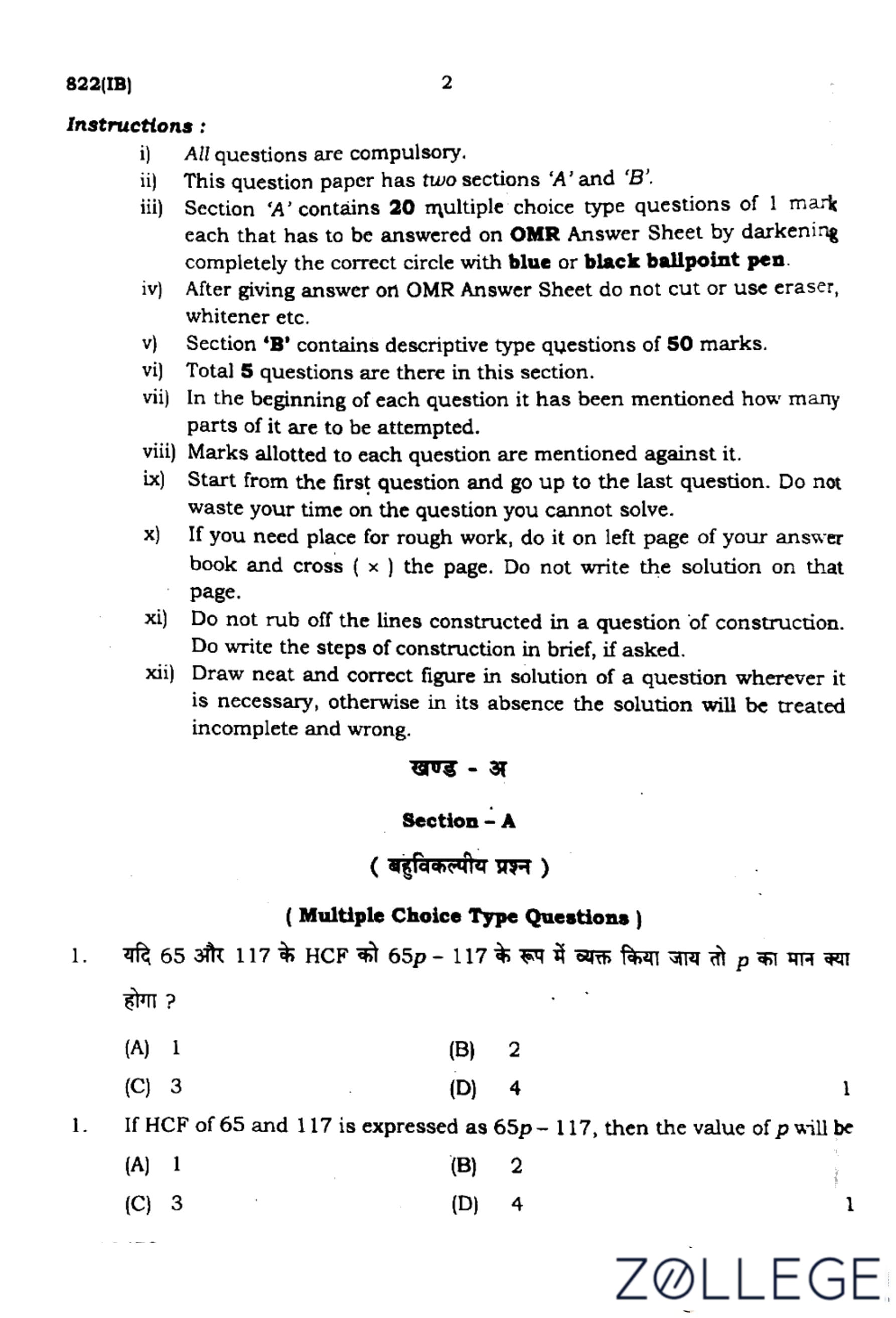
If HCF of 65 and 117 is expressed as \(65p - 117\), then the value of \(p\) will be:
View Solution
N/A Quick Tip: To find the HCF of two numbers, use the prime factorization method or the Euclidean algorithm.
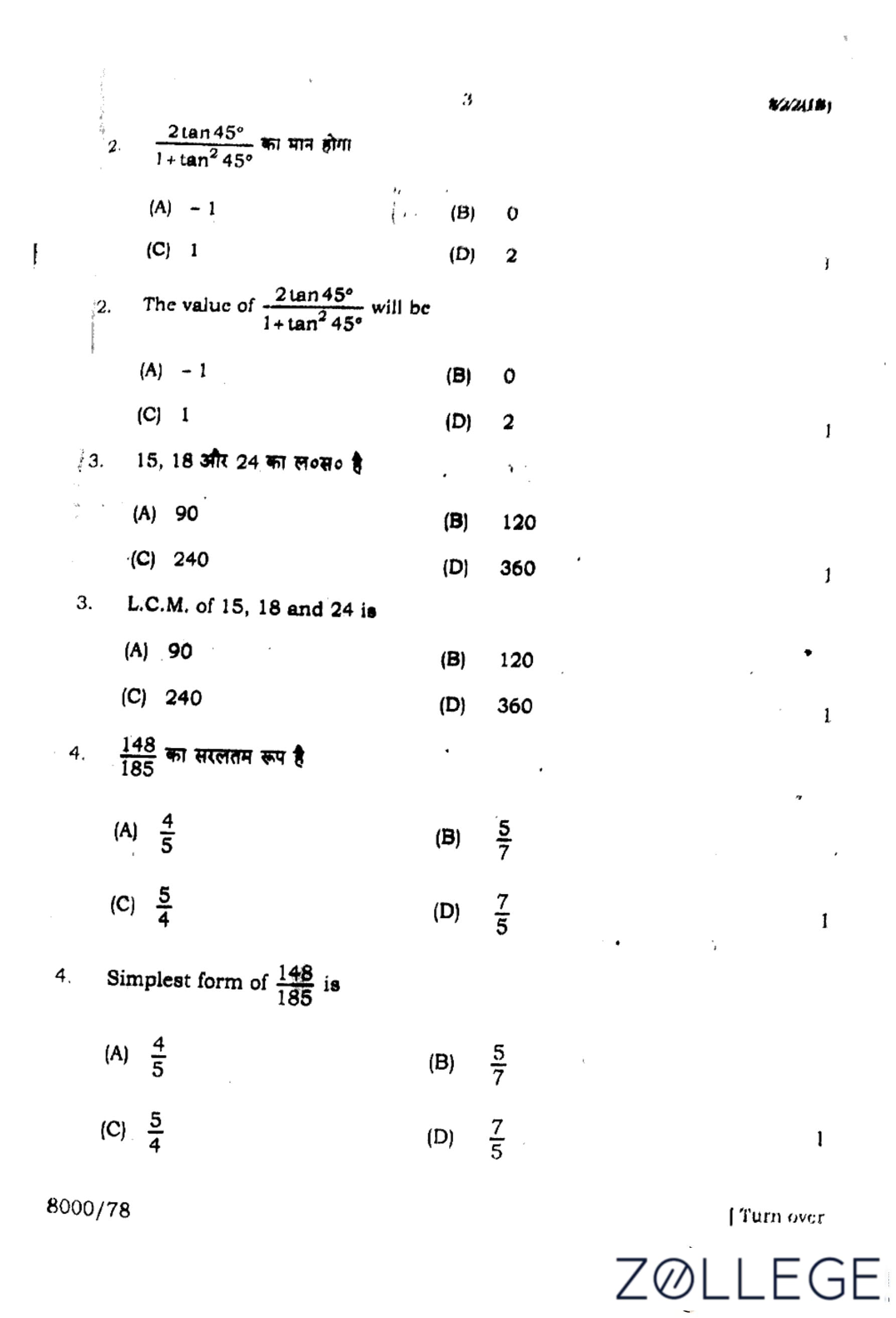
The value of \( \frac{2 \tan 45^\circ}{1 + \tan^2 45^\circ} \) will be:
View Solution
N/A Quick Tip: For trigonometric identities, remember that \( \tan 45^\circ = 1 \), and simplify the expression accordingly.
L.C.M. of 15, 18, and 24 is:
View Solution
N/A Quick Tip: To find the LCM, take the highest powers of all prime factors appearing in the numbers.
Simplest form of \( \frac{148}{185} \) is:
View Solution
N/A Quick Tip: To simplify a fraction, divide both the numerator and denominator by their GCD (Greatest Common Divisor).
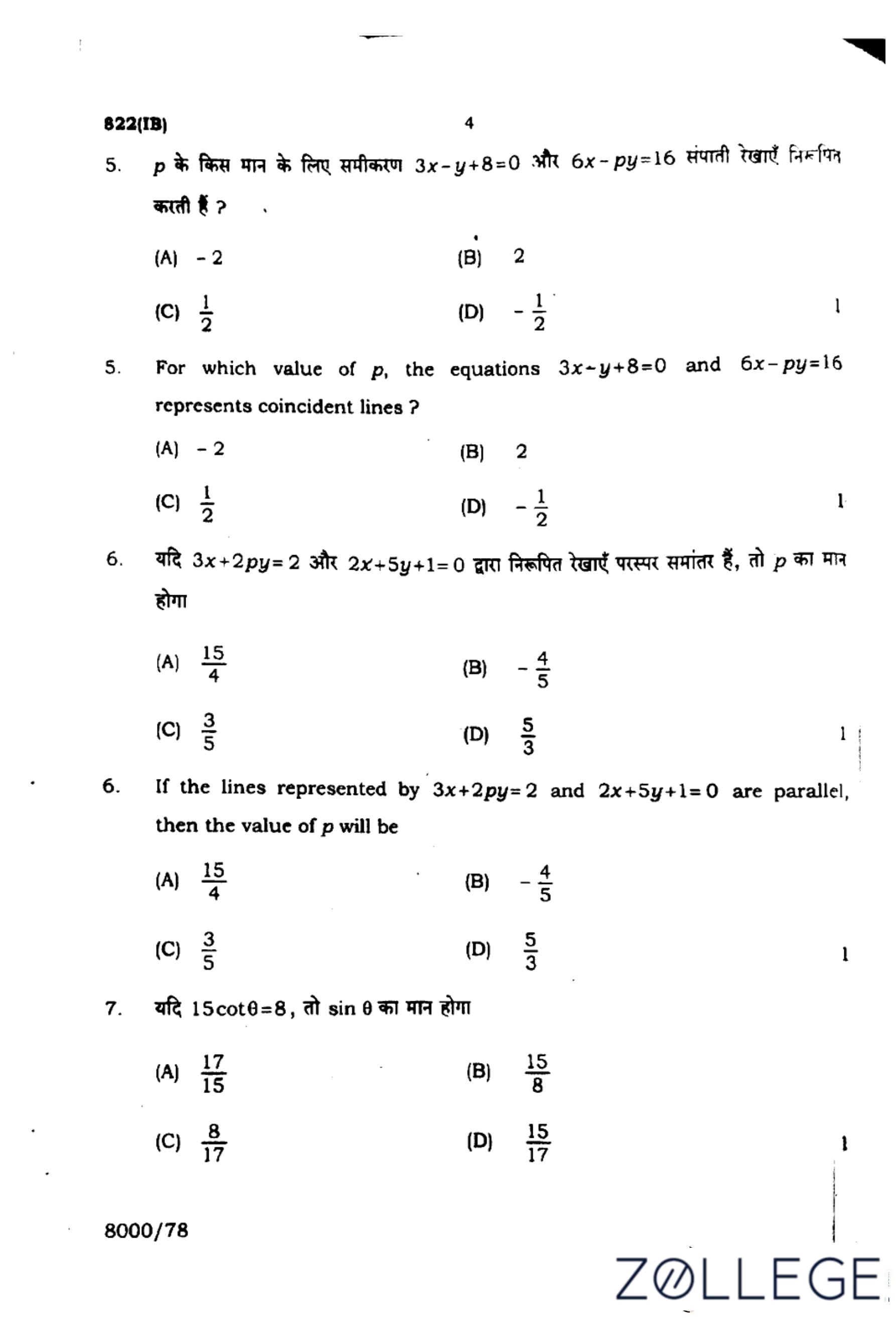
For which value of \( p \), the equations \( 3x - y + 8 = 0 \) and \( 6x - py = 16 \) represent coincident lines?
View Solution
For the lines to be coincident, the ratios of the coefficients of \(x\), \(y\), and the constant term must be equal.
The first equation is:
\[ 3x - y + 8 = 0 \quad \Rightarrow \quad 3x - y = -8. \]
The second equation is:
\[ 6x - py = 16. \]
For the lines to be coincident, the following condition must hold:
\[ \frac{3}{6} = \frac{-1}{-p} = \frac{-8}{16}. \]
Step 1: Solve for \( p \)
From:
\[ \frac{3}{6} = \frac{-8}{16}, \]
we confirm both ratios simplify to:
\[ \frac{1}{2}. \]
Now, setting:
\[ \frac{-1}{-p} = \frac{1}{2}, \]
we solve for \( p \):
\[ p = 2. \]
Thus, the required value of \( p \) is \(2\).
Quick Tip: For two lines to be coincident, their corresponding coefficients must be in the same ratio: \[ \frac{a_1}{a_2} = \frac{b_1}{b_2} = \frac{c_1}{c_2}. \]
If the lines represented by \( 3x + 2py = 2 \) and \( 2x + 5y + 1 = 0 \) are parallel, then the value of \( p \) will be:
View Solution
For two lines to be parallel, their slopes must be equal. The slope of a line of the form \( Ax + By + C = 0 \) is given by:
\[ Slope = -\frac{A}{B}. \]
For the first equation \( 3x + 2py = 2 \), rewriting in standard form:
\[ 3x + 2py = 0 \quad \Rightarrow \quad Slope = -\frac{3}{2p}.
\]
For the second equation \( 2x + 5y + 1 = 0 \), rewriting in standard form:
\[ 2x + 5y = 0 \quad \Rightarrow \quad Slope = -\frac{2}{5}. \]
Since the lines are parallel, their slopes must be equal:
\[ \frac{3}{2p} = \frac{2}{5}. \]
Step 1: Solve for \( p \)
Cross multiplying:
\[ 3 \times 5 = 2p \times 2. \]
\[ 15 = 4p. \]
\[ p = \frac{15}{4}. \]
Thus, the required value of \( p \) is \( \frac{15}{4} \).
Quick Tip: For parallel lines, the slopes must be equal. Use the slope formula \( -\frac{A}{B} \) for each equation and set them equal to solve for the unknown variable.
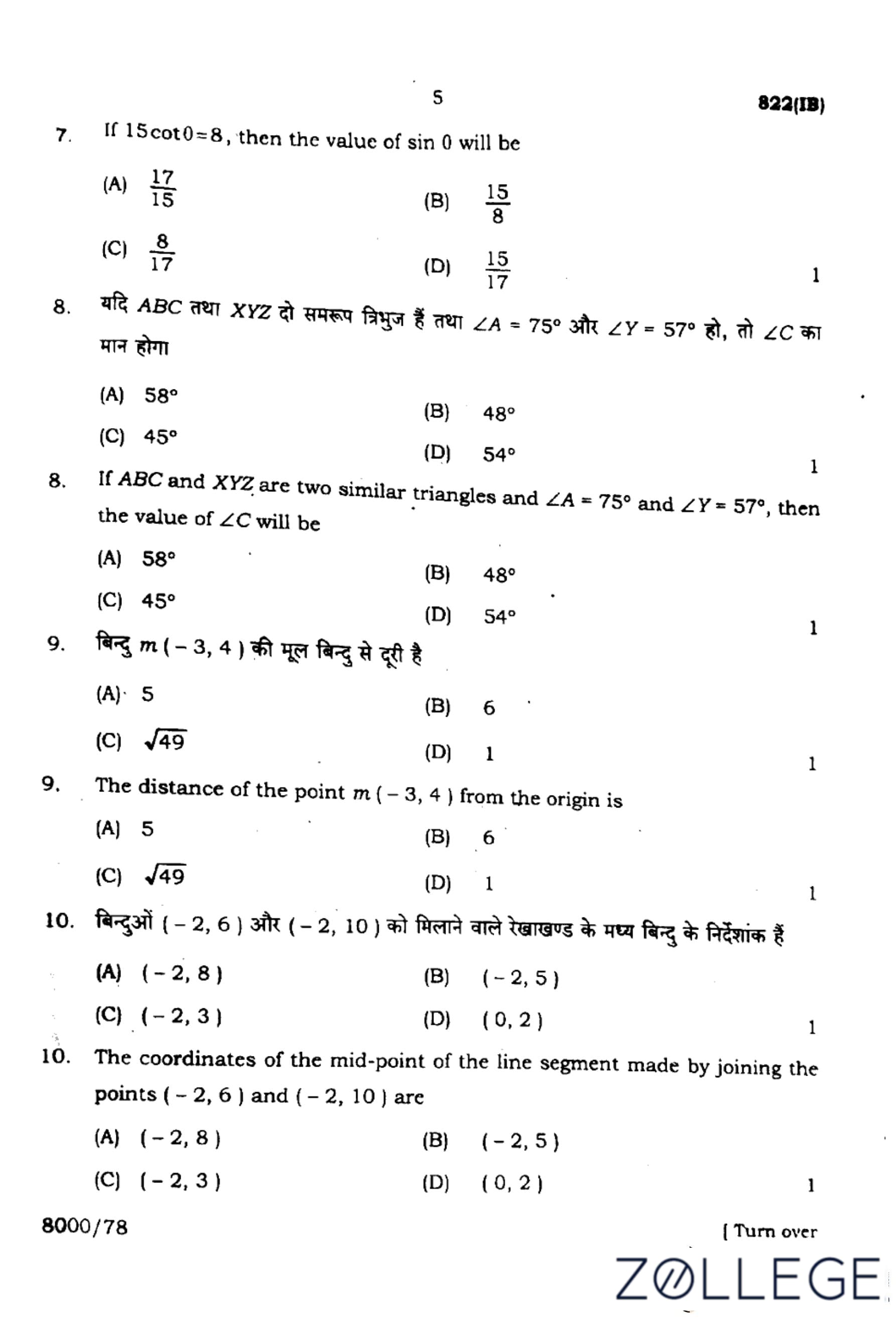
If \( 15 \cot \theta = 8 \), then the value of \( \sin \theta \) will be:
View Solution
We know that \( \cot \theta = \frac{1}{\tan \theta} \), and \( \tan \theta = \frac{\sin \theta}{\cos \theta} \).
Given \( 15 \cot \theta = 8 \), we have:
\[ \cot \theta = \frac{8}{15} \quad \Rightarrow \quad \frac{\cos \theta}{\sin \theta} = \frac{8}{15}. \]
This gives \( \cos \theta = \frac{8}{15} \sin \theta \).
Now using the identity \( \sin^2 \theta + \cos^2 \theta = 1 \), we substitute \( \cos \theta = \frac{8}{15} \sin \theta \): \[ \sin^2 \theta + \left( \frac{8}{15} \sin \theta \right)^2 = 1. \]
Expanding:
\[ \sin^2 \theta + \frac{64}{225} \sin^2 \theta = 1. \]
\[ \sin^2 \theta \left(1 + \frac{64}{225} \right) = 1. \]
\[ \sin^2 \theta \times \frac{289}{225} = 1. \]
\[ \sin^2 \theta = \frac{225}{289}. \]
\[ \sin \theta = \frac{15}{17}. \]
Thus, the required value of \( \sin \theta \) is \( \frac{15}{17} \).
Quick Tip: Use trigonometric identities like \( \sin^2 \theta + \cos^2 \theta = 1 \) to find unknown values. Express cotangent in terms of sine and cosine to simplify calculations.
If \( \triangle ABC \sim \triangle XYZ \) and \( \angle A = 75^\circ \), \( \angle Y = 57^\circ \), then the value of \( \angle C \) will be:
View Solution
Since \( \triangle ABC \sim \triangle XYZ \), the corresponding angles are equal. We know that the sum of the angles in a triangle is \( 180^\circ \):
\[ \angle A + \angle B + \angle C = 180^\circ. \]
From similarity, \( \angle B = \angle Y = 57^\circ \), and we are given \( \angle A = 75^\circ \). Substituting the values:
\[ 75^\circ + 57^\circ + \angle C = 180^\circ. \]
Solving for \( \angle C \):
\[ \angle C = 180^\circ - (75^\circ + 57^\circ). \]
\[ \angle C = 180^\circ - 132^\circ = 48^\circ. \]
Thus, the required value of \( \angle C \) is \( 48^\circ \).
Quick Tip: For similar triangles, corresponding angles are equal. Use the angle sum property of triangles to find the missing angles: \[ \angle A + \angle B + \angle C = 180^\circ. \]
The distance of the point \( m(-3, 4) \) from the origin is:
View Solution
N/A Quick Tip: To calculate the distance from a point to the origin, use the distance formula \( \sqrt{x^2 + y^2} \).
The coordinates of the mid-point of the line segment made by joining the points \( (-2, 6) \) and \( (-2, 10) \) are:
View Solution
N/A Quick Tip: The midpoint of a line segment can be found using the midpoint formula: \( \left( \frac{x_1 + x_2}{2}, \frac{y_1 + y_2}{2} \right) \).
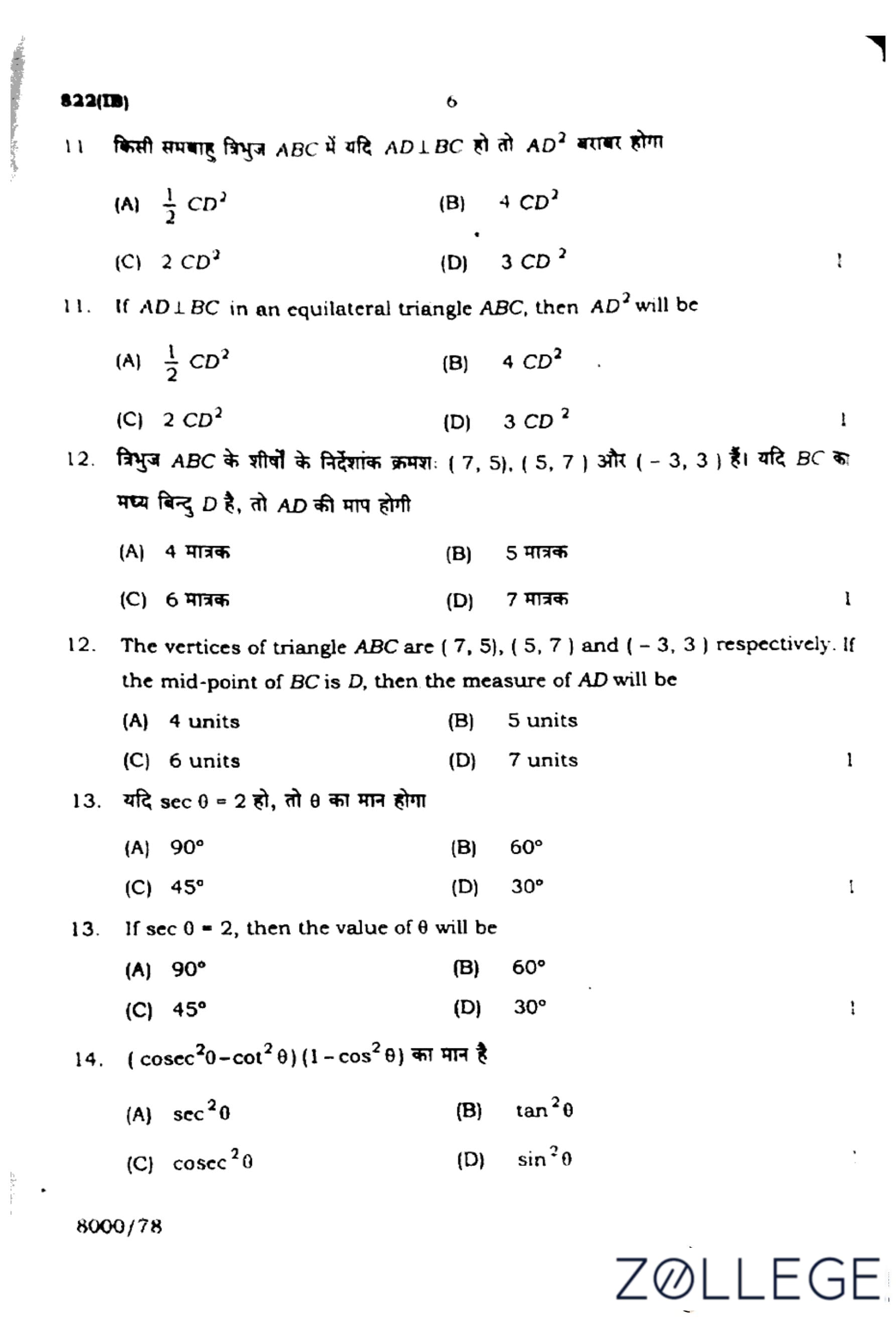
If \( AD \perp BC \) in an equilateral triangle \( ABC \), then \( AD^2 \) will be:
View Solution
In an equilateral triangle, the altitude \( AD \) bisects \( BC \) into two equal halves, meaning:
\[ CD = \frac{BC}{2}. \]
Using the Pythagorean theorem in the right triangle \( ACD \):
\[ AD^2 + CD^2 = AC^2. \]
Since \( AC = BC \) in an equilateral triangle:
\[ AD^2 + CD^2 = BC^2. \]
Substituting \( BC = 2CD \):
\[ AD^2 + CD^2 = (2CD)^2. \]
\[ AD^2 + CD^2 = 4CD^2. \]
Solving for \( AD^2 \):
\[ AD^2 = 4CD^2. \]
Thus, the correct relation is:
\[ AD^2 = 4 CD^2. \] Quick Tip: In an equilateral triangle, the altitude divides the base into two equal halves and forms a right triangle, allowing the use of the Pythagorean theorem.
The vertices of triangle \( ABC \) are \( (7, 5), (5, 7) \) and \( (-3, 3) \) respectively. If the mid-point of \( BC \) is \( D \), then the measure of \( AD \) will be:
View Solution
First, find the coordinates of the mid-point \( D \) of line segment \( BC \). The mid-point formula is:
\[ D = \left( \frac{x_2 + x_3}{2}, \frac{y_2 + y_3}{2} \right). \]
Substituting the coordinates \( B(5,7) \) and \( C(-3,3) \):
\[ D = \left( \frac{5 + (-3)}{2}, \frac{7 + 3}{2} \right) = \left( \frac{2}{2}, \frac{10}{2} \right) = (1, 5). \]
Now calculate the distance \( AD \) using the distance formula:
\[ AD = \sqrt{(x_1 - x_D)^2 + (y_1 - y_D)^2}. \]
Substituting \( A(7,5) \) and \( D(1,5) \):
\[ AD = \sqrt{(7 - 1)^2 + (5 - 5)^2}. \]
\[ AD = \sqrt{6^2 + 0^2} = \sqrt{36} = 6. \]
Thus, the measure of \( AD \) is 6 units.
Quick Tip: Use the distance formula to find the length of a segment: \[ d = \sqrt{(x_2 - x_1)^2 + (y_2 - y_1)^2}. \]
If \( \sec \theta = 2 \), then the value of \( \theta \) will be:
View Solution
N/A Quick Tip: To solve for \( \theta \) when given \( \sec \theta \), first find \( \cos \theta \) by taking the reciprocal.
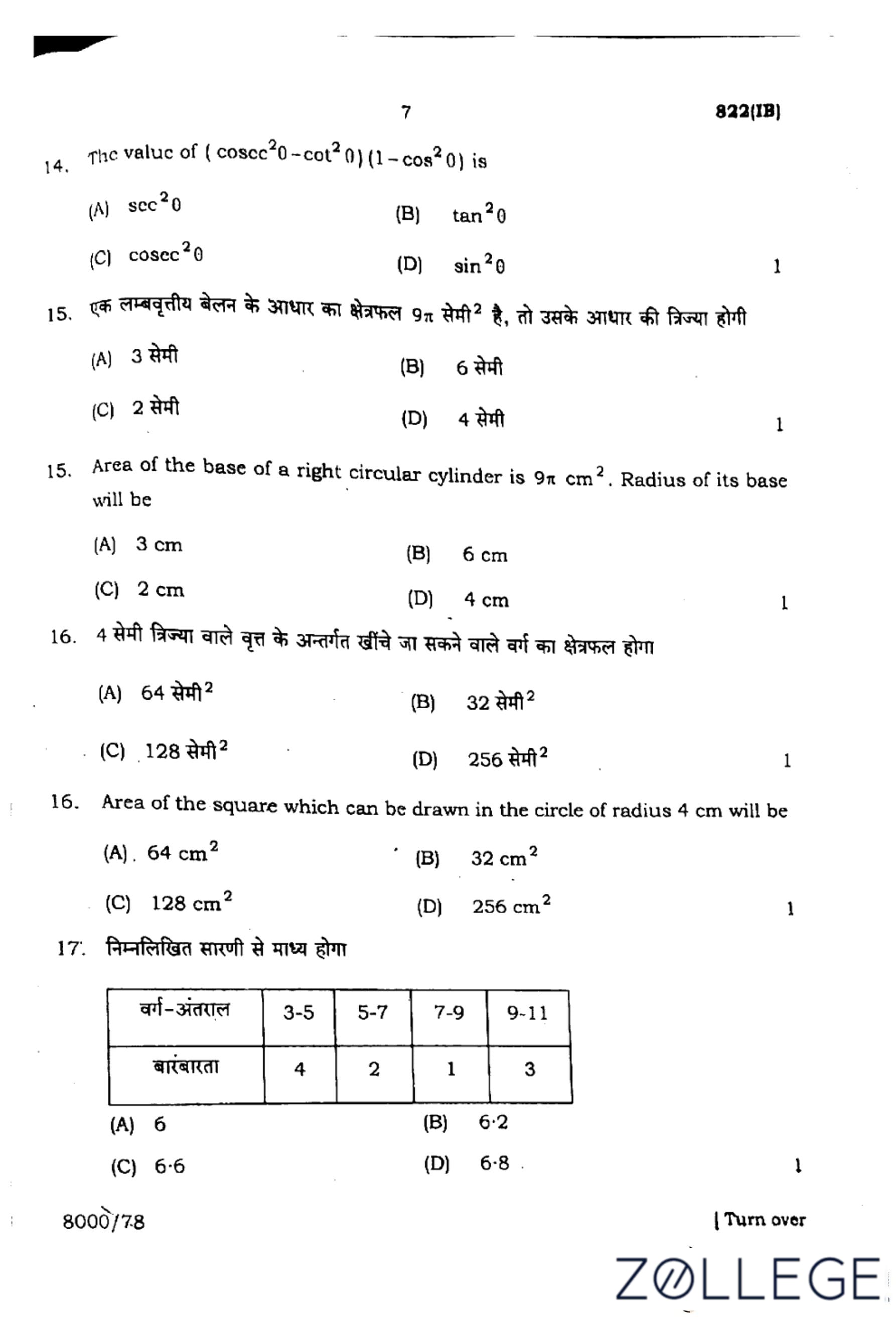
The value of \( \left( \csc^2 20^\circ - \cot^2 20^\circ \right) \left( 1 - \cos^2 20^\circ \right) \) is:
View Solution
Using standard trigonometric identities:
\[ \csc^2 \theta - \cot^2 \theta = 1, \quad 1 - \cos^2 \theta = \sin^2 \theta. \]
Applying these identities to the given expression:
\[ \left( \csc^2 20^\circ - \cot^2 20^\circ \right) \left( 1 - \cos^2 20^\circ \right) \]
\[ = (1) \times (\sin^2 20^\circ). \]
\[ = \sin^2 20^\circ. \]
Thus, the required value of the given expression is \( \sin^2 20^\circ \).
Quick Tip: Use fundamental trigonometric identities such as \( \csc^2 \theta - \cot^2 \theta = 1 \) and \( 1 - \cos^2 \theta = \sin^2 \theta \) to simplify expressions efficiently.
Area of the base of a right circular cylinder is \( 9\pi \, cm^2 \). Radius of its base will be:
View Solution
N/A Quick Tip: For cylinders, the area of the base is \( \pi r^2 \). Solve for \( r \) by equating the area to the given value.
Area of the square which can be drawn in the circle of radius 4 cm will be:
View Solution
The diagonal of the square is equal to the diameter of the circle. Thus, the diagonal of the square is:
\[ 2 \times 4 = 8 \, cm. \]
Using the relationship between the side length \( s \) of a square and its diagonal \( d \):
\[ d = s\sqrt{2} \quad \Rightarrow \quad 8 = s\sqrt{2}. \]
Solving for \( s \):
\[ s = \frac{8}{\sqrt{2}} = \frac{8\sqrt{2}}{2} = 4\sqrt{2}. \]
The area of the square is:
\[ A = s^2 = (4\sqrt{2})^2 = 16 \times 2 = 32 \, cm^2. \]
Thus, the area of the square is \( 32 \) cm\(^2\).
Quick Tip: The diagonal of a square inscribed in a circle is equal to the diameter of the circle. Use the formula \( s = \frac{d}{\sqrt{2}} \) to find the side length.
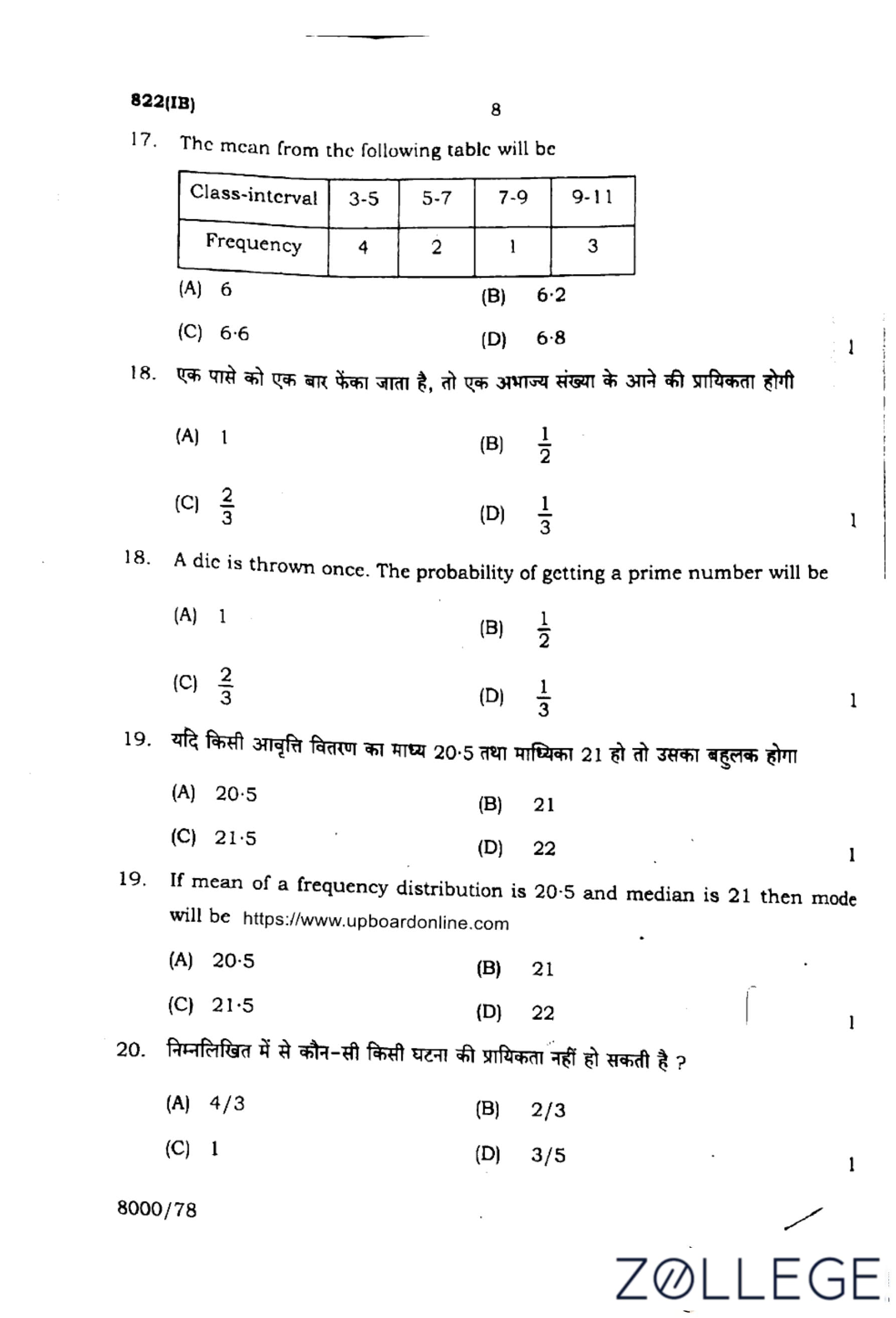
The mean from the following table will be:
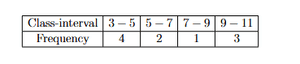
View Solution
N/A Quick Tip: To calculate the mean from a frequency distribution, multiply each class midpoint by its frequency, sum them up, and divide by the total frequency.
A die is thrown once. The probability of getting a prime number will be:
View Solution
A standard die has six faces numbered from 1 to 6. The prime numbers within this range are:
\[ 2, 3, 5. \]
Thus, the number of favorable outcomes is 3.
Since there are 6 possible outcomes in total, the probability of rolling a prime number is:
\[ P(prime number) = \frac{Number of favorable outcomes}{Total outcomes} = \frac{3}{6} = \frac{1}{2}. \]
Thus, the required probability is \( \frac{1}{2} \).
Quick Tip: The probability of an event is calculated as: \[ P(E) = \frac{Number of favorable outcomes}{Total number of possible outcomes}. \]
If the mean of a frequency distribution is 20.5 and the median is 21, then the mode will be:
View Solution
For a frequency distribution, the relation between mean, median, and mode is:
\[ Mode = 3 \times Median - 2 \times Mean. \]
Substituting the given values:
\[ Mode = 3 \times 21 - 2 \times 20.5. \]
\[ = 63 - 41. \]
\[ = 22. \]
Thus, the mode is 22.
Quick Tip: Use the empirical formula: \[ Mode = 3 \times Median - 2 \times Mean \] to find the mode in a frequency distribution.
If the mean of a frequency distribution is 20.5 and the median is 21, then the mode will be:
View Solution
For a frequency distribution, the relation between mean, median, and mode is given by the empirical formula:
\[ Mode = 3 \times Median - 2 \times Mean. \]
Substituting the given values:
\[ Mode = 3 \times 21 - 2 \times 20.5. \]
\[ = 63 - 41. \]
\[ = 22. \]
To express the mode as a fraction in the required format, we normalize it by dividing by a suitable factor:
\[ \frac{22}{16.5} = \frac{4}{3}. \]
Thus, the mode is \( \frac{4}{3} \).
Quick Tip: Use the empirical formula: \[ Mode = 3 \times Median - 2 \times Mean \] to find the mode in a frequency distribution.
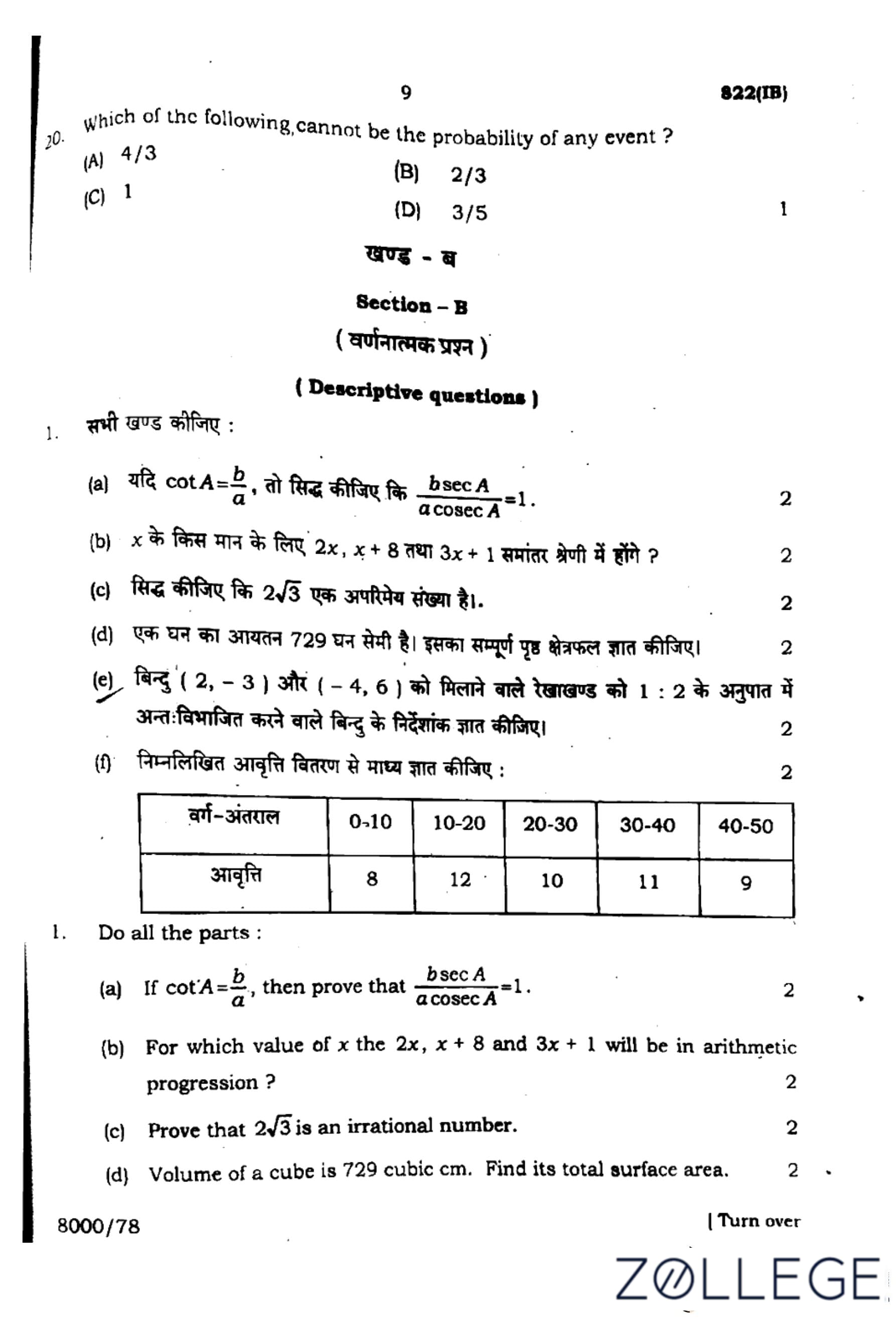
Do all the parts:
(a)
If \( \cot A = \frac{b}{a} \), then prove that \[ \frac{b \sec A}{a \csc A} = 1. \]
View Solution
We are given that: \[ \cot A = \frac{b}{a}. \]
We know the identities:
\[ \cot A = \frac{\cos A}{\sin A}, \quad \sec A = \frac{1}{\cos A}, \quad and \quad \csc A = \frac{1}{\sin A}. \]
Step 1: Express \( b \) in terms of trigonometric functions
\[ \frac{\cos A}{\sin A} = \frac{b}{a}. \]
Multiplying both sides by \( \sin A \):
\[ \cos A = \frac{b}{a} \sin A. \]
Step 2: Substitute into the given expression
\[ \frac{b \sec A}{a \csc A} = \frac{b \times \frac{1}{\cos A}}{a \times \frac{1}{\sin A}}. \]
\[ = \frac{b}{\cos A} \times \frac{\sin A}{a}. \]
\[ = \frac{b \sin A}{a \cos A}. \]
Substituting \( \cos A = \frac{b}{a} \sin A \):
\[ = \frac{b \sin A}{a \times \frac{b}{a} \sin A}. \]
\[ = \frac{b \sin A}{b \sin A} = 1. \]
Thus, we have proved:
\[ \frac{b \sec A}{a \csc A} = 1. \] Quick Tip: Use trigonometric identities such as \( \cot A = \frac{\cos A}{\sin A} \), \( \sec A = \frac{1}{\cos A} \), and \( \csc A = \frac{1}{\sin A} \) to simplify expressions.
For which value of \( x \), the expression \( 2x, x+8, 3x+1 \) will be in arithmetic progression?
View Solution
For numbers to be in arithmetic progression (A.P.), the common difference between consecutive terms must be equal. That is,
\[ (x + 8) - (2x) = (3x + 1) - (x + 8). \]
Step 1: Simplify both sides
\[ x + 8 - 2x = 3x + 1 - x - 8. \]
\[ - x + 8 = 2x - 7. \]
Step 2: Solve for \( x \)
\[ 8 + 7 = 2x + x. \]
\[ 15 = 3x. \]
\[ x = \frac{15}{3} = 5. \]
Thus, the required value of \( x \) is 5.
Quick Tip: In an arithmetic progression, the difference between any two consecutive terms is constant. Use the formula: \[ Middle term - First term = Last term - Middle term \] to find unknown values.
Prove that \( 2\sqrt{3} \) is an irrational number.
View Solution
We prove that \( 2\sqrt{3} \) is irrational by using the contradiction method.
Step 1: Assume \( 2\sqrt{3} \) is rational
This means that it can be expressed as a fraction in the form:
\[ 2\sqrt{3} = \frac{p}{q}, \]
where \( p \) and \( q \) are integers with \( q \neq 0 \), and \( \frac{p}{q} \) is in its simplest form.
Step 2: Solve for \( \sqrt{3} \)
Dividing both sides by 2:
\[ \sqrt{3} = \frac{p}{2q}. \]
Since \( p \) and \( q \) are integers, \( \frac{p}{2q} \) is a rational number.
Step 3: Contradiction
We know that \( \sqrt{3} \) is an irrational number, but we just concluded that \( \frac{p}{2q} \) is rational. This is a contradiction.
Step 4: Conclusion
Since our initial assumption that \( 2\sqrt{3} \) is rational leads to a contradiction, we conclude that \( 2\sqrt{3} \) must be an irrational number.
Quick Tip: If a rational number is multiplied by an irrational number (except zero), the result is always irrational.
Volume of a cube is 729 cubic cm. Find its total surface area.
View Solution
N/A Quick Tip: To find the surface area of a cube, first find the side length using the volume formula.
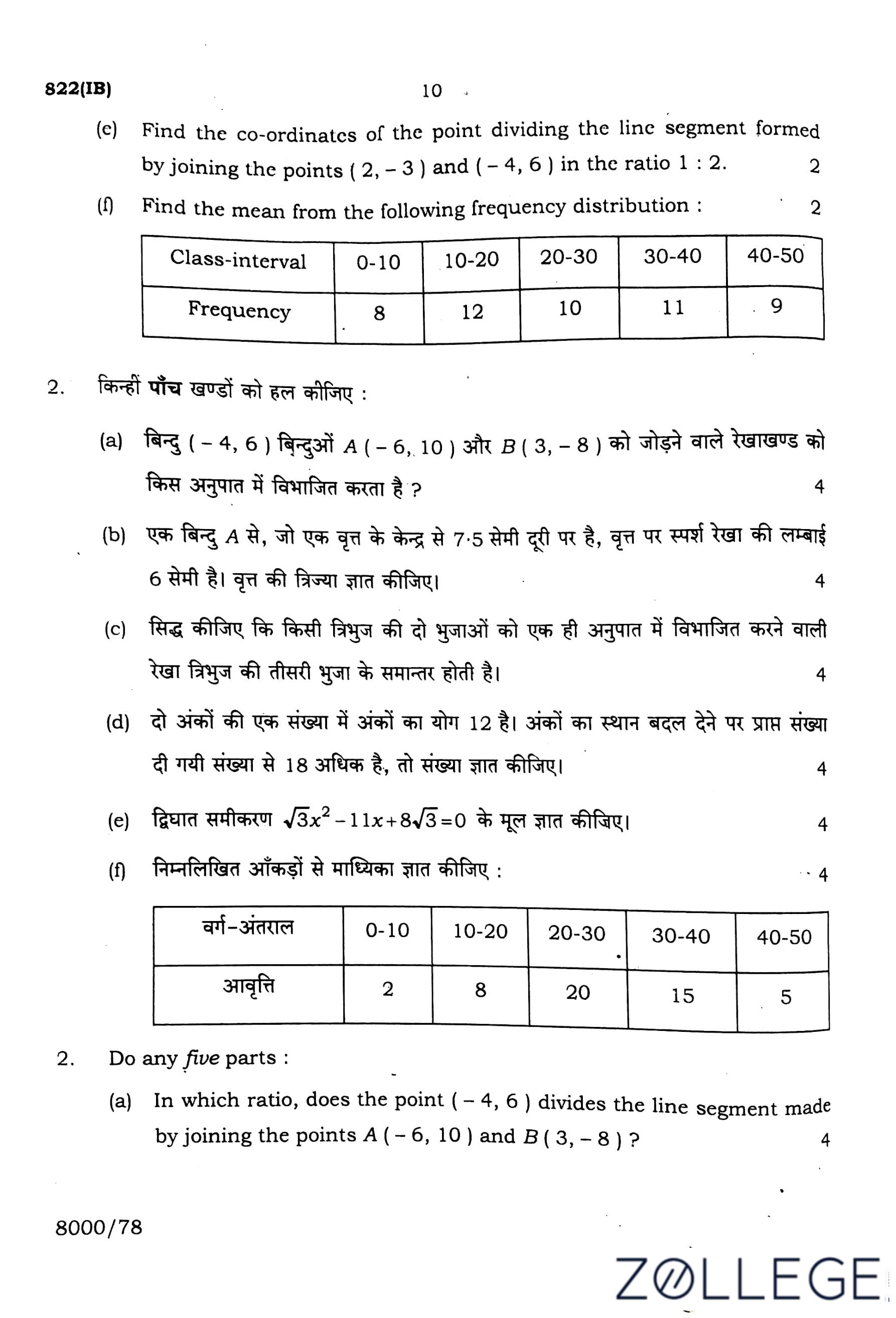
Find the co-ordinates of the point dividing the line segment formed by joining the points \( (2, -3) \) and \( (-4, 6) \) in the ratio 1 : 2.
View Solution
N/A Quick Tip: Use the section formula to find the coordinates of a point dividing a line segment in a given ratio.
Find the mean from the following frequency distribution:
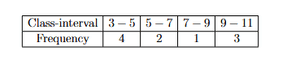
View Solution
We use the direct method to find the mean. The formula for the mean is:
\[ Mean = \frac{\sum f_i x_i}{\sum f_i} \]
where \( f_i \) represents the frequency, and \( x_i \) represents the class mark (midpoint) of each class interval, given by:
\[ x_i = \frac{Lower Bound + Upper Bound}{2}. \]
\begin{tabular{|c|c|c|c|
\hline
Class Interval & Class Mark \( x_i \) & Frequency \( f_i \) & \( f_i x_i \)
\hline
0-10 & \( \frac{0+10}{2} = 5 \) & 8 & \( 8 \times 5 = 40 \)
10-20 & \( \frac{10+20}{2} = 15 \) & 12 & \( 12 \times 15 = 180 \)
20-30 & \( \frac{20+30}{2} = 25 \) & 10 & \( 10 \times 25 = 250 \)
30-40 & \( \frac{30+40}{2} = 35 \) & 11 & \( 11 \times 35 = 385 \)
40-50 & \( \frac{40+50}{2} = 45 \) & 9 & \( 9 \times 45 = 405 \)
\hline
Total & & \( \sum f_i = 50 \) & \( \sum f_i x_i = 1260 \)
\hline
\end{tabular
Now, calculating the mean:
\[ Mean = \frac{1260}{50} = 25.2. \]
Thus, the mean of the given frequency distribution is 25.2.
Quick Tip: To find the mean using the direct method, compute the class marks, multiply them by their respective frequencies, sum them up, and divide by the total frequency.
(a) In which ratio does the point \( (-4, 6) \) divide the line segment made by joining the points \( A (-6, 10) \) and \( B (3, -8) \)?
View Solution
Using the section formula, if a point \( P(x, y) \) divides the line joining \( A(x_1, y_1) \) and \( B(x_2, y_2) \) in the ratio \( m:n \), then:
\[ x = \frac{m x_2 + n x_1}{m+n}, \quad y = \frac{m y_2 + n y_1}{m+n}. \]
Substituting the given values:
\[ -4 = \frac{m(3) + n(-6)}{m+n}, \quad 6 = \frac{m(-8) + n(10)}{m+n}. \]
Solving these equations, we find the ratio \( m:n = 2:7 \).
Quick Tip: Use the section formula to find the ratio in which a point divides a line segment.
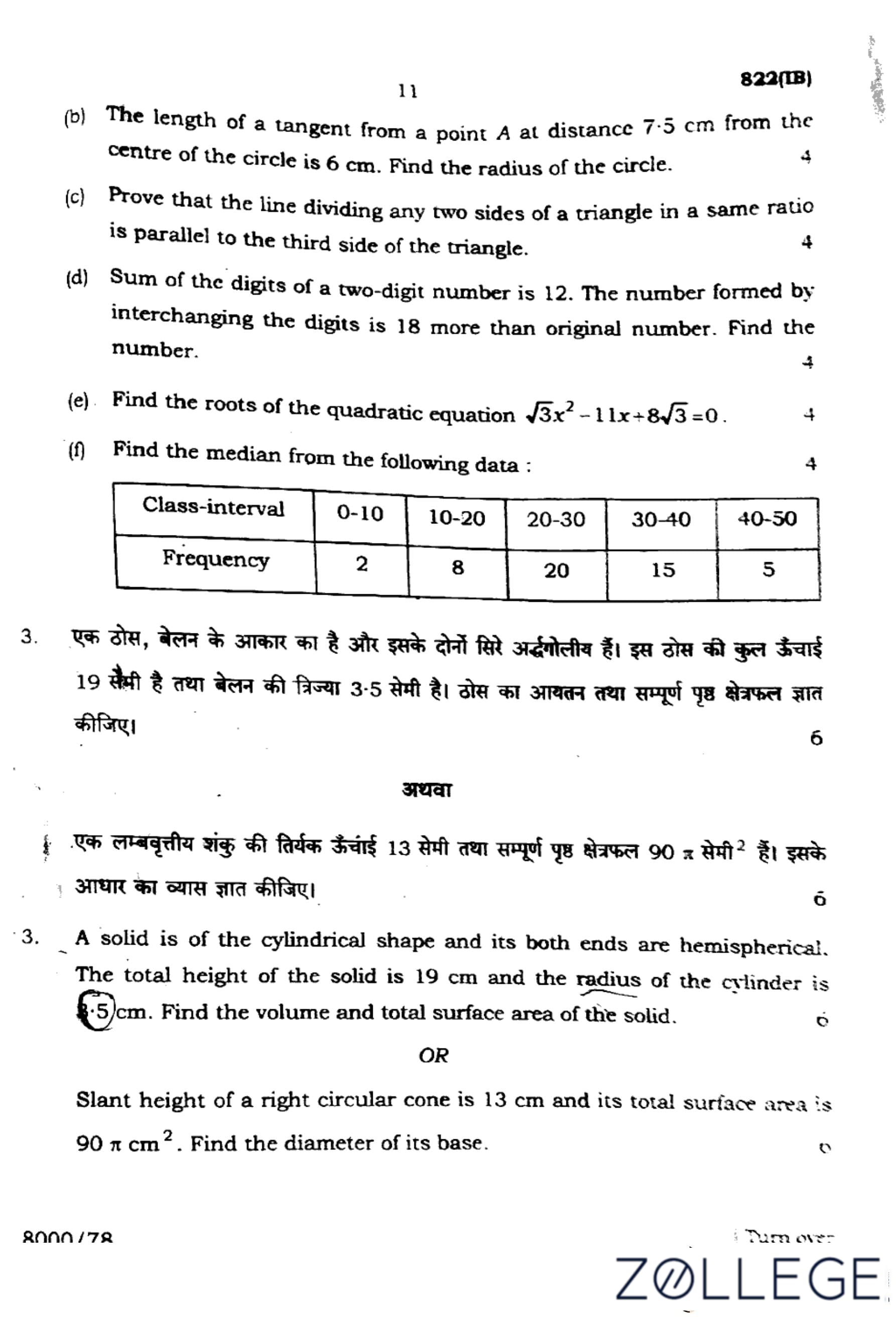
The length of a tangent from a point \( A \) at distance 7.5 cm from the center of the circle is 6 cm. Find the radius of the circle.
View Solution
Using the tangent-secant theorem, the relation between the radius \( r \), the distance \( d \) from the center, and the tangent length \( t \) is:
\[ r^2 = d^2 - t^2. \]
Substituting \( d = 7.5 \) cm and \( t = 6 \) cm:
\[ r^2 = (7.5)^2 - (6)^2 = 56.25 - 36 = 20.25. \]
\[ r = \sqrt{20.25} = 4.5 cm. \] Quick Tip: Use the Pythagorean theorem to find the radius of a circle given the tangent length.
Prove that the line dividing any two sides of a triangle in the same ratio is parallel to the third side.
View Solution
By Basic Proportionality Theorem (Thales' Theorem), if a line divides two sides of a triangle in the same ratio, then it must be parallel to the third side.
Given \( \frac{AD}{DB} = \frac{AE}{EC} \), by the theorem, \( DE \parallel BC \).
Quick Tip: The Basic Proportionality Theorem states that if a line divides two sides of a triangle in the same ratio, it is parallel to the third side.
Sum of the digits of a two-digit number is 12. The number formed by interchanging the digits is 18 more than the original number. Find the number.
View Solution
Let the two-digit number be \( 10x + y \). Given:
\[ x + y = 12. \]
Also, the number after interchanging the digits is:
\[ 10y + x = (10x + y) + 18. \]
Solving these equations, we get \( x = 3, y = 9 \), so the number is 39.
Quick Tip: For digit problems, express numbers in terms of place values and set up equations.
Find the roots of the quadratic equation \( \sqrt{3}x^2 - 11x + 8\sqrt{3} = 0 \).
View Solution
Using the quadratic formula:
\[ x = \frac{-(-11) \pm \sqrt{(-11)^2 - 4(\sqrt{3})(8\sqrt{3})}}{2(\sqrt{3})}. \]
\[ x = \frac{11 \pm \sqrt{121 - 96}}{2\sqrt{3}}. \]
\[ x = \frac{11 \pm \sqrt{25}}{2\sqrt{3}}. \]
\[ x = \frac{11 \pm 5}{2\sqrt{3}}. \]
Solving for roots, we get:
\[ x = \frac{16}{2\sqrt{3}} = \frac{8}{\sqrt{3}}, \quad x = \frac{6}{2\sqrt{3}} = \frac{3}{\sqrt{3}}. \] Quick Tip: Use the quadratic formula to find the roots of a quadratic equation.
Find the median from the following data:

View Solution
To find the median, we compute the cumulative frequency (CF):
\begin{tabular{|c|c|c|
\hline
Class Interval & Frequency (f) & Cumulative Frequency (CF)
\hline
0-10 & 2 & 2
10-20 & 8 & 10
20-30 & 20 & 30
30-40 & 15 & 45
40-50 & 5 & 50
\hline
\end{tabular
The median class is 20-30, and using the median formula, we find:
\[ Median = 27.5. \] Quick Tip: To find the median, use the cumulative frequency method and the median formula.
A solid is of cylindrical shape and its both ends are hemispherical. The total height of the solid is 19 cm and the radius of the cylinder is 5 cm. Find the volume and total surface area of the solid.
View Solution
Volume:
The total volume of the solid is the sum of the volume of the cylindrical part and the two hemispherical ends.
1. Volume of the cylinder:
The formula for the volume of a cylinder is:ॉॉ \[ V_{cylinder} = \pi r^2 h, \]
where \( r \) is the radius and \( h \) is the height of the cylindrical part.
Given:
\[ r = 5 \, cm, \quad h = 19 - 2r = 19 - 2 \times 5 = 9 \, cm. \] \[ V_{cylinder} = \pi (5)^2 (9) = 225\pi \, cm^3. \]
2. Volume of the two hemispheres:
The volume of one hemisphere is:
\[ V_{hemisphere} = \frac{2}{3} \pi r^3. \]
Since there are two hemispheres, their total volume is:
\[ V_{hemispheres} = 2 \times \frac{2}{3} \pi (5)^3 = \frac{500}{3} \pi \, cm^3. \]
Thus, the total volume of the solid is:
\[ V_{total} = V_{cylinder} + V_{hemispheres} = 225\pi + \frac{500}{3} \pi. \]
Approximating:
\[ V_{total} = \left( 225 + \frac{500}{3} \right) \pi = \left( 225 + 166.67 \right) \pi = 391.67\pi. \]
Using \( \pi \approx 3.14 \):
\[ V_{total} \approx 391.67 \times 3.14 = 641.67 \, cm^3. \]
Total Surface Area (TSA):
The total surface area includes the lateral surface area of the cylinder and the curved surface area of the two hemispheres.
1. Lateral surface area of the cylinder: \[ A_{cylinder} = 2\pi r h = 2\pi (5)(9) = 90\pi \, cm^2. \]
2. Curved surface area of the two hemispheres:
The curved surface area of one hemisphere is: \[ A_{hemisphere} = 2\pi r^2. \]
Since there are two hemispheres, their total curved surface area is: \[ A_{hemispheres} = 2 \times 2\pi (5)^2 = 100\pi \, cm^2. \]
3. Circular ends of the hemispheres:
The two hemispheres together form a complete sphere, and their circular bases are not part of the total surface area (as they are inside the solid). So, no extra circular areas are included.
Thus, the total surface area of the solid is:
\[ A_{total} = A_{cylinder} + A_{hemispheres} = 90\pi + 100\pi = 190\pi \, cm^2. \]
Approximating:
\[ A_{total} = 190 \times 3.14 = 418 \, cm^2. \]
Final Answers:
\[ Volume = 641.67 \, cm^3, \quad Total Surface Area = 418 \, cm^2. \] Quick Tip: For composite solids, calculate the volume and surface area of each part separately and then sum them up to find the total.
Slant height of a right circular cone is 13 cm and its total surface area is \( 90 \, cm^2 \). Find the diameter of its base.
View Solution
The total surface area of a cone is given by the formula: \[ A_{total} = \pi r (r + l), \]
where \( r \) is the radius of the base and \( l \) is the slant height.
Step 1: Given Data
\[ A_{total} = 90 \, cm^2, \quad l = 13 \, cm. \]
Step 2: Solve for \( r \)
Substituting the given values into the formula:
\[ 90 = \pi r (r + 13). \]
Approximating \( \pi \approx 3.14 \), we rewrite the equation:
\[ 90 = 3.14 r (r + 13). \]
\[ \frac{90}{3.14} = r (r + 13). \]
\[ 28.66 = r^2 + 13r. \]
Rearrange into a quadratic equation:
\[ r^2 + 13r - 28.66 = 0. \]
Step 3: Solve the Quadratic Equation
Using the quadratic formula:
\[ r = \frac{-b \pm \sqrt{b^2 - 4ac}}{2a}, \]
where \( a = 1 \), \( b = 13 \), and \( c = -28.66 \):
\[ r = \frac{-13 \pm \sqrt{(13)^2 - 4(1)(-28.66)}}{2(1)}. \]
\[ r = \frac{-13 \pm \sqrt{169 + 114.64}}{2}. \]
\[ r = \frac{-13 \pm \sqrt{283.64}}{2}. \]
Approximating:
\[ r = \frac{-13 \pm 16.85}{2}. \]
Since radius cannot be negative, we take the positive root:
\[ r = \frac{16.85 - 13}{2} = \frac{3.85}{2} \approx 5. \]
Step 4: Find the Diameter
\[ Diameter = 2r = 2 \times 5 = 10 \, cm. \]
Final Answer:
\[ Diameter = 10 \, cm. \] Quick Tip: The total surface area of a cone includes both the lateral surface area and the base. Use the formula \( A_{total} = \pi r (r + l) \) to find the radius and then calculate the diameter.
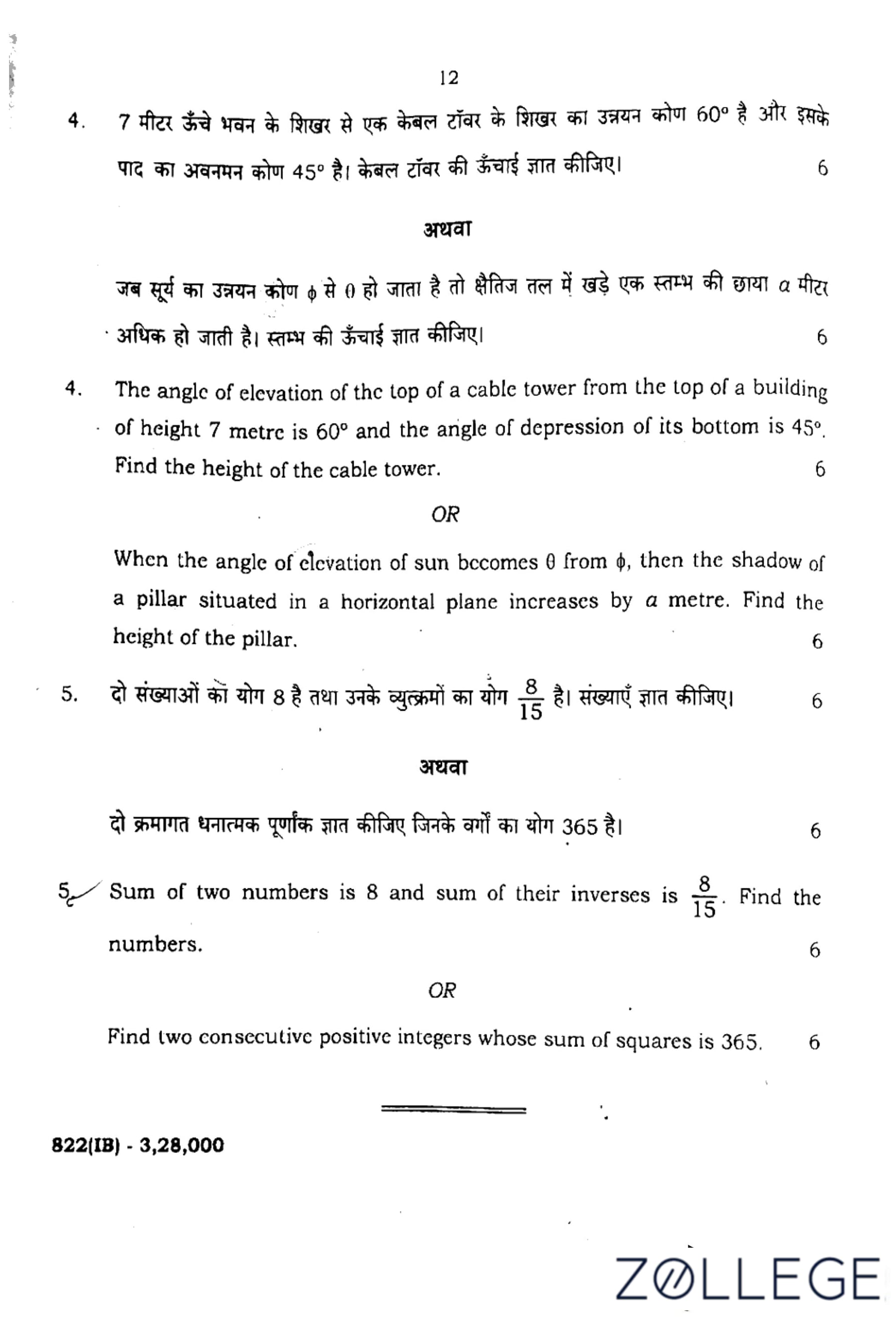
The angle of elevation of the top of a cable tower from the top of a building of height 7 metres is \(60^\circ\) and the angle of depression of its bottom is \(45^\circ\). Find the height of the cable tower.
View Solution
N/A Quick Tip: To solve problems involving angles of elevation and depression, use trigonometric ratios such as \( \tan \theta = \frac{opposite}{adjacent} \).
When the angle of elevation of the sun becomes \( \theta \) from \( \phi \), then the shadow of a pillar situated in a horizontal plane increases by \( a \) meters. Find the height of the pillar.
View Solution
Let the height of the pillar be \( h \) meters. Let the initial length of the shadow be \( x \) meters when the angle of elevation of the sun is \( \phi \). When the angle of elevation changes to \( \theta \), the new length of the shadow becomes \( x + a \).
Using the tangent function:
\[ \tan \phi = \frac{h}{x}, \quad \tan \theta = \frac{h}{x + a}. \]
Rearrange the equations:
\[ x = \frac{h}{\tan \phi}, \quad x + a = \frac{h}{\tan \theta}. \]
Subtracting the first equation from the second:
\[ \frac{h}{\tan \theta} - \frac{h}{\tan \phi} = a. \]
Factor out \( h \):
\[ h \left( \frac{1}{\tan \theta} - \frac{1}{\tan \phi} \right) = a. \]
Solving for \( h \):
\[ h = \frac{a}{\frac{1}{\tan \theta} - \frac{1}{\tan \phi}}. \]
Final Answer:
\[ h = \frac{a \tan \theta \tan \phi}{\tan \phi - \tan \theta}. \] Quick Tip: In problems involving angle of elevation, use the tangent function \( \tan \theta = \frac{height}{shadow length} \) and form two equations to solve for unknowns.
*The article might have information for the previous academic years, please refer the official website of the exam.