
UP Board Class 10 Science (Code 824 IK) Question Paper 2024 Available : Download Solution PDF With Answer Key


Content Writer | Updated On - Feb 26, 2025
UP Board Class 10 Science Question Paper 2024 PDF (Code 824 IK) is available for download here. The Science exam was conducted on February 29, 2024 in the Morning Shift from 8:30 AM to 11:45 AM. The total marks for the theory paper are 70. Students reported the paper to be moderate.
UP Board Class 10 Science Question Paper 2024 (Code 824 IK) with Solutions
| UP Board Class 10 Science Question Paper With Answer Key |  Download Download |
Check Solution |
UP Board Class 10 Science Question Paper With Solution
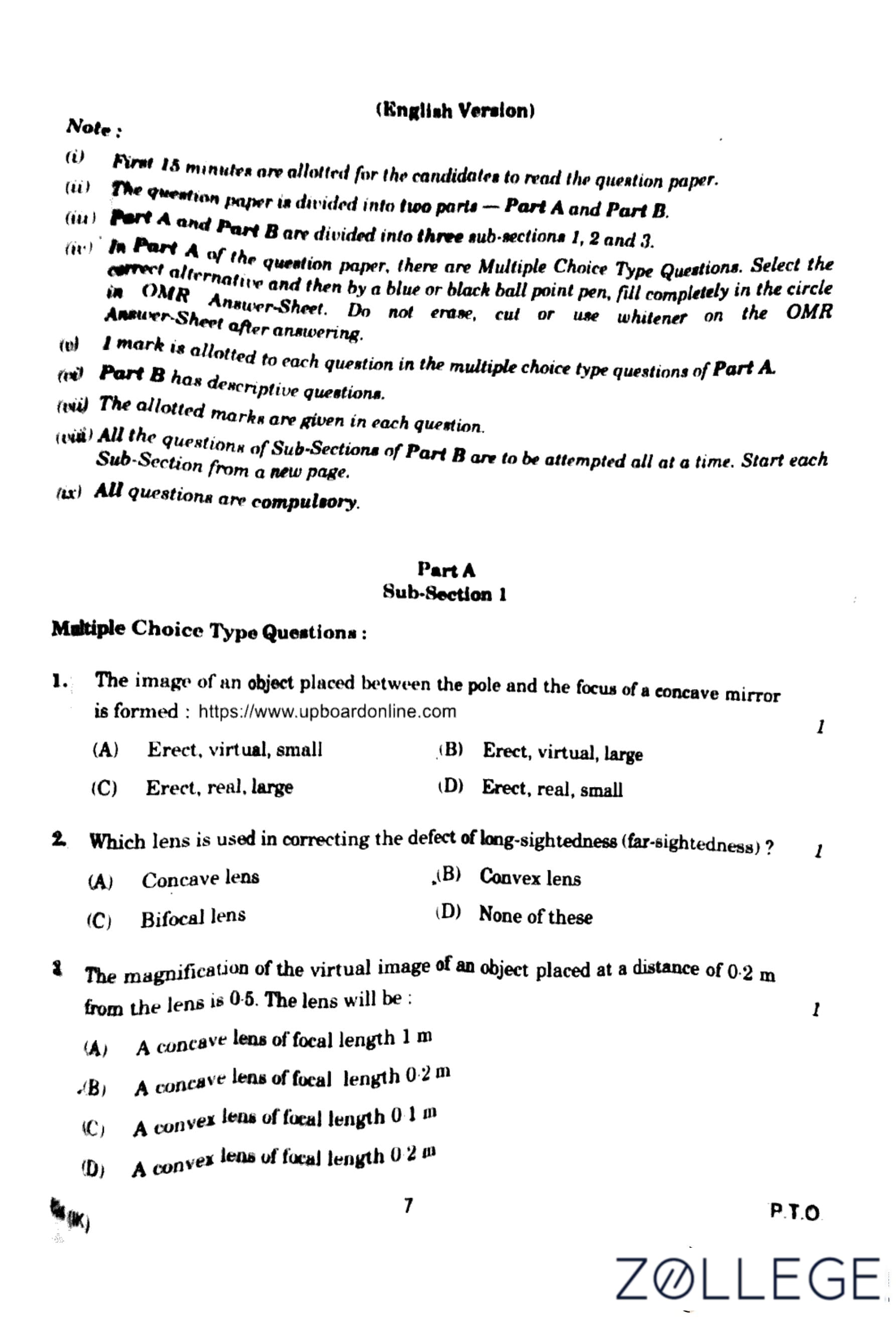
Part–A
(Sub-Section 1)
Multiple Choice Type Questions
Question 1:
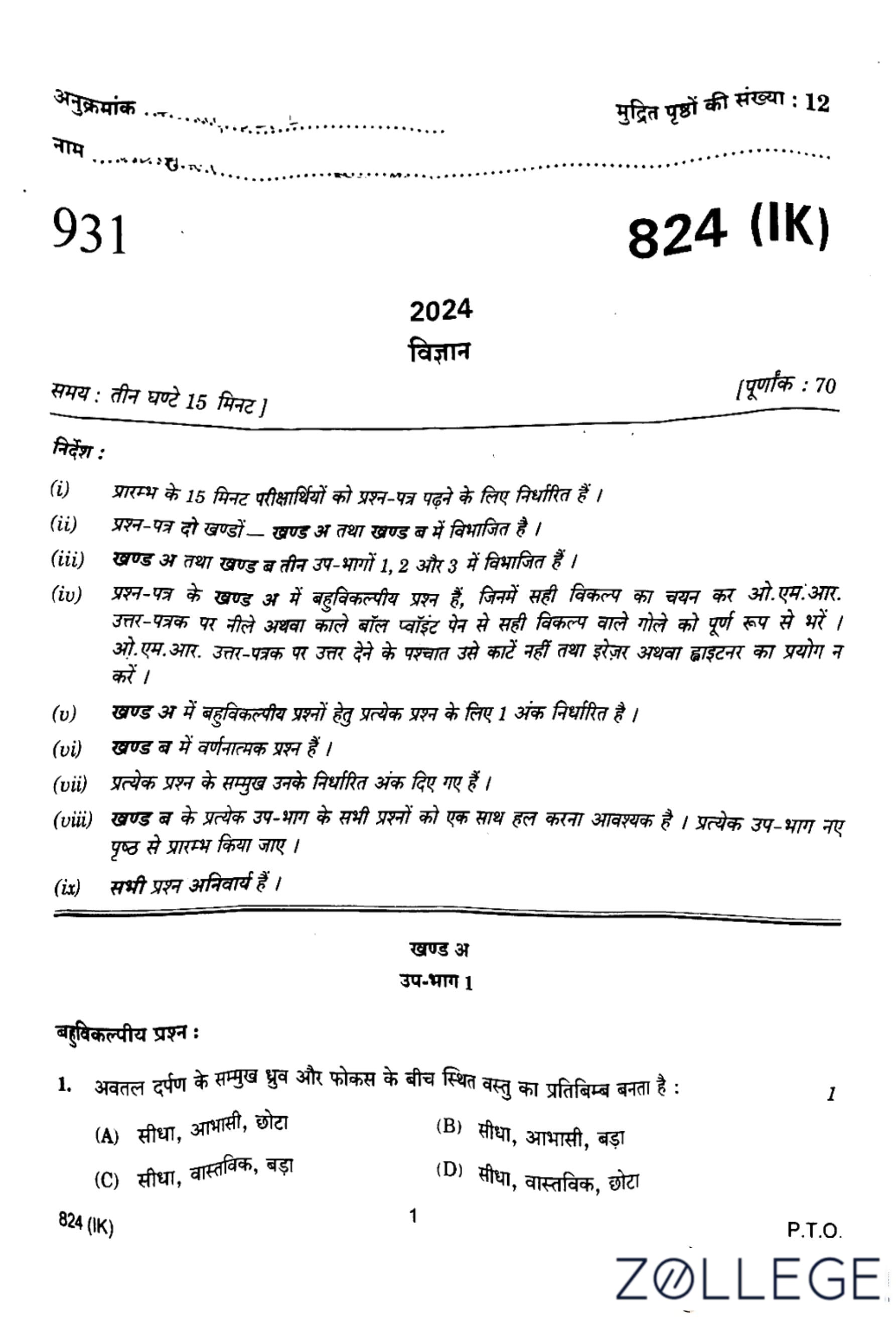
The image of an object placed between the pole and the focus of a concave mirror is formed:
View Solution
When an object is placed between the pole and the focus of a concave mirror, the image formed is erect, virtual, and larger than the object. This occurs because the reflected rays diverge and appear to come from a point behind the mirror, forming a magnified virtual image.
Quick Tip: Concave mirrors can form both real and virtual images depending on the position of the object.
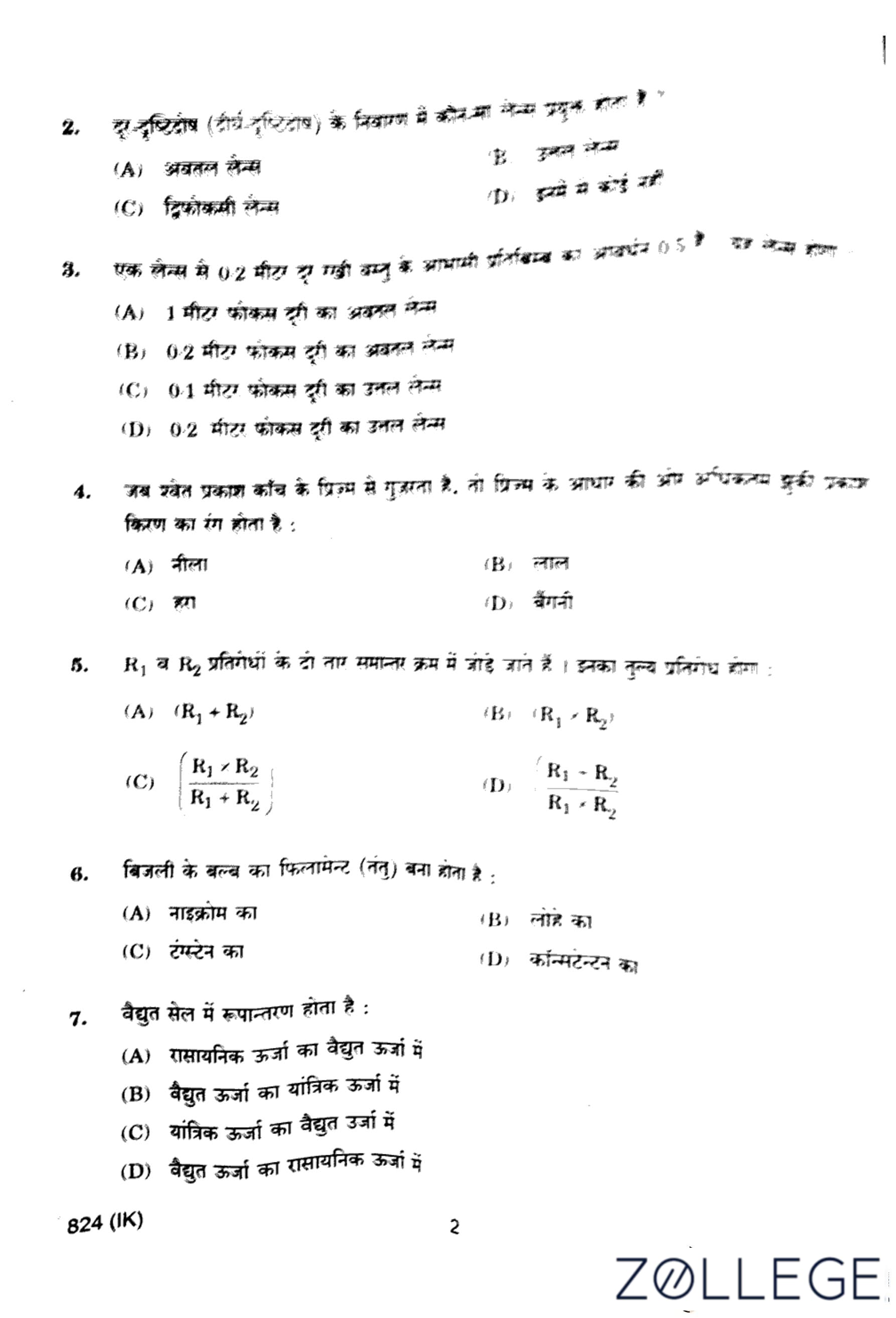
Which lens is used in correcting the defect of long-sightedness (far-sightedness)?
View Solution
A convex lens is used to correct long-sightedness (hypermetropia). It helps focus light rays properly onto the retina by converging the light before it enters the eye.
Quick Tip: Hypermetropia (far-sightedness) occurs when the eye cannot focus on nearby objects, requiring a convex lens for correction.
The magnification of the virtual image of an object placed at a distance of 0.2 m from the lens is 0.5. The lens will be:
View Solution
Given:
- The object distance \( u = -0.2 \, m \) (negative because the object is placed on the same side as the incident light).
- The magnification \( M = 0.5 \).
- The image is virtual, which implies a positive magnification for a concave lens.
### Step 1: Use the magnification formula
The magnification \( M \) for a lens is given by the formula: \[ M = \frac{v}{u} \]
Where:
- \( v \) is the image distance.
- \( u \) is the object distance.
Substitute the known values: \[ 0.5 = \frac{v}{-0.2} \]
Solving for \( v \): \[ v = 0.5 \times (-0.2) = -0.1 \, m \]
Thus, the image distance \( v = -0.1 \, m \). The negative sign indicates that the image is virtual and formed on the same side as the object (characteristic of concave lenses).
### Step 2: Use the lens formula to find the focal length
The lens formula is: \[ \frac{1}{f} = \frac{1}{v} - \frac{1}{u} \]
Where:
- \( f \) is the focal length of the lens.
- \( v \) is the image distance.
- \( u \) is the object distance.
Substitute the known values \( v = -0.1 \, m \) and \( u = -0.2 \, m \): \[ \frac{1}{f} = \frac{1}{-0.1} - \frac{1}{-0.2} \] \[ \frac{1}{f} = -10 + 5 = -5 \]
Therefore: \[ f = \frac{1}{-5} = -0.2 \, m \]
The negative focal length indicates that the lens is a concave lens.
### Step 3: Conclusion
Thus, the lens is a concave lens with a focal length of \( 0.2 \, m \).
The correct answer is: \[ \boxed{(B) A concave lens of focal length 0.2 m.} \] Quick Tip: Concave lenses always form virtual, upright, and diminished images, whereas convex lenses can form both real and virtual images.
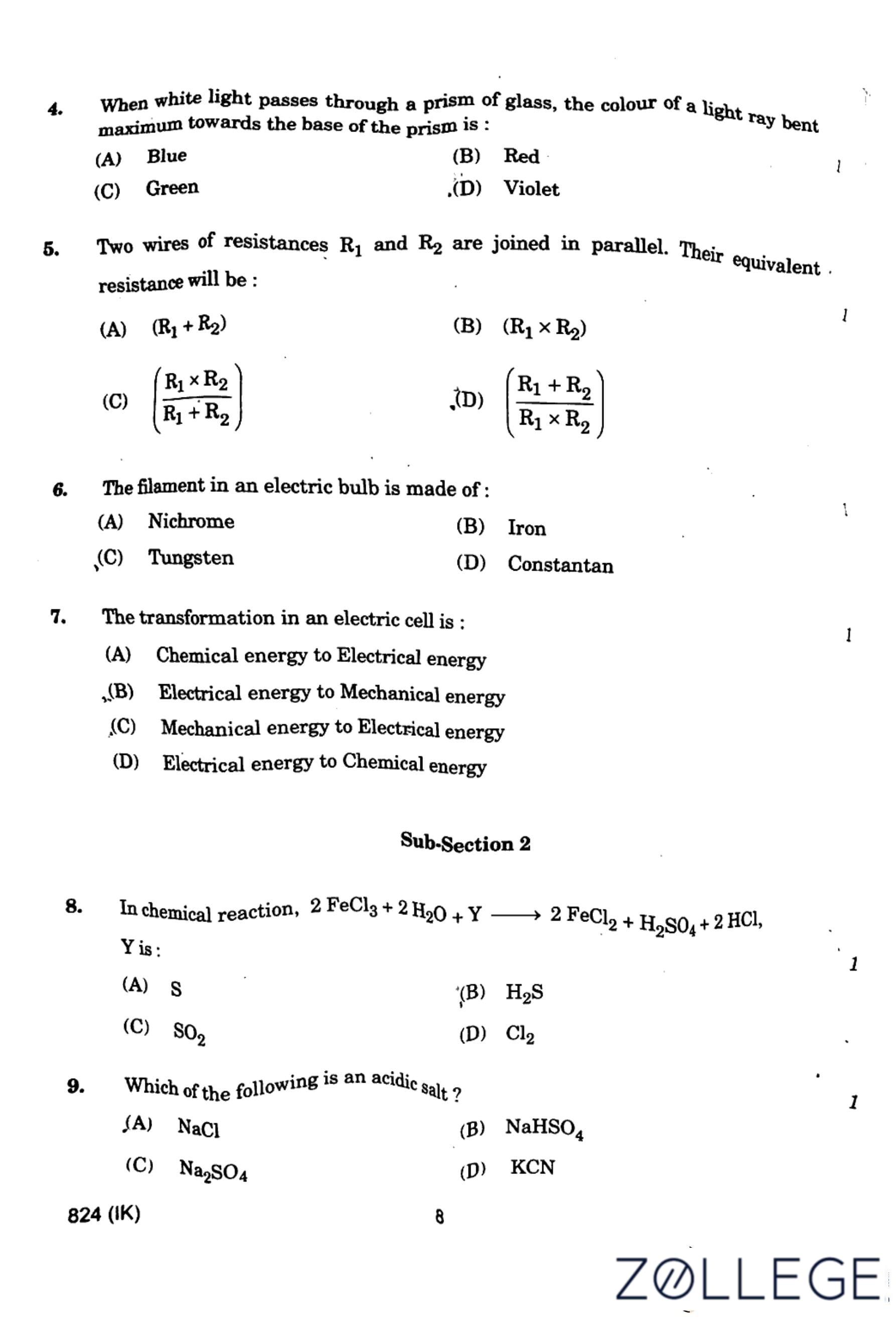
When white light passes through a prism of glass, the colour of a light ray bent maximum towards the base of the prism is:
View Solution
When white light passes through a prism, dispersion occurs, and different colors bend at different angles. Violet light bends the most due to its shortest wavelength among visible light.
Quick Tip: Dispersion of light in a prism leads to the formation of a spectrum, with violet bending the most and red bending the least.
Two wires of resistances \(R_1\) and \(R_2\) are joined in parallel. Their equivalent resistance will be:
View Solution
For resistors in parallel, the equivalent resistance formula is: \[ \frac{1}{R_{eq}} = \frac{1}{R_1} + \frac{1}{R_2} \]
which simplifies to: \[ R_{eq} = \frac{R_1 \times R_2}{R_1 + R_2} \] Quick Tip: In a parallel circuit, the total resistance is always less than the smallest individual resistance.
The filament in an electric bulb is made of:
View Solution
Tungsten is used as the filament in an electric bulb because it has a high melting point (around 3400°C) and high resistivity, allowing it to emit bright light when heated.
Quick Tip: Tungsten filaments are chosen due to their ability to withstand high temperatures without melting.
The transformation in an electric cell is:
View Solution
An electric cell converts chemical energy into electrical energy through a redox reaction inside the cell, where electrons move from the negative electrode to the positive electrode.
Quick Tip: A battery operates by converting stored chemical energy into electrical energy used to power devices.
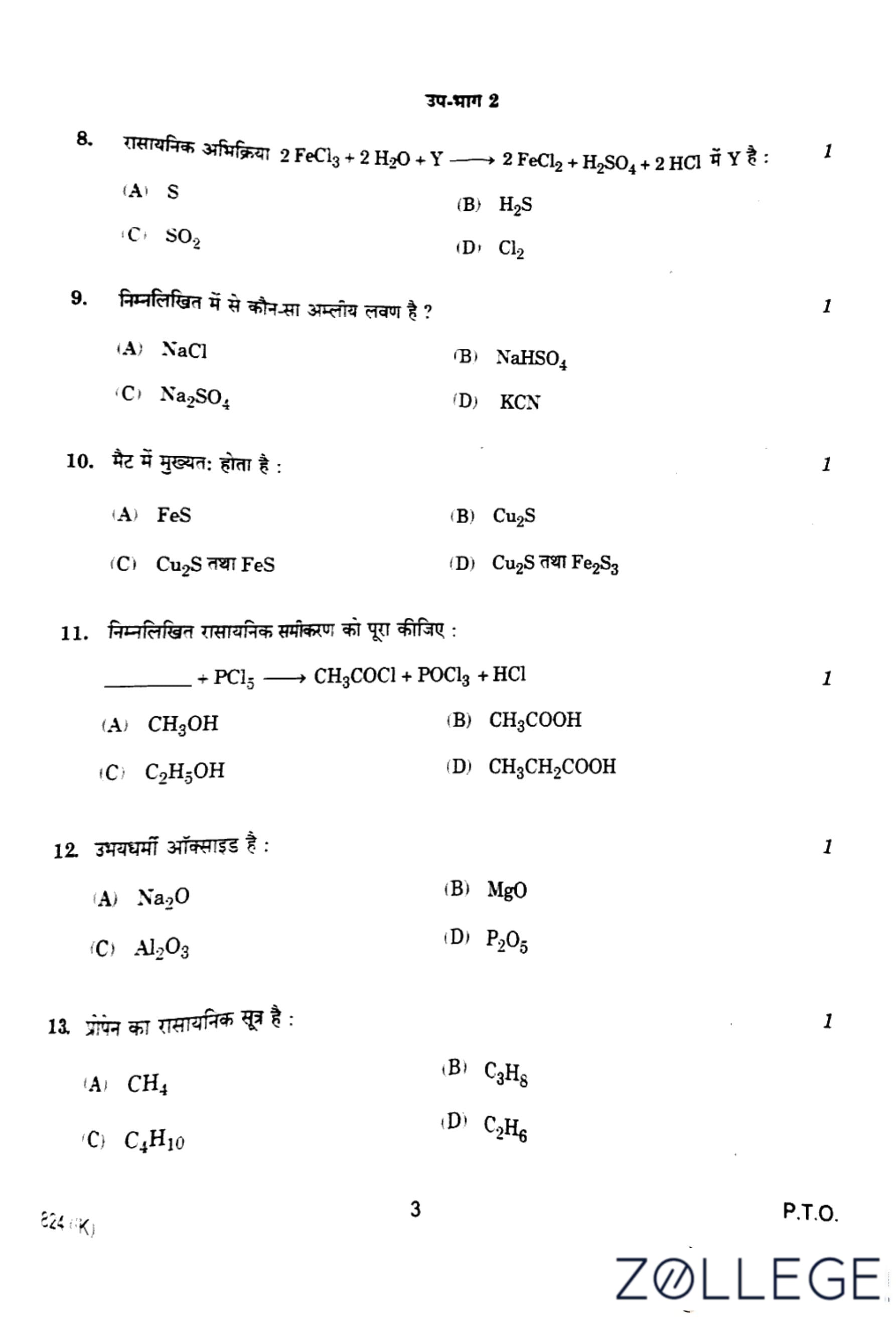
In the chemical reaction, \(2 FeCl_3 + 2 H_2O + Y \rightarrow 2 FeCl_2 + H_2SO_4 + 2 HCl\), Y is:
View Solution
The given reaction represents the reduction of ferric chloride (\(FeCl_3\)) to ferrous chloride (\(FeCl_2\)) with sulfur dioxide (\(SO_2\)) acting as the reducing agent. In this reaction, sulfur dioxide reduces ferric chloride (\(FeCl_3\)) to ferrous chloride (\(FeCl_2\)), and itself gets oxidized to sulfuric acid (\(H_2SO_4\)). The reaction proceeds as: \[ 2 FeCl_3 + SO_2 + 2 H_2O \rightarrow 2 FeCl_2 + H_2SO_4 + 2 HCl \]
Thus, Y is \( SO_2 \).
Quick Tip: Sulfur dioxide (\(SO_2\)) is commonly used as a reducing agent in inorganic chemistry, especially in the reduction of metal chlorides.
Which of the following is an acidic salt?
View Solution
An acidic salt is formed when a strong acid and a weak base react. Sodium bisulfate (\(NaHSO_4\)) is an acidic salt because it contains an ionizable hydrogen ion (\(H^+\)), making the solution acidic.
Quick Tip: Acidic salts form when a polybasic acid (like sulfuric acid) is only partially neutralized by a base.
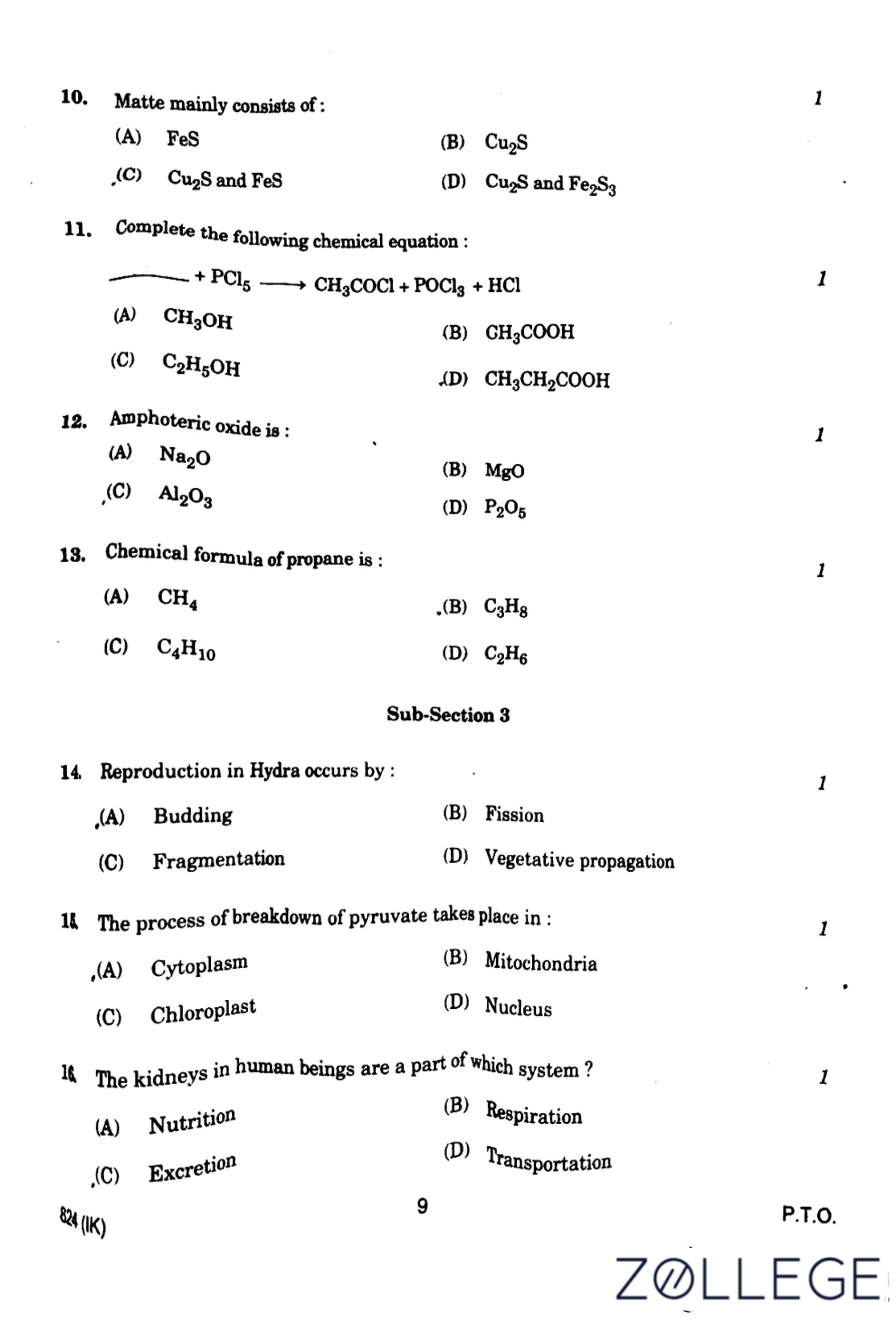
Matte mainly consists of:
View Solution
Matte is a molten phase mainly composed of copper sulfide (Cu\(_2\)S) and iron sulfide (FeS), formed during the smelting of copper ores. It is an intermediate product in the extraction of copper.
Quick Tip: Matte is further processed to extract pure copper by oxidation and reduction methods.
Complete the following chemical equation: \[ \_\_\_\_ + PCl_5 \rightarrow CH_3COCl + POCl_3 + HCl \]
View Solution
The reaction given is the conversion of acetic acid (CH\(_3\)COOH) into acetyl chloride (CH\(_3\)COCl) using phosphorus pentachloride (PCl\(_5\)). The complete reaction is: \[ CH_3COOH + PCl_5 \rightarrow CH_3COCl + POCl_3 + HCl \]
Acetyl chloride is an important reagent in organic synthesis.
Quick Tip: PCl\(_5\) is commonly used to convert carboxylic acids into acyl chlorides.
Which of the following is an amphoteric oxide?
View Solution
An amphoteric oxide is one that reacts with both acids and bases. Aluminum oxide (Al\(_2\)O\(_3\)) exhibits this behavior: \[ Al_2O_3 + 6HCl \rightarrow 2AlCl_3 + 3H_2O \] \[ Al_2O_3 + 2NaOH + 3H_2O \rightarrow 2Na[Al(OH)_4] \] Quick Tip: Al\(_2\)O\(_3\) is found in bauxite and is used in aluminum extraction.
Chemical formula of propane is:
View Solution
Propane (C\(_3\)H\(_8\)) is a hydrocarbon belonging to the alkane family. It consists of three carbon atoms bonded with hydrogen in a single-bonded structure. Propane is widely used as a fuel for heating and cooking. Quick Tip: Alkanes follow the general formula C\(_n\)H\(_{2n+2}\).
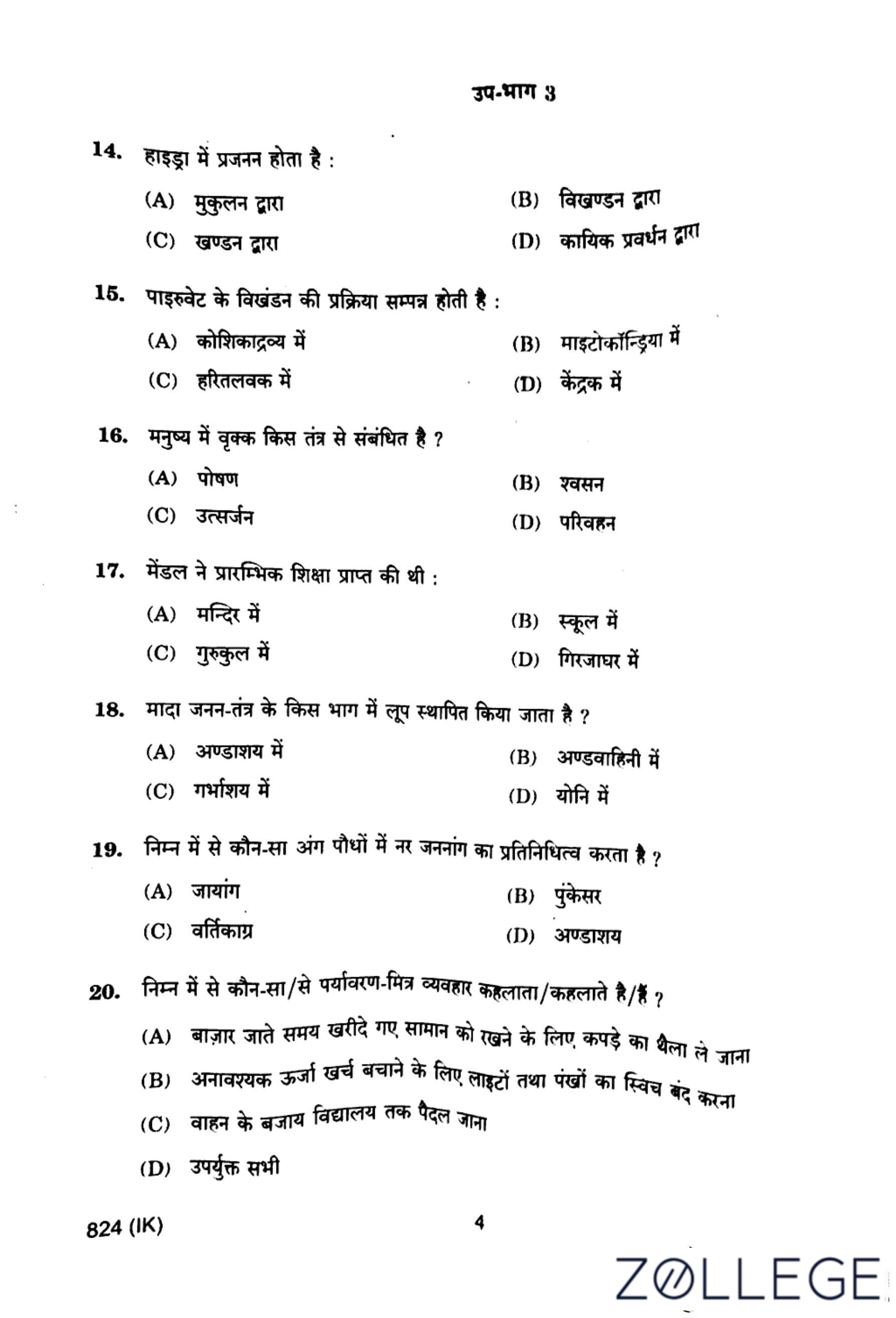
Reproduction in Hydra occurs by:
View Solution
Hydra reproduces asexually by budding. A small outgrowth called a bud forms on the parent body. It gradually grows and develops into a new individual, eventually detaching from the parent. This type of reproduction allows Hydra to multiply efficiently.
Quick Tip: \textbf{Budding} is a common asexual reproduction method found in simple organisms like Hydra and yeast.
The process of breakdown of pyruvate takes place in:
View Solution
Pyruvate breakdown occurs in the mitochondria during aerobic respiration. The pyruvate is converted into Acetyl-CoA, which enters the Krebs cycle, producing ATP, NADH, and FADH\(_2\). This process is essential for energy production in cells.
Quick Tip: The \textbf{mitochondria} are known as the "powerhouse of the cell" because they generate ATP through aerobic respiration.
The kidneys in human beings are a part of which system?
View Solution
Kidneys are part of the excretory system. They filter waste materials like urea, excess salts, and water from the blood and excrete them as urine. This process helps maintain body fluid balance and removes toxins.
Quick Tip: The \textbf{excretory system} includes the kidneys, ureters, bladder, and urethra, which work together to remove waste from the body.
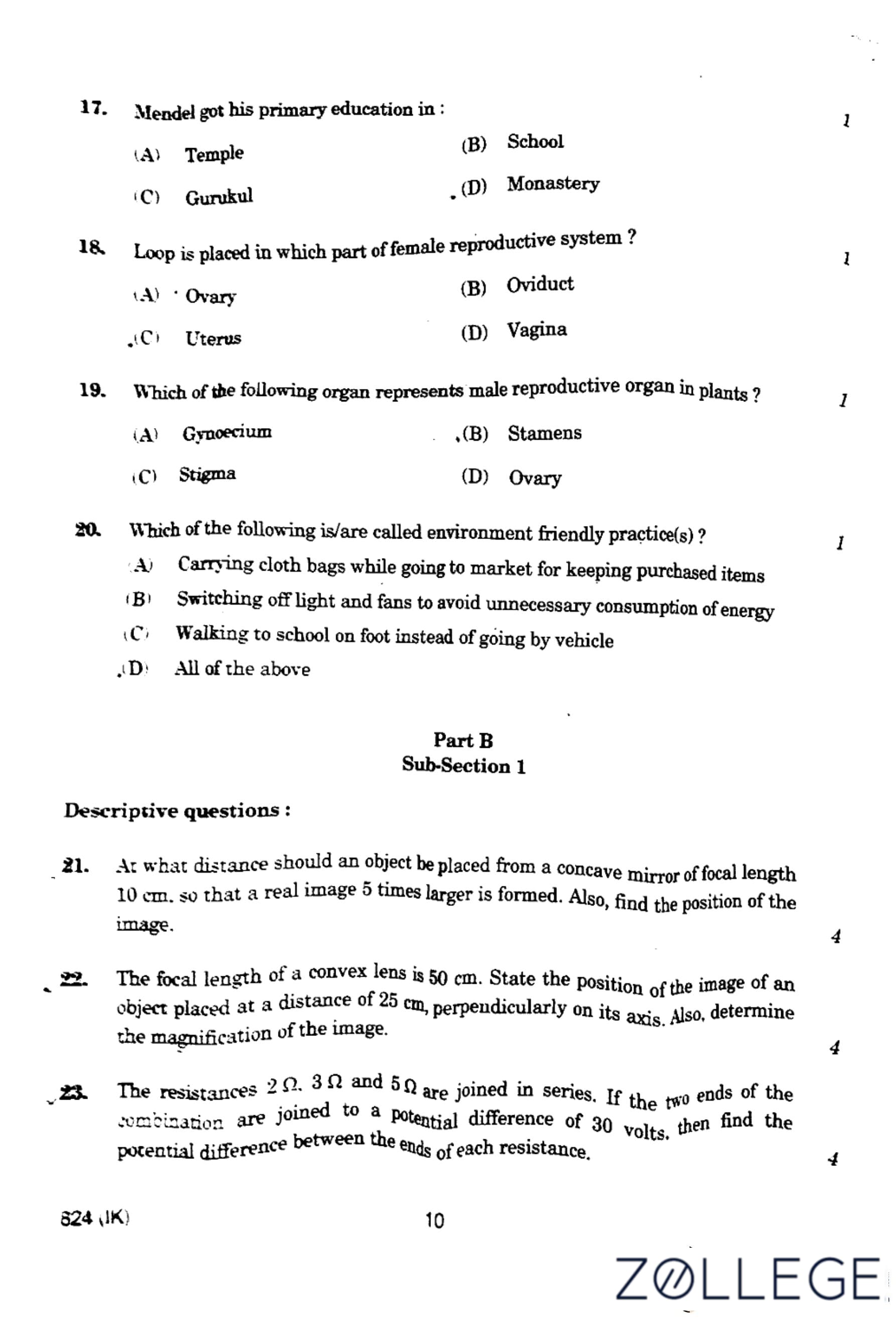
Mendel got his primary education in:
View Solution
Gregor Mendel received his primary education in a school. Later, he joined a monastery where he carried out his famous genetic experiments on pea plants, leading to the discovery of the fundamental laws of inheritance.
Quick Tip: Mendel is known as the \textbf{"Father of Genetics"} for his pioneering work on inheritance.
Loop is placed in which part of the female reproductive system?
View Solution
A loop or intrauterine device (IUD) is placed in the uterus as a contraceptive measure to prevent pregnancy. It acts as a physical barrier to implantation and can also release hormones to regulate fertility.
Quick Tip: IUDs are one of the most effective long-term reversible contraceptive methods.
Which of the following organ represents the male reproductive organ in plants?
View Solution
The stamen is the male reproductive organ of a flower. It consists of the anther, which produces pollen grains, and the filament, which supports the anther. Pollen grains contain male gametes necessary for fertilization.
Quick Tip: The \textbf{carpel (pistil)} represents the female reproductive organ in plants.
Which of the following is/are called environment-friendly practice(s)?
View Solution
Environment-friendly practices include reducing plastic use, conserving energy, and minimizing carbon footprint. Carrying cloth bags reduces plastic waste, switching off electrical appliances conserves energy, and walking instead of using vehicles decreases air pollution.
Quick Tip: \textbf{Reduce, Reuse, and Recycle} are the three essential principles of environmental conservation.
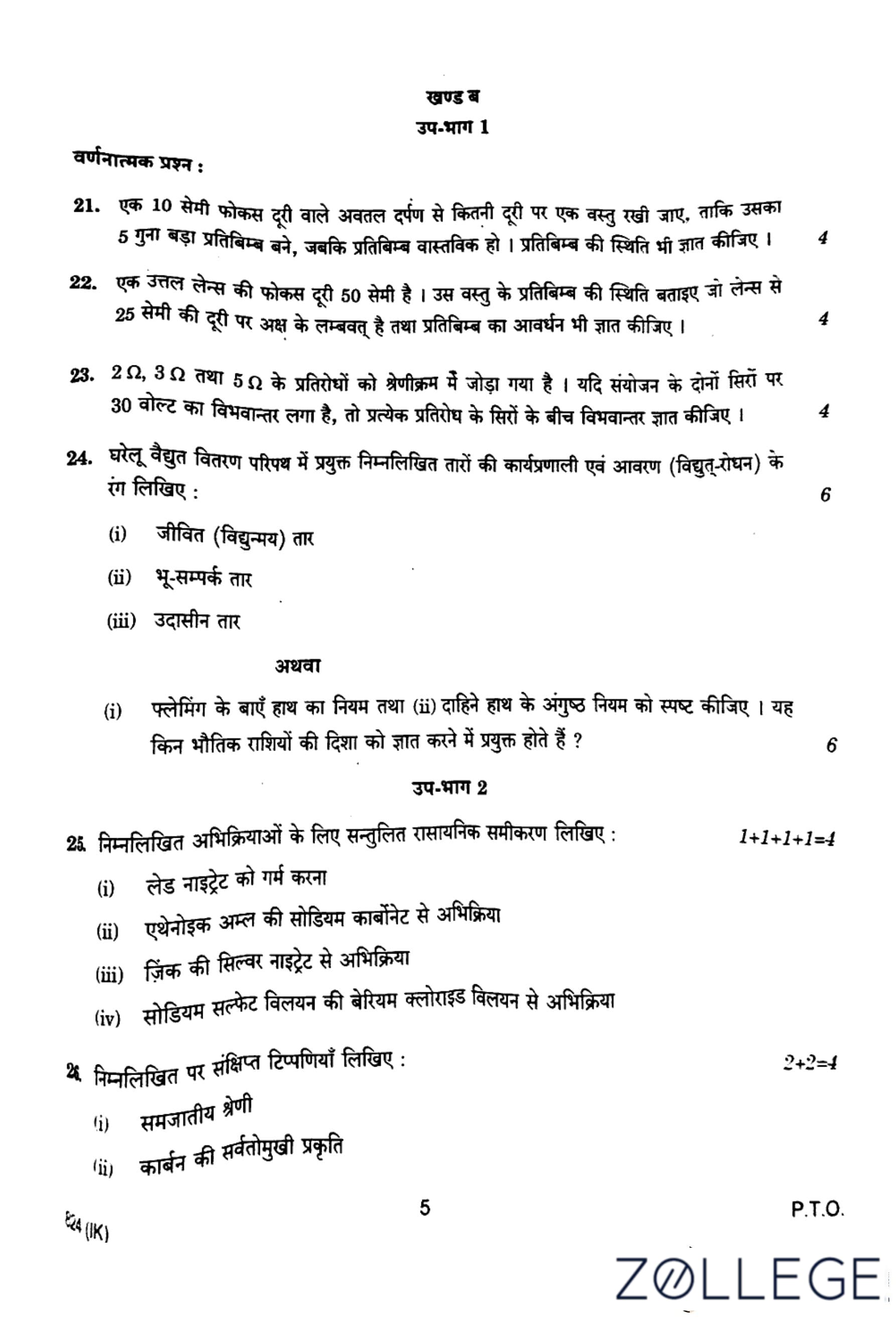
At what distance should an object be placed from a concave mirror of focal length 10 cm, so that a real image 5 times larger is formed? Also, find the position of the image.
View Solution
Let the object distance be \( u \) and the image distance be \( v \). Given that the magnification \( m \) is -5 for a real and inverted image, we use: \[ m = \frac{-v}{u} \] \[ v = -5u \]
Using the mirror formula: \[ \frac{1}{f} = \frac{1}{u} + \frac{1}{v} \]
Substituting \( f = -10 \) cm and \( v = -5u \): \[ \frac{1}{-10} = \frac{1}{u} + \frac{1}{-5u} \]
Solving, we get \( u = -12 \) cm and \( v = -60 \) cm.
Quick Tip: A real and inverted image means the image distance is negative.
The focal length of a convex lens is 50 cm. State the position of the image of an object placed at a distance of 25 cm, perpendicularly on its axis. Also, determine the magnification of the image.
View Solution
Using the lens formula: \[ \frac{1}{f} = \frac{1}{v} - \frac{1}{u} \]
Given \( f = 50 \) cm and \( u = -25 \) cm: \[ \frac{1}{50} = \frac{1}{v} - \frac{1}{-25} \] \[ \frac{1}{v} = \frac{1}{50} - \frac{1}{25} = \frac{1}{50} - \frac{2}{50} = \frac{-1}{50} \] \[ v = -50 cm \]
The image is formed at -50 cm, meaning it is virtual and on the same side as the object.
Magnification is given by: \[ m = \frac{v}{u} = \frac{-50}{-25} = 2 \]
Thus, the image is magnified and erect.
Quick Tip: A negative image distance in convex lenses indicates a virtual image.
The resistances 2Ω, 3Ω, and 5Ω are joined in series. If the two ends of the combination are joined to a potential difference of 30 volts, then find the potential difference between the ends of each resistance.
View Solution
In a series circuit, the same current flows through all resistors. Using Ohm’s law: \[ V = IR \]
Total resistance: \[ R_{total} = 2 + 3 + 5 = 10Ω \]
Total current: \[ I = \frac{V}{R_{total}} = \frac{30}{10} = 3A \]
Voltage drop across each resistor: \[ V_1 = IR_1 = (3)(2) = 6V \] \[ V_2 = IR_2 = (3)(3) = 9V \] \[ V_3 = IR_3 = (3)(5) = 15V \]
Thus, the potential differences across 2Ω, 3Ω, and 5Ω resistors are 6V, 9V, and 15V, respectively.
Quick Tip: In a series circuit, the sum of individual voltage drops equals the total supplied voltage.
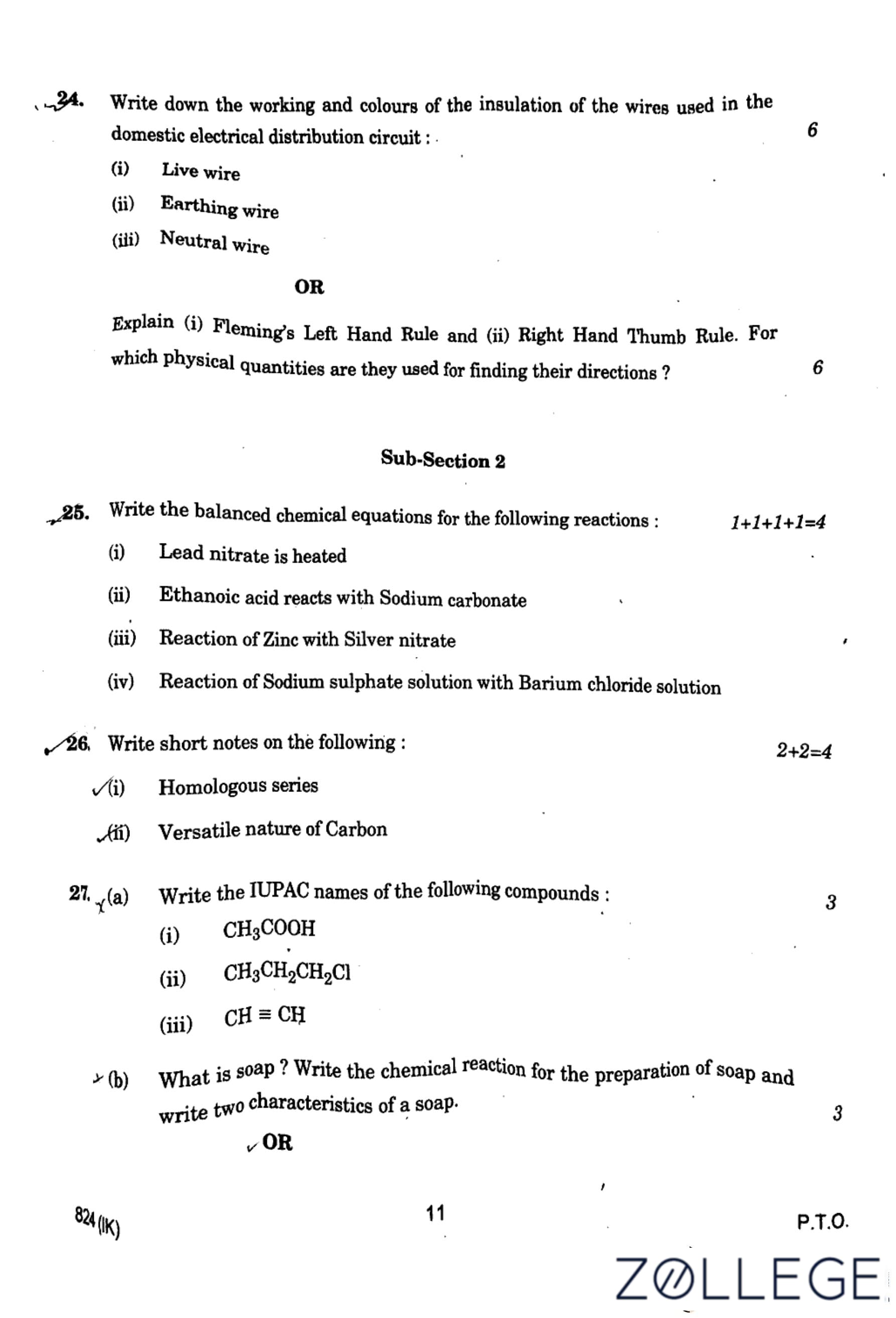
Write down the working and colours of the insulation of the wires used in the domestic electrical distribution circuit:
(i) Live wire
(ii) Earthing wire
(iii) Neutral wire
View Solution
The domestic electrical distribution circuit consists of three main types of wires:
- Live Wire: This wire carries the current from the supply to the electrical appliance. It is typically red or brown in color.
- Neutral Wire: It completes the circuit by carrying the current back to the power source. It is usually black or blue in color.
- Earthing Wire: This wire provides safety by preventing electric shocks. It carries leakage current to the ground and is generally green or yellow-green in color.
Quick Tip: The earthing wire is crucial for preventing electric shocks by directing excess current safely into the ground.
Explain
(i) Fleming’s Left Hand Rule and
(ii) Right Hand Thumb Rule. For which physical quantities are they used for finding their directions?
View Solution
- Fleming’s Left Hand Rule: This rule is used to determine the direction of force experienced by a current-carrying conductor in a magnetic field. It states that if the thumb, forefinger, and middle finger of the left hand are stretched perpendicular to each other:
- Forefinger represents the direction of the magnetic field.
- Middle finger represents the direction of current.
- Thumb represents the direction of force (motion).
- Right Hand Thumb Rule: This rule is used to determine the direction of the magnetic field around a current-carrying conductor. If the thumb of the right hand points in the direction of current, then the curled fingers represent the direction of the magnetic field. Quick Tip: Fleming’s Left Hand Rule is used in motors, while the Right Hand Thumb Rule helps in understanding electromagnetism and solenoid fields.
Write the balanced chemical equations for the following reactions:
View Solution
(i) Lead nitrate is heated:
\[ 2 \, Pb(NO_3)_2 \xrightarrow{heat} 2 \, PbO + 4 \, NO_2 + O_2 \]
(ii) Ethanoic acid reacts with Sodium carbonate:
\[ CH_3COOH + Na_2CO_3 \rightarrow 2 \, CH_3COONa + CO_2 + H_2O \]
(iii) Reaction of Zinc with Silver nitrate:
\[ Zn + 2 \, AgNO_3 \rightarrow Zn(NO_3)_2 + 2 \, Ag \]
(iv) Reaction of Sodium sulphate solution with Barium chloride solution:
\[ Na_2SO_4 + BaCl_2 \rightarrow BaSO_4 + 2 \, NaCl \]
Quick Tip: Balanced chemical equations are essential for understanding the stoichiometry of reactions.
Write short notes on the following:
View Solution
(i) Homologous series: A homologous series is a series of organic compounds with similar chemical properties and a gradual change in physical properties, where each member differs by a -CH₂ group. Examples include alkanes, alkenes, and alkynes.
(ii) Versatile nature of Carbon: Carbon is versatile because it can form long chains, rings, and networks, which are the basis for organic chemistry. Carbon atoms can bond with other elements to form a variety of organic compounds, including hydrocarbons, sugars, and proteins.
Quick Tip: Carbon’s versatility makes it the backbone of organic life.
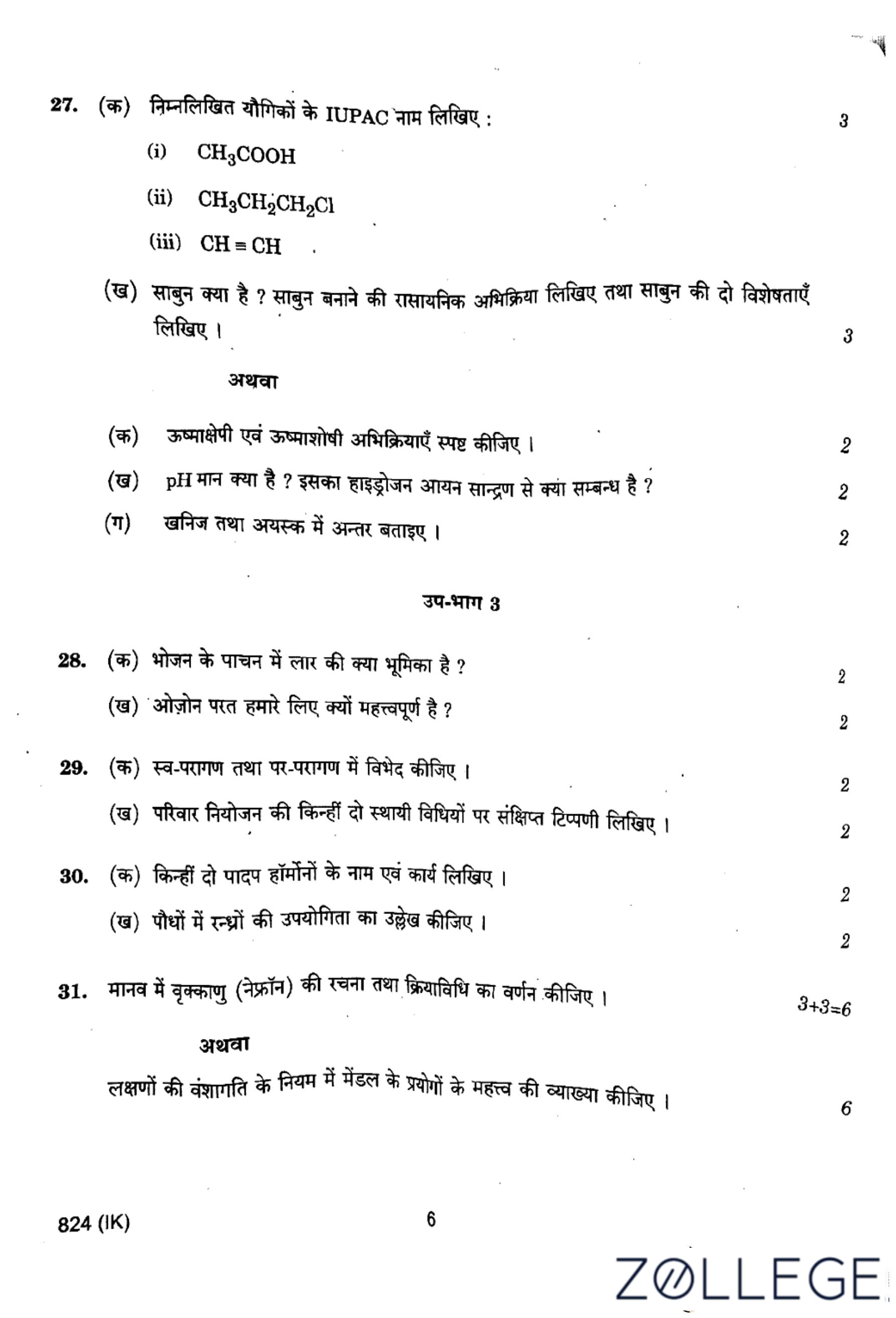
(a) Write the IUPAC names of the following compounds:
View Solution
(i) CH₃COOH is Ethanoic acid.
(ii) CH₃CH₂CH₂Cl is 1-chloropropane.
(iii) CH ≡ CH is Ethyne.
Quick Tip: Always remember to follow IUPAC rules for naming compounds based on structure.
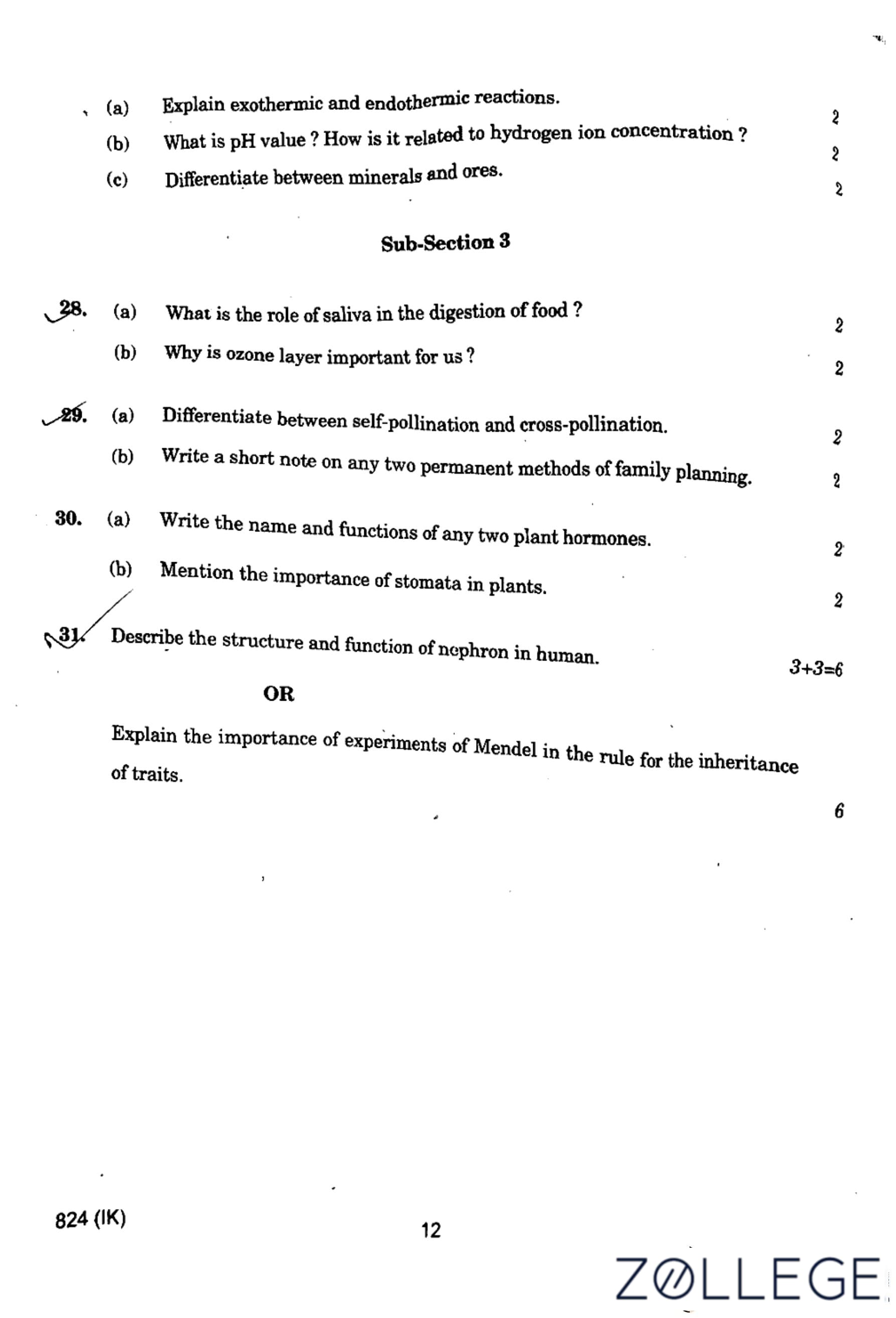
Explain exothermic and endothermic reactions.
View Solution
(i) Exothermic reaction: These are reactions in which heat is released to the surroundings. The energy required to break bonds is less than the energy released when new bonds are formed. Examples include combustion and respiration.
(ii) Endothermic reaction: These are reactions in which heat is absorbed from the surroundings. The energy required to break bonds is more than the energy released when new bonds are formed. An example is photosynthesis.
Quick Tip: In exothermic reactions, heat is released, and in endothermic reactions, heat is absorbed.
What is pH value? How is it related to hydrogen ion concentration?
View Solution
The pH value is a measure of the hydrogen ion concentration in a solution. It is calculated as the negative logarithm of the hydrogen ion concentration, i.e., \(pH = -\log[H^+]\). The higher the concentration of hydrogen ions, the lower the pH, indicating an acidic solution. Conversely, a lower concentration of hydrogen ions results in a higher pH, indicating a basic solution.
For example, a pH of 7 indicates neutrality (pure water), while values below 7 indicate acidity and above 7 indicate alkalinity.
Quick Tip: A decrease in pH indicates an increase in hydrogen ion concentration, and an increase in pH indicates a decrease in hydrogen ion concentration.
Differentiate between minerals and ores.
View Solution
(i) Minerals: A mineral is a naturally occurring inorganic substance with a definite chemical composition and crystal structure. Minerals are the raw materials from which metals can be extracted. For example, \(Haematite (Fe_2O_3)\) is a mineral.
(ii) Ores: An ore is a naturally occurring mineral from which metals can be extracted profitably. It is usually a mixture of a metal compound with other elements. For example, \(Bauxite (Al_2O_3)\) is an ore of aluminum.
Quick Tip: All ores are minerals, but not all minerals are ores.
*The article might have information for the previous academic years, please refer the official website of the exam.