
UP Board Class 10 Science (Code 824 IM) Question Paper 2024 Available :Download Solution PDF With Answer Key


Content Writer | Updated On - Feb 26, 2025
UP Board Class 10 Science Question Paper 2024 PDF (Code 824 IM) is available for download here. The Science exam was conducted on February 29, 2024 in the Morning Shift from 8:30 AM to 11:45 AM. The total marks for the theory paper are 70. Students reported the paper to be moderate.
UP Board Class 10 Science Question Paper 2024 (Code 824 IM) with Solutions
| UP Board Class 10 Science Question Paper With Answer Key |  Download Download |
Check Solution |
UP Board Class 10 Science Question Paper With Solution
Part–A
(Sub-Section 1)
Multiple Choice Type Questions
Question 1:
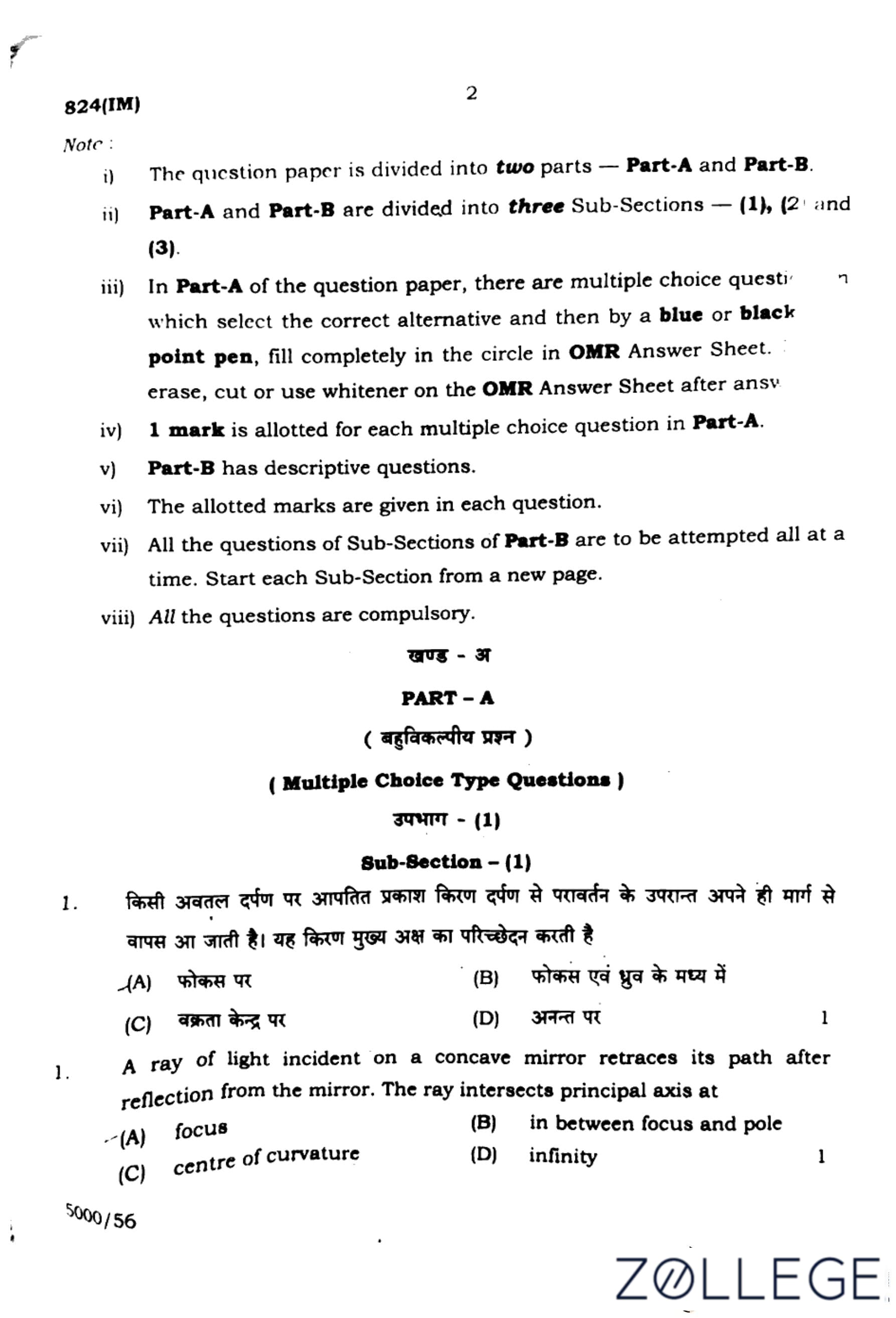
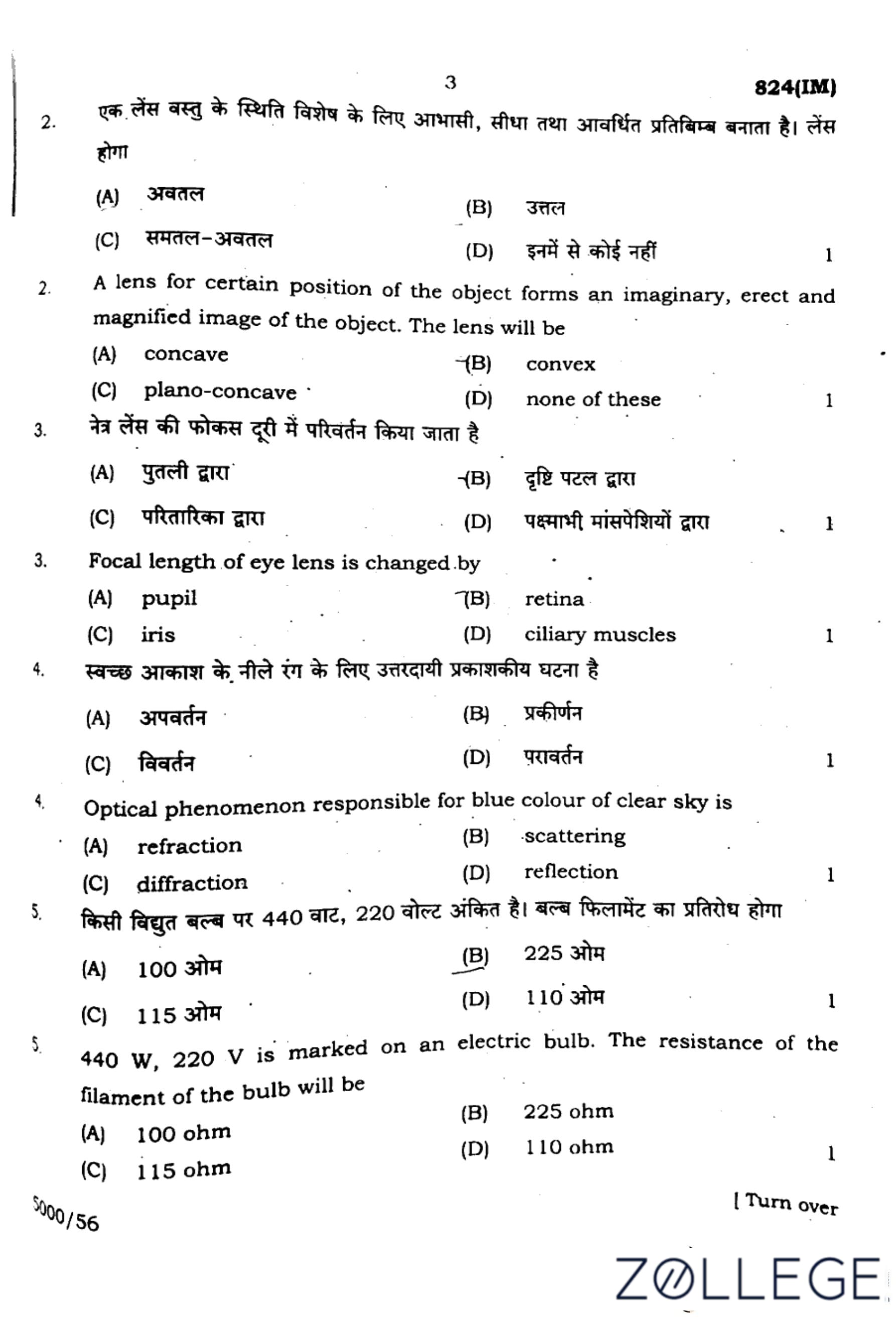
A 440 W, 220 V is marked on an electric bulb. The resistance of the filament of the bulb will be:
View Solution
Using the formula for electrical power, \(P = \frac{V^2}{R}\), where \(P\) is the power, \(V\) is the voltage, and \(R\) is the resistance, we can calculate the resistance as:
\[ R = \frac{V^2}{P} = \frac{220^2}{440} = 110 ohm. \]
Quick Tip: To find the resistance of an electric bulb, use the formula \( R = \frac{V^2}{P} \), where \(V\) is the voltage and \(P\) is the power.
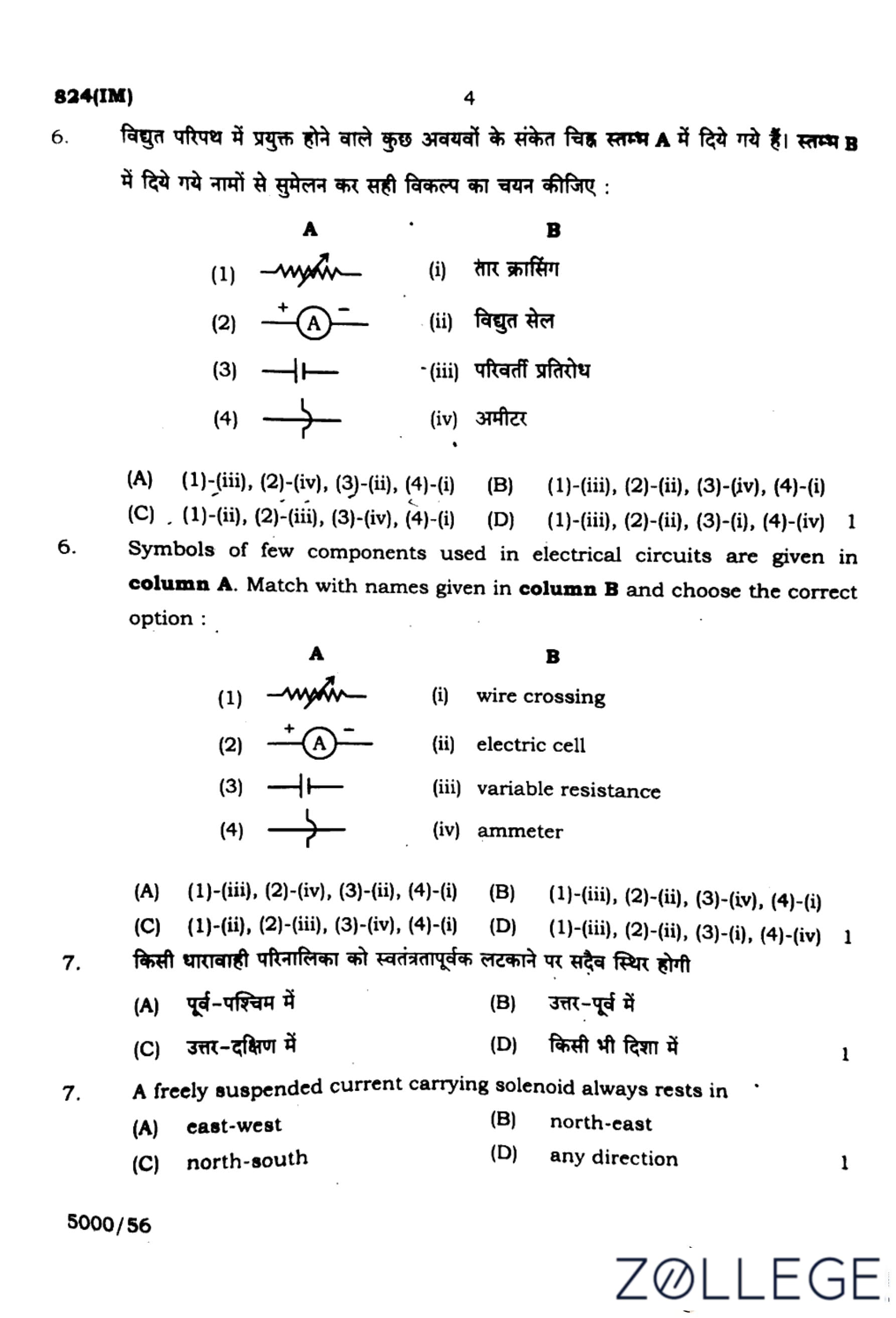
Symbols of few components used in electrical circuits are given in column A. Match with names given in column B and choose the correct option:
View Solution
(1) The symbol represents a variable resistance.
(2) The symbol represents an ammeter.
(3) The symbol represents an electric cell.
(4) The symbol represents a wire crossing.
Quick Tip: Make sure you are familiar with standard electrical circuit symbols to easily recognize and match them.
A freely suspended current carrying solenoid always rests in:
View Solution
When a current-carrying solenoid is freely suspended, it aligns itself with the Earth's magnetic field, which runs along the north-south direction. This is why the solenoid always rests in the north-south direction.
Quick Tip: The Earth's magnetic field plays a key role in determining the orientation of a freely suspended current-carrying solenoid.
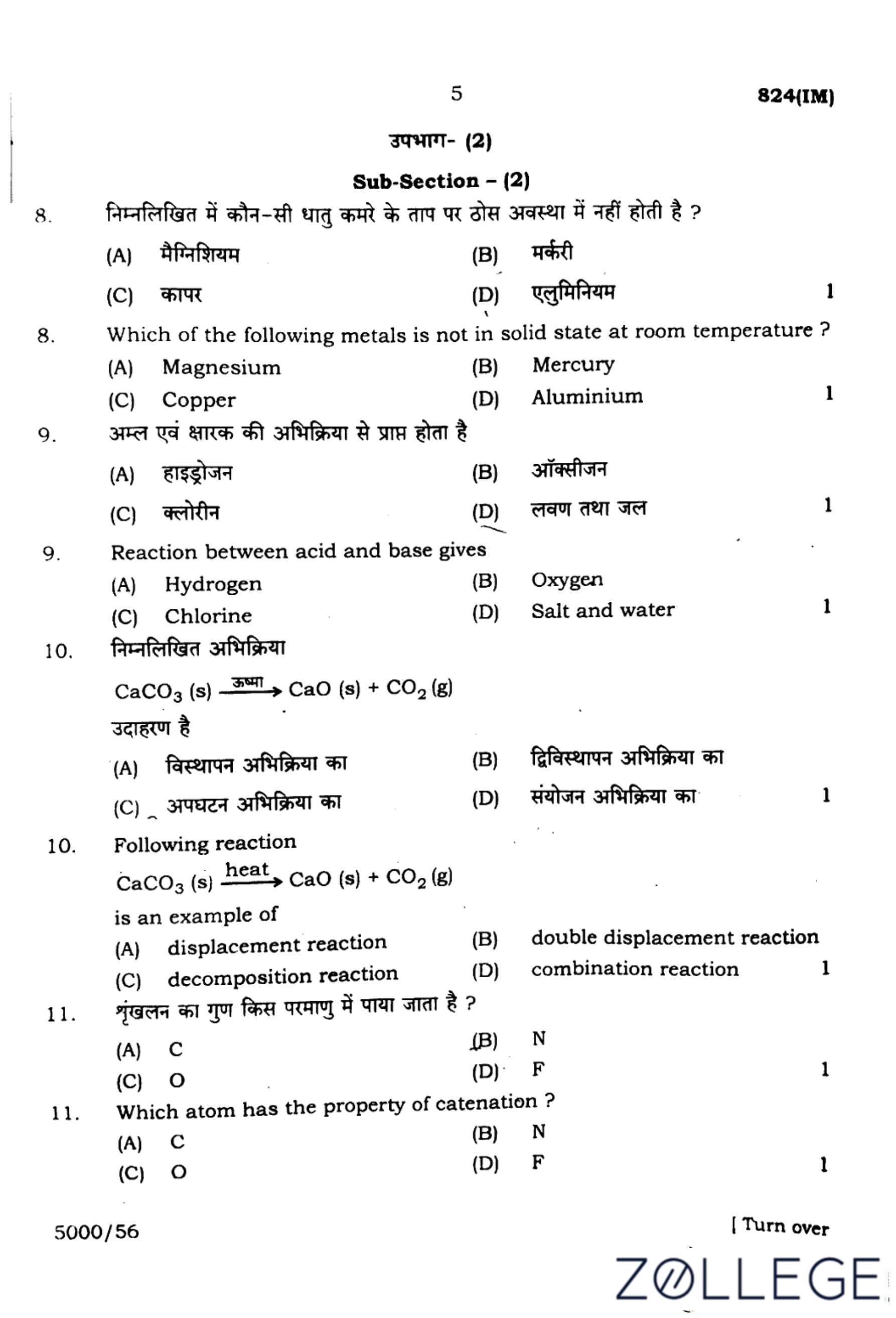
Which of the following metals is not in solid state at room temperature?
View Solution
Mercury is the only metal that is in liquid form at room temperature. The other metals—Magnesium, Copper, and Aluminium—are all solid at room temperature.
Quick Tip: Mercury is the only metal that exists as a liquid at room temperature.
Reaction between acid and base gives:
View Solution
When an acid reacts with a base, the typical products are salt and water. This is known as a neutralization reaction.
Quick Tip: Neutralization reactions always produce salt and water.
Following reaction:
\(CaCO_3 (s) \xrightarrow{heat} CaO (s) + CO_2 (g)\)
is an example of:
View Solution
This reaction is an example of a decomposition reaction because one reactant (calcium carbonate) breaks down into two products (calcium oxide and carbon dioxide).
Quick Tip: In a decomposition reaction, a single reactant breaks down into two or more products.
Which atom has the property of catenation?
View Solution
Carbon (C) is the element that has the property of catenation, which means it can form long chains or rings by bonding with other carbon atoms.
Quick Tip: Catenation is the ability of an element to form long chains or rings, and carbon is the most well-known element with this property.
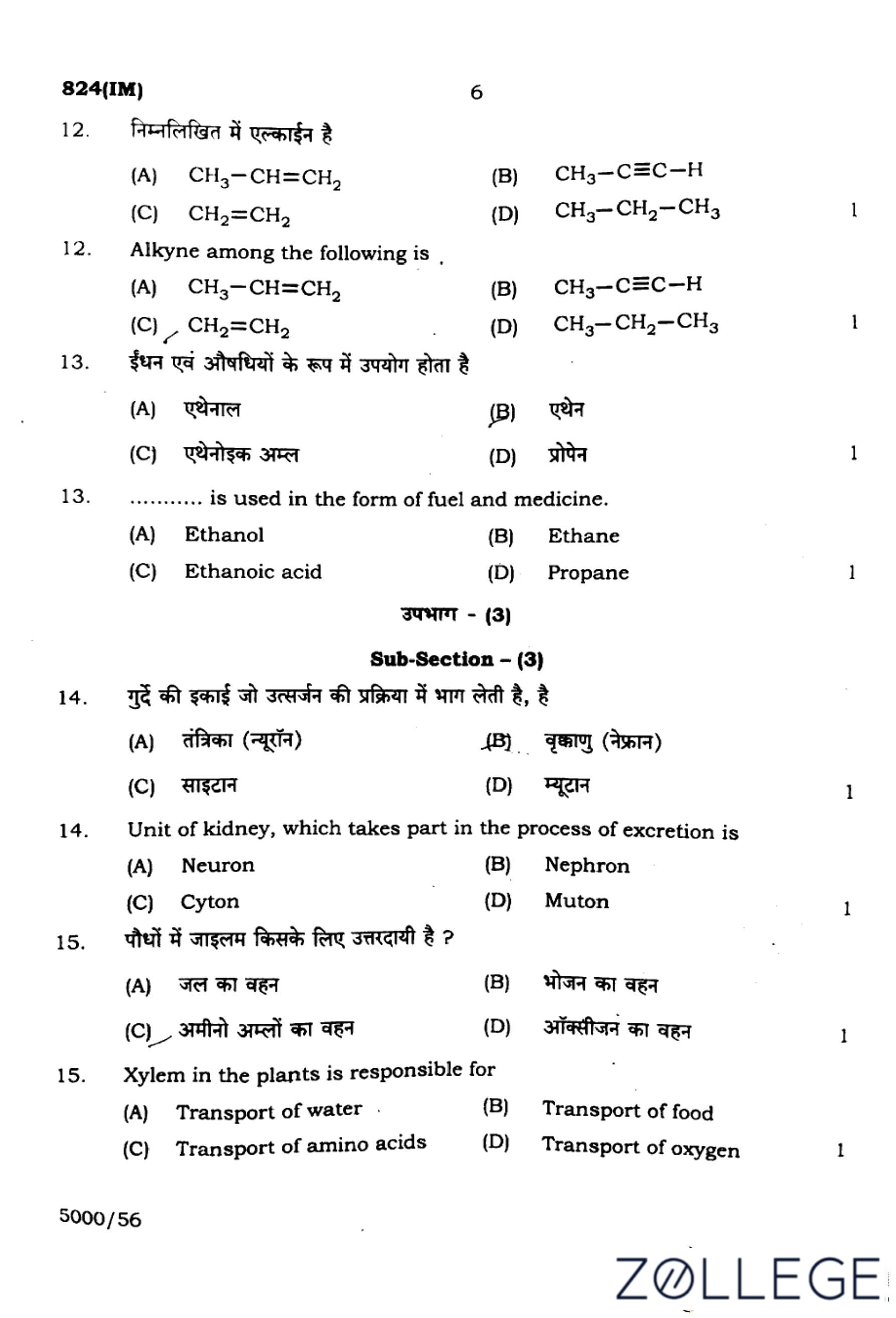
Alkyne among the following is:
View Solution
Alkyne is characterized by a triple bond between two carbon atoms. In this case, CH\(_3\)-C≡C-H contains a triple bond, making it an alkyne. The other options do not contain triple bonds.
Quick Tip: In alkynes, the triple bond between two carbon atoms is a distinguishing feature.
.......... is used in the form of fuel and medicine.
View Solution
Ethanol is widely used as a fuel and in medicine due to its antiseptic and solvent properties. Ethanol is commonly found in alcoholic beverages and used in thermometers and as a fuel additive.
Quick Tip: Ethanol has multiple uses in medicine, fuel, and as a solvent due to its properties.
Unit of kidney, which takes part in the process of excretion is:
View Solution
The functional unit of the kidney is the nephron, which is responsible for the process of filtration, reabsorption, and secretion during excretion. The nephron consists of a renal corpuscle and renal tubules. The other options are not involved in excretion in the kidney.
Quick Tip: Nephrons are the building blocks of kidney function, and they play a key role in waste filtration and fluid regulation in the body.
Xylem in the plants is responsible for:
View Solution
Xylem is a vascular tissue in plants responsible for the transport of water and dissolved minerals from the roots to the rest of the plant. It also provides structural support to the plant. The other options are functions carried out by different plant tissues like phloem (transport of food).
Quick Tip: Xylem is primarily responsible for water transport, while phloem takes care of food transport in plants.
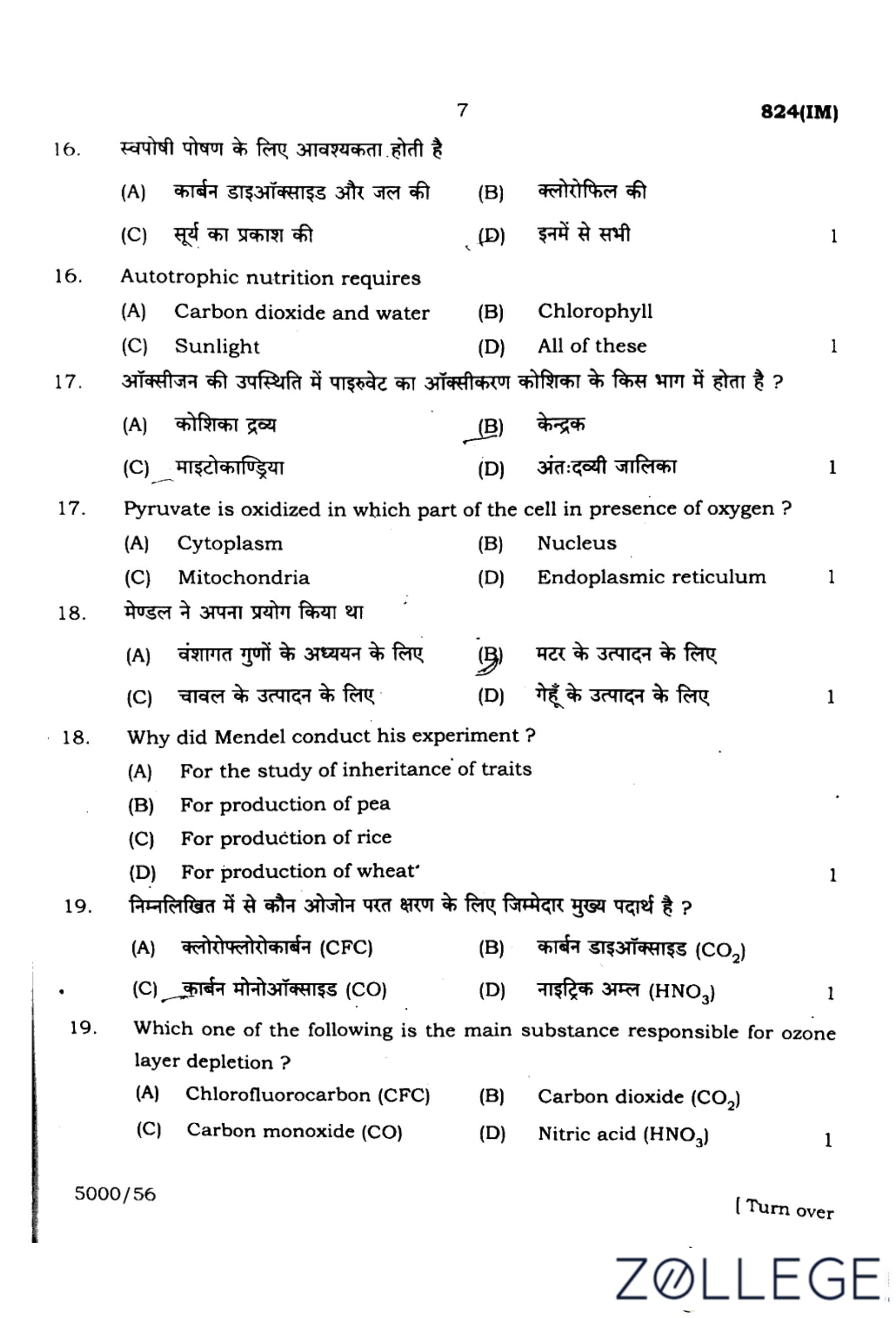
Autotrophic nutrition requires:
View Solution
Autotrophic nutrition refers to the process where organisms synthesize their own food using carbon dioxide, water, and sunlight. Chlorophyll is essential as it captures sunlight energy required for photosynthesis. Thus, all of these components are required for autotrophic nutrition.
Quick Tip: Remember, autotrophs (like plants) utilize sunlight, carbon dioxide, and water to produce food.
Pyruvate is oxidized in which part of the cell in presence of oxygen?
View Solution
Pyruvate is oxidized in the mitochondria in the presence of oxygen during cellular respiration. This process occurs in the mitochondria, where it is converted into acetyl-CoA before entering the citric acid cycle.
Quick Tip: Pyruvate is processed in the mitochondria when oxygen is available, making it a key location for energy production.
Why did Mendel conduct his experiment?
View Solution
Mendel's experiments were primarily focused on understanding the inheritance of traits. He used pea plants to study how traits were passed down through generations, leading to the formulation of the laws of inheritance.
Quick Tip: Mendel’s work laid the foundation for modern genetics by demonstrating how traits are inherited.
Which one of the following is the main substance responsible for ozone layer depletion?
View Solution
Chlorofluorocarbons (CFCs) are primarily responsible for the depletion of the ozone layer. These compounds release chlorine atoms in the stratosphere, which react with ozone molecules, breaking them down.
Quick Tip: CFCs are a major environmental concern as they directly impact the ozone layer, which protects us from harmful ultraviolet radiation.
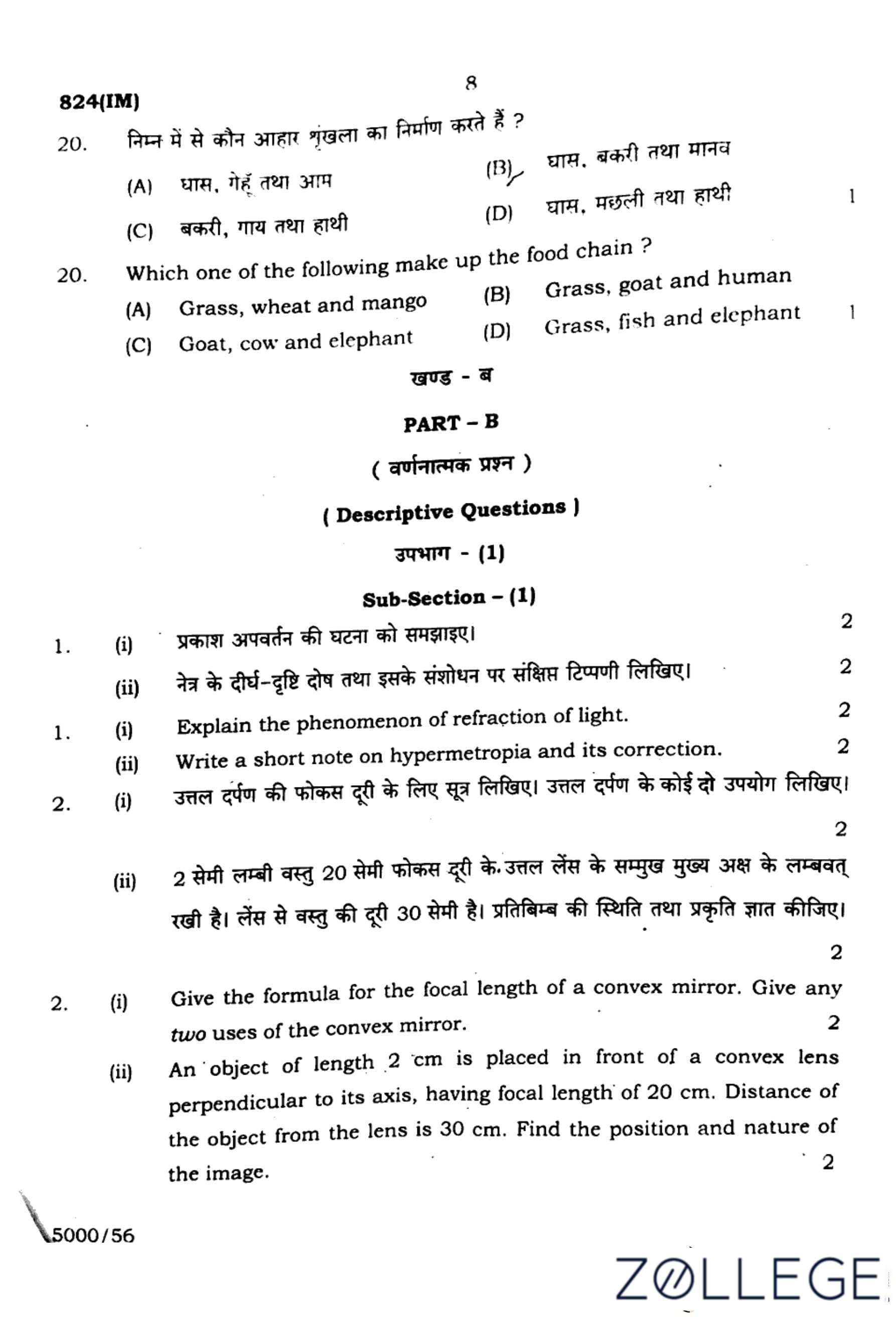
Which one of the following make up the food chain?
View Solution
A food chain typically starts with producers (like grass), followed by primary consumers (like herbivores such as goats), and then secondary consumers (like humans who consume the goat). Therefore, the correct food chain is Grass, goat, and human.
Quick Tip: In a food chain, producers are consumed by primary consumers, and primary consumers are consumed by secondary consumers.
(i) Explain the phenomenon of refraction of light.
View Solution
Refraction is the bending of light as it passes from one medium to another. This happens because light travels at different speeds in different media. When light enters a medium with a different refractive index, it bends at the interface. The amount of bending depends on the angle of incidence and the refractive indices of the two media. The refractive index \(n\) is given by \(n = \frac{speed of light in vacuum}{speed of light in the medium}\).
Quick Tip: When light moves from a denser medium to a rarer one, it bends away from the normal.
Write a short note on hypermetropia and its correction.
View Solution
Hypermetropia, also known as farsightedness, is a condition where distant objects are seen clearly, but nearby objects appear blurred. This occurs when the eyeball is too short or the lens has too little curvature. The focal point of the eye is beyond the retina. To correct hypermetropia, convex lenses are used, which bring the focal point closer to the retina, allowing clear vision for nearby objects.
Quick Tip: Convex lenses help converge light rays to focus the image on the retina for hypermetropia correction.
(i) Give the formula for the focal length of a convex mirror. Give any two uses of the convex mirror.
View Solution
The formula for the focal length \(f\) of a convex mirror is: \[ f = \frac{R}{2} \]
where \(R\) is the radius of curvature of the mirror.
The uses of a convex mirror are:
1. Convex mirrors are used in vehicles as rearview mirrors because they provide a wider field of view.
2. They are used in security systems to monitor large areas.
Quick Tip: Convex mirrors have a wide field of view and form virtual, diminished images.
An object of length 2 cm is placed in front of a convex lens perpendicular to its axis, having focal length of 20 cm. Distance of the object from the lens is 30 cm. Find the position and nature of the image.
View Solution
Using the lens formula: \[ \frac{1}{f} = \frac{1}{v} - \frac{1}{u} \]
where:
- \( f = 20 \, cm \) (focal length),
- \( u = -30 \, cm \) (object distance; negative as per sign convention),
- \( v \) is the image distance (unknown).
Substitute the known values into the lens formula: \[ \frac{1}{20} = \frac{1}{v} - \frac{1}{-30} \] \[ \frac{1}{v} = \frac{1}{20} + \frac{1}{30} \]
To simplify: \[ \frac{1}{v} = \frac{3 + 2}{60} = \frac{5}{60} \] \[ v = 12 \, cm \]
The positive value of \( v \) indicates that the image is formed on the opposite side of the object, which means it is a real and inverted image.
Quick Tip: For convex lenses, when the object is beyond the focal point, the image formed is real, inverted, and on the opposite side of the object.
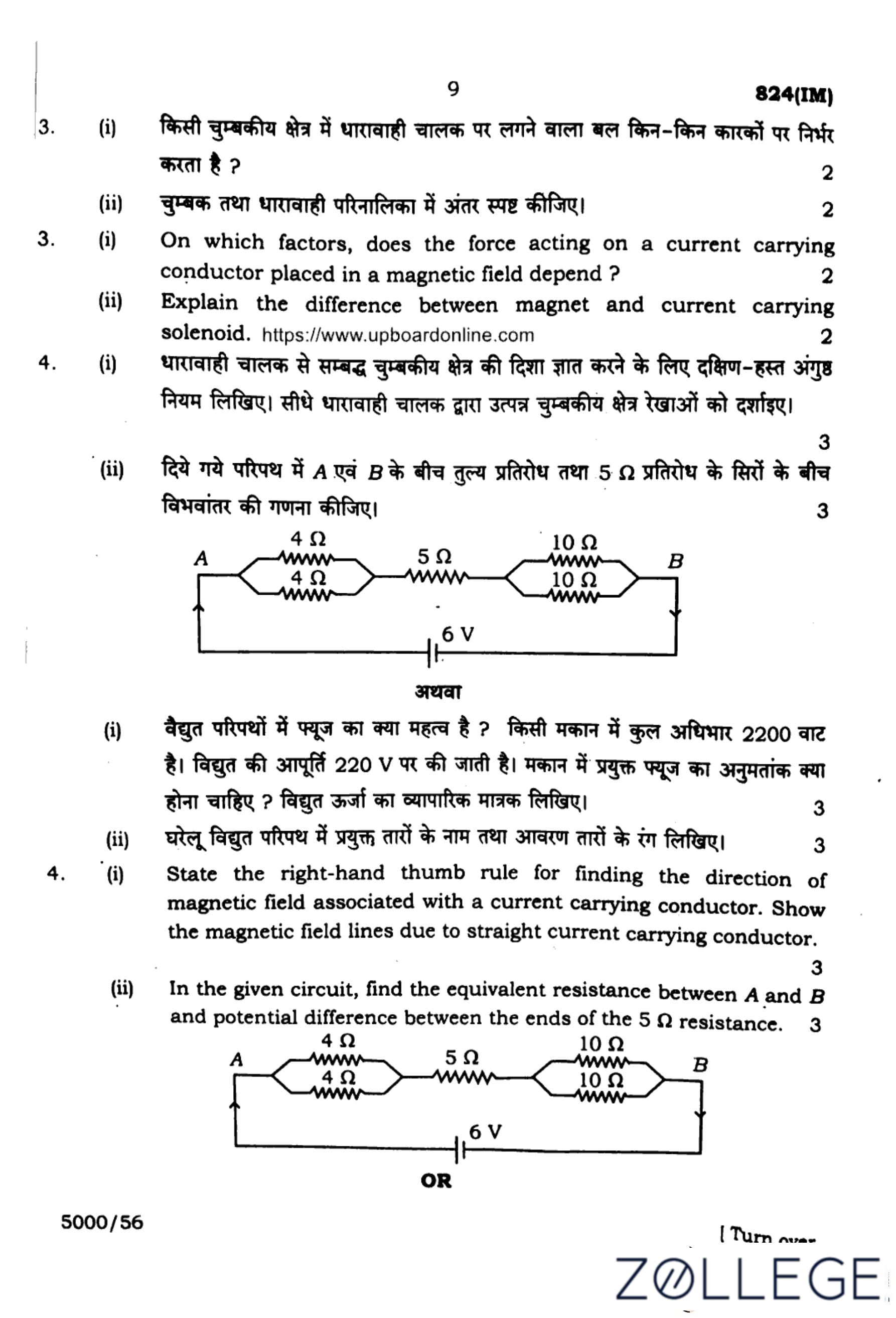
(i) On which factors does the force acting on a current carrying conductor placed in a magnetic field depend?
View Solution
The force on a current-carrying conductor in a magnetic field depends on the following factors:
The strength of the magnetic field \(B\),
The current \(I\) flowing through the conductor,
The length of the conductor \(L\) within the magnetic field,
The angle between the direction of the magnetic field and the current (denoted as \(\theta\)).
The force can be calculated using the formula: \[ F = BIL \sin \theta \] Quick Tip: The force is maximum when the current is perpendicular to the magnetic field.
Explain the difference between magnet and current carrying solenoid.
View Solution
The differences between a magnet and a current-carrying solenoid are as follows:
\[ \begin{array}{|l|l|} \hline \textbf{Magnet} & \textbf{Current Carrying Solenoid}
\hline Produces a magnetic field naturally. & Produces a magnetic field when current flows through it.
\hline Has fixed north and south poles. & Has magnetic poles that depend on the current direction.
\hline The magnetic field is permanent. & The magnetic field can be turned on or off.
\hline \end{array} \] Quick Tip: A current-carrying solenoid creates a magnetic field that behaves like a bar magnet.
(i) State the right-hand thumb rule for finding the direction of magnetic field associated with a current carrying conductor. Show the magnetic field lines due to a straight current carrying conductor.
View Solution
The right-hand thumb rule states that if the right-hand thumb is held in the direction of the current in a straight conductor, the curl of the fingers shows the direction of the magnetic field around the conductor.
For a straight current-carrying wire:
- The current flows along the wire in a certain direction.
- If you hold the wire with your right hand such that the thumb points in the direction of the current, the curl of your fingers indicates the direction of the magnetic field lines around the wire.
- These magnetic field lines form concentric circles around the wire, with the direction determined by the curl of your fingers.
Quick Tip: Use your right hand: Thumb shows current, fingers show the direction of the magnetic field.
In the given circuit, find the equivalent resistance between A and B and potential difference between the ends of the 5 \(\Omega\) resistance.
View Solution
The circuit involves resistors in series and parallel. First, the two 4 \(\Omega\) resistors are in parallel. The total resistance of this parallel combination is: \[ \frac{1}{R_{parallel}} = \frac{1}{4} + \frac{1}{4} = \frac{2}{4} = \frac{1}{2} \] \[ R_{parallel} = 2 \, \Omega \]
Now, this 2 \(\Omega\) combination is in series with the 5 \(\Omega\) resistor, so the total resistance of this combination is: \[ R_{total1} = 2 + 5 = 7 \, \Omega \]
Next, this 7 \(\Omega\) is in parallel with the 10 \(\Omega\) resistor: \[ \frac{1}{R_{total}} = \frac{1}{7} + \frac{1}{10} \] \[ \frac{1}{R_{total}} = \frac{10 + 7}{70} = \frac{17}{70} \] \[ R_{total} = \frac{70}{17} \approx 4.12 \, \Omega \]
So the equivalent resistance between A and B is approximately \(4.12 \, \Omega\).
Now, using Ohm's law, the total current in the circuit is: \[ I = \frac{V}{R_{total}} = \frac{6}{4.12} \approx 1.46 \, A \]
The potential difference across the 5 \(\Omega\) resistor can be found using: \[ V = I \times 5 = 1.46 \times 5 = 7.3 \, V \] Quick Tip: When calculating the equivalent resistance of resistors in parallel, use the formula \(\frac{1}{R_{total}} = \sum \frac{1}{R_i}\). In series, simply add the resistances.
(i) What is the importance of fuse in electrical circuits? Total load of a house is 2200 W. Electricity is supplied at 220 V. What should be the rating of fuse used in the house? Write down the commercial unit of electrical energy.
View Solution
A fuse is an essential safety device used in electrical circuits. It prevents damage to the electrical appliances and wiring by melting and breaking the circuit when the current exceeds a safe value, thereby protecting the circuit from overheating and potential fires. The rating of the fuse is based on the maximum current that the circuit is expected to handle.
The current in the circuit can be calculated using the formula: \[ I = \frac{P}{V} = \frac{2200 \, W}{220 \, V} = 10 \, A \]
Therefore, the fuse should have a rating of at least 10 A.
The commercial unit of electrical energy is the kWh (kilowatt-hour), which is the energy consumed by a 1 kW load in 1 hour. 1 kWh is equivalent to 1000 watts used for 1 hour.
Quick Tip: When selecting a fuse, ensure the fuse rating is slightly higher than the normal operating current of the circuit to prevent unnecessary blows.
Write the names of the wires used in the domestic electrical circuit and also write the colours of the insulating wires.
View Solution
In a domestic electrical circuit, three types of wires are used:
Live wire: The wire that carries current to the load. It is usually coloured red or brown.
Neutral wire: The wire that completes the circuit by carrying current away from the load. It is coloured blue.
Earth wire: This wire provides safety by carrying current directly to the ground in case of a fault. It is coloured green or yellow-green.
Quick Tip: Always check the colour coding of wires before handling them to ensure safety and proper connection in circuits.
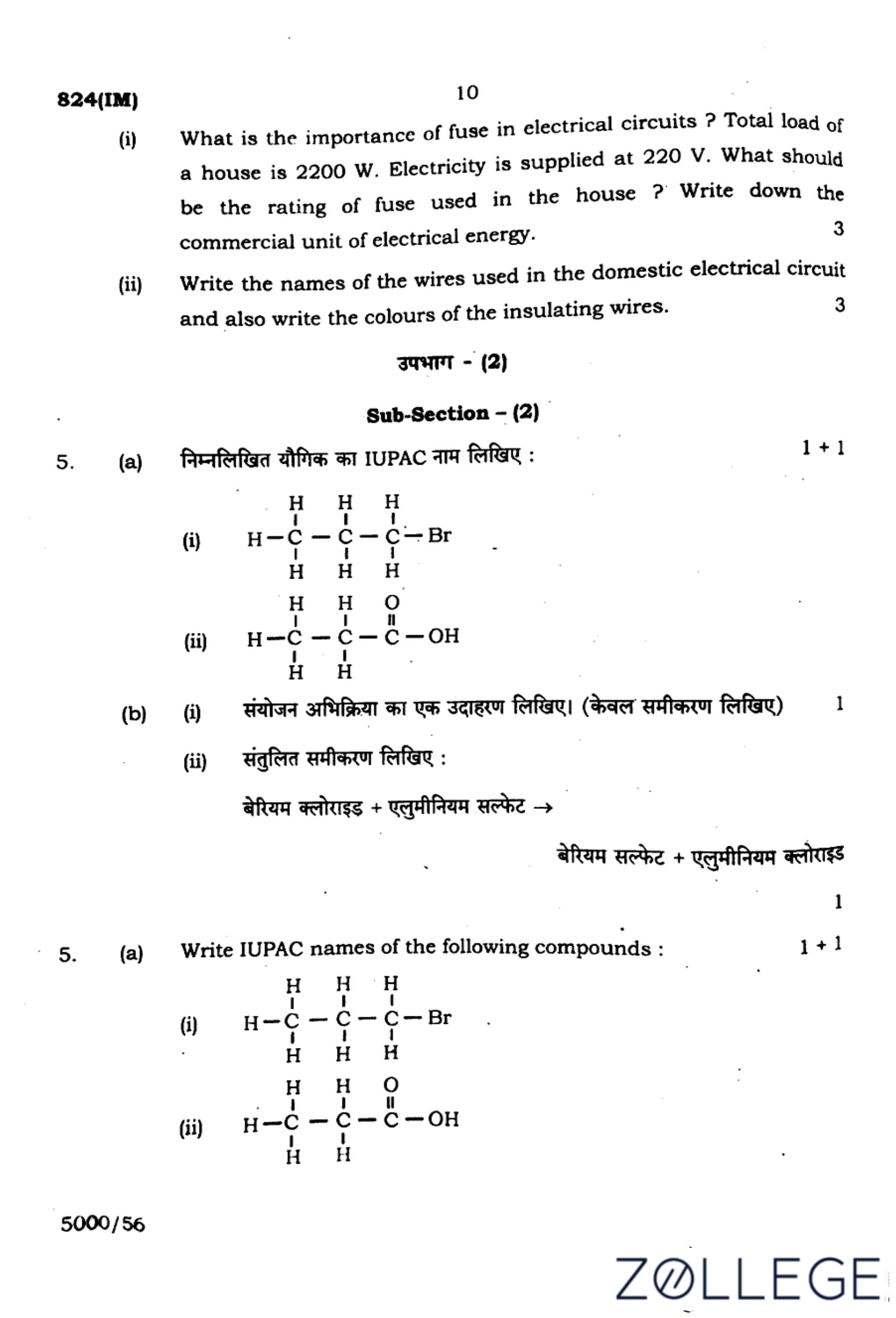
Write IUPAC names of the following compounds:
% Compound (i)
(i)
View Solution
The longest carbon chain in this compound has 3 carbon atoms, so the base name is "propane". The bromine atom is attached to the first carbon, so the name is 1-Bromopropane.
Quick Tip: In IUPAC naming, always number the carbon chain from the end nearest to the functional group (in this case, bromine).
(b)
(i) Write an example of a combination reaction (write equation only).
View Solution
An example of a combination reaction is:
\[ A + B \rightarrow AB \]
Quick Tip: A combination reaction occurs when two or more reactants combine to form a single product.
Write balanced equation:
\text{Barium chloride + Aluminium sulphate → Barium sulphate + Aluminium chloride
View Solution
The balanced chemical equation for the given reaction is:
\[ BaCl_2 (aq) + Al_2(SO_4)_3 (aq) \rightarrow BaSO_4 (s) + 2AlCl_3 (aq) \]
Quick Tip: In a combination reaction, the products are simpler compounds formed from the combination of reactants.
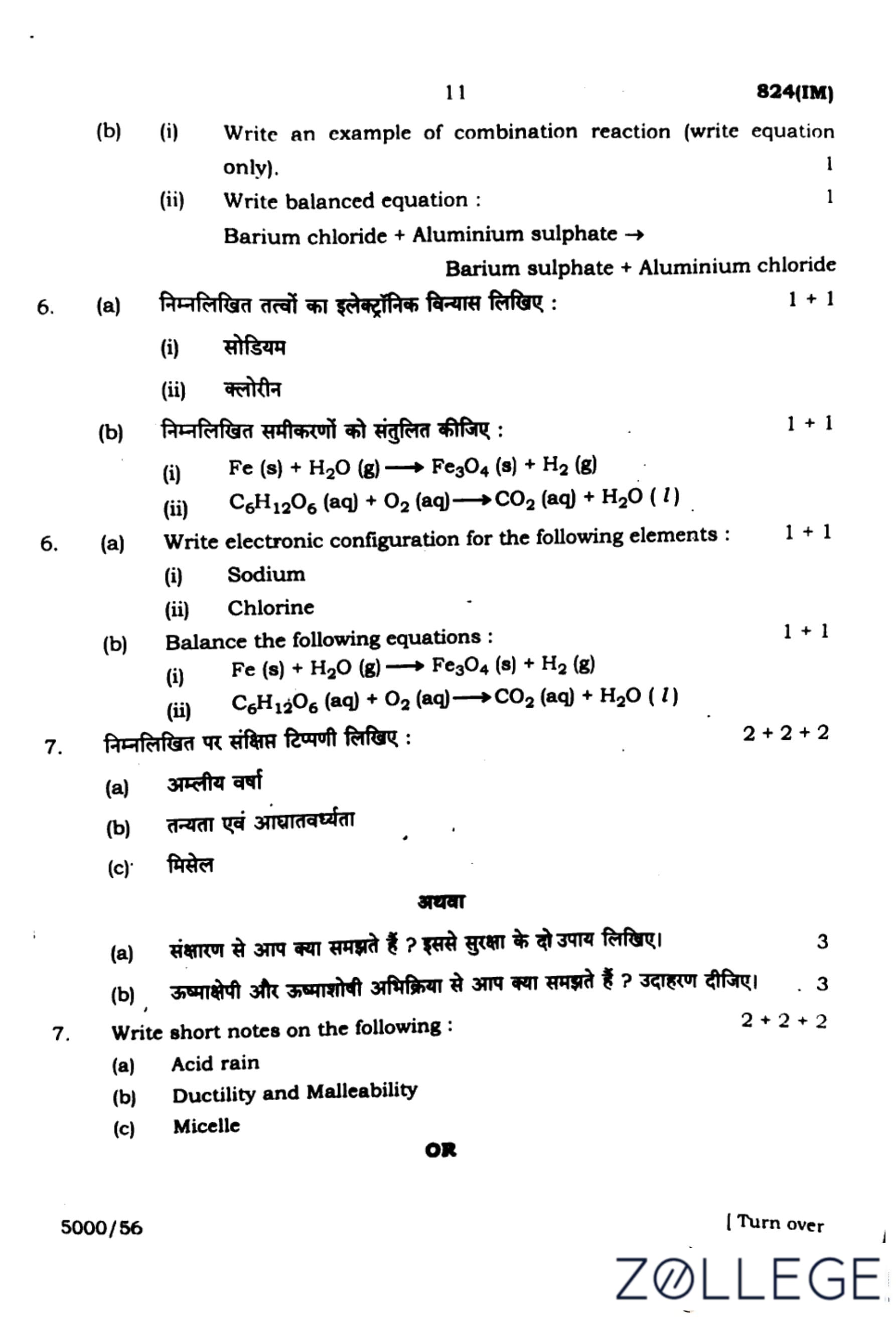
(a) Write electronic configuration for the following elements:
(i) Sodium
(ii) Chlorine
View Solution
(i) The electronic configuration of Sodium (Na) is:
\[ Na: 1s^2 \, 2s^2 \, 2p^6 \, 3s^1 \]
(ii) The electronic configuration of Chlorine (Cl) is:
\[ Cl: 1s^2 \, 2s^2 \, 2p^6 \, 3s^2 \, 3p^5 \]
Quick Tip: To write the electronic configuration, follow the Aufbau principle and fill orbitals in order of increasing energy.
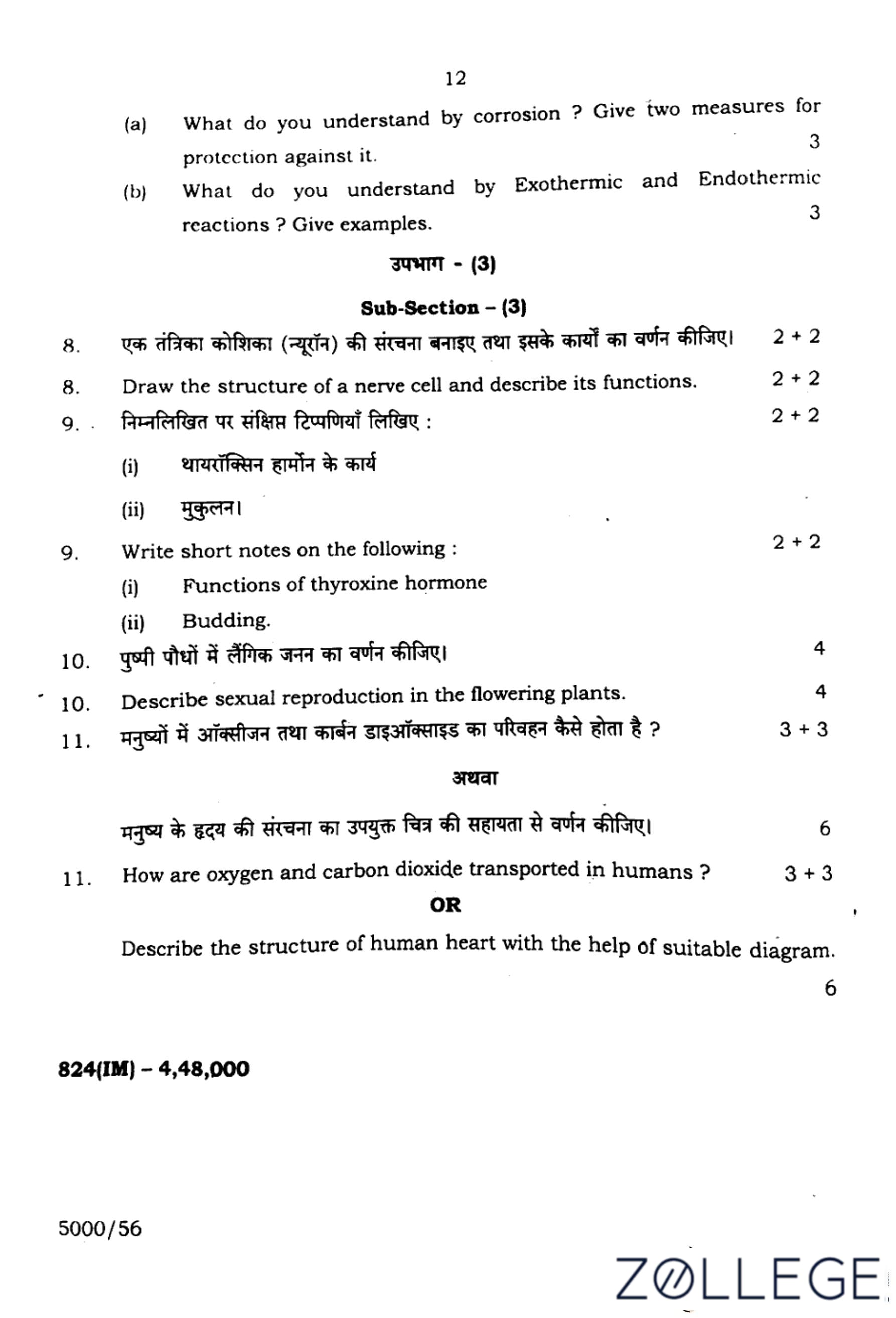
What do you understand by corrosion? Give two measures for protection against it.
View Solution
Corrosion is the process by which metals deteriorate due to chemical reactions with their environment, typically with oxygen or moisture. For example, iron reacts with water and oxygen to form rust (iron oxide).
Two measures for protection against corrosion are:
1. Galvanization: Coating the metal with a layer of zinc to protect it from environmental factors.
2. Use of corrosion-resistant materials: Choosing alloys like stainless steel, which do not easily corrode.
Quick Tip: Corrosion can be minimized by using protective coatings or choosing corrosion-resistant materials.
What do you understand by Exothermic and Endothermic reactions? Give examples.
View Solution
(i) Exothermic reactions: These are reactions that release energy in the form of heat or light. The energy required to break bonds is less than the energy released when new bonds are formed. Example: Combustion of wood, where energy is released as heat and light.
(ii) Endothermic reactions: These are reactions that absorb energy from the surroundings. The energy required to break bonds is more than the energy released when new bonds are formed. Example: Photosynthesis, where plants absorb sunlight to convert carbon dioxide and water into glucose.
Quick Tip: Exothermic reactions release energy, while endothermic reactions absorb energy.
Draw the structure of a nerve cell and describe its functions.
View Solution
The structure of a nerve cell (neuron) consists of the following parts:
1. Cell body (Soma): Contains the nucleus and other organelles.
2. Dendrites: Branch-like structures that receive signals from other neurons.
3. Axon: A long fiber that transmits electrical impulses away from the cell body.
4. Axon terminals: Branches at the end of the axon that transmit the signal to the next neuron.
Functions: The nerve cell transmits electrical signals to communicate with other neurons, muscles, or glands in the body.
Quick Tip: The axon is the main conducting part of a neuron, while dendrites receive stimuli.
Write short notes on the following:
View Solution
Thyroxine is produced by the thyroid gland and plays a crucial role in regulating metabolism. It increases the rate of energy production in cells, helping maintain body temperature and supporting normal growth and development.
% Option (ii)
(ii) Budding
% Solution (ii)
Solution:
Budding is a type of asexual reproduction where a new organism grows from a bud on the parent organism. The new organism may eventually separate from the parent, becoming an independent individual. This method is commonly observed in yeast and hydra.
Quick Tip: Thyroxine is essential for controlling the body's metabolism, while budding is a type of asexual reproduction.
Describe sexual reproduction in the flowering plants.
View Solution
In flowering plants, sexual reproduction involves the fusion of male and female gametes (sperm and ovule). The process begins with pollination, where pollen from the male part (anther) reaches the female part (stigma). The sperm cells then travel through the style to fertilize the ovule in the ovary. After fertilization, the ovule develops into a seed, and the ovary forms the fruit.
Quick Tip: Sexual reproduction in plants ensures genetic diversity through the fusion of male and female gametes.
How are oxygen and carbon dioxide transported in humans?
View Solution
In humans, oxygen is carried by red blood cells as oxyhemoglobin, where oxygen binds to hemoglobin in the lungs and is transported to tissues. Carbon dioxide is transported back to the lungs in three forms: dissolved in plasma, bound to hemoglobin, and as bicarbonate ions (HCO3-) in the plasma.
Quick Tip: The majority of carbon dioxide is carried as bicarbonate ions in the blood, while oxygen binds to hemoglobin.
Describe the structure of human heart with the help of a suitable diagram.
View Solution
The human heart is a four-chambered organ, consisting of two atria and two ventricles. The right atrium receives deoxygenated blood from the body and pumps it into the right ventricle, which sends it to the lungs for oxygenation. The left atrium receives oxygenated blood from the lungs and pumps it into the left ventricle, which circulates it throughout the body. The heart also has valves that regulate blood flow between the chambers and prevent backflow.
Quick Tip: The left ventricle pumps oxygenated blood to the entire body, while the right ventricle pumps deoxygenated blood to the lungs.
*The article might have information for the previous academic years, please refer the official website of the exam.