
UP Board Class 10 Science (Code 824 IN) Question Paper 2024 Available :Download Solution PDF With Answer Key


Content Writer | Updated On - Feb 27, 2025
UP Board Class 10 Science Question Paper 2024 PDF (Code 824 IN) is available for download here. The Science exam was conducted on February 29, 2024 in the Morning Shift from 8:30 AM to 11:45 AM. The total marks for the theory paper are 70. Students reported the paper to be moderate.
UP Board Class 10 Science Question Paper 2024 (Code 824 IN) with Solutions
| UP Board Class 10 Science Question Paper With Answer Key |  Download Download |
Check Solution |

UP Board Class 10 Science Question Paper With Solution
Part–A
(Sub-Section 1)
Multiple Choice Type Questions
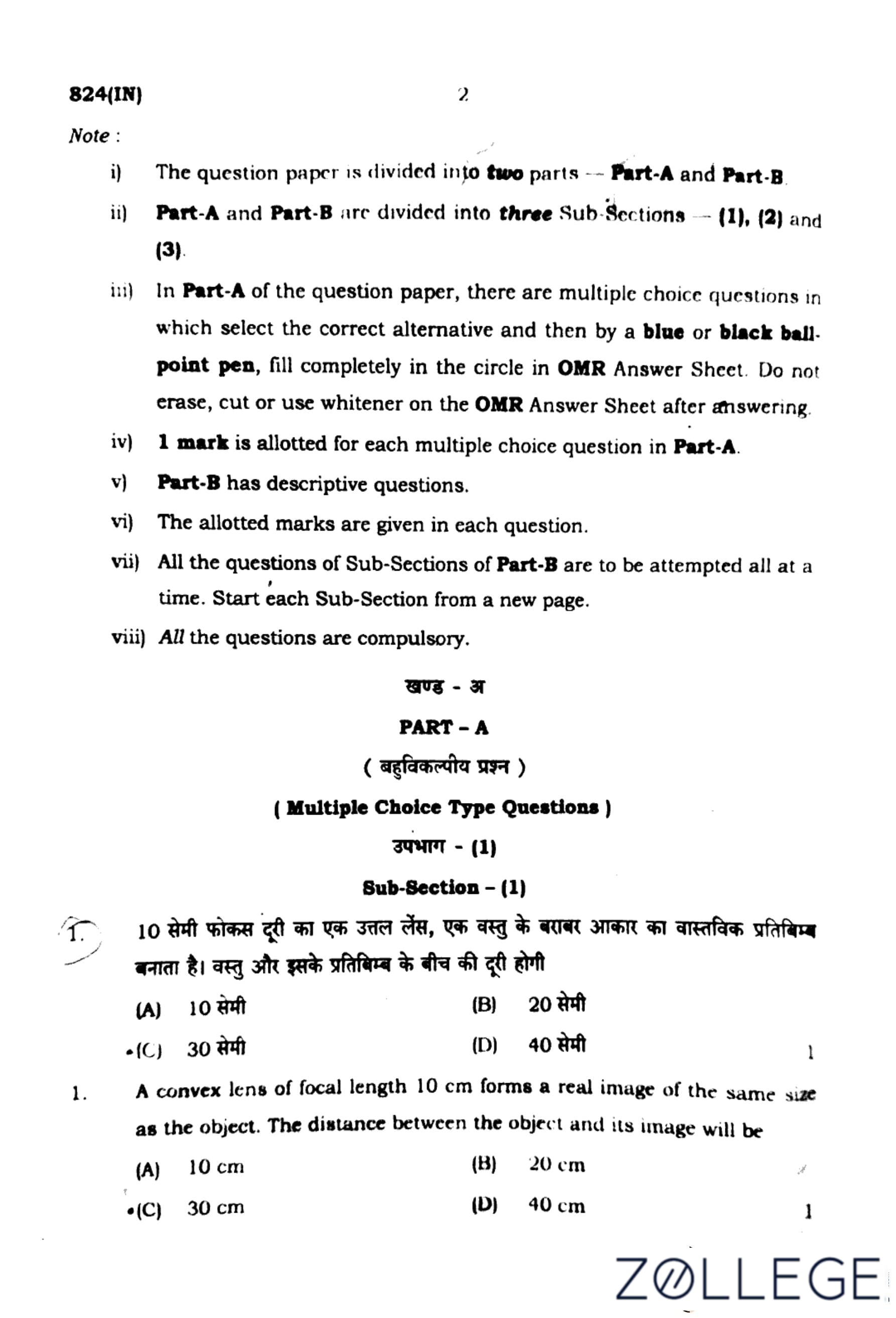
Question 1:
A convex lens of focal length 10 cm forms a real image of the same size as the object. The distance between the object and its image will be:
View Solution
N/A Quick Tip: For a convex lens forming a real image of the same size as the object, the distance between the object and the image is twice the focal length.
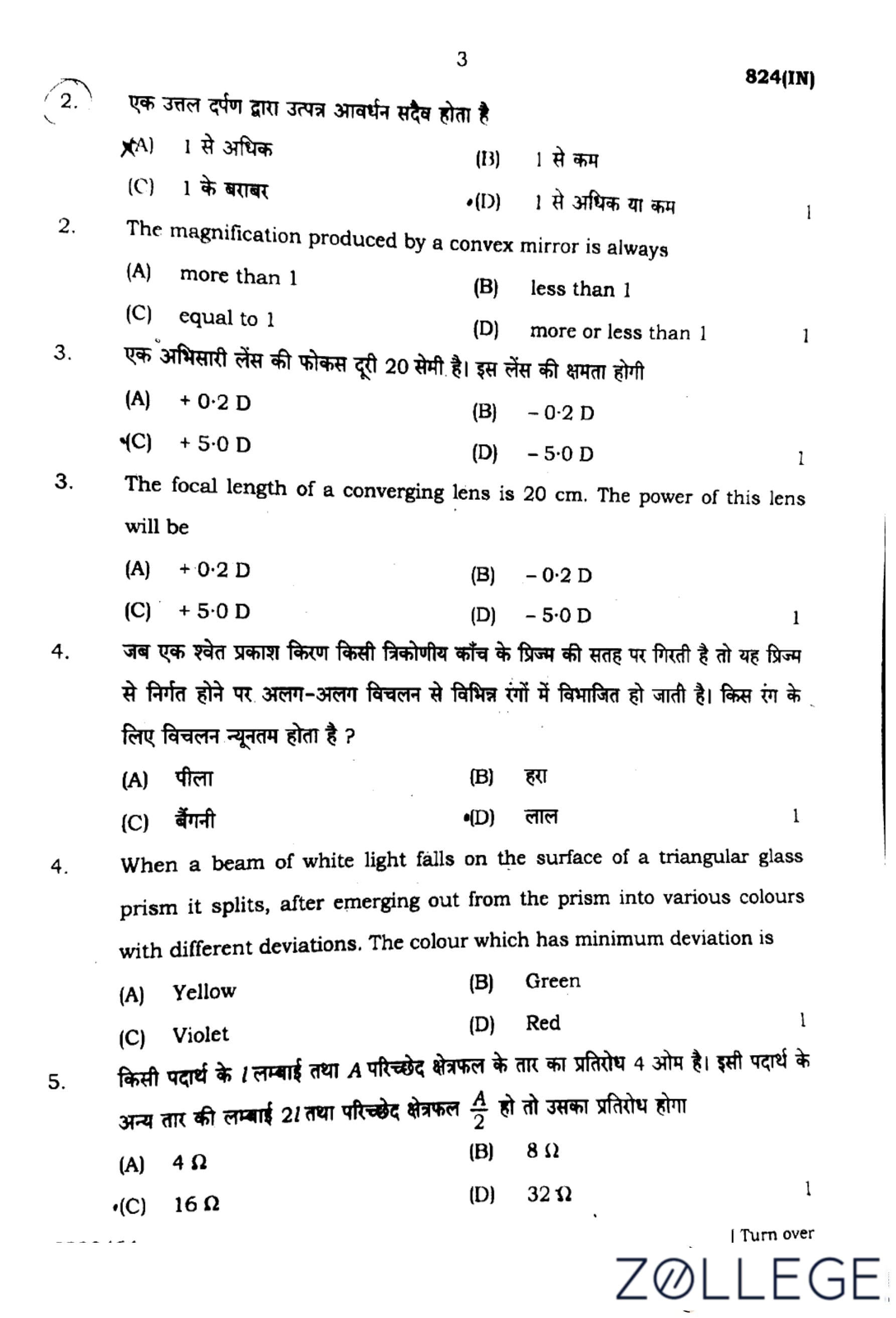
The magnification produced by a convex mirror is always
View Solution
N/A Quick Tip: A convex mirror always produces a virtual, erect, and diminished image, making its magnification less than 1.
The focal length of a converging lens is 20 cm. The power of this lens will be
View Solution
N/A Quick Tip: The power of a lens is calculated using \( P = \frac{100}{f} \), where \( f \) is in cm. A convex lens has a positive power.
When a beam of white light falls on the surface of a triangular glass prism it splits, after emerging out from the prism into various colours with different deviations. The colour which has minimum deviation is
View Solution
N/A Quick Tip: The deviation of light in a prism depends on its wavelength. Red light, having the longest wavelength, experiences the least deviation.
The resistance of a wire of any substance of length \( l \) and area of cross-section \( A \) is 4 \( \Omega \). Another wire of the same substance has length \( 2l \) and area of cross-section \( \frac{A}{2} \). Then its resistance will be
View Solution
N/A Quick Tip: Resistance of a wire is directly proportional to length and inversely proportional to the cross-sectional area.
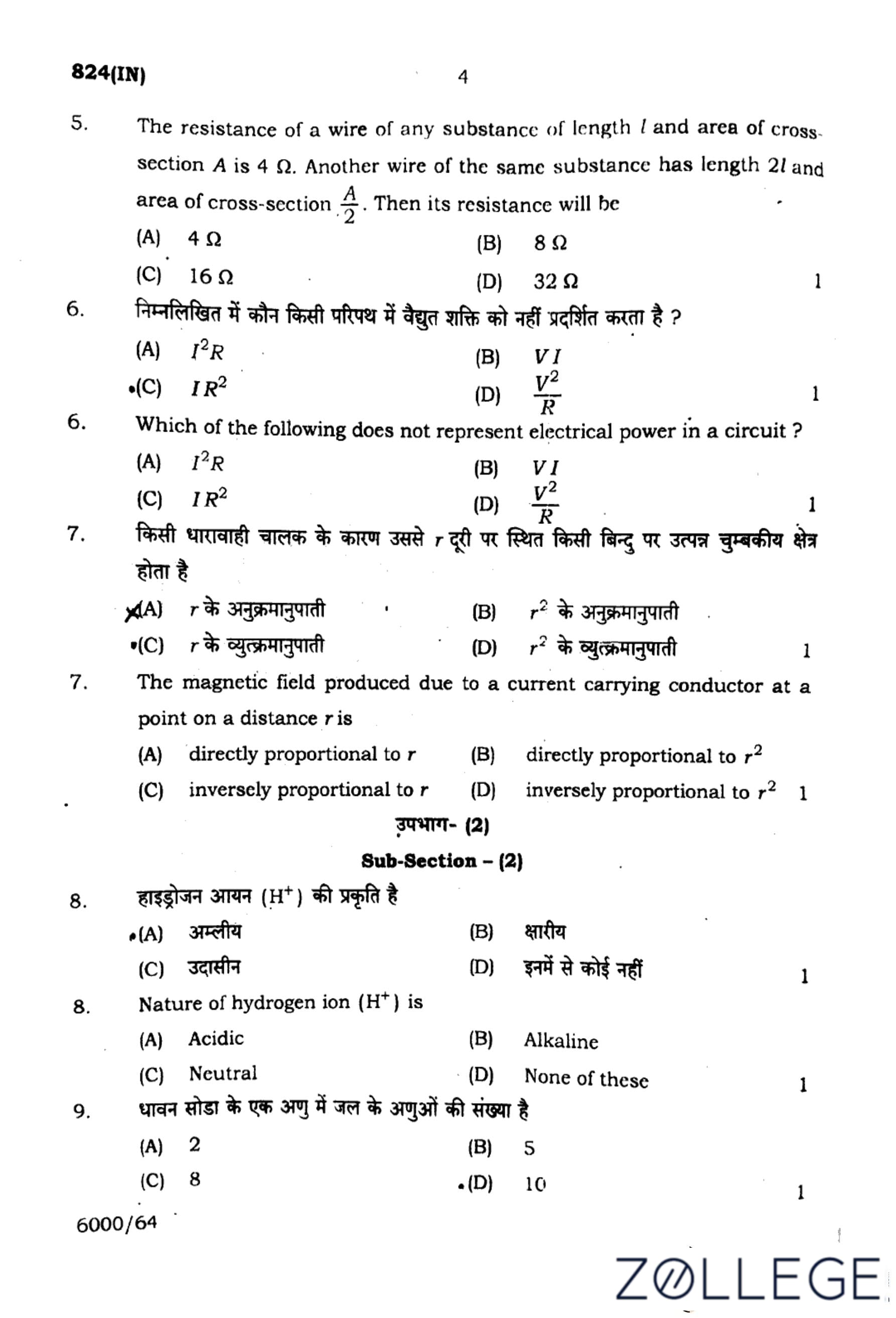
Which of the following does not represent electrical power in a circuit?
View Solution
N/A Quick Tip: Electrical power formulas include \( P = VI \), \( P = I^2 R \), and \( P = \frac{V^2}{R} \).
The magnetic field produced due to a current-carrying conductor at a point on a distance \( r \) is
View Solution
N/A Quick Tip: Magnetic field due to a long straight current-carrying wire follows \( B \propto \frac{1}{r} \).
Nature of hydrogen ion (\( H^+ \)) is
View Solution
N/A Quick Tip: \( H^+ \) ions are responsible for the acidic nature of a solution.
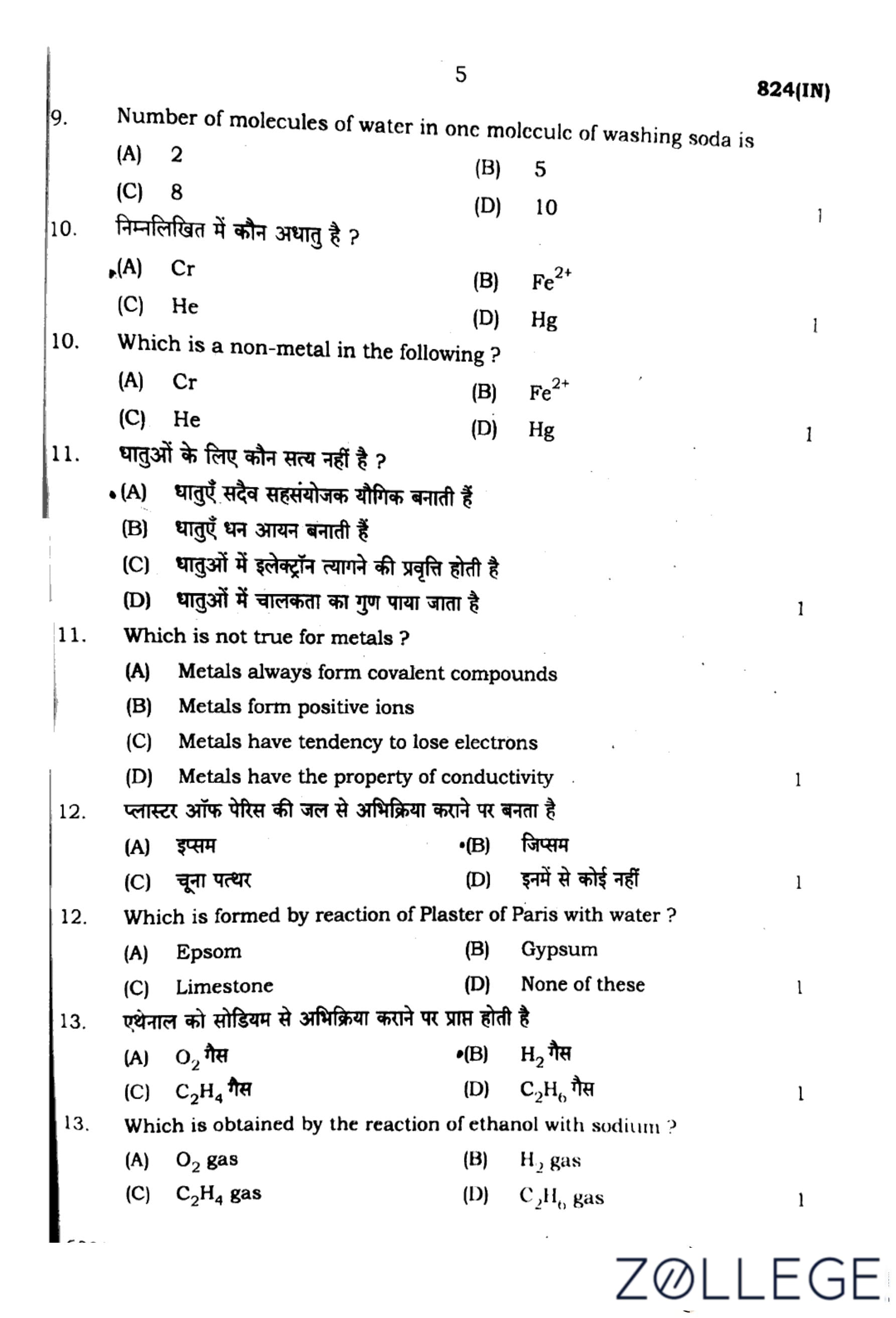
Number of molecules of water in one molecule of washing soda is
View Solution
N/A Quick Tip: Washing soda (\( Na_2CO_3 \cdot 10H_2O \)) contains 10 water molecules of crystallization.
Which is a non-metal in the following?
View Solution
N/A Quick Tip: Noble gases like Helium (\( He \)) are non-metals and are chemically inert.
Which is not true for metals?
View Solution
N/A Quick Tip: Metals generally form ionic compounds by losing electrons to form cations.
Which is formed by reaction of Plaster of Paris with water?
View Solution
N/A Quick Tip: Plaster of Paris hardens into Gypsum when mixed with water.
Which is obtained by the reaction of ethanol with sodium?
View Solution
N/A Quick Tip: The reaction of ethanol with sodium metal releases hydrogen gas.
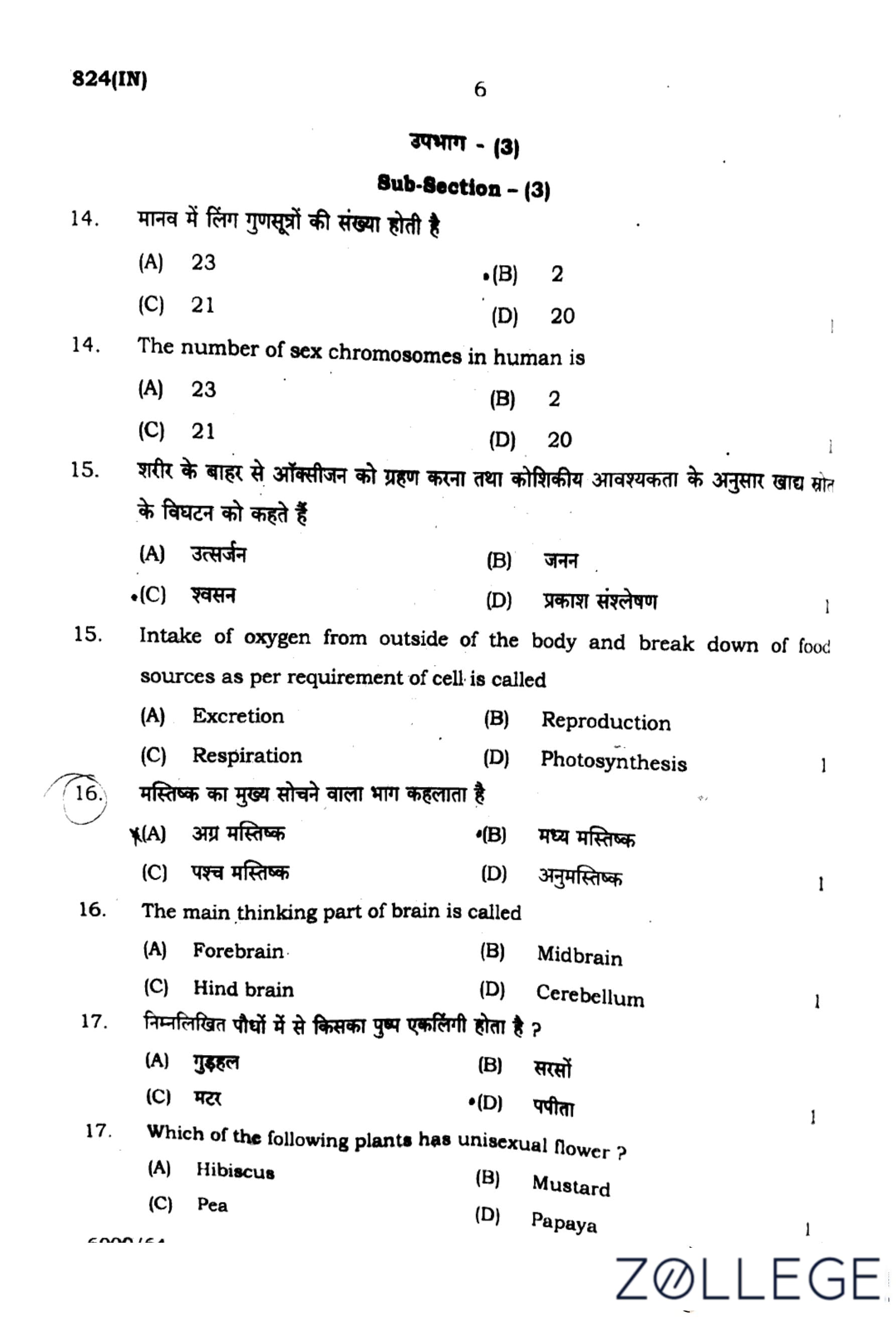
The number of sex chromosomes in humans is
View Solution
N/A Quick Tip: Humans have 2 sex chromosomes (XX in females, XY in males) and 44 autosomes.
Intake of oxygen from outside of the body and breakdown of food sources as per requirement of the cell is called
View Solution
N/A Quick Tip: Respiration involves oxygen intake and the breakdown of food to produce energy.
The main thinking part of the brain is called
View Solution
N/A Quick Tip: The forebrain controls higher cognitive functions, including thinking and decision-making.
Which of the following plants has a unisexual flower?
View Solution
N/A Quick Tip: Unisexual flowers contain only male or female reproductive parts. Papaya is a unisexual plant.
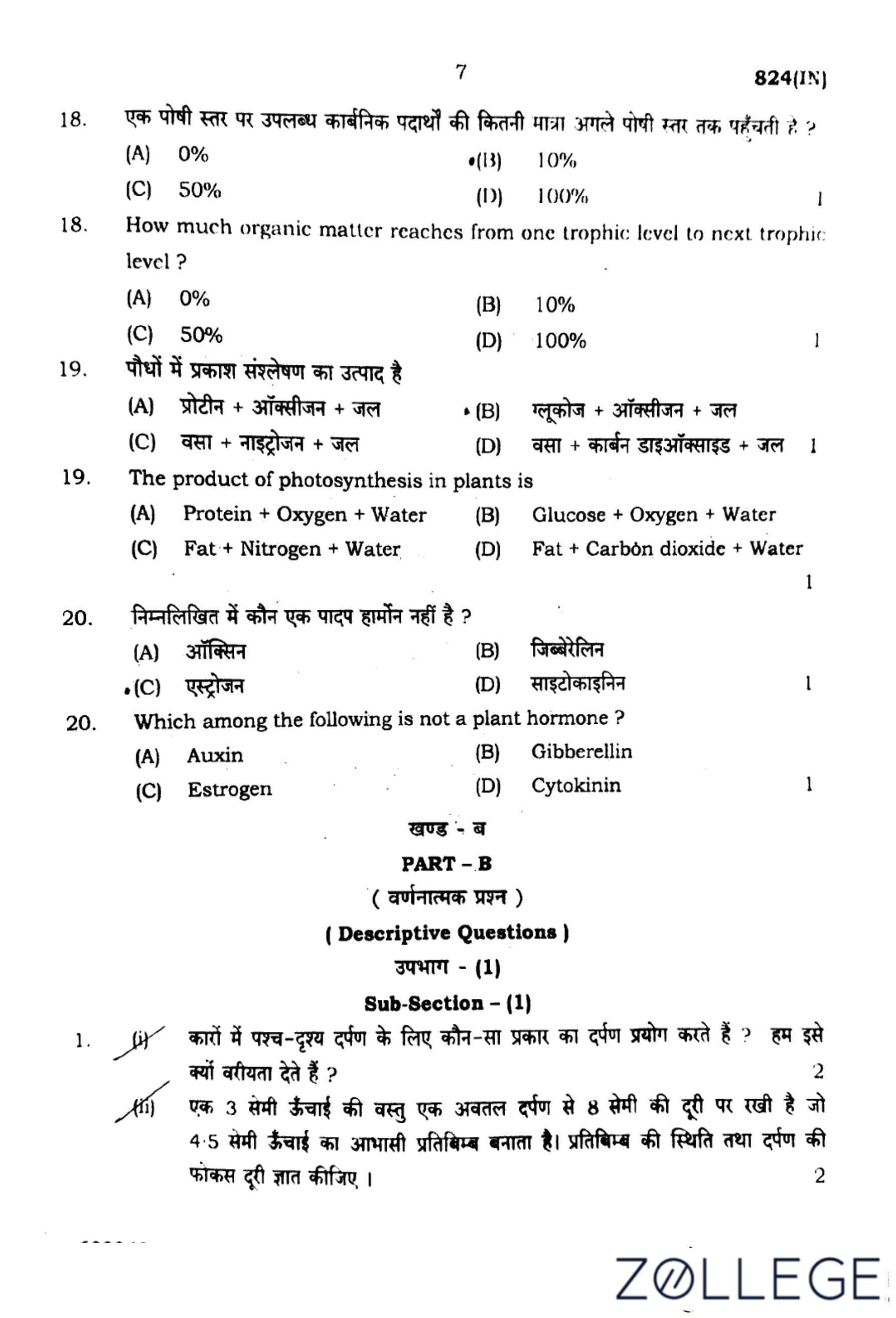
How much organic matter reaches from one trophic level to the next trophic level?
View Solution
N/A Quick Tip: The 10% rule states that only 10% of energy is passed on to the next trophic level.
The product of photosynthesis in plants is
View Solution
N/A Quick Tip: Photosynthesis produces glucose (\( C_6H_{12}O_6 \)) and oxygen as its primary products.
Which among the following is not a plant hormone?
View Solution
N/A Quick Tip: Estrogen is an animal hormone, not a plant hormone.
Which type of mirror is used as a rear-view mirror in cars? Why do we prefer it?
View Solution
N/A Quick Tip: Convex mirrors provide a wider view, making them ideal for rear-view mirrors in vehicles.
An object of 3 cm height is placed at a distance of 8 cm from a concave mirror which produces a virtual image of 4.5 cm height. Find the position of the image and focal length of the mirror.
View Solution
N/A Quick Tip: For a concave mirror, a virtual image is formed when the object is placed between the pole and the focus.
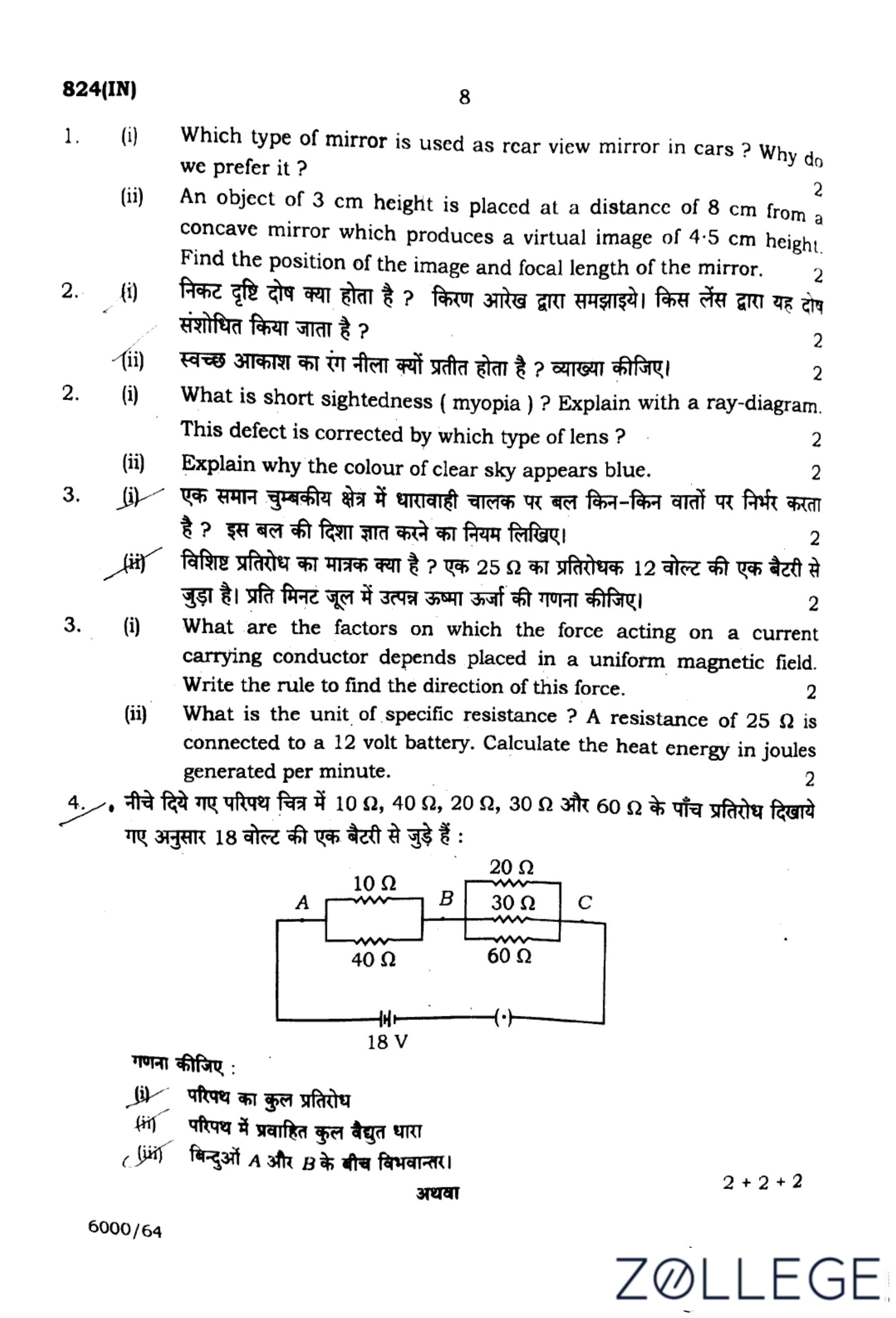
What is short-sightedness (myopia)? Explain with a ray diagram. This defect is corrected by which type of lens?
View Solution
N/A Quick Tip: Myopia is corrected using a concave lens, which helps in diverging light rays before they enter the eye.
Explain why the colour of the clear sky appears blue.
View Solution
N/A Quick Tip: Rayleigh scattering causes blue light to scatter more than other wavelengths, making the sky appear blue.
What are the factors on which the force acting on a current-carrying conductor depends when placed in a uniform magnetic field? Write the rule to find the direction of this force.
View Solution
N/A Quick Tip: Fleming’s Left-Hand Rule helps determine the direction of force on a current-carrying conductor in a magnetic field.
What is the unit of specific resistance? A resistance of 25 \( \Omega \) is connected to a 12-volt battery. Calculate the heat energy in joules generated per minute.
View Solution
N/A Quick Tip: Heat energy (\( H \)) in a resistor is calculated using \( H = I^2 R t \).
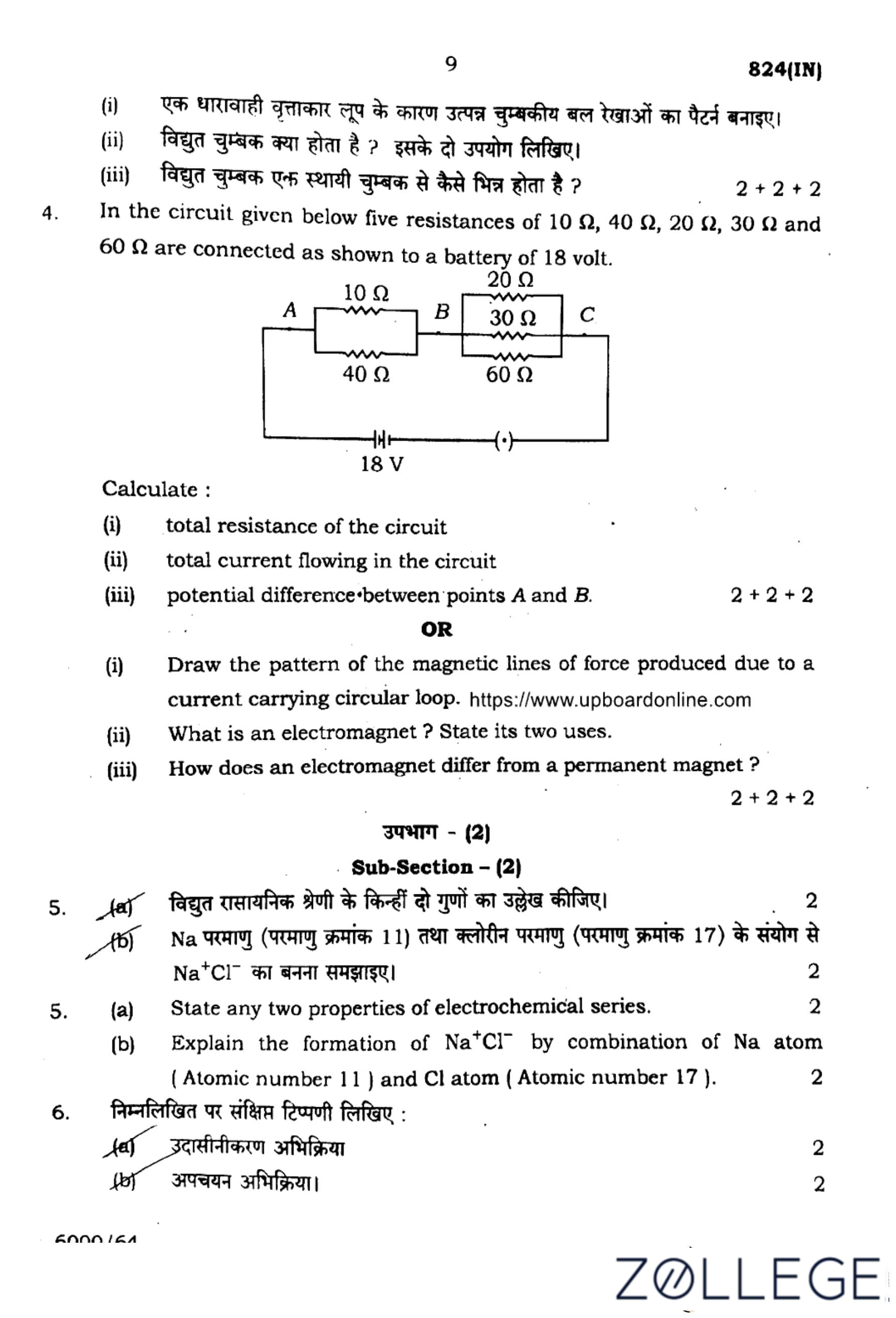
Total resistance of the circuit
View Solution
N/A Quick Tip: For resistors in parallel, use \( \frac{1}{R_{eq}} = \frac{1}{R_1} + \frac{1}{R_2} \), and for resistors in series, add them directly.
Total current flowing in the circuit
View Solution
N/A Quick Tip: Ohm’s Law states that current \( I = \frac{V}{R} \). Knowing total resistance and voltage allows calculating total current.
Potential difference between points A and B
View Solution
N/A Quick Tip: Potential difference (\( V \)) is calculated using \( V = IR \), where \( I \) is the current and \( R \) is the resistance between two points.
Draw the pattern of the magnetic lines of force produced due to a current-carrying circular loop.
View Solution
N/A Quick Tip: The magnetic field around a current-carrying circular loop forms concentric circles, and its direction follows the right-hand thumb rule.
What is an electromagnet? State its two uses.
View Solution
N/A Quick Tip: Electromagnets work only when current flows and are widely used in medical and industrial applications.
How does an electromagnet differ from a permanent magnet?
View Solution
N/A Quick Tip: Unlike permanent magnets, electromagnets can be switched on or off and have adjustable strength.
State any two properties of the electrochemical series.
View Solution
N/A Quick Tip: The electrochemical series ranks elements based on their electrode potential, aiding in reactivity and displacement reactions.
Explain the formation of \( Na^+ Cl^- \) by combination of Na atom (Atomic number 11) and Cl atom (Atomic number 17).
View Solution
N/A Quick Tip: Ionic bonds form when one atom donates electrons and another accepts them to complete their octets.
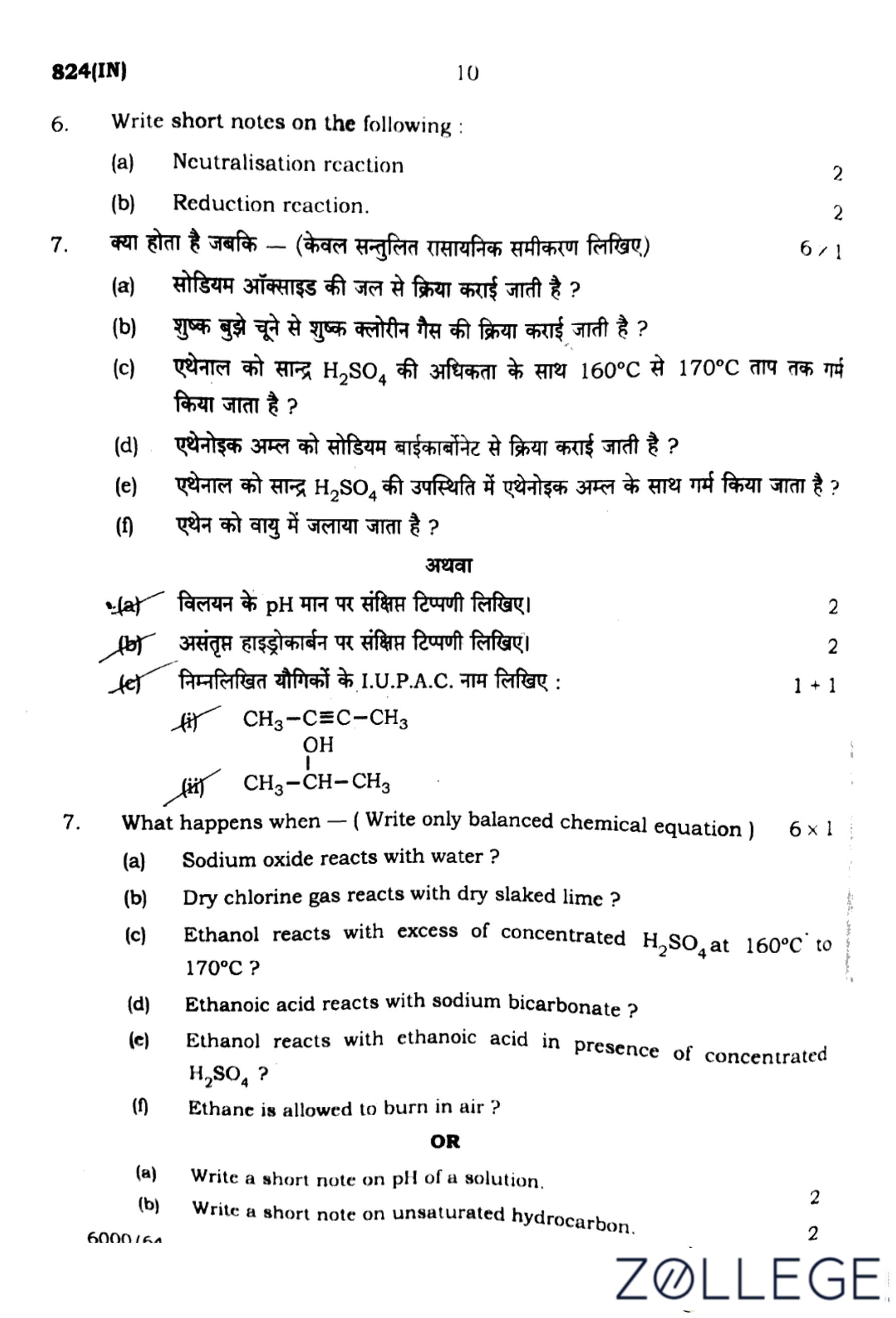
Neutralisation reaction
View Solution
N/A Quick Tip: Neutralisation reactions help in maintaining pH balance and are used in antacids and wastewater treatment.
Reduction reaction
View Solution
N/A Quick Tip: Reduction is the gain of electrons or a decrease in oxidation state. It occurs simultaneously with oxidation in redox reactions.
Sodium oxide reacts with water
View Solution
N/A Quick Tip: Sodium oxide (\( Na_2O \)) dissolves in water to form sodium hydroxide, a strong base.
Dry chlorine gas reacts with dry slaked lime
View Solution
N/A Quick Tip: This reaction produces bleaching powder (\( CaOCl_2 \)), used for disinfection.
Ethanol reacts with excess of concentrated \( H_2SO_4 \) at 160°C to 170°C
View Solution
N/A Quick Tip: Ethanol undergoes dehydration in the presence of concentrated \( H_2SO_4 \) to form ethene.
Ethanoic acid reacts with sodium bicarbonate
View Solution
N/A Quick Tip: Ethanoic acid reacts with sodium bicarbonate to release carbon dioxide gas, which is observed as effervescence.
Ethanol reacts with ethanoic acid in presence of concentrated \( H_2SO_4 \)
View Solution
N/A Quick Tip: This esterification reaction forms ethyl ethanoate, which has a fruity smell.
Ethane is allowed to burn in air
View Solution
N/A Quick Tip: Ethane undergoes complete combustion in oxygen, producing carbon dioxide and water vapor.
Write a short note on pH of a solution.
View Solution
N/A Quick Tip: pH is a logarithmic scale where a decrease in one unit means a tenfold increase in acidity.
Write a short note on unsaturated hydrocarbon.
View Solution
N/A Quick Tip: Unsaturated hydrocarbons undergo addition reactions, making them useful in polymer production and industrial applications.
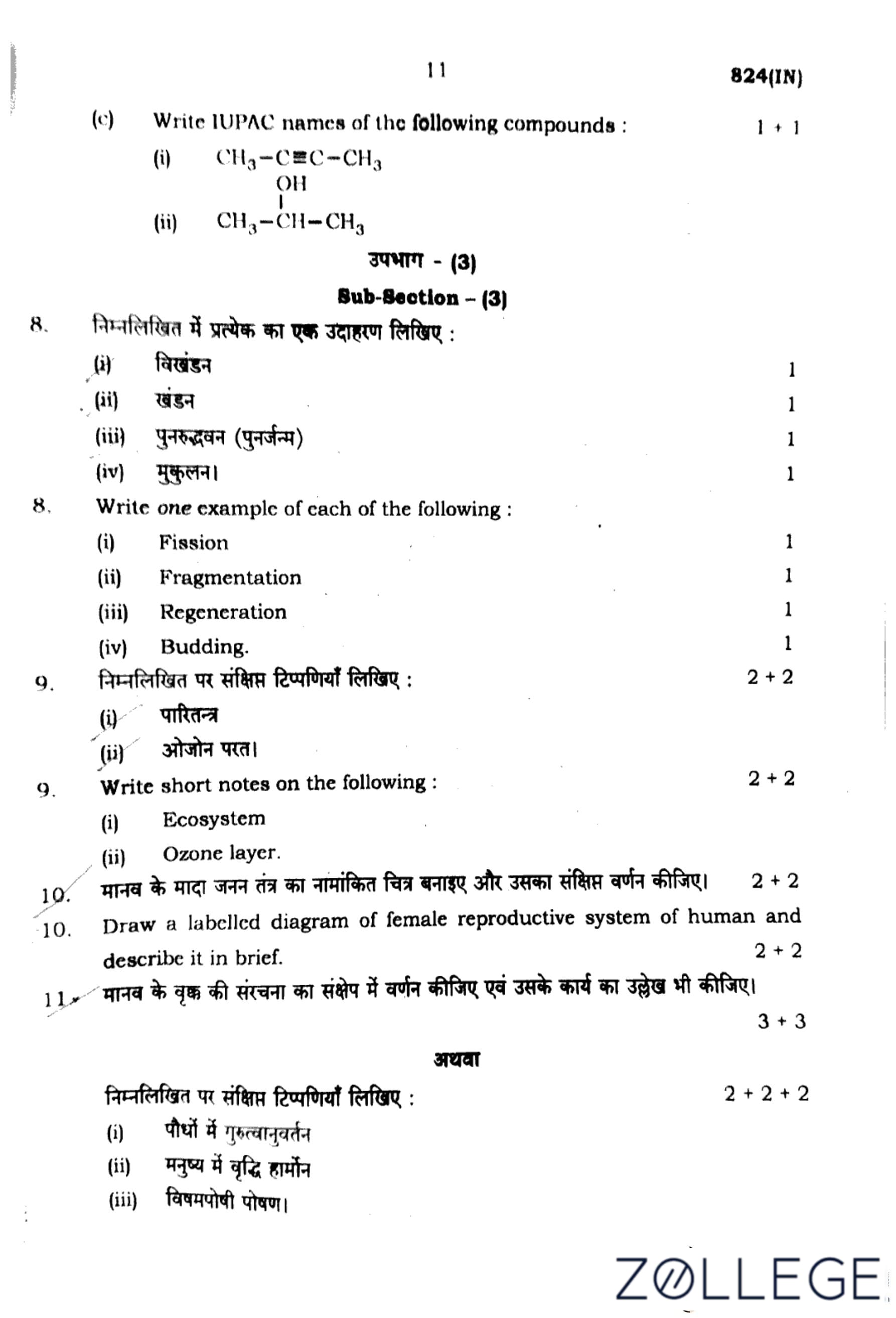
Structure:
\[ \chemfig{CH_3-C\equiv C-CH_3} \]
View Solution
N/A Quick Tip: In IUPAC nomenclature, the longest carbon chain containing the functional groups is chosen, and priority is given to the triple bond over the hydroxyl group.
Structure:
\[ \chemfig{CH_3-CH(-[2]OH)-CH_3} \]
View Solution
N/A Quick Tip: In IUPAC nomenclature, alcohols are named with the suffix -ol, and the position of the hydroxyl (-OH) group is indicated by the lowest possible number.
Fission
View Solution
N/A Quick Tip: Fission is common in unicellular organisms like Amoeba and Paramecium.
Fragmentation
View Solution
N/A Quick Tip: Fragmentation occurs in multicellular organisms like Spirogyra and some fungi.
Regeneration
View Solution
N/A Quick Tip: Regeneration is common in lower animals like Planaria and Starfish.
Budding
View Solution
N/A Quick Tip: Budding is common in organisms like Hydra and Yeast.
Ecosystem
View Solution
N/A Quick Tip: An ecosystem consists of biotic and abiotic factors interacting for survival and sustainability.
Ozone layer
View Solution
N/A Quick Tip: The ozone layer protects life on Earth from UV rays, but pollutants like CFCs are depleting it.
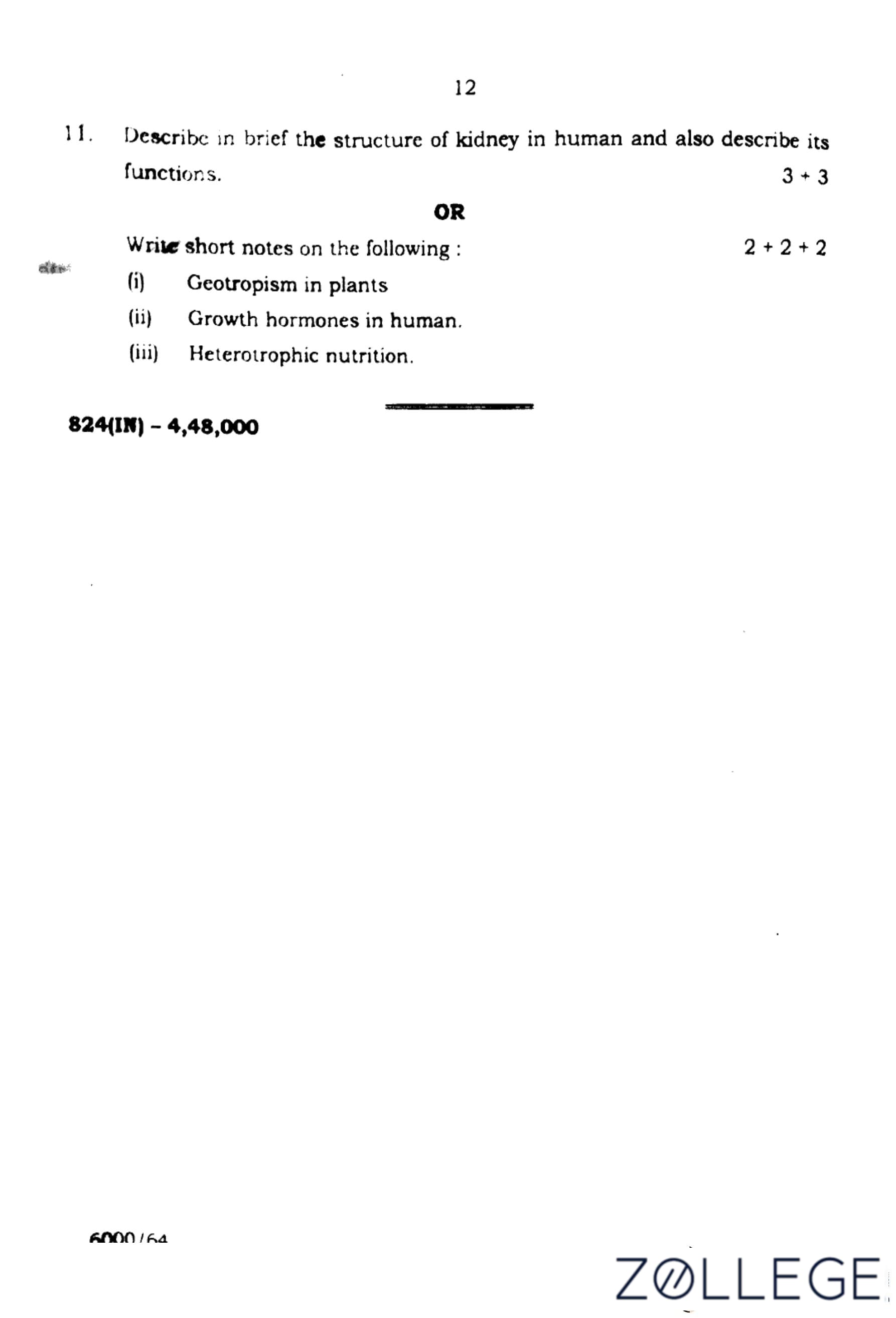
Describe in brief the structure of the kidney in humans and also describe its functions.
View Solution
N/A Quick Tip: The kidneys filter around 50 gallons of blood daily, maintaining homeostasis and detoxifying the body.
Geotropism in plants
View Solution
N/A Quick Tip: Geotropism helps roots anchor plants in soil and absorb nutrients while guiding shoots towards light.
Growth hormones in humans
View Solution
N/A Quick Tip: Growth hormones are essential for height, muscle development, and metabolism in humans.
Heterotrophic nutrition
View Solution
N/A Quick Tip: Heterotrophic organisms depend on plants or other animals for energy and survival.
*The article might have information for the previous academic years, please refer the official website of the exam.