
UP Board Class 10 Science (Code 824 IP) Question Paper 2024 Available :Download Solution PDF With Answer Key


Content Writer | Updated On - Feb 27, 2025
UP Board Class 10 Science Question Paper 2024 PDF (Code 824 IP) is available for download here. The Science exam was conducted on February 29, 2024 in the Morning Shift from 8:30 AM to 11:45 AM. The total marks for the theory paper are 70. Students reported the paper to be moderate.
UP Board Class 10 Science Question Paper 2024 (Code 824 IP) with Solutions
| UP Board Class 10 Science Question Paper With Answer Key |  Download Download |
Check Solution |

UP Board Class 10 Science Question Paper With Solution
Part–A
(Sub-Section 1)
Multiple Choice Type Questions
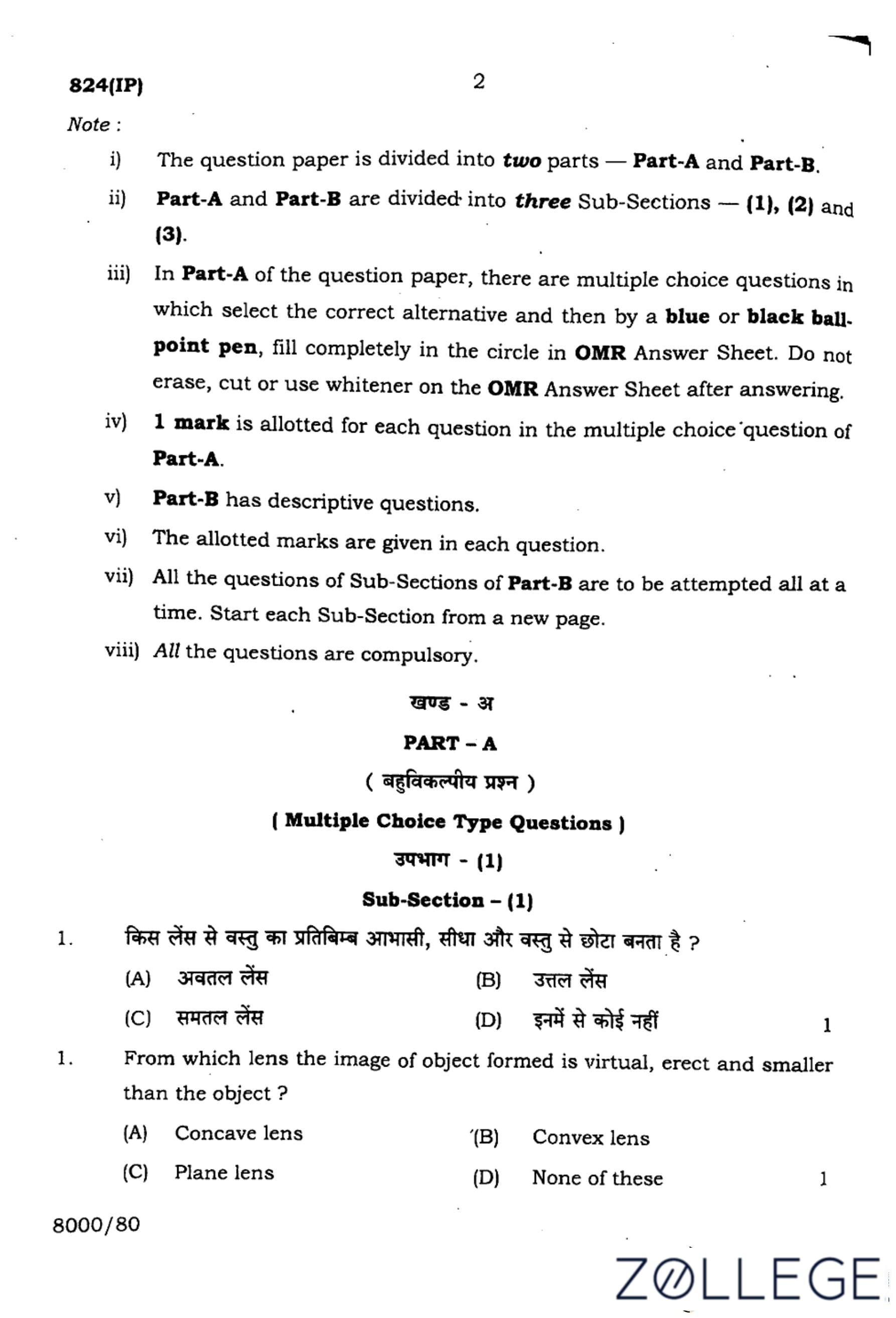
Question 1:
From which lens the image of the object formed is virtual, erect, and smaller than the object?
View Solution
A concave lens always forms a virtual, erect, and diminished image regardless of the object's position. This is because concave lenses diverge light rays, making them appear to originate from a single point on the same side as the object. Quick Tip: Concave lenses always form virtual, erect, and diminished images, making them useful in applications like spectacles for myopia.
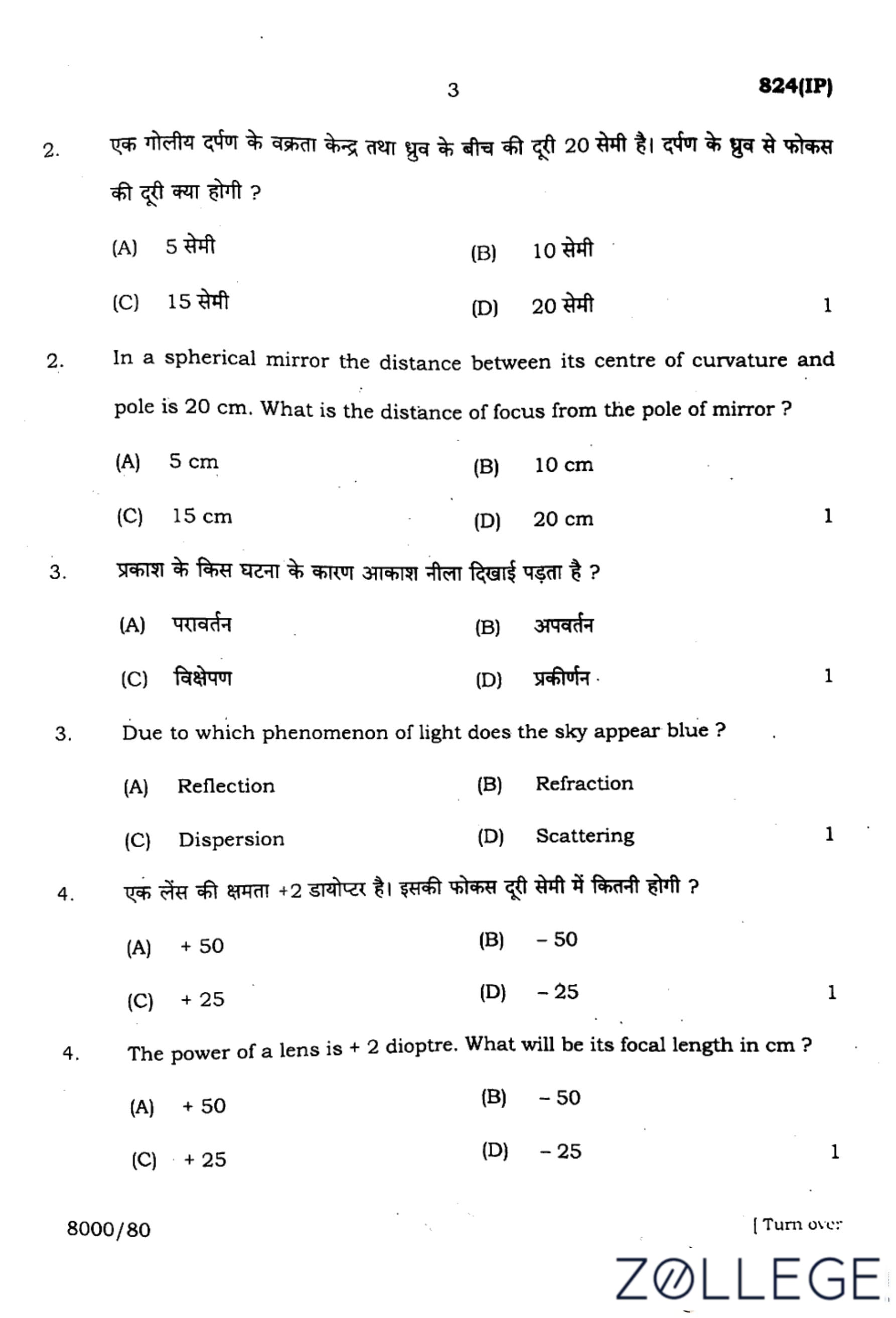
In a spherical mirror, the distance between its center of curvature and pole is 20 cm. What is the distance of focus from the pole of the mirror?
View Solution
For a spherical mirror, the focal length (\(f\)) is always half of the radius of curvature (\(R\)). Given that the radius of curvature \(R = 20\) cm, the focal length is: \[ f = \frac{R}{2} = \frac{20}{2} = 10 cm \]
Thus, the focus is located 10 cm away from the pole of the mirror. Quick Tip: The focal length of a spherical mirror is always half of its radius of curvature (\( f = R/2 \)).
Due to which phenomenon of light does the sky appear blue?
View Solution
The blue color of the sky is due to the scattering of light. When sunlight enters Earth's atmosphere, shorter wavelengths like blue are scattered more by air molecules than longer wavelengths like red. This scattering makes the sky appear blue. Quick Tip: Rayleigh scattering causes shorter wavelengths (blue) to scatter more than longer wavelengths, making the sky appear blue.
The power of a lens is +2 dioptre. What will be its focal length in cm?
View Solution
The focal length (\(f\)) of a lens is given by the formula: \[ f = \frac{100}{P} \]
where \(P\) is the power of the lens in dioptres. Given \(P = +2\), \[ f = \frac{100}{2} = +50 cm \]
Thus, the focal length of the lens is +50 cm. Quick Tip: The focal length (\(f\)) of a lens is calculated using the formula \( f = \frac{100}{P} \), where \(P\) is the power in dioptres.
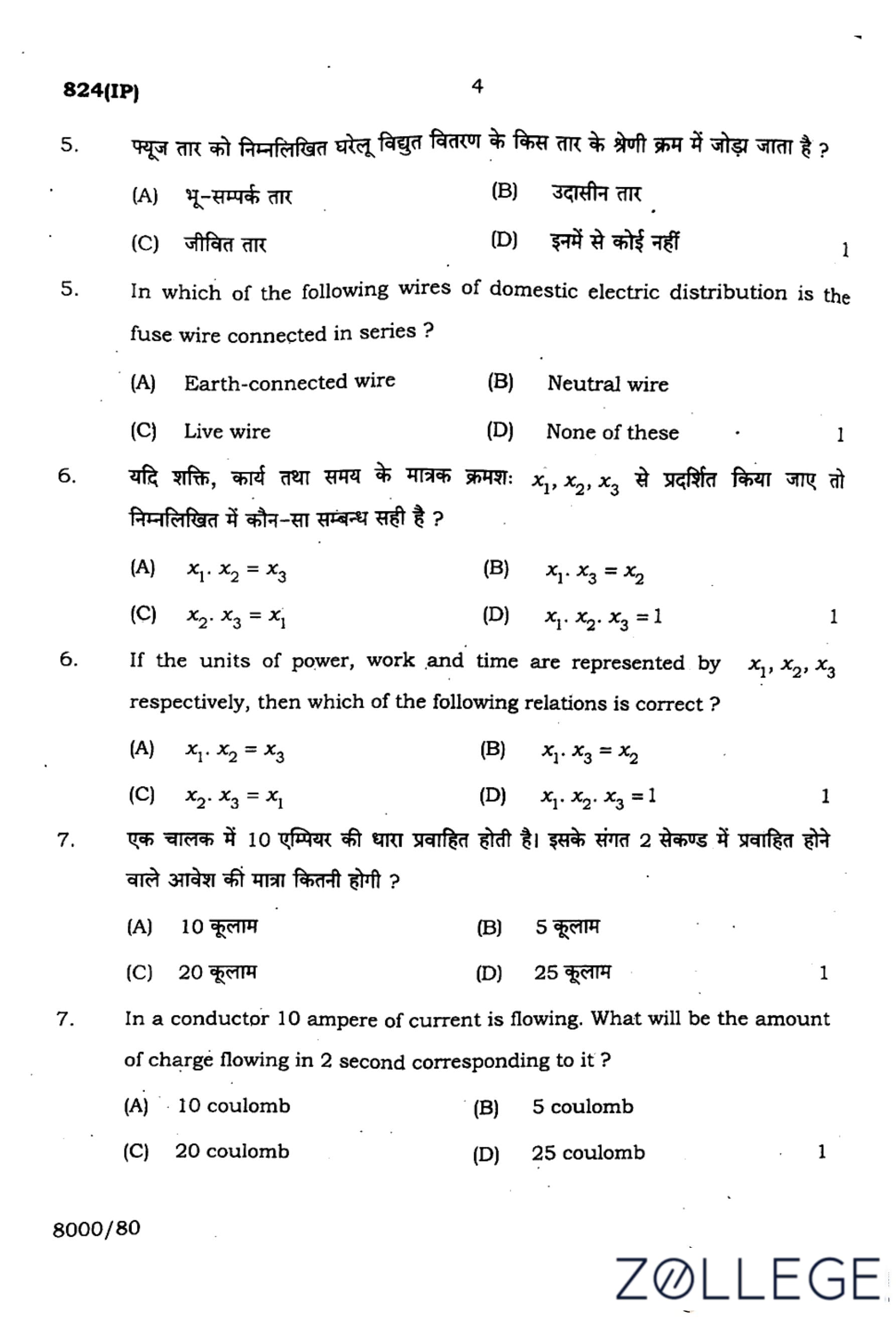
In which of the following wires of domestic electric distribution is the fuse wire connected in series?
View Solution
A fuse wire is always connected in series with the live wire in a domestic circuit. The live wire carries current from the power source, and in case of excessive current due to overloading or short-circuiting, the fuse melts and breaks the circuit, preventing damage to appliances. Quick Tip: A fuse is a safety device that protects electrical circuits from excessive current flow by melting and breaking the circuit when current exceeds a safe level.
If the units of power, work, and time are represented by \( x_1, x_2, x_3 \) respectively, then which of the following relations is correct?
View Solution
The relationship between power, work, and time is given by: \[ Power = \frac{Work}{Time} \]
or, in terms of symbols: \[ x_1 = \frac{x_2}{x_3} \]
Multiplying both sides by \( x_3 \), we get: \[ x_1 \times x_3 = x_2 \]
Thus, the correct answer is option (B). Quick Tip: The formula \( P = \frac{W}{t} \) is a fundamental equation in physics, where power is the rate at which work is done.
In a conductor 10 ampere of current is flowing. What will be the amount of charge flowing in 2 second corresponding to it?
View Solution
The charge (\( Q \)) flowing through a conductor is given by the formula: \[ Q = I \times t \]
where \( I \) is the current in amperes and \( t \) is the time in seconds.
Substituting the given values: \[ Q = 10 \times 2 = 20 coulombs \]
Thus, the correct answer is 20 coulombs. Quick Tip: The formula \( Q = I \times t \) is fundamental in electric current calculations. Always ensure that the current is in amperes and time is in seconds.
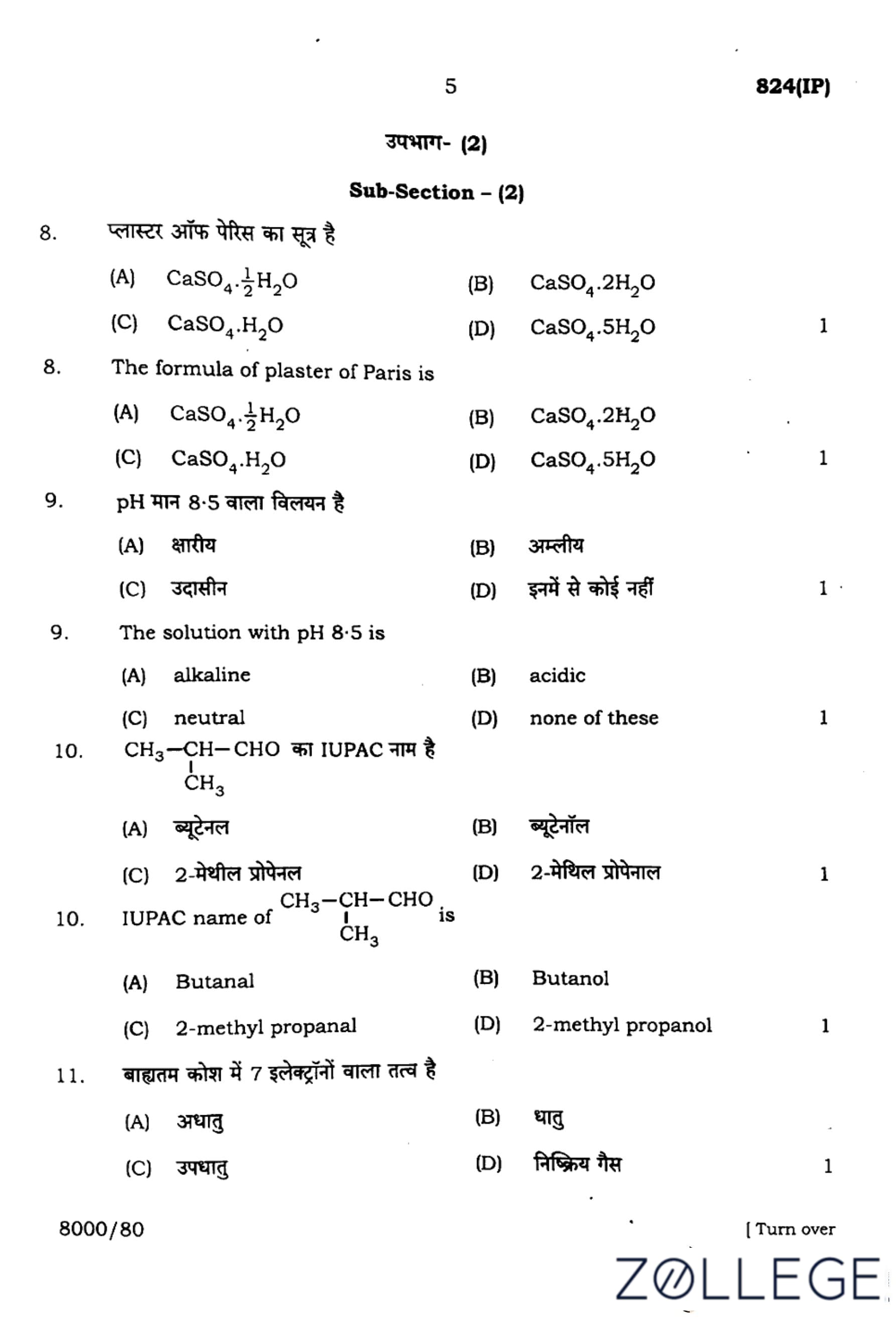
The formula of plaster of Paris is:
View Solution
Plaster of Paris (POP) is chemically known as calcium sulfate hemihydrate (CaSO\textsubscript{4 \(\cdot\) \(\frac{1}{2}\)H\textsubscript{2O). It is obtained by heating gypsum (CaSO\textsubscript{4 \(\cdot\) 2H\textsubscript{2O) at around 373K. POP is widely used in construction, medical applications (for making casts), and sculpture making. Quick Tip: Plaster of Paris is made by heating gypsum and hardens when mixed with water, making it useful for molds and casts.
The solution with pH 8.5 is:
View Solution
A solution with a pH of 8.5 is slightly basic (alkaline). The pH scale ranges from 0 to 14, where a pH below 7 is acidic, pH exactly 7 is neutral, and pH above 7 is basic. Substances like baking soda and mild soaps have pH values in this range. Quick Tip: A pH above 7 indicates an alkaline solution, while a pH below 7 represents an acidic solution.
IUPAC name of CH\textsubscript{3} - CH - CHO (where CH\textsubscript{3} is a side group) is:
View Solution
The given compound consists of a three-carbon (propane) chain with an aldehyde (-CHO) functional group at carbon 1 and a methyl (-CH\textsubscript{3) group at carbon 2. The correct IUPAC name follows the rule of numbering the longest chain such that the functional group gets the lowest number, resulting in 2-methyl propanal. Quick Tip: Aldehydes (-CHO) are named with the suffix "-al" and given the lowest possible number in the main chain.
The element having 7 electrons in its outermost orbit is
View Solution
Elements with 7 electrons in the outermost shell belong to Group 17, known as halogens. These are highly reactive non-metals, and examples include fluorine, chlorine, bromine, and iodine. Quick Tip: Elements in Group 17 have seven valence electrons and need only one more electron to complete their octet, making them highly reactive non-metals.
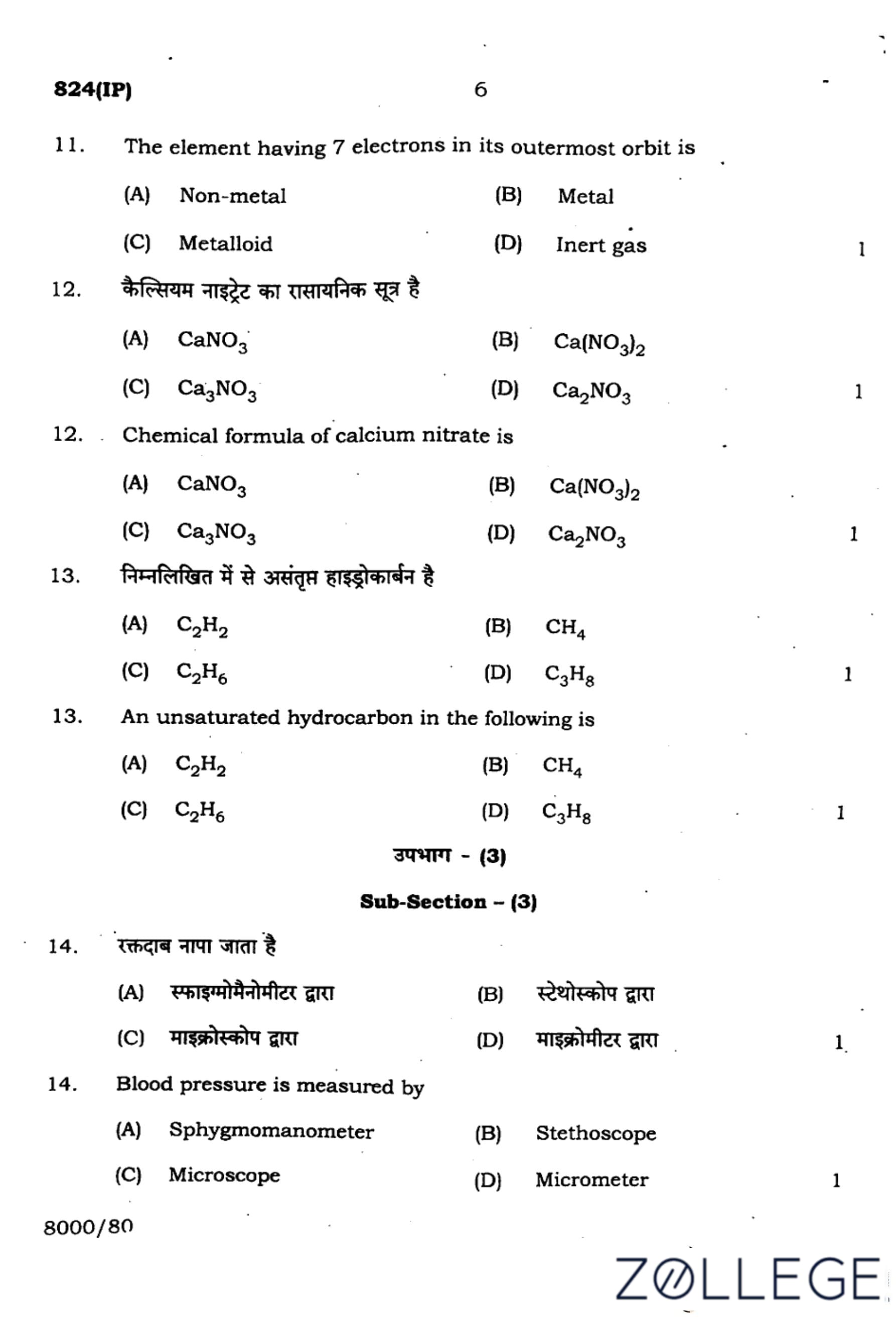
Chemical formula of calcium nitrate is
View Solution
Calcium nitrate is an ionic compound composed of calcium (Ca\textsuperscript{2+) and nitrate (NO\textsubscript{3\textsuperscript{-) ions. Since calcium has a +2 charge and each nitrate ion has a -1 charge, two nitrate ions are required to balance the charge, leading to the formula Ca(NO\textsubscript{3)\textsubscript{2. Quick Tip: Calcium nitrate is commonly used as a fertilizer and provides both calcium and nitrogen to plants.
An unsaturated hydrocarbon in the following is
View Solution
Unsaturated hydrocarbons contain at least one double or triple bond. C\textsubscript{2H\textsubscript{2 (ethyne) is an alkyne with a triple bond, making it unsaturated. The other options (CH\textsubscript{4, C\textsubscript{2H\textsubscript{6, and C\textsubscript{3H\textsubscript{8) are all alkanes, which are saturated hydrocarbons. Quick Tip: Alkenes contain at least one double bond, and alkynes contain at least one triple bond. These are classified as unsaturated hydrocarbons.
Blood pressure is measured by
View Solution
Blood pressure is measured using a sphygmomanometer, which consists of an inflatable cuff to restrict blood flow and a mercury or digital manometer to measure the pressure. The stethoscope is used in conjunction with it to listen to blood flow sounds. Quick Tip: Sphygmomanometers measure systolic and diastolic blood pressure, which are important indicators of cardiovascular health.
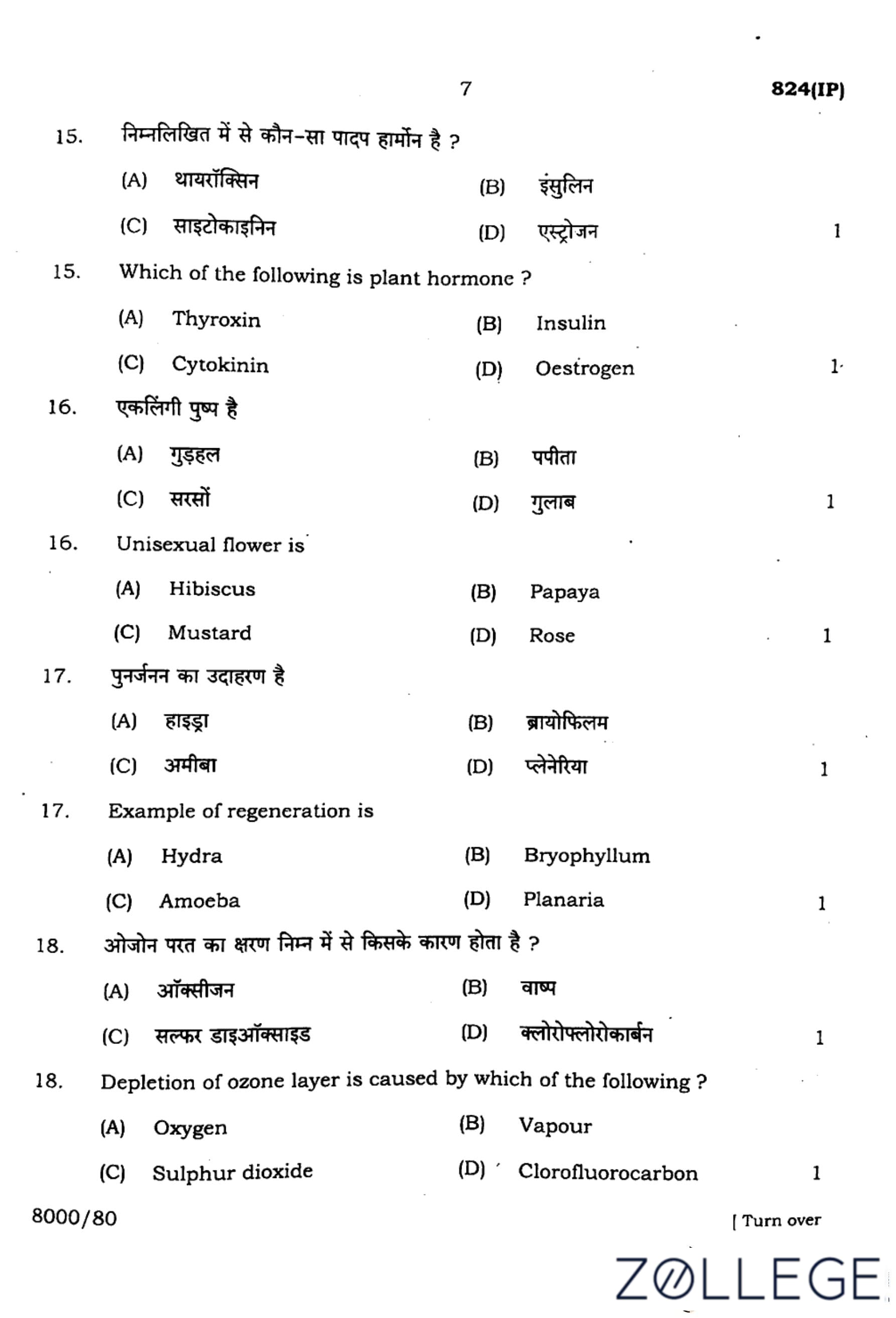
Which of the following is a plant hormone?
View Solution
Cytokinins are plant hormones that promote cell division and growth. They help in shoot formation, delay leaf senescence, and work alongside auxins to regulate plant development. The other options—thyroxin, insulin, and oestrogen—are animal hormones. Quick Tip: Cytokinins are essential for plant tissue culture, promoting shoot growth, and delaying leaf aging.
Unisexual flower is
View Solution
Unisexual flowers contain either male (stamens) or female (carpels) reproductive organs, but not both. Papaya is a unisexual plant as it produces separate male and female flowers. Hibiscus, mustard, and rose are bisexual flowers as they contain both reproductive organs. Quick Tip: Unisexual flowers require cross-pollination for reproduction, whereas bisexual flowers can undergo self-pollination.
Example of regeneration is
View Solution
Regeneration is the ability of an organism to regrow lost or damaged body parts. Planaria, a type of flatworm, exhibits remarkable regenerative abilities where even a small part can develop into a complete organism. Hydra also shows regeneration, but Amoeba and Bryophyllum reproduce through other means. Quick Tip: Regeneration is commonly observed in lower organisms such as Planaria, Hydra, and starfish, but not in higher animals.
Depletion of ozone layer is caused by which of the following?
View Solution
Chlorofluorocarbons (CFCs) are major contributors to ozone layer depletion. When released into the atmosphere, they break down ozone molecules, reducing the protective layer that shields Earth from harmful UV radiation. Oxygen, vapors, and sulfur dioxide do not play a significant role in ozone depletion. Quick Tip: CFCs are widely used in refrigeration, air conditioning, and aerosol sprays, but their use has been phased out in many countries due to their harmful effects on the ozone layer.
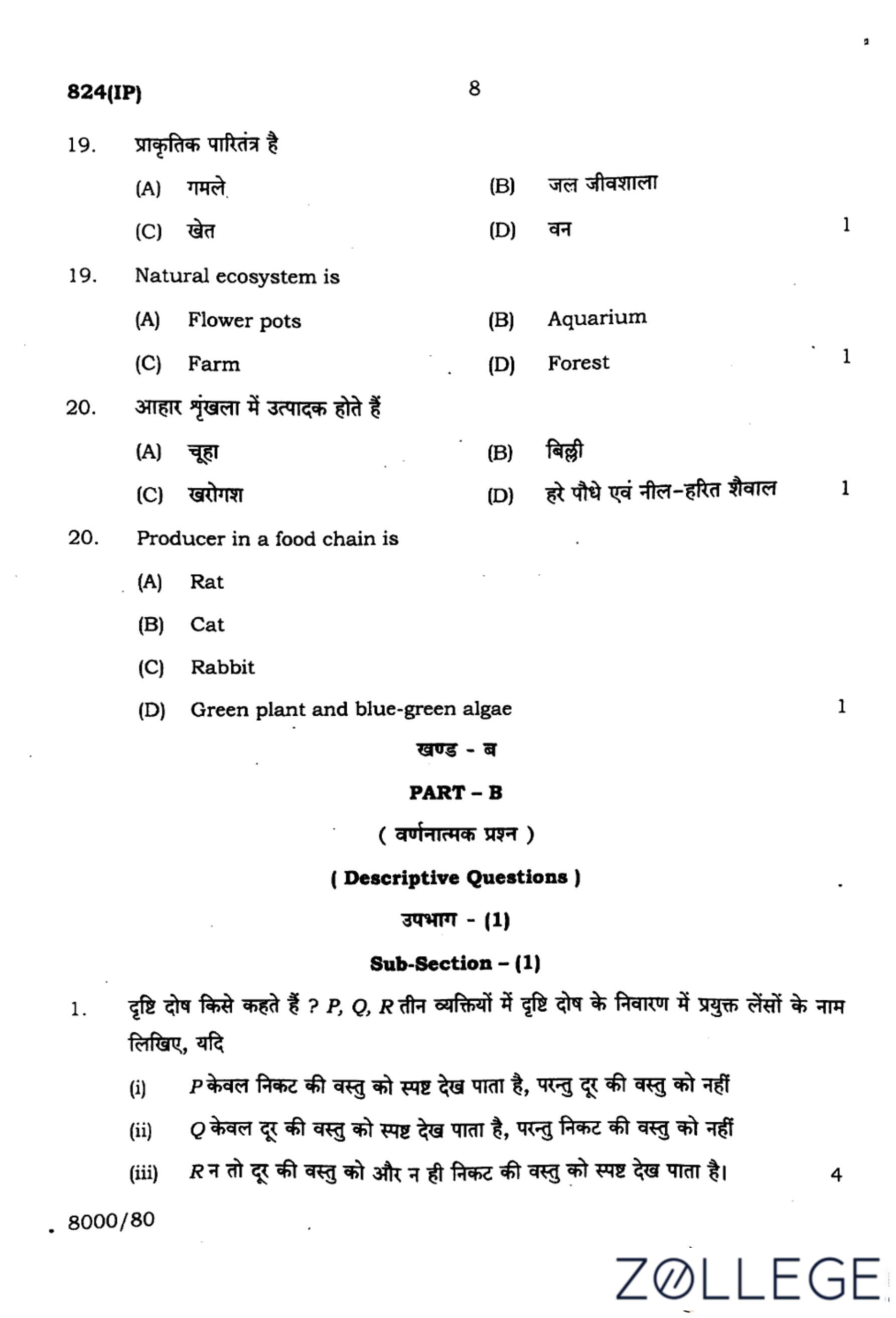
Natural ecosystem is
View Solution
A natural ecosystem is one that develops and sustains itself without human intervention. Forests are natural ecosystems because they support diverse flora and fauna without artificial maintenance. In contrast, flower pots, aquariums, and farms are artificial ecosystems maintained by humans. Quick Tip: Natural ecosystems, such as forests and oceans, function independently, while artificial ecosystems require human intervention for maintenance.
Producer in a food chain is
View Solution
Producers in a food chain are organisms that create their own food using sunlight through photosynthesis. Green plants and blue-green algae (cyanobacteria) are primary producers that form the base of the food chain. The other options—rat, cat, and rabbit—are consumers that depend on other organisms for food. Quick Tip: Producers are autotrophs that convert solar energy into chemical energy, supporting all higher trophic levels in an ecosystem.
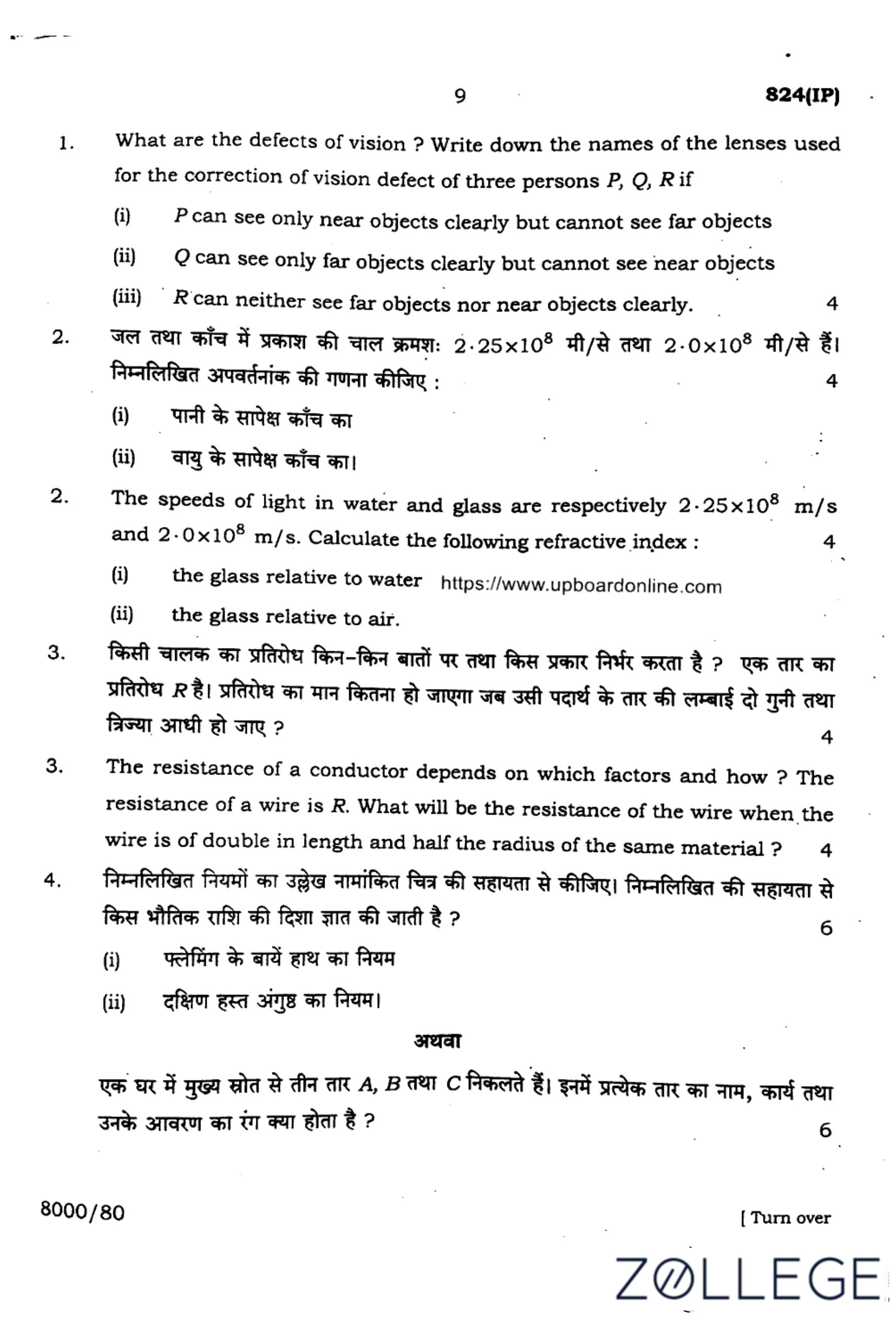
What are the defects of vision? Write down the names of the lenses used for the correction of vision defect of three persons P, Q, R if
(i) \( P \) can see only near objects clearly but cannot see far objects.
(ii) \( Q \) can see only far objects clearly but cannot see near objects.
(iii) \( R \) can neither see far objects nor near objects clearly.
View Solution
Vision defects occur when the eye cannot focus light properly on the retina, leading to blurred vision. The three types of vision defects and their corrective lenses are:
(i). Myopia (Nearsightedness) - P
- Defect: \( P \) can see near objects clearly but not far objects.
- Cause: The image forms in front of the retina due to the elongation of the eyeball.
- Correction: Concave lens is used to diverge light rays before they enter the eye, shifting the image onto the retina.
(ii). Hypermetropia (Farsightedness) - Q
- Defect: \( Q \) can see far objects clearly but not near objects.
- Cause: The image forms behind the retina due to the shortening of the eyeball.
- Correction: Convex lens is used to converge light rays before they enter the eye, allowing proper focus on the retina.
(iii). Presbyopia - R
- Defect: \( R \) can neither see near nor far objects clearly.
- Cause: Weakening of the eye muscles and loss of elasticity in the lens due to aging.
- Correction: Bifocal lens is used, which has both concave and convex sections to correct near and far vision simultaneously. Quick Tip: Myopia is corrected using concave lenses, hypermetropia with convex lenses, and presbyopia with bifocal or progressive lenses.
The speeds of light in water and glass are respectively \(2.25 \times 10^8\) m/s and \(2.0 \times 10^8\) m/s. Calculate the following refractive indices:
(i) The refractive index of glass relative to water.
(ii) The refractive index of glass relative to air.
View Solution
The refractive index \( n \) of a medium is given by the formula:
\[ n = \frac{Speed of light in reference medium}{Speed of light in given medium} \]
(i). Refractive index of glass relative to water
\[ n_{glass, water} = \frac{v_{water}}{v_{glass}} = \frac{2.25 \times 10^8}{2.0 \times 10^8} = 1.125 \]
So, the refractive index of glass relative to water is 1.125.
(ii). Refractive index of glass relative to air
The speed of light in air is approximately \( 3.0 \times 10^8 \) m/s.
\[ n_{glass, air} = \frac{v_{air}}{v_{glass}} = \frac{3.0 \times 10^8}{2.0 \times 10^8} = 1.5 \]
So, the refractive index of glass relative to air is 1.5. Quick Tip: Refractive index indicates how much light slows down when passing through a medium. A higher refractive index means greater bending of light.
The resistance of a conductor depends on which factors and how? The resistance of a wire is \( R \). What will be the resistance of the wire when the wire is double in length and half the radius of the same material?
View Solution
The resistance \( R \) of a conductor is given by the formula:
\[ R = \rho \frac{L}{A} \]
where:
- \( R \) is the resistance,
- \( \rho \) is the resistivity of the material,
- \( L \) is the length of the conductor,
- \( A \) is the cross-sectional area of the conductor.
Factors affecting resistance:
1. Length of the conductor: Resistance is directly proportional to length, i.e., \( R \propto L \).
2. Cross-sectional area: Resistance is inversely proportional to area, i.e., \( R \propto \frac{1}{A} \).
3. Material of the conductor: Different materials have different resistivities \( \rho \).
4. Temperature: Resistance increases with temperature for most conductors.
New Resistance Calculation:
- Given that the length is doubled (\( L' = 2L \)), and radius is halved (\( r' = \frac{r}{2} \)).
- Since the area \( A \) is given by \( A = \pi r^2 \), the new area is:
\[ A' = \pi \left( \frac{r}{2} \right)^2 = \frac{\pi r^2}{4} = \frac{A}{4} \]
- Using the resistance formula:
\[ R' = \rho \frac{L'}{A'} = \rho \frac{2L}{\frac{A}{4}} \]
\[ R' = \rho \frac{2L \times 4}{A} = 8 \rho \frac{L}{A} = 8R \]
Thus, the new resistance of the wire is \( 8R \). Quick Tip: Increasing the length of a wire increases its resistance, while decreasing the cross-sectional area further increases resistance significantly.
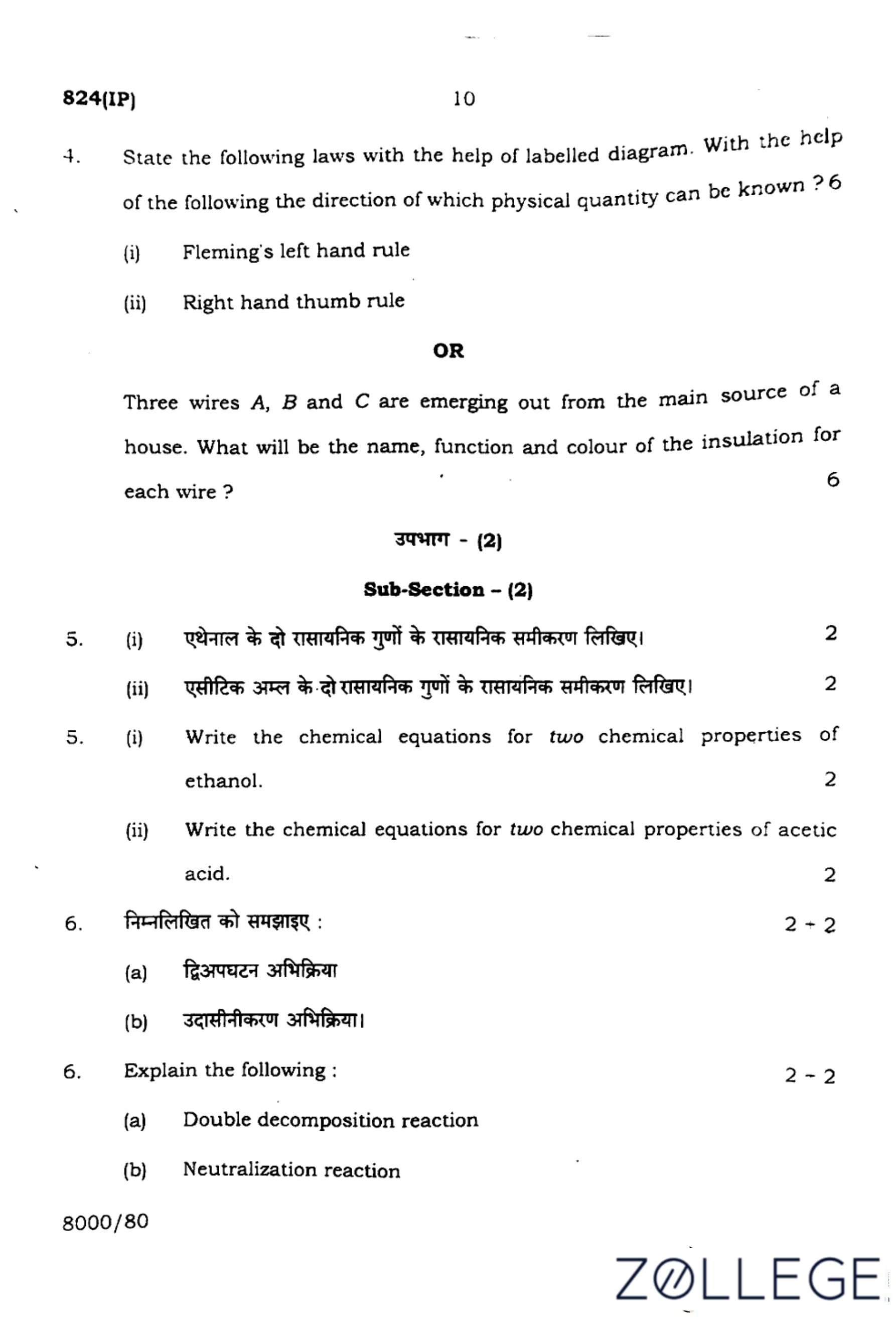
State the following laws with the help of a labeled diagram. With the help of the following, the direction of which physical quantity can be known?
(i) Fleming's left-hand rule
(ii) Right-hand thumb rule
View Solution
(i). Fleming's Left-Hand Rule:
Statement: Fleming's left-hand rule is used to determine the direction of force in a current-carrying conductor placed in a magnetic field.
Explanation:
- Stretch your left-hand thumb, forefinger, and middle finger perpendicular to each other.
- The forefinger represents the direction of the magnetic field.
- The middle finger represents the direction of current.
- The thumb points in the direction of the force (motion) experienced by the conductor.
\[ Magnetic Field \rightarrow Forefinger, \quad Current \rightarrow Middle finger, \quad Force (Motion) \rightarrow Thumb \]
(ii). Right-Hand Thumb Rule:
Statement: The right-hand thumb rule is used to determine the direction of the magnetic field around a current-carrying conductor.
Explanation:
- Point your right-hand thumb in the direction of the conventional current (from positive to negative).
- The curled fingers around the conductor indicate the direction of the magnetic field lines.
\[ Current \rightarrow Thumb, \quad Magnetic Field \rightarrow Curled fingers \]
Quick Tip: Fleming’s left-hand rule applies to electric motors (force determination), whereas the right-hand thumb rule helps find the magnetic field direction around a conductor.
Three wires \( A, B, \) and \( C \) are emerging out from the main source of a house. What will be the name, function, and color of the insulation for each wire?
View Solution
In household electrical wiring, three main wires are used for safe and effective power distribution. Their details are:
\[ \begin{array}{|c|c|c|} \hline \textbf{Wire Name} & \textbf{Function} & \textbf{Insulation Color}
\hline Live (Phase) Wire & \begin{array}{c} Carries current from
the source to appliances \end{array} & Red or Brown
\hline Neutral Wire & \begin{array}{c} Completes the circuit by
returning current to the source \end{array} & Black or Blue
\hline Earth (Ground) Wire & \begin{array}{c} Provides safety by
directing excess current to the ground \end{array} & Green or Yellow-Green
\hline \end{array} \]
- Live Wire (\( A \)): Responsible for supplying current to electrical appliances.
- Neutral Wire (\( B \)): Completes the electrical circuit by returning the current.
- Earth Wire (\( C \)): Ensures safety by preventing electric shocks in case of faults. Quick Tip: The live and neutral wires carry electricity, while the earth wire is a safety measure to prevent electrical hazards.
Write the chemical equations for two chemical properties of ethanol.
View Solution
Ethanol (\( C_2H_5OH \)) exhibits various chemical properties. Two key reactions are:
1. Combustion Reaction
Ethanol burns in the presence of oxygen to produce carbon dioxide and water:
\[ C_2H_5OH + 3O_2 \rightarrow 2CO_2 + 3H_2O \]
2. Reaction with Sodium
Ethanol reacts with sodium metal to form sodium ethoxide and hydrogen gas:
\[ 2C_2H_5OH + 2Na \rightarrow 2C_2H_5ONa + H_2 \] Quick Tip: Ethanol is highly flammable and reacts with active metals like sodium to release hydrogen gas.
Write the chemical equations for two chemical properties of acetic acid.
View Solution
Acetic acid (\( CH_3COOH \)) exhibits acidic properties and reacts with metals, bases, and carbonates. Two key reactions are:
1. Reaction with Sodium Bicarbonate
Acetic acid reacts with sodium bicarbonate to release carbon dioxide gas:
\[ CH_3COOH + NaHCO_3 \rightarrow CH_3COONa + CO_2 + H_2O \]
2. Reaction with Ethanol (Esterification)
Acetic acid reacts with ethanol in the presence of concentrated sulfuric acid to form ethyl acetate (an ester):
\[ CH_3COOH + C_2H_5OH \xrightarrow{H_2SO_4} CH_3COOC_2H_5 + H_2O \] Quick Tip: Acetic acid reacts with carbonates to release carbon dioxide, and esterification with alcohols produces sweet-smelling esters.
Explain the following:
(a) Double decomposition reaction
(b) Neutralization reaction
View Solution
(a) Double Decomposition Reaction:
Definition: A double decomposition reaction (also known as a double displacement reaction) occurs when two compounds exchange their ions to form two new compounds.
General Formula: \[ AB + CD \rightarrow AD + CB \]
Example:
When silver nitrate reacts with sodium chloride, a white precipitate of silver chloride is formed: \[ AgNO_3 + NaCl \rightarrow AgCl \downarrow + NaNO_3 \]
(b) Neutralization Reaction:
Definition: A neutralization reaction occurs when an acid reacts with a base to form salt and water. This reaction is exothermic in nature.
General Formula: \[ Acid + Base \rightarrow Salt + Water \]
Example:
The reaction between hydrochloric acid and sodium hydroxide: \[ HCl + NaOH \rightarrow NaCl + H_2O \] Quick Tip: Double decomposition reactions often produce precipitates, while neutralization reactions result in the formation of water and salt.
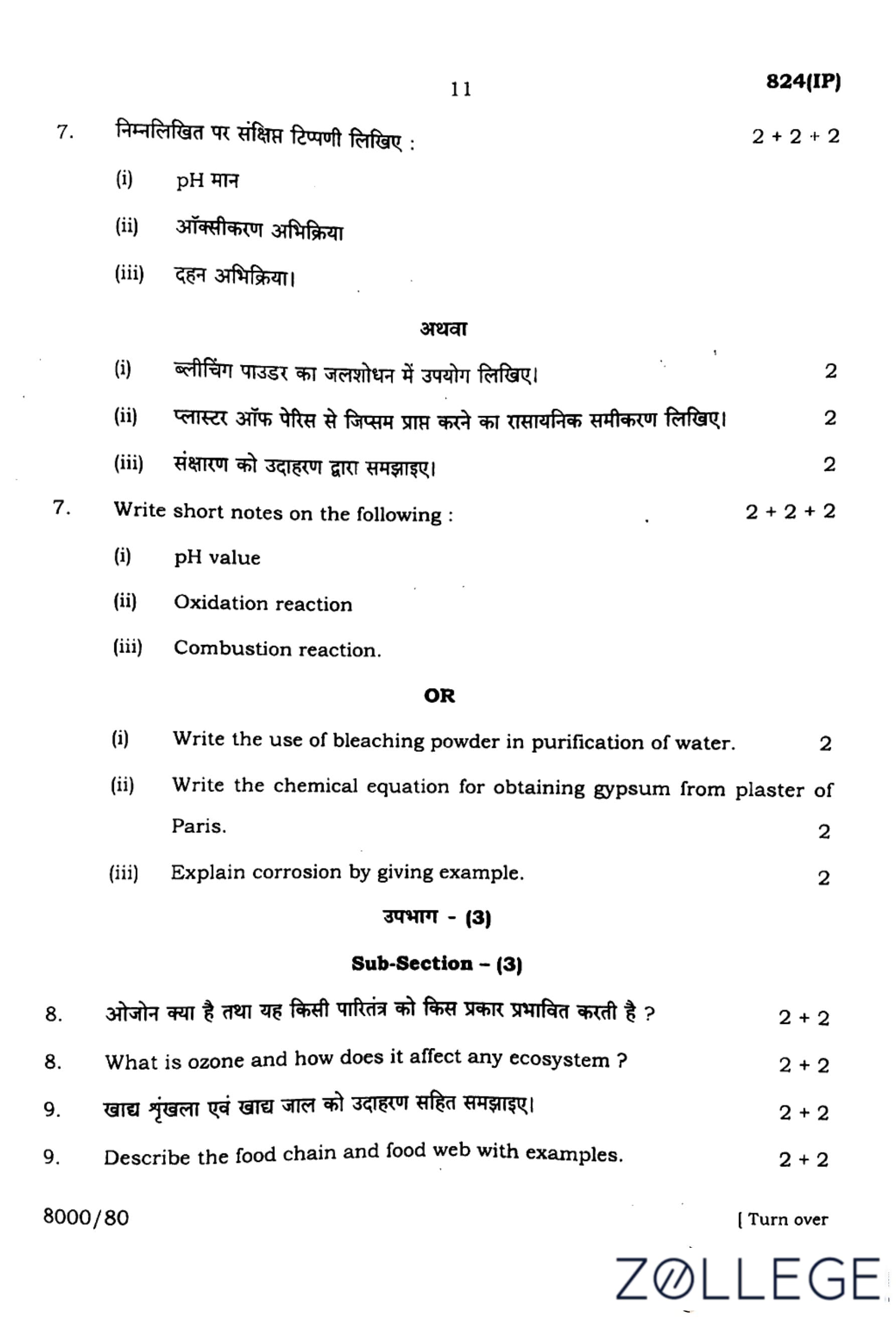
Write short notes on the following:
(i) pH value
(ii) Oxidation reaction
(iii) Combustion reaction
View Solution
(i) pH Value:
The pH value measures the acidity or basicity of a solution on a scale of 0 to 14. It is defined as the negative logarithm of the hydrogen ion concentration (\( pH = -\log[H^+] \)).
- Acids (pH \(<\) 7) release \( H^+ \) ions (e.g., HCl).
- Bases (pH \(>\) 7) release \( OH^- \) ions (e.g., NaOH).
- Neutral Solution (pH = 7) include pure water.
Indicators like litmus and universal indicators help determine pH values in laboratories.
(ii) Oxidation Reaction:
Oxidation is a chemical process where a substance loses electrons or gains oxygen. It is the opposite of reduction and is an essential part of redox reactions.
- Example:
\[ 2Mg + O_2 \rightarrow 2MgO \]
Here, magnesium loses electrons and combines with oxygen to form magnesium oxide.
Oxidation plays a vital role in corrosion, respiration, and various industrial processes, such as metal extraction from ores.
(iii) Combustion Reaction:
Combustion is a rapid exothermic reaction where a substance reacts with oxygen to release heat and light energy. It occurs in fuels, engines, and fires.
- Example:
\[ CH_4 + 2O_2 \rightarrow CO_2 + 2H_2O + energy \]
Here, methane burns in oxygen to produce carbon dioxide, water, and energy.
Complete combustion produces carbon dioxide and water, whereas incomplete combustion results in carbon monoxide and soot. Quick Tip: The pH scale determines acidity or basicity, oxidation involves electron loss, and combustion releases energy via oxygen reaction.
Write the use of bleaching powder in purification of water.
View Solution
Bleaching powder (\(Ca(OCl)_2\)) is widely used in water purification due to its disinfecting properties. It acts as an oxidizing agent, releasing chlorine when dissolved in water, which kills harmful bacteria and pathogens.
Reaction: \[ Ca(OCl)_2 + H_2O \rightarrow Ca(OH)_2 + Cl_2 \]
The released chlorine acts as a germicide, making water safe for drinking. Quick Tip: Bleaching powder is an effective disinfectant that eliminates harmful microbes from water, ensuring safe drinking water.
Write the chemical equation for obtaining gypsum from plaster of Paris.
View Solution
Plaster of Paris (POP) is chemically calcium sulfate hemihydrate (\(CaSO_4 \cdot \frac{1}{2} H_2O\)). When mixed with water, it forms gypsum (\(CaSO_4 \cdot 2H_2O\)), which is a hard solid.
Reaction: \[ CaSO_4 \cdot \frac{1}{2} H_2O + \frac{3}{2} H_2O \rightarrow CaSO_4 \cdot 2H_2O \]
This reaction is used in making molds, casts, and construction materials. Quick Tip: Plaster of Paris sets into a hard mass when mixed with water due to its conversion into gypsum, making it ideal for sculptures and medical casts.
Explain corrosion by giving an example.
View Solution
Corrosion is the gradual deterioration of metals due to chemical reactions with environmental factors such as oxygen, moisture, or acids. Rusting of iron is a common example where iron reacts with oxygen and water to form hydrated iron oxide (rust).
Reaction: \[ 4Fe + 3O_2 + 6H_2O \rightarrow 4Fe(OH)_3 \] \[ Fe(OH)_3 \rightarrow Fe_2O_3 \cdot xH_2O \]
This weakens the metal over time, causing structural damage and reducing durability. Quick Tip: Corrosion can be prevented by galvanization, painting, or using protective coatings to block exposure to air and moisture.
What is ozone and how does it affect any ecosystem?
View Solution
Ozone (\(O_3\)) is a molecule composed of three oxygen atoms and is found in the Earth's atmosphere. It exists in two layers:
- Stratospheric ozone forms the ozone layer, which protects life by absorbing harmful UV radiation.
- Tropospheric ozone is a pollutant that can harm plants, animals, and humans.
Ozone depletion due to chlorofluorocarbons (CFCs) allows excessive UV radiation to reach Earth, leading to health issues and ecosystem disruptions. Quick Tip: Ozone in the stratosphere protects life, while ozone at ground level is a harmful pollutant affecting ecosystems.
Describe the food chain and food web with examples.
View Solution
Food Chain:
A food chain is a linear sequence of organisms where energy is transferred from one organism to another.
Example: \[ Grass \rightarrow Grasshopper \rightarrow Frog \rightarrow Snake \rightarrow Hawk \]
Here, each organism serves as food for the next, transferring energy through the ecosystem.
Food Web:
A food web is a network of interconnected food chains showing multiple feeding relationships among organisms. It provides stability to an ecosystem.
Example:
In a pond ecosystem, a frog may eat insects, but it can also be eaten by birds, snakes, or fish, forming a complex web of energy transfer. Quick Tip: A food chain follows a single pathway, while a food web consists of multiple interconnected food chains in an ecosystem.
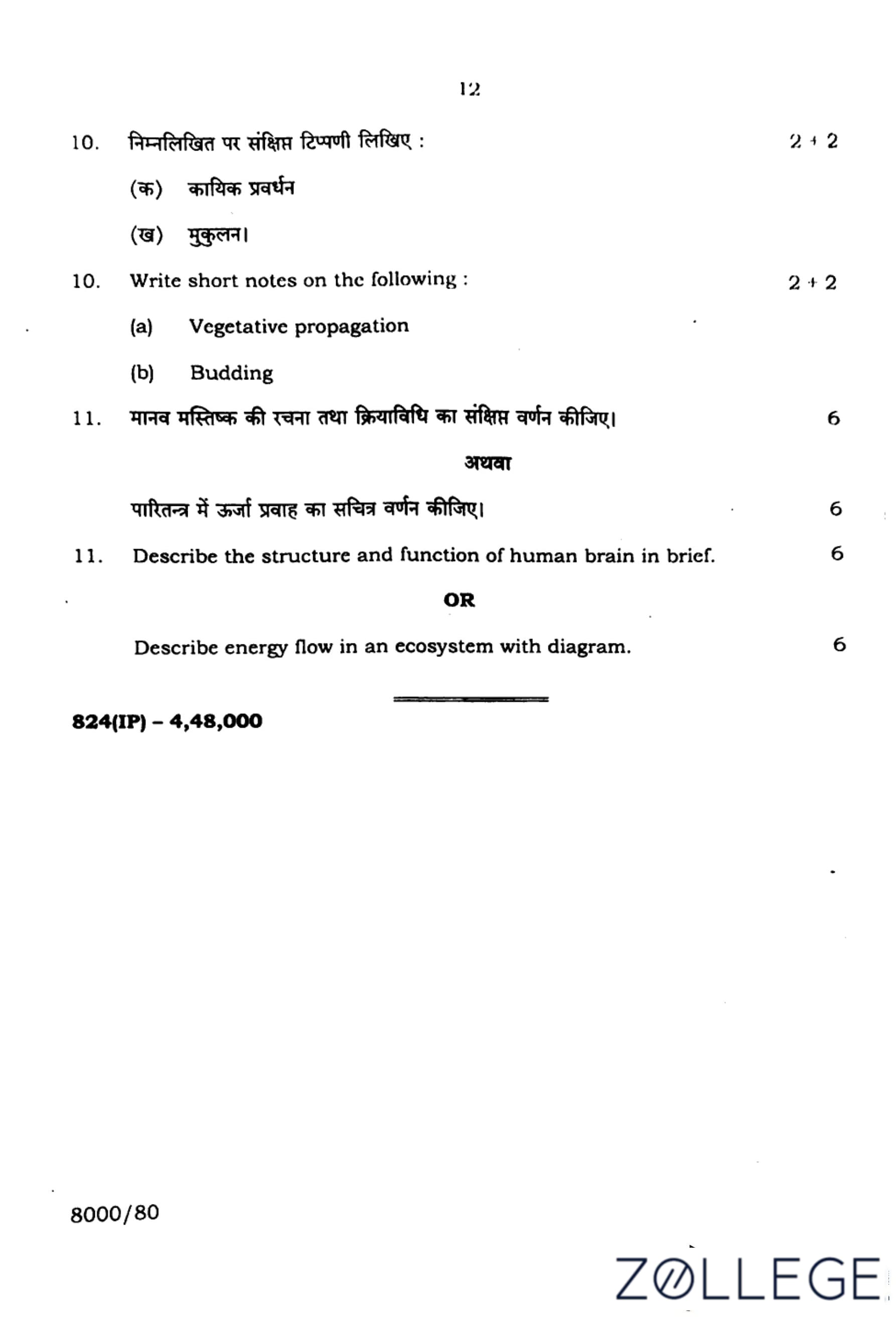
Vegetative propagation
View Solution
Vegetative propagation is a form of asexual reproduction in plants where new plants grow from roots, stems, or leaves without seeds. It occurs naturally in plants like potatoes (tubers), onions (bulbs), and strawberries (runners). Artificial methods include grafting, layering, and tissue culture. This method ensures genetic uniformity and faster reproduction. Quick Tip: Vegetative propagation helps in growing seedless plants and ensures identical offspring.
Budding
View Solution
Budding is an asexual reproduction method where a small outgrowth (bud) develops on the parent organism, grows, and eventually detaches to form a new individual. It is common in yeast and hydra. In yeast, a small bud emerges, enlarges, and separates to become a new cell. In hydra, buds develop due to repeated cell division at a specific site. Quick Tip: Budding allows rapid reproduction in unicellular organisms like yeast and simple multicellular organisms like hydra.
Describe the structure and function of the human brain in brief.
View Solution
The human brain is a highly complex organ that controls bodily functions, processes information, and enables thinking, emotions, and memory. It is protected by the skull, cerebrospinal fluid, and three meninges (protective membranes). The brain is divided into three main parts:
1. Forebrain:
- Cerebrum: The largest part, responsible for intelligence, memory, sensory processing, voluntary actions, and speech.
- Thalamus: Acts as a relay center, transmitting sensory signals to the cerebrum.
- Hypothalamus: Regulates body temperature, hunger, thirst, emotions, and endocrine functions.
2. Midbrain:
- Connects the forebrain and hindbrain.
- Controls reflex movements of the eyes and ears.
3. Hindbrain:
- Cerebellum: Maintains posture, balance, and coordinated movements.
- Pons: Connects different parts of the brain and assists in respiratory functions.
- Medulla Oblongata: Regulates involuntary functions like breathing, heartbeat, and digestion.
The brain functions through neurons, transmitting signals via electrical and chemical impulses. It coordinates sensory input and motor output, maintaining homeostasis and higher-order cognitive abilities. Quick Tip: The cerebrum handles voluntary actions and intelligence, while the medulla controls involuntary functions like heartbeat and breathing.
Describe energy flow in an ecosystem with a diagram.
View Solution
Energy flow in an ecosystem follows a unidirectional path from the Sun to producers and then to consumers at different trophic levels. It is governed by the 10% Law, which states that only 10% of the energy is transferred from one trophic level to the next, while the rest is lost as heat.
Trophic Levels in Energy Flow:
1. Producers (Autotrophs): Green plants convert solar energy into chemical energy through photosynthesis.
2. Primary Consumers (Herbivores): Consume producers and obtain energy.
3. Secondary Consumers (Carnivores): Feed on primary consumers.
4. Tertiary Consumers (Top Carnivores): Consume secondary consumers.
5. Decomposers: Break down dead organisms, recycling nutrients into the environment.
Energy Flow Diagram:
\end{figure Quick Tip: Energy flow in an ecosystem is unidirectional and follows the 10% Law, ensuring a continuous cycle of energy transfer.
*The article might have information for the previous academic years, please refer the official website of the exam.