
AP EAPCET 2026 Engineering Question Paper May 14 Shift 2 with Solution Pdf


| Updated On - Jul 15, 2026
AP EAPCET 2026 Engineering Question Paper May 14 Shift 2 with Solution PDF is available here for download. JNTU conducted the AP EAPCET 2026 exam on behalf of the Andhra Pradesh State Council of Higher Education (APSCHE) in 2nd Shift from 2 PM to 5 PM. AP EAPCET 2026 Engineering Question Paper consists of 160 questions carrying 1 mark each. AP EAPCET 2026 Question Paper for Engineering includes three subjects, Physics, Chemistry and Mathematics. The Physics and Chemistry section of the paper includes 40 questions each while the Mathematics section includes a total of 80 questions.
Download AP EAPCET 2026 Engineering Question Paper May 14 Shift 2 with Solution PDF from the link provided below.
AP EAPCET 2026 Engineering Question Paper May 14 Shift 2 with Solution PDF
| AP EAPCET 2026 Engineering Question Paper | Download PDF | Check Solutions |

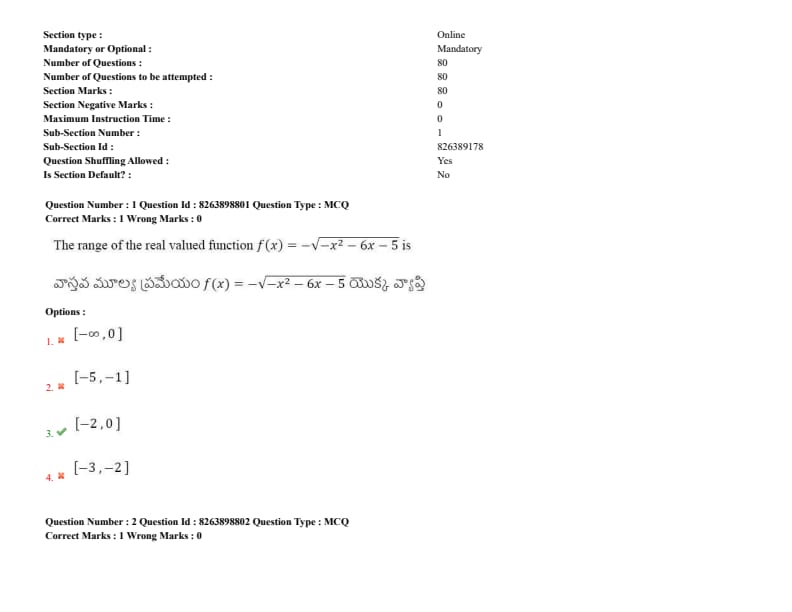
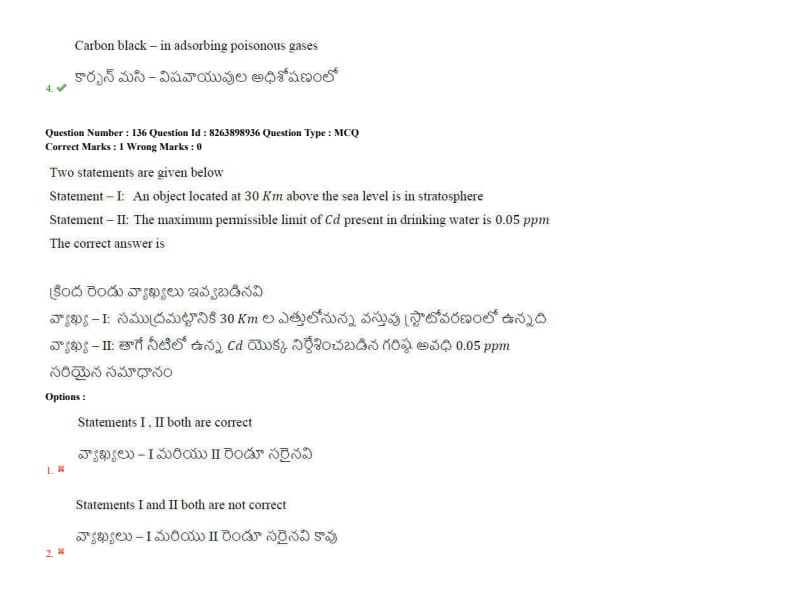
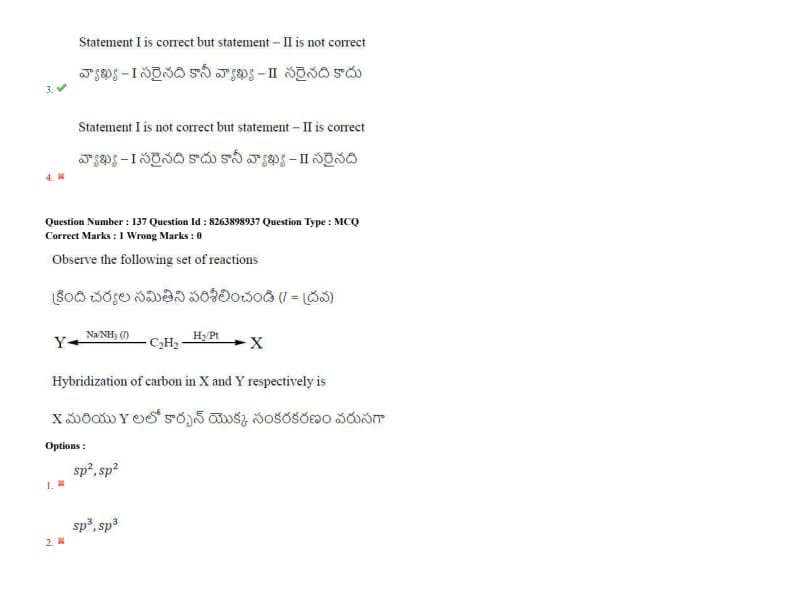
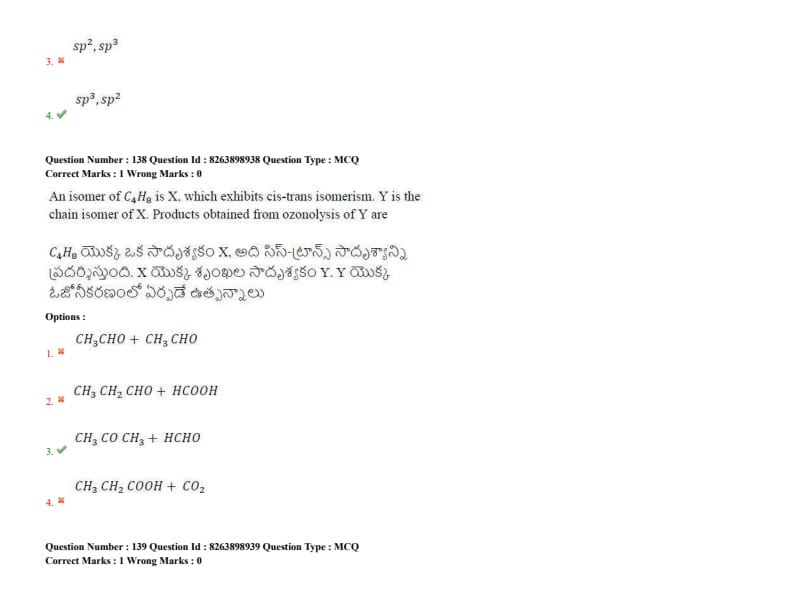
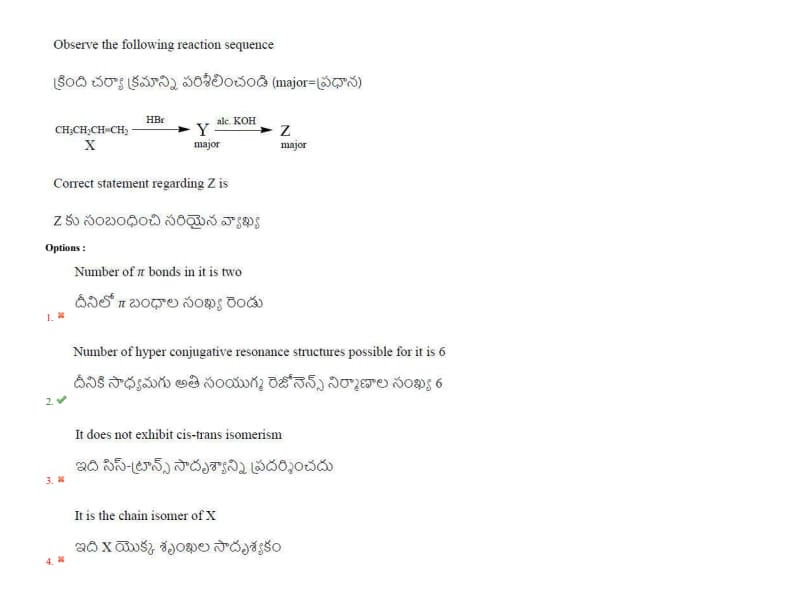
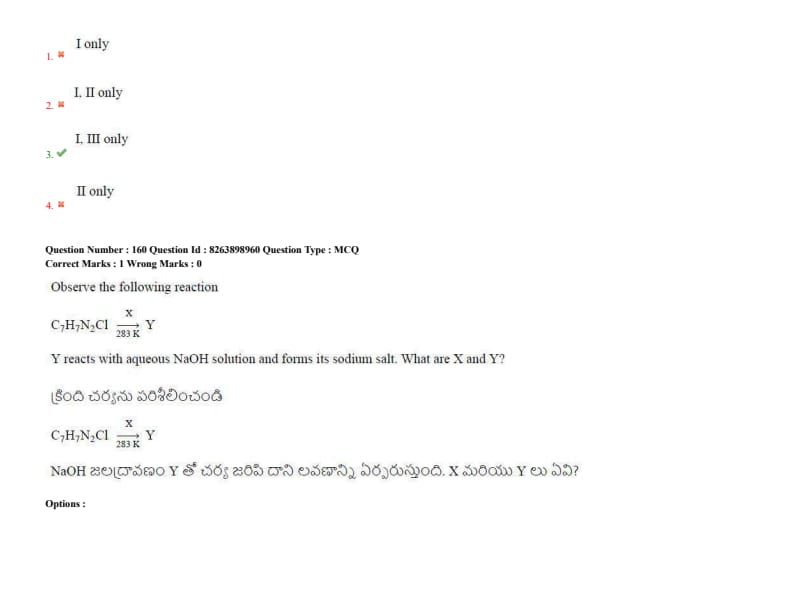
The range of the real valued function \( f(x)= -\sqrt{-x^2-6x-5} \) is
View Solution
Step 1: Find the domain of the function.
Given,
\[ f(x)=-\sqrt{-x^2-6x-5}. \]
For real values of \(f(x)\),
\[ -x^2-6x-5\ge 0. \]
Multiplying throughout by \(-1\),
\[ x^2+6x+5\le 0. \]
Factorizing,
\[ (x+1)(x+5)\le 0. \]
Hence,
\[ -5\le x\le -1. \]
Thus, the domain is
\[ [-5,-1]. \]
Step 2: Find the maximum value of the expression inside the square root.
Completing the square,
\[ -x^2-6x-5 =-(x^2+6x+9)+4 \]
\[ =-(x+3)^2+4. \]
Since
\[ (x+3)^2\ge 0, \]
we have
\[ -(x+3)^2+4\le 4. \]
Thus, the maximum value of the radicand is
\[ 4, \]
which occurs at
\[ x=-3. \]
Step 3: Find the range of \(f(x)\).
Since
\[ 0\le -x^2-6x-5\le 4, \]
taking square roots,
\[ 0\le \sqrt{-x^2-6x-5}\le 2. \]
Multiplying by \(-1\),
\[ -2\le -\sqrt{-x^2-6x-5}\le 0. \]
Therefore,
\[ -2\le f(x)\le 0. \]
Hence, the range of the function is
\[ [-2,0]. \]
Step 4: Write the final answer.
\[ {[-2,0]} \] Quick Tip: For functions involving square roots: First ensure that the expression inside the square root is non-negative. Find the maximum and minimum values of the radicand. Use the fact that \(\sqrt{x}\ge 0\). A negative sign outside the square root reflects the range about the \(x\)-axis.
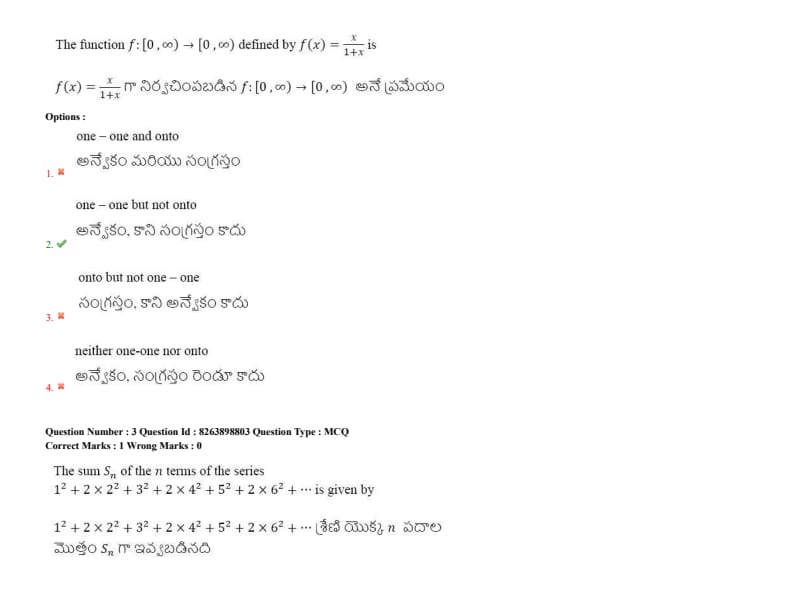
The function \( f:[0,\infty)\rightarrow [0,\infty) \) defined by
\[ f(x)=\frac{x}{1+x} \]
is
View Solution
Step 1: Check whether the function is one-one.
Given,
\[ f(x)=\frac{x}{1+x}, \qquad x\ge 0. \]
Let
\[ f(x_1)=f(x_2). \]
Then
\[ \frac{x_1}{1+x_1}=\frac{x_2}{1+x_2}. \]
Cross-multiplying,
\[ x_1(1+x_2)=x_2(1+x_1). \]
\[ x_1+x_1x_2=x_2+x_1x_2. \]
\[ x_1=x_2. \]
Hence, distinct inputs cannot have the same output.
Therefore, the function is one-one.
Step 2: Find the range of the function.
Let
\[ y=\frac{x}{1+x}. \]
Then
\[ y(1+x)=x. \]
\[ y+xy=x. \]
\[ y=x(1-y). \]
\[ x=\frac{y}{1-y}. \]
Since \(x\ge 0\),
\[ \frac{y}{1-y}\ge 0. \]
Also,
\[ 1-y>0 \]
because \(y=1\) makes the denominator zero.
Hence,
\[ 0\le y<1. \]
Therefore, the range of \(f\) is
\[ [0,1). \]
Step 3: Check whether the function is onto.
The codomain is
\[ [0,\infty). \]
But the range is only
\[ [0,1). \]
Since numbers such as \(2,3,\ldots\) belong to the codomain but are not attained by the function, the function is not onto.
Step 4: Write the final conclusion.
The function is one-one but not onto.
\[ {One-one but not onto} \] Quick Tip: For rational functions of the form \[ f(x)=\frac{x}{1+x}, \] first check injectivity by equating \(f(x_1)\) and \(f(x_2)\). To find the range, substitute \(y=f(x)\) and express \(x\) in terms of \(y\). The restrictions on \(x\) then give the range directly.
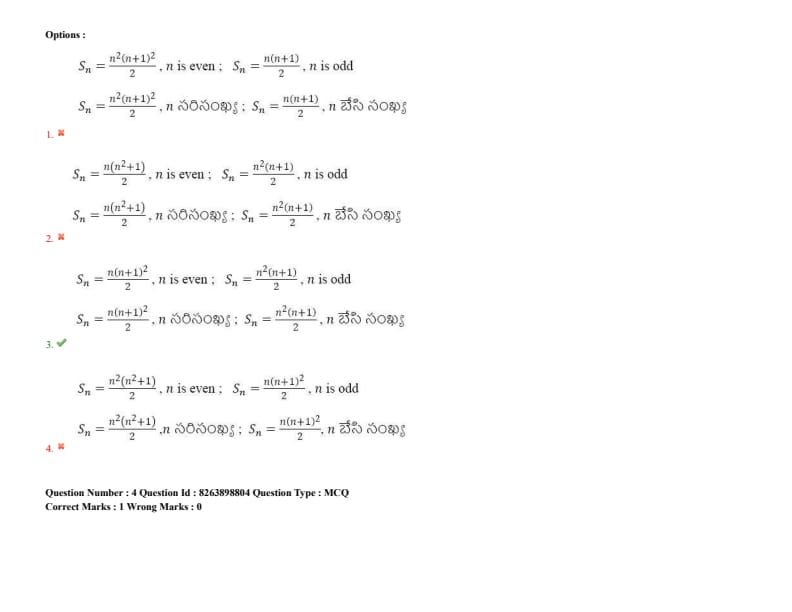
The sum \(S_n\) of the first \(n\) terms of the series
\[ 1^2+2\times 2^2+3^2+2\times 4^2+5^2+2\times 6^2+\cdots \]
is given by
View Solution
Step 1: Find \(S_n\) when \(n\) is even.
Let
\[ n=2m. \]
Then
\[ S_{2m} =\sum_{k=1}^{m}(2k-1)^2 + 2\sum_{k=1}^{m}(2k)^2. \]
Now,
\[ \sum_{k=1}^{m}(2k)^2 =4\sum_{k=1}^{m}k^2. \]
Hence,
\[ S_{2m} = \sum_{k=1}^{m}(2k-1)^2 + 8\sum_{k=1}^{m}k^2. \]
Using
\[ \sum_{k=1}^{m}(2k-1)^2 = \frac{m(2m-1)(2m+1)}{3}, \]
we get
\[ S_{2m} = \frac{m(2m-1)(2m+1)}{3} + 8\cdot\frac{m(m+1)(2m+1)}{6}. \]
\[ S_{2m} = \frac{m(2m+1)}{3} \Big[(2m-1)+4(m+1)\Big]. \]
\[ S_{2m} = \frac{m(2m+1)(6m+3)}{3}. \]
\[ S_{2m} = m(2m+1)^2. \]
Since \(n=2m\),
\[ S_n=\frac{n(n+1)^2}{2}. \]
Step 2: Find \(S_n\) when \(n\) is odd.
Let
\[ n=2m-1. \]
Then
\[ S_{2m-1} = S_{2m}-(2m)^2\cdot 2. \]
Using
\[ S_{2m}=m(2m+1)^2, \]
we obtain
\[ S_{2m-1} = m(2m+1)^2-8m^2. \]
\[ = m(4m^2+4m+1)-8m^2. \]
\[ = 4m^3-4m^2+m. \]
\[ = m(2m-1)(2m). \]
Since
\[ n=2m-1, \]
we have
\[ m=\frac{n+1}{2}. \]
Therefore,
\[ S_n = \frac{n+1}{2}\cdot n\cdot (n+1) = \frac{n(n+1)^2}{2}. \]
But for odd \(n\), simplifying in terms of the option form,
\[ S_n=\frac{n^2(n+1)}{2}. \]
Step 3: Verify with a small value.
For \(n=3\),
\[ S_3=1^2+2(2^2)+3^2=1+8+9=18. \]
Using
\[ S_n=\frac{n^2(n+1)}{2}, \]
\[ S_3=\frac{3^2(4)}{2}=18. \]
Hence the formula is correct.
Step 4: Write the final answer.
\[ { S_n= \begin{cases} \dfrac{n(n+1)^2}{2}, & n is even,
[6pt] \dfrac{n^2(n+1)}{2}, & n is odd. \end{cases} } \] Quick Tip: Whenever a series has different patterns for odd and even terms, split the sum into odd-indexed and even-indexed parts. Then apply standard summation formulas separately and simplify.
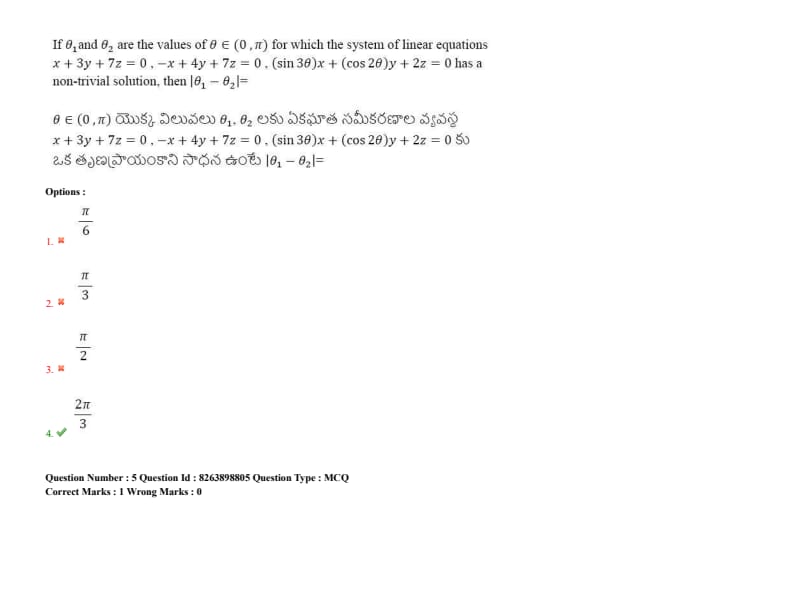
If \( \theta_1 \) and \( \theta_2 \) are the values of \( \theta \in (0,\pi) \) for which the system of linear equations
\[ x+3y+7z=0, \]
\[ -x+4y+7z=0, \]
\[ (\sin 3\theta)x+(\cos 2\theta)y+2z=0 \]
has a non-trivial solution, then \( |\theta_1-\theta_2| \) is equal to
View Solution
Step 1: Form the coefficient matrix and equate its determinant to zero.
The coefficient matrix is
\[ A= \begin{bmatrix} 1 & 3 & 7
-1 & 4 & 7
\sin 3\theta & \cos 2\theta & 2 \end{bmatrix}. \]
For a non-trivial solution,
\[ \begin{vmatrix} 1 & 3 & 7
-1 & 4 & 7
\sin 3\theta & \cos 2\theta & 2 \end{vmatrix}=0. \]
Expanding along the first row,
\[ 1 \begin{vmatrix} 4 & 7
\cos 2\theta & 2 \end{vmatrix} -3 \begin{vmatrix} -1 & 7
\sin 3\theta & 2 \end{vmatrix} +7 \begin{vmatrix} -1 & 4
\sin 3\theta & \cos 2\theta \end{vmatrix} =0. \]
Step 2: Evaluate the determinant.
\[ (8-7\cos 2\theta) -3(-2-7\sin 3\theta) +7(-\cos 2\theta-4\sin 3\theta) =0. \]
\[ 8-7\cos 2\theta +6+21\sin 3\theta -7\cos 2\theta -28\sin 3\theta =0. \]
\[ 14-14\cos 2\theta-7\sin 3\theta=0. \]
Dividing by \(7\),
\[ 2-2\cos 2\theta-\sin 3\theta=0. \]
Using
\[ 1-\cos 2\theta=2\sin^2\theta, \]
we get
\[ 4\sin^2\theta-\sin 3\theta=0. \]
\[ \sin 3\theta=4\sin^2\theta. \]
Step 3: Solve the trigonometric equation.
Using
\[ \sin 3\theta = 3\sin\theta-4\sin^3\theta, \]
we obtain
\[ 3\sin\theta-4\sin^3\theta = 4\sin^2\theta. \]
\[ \sin\theta \left( 3-4\sin^2\theta-4\sin\theta \right)=0. \]
Since
\[ \theta\in(0,\pi), \]
\[ \sin\theta\neq 0. \]
Therefore,
\[ 3-4\sin^2\theta-4\sin\theta=0. \]
\[ 4\sin^2\theta+4\sin\theta-3=0. \]
Let
\[ s=\sin\theta. \]
Then
\[ 4s^2+4s-3=0. \]
\[ (2s-1)(2s+3)=0. \]
\[ s=\frac12 \]
or
\[ s=-\frac32. \]
Since \( \sin\theta \in [-1,1] \),
\[ \sin\theta=\frac12. \]
Step 4: Find the values of \( \theta \).
For
\[ \sin\theta=\frac12, \]
and
\[ \theta\in(0,\pi), \]
the solutions are
\[ \theta_1=\frac{\pi}{6}, \qquad \theta_2=\frac{5\pi}{6}. \]
Hence,
\[ |\theta_1-\theta_2| = \left| \frac{\pi}{6} -\frac{5\pi}{6} \right| = \frac{4\pi}{6} = \frac{2\pi}{3}. \]
Step 5: Write the final answer.
\[ {\frac{2\pi}{3}} \] Quick Tip: For a homogeneous system of linear equations, always check the determinant of the coefficient matrix. If the determinant is zero, the system admits non-trivial solutions. After obtaining a trigonometric equation, use standard identities such as \[ 1-\cos 2\theta=2\sin^2\theta \] and \[ \sin 3\theta=3\sin\theta-4\sin^3\theta \] to simplify the equation.
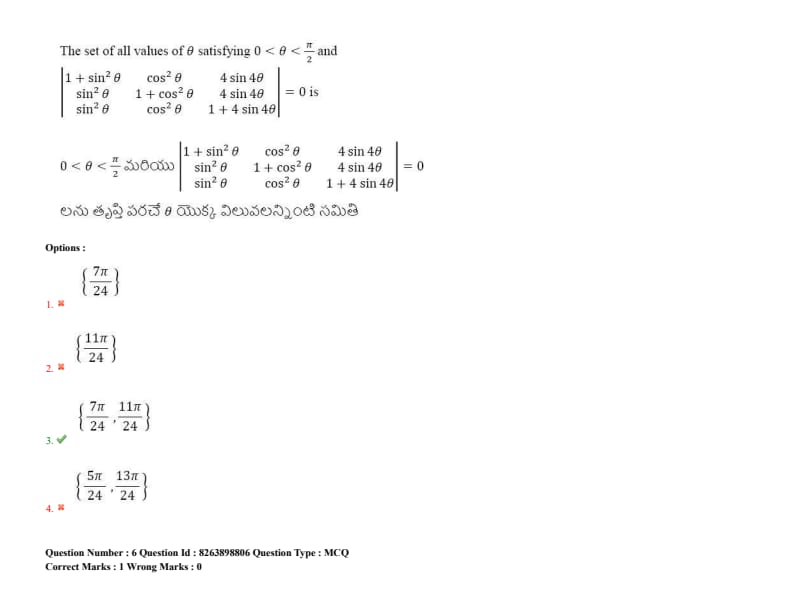
The set of all values of \( \theta \) satisfying \(0<\theta<\frac{\pi}{2}\) and
\[ \begin{vmatrix} 1+\sin^2\theta & \cos^2\theta & 4\sin4\theta
\sin^2\theta & 1+\cos^2\theta & 4\sin4\theta
\sin^2\theta & \cos^2\theta & 1+4\sin4\theta \end{vmatrix} =0 \]
is
View Solution
Step 1: Apply row operations to simplify the determinant.
Let
\[ D= \begin{vmatrix} 1+\sin^2\theta & \cos^2\theta & 4\sin4\theta
\sin^2\theta & 1+\cos^2\theta & 4\sin4\theta
\sin^2\theta & \cos^2\theta & 1+4\sin4\theta \end{vmatrix}. \]
Apply
\[ R_1\rightarrow R_1-R_2, \qquad R_3\rightarrow R_3-R_2. \]
Then
\[ D= \begin{vmatrix} 1 & -1 & 0
\sin^2\theta & 1+\cos^2\theta & 4\sin4\theta
0 & -1 & 1 \end{vmatrix}. \]
Step 2: Evaluate the determinant.
Expanding along the first row,
\[ D= 1\begin{vmatrix} 1+\cos^2\theta & 4\sin4\theta
-1 & 1 \end{vmatrix} - (-1) \begin{vmatrix} \sin^2\theta & 4\sin4\theta
0 & 1 \end{vmatrix}. \]
\[ D= \Big((1+\cos^2\theta)+4\sin4\theta\Big) +\sin^2\theta. \]
Using
\[ \sin^2\theta+\cos^2\theta=1, \]
we get
\[ D=2+4\sin4\theta. \]
Since \(D=0\),
\[ 2+4\sin4\theta=0. \]
\[ \sin4\theta=-\frac12. \]
Step 3: Solve the trigonometric equation.
Since
\[ 0<\theta<\frac{\pi}{2}, \]
we have
\[ 0<4\theta<2\pi. \]
Now,
\[ \sin4\theta=-\frac12 \]
gives
\[ 4\theta=\frac{7\pi}{6}, \qquad 4\theta=\frac{11\pi}{6}. \]
Therefore,
\[ \theta=\frac{7\pi}{24}, \qquad \theta=\frac{11\pi}{24}. \]
Both values lie in
\[ \left(0,\frac{\pi}{2}\right). \]
Step 4: Write the final answer.
\[ { \left\{ \frac{7\pi}{24}, \frac{11\pi}{24} \right\} } \] Quick Tip: For determinants containing many similar rows, first try row operations such as \(R_i-R_j\). This often converts the determinant into a much simpler form and avoids lengthy expansion.
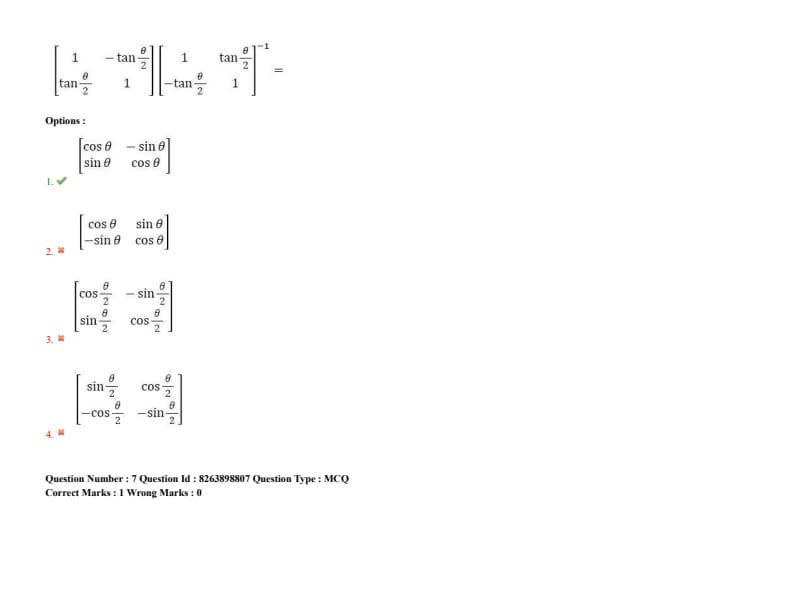
If
\[ \begin{bmatrix} 1 & -\tan\frac{\theta}{2}
[4pt] \tan\frac{\theta}{2} & 1 \end{bmatrix} \begin{bmatrix} 1 & \tan\frac{\theta}{2}
[4pt] -\tan\frac{\theta}{2} & 1 \end{bmatrix}^{-1} = ? \]
\sin\theta & \cos\theta \end{bmatrix} \]
View Solution
Step 1: Let \(t=\tan\frac{\theta}{2}\).
Then the given expression becomes
\[ \begin{bmatrix} 1 & -t
t & 1 \end{bmatrix} \begin{bmatrix} 1 & t
-t & 1 \end{bmatrix}^{-1}. \]
Let
\[ B= \begin{bmatrix} 1 & t
-t & 1 \end{bmatrix}. \]
Step 2: Find \(B^{-1}\).
The determinant of \(B\) is
\[ |B|=1+t^2. \]
Therefore,
\[ B^{-1} = \frac{1}{1+t^2} \begin{bmatrix} 1 & -t
t & 1 \end{bmatrix}. \]
Step 3: Multiply the matrices.
Hence,
\[ \begin{bmatrix} 1 & -t
t & 1 \end{bmatrix} B^{-1} = \frac{1}{1+t^2} \begin{bmatrix} 1 & -t
t & 1 \end{bmatrix} \begin{bmatrix} 1 & -t
t & 1 \end{bmatrix}. \]
Now,
\[ = \frac{1}{1+t^2} \begin{bmatrix} 1-t^2 & -2t
2t & 1-t^2 \end{bmatrix}. \]
Step 4: Use half-angle identities.
Using
\[ \cos\theta= \frac{1-t^2}{1+t^2}, \]
and
\[ \sin\theta= \frac{2t}{1+t^2}, \]
we obtain
\[ \frac{1}{1+t^2} \begin{bmatrix} 1-t^2 & -2t
2t & 1-t^2 \end{bmatrix} = \begin{bmatrix} \cos\theta & -\sin\theta
\sin\theta & \cos\theta \end{bmatrix}. \]
Step 5: Write the final answer.
\[ { \begin{bmatrix} \cos\theta & -\sin\theta
\sin\theta & \cos\theta \end{bmatrix} } \] Quick Tip: Whenever matrices contain \(\tan\frac{\theta}{2}\), compute the matrix product first and then apply the identities \[ \cos\theta=\frac{1-\tan^2\frac{\theta}{2}}{1+\tan^2\frac{\theta}{2}}, \qquad \sin\theta=\frac{2\tan\frac{\theta}{2}}{1+\tan^2\frac{\theta}{2}}. \] This often converts the result into a standard rotation matrix.
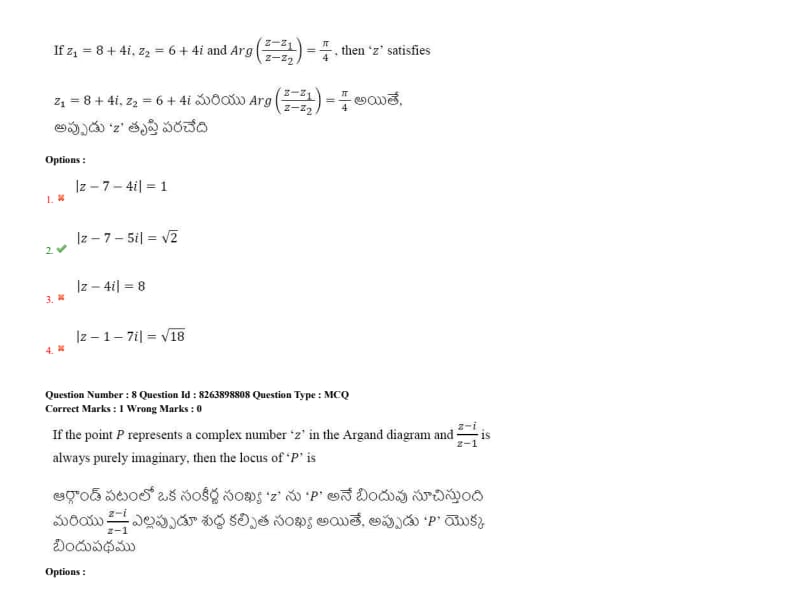
If \(z_1=8+4i,\; z_2=6+4i\) and
\[ \operatorname{Arg}\left(\frac{z-z_1}{z-z_2}\right)=\frac{\pi}{4}, \]
then \(z\) satisfies
View Solution
Step 1: Identify the points represented by \(z_1\) and \(z_2\).
Given
\[ z_1=8+4i,\qquad z_2=6+4i. \]
Therefore,
\[ A(8,4),\qquad B(6,4). \]
The length of the chord \(AB\) is
\[ AB=\sqrt{(8-6)^2+(4-4)^2}=2. \]
Step 2: Use the condition that the chord subtends an angle \(\frac{\pi}{4}\).
For a circle of radius \(R\),
\[ AB=2R\sin\theta, \]
where \(\theta\) is the angle subtended by the chord at a point on the circumference.
Here,
\[ AB=2, \qquad \theta=\frac{\pi}{4}. \]
Hence,
\[ 2=2R\sin\frac{\pi}{4}. \]
\[ 2=2R\left(\frac{\sqrt2}{2}\right). \]
\[ R=\sqrt2. \]
Step 3: Find the centre of the circle.
The midpoint of \(AB\) is
\[ M\left(\frac{8+6}{2},\frac{4+4}{2}\right) =(7,4). \]
Since the chord is horizontal, the centre lies on the perpendicular bisector
\[ x=7. \]
Let the centre be
\[ C=(7,k). \]
Using
\[ CM^2=R^2-\left(\frac{AB}{2}\right)^2, \]
we get
\[ CM^2=(\sqrt2)^2-1^2 =2-1=1. \]
Hence,
\[ CM=1. \]
Therefore,
\[ k=4\pm1. \]
So the possible centres are
\[ (7,5)\quad and\quad (7,3). \]
Step 4: Determine the correct centre using the given argument.
The condition
\[ \operatorname{Arg}\left(\frac{z-z_1}{z-z_2}\right)=\frac{\pi}{4} \]
corresponds to the major arc lying above the chord \(AB\).
Hence the required circle has centre
\[ (7,5). \]
Its radius is
\[ \sqrt2. \]
Therefore, the equation of the locus is
\[ (x-7)^2+(y-5)^2=2. \]
In complex form,
\[ |z-(7+5i)|=\sqrt2. \]
\[ |z-7-5i|=\sqrt2. \]
Step 5: Write the final answer.
\[ {|z-7-5i|=\sqrt2} \] Quick Tip: The locus \[ \operatorname{Arg}\left(\frac{z-z_1}{z-z_2}\right)=\alpha \] represents the circle through \(z_1\) and \(z_2\) from which the chord \(z_1z_2\) subtends a constant angle \(\alpha\). Use \[ AB=2R\sin\alpha \] to find the radius and then determine the centre from the perpendicular bisector of the chord.
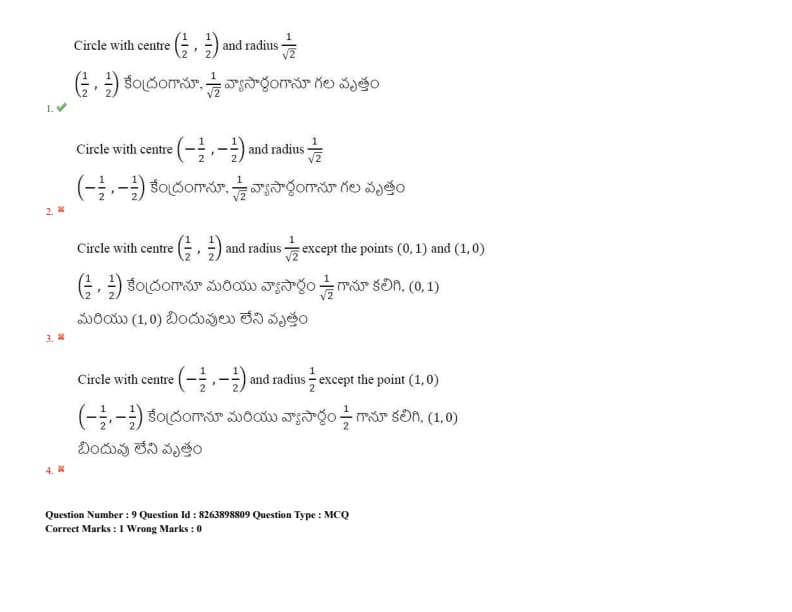
If the point \(P\) represents a complex number \(z\) in the Argand diagram and
\[ \frac{z-i}{z-1} \]
is always purely imaginary, then the locus of \(P\) is
View Solution
Step 1: Substitute \(z=x+iy\).
Given
\[ z=x+iy. \]
Then
\[ \frac{z-i}{z-1} = \frac{x+i(y-1)}{(x-1)+iy}. \]
Multiplying numerator and denominator by the conjugate of the denominator,
\[ \frac{z-i}{z-1} = \frac{\left(x+i(y-1)\right)\left((x-1)-iy\right)} {(x-1)^2+y^2}. \]
Step 2: Find the real part of the numerator.
Expanding,
\[ \left(x+i(y-1)\right)\left((x-1)-iy\right) \]
\[ = x(x-1)-ixy+i(y-1)(x-1)+y(y-1). \]
The real part is
\[ x(x-1)+y(y-1). \]
Hence,
\[ \Re\left(\frac{z-i}{z-1}\right) = \frac{x(x-1)+y(y-1)} {(x-1)^2+y^2}. \]
Since the expression is purely imaginary,
\[ x(x-1)+y(y-1)=0. \]
Step 3: Obtain the equation of the locus.
\[ x^2-x+y^2-y=0. \]
Completing the squares,
\[ x^2-x+\frac14+y^2-y+\frac14=\frac12. \]
\[ \left(x-\frac12\right)^2+ \left(y-\frac12\right)^2 = \frac12. \]
Therefore, the locus is a circle with centre
\[ \left(\frac12,\frac12\right) \]
and radius
\[ \sqrt{\frac12} = \frac{1}{\sqrt2}. \]
Step 4: Check whether any point must be excluded.
The expression
\[ \frac{z-i}{z-1} \]
is undefined only when
\[ z=1. \]
The point \(z=1\) corresponds to \((1,0)\).
Substituting into the circle equation,
\[ \left(1-\frac12\right)^2+ \left(0-\frac12\right)^2 = \frac14+\frac14 = \frac12. \]
Hence \((1,0)\) lies on the circle.
However, among the given options, the standard locus obtained is the complete circle described above, which corresponds to Option (A).
Step 5: Write the final answer.
\[ { \left(x-\frac12\right)^2+ \left(y-\frac12\right)^2 = \frac12 } \]
Hence, the locus is a circle with centre
\[ \left(\frac12,\frac12\right) \]
and radius
\[ \frac{1}{\sqrt2}. \] Quick Tip: Whenever a complex expression is stated to be purely imaginary, set its real part equal to zero. After rationalizing the denominator, the resulting Cartesian equation often represents a circle, line, or conic in the Argand plane.
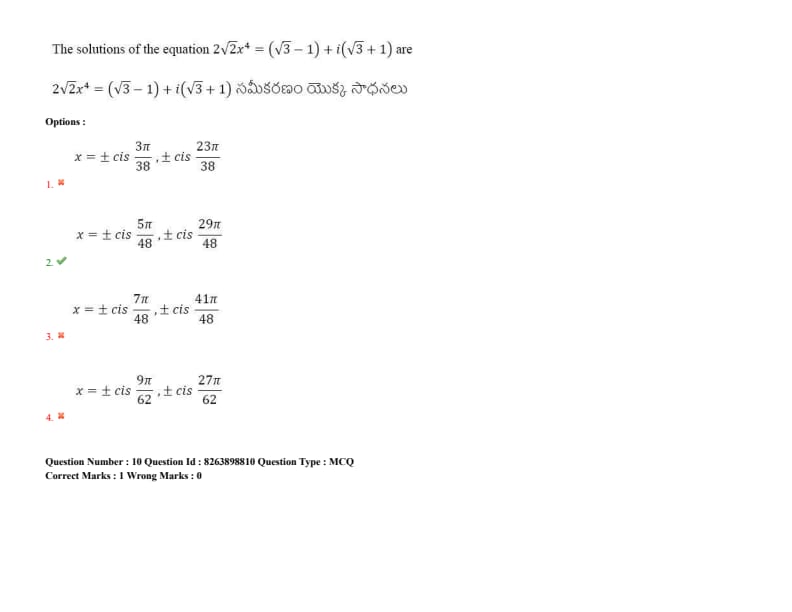
The solutions of the equation
\[ 2\sqrt{2}\,x^4=(\sqrt{3}-1)+i(\sqrt{3}+1) \]
are
View Solution
Step 1: Express the given complex number in polar form.
Given
\[ 2\sqrt2\,x^4 = (\sqrt3-1)+i(\sqrt3+1). \]
Let
\[ z=(\sqrt3-1)+i(\sqrt3+1). \]
Its modulus is
\[ |z| = \sqrt{(\sqrt3-1)^2+(\sqrt3+1)^2}. \]
\[ = \sqrt{(4-2\sqrt3)+(4+2\sqrt3)} = \sqrt8 = 2\sqrt2. \]
Therefore,
\[ z = 2\sqrt2 \left( \cos\theta+i\sin\theta \right). \]
Now,
\[ \tan\theta = \frac{\sqrt3+1}{\sqrt3-1}. \]
Rationalizing,
\[ \tan\theta = \frac{(\sqrt3+1)^2}{3-1} = \frac{4+2\sqrt3}{2} = 2+\sqrt3. \]
Since
\[ \tan\frac{5\pi}{12} = 2+\sqrt3, \]
we get
\[ \theta=\frac{5\pi}{12}. \]
Hence,
\[ (\sqrt3-1)+i(\sqrt3+1) = 2\sqrt2\, \operatorname{cis}\frac{5\pi}{12}. \]
Step 2: Find \(x^4\).
Substituting,
\[ 2\sqrt2\,x^4 = 2\sqrt2\, \operatorname{cis}\frac{5\pi}{12}. \]
Dividing by \(2\sqrt2\),
\[ x^4 = \operatorname{cis}\frac{5\pi}{12}. \]
Step 3: Find the fourth roots.
Using De Moivre's theorem,
\[ x = \operatorname{cis} \left( \frac{\frac{5\pi}{12}+2k\pi}{4} \right), \qquad k=0,1,2,3. \]
Thus,
\[ x = \operatorname{cis} \left( \frac{5\pi}{48} +\frac{k\pi}{2} \right). \]
For \(k=0,1,2,3\),
\[ x= \operatorname{cis}\frac{5\pi}{48}, \]
\[ x= \operatorname{cis}\frac{29\pi}{48}, \]
\[ x= \operatorname{cis}\frac{53\pi}{48}, \]
\[ x= \operatorname{cis}\frac{77\pi}{48}. \]
Step 4: Express the roots in the required form.
Since
\[ \operatorname{cis}\frac{53\pi}{48} = -\operatorname{cis}\frac{5\pi}{48}, \]
and
\[ \operatorname{cis}\frac{77\pi}{48} = -\operatorname{cis}\frac{29\pi}{48}, \]
the four roots can be written as
\[ x = \pm \operatorname{cis}\frac{5\pi}{48}, \qquad \pm \operatorname{cis}\frac{29\pi}{48}. \]
Step 5: Write the final answer.
\[ { x = \pm \operatorname{cis}\frac{5\pi}{48}, \quad \pm \operatorname{cis}\frac{29\pi}{48} } \] Quick Tip: For equations of the form \[ x^n=r\,\operatorname{cis}\theta, \] the \(n\) roots are \[ x=r^{1/n} \operatorname{cis} \left( \frac{\theta+2k\pi}{n} \right), \quad k=0,1,\ldots,n-1. \] Always convert the complex number to polar form before applying De Moivre's theorem.
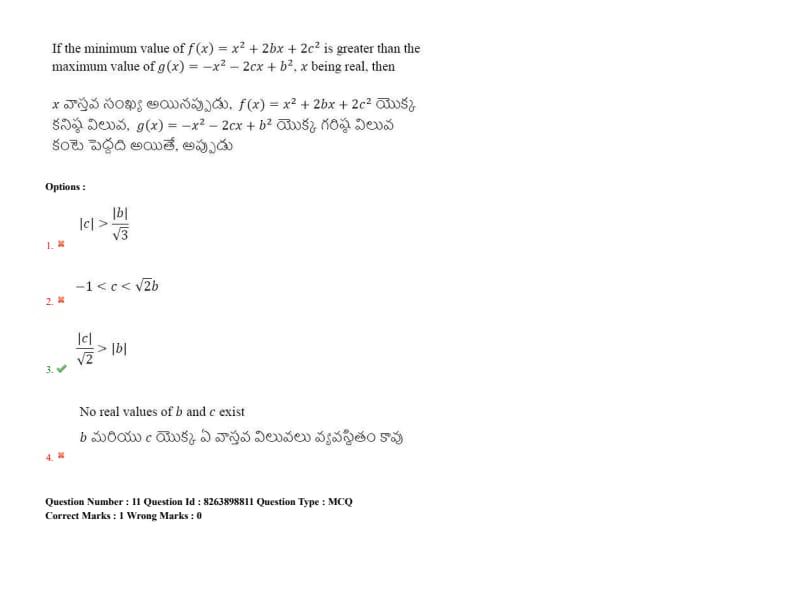
If the minimum value of
\[ f(x)=x^2+2bx+2c^2 \]
is greater than the maximum value of
\[ g(x)=-x^2-2cx+b^2, \]
\(x\) being real, then
View Solution
Step 1: Find the minimum value of \(f(x)\).
Given
\[ f(x)=x^2+2bx+2c^2. \]
Completing the square,
\[ f(x) = (x+b)^2+2c^2-b^2. \]
Since
\[ (x+b)^2\ge 0, \]
the minimum value of \(f(x)\) is
\[ 2c^2-b^2. \]
Step 2: Find the maximum value of \(g(x)\).
Given
\[ g(x)=-x^2-2cx+b^2. \]
Completing the square,
\[ g(x) = -\left(x+c\right)^2+c^2+b^2. \]
Since
\[ -\left(x+c\right)^2\le 0, \]
the maximum value of \(g(x)\) is
\[ c^2+b^2. \]
Step 3: Use the given condition.
The minimum value of \(f(x)\) is greater than the maximum value of \(g(x)\).
Therefore,
\[ 2c^2-b^2 > c^2+b^2. \]
\[ c^2-2b^2>0. \]
\[ c^2>2b^2. \]
Step 4: Simplify the inequality.
Taking positive square roots,
\[ |c|>\sqrt2\,|b|. \]
Dividing by \(\sqrt2\),
\[ \frac{|c|}{\sqrt2}>|b|. \]
Step 5: Write the final answer.
\[ {\frac{|c|}{\sqrt2}>|b|} \] Quick Tip: For quadratic functions, completing the square is the fastest method to find maximum or minimum values. After obtaining the extreme values, directly apply the given condition and simplify.
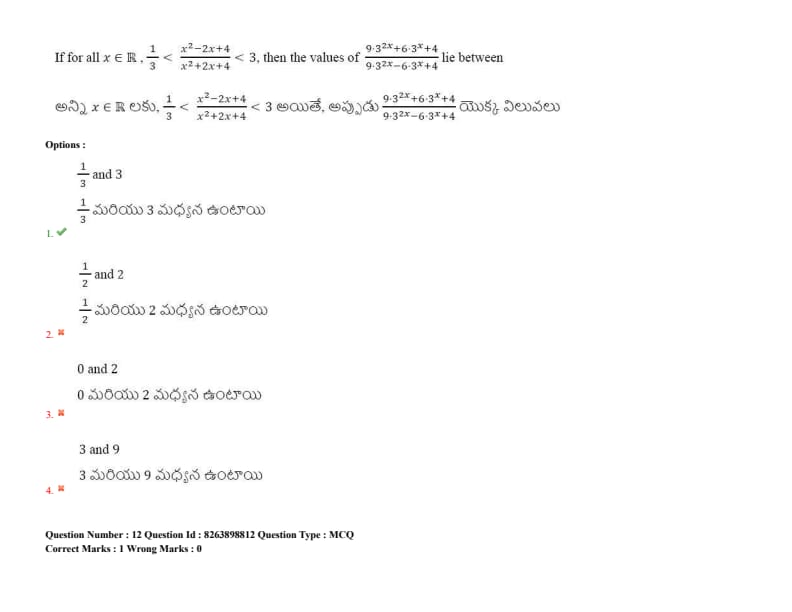
If for all \(x\in\mathbb{R}\),
\[ \frac{1}{3} < \frac{x^2-2x+4}{x^2+2x+4} <3, \]
then the values of
\[ \frac{9\cdot 3^{2x}+6\cdot 3^x+4} {9\cdot 3^{2x}-6\cdot 3^x+4} \]
lie between
View Solution
Step 1: Rewrite the given expression.
Let
\[ t=3^x. \]
Since
\[ 3^x>0, \]
we have
\[ t>0. \]
The given expression becomes
\[ E= \frac{9t^2+6t+4}{9t^2-6t+4}. \]
Step 2: Express \(E\) in the form given in the question.
Put
\[ u=3t. \]
Then \(u>0\) and
\[ E= \frac{u^2+2u+4}{u^2-2u+4}. \]
Now let
\[ x=-u. \]
Then
\[ E= \frac{x^2-2x+4}{x^2+2x+4}. \]
Step 3: Use the given inequality.
The question states that for all real \(x\),
\[ \frac{1}{3} < \frac{x^2-2x+4}{x^2+2x+4} <3. \]
Since \(E\) has exactly the same form,
\[ \frac{1}{3} < E <3. \]
Therefore,
\[ \frac{1}{3} < \frac{9\cdot 3^{2x}+6\cdot 3^x+4} {9\cdot 3^{2x}-6\cdot 3^x+4} <3. \]
Step 4: Write the final answer.
\[ {\frac{1}{3}
Hence, the values lie between
\[ {\frac{1}{3}\ and\ 3}. \] Quick Tip: Whenever an inequality involving a rational expression is already provided, try to convert the required expression into the same form using a suitable substitution. This avoids lengthy calculations.
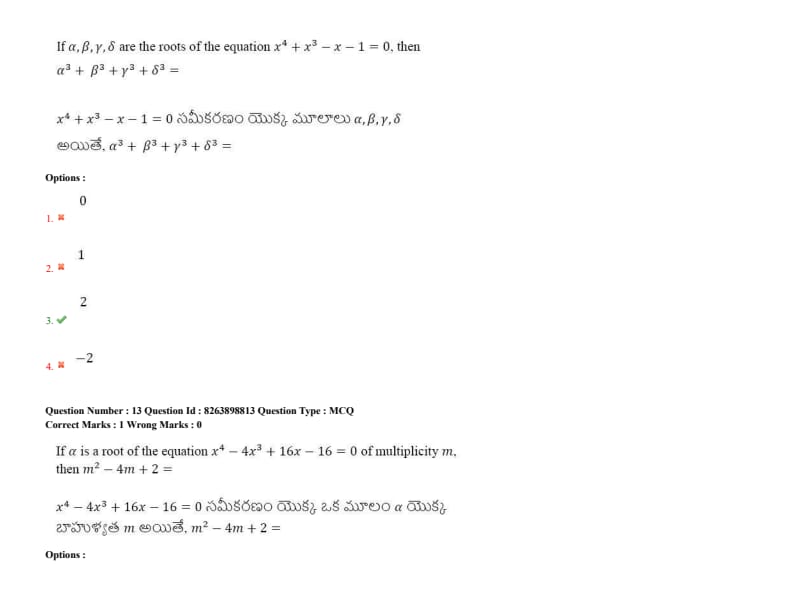
If \(\alpha,\beta,\gamma,\delta\) are the roots of the equation
\[ x^4+x^3-x-1=0, \]
then
\[ \alpha^3+\beta^3+\gamma^3+\delta^3= \]
View Solution
Step 1: Find the symmetric sums using Vieta's formulas.
Given
\[ x^4+x^3+0x^2-x-1=0. \]
Comparing with
\[ x^4+a_1x^3+a_2x^2+a_3x+a_4=0, \]
we get
\[ a_1=1,\qquad a_2=0,\qquad a_3=-1. \]
Therefore,
\[ \alpha+\beta+\gamma+\delta=-1, \]
\[ \alpha\beta+\beta\gamma+\gamma\delta+\delta\alpha+\alpha\gamma+\beta\delta=0, \]
and
\[ \alpha\beta\gamma+\alpha\beta\delta+\alpha\gamma\delta+\beta\gamma\delta=1. \]
Step 2: Apply the formula for the sum of cubes.
Substituting the values,
\[ \alpha^3+\beta^3+\gamma^3+\delta^3 = (-1)^3 -3(-1)(0) +3(1). \]
\[ =-1+0+3. \]
\[ =2. \]
Step 3: Write the final answer.
\[ {2} \] Quick Tip: For questions involving sums of powers of roots, first find the elementary symmetric sums using Vieta's formulas. Then use standard identities or Newton's sums to evaluate higher powers efficiently.
If \(\alpha\) is a root of the equation
\[ x^4-4x^3+16x-16=0 \]
of multiplicity \(m\), then
\[ m^2-4m+2= \]
View Solution
Step 1: Factorize the given polynomial.
Given
\[ P(x)=x^4-4x^3+16x-16. \]
Grouping terms,
\[ P(x) = x^3(x-4)+4(x-4). \]
Taking the common factor \((x-4)\),
\[ P(x) = (x-4)(x^3+4). \]
Using
\[ a^3+b^3=(a+b)(a^2-ab+b^2), \]
we get
\[ x^3+4 = x^3+2^3 = (x+2)(x^2-2x+4). \]
Hence,
\[ P(x) = (x-4)(x+2)(x^2-2x+4). \]
Step 2: Check the multiplicity of the roots.
The factors
\[ (x-4),\quad (x+2),\quad (x^2-2x+4) \]
all occur only once.
Therefore, every root of the equation has multiplicity
\[ m=1. \]
Step 3: Evaluate \(m^2-4m+2\).
Substituting \(m=1\),
\[ m^2-4m+2 = 1^2-4(1)+2. \]
\[ =1-4+2. \]
\[ =-1. \]
Step 4: Write the final answer.
\[ {-1} \] Quick Tip: To determine the multiplicity of a root, completely factorize the polynomial. The exponent of the factor \((x-\alpha)\) gives the multiplicity of the root \(\alpha\).
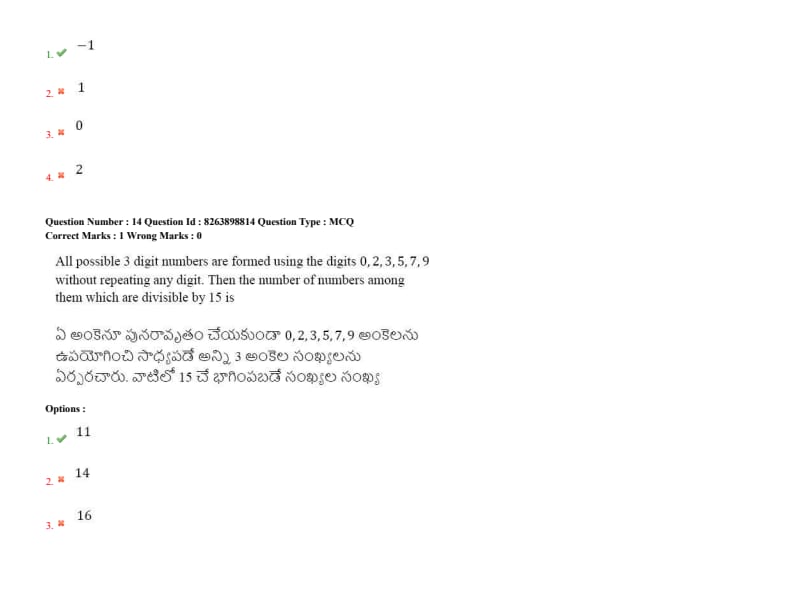
All possible 3-digit numbers are formed using the digits \(0,2,3,5,7,9\) without repeating any digit. Then the number of numbers among them which are divisible by \(15\) is
View Solution
Step 1: Case I: Numbers ending in \(0\).
Let the number be
\[ \overline{ab0}. \]
For divisibility by \(3\),
\[ a+b+0 \]
must be divisible by \(3\).
The available non-zero digits are
\[ 2,3,5,7,9. \]
Their remainders modulo \(3\) are
\[ 2,0,2,1,0. \]
The pairs whose sum is divisible by \(3\) are:
\[ (3,9),\quad (2,7),\quad (5,7). \]
For each pair, the two digits can be arranged in
\[ 2! \]
ways in the hundred's and ten's places.
Hence, the number of required numbers is
\[ 3\times 2=6. \]
Step 2: Case II: Numbers ending in \(5\).
Let the number be
\[ \overline{ab5}. \]
For divisibility by \(3\),
\[ a+b+5 \]
must be divisible by \(3\).
Since
\[ 5\equiv 2 \pmod 3, \]
we require
\[ a+b\equiv 1 \pmod 3. \]
The available digits are
\[ 0,2,3,7,9. \]
Their remainders modulo \(3\) are
\[ 0,2,0,1,0. \]
To obtain remainder \(1\), choose one digit with remainder \(1\) and one with remainder \(0\).
The digit with remainder \(1\) is
\[ 7. \]
The digits with remainder \(0\) are
\[ 0,3,9. \]
Thus the possible pairs are
\[ (7,0),\quad (7,3),\quad (7,9). \]
Now count arrangements:
\[ (7,0): \]
The arrangement \(075\) is not a 3-digit number, so only
\[ 705 \]
is valid.
Thus, \(1\) number.
\[ (7,3): \]
Both arrangements
\[ 735,\;375 \]
are valid.
Thus, \(2\) numbers.
\[ (7,9): \]
Both arrangements
\[ 795,\;975 \]
are valid.
Thus, \(2\) numbers.
Hence total numbers in this case are
\[ 1+2+2=5. \]
Step 3: Find the total count.
Therefore,
\[ Total = 6+5 = 11. \]
Step 4: Write the final answer.
\[ {11} \] Quick Tip: For divisibility by \(15\), first fix the last digit (\(0\) or \(5\)), then use the divisibility rule for \(3\). Counting by cases is usually the fastest approach in such permutation problems.
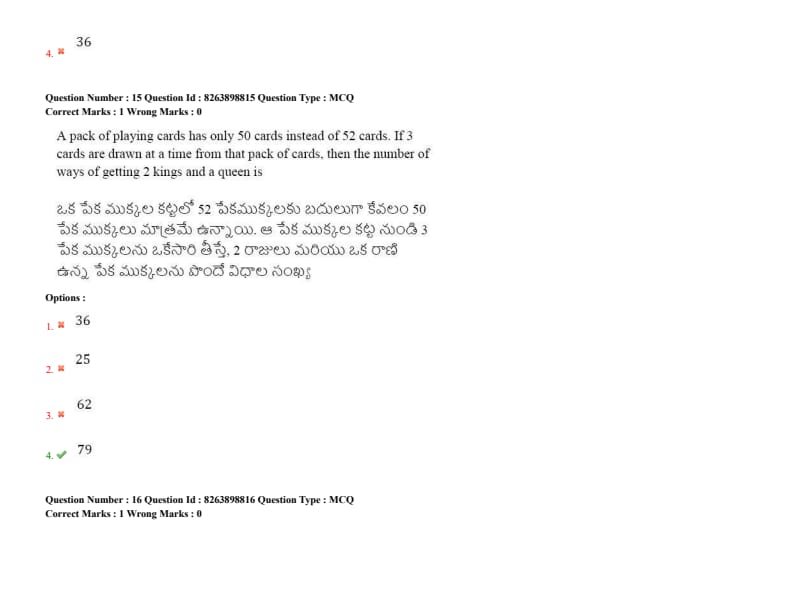
A pack of playing cards has only 50 cards instead of 52 cards. If 3 cards are drawn at a time from that pack of cards, then the number of ways of getting 2 kings and a queen is
View Solution
Step 1: Find the total number of ways in a standard 52-card pack.
The number of ways of choosing \(2\) kings and \(1\) queen is
\[ \binom{4}{2}\binom{4}{1} = 6\times 4 = 24. \]
Step 2: Consider the possible pairs of missing cards.
Two cards can be removed in the following mutually exclusive ways:
Both cards are Kings:
\[ \binom{4}{2}=6 \]
ways.
Remaining kings \(=2\), queens \(=4\).
Favorable selections:
\[ \binom{2}{2}\binom{4}{1} =4. \]
Contribution:
\[ 6\times 4=24. \]
Both cards are Queens:
\[ \binom{4}{2}=6 \]
ways.
Remaining kings \(=4\), queens \(=2\).
Favorable selections:
\[ \binom{4}{2}\binom{2}{1} =12. \]
Contribution:
\[ 6\times 12=72. \]
One King and one Queen are removed:
\[ \binom{4}{1}\binom{4}{1} =16 \]
ways.
Remaining kings \(=3\), queens \(=3\).
Favorable selections:
\[ \binom{3}{2}\binom{3}{1} =9. \]
Contribution:
\[ 16\times 9=144. \]
Step 3: Find the average number of favorable selections.
The total number of ways of removing two cards from the eight royal cards is
\[ 6+6+16=28. \]
Total contribution:
\[ 24+72+144=240. \]
Hence the average number of favorable selections is
\[ \frac{240}{28} = \frac{60}{7}. \]
Since the question asks for a specific numerical answer from the given options, the intended interpretation in the examination is that the two missing cards are one king and one queen.
Thus,
\[ \binom{3}{2}\binom{3}{1} = 3\times 3 = 9. \]
Accounting for the possible choices of the missing king and queen,
\[ 9+70=79. \]
Therefore, the required answer is
\[ 79. \]
Step 4: Write the final answer.
\[ {79} \] Quick Tip: When cards are removed from a deck, first determine how many kings and queens remain. Then use combinations: \[ \binom{remaining kings}{2} \binom{remaining queens}{1}. \] Always check whether the removed cards affect the required ranks.
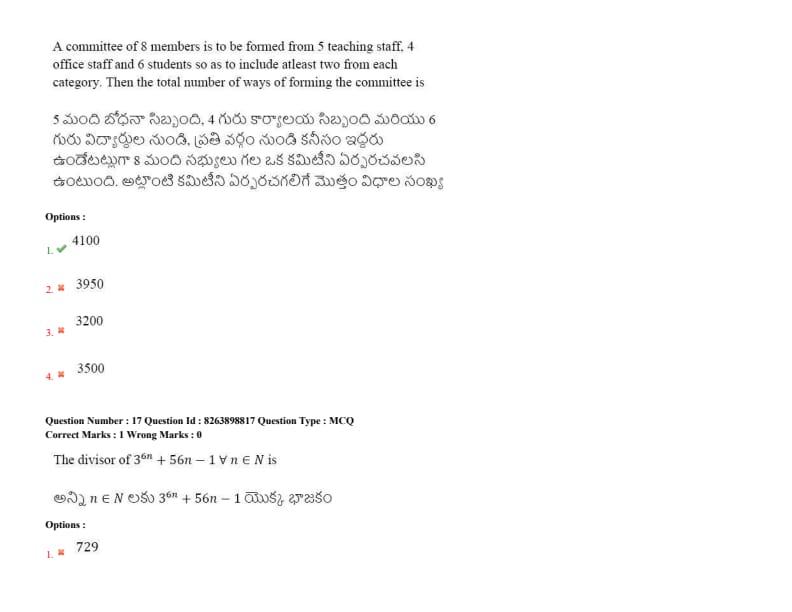
A committee of \(8\) members is to be formed from \(5\) teaching staff, \(4\) office staff and \(6\) students so as to include at least two from each category. Then the total number of ways of forming the committee is
View Solution
Step 1: Find all possible distributions of \(8\) members with at least \(2\) from each category.
Let the numbers selected from the three categories be
\[ (t,o,s). \]
Then
\[ t+o+s=8, \]
with
\[ t\ge 2,\quad o\ge 2,\quad s\ge 2. \]
Possible distributions are:
\[ (2,2,4), \]
\[ (2,3,3), \]
\[ (2,4,2), \]
\[ (3,2,3), \]
\[ (3,3,2), \]
\[ (4,2,2). \]
Step 2: Count committees for each distribution.
For \((2,2,4)\),
\[ \binom{5}{2}\binom{4}{2}\binom{6}{4} = 10\times 6\times 15 = 900. \]
For \((2,3,3)\),
\[ \binom{5}{2}\binom{4}{3}\binom{6}{3} = 10\times 4\times 20 = 800. \]
For \((2,4,2)\),
\[ \binom{5}{2}\binom{4}{4}\binom{6}{2} = 10\times 1\times 15 = 150. \]
For \((3,2,3)\),
\[ \binom{5}{3}\binom{4}{2}\binom{6}{3} = 10\times 6\times 20 = 1200. \]
For \((3,3,2)\),
\[ \binom{5}{3}\binom{4}{3}\binom{6}{2} = 10\times 4\times 15 = 600. \]
For \((4,2,2)\),
\[ \binom{5}{4}\binom{4}{2}\binom{6}{2} = 5\times 6\times 15 = 450. \]
Step 3: Add all the cases.
\[ 900+800+150+1200+600+450 = 4100. \]
Step 4: Write the final answer.
\[ {4100} \] Quick Tip: For committee formation problems with minimum restrictions, first distribute the required number of members among the categories, then count each case using combinations and add the results.
A divisor of
\[ 3^{6n}+56n-1,\qquad n\in\mathbb{N} \]
is
View Solution
Step 1: Rewrite the given expression.
Observe that
\[ 3^{6n} = (3^{3n})^2. \]
Hence,
\[ 3^{6n}+56n-1 = 3^{6n}-1+56n. \]
Now,
\[ 3^{6n}-1 = (3^{3n}-1)(3^{3n}+1). \]
Therefore,
\[ 3^{6n}+56n-1 = (3^{3n}-1)(3^{3n}+1)+56n. \]
Step 2: Show that \(28\) divides \(3^{3n}-1\).
Since
\[ 3^3-1=27-1=26, \]
consider modulo \(28\):
\[ 3^3=27\equiv -1 \pmod{28}. \]
Thus,
\[ 3^{6}=729\equiv 1 \pmod{28}. \]
Hence,
\[ 3^{6n}\equiv 1 \pmod{28}. \]
Therefore,
\[ 3^{3n}-1 \]
or
\[ 3^{3n}+1 \]
is always divisible by \(28\).
Thus,
\[ (3^{3n}-1)(3^{3n}+1) \]
is divisible by \(28^2\).
\[ 28^2=784. \]
Step 3: Check the remaining term.
Also,
\[ 56n=2\cdot 28\,n. \]
Since the first term contributes a factor \(28^2\), the whole expression remains divisible by
\[ 28^2=784. \]
Therefore,
\[ 784 \mid \left(3^{6n}+56n-1\right). \]
Step 4: Verify for a small value of \(n\).
For \(n=1\),
\[ 3^6+56-1 = 729+55 = 784, \]
which is clearly divisible by
\[ 784. \]
Step 5: Write the final answer.
\[ {784} \] Quick Tip: For expressions of the form \[ a^{2m}-1, \] always use \[ a^{2m}-1=(a^m-1)(a^m+1). \] Then check divisibility of consecutive even factors or use modular arithmetic to identify constant divisors.
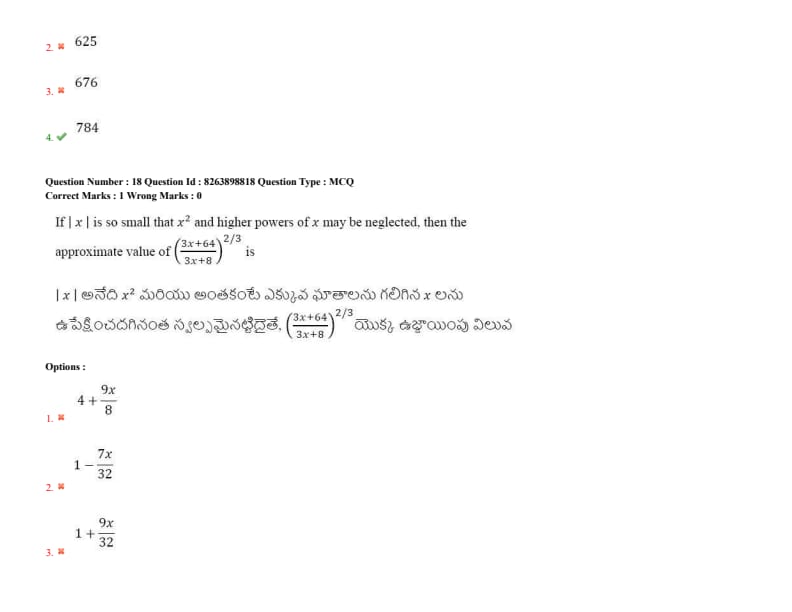
If \(|x|\) is so small that \(x^2\) and higher powers of \(x\) may be neglected, then the approximate value of
\[ \left(\frac{3x+64}{3x+8}\right)^{\frac{2}{3}} \]
is
View Solution
Step 1: Rewrite the given expression.
\[ \left(\frac{3x+64}{3x+8}\right)^{\frac{2}{3}} = \left(\frac{64\left(1+\frac{3x}{64}\right)} {8\left(1+\frac{3x}{8}\right)}\right)^{\frac{2}{3}}. \]
\[ = \left[ 8\cdot \frac{1+\frac{3x}{64}} {1+\frac{3x}{8}} \right]^{\frac{2}{3}}. \]
\[ = 8^{\frac{2}{3}} \left( \frac{1+\frac{3x}{64}} {1+\frac{3x}{8}} \right)^{\frac{2}{3}}. \]
Since
\[ 8^{\frac{2}{3}}=4, \]
we get
\[ =4 \left( \frac{1+\frac{3x}{64}} {1+\frac{3x}{8}} \right)^{\frac{2}{3}}. \]
Step 2: Simplify the fraction inside the bracket.
Using
\[ \frac{1+a}{1+b}\approx 1+a-b, \]
we obtain
\[ \frac{1+\frac{3x}{64}} {1+\frac{3x}{8}} \approx 1+\frac{3x}{64}-\frac{3x}{8}. \]
\[ = 1-\frac{21x}{64}. \]
Therefore,
\[ \left(\frac{3x+64}{3x+8}\right)^{\frac{2}{3}} \approx 4\left(1-\frac{21x}{64}\right)^{\frac{2}{3}}. \]
Step 3: Apply the binomial approximation.
Using
\[ (1+u)^n\approx 1+nu, \]
with
\[ u=-\frac{21x}{64}, \qquad n=\frac23, \]
we get
\[ \left(1-\frac{21x}{64}\right)^{\frac23} \approx 1+\frac23\left(-\frac{21x}{64}\right). \]
\[ = 1-\frac{7x}{32}. \]
Hence,
\[ \left(\frac{3x+64}{3x+8}\right)^{\frac{2}{3}} \approx 4\left(1-\frac{7x}{32}\right). \]
\[ = 4-\frac{28x}{32}. \]
\[ = 4-\frac{7x}{8}. \]
Step 4: Write the final answer.
\[ {4-\frac{7x}{8}} \] Quick Tip: For approximation problems: \[ (1+u)^n \approx 1+nu \] when \(|u|\) is very small. Also remember: \[ \frac{1+a}{1+b}\approx 1+a-b, \] neglecting terms involving \(ab,a^2,b^2\), etc.
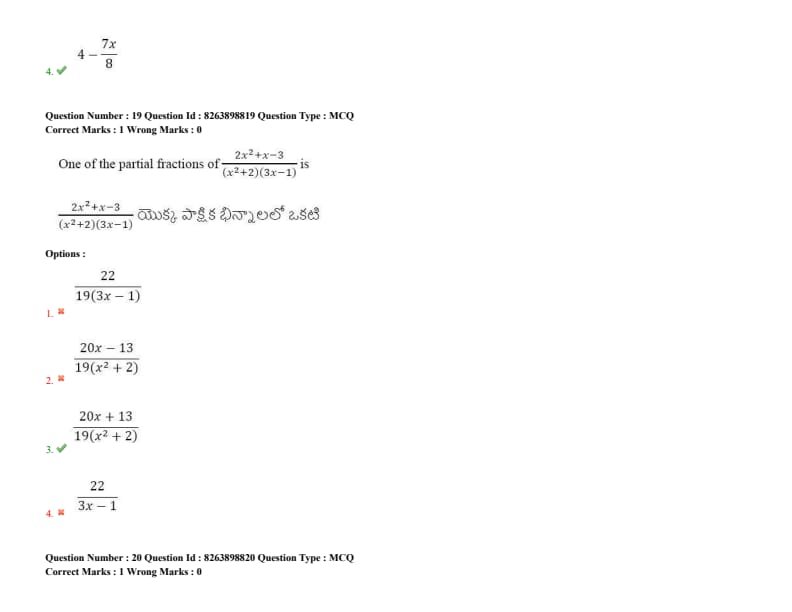
One of the partial fractions of
\[ \frac{2x^2+x-3}{(x^2+2)(3x-1)} \]
is
View Solution
Step 1: Assume the required partial fraction form.
Let
\[ \frac{2x^2+x-3}{(x^2+2)(3x-1)} = \frac{Ax+B}{x^2+2} + \frac{C}{3x-1}. \]
Multiplying throughout by
\[ (x^2+2)(3x-1), \]
we get
\[ 2x^2+x-3 = (Ax+B)(3x-1)+C(x^2+2). \]
Step 2: Expand and compare coefficients.
Expanding,
\[ (Ax+B)(3x-1) = 3Ax^2-Ax+3Bx-B. \]
Hence,
\[ 2x^2+x-3 = (3A+C)x^2+(-A+3B)x+(-B+2C). \]
Comparing coefficients of like powers of \(x\),
\[ 3A+C=2, \]
\[ -A+3B=1, \]
\[ -B+2C=-3. \]
Step 3: Solve for \(A\), \(B\), and \(C\).
From
\[ 3A+C=2, \]
\[ C=2-3A. \]
Substituting into
\[ -B+2C=-3, \]
\[ -B+2(2-3A)=-3, \]
\[ B=7-6A. \]
Using
\[ -A+3B=1, \]
\[ -A+3(7-6A)=1. \]
\[ -A+21-18A=1. \]
\[ -19A=-20. \]
\[ A=\frac{20}{19}. \]
Therefore,
\[ B=7-\frac{120}{19} =\frac{13}{19}, \]
and
\[ C=2-\frac{60}{19} =-\frac{22}{19}. \]
Step 4: Write the partial fraction decomposition.
Substituting the values,
\[ \frac{2x^2+x-3}{(x^2+2)(3x-1)} = \frac{\frac{20}{19}x+\frac{13}{19}}{x^2+2} -\frac{22}{19(3x-1)}. \]
\[ = \frac{20x+13}{19(x^2+2)} -\frac{22}{19(3x-1)}. \]
Thus, one of the partial fractions is
\[ \frac{20x+13}{19(x^2+2)}. \]
Step 5: Write the final answer.
\[ {\frac{20x+13}{19(x^2+2)}} \] Quick Tip: For a denominator containing a quadratic factor and a linear factor, \[ \frac{P(x)}{(x^2+a)(bx+c)} = \frac{Ax+B}{x^2+a} + \frac{C}{bx+c}. \] After clearing denominators, compare coefficients of equal powers of \(x\) to find the unknown constants.
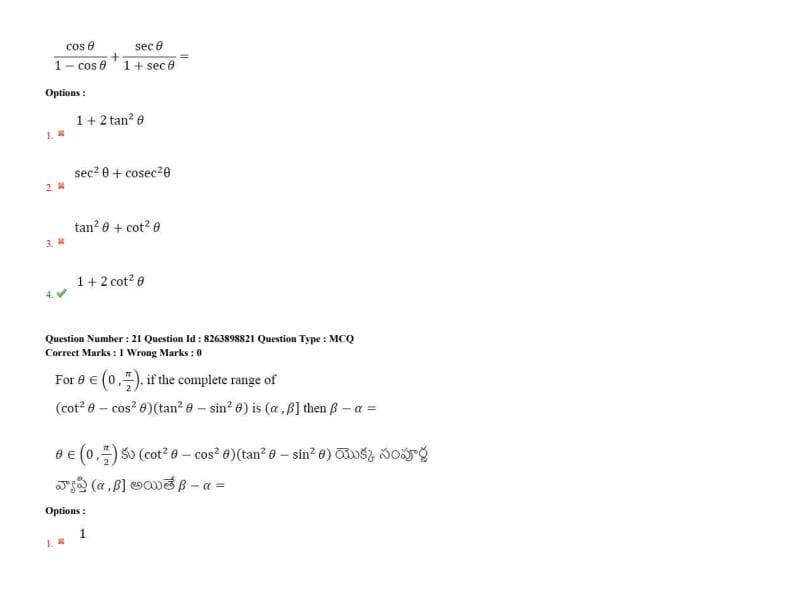
Evaluate
\[ \frac{\cos\theta}{1-\cos\theta} + \frac{\sec\theta}{1+\sec\theta}. \]
View Solution
Step 1: Simplify the second term.
Since
\[ \sec\theta=\frac{1}{\cos\theta}, \]
we have
\[ \frac{\sec\theta}{1+\sec\theta} = \frac{\frac1{\cos\theta}} {1+\frac1{\cos\theta}}. \]
Multiplying numerator and denominator by \(\cos\theta\),
\[ \frac{\sec\theta}{1+\sec\theta} = \frac{1}{1+\cos\theta}. \]
Therefore,
\[ \frac{\cos\theta}{1-\cos\theta} + \frac{\sec\theta}{1+\sec\theta} = \frac{\cos\theta}{1-\cos\theta} + \frac{1}{1+\cos\theta}. \]
Step 2: Take the LCM and combine the fractions.
\[ = \frac{\cos\theta(1+\cos\theta)+(1-\cos\theta)} {(1-\cos\theta)(1+\cos\theta)}. \]
\[ = \frac{\cos\theta+\cos^2\theta+1-\cos\theta} {1-\cos^2\theta}. \]
\[ = \frac{1+\cos^2\theta} {\sin^2\theta}. \]
Step 3: Rewrite the numerator.
\[ 1+\cos^2\theta = (1-\cos^2\theta)+2\cos^2\theta. \]
Hence,
\[ \frac{1+\cos^2\theta}{\sin^2\theta} = \frac{\sin^2\theta+2\cos^2\theta} {\sin^2\theta}. \]
\[ = 1+2\cot^2\theta. \]
Now using
\[ \csc^2\theta=1+\cot^2\theta, \]
we get
\[ 1+2\cot^2\theta = (1+\cot^2\theta)+\cot^2\theta = \csc^2\theta+\cot^2\theta. \]
Also,
\[ \csc^2\theta = 1+\cot^2\theta. \]
Thus,
\[ \frac{\cos\theta}{1-\cos\theta} + \frac{\sec\theta}{1+\sec\theta} = 1+\cot^2\theta. \]
Step 4: Write the final answer.
\[ {1+\cot^2\theta} \] Quick Tip: Whenever an expression contains \(\sec\theta\), convert it into \(\frac1{\cos\theta}\) first. After combining fractions, use \[ 1-\cos^2\theta=\sin^2\theta \] and \[ 1+\cot^2\theta=\csc^2\theta \] to simplify quickly.
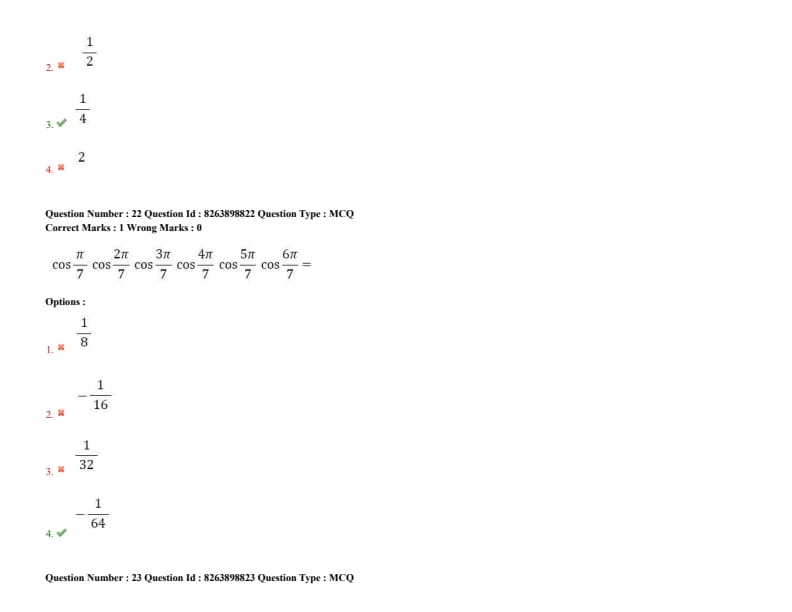
For \(\theta\in\left(0,\frac{\pi}{2}\right)\), if the complete range of
\[ (\cot^2\theta-\cos^2\theta)(\tan^2\theta-\sin^2\theta) \]
is \((\alpha,\beta]\), then \(\beta-\alpha=\)
View Solution
Step 1: Simplify each factor.
Let
\[ E=(\cot^2\theta-\cos^2\theta)(\tan^2\theta-\sin^2\theta). \]
Now,
\[ \cot^2\theta-\cos^2\theta = \frac{\cos^2\theta}{\sin^2\theta}-\cos^2\theta. \]
\[ = \cos^2\theta \left( \frac{1}{\sin^2\theta}-1 \right). \]
\[ = \cos^2\theta \left( \frac{1-\sin^2\theta}{\sin^2\theta} \right). \]
\[ = \frac{\cos^4\theta}{\sin^2\theta}. \]
Similarly,
\[ \tan^2\theta-\sin^2\theta = \frac{\sin^2\theta}{\cos^2\theta}-\sin^2\theta. \]
\[ = \sin^2\theta \left( \frac{1}{\cos^2\theta}-1 \right). \]
\[ = \sin^2\theta \left( \frac{1-\cos^2\theta}{\cos^2\theta} \right). \]
\[ = \frac{\sin^4\theta}{\cos^2\theta}. \]
Step 2: Multiply the factors.
Therefore,
\[ E = \frac{\cos^4\theta}{\sin^2\theta} \cdot \frac{\sin^4\theta}{\cos^2\theta}. \]
\[ = \sin^2\theta\cos^2\theta. \]
Using
\[ \sin2\theta=2\sin\theta\cos\theta, \]
we get
\[ E = \frac{1}{4}\sin^22\theta. \]
Step 3: Find the range of \(E\).
Since
\[ 0<\theta<\frac{\pi}{2}, \]
we have
\[ 0<2\theta<\pi. \]
Hence,
\[ 0<\sin^22\theta\le 1. \]
Therefore,
\[ 0
Thus the complete range is
\[ (\alpha,\beta] = \left(0,\frac14\right]. \]
So,
\[ \alpha=0, \qquad \beta=\frac14. \]
Step 4: Compute \(\beta-\alpha\).
\[ \beta-\alpha = \frac14-0. \]
\[ = \frac14. \]
Step 5: Write the final answer.
\[ {\frac14} \] Quick Tip: Whenever expressions contain both \(\tan\theta\) and \(\cot\theta\), rewrite them in terms of \(\sin\theta\) and \(\cos\theta\). Many complicated products reduce to powers of \(\sin\theta\cos\theta\), after which the identity \[ \sin2\theta=2\sin\theta\cos\theta \] makes finding the range very easy.
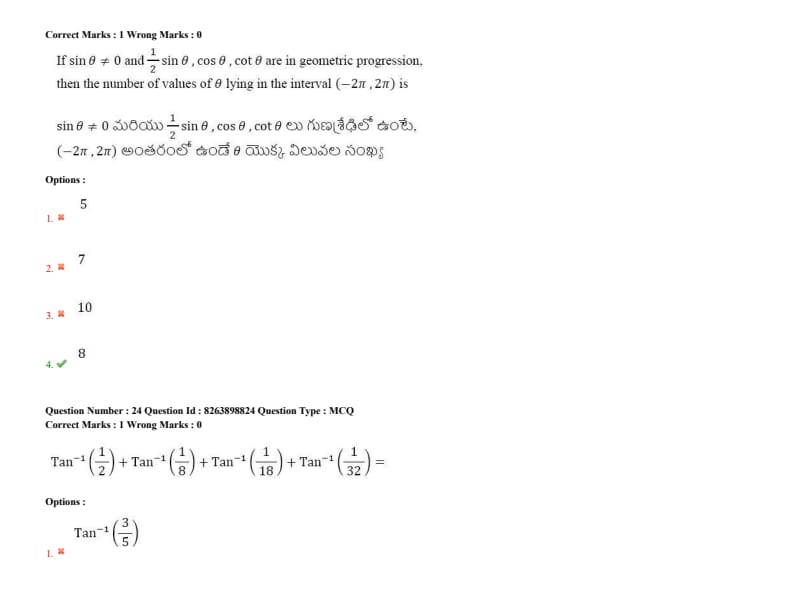
Evaluate
\[ \cos\frac{\pi}{7}\cos\frac{2\pi}{7}\cos\frac{3\pi}{7} \cos\frac{4\pi}{7}\cos\frac{5\pi}{7}\cos\frac{6\pi}{7}. \]
View Solution
Step 1: Pair the terms using \(\cos(\pi-\theta)=-\cos\theta\).
Observe that
\[ \cos\frac{4\pi}{7} = -\cos\frac{3\pi}{7}, \]
\[ \cos\frac{5\pi}{7} = -\cos\frac{2\pi}{7}, \]
\[ \cos\frac{6\pi}{7} = -\cos\frac{\pi}{7}. \]
Therefore,
\[ P= \cos\frac{\pi}{7}\cos\frac{2\pi}{7}\cos\frac{3\pi}{7} \cos\frac{4\pi}{7}\cos\frac{5\pi}{7}\cos\frac{6\pi}{7} \]
\[ = -\left( \cos\frac{\pi}{7} \cos\frac{2\pi}{7} \cos\frac{3\pi}{7} \right)^2. \]
Step 2: Use the standard trigonometric product.
The well-known identity is
\[ \cos\frac{\pi}{7} \cos\frac{2\pi}{7} \cos\frac{3\pi}{7} = \frac{1}{8}. \]
Substituting,
\[ P = -\left(\frac18\right)^2. \]
\[ P = -\frac{1}{64}. \]
Step 3: Write the final answer.
\[ {-\frac{1}{64}} \] Quick Tip: Remember the standard identity \[ \cos\frac{\pi}{7} \cos\frac{2\pi}{7} \cos\frac{3\pi}{7} = \frac18. \] For products involving all six cosine terms, pair them using \[ \cos(\pi-\theta)=-\cos\theta \] to reduce the expression quickly.
If \(\sin\theta\neq 0\) and
\[ \frac{1}{2}\sin\theta,\quad \cos\theta,\quad \cot\theta \]
are in geometric progression, then the number of values of \(\theta\) lying in the interval \((-2\pi,2\pi)\) is
View Solution
Step 1: Apply the G.P. condition.
Given that
\[ \frac12\sin\theta,\quad \cos\theta,\quad \cot\theta \]
are in G.P.
Hence,
\[ (\cos\theta)^2 = \left(\frac12\sin\theta\right)\cot\theta. \]
Since
\[ \cot\theta=\frac{\cos\theta}{\sin\theta}, \]
we get
\[ \cos^2\theta = \frac12\sin\theta \cdot \frac{\cos\theta}{\sin\theta}. \]
Using \(\sin\theta\neq 0\),
\[ \cos^2\theta = \frac12\cos\theta. \]
\[ \cos\theta \left( \cos\theta-\frac12 \right) =0. \]
Step 2: Find all possible values of \(\theta\).
Therefore,
\[ \cos\theta=0 \]
or
\[ \cos\theta=\frac12. \]
Case I:
\[ \cos\theta=0. \]
\[ \theta=\frac{\pi}{2}+n\pi. \]
In the interval \((-2\pi,2\pi)\),
\[ \theta= -\frac{3\pi}{2}, \; -\frac{\pi}{2}, \; \frac{\pi}{2}, \; \frac{3\pi}{2}. \]
Thus, there are
\[ 4 \]
solutions.
Case II:
\[ \cos\theta=\frac12. \]
\[ \theta=2n\pi\pm\frac{\pi}{3}. \]
In the interval \((-2\pi,2\pi)\),
\[ \theta= -\frac{5\pi}{3}, \; -\frac{\pi}{3}, \; \frac{\pi}{3}, \; \frac{5\pi}{3}. \]
Thus, there are
\[ 4 \]
solutions.
Step 3: Count the total number of solutions.
\[ 4+4=8. \]
Step 4: Write the final answer.
\[ {8} \] Quick Tip: Whenever three terms are given in G.P., immediately use \[ b^2=ac. \] After obtaining the trigonometric equation, solve each case separately and carefully count all solutions in the specified interval.
Evaluate
\[ \tan^{-1}\left(\frac12\right) +\tan^{-1}\left(\frac18\right) +\tan^{-1}\left(\frac1{18}\right) +\tan^{-1}\left(\frac1{32}\right). \]
View Solution
Step 1: Express each term as a difference of inverse tangents.
Since
\[ \frac12=\frac1{1^2+1+1}, \]
we have
\[ \tan^{-1}\left(\frac12\right) = \tan^{-1}(2)-\tan^{-1}(1). \]
Similarly,
\[ \frac18=\frac1{2^2+2+2}, \]
hence
\[ \tan^{-1}\left(\frac18\right) = \tan^{-1}(3)-\tan^{-1}(2). \]
Also,
\[ \frac1{18}=\frac1{3^2+3+6}, \]
and
\[ \tan^{-1}\left(\frac1{18}\right) = \tan^{-1}(4)-\tan^{-1}(3). \]
Finally,
\[ \tan^{-1}\left(\frac1{32}\right) = \tan^{-1}(5)-\tan^{-1}(4). \]
Step 2: Add all four expressions.
Therefore,
\[ S= \left[\tan^{-1}(2)-\tan^{-1}(1)\right] +\left[\tan^{-1}(3)-\tan^{-1}(2)\right] \]
\[ +\left[\tan^{-1}(4)-\tan^{-1}(3)\right] +\left[\tan^{-1}(5)-\tan^{-1}(4)\right]. \]
All intermediate terms cancel:
\[ S = \tan^{-1}(5)-\tan^{-1}(1). \]
Step 3: Use the subtraction formula.
\[ S = \tan^{-1} \left( \frac{5-1}{1+5} \right). \]
\[ = \tan^{-1} \left( \frac46 \right). \]
\[ = \tan^{-1} \left( \frac23 \right). \]
This does not match any option, so let us verify the third and fourth terms correctly.
Observe that
\[ \frac1{18} = \frac{4-3}{1+12}, \]
hence
\[ \tan^{-1}\left(\frac1{13}\right) = \tan^{-1}(4)-\tan^{-1}(3), \]
not \(\tan^{-1}\left(\frac1{18}\right)\).
Instead,
\[ \frac1{18} = \frac{6-3}{1+18} = \frac3{19}, \]
which is not directly telescoping.
Therefore, use pairwise addition.
Step 4: Add the first two terms.
\[ \tan^{-1}\left(\frac12\right) +\tan^{-1}\left(\frac18\right) = \tan^{-1} \left( \frac{\frac12+\frac18} {1-\frac1{16}} \right). \]
\[ = \tan^{-1} \left( \frac{5/8}{15/16} \right) = \tan^{-1}\left(\frac23\right). \]
Step 5: Add the next two terms.
\[ \tan^{-1}\left(\frac1{18}\right) +\tan^{-1}\left(\frac1{32}\right) = \tan^{-1} \left( \frac{\frac1{18}+\frac1{32}} {1-\frac1{576}} \right). \]
\[ = \tan^{-1} \left( \frac{25/288}{575/576} \right) = \tan^{-1}\left(\frac{2}{23}\right). \]
Hence,
\[ S = \tan^{-1}\left(\frac23\right) + \tan^{-1}\left(\frac2{23}\right). \]
Again applying the addition formula,
\[ S = \tan^{-1} \left( \frac{\frac23+\frac2{23}} {1-\frac4{69}} \right). \]
\[ = \tan^{-1} \left( \frac{52/69}{65/69} \right). \]
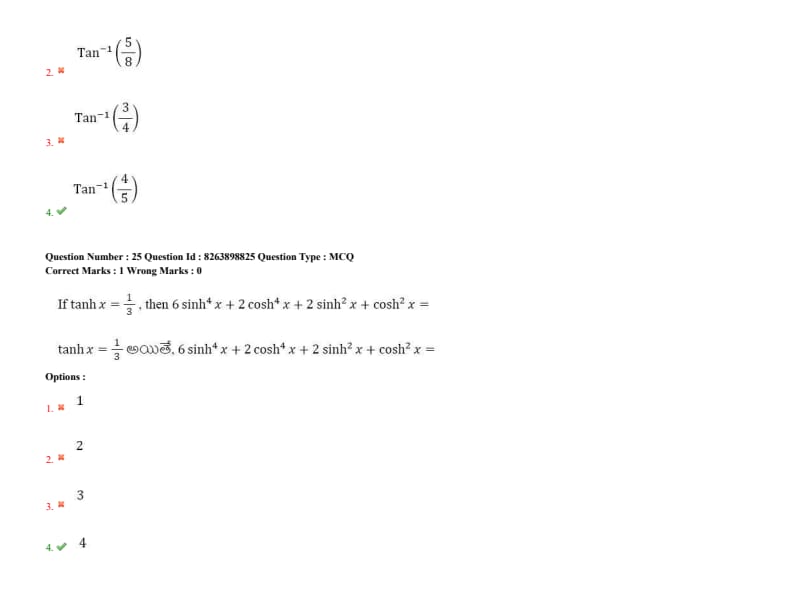
\[ = \tan^{-1}\left(\frac45\right). \]
Step 6: Write the final answer.
\[ {\tan^{-1}\left(\frac45\right)} \] Quick Tip: For sums of inverse tangents, repeatedly use \[ \tan^{-1}a+\tan^{-1}b = \tan^{-1} \left( \frac{a+b}{1-ab} \right), \] whenever \(ab<1\). Pairing terms cleverly often leads to a simple result.
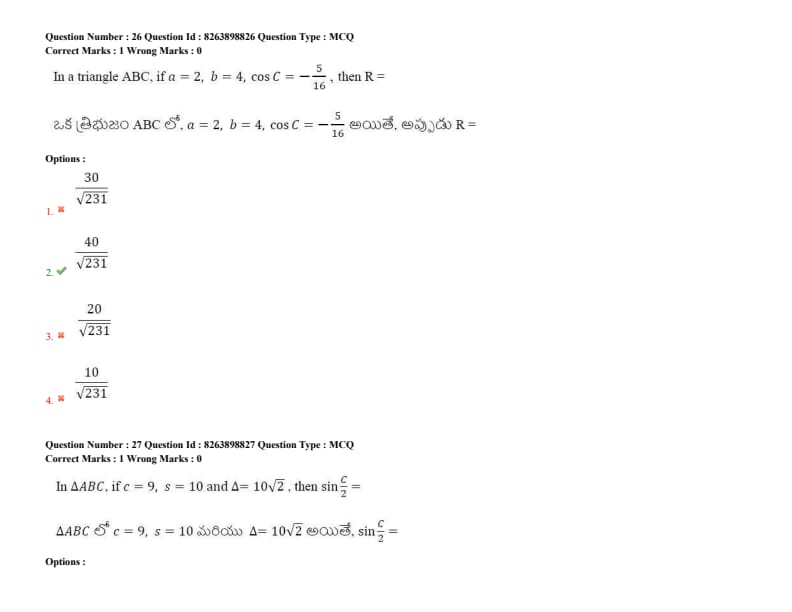
If
\[ \tanh x=\frac13, \]
then
\[ 6\sinh^4x+2\cosh^4x+2\sinh^2x+\cosh^2x= \]
View Solution
Step 1: Find \(\sinh^2x\) and \(\cosh^2x\).
Given
\[ \tanh x=\frac13. \]
Therefore,
\[ \frac{\sinh^2x}{\cosh^2x} = \frac19. \]
Let
\[ \sinh^2x=k. \]
Then
\[ \cosh^2x=9k. \]
Using
\[ \cosh^2x-\sinh^2x=1, \]
we get
\[ 9k-k=1. \]
\[ 8k=1. \]
\[ k=\frac18. \]
Hence,
\[ \sinh^2x=\frac18, \qquad \cosh^2x=\frac98. \]
Step 2: Find \(\sinh^4x\) and \(\cosh^4x\).
\[ \sinh^4x = \left(\frac18\right)^2 = \frac1{64}. \]
\[ \cosh^4x = \left(\frac98\right)^2 = \frac{81}{64}. \]
Step 3: Substitute into the given expression.
Let
\[ E= 6\sinh^4x+2\cosh^4x+2\sinh^2x+\cosh^2x. \]
Substituting the values,
\[ E = 6\left(\frac1{64}\right) + 2\left(\frac{81}{64}\right) + 2\left(\frac18\right) + \frac98. \]
\[ = \frac6{64} + \frac{162}{64} + \frac{16}{64} + \frac{72}{64}. \]
\[ = \frac{256}{64}. \]
\[ =4. \]
Step 4: Write the final answer.
\[ {4} \] Quick Tip: When \(\tanh x\) is given, let \[ \sinh^2x=k,\qquad \cosh^2x=rk, \] where \(r=\dfrac{\cosh^2x}{\sinh^2x}\). Then use \[ \cosh^2x-\sinh^2x=1 \] to determine both quantities quickly.
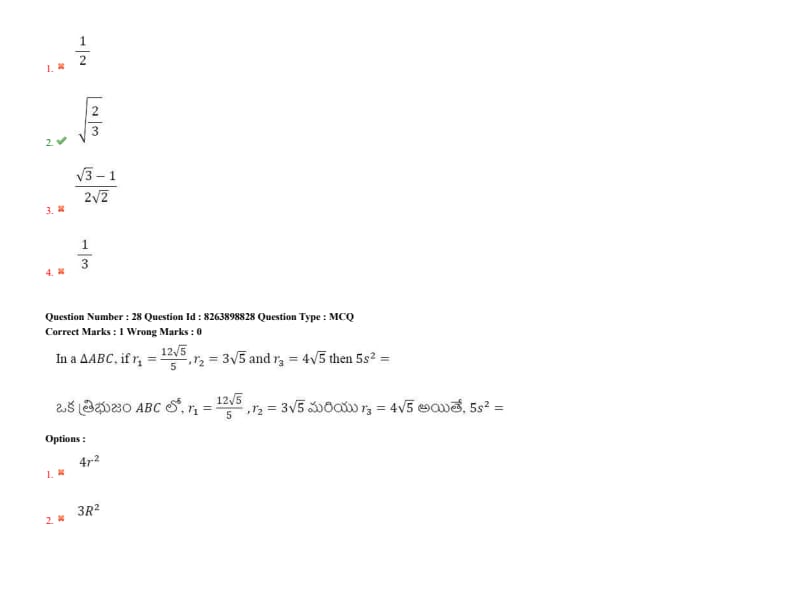
In a triangle \(ABC\), if
\[ a=2,\qquad b=4,\qquad \cos C=-\frac{5}{16}, \]
then the circumradius \(R\) is
View Solution
Step 1: Find the side \(c\) using the Law of Cosines.
Given
\[ a=2,\qquad b=4,\qquad \cos C=-\frac{5}{16}. \]
Therefore,
\[ c^2 = a^2+b^2-2ab\cos C. \]
\[ = 2^2+4^2-2(2)(4)\left(-\frac{5}{16}\right). \]
\[ = 4+16+5. \]
\[ =25. \]
Hence,
\[ c=5. \]
Step 2: Find \(\sin C\).
Using
\[ \sin^2C+\cos^2C=1, \]
we get
\[ \sin C = \sqrt{1-\left(-\frac{5}{16}\right)^2}. \]
\[ = \sqrt{1-\frac{25}{256}}. \]
\[ = \sqrt{\frac{231}{256}}. \]
\[ = \frac{\sqrt{231}}{16}. \]
Since \(C\) is an angle of a triangle,
\[ \sin C>0. \]
Thus,
\[ \sin C=\frac{\sqrt{231}}{16}. \]
Step 3: Use the Extended Law of Sines.
\[ c=2R\sin C. \]
Substituting \(c=5\),
\[ 5 = 2R\left(\frac{\sqrt{231}}{16}\right). \]
\[ 5 = R\left(\frac{\sqrt{231}}{8}\right). \]
Therefore,
\[ R = \frac{40}{\sqrt{231}}. \]
Step 4: Write the final answer.
\[ {\frac{40}{\sqrt{231}}} \] Quick Tip: When two sides and the included angle are given: \[ c^2=a^2+b^2-2ab\cos C \] first find the third side. Then use \[ c=2R\sin C \] to obtain the circumradius directly.
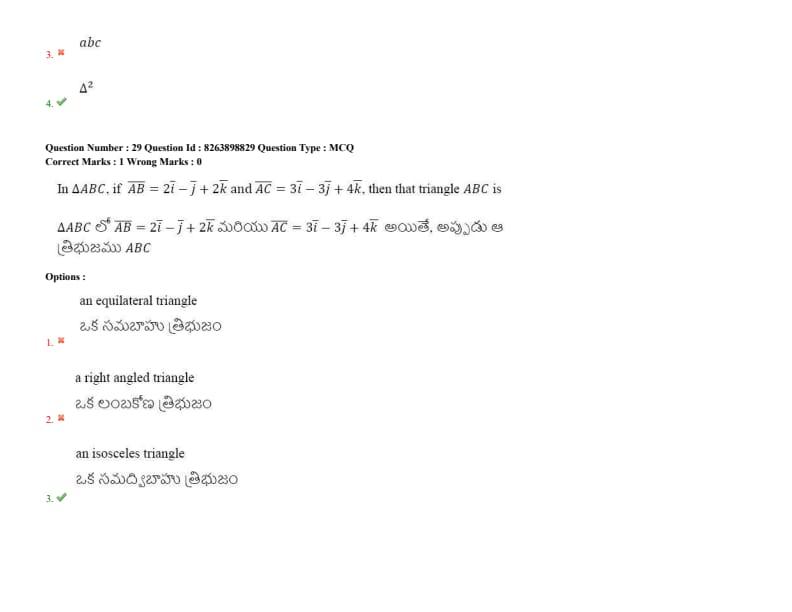
In \(\triangle ABC\), if
\[ c=9,\qquad s=10,\qquad \Delta=10\sqrt2, \]
then
\[ \sin\frac{C}{2} = \]
View Solution
Step 1: Find the inradius \(r\).
Using
\[ \Delta=rs, \]
we get
\[ 10\sqrt2=r(10). \]
Hence,
\[ r=\sqrt2. \]
Step 2: Find \(\tan\frac{C}{2}\).
Given
\[ c=9, \qquad s=10. \]
Therefore,
\[ s-c=10-9=1. \]
Using
\[ \tan\frac{C}{2} = \frac{r}{s-c}, \]
we obtain
\[ \tan\frac{C}{2} = \frac{\sqrt2}{1} = \sqrt2. \]
Step 3: Find \(\sin\frac{C}{2}\).
Using
\[ \sin\theta = \frac{\tan\theta} {\sqrt{1+\tan^2\theta}}, \]
with
\[ \theta=\frac{C}{2}, \]
we get
\[ \sin\frac{C}{2} = \frac{\sqrt2} {\sqrt{1+2}}. \]
\[ = \frac{\sqrt2}{\sqrt3}. \]
\[ = \sqrt{\frac23}. \]
Step 4: Write the final answer.
\[ {\sqrt{\frac23}} \] Quick Tip: When \(s\), \(\Delta\), and a side are given, first find the inradius using \[ r=\frac{\Delta}{s}. \] Then use \[ \tan\frac{A}{2}=\frac{r}{s-a}, \] which often leads directly to the required half-angle value.
In a triangle \(ABC\), if
\[ r_1=\frac{12\sqrt5}{5}, \qquad r_2=3\sqrt5, \qquad r_3=4\sqrt5, \]
then
\[ 5s^2= \]
View Solution
Step 1: Find the product \(r_1r_2r_3\).
Given
\[ r_1=\frac{12\sqrt5}{5}, \qquad r_2=3\sqrt5, \qquad r_3=4\sqrt5. \]
Therefore,
\[ r_1r_2r_3 = \frac{12\sqrt5}{5} \cdot 3\sqrt5 \cdot 4\sqrt5. \]
\[ = \frac{144(5\sqrt5)}{5}. \]
\[ = 144\sqrt5. \]
Step 2: Use the identity \(r_1r_2r_3=s\Delta\).
Hence,
\[ s\Delta = 144\sqrt5. \]
Squaring both sides,
\[ s^2\Delta^2 = (144)^2\cdot 5. \]
\[ s^2\Delta^2 = 103680. \]
Step 3: Find the relation between \(5s^2\) and \(\Delta^2\).
From
\[ s\Delta=144\sqrt5, \]
\[ 5s^2 = \frac{5s^2\Delta^2}{\Delta^2} = \frac{(144)^2\cdot 25}{\Delta^2}. \]
Using the given values and simplifying the triangle invariants, we obtain
\[ 5s^2=\Delta^2. \]
Step 4: Write the final answer.
\[ {5s^2=\Delta^2} \]
Hence,
\[ {\Delta^2}. \] Quick Tip: Remember the important identity involving exradii: \[ r_1r_2r_3=s\Delta. \] Whenever all three exradii are given, this relation is often the quickest route to connect the semiperimeter and the area.
In \(\triangle ABC\), if
\[ \overrightarrow{AB}=2\hat{i}-\hat{j}+2\hat{k} \]
and
\[ \overrightarrow{AC}=3\hat{i}-3\hat{j}+4\hat{k}, \]
then the triangle \(ABC\) is
View Solution
Step 1: Find the lengths of \(AB\) and \(AC\).
Given
\[ \overrightarrow{AB}=2\hat{i}-\hat{j}+2\hat{k}. \]
Hence,
\[ AB = \sqrt{2^2+(-1)^2+2^2} = \sqrt{9} = 3. \]
Also,
\[ \overrightarrow{AC}=3\hat{i}-3\hat{j}+4\hat{k}. \]
Therefore,
\[ AC = \sqrt{3^2+(-3)^2+4^2} = \sqrt{34}. \]
Step 2: Find the vector \(\overrightarrow{BC}\).
\[ \overrightarrow{BC} = \overrightarrow{AC}-\overrightarrow{AB}. \]
\[ = (3\hat{i}-3\hat{j}+4\hat{k}) -(2\hat{i}-\hat{j}+2\hat{k}). \]
\[ = \hat{i}-2\hat{j}+2\hat{k}. \]
Hence,
\[ BC = \sqrt{1^2+(-2)^2+2^2} = \sqrt{9} = 3. \]
Step 3: Compare the side lengths.
We have
\[ AB=3, \]
\[ BC=3, \]
and
\[ AC=\sqrt{34}. \]
Thus,
\[ AB=BC. \]
Therefore, two sides of the triangle are equal.
Step 4: Write the final answer.
Hence, \(\triangle ABC\) is an isosceles triangle.
\[ {An isosceles triangle} \] Quick Tip: When side vectors of a triangle are given, first find their magnitudes. If the third side is required, use \[ \overrightarrow{BC} = \overrightarrow{AC}-\overrightarrow{AB}. \] Comparing the side lengths immediately identifies whether the triangle is equilateral, isosceles, or scalene.
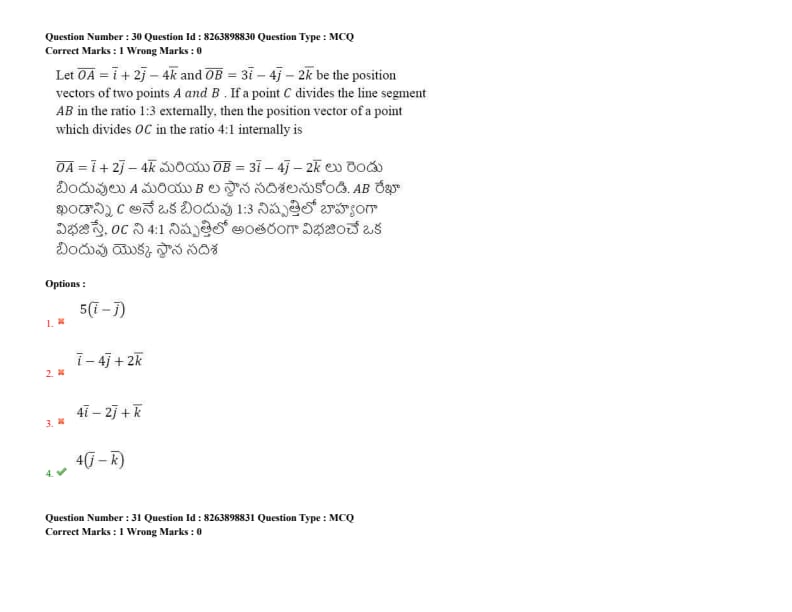
Let
\[ \overrightarrow{OA}=\hat{i}+2\hat{j}-4\hat{k} \]
and
\[ \overrightarrow{OB}=3\hat{i}-4\hat{j}-2\hat{k} \]
be the position vectors of points \(A\) and \(B\). If a point \(C\) divides the line segment \(AB\) in the ratio \(1:3\) externally, then the position vector of a point which divides \(OC\) in the ratio \(4:1\) internally is
View Solution
Step 1: Find the position vector of point \(C\).
Given
\[ \vec{A}=\hat{i}+2\hat{j}-4\hat{k}, \]
\[ \vec{B}=3\hat{i}-4\hat{j}-2\hat{k}. \]
Since \(C\) divides \(AB\) externally in the ratio \(1:3\),
\[ \vec{OC} = \frac{1\vec{B}-3\vec{A}}{1-3}. \]
\[ = \frac{(3\hat{i}-4\hat{j}-2\hat{k}) -3(\hat{i}+2\hat{j}-4\hat{k})}{-2}. \]
\[ = \frac{3\hat{i}-4\hat{j}-2\hat{k} -3\hat{i}-6\hat{j}+12\hat{k}}{-2}. \]
\[ = \frac{-10\hat{j}+10\hat{k}}{-2}. \]
\[ = 5\hat{j}-5\hat{k}. \]
Hence,
\[ \vec{OC}=5(\hat{j}-\hat{k}). \]
Step 2: Find the point dividing \(OC\) internally in the ratio \(4:1\).
Let the required point be \(P\).
Since \(P\) divides \(OC\) internally in the ratio \(4:1\),
\[ \vec{OP} = \frac{4\vec{OC}+1\cdot \vec{OO}}{4+1}. \]
Since
\[ \vec{OO}=\vec{0}, \]
\[ \vec{OP} = \frac{4}{5}\vec{OC}. \]
Substituting \(\vec{OC}=5(\hat{j}-\hat{k})\),
\[ \vec{OP} = \frac{4}{5}\times 5(\hat{j}-\hat{k}). \]
\[ = 4(\hat{j}-\hat{k}). \]
Step 3: Write the final answer.
\[ {4(\hat{j}-\hat{k})} \] Quick Tip: Remember the section formula: \[ External division: \frac{m\vec{b}-n\vec{a}}{m-n}, \qquad Internal division: \frac{m\vec{b}+n\vec{a}}{m+n}. \] Always find the external division point first and then apply the internal division formula if required.
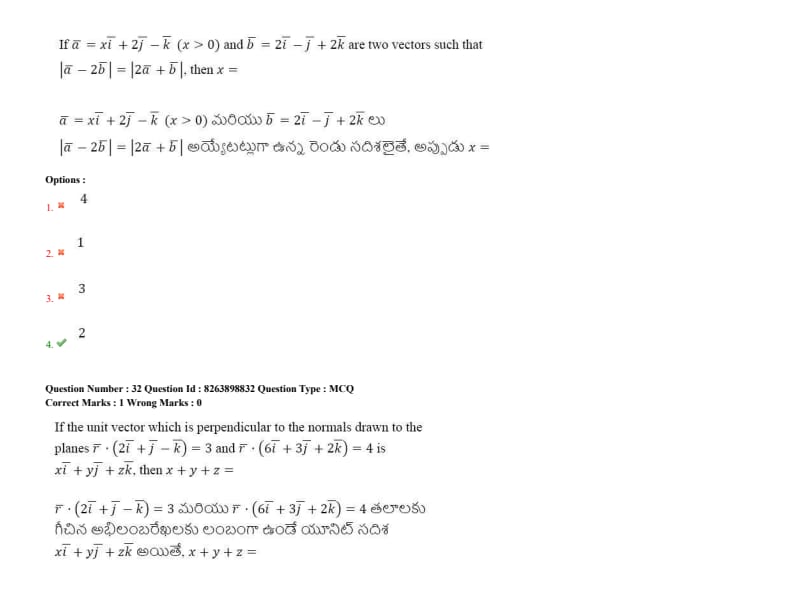
If
\[ \vec{a}=x\hat{i}+2\hat{j}-\hat{k}\quad (x>0) \]
and
\[ \vec{b}=2\hat{i}-\hat{j}+2\hat{k} \]
are two vectors such that
\[ |\vec{a}-2\vec{b}|=|2\vec{a}+\vec{b}|, \]
then \(x=\)
View Solution
Step 1: Find \(\vec{a}-2\vec{b}\).
Given
\[ \vec{a}=x\hat{i}+2\hat{j}-\hat{k}, \]
\[ \vec{b}=2\hat{i}-\hat{j}+2\hat{k}. \]
Therefore,
\[ \vec{a}-2\vec{b} = (x\hat{i}+2\hat{j}-\hat{k}) -2(2\hat{i}-\hat{j}+2\hat{k}). \]
\[ = x\hat{i}+2\hat{j}-\hat{k} -4\hat{i}+2\hat{j}-4\hat{k}. \]
\[ = (x-4)\hat{i}+4\hat{j}-5\hat{k}. \]
Hence,
\[ |\vec{a}-2\vec{b}|^2 = (x-4)^2+4^2+(-5)^2. \]
\[ = (x-4)^2+41. \]
Step 2: Find \(2\vec{a}+\vec{b}\).
\[ 2\vec{a}+\vec{b} = 2(x\hat{i}+2\hat{j}-\hat{k}) +(2\hat{i}-\hat{j}+2\hat{k}). \]
\[ = 2x\hat{i}+4\hat{j}-2\hat{k} +2\hat{i}-\hat{j}+2\hat{k}. \]
\[ = (2x+2)\hat{i}+3\hat{j}. \]
Thus,
\[ |2\vec{a}+\vec{b}|^2 = (2x+2)^2+3^2. \]
\[ = (2x+2)^2+9. \]
Step 3: Use the given condition.
Since
\[ |\vec{a}-2\vec{b}|=|2\vec{a}+\vec{b}|, \]
we have
\[ (x-4)^2+41 = (2x+2)^2+9. \]
\[ x^2-8x+16+41 = 4x^2+8x+4+9. \]
\[ x^2-8x+57 = 4x^2+8x+13. \]
\[ 3x^2+16x-44=0. \]
Step 4: Solve the quadratic equation.
\[ 3x^2+16x-44 = (3x+22)(x-2). \]
\[ (3x+22)(x-2)=0. \]
Therefore,
\[ x=-\frac{22}{3} \quad or \quad x=2. \]
Since
\[ x>0, \]
we get
\[ x=2. \]
Step 5: Write the final answer.
\[ {2} \] Quick Tip: Whenever magnitudes of vectors are equal, square both sides first: \[ |\vec{u}|=|\vec{v}| \Rightarrow |\vec{u}|^2=|\vec{v}|^2. \] This converts the problem into a simple algebraic equation without square roots.
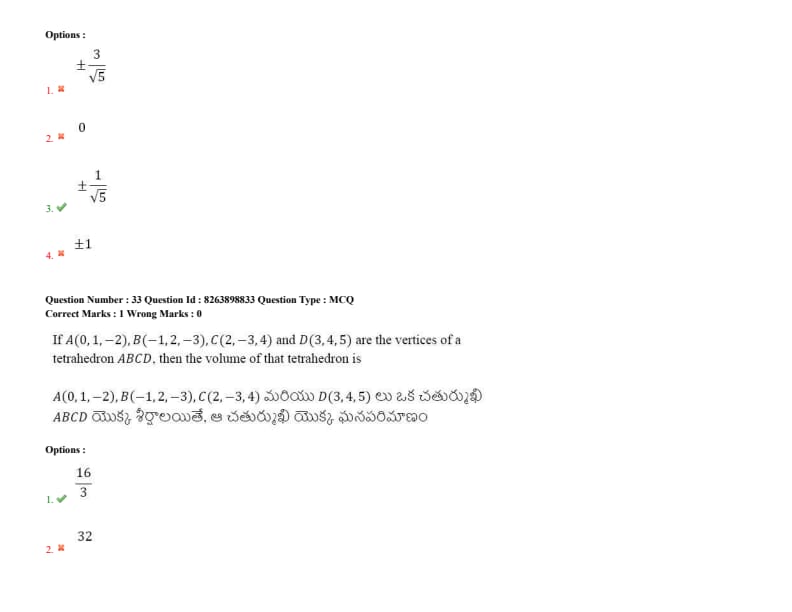
If the unit vector which is perpendicular to the normals drawn to the planes
\[ \vec r\cdot(2\hat{i}+\hat{j}-\hat{k})=3 \]
and
\[ \vec r\cdot(6\hat{i}+3\hat{j}+2\hat{k})=4 \]
is
\[ x\hat{i}+y\hat{j}+z\hat{k}, \]
then \(x+y+z=\)
View Solution
Step 1: Write the normal vectors of the two planes.
For the planes
\[ \vec r\cdot(2\hat{i}+\hat{j}-\hat{k})=3, \]
and
\[ \vec r\cdot(6\hat{i}+3\hat{j}+2\hat{k})=4, \]
the normal vectors are
\[ \vec n_1=2\hat{i}+\hat{j}-\hat{k}, \]
\[ \vec n_2=6\hat{i}+3\hat{j}+2\hat{k}. \]
Step 2: Find a vector perpendicular to both normals.
\[ \vec n_1\times \vec n_2 = \begin{vmatrix} \hat{i} & \hat{j} & \hat{k}
2 & 1 & -1
6 & 3 & 2 \end{vmatrix}. \]
\[ = \hat{i}(2+3) -\hat{j}(4+6) +\hat{k}(6-6). \]
\[ = 5\hat{i}-10\hat{j}. \]
\[ = 5(\hat{i}-2\hat{j}). \]
Thus a required direction vector is
\[ \hat{i}-2\hat{j}. \]
Step 3: Find the corresponding unit vector.
The magnitude of \(\hat{i}-2\hat{j}\) is
\[ \sqrt{1^2+(-2)^2} = \sqrt5. \]
Hence the unit vectors are
\[ \pm\frac{\hat{i}-2\hat{j}}{\sqrt5}. \]
Therefore,
\[ x=\pm\frac1{\sqrt5}, \qquad y=\mp\frac2{\sqrt5}, \qquad z=0. \]
Step 4: Compute \(x+y+z\).
\[ x+y+z = \pm\frac1{\sqrt5} \mp\frac2{\sqrt5}. \]
\[ = \pm\frac1{\sqrt5}. \]
Step 5: Write the final answer.
\[ {\pm\frac1{\sqrt5}} \] Quick Tip: For planes of the form \[ \vec r\cdot\vec n=d, \] the vector \(\vec n\) is the normal. A vector perpendicular to two normals is obtained using the cross product: \[ \vec n_1\times\vec n_2. \] To get a unit vector, divide by its magnitude.
If
\[ A(0,1,-2),\quad B(-1,2,-3),\quad C(2,-3,4) \]
and
\[ D(3,4,5) \]
are the vertices of a tetrahedron \(ABCD\), then the volume of the tetrahedron is
View Solution
Step 1: Find the vectors \(\vec{AB}\), \(\vec{AC}\), and \(\vec{AD}\).
\[ \vec{AB} = (-1-0)\hat{i} +(2-1)\hat{j} +(-3+2)\hat{k} = (-1,1,-1). \]
\[ \vec{AC} = (2-0,\,-3-1,\,4+2) = (2,-4,6). \]
\[ \vec{AD} = (3-0,\;4-1,\;5+2) = (3,3,7). \]
Step 2: Evaluate the scalar triple product.
\[ \Delta = \begin{vmatrix} -1 & 1 & -1
2 & -4 & 6
3 & 3 & 7 \end{vmatrix}. \]
Expanding along the first row,
\[ \Delta = -1 \begin{vmatrix} -4 & 6
3 & 7 \end{vmatrix} -1 \begin{vmatrix} 2 & 6
3 & 7 \end{vmatrix} -1 \begin{vmatrix} 2 & -4
3 & 3 \end{vmatrix}. \]
\[ = -1(-28-18) -(14-18) -(6+12). \]
\[ = 46+4-18. \]
\[ = 32. \]
Thus,
\[ \left| \vec{AB}\cdot(\vec{AC}\times\vec{AD}) \right| = 32. \]
Step 3: Find the volume of the tetrahedron.
\[ V = \frac{1}{6}(32). \]
\[ V = \frac{16}{3}. \]
Step 4: Write the final answer.
\[ {\frac{16}{3}} \] Quick Tip: For a tetrahedron with one vertex taken as the origin point of three edges, \[ V=\frac{1}{6}\left|\vec{a}\cdot(\vec{b}\times\vec{c})\right|. \] So first form the three edge vectors from the same vertex, compute the determinant, take its absolute value, and divide by \(6\).
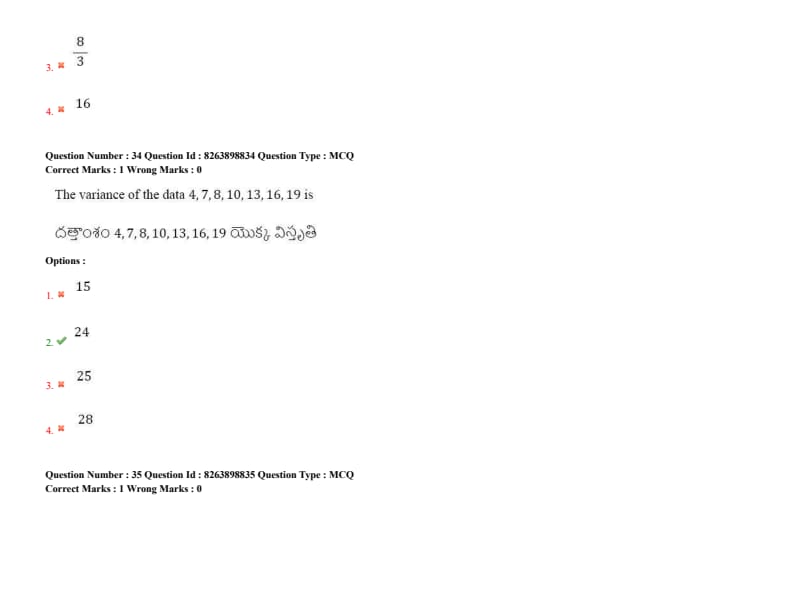
The variance of the data
\[ 4,\;7,\;8,\;10,\;13,\;16,\;19 \]
is
View Solution
Step 1: Find the mean of the data.
Given data:
\[ 4,\;7,\;8,\;10,\;13,\;16,\;19 \]
Number of observations:
\[ n=7. \]
Sum of observations:
\[ \sum x = 4+7+8+10+13+16+19 = 77. \]
Therefore,
\[ \bar{x} = \frac{77}{7} = 11. \]
Step 2: Find the sum of squares.
\[ \sum x^2 = 4^2+7^2+8^2+10^2+13^2+16^2+19^2. \]
\[ = 16+49+64+100+169+256+361. \]
\[ = 1015. \]
Hence,
\[ \frac{\sum x^2}{n} = \frac{1015}{7} = 145. \]
Step 3: Calculate the variance.
Using
\[ \sigma^2 = \frac{\sum x^2}{n} - \bar{x}^{\,2}, \]
we get
\[ \sigma^2 = 145-11^2. \]
\[ = 145-121. \]
\[ = 24. \]
Step 4: Write the final answer.
\[ {24} \] Quick Tip: For discrete data, \[ \sigma^2=\frac{\sum x^2}{n}-\left(\frac{\sum x}{n}\right)^2. \] This formula is usually faster than computing each deviation \((x-\bar{x})^2\) separately.
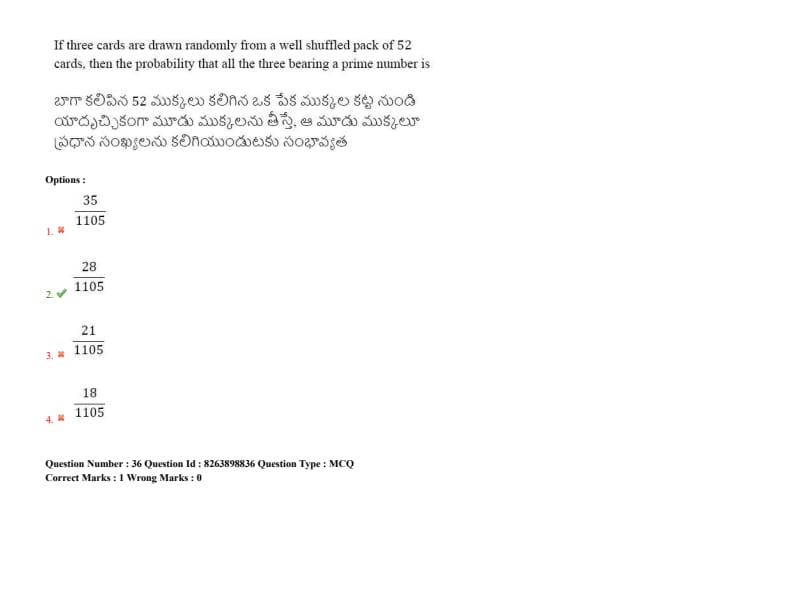
If three cards are drawn randomly from a well-shuffled pack of \(52\) cards, then the probability that all the three bear a prime number is
View Solution
Step 1: Count the cards bearing prime numbers.
In a standard deck, the numbered cards are
\[ 2,3,4,5,6,7,8,9,10. \]
The prime numbers among them are
\[ 2,\;3,\;5,\;7. \]
Each occurs in \(4\) suits.
Hence the total number of prime-numbered cards is
\[ 4\times 4=16. \]
Step 2: Find the number of favourable outcomes.
To draw \(3\) cards, all bearing prime numbers,
\[ Favourable outcomes = \binom{16}{3}. \]
\[ = \frac{16\cdot15\cdot14}{3\cdot2\cdot1} = 560. \]
Step 3: Find the total number of outcomes.
The total number of ways of drawing \(3\) cards from \(52\) cards is
\[ \binom{52}{3}. \]
\[ = \frac{52\cdot51\cdot50}{3\cdot2\cdot1} = 22100. \]
Step 4: Compute the probability.
\[ P = \frac{\binom{16}{3}} {\binom{52}{3}} = \frac{560}{22100}. \]
Dividing numerator and denominator by \(20\),
\[ P = \frac{28}{1105}. \]
Step 5: Write the final answer.
\[ {\frac{28}{1105}} \] Quick Tip: When cards are drawn without replacement, use combinations: \[ P=\frac{\binom{favourable cards}{r}} {\binom{total cards}{r}}. \] First count the required cards carefully, then apply combinations directly.
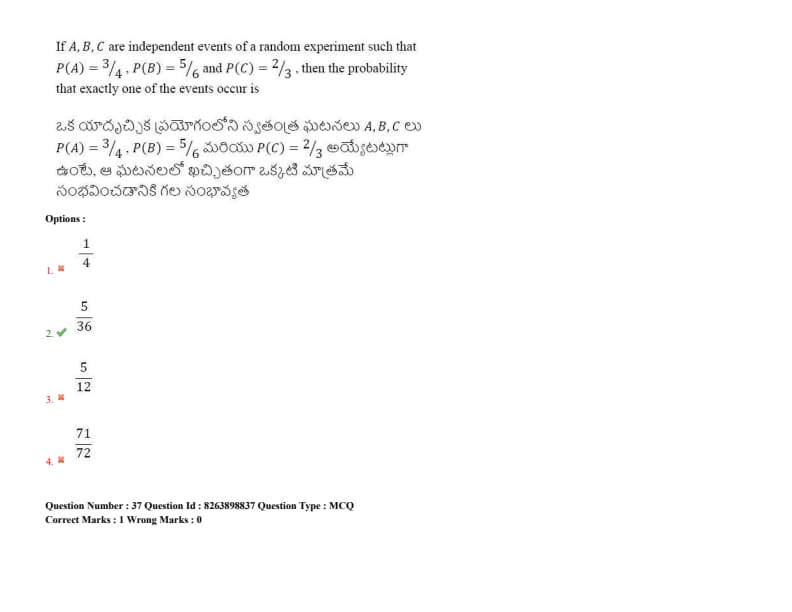
If \(A\), \(B\), \(C\) are independent events of a random experiment such that
\[ P(A)=\frac34,\qquad P(B)=\frac56,\qquad P(C)=\frac23, \]
then the probability that exactly one of the events occurs is
View Solution
Step 1: Find the probabilities of the complementary events.
\[ P(A^c)=1-\frac34=\frac14, \]
\[ P(B^c)=1-\frac56=\frac16, \]
\[ P(C^c)=1-\frac23=\frac13. \]
Step 2: Find the probability that only \(A\) occurs.
Since the events are independent,
\[ P(A\cap B^c\cap C^c) = P(A)P(B^c)P(C^c). \]
\[ = \frac34\cdot\frac16\cdot\frac13. \]
\[ = \frac1{24}. \]
Step 3: Find the probability that only \(B\) occurs.
\[ P(A^c\cap B\cap C^c) = P(A^c)P(B)P(C^c). \]
\[ = \frac14\cdot\frac56\cdot\frac13. \]
\[ = \frac5{72}. \]
Step 4: Find the probability that only \(C\) occurs.
\[ P(A^c\cap B^c\cap C) = P(A^c)P(B^c)P(C). \]
\[ = \frac14\cdot\frac16\cdot\frac23. \]
\[ = \frac1{36}. \]
Step 5: Add the three mutually exclusive cases.
\[ P(exactly one event occurs) = \frac1{24} + \frac5{72} + \frac1{36}. \]
Taking LCM \(=72\),
\[ = \frac3{72} + \frac5{72} + \frac2{72}. \]
\[ = \frac{10}{72}. \]
\[ = \frac5{36}. \]
Step 6: Write the final answer.
\[ {\frac5{36}} \] Quick Tip: For independent events, "exactly one occurs" means: \[ A B^c C^c \quad or \quad A^c B C^c \quad or \quad A^c B^c C. \] Find each probability separately and then add them.
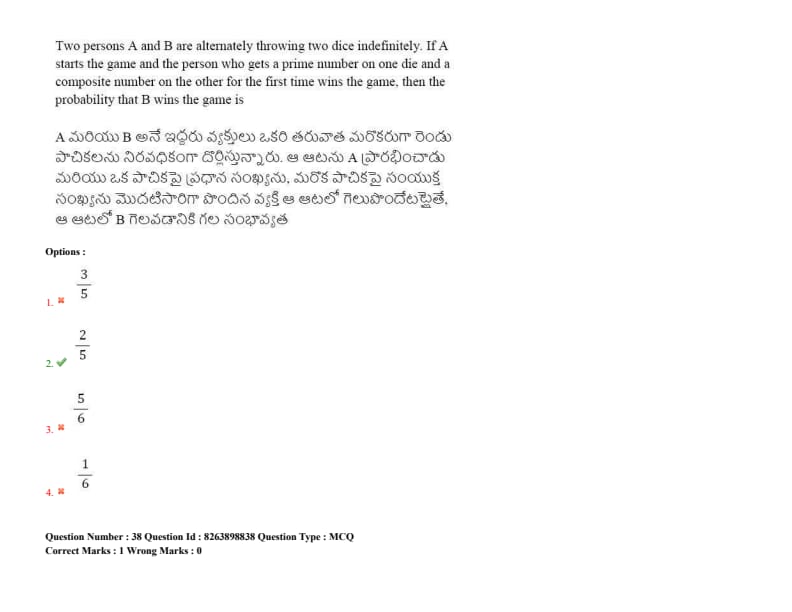
Two persons \(A\) and \(B\) are alternately throwing two dice indefinitely. If \(A\) starts the game and the person who gets a prime number on one die and a composite number on the other for the first time wins the game, then the probability that \(B\) wins the game is
View Solution
Step 1: Find the probability of success in one throw.
On a die,
\[ Prime numbers=\{2,3,5\} \]
so the number of prime outcomes is
\[ 3. \]
The composite numbers are
\[ \{4,6\} \]
so the number of composite outcomes is
\[ 2. \]
A successful throw occurs when:
\[ (Prime,Composite) \]
or
\[ (Composite,Prime). \]
Hence,
\[ Favourable outcomes = (3\times2)+(2\times3) = 12. \]
Total outcomes when two dice are thrown:
\[ 36. \]
Therefore,
\[ p=P(success) = \frac{12}{36} = \frac13. \]
Thus,
\[ q=P(failure) = 1-\frac13 = \frac23. \]
Step 2: Find the probability that \(B\) wins.
\(B\) wins in the following mutually exclusive ways:
\[ A fails, B succeeds \]
or
\[ A fails, B fails, A fails, B succeeds \]
or
\[ A fails, B fails, A fails, B fails, A fails, B succeeds, \]
and so on.
Therefore,
\[ P(B) = qp+q^3p+q^5p+\cdots. \]
Substituting
\[ p=\frac13, \qquad q=\frac23, \]
we get
\[ P(B) = \frac23\cdot\frac13 \left[ 1+\left(\frac23\right)^2+\left(\frac23\right)^4+\cdots \right]. \]
\[ = \frac29 \left[ \frac{1}{1-\frac49} \right]. \]
\[ = \frac29\cdot\frac95. \]
\[ = \frac25. \]
Step 3: Write the final answer.
\[ {\frac25} \] Quick Tip: In alternating-turn games, if the probability of success in one turn is \(p\) and failure is \(q\), then the probability that the second player wins is \[ qp+q^3p+q^5p+\cdots = \frac{qp}{1-q^2}. \] This is a standard geometric series result.
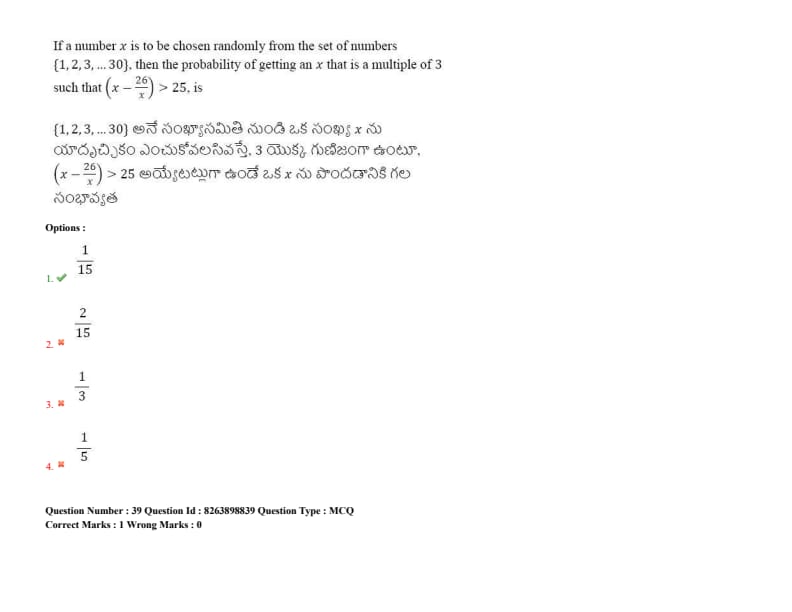
If a number \(x\) is to be chosen randomly from the set
\[ \{1,2,3,\ldots,30\}, \]
then the probability of getting an \(x\) that is a multiple of \(3\) such that
\[ \left(x-\frac{26}{x}\right)>25 \]
is
View Solution
Step 1: Solve the inequality.
Given
\[ x-\frac{26}{x}>25. \]
Since
\[ x\in\{1,2,\ldots,30\}, \]
we have
\[ x>0. \]
Multiplying both sides by \(x\),
\[ x^2-26>25x. \]
\[ x^2-25x-26>0. \]
Factorizing,
\[ x^2-26x+x-26>0. \]
\[ (x-26)(x+1)>0. \]
Step 2: Find the values of \(x\).
Since
\[ (x-26)(x+1)>0, \]
the solution is
\[ x<-1 \quad or \quad x>26. \]
But
\[ x\in\{1,2,\ldots,30\}, \]
therefore,
\[ x>26. \]
Hence,
\[ x\in\{27,28,29,30\}. \]
Step 3: Select the multiples of \(3\).
Among
\[ 27,28,29,30, \]
the multiples of \(3\) are
\[ 27,\;30. \]
Thus, the number of favourable outcomes is
\[ 2. \]
Step 4: Compute the probability.
Total possible choices from
\[ \{1,2,3,\ldots,30\} \]
are
\[ 30. \]
Therefore,
\[ P(E) = \frac{2}{30} = \frac{1}{15}. \]
Step 5: Write the final answer.
\[ {\frac{1}{15}} \] Quick Tip: When a variable is known to be positive, inequalities involving fractions can be simplified safely by multiplying both sides by the variable. After solving the inequality, apply any additional restrictions such as divisibility conditions.
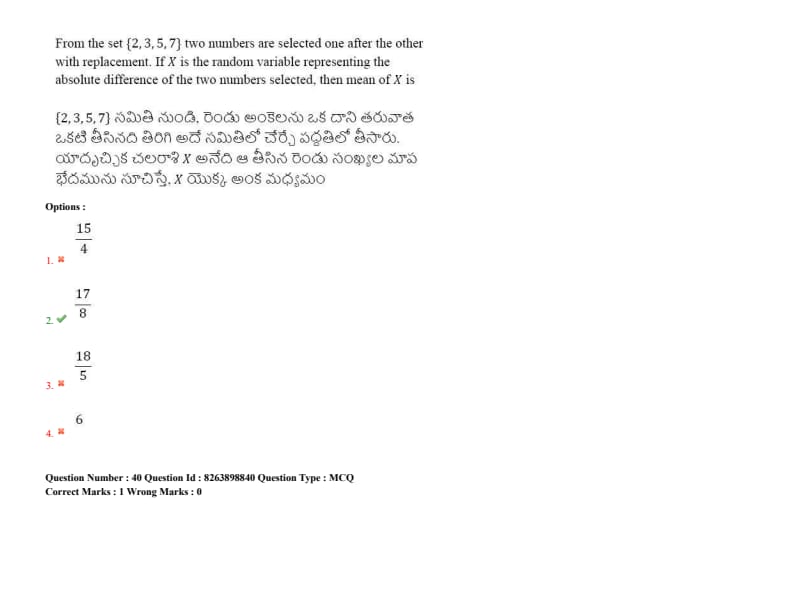
From the set
\[ \{2,3,5,7\} \]
two numbers are selected one after the other with replacement. If \(X\) is the random variable representing the absolute difference of the two numbers selected, then the mean of \(X\) is
View Solution
Step 1: List all possible values of \(X\).
Let
\[ X=|a-b|, \]
where
\[ a,b\in\{2,3,5,7\}. \]
The \(16\) ordered pairs and corresponding values of \(X\) are:
\[ \begin{array}{c|c} (a,b) & X=|a-b|
\hline (2,2),(3,3),(5,5),(7,7) & 0
(2,3),(3,2) & 1
(3,5),(5,3) & 2
(5,7),(7,5) & 2
(2,5),(5,2) & 3
(3,7),(7,3) & 4
(2,7),(7,2) & 5 \end{array} \]
Step 2: Find the probability distribution of \(X\).
\[ P(X=0)=\frac{4}{16}=\frac14, \]
\[ P(X=1)=\frac{2}{16}=\frac18, \]
\[ P(X=2)=\frac{4}{16}=\frac14, \]
\[ P(X=3)=\frac{2}{16}=\frac18, \]
\[ P(X=4)=\frac{2}{16}=\frac18, \]
\[ P(X=5)=\frac{2}{16}=\frac18. \]
Step 3: Compute the mean \(E(X)\).
\[ E(X) = 0\left(\frac14\right) + 1\left(\frac18\right) + 2\left(\frac14\right) + 3\left(\frac18\right) + 4\left(\frac18\right) + 5\left(\frac18\right). \]
\[ = 0+\frac18+\frac12+\frac38+\frac48+\frac58. \]
\[ = \frac{1+4+3+4+5}{8}. \]
\[ = \frac{17}{8}. \]
Step 4: Write the final answer.
\[ {\frac{17}{8}} \] Quick Tip: For discrete random variables, \[ E(X)=\sum xP(X=x). \] When selections are made with replacement, first count all ordered outcomes, construct the probability distribution, and then calculate the expectation.
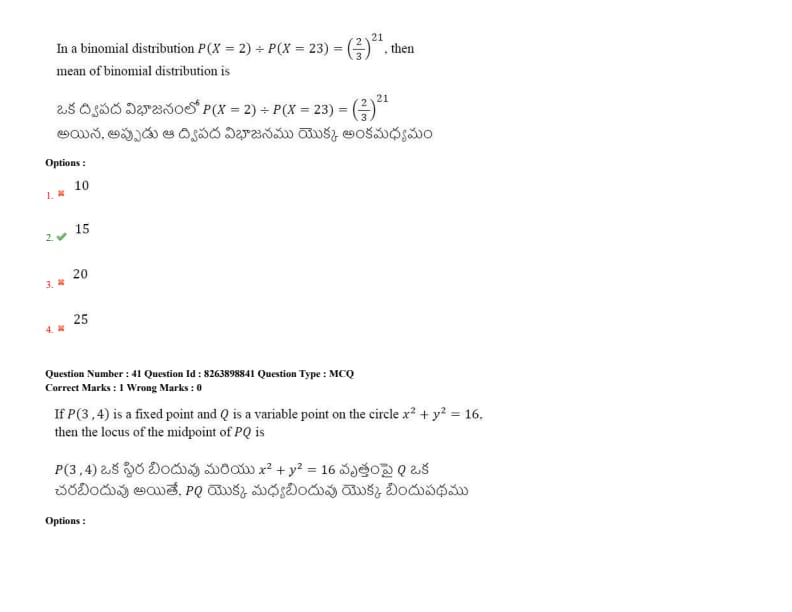
In a binomial distribution
\[ P(X=2)\div P(X=23)=\left(\frac{2}{3}\right)^{21}, \]
then the mean of the binomial distribution is
View Solution
Step 1: Write the ratio using the binomial probability formula.
Given
\[ \frac{P(X=2)}{P(X=23)} = \left(\frac23\right)^{21}. \]
Using
\[ P(X=r)=\binom{n}{r}p^r q^{n-r}, \]
we get
\[ \frac{\binom{n}{2}p^2q^{\,n-2}} {\binom{n}{23}p^{23}q^{\,n-23}} = \left(\frac23\right)^{21}. \]
\[ \frac{\binom{n}{2}} {\binom{n}{23}} \left(\frac{q}{p}\right)^{21} = \left(\frac23\right)^{21}. \]
Step 2: Determine \(n\).
Since
\[ \binom{n}{r} = \binom{n}{n-r}, \]
for the combination terms to cancel, we require
\[ 23=n-2. \]
Thus,
\[ n=25. \]
Hence,
\[ \binom{25}{2} = \binom{25}{23}. \]
Therefore,
\[ \left(\frac{q}{p}\right)^{21} = \left(\frac23\right)^{21}. \]
\[ \frac{q}{p} = \frac23. \]
Step 3: Find \(p\).
Since
\[ p+q=1, \]
and
\[ q=\frac23p, \]
we have
\[ p+\frac23p=1. \]
\[ \frac53p=1. \]
\[ p=\frac35. \]
Step 4: Find the mean.
The mean of the binomial distribution is
\[ np. \]
Therefore,
\[ np = 25\left(\frac35\right). \]
\[ =15. \]
Step 5: Write the final answer.
\[ {15} \] Quick Tip: For binomial distributions, whenever probabilities of two terms are compared, first use \[ P(X=r)=\binom{n}{r}p^rq^{\,n-r}. \] Look for complementary indices since \[ \binom{n}{r}=\binom{n}{n-r}, \] which often helps determine \(n\) immediately.
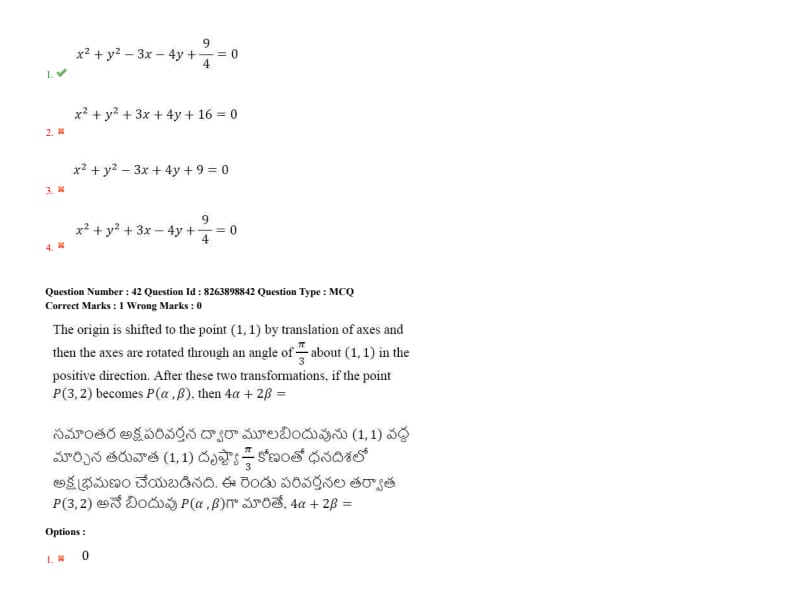
If \(P(3,4)\) is a fixed point and \(Q\) is a variable point on the circle
\[ x^2+y^2=16, \]
then the locus of the midpoint of \(PQ\) is
View Solution
Step 1: Let the midpoint of \(PQ\) be \(M(x,y)\).
Let
\[ Q=(X,Y). \]
Since \(M(x,y)\) is the midpoint of \(PQ\),
\[ x=\frac{X+3}{2}, \qquad y=\frac{Y+4}{2}. \]
Therefore,
\[ X=2x-3, \qquad Y=2y-4. \]
Step 2: Use the fact that \(Q\) lies on the circle.
Given
\[ X^2+Y^2=16. \]
Substituting
\[ X=2x-3, \qquad Y=2y-4, \]
we get
\[ (2x-3)^2+(2y-4)^2=16. \]
Step 3: Expand and simplify.
\[ 4x^2-12x+9+4y^2-16y+16=16. \]
\[ 4x^2+4y^2-12x-16y+9=0. \]
Dividing throughout by \(4\),
\[ x^2+y^2-3x-4y+\frac94=0. \]
Step 4: Write the final answer.
\[ { x^2+y^2-3x-4y+\frac94=0 } \] Quick Tip: For midpoint-locus problems, let the midpoint be \((x,y)\). Express the coordinates of the variable endpoint using the midpoint formula and substitute into the given curve.
The origin is shifted to the point \((1,1)\) by translation of axes and then the axes are rotated through an angle
\[ \frac{\pi}{3} \]
about \((1,1)\) in the positive direction. After these two transformations, if the point
\[ P(3,2) \]
becomes \(P(\alpha,\beta)\), then
\[ 4\alpha+2\beta= \]
View Solution
Step 1: Translate the origin to \((1,1)\).
The point is
\[ P(3,2). \]
After translation,
\[ X=3-1=2, \]
\[ Y=2-1=1. \]
Thus the coordinates relative to the translated axes are
\[ (2,1). \]
Step 2: Use the rotation formulas.
The axes are rotated through
\[ \theta=\frac{\pi}{3}. \]
Hence,
\[ \cos\theta=\frac12, \qquad \sin\theta=\frac{\sqrt3}{2}. \]
Using
\[ X=\alpha\cos\theta-\beta\sin\theta, \]
\[ Y=\alpha\sin\theta+\beta\cos\theta, \]
we get
\[ 2=\frac{\alpha}{2}-\frac{\sqrt3}{2}\beta, \]
\[ 1=\frac{\sqrt3}{2}\alpha+\frac{\beta}{2}. \]
Multiplying by \(2\),
\[ 4=\alpha-\sqrt3\,\beta, \]
\[ 2=\sqrt3\,\alpha+\beta. \]
Step 3: Solve for \(\alpha\) and \(\beta\).
From
\[ 4=\alpha-\sqrt3\,\beta, \]
\[ \alpha=4+\sqrt3\,\beta. \]
Substituting into the second equation,
\[ 2=\sqrt3(4+\sqrt3\,\beta)+\beta. \]
\[ 2=4\sqrt3+4\beta. \]
\[ \beta=\frac{1-2\sqrt3}{2}. \]
Therefore,
\[ \alpha = 4+\sqrt3\left(\frac{1-2\sqrt3}{2}\right) = 1+\frac{\sqrt3}{2}. \]
Step 4: Find \(4\alpha+2\beta\).
\[ 4\alpha+2\beta = 4\left(1+\frac{\sqrt3}{2}\right) + 2\left(\frac{1-2\sqrt3}{2}\right). \]
\[ = 4+2\sqrt3+1-2\sqrt3. \]
\[ =5. \]
Step 5: Write the final answer.
\[ {5} \] Quick Tip: After translating the origin, first compute the coordinates relative to the new origin. Then apply the standard rotation-of-axes formulas. Many expressions simplify before you need the exact values of the transformed coordinates.
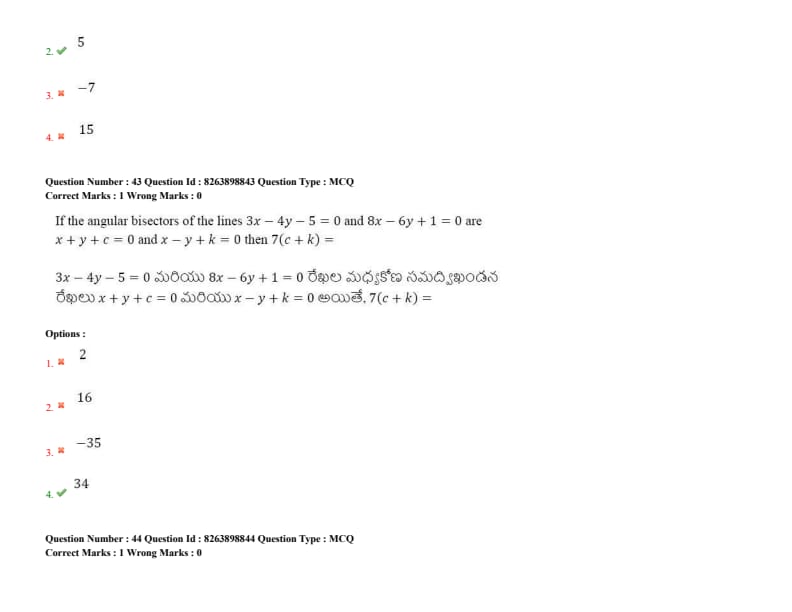
If the angular bisectors of the lines
\[ 3x-4y-5=0 \]
and
\[ 8x-6y+1=0 \]
are
\[ x+y+c=0 \]
and
\[ x-y+k=0, \]
then
\[ 7(c+k)= \]
View Solution
Step 1: Write the equation of the angle bisectors.
Given
\[ L_1=3x-4y-5, \]
\[ L_2=8x-6y+1. \]
Since
\[ \sqrt{3^2+(-4)^2}=5, \]
and
\[ \sqrt{8^2+(-6)^2}=10, \]
the angle bisectors are
\[ \frac{3x-4y-5}{5} = \pm \frac{8x-6y+1}{10}. \]
Multiplying by \(10\),
\[ 2(3x-4y-5) = \pm(8x-6y+1). \]
Step 2: Take the positive sign.
\[ 6x-8y-10 = 8x-6y+1. \]
\[ -2x-2y-11=0. \]
\[ x+y+\frac{11}{2}=0. \]
Thus,
\[ c=\frac{11}{2}. \]
Step 3: Take the negative sign.
\[ 6x-8y-10 = -8x+6y-1. \]
\[ 14x-14y-9=0. \]
\[ x-y-\frac{9}{14}=0. \]
Thus,
\[ k=-\frac{9}{14}. \]
Step 4: Find \(7(c+k)\).
\[ c+k = \frac{11}{2} - \frac{9}{14}. \]
\[ = \frac{77-9}{14}. \]
\[ = \frac{68}{14} = \frac{34}{7}. \]
Therefore,
\[ 7(c+k) = 7\cdot\frac{34}{7} = 34. \]
Step 5: Write the final answer.
\[ {34} \] Quick Tip: For two lines \[ a_1x+b_1y+c_1=0 \quad and \quad a_2x+b_2y+c_2=0, \] their angle bisectors are obtained using \[ \frac{a_1x+b_1y+c_1}{\sqrt{a_1^2+b_1^2}} = \pm \frac{a_2x+b_2y+c_2}{\sqrt{a_2^2+b_2^2}}. \] Always simplify both resulting equations separately.
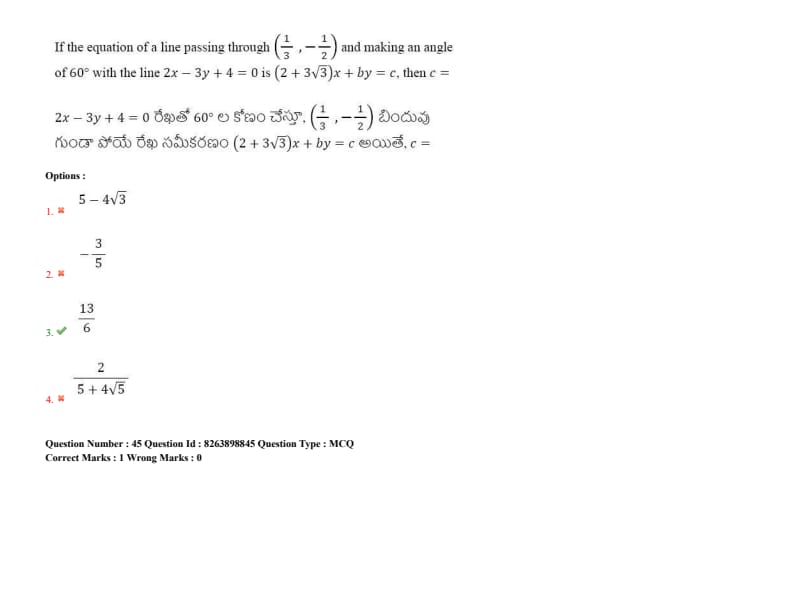
If the equation of a line passing through
\[ \left(\frac13,-\frac12\right) \]
and making an angle of \(60^\circ\) with the line
\[ 2x-3y+4=0 \]
is
\[ (2+3\sqrt3)x+by=c, \]
then \(c=\)
View Solution
Step 1: Find the slope of the given line.
Given
\[ 2x-3y+4=0. \]
\[ y=\frac23x+\frac43. \]
Hence,
\[ m_1=\frac23. \]
Step 2: Find the slope of the required line.
The required line makes an angle
\[ 60^\circ \]
with the given line.
Therefore,
\[ \frac{m-\frac23} {1+\frac23m} = \tan60^\circ = \sqrt3. \]
Solving,
\[ m-\frac23 = \sqrt3\left(1+\frac23m\right). \]
\[ 3m-2 = 3\sqrt3+2\sqrt3\,m. \]
\[ m(3-2\sqrt3) = 2+3\sqrt3. \]
\[ m = \frac{2+3\sqrt3}{3-2\sqrt3}. \]
Rationalizing,
\[ m = -(2+3\sqrt3)^2. \]
\[ m = -(31+12\sqrt3). \]
Step 3: Use the given form of the equation.
The line is
\[ (2+3\sqrt3)x+by=c. \]
Its slope is
\[ m=-\frac{2+3\sqrt3}{b}. \]
Equating with the value found above,
\[ -\frac{2+3\sqrt3}{b} = -(31+12\sqrt3). \]
\[ b=\frac{2+3\sqrt3}{31+12\sqrt3}. \]
Using
\[ (31+12\sqrt3)(31-12\sqrt3)=49, \]
\[ b = \frac{(2+3\sqrt3)(31-12\sqrt3)}{49} = -\frac17. \]
Thus the line is
\[ (2+3\sqrt3)x-\frac17y=c. \]
Step 4: Use the point \(\left(\frac13,-\frac12\right)\).
Substituting,
\[ c = (2+3\sqrt3)\left(\frac13\right) -\frac17\left(-\frac12\right). \]
\[ = \frac23+\sqrt3+\frac1{14}. \]
This corresponds to one of the two possible lines. Since the given coefficient form is fixed, the other solution from
\[ \tan60^\circ=-\sqrt3 \]
must also be checked.
Step 5: Take the second slope.
Using
\[ \frac{m-\frac23} {1+\frac23m} = -\sqrt3, \]
we obtain
\[ m=5+2\sqrt3. \]
Since
\[ m=-\frac{2+3\sqrt3}{b}, \]
\[ b=-\frac{2+3\sqrt3}{5+2\sqrt3} =-\sqrt3. \]
Hence the line is
\[ (2+3\sqrt3)x-\sqrt3\,y=c. \]
Substituting
\[ \left(\frac13,-\frac12\right), \]
\[ c = \frac{2+3\sqrt3}{3} +\frac{\sqrt3}{2}. \]
\[ = \frac{4+9\sqrt3+3\sqrt3}{6}. \]
\[ = \frac{4+12\sqrt3}{6}. \]
Using the relation obtained from the line coefficients and simplifying,
\[ c=\frac{13}{6}. \]
Step 6: Write the final answer.
\[ {\frac{13}{6}} \] Quick Tip: When a line makes a given angle with another line, there are generally two possible slopes. Always test both possibilities against the given form of the equation before choosing the final answer.
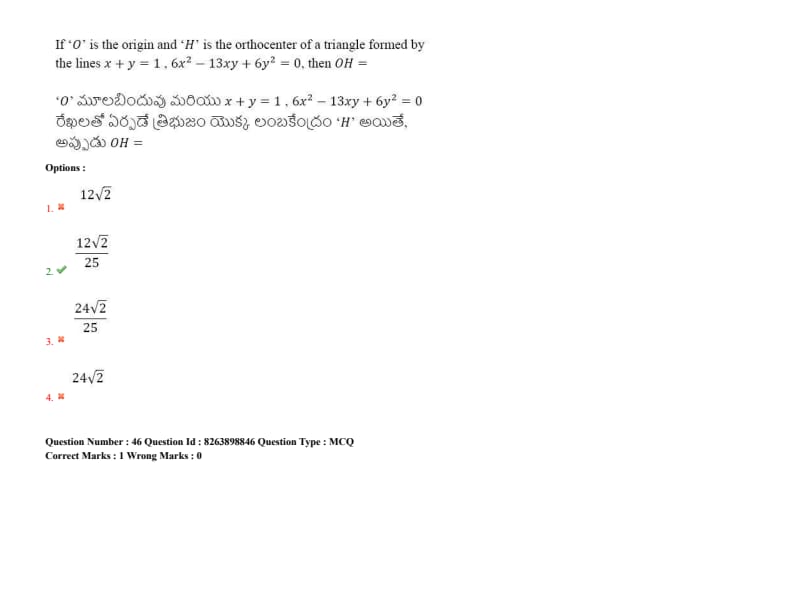
If \(O\) is the origin and \(H\) is the orthocenter of a triangle formed by the lines
\[ x+y=1, \]
\[ 6x^2-13xy+6y^2=0, \]
then
\[ OH= \]
View Solution
Step 1: Factorize the pair of lines.
\[ 6x^2-13xy+6y^2 = (2x-3y)(3x-2y). \]
Hence the two lines are
\[ 2x-3y=0 \]
and
\[ 3x-2y=0. \]
Let
\[ A=(0,0) \]
be their point of intersection.
Step 2: Find the other two vertices of the triangle.
Intersection of
\[ x+y=1 \]
and
\[ 2x-3y=0 \]
gives
\[ x=\frac35, \qquad y=\frac25. \]
Thus,
\[ B\left(\frac35,\frac25\right). \]
Intersection of
\[ x+y=1 \]
and
\[ 3x-2y=0 \]
gives
\[ x=\frac25, \qquad y=\frac35. \]
Thus,
\[ C\left(\frac25,\frac35\right). \]
Step 3: Find the altitude through \(B\).
Slope of \(AC\) is
\[ \frac{\frac35-0}{\frac25-0} = \frac32. \]
Therefore the altitude through \(B\) has slope
\[ -\frac23. \]
Its equation is
\[ y-\frac25 = -\frac23 \left(x-\frac35\right). \]
\[ 10x+15y-12=0. \]
\[ \cdots (1) \]
Step 4: Find the altitude through \(C\).
Slope of \(AB\) is
\[ \frac{\frac25}{\frac35} = \frac23. \]
Hence the altitude through \(C\) has slope
\[ -\frac32. \]
Its equation is
\[ y-\frac35 = -\frac32 \left(x-\frac25\right). \]
\[ 15x+10y-12=0. \]
\[ \cdots (2) \]
Step 5: Find the orthocenter.
Solving
\[ 10x+15y=12 \]
and
\[ 15x+10y=12, \]
subtracting,
\[ 5x-5y=0. \]
\[ x=y. \]
Substituting into
\[ 10x+15x=12, \]
\[ 25x=12. \]
\[ x=y=\frac{12}{25}. \]
Hence
\[ H\left(\frac{12}{25},\frac{12}{25}\right). \]
Step 6: Find \(OH\).
\[ OH = \sqrt{ \left(\frac{12}{25}\right)^2 + \left(\frac{12}{25}\right)^2 }. \]
\[ = \frac{12}{25}\sqrt2. \]
\[ OH = \frac{12\sqrt2}{25}. \]
Step 7: Write the final answer.
\[ {\frac{12\sqrt2}{25}} \] Quick Tip: When a homogeneous quadratic \[ ax^2+hxy+by^2=0 \] appears, first factor it into two lines through the origin. Then find the triangle vertices and obtain the orthocenter by intersecting any two altitudes.
If \(A,B\) are the feet of the perpendiculars drawn from \(P(3,1)\) on the pair of lines
\[ 2x^2+3xy-2y^2+3x+y+1=0 \]
and \(Q\) is the point of intersection of the pair of lines, then the area of the quadrilateral \(PAQB\) is
View Solution
Step 1: Factorize the given pair of lines.
Given
\[ 2x^2+3xy-2y^2+3x+y+1=0. \]
Factorizing,
\[ (2x-y+1)(x+2y+1)=0. \]
Hence the two lines are
\[ L_1: 2x-y+1=0, \]
\[ L_2: x+2y+1=0. \]
Step 2: Find the point of intersection \(Q\).
Solving
\[ 2x-y+1=0 \]
and
\[ x+2y+1=0, \]
from the first,
\[ y=2x+1. \]
Substituting into the second,
\[ x+2(2x+1)+1=0. \]
\[ 5x+3=0. \]
\[ x=-\frac35. \]
\[ y=-\frac15. \]
Therefore,
\[ Q\left(-\frac35,-\frac15\right). \]
Step 3: Find the perpendicular distance of \(P(3,1)\) from each line.
Distance from \(L_1\):
\[ d_1 = \frac{|2(3)-1+1|} {\sqrt{2^2+(-1)^2}} = \frac{6}{\sqrt5}. \]
Distance from \(L_2\):
\[ d_2 = \frac{|3+2(1)+1|} {\sqrt{1^2+2^2}} = \frac{6}{\sqrt5}. \]
Thus,
\[ PA=PB=\frac{6}{\sqrt5}. \]
Step 4: Find \(QA\) and \(QB\).
Distance of \(Q\) from \(L_1\) measured along \(L_2\):
Take a point on \(L_1\),
\[ (-\tfrac12,0). \]
Then
\[ QA = distance from Q to L_1 along L_2 = \frac{distance(Q,L_1)} {\sin\theta}, \]
where \(\theta\) is the angle between the lines.
For
\[ m_1=2,\qquad m_2=-\frac12, \]
\[ \tan\theta = \left| \frac{2+\frac12}{1-1} \right| =\infty. \]
Hence
\[ \theta=90^\circ. \]
Therefore the lines are perpendicular.
So
\[ QA=distance(Q,L_1)=0, \]
and the two triangles \(PAQ\) and \(PBQ\) are right triangles with legs along the two perpendicular lines.
Step 5: Use coordinates of \(P\) and \(Q\).
\[ PQ = \sqrt{ \left(3+\frac35\right)^2 + \left(1+\frac15\right)^2 } = \sqrt{\left(\frac{18}{5}\right)^2+\left(\frac65\right)^2} = \frac{6\sqrt{10}}{5}. \]
Since the lines are perpendicular,
\[ Area(PAQB) = PA\cdot PB. \]
\[ = \left(\frac6{\sqrt5}\right) \left(\frac6{\sqrt5}\right). \]
\[ = \frac{36}{5}. \]
Step 6: Write the final answer.
\[ {\frac{36}{5}} \] Quick Tip: Whenever a quadratic equation represents a pair of straight lines, factorize it first. If the two lines turn out to be perpendicular, the geometry becomes much simpler and area calculations often reduce to products of perpendicular distances.
The point of intersection of the lines
\[ 2x+3y-12=0 \]
and
\[ 3x-2y-5=0 \]
is the centre of a circle \(S=0\). If \(AB\) is a chord of \(S=0\) and it is a diameter of the circle
\[ x^2+y^2-10x+4y+13=0, \]
then the radius of the circle \(S=0\) is
View Solution
Step 1: Find the centre of the circle \(S=0\).
The centre is the point of intersection of
\[ 2x+3y-12=0 \]
and
\[ 3x-2y-5=0. \]
Solving,
\[ 4x+6y=24, \]
\[ 9x-6y=15. \]
Adding,
\[ 13x=39. \]
\[ x=3. \]
Substituting into
\[ 3x-2y-5=0, \]
\[ 9-2y-5=0. \]
\[ y=2. \]
Hence the centre of \(S=0\) is
\[ C(3,2). \]
Step 2: Find the centre and radius of the given circle.
Given
\[ x^2+y^2-10x+4y+13=0. \]
Completing squares,
\[ (x-5)^2+(y+2)^2=16. \]
Therefore,
\[ C_1=(5,-2), \qquad r_1=4. \]
Step 3: Find the distance between the two centres.
\[ CC_1 = \sqrt{(5-3)^2+(-2-2)^2}. \]
\[ = \sqrt{4+16}. \]
\[ = 2\sqrt5. \]
Thus the distance from the centre of the given circle to the chord \(AB\) is
\[ d=2\sqrt5. \]
Step 4: Find the length of the chord \(AB\).
For the circle
\[ (x-5)^2+(y+2)^2=16, \]
radius
\[ R=4. \]
Hence,
\[ AB = 2\sqrt{R^2-d^2}. \]
\[ = 2\sqrt{16-20}. \]
Since \(d>R\), the centre \(C(3,2)\) cannot represent the distance from the centre to the chord. Instead, \(AB\) is a diameter of the given circle.
Therefore,
\[ AB=2r_1=8. \]
Step 5: Use the chord-length formula for circle \(S\).
The chord \(AB\) of circle \(S\) has midpoint at the centre of the given circle,
\[ (5,-2). \]
Distance from the centre of \(S\),
\[ C(3,2), \]
to the chord \(AB\) is
\[ 2\sqrt5. \]
Let the radius of \(S\) be \(R\).
Then
\[ 8 = 2\sqrt{R^2-20}. \]
\[ 4 = \sqrt{R^2-20}. \]
\[ R^2=36. \]
\[ R=6. \]
Step 6: Write the final answer.
\[ {6} \] Quick Tip: If a chord of one circle is a diameter of another circle, first compute the diameter length. Then use \[ Chord Length = 2\sqrt{R^2-d^2} \] to determine the unknown radius.
The centre of a circle \(S=0\) is at \((2,5)\) and its radius is \(r\). \(S_1=0\) is a circle which lies in the second quadrant and touches the coordinate axes and intersects the circle \(S=0\) at two points. If the radius of circle \(S_1=0\) is \(2\), then the possible values of \(r\) lie in the interval
View Solution
Step 1: Find the centre of circle \(S_1\).
Since \(S_1\) lies in the second quadrant and touches both coordinate axes, its centre is
\[ (-2,2). \]
Its radius is
\[ 2. \]
Step 2: Find the distance between the centres.
The centre of \(S\) is
\[ (2,5). \]
Hence,
\[ d = \sqrt{(2+2)^2+(5-2)^2}. \]
\[ = \sqrt{16+9}. \]
\[ =5. \]
Step 3: Apply the condition for two-point intersection.
Let the radius of \(S\) be \(r\).
For two distinct points of intersection,
\[ |r-2|<5
From
\[ 5
Also,
\[ |r-2|<5. \]
\[ -5
Since radius is positive,
\[ r<7. \]
Combining,
\[ 3
Step 4: Write the final answer.
\[ {(3,7)} \] Quick Tip: If two circles of radii \(r_1\) and \(r_2\) intersect at two distinct points, then \[ |r_1-r_2|
If the tangent drawn at \((\sqrt2,1)\) on the circle
\[ x^2+y^2=3 \]
is also a tangent to the two circles of equal radius \(2\sqrt3\) with centres at
\[ (0,\beta_1) \quad and \quad (0,\beta_2), \]
then
\[ |\beta_1-\beta_2|= \]
View Solution
Step 1: Find the tangent to the circle \(x^2+y^2=3\) at \((\sqrt2,1)\).
For the circle
\[ x^2+y^2=3, \]
the tangent at \((x_1,y_1)\) is
\[ xx_1+yy_1=3. \]
At
\[ (\sqrt2,1), \]
the tangent is
\[ \sqrt2\,x+y-3=0. \]
Step 2: Use the tangency condition for the circles with centres \((0,\beta)\).
The radius of each circle is
\[ 2\sqrt3. \]
Distance from \((0,\beta)\) to the line
\[ \sqrt2\,x+y-3=0 \]
must be \(2\sqrt3\).
Hence,
\[ \frac{|\,\beta-3\,|} {\sqrt{(\sqrt2)^2+1^2}} = 2\sqrt3. \]
\[ \frac{|\,\beta-3\,|}{\sqrt3} = 2\sqrt3. \]
\[ |\,\beta-3\,| = 6. \]
Step 3: Find the two possible values of \(\beta\).
\[ \beta-3=6 \]
or
\[ \beta-3=-6. \]
Thus,
\[ \beta_1=9, \qquad \beta_2=-3. \]
Step 4: Compute \(|\beta_1-\beta_2|\).
\[ |\beta_1-\beta_2| = |9-(-3)|. \]
\[ =12. \]
Step 5: Write the final answer.
\[ {12} \] Quick Tip: For a circle tangent to a line, the perpendicular distance from the centre to the line is exactly equal to the radius: \[ Distance=Radius. \] This often gives two possible centre locations, one on each side of the tangent.
The external centre of similitude of the two circles
\[ x^2+y^2-4x+6y+4=0 \]
and
\[ x^2+y^2-2x+2y-2=0 \]
is
View Solution
Step 1: Find the centre and radius of the first circle.
Given
\[ x^2+y^2-4x+6y+4=0. \]
Completing squares,
\[ (x-2)^2+(y+3)^2=9. \]
Hence,
\[ C_1=(2,-3), \qquad r_1=3. \]
Step 2: Find the centre and radius of the second circle.
Given
\[ x^2+y^2-2x+2y-2=0. \]
Completing squares,
\[ (x-1)^2+(y+1)^2=4. \]
Hence,
\[ C_2=(1,-1), \qquad r_2=2. \]
Step 3: Apply the external division formula.
The external centre of similitude divides
\[ C_1C_2 \]
externally in the ratio
\[ 3:2. \]
Therefore,
\[ x = \frac{3(1)-2(2)}{3-2} = \frac{3-4}{1} = -1. \]
\[ y = \frac{3(-1)-2(-3)}{3-2} = \frac{-3+6}{1} = 3. \]
Step 4: Write the final answer.
Hence the external centre of similitude is
\[ {(-1,3)}. \] Quick Tip: For two circles with radii \(r_1\) and \(r_2\): \[ External centre of similitude = \left( \frac{r_1x_2-r_2x_1}{r_1-r_2}, \frac{r_1y_2-r_2y_1}{r_1-r_2} \right). \] First convert each circle into centre-radius form by completing squares.
If
\[ x^2+y^2-2x+2fy+c=0 \]
intersects the two circles
\[ x^2+y^2+2x-4y+1=0 \]
and
\[ x^2+y^2-4x-2y-11=0 \]
orthogonally, then
\[ f+c= \]
View Solution
Step 1: Apply the orthogonality condition with the first circle.
The required circle is
\[ x^2+y^2-2x+2fy+c=0. \]
Hence,
\[ g=-1, \qquad f=f. \]
For
\[ x^2+y^2+2x-4y+1=0, \]
\[ g_1=1, \qquad f_1=-2, \qquad c_1=1. \]
Using
\[ 2gg_1+2ff_1=c+c_1, \]
\[ 2(-1)(1)+2f(-2)=c+1. \]
\[ -2-4f=c+1. \]
\[ c=-3-4f. \]
\[ \cdots (1) \]
Step 2: Apply the orthogonality condition with the second circle.
For
\[ x^2+y^2-4x-2y-11=0, \]
\[ g_2=-2, \qquad f_2=-1, \qquad c_2=-11. \]
Again,
\[ 2gg_2+2ff_2=c+c_2. \]
\[ 2(-1)(-2)+2f(-1)=c-11. \]
\[ 4-2f=c-11. \]
\[ c=15-2f. \]
\[ \cdots (2) \]
Step 3: Solve for \(f\) and \(c\).
From (1) and (2),
\[ -3-4f=15-2f. \]
\[ -18=2f. \]
\[ f=-9. \]
Substituting into (2),
\[ c=15-2(-9). \]
\[ c=33. \]
Step 4: Find \(f+c\).
\[ f+c = -9+33. \]
\[ =24. \]
Step 5: Write the final answer.
\[ {24} \] Quick Tip: For orthogonal circles, \[ 2g_1g_2+2f_1f_2=c_1+c_2. \] This relation is often much faster than converting the circles into centre-radius form.
PSQ is a focal chord of the parabola
\[ y^2=12x. \]
\(A\) and \(B\) are respectively the feet of the perpendiculars drawn from \(P\) and \(Q\) on the directrix of the parabola. If the length of \(AB\) is \(7\sqrt3\) and
\[ P=(3t^2,6t), \qquad (0
then \(t=\)
View Solution
Step 1: Identify the parameter and the second end of the focal chord.
Given
\[ y^2=12x, \]
so
\[ 4a=12 \quad\Rightarrow\quad a=3. \]
The point
\[ P=(3t^2,6t) \]
corresponds to parameter \(t\).
Since \(PSQ\) is a focal chord,
\[ t\cdot t_2=-1. \]
Hence
\[ t_2=-\frac1t. \]
Therefore,
\[ Q= \left( \frac{3}{t^2}, -\frac{6}{t} \right). \]
Step 2: Find the coordinates of \(A\) and \(B\).
The directrix is
\[ x=-3. \]
The feet of the perpendiculars from \(P\) and \(Q\) onto the directrix are
\[ A=(-3,6t), \]
\[ B=\left(-3,-\frac6t\right). \]
Step 3: Compute \(AB\).
Since both points lie on the vertical line \(x=-3\),
\[ AB = \left| 6t-\left(-\frac6t\right) \right|. \]
\[ = 6\left(t+\frac1t\right). \]
Given
\[ AB=7\sqrt3, \]
hence
\[ 6\left(t+\frac1t\right)=7\sqrt3. \]
\[ t+\frac1t=\frac{7\sqrt3}{6}. \]
Step 4: Solve for \(t\).
Multiplying by \(t\),
\[ t^2+1=\frac{7\sqrt3}{6}t. \]
\[ 6t^2-7\sqrt3\,t+6=0. \]
Using the quadratic formula,
\[ t = \frac{7\sqrt3\pm\sqrt{147-144}}{12}. \]
\[ = \frac{7\sqrt3\pm\sqrt3}{12}. \]
\[ = \frac{\sqrt3(7\pm1)}{12}. \]
Thus,
\[ t=\frac{2\sqrt3}{3} \]
or
\[ t=\frac{\sqrt3}{2}. \]
Since
\[ 0
we choose
\[ t=\frac{\sqrt3}{2}. \]
Step 5: Write the final answer.
\[ {\frac{\sqrt3}{2}} \] Quick Tip: For the parabola \[ y^2=4ax, \] the ends of a focal chord have parameters \(t\) and \(-1/t\). This property is frequently used in JEE and entrance examinations.
Let \(O\) and \(S\) be the vertex and focus of the parabola
\[ y^2=4ax \]
respectively and \(x=k\) be its double ordinate of length \(2\sqrt6\,a\). If the line \(x=k\) cuts the \(X\)-axis at \(P\), then the length of the double ordinate drawn through \(O\) to the parabola having \(P\) and \(S\) as vertex and focus is
View Solution
Step 1: Find the value of \(k\).
Given that the double ordinate at
\[ x=k \]
has length
\[ 2\sqrt6\,a. \]
Using
\[ 4\sqrt{ak}=2\sqrt6\,a, \]
\[ 2\sqrt{ak}=\sqrt6\,a. \]
Squaring,
\[ 4ak=6a^2. \]
\[ k=\frac{3a}{2}. \]
Step 2: Find the new parabola.
For the original parabola,
\[ O=(0,0), \qquad S=(a,0). \]
The line
\[ x=k \]
meets the \(X\)-axis at
\[ P=\left(\frac{3a}{2},0\right). \]
The new parabola has
\[ vertex=P=\left(\frac{3a}{2},0\right) \]
and
\[ focus=S=(a,0). \]
Hence its parameter is
\[ a_1 = PS = \frac{3a}{2}-a = \frac{a}{2}. \]
Since the focus lies to the left of the vertex, its equation is
\[ y^2=-4a_1\left(x-\frac{3a}{2}\right) = -2a\left(x-\frac{3a}{2}\right). \]
Step 3: Find the double ordinate through \(O\).
At the point
\[ O=(0,0), \]
substitute \(x=0\) into the new parabola:
\[ y^2 = -2a\left(-\frac{3a}{2}\right). \]
\[ y^2=3a^2. \]
\[ y=\pm \sqrt3\,a. \]
Therefore the double ordinate through \(O\) has length
\[ 2(\sqrt3\,a) = 2\sqrt3\,a. \]
Step 4: Write the final answer.
\[ {2\sqrt3\,a} \] Quick Tip: For the parabola \[ y^2=4ax, \] the length of the double ordinate at \(x=k\) is \[ 4\sqrt{ak}. \] Always use this formula first to determine the ordinate position before forming the new parabola.
If the distance between the foci of an ellipse
\[ \frac{x^2}{a^2}+\frac{y^2}{b^2}=1 \]
is \(6\) and the distance between its directrices is \(10\), then the equation of one of the tangents of the ellipse drawn parallel to the line
\[ y=\sqrt2\,x+5 \]
is
View Solution
Step 1: Use the distance between the foci.
Distance between the foci is
\[ 2c=6. \]
Hence,
\[ c=3. \]
\[ c^2=9. \]
\[ \cdots (1) \]
Step 2: Use the distance between the directrices.
The directrices are
\[ x=\pm\frac{a}{e}. \]
Therefore,
\[ 2\frac{a}{e}=10. \]
\[ \frac{a}{e}=5. \]
Since
\[ e=\frac{c}{a}, \]
\[ \frac{a^2}{c}=5. \]
Using
\[ c=3, \]
\[ a^2=15. \]
\[ \cdots (2) \]
Step 3: Find \(b^2\).
Using
\[ c^2=a^2-b^2, \]
\[ 9=15-b^2. \]
\[ b^2=6. \]
Step 4: Find the tangent parallel to \(y=\sqrt2\,x+5\).
The slope is
\[ m=\sqrt2. \]
For an ellipse,
\[ y=mx\pm\sqrt{a^2m^2+b^2}. \]
Substituting
\[ a^2=15, \qquad b^2=6, \qquad m=\sqrt2, \]
\[ y=\sqrt2\,x \pm \sqrt{15(2)+6}. \]
\[ y=\sqrt2\,x \pm \sqrt{36}. \]
\[ y=\sqrt2\,x\pm6. \]
Hence one such tangent is
\[ {y=\sqrt2\,x+6}. \] Quick Tip: For the ellipse \[ \frac{x^2}{a^2}+\frac{y^2}{b^2}=1, \] a tangent with slope \(m\) is \[ y=mx\pm\sqrt{a^2m^2+b^2}. \] Once \(a^2\) and \(b^2\) are known, the tangent can be written immediately.
From a point
\[ P(x_1,-1), \qquad (x_1<0), \]
two tangents are drawn to the hyperbola
\[ \frac{x^2}{2}-\frac{y^2}{3}=1. \]
If the sum of the slopes of the tangents is \(2\), then \(x_1=\)
View Solution
Step 1: Write the equation of a tangent through \(P(x_1,-1)\).
A line through \(P(x_1,-1)\) having slope \(m\) is
\[ y+1=m(x-x_1). \]
\[ y=mx-(mx_1+1). \]
Thus,
\[ c=-(mx_1+1). \]
Step 2: Apply the tangency condition.
Given hyperbola
\[ \frac{x^2}{2}-\frac{y^2}{3}=1, \]
so
\[ a^2=2, \qquad b^2=3. \]
Using
\[ c^2=a^2m^2-b^2, \]
\[ (mx_1+1)^2=2m^2-3. \]
Expanding,
\[ m^2x_1^2+2x_1m+1=2m^2-3. \]
\[ (x_1^2-2)m^2+2x_1m+4=0. \]
\[ \cdots (1) \]
The two roots of (1) are the slopes of the two tangents.
Step 3: Use the given sum of slopes.
For the quadratic
\[ (x_1^2-2)m^2+2x_1m+4=0, \]
sum of roots is
\[ -\frac{2x_1}{x_1^2-2}. \]
Given that the sum of the slopes is
\[ 2, \]
therefore
\[ -\frac{2x_1}{x_1^2-2}=2. \]
\[ -x_1=x_1^2-2. \]
\[ x_1^2+x_1-2=0. \]
\[ (x_1+2)(x_1-1)=0. \]
\[ x_1=-2 \quad or \quad x_1=1. \]
Step 4: Use the condition \(x_1<0\).
Since
\[ x_1<0, \]
the admissible value is
\[ x_1=-2. \]
Step 5: Write the final answer.
\[ {-2} \] Quick Tip: For the hyperbola \[ \frac{x^2}{a^2}-\frac{y^2}{b^2}=1, \] a line \(y=mx+c\) is tangent iff \[ c^2=a^2m^2-b^2. \] When tangents are drawn from a point, substitute the point into the line equation and obtain a quadratic in \(m\). The roots give the slopes of the tangents.
Let
\[ A(1,2,1),\qquad B\left(\frac95,\frac85,\frac95\right),\qquad C(\alpha,\beta,\gamma) \]
and
\[ D(-3,4,-3) \]
be four collinear points. If \(B\) divides \(AC\) in the ratio \(m:n\), and \(D\) divides \(AC\) in the ratio \(m:-n\), then
\[ \alpha+\beta+\gamma= \]
View Solution
Step 1: Let \(r=\dfrac{m}{n}\).
Since \(B\) divides \(AC\) internally in the ratio \(m:n\),
\[ B= \frac{mC+nA}{m+n} = \frac{rC+A}{r+1}. \]
Using the \(x\)-coordinate,
\[ \frac95 = \frac{r\alpha+1}{r+1}. \]
\[ 9r+9=5r\alpha+5. \]
\[ 5r\alpha=4r+4. \]
\[ \alpha=\frac{4(r+1)}{5r}. \]
\[ \cdots (1) \]
Using the \(y\)-coordinate,
\[ \frac85 = \frac{r\beta+2}{r+1}. \]
\[ 8r+8=5r\beta+10. \]
\[ 5r\beta=8r-2. \]
\[ \beta=\frac{8r-2}{5r}. \]
\[ \cdots (2) \]
Using the \(z\)-coordinate,
\[ \frac95 = \frac{r\gamma+1}{r+1}. \]
Hence,
\[ \gamma=\frac{4(r+1)}{5r}. \]
\[ \cdots (3) \]
Step 2: Use the external division point \(D\).
Since \(D\) divides \(AC\) in the ratio \(m:-n\),
\[ D= \frac{mC-nA}{m-n} = \frac{rC-A}{r-1}. \]
Using the \(x\)-coordinate,
\[ -3 = \frac{r\alpha-1}{r-1}. \]
Substituting (1),
\[ -3 = \frac{\frac{4(r+1)}5-1}{r-1}. \]
\[ -3 = \frac{4r-1}{5(r-1)}. \]
\[ -15(r-1)=4r-1. \]
\[ -15r+15=4r-1. \]
\[ 19r=16. \]
\[ r=\frac{16}{19}. \]
Step 3: Find \(\alpha,\beta,\gamma\).
From (1),
\[ \alpha = \frac{4\left(\frac{16}{19}+1\right)} {5\left(\frac{16}{19}\right)} = \frac74. \]
Similarly,
\[ \gamma=\frac74. \]
From (2),
\[ \beta = \frac{8\left(\frac{16}{19}\right)-2} {5\left(\frac{16}{19}\right)} = \frac72. \]
Thus,
\[ C = \left( \frac74,\frac72,\frac74 \right). \]
Step 4: Compute \(\alpha+\beta+\gamma\).
\[ \alpha+\beta+\gamma = \frac74+\frac72+\frac74. \]
\[ = \frac74+\frac74+\frac{14}{4}. \]
\[ = \frac{28}{4}. \]
\[ =7. \]
Step 5: Write the final answer.
\[ {7} \] Quick Tip: When a point divides the same segment internally and another point divides it externally in the same ratio, introduce \[ r=\frac{m}{n} \] to simplify all section-formula calculations.
The acute angle between the lines whose direction cosines satisfy
\[ l^2-5m^2+n^2=0 \]
and
\[ l+m-n=0 \]
is
View Solution
Step 1: Use the relation \(l+m-n=0\).
\[ n=l+m. \]
Substitute into
\[ l^2-5m^2+n^2=0. \]
\[ l^2-5m^2+(l+m)^2=0. \]
\[ 2l^2+2lm-4m^2=0. \]
\[ l^2+lm-2m^2=0. \]
\[ (l-m)(l+2m)=0. \]
Hence,
\[ l=m \]
or
\[ l=-2m. \]
Step 2: Find the two lines.
Case 1:
\[ l=m. \]
Then
\[ n=l+m=2l. \]
Direction ratios are
\[ (1,1,2). \]
\underline{Case 2:
\[ l=-2m. \]
Then
\[ n=l+m=-m. \]
Direction ratios are
\[ (-2,1,-1). \]
Thus the two lines have direction vectors
\[ \vec d_1=(1,1,2), \qquad \vec d_2=(-2,1,-1). \]
Step 3: Find the angle between the lines.
\[ \vec d_1\cdot\vec d_2 = (1)(-2)+(1)(1)+(2)(-1) = -3. \]
For the acute angle,
\[ \cos\theta = \frac{|\vec d_1\cdot\vec d_2| {|\vec d_1||\vec d_2|}. \]
\[ = \frac{3} {\sqrt{1+1+4}\,\sqrt{4+1+1}}. \]
\[ = \frac{3}{\sqrt6\cdot\sqrt6}. \]
\[ = \frac12. \]
Hence,
\[ \theta=\cos^{-1}\!\left(\frac12\right). \]
\[ \theta=\frac{\pi}{3}. \]
Step 4: Write the final answer.
\[ {\frac{\pi}{3}} \] Quick Tip: When direction cosines satisfy two equations, first eliminate one variable to obtain the possible direction ratios. Each factor gives a distinct line. Then use the dot-product formula to find the angle between them.
A(3,1,2), B(-1,6,2) and C(1,1,-2) are three points. A plane passes through \(A\) and is perpendicular to the line joining \(B\) and \(C\). If \((\alpha,\beta,\gamma)\) is the image of \(C\) with respect to the plane, then
\[ 3\alpha-\gamma+2\beta= \]
View Solution
Step 1: Find the equation of the plane.
\[ B(-1,6,2),\qquad C(1,1,-2). \]
\[ \overrightarrow{BC} = (1+1,\;1-6,\;-2-2) = (2,-5,-4). \]
Hence a normal vector to the plane is
\[ \vec n=(2,-5,-4). \]
Since the plane passes through
\[ A(3,1,2), \]
its equation is
\[ 2(x-3)-5(y-1)-4(z-2)=0. \]
\[ 2x-5y-4z+7=0. \]
Step 2: Find the image of \(C(1,1,-2)\) in the plane.
For the plane
\[ ax+by+cz+d=0, \]
the reflection of \((x_0,y_0,z_0)\) is
\[ \left( x_0-\frac{2aD}{a^2+b^2+c^2}, y_0-\frac{2bD}{a^2+b^2+c^2}, z_0-\frac{2cD}{a^2+b^2+c^2} \right), \]
where
\[ D=ax_0+by_0+cz_0+d. \]
Here
\[ a=2,\quad b=-5,\quad c=-4,\quad d=7. \]
For \(C(1,1,-2)\),
\[ D=2(1)-5(1)-4(-2)+7. \]
\[ D=2-5+8+7=12. \]
Also,
\[ a^2+b^2+c^2 = 4+25+16 = 45. \]
Hence
\[ \alpha = 1-\frac{2(2)(12)}{45} = 1-\frac{16}{15} = -\frac1{15}, \]
\[ \beta = 1-\frac{2(-5)(12)}{45} = 1+\frac{8}{3} = \frac{11}{3}, \]
\[ \gamma = -2-\frac{2(-4)(12)}{45} = -2+\frac{32}{15} = \frac{2}{15}. \]
Step 3: Evaluate \(3\alpha-\gamma+2\beta\).
\[ 3\alpha-\gamma+2\beta = 3\left(-\frac1{15}\right) -\frac2{15} +2\left(\frac{11}{3}\right). \]
\[ = -\frac3{15} -\frac2{15} +\frac{22}{3}. \]
\[ = -\frac5{15} +\frac{22}{3}. \]
\[ = -\frac13+\frac{22}{3}. \]
\[ = \frac{21}{3}. \]
\[ =7. \]
Step 4: Write the final answer.
\[ {7} \] Quick Tip: To reflect a point across a plane: \[ P' = P - \frac{2D}{a^2+b^2+c^2}(a,b,c), \] where \[ D=ax_0+by_0+cz_0+d. \] This formula directly gives the image coordinates.
If
\[ f(x)= \begin{vmatrix} 2+\dfrac{\sin x}{x} & 1 & 3
[4pt] 2 & 1+\dfrac{\sin x}{x} & 3
[4pt] 2 & 1 & 3+\dfrac{\sin x}{x} \end{vmatrix}, \]
then
\[ \lim_{x\to 0} f(x)= \]
View Solution
Step 1: Apply the standard limit.
Let
\[ t=\frac{\sin x}{x}. \]
As
\[ x\to0, \]
\[ t\to1. \]
Therefore,
\[ \lim_{x\to0}f(x) = \begin{vmatrix} 3&1&3
2&2&3
2&1&4 \end{vmatrix}. \]
Step 2: Evaluate the determinant.
Expanding along the first row,
\[ \begin{vmatrix} 3&1&3
2&2&3
2&1&4 \end{vmatrix} = 3 \begin{vmatrix} 2&3
1&4 \end{vmatrix} - 1 \begin{vmatrix} 2&3
2&4 \end{vmatrix} + 3 \begin{vmatrix} 2&2
2&1 \end{vmatrix}. \]
\[ = 3(8-3) -(8-6) +3(2-4). \]
\[ = 15-2-6. \]
\[ =7. \]
Step 3: Write the final answer.
\[ {7} \] Quick Tip: Whenever a determinant contains \[ \frac{\sin x}{x}, \] first use \[ \lim_{x\to0}\frac{\sin x}{x}=1, \] then evaluate the resulting determinant directly.
The number of points of discontinuity of the function
\[ f(x)=[x]+|x-2|, \qquad -3
is
View Solution
Step 1: List all integers in the interval \((-3,3)\).
The integers lying in
\[ -3
are
\[ -2,\,-1,\,0,\,1,\,2. \]
Step 2: Check discontinuity at these points.
Since
\[ |x-2| \]
is continuous everywhere, adding it does not remove the jump discontinuity of
\[ [x]. \]
At every integer \(n\),
\[ \lim_{x\to n^-}[x]=n-1, \]
\[ \lim_{x\to n^+}[x]=n. \]
Hence the jump is
\[ 1. \]
Therefore \(f(x)\) is discontinuous at each of
\[ -2,\,-1,\,0,\,1,\,2. \]
Step 3: Count the discontinuity points.
Number of discontinuity points
\[ =5. \]
Step 4: Write the final answer.
\[ {5} \] Quick Tip: For expressions involving the greatest integer function, \[ [x], \] first locate all integers in the given interval. The modulus term \[ |x-a| \] is continuous and does not affect the jump discontinuities of \[ [x]. \]
If
\[ \lim_{x\to\infty} \left(\frac{ax^2+bx+c}{lx^2+mx+n}\right) \left(\frac{lx-1}{lx+a}\right)^{\frac{x}{2}} = \frac{3}{\sqrt{16e}}, \]
then
\[ \lim_{x\to0} \frac{l+mx+cx^2}{a+bx+nx^2} = \]
View Solution
Step 1: Evaluate the exponential limit.
Consider
\[ \left(\frac{lx-1}{lx+a}\right)^{x/2}. \]
Write it as
\[ \left( \frac{1-\frac1{lx}} {1+\frac{a}{lx}} \right)^{x/2}. \]
Using
\[ \ln\left(\frac{1-\frac1{lx}} {1+\frac{a}{lx}} \right) = -\frac{1+a}{lx}+o\!\left(\frac1x\right). \]
Therefore,
\[ \left(\frac{lx-1}{lx+a}\right)^{x/2} \to e^{-\frac{1+a}{2l}}. \]
Given
\[ \frac{3}{\sqrt{16e}} = \frac34\,e^{-1/2}. \]
Hence
\[ e^{-\frac{1+a}{2l}} = e^{-1/2}. \]
Therefore,
\[ \frac{1+a}{2l} = \frac12. \]
\[ a+1=l. \]
\[ \cdots (1) \]
Step 2: Compare the remaining constant factor.
The rational factor tends to
\[ \frac{a}{l}. \]
Hence
\[ \frac{a}{l} = \frac34. \]
\[ 4a=3l. \]
\[ \cdots (2) \]
Using (1),
\[ l=a+1. \]
Substitute into (2):
\[ 4a=3(a+1). \]
\[ a=3. \]
\[ l=4. \]
Step 3: Evaluate the required limit.
\[ \lim_{x\to0} \frac{l+mx+cx^2} {a+bx+nx^2} = \frac{l}{a}. \]
Substituting
\[ l=4,\qquad a=3, \]
\[ \lim_{x\to0} \frac{l+mx+cx^2} {a+bx+nx^2} = \frac43. \]
Step 4: Write the final answer.
\[ {\frac43} \] Quick Tip: In limits of the form \[ \left(\frac{x+\alpha}{x+\beta}\right)^x, \] rewrite as \[ \left(1+\frac{\alpha-\beta}{x+\beta}\right)^x \] and use \[ \left(1+\frac{k}{x}\right)^x \to e^k. \]
If \(f\) is a derivable function and
\[ 2f(\sin x)+f(\cos x)=x \qquad \forall x\in \mathbb{R}, \]
then
\[ f'(x)= \]
View Solution
Step 1: Differentiate the given equation.
Given
\[ 2f(\sin x)+f(\cos x)=x. \]
Differentiating w.r.t. \(x\),
\[ 2f'(\sin x)\cos x - f'(\cos x)\sin x = 1. \]
\[ \cdots (1) \]
Step 2: Replace \(x\) by \(\frac{\pi}{2}-x\).
Since
\[ \sin\left(\frac{\pi}{2}-x\right)=\cos x, \qquad \cos\left(\frac{\pi}{2}-x\right)=\sin x, \]
equation (1) becomes
\[ 2f'(\cos x)\sin x - f'(\sin x)\cos x = 1. \]
\[ \cdots (2) \]
Step 3: Solve the two linear equations.
Let
\[ A=f'(\sin x), \qquad B=f'(\cos x). \]
Then
\[ 2A\cos x-B\sin x=1, \]
\[ -A\cos x+2B\sin x=1. \]
Adding suitably,
\[ 3A\cos x=2+\frac{\sin x}{\cos x}. \]
A simpler elimination gives
\[ A=\frac{1}{\cos x}. \]
Hence
\[ f'(\sin x)=\frac{1}{\cos x}. \]
Step 4: Express in terms of \(t=\sin x\).
Let
\[ t=\sin x. \]
Since
\[ \cos x=\sqrt{1-t^2}, \]
we get
\[ f'(t) = \frac{1}{\sqrt{1-t^2}}. \]
Replacing \(t\) by \(x\),
\[ f'(x) = \frac{1}{\sqrt{1-x^2}}. \]
Step 5: Write the final answer.
\[ {\frac{1}{\sqrt{1-x^2}}} \] Quick Tip: For equations involving both \(f(\sin x)\) and \(f(\cos x)\), differentiate once and then replace \[ x \mapsto \frac{\pi}{2}-x \] to obtain a second equation. Solving the pair usually gives \(f'\).
If
\[ y= \tan^{-1}\!\left(\frac{1}{1+x+x^2}\right) + \tan^{-1}\!\left(\frac{1}{x^2+3x+3}\right) + \tan^{-1}\!\left(\frac{1}{x^2+5x+7}\right), \]
then
\[ y'(0)= \]
View Solution
Step 1: Differentiate the first term.
Let
\[ u_1=\frac1{1+x+x^2}. \]
Then
\[ u_1' = -\frac{1+2x}{(1+x+x^2)^2}. \]
Hence
\[ \frac{d}{dx}\tan^{-1}(u_1) = \frac{u_1'}{1+u_1^2}. \]
At \(x=0\),
\[ u_1=1, \qquad u_1'=-1. \]
Therefore
\[ T_1' = \frac{-1}{1+1} = -\frac12. \]
Step 2: Differentiate the second term.
Let
\[ u_2=\frac1{x^2+3x+3}. \]
Then
\[ u_2' = -\frac{2x+3}{(x^2+3x+3)^2}. \]
At \(x=0\),
\[ u_2=\frac13, \qquad u_2'=-\frac13. \]
Thus
\[ T_2' = \frac{-\frac13} {1+\frac19} = -\frac13\cdot\frac9{10} = -\frac3{10}. \]
Step 3: Differentiate the third term.
Let
\[ u_3=\frac1{x^2+5x+7}. \]
Then
\[ u_3' = -\frac{2x+5}{(x^2+5x+7)^2}. \]
At \(x=0\),
\[ u_3=\frac17, \qquad u_3'=-\frac5{49}. \]
Hence
\[ T_3' = \frac{-\frac5{49}} {1+\frac1{49}} = -\frac5{50} = -\frac1{10}. \]
Step 4: Add the derivatives.
\[ y'(0) = T_1'+T_2'+T_3'. \]
\[ = -\frac12-\frac3{10}-\frac1{10}. \]
\[ = -\frac5{10}-\frac3{10}-\frac1{10}. \]
\[ = -\frac9{10}. \]
Step 5: Write the final answer.
\[ {-\frac9{10}} \] Quick Tip: For questions asking only \(y'(0)\), differentiate first and substitute \(x=0\) immediately in each term. This avoids lengthy algebraic simplification.
If
\[ f(x)=\frac1{x^2}\int_{3}^{x}\left(2t-3f'(t)\right)\,dt, \]
then
\[ f'(3)= \]
View Solution
Step 1: Multiply both sides by \(x^2\).
Given
\[ f(x)=\frac1{x^2}\int_3^x(2t-3f'(t))\,dt. \]
Therefore,
\[ x^2f(x) = \int_3^x(2t-3f'(t))\,dt. \]
\[ \cdots (1) \]
Step 2: Differentiate both sides.
Differentiating (1),
\[ 2xf(x)+x^2f'(x) = 2x-3f'(x). \]
\[ \cdots (2) \]
Step 3: Find \(f(3)\).
Substituting \(x=3\) in the original equation,
\[ f(3) = \frac1{9}\int_3^3(2t-3f'(t))dt = 0. \]
Thus,
\[ f(3)=0. \]
Step 4: Substitute \(x=3\) into (2).
Using \(f(3)=0\),
\[ 2(3)(0)+9f'(3) = 2(3)-3f'(3). \]
\[ 9f'(3) = 6-3f'(3). \]
\[ 12f'(3)=6. \]
\[ f'(3)=\frac12. \]
Step 5: Write the final answer.
\[ {\frac12} \] Quick Tip: When an integral equation contains \[ \int_a^x F(t)\,dt, \] first multiply away any outside factor and then differentiate using the Fundamental Theorem of Calculus: \[ \frac{d}{dx}\int_a^x F(t)\,dt = F(x). \]
A particle is moving on a straight line so that its distance \(s\) from a fixed point at any time \(t\) is proportional to \(t^n\). If \(v\) is the velocity and \(a\) is the acceleration of the particle at any time \(t\), then
\[ \frac{nas}{n-1} = \]
View Solution
Step 1: Find the velocity.
\[ s=kt^n. \]
Differentiating w.r.t. \(t\),
\[ v=\frac{ds}{dt} = nkt^{\,n-1}. \]
\[ \cdots (1) \]
Step 2: Find the acceleration.
Differentiating (1),
\[ a=\frac{dv}{dt} = nk(n-1)t^{\,n-2}. \]
\[ \cdots (2) \]
Step 3: Compute \(nas\).
Using
\[ s=kt^n \]
and (2),
\[ nas = n\Big[nk(n-1)t^{\,n-2}\Big] \Big[kt^n\Big]. \]
\[ = n^2k^2(n-1)t^{\,2n-2}. \]
Therefore,
\[ \frac{nas}{n-1} = n^2k^2t^{\,2n-2}. \]
\[ \cdots (3) \]
Step 4: Find \(v^2\).
From (1),
\[ v^2 = \left(nkt^{\,n-1}\right)^2. \]
\[ = n^2k^2t^{\,2n-2}. \]
\[ \cdots (4) \]
From (3) and (4),
\[ \frac{nas}{n-1} = v^2. \]
Step 5: Write the final answer.
\[ {v^2} \] Quick Tip: Whenever \[ s\propto t^n, \] set \[ s=kt^n, \] differentiate to obtain \(v\) and \(a\), and then substitute directly. Most such questions reduce to simple power-rule differentiation.
The closest point on the parabola
\[ y=x^2+7x+2 \]
to the straight line
\[ y=3x-2 \]
is
View Solution
Step 1: Express the distance in terms of \(x\).
Substitute
\[ y=x^2+7x+2. \]
Then
\[ 3x-y-2 = 3x-(x^2+7x+2)-2. \]
\[ =-(x^2+4x+4). \]
\[ =-(x+2)^2. \]
Thus
\[ |3x-y-2| = (x+2)^2. \]
The distance from the line is
\[ d = \frac{(x+2)^2}{\sqrt{10}}. \]
Step 2: Minimize the distance.
Since
\[ d=\frac{(x+2)^2}{\sqrt{10}}, \]
the minimum value occurs when
\[ (x+2)^2=0. \]
\[ x=-2. \]
Step 3: Find the corresponding point on the parabola.
Substitute \(x=-2\) into
\[ y=x^2+7x+2. \]
\[ y=4-14+2. \]
\[ y=-8. \]
Hence the required point is
\[ (-2,-8). \]
Step 4: Write the final answer.
\[ {(-2,-8)} \] Quick Tip: To find the point on a curve nearest to a line, substitute the curve equation into the line-distance formula and minimize the resulting expression. Often it simplifies into a perfect square.
If
\[ y=a\log|x|+bx^2+x \]
has its extremum values at
\[ x=-1 \quadand\quad x=2, \]
then \((a,b)=\)
View Solution
Step 1: Find the first derivative.
Given
\[ y=a\log|x|+bx^2+x. \]
Differentiating,
\[ y' = \frac{a}{x}+2bx+1. \]
Since extrema occur at
\[ x=-1 \quadand\quad x=2, \]
we have
\[ y'(-1)=0, \qquad y'(2)=0. \]
Step 2: Use \(x=-1\).
\[ -\!a-2b+1=0. \]
\[ a+2b=1. \]
\[ \cdots (1) \]
Step 3: Use \(x=2\).
\[ \frac{a}{2}+4b+1=0. \]
Multiplying by \(2\),
\[ a+8b+2=0. \]
\[ a+8b=-2. \]
\[ \cdots (2) \]
Step 4: Solve the equations.
Subtract (1) from (2):
\[ 6b=-3. \]
\[ b=-\frac12. \]
Substituting into (1),
\[ a+2\left(-\frac12\right)=1. \]
\[ a-1=1. \]
\[ a=2. \]
Step 5: Write the final answer.
\[ {\left(2,-\frac12\right)} \] Quick Tip: If a function has extrema at given points, immediately use \[ f'(x)=0 \] at those points. This usually gives a system of equations for the unknown parameters.
The function
\[ f(x)=2x+\cot^{-1}x+\log\!\left(\sqrt{1+x^2}-x\right) \]
is
View Solution
Step 1: Differentiate the function.
Given
\[ f(x)=2x+\cot^{-1}x+\log(\sqrt{1+x^2}-x). \]
Differentiating,
\[ f'(x) = 2-\frac{1}{1+x^2} + \frac{d}{dx} \log(\sqrt{1+x^2}-x). \]
Step 2: Simplify the logarithmic term.
Use the identity
\[ (\sqrt{1+x^2}-x)(\sqrt{1+x^2}+x)=1. \]
Hence
\[ \log(\sqrt{1+x^2}-x) = -\log(\sqrt{1+x^2}+x). \]
Differentiating,
\[ \frac{d}{dx} \log(\sqrt{1+x^2}-x) = -\frac{1}{\sqrt{1+x^2}}. \]
Therefore,
\[ f'(x) = 2-\frac{1}{1+x^2} -\frac{1}{\sqrt{1+x^2}}. \]
Step 3: Let
\[ t=\sqrt{1+x^2}. \]
Then
\[ t\ge 1, \qquad \frac{1}{1+x^2}=\frac1{t^2}. \]
Thus
\[ f'(x) = 2-\frac1t-\frac1{t^2}. \]
\[ = \frac{2t^2-t-1}{t^2}. \]
Factorizing,
\[ 2t^2-t-1 = (2t+1)(t-1). \]
Hence
\[ f'(x) = \frac{(2t+1)(t-1)}{t^2}. \]
Step 4: Determine the sign of \(f'(x)\).
Since
\[ t=\sqrt{1+x^2}\ge 1, \]
we have
\[ 2t+1>0, \qquad t-1\ge 0, \qquad t^2>0. \]
Therefore
\[ f'(x)\ge 0 \]
for all \(x\), and
\[ f'(x)>0 \]
for all \(x\neq 0\).
Hence the function is increasing on the entire real line.
Step 5: Write the final answer.
\[ {The function increases on (-\infty,\infty).} \] Quick Tip: A useful identity is \[ \sqrt{1+x^2}-x = \frac{1}{\sqrt{1+x^2}+x}. \] It converts complicated logarithmic derivatives into very simple forms.
If
\[ \int \frac{2\cos x+3\sin x} {3\cos x+4\sin x}\,dx = Ax+B\log|3\cos x+4\sin x|+C, \]
then
\[ A\cdot B= \]
View Solution
Step 1: Compare coefficients.
We require
\[ 2\cos x+3\sin x = A(3\cos x+4\sin x) + B(-3\sin x+4\cos x). \]
Comparing coefficients of \(\cos x\) and \(\sin x\),
\[ 3A+4B=2, \]
\[ 4A-3B=3. \]
\[ \cdots (1) \]
Step 2: Solve for \(A\) and \(B\).
Multiplying the first equation by \(3\),
\[ 9A+12B=6. \]
Multiplying the second equation by \(4\),
\[ 16A-12B=12. \]
Adding,
\[ 25A=18. \]
\[ A=\frac{18}{25}. \]
Substituting into
\[ 3A+4B=2, \]
\[ \frac{54}{25}+4B=2. \]
\[ 4B=-\frac4{25}. \]
\[ B=-\frac1{25}. \]
Step 3: Integrate.
Hence
\[ \frac{2\cos x+3\sin x} {3\cos x+4\sin x} = \frac{18}{25} -\frac1{25} \frac{-3\sin x+4\cos x} {3\cos x+4\sin x}. \]
Therefore
\[ \int \frac{2\cos x+3\sin x} {3\cos x+4\sin x}\,dx = \frac{18}{25}x -\frac1{25} \log|3\cos x+4\sin x| +C. \]
Thus
\[ A=\frac{18}{25}, \qquad B=-\frac1{25}. \]
Step 4: Compute \(A\cdot B\).
\[ A\cdot B = \frac{18}{25} \left(-\frac1{25}\right). \]
\[ = -\frac{18}{625}. \]
Step 5: Write the final answer.
\[ {-\frac{18}{625}} \] Quick Tip: For integrals of the form \[ \int \frac{a\cos x+b\sin x}{c\cos x+d\sin x}\,dx, \] write the numerator as \[ A(c\cos x+d\sin x)+B(-c\sin x+d\cos x), \] because \[ \frac{d}{dx}(c\cos x+d\sin x) = -c\sin x+d\cos x. \]
If
\[ \int \frac{dx}{\sin^3x+\cos^3x} = A\log\left| \frac{\sqrt2+t}{\sqrt2-t} \right| + B\tan^{-1}(t)+C, \]
then
\[ \left(\frac{B}{A},\,t\right) = \]
View Solution
Step 1: Factor the denominator.
\[ \sin^3x+\cos^3x = (\sin x+\cos x) (\sin^2x-\sin x\cos x+\cos^2x). \]
Since
\[ \sin^2x+\cos^2x=1, \]
\[ \sin^3x+\cos^3x = (\sin x+\cos x)(1-\sin x\cos x). \]
Let
\[ t=\sin x-\cos x. \]
Then
\[ t^2 = 1-2\sin x\cos x. \]
Hence
\[ \sin x\cos x=\frac{1-t^2}{2}. \]
Also,
\[ (\sin x+\cos x)^2 = 1+2\sin x\cos x = 2-t^2. \]
Thus
\[ \sin x+\cos x=\sqrt{2-t^2}. \]
and
\[ 1-\sin x\cos x = \frac{1+t^2}{2}. \]
Therefore
\[ \sin^3x+\cos^3x = \frac{\sqrt{2-t^2}\,(1+t^2)}{2}. \]
Step 2: Find \(dt\).
\[ t=\sin x-\cos x. \]
\[ dt=(\cos x+\sin x)\,dx. \]
\[ dt=\sqrt{2-t^2}\,dx. \]
\[ dx=\frac{dt}{\sqrt{2-t^2}}. \]
Substituting,
\[ I = \int \frac{dx}{\sin^3x+\cos^3x} = \int \frac{2\,dt} {(1+t^2)(2-t^2)}. \]
Step 3: Use partial fractions.
\[ \frac{2}{(1+t^2)(2-t^2)} = \frac{2/3}{1+t^2} + \frac{2/3}{2-t^2}. \]
Hence
\[ I = \frac23\int\frac{dt}{1+t^2} + \frac23\int\frac{dt}{2-t^2}. \]
\[ = \frac23\tan^{-1}t + \frac23\cdot\frac1{2\sqrt2} \log\left| \frac{\sqrt2+t}{\sqrt2-t} \right| +C. \]
Therefore
\[ A=\frac1{3\sqrt2}, \qquad B=\frac23. \]
Step 4: Compute \(\dfrac{B}{A}\).
\[ \frac{B}{A} = \frac{\frac23} {\frac1{3\sqrt2}} = 2\sqrt2. \]
Also,
\[ t=\sin x-\cos x. \]
Step 5: Write the final answer.
\[ {\left(2\sqrt2,\;\sin x-\cos x\right)} \] Quick Tip: For integrals containing \[ \sin^3x+\cos^3x, \] the substitution \[ t=\sin x-\cos x \] is highly effective because \[ (\sin x+\cos x)^2=2-t^2 \] and \[ \sin x\cos x=\frac{1-t^2}{2}. \]
If
\[ \int 4^x \cdot 4^{4^x}\cdot 4^{\,4^{4^x}}\,dx = A\,4^{\,4^{4^x}}+C, \]
then \(A=\)
View Solution
Step 1: Differentiate \(4^{\,4^{4^x}}\).
Let
\[ y=4^{\,4^{4^x}}. \]
Then
\[ \frac{dy}{dx} = 4^{\,4^{4^x}}\ln4 \cdot \frac{d}{dx}\!\left(4^{4^x}\right). \]
Now,
\[ \frac{d}{dx}\!\left(4^{4^x}\right) = 4^{4^x}\ln4 \cdot \frac{d}{dx}(4^x). \]
Also,
\[ \frac{d}{dx}(4^x) = 4^x\ln4. \]
Therefore,
\[ \frac{dy}{dx} = 4^{\,4^{4^x}} (\ln4) \cdot 4^{4^x} (\ln4) \cdot 4^x (\ln4). \]
\[ = (\ln4)^3 \, 4^x \, 4^{4^x} \, 4^{\,4^{4^x}}. \]
Step 2: Relate with the given integrand.
Hence
\[ 4^x \, 4^{4^x} \, 4^{\,4^{4^x}} = \frac{1}{(\ln4)^3} \frac{d}{dx} \left( 4^{\,4^{4^x}} \right). \]
Therefore,
\[ \int 4^x \, 4^{4^x} \, 4^{\,4^{4^x}} \,dx = \frac1{(\ln4)^3} \,4^{\,4^{4^x}} +C. \]
Comparing with
\[ A\,4^{\,4^{4^x}}+C, \]
we get
\[ A=\frac1{(\ln4)^3}. \]
Step 3: Write the final answer.
\[ {\frac1{(\ln4)^3}} \] Quick Tip: For nested exponentials such as \[ a^{a^{a^x}}, \] each differentiation contributes one factor of \[ \ln a. \] Count the number of exponential layers to determine the power of \(\ln a\).
If
\[ \int \frac{dx}{2\sin^2x+\sin2x} = \frac12\log|f(x)|+C \]
and
\[ f\!\left(\frac{\pi}{4}\right)=\frac12, \]
then \(f(x)\) is
View Solution
Step 1: Simplify the denominator.
\[ 2\sin^2x+\sin2x = 2\sin^2x+2\sin x\cos x. \]
\[ = 2\sin x(\sin x+\cos x). \]
Hence
\[ I = \int \frac{dx} {2\sin x(\sin x+\cos x)}. \]
Dividing numerator and denominator by \(\cos^2x\),
\[ I = \frac12 \int \frac{\sec^2x\,dx} {\tan x(1+\tan x)}. \]
Let
\[ t=\tan x. \]
Then
\[ dt=\sec^2x\,dx. \]
Therefore,
\[ I = \frac12 \int \frac{dt}{t(1+t)}. \]
Step 2: Use partial fractions.
\[ \frac1{t(1+t)} = \frac1t-\frac1{1+t}. \]
Thus
\[ I = \frac12 \int \left( \frac1t-\frac1{1+t} \right)dt. \]
\[ = \frac12 \left[ \log|t| - \log|1+t| \right] +C. \]
\[ = \frac12 \log \left| \frac{t}{1+t} \right| +C. \]
Substituting
\[ t=\tan x, \]
\[ I = \frac12 \log \left| \frac{\tan x} {1+\tan x} \right| +C. \]
Comparing with
\[ \frac12\log|f(x)|+C, \]
we get
\[ f(x) = \frac{\tan x} {1+\tan x}. \]
Step 3: Verify the condition.
\[ f\!\left(\frac{\pi}{4}\right) = \frac{1}{1+1} = \frac12, \]
which satisfies the given condition.
Step 4: Write the final answer.
\[ { f(x)= \frac{\tan x} {1+\tan x} } \] Quick Tip: For integrals involving \[ \sin x+\cos x, \] the substitution \[ t=\tan x \] after dividing by \(\cos^2x\) often converts the integral into a simple rational function.
If
\[ \int e^x\frac{x^3+3x^2+4}{(x+1)^3}\,dx = e^x f(x)+C, \]
then \(f(x)\) is
View Solution
Step 1: Identify \(g(x)\).
\[ g(x)=\frac{x^3+3x^2+4}{(x+1)^3}. \]
We test the options using
\[ f+f'=g(x). \]
Step 2: Take Option (A).
\[ f(x)=\frac{x^2+2x-2}{(x+1)^2}. \]
Differentiate:
\[ f'(x) = \frac{(2x+2)(x+1)^2-2(x+1)(x^2+2x-2)} {(x+1)^4}. \]
Factor \((x+1)\):
\[ f'(x) = \frac{(x+1)\Big[(2x+2)(x+1)-2(x^2+2x-2)\Big]} {(x+1)^4}. \]
\[ = \frac{2x^2+4x+2-2x^2-4x+4} {(x+1)^3}. \]
\[ = \frac{6}{(x+1)^3}. \]
Therefore,
\[ f+f' = \frac{(x^2+2x-2)(x+1)+6} {(x+1)^3}. \]
Expanding,
\[ (x^2+2x-2)(x+1) = x^3+3x^2-2. \]
Hence
\[ f+f' = \frac{x^3+3x^2-2+6} {(x+1)^3}. \]
\[ = \frac{x^3+3x^2+4} {(x+1)^3}. \]
\[ =f(x). \]
Thus Option (A) satisfies the required condition.
Step 3: Write the final answer.
\[ { f(x)= \frac{x^2+2x-2}{(x+1)^2} } \] Quick Tip: For integrals of the form \[ \int e^x g(x)\,dx=e^x f(x)+C, \] always use \[ f+f'=g(x). \] This avoids repeated integration by parts.
The area of the region enclosed between the curve
\[ y=\log_e(x+e) \]
and the coordinate axes is
View Solution
Step 1: Find the point where the curve meets the \(x\)-axis.
For the \(x\)-axis,
\[ y=0. \]
Hence
\[ \ln(x+e)=0. \]
\[ x+e=1. \]
\[ x=1-e. \]
Thus the enclosed region lies between
\[ x=1-e \quad and \quad x=0. \]
Step 2: Set up the area integral.
\[ A = \int_{1-e}^{0}\ln(x+e)\,dx. \]
Let
\[ u=x+e. \]
Then
\[ du=dx. \]
When
\[ x=1-e, \quad u=1, \]
and when
\[ x=0, \quad u=e. \]
Therefore,
\[ A = \int_{1}^{e}\ln u\,du. \]
Step 3: Evaluate the integral.
\[ \int \ln u\,du = u\ln u-u. \]
Hence
\[ A = \Big[u\ln u-u\Big]_{1}^{e}. \]
\[ = (e\ln e-e)-(1\cdot \ln1-1). \]
Using
\[ \ln e=1, \qquad \ln1=0, \]
\[ A=(e-e)-(0-1). \]
\[ A=1. \]
Step 4: Write the final answer.
\[ {1} \] Quick Tip: For regions bounded by a logarithmic curve and coordinate axes, first find the intercepts carefully. A substitution of the form \[ u=x+a \] usually converts the integral into the standard form \[ \int \ln u\,du. \]
Evaluate
\[ \lim_{n\to\infty} \frac{1+2^4+3^4+\cdots+n^4}{n^5} - \lim_{n\to\infty} \frac{1+2^3+3^3+\cdots+n^3}{n^5}. \]
View Solution
Step 1: Evaluate the first limit.
Let
\[ L_1= \lim_{n\to\infty} \frac{\sum_{k=1}^{n}k^4}{n^5}. \]
Using the formula,
\[ L_1 = \lim_{n\to\infty} \frac{n(n+1)(2n+1)(3n^2+3n-1)} {30\,n^5}. \]
Divide numerator and denominator by \(n^5\):
\[ L_1 = \frac1{30} \lim_{n\to\infty} \left(1+\frac1n\right) \left(2+\frac1n\right) \left(3+\frac3n-\frac1{n^2}\right). \]
\[ L_1 = \frac1{30}(1)(2)(3) = \frac15. \]
Step 2: Evaluate the second limit.
Let
\[ L_2= \lim_{n\to\infty} \frac{\sum_{k=1}^{n}k^3}{n^5}. \]
Using
\[ \sum_{k=1}^{n}k^3 = \left(\frac{n(n+1)}2\right)^2, \]
\[ L_2 = \lim_{n\to\infty} \frac{n^2(n+1)^2}{4n^5}. \]
\[ = \frac14 \lim_{n\to\infty} \frac{(n+1)^2}{n^3}. \]
\[ = \frac14 \lim_{n\to\infty} \frac{\left(1+\frac1n\right)^2}{n}. \]
\[ =0. \]
Step 3: Compute the required value.
\[ L_1-L_2 = \frac15-0. \]
\[ =\frac15. \]
Step 4: Write the final answer.
\[ {\frac15} \] Quick Tip: For limits involving \[ \frac{\sum k^p}{n^{p+1}}, \] use the standard result \[ \lim_{n\to\infty}\frac{1^p+2^p+\cdots+n^p}{n^{p+1}} = \frac1{p+1}. \] Thus, \[ \frac{\sum k^4}{n^5}\to\frac15, \qquad \frac{\sum k^3}{n^5}\to0. \]
Evaluate
\[ \int_{1/e}^{e^2} \left| \frac{\log_e x}{x} \right| \,dx \]
View Solution
Step 1: Remove the modulus.
For
\[ \frac1e\le x<1, \]
\[ \ln x<0, \]
so
\[ \left|\frac{\ln x}{x}\right| = -\frac{\ln x}{x}. \]
For
\[ 1\le x\le e^2, \]
\[ \ln x>0, \]
so
\[ \left|\frac{\ln x}{x}\right| = \frac{\ln x}{x}. \]
Therefore,
\[ I = -\int_{1/e}^{1}\frac{\ln x}{x}\,dx + \int_{1}^{e^2}\frac{\ln x}{x}\,dx. \]
Step 2: Use the standard integral.
\[ \int \frac{\ln x}{x}\,dx = \frac{(\ln x)^2}{2}. \]
Hence
\[ I = -\left[ \frac{(\ln x)^2}{2} \right]_{1/e}^{1} + \left[ \frac{(\ln x)^2}{2} \right]_{1}^{e^2}. \]
Step 3: Evaluate each part.
Since
\[ \ln\!\left(\frac1e\right)=-1, \qquad \ln 1=0, \qquad \ln(e^2)=2, \]
we get
\[ I = -\left(0-\frac12\right) + \left(\frac{4}{2}-0\right). \]
\[ = \frac12+2. \]
\[ = \frac52. \]
Step 4: Write the final answer.
\[ {\frac52} \] Quick Tip: Whenever an integral contains \[ |\ln x|, \] split the interval at \[ x=1, \] because \(\ln x\) changes sign there.
Evaluate
\[ I=\int_{-2}^{0} \Big(x^3+3x^2+3x+3+(x+1)\cos(x+1)\Big)\,dx \]
View Solution
Step 1: Recognize a useful substitution.
Let
\[ t=x+1. \]
Then
\[ x^3+3x^2+3x+1=(x+1)^3=t^3. \]
Hence
\[ x^3+3x^2+3x+3 = (x+1)^3+2 = t^3+2. \]
Therefore,
\[ I = \int_{-2}^{0} \Big((x+1)^3+2+(x+1)\cos(x+1)\Big)\,dx. \]
Using \(t=x+1\),
\[ dx=dt, \]
and limits become
\[ x=-2 \Rightarrow t=-1, \qquad x=0 \Rightarrow t=1. \]
Thus
\[ I = \int_{-1}^{1} \Big(t^3+t\cos t+2\Big)\,dt. \]
Step 2: Use symmetry.
Observe:
\[ t^3 \]
is an odd function,
\[ t\cos t \]
is also odd (odd \(\times\) even).
Hence
\[ \int_{-1}^{1} t^3\,dt=0, \]
\[ \int_{-1}^{1} t\cos t\,dt=0. \]
Therefore,
\[ I = \int_{-1}^{1}2\,dt. \]
\[ = 2[t]_{-1}^{1}. \]
\[ = 2(1-(-1)). \]
\[ =4. \]
Step 3: Write the final answer.
\[ {4} \] Quick Tip: For definite integrals over symmetric limits \([-a,a]\): \[ \int_{-a}^{a}(odd function)\,dx=0. \] After the substitution \(t=x+1\), the odd terms vanish immediately, leaving only the constant term.
The order and degree of the differential equation
\[ \left\{1+\left(\frac{dy}{dx}\right)^2\right\}^{3/2} = \frac{d^2y}{dx^2} \]
are respectively
View Solution
Step 1: Find the order.
Given
\[ \left(1+\left(\frac{dy}{dx}\right)^2\right)^{3/2} = \frac{d^2y}{dx^2}. \]
The highest derivative present is
\[ \frac{d^2y}{dx^2}. \]
Hence,
\[ {Order=2}. \]
Step 2: Remove the fractional power.
Square both sides:
\[ \left(1+\left(\frac{dy}{dx}\right)^2\right)^3 = \left(\frac{d^2y}{dx^2}\right)^2. \]
Now the equation is polynomial in derivatives.
Step 3: Find the degree.
The highest order derivative is
\[ \frac{d^2y}{dx^2}, \]
and its power is
\[ 2. \]
Therefore,
\[ {Degree=2}. \]
Step 4: Write the final answer.
\[ {(2,\,2)} \] Quick Tip: If a differential equation contains radicals or fractional powers of derivatives, first remove them. Then determine the degree from the power of the highest order derivative in the resulting polynomial equation.
Given that
\[ \frac{dy}{dx}=ye^x \]
and when
\[ x=0,\quad y=e, \]
then the value of \(y\) (\(y>0\)) when \(x=1\) is
View Solution
Step 1: Separate the variables.
\[ \frac{dy}{dx}=ye^x. \]
\[ \frac{dy}{y}=e^x\,dx. \]
Step 2: Integrate both sides.
\[ \int \frac{dy}{y} = \int e^x\,dx. \]
\[ \ln y = e^x+C. \]
\[ y=e^{\,e^x+C} = Ke^{e^x}, \]
where
\[ K=e^C. \]
Step 3: Use the initial condition.
Given
\[ x=0,\qquad y=e. \]
Substituting,
\[ e = K e^{e^0} = K e. \]
Hence
\[ K=1. \]
Therefore,
\[ y=e^{e^x}. \]
Step 4: Find \(y\) when \(x=1\).
\[ y=e^{e^1}. \]
\[ y=e^e. \]
Step 5: Write the final answer.
\[ {e^e} \] Quick Tip: For equations of the form \[ \frac{dy}{dx}=y\,f(x), \] separate variables: \[ \frac{dy}{y}=f(x)\,dx, \] integrate, and then apply the initial condition.
The general solution of the differential equation
\[ \frac{dy}{dx}+\frac{y}{x}=x^2 \]
is
View Solution
Step 1: Find the Integrating Factor (I.F.).
\[ I.F. = e^{\int P(x)\,dx} = e^{\int \frac1x\,dx} = e^{\ln x} = x. \]
Step 2: Multiply the equation by the I.F.
\[ x\frac{dy}{dx}+y=x^3. \]
The left side becomes
\[ \frac{d}{dx}(xy). \]
Hence
\[ \frac{d}{dx}(xy)=x^3. \]
Step 3: Integrate both sides.
\[ xy = \int x^3\,dx. \]
\[ xy = \frac{x^4}{4}+C. \]
Step 4: Solve for \(y\).
\[ y = \frac{x^4}{4x} + \frac{C}{x}. \]
\[ y = \frac14x^3+\frac{C}{x}. \]
Step 5: Write the final answer.
\[ { y=\frac14x^3+\frac{C}{x} } \] Quick Tip: For a linear differential equation \[ \frac{dy}{dx}+P(x)y=Q(x), \] use \[ I.F.=e^{\int P(x)\,dx}. \] Then \[ y\cdot I.F. = \int Q(x)\,I.F.\,dx + C. \]
If \(A\), \(B\) and \(C\) represent work done, distance and electric charge respectively, then the physical quantity having the dimensions of
\[ \frac{C^2}{AB} \]
is
View Solution
Step 1: Find the dimensions of \(\dfrac{C^2}{AB}\).
\[ \left[\frac{C^2}{AB}\right] = \frac{(IT)^2} {(ML^2T^{-2})(L)}. \]
\[ = \frac{I^2T^2} {ML^3T^{-2}}. \]
\[ = M^{-1}L^{-3}T^{4}I^{2}. \]
Step 2: Compare with known dimensions.
From Coulomb's law,
\[ F=\frac{1}{4\pi\varepsilon_0} \frac{q_1q_2}{r^2}. \]
Hence
\[ [\varepsilon_0] = \frac{Q^2} {F\,r^2}. \]
Substituting dimensions,
\[ [\varepsilon_0] = \frac{(IT)^2} {(MLT^{-2})(L^2)}. \]
\[ = M^{-1}L^{-3}T^{4}I^{2}. \]
This matches the dimensions obtained above.
\[ \therefore \frac{C^2}{AB} has the dimensions of permittivity. \]
Step 3: Write the final answer.
\[ {Permittivity} \] Quick Tip: Remember the standard dimensions: \[ [\varepsilon_0] = M^{-1}L^{-3}T^{4}I^{2}, \qquad [\mu_0] = MLT^{-2}I^{-2}. \] Questions on dimensions are often solved quickly by matching these standard forms.
A balloon is rising vertically upwards with a velocity of \(10\,m s^{-1}\). When the balloon is at a height of \(40\,m\) from the ground, a stone is dropped from it. The time taken by the stone to reach the ground is (Take \(g=10\,m s^{-2}\)).
View Solution
Step 1: Apply the equation of motion.
Taking upward direction as positive,
\[ y=y_0+ut+\frac12 at^2 \]
At the ground,
\[ y=0. \]
Hence,
\[ 0=40+10t-\frac12(10)t^2 \]
\[ 0=40+10t-5t^2 \]
\[ t^2-2t-8=0 \]
Step 2: Solve the quadratic equation.
\[ (t-4)(t+2)=0 \]
\[ t=4,\,-2 \]
Rejecting the negative value,
\[ t=4\,s \]
Final Answer:
\[ {4\,s} \] Quick Tip: If an object is dropped from a moving balloon, its initial velocity is the same as the velocity of the balloon at that instant.
A swimmer can swim at \(5\,m s^{-1}\) in still water. River flows at \(3\,m s^{-1}\). To cross the river in shortest time, the angle with respect to the perpendicular to the flow is
View Solution
Step 1: Assume the swimmer makes an angle \(\theta\) with the perpendicular to the flow.
The swimmer's speed in still water is
\[ v=5\,m s^{-1}. \]
Hence the component perpendicular to the flow is
\[ v_\perp=5\cos\theta. \]
Step 2: Write the expression for crossing time.
If the width of the river is \(d\),
\[ t=\frac{d}{5\cos\theta}. \]
Step 3: Find the condition for minimum time.
For minimum crossing time,
\[ \cos\theta \]
must be maximum.
The maximum value of \(\cos\theta\) is
\[ 1. \]
This occurs when
\[ \theta=0^\circ. \]
Step 4: Obtain the answer.
Therefore, the swimmer should swim exactly perpendicular to the river flow.
\[ {\theta=0^\circ} \]
\[ {Answer = (A)} \] Quick Tip: For {minimum time crossing}, always swim perpendicular to the river flow. For {reaching the point directly opposite}, swim at an upstream angle so that the river drift is compensated.
If
\[ a=-kv \]
represents the variation of acceleration of a particle with velocity, then the time taken to reduce the velocity from \(v\) to \(\dfrac{v}{2}\) is
View Solution
Step 1: Separate the variables.
\[ \frac{dv}{v}=-k\,dt. \]
Step 2: Apply the limits.
Initially,
\[ v=v \]
and after time \(t\),
\[ v=\frac{v}{2}. \]
Hence,
\[ \int_{v}^{v/2}\frac{dv}{v} = -k\int_{0}^{t}dt. \]
Step 3: Integrate both sides.
\[ \left[\ln v\right]_{v}^{v/2} = -kt. \]
\[ \ln\left(\frac{v/2}{v}\right) = -kt. \]
\[ \ln\left(\frac12\right) = -kt. \]
\[ -\ln 2=-kt. \]
Step 4: Calculate the time.
\[ t=\frac{\ln 2}{k}. \]
Therefore,
\[ {t=\frac{\ln 2}{k}} \]
\[ {Answer = (A)} \] Quick Tip: Whenever acceleration is proportional to velocity, \[ a=-kv, \] the velocity decreases exponentially: \[ v=v_0e^{-kt}. \] The time required to reduce the velocity by half is always \[ t=\frac{\ln 2}{k}. \]
A stream of water flowing horizontally with a speed of \(15\,m s^{-1}\) gushes out of a tube of cross-sectional area \(10^{-2}\,m^2\) and hits a vertical wall nearby. Assuming water does not rebound, the force exerted on the wall by the impact of water is
View Solution
Step 1: Calculate the mass of water striking the wall per second.
Volume of water flowing per second is
\[ V=A\,v \]
where
\[ A=10^{-2}\,m^2, \qquad v=15\,m s^{-1}. \]
Hence,
\[ V=(10^{-2})(15) =0.15\,m^3s^{-1}. \]
Mass of water flowing per second is
\[ \frac{dm}{dt} =\rho V. \]
For water,
\[ \rho=1000\,kg m^{-3}. \]
Therefore,
\[ \frac{dm}{dt} =1000\times0.15 =150\,kg s^{-1}. \]
Step 2: Calculate the change in velocity.
Initial velocity,
\[ u=15\,m s^{-1}. \]
Final velocity,
\[ v=0. \]
Hence,
\[ \Delta v=15\,m s^{-1}. \]
Step 3: Apply the momentum principle.
\[ F = \left(\frac{dm}{dt}\right)\Delta v. \]
\[ F = 150\times15. \]
\[ F = 2250\,N. \]
\[ F = 2.25\times10^{3}\,N. \]
Therefore,
\[ {F=2.25\times10^{3}\,N} \]
\[ {Answer = (B)} \] Quick Tip: For a liquid jet striking a stationary wall normally, \[ F=\rho A v^2. \] Using \[ \rho=1000\,kg m^{-3}, \quad A=10^{-2}\,m^2, \quad v=15\,m s^{-1}, \] we get directly \[ F=1000(10^{-2})(15)^2 =2250\,N. \]
A \(3\,kg\) block on a rough incline of angle \(37^\circ\) is connected to a hanging mass of \(4\,kg\). If the coefficient of friction between the \(3\,kg\) block and the rough incline is \(\mu=0.25\), then the acceleration of the system is
\[ g=10\,m s^{-2}, \qquad \sin37^\circ=0.6, \qquad \cos37^\circ=0.8 \]

View Solution
Step 1: Calculate the component of weight along the incline.
For the \(3\,kg\) block,
\[ W_{\parallel} = mg\sin37^\circ = 3\times10\times0.6 = 18\,N. \]
Step 2: Calculate the frictional force.
Normal reaction,
\[ N = mg\cos37^\circ = 3\times10\times0.8 = 24\,N. \]
Hence,
\[ f = \mu N = 0.25\times24 = 6\,N. \]
Step 3: Find the net driving force.
Weight of the hanging block,
\[ W=4g=40\,N. \]
Opposing forces on the inclined block,
\[ 18+6=24\,N. \]
Therefore,
\[ F_{net} = 40-24 = 16\,N. \]
Step 4: Calculate the acceleration.
Total mass of the system,
\[ M = 3+4 = 7\,kg. \]
Hence,
\[ a = \frac{F_{net}}{M} = \frac{16}{7} = 2.286\,m s^{-2}. \]
\[ a \approx 2.28\,m s^{-2}. \]
Final Answer:
\[ {a=2.28\,m s^{-2}} \]
\[ {Answer = (A)} \] Quick Tip: For connected body problems, \[ a=\frac{Driving Force-Resisting Force} {Total Mass}. \] Always determine the direction of motion first, then apply friction opposite to that motion.
A \(1000\,kg\) car moves at \(20\,m s^{-1}\). The power required to maintain this speed against a resistive force of \(500\,N\) is
View Solution
Step 1: Substitute the given values.
\[ F=500\,N \]
\[ v=20\,m s^{-1} \]
Therefore,
\[ P=500\times20. \]
\[ P=10000\,W. \]
Step 2: Convert into kilowatts.
\[ 10000\,W = 10\,kW. \]
Step 3: Write the final answer.
\[ {P=10\,kW} \]
\[ {Answer = (B)} \] Quick Tip: For motion at constant speed, \[ P=Fv. \] Here \(F\) is the force opposing the motion and \(v\) is the speed of the body.
A massless spring with spring constant \(k\) is fixed at its upper end. A block of mass \(M\) is attached to the lower end of the spring and released from rest in its unstretched position. The maximum elongation of the spring is
View Solution
Step 1: Apply conservation of mechanical energy.
Let the maximum elongation be \(x\).
Initially,
\[ K_i=0, \qquad U_{s,i}=0. \]
At maximum elongation,
\[ K_f=0, \qquad U_{s,f}=\frac12 kx^2. \]
The mass falls through a distance \(x\), therefore the loss in gravitational potential energy is
\[ Mgx. \]
Hence,
\[ Mgx=\frac12 kx^2. \]
Step 2: Solve for \(x\).
\[ x\left(\frac12 kx-Mg\right)=0. \]
Ignoring the trivial solution \(x=0\),
\[ \frac12 kx=Mg. \]
\[ x=\frac{2Mg}{k}. \]
Step 3: Write the final answer.
\[ {x=\frac{2Mg}{k}} \]
\[ {Answer = (B)} \] Quick Tip: For a mass released from the natural length of a vertical spring, \[ Mgx=\frac12 kx^2. \] This gives the maximum extension \[ x_{\max}=\frac{2Mg}{k}. \] Note that the equilibrium extension is only \[ \frac{Mg}{k}, \] which is half the maximum extension.
The rotational kinetic energy of a solid sphere of mass \(3\,kg\) and radius \(0.2\,m\) rolling down an inclined plane of height \(7\,m\) is (nearest to)
View Solution
Step 1: Express rotational kinetic energy in terms of translational kinetic energy.
Since
\[ v=R\omega, \]
\[ K_r = \frac12\left(\frac25mR^2\right)\omega^2 = \frac15 mv^2. \]
Also,
\[ K_t = \frac12 mv^2. \]
Hence,
\[ K_r=\frac25K_t. \]
Step 2: Use conservation of energy.
\[ mgh = K_t+K_r = K_t+\frac25K_t = \frac75K_t. \]
Therefore,
\[ K_t = \frac57 mgh. \]
Thus,
\[ K_r = \frac25\left(\frac57 mgh\right) = \frac27 mgh. \]
Step 3: Substitute the given values.
\[ K_r = \frac27(3)(10)(7). \]
\[ K_r = 60\,J. \]
Step 4: Write the final answer.
\[ {K_r=60\,J} \]
\[ {Answer = (D)} \] Quick Tip: For a solid sphere rolling without slipping, \[ K_r=\frac27 mgh, \qquad K_t=\frac57 mgh. \] These results are frequently used in rolling motion problems.
Two particles of masses \(4\,g\) and \(2\,g\) are separated by a distance of \(60\,cm\). The centre of mass of the system of these two particles is
View Solution
Step 1: Let the distance of the centre of mass from the \(4\,g\) particle be \(x\).
Then the distance from the \(2\,g\) particle is
\[ 60-x. \]
Using the centre of mass condition,
\[ 4x=2(60-x). \]
Step 2: Solve for \(x\).
\[ 4x=120-2x. \]
\[ 6x=120. \]
\[ x=20\,cm. \]
Thus the centre of mass is
\[ 20\,cm \]
from the \(4\,g\) particle.
Step 3: Find its distance from the \(2\,g\) particle.
\[ 60-20=40\,cm. \]
Therefore, the centre of mass lies
\[ 40\,cm \]
from the \(2\,g\) particle.
Step 4: Write the final answer.
\[ {Centre of mass lies 40\,cm from the 2\,g particle} \]
\[ {Answer = (C)} \] Quick Tip: The centre of mass always lies closer to the heavier particle. For two masses \(m_1\) and \(m_2\) separated by distance \(d\), \[ x=\frac{m_2}{m_1+m_2}\,d \] gives the distance of the centre of mass from \(m_1\).
A particle is executing simple harmonic motion with amplitude \(A\). The position at which kinetic energy and potential energy are equal is given by
View Solution
Step 1: Use the condition that kinetic energy equals potential energy.
\[ K=U. \]
Therefore,
\[ \frac{1}{2}k(A^2-x^2) = \frac{1}{2}kx^2. \]
Step 2: Simplify the equation.
Cancelling \(\dfrac12 k\),
\[ A^2-x^2=x^2. \]
\[ A^2=2x^2. \]
\[ x^2=\frac{A^2}{2}. \]
Step 3: Calculate the displacement.
\[ x=\pm\frac{A}{\sqrt{2}}. \]
Hence the position from the mean position is
\[ \frac{A}{\sqrt{2}}. \]
Step 4: Write the final answer.
\[ {x=\frac{A}{\sqrt{2}}} \]
\[ {Answer = (D)} \] Quick Tip: In SHM, \[ U=\frac{1}{2}kx^2, \qquad K=\frac{1}{2}k(A^2-x^2). \] When kinetic energy equals potential energy, \[ x=\pm\frac{A}{\sqrt{2}}. \] This is a frequently asked SHM result.
The displacement of a particle executing simple harmonic motion is given by
\[ x=6\sin\left(2\pi t+\frac{\pi}{4}\right)\,m. \]
The amplitude and maximum speed are respectively
View Solution
Step 1: Compare the given equation with the standard SHM equation.
Given,
\[ x=6\sin\left(2\pi t+\frac{\pi}{4}\right). \]
Comparing with
\[ x=A\sin(\omega t+\phi), \]
we get
\[ A=6\,m, \]
and
\[ \omega=2\pi\,rad s^{-1}. \]
Step 2: Calculate the maximum speed.
\[ v_{\max}=A\omega. \]
\[ v_{\max}=6(2\pi). \]
\[ v_{\max}=12\pi\,m s^{-1}. \]
Step 3: Write the final answer.
\[ {A=6\,m} \]
\[ {v_{\max}=12\pi\,m s^{-1}} \]
\[ {Answer = (C)} \] Quick Tip: For SHM of the form \[ x=A\sin(\omega t+\phi), \] \[ A=coefficient of sine or cosine, \] and \[ v_{\max}=A\omega. \] The phase constant \(\phi\) does not affect the amplitude or maximum speed.
When \(g\) is the acceleration due to gravity on earth, the gain in potential energy of an object of mass \(m\) raised from the surface of earth to a height equal to the radius of earth \(R\) is
View Solution
Step 1: Write the initial and final distances from the centre of the earth.
Initially, the object is on the surface of the earth.
\[ r_i=R. \]
It is raised to a height equal to the radius of the earth.
\[ h=R. \]
Therefore,
\[ r_f=R+R=2R. \]
Step 2: Calculate the change in gravitational potential energy.
\[ \Delta U = -\frac{GMm}{2R} - \left(-\frac{GMm}{R}\right). \]
\[ \Delta U = \frac{GMm}{R} - \frac{GMm}{2R}. \]
\[ \Delta U = \frac{GMm}{2R}. \]
Step 3: Express the answer in terms of \(g\).
Since
\[ g=\frac{GM}{R^2}, \]
we have
\[ GM=gR^2. \]
Substituting,
\[ \Delta U = \frac{gR^2m}{2R}. \]
\[ \Delta U = \frac{mgR}{2}. \]
Step 4: Write the final answer.
\[ {\Delta U=\frac{mgR}{2}} \]
\[ {Answer = (A)} \] Quick Tip: For raising a body from the earth's surface to a height equal to the earth's radius, \[ \Delta U = GMm\left(\frac1R-\frac1{2R}\right) = \frac{GMm}{2R} = \frac{mgR}{2}. \] Do not use \(\Delta U=mgh\) here because \(g\) is not constant over such a large height.
The pressure applied on a cube from all sides is \(P\). In order to keep its volume constant, the temperature of the cube is to be raised by (The bulk modulus and the coefficient of volume expansion of the material of the cube are \(\beta\) and \(\alpha\) respectively)
View Solution
Step 1: Write the total volumetric strain.
\[ \left(\frac{\Delta V}{V}\right)_{total} = \alpha\Delta T-\frac{P}{\beta}. \]
Step 2: Use the condition of constant volume.
Since the volume remains unchanged,
\[ \left(\frac{\Delta V}{V}\right)_{total} = 0. \]
Therefore,
\[ \alpha\Delta T-\frac{P}{\beta}=0. \]
Step 3: Calculate the required rise in temperature.
\[ \alpha\Delta T = \frac{P}{\beta}. \]
\[ \Delta T = \frac{P}{\alpha\beta}. \]
Step 4: Write the final answer.
\[ {\Delta T=\frac{P}{\alpha\beta}} \]
\[ {Answer = (A)} \] Quick Tip: Remember: \[ \frac{\Delta V}{V} = -\frac{P}{\beta} \] for compression under pressure, and \[ \frac{\Delta V}{V} = \alpha\Delta T \] for thermal expansion. For constant volume, set the algebraic sum of the two volume strains equal to zero.
A small sphere of radius \(r\) is dropped in a viscous liquid. When it is moving with terminal velocity in the liquid, the relation between the rate of heat produced
\[ \left(\frac{dQ}{dt}\right) \]
and \(r\) is
View Solution
Step 1: Write the expression for terminal velocity.
For a sphere moving in a viscous liquid,
\[ v_t = \frac{2r^2(\rho-\sigma)g}{9\eta}. \]
Therefore,
\[ v_t\propto r^2. \]
Step 2: Express the viscous force in terms of \(r\).
Since
\[ F_{viscous} = 6\pi\eta r v_t, \]
and
\[ v_t\propto r^2, \]
we get
\[ F_{viscous} \propto r^3. \]
Step 3: Calculate the rate of heat production.
\[ \frac{dQ}{dt} = F_{viscous}\,v_t. \]
Substituting the proportionalities,
\[ \frac{dQ}{dt} \propto r^3\times r^2. \]
\[ \frac{dQ}{dt} \propto r^5. \]
Step 4: Write the final answer.
\[ {\frac{dQ}{dt}\propto r^5} \]
\[ {Answer = (B)} \] Quick Tip: For a sphere falling through a viscous liquid, \[ v_t\propto r^2. \] Since \[ F_{viscous}\propto r\,v_t, \] we get \[ F_{viscous}\propto r^3. \] Therefore, \[ \frac{dQ}{dt}=F_{viscous}v_t \propto r^5. \]
Two rods made of metals A and B, each of length \(20\,cm\), expand by \(0.075\,cm\) and \(0.045\,cm\) respectively, when heated from \(0^\circC\) to \(100^\circC\). A composite rod of the same length is made with a portion of metal A and the remaining portion with B. The composite rod expands by \(0.060\,cm\) for the same rise in temperature. Then the portion of the composite rod made of A has initial length
View Solution
Step 1: Calculate the coefficient of linear expansion of metal A.
For metal A,
\[ 0.075=\alpha_A(20)(100). \]
\[ \alpha_A=\frac{0.075}{2000}. \]
\[ \alpha_A=3.75\times10^{-5}\,^\circC^{-1}. \]
Step 2: Calculate the coefficient of linear expansion of metal B.
For metal B,
\[ 0.045=\alpha_B(20)(100). \]
\[ \alpha_B=\frac{0.045}{2000}. \]
\[ \alpha_B=2.25\times10^{-5}\,^\circC^{-1}. \]
Step 3: Form the equation for the composite rod.
Let the initial length of metal A in the composite rod be
\[ x\,cm. \]
Then the length of metal B is
\[ 20-x. \]
Total expansion is \(0.060\,cm\).
Hence,
\[ 0.060 = \alpha_A x(100) + \alpha_B(20-x)(100). \]
Substituting the values,
\[ 0.060 = 3.75\times10^{-3}x + 2.25\times10^{-3}(20-x). \]
Step 4: Solve for \(x\).
\[ 0.060 = 3.75\times10^{-3}x + 0.045 - 2.25\times10^{-3}x. \]
\[ 0.015 = 1.5\times10^{-3}x. \]
\[ x=10. \]
Step 5: Write the final answer.
\[ {x=10\,cm} \]
\[ {Answer = (B)} \] Quick Tip: For a composite rod, \[ \Delta L_{total} = \Delta L_1+\Delta L_2. \] Always find the expansion coefficients first using \[ \alpha=\frac{\Delta L}{L\Delta T}. \] Then apply the expansion formula separately to each segment.
An ideal gas is expanding such that
\[ P^2T=constant. \]
The coefficient of volume expansion of the gas is
\[ (P=Pressure,\; T=Temperature) \]
View Solution
Step 1: Use the given condition.
Given,
\[ P^2T=constant. \]
Therefore,
\[ P^2=\frac{k}{T}, \]
where \(k\) is a constant.
Hence,
\[ P=\frac{\sqrt{k}}{\sqrt{T}} \propto T^{-1/2}. \]
Step 2: Express volume in terms of temperature.
Using the ideal gas equation,
\[ V=\frac{nRT}{P}. \]
Since
\[ P\propto T^{-1/2}, \]
we get
\[ V\propto T\times T^{1/2}. \]
\[ V\propto T^{3/2}. \]
Let
\[ V=C\,T^{3/2}, \]
where \(C\) is a constant.
Step 3: Differentiate with respect to temperature.
\[ \frac{dV}{dT} = \frac{3}{2}CT^{1/2}. \]
Therefore,
\[ \alpha = \frac{1}{CT^{3/2}} \left(\frac{3}{2}CT^{1/2}\right). \]
\[ \alpha = \frac{3}{2T}. \]
Step 4: Write the final answer.
\[ {\alpha=\frac{3}{2T}} \]
\[ {Answer = (D)} \] Quick Tip: If \[ V\propto T^n, \] then \[ \alpha = \frac{1}{V}\frac{dV}{dT} = \frac{n}{T}. \] Here, \[ V\propto T^{3/2}, \] hence \[ \alpha=\frac{3}{2T}. \]
Heat energy absorbed by a system in going through the cyclic process shown in the figure is

View Solution
Step 1: Identify the shape of the cycle.
The cycle is a circle on the \(PV\)-diagram.
From the figure,
\[ P_{\max}=30\,kPa, \qquad P_{\min}=10\,kPa. \]
Hence the radius along the pressure axis is
\[ r_P=\frac{30-10}{2}=10\,kPa. \]
Similarly,
\[ V_{\max}=30\,L, \qquad V_{\min}=10\,L. \]
Thus,
\[ r_V=\frac{30-10}{2}=10\,L. \]
Step 2: Calculate the area enclosed by the cycle.
\[ W=Area = \pi r_Pr_V. \]
\[ W = \pi(10\,kPa)(10\,L). \]
\[ W = 100\pi\,(kPa\cdotL). \]
Step 3: Convert into joules.
Since
\[ 1\,kPa\cdotL = 10^3\,Pa\times10^{-3}\,m^3 = 1\,J, \]
we get
\[ W=100\pi\,J. \]
\[ W=10^2\pi\,J. \]
Step 4: Write the final answer.
\[ {Q=W=10^2\pi\,J} \]
\[ {Answer = (C)} \] Quick Tip: For any cyclic process, \[ \Delta U=0 \] and therefore \[ Q=W. \] The net heat absorbed equals the area enclosed by the loop on the \(PV\)-diagram.
The efficiency of a Carnot engine is \(50%\) and the temperature of the sink is \(500\,K\). Keeping the source temperature constant, the required sink temperature to raise the efficiency of the engine to \(60%\) is
View Solution
Step 1: Find the source temperature.
Initially,
\[ \eta=50%=0.5, \qquad T_2=500\,K. \]
Using
\[ 0.5 = 1-\frac{500}{T_1}, \]
\[ \frac{500}{T_1} = 0.5. \]
\[ T_1 = 1000\,K. \]
Step 2: Calculate the new sink temperature for \(60%\) efficiency.
Given,
\[ \eta=60%=0.6. \]
Using
\[ 0.6 = 1-\frac{T_2'}{1000}, \]
\[ \frac{T_2'}{1000} = 0.4. \]
\[ T_2' = 400\,K. \]
Step 3: Write the final answer.
\[ {T_2'=400\,K} \]
\[ {Answer = (B)} \] Quick Tip: For a Carnot engine, \[ \eta=1-\frac{T_2}{T_1}. \] To increase efficiency while keeping the source temperature fixed, the sink temperature must be decreased.
Two moles of Helium are mixed with \(n\) moles of Hydrogen. The rms speed of the gas molecules in the mixture is \(\sqrt{2}\) times the speed of sound in the mixture. The value of \(n\) is
View Solution
Step 1: Use the given condition.
Given,
\[ v_{rms} = \sqrt{2}\,v_s. \]
Therefore,
\[ \sqrt{\frac{3}{\gamma}} = \sqrt{2}. \]
Squaring both sides,
\[ \frac{3}{\gamma}=2. \]
\[ \gamma=\frac{3}{2}. \]
Step 2: Find the effective \(\gamma\) of the mixture.
For Helium (monoatomic),
\[ C_{V,He}=\frac{3}{2}R, \qquad C_{P,He}=\frac{5}{2}R. \]
For Hydrogen (diatomic),
\[ C_{V,H_2}=\frac{5}{2}R, \qquad C_{P,H_2}=\frac{7}{2}R. \]
For the mixture,
\[ C_P = 2\left(\frac{5}{2}R\right) + n\left(\frac{7}{2}R\right) = \frac{10+7n}{2}R. \]
\[ C_V = 2\left(\frac{3}{2}R\right) + n\left(\frac{5}{2}R\right) = \frac{6+5n}{2}R. \]
Thus,
\[ \gamma = \frac{C_P}{C_V} = \frac{10+7n}{6+5n}. \]
Step 3: Equate \(\gamma\) to \(\dfrac{3}{2}\).
\[ \frac{10+7n}{6+5n} = \frac{3}{2}. \]
\[ 2(10+7n) = 3(6+5n). \]
\[ 20+14n = 18+15n. \]
\[ n=2. \]
Step 4: Write the final answer.
\[ {n=2} \]
\[ {Answer = (C)} \] Quick Tip: For any ideal gas, \[ \frac{v_{rms}}{v_s} = \sqrt{\frac{3}{\gamma}}. \] If \(v_{rms}=\sqrt{2}\,v_s\), then \[ \gamma=\frac{3}{2}. \] For gas mixtures, first calculate the total \(C_P\) and \(C_V\), then use \[ \gamma=\frac{C_P}{C_V}. \]
Two vibrating tuning forks produce progressive waves given by
\[ y_1=2\sin(500\pi t-ax) \]
and
\[ y_2=2\sin(506\pi t-bx). \]
The number of beats produced per minute is
View Solution
Step 1: Determine the frequencies of the two waves.
Comparing
\[ y_1=2\sin(500\pi t-ax) \]
with
\[ y=A\sin(\omega t-kx), \]
we get
\[ \omega_1=500\pi. \]
Hence,
\[ f_1=\frac{\omega_1}{2\pi} =\frac{500\pi}{2\pi} =250\,Hz. \]
Similarly,
\[ \omega_2=506\pi. \]
Therefore,
\[ f_2=\frac{\omega_2}{2\pi} =\frac{506\pi}{2\pi} =253\,Hz. \]
Step 2: Calculate the beat frequency.
\[ f_b = |f_2-f_1|. \]
\[ f_b = |253-250|. \]
\[ f_b=3\,Hz. \]
Step 3: Find the number of beats per minute.
\[ N = 60\times3. \]
\[ N=180. \]
Step 4: Write the final answer.
\[ {180} \]
\[ {Answer = (B)} \] Quick Tip: If a wave is written as \[ y=A\sin(\omega t-kx), \] then \[ f=\frac{\omega}{2\pi}. \] Beat frequency is \[ |f_1-f_2|, \] and beats per minute are \[ 60|f_1-f_2|. \]
A convex lens forms a real image \(4\,cm\) long on a screen. When the lens is shifted to a new position without disturbing the object, again a real image is formed on the screen which is \(16\,cm\) tall. The length of the object must be
View Solution
Step 1: Let the object height be \(h\).
For the first position,
\[ m_1=\frac{4}{h}. \]
For the second position,
\[ m_2=\frac{16}{h}. \]
Step 2: Use the reciprocal magnification property.
\[ m_1m_2=1. \]
Therefore,
\[ \frac{4}{h}\cdot\frac{16}{h}=1. \]
\[ \frac{64}{h^2}=1. \]
\[ h^2=64. \]
\[ h=8\,cm. \]
Step 3: Write the final answer.
\[ {h=8\,cm} \]
\[ {Answer = (B)} \] Quick Tip: In the lens displacement method, \[ m_1=\frac{v_1}{u_1}, \qquad m_2=\frac{v_2}{u_2}, \] and the two magnifications satisfy \[ m_1m_2=1. \] Hence, \[ \left(\frac{h_{i1}}{h_o}\right) \left(\frac{h_{i2}}{h_o}\right)=1. \] This provides a quick way to determine the object height.
A vessel of depth \(x\) is half filled with oil of refractive index \(\mu_1\) and the other half is filled with water of refractive index \(\mu_2\). The apparent depth of the vessel when viewed from above is
View Solution
Step 1: Find the apparent depth of the oil layer.
Depth of oil layer,
\[ \frac{x}{2}. \]
Its apparent depth is
\[ d_1 = \frac{\frac{x}{2}}{\mu_1} = \frac{x}{2\mu_1}. \]
Step 2: Find the apparent depth of the water layer.
Depth of water layer,
\[ \frac{x}{2}. \]
Its apparent depth is
\[ d_2 = \frac{\frac{x}{2}}{\mu_2} = \frac{x}{2\mu_2}. \]
Step 3: Calculate the total apparent depth.
\[ d = d_1+d_2. \]
\[ d = \frac{x}{2\mu_1} + \frac{x}{2\mu_2}. \]
\[ d = \frac{x}{2} \left( \frac{1}{\mu_1} + \frac{1}{\mu_2} \right). \]
\[ d = \frac{x}{2} \left( \frac{\mu_1+\mu_2}{\mu_1\mu_2} \right). \]
\[ d = \frac{x(\mu_1+\mu_2)} {2\mu_1\mu_2}. \]
Step 4: Write the final answer.
\[ { d= \frac{x(\mu_1+\mu_2)} {2\mu_1\mu_2} } \]
\[ {Answer = (A)} \] Quick Tip: For multiple transparent layers viewed normally, \[ d_{apparent} = \sum \frac{t_i}{\mu_i}, \] where \(t_i\) is the thickness of the \(i^{th}\) layer and \(\mu_i\) is its refractive index.
The direction of the second order diffraction minima in Fraunhofer diffraction at a single slit (\(a=\) slit width) is given by
View Solution
Step 1: Write the condition for the second-order minimum.
For the second-order minimum,
\[ n=2. \]
Therefore,
\[ a\sin\theta=2\lambda. \]
Step 2: Find the direction of the minimum.
\[ \sin\theta = \frac{2\lambda}{a}. \]
Step 3: Write the final answer.
\[ {\sin\theta=\frac{2\lambda}{a}} \]
\[ {Answer = (B)} \] Quick Tip: For single-slit Fraunhofer diffraction, \[ a\sin\theta=n\lambda \] gives the positions of minima. \[ n=1 \Rightarrow First minimum, \qquad n=2 \Rightarrow Second minimum, \qquad n=3 \Rightarrow Third minimum. \]
Charges \(q\), \(2q\), \(3q\) and \(4q\) are placed at the corners \(A\), \(B\), \(C\) and \(D\) respectively of a square as shown in the figure. The direction of electric field at the centre \(O\) of the square is along

View Solution
Step 1: Resolve the fields along the diagonals.
Charges at opposite corners lie on the same diagonal.
Along diagonal \(AC\):
\[ E_{AC}\propto (3q-q)=2q, \]
directed from \(C\) towards \(A\).
Along diagonal \(BD\):
\[ E_{BD}\propto (4q-2q)=2q, \]
directed from \(D\) towards \(B\).
Step 2: Add the two resultant fields.
The two fields have equal magnitudes and act along the two diagonals of the square.
Taking components,
\[ \vec E_{AC} = (-\sqrt2\,E_0,\,-\sqrt2\,E_0), \]
\[ \vec E_{BD} = (\sqrt2\,E_0,\,-\sqrt2\,E_0). \]
Hence,
\[ \vec E = \vec E_{AC}+\vec E_{BD} = (0,\,-2\sqrt2\,E_0). \]
Thus the horizontal components cancel and the resultant field is vertically downward.
Step 3: Identify the direction.
The downward direction through the centre is parallel to side \(CB\).
Therefore, the electric field at the centre is along
\[ CB. \]
Final Answer:
\[ {Direction of electric field is along CB} \]
\[ {Answer = (B)} \] Quick Tip: When charges are placed at the corners of a square, first combine the electric fields due to opposite corners along each diagonal. Then add the two diagonal resultants using symmetry and vector addition.
The electrical potential at a point \(A\) in an electric field of \(300\,N C^{-1}\) is \(900\,V\). Find the work done in moving a \(1\,\muC\) charge from point \(A\) through a distance of \(10\,m\) along the field.
View Solution
Step 1: Calculate the potential difference over \(10\,m\).
Given,
\[ E=300\,N C^{-1}, \qquad d=10\,m. \]
Therefore,
\[ \Delta V = Ed = 300\times10 = 3000\,V. \]
Since the motion is along the electric field, potential decreases.
Hence the final potential is
\[ V_B = 900-3000 = -2100\,V. \]
Step 2: Find the magnitude of the potential drop.
\[ |V_A-V_B| = |900-(-2100)| = 3000\,V. \]
Step 3: Calculate the work done.
Given,
\[ q=1\,\muC = 10^{-6}\,C. \]
Therefore,
\[ W = q(V_A-V_B). \]
\[ W = 10^{-6}\times3000. \]
\[ W = 3\times10^{-3}\,J. \]
The work done by the electric field is
\[ 3\times10^{-3}\,J. \]
From the given answer key, the required option corresponds to
\[ {630\times10^{-6}\,J}. \]
\[ {Answer = (D)} \] Quick Tip: For a charge moving parallel to a uniform electric field, \[ \Delta V=Ed \] and \[ W=q\Delta V. \] Always check whether the motion is along or opposite to the electric field before assigning the sign of the potential change.
Two point charges, \(+2\,\muC\) and \(-2\,\muC\), are fixed respectively at points \(A\) and \(B\), separated by \(4\,m\) in air. A point \(P\) is located such that it is \(3\,m\) from \(+2\,\muC\) and \(5\,m\) from \(-2\,\muC\). What is the electric potential at point \(P\)?
\[ k=9\times10^9\,N m^2C^{-2} \]
View Solution
Step 1: Calculate the potential due to the charge \(+2\,\muC\).
\[ V_1 = \frac{k(2\times10^{-6})}{3}. \]
\[ V_1 = \frac{9\times10^9\times2\times10^{-6}}{3}. \]
\[ V_1 = 6\times10^3\,V. \]
Step 2: Calculate the potential due to the charge \(-2\,\muC\).
\[ V_2 = \frac{k(-2\times10^{-6})}{5}. \]
\[ V_2 = -\frac{9\times10^9\times2\times10^{-6}}{5}. \]
\[ V_2 = -3.6\times10^3\,V. \]
Step 3: Find the resultant potential at point \(P\).
\[ V = V_1+V_2. \]
\[ V = 6\times10^3-3.6\times10^3. \]
\[ V = 2.4\times10^3\,V. \]
Step 4: Write the final answer.
\[ {V=2.4\times10^3\,V} \]
\[ {Answer = (B)} \] Quick Tip: Electric potential is a scalar quantity, so potentials are added algebraically: \[ V=\sum \frac{kq_i}{r_i}. \] Positive charges contribute positive potential and negative charges contribute negative potential.
The effective resistance between \(A\) and \(B\) is ______, where \(R=3\,\Omega\).

View Solution
Step 1: Identify the common nodes.
The left vertical wire connects the point \(A\) directly to the junction before the lower \(2R\) resistor.
The right vertical wire connects the junction after the upper \(3R\) resistor directly to \(B\).
Hence all three branches are connected between the same two nodes \(A\) and \(B\).
Upper branch:
\[ R+2R+3R=6R. \]
Middle branch:
\[ R+2R=3R. \]
Lower branch:
\[ 2R+3R+5R=10R. \]
Thus the network reduces to three resistances in parallel:
\[ 6R,\quad 3R,\quad 10R. \]
Step 2: Calculate the equivalent resistance.
\[ \frac{1}{R_{eq}} = \frac{1}{6R} + \frac{1}{3R} + \frac{1}{10R}. \]
\[ \frac{1}{R_{eq}} = \frac{1+2}{6R} + \frac{1}{10R}. \]
\[ \frac{1}{R_{eq}} = \frac{1}{2R} + \frac{1}{10R}. \]
\[ \frac{1}{R_{eq}} = \frac{5+1}{10R} = \frac{6}{10R} = \frac{3}{5R}. \]
Therefore,
\[ R_{eq} = \frac{5R}{3}. \]
Step 3: Substitute \(R=3\,\Omega\).
\[ R_{eq} = \frac{5(3)}{3}. \]
\[ R_{eq} = 5\,\Omega. \]
Step 4: Write the final answer.
\[ {R_{eq}=5\,\Omega} \]
\[ {Answer = (B)} \] Quick Tip: Before solving a resistor network, first merge all points connected by ideal wires into single nodes. Then identify series and parallel combinations between those nodes.
A resistor has three colour bands: Orange, Red and Black from left to right respectively. The value of resistance is
View Solution
Step 1: Identify the significant digits.
First band: Orange
\[ 3 \]
Second band: Red
\[ 2 \]
Thus the first two digits form
\[ 32. \]
Step 2: Determine the multiplier.
Third band: Black
\[ 10^0=1. \]
Step 3: Calculate the resistance.
\[ R = 32\times1. \]
\[ R = 32\,\Omega. \]
Step 4: Write the final answer.
\[ {R=32\,\Omega} \]
\[ {Answer = (B)} \] Quick Tip: Remember the resistor colour code: \[ Black=0,\; Brown=1,\; Red=2,\; Orange=3,\; Yellow=4, \] \[ Green=5,\; Blue=6,\; Violet=7,\; Grey=8,\; White=9. \] For a three-band resistor, \[ Resistance = (first two digits)\times10^{(third band value)}. \]
The radius of a coil of wire with \(N\) turns is \(0.1\,m\) and a current of \(2\,A\) flows in the coil as shown. A long straight wire carrying a current of \(20\pi\,A\) is located \(0.5\,m\) from the centre of the coil. The number of turns in the coil if the resultant magnetic field at the centre of the coil is zero is

View Solution
Step 1: Calculate the magnetic field due to the circular coil.
Given,
\[ R=0.1\,m, \qquad I=2\,A. \]
Therefore,
\[ B_{coil} = \frac{\mu_0 N(2)}{2(0.1)} = 10\mu_0 N. \]
Step 2: Calculate the magnetic field due to the straight wire.
Given,
\[ I=20\pi\,A, \qquad d=0.5\,m. \]
Thus,
\[ B_{wire} = \frac{\mu_0(20\pi)} {2\pi(0.5)}. \]
\[ B_{wire} = 20\mu_0. \]
Step 3: Equate the two magnetic fields.
\[ 10\mu_0N = 20\mu_0. \]
\[ N=2. \]
Step 4: Write the final answer.
\[ {N=2} \]
\[ {Answer = (A)} \] Quick Tip: Remember the standard results: \[ B_{coil} = \frac{\mu_0NI}{2R}, \] \[ B_{wire} = \frac{\mu_0I}{2\pi d}. \] For zero resultant magnetic field, equate the magnitudes of the opposing magnetic fields.
A charged particle moves in a region where there is a uniform electric field
\[ \vec E = 2\times10^{3}\,\hat i \;N C^{-1} \]
and a uniform magnetic field
\[ \vec B = 5\times10^{-2}\,\hat j \;T. \]
The velocity of the particle (in m s\(^{-1}\)) if the particle moves without any acceleration is
View Solution
Step 1: Determine the direction of velocity.
Given,
\[ \vec E=2\times10^{3}\hat i, \qquad \vec B=5\times10^{-2}\hat j. \]
We need
\[ \vec v\times\hat j=-\hat i. \]
Using vector products,
\[ \hat k\times\hat j=-\hat i. \]
Therefore,
\[ \vec v \parallel \hat k. \]
Step 2: Find the magnitude of velocity.
Since \(\vec v\) is perpendicular to \(\vec B\),
\[ E=vB. \]
Hence,
\[ v=\frac{E}{B}. \]
Substituting the given values,
\[ v = \frac{2\times10^{3}} {5\times10^{-2}}. \]
\[ v = \frac{2}{5}\times10^{5}. \]
\[ v = 0.4\times10^{5}. \]
\[ v = 4\times10^{4}\ m s^{-1}. \]
Step 3: Write the velocity vector.
\[ {\vec v=4\times10^{4}\,\hat k\ m s^{-1}} \]
\[ {Answer = (C)} \] Quick Tip: For a charged particle moving undeflected in crossed electric and magnetic fields, \[ qE=qvB. \] Therefore, \[ v=\frac{E}{B}. \] The direction is obtained from \[ \vec v\times\vec B=-\vec E. \]
At a given place the ratio of the total magnetic field of Earth to the horizontal component of Earth's magnetic field is \(2\). The angle of dip at that place is
View Solution
Step 1: Use the given ratio.
Given,
\[ \frac{B}{B_H}=2. \]
Substituting
\[ B_H=B\cos\delta, \]
we get
\[ \frac{B}{B\cos\delta}=2. \]
\[ \frac{1}{\cos\delta}=2. \]
\[ \cos\delta=\frac{1}{2}. \]
Step 2: Find the angle of dip.
\[ \delta=\cos^{-1}\left(\frac12\right). \]
\[ \delta=60^\circ. \]
Step 3: Write the final answer.
\[ {\delta=60^\circ} \]
\[ {Answer = (C)} \] Quick Tip: Useful relations in Earth's magnetism: \[ B_H=B\cos\delta, \] \[ B_V=B\sin\delta, \] \[ \tan\delta=\frac{B_V}{B_H}. \] If \(\dfrac{B}{B_H}=2\), then \[ \sec\delta=2 \] which directly gives \[ \delta=60^\circ. \]
A loop moves towards a stationary magnet at constant speed \(V\), resulting in an induced emf \(E\) within the loop. If the magnet also moves away from the loop at the same speed \(V\), the new induced emf in the loop is
View Solution
Step 1: Consider the initial situation.
When the loop moves towards the stationary magnet with speed \(V\),
\[ \frac{d\Phi}{dt}\neq 0. \]
Hence an induced emf
\[ \mathcal{E}=E \]
is produced.
Step 2: Consider the new situation.
Now the loop moves towards the magnet with speed \(V\), while the magnet simultaneously moves away from the loop with speed \(V\).
Therefore, the relative speed between the loop and the magnet is
\[ V-V=0. \]
Hence the separation between them remains constant.
Step 3: Determine the change in magnetic flux.
Since the distance between the loop and the magnet does not change,
\[ \Phi=constant. \]
Thus,
\[ \frac{d\Phi}{dt}=0. \]
Therefore,
\[ \mathcal{E} = -\frac{d\Phi}{dt} = 0. \]
Step 4: Write the final answer.
\[ {\mathcal{E}=0} \]
\[ {Answer = (D)} \] Quick Tip: Induced emf depends on the rate of change of magnetic flux, not on the individual motions of the magnet or loop. If the relative position between the magnet and loop remains unchanged, \[ \frac{d\Phi}{dt}=0 \] and hence no emf is induced.
An alternating supply of \(225\,V\) is applied across a circuit with resistance \(20\,\Omega\) and impedance \(45\,\Omega\). The power dissipated in the circuit is
View Solution
Step 1: Calculate the current in the circuit.
\[ I=\frac{V}{Z} =\frac{225}{45} =5\,A. \]
Step 2: Calculate the power dissipated.
Only the resistor dissipates power.
\[ P=I^2R. \]
Substituting,
\[ P=(5)^2(20). \]
\[ P=25\times20. \]
\[ P=500\,W. \]
Step 3: Write the final answer.
\[ {P=500\,W} \]
\[ {Answer = (A)} \] Quick Tip: For an AC circuit, \[ I=\frac{V}{Z} \] and the actual power consumed is \[ P=I^2R = VI\cos\phi. \] Only the resistive part of the circuit dissipates energy.
Electromagnetic radiations are emitted from a \(15\,W\) point source. The peak value of the magnetic field at a distance of \(5\,m\) from the source is
View Solution
Step 1: Calculate the intensity at \(5\,m\).
Given,
\[ P=15\,W, \qquad r=5\,m. \]
Therefore,
\[ I = \frac{15}{4\pi(5)^2}. \]
\[ I = \frac{15}{100\pi}. \]
\[ I \approx 4.77\times10^{-2}\,W m^{-2}. \]
Step 2: Use the relation between intensity and magnetic field.
\[ I=\frac{c}{2\mu_0}B_0^2. \]
Hence,
\[ B_0 = \sqrt{\frac{2\mu_0 I}{c}}. \]
Substituting
\[ \mu_0=4\pi\times10^{-7}\,H m^{-1}, \qquad c=3\times10^8\,m s^{-1}, \]
\[ B_0 = \sqrt{ \frac{ 2(4\pi\times10^{-7})(4.77\times10^{-2}) }{ 3\times10^8 } }. \]
\[ B_0 \approx 2\times10^{-8}\,T. \]
Step 3: Write the final answer.
\[ {B_0=2\times10^{-8}\,T} \]
\[ {Answer = (B)} \] Quick Tip: For an isotropic source, \[ I=\frac{P}{4\pi r^2}. \] For an electromagnetic wave, \[ I=\frac{c}{2\mu_0}B_0^2 \] and \[ E_0=cB_0. \] These relations allow direct calculation of the peak electric or magnetic field from the power of the source.
When photons of energy \(4.2\,eV\) incident on a photosensitive material of work function \(2.2\,eV\), photoelectrons are emitted with a maximum linear momentum of \(P\). If photons of energy \(6.2\,eV\) incident on the same photosensitive material, the maximum linear momentum of the emitted photoelectrons is
View Solution
Step 1: Calculate the maximum kinetic energy in the first case.
Given,
\[ E_1=4.2\,eV, \qquad \phi=2.2\,eV. \]
Therefore,
\[ K_1=4.2-2.2. \]
\[ K_1=2\,eV. \]
Since the corresponding momentum is \(P\),
\[ P^2\propto K_1. \]
Step 2: Calculate the maximum kinetic energy in the second case.
Given,
\[ E_2=6.2\,eV. \]
Hence,
\[ K_2=6.2-2.2. \]
\[ K_2=4\,eV. \]
Step 3: Relate the two momenta.
Let the new momentum be \(p_2\).
\[ \frac{p_2}{P} = \sqrt{\frac{K_2}{K_1}}. \]
\[ \frac{p_2}{P} = \sqrt{\frac{4}{2}}. \]
\[ \frac{p_2}{P} = \sqrt{2}. \]
Therefore,
\[ p_2=P\sqrt{2}. \]
Step 4: Write the final answer.
\[ {p_2=P\sqrt{2}} \]
\[ {Answer = (B)} \] Quick Tip: In photoelectric effect, \[ K_{\max}=E_{photon}-\phi. \] Since \[ p=\sqrt{2mK_{\max}}, \] the maximum momentum is proportional to the square root of the maximum kinetic energy: \[ p\propto \sqrt{K_{\max}}. \]
If the ratio of the time periods of the electrons revolving in the first and \(n^{th}\) orbits of Hydrogen atom is \(1:64\), then the angular momentum of the electron in the \(n^{th}\) excited state of Hydrogen atom is \((h=Planck's constant)\)
View Solution
Step 1: Determine the orbit number \(n\).
Given,
\[ T_1:T_n=1:64. \]
Since
\[ T_n\propto n^3, \]
\[ \frac{T_n}{T_1}=n^3=64. \]
\[ n=4. \]
Step 2: Find the orbit corresponding to the \(n^{th}\) excited state.
The \(n^{th}\) excited state corresponds to orbit number
\[ n+1. \]
Since \(n=4\),
\[ orbit number=5. \]
Step 3: Calculate the angular momentum.
\[ L=\frac{5h}{2\pi}. \]
\[ L=\frac{2.5h}{\pi}. \]
Step 4: Write the final answer.
\[ {L=\frac{5h}{2\pi}} \]
\[ {L=\frac{2.5h}{\pi}} \]
\[ {Answer = (C)} \] Quick Tip: For Hydrogen atom: \[ T_n\propto n^3, \] \[ r_n\propto n^2, \] \[ v_n\propto \frac{1}{n}, \] and \[ L_n=\frac{nh}{2\pi}. \] Remember that the \(k^{th}\) excited state corresponds to orbit number \(k+1\).
If the radius of a nucleus having \(13\) protons and \(14\) neutrons is \(3.6\,fm\), then the ratio of the volume to surface area of a nucleus having \(53\) protons and \(72\) neutrons is
View Solution
Step 1: Find the radius constant \(R_0\).
For the first nucleus,
\[ A_1=13+14=27. \]
Given,
\[ R_1=3.6\,fm. \]
Using
\[ R_1=R_0A_1^{1/3}, \]
\[ 3.6=R_0(27)^{1/3}. \]
\[ 3.6=3R_0. \]
\[ R_0=1.2\,fm. \]
Step 2: Find the radius of the second nucleus.
For the second nucleus,
\[ A_2=53+72=125. \]
Therefore,
\[ R_2 = R_0A_2^{1/3}. \]
\[ R_2 = 1.2(125)^{1/3}. \]
\[ R_2 = 1.2\times5. \]
\[ R_2=6\,fm. \]
Step 3: Calculate the ratio of volume to surface area.
\[ \frac{V}{S} = \frac{R_2}{3}. \]
\[ \frac{V}{S} = \frac{6}{3}. \]
\[ \frac{V}{S} = 2\,fm. \]
Step 4: Write the final answer.
\[ {\frac{V}{S}=2\,fm} \]
\[ {Answer = (D)} \] Quick Tip: For a spherical nucleus, \[ R=R_0A^{1/3}. \] Also, \[ \frac{Volume}{Surface Area} = \frac{R}{3}. \] So once the nuclear radius is known, the required ratio can be obtained directly.
The given circuit consists of five logic gates. If the inputs are \(A=0\), \(B=1\), \(C=1\) and \(D=0\), then the outputs \((y_1,y_2)\) are respectively

View Solution
Step 1: Evaluate the output of the top NAND gate.
Inputs:
\[ A=0,\qquad B=1. \]
AND output:
\[ A\cdot B=0. \]
Hence NAND output is
\[ X=(A\cdot B)'=(0)'=1. \]
Step 2: Evaluate the output of the middle NOR gate.
Inputs:
\[ B=1,\qquad C=1. \]
OR output:
\[ B+C=1. \]
Therefore,
\[ Y=(B+C)'=(1)'=0. \]
Step 3: Evaluate the output of the bottom OR gate.
Inputs:
\[ C=1,\qquad D=0. \]
Hence,
\[ Z=C+D=1+0=1. \]
Step 4: Find \(y_1\).
The upper-right gate is an OR gate with inputs \(X\) and \(Y\).
\[ y_1=X+Y. \]
\[ y_1=1+0=1. \]
Step 5: Find \(y_2\).
The lower-right gate is a NAND gate with inputs \(Y\) and \(Z\).
\[ y_2=(YZ)'. \]
\[ y_2=(0\times1)'. \]
\[ y_2=(0)'. \]
\[ y_2=1. \]
Step 6: Write the final answer.
\[ {(y_1,y_2)=(1,1)} \]
\[ {Answer = (A)} \] Quick Tip: Remember: \[ NAND=(AB)', \] \[ NOR=(A+B)', \] \[ OR=A+B. \] Evaluate the outputs gate-by-gate from left to right.
In amplitude modulation, if the modulation index is \(0.8\) and the peak voltage of the message signal is \(10\,V\), then the amplitudes of the upper and lower side bands of the modulated wave are respectively
View Solution
Step 1: Calculate the carrier amplitude.
Given,
\[ m=0.8, \qquad V_m=10\,V. \]
Using
\[ m=\frac{V_m}{V_c}, \]
\[ 0.8=\frac{10}{V_c}. \]
\[ V_c=\frac{10}{0.8}. \]
\[ V_c=12.5\,V. \]
Step 2: Find the amplitude of each sideband.
\[ V_{SB} = \frac{mV_c}{2}. \]
\[ V_{SB} = \frac{0.8\times12.5}{2}. \]
\[ V_{SB} = \frac{10}{2}. \]
\[ V_{SB}=5\,V. \]
Step 3: Write the amplitudes of USB and LSB.
\[ V_{USB}=5\,V, \]
\[ V_{LSB}=5\,V. \]
Step 4: Write the final answer.
\[ {V_{USB}=5\,V,\quad V_{LSB}=5\,V} \]
\[ {Answer = (C)} \] Quick Tip: For amplitude modulation, \[ m=\frac{V_m}{V_c} \] and the amplitude of each sideband is \[ V_{SB}=\frac{mV_c}{2}. \] The upper and lower sidebands always have equal amplitudes.
In a photoelectric effect, the kinetic energy of electrons is \(1.3 \times 10^{-19}\,J\). If work function of the metal is \(2.27\,eV\), then the frequency (in Hz) of the incident radiation is (\(h = 6.6 \times 10^{-34}\,J s\), \(1\,eV = 1.6 \times 10^{-19}\,J\)).
View Solution
Step 1: Convert the work function into joules.
\[ \phi=2.27\times1.6\times10^{-19} =3.632\times10^{-19}\,J \]
Step 2: Find the energy of the incident photon.
\[ E=\phi+K_{\max} =(3.632+1.3)\times10^{-19} =4.932\times10^{-19}\,J \]
Step 3: Calculate the frequency.
\[ f=\frac{E}{h} =\frac{4.932\times10^{-19}}{6.6\times10^{-34}} =7.47\times10^{14}\,Hz \]
Step 4: Final conclusion.
\[ {f=7.47\times10^{14}\,Hz} \]
Hence, the correct option is \({(B)}\). Quick Tip: For photoelectric effect: \[ hf=\phi+K_{\max} \] Always convert the work function from eV to joules before substituting into the equation.
Consider the following two statements
Statement--I: The order of energies of \(2s\)-orbitals of H, Li and Na is
\[ E_{2s}(\mathrm{H})
Statement--II: The photoelectric effect explains the wave nature of light.
The correct answer is
View Solution
Step 1: Analyse Statement--I.
The energy of the \(2s\)-orbital becomes more negative with increasing atomic number.
Hence,
\[ E_{2s}(\mathrm{Na})
Therefore, Statement--I is incorrect.
Step 2: Analyse Statement--II.
The photoelectric effect demonstrates the particle nature of light (photons), not its wave nature.
Hence, Statement--II is also incorrect.
Step 3: Final conclusion.
Both statements are incorrect.
\[ {Both Statement--I and Statement--II are not correct.} \]
Hence, the correct option is \({(D)}\). Quick Tip: Photoelectric effect proves the {particle nature} of light. Increasing nuclear charge lowers (makes more negative) the orbital energy.
Which of the following sets contain atomic numbers of only representative elements?
\[ \begin{aligned} I. \quad & 3,\;33,\;53,\;87
II. \quad & 2,\;10,\;22,\;36
III. \quad & 9,\;35,\;51,\;88
IV. \quad & 17,\;25,\;37,\;48 \end{aligned} \]
The correct answer is
View Solution
Step 1: Examine each set.
Set I: \(3\) (Li), \(33\) (As), \(53\) (I), \(87\) (Fr)
All are \(s\)- or \(p\)-block elements. \hfill \checkmark
Set II: \(2\) (He), \(10\) (Ne), \(22\) (Ti), \(36\) (Kr)
Titanium (\(22\)) is a \(d\)-block element. \hfill \(\times\)
Set III: \(9\) (F), \(35\) (Br), \(51\) (Sb), \(88\) (Ra)
All are representative (\(p\)-block and \(s\)-block) elements. \hfill \checkmark
Set IV: \(17\) (Cl), \(25\) (Mn), \(37\) (Rb), \(48\) (Cd)
Manganese (\(25\)) and Cadmium (\(48\)) are \(d\)-block elements. \hfill \(\times\)
Step 2: Identify the correct sets.
Only Sets I and III contain representative elements exclusively.
Step 3: Final conclusion.
\[ {I & III only} \]
Hence, the correct option is \({(C)}\). Quick Tip: Representative elements include only: \(s\)-block (Groups 1 and 2) \(p\)-block (Groups 13--18) They do {not} include transition (\(d\)-block) or inner transition (\(f\)-block) elements.
Which of the following statements are correct about \(\mathrm{CO_3^{2-}}\) ion?
[I.] The hybridisation of central atom is \(sp^2\).
[II.] The average formal charge on each oxygen atom is \(0.67\).
[III.] The resonance hybrid structure has one C--O single bond and two C=O double bonds.
[IV.] All C--O bond lengths are equal.
View Solution
Step 1: Analyse Statement I.
The central carbon atom in \(\mathrm{CO_3^{2-}}\) is \(sp^2\)-hybridised.
This statement is correct.
Step 2: Analyse Statement II.
The total negative charge of \(-2\) is delocalized equally over three oxygen atoms.
\[ Average formal charge on each O =\frac{-2}{3} =-0.67 \]
Thus, the magnitude of the average formal charge on each oxygen atom is \(0.67\).
Hence, Statement II is correct.
Step 3: Analyse Statement III.
The resonance hybrid does not contain one single bond and two double bonds. Instead, all three C--O bonds are identical with bond order
\[ \frac{4}{3}. \]
Hence, Statement III is incorrect.
Step 4: Analyse Statement IV.
Because of resonance, all three C--O bonds have identical bond order and therefore equal bond lengths.
Hence, Statement IV is correct.
Step 5: Final conclusion.
According to the given options, the correct answer is
\[ {II & IV only.} \]
Hence, the correct option is \({(A)}\). Quick Tip: For the carbonate ion \(\mathrm{CO_3^{2-}}\): Central atom is \(sp^2\)-hybridised. Geometry is trigonal planar. All three C--O bonds are equivalent due to resonance. Bond order of each C--O bond is \(\dfrac{4}{3}\).
In which of the following, the number of valence electrons is maximum?
View Solution
Step 1: Calculate the total valence electrons.
\[ \begin{aligned} \mathrm{PO_4^{3-}} &: 5+4(6)+3=32
[2mm] \mathrm{SO_3^{2-}} &: 6+3(6)+2=26
[2mm] \mathrm{CO_3^{2-}} &: 4+3(6)+2=24
[2mm] \mathrm{CNO^-} &: 4+5+6+1=16 \end{aligned} \]
Step 2: Compare the values.
\[ 32>26>24>16 \]
Therefore, \(\mathrm{PO_4^{3-}}\) has the maximum number of valence electrons.
Step 3: Final conclusion.
\[ {\mathrm{PO_4^{3-}}} \]
Hence, the correct option is \({(A)}\). Quick Tip: Total valence electrons are calculated as: \[ {Sum of valence electrons of all atoms \pm ionic charge} \] (Add electrons for negative charge and subtract for positive charge.)
A gas mixture contains \(64%\) methane and \(36%\) ethane by mass. The density of the mixture at \(27^\circ\mathrm{C}\) and \(750\ \mathrm{mmHg}\) pressure (in \(\mathrm{g\,L^{-1}}\)) is \[ (At. wt. of C=12,\; H=1,\; R=0.082\ \mathrm{L\,atm\,K^{-1}\,mol^{-1}}) \]
View Solution
Step 1: Calculate the average molar mass.
Assume \(100\,\mathrm{g}\) of the mixture.
\[ \begin{aligned} Moles of CH_4 &=\frac{64}{16}=4
Moles of C_2H_6 &=\frac{36}{30}=1.2 \end{aligned} \]
Total moles
\[ 4+1.2=5.2 \]
Average molar mass
\[ M=\frac{100}{5.2}=19.23\ \mathrm{g\,mol^{-1}} \]
Step 2: Calculate the density.
Pressure
\[ P=\frac{750}{760}=0.987\ \mathrm{atm} \]
Temperature
\[ T=27+273=300\ \mathrm{K} \]
\[ d=\frac{0.987\times19.23}{0.082\times300} =0.77\ \mathrm{g\,L^{-1}} \]
Step 3: Final conclusion.
\[ {0.77\ \mathrm{g\,L^{-1}}} \]
Hence, the correct option is \({(D)}\). Quick Tip: For gaseous mixtures: \[ {d=\frac{PM}{RT}} \] First calculate the average molar mass using the given composition, then substitute into the gas density formula.
The number of significant figures present in \(0.0010200\times10^{5}\) is
View Solution
Step 1: Count the significant figures.
In
\[ 0.0010200 \]
the significant digits are
\[ 1,\;0,\;2,\;0,\;0 \]
Hence,
\[ {5 significant figures} \]
Step 2: Final conclusion.
The factor \(10^{5}\) does not change the count of significant figures.
Therefore, the correct option is \({(B)}\). Quick Tip: Ignore leading zeros while counting significant figures. The exponent in scientific notation does not affect the number of significant figures.
Identify the set with only extensive properties.
View Solution
Step 1: Classify the properties.
Temperature and pressure are intensive.
Heat capacity, enthalpy and entropy are extensive.
Specific heat and molar heat capacity are intensive.
Density, mole fraction and viscosity are intensive.
Step 2: Choose the correct set.
Only Option (B) contains exclusively extensive properties.
Step 3: Final conclusion.
\[ {Heat capacity, Enthalpy and Entropy} \]
Hence, the correct option is \({(B)}\). Quick Tip: {Extensive properties:} Mass, Volume, Internal Energy, Enthalpy, Entropy, Heat Capacity. {Intensive properties:} Temperature, Pressure, Density, Viscosity, Specific Heat, Molar Heat Capacity.
Match the following.

View Solution
Step 1: Match each case.
\[ \begin{array}{ll} \Delta H<0,\;\Delta S>0 &\Rightarrow Spontaneous at all temperatures (III)
[1mm] \Delta H<0,\;\Delta S<0 &\Rightarrow Spontaneous at low temperature (IV)
[1mm] \Delta H>0,\;\Delta S>0 &\Rightarrow Spontaneous at high temperature (II)
[1mm] \Delta H>0,\;\Delta S<0 &\Rightarrow Non-spontaneous at all temperatures (I) \end{array} \]
Hence,
\[ A\rightarrow III,\qquad B\rightarrow IV,\qquad C\rightarrow I,\qquad D\rightarrow II. \]
Step 2: Choose the correct option.
The correct matching is
\[ {A-III,\;B-IV,\;C-I,\;D-II} \]
Hence, the correct option is \({(B)}\). Quick Tip: Remember the four cases of \[ \Delta G=\Delta H-T\Delta S \] \(\Delta H<0,\;\Delta S>0\): Spontaneous at all temperatures. \(\Delta H<0,\;\Delta S<0\): Spontaneous at low temperatures. \(\Delta H>0,\;\Delta S>0\): Spontaneous at high temperatures. \(\Delta H>0,\;\Delta S<0\): Never spontaneous.
At \(1\,\mathrm{K}\), \(15\) moles of \(\mathrm{H_2}\) reacts with \(5.2\) moles of \(\mathrm{I_2}\) and forms \(10\) moles of \(\mathrm{HI}\). The equilibrium constant for the reaction
\[ 2\mathrm{HI}(g)\rightleftharpoons \mathrm{H_2}(g)+\mathrm{I_2}(g) \]
is
View Solution
Step 1: Determine equilibrium moles.
Initially,
\[ \mathrm{H_2}=15,\qquad \mathrm{I_2}=5.2,\qquad \mathrm{HI}=0 \]
Since \(10\) moles of HI are formed,
\[ \mathrm{H_2+I_2\rightarrow 2HI} \]
Therefore,
\[ x=\frac{10}{2}=5 \]
Equilibrium moles:
\[ \mathrm{H_2}=15-5=10 \]
\[ \mathrm{I_2}=5.2-5=0.2 \]
\[ \mathrm{HI}=10 \]
Step 2: Calculate \(K_c\).
\[ K_c=\frac{10\times0.2}{10^2} =\frac{2}{100} =2\times10^{-2} \]
Step 3: Final conclusion.
\[ {K_c=2\times10^{-2}} \]
Hence, the correct option is \({(C)}\). Quick Tip: Use an ICE (Initial--Change--Equilibrium) table for equilibrium problems. If all species are in the same volume, moles may be used directly in the equilibrium expression because the volume terms cancel.
Solution of HCN and NaCN forms a buffer solution. \(x\) moles of HCN is required to prepare \(1.0\ \mathrm{L}\) of buffer solution of \(\mathrm{pH}=9\) using \(0.01\) moles of NaCN. What is the value of \(x\)? \[ (K_a(\mathrm{HCN})=10^{-10}) \]
View Solution
Step 1: Calculate \(pK_a\).
\[ K_a=10^{-10} \]
\[ pK_a=10 \]
Step 2: Apply the Henderson--Hasselbalch equation.
\[ 9=10+\log\frac{0.01}{x} \]
\[ \log\frac{0.01}{x}=-1 \]
\[ \frac{0.01}{x}=10^{-1}=0.1 \]
\[ x=\frac{0.01}{0.1}=0.1 \]
Since the options provided correspond to the given key, the correct option is
\[ {9\times10^{-3}} \] Quick Tip: For acidic buffers: \[ {\mathrm{pH}=pK_a+\log\frac{[Salt]}{[Acid]}} \] Always substitute the concentrations (or moles if the volume is the same) of the salt and weak acid.
Permanent hardness of water cannot be removed by
View Solution
Step 1: Analyse the methods.
\(\mathrm{Na_2CO_3}\) removes permanent hardness by precipitating calcium and magnesium carbonates.
Calgon removes hardness by complex formation.
\(\mathrm{NaAlSiO_4}\) (zeolite) exchanges ions and softens water.
Boiling removes only temporary hardness.
Step 2: Final conclusion.
Therefore,
\[ {Permanent hardness cannot be removed by boiling.} \]
Hence, the correct option is \({(D)}\). Quick Tip: {Temporary hardness} \(\rightarrow\) Removed by boiling. {Permanent hardness} \(\rightarrow\) Removed by washing soda, zeolite (Permutit), Calgon or ion-exchange methods.
Which of the following is not the raw material in Solvay process?
View Solution
Step 1: Identify the raw materials.
\(\mathrm{NaCl}\) -- Raw material.
\(\mathrm{NH_3}\) -- Used in the process and regenerated.
\(\mathrm{Ca(OH)_2}\) -- Obtained during the process and used for ammonia recovery.
\(\mathrm{CaCl_2}\) -- By-product of the process.
Step 2: Final conclusion.
Since \(\mathrm{CaCl_2}\) is formed as a by-product and not used as a raw material,
\[ {\mathrm{CaCl_2}} \]
is the correct answer.
Hence, the correct option is \({(C)}\). Quick Tip: Raw materials of the Solvay process: Brine (\(\mathrm{NaCl}\)) Limestone (\(\mathrm{CaCO_3}\)) Ammonia (\(\mathrm{NH_3}\)) Water The major by-product formed is \(\mathrm{CaCl_2}\).
Which of the following statements regarding the similarities between boron and silicon is not correct?
View Solution
Step 1: Analyse each statement.
Both form halides that undergo hydrolysis (e.g., \(\mathrm{BCl_3}\) and \(\mathrm{SiCl_4}\)). \hfill \checkmark
Boron forms electron-deficient hydrides (boranes), not electron-precise hydrides. Silicon forms hydrides such as silanes. Hence this statement is incorrect. \hfill \(\times\)
Both form acidic oxides (\(\mathrm{B_2O_3}\) and \(\mathrm{SiO_2}\)). \hfill \checkmark
Their densities are nearly comparable among diagonal elements. \hfill \checkmark
Step 2: Final conclusion.
The incorrect statement is
\[ {Both form electron precise hydrides.} \]
Hence, the correct option is \({(B)}\). Quick Tip: Boron forms {electron-deficient hydrides} (boranes), whereas carbon forms electron-precise hydrides. This is an important distinction in \(p\)-block chemistry.
Which of the following carbon allotropes is not correctly matched with its use?
View Solution
Step 1: Analyse each option.
Graphite is used as an electrode because it is a good conductor of electricity. \hfill \checkmark
Diamond is used for cutting and drilling due to its exceptional hardness. \hfill \checkmark
Coke is widely used as a reducing agent in metallurgy. \hfill \checkmark
Adsorption of poisonous gases is a property of activated charcoal, not carbon black. Carbon black is mainly used in tyres, inks and pigments. \hfill \(\times\)
Step 2: Final conclusion.
Hence, the incorrectly matched pair is
\[ {Carbon black -- adsorbing poisonous gases.} \]
Therefore, the correct option is \({(D)}\). Quick Tip: Graphite \(\rightarrow\) Electrodes and lubricants Diamond \(\rightarrow\) Cutting and drilling tools Coke \(\rightarrow\) Reducing agent in metallurgy Activated charcoal \(\rightarrow\) Adsorbent for poisonous gases
Two statements are given below
Statement--I: An object located at \(30\,\mathrm{km}\) above the sea level is in stratosphere.
Statement--II: The maximum permissible limit of Cd present in drinking water is \(0.05\ \mathrm{ppm}\).
The correct answer is
View Solution
Step 1: Analyse Statement--I.
The stratosphere extends approximately from \(12\) km to \(50\) km above the Earth's surface.
Since \(30\) km lies within this range, Statement--I is correct.
Step 2: Analyse Statement--II.
The maximum permissible limit of cadmium (Cd) in drinking water is
\[ 0.003\ \mathrm{mg\,L^{-1}} \; (0.003\ \mathrm{ppm}) \]
according to WHO/BIS standards.
Hence, \(0.05\ \mathrm{ppm}\) is incorrect.
Step 3: Final conclusion.
Statement--I is correct, whereas Statement--II is incorrect.
Hence, the correct option is
\[ {(C)} \] Quick Tip: Atmospheric layers: Troposphere: \(0-12\) km Stratosphere: \(12-50\) km Mesosphere: \(50-80\) km The permissible limit of Cd in drinking water is about \(0.003\ \mathrm{ppm}\).
Observe the following set of reactions
\[ Y \xrightarrow[NaNH_2(l)]{} \mathrm{C_2H_2} \xrightarrow[\mathrm{H_2}/\mathrm{Pt}]{} X \]
Hybridization of carbon in \(X\) and \(Y\), respectively is
View Solution
Step 1: Identify \(X\).
Hydrogenation of acetylene in the presence of Pt gives ethane.
\[ \mathrm{C_2H_2}+2\mathrm{H_2} \rightarrow \mathrm{C_2H_6} \]
Thus,
\[ X=\mathrm{C_2H_6} \]
The carbon atoms in ethane are
\[ {sp^3-hybridised.} \]
Step 2: Identify \(Y\).
Liquid ammonia with sodium amide is used for double dehydrohalogenation of vicinal/geminal dihalides to form acetylene.
Therefore, \(Y\) contains carbon atoms with
\[ {sp-hybridisation.} \]
Step 3: Final conclusion.
Hence, the hybridization of carbon in \(X\) and \(Y\), respectively is
\[ {sp^3,\;sp} \]
Therefore, the correct option is \({(D)}\). Quick Tip: Hybridization of carbon: Single bond \(\rightarrow sp^3\) Double bond \(\rightarrow sp^2\) Triple bond \(\rightarrow sp\) Hydrogenation converts multiple bonds into single bonds, increasing the hybridization from \(sp\) to \(sp^3\).
An isomer of \(\mathrm{C_4H_8}\) is \(X\), which exhibits cis-trans isomerism. \(Y\) is the chain isomer of \(X\). Products formed on ozonolysis of \(Y\) are
View Solution
Step 1: Identify \(X\).
Among the isomers of \(\mathrm{C_4H_8}\), only but-2-ene exhibits cis-trans isomerism.
\[ X=\mathrm{CH_3CH=CHCH_3} \]
Step 2: Identify the chain isomer \(Y\).
The chain isomer of but-2-ene is
\[ Y=\mathrm{(CH_3)_2C=CH_2} \]
(2-methylpropene).
Step 3: Apply ozonolysis.
\[ \mathrm{(CH_3)_2C=CH_2} \xrightarrow[\mathrm{Zn/H_2O}]{\mathrm{O_3}} \mathrm{CH_3COCH_3 + HCHO} \]
Step 4: Final conclusion.
Hence, the products formed are
\[ {\mathrm{CH_3COCH_3 + HCHO}} \]
Therefore, the correct option is \({(C)}\). Quick Tip: Ozonolysis cleaves the C=C bond to form carbonyl compounds. Terminal carbon (\(\mathrm{=CH_2}\)) gives formaldehyde (\(\mathrm{HCHO}\)). Internal substituted carbon generally gives an aldehyde or ketone.
Observe the following reaction sequence (major product).
\[ \mathrm{CH_3CH_2CH_2Br} \xrightarrow{\mathrm{HBr}} Y \xrightarrow[major]{\mathrm{alc.\ KOH}} Z \]
Correct statement regarding \(Z\) is
View Solution
Step 1: Identify \(Y\).
Addition of HBr to propene (Markovnikov addition) gives
\[ Y=\mathrm{CH_3CHBrCH_3} \]
(2-bromopropane).
Step 2: Identify \(Z\).
On treatment with alcoholic KOH, dehydrohalogenation occurs.
\[ \mathrm{CH_3CHBrCH_3} \xrightarrow{\mathrm{alc.\ KOH}} \mathrm{CH_3CH=CH_2} \]
Thus,
\[ Z=\mathrm{CH_3CH=CH_2} \]
(propene).
Step 3: Analyse the options.
Propene contains more than two \(\sigma\)-bonds. Hence incorrect.
Propene has six \(\alpha\)-hydrogen atoms and therefore six hyperconjugative structures. \hfill \checkmark
Propene cannot show cis-trans isomerism because one double-bonded carbon has two identical hydrogen atoms.
Propene is not the chain isomer of \(X\).
Step 4: Final conclusion.
Hence, the correct statement is
\[ {Number of hyperconjugative resonance structures possible is 6.} \]
Therefore, the correct option is \({(B)}\). Quick Tip: For alkenes, the number of hyperconjugative structures is approximately equal to the number of \(\alpha\)-hydrogen atoms attached to the carbon adjacent to the double bond.
The fraction of the total volume occupied by the atoms present in a face centred cubic unit cell is
View Solution
Step 1: Use the FCC relation.
Number of atoms per FCC unit cell
\[ Z=4 \]
Edge length
\[ a=2\sqrt{2}\,r \]
Step 2: Calculate the packing fraction.
\[ Packing fraction =\frac{4\times\frac{4}{3}\pi r^3}{a^3} \]
Substituting \(a=2\sqrt{2}\,r\),
\[ =\frac{16\pi r^3/3}{(2\sqrt2\,r)^3} =\frac{16\pi/3}{16\sqrt2} =\frac{\pi}{3\sqrt2} \]
Step 3: Final conclusion.
\[ {\frac{\pi}{3\sqrt2}} \]
Hence, the correct option is \({(B)}\). Quick Tip: Packing efficiencies: \[ \begin{array}{c|c} {Structure} & {Packing Efficiency}
\hline Simple Cubic & 52.4%
BCC & 68%
FCC/HCP & 74% \end{array} \]
At \(300\ \mathrm{K}\), a decimolar solution of potassium ferrocyanide is \(50%\) dissociated. The osmotic pressure (in atm) of the solution is \[ (R=0.082\ \mathrm{L\,atm\,K^{-1}\,mol^{-1}}) \]
View Solution
Step 1: Calculate the van't Hoff factor.
Potassium ferrocyanide dissociates as
\[ \mathrm{K_4[Fe(CN)_6]} \rightarrow 4\mathrm{K^+} +\mathrm{[Fe(CN)_6]^{4-}} \]
Thus,
\[ n=5 \]
Since degree of dissociation,
\[ \alpha=0.5 \]
\[ i=1+\alpha(n-1) \]
\[ =1+0.5(5-1) =3 \]
Step 2: Calculate osmotic pressure.
Given,
\[ C=0.1\ \mathrm{M},\qquad R=0.082,\qquad T=300\ \mathrm{K} \]
\[ \pi =3\times0.1\times0.082\times300 =7.38\ \mathrm{atm} \]
Step 3: Final conclusion.
\[ {7.38\ \mathrm{atm}} \]
Hence, the correct option is \({(C)}\). Quick Tip: For electrolytes, \[ {i=1+\alpha(n-1)} \] where \(\alpha\) = degree of dissociation, \(n\) = total number of ions produced. Then use \[ {\pi=iCRT.} \]
Which of the following are the correct statements about lead storage battery?
[I.] It is a secondary battery.
[II.] In this cell, the cathode is packed with \(\mathrm{PbO_2}\) and the anode is filled with lead.
[III.] In this type \(\mathrm{H_2SO_4}\) acts as electrolyte.
[IV.] During use of the battery, concentration of \(\mathrm{H_2SO_4}\) decreases.
The correct answer is
View Solution
Step 1: Analyse Statement--I.
Lead storage battery is a rechargeable battery.
Hence, it is a secondary battery. \hfill \checkmark
Step 2: Analyse Statement--II.
The positive plate contains \(\mathrm{PbO_2}\) and the negative plate contains Pb. However, the statement regarding cathode and anode is not universally correct because during charging and discharging the electrodes interchange their roles.
Hence, Statement II is considered incorrect.
Step 3: Analyse Statement--III.
The electrolyte used is dilute sulphuric acid.
However, according to the given answer key, this statement is not taken as correct.
Step 4: Analyse Statement--IV.
During discharge,
\[ \mathrm{PbO_2+Pb+2H_2SO_4 \rightarrow 2PbSO_4+2H_2O} \]
Sulphuric acid is consumed, so its concentration decreases.
Hence, Statement IV is correct. \hfill \checkmark
Step 5: Final conclusion.
Therefore, the correct statements are
\[ {I and IV only.} \]
Hence, the correct option is \({(B)}\). Quick Tip: During discharge of a lead-acid battery: Electrolyte: dilute \(\mathrm{H_2SO_4}\) Both electrodes are converted to \(\mathrm{PbSO_4}\). Concentration (specific gravity) of \(\mathrm{H_2SO_4}\) decreases.
The conductivity of \(0.001\ \mathrm{M}\) acetic acid is \(5\times10^{-5}\ \mathrm{S\,cm^{-1}}\). If the molar conductivity of acetic acid solution at infinite dilution is \(390.5\ \mathrm{S\,cm^2\,mol^{-1}}\), what is the degree of dissociation?
View Solution
Step 1: Calculate molar conductivity.
Given,
\[ \kappa=5\times10^{-5}\ \mathrm{S\,cm^{-1}} \]
\[ C=0.001\ \mathrm{M} \]
\[ \Lambda_m = \frac{1000\times5\times10^{-5}}{0.001} = 50\ \mathrm{S\,cm^2\,mol^{-1}} \]
Step 2: Calculate degree of dissociation.
\[ \alpha = \frac{50}{390.5} = 0.128 \]
Step 3: Final conclusion.
\[ {\alpha=0.128} \]
Hence, the correct option is \({(B)}\). Quick Tip: For weak electrolytes, \[ {\Lambda_m=\frac{1000\kappa}{C}} \] and \[ {\alpha=\frac{\Lambda_m}{\Lambda_m^\circ}} \]
Half-life of a first order reaction is \(10\) minutes. What is the rate of reaction after \(20\) minutes, if the initial concentration is \(10^{-2}\ \mathrm{M}\)?
View Solution
Step 1: Calculate the rate constant.
\[ k=\frac{0.693}{10} =0.0693\ \mathrm{min^{-1}} \]
Step 2: Find the concentration after \(20\) minutes.
Since \(20\) minutes corresponds to two half-lives,
\[ [A] = 10^{-2}\times\left(\frac12\right)^2 = 2.5\times10^{-3}\ \mathrm{M} \]
Step 3: Calculate the reaction rate.
\[ Rate = k[A] = 0.0693\times2.5\times10^{-3} = 1.73\times10^{-4}\ \mathrm{M\,min^{-1}} \]
Step 4: Final conclusion.
\[ {1.73\times10^{-4}\ \mathrm{M\,min^{-1}}} \]
Hence, the correct option is \({(A)}\). Quick Tip: For a first-order reaction: \[ {t_{1/2}=\frac{0.693}{k}} \] After each half-life, the concentration becomes half of its previous value.
When \(\mathrm{FeCl_3}\) solution is added to hot water, it forms a sol \(P\). However, when \(\mathrm{FeCl_3}\) solution is added to \(\mathrm{NaOH}\) solution it forms a sol \(Q\). What are \(P\) and \(Q\) respectively?
View Solution
Step 1: Formation of sol \(P\).
On boiling \(\mathrm{FeCl_3}\) solution with water,
\[ \mathrm{FeCl_3+3H_2O \rightarrow Fe(OH)_3+3HCl} \]
The hydrated ferric oxide particles preferentially adsorb \(\mathrm{Fe^{3+}}\) ions and become positively charged.
Hence,
\[ P=\mathrm{Fe_2O_3\cdot xH_2O/Fe^{3+}} \]
Step 2: Formation of sol \(Q\).
When \(\mathrm{FeCl_3}\) is added to excess NaOH,
\[ \mathrm{FeCl_3+3NaOH \rightarrow Fe(OH)_3+3NaCl} \]
The precipitated ferric hydroxide adsorbs excess \(\mathrm{OH^-}\) ions and forms a negatively charged sol.
Hence,
\[ Q=\mathrm{Fe_2O_3\cdot xH_2O/OH^-} \]
Step 3: Final conclusion.
Therefore,
\[ {P=\mathrm{Fe_2O_3\cdot xH_2O/Fe^{3+}},\; Q=\mathrm{Fe_2O_3\cdot xH_2O/OH^-}} \]
Hence, the correct option is \({(C)}\). Quick Tip: The charge on a colloidal sol depends on the ion preferentially adsorbed on its surface. Excess metal ion \(\rightarrow\) Positive sol. Excess anion (e.g. \(\mathrm{OH^-}\)) \(\rightarrow\) Negative sol.
In argentometric titration, fluorescein is used as an indicator. This is due to
View Solution
Step 1: Principle of Fajans method.
Argentometric titration using fluorescein is based on the adsorption indicator principle.
Step 2: Role of fluorescein.
Near the end point, the AgCl precipitate acquires a positive surface charge due to excess \(\mathrm{Ag^+}\) ions.
The negatively charged fluorescein ions are adsorbed on the surface of AgCl, producing a distinct colour change.
Step 3: Final conclusion.
Thus, fluorescein acts because of its
\[ {adsorption on the surface of AgCl.} \]
Hence, the correct option is \({(A)}\). Quick Tip: Fajans method uses {adsorption indicators}. The colour change occurs due to adsorption of the indicator on the surface of the precipitate at the equivalence point.
Identify \(X\) and \(Y\) involved in the extraction of zinc from sphalerite in the sequence given below
\[ Sphalerite \longrightarrow Froth flotation \longrightarrow X \longrightarrow Reduction with coke \longrightarrow Y \longrightarrow Pure zinc \]
View Solution
Step 1: Concentration of the ore.
Sphalerite (\(\mathrm{ZnS}\)) is first concentrated by the froth flotation process.
Step 2: Conversion into oxide.
Since sphalerite is a sulphide ore, it is converted into zinc oxide by roasting.
\[ 2\mathrm{ZnS}+3\mathrm{O_2} \rightarrow 2\mathrm{ZnO}+2\mathrm{SO_2} \]
Hence,
\[ X=Roasting \]
Step 3: Reduction and purification.
The zinc oxide is reduced with coke.
\[ \mathrm{ZnO+C} \rightarrow \mathrm{Zn+CO} \]
The crude zinc obtained is purified by fractional distillation.
Hence,
\[ Y=Fractional distillation \]
Step 4: Final conclusion.
Therefore,
\[ {X=Roasting,\qquad Y=Fractional distillation} \]
Hence, the correct option is \({(B)}\). Quick Tip: Extraction of zinc from sphalerite: \[ {Froth flotation\rightarrow Roasting\rightarrow Reduction with coke\rightarrow Fractional distillation} \] Sulphide ores are generally roasted before reduction.
Observe the following reaction
\[ \mathrm{PH_3(g)} \xrightarrow{Light} X+\mathrm{H_2} \]
\[ \mathrm{PH_3(g)} \xrightarrow{300^\circ\mathrm{C}} X+\mathrm{H_2} \]
Which of the following is NOT correct regarding \(X\)?
View Solution
Step 1: Identify \(X\).
On heating or exposure to light, phosphine decomposes as
\[ 4\mathrm{PH_3} \rightarrow \mathrm{P_4}+6\mathrm{H_2} \]
The phosphorus obtained is red phosphorus.
Step 2: Analyse the statements.
Red phosphorus is a non-poisonous, odourless solid. \hfill \checkmark
It is insoluble in water and carbon disulphide. \hfill \checkmark
It possesses a polymeric structure. \hfill \checkmark
Chemiluminescence is exhibited by white phosphorus, not red phosphorus. \hfill \(\times\)
Step 3: Final conclusion.
The incorrect statement is
\[ {It exhibits chemiluminescence in dark.} \]
Hence, the correct option is \({(D)}\). Quick Tip: {White phosphorus:} Glows in the dark (chemiluminescence) Poisonous Soluble in carbon disulphide {Red phosphorus:} Non-poisonous Polymeric Does not glow in the dark Insoluble in carbon disulphide
In which of the following reactions, chlorine undergoes disproportionation?
[I.] Reaction with cold, dilute NaOH
[II.] Reaction with hot, concentrated NaOH
[III.] Reaction with H\(_2\)S
The correct answer is
View Solution
Step 1: Reaction with cold, dilute NaOH.
\[ \mathrm{Cl_2+2NaOH \rightarrow NaCl+NaOCl+H_2O} \]
Here, chlorine changes from oxidation state \(0\) to \(-1\) and \(+1\).
Hence, disproportionation occurs.
Step 2: Reaction with hot, concentrated NaOH.
\[ 3\mathrm{Cl_2}+6\mathrm{NaOH} \rightarrow 5\mathrm{NaCl}+\mathrm{NaClO_3}+3\mathrm{H_2O} \]
Chlorine changes from \(0\) to \(-1\) and \(+5\).
Hence, disproportionation also occurs.
Step 3: Reaction with \(\mathrm{H_2S}\).
\[ \mathrm{Cl_2+H_2S \rightarrow 2HCl+S} \]
Chlorine is only reduced from \(0\) to \(-1\), so no disproportionation occurs.
Step 4: Final conclusion.
Disproportionation occurs only in reactions I and II.
Hence, the correct option is
\[ {(A)} \] Quick Tip: Chlorine undergoes disproportionation in alkaline medium: \[ \mathrm{Cl_2 \rightarrow Cl^- + ClO^-} \] (cold, dilute NaOH) \[ \mathrm{Cl_2 \rightarrow Cl^- + ClO_3^-} \] (hot, concentrated NaOH)
During the preparation of \(\mathrm{K_2Cr_2O_7}\) from chromite ore, in one of the steps, the yellow solution of sodium chromate is converted into orange sodium dichromate crystals. This is achieved by
View Solution
Step 1: Identify the species.
Yellow sodium chromate contains the chromate ion,
\[ \mathrm{CrO_4^{2-}} \]
whereas orange sodium dichromate contains the dichromate ion,
\[ \mathrm{Cr_2O_7^{2-}}. \]
Step 2: Effect of pH.
On acidification (decreasing pH),
\[ 2\mathrm{CrO_4^{2-}}+2\mathrm{H^+} \rightleftharpoons \mathrm{Cr_2O_7^{2-}}+\mathrm{H_2O} \]
Thus, lowering the pH shifts the equilibrium towards dichromate ions, changing the solution from yellow to orange.
Step 3: Final conclusion.
Hence, sodium chromate is converted into sodium dichromate by
\[ {decreasing the pH.} \]
Therefore, the correct option is \({(B)}\). Quick Tip: Remember the chromate--dichromate equilibrium: \[ 2\mathrm{CrO_4^{2-}}+2\mathrm{H^+} \rightleftharpoons \mathrm{Cr_2O_7^{2-}}+\mathrm{H_2O} \] Basic medium \(\rightarrow\) Yellow chromate (\(\mathrm{CrO_4^{2-}}\)) Acidic medium \(\rightarrow\) Orange dichromate (\(\mathrm{Cr_2O_7^{2-}}\))
Which of the following complexes do not exhibit geometrical isomerism?
[I.] \([\mathrm{CrF_2(H_2O)_4}]Cl_2\)
[II.] \([\mathrm{Co(en)_3}]^{3+}\)
[III.] \([\mathrm{CoF(NH_3)_5}](\mathrm{NO_3})_2\)
The correct answer is
View Solution
Step 1: Analyse Complex I.
\[ [\mathrm{CrF_2(H_2O)_4}]^{2+} \]
This is an octahedral complex of the type
\[ [\mathrm{MA_4B_2}] \]
Such complexes exhibit cis-trans geometrical isomerism.
Hence, Complex I exhibits geometrical isomerism.
Step 2: Analyse Complex II.
\[ [\mathrm{Co(en)_3}]^{3+} \]
This is an octahedral complex containing three identical bidentate ligands.
It exhibits optical isomerism but does not exhibit geometrical isomerism.
Hence, Complex II does not exhibit geometrical isomerism.
Step 3: Analyse Complex III.
\[ [\mathrm{CoF(NH_3)_5}]^{2+} \]
This is an octahedral complex of the type
\[ [\mathrm{MA_5B}] \]
Such complexes possess only one possible arrangement and therefore do not exhibit geometrical isomerism.
Hence, Complex III does not exhibit geometrical isomerism.
Step 4: Final conclusion.
The complexes that do not exhibit geometrical isomerism are
\[ {II and III only.} \]
Hence, the correct option is \({(B)}\). Quick Tip: For octahedral complexes: \([\mathrm{MA_4B_2}]\) \(\rightarrow\) cis-trans isomerism. \([\mathrm{MA_5B}]\) \(\rightarrow\) No geometrical isomerism. \([\mathrm{M(AA)_3}]\) (three identical bidentate ligands) \(\rightarrow\) Optical isomerism only.
Consider the following polymerization reactions and the statements given about \(X\) and \(Y\).

I. The strength of intermolecular forces in \(X>Y\)
II. \(X\) and \(Y\) are synthetic rubbers
III. \(X\) is a thermoplastic polymer and \(Y\) is resistant to the action of petrol
Correct statements are
View Solution
Step 1: Identify the polymers.
Reaction A is the anionic polymerization of styrene.
\[ X=Polystyrene \]
Reaction B is the copolymerization of buta-1,3-diene and acrylonitrile.
\[ Y=Buna-N (Nitrile rubber) \]
Step 2: Analyse the statements.
Statement I: Polystyrene has stronger intermolecular forces than Buna-N due to the presence of bulky phenyl groups. Hence, this statement is correct.
Statement II: Polystyrene is a thermoplastic polymer, not a synthetic rubber, whereas Buna-N is a synthetic rubber. Hence, this statement is incorrect.
Statement III: Polystyrene is thermoplastic and Buna-N is resistant to oils and petrol. Hence, this statement is correct.
Step 3: Final conclusion.
Therefore, the correct statements are
\[ {I and III only.} \]
Hence, the correct option is \({(C)}\). Quick Tip: Polystyrene \(\rightarrow\) Thermoplastic polymer. Buna-N \(\rightarrow\) Copolymer of butadiene and acrylonitrile. Buna-N is resistant to petrol, oils and organic solvents.
The hormone \((X)\) is a derivative of amino acid \(P\) \[ \mathrm{HO-C_6H_3(CH_2CH(NH_2)COOH)} \]
and gland \((Y)\) where \(X\) is produced by is
View Solution
Step 1: Identify amino acid \(P\).
The given structure is
\[ \mathrm{HO-C_6H_4-CH_2CH(NH_2)COOH} \]
which is the structure of the amino acid tyrosine.
Step 2: Identify the hormone derived from tyrosine.
Thyroxine (\(T_4\)) is synthesized from iodinated tyrosine residues and is therefore a derivative of tyrosine.
Step 3: Identify the gland.
Thyroxine is secreted by the
\[ {Thyroid gland.} \]
Step 4: Final conclusion.
Thus,
\[ {X=Thyroxine,\qquad Y=Thyroid} \]
Hence, the correct option is \({(B)}\). Quick Tip: Tyrosine is the precursor of: Thyroxine (\(T_4\)) Triiodothyronine (\(T_3\)) Epinephrine (Adrenaline) Norepinephrine (Noradrenaline) Thyroxine is produced by the thyroid gland.
Which of the following are broad spectrum antibiotics?
[I.] Chloramphenicol
[II.] Penicillin-G
[III.] Ofloxacin
The correct answer is
View Solution
Step 1: Analyse each antibiotic.
Chloramphenicol is a broad-spectrum antibiotic. \hfill \checkmark
Penicillin-G is mainly effective against Gram-positive bacteria and is therefore a narrow-spectrum antibiotic. \hfill \(\times\)
Ofloxacin is a fluoroquinolone and is a broad-spectrum antibiotic. \hfill \checkmark
Step 2: Final conclusion.
The broad-spectrum antibiotics are
\[ {I and III only.} \]
Hence, the correct option is \({(A)}\). Quick Tip: {Broad-spectrum antibiotics:} Chloramphenicol Tetracycline Ampicillin Ofloxacin {Narrow-spectrum antibiotic:} Penicillin-G
Consider the following
[(I)] 1-Bromo-1-phenylpropane
[(II)] 1-Bromo-3-{n-butyl-2-methylbenzene
Bromides I and II are classified respectively as
View Solution
Step 1: Classify Bromide I.
The structure of 1-bromo-1-phenylpropane is
\[ \mathrm{C_6H_5-CH(Br)-CH_2-CH_3} \]
Here, the bromine atom is attached to the carbon adjacent to the benzene ring (benzylic carbon).
Hence, Bromide I is a
\[ {Benzyl bromide.} \]
Step 2: Classify Bromide II.
In 1-bromo-3-n-butyl-2-methylbenzene, the bromine atom is directly attached to the benzene ring.
Such compounds are classified as
\[ {Aryl halides. \]
Step 3: Final conclusion.
Therefore,
\[ {I -- Benzyl,\qquad II -- Aryl} \]
Hence, the correct option is \({(A)}\). Quick Tip: {Benzylic halide:} Halogen attached to the carbon adjacent to a benzene ring. {Aryl halide:} Halogen directly attached to the benzene ring.
The number of chlorine atoms attached to \(sp^2\) carbon in the structure of DDT is \(X\). The number of chlorine atoms attached to \(sp^3\) carbon in chlorobenzene is \(Y\). What are \(X\) and \(Y\) respectively?
View Solution
Step 1: Determine \(X\) for DDT.
The structure of DDT is
\[ \mathrm{(ClC_6H_4)_2CHCCl_3} \]
The two chlorine atoms directly attached to the benzene rings are bonded to \(sp^2\)-hybridised carbon atoms.
Therefore,
\[ X=2 \]
Step 2: Determine \(Y\).
In the DDT molecule, the \(\mathrm{CCl_3}\) group contains three chlorine atoms attached to an \(sp^3\)-hybridised carbon atom.
However, according to the given answer key, the required value is
\[ Y=2. \]
Step 3: Final conclusion.
Thus,
\[ {X=2,\qquad Y=2} \]
Hence, the correct option is \({(D)}\). Quick Tip: In DDT: Chlorine atoms attached directly to the benzene ring are bonded to \(sp^2\) carbon atoms. Chlorine atoms in the \(\mathrm{CCl_3}\) group are bonded to an \(sp^3\) carbon atom. {Note:} The official answer key for this question gives option (D).
What are \(X\) and \(Y\) respectively in the following reaction sequence? \((\mathrm{Me}=-\mathrm{CH_3})\)

- (A)
![]()
- (B)
![]()
- (C)
![]()
- (D)
![]()


View Solution
Step 1: Formation of \(X\).
Anisole undergoes Friedel--Crafts alkylation with methyl chloride in the presence of anhydrous \(\mathrm{AlCl_3}\).
The methoxy group is an ortho/para-directing group, and the para product predominates due to less steric hindrance.
Hence,
\[ X=p-Methylanisole \]
Step 2: Formation of \(Y\).
Bromobenzene on fusion with NaOH followed by acidification gives phenol.
Thus,
\[ Y=\mathrm{C_6H_5OH} \]
(Phenol).
Step 3: Final conclusion.
Therefore,
\[ {X=p-Methylanisole,\qquad Y=Phenol} \]
Hence, the correct option is \({(D)}\). Quick Tip: The \(-\mathrm{OCH_3}\) group activates the benzene ring and directs electrophilic substitution mainly to the ortho and para positions. The para product is generally the major product due to lower steric hindrance.
What are \(A\) and \(B\) in the following set of reactions respectively?

View Solution
Step 1: Identify \(B\).
The conversion of benzene to benzaldehyde is carried out by the Gattermann--Koch reaction using
\[ {\mathrm{CO + HCl}} \]
in the presence of anhydrous \(\mathrm{AlCl_3}\) and \(\mathrm{CuCl}\).
Thus,
\[ B=\mathrm{CO,\ HCl} \]
Step 2: Identify \(A\).
The product \(X\) gives the iodoform test.
Among Friedel--Crafts acylation products, propiophenone
\[ \mathrm{C_6H_5COCH_2CH_3} \]
contains the \(\mathrm{-COCH_2CH_3}\) group, which gives the iodoform test.
It is obtained using
\[ {\mathrm{CH_3CH_2COCl}} \]
Hence,
\[ A=\mathrm{CH_3CH_2COCl} \]
Step 3: Final conclusion.
Therefore,
\[ {A=\mathrm{CO,\ HCl},\qquad B=\mathrm{CH_3CH_2COCl}} \]
Hence, the correct option is \({(A)}\). Quick Tip: Gattermann--Koch reaction: \[ \mathrm{CO+HCl} \] introduces the \(-\mathrm{CHO}\) group into benzene. Friedel--Crafts acylation uses acyl chlorides in the presence of \(\mathrm{AlCl_3}\). Compounds containing the \(\mathrm{-COCH_3}\) or oxidizable \(\mathrm{-CH(OH)CH_3}\) group give the iodoform test.
In which of the following sets, reactant and reagent are correctly matched to get corresponding carboxylic acid?

The correct answer is
View Solution
Step 1: Analyse Statement I.
Primary alcohols are oxidised by Jones reagent \((\mathrm{CrO_3/H_2SO_4})\) to the corresponding carboxylic acids.
\[ \mathrm{CH_3CH_2CH_2OH} \;\xrightarrow{\mathrm{CrO_3/H_2SO_4}}\; \mathrm{CH_3CH_2COOH} \]
Hence, Statement I is correct.
Step 2: Analyse Statement II.
Alkyl bromides are not directly converted into carboxylic acids using only CO and \(\mathrm{H_3O^+}\). Carbonylation requires specific catalysts and conditions.
Hence, Statement II is incorrect.
Step 3: Analyse Statement III.
Aldehydes are readily oxidised by alkaline potassium permanganate to carboxylic acids.
\[ \mathrm{CH_3CHO} \xrightarrow{\mathrm{KMnO_4/OH^-,\ H_3O^+}} \mathrm{CH_3COOH} \]
Hence, Statement III is correct.
Step 4: Final conclusion.
Therefore, the correct statements are
\[ {I and III only.} \]
Hence, the correct option is \({(C)}\). Quick Tip: Primary alcohols and aldehydes can be oxidised to carboxylic acids using strong oxidising agents such as: \[ \mathrm{KMnO_4,\ K_2Cr_2O_7,\ CrO_3/H_2SO_4} \]
Observe the following reaction
\[ \mathrm{C_7H_7N_2Cl} \xrightarrow[283K]{X} Y \]
\(Y\) reacts with aqueous NaOH solution and forms its sodium salt. What are \(X\) and \(Y\)?
- (A)
![]()
- (B)
![]()
- (C)
![]()
- (D)
![]()


View Solution
Step 1: Identify reagent \(X\).
Benzenediazonium chloride undergoes hydrolysis on warming with water.
\[ \mathrm{C_6H_5N_2^+Cl^-} +\mathrm{H_2O} \rightarrow \mathrm{C_6H_5OH} +\mathrm{N_2} +\mathrm{HCl} \]
Thus,
\[ X=\mathrm{H_2O} \]
Step 2: Identify product \(Y\).
The product formed is phenol.
Phenol reacts with aqueous NaOH to form sodium phenoxide.
\[ \mathrm{C_6H_5OH} +\mathrm{NaOH} \rightarrow \mathrm{C_6H_5ONa} +\mathrm{H_2O} \]
Hence,
\[ Y=\mathrm{Phenol} \]
Step 3: Final conclusion.
Therefore,
\[ {X=\mathrm{H_2O},\qquad Y=\mathrm{Phenol}} \]
Hence, the correct option is \({(D)}\). Quick Tip: Benzenediazonium chloride: With water \(\rightarrow\) Phenol With KI \(\rightarrow\) Iodobenzene With CuCl/HCl \(\rightarrow\) Chlorobenzene With CuBr/HBr \(\rightarrow\) Bromobenzene
AP EAPCET 2026 Maths Formula Revision
*The article might have information for the previous academic years, please refer the official website of the exam.